Prasna Upanishad, Question 5
Introduction
The Prasna ('Question') Upanishad belongs to the Atharvaveda (Paippalada school). Six students come to the sage Pippalada, and after a year of discipline each asks one question: on the origin of creatures, the powers that sustain the body, the breath, sleep and dreaming, meditation on the syllable Om, and the person of sixteen parts. This entry gives question 5, asked by Saibya Satyakama.
The page images come from a single paper manuscript in the University of Pennsylvania Libraries, Ms. Coll. 390 Item 869, catalogued as 'Six early upanisads'. It has 16 leaves (13 x 27 cm) written in Devanagari, 11 to 13 lines to a side, and is undated (the library assigns it to the 18th or 19th century). It contains the Isa, Kena, Katha, Prasna, Mundaka and Mandukya Upanisads in that order; its title page names a set of ten. Leaves are numbered in the right margin of each verso and carry abbreviated titles in the upper left margin.
The Prasna runs from fol. 8v to fol. 12v. The scribe numbers the end of each question (||1|| to ||6||) and groups the questions in pairs as three adhyayas. Each section below holds the paragraphs that end on one page; a paragraph that begins on the previous page is shown with both pages.
How was this verified? (Provenance)
Where on the image
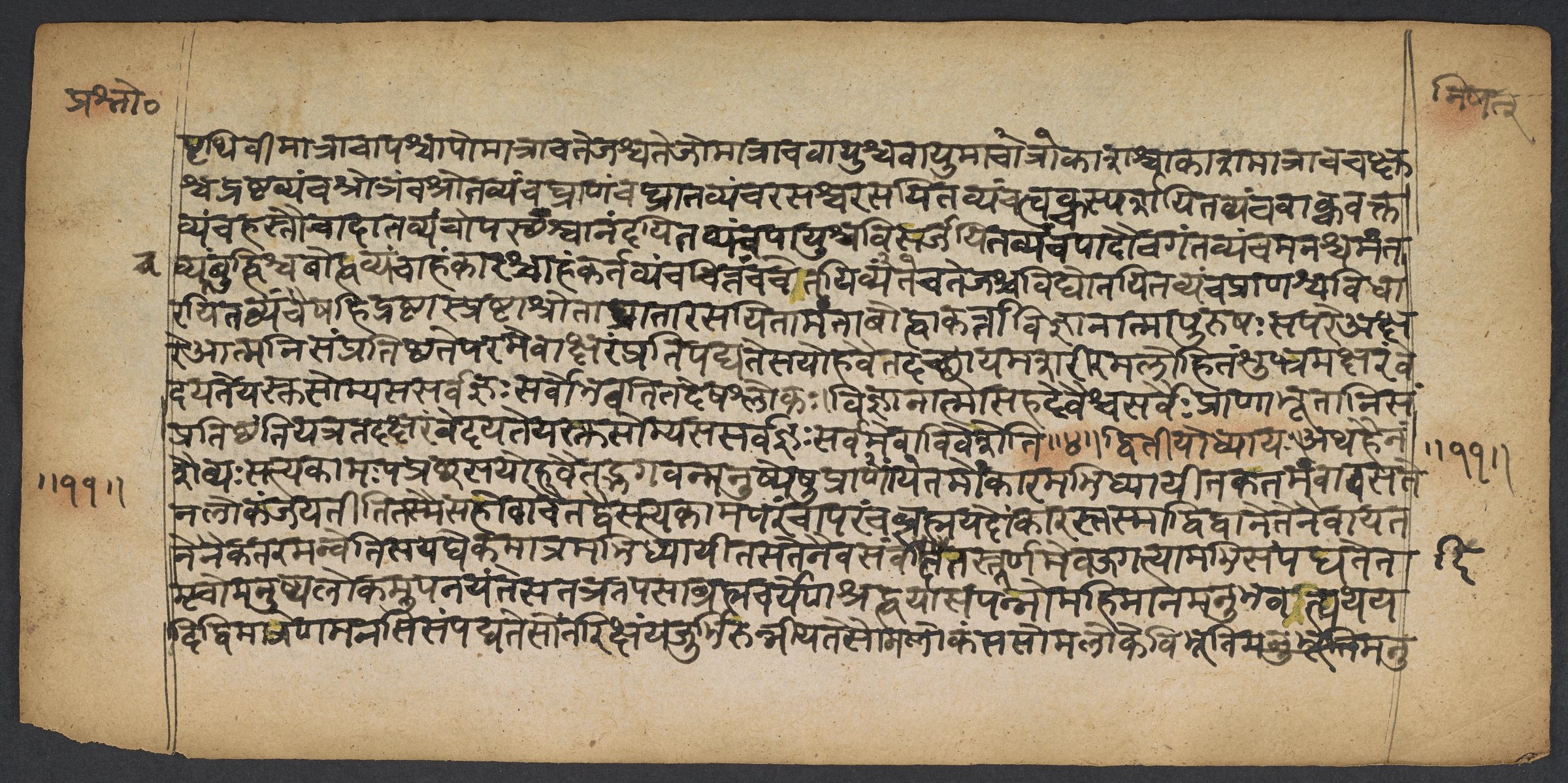
Penn Ms. Coll. 390 Item 869, fol. 11v. fol. 11v line 8: paragraph 1 begins ‹atha hainaṃ śaibyaḥ satyakāmaḥ›; paragraph 3 ends in line 12 ‹mahimānam anubhavati›. Checked on the image; readings logged in data/sources/upanishads/mapping_notes_869.txt.
1atha hainaṃ śaibyaḥ satyakāmaḥ papraccha |
sa yo ha vai tad bhagavan manuṣyeṣu prāyaṇāntam oṃkāram abhidhyāyīta |
katamaṃ vāva sa tena lokaṃ jayatīti ||
2tasmai sa hovāca |
etad vai satyakāma paraṃ cāparaṃ ca brahma yad oṃkāraḥ |
tasmād vidvān etenaivāyatanenaikataram anveti ||
3sa yady ekamātram abhidhyāyīta |
sa tenaiva saṃveditas tūrṇam eva jagatyām abhisampadyate |
tam ṛco manuṣyalokam upanayante |
sa tatra tapasā brahmacaryeṇa śraddhayā sampanno mahimānam anubhavati ||
1Then Saivya Satyakâma asked him: "Sir, if some one among men should meditate here until death on the syllable Om, what would he obtain by it?"
2He replied: "O Satyakâma, the syllable Om (AUM) is the highest and also the other Brahman; therefore he who knows it arrives by the same means at one of the two.
3If he meditate on one Mâtrâ (the A), then, being enlightened by that only, he arrives quickly at the earth. The Rik-verses lead him to the world of men, and being endowed there with penance, abstinence, and faith, he enjoys greatness.
Where on the image
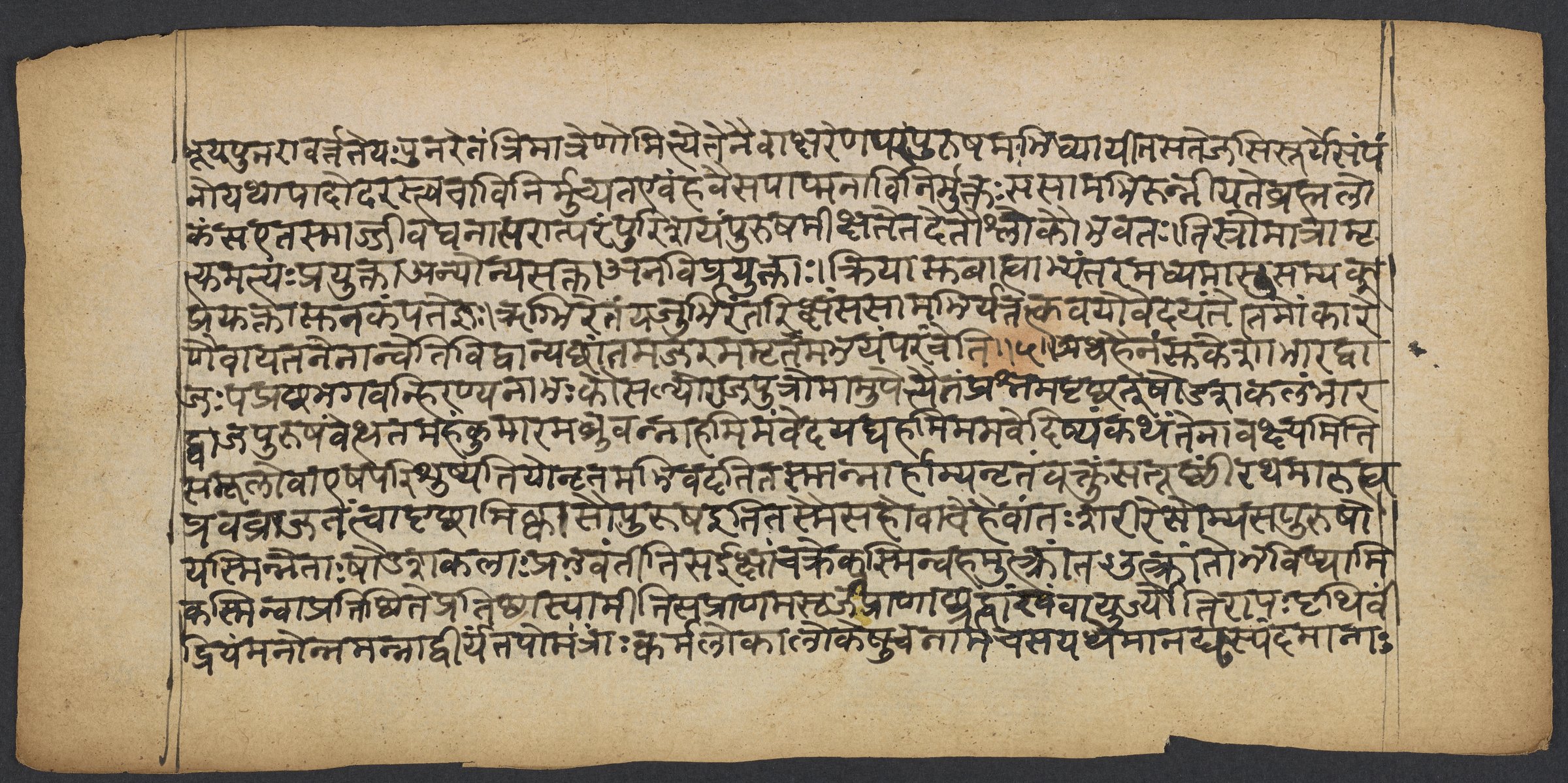
Penn Ms. Coll. 390 Item 869, fol. 11v, fol. 12r. Paragraph 4 begins at the end of fol. 11v line 12 ‹atha yadi dvimātreṇa› and ends at fol. 12r line 1 ‹punar āvartate›; paragraphs 5-7 follow to line 6 ‹abhayaṃ paraṃ ceti›, marked ‹||5||›. Checked on the image; readings logged in data/sources/upanishads/mapping_notes_869.txt.
4atha yadi dvimātreṇa manasi saṃpadyate |
so 'ntarīkṣaṃ yajurbhir unnīyate somalokam |
sa somaloke vibhūtim anubhūya punar āvartate ||
5yaḥ punar etaṃ trimātreṇomity etenaivākṣareṇa paraṃ puruṣam abhidhyāyīta |
sa tejasi sūrye saṃpannaḥ |
yathā pādodaras tvacā vinirmucyate |
evaṃ ha vai sa pāpmanā vinirmuktaḥ sa sāmabhir unnīyate brahmalokam |
sa etasmāj jīvadhanāt parāparaṃ puriśayaṃ puruṣam īkṣate tad etau ślokau bhavataḥ ||
6tisro mātrā mṛtyumatyaḥ prayuktā anyonyasaktā anaviprayuktāḥ /
kriyāsu bāhyābhyantaramadhyamāsu samyakprayuktāsu na kampate jñaḥ //
7ṛgbhir etaṃ yajurbhir antarikṣaṃ sāmabhir yat tat kavayo vedayante /
tam oṃkāreṇaivāyatanenānveti vidvān yat tac chāntam ajaram amṛtam abhayaṃ paraṃ ceti //
4If he meditate with two Mâtrâs (A+U) he arrives at the Manas, and is led up by the Yagus-verses to the sky, to the Soma-world. Having enjoyed greatness in the Soma-world, he returns again.
5Again, he who meditates with this syllable AUM of three Mâtrâs, on the Highest Person, he comes to light and to the sun. And as a snake is freed from its skin, so is he freed from evil. He is led up by the Sâman-verses to the Brahma-world; and from him, full of life (Hiranyagarbha, the lord of the Satya-loka), he learns to see the all-pervading, the Highest Person. And there are these two Slokas:
6The three Mâtrâs (A+U+M), if employed separate, and only joined one to another, are mortal; but in acts, external, internal, or intermediate, if well performed, the sage trembles not.
7Through the Rik-verses he arrives at this world, through the Yagus-verses at the sky, through the Sâman-verses at that which the poets teach,— he arrives at this by means of the Onkâra; the wise arrives at that which is at rest, free from decay, from death, from fear,— the Highest."
Notes
- Sanskrit: GRETIL, Prasnopanisad with the commentary ascribed to Samkara, mula text only; input by the Sansknet project. Paragraph numbers follow the edition; the manuscript has none.
- Prasna 2.9: the GRETIL file (TEI and legacy mula file alike) prints Samkara's paraphrase in place of this verse, so its Sanskrit is left out and marked [...]; the verse itself can be read on fol. 10r lines 7-8 of the manuscript.
- English: F. Max Müller, 'Prasña-upanishad', The Upanishads part II, Sacred Books of the East 15 (1884), from the proofread English Wikisource transcription. Footnotes are not reproduced.
Cite
Sources
- Source: Penn Ms. Coll. 390 Item 869 (OPenn, public domain) + GRETIL Sanskrit + F. Max Müller (1884) English (holding institution)
- Critical edition: GRETIL Sanskrit e-texts (Isa, Katha, Prasna, Mandukya, Aitareya, Taittiriya, Svetasvatara, Chandogya); Nirnaya Sagar edition of 1925, transcribed (Kena, Mundaka)
← previous · → next · v cycle view · l back to library