Prasna Upanishad, Question 6
Introduction
The Prasna ('Question') Upanishad belongs to the Atharvaveda (Paippalada school). Six students come to the sage Pippalada, and after a year of discipline each asks one question: on the origin of creatures, the powers that sustain the body, the breath, sleep and dreaming, meditation on the syllable Om, and the person of sixteen parts. This entry gives question 6, asked by Sukesas Bharadvaja.
The page images come from a single paper manuscript in the University of Pennsylvania Libraries, Ms. Coll. 390 Item 869, catalogued as 'Six early upanisads'. It has 16 leaves (13 x 27 cm) written in Devanagari, 11 to 13 lines to a side, and is undated (the library assigns it to the 18th or 19th century). It contains the Isa, Kena, Katha, Prasna, Mundaka and Mandukya Upanisads in that order; its title page names a set of ten. Leaves are numbered in the right margin of each verso and carry abbreviated titles in the upper left margin.
The Prasna runs from fol. 8v to fol. 12v. The scribe numbers the end of each question (||1|| to ||6||) and groups the questions in pairs as three adhyayas. Each section below holds the paragraphs that end on one page; a paragraph that begins on the previous page is shown with both pages.
How was this verified? (Provenance)
Where on the image
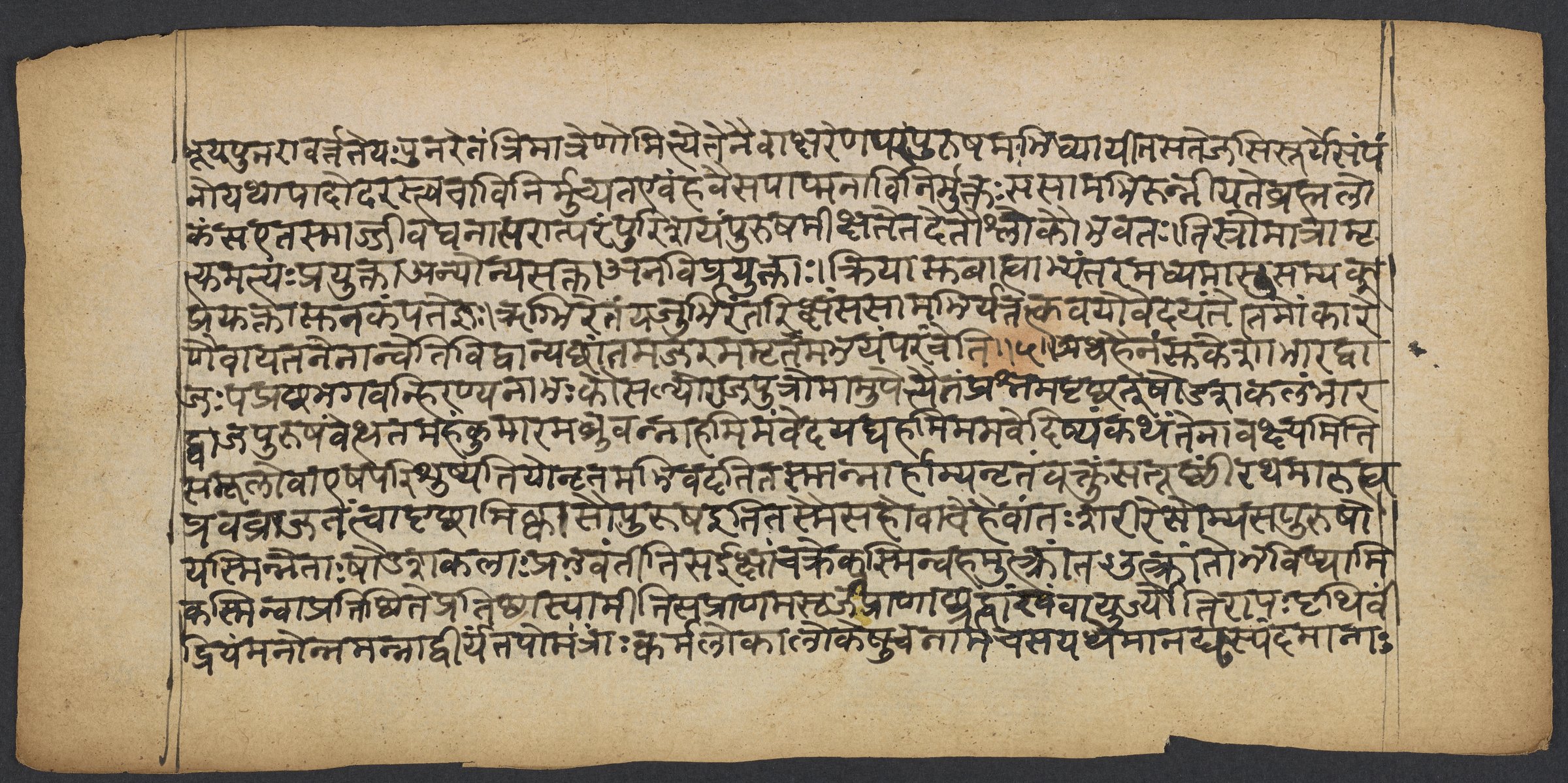
Penn Ms. Coll. 390 Item 869, fol. 12r. fol. 12r line 6: paragraph 1 begins ‹atha hainaṃ sukeśā bhāradvājaḥ›; paragraph 4 ends in line 13 ‹lokeṣu ca nāma ca›. Checked on the image; readings logged in data/sources/upanishads/mapping_notes_869.txt.
1atha hainaṃ sukeśā bhāradvājaḥ papraccha |
bhagavan hiraṇyanābhaḥ kausalyo rājaputro māmupetyaitaṃ praśnamapṛcchata |
ṣoḍaśakalaṃ bhāradvāja puruṣaṃ vettha |
tam ahaṃ kumāram abruvaṃ nāham imaṃ veda |
yady aham imam avediṣaṃ kathaṃ te nāvakṣyam iti |
samūlo vā eṣa pariśuṣyati yo 'nṛtam abhivadati |
tasmān nārhāmy anṛtaṃ vaktuṃ |
sa tūṣṇīṃ ratham āruhya pravavrāja |
taṃ tvā pṛcchāmi kāsau puruṣa iti ||
2tasmai sa hovāca |
ihaivāntaḥ śarīre somya sa puruṣo yasminn etāḥ ṣoḍaśa kalāḥ prabhavantīti ||
3sa īkṣāṃ cakre |
kasminn aham utkrānta utkrānto bhaviṣyāmi kasmin vā pratiṣṭhite pratiṣṭhāsyāmīti ||
4sa prāṇamasṛjata |
prāṇāc chadvāṃ khaṃ vāyur jyotir āpaḥ pṛthivīndriyaṃ mano 'nnam annād vīryaṃ tapo mantrāḥ karma lokā lokeṣu nāma ca ||
1Then Sukesas Bhâradvâga asked him, saying: "Sir, Hiranyanâbha, the prince of Kosalâ, came to me and asked this question: Do you know the person of sixteen parts, O Bhâradvâga? I said to the prince: I do not know him; if I knew him, how should I not tell you? Surely, he who speaks what is untrue withers away to the very root; therefore I will not say what is untrue. Then he mounted his chariot and went away silently. Now I ask you, where is that person?"
2He replied: "Friend, that person is here within the body, he in whom these sixteen parts arise.
3He reflected: What is it by whose departure I shall depart, and by whose staying I shall stay?
4He sent forth (created) Prâna (spirit); from Prâna Sraddhâ (faith), ether, air, light, water, earth, sense, mind, food; from food came vigour, penance, hymns, sacrifice, the worlds, and in the worlds the name also.
Where on the image
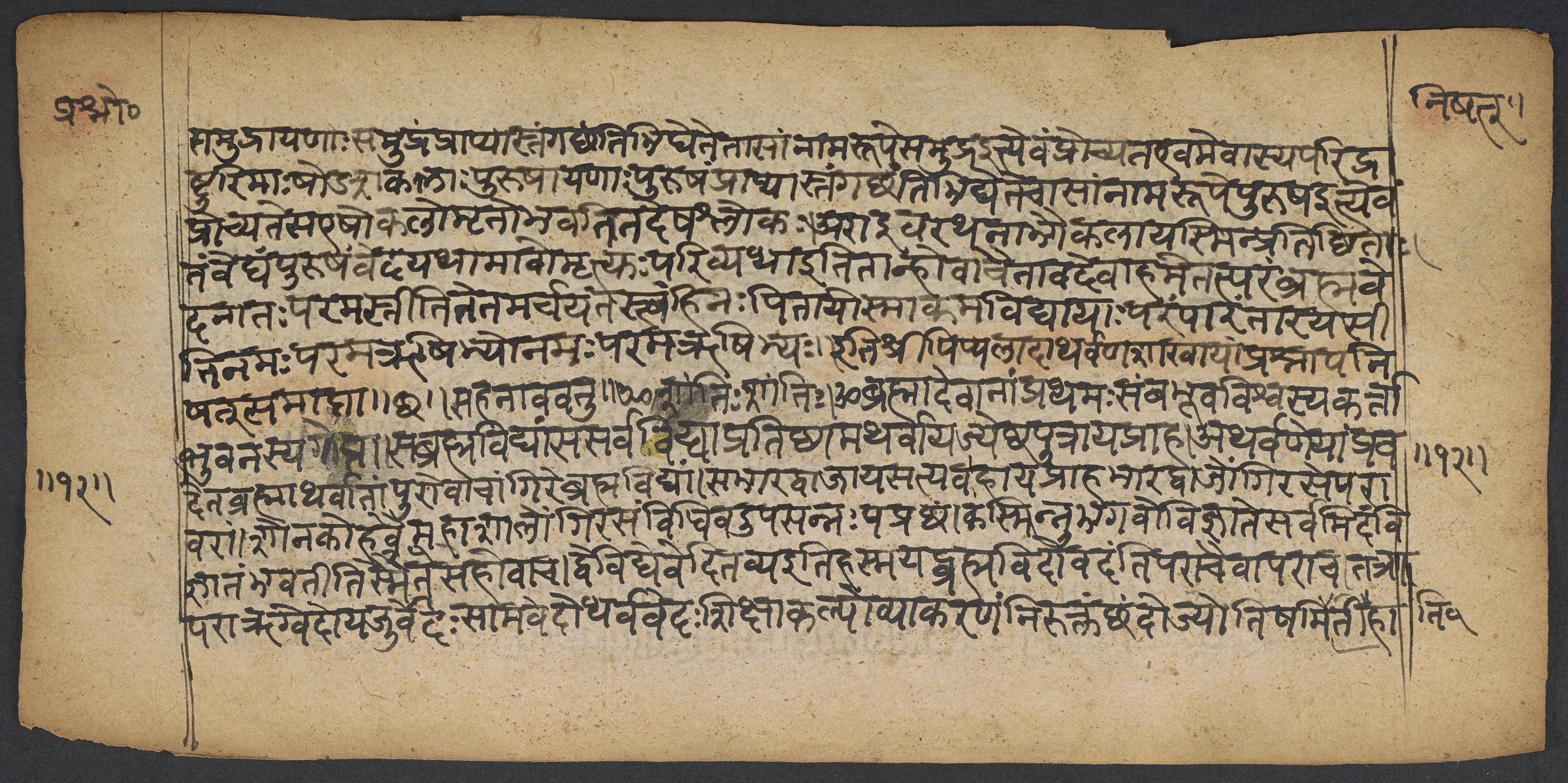
Penn Ms. Coll. 390 Item 869, fol. 12r, fol. 12v. Paragraph 5 begins at fol. 12r line 13 ‹sa yathemā nadyaḥ syandamānāḥ› and ends at fol. 12v line 3 ‹tad eṣa ślokaḥ›; paragraphs 6-8 follow to line 6 ‹namaḥ paramaṛṣibhyaḥ›, then the colophon ‹iti śrī pippalādātharvaṇaśākhāyāṃ praśnopaniṣat samāptā ||6||› (lines 6-7). Checked on the image; readings logged in data/sources/upanishads/mapping_notes_869.txt.
5sa yathemā nadyaḥ syandamānāḥ samudrāyaṇāḥ samudraṃ prāpyāstaṃ gacchanti |
bhidyete tāsāṃ nāmarūpe |
samudra ity evaṃ procyate |
evam evāsya paridraṣṭur imāḥ ṣoḍaśa kalāḥ puruṣāyaṇāḥ puruṣaṃ prāpyāstaṃ gacchanti |
bhidyete cāsāṃ nāmarūpe |
puruṣa ity evaṃ procyate |
sa eṣo 'kalo 'mṛto bhavati tadeṣa ślokaḥ ||
6arā iva rathanābhau kalā yasmin pratiṣṭhitāḥ /
taṃ vedyaṃ puruṣaṃ veda yathā mā vo mṛtyuḥ parivyathā iti //
7tān hovāca |
etāvad evāham etat paraṃ brahma veda |
nātaḥ param astīti ||
8te tam arcayantas tvaṃ hi naḥ pitā yo 'smākam avidyāyāḥ paraṃ pāraṃ tārayasīti namaḥ |
paramaṛṣibhyo namaḥ paramaṛṣibhyaḥ ||
5As these flowing rivers that go towards the ocean, when they have reached the ocean, sink into it, their name and form are broken, and people speak of the ocean only, exactly thus these sixteen parts of the spectator that go towards the person (purusha), when they have reached the person, sink into him, their name and form are broken, and people speak of the person only, and he becomes without parts and immortal. On this there is this verse:
6That person who is to be known, he in whom these parts rest, like spokes in the nave of a wheel, you know him, lest death should hurt you."
7Then he (Pippalâda) said to them: "So far do I know this Highest Brahman, there is nothing higher than it."
8And they praising him, said: "You, indeed, are our father, you who carry us from our ignorance to the other shore." Adoration to the highest Rishis! Adoration to the highest Rishis! Tat sat. Harih, Om!
Notes
- Sanskrit: GRETIL, Prasnopanisad with the commentary ascribed to Samkara, mula text only; input by the Sansknet project. Paragraph numbers follow the edition; the manuscript has none.
- Prasna 2.9: the GRETIL file (TEI and legacy mula file alike) prints Samkara's paraphrase in place of this verse, so its Sanskrit is left out and marked [...]; the verse itself can be read on fol. 10r lines 7-8 of the manuscript.
- English: F. Max Müller, 'Prasña-upanishad', The Upanishads part II, Sacred Books of the East 15 (1884), from the proofread English Wikisource transcription. Footnotes are not reproduced.
Cite
Sources
- Source: Penn Ms. Coll. 390 Item 869 (OPenn, public domain) + GRETIL Sanskrit + F. Max Müller (1884) English (holding institution)
- Critical edition: GRETIL Sanskrit e-texts (Isa, Katha, Prasna, Mandukya, Aitareya, Taittiriya, Svetasvatara, Chandogya); Nirnaya Sagar edition of 1925, transcribed (Kena, Mundaka)
← previous · → next · v cycle view · l back to library