Taittiriya Upanishad, Brahmananda Valli (on bliss)
Introduction
The Taittiriya Upanishad belongs to the Taittiriya school of the Black Yajurveda, where it forms chapters 7-9 of the Taittiriya Aranyaka. It has three chapters (vallīs), each divided into lessons (anuvākas).
The second vallī, on bliss (ānanda), describes the Self in five sheaths, one inside the other: the self made of food, of breath, of mind, of understanding and of bliss. It contains the account of creation from the Self (ether, air, fire, water, earth) and a scale of bliss rising by hundreds from the human to the bliss of Brahman.
The page images come from University of Pennsylvania Libraries, Ms. Coll. 390 Item 868, a paper manuscript of ten leaves (13 x 28 cm) in Devanagari, 10 to 12 lines to a side, with red accent marks and double red margin lines, undated (catalogued 18th or 19th century). The scribe closes each anuvāka with its number and a short summary line naming its first words and its number of sentences, so every anuvāka could be found on the pages; each section below is one anuvāka, shown with the page or pages that carry it.
How was this verified? (Provenance)
Where on the image
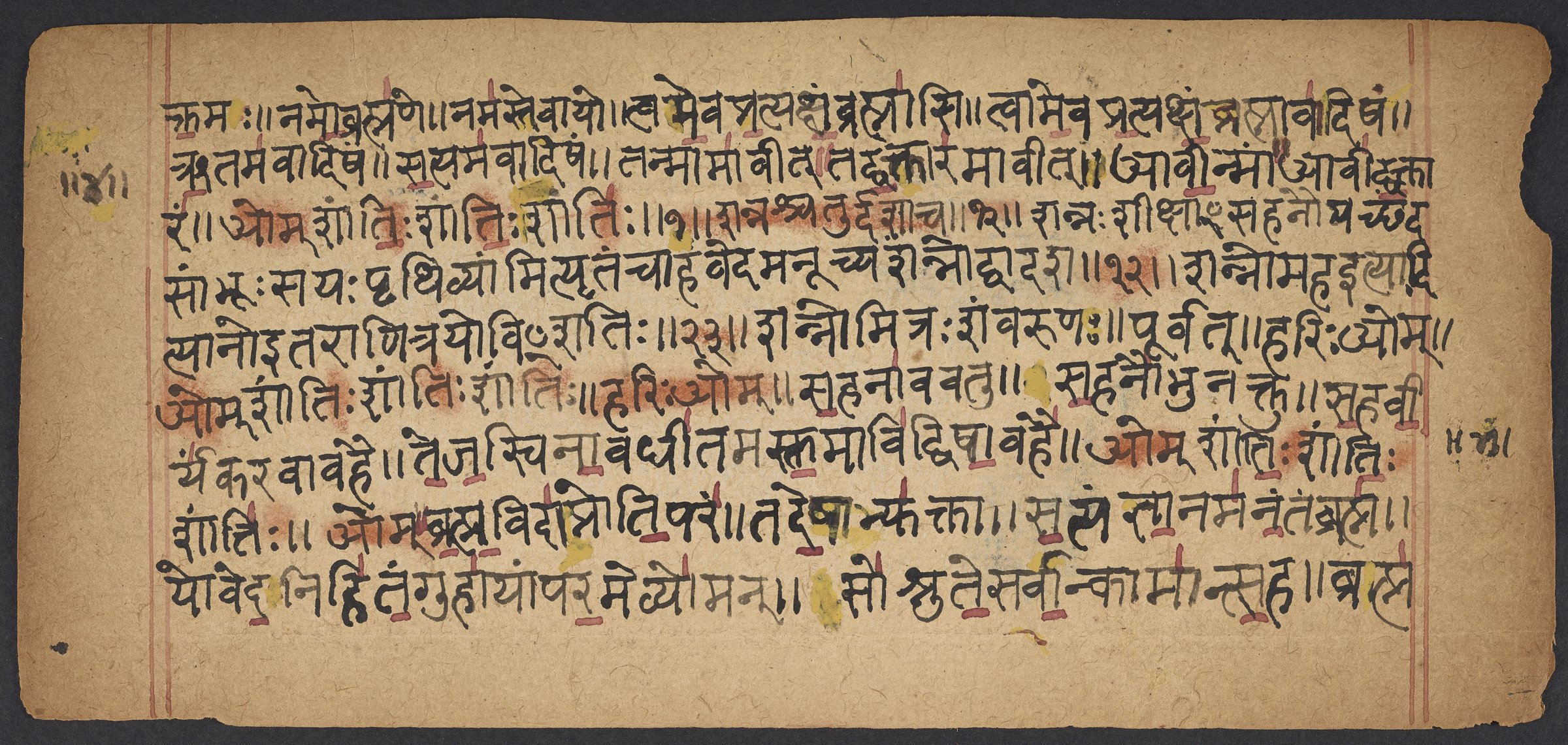
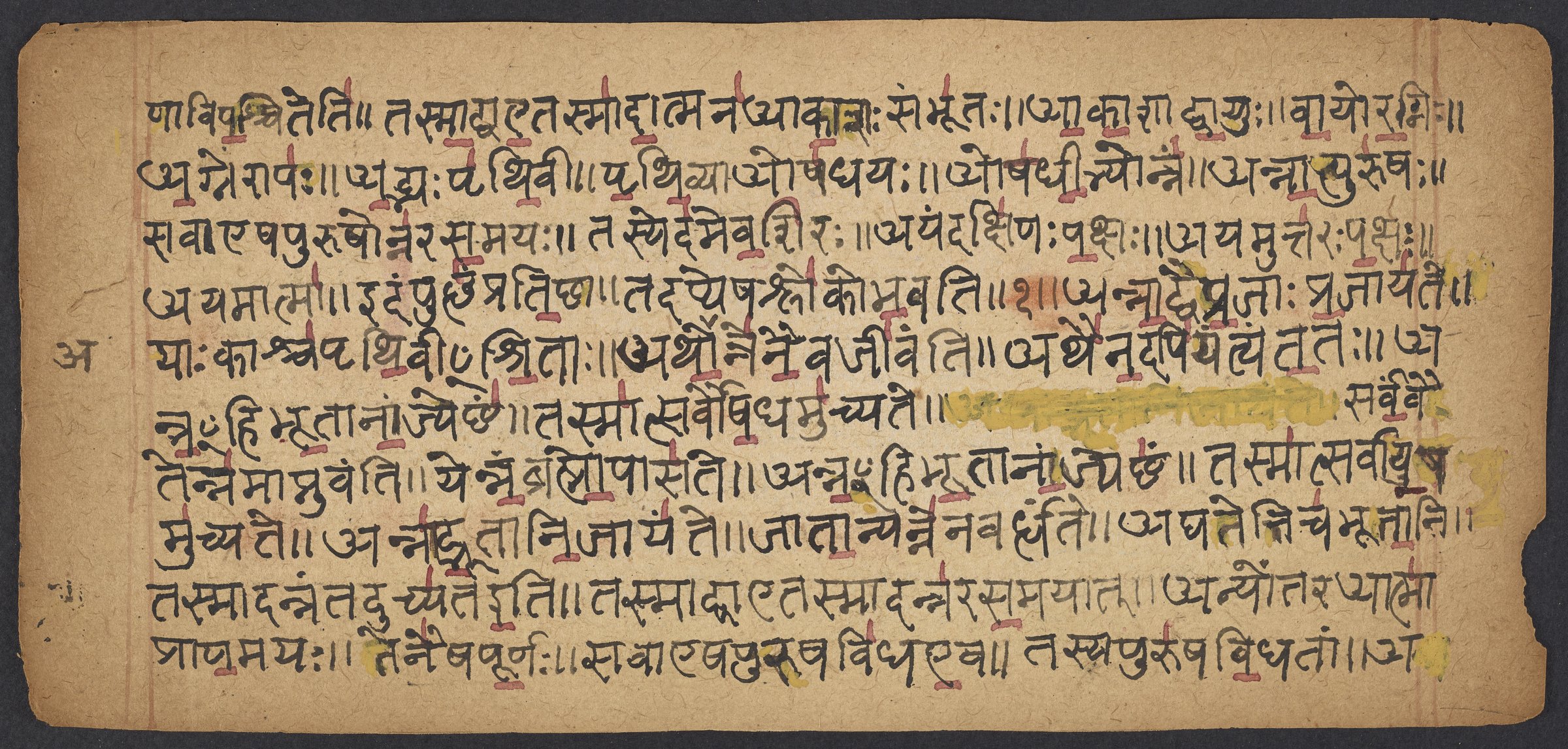
Penn Ms. Coll. 390 Item 868, fol. 4v, fol. 5r. on fol. 4v, after the invocation ‹hariḥ om || saha nāv avatu ... oṃ śāntiḥ śāntiḥ śāntiḥ›, the vallī begins ‹om brahmavid āpnoti param || tad eṣābhyuktā›; fol. 4v ends ‹so 'śnute sarvān kāmān saha || brahma-›; fol. 5r begins ‹-ṇā vipaściteti || tasmād vā etasmād ātmana ākāśaḥ saṃbhūtaḥ›; the anuvāka ends on fol. 5r ‹idaṃ pucchaṃ pratiṣṭhā || tad apy eṣa śloko bhavati ||1||›. The invocation on this page (‹saha nāv avatu›) is not in the Sanskrit text used and its English is not shown. Checked on the image; readings logged in data/sources/upanishads/mapping_notes_868.txt.
1oṃ brahmavidāpnoti param / tadeṣābhuktā / satyaṃ jñānamanantaṃ brahma / yo veda nihitaṃ guhāyāṃ parame vyoman / so 'śnute sarvān kāmān saha / brahmaṇā vipaściteti / tasmādvā etasmādātmana ākāśaḥ saṃbhūtaḥ / ākāśādvāyuḥ / vāyoragniḥ / agnerāpaḥ / adabhyaḥ pṛthivī / pṛthivyā oṣadhayaḥ / oṣadhībhyonnam / annātpuruṣaḥ / sa vā eṣa puruṣo 'nnnarasamayaḥ / tasyedameva śiraḥ / ayaṃ dakṣiṇaḥ pakṣaḥ / ayamuttaraḥ pakṣaḥ / ayamātmā / idaṃ pucchaṃ pratiṣṭhā / tadapyeṣa śloko bhavati //
He who knows the Brahman attains the highest (Brahman). On this the following verse is recorded:
'He who knows Brahman, which is (i.e. cause, not effect), which is conscious, which is without end, as hidden in the depth (of the heart), in the highest ether, he enjoys all blessings, at one with the omniscient Brahman.'
From that Self (Brahman) sprang ether (âkâsa, that through which we hear); from ether air (that through which we hear and feel); from air fire (that through which we hear, feel, and see); from fire water (that through which we hear, feel, see, and taste); from water earth (that through which we hear, feel, see, taste, and smell). From earth herbs, from herbs food, from food seed, from seed man. Man thus consists of the essence of food. This is his head, this his right arm, this his left arm, this his trunk (âtman), this the seat (the support).
On this there is also the following Sloka:
Where on the image
Penn Ms. Coll. 390 Item 868, fol. 5r, fol. 5v. begins fol. 5r ‹annād vai prajāḥ prajāyante›; fol. 5r ends ‹sa vā eṣa puruṣavidha eva || tasya puruṣavidhatām || a-›; fol. 5v begins ‹-nvayaṃ puruṣavidhaḥ || tasya prāṇa eva śiraḥ›; the anuvāka ends on fol. 5v ‹pṛthivī pucchaṃ pratiṣṭhā || tad apy eṣa śloko bhavati ||2||›. Checked on the image; readings logged in data/sources/upanishads/mapping_notes_868.txt.
1annādvai prajāḥ prajāyante / yāḥ kāśca pṛthivīṃśritāḥ / atho annenaiva jīvanti / athainadapi yantyantataḥ / annaṃ hi bhūtānāṃ jyeṣṭham / tasmāt sarvauṣadhamucyate / sarvaṃ vai te 'nnamāpnuvanti / ye 'nnaṃ brahmopāsate / annaṃ hi bhūtānāṃ jyeṣṭham / tasmāt sarvauṣadhamucyate / annādbhūtāni jāyante / jātānyannena vardhante / adyate 'tti ca bhūtāni / tasmādannaṃ taducyata iti / tasmādvā etasmādannarasamayāt / anyo 'ntara ātmā prāṇamayaḥ / tenaiṣa pūrṇaḥ / sa vā eṣa puruṣavidha eva / tasya puruṣavidhatām / anvayaṃ puruṣavidhaḥ / tasya prāṇa eva śiraḥ / vyāno dakṣiṇaḥ pakṣaḥ / apāna uttaraḥ pakṣaḥ / ākāśa ātmā / pṛthivī pucchaṃ pratiṣṭhā / tadapyeṣa śloko bhavati //
'From food are produced all creatures which dwell on earth. Then they live by food, and in the end they return to food. For food is the oldest of all beings, and therefore it is called panacea (sarvaushadha, i.e. consisting of all herbs, or quieting the heat of the body of all beings).'
They who worship food as Brahman, obtain all food. For food is the oldest of all beings, and therefore it is called panacea. From food all creatures are produced; by food, when born, they grow. Because it is fed on, or because it feeds on beings, therefore it is called food (anna).
Different from this, which consists of the essence of food, is the other, the inner Self, which consists of breath. The former is filled by this. It also has the shape of man. Like the human shape of the former is the human shape of the latter. Prâna (up-breathing) is its head. Vyâna (back-breathing) is its right arm. Apâna (down-breathing) is its left arm. Ether is its trunk. The earth the seat (the support).
On this there is also the following Sloka:
Where on the image
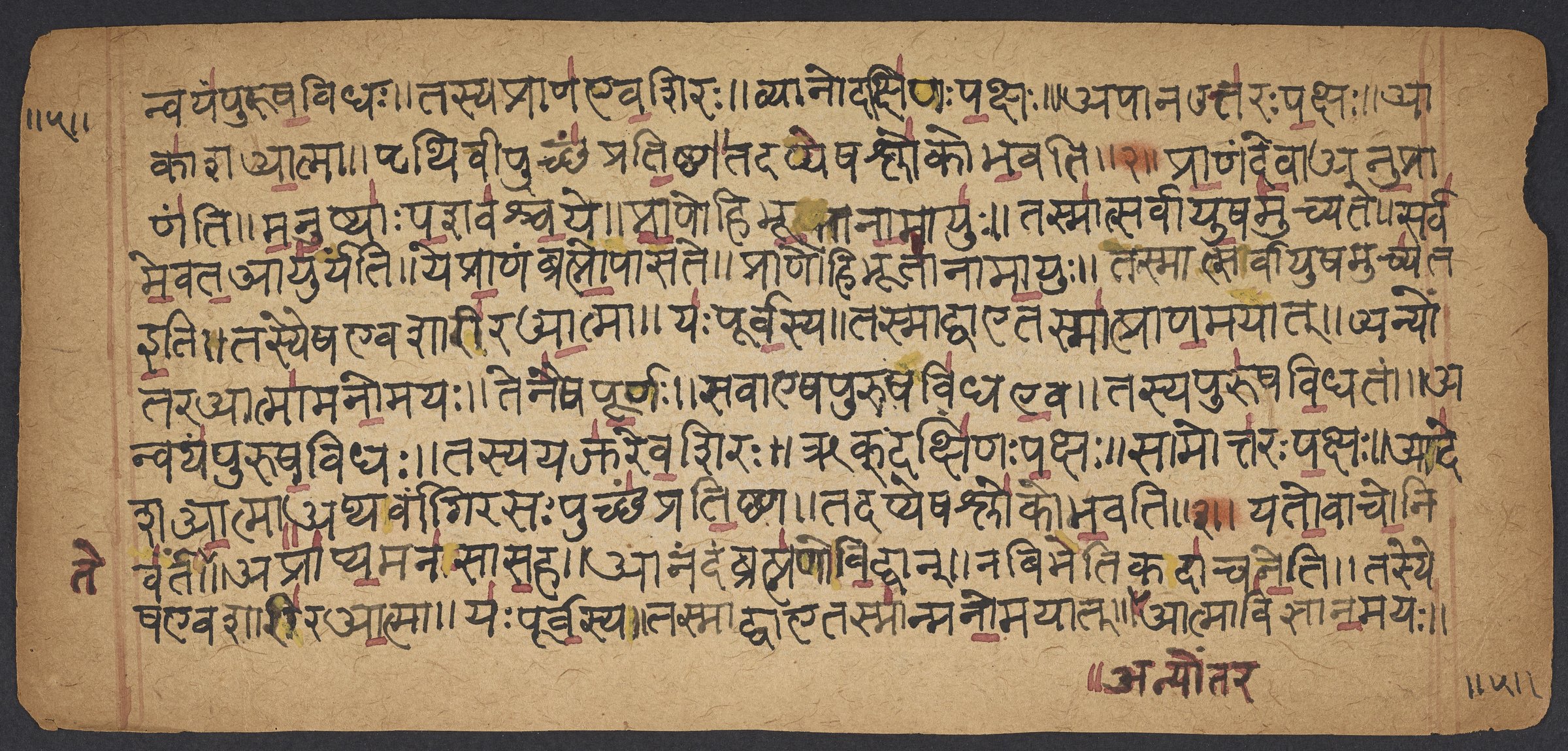
Penn Ms. Coll. 390 Item 868, fol. 5v. fol. 5v from ‹prāṇaṃ devā anu prāṇanti› to ‹atharvāṅgirasaḥ pucchaṃ pratiṣṭhā || tad apy eṣa śloko bhavati ||3||›. Checked on the image; readings logged in data/sources/upanishads/mapping_notes_868.txt.
1prāṇaṃ devā anu prāṇanti / manuṣyāḥ paśavaśca ye / prāṇo hi bhūtānāmāyuḥ / tasmāt sarvāyuṣamucyate / sarvameva ta āyuryanti / ye prāṇaṃ brahmopāsate / prāṇo hi bhūtānāmāyuḥ / tasmāt sarvāyuṣamucyata iti / tasyaiṣa eva śārīra ātmā / yaḥ pūrvasya / tasmādvā etasmāt prāṇamayāt / anyo 'ntara ātmā manomayaḥ / tenaiṣa pūrṇaḥ / sa vā eṣa puruṣavidha eva / tasya puruṣavidhatām / anvayaṃ puruṣavidhaḥ / tasya yajureva śiraḥ / ṛgdakṣiṇaḥ pakṣaḥ / sāmottaraḥ pakṣaḥ / ādeśa ātmā / atharvāṅgirasaḥ pucchaṃ pratiṣṭhā / tadapyeṣa śloko bhavati //
'The Devas breathe after breath (prâna), so do men and cattle. Breath is the life of beings, therefore it is called sarvâyusha (all-enlivening).'
They who worship breath as Brahman, obtain the full life. For breath is the life of all beings, and therefore it is called sarvâyusha. The embodied Self of this (consisting of breath) is the same as that of the former (consisting of food).
Different from this, which consists of breath, is the other, the inner Self, which consists of mind. The former is filled by this. It also has the shape of man. Like the human shape of the former is the human shape of the latter. Yagus is its head. Rik is its right arm. Sâman is its left arm. The doctrine (âdesa, i.e. the Brâhmana) is its trunk. The Atharvâṅgiras (Atharva-hymns) the seat (the support).
On this there is also the following Sloka:
Where on the image
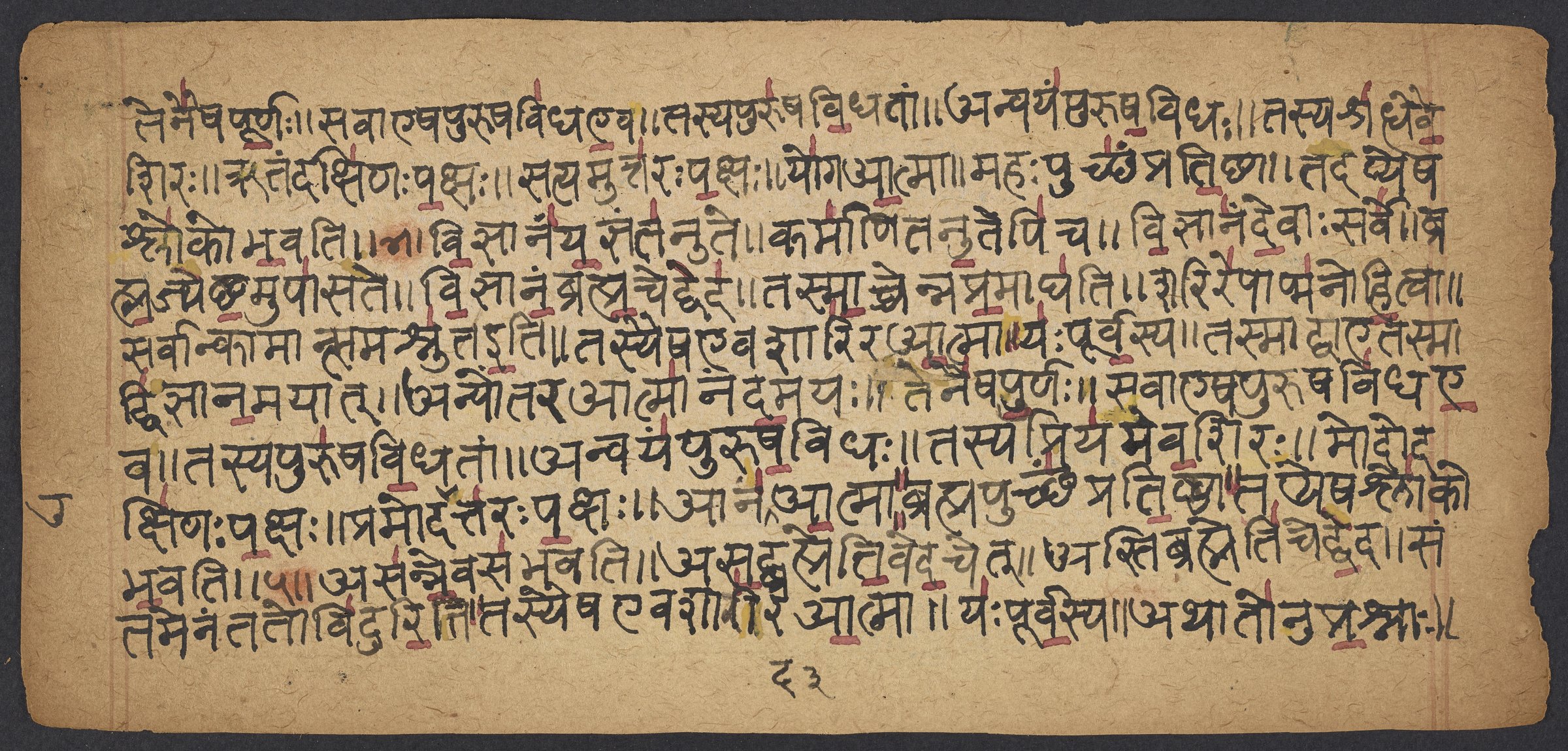
Penn Ms. Coll. 390 Item 868, fol. 5v, fol. 6r. begins fol. 5v ‹yato vāco nivartante || aprāpya manasā saha›; fol. 5v ends ‹anyo 'ntara ātmā vijñānamayaḥ›; fol. 6r begins ‹tenaiṣa pūrṇaḥ›; the anuvāka ends on fol. 6r ‹mahaḥ pucchaṃ pratiṣṭhā || tad apy eṣa śloko bhavati ||4||›. Checked on the image; readings logged in data/sources/upanishads/mapping_notes_868.txt.
1yato vāco nivartante / aprāpya manasā saha / ānandaṃ brahmaṇo vidvān / na bibheti kadācaneti / tasyaiṣa eva śārīra ātmā / yaḥ pūrvasya / tasmādvā etasmānmanomayāt / anyontara ātmā vijñānamayaḥ / tenaiṣa pūrṇaḥ / sa vā eṣa puruṣavidha eva / tasya puruṣavidhatām / anvayaṃ puruṣavidhaḥ / tasya śraddhaiva śiraḥ / ṛtaṃ dakṣiṇaḥ pakṣaḥ / satyamuttaraḥ pakṣaḥ / yoga ātmā / mahaḥ pucchaṃ pratiṣṭhā / tadapyeṣa śloko bhavati //
'He who knows the bliss of that Brahman, from whence all speech, with the mind, turns away unable to reach it, he never fears.' The embodied Self of this (consisting of mind) is the same as that of the former (consisting of breath).
Different from this, which consists of mind, is the other, the inner Self, which consists of understanding. The former is filled by this. It also has the shape of man. Like the human shape of the former is the human shape of the latter. Faith is its head. What is right is its right arm. What is true is its left arm. Absorption (yoga) is its trunk. The great (intellect?) is the seat (the support).
On this there is also the following Sloka:
Where on the image
Penn Ms. Coll. 390 Item 868, fol. 6r. fol. 6r from ‹vijñānaṃ yajñaṃ tanute› to ‹brahma pucchaṃ pratiṣṭhā || tad apy eṣa śloko bhavati ||5||›. Checked on the image; readings logged in data/sources/upanishads/mapping_notes_868.txt.
1vijñānaṃ yajñaṃ tanute / karmāṇi tanute 'pi ca / vijñānaṃ devāḥ sarve / brahma jyeṣṭhamupāsate / vijñānaṃ brahma cedveda / tasmaccenna pramādyati / śarīre pāpmano hitvā / sarvānkāmānsamaśnuta iti / tasyaiṣa eva śārīra ātmā / yaḥ pūrvasya / tasmādvā etasmādvijñānamayāt / anyo 'ntara ātmānandamayaḥ / tenaiṣa pūrṇaḥ / sa vā eṣa puruṣavidha eva / tasya puruṣavidhatām / anvayaṃ puruṣavidhaḥ / tasya priyameva śiraḥ / modo dakṣiṇaḥ pakṣaḥ / pramoda uttaraḥ pakṣaḥ / ānanda ātmā / brahma pucchaṃ pratiṣṭhā / tadapyeṣa śloko bhavati //
'Understanding performs the sacrifice, it performs all sacred acts. All Devas worship understanding as Brahman, as the oldest. If a man knows understanding as Brahman, and if he does not swerve from it, he leaves all evils behind in the body, and attains all his wishes.' The embodied Self of this (consisting of understanding) is the same as that of the former (consisting of mind).
Different from this, which consists of understanding, is the other inner Self, which consists of bliss. The former is filled by this. It also has the shape of man. Like the human shape of the former is the human shape of the latter. Joy is its head. Satisfaction its right arm. Great satisfaction is its left arm. Bliss is its trunk. Brahman is the seat (the support).
On this there is also the following Sloka:
Where on the image
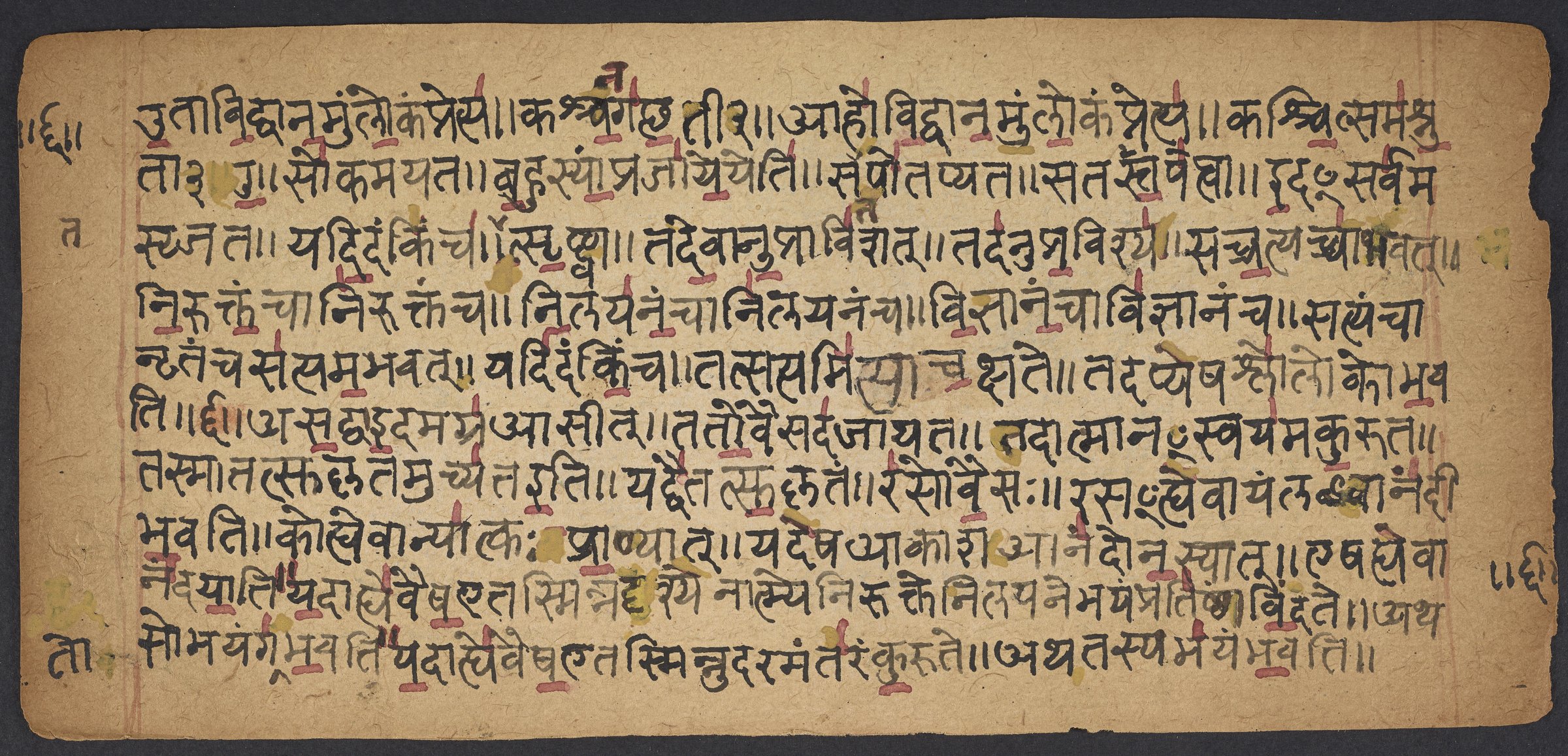
Penn Ms. Coll. 390 Item 868, fol. 6r, fol. 6v. begins in the last lines of fol. 6r ‹asann eva sa bhavati›; fol. 6r ends ‹athāto 'nupraśnāḥ›; fol. 6v begins ‹utāvidvān amuṃ lokaṃ pretya›; the anuvāka ends on fol. 6v ‹tat satyam ity ācakṣate || tad apy eṣa śloko bhavati ||6||›. Checked on the image; readings logged in data/sources/upanishads/mapping_notes_868.txt.
1asanneva sa bhavati / asadabrahmeti veda cet / asti brahmeti cedveda / santamenaṃ tato viduriti / tasyaiṣa eva śārīra ātmā / yaḥ pūrvasya / athāto 'nupraśnāḥ / utāvidvānamuṃ lokaṃ pretya / kaścana gacchatī3 āho vidvānamuṃ lokaṃ pretya kaścitsamaśnutā3u / so 'kāmayata / bahu syāṃ prajāyeyeti / sa tapo 'tapyata / sa tapastaptvā / idaṃ sarvamasṛjata / yadidaṃ kiñca / tatsṛṣṭvā / tadevānuprāviśat / tadanupraviśya / sacca tyaccābhavat / niruktaṃ cāniruktaṃ ca / nilayanaṃ cānilayanaṃ ca / vijñānaṃ cāvijñānaṃ ca / satyaṃ cānṛtaṃ ca satyamabhavat / yadidaṃ kiñca / tatsatyamityācakṣate / a tadapyeṣa śloko bhavati //
'He who knows the Brahman as non-existing, becomes himself non-existing. He who knows the Brahman as existing, him we know himself as existing.' The embodied Self of this (bliss) is the same as that of the former (understanding).
Thereupon follow the questions of the pupil: 'Does any one who knows not, after he has departed this life, ever go to that world? Or does he who knows, after he has departed, go to that world?'
The answer is: He wished, may I be many, may I grow forth. He brooded over himself (like a man performing penance). After he had thus brooded, he sent forth (created) all, whatever there is. Having sent forth, he entered into it. Having entered it, he became sat (what is manifest) and tyat (what is not manifest), defined and undefined, supported and not supported, (endowed with) knowledge and without knowledge (as stones), real and unreal. The Sattya (true) became all this whatsoever, and therefore the wise call it (the Brahman) Sat-tya (the true).
On this there is also this Sloka:
Where on the image
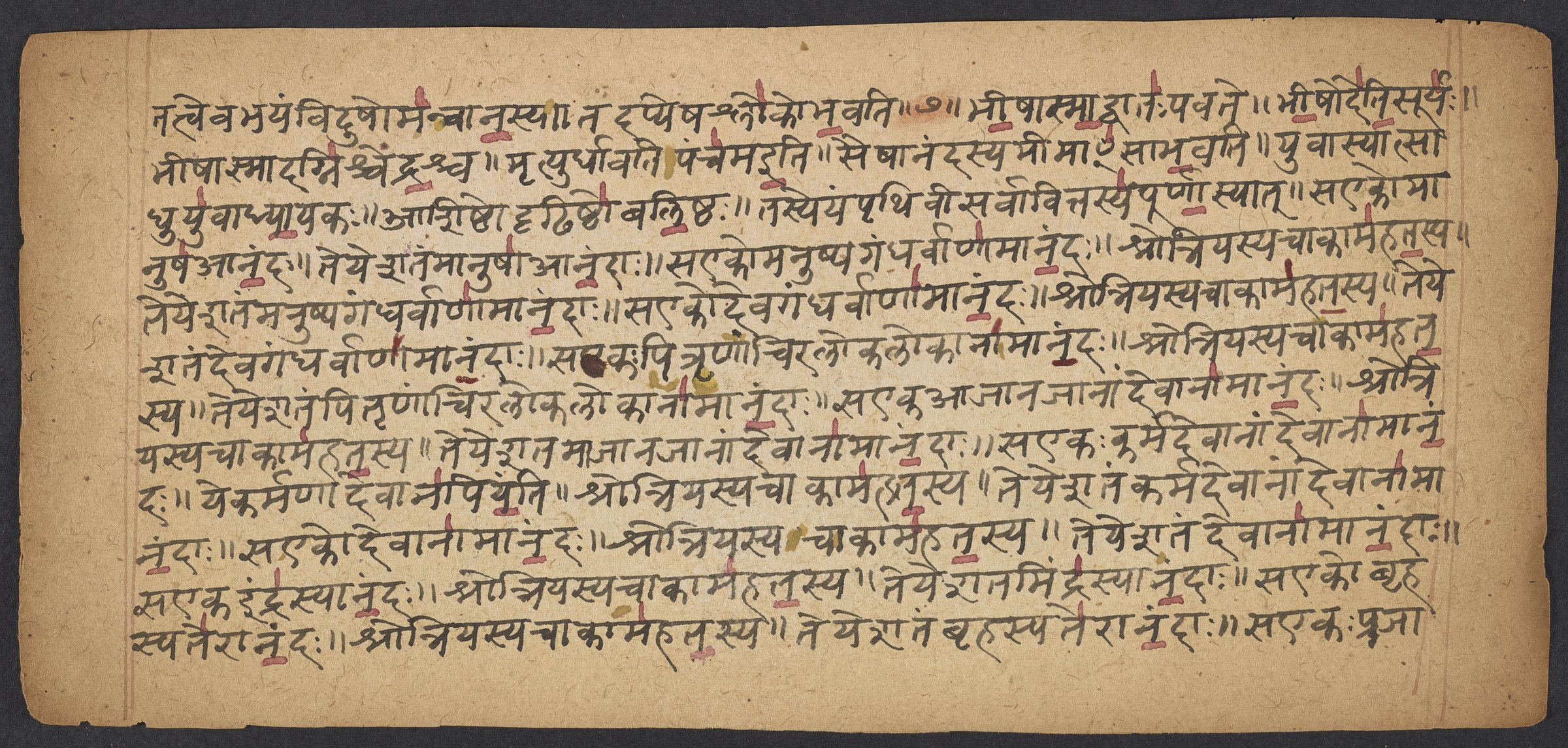
Penn Ms. Coll. 390 Item 868, fol. 6v, fol. 7r. begins fol. 6v ‹asad vā idam agra āsīt›; fol. 6v ends ‹atha tasya bhayaṃ bhavati›; the anuvāka ends in the first line of fol. 7r ‹tat tv eva bhayaṃ viduṣo 'manvānasya || tad apy eṣa śloko bhavati ||7||›. Checked on the image; readings logged in data/sources/upanishads/mapping_notes_868.txt.
1asadvā idamagra āsīt / tato vai sadajāyata / tadātmānaṃ svayamakuruta / tasmāttatsukṛtamucyata iti / yadvai tat sukṛtam / raso vai saḥ / rasaṃ hyevāyaṃ labdhvānandī bhavati / ko hyevānyātkaḥ prāṇyāt / yadeṣa ākāśa ānando na syāt / eṣa hyevānandayāti / yadā hyevaiṣa etasminnadṛśye 'nātmye 'nirukte 'nilayane 'bhayaṃ pratiṣṭhāṃ vindate / atha so 'bhayaṃ gato bhavati / yadā hyevaiṣa etasminnudaramantaraṃ kurute / atha tasya bhayaṃ bhavati / tatveva bhayaṃ viduṣo 'manvānasya / tadapyeṣa śloko bhavati //
'In the beginning this was non-existent (not yet defined by form and name). From it was born what exists. That made itself its Self, therefore it is called the Self-made.' That which is Self-made is a flavour (can be tasted), for only after perceiving a flavour can any one perceive pleasure. Who could breathe, who could breathe forth, if that bliss (Brahman) existed not in the ether (in the heart)? For he alone causes blessedness.
When he finds freedom from fear and rest in that which is invisible, incorporeal, undefined, unsupported, then he has obtained the fearless. For if he makes but the smallest distinction in it, there is fear for him. But that fear exists only for one who thinks himself wise, (not for the true sage.)
On this there is also this Sloka:
Where on the image
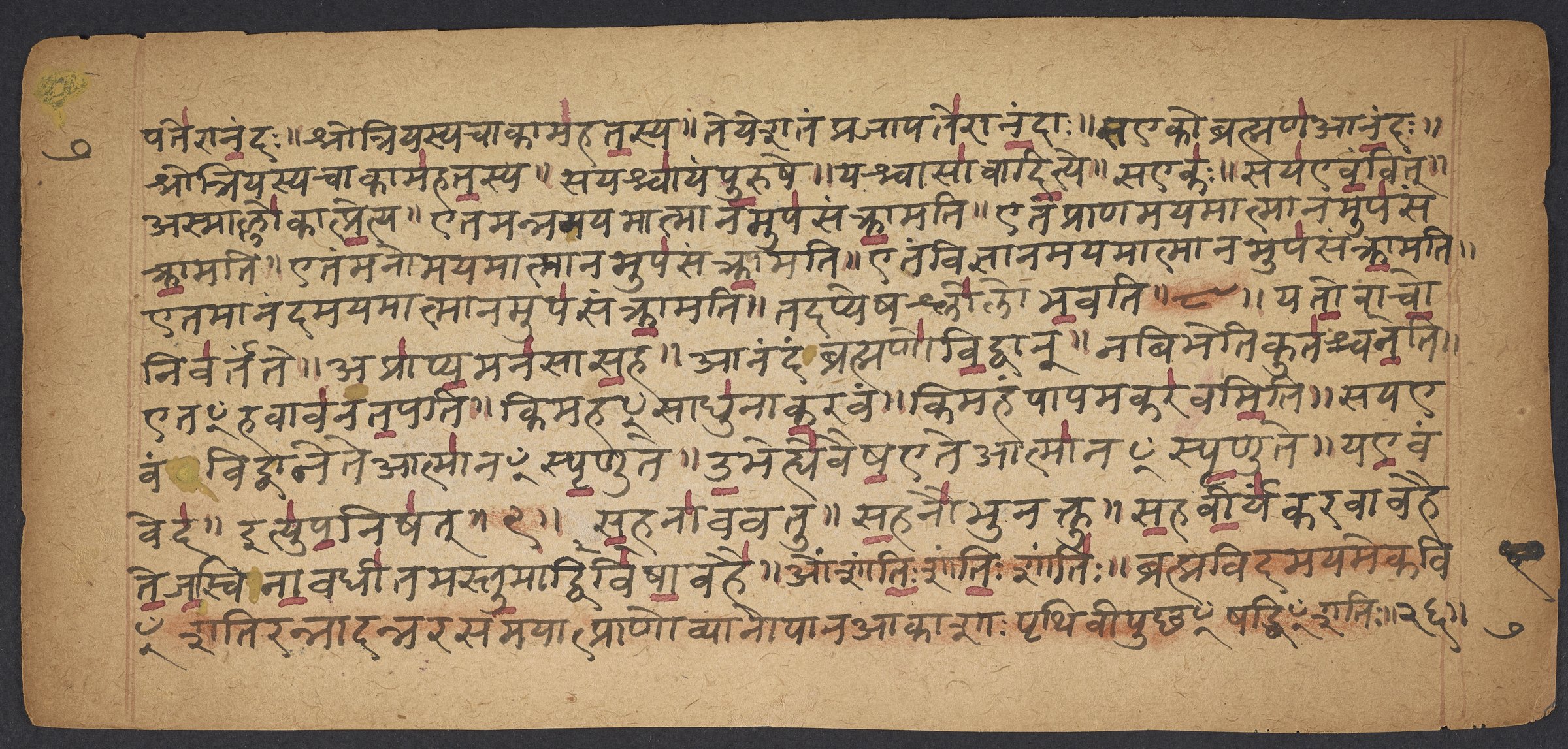
Penn Ms. Coll. 390 Item 868, fol. 7r, fol. 7v. begins in the first line of fol. 7r ‹bhīṣāsmād vātaḥ pavate›; fol. 7r ends ‹sa ekaḥ prajā-›; fol. 7v begins ‹-pater ānandaḥ || śrotriyasya cākāmahatasya›; the anuvāka ends on fol. 7v ‹etam ānandamayam ātmānam upasaṃkrāmati || tad apy eṣa śloko bhavati ||8||›. Checked on the image; readings logged in data/sources/upanishads/mapping_notes_868.txt.
1bhīṣāsmādvātaḥ pavate / bhīṣodeti sūryaḥ / bhīṣāsmādagniścendraśca / mṛtyurdhāvati pañcama iti / saiṣānandasya mīmāṃsā bhavati / yuvā syātsādhuyuvādhyāyakaḥ / āśiṣṭho dṛḍhiṣṭho baliṣṭhaḥ / tasyeyaṃ pṛthivī sarvā vittasya pūrṇā syāt / sa eko mānuṣa ānandaḥ / te ye śataṃ mānuṣā ānandāḥ //
2sa eko manuṣyagandharvāṇāmānandaḥ / śrotriyasya cākāmahatasya / te ye śataṃ manuṣyagandharvāṇāmānandāḥ / sa eko devagandharvāṇāmānandaḥ / śrotriyasya cākāmahatasya / te ye śataṃ devagandharvāṇāmānandāḥ / sa ekaḥ pitṝṇāṃ ciralokalokānāmānandaḥ / śrotriyasya cākāmahatasya / te ye śataṃ pitṝṇāṃ ciralokalokānāmānandāḥ / sa eka ājānajānāṃ devānāmānandaḥ //
3śrotriyasya cākāmahatasya / te ye śatam ājānajānāṃ devānāmānandāḥ / sa ekaḥ karmadevānāṃ devānāmānandaḥ / ye karmaṇā devānapiyanti / śrotriyasya cākāmahatasya / te ye śataṃ karmadevānāṃ devānāmānandāḥ / sa eko devānāmānandaḥ / śrotriyasya cākāmahatasya / te ye śataṃ devānāmānandāḥ / sa eka indrasyānandaḥ //
4śrotriyasya cākāmahatasya / te ye śatamindrasyānandāḥ / sa eko bṛhaspaterānandaḥ / śrotriyasya cākāmahatasya / te ye śataṃ bṛhaspaterānandāḥ / sa ekaḥ prajāpaterānandaḥ / śrotriyasya cākāmahatasya / te ye śataṃ prajāpaterānandāḥ / sa eko brahmaṇa ānandaḥ / śrotriyasya cākāmahatasya //
5sa yaścāyaṃ puruṣe / yaścāsāvāditye / sa ekaḥ / sa ya evaṃvit / asmāllokātpretya / etamannamayamātmānamupasaṅkrāmati / etaṃ prāṇamayamātmānamupasaṅkrāmati / etaṃ manomayamātmānamupasaṅkrāmati / etaṃ vijñānamayamātmānamupasaṅkrāmati / etamānandamayamātmānamupasaṅkrāmati / tadapyeṣa śloko bhavati //
(1) 'From terror of it (Brahman) the wind blows, from terror the sun rises; from terror of it Agni and Indra, yea Death runs as the fifth.'
Now this is an examination of (what is meant by) Bliss (ânanda):
Let there be a noble young man, who is well read (in the Veda), very swift, firm, and strong, and let the whole world be full of wealth for him, that is one measure of human bliss.
One hundred times that human bliss (2) is one measure of the bliss of human Gandharvas (genii), and likewise of a great sage (learned in the Vedas) who is free from desires.
One hundred times that bliss of human Gandharvas is one measure of the bliss of divine Gandharvas (genii), and likewise of a great sage who is free from desires.
One hundred times that bliss of divine Gandharvas is one measure of the bliss of the Fathers, enjoying their long estate, and likewise of a great sage who is free from desires.
One hundred times that bliss of the Fathers is one measure of the bliss of the Devas, born in the Âgâna heaven (through the merit of their lawful works), (3) and likewise of a great sage who is free from desires.
One hundred times that bliss of the Devas born in the Âgâna heaven is one measure of the bliss of the sacrificial Devas, who go to the Devas by means of their Vaidik sacrifices, and likewise of a great sage who is free from desires.
One hundred times that bliss of the sacrificial Devas is one measure of the bliss of the (thirty-three) Devas, and likewise of a great sage who is free from desires.
One hundred times that bliss of the (thirty-three) Devas is one measure of the bliss of Indra, (4) and likewise of a great sage who is free from desires.
One hundred times that bliss of Indra is one measure of the bliss of Brihaspati, and likewise of a great sage who is free from desires.
One hundred times that bliss of Brihaspati is one measure of the bliss of Pragâpati, and likewise of a great sage who is free from desires.
One hundred times that bliss of Pragâpati is one measure of the bliss of Brahman, and likewise of a great sage who is free from desires.
(5) He who is this (Brahman) in man, and he who is that (Brahman) in the sun, both are one.
He who knows this, when he has departed this world, reaches and comprehends the Self which consists of food, the Self which consists of breath, the Self which consists of mind, the Self which consists of understanding, the Self which consists of bliss.
On this there is also this Sloka:
Where on the image
Penn Ms. Coll. 390 Item 868, fol. 7v. fol. 7v from ‹yato vāco nivartante› to ‹ya evaṃ veda || ity upaniṣat ||9||›, followed by the invocation ‹saha nāv avatu ...› and the summary of the vallī. Checked on the image; readings logged in data/sources/upanishads/mapping_notes_868.txt.
1yato vāco nivartante / aprāpya manasā saha / ānandaṃ brahmaṇo vidvān / na bibheti kutaścaneti / etaṃ ha vāva na tapati / kimahaṃ sādhu nākaravam / kimahaṃ pāpamakaravamiti / sa ya evaṃ vidvānete ātmānaṃ spṛṇute / ubhe hyevaiṣa ete ātmānaṃ spṛṇute / ya evaṃ veda / ityupaniṣat //
'He who knows the bliss of that Brahman, from whence all speech, with the mind, turns away unable to reach it, he fears nothing.'
He does not distress himself with the thought, Why did I not do what is good? Why did I do what is bad? He who thus knows these two (good and bad), frees himself. He who knows both, frees himself. This is the Upanishad.
Notes
- Sanskrit: GRETIL, Taittirīya-Upaniṣad with Śaṃkarabhāṣya (data entry Ivan Andrijanić, after Ten Principal Upaniṣads with Śaṅkarabhāṣya, Motilal Banarsidass 1964), the text of the Upanishad only, paragraph numbers vallī.anuvāka.paragraph. The edition's closing words for anuvākas 1 and 2 of the first vallī ('iti ... 'nuvākaḥ') are left out. The Sanskrit shown is the edition text, not a transcription of the manuscript; the manuscript's summary lines and invocations are not shown.
- English: F. Max Müller, 'Taittirîyaka-upanishad', The Upanishads part II, Sacred Books of the East 15 (1884), pp. 45-69. No proofread transcription exists online, so the text was transcribed for this collection from the page images of the archive.org copy p2upanishads00mluoft and checked word by word against the OCR of that copy; every difference was looked up on the page images (data/sources/upanishads/english/muller1884_taittiriya.txt). Footnotes are not reproduced. Müller's parenthesized numbers such as '(1-5)' count the short sentences of the anuvāka and are kept as printed.
- Müller prints an invocation ('Harih, Om! May it (the Brahman) protect us both ...') before the first anuvāka of this vallī and does not count it as an anuvāka. The Sanskrit text used does not include it, so it is not shown; the manuscript has it before the vallī.
Cite
Sources
- Source: Penn Ms. Coll. 390 Item 868 (OPenn, public domain) + GRETIL Sanskrit + F. Max Müller (1884) English (holding institution)
- Critical edition: GRETIL Sanskrit e-texts (Isa, Katha, Prasna, Mandukya, Aitareya, Taittiriya, Svetasvatara, Chandogya); Nirnaya Sagar edition of 1925, transcribed (Kena, Mundaka)
← previous · → next · v cycle view · l back to library