Luke, Chapter 15 (Codex Vaticanus)
Introduction
Luke 15 from Codex Vaticanus (4th c.).
Greek text: a diplomatic transcription of Codex Vaticanus made by the Institut für Neutestamentliche Textforschung (INTF), Münster, for the New Testament Virtual Manuscript Room (NTVMR), published under a Creative Commons Attribution 4.0 licence. It gives the letters as the first scribe wrote them: no accents or breathings, the scribe's own spelling, and the sacred names in their contracted form (θς for θεος, ις for ιησους, κς for κυριος; the overline is not reproduced). Corrections by later hands are not shown. Letters in square brackets are not legible on the page and were restored by the transcribers, a dot under a letter marks an uncertain reading, and [...] marks text lost to damage. Beneath each section, for comparison, is Tischendorf's 8th critical edition (1869). Where the two differ, the transcription is what the manuscript says. Each section is shown with the page on which the transcription places its verses.
How was this verified? (Provenance)
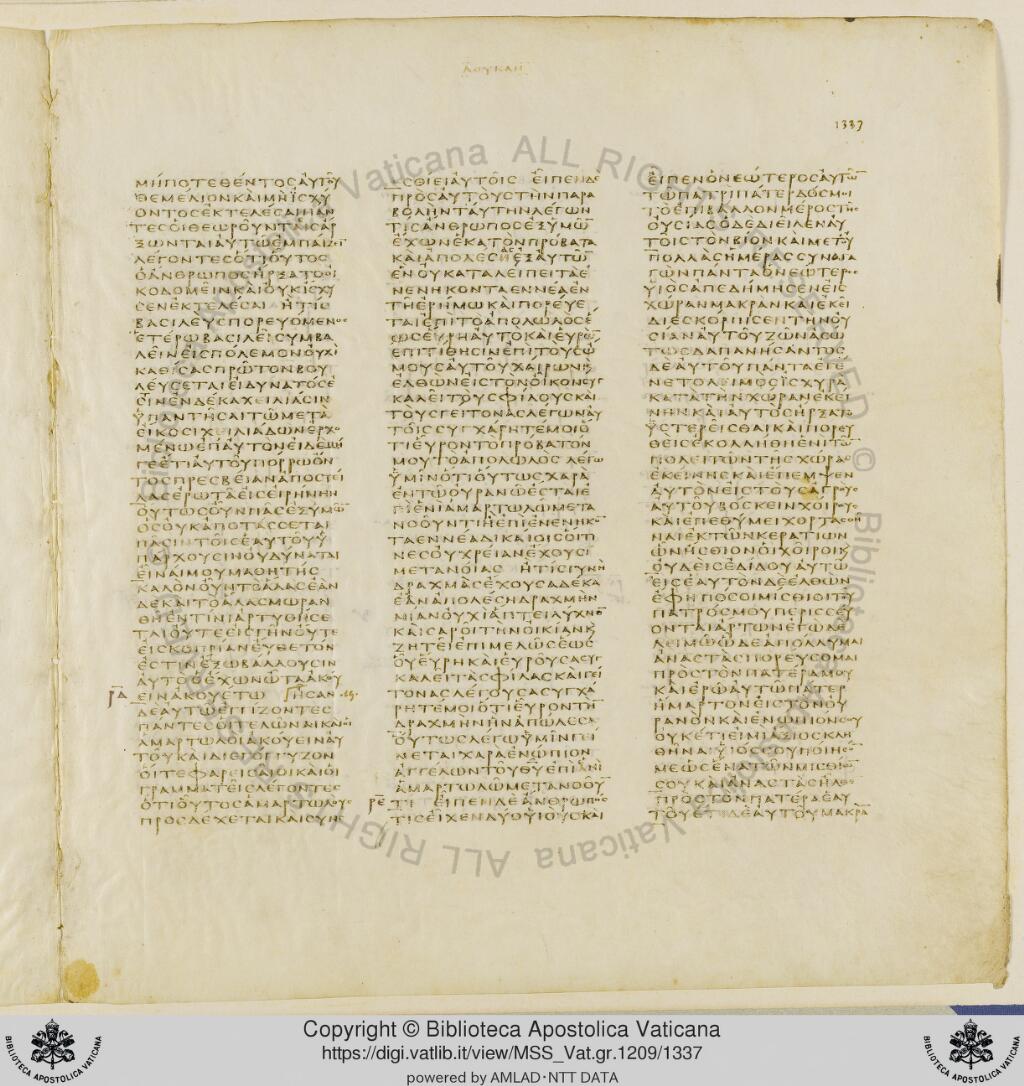
Where on the image
Page from the NTVMR transcription (docID 20003): verses 1-2 on p. 1333, col. 1.
1ησαν δε αυτω εγγιζοντες παντες οι τελωναι και οι αμαρτωλοι ακουειν αυτου 2και διεγογγυζον οι τε φαρεισαιοι και οι γραμματεις λεγοντες οτι ουτος αμαρτωλους προσδεχεται και συνεσθιει αυτοις
Compare: Tischendorf 8th edition (1869)
1Ἦσαν δὲ αὐτῷ ἐγγίζοντες πάντες οἱ τελῶναι καὶ οἱ ἁμαρτωλοὶ ἀκούειν αὐτοῦ. 2καὶ διεγόγγυζον οἵ τε Φαρισαῖοι καὶ οἱ γραμματεῖς λέγοντες ὅτι οὗτος ἁμαρτωλοὺς προσδέχεται καὶ συνεσθίει αὐτοῖς.
1Then drew near unto him all the publicans and sinners for to hear him. 2And the Pharisees and scribes murmured, saying, This man receiveth sinners, and eateth with them.
Where on the image
Page from the NTVMR transcription (docID 20003): verses 3-12 on p. 1333, col. 2.
3ειπεν δε προς αυτους την παραβολην ταυτην λεγων 4τις ανθρωπος εξ υμων εχων εκατον προβατα και απολεση εξ αυτων εν ου καταλειπει τα ενενηκοντα εννεα εν τη ερημω και πορευεται επι το απολωλος εως ευρη αυτο 5και ευρων επιτιθησιν επι τους ωμους αυτου χαιρων 6και ελθων εις τον οικον συγκαλει τους φιλους και τους γειτονας λεγων αυτοις συγχαρητε μοι οτι ευρον το προβατον μου το απολωλος 7λεγω υμιν οτι ουτως χαρα εν τω ουρανω εσται επι ενι αμαρτωλω μετανοουντι η επι ενενηκοντα εννεα δικαιοις οιτινες ου χρειαν εχουσιν μετανοιας 8η τις γυνη δραχμας εχουσα δεκα εαν απολεση δραχμην μιαν ουχι απτει λυχνον και σαροι την οικιαν και ζητει επιμελως εως ου ευρη 9και ευρουσα συγκαλει τας φιλας και γειτονας λεγουσα συγχαρητε μοι οτι ευρον την δραχμην ην απωλεσα 10ουτως λεγω υμιν γεινεται χαρα ενωπιον αγγελων του θυ επι ανι αμαρτωλω μετανοουντι 11ειπεν δε ανθρωπος τις ειχεν δυο υιους 12και ειπεν ο νεωτερος αυτων τω πατρι πατερ δος μοι το επιβαλλον μερος της ουσιας ο δε διειλεν αυτοις τον βιον
Compare: Tischendorf 8th edition (1869)
3εἶπεν δὲ πρὸς αὐτοὺς τὴν παραβολὴν ταύτην λέγων· 4τίς ἄνθρωπος ἐξ ὑμῶν ἔχων ἑκατὸν πρόβατα καὶ ἀπολέσας ἐξ αὐτῶν ἓν οὐ καταλείπει τὰ ἐνενήκοντα ἐννέα ἐν τῇ ἐρήμῳ καὶ πορεύεται ἐπὶ τὸ ἀπολωλός, ἕως εὕρῃ αὐτό; 5καὶ εὑρὼν ἐπιτίθησιν ἐπὶ τοὺς ὤμους αὐτοῦ χαίρων, 6καὶ ἐλθὼν εἰς τὸν οἶκον συνκαλεῖ τοὺς φίλους καὶ τοὺς γείτονας, λέγων αὐτοῖς· συνχάρητέ μοι, ὅτι εὗρον τὸ πρόβατόν μου τὸ ἀπολωλός. 7λέγω ὑμῖν ὅτι οὕτως χαρὰ ἐν τῷ οὐρανῷ ἔσται ἐπὶ ἑνὶ ἁμαρτωλῷ μετανοοῦντι ἢ ἐπὶ ἐνενήκοντα ἐννέα δικαίοις οἵτινες οὐ χρείαν ἔχουσιν μετανοίας. 8Ἢ τίς γυνὴ δραχμὰς ἔχουσα δέκα, ἐὰν ἀπολέσῃ δραχμὴν μίαν, οὐχὶ ἅπτει λύχνον καὶ σαροῖ τὴν οἰκίαν καὶ ζητεῖ ἐπιμελῶς ἕως ὅτου εὕρῃ; 9καὶ εὑροῦσα συνκαλεῖ τὰς φίλας καὶ γείτονας λέγουσα· συνχάρητέ μοι, ὅτι εὗρον τὴν δραχμὴν ἣν ἀπώλεσα. 10οὕτως, λέγω ὑμῖν, γίνεται χαρὰ ἐνώπιον τῶν ἀγγέλων τοῦ θεοῦ ἐπὶ ἑνὶ ἁμαρτωλῷ μετανοοῦντι. 11Εἶπεν δέ· ἄνθρωπός τις εἶχεν δύο υἱούς. 12καὶ εἶπεν ὁ νεώτερος αὐτῶν τῷ πατρί· πάτερ, δός μοι τὸ ἐπιβάλλον μέρος τῆς οὐσίας. καὶ διεῖλεν αὐτοῖς τὸν βίον.
3And he spake this parable unto them, saying, 4What man of you, having an hundred sheep, if he lose one of them, doth not leave the ninety and nine in the wilderness, and go after that which is lost, until he find it? 5And when he hath found it, he layeth it on his shoulders, rejoicing. 6And when he cometh home, he calleth together his friends and neighbours, saying unto them, Rejoice with me; for I have found my sheep which was lost. 7I say unto you, that likewise joy shall be in heaven over one sinner that repenteth, more than over ninety and nine just persons, which need no repentance. 8Either what woman having ten pieces of silver, if she lose one piece, doth not light a candle, and sweep the house, and seek diligently till she find it? 9And when she hath found it, she calleth her friends and her neighbours together, saying, Rejoice with me; for I have found the piece which I had lost. 10Likewise, I say unto you, there is joy in the presence of the angels of God over one sinner that repenteth. 11And he said, A certain man had two sons: 12And the younger of them said to his father, Father, give me the portion of goods that falleth to me. And he divided unto them his living.
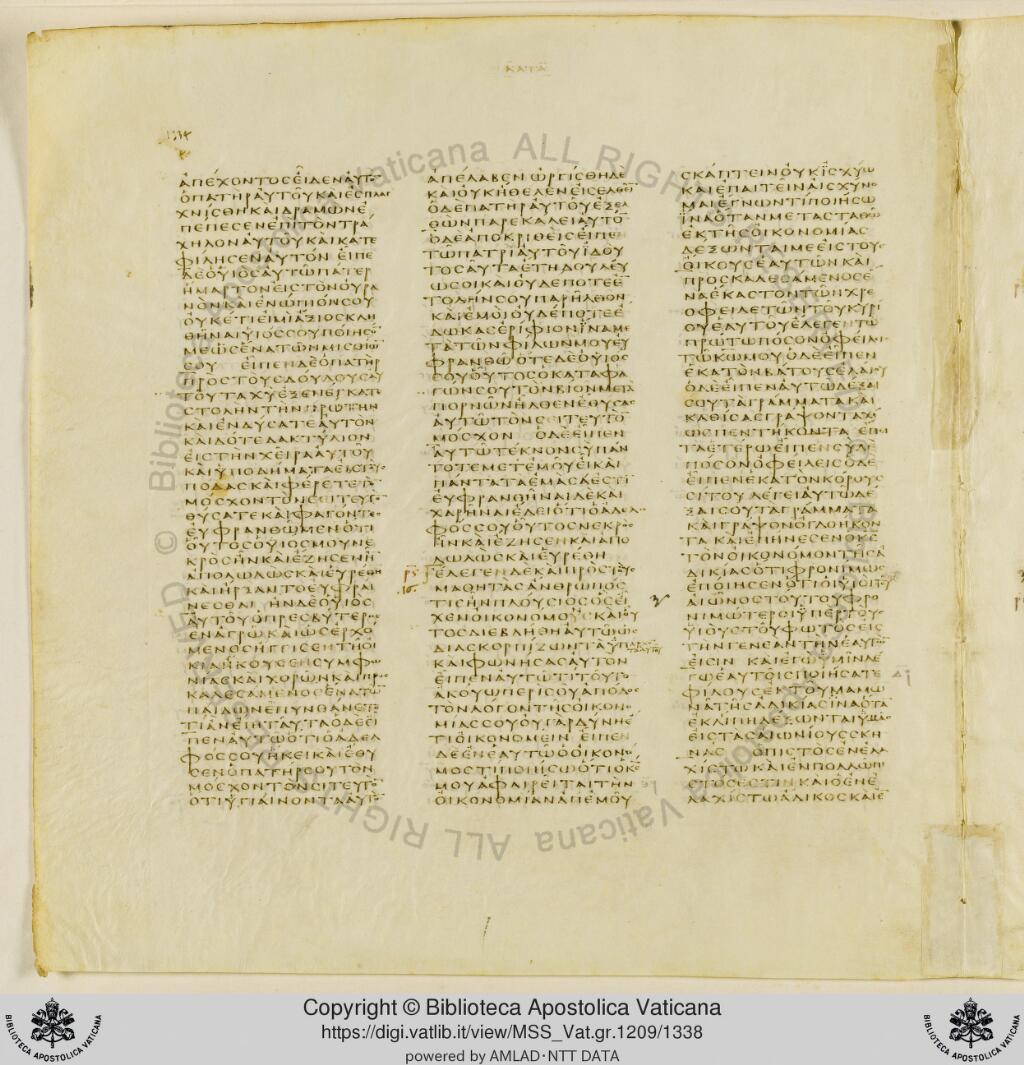
Where on the image
Page from the NTVMR transcription (docID 20003): verses 13-20 on p. 1333, col. 3; verse 20 continues on p. 1334, col. 1 (which begins 'απεχοντος ειδεν αυτον').
13και μετ ου πολλας ημερας συναγαγων παντα ο νεωτερος υιος απεδημησεν εις χωραν μακραν και εκει διεσκορπισεν την ουσιαν αυτου ζων ασωτως 14δαπανησαντος δε αυτου παντα εγενετο λειμος ισχυρα κατα την χωραν εκεινην και αυτος ηρξατο υστερεισθαι 15και πορευθεις εκολληθη ενι των πολειτων της χωρας εκεινης και επεμψεν αυτον εις τους αγρους αυτου βοσκειν χοιρους 16και επεθυμει χορτασθηναι εκ των κερατιων ων ησθιον οι χοιροι και ουδεις εδιδου αυτω 17εις εαυτον δε ελθων εφη ποσοι μισθιοι του πατρος μου περισσευονται αρτων εγω δε λειμω ωδε απολλυμαι 18αναστας πορευσομαι προς τον πατερα μου και ερω αυτω πατερ ημαρτον εις τον ουρανον και ενωπιον σου 19ουκετι ειμι αξιος κληθηναι υιος σου ποιησον με ως ενα των μισθιων σου 20και αναστας ηλθεν προς τον πατερα εαυτου ετι δε αυτου μακραν απεχοντος ειδεν αυτον ο πατηρ αυτου και εσπλαγχνισθη και δραμων επεπεσεν επι τον τραχηλον αυτου και κατεφιλησεν αυτον
Compare: Tischendorf 8th edition (1869)
13καὶ μετ’ οὐ πολλὰς ἡμέρας συναγαγὼν ἅπαντα ὁ νεώτερος υἱὸς ἀπεδήμησεν εἰς χώραν μακράν, καὶ ἐκεῖ διεσκόρπισεν τὴν οὐσίαν αὐτοῦ ζῶν ἀσώτως. 14δαπανήσαντος δὲ αὐτοῦ πάντα ἐγένετο λιμὸς ἰσχυρὰ κατὰ τὴν χώραν ἐκείνην, καὶ αὐτὸς ἤρξατο ὑστερεῖσθαι. 15καὶ πορευθεὶς ἐκολλήθη ἑνὶ τῶν πολιτῶν τῆς χώρας ἐκείνης, καὶ ἔπεμψεν αὐτὸν εἰς τοὺς ἀγροὺς αὐτοῦ βόσκειν χοίρους· 16καὶ ἐπεθύμει γεμίσαι τὴν κοιλίαν αὐτοῦ ἀπὸ τῶν κερατίων ᾧν ἤσθιον οἱ χοῖροι, καὶ οὐδεὶς ἐδίδου αὐτῷ. 17εἰς ἑαυτὸν δὲ ἐλθὼν ἔφη· πόσοι μίσθιοι τοῦ πατρός μου περισσεύουσιν ἄρτων· ἐγὼ δὲ λιμῷ ὧδε ἀπόλλυμαι. 18ἀναστὰς πορεύσομαι πρὸς τὸν πατέρα μου καὶ ἐρῶ αὐτῷ· πάτερ, ἥμαρτον εἰς τὸν οὐρανὸν καὶ ἐνώπιόν σου, 19οὐκέτι εἰμὶ ἄξιος κληθῆναι υἱός σου· ποίησόν με ὡς ἕνα τῶν μισθίων σου. 20καὶ ἀναστὰς ἦλθεν πρὸς τὸν πατέρα αὐτοῦ. ἔτι δὲ αὐτοῦ μακρὰν ἀπέχοντος εἶδεν αὐτὸν ὁ πατὴρ αὐτοῦ καὶ ἐσπλαγχνίσθη, καὶ δραμὼν ἐπέπεσεν ἐπὶ τὸν τράχηλον αὐτοῦ καὶ κατεφίλησεν αὐτόν.
13And not many days after the younger son gathered all together, and took his journey into a far country, and there wasted his substance with riotous living. 14And when he had spent all, there arose a mighty famine in that land; and he began to be in want. 15And he went and joined himself to a citizen of that country; and he sent him into his fields to feed swine. 16And he would fain have filled his belly with the husks that the swine did eat: and no man gave unto him. 17And when he came to himself, he said, How many hired servants of my father’s have bread enough and to spare, and I perish with hunger! 18I will arise and go to my father, and will say unto him, Father, I have sinned against heaven, and before thee, 19And am no more worthy to be called thy son: make me as one of thy hired servants. 20And he arose, and came to his father. But when he was yet a great way off, his father saw him, and had compassion, and ran, and fell on his neck, and kissed him.
Where on the image
Page from the NTVMR transcription (docID 20003): verses 21-27 on p. 1334, col. 1.
21ειπεν δε ο υιος αυτω πατερ ημαρτον εις τον ουρανον και ενωπιον σου ουκετι ειμι αξιος κληθηναι υιος σου ποιησον με ως ενα των μισθιων σου 22ειπεν δε ο πατηρ προς τους δουλους αυτου · · ταχυ εξενεγκατε στολην την πρωτην και ενδυσατε αυτον και δοτε δακτυλιον εις την χειρα αυτου και υποδηματα εις τους ποδας 23και φερετε τον μοσχον τον σειτευτον θυσατε και φαγοντες ευφρανθωμεν 24οτι ουτος ο υιος μου νεκρος ην και εζησεν ην απολωλως και ευρεθη και ηρξαντο ευφραινεσθαι 25ην δε ο υιος αυτου ο πρεσβυτερος εν αγρω και ως ερχομενος ηγγισεν τη οικια ηκουσεν συμφωνιας και χορων 26και προσκαλεσαμενος ενα των παιδων επυνθανετο τι αν ειη ταυτα 27ο δε ειπεν αυτω οτι ο αδελφος σου ηκει και εθυσεν ο πατηρ σου τον μοσχον τον σιτευτον οτι υγιαινοντα αυτον απελαβεν
Compare: Tischendorf 8th edition (1869)
21εἶπεν δὲ αὐτῷ ὁ υἱός· πάτερ, ἥμαρτον εἰς τὸν οὐρανὸν καὶ ἐνώπιόν σου, οὐκέτι εἰμὶ ἄξιος κληθῆναι υἱός σου. 22εἶπεν δὲ ὁ πατὴρ πρὸς τοὺς δούλους αὐτοῦ· ἐξενέγκατε στολὴν τὴν πρώτην καὶ ἐνδύσατε αὐτόν, καὶ δότε δακτύλιον εἰς τὴν χεῖρα αὐτοῦ καὶ ὑποδήματα εἰς τοὺς πόδας, 23καὶ φέρετε τὸν μόσχον τὸν σιτευτόν, θύσατε καὶ φαγόντες εὐφρανθῶμεν, 24ὅτι οὗτος ὁ υἱός μου νεκρὸς ἦν καὶ ἀνέζησεν, ἦν ἀπολωλὼς καὶ εὑρέθη. καὶ ἤρξαντο εὐφραίνεσθαι. 25ἦν δὲ ὁ υἱὸς αὐτοῦ ὁ πρεσβύτερος ἐν ἀγρῷ· καὶ ὡς ἐρχόμενος ἤγγισεν τῇ οἰκίᾳ, ἤκουσεν συμφωνίας καὶ χορῶν, 26καὶ προσκαλεσάμενος ἕνα τῶν παίδων ἐπυνθάνετο τί εἴη ταῦτα. 27ὁ δὲ εἶπεν αὐτῷ ὅτι ὁ ἀδελφός σου ἥκει, καὶ ἔθυσεν ὁ πατήρ σου τὸν μόσχον τὸν σιτευτόν, ὅτι ὑγιαίνοντα αὐτὸν ἀπέλαβεν.
21And the son said unto him, Father, I have sinned against heaven, and in thy sight, and am no more worthy to be called thy son. 22But the father said to his servants, Bring forth the best robe, and put it on him; and put a ring on his hand, and shoes on his feet: 23And bring hither the fatted calf, and kill it; and let us eat, and be merry: 24For this my son was dead, and is alive again; he was lost, and is found. And they began to be merry. 25Now his elder son was in the field: and as he came and drew nigh to the house, he heard musick and dancing. 26And he called one of the servants, and asked what these things meant. 27And he said unto him, Thy brother is come; and thy father hath killed the fatted calf, because he hath received him safe and sound.
Where on the image
Page from the NTVMR transcription (docID 20003): verses 28-32 on p. 1334, col. 2.
28ωργισθη δε και ουκ ηθελεν εισελθειν ο δε πατηρ αυτου εξελθων παρεκαλει αυτον 29ο δε αποκριθεις ειπεν τω πατρι αυτου ιδου τοσαυτα ετη δουλευω σοι και ουδεποτε εντολην σου παρηλθον και εμοι ουδεποτε εδωκας εριφιον ινα μετα των φιλων μου ευφρανθω 30οτε δε ο υιος σου ουτος ο καταφαγων · · σου τον βιον μετα πορνων ηλθεν εθυσας αυτω τον σειτευτον μοσχον 31ο δε ειπεν αυτω τεκνον συ παντοτε μετ εμου ει και παντα τα εμα σα εστιν 32ευφρανθηναι δε και χαρηναι εδει οτι ο · · αδελφος σου ουτος νεκρος ην και εζησεν και απολωλως και ευρεθη
Compare: Tischendorf 8th edition (1869)
28ὠργίσθη δὲ καὶ οὐκ ἤθελεν εἰσελθεῖν· ὁ δὲ πατὴρ αὐτοῦ ἐξελθὼν παρεκάλει αὐτόν. 29ὁ δὲ ἀποκριθεὶς εἶπεν τῷ πατρί· ἰδοὺ τοσαῦτα ἔτη δουλεύω σοι καὶ οὐδέποτε ἐντολήν σου παρῆλθον, καὶ ἐμοὶ οὐδέποτε ἔδωκας ἔριφον ἵνα μετὰ τῶν φίλων μου εὐφρανθῶ· 30ὅτε δὲ ὁ υἱός σου οὗτος ὁ καταφαγών σου τὸν βίον μετὰ πορνῶν ἦλθεν, ἔθυσας αὐτῷ τὸν σιτευτὸν μόσχον. 31ὁ δὲ εἶπεν αὐτῷ· τέκνον, σὺ πάντοτε μετ’ ἐμοῦ εἶ, καὶ πάντα τὰ ἐμὰ σά ἐστιν· 32εὐφρανθῆναι δὲ καὶ χαρῆναι ἔδει, ὅτι ὁ ἀδελφός σου οὗτος νεκρὸς ἦν καὶ ἔζησεν, καὶ ἀπολωλὼς καὶ εὑρέθη.
28And he was angry, and would not go in: therefore came his father out, and intreated him. 29And he answering said to his father, Lo, these many years do I serve thee, neither transgressed I at any time thy commandment: and yet thou never gavest me a kid, that I might make merry with my friends: 30But as soon as this thy son was come, which hath devoured thy living with harlots, thou hast killed for him the fatted calf. 31And he said unto him, Son, thou art ever with me, and all that I have is thine. 32It was meet that we should make merry, and be glad: for this thy brother was dead, and is alive again; and was lost, and is found.
Cite
Sources
- Source: Codex Vaticanus page images + NTVMR transcription (CC BY 4.0) + Tischendorf 8th edition + KJV (holding institution)
- Critical edition: Codex Vaticanus transcription, NTVMR (INTF Münster, CC BY 4.0); Tischendorf 8th edition for comparison
← previous · → next · v cycle view · l back to library