The Iliad, Book 13
Introduction
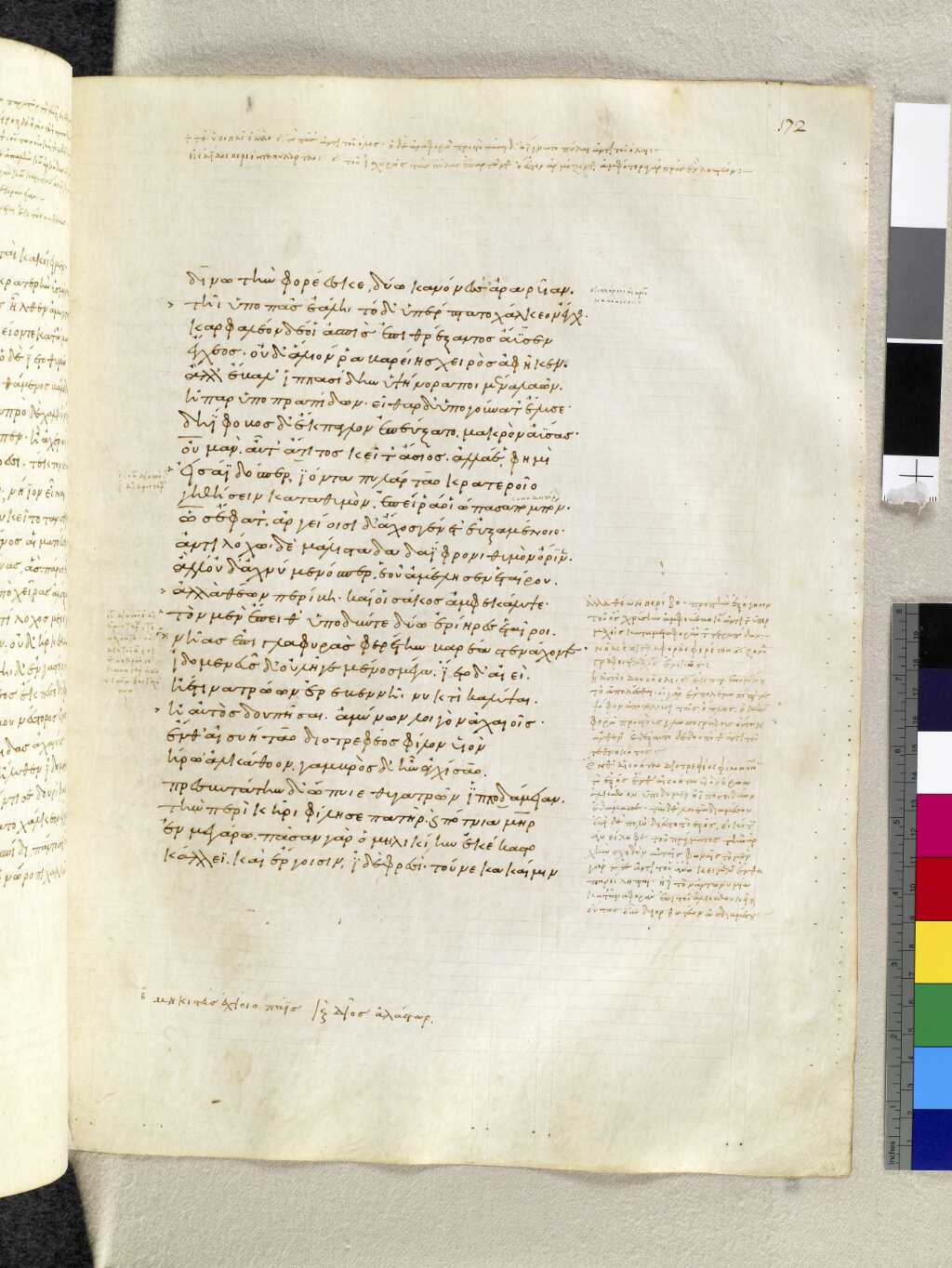
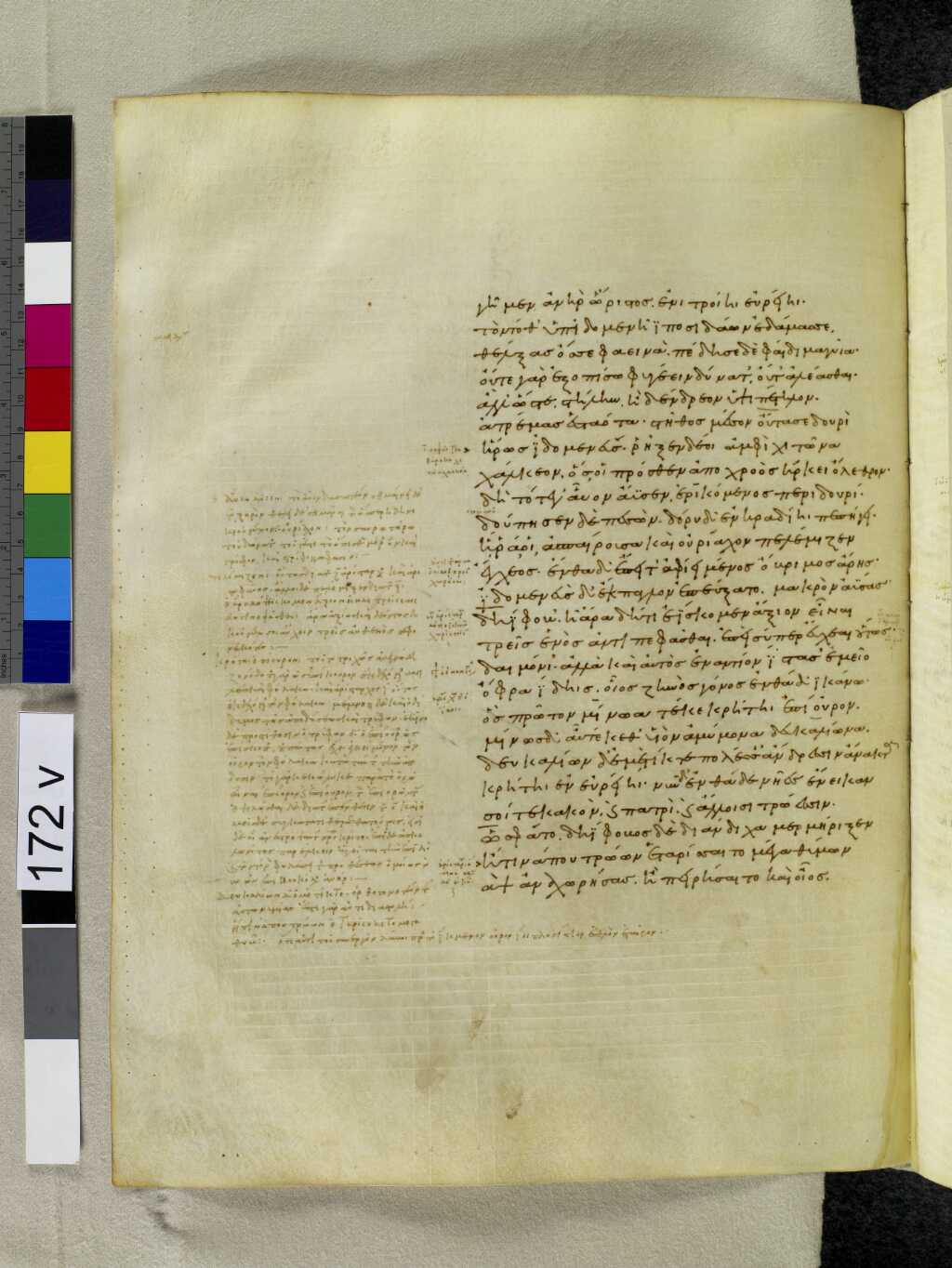
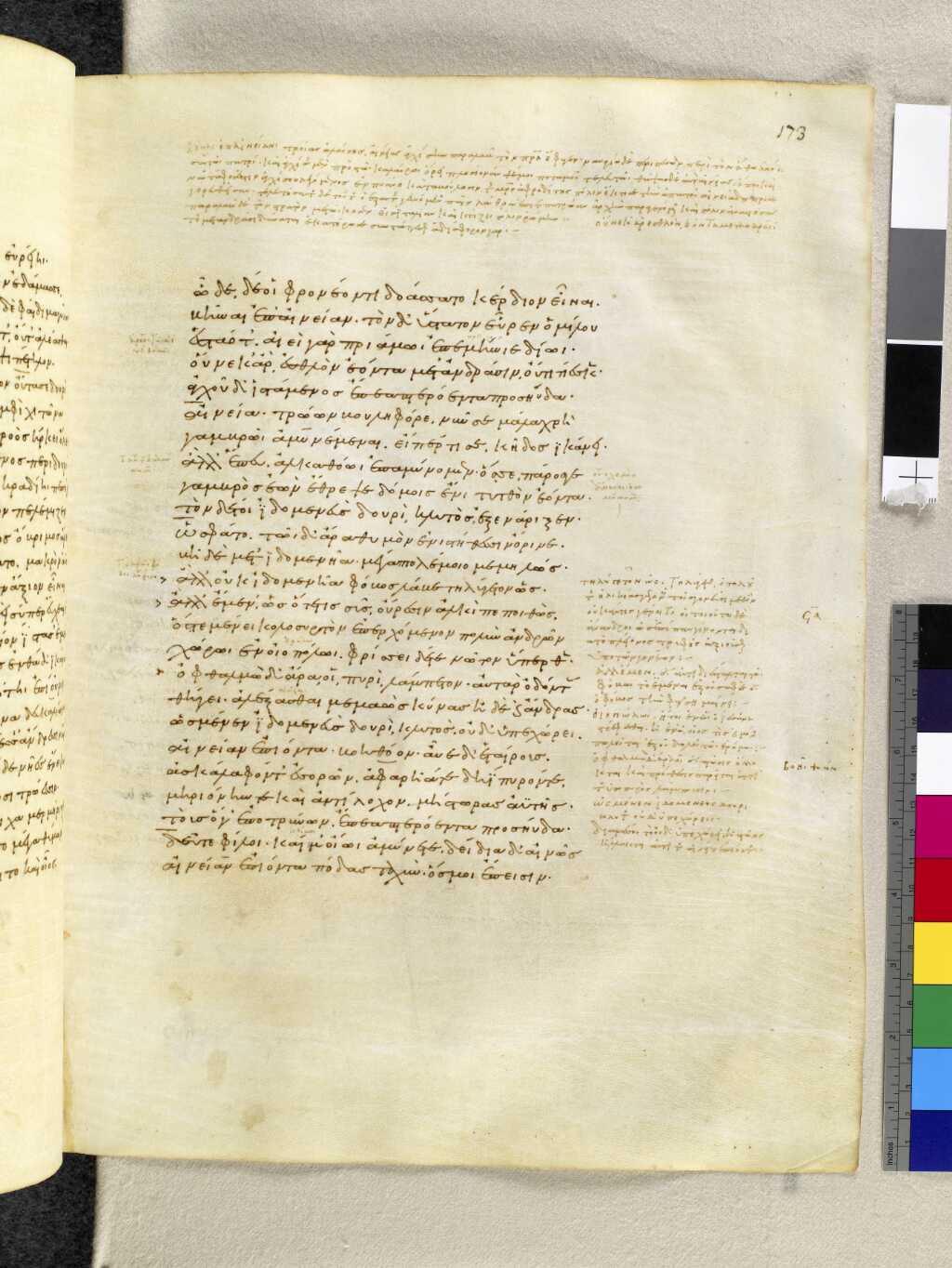
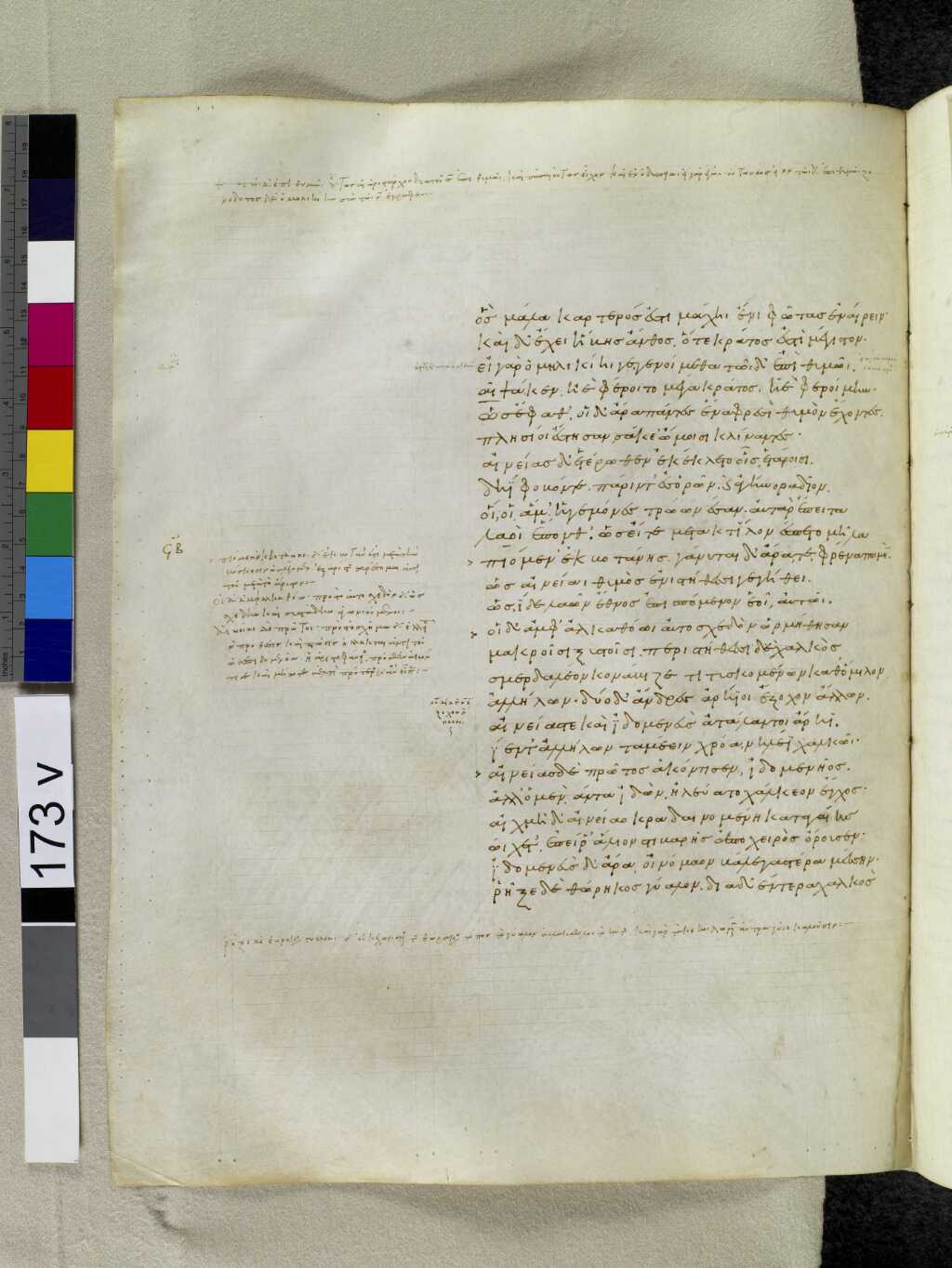
Book 13 of the Iliad with 34 sections, each linked to its specific folio in Venetus A (Marcianus Graecus 454, 10th c.). The Homer Multitext Project provides line-level folio mappings, ensuring every section of text corresponds to the exact manuscript page where it appears.
How was this verified? (Provenance)
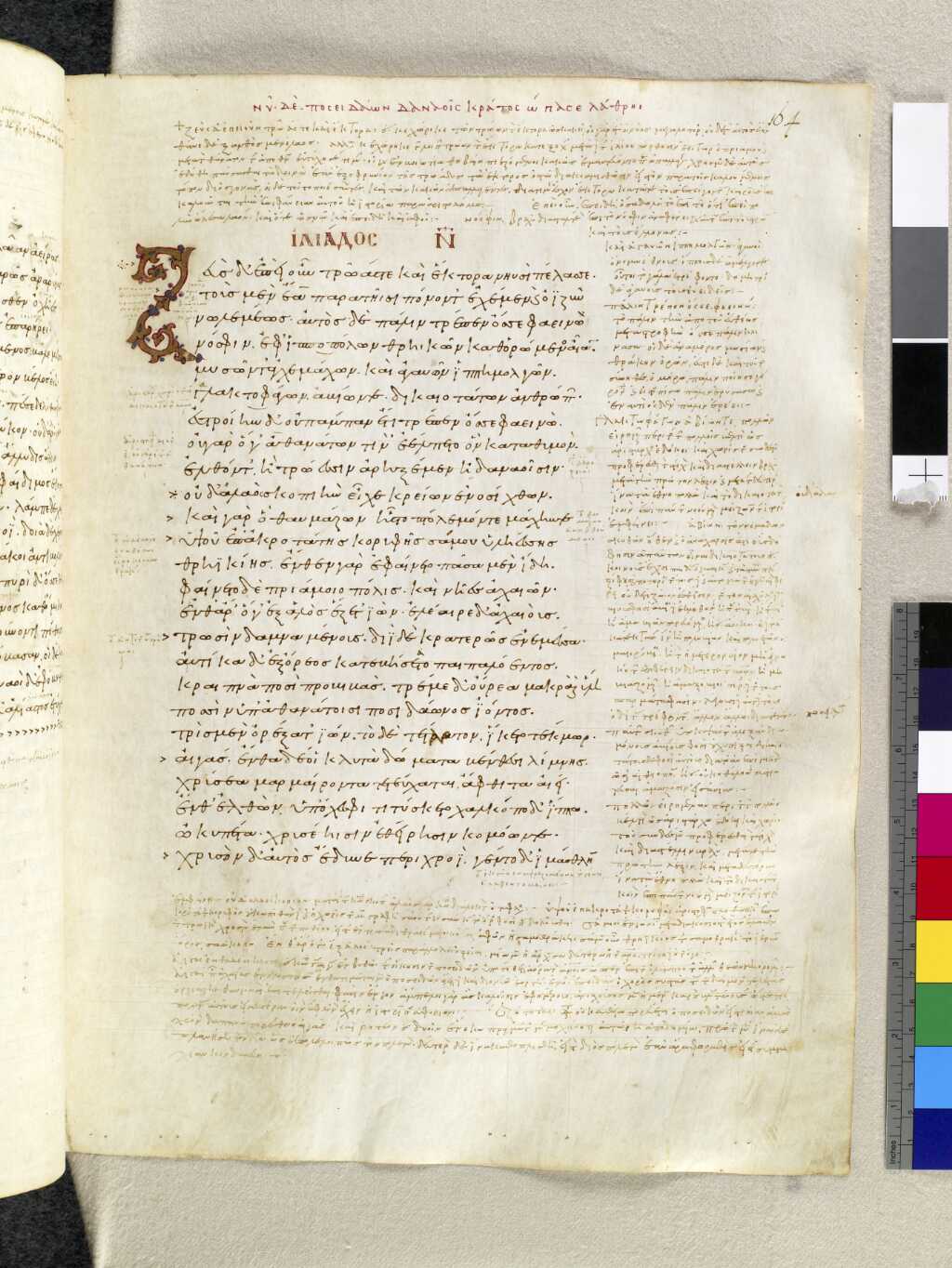
1Ζεὺς δʼ ἐπεὶ οὖν Τρῶάς τε καὶ Ἕκτορα νηυσὶ πέλασσε, 2τοὺς μὲν ἔα παρὰ τῇσι πόνον τʼ ἐχέμεν καὶ ὀϊζὺν 3νωλεμέως, αὐτὸς δὲ πάλιν τρέπεν ὄσσε φαεινὼ 4νόσφιν ἐφʼ ἱπποπόλων Θρῃκῶν καθορώμενος αἶαν 5Μυσῶν τʼ ἀγχεμάχων καὶ ἀγαυῶν ἱππημολγῶν 6γλακτοφάγων Ἀβίων τε δικαιοτάτων ἀνθρώπων. 7ἐς Τροίην δʼ οὐ πάμπαν ἔτι τρέπεν ὄσσε φαεινώ· 8οὐ γὰρ ὅ γʼ ἀθανάτων τινα ἔλπετο ὃν κατὰ θυμὸν 9ἐλθόντʼ ἢ Τρώεσσιν ἀρηξέμεν ἢ Δαναοῖσιν. 10οὐδʼ ἀλαοσκοπιὴν εἶχε κρείων ἐνοσίχθων· 11καὶ γὰρ ὃ θαυμάζων ἧστο πτόλεμόν τε μάχην τε 12ὑψοῦ ἐπʼ ἀκροτάτης κορυφῆς Σάμου ὑληέσσης 13Θρηϊκίης· ἔνθεν γὰρ ἐφαίνετο πᾶσα μὲν Ἴδη, 14φαίνετο δὲ Πριάμοιο πόλις καὶ νῆες Ἀχαιῶν. 15ἔνθʼ ἄρʼ ὅ γʼ ἐξ ἁλὸς ἕζετʼ ἰών, ἐλέαιρε δʼ Ἀχαιοὺς 16Τρωσὶν δαμναμένους, Διὶ δὲ κρατερῶς ἐνεμέσσα. 17αὐτίκα δʼ ἐξ ὄρεος κατεβήσετο παιπαλόεντος 18κραιπνὰ ποσὶ προβιβάς· τρέμε δʼ οὔρεα μακρὰ καὶ ὕλη 19ποσσὶν ὑπʼ ἀθανάτοισι Ποσειδάωνος ἰόντος. 20τρὶς μὲν ὀρέξατʼ ἰών, τὸ δὲ τέτρατον ἵκετο τέκμωρ 21Αἰγάς, ἔνθα δέ οἱ κλυτὰ δώματα βένθεσι λίμνης 22χρύσεα μαρμαίροντα τετεύχαται ἄφθιτα αἰεί. 23ἔνθʼ ἐλθὼν ὑπʼ ὄχεσφι τιτύσκετο χαλκόποδʼ ἵππω 24ὠκυπέτα χρυσέῃσιν ἐθείρῃσιν κομόωντε, 25χρυσὸν δʼ αὐτὸς ἔδυνε περὶ χροΐ, γέντο δʼ ἱμάσθλην
Neptune helps the Achaeans—The feats of Idomeneus—Hector at the ships.
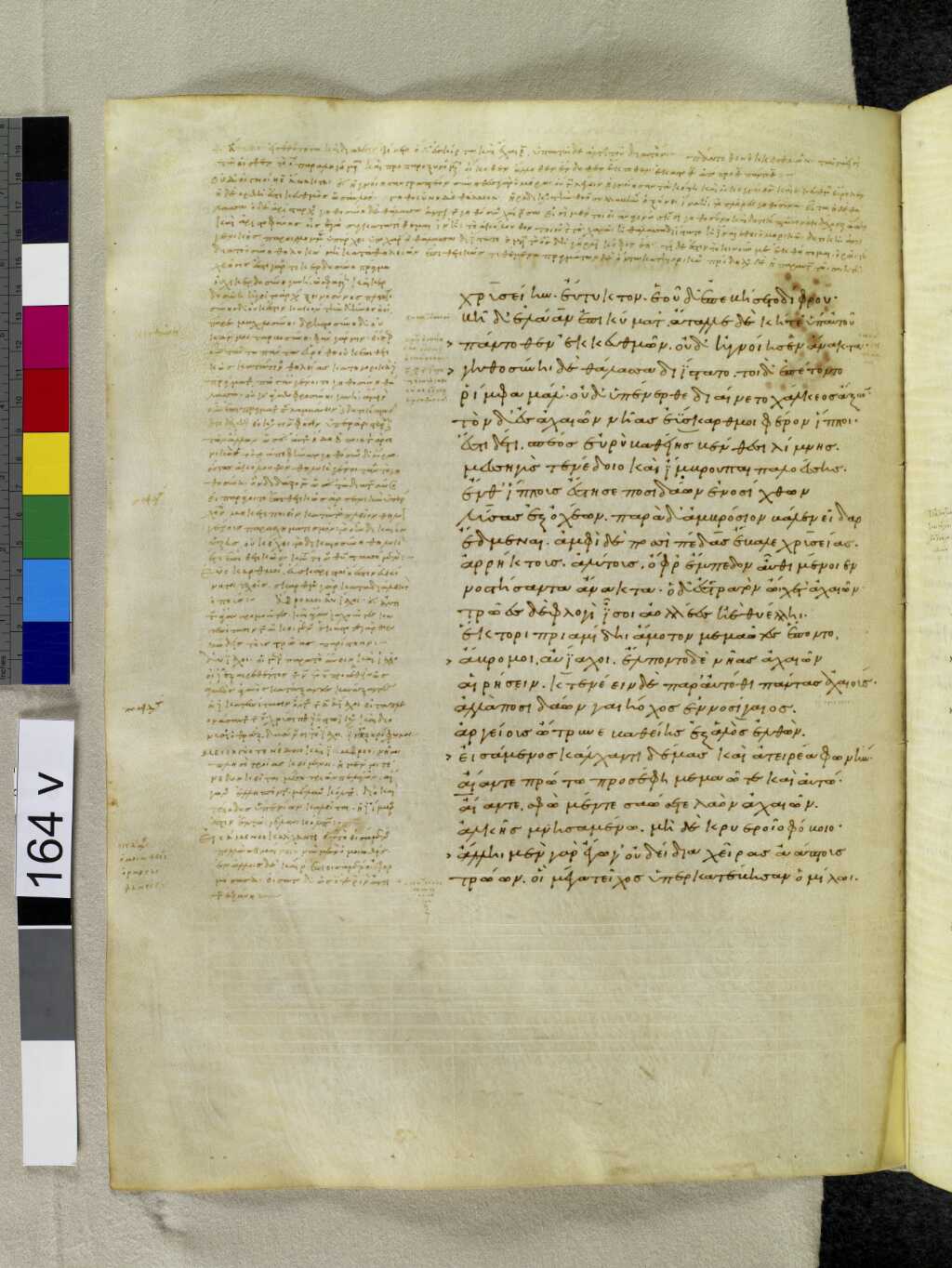
26χρυσείην εὔτυκτον, ἑοῦ δʼ ἐπεβήσετο δίφρου, 27βῆ δʼ ἐλάαν ἐπὶ κύματʼ· ἄταλλε δὲ κήτεʼ ὑπʼ αὐτοῦ 28πάντοθεν ἐκ κευθμῶν, οὐδʼ ἠγνοίησεν ἄνακτα· 29γηθοσύνῃ δὲ θάλασσα διίστατο· τοὶ δὲ πέτοντο 30ῥίμφα μάλʼ, οὐδʼ ὑπένερθε διαίνετο χάλκεος ἄξων· 31τὸν δʼ ἐς Ἀχαιῶν νῆας ἐΰσκαρθμοι φέρον ἵπποι. 32ἔστι δέ τι σπέος εὐρὺ βαθείης βένθεσι λίμνης 33μεσσηγὺς Τενέδοιο καὶ Ἴμβρου παιπαλοέσσης· 34ἔνθʼ ἵππους ἔστησε Ποσειδάων ἐνοσίχθων 35λύσας ἐξ ὀχέων, παρὰ δʼ ἀμβρόσιον βάλεν εἶδαρ 36ἔδμεναι· ἀμφὶ δὲ ποσσὶ πέδας ἔβαλε χρυσείας 37ἀρρήκτους ἀλύτους, ὄφρʼ ἔμπεδον αὖθι μένοιεν 38νοστήσαντα ἄνακτα· ὃ δʼ ἐς στρατὸν ᾤχετʼ Ἀχαιῶν. 39Τρῶες δὲ φλογὶ ἶσοι ἀολλέες ἠὲ θυέλλῃ 40Ἕκτορι Πριαμίδῃ ἄμοτον μεμαῶτες ἕποντο 41ἄβρομοι αὐΐαχοι· ἔλποντο δὲ νῆας Ἀχαιῶν 42αἱρήσειν, κτενέειν δὲ παρʼ αὐτόθι πάντας ἀρίστους. 43ἀλλὰ Ποσειδάων γαιήοχος ἐννοσίγαιος 44Ἀργείους ὄτρυνε βαθείης ἐξ ἁλὸς ἐλθὼν 45εἰσάμενος Κάλχαντι δέμας καὶ ἀτειρέα φωνήν· 46Αἴαντε πρώτω προσέφη μεμαῶτε καὶ αὐτώ· 47Αἴαντε σφὼ μέν τε σαώσετε λαὸν Ἀχαιῶν 48ἀλκῆς μνησαμένω, μὴ δὲ κρυεροῖο φόβοιο. 49ἄλλῃ μὲν γὰρ ἔγωγʼ οὐ δείδια χεῖρας ἀάπτους 50Τρώων, οἳ μέγα τεῖχος ὑπερκατέβησαν ὁμίλῳ·
Now when Jove had thus brought Hector and the Trojans to the ships, he left them to their never-ending toil, and turned his keen eyes away, looking elsewhither towards the horse-breeders of Thrace, the Mysians, fighters at close quarters, the noble Hippemolgi, who live on milk, and the Abians, justest of mankind. He no longer turned so much as a glance towards Troy, for he did not think that any of the immortals would go and help either Trojans or Danaans.
But King Neptune had kept no blind look-out; he had been looking admiringly on the battle from his seat on the topmost crests of wooded Samothrace, whence he could see all Ida, with the city of Priam and the ships of the Achaeans. He had come from under the sea and taken his place here, for he pitied the Achaeans who were being overcome by the Trojans; and he was furiously angry with Jove.
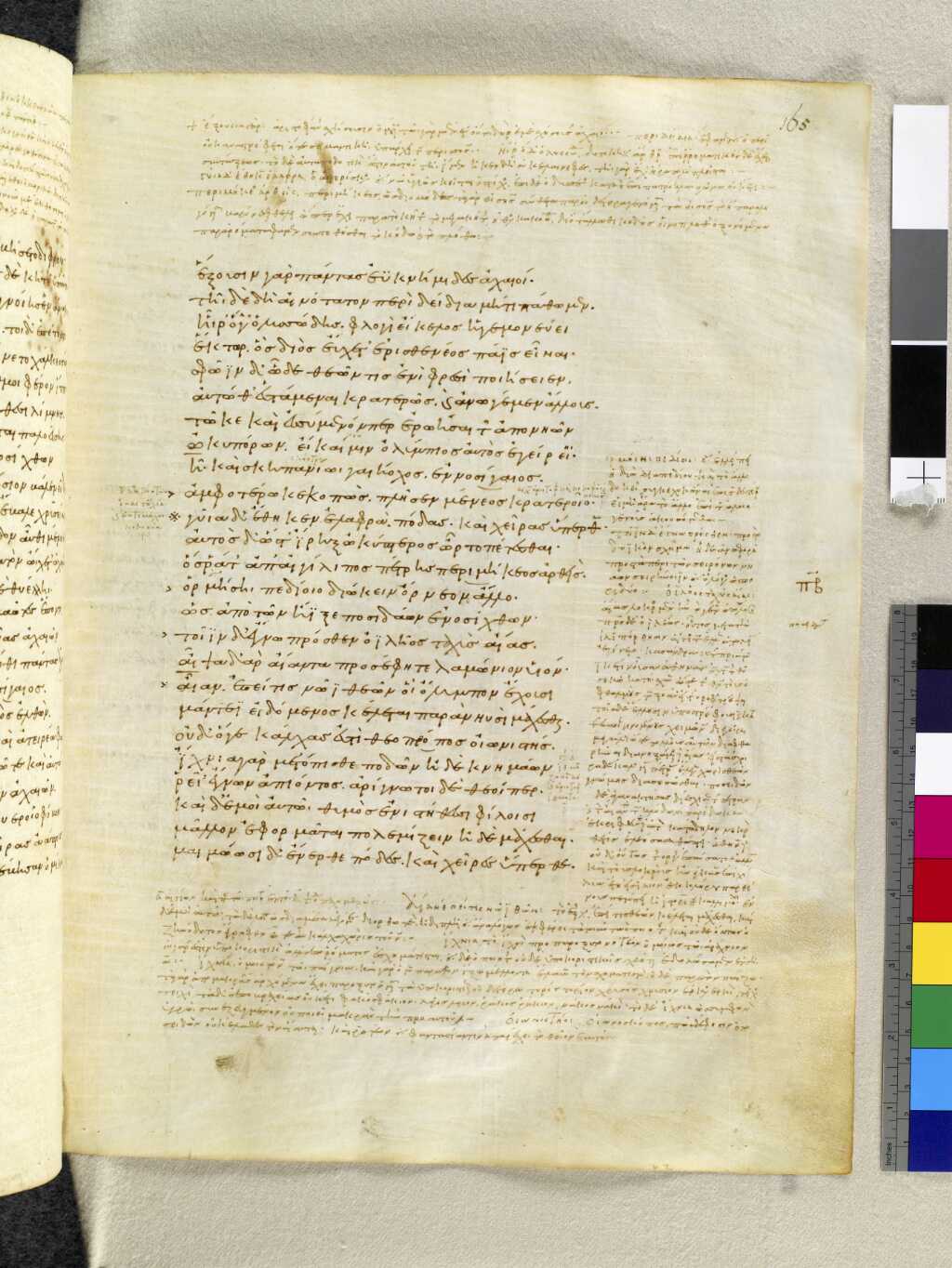
51ἕξουσιν γὰρ πάντας ἐϋκνήμιδες Ἀχαιοί· 52τῇ δὲ δὴ αἰνότατον περιδείδια μή τι πάθωμεν, 53ᾗ ῥʼ ὅ γʼ ὁ λυσσώδης φλογὶ εἴκελος ἡγεμονεύει 54Ἕκτωρ, ὃς Διὸς εὔχετʼ ἐρισθενέος πάϊς εἶναι. 55σφῶϊν δʼ ὧδε θεῶν τις ἐνὶ φρεσὶ ποιήσειεν 56αὐτώ θʼ ἑστάμεναι κρατερῶς καὶ ἀνωγέμεν ἄλλους· 57τώ κε καὶ ἐσσύμενόν περ ἐρωήσαιτʼ ἀπὸ νηῶν 58ὠκυπόρων, εἰ καί μιν Ὀλύμπιος αὐτὸς ἐγείρει. 59ἦ καὶ σκηπανίῳ γαιήοχος ἐννοσίγαιος 60ἀμφοτέρω κεκοπὼς πλῆσεν μένεος κρατεροῖο, 61γυῖα δʼ ἔθηκεν ἐλαφρὰ πόδας καὶ χεῖρας ὕπερθεν. 62αὐτὸς δʼ ὥς τʼ ἴρηξ ὠκύπτερος ὦρτο πέτεσθαι, 63ὅς ῥά τʼ ἀπʼ αἰγίλιπος πέτρης περιμήκεος ἀρθεὶς 64ὁρμήσῃ πεδίοιο διώκειν ὄρνεον ἄλλο, 65ὣς ἀπὸ τῶν ἤϊξε Ποσειδάων ἐνοσίχθων. 66τοῖιν δʼ ἔγνω πρόσθεν Ὀϊλῆος ταχὺς Αἴας, 67αἶψα δʼ ἄρʼ Αἴαντα προσέφη Τελαμώνιον υἱόν· 68Αἶαν ἐπεί τις νῶϊ θεῶν οἳ Ὄλυμπον ἔχουσι 69μάντεϊ εἰδόμενος κέλεται παρὰ νηυσὶ μάχεσθαι, 70οὐδʼ ὅ γε Κάλχας ἐστὶ θεοπρόπος οἰωνιστής· 71ἴχνια γὰρ μετόπισθε ποδῶν ἠδὲ κνημάων 72ῥεῖʼ ἔγνων ἀπιόντος· ἀρίγνωτοι δὲ θεοί περ· 73καὶ δʼ ἐμοὶ αὐτῷ θυμὸς ἐνὶ στήθεσσι φίλοισι 74μᾶλλον ἐφορμᾶται πολεμίζειν ἠδὲ μάχεσθαι, 75μαιμώωσι δʼ ἔνερθε πόδες καὶ χεῖρες ὕπερθε.
Presently he came down from his post on the mountain top, and as he strode swiftly onwards the high hills and the forest quaked beneath the tread of his immortal feet. Three strides he took, and with the fourth he reached his goal—Aegae, where is his glittering golden palace, imperishable, in the depths of the sea. When he got there, he yoked his fleet brazen-footed steeds with their manes of gold all flying in the wind; he clothed himself in raiment of gold, grasped his gold whip, and took his stand upon his chariot. As he went his way over the waves the sea-monsters left their lairs, for they knew their lord, and came gambolling round him from every quarter of the deep, while the sea in her gladness opened a path before his chariot. So lightly did the horses fly that the bronze axle of the car was not even wet beneath it; and thus his bounding steeds took him to the ships of the Achaeans.
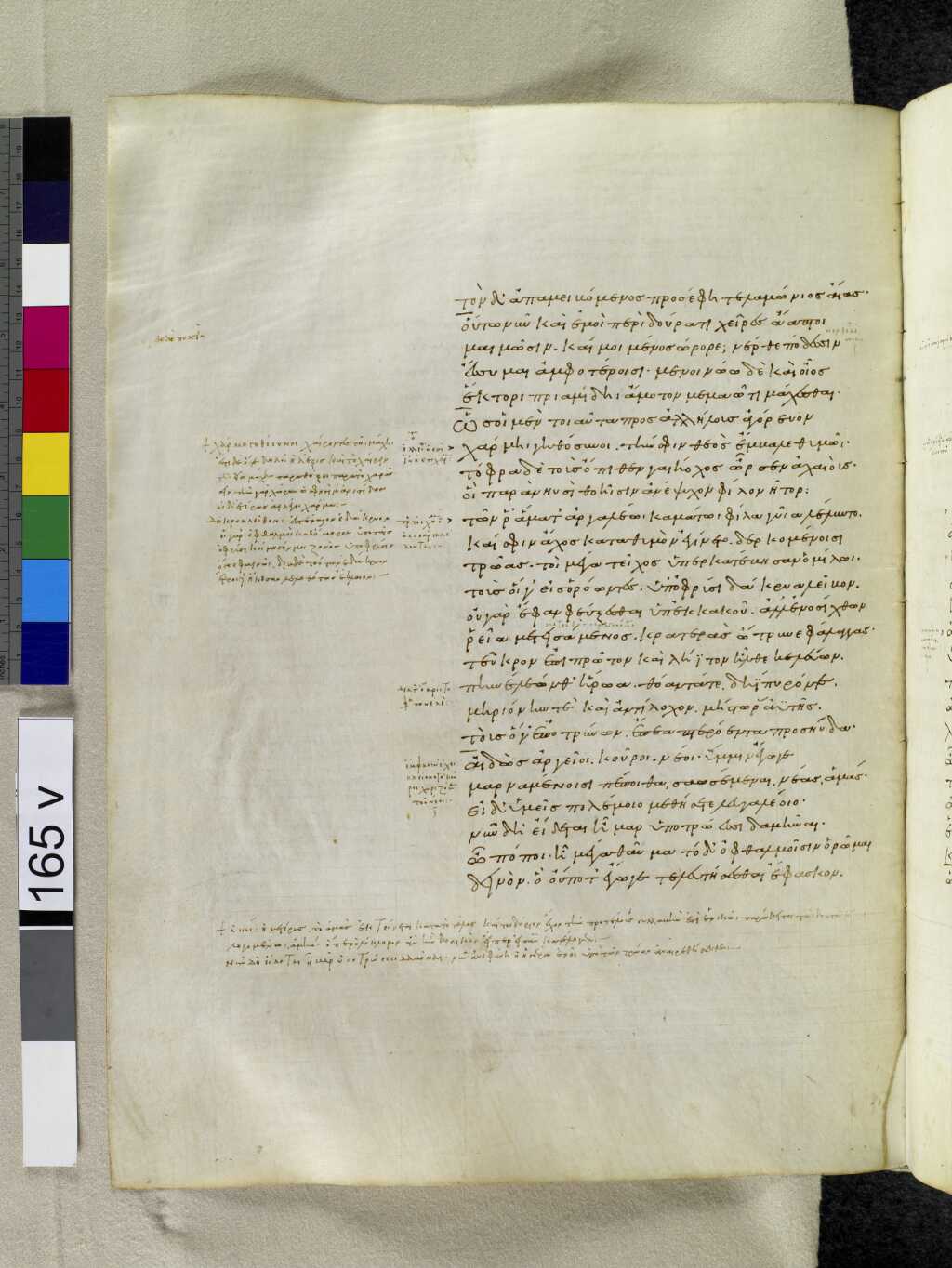
76τὸν δʼ ἀπαμειβόμενος προσέφη Τελαμώνιος Αἴας· 77οὕτω νῦν καὶ ἐμοὶ περὶ δούρατι χεῖρες ἄαπτοι 78μαιμῶσιν, καί μοι μένος ὤρορε, νέρθε δὲ ποσσὶν 79ἔσσυμαι ἀμφοτέροισι· μενοινώω δὲ καὶ οἶος 80Ἕκτορι Πριαμίδῃ ἄμοτον μεμαῶτι μάχεσθαι. 81ὣς οἳ μὲν τοιαῦτα πρὸς ἀλλήλους ἀγόρευον 82χάρμῃ γηθόσυνοι, τήν σφιν θεὸς ἔμβαλε θυμῷ· 83τόφρα δὲ τοὺς ὄπιθεν γαιήοχος ὦρσεν Ἀχαιούς, 84οἳ παρὰ νηυσὶ θοῇσιν ἀνέψυχον φίλον ἦτορ. 85τῶν ῥʼ ἅμα τʼ ἀργαλέῳ καμάτῳ φίλα γυῖα λέλυντο, 86καί σφιν ἄχος κατὰ θυμὸν ἐγίγνετο δερκομένοισι 87Τρῶας, τοὶ μέγα τεῖχος ὑπερκατέβησαν ὁμίλῳ. 88τοὺς οἵ γʼ εἰσορόωντες ὑπʼ ὀφρύσι δάκρυα λεῖβον· 89οὐ γὰρ ἔφαν φεύξεσθαι ὑπʼ ἐκ κακοῦ· ἀλλʼ ἐνοσίχθων 90ῥεῖα μετεισάμενος κρατερὰς ὄτρυνε φάλαγγας. 91Τεῦκρον ἔπι πρῶτον καὶ Λήϊτον ἦλθε κελεύων 92Πηνέλεών θʼ ἥρωα Θόαντά τε Δηΐπυρόν τε 93Μηριόνην τε καὶ Ἀντίλοχον μήστωρας ἀϋτῆς· 94τοὺς ὅ γʼ ἐποτρύνων ἔπεα πτερόεντα προσηύδα· 95αἰδὼς Ἀργεῖοι, κοῦροι νέοι· ὔμμιν ἔγωγε 96μαρναμένοισι πέποιθα σαωσέμεναι νέας ἁμάς· 97εἰ δʼ ὑμεῖς πολέμοιο μεθήσετε λευγαλέοιο, 98νῦν δὴ εἴδεται ἦμαρ ὑπὸ Τρώεσσι δαμῆναι. 99ὢ πόποι ἦ μέγα θαῦμα τόδʼ ὀφθαλμοῖσιν ὁρῶμαι 100δεινόν, ὃ οὔ ποτʼ ἔγωγε τελευτήσεσθαι ἔφασκον,
Now there is a certain huge cavern in the depths of the sea midway between Tenedos and rocky Imbrus; here Neptune lord of the earthquake stayed his horses, unyoked them, and set before them their ambrosial forage. He hobbled their feet with hobbles of gold which none could either unloose or break, so that they might stay there in that place until their lord should return. This done he went his way to the host of the Achaeans.
Now the Trojans followed Hector son of Priam in close array like a storm-cloud or flame of fire, fighting with might and main and raising the cry battle; for they deemed that they should take the ships of the Achaeans and kill all their chiefest heroes then and there. Meanwhile earth-encircling Neptune lord of the earthquake cheered on the Argives, for he had come up out of the sea and had assumed the form and voice of Calchas.
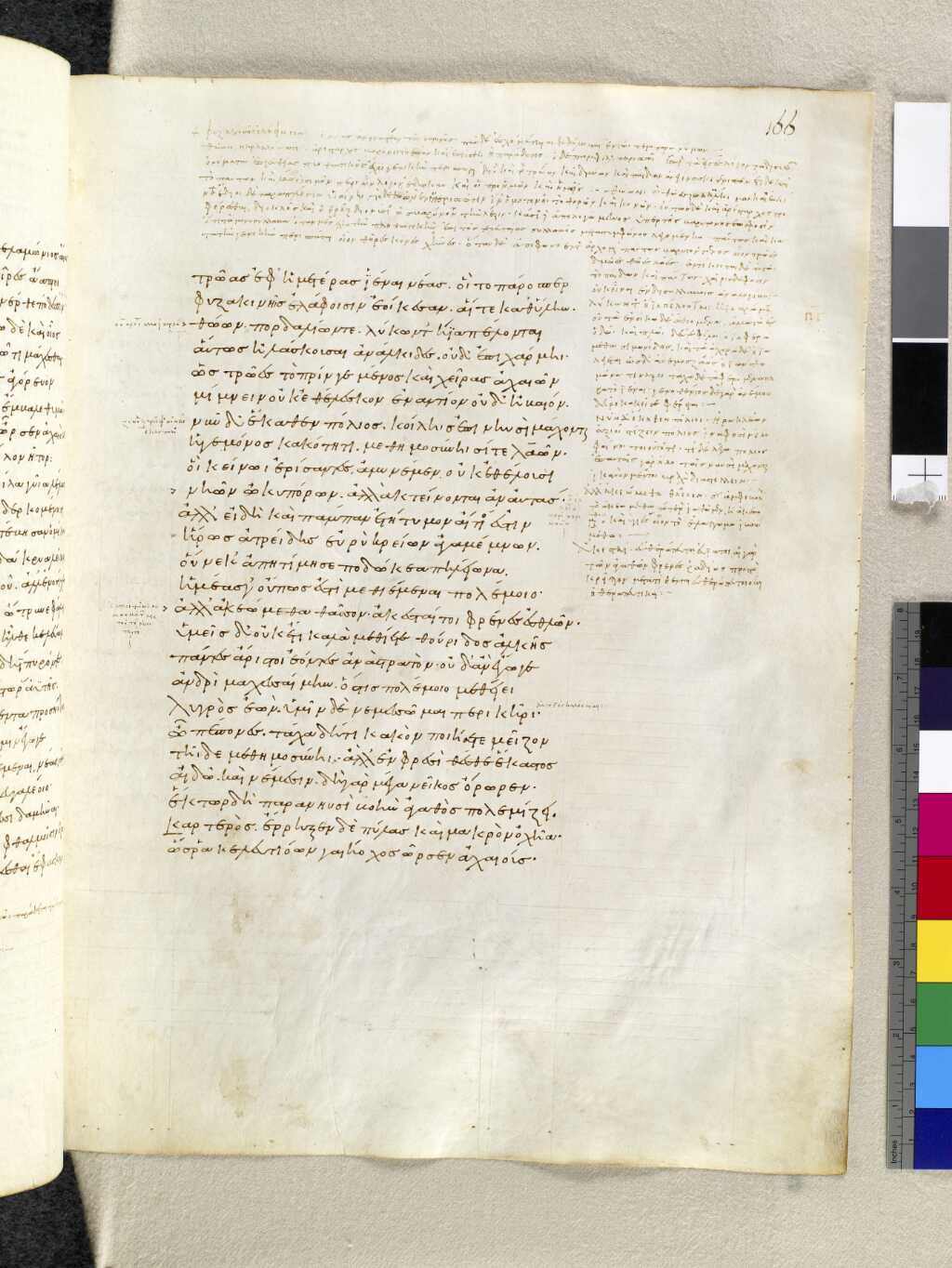
101Τρῶας ἐφʼ ἡμετέρας ἰέναι νέας, οἳ τὸ πάρος περ 102φυζακινῇς ἐλάφοισιν ἐοίκεσαν, αἵ τε καθʼ ὕλην 103θώων παρδαλίων τε λύκων τʼ ἤϊα πέλονται 104αὔτως ἠλάσκουσαι ἀνάλκιδες, οὐδʼ ἔπι χάρμη· 105ὣς Τρῶες τὸ πρίν γε μένος καὶ χεῖρας Ἀχαιῶν 106μίμνειν οὐκ ἐθέλεσκον ἐναντίον, οὐδʼ ἠβαιόν· 107νῦν δὲ ἑκὰς πόλιος κοίλῃς ἐπὶ νηυσὶ μάχονται 108ἡγεμόνος κακότητι μεθημοσύνῃσί τε λαῶν, 109οἳ κείνῳ ἐρίσαντες ἀμυνέμεν οὐκ ἐθέλουσι 110νηῶν ὠκυπόρων, ἀλλὰ κτείνονται ἀνʼ αὐτάς. 111ἀλλʼ εἰ δὴ καὶ πάμπαν ἐτήτυμον αἴτιός ἐστιν 112ἥρως Ἀτρεΐδης εὐρὺ κρείων Ἀγαμέμνων 113οὕνεκʼ ἀπητίμησε ποδώκεα Πηλεΐωνα, 114ἡμέας γʼ οὔ πως ἔστι μεθιέμεναι πολέμοιο. 115ἀλλʼ ἀκεώμεθα θᾶσσον· ἀκεσταί τοι φρένες ἐσθλῶν. 116ὑμεῖς δʼ οὐκ ἔτι καλὰ μεθίετε θούριδος ἀλκῆς 117πάντες ἄριστοι ἐόντες ἀνὰ στρατόν. οὐδʼ ἂν ἔγωγε 118ἀνδρὶ μαχεσσαίμην ὅς τις πολέμοιο μεθείη 119λυγρὸς ἐών· ὑμῖν δὲ νεμεσσῶμαι περὶ κῆρι. 120ὦ πέπονες τάχα δή τι κακὸν ποιήσετε μεῖζον 121τῇδε μεθημοσύνῃ· ἀλλʼ ἐν φρεσὶ θέσθε ἕκαστος 122αἰδῶ καὶ νέμεσιν· δὴ γὰρ μέγα νεῖκος ὄρωρεν. 123Ἕκτωρ δὴ παρὰ νηυσὶ βοὴν ἀγαθὸς πολεμίζει 124καρτερός, ἔρρηξεν δὲ πύλας καὶ μακρὸν ὀχῆα. 125ὥς ῥα κελευτιόων γαιήοχος ὦρσεν Ἀχαιούς.
First he spoke to the two Ajaxes, who were doing their best already, and said, “Ajaxes, you two can be the saving of the Achaeans if you will put out all your strength and not let yourselves be daunted. I am not afraid that the Trojans, who have got over the wall in force, will be victorious in any other part, for the Achaeans can hold all of them in check, but I much fear that some evil will befall us here where furious Hector, who boasts himself the son of great Jove himself, is leading them on like a pillar of flame. May some god, then, put it into your hearts to make a firm stand here, and to incite others to do the like. In this case you will drive him from the ships even though he be inspired by Jove himself.”
As he spoke the earth-encircling lord of the earthquake struck both of them with his sceptre and filled their hearts with daring. He made their legs light and active, as also their hands and their feet. Then, as the soaring falcon poises on the wing high above some sheer rock, and presently swoops down to chase some bird over the plain, even so did Neptune lord of the earthquake wing his flight into the air and leave them. Of the two, swift Ajax son of Oileus was the first to know who it was that had been speaking with them, and said to Ajax son of Telamon, “Ajax, this is one of the gods that dwell on Olympus, who in the likeness of the prophet is bidding us fight hard by our ships. It was not Calchas the seer and diviner of omens; I knew him at once by his feet and knees as he turned away, for the gods are soon recognised. Moreover I feel the lust of battle burn more fiercely within me, while my hands and my feet under me are more eager for the fray.”
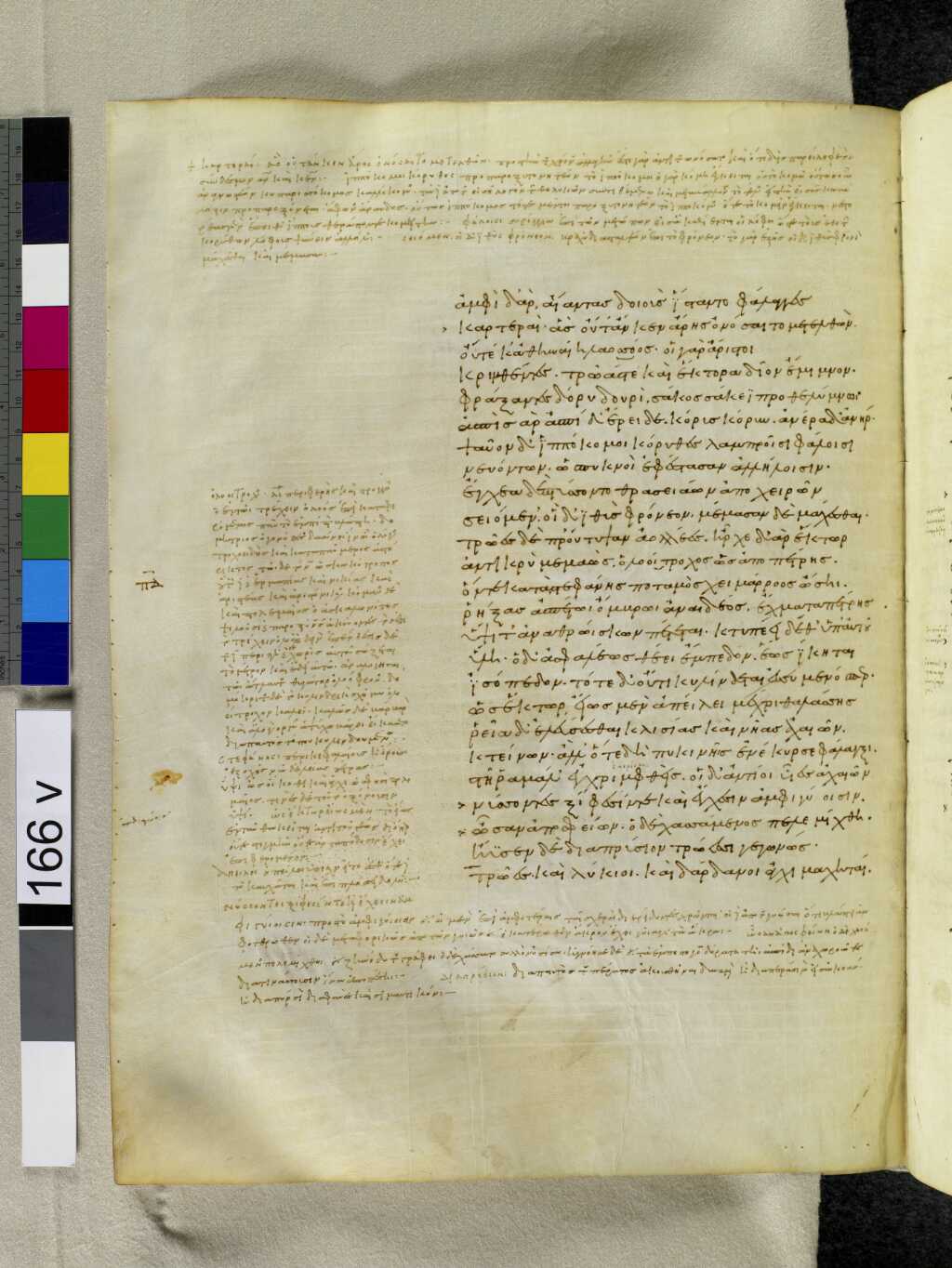
126ἀμφὶ δʼ ἄρʼ Αἴαντας δοιοὺς ἵσταντο φάλαγγες 127καρτεραί, ἃς οὔτʼ ἄν κεν Ἄρης ὀνόσαιτο μετελθὼν 128οὔτε κʼ Ἀθηναίη λαοσσόος· οἳ γὰρ ἄριστοι 129κρινθέντες Τρῶάς τε καὶ Ἕκτορα δῖον ἔμιμνον, 130φράξαντες δόρυ δουρί, σάκος σάκεϊ προθελύμνῳ· 131ἀσπὶς ἄρʼ ἀσπίδʼ ἔρειδε, κόρυς κόρυν, ἀνέρα δʼ ἀνήρ· 132ψαῦον δʼ ἱππόκομοι κόρυθες λαμπροῖσι φάλοισι 133νευόντων, ὡς πυκνοὶ ἐφέστασαν ἀλλήλοισιν· 134ἔγχεα δʼ ἐπτύσσοντο θρασειάων ἀπὸ χειρῶν 135σειόμενʼ· οἳ δʼ ἰθὺς φρόνεον, μέμασαν δὲ μάχεσθαι. 136Τρῶες δὲ προὔτυψαν ἀολλέες, ἦρχε δʼ ἄρʼ Ἕκτωρ 137ἀντικρὺ μεμαώς, ὀλοοίτροχος ὣς ἀπὸ πέτρης, 138ὅν τε κατὰ στεφάνης ποταμὸς χειμάρροος ὤσῃ 139ῥήξας ἀσπέτῳ ὄμβρῳ ἀναιδέος ἔχματα πέτρης· 140ὕψι δʼ ἀναθρῴσκων πέτεται, κτυπέει δέ θʼ ὑπʼ αὐτοῦ 141ὕλη· ὃ δʼ ἀσφαλέως θέει ἔμπεδον, εἷος ἵκηται 142ἰσόπεδον, τότε δʼ οὔ τι κυλίνδεται ἐσσύμενός περ· 143ὣς Ἕκτωρ εἷος μὲν ἀπείλει μέχρι θαλάσσης 144ῥέα διελεύσεσθαι κλισίας καὶ νῆας Ἀχαιῶν 145κτείνων· ἀλλʼ ὅτε δὴ πυκινῇς ἐνέκυρσε φάλαγξι 146στῆ ῥα μάλʼ ἐγχριμφθείς· οἳ δʼ ἀντίοι υἷες Ἀχαιῶν 147νύσσοντες ξίφεσίν τε καὶ ἔγχεσιν ἀμφιγύοισιν 148ὦσαν ἀπὸ σφείων· ὃ δὲ χασσάμενος πελεμίχθη. 149ἤϋσεν δὲ διαπρύσιον Τρώεσσι γεγωνώς· 150Τρῶες καὶ Λύκιοι καὶ Δάρδανοι ἀγχιμαχηταὶ
And Ajax son of Telamon answered, “I too feel my hands grasp my spear more firmly; my strength is greater, and my feet more nimble; I long, moreover, to meet furious Hector son of Priam, even in single combat.”
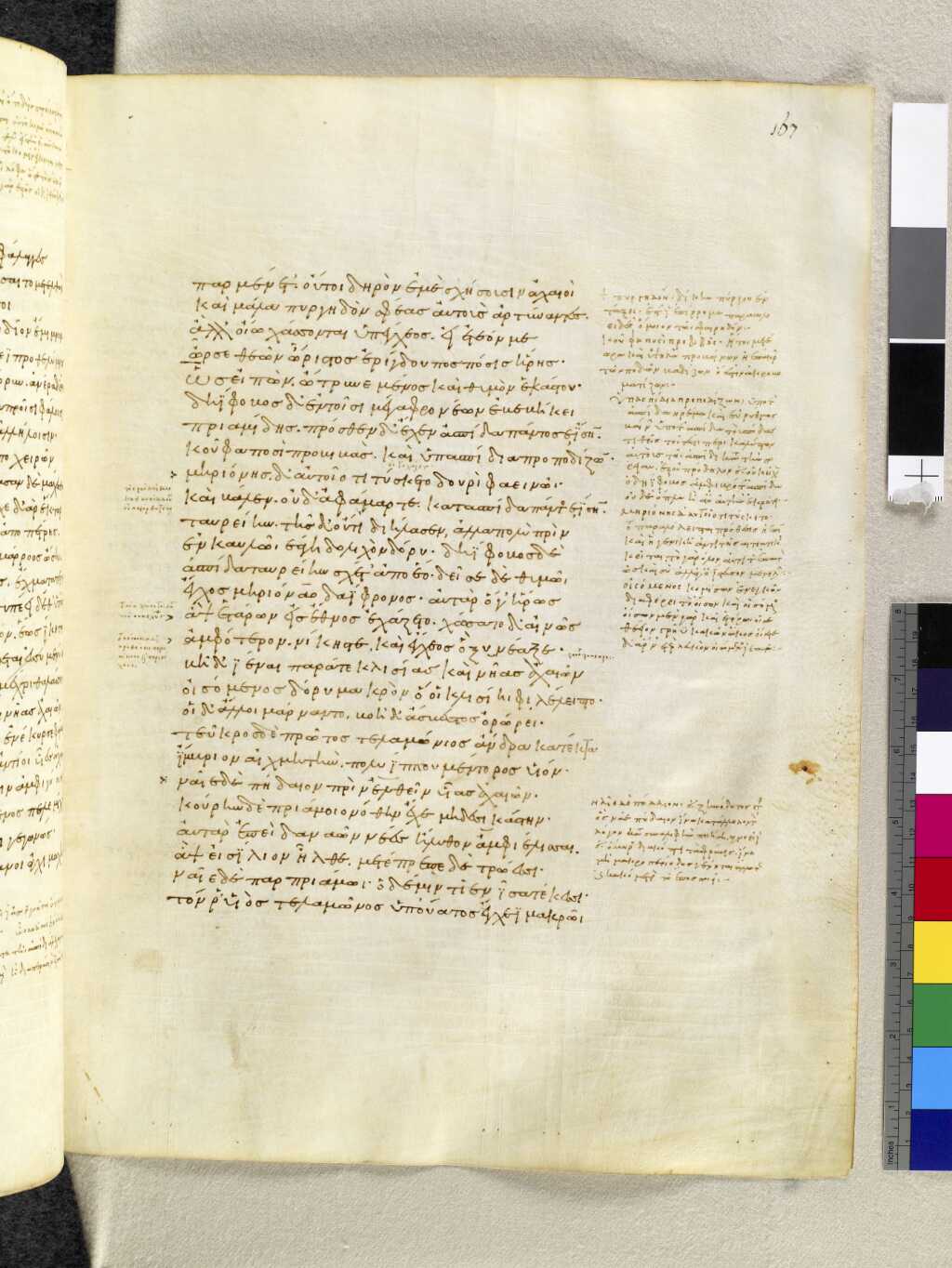
151παρμένετʼ· οὔ τοι δηρὸν ἐμὲ σχήσουσιν Ἀχαιοὶ 152καὶ μάλα πυργηδὸν σφέας αὐτοὺς ἀρτύναντες, 153ἀλλʼ ὀΐω χάσσονται ὑπʼ ἔγχεος, εἰ ἐτεόν με 154ὦρσε θεῶν ὤριστος, ἐρίγδουπος πόσις Ἥρης. 155ὣς εἰπὼν ὄτρυνε μένος καὶ θυμὸν ἑκάστου. 156Δηΐφοβος δʼ ἐν τοῖσι μέγα φρονέων ἐβεβήκει 157Πριαμίδης, πρόσθεν δʼ ἔχεν ἀσπίδα πάντοσʼ ἐΐσην 158κοῦφα ποσὶ προβιβὰς καὶ ὑπασπίδια προποδίζων. 159Μηριόνης δʼ αὐτοῖο τιτύσκετο δουρὶ φαεινῷ 160καὶ βάλεν, οὐδʼ ἀφάμαρτε, κατʼ ἀσπίδα πάντοσʼ ἐΐσην 161ταυρείην· τῆς δʼ οὔ τι διήλασεν, ἀλλὰ πολὺ πρὶν 162ἐν καυλῷ ἐάγη δολιχὸν δόρυ· Δηΐφοβος δὲ 163ἀσπίδα ταυρείην σχέθʼ ἀπὸ ἕο, δεῖσε δὲ θυμῷ 164ἔγχος Μηριόναο δαΐφρονος· αὐτὰρ ὅ γʼ ἥρως 165ἂψ ἑτάρων εἰς ἔθνος ἐχάζετο, χώσατο δʼ αἰνῶς 166ἀμφότερον, νίκης τε καὶ ἔγχεος ὃ ξυνέαξε. 167βῆ δʼ ἰέναι παρά τε κλισίας καὶ νῆας Ἀχαιῶν 168οἰσόμενος δόρυ μακρόν, ὅ οἱ κλισίηφι λέλειπτο. 169οἳ δʼ ἄλλοι μάρναντο, βοὴ δʼ ἄσβεστος ὀρώρει. 170Τεῦκρος δὲ πρῶτος Τελαμώνιος ἄνδρα κατέκτα 171Ἴμβριον αἰχμητὴν πολυΐππου Μέντορος υἱόν· 172ναῖε δὲ Πήδαιον πρὶν ἐλθεῖν υἷας Ἀχαιῶν, 173κούρην δὲ Πριάμοιο νόθην ἔχε, Μηδεσικάστην· 174αὐτὰρ ἐπεὶ Δαναῶν νέες ἤλυθον ἀμφιέλισσαι, 175ἂψ ἐς Ἴλιον ἦλθε, μετέπρεπε δὲ Τρώεσσι,
Thus did they converse, exulting in the hunger after battle with which the god had filled them. Meanwhile the earth-encircler roused the Achaeans, who were resting in the rear by the ships overcome at once by hard fighting and by grief at seeing that the Trojans had got over the wall in force. Tears began falling from their eyes as they beheld them, for they made sure that they should not escape destruction; but the lord of the earthquake passed lightly about among them and urged their battalions to the front.
First he went up to Teucer and Leitus, the hero Peneleos, and Thoas and Deipyrus; Meriones also and Antilochus, valiant warriors; all did he exhort. “Shame on you young Argives,” he cried, “it was on your prowess I relied for the saving of our ships; if you fight not with might and main, this very day will see us overcome by the Trojans. Of a truth my eyes behold a great and terrible portent which I had never thought to see—the Trojans at our ships—they, who were heretofore like panic-stricken hinds, the prey of jackals and wolves in a forest, with no strength but in flight for they cannot defend themselves. Hitherto the Trojans dared not for one moment face the attack of the Achaeans, but now they have sallied far from their city and are fighting at our very ships through the cowardice of our leader and the disaffection of the people themselves, who in their discontent care not to fight in defence of the ships but are being slaughtered near them. True, King Agamemnon son of Atreus is the cause of our disaster by having insulted the son of Peleus, still this is no reason why we should leave off fighting. Let us be quick to heal, for the hearts of the brave heal quickly. You do ill to be thus remiss, you, who are the finest soldiers in our whole army. I blame no man for keeping out of battle if he is a weakling, but I am indignant with such men as you are. My good friends, matters will soon become even worse through this slackness; think, each one of you, of his own honour and credit, for the hazard of the fight is extreme. Great Hector is now fighting at our ships; he has broken through the gates and the strong bolt that held them.”
176ναῖε δὲ πὰρ Πριάμῳ· ὃ δέ μιν τίεν ἶσα τέκεσσι. 177τόν ῥʼ υἱὸς Τελαμῶνος ὑπʼ οὔατος ἔγχεϊ μακρῷ 178νύξʼ, ἐκ δʼ ἔσπασεν ἔγχος· ὃ δʼ αὖτʼ ἔπεσεν μελίη ὣς 179ἥ τʼ ὄρεος κορυφῇ ἕκαθεν περιφαινομένοιο 180χαλκῷ ταμνομένη τέρενα χθονὶ φύλλα πελάσσῃ· 181ὣς πέσεν, ἀμφὶ δέ οἱ βράχε τεύχεα ποικίλα χαλκῷ. 182Τεῦκρος δʼ ὁρμήθη μεμαὼς ἀπὸ τεύχεα δῦσαι· 183Ἕκτωρ δʼ ὁρμηθέντος ἀκόντισε δουρὶ φαεινῷ. 184ἀλλʼ ὃ μὲν ἄντα ἰδὼν ἠλεύατο χάλκεον ἔγχος 185τυτθόν· ὃ δʼ Ἀμφίμαχον Κτεάτου υἷʼ Ἀκτορίωνος 186νισόμενον πόλεμον δὲ κατὰ στῆθος βάλε δουρί· 187δούπησεν δὲ πεσών, ἀράβησε δὲ τεύχεʼ ἐπʼ αὐτῷ. 188Ἕκτωρ δʼ ὁρμήθη κόρυθα κροτάφοις ἀραρυῖαν 189κρατὸς ἀφαρπάξαι μεγαλήτορος Ἀμφιμάχοιο· 190Αἴας δʼ ὁρμηθέντος ὀρέξατο δουρὶ φαεινῷ 191Ἕκτορος· ἀλλʼ οὔ πῃ χροὸς εἴσατο, πᾶς δʼ ἄρα χαλκῷ 192σμερδαλέῳ κεκάλυφθʼ· ὃ δʼ ἄρʼ ἀσπίδος ὀμφαλὸν οὖτα, 193ὦσε δέ μιν σθένεϊ μεγάλῳ· ὃ δὲ χάσσατʼ ὀπίσσω 194νεκρῶν ἀμφοτέρων, τοὺς δʼ ἐξείρυσσαν Ἀχαιοί. 195Ἀμφίμαχον μὲν ἄρα Στιχίος δῖός τε Μενεσθεὺς 196ἀρχοὶ Ἀθηναίων κόμισαν μετὰ λαὸν Ἀχαιῶν· 197Ἴμβριον αὖτʼ Αἴαντε μεμαότε θούριδος ἀλκῆς 198ὥς τε δύʼ αἶγα λέοντε κυνῶν ὕπο καρχαροδόντων 199ἁρπάξαντε φέρητον ἀνὰ ῥωπήϊα πυκνὰ 200ὑψοῦ ὑπὲρ γαίης μετὰ γαμφηλῇσιν ἔχοντε,
Thus did the earth-encircler address the Achaeans and urge them on. Thereon round the two Ajaxes there gathered strong bands of men, of whom not even Mars nor Minerva, marshaller of hosts could make light if they went among them, for they were the picked men of all those who were now awaiting the onset of Hector and the Trojans. They made a living fence, spear to spear, shield to shield, buckler to buckler, helmet to helmet, and man to man. The horse-hair crests on their gleaming helmets touched one another as they nodded forward, so closely serried were they; the spears they brandished in their strong hands were interlaced, and their hearts were set on battle.
The Trojans advanced in a dense body, with Hector at their head pressing right on as a rock that comes thundering down the side of some mountain from whose brow the winter torrents have torn it; the foundations of the dull thing have been loosened by floods of rain, and as it bounds headlong on its way it sets the whole forest in an uproar; it swerves neither to right nor left till it reaches level ground, but then for all its fury it can go no further—even so easily did Hector for a while seem as though he would career through the tents and ships of the Achaeans till he had reached the sea in his murderous course; but the closely serried battalions stayed him when he reached them, for the sons of the Achaeans thrust at him with swords and spears pointed at both ends, and drove him from them so that he staggered and gave ground; thereon he shouted to the Trojans, “Trojans, Lycians, and Dardanians, fighters in close combat, stand firm: the Achaeans have set themselves as a wall against me, but they will not check me for long; they will give ground before me if the mightiest of the gods, the thundering spouse of Juno, has indeed inspired my onset.”
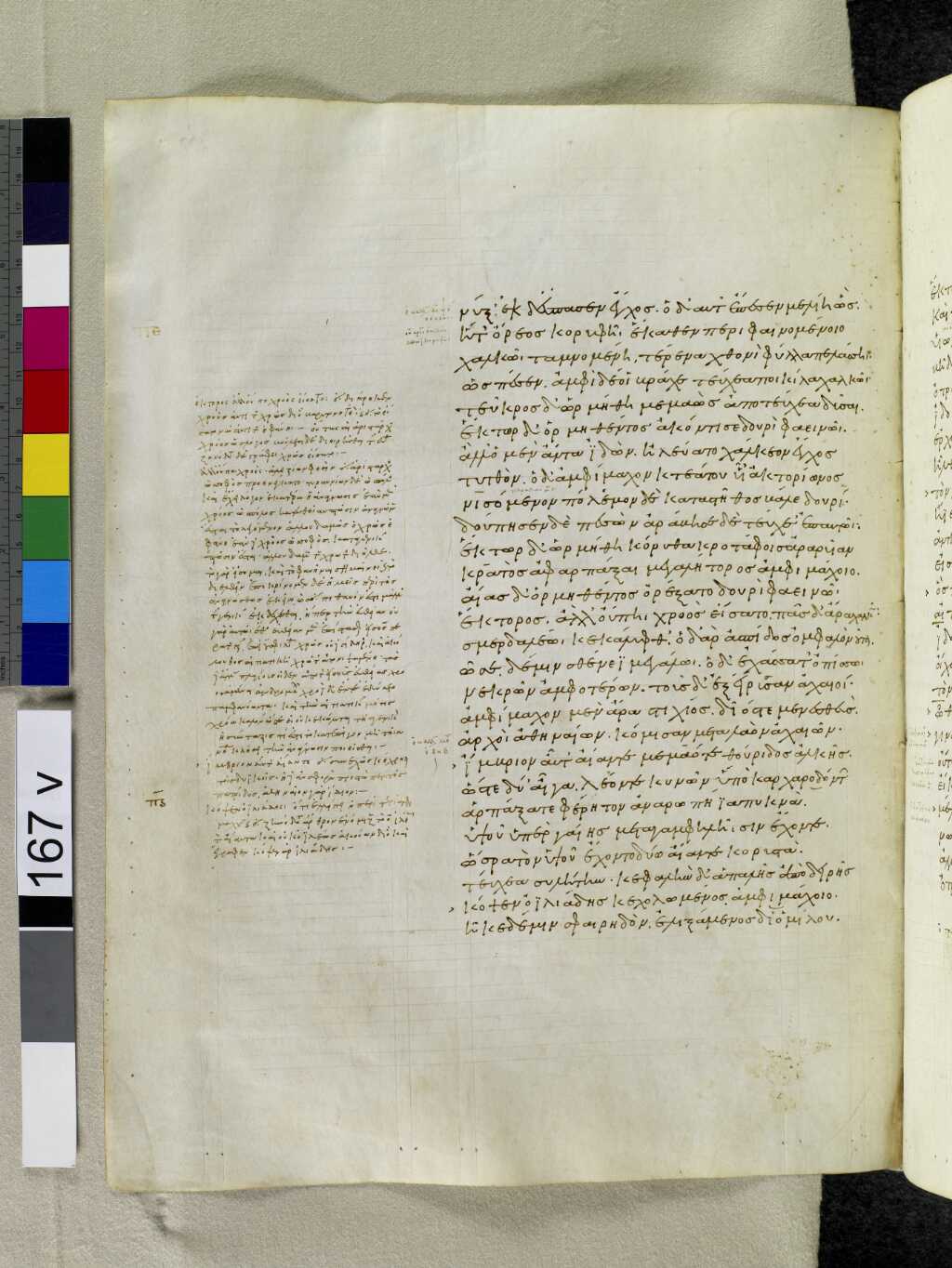
201ὥς ῥα τὸν ὑψοῦ ἔχοντε δύω Αἴαντε κορυστὰ 202τεύχεα συλήτην· κεφαλὴν δʼ ἁπαλῆς ἀπὸ δειρῆς 203κόψεν Ὀϊλιάδης κεχολωμένος Ἀμφιμάχοιο, 204ἧκε δέ μιν σφαιρηδὸν ἑλιξάμενος διʼ ὁμίλου· 205Ἕκτορι δὲ προπάροιθε ποδῶν πέσεν ἐν κονίῃσι. 206καὶ τότε δὴ περὶ κῆρι Ποσειδάων ἐχολώθη 207υἱωνοῖο πεσόντος ἐν αἰνῇ δηϊοτῆτι, 208βῆ δʼ ἰέναι παρά τε κλισίας καὶ νῆας Ἀχαιῶν 209ὀτρυνέων Δαναούς, Τρώεσσι δὲ κήδεα τεῦχεν. 210Ἰδομενεὺς δʼ ἄρα οἱ δουρικλυτὸς ἀντεβόλησεν 211ἐρχόμενος παρʼ ἑταίρου, ὅ οἱ νέον ἐκ πολέμοιο 212ἦλθε κατʼ ἰγνύην βεβλημένος ὀξέϊ χαλκῷ. 213τὸν μὲν ἑταῖροι ἔνεικαν, ὃ δʼ ἰητροῖς ἐπιτείλας 214ἤϊεν ἐς κλισίην· ἔτι γὰρ πολέμοιο μενοίνα 215ἀντιάαν· τὸν δὲ προσέφη κρείων ἐνοσίχθων 216εἰσάμενος φθογγὴν Ἀνδραίμονος υἷϊ Θόαντι 217ὃς πάσῃ Πλευρῶνι καὶ αἰπεινῇ Καλυδῶνι 218Αἰτωλοῖσιν ἄνασσε, θεὸς δʼ ὣς τίετο δήμῳ· 219Ἰδομενεῦ Κρητῶν βουληφόρε ποῦ τοι ἀπειλαὶ 220οἴχονται, τὰς Τρωσὶν ἀπείλεον υἷες Ἀχαιῶν; 221τὸν δʼ αὖτʼ Ἰδομενεὺς Κρητῶν ἀγὸς ἀντίον ηὔδα· 222ὦ Θόαν οὔ τις ἀνὴρ νῦν γʼ αἴτιος, ὅσσον ἔγωγε 223γιγνώσκω· πάντες γὰρ ἐπιστάμεθα πτολεμίζειν. 224οὔτέ τινα δέος ἴσχει ἀκήριον οὔτέ τις ὄκνῳ 225εἴκων ἀνδύεται πόλεμον κακόν· ἀλλά που οὕτω
With these words he put heart and soul into them all. Deiphobus son of Priam went about among them intent on deeds of daring with his round shield before him, under cover of which he strode quickly forward. Meriones took aim at him with a spear, nor did he fail to hit the broad orb of ox-hide; but he was far from piercing it for the spear broke in two pieces long ere he could do so; moreover Deiphobus had seen it coming and had held his shield well away from him. Meriones drew back under cover of his comrades, angry alike at having failed to vanquish Deiphobus, and having broken his spear. He turned therefore towards the ships and tents to fetch a spear which he had left behind in his tent.
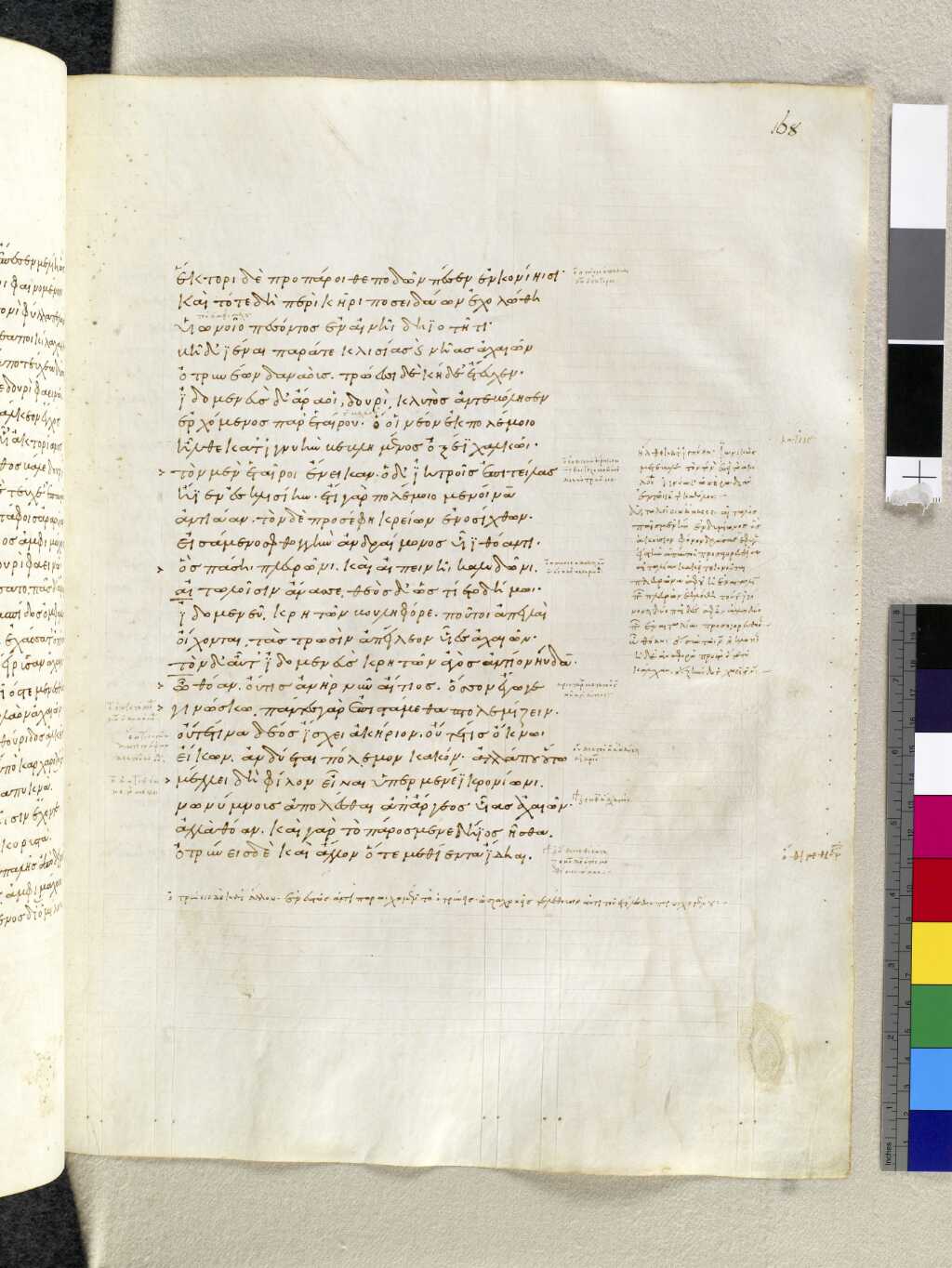
226μέλλει δὴ φίλον εἶναι ὑπερμενέϊ Κρονίωνι 227νωνύμνους ἀπολέσθαι ἀπʼ Ἄργεος ἐνθάδʼ Ἀχαιούς. 228ἀλλὰ Θόαν, καὶ γὰρ τὸ πάρος μενεδήϊος ἦσθα, 229ὀτρύνεις δὲ καὶ ἄλλον ὅθι μεθιέντα ἴδηαι· 230τὼ νῦν μήτʼ ἀπόληγε κέλευέ τε φωτὶ ἑκάστῳ. 231τὸν δʼ ἠμείβετʼ ἔπειτα Ποσειδάων ἐνοσίχθων· 232Ἰδομενεῦ μὴ κεῖνος ἀνὴρ ἔτι νοστήσειεν 233ἐκ Τροίης, ἀλλʼ αὖθι κυνῶν μέλπηθρα γένοιτο, 234ὅς τις ἐπʼ ἤματι τῷδε ἑκὼν μεθίῃσι μάχεσθαι. 235ἀλλʼ ἄγε τεύχεα δεῦρο λαβὼν ἴθι· ταῦτα δʼ ἅμα χρὴ 236σπεύδειν, αἴ κʼ ὄφελός τι γενώμεθα καὶ δύʼ ἐόντε. 237συμφερτὴ δʼ ἀρετὴ πέλει ἀνδρῶν καὶ μάλα λυγρῶν, 238νῶϊ δὲ καί κʼ ἀγαθοῖσιν ἐπισταίμεσθα μάχεσθαι. 239ὣς εἰπὼν ὃ μὲν αὖτις ἔβη θεὸς ἂμ πόνον ἀνδρῶν· 240Ἰδομενεὺς δʼ ὅτε δὴ κλισίην εὔτυκτον ἵκανε 241δύσετο τεύχεα καλὰ περὶ χροΐ, γέντο δὲ δοῦρε, 242βῆ δʼ ἴμεν ἀστεροπῇ ἐναλίγκιος, ἥν τε Κρονίων 243χειρὶ λαβὼν ἐτίναξεν ἀπʼ αἰγλήεντος Ὀλύμπου 244δεικνὺς σῆμα βροτοῖσιν· ἀρίζηλοι δέ οἱ αὐγαί· 245ὣς τοῦ χαλκὸς ἔλαμπε περὶ στήθεσσι θέοντος. 246Μηριόνης δʼ ἄρα οἱ θεράπων ἐῢς ἀντεβόλησεν 247ἐγγὺς ἔτι κλισίης· μετὰ γὰρ δόρυ χάλκεον ᾔει 248οἰσόμενος· τὸν δὲ προσέφη σθένος Ἰδομενῆος· 249Μηριόνη Μόλου υἱὲ πόδας ταχὺ φίλταθʼ ἑταίρων 250τίπτʼ ἦλθες πόλεμόν τε λιπὼν καὶ δηϊοτῆτα;
The others continued fighting, and the cry of battle rose up into the heavens. Teucer son of Telamon was the first to kill his man, to wit, the warrior Imbrius, son of Mentor, rich in horses. Until the Achaeans came he had lived in Pedaeum, and had married Medesicaste, a bastard daughter of Priam; but on the arrival of the Danaan fleet he had gone back to Ilius, and was a great man among the Trojans, dwelling near Priam himself, who gave him like honour with his own sons. The son of Telamon now struck him under the ear with a spear which he then drew back again, and Imbrius fell headlong as an ash-tree when it is felled on the crest of some high mountain beacon, and its delicate green foliage comes toppling down to the ground. Thus did he fall with his bronze-dight armour ringing harshly round him, and Teucer sprang forward with intent to strip him of his armour; but as he was doing so, Hector took aim at him with a spear. Teucer saw the spear coming and swerved aside, whereon it hit Amphimachus, son of Cteatus son of Actor, in the chest as he was coming into battle, and his armour rang rattling round him as he fell heavily to the ground. Hector sprang forward to take Amphimachus’s helmet from off his temples, and in a moment Ajax threw a spear at him, but did not wound him, for he was encased all over in his terrible armour; nevertheless the spear struck the boss of his shield with such force as to drive him back from the two corpses, which the Achaeans then drew off. Stichius and Menestheus, captains of the Athenians, bore away Amphimachus to the host of the Achaeans, while the two brave and impetuous Ajaxes did the like by Imbrius. As two lions snatch a goat from the hounds that have it in their fangs, and bear it through thick brushwood high above the ground in their jaws, thus did the Ajaxes bear aloft the body of Imbrius, and strip it of its armour. Then the son of Oileus severed the head from the neck in revenge for the death of Amphimachus, and sent it whirling over the crowd as though it had been a ball, till it fell in the dust at Hector’s feet.
Neptune was exceedingly angry that his grandson Amphimachus should have fallen; he therefore went to the tents and ships of the Achaeans to urge the Danaans still further, and to devise evil for the Trojans. Idomeneus met him, as he was taking leave of a comrade, who had just come to him from the fight, wounded in the knee. His fellow-soldiers bore him off the field, and Idomeneus having given orders to the physicians went on to his tent, for he was still thirsting for battle. Neptune spoke in the likeness and with the voice of Thoas son of Andraemon who ruled the Aetolians of all Pleuron and high Calydon, and was honoured among his people as though he were a god. “Idomeneus,” said he, “lawgiver to the Cretans, what has now become of the threats with which the sons of the Achaeans used to threaten the Trojans?”
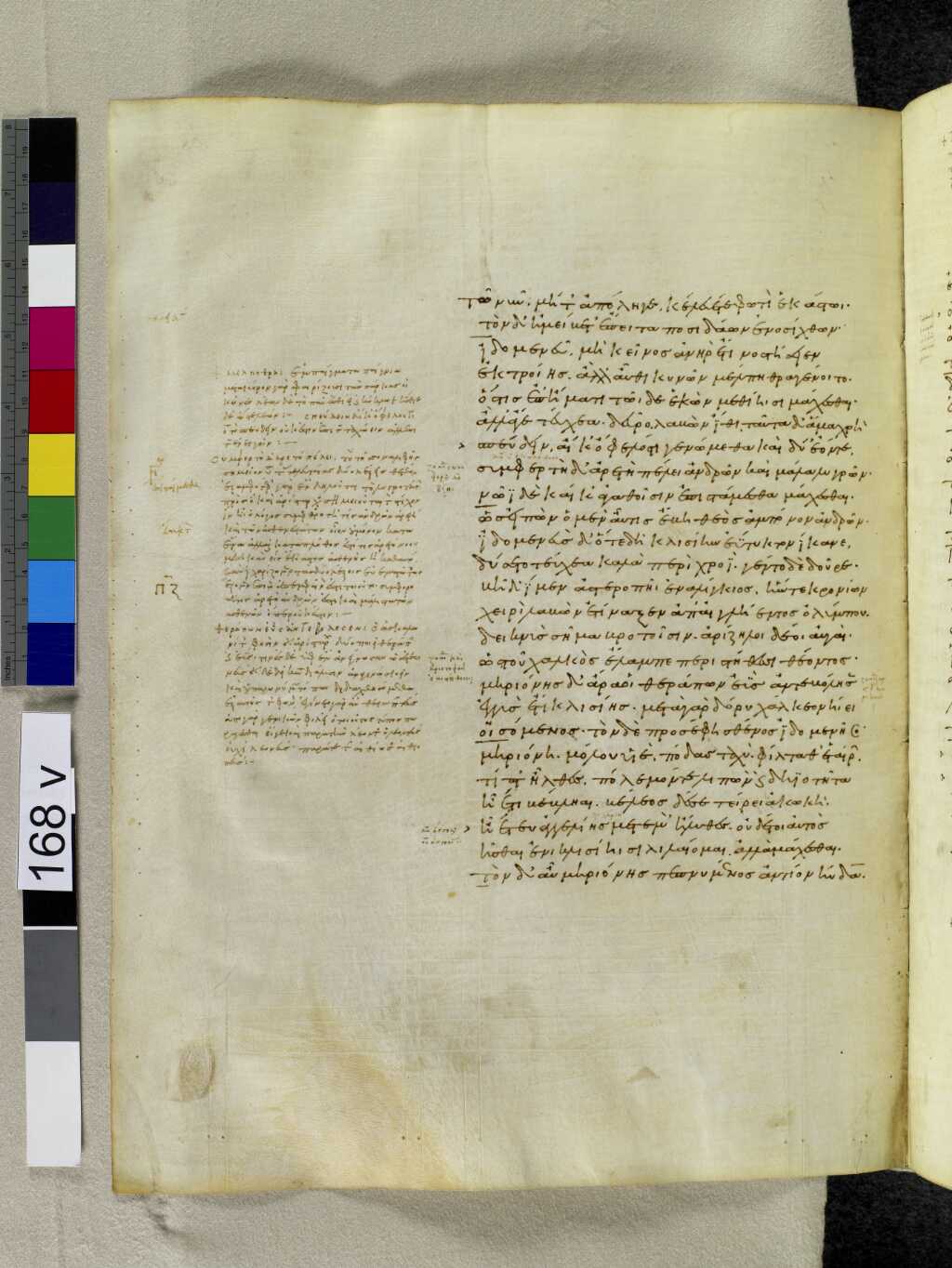
251ἠέ τι βέβληαι, βέλεος δέ σε τείρει ἀκωκή, 252ἦέ τευ ἀγγελίης μετʼ ἔμʼ ἤλυθες; οὐδέ τοι αὐτὸς 253ἧσθαι ἐνὶ κλισίῃσι λιλαίομαι, ἀλλὰ μάχεσθαι. 254τὸν δʼ αὖ Μηριόνης πεπνυμένος ἀντίον ηὔδα· 255Ἰδομενεῦ, Κρητῶν βουληφόρε χαλκοχιτώνων, 256ἔρχομαι εἴ τί τοι ἔγχος ἐνὶ κλισίῃσι λέλειπται 257οἰσόμενος· τό νυ γὰρ κατεάξαμεν ὃ πρὶν ἔχεσκον 258ἀσπίδα Δηϊφόβοιο βαλὼν ὑπερηνορέοντος. 259τὸν δʼ αὖτʼ Ἰδομενεὺς Κρητῶν ἀγὸς ἀντίον ηὔδα· 260δούρατα δʼ αἴ κʼ ἐθέλῃσθα καὶ ἓν καὶ εἴκοσι δήεις 261ἑσταότʼ ἐν κλισίῃ πρὸς ἐνώπια παμφανόωντα 262Τρώϊα, τὰ κταμένων ἀποαίνυμαι· οὐ γὰρ ὀΐω 263ἀνδρῶν δυσμενέων ἑκὰς ἱστάμενος πολεμίζειν. 264τώ μοι δούρατά τʼ ἔστι καὶ ἀσπίδες ὀμφαλόεσσαι 265καὶ κόρυθες καὶ θώρηκες λαμπρὸν γανόωντες. 266τὸν δʼ αὖ Μηριόνης πεπνυμένος ἀντίον ηὔδα· 267καί τοι ἐμοὶ παρά τε κλισίῃ καὶ νηῒ μελαίνῃ 268πόλλʼ ἔναρα Τρώων· ἀλλʼ οὐ σχεδόν ἐστιν ἑλέσθαι. 269οὐδὲ γὰρ οὐδʼ ἐμέ φημι λελασμένον ἔμμεναι ἀλκῆς, 270ἀλλὰ μετὰ πρώτοισι μάχην ἀνὰ κυδιάνειραν 271ἵσταμαι, ὁππότε νεῖκος ὀρώρηται πολέμοιο. 272ἄλλόν πού τινα μᾶλλον Ἀχαιῶν χαλκοχιτώνων 273λήθω μαρνάμενος, σὲ δὲ ἴδμεναι αὐτὸν ὀΐω. 274τὸν δʼ αὖτʼ Ἰδομενεὺς Κρητῶν ἀγὸς ἀντίον ηὔδα· 275οἶδʼ ἀρετὴν οἷός ἐσσι· τί σε χρὴ ταῦτα λέγεσθαι;
And Idomeneus chief among the Cretans answered, “Thoas, no one, so far as I know, is in fault, for we can all fight. None are held back neither by fear nor slackness, but it seems to be the will of almighty Jove that the Achaeans should perish ingloriously here far from Argos: you, Thoas, have been always staunch, and you keep others in heart if you see any fail in duty; be not then remiss now, but exhort all to do their utmost.”
To this Neptune lord of the earthquake made answer, “Idomeneus, may he never return from Troy, but remain here for dogs to batten upon, who is this day wilfully slack in fighting. Get your armour and go, we must make all haste together if we may be of any use, though we are only two. Even cowards gain courage from companionship, and we two can hold our own with the bravest.”
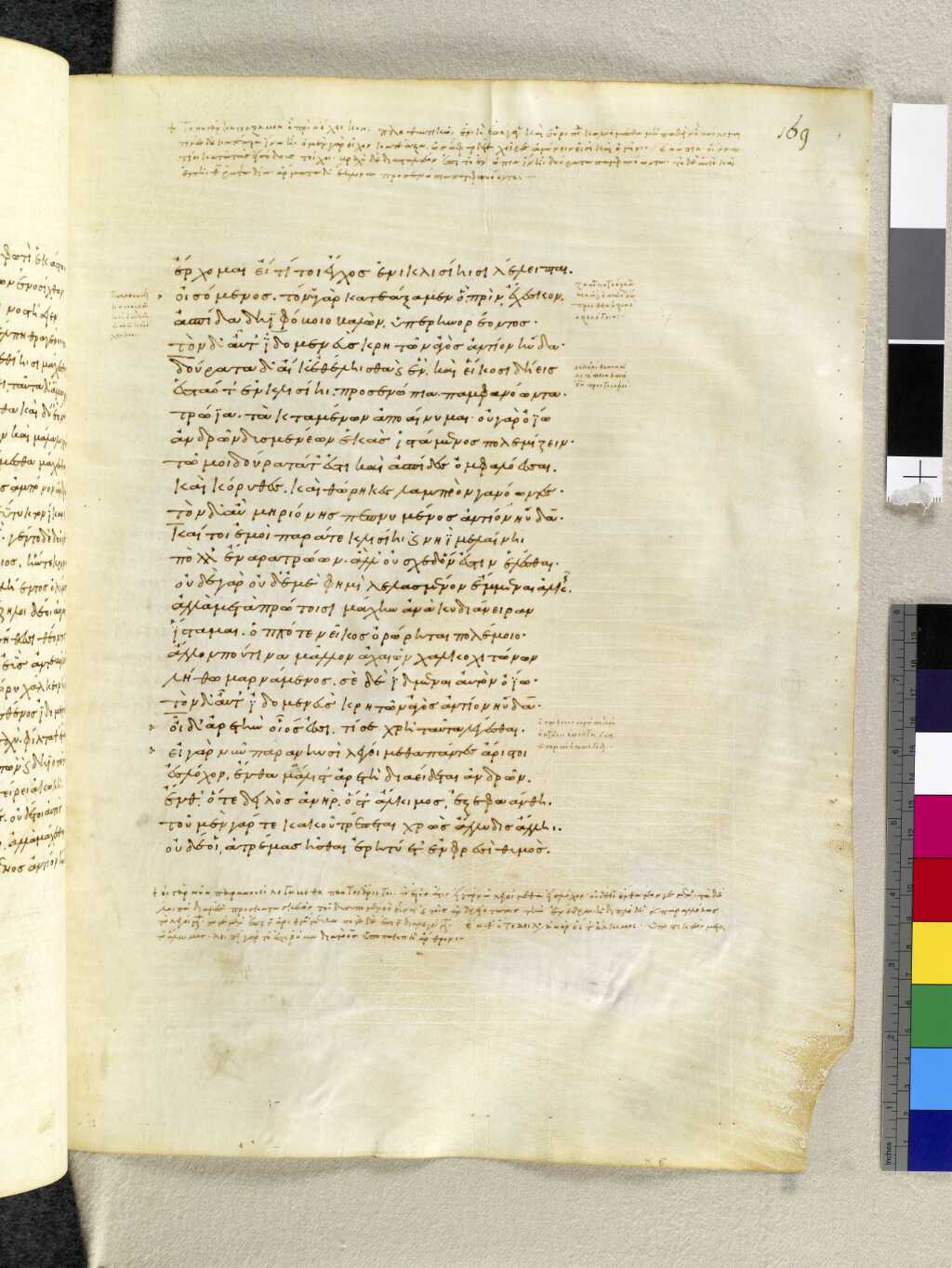
276εἰ γὰρ νῦν παρὰ νηυσὶ λεγοίμεθα πάντες ἄριστοι 277ἐς λόχον, ἔνθα μάλιστʼ ἀρετὴ διαείδεται ἀνδρῶν, 278ἔνθʼ ὅ τε δειλὸς ἀνὴρ ὅς τʼ ἄλκιμος ἐξεφαάνθη· 279τοῦ μὲν γάρ τε κακοῦ τρέπεται χρὼς ἄλλυδις ἄλλῃ, 280οὐδέ οἱ ἀτρέμας ἧσθαι ἐρητύετʼ ἐν φρεσὶ θυμός, 281ἀλλὰ μετοκλάζει καὶ ἐπʼ ἀμφοτέρους πόδας ἵζει, 282ἐν δέ τέ οἱ κραδίη μεγάλα στέρνοισι πατάσσει 283κῆρας ὀϊομένῳ, πάταγος δέ τε γίγνετʼ ὀδόντων· 284τοῦ δʼ ἀγαθοῦ οὔτʼ ἂρ τρέπεται χρὼς οὔτέ τι λίην 285ταρβεῖ, ἐπειδὰν πρῶτον ἐσίζηται λόχον ἀνδρῶν, 286ἀρᾶται δὲ τάχιστα μιγήμεναι ἐν δαῒ λυγρῇ· 287οὐδέ κεν ἔνθα τεόν γε μένος καὶ χεῖρας ὄνοιτο. 288εἴ περ γάρ κε βλεῖο πονεύμενος ἠὲ τυπείης 289οὐκ ἂν ἐν αὐχένʼ ὄπισθε πέσοι βέλος οὐδʼ ἐνὶ νώτῳ, 290ἀλλά κεν ἢ στέρνων ἢ νηδύος ἀντιάσειε 291πρόσσω ἱεμένοιο μετὰ προμάχων ὀαριστύν. 292ἀλλʼ ἄγε μηκέτι ταῦτα λεγώμεθα νηπύτιοι ὣς 293ἑσταότες, μή πού τις ὑπερφιάλως νεμεσήσῃ· 294ἀλλὰ σύ γε κλισίην δὲ κιὼν ἕλευ ὄβριμον ἔγχος. 295ὣς φάτο, Μηριόνης δὲ θοῷ ἀτάλαντος Ἄρηϊ 296καρπαλίμως κλισίηθεν ἀνείλετο χάλκεον ἔγχος, 297βῆ δὲ μετʼ Ἰδομενῆα μέγα πτολέμοιο μεμηλώς. 298οἷος δὲ βροτολοιγὸς Ἄρης πόλεμον δὲ μέτεισι, 299τῷ δὲ Φόβος φίλος υἱὸς ἅμα κρατερὸς καὶ ἀταρβὴς 300ἕσπετο, ὅς τʼ ἐφόβησε ταλάφρονά περ πολεμιστήν·
Therewith the god went back into the thick of the fight, and Idomeneus when he had reached his tent donned his armour, grasped his two spears, and sallied forth. As the lightning which the son of Saturn brandishes from bright Olympus when he would show a sign to mortals, and its gleam flashes far and wide—even so did his armour gleam about him as he ran. Meriones his sturdy squire met him while he was still near his tent (for he was going to fetch his spear) and Idomeneus said:
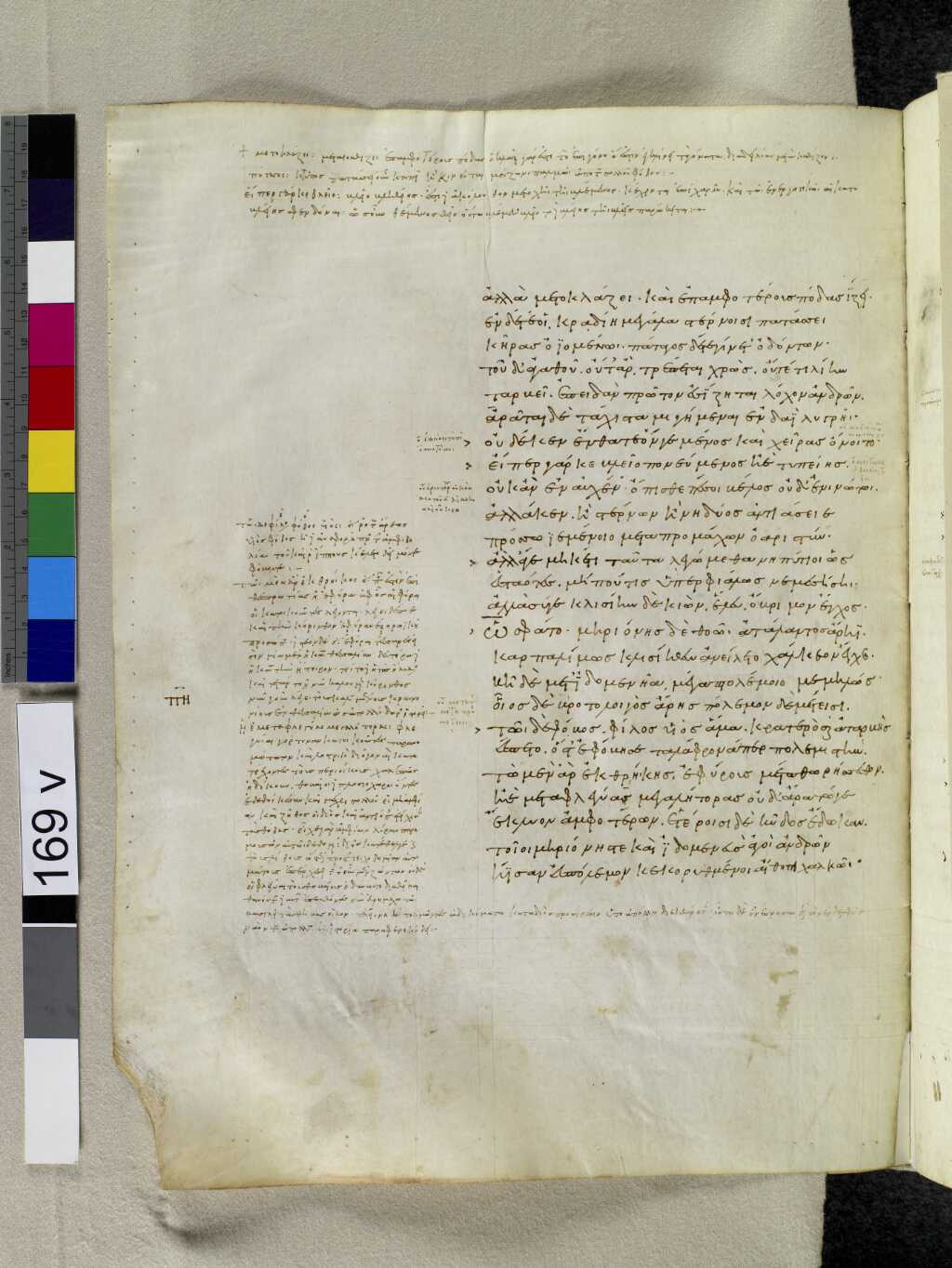
301τὼ μὲν ἄρʼ ἐκ Θρῄκης Ἐφύρους μέτα θωρήσσεσθον, 302ἠὲ μετὰ Φλεγύας μεγαλήτορας· οὐδʼ ἄρα τώ γε 303ἔκλυον ἀμφοτέρων, ἑτέροισι δὲ κῦδος ἔδωκαν· 304τοῖοι Μηριόνης τε καὶ Ἰδομενεὺς ἀγοὶ ἀνδρῶν 305ἤϊσαν ἐς πόλεμον κεκορυθμένοι αἴθοπι χαλκῷ. 306τὸν καὶ Μηριόνης πρότερος πρὸς μῦθον ἔειπε· 307Δευκαλίδη πῇ τὰρ μέμονας καταδῦναι ὅμιλον; 308ἢ ἐπὶ δεξιόφιν παντὸς στρατοῦ, ἦ ἀνὰ μέσσους, 309ἦ ἐπʼ ἀριστερόφιν; ἐπεὶ οὔ ποθι ἔλπομαι οὕτω 310δεύεσθαι πολέμοιο κάρη κομόωντας Ἀχαιούς. 311τὸν δʼ αὖτʼ Ἰδομενεὺς Κρητῶν ἀγὸς ἀντίον ηὔδα· 312νηυσὶ μὲν ἐν μέσσῃσιν ἀμύνειν εἰσὶ καὶ ἄλλοι 313Αἴαντές τε δύω Τεῦκρός θʼ, ὃς ἄριστος Ἀχαιῶν 314τοξοσύνῃ, ἀγαθὸς δὲ καὶ ἐν σταδίῃ ὑσμίνῃ· 315οἵ μιν ἅδην ἐλόωσι καὶ ἐσσύμενον πολέμοιο 316Ἕκτορα Πριαμίδην, καὶ εἰ μάλα καρτερός ἐστιν. 317αἰπύ οἱ ἐσσεῖται μάλα περ μεμαῶτι μάχεσθαι 318κείνων νικήσαντι μένος καὶ χεῖρας ἀάπτους 319νῆας ἐνιπρῆσαι, ὅτε μὴ αὐτός γε Κρονίων 320ἐμβάλοι αἰθόμενον δαλὸν νήεσσι θοῇσιν. 321ἀνδρὶ δέ κʼ οὐκ εἴξειε μέγας Τελαμώνιος Αἴας, 322ὃς θνητός τʼ εἴη καὶ ἔδοι Δημήτερος ἀκτὴν 323χαλκῷ τε ῥηκτὸς μεγάλοισί τε χερμαδίοισιν. 324οὐδʼ ἂν Ἀχιλλῆϊ ῥηξήνορι χωρήσειεν 325ἔν γʼ αὐτοσταδίῃ· ποσὶ δʼ οὔ πως ἔστιν ἐρίζειν.
“Meriones, fleet son of Molus, best of comrades, why have you left the field? Are you wounded, and is the point of the weapon hurting you? or have you been sent to fetch me? I want no fetching; I had far rather fight than stay in my tent.”
“Idomeneus,” answered Meriones, “I come for a spear, if I can find one in my tent; I have broken the one I had, in throwing it at the shield of Deiphobus.”
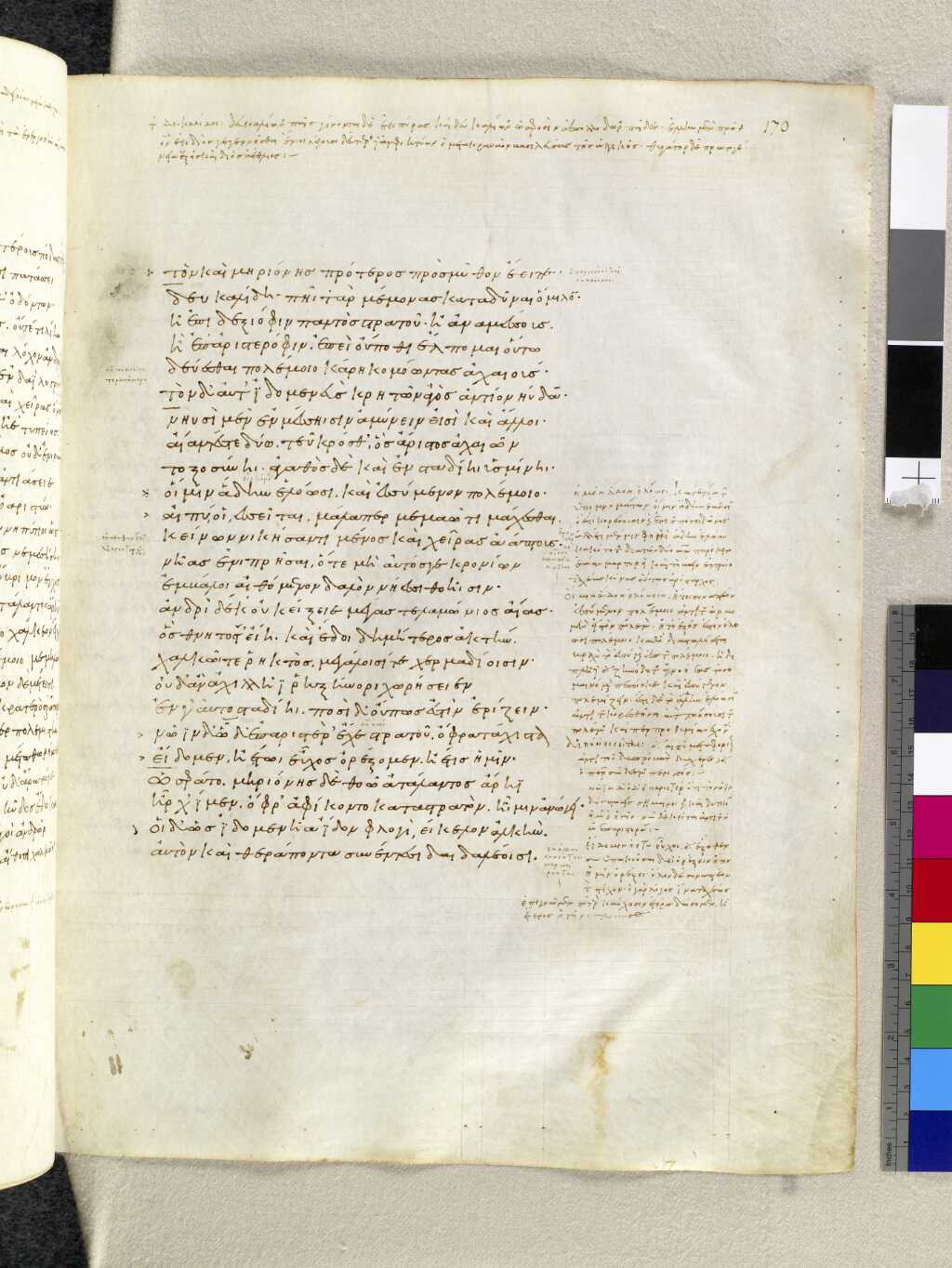
326νῶϊν δʼ ὧδʼ ἐπʼ ἀριστέρʼ ἔχε στρατοῦ, ὄφρα τάχιστα 327εἴδομεν ἠέ τῳ εὖχος ὀρέξομεν, ἦέ τις ἡμῖν. 328ὣς φάτο, Μηριόνης δὲ θοῷ ἀτάλαντος Ἄρηϊ 329ἦρχʼ ἴμεν, ὄφρʼ ἀφίκοντο κατὰ στρατὸν ᾗ μιν ἀνώγει, 330οἳ δʼ ὡς Ἰδομενῆα ἴδον φλογὶ εἴκελον ἀλκὴν 331αὐτὸν καὶ θεράποντα σὺν ἔντεσι δαιδαλέοισι, 332κεκλόμενοι καθʼ ὅμιλον ἐπʼ αὐτῷ πάντες ἔβησαν· 333τῶν δʼ ὁμὸν ἵστατο νεῖκος ἐπὶ πρυμνῇσι νέεσσιν. 334ὡς δʼ ὅθʼ ὑπὸ λιγέων ἀνέμων σπέρχωσιν ἄελλαι 335ἤματι τῷ ὅτε τε πλείστη κόνις ἀμφὶ κελεύθους, 336οἵ τʼ ἄμυδις κονίης μεγάλην ἱστᾶσιν ὀμίχλην, 337ὣς ἄρα τῶν ὁμόσʼ ἦλθε μάχη, μέμασαν δʼ ἐνὶ θυμῷ 338ἀλλήλους καθʼ ὅμιλον ἐναιρέμεν ὀξέϊ χαλκῷ. 339ἔφριξεν δὲ μάχη φθισίμβροτος ἐγχείῃσι 340μακρῇς, ἃς εἶχον ταμεσίχροας· ὄσσε δʼ ἄμερδεν 341αὐγὴ χαλκείη κορύθων ἄπο λαμπομενάων 342θωρήκων τε νεοσμήκτων σακέων τε φαεινῶν 343ἐρχομένων ἄμυδις· μάλα κεν θρασυκάρδιος εἴη 344ὃς τότε γηθήσειεν ἰδὼν πόνον οὐδʼ ἀκάχοιτο. 345τὼ δʼ ἀμφὶς φρονέοντε δύω Κρόνου υἷε κραταιὼ 346ἀνδράσιν ἡρώεσσιν ἐτεύχετον ἄλγεα λυγρά. 347Ζεὺς μέν ῥα Τρώεσσι καὶ Ἕκτορι βούλετο νίκην 348κυδαίνων Ἀχιλῆα πόδας ταχύν· οὐδέ τι πάμπαν 349ἤθελε λαὸν ὀλέσθαι Ἀχαιϊκὸν Ἰλιόθι πρό, 350ἀλλὰ Θέτιν κύδαινε καὶ υἱέα καρτερόθυμον.
And Idomeneus captain of the Cretans answered, “You will find one spear, or twenty if you so please, standing up against the end wall of my tent. I have taken them from Trojans whom I have killed, for I am not one to keep my enemy at arm’s length; therefore I have spears, bossed shields, helmets, and burnished corslets.”
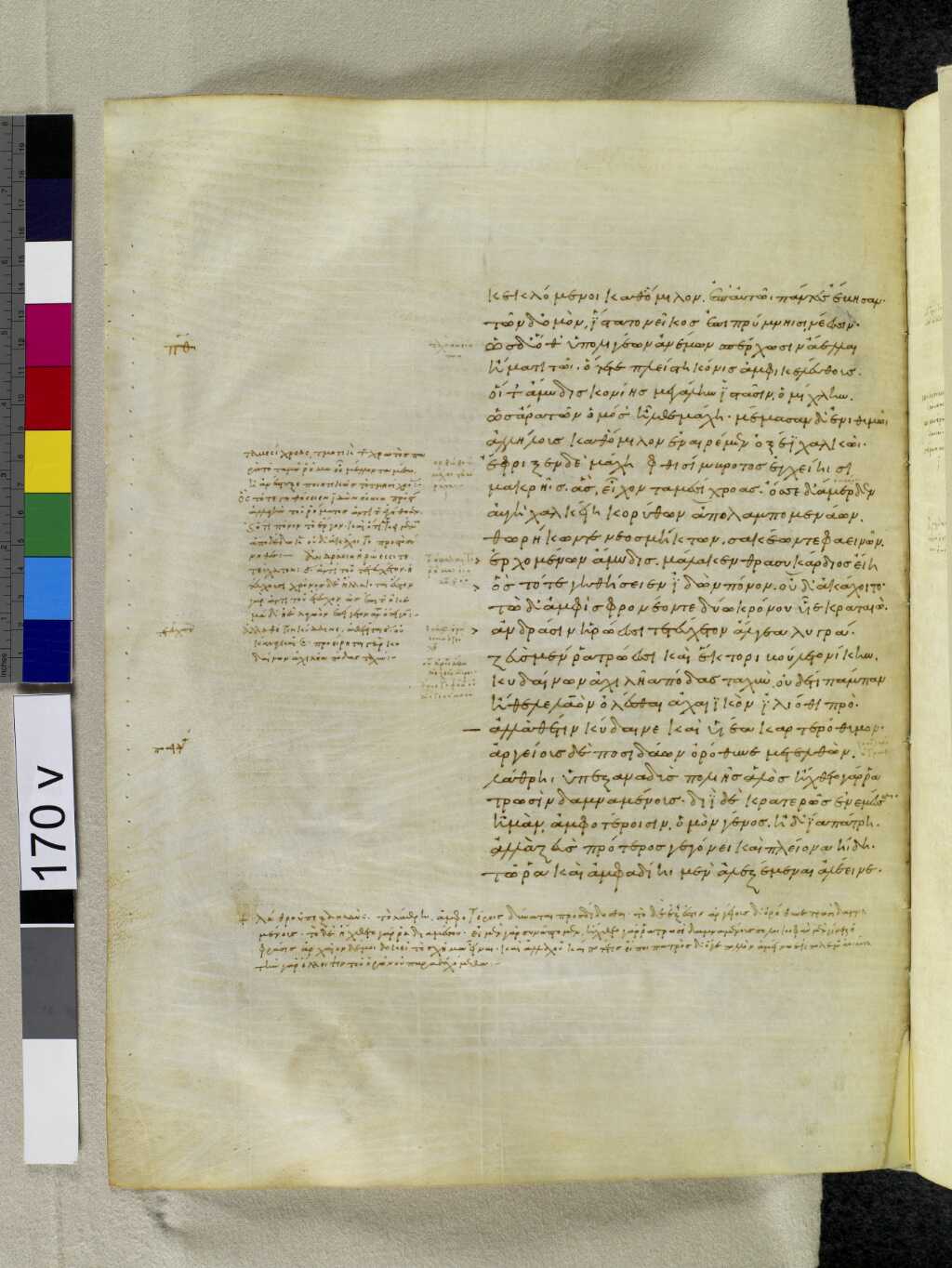
351Ἀργείους δὲ Ποσειδάων ὀρόθυνε μετελθὼν 352λάθρῃ ὑπεξαναδὺς πολιῆς ἁλός· ἤχθετο γάρ ῥα 353Τρωσὶν δαμναμένους, Διὶ δὲ κρατερῶς ἐνεμέσσα. 354ἦ μὰν ἀμφοτέροισιν ὁμὸν γένος ἠδʼ ἴα πάτρη, 355ἀλλὰ Ζεὺς πρότερος γεγόνει καὶ πλείονα ᾔδη. 356τώ ῥα καὶ ἀμφαδίην μὲν ἀλεξέμεναι ἀλέεινε, 357λάθρῃ δʼ αἰὲν ἔγειρε κατὰ στρατὸν ἀνδρὶ ἐοικώς. 358τοὶ δʼ ἔριδος κρατερῆς καὶ ὁμοιΐου πτολέμοιο 359πεῖραρ ἐπαλλάξαντες ἐπʼ ἀμφοτέροισι τάνυσσαν 360ἄρρηκτόν τʼ ἄλυτόν τε, τὸ πολλῶν γούνατʼ ἔλυσεν. 361ἔνθα μεσαιπόλιός περ ἐὼν Δαναοῖσι κελεύσας 362Ἰδομενεὺς Τρώεσσι μετάλμενος ἐν φόβον ὦρσε. 363πέφνε γὰρ Ὀθρυονῆα Καβησόθεν ἔνδον ἐόντα, 364ὅς ῥα νέον πολέμοιο μετὰ κλέος εἰληλούθει, 365ᾔτεε δὲ Πριάμοιο θυγατρῶν εἶδος ἀρίστην 366Κασσάνδρην ἀνάεδνον, ὑπέσχετο δὲ μέγα ἔργον, 367ἐκ Τροίης ἀέκοντας ἀπωσέμεν υἷας Ἀχαιῶν. 368τῷ δʼ ὁ γέρων Πρίαμος ὑπό τʼ ἔσχετο καὶ κατένευσε 369δωσέμεναι· ὃ δὲ μάρναθʼ ὑποσχεσίῃσι πιθήσας. 370Ἰδομενεὺς δʼ αὐτοῖο τιτύσκετο δουρὶ φαεινῷ, 371καὶ βάλεν ὕψι βιβάντα τυχών· οὐδʼ ἤρκεσε θώρηξ 372χάλκεος, ὃν φορέεσκε, μέσῃ δʼ ἐν γαστέρι πῆξε. 373δούπησεν δὲ πεσών· ὃ δʼ ἐπεύξατο φώνησέν τε· 374Ὀθρυονεῦ περὶ δή σε βροτῶν αἰνίζομʼ ἁπάντων 375εἰ ἐτεὸν δὴ πάντα τελευτήσεις ὅσʼ ὑπέστης
Then Meriones said, “I too in my tent and at my ship have spoils taken from the Trojans, but they are not at hand. I have been at all times valorous, and wherever there has been hard fighting have held my own among the foremost. There may be those among the Achaeans who do not know how I fight, but you know it well enough yourself.”
Idomeneus answered, “I know you for a brave man: you need not tell me. If the best men at the ships were being chosen to go on an ambush—and there is nothing like this for showing what a man is made of; it comes out then who is cowardly and who brave; the coward will change colour at every touch and turn; he is full of fears, and keeps shifting his weight first on one knee and then on the other; his heart beats fast as he thinks of death, and one can hear the chattering of his teeth; whereas the brave man will not change colour nor be frightened on finding himself in ambush, but is all the time longing to go into action—if the best men were being chosen for such a service, no one could make light of your courage nor feats of arms. If you were struck by a dart or smitten in close combat, it would not be from behind, in your neck nor back, but the weapon would hit you in the chest or belly as you were pressing forward to a place in the front ranks. But let us no longer stay here talking like children, lest we be ill spoken of; go, fetch your spear from the tent at once.”
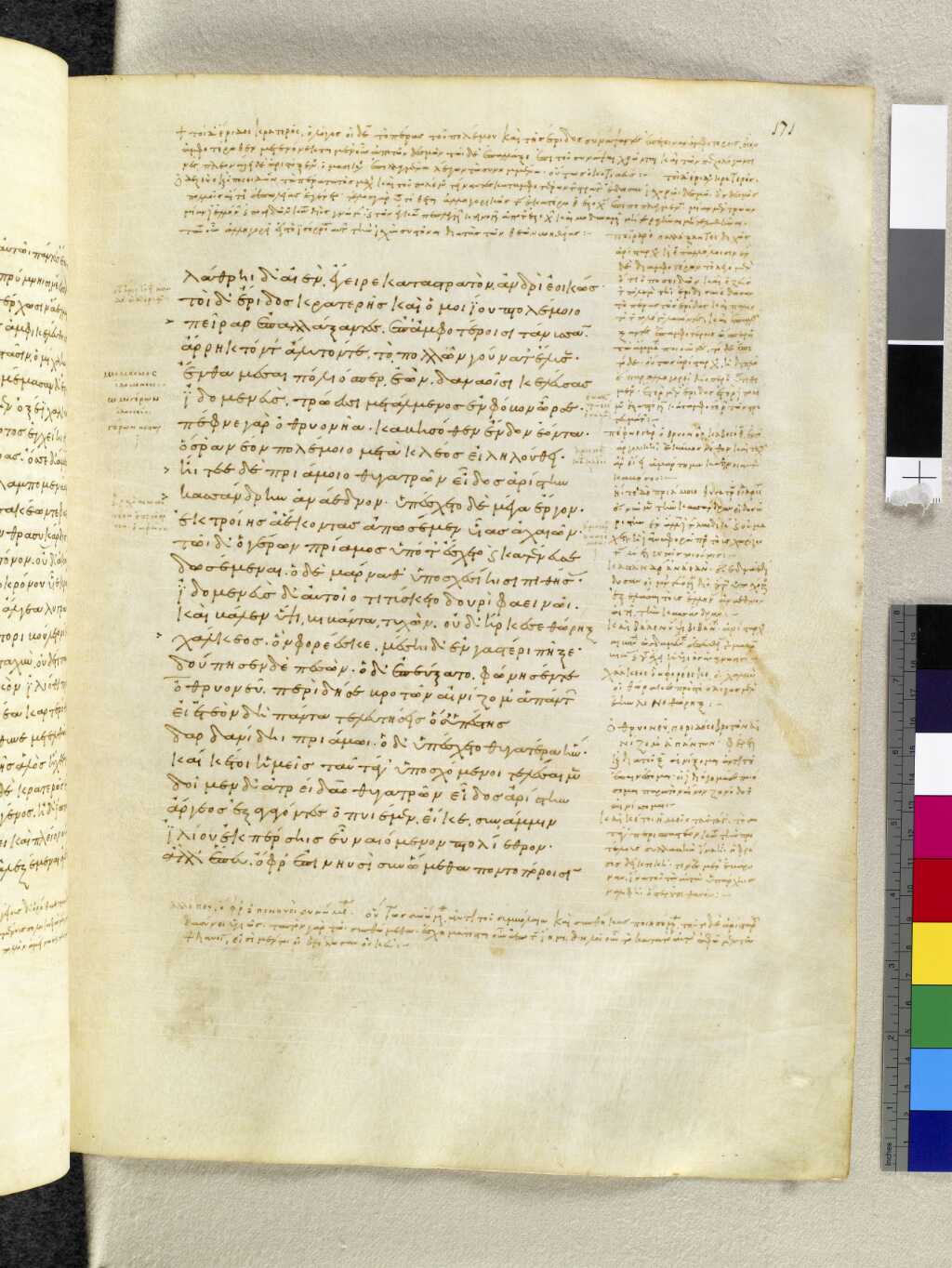
376Δαρδανίδῃ Πριάμῳ· ὃ δʼ ὑπέσχετο θυγατέρα ἥν. 377καί κέ τοι ἡμεῖς ταῦτά γʼ ὑποσχόμενοι τελέσαιμεν, 378δοῖμεν δʼ Ἀτρεΐδαο θυγατρῶν εἶδος ἀρίστην 379Ἄργεος ἐξαγαγόντες ὀπυιέμεν, εἴ κε σὺν ἄμμιν 380Ἰλίου ἐκπέρσῃς εὖ ναιόμενον πτολίεθρον. 381ἀλλʼ ἕπεʼ, ὄφρʼ ἐπὶ νηυσὶ συνώμεθα ποντοπόροισιν 382ἀμφὶ γάμῳ, ἐπεὶ οὔ τοι ἐεδνωταὶ κακοί εἰμεν. 383ὣς εἰπὼν ποδὸς ἕλκε κατὰ κρατερὴν ὑσμίνην 384ἥρως Ἰδομενεύς· τῷ δʼ Ἄσιος ἦλθʼ ἐπαμύντωρ 385πεζὸς πρόσθʼ ἵππων· τὼ δὲ πνείοντε κατʼ ὤμων 386αἰὲν ἔχʼ ἡνίοχος θεράπων· ὃ δὲ ἵετο θυμῷ 387Ἰδομενῆα βαλεῖν· ὃ δέ μιν φθάμενος βάλε δουρὶ 388λαιμὸν ὑπʼ ἀνθερεῶνα, διὰ πρὸ δὲ χαλκὸν ἔλασσεν. 389ἤριπε δʼ ὡς ὅτε τις δρῦς ἤριπεν ἢ ἀχερωῒς 390ἠὲ πίτυς βλωθρή, τήν τʼ οὔρεσι τέκτονες ἄνδρες 391ἐξέταμον πελέκεσσι νεήκεσι νήϊον εἶναι· 392ὣς ὃ πρόσθʼ ἵππων καὶ δίφρου κεῖτο τανυσθεὶς 393βεβρυχὼς κόνιος δεδραγμένος αἱματοέσσης. 394ἐκ δέ οἱ ἡνίοχος πλήγη φρένας ἃς πάρος εἶχεν, 395οὐδʼ ὅ γʼ ἐτόλμησεν δηΐων ὑπὸ χεῖρας ἀλύξας 396ἂψ ἵππους στρέψαι, τὸν δʼ Ἀντίλοχος μενεχάρμης 397δουρὶ μέσον περόνησε τυχών· οὐδʼ ἤρκεσε θώρηξ 398χάλκεος ὃν φορέεσκε, μέσῃ δʼ ἐν γαστέρι πῆξεν. 399αὐτὰρ ὃ ἀσθμαίνων εὐεργέος ἔκπεσε δίφρου, 400ἵππους δʼ Ἀντίλοχος μεγαθύμου Νέστορος υἱὸς
On this Meriones, peer of Mars, went to the tent and got himself a spear of bronze. He then followed after Idomeneus, big with great deeds of valour. As when baneful Mars sallies forth to battle, and his son Panic so strong and dauntless goes with him, to strike terror even into the heart of a hero—the pair have gone from Thrace to arm themselves among the Ephyri or the brave Phlegyans, but they will not listen to both the contending hosts, and will give victory to one side or to the other—even so did Meriones and Idomeneus, captains of men, go out to battle clad in their bronze armour. Meriones was first to speak. “Son of Deucalion,” said he, “where would you have us begin fighting? On the right wing of the host, in the centre, or on the left wing, where I take it the Achaeans will be weakest?”
Idomeneus answered, “There are others to defend the centre—the two Ajaxes and Teucer, who is the finest archer of all the Achaeans, and is good also in a hand-to-hand fight. These will give Hector son of Priam enough to do; fight as he may, he will find it hard to vanquish their indomitable fury, and fire the ships, unless the son of Saturn fling a firebrand upon them with his own hand. Great Ajax son of Telamon will yield to no man who is in mortal mould and eats the grain of Ceres, if bronze and great stones can overthrow him. He would not yield even to Achilles in hand-to-hand fight, and in fleetness of foot there is none to beat him; let us turn therefore towards the left wing, that we may know forthwith whether we are to give glory to some other, or he to us.”
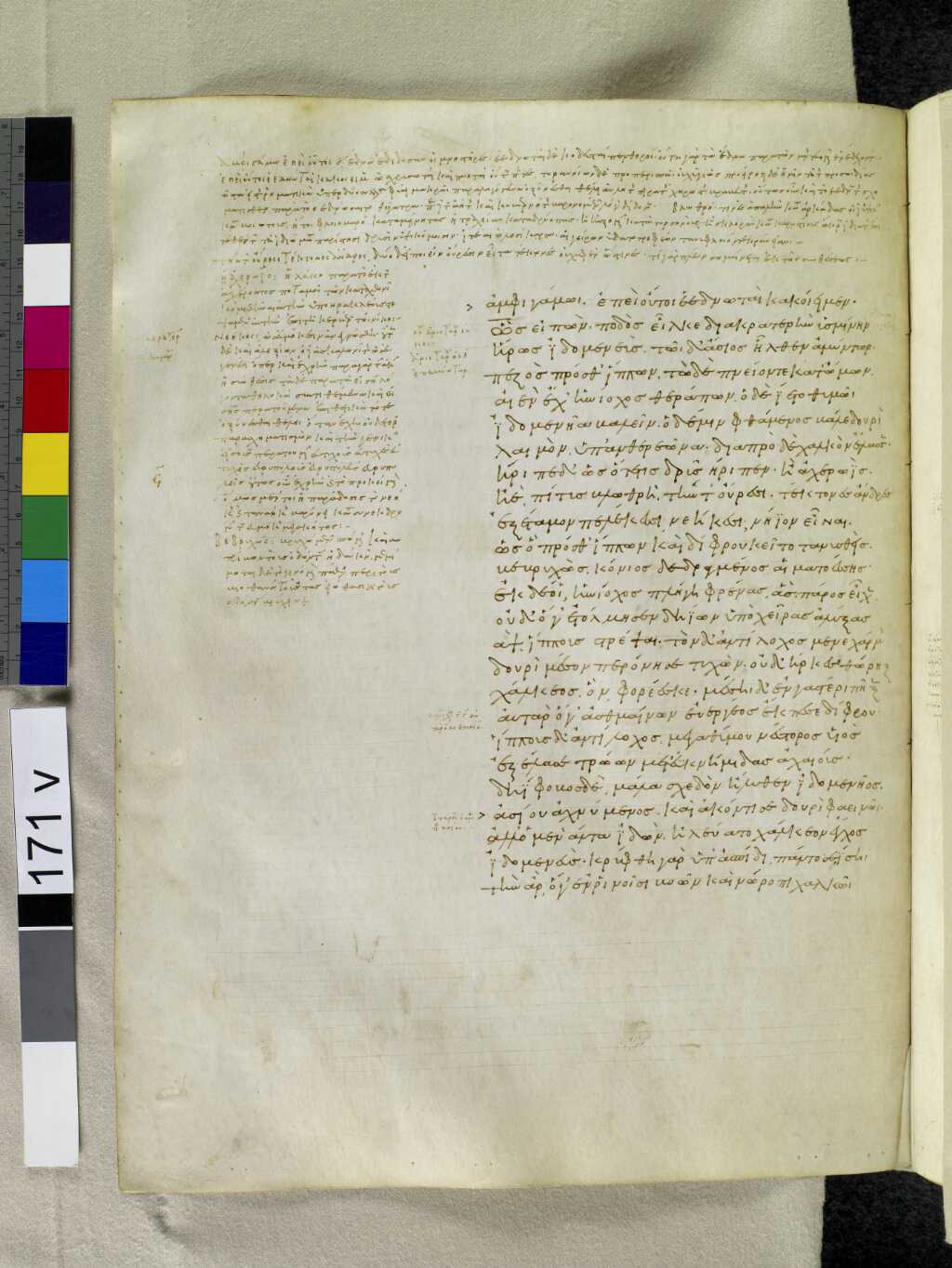
401ἐξέλασε Τρώων μετʼ ἐϋκνήμιδας Ἀχαιούς. 402Δηΐφοβος δὲ μάλα σχεδὸν ἤλυθεν Ἰδομενῆος 403Ἀσίου ἀχνύμενος, καὶ ἀκόντισε δουρὶ φαεινῷ. 404ἀλλʼ ὃ μὲν ἄντα ἰδὼν ἠλεύατο χάλκεον ἔγχος 405Ἰδομενεύς· κρύφθη γὰρ ὑπʼ ἀσπίδι πάντοσʼ ἐΐσῃ, 406τὴν ἄρʼ ὅ γε ῥινοῖσι βοῶν καὶ νώροπι χαλκῷ 407δινωτὴν φορέεσκε, δύω κανόνεσσʼ ἀραρυῖαν· 408τῇ ὕπο πᾶς ἐάλη, τὸ δʼ ὑπέρπτατο χάλκεον ἔγχος, 409καρφαλέον δέ οἱ ἀσπὶς ἐπιθρέξαντος ἄϋσεν 410ἔγχεος· οὐδʼ ἅλιόν ῥα βαρείης χειρὸς ἀφῆκεν, 411ἀλλʼ ἔβαλʼ Ἱππασίδην Ὑψήνορα ποιμένα λαῶν 412ἧπαρ ὑπὸ πραπίδων, εἶθαρ δʼ ὑπὸ γούνατʼ ἔλυσε. 413Δηΐφοβος δʼ ἔκπαγλον ἐπεύξατο μακρὸν ἀΰσας· 414οὐ μὰν αὖτʼ ἄτιτος κεῖτʼ Ἄσιος, ἀλλά ἕ φημι 415εἰς Ἄϊδός περ ἰόντα πυλάρταο κρατεροῖο 416γηθήσειν κατὰ θυμόν, ἐπεί ῥά οἱ ὤπασα πομπόν. 417ὣς ἔφατʼ, Ἀργείοισι δʼ ἄχος γένετʼ εὐξαμένοιο, 418Ἀντιλόχῳ δὲ μάλιστα δαΐφρονι θυμὸν ὄρινεν· 419ἀλλʼ οὐδʼ ἀχνύμενός περ ἑοῦ ἀμέλησεν ἑταίρου, 420ἀλλὰ θέων περίβη καί οἱ σάκος ἀμφεκάλυψε. 421τὸν μὲν ἔπειθʼ ὑποδύντε δύω ἐρίηρες ἑταῖροι 422Μηκιστεὺς Ἐχίοιο πάϊς καὶ δῖος Ἀλάστωρ, 423νῆας ἔπι γλαφυρὰς φερέτην βαρέα στενάχοντα. 424Ἰδομενεὺς δʼ οὐ λῆγε μένος μέγα, ἵετο δʼ αἰεὶ 425ἠέ τινα Τρώων ἐρεβεννῇ νυκτὶ καλύψαι
Meriones, peer of fleet Mars, then led the way till they came to the part of the host which Idomeneus had named.
426ἢ αὐτὸς δουπῆσαι ἀμύνων λοιγὸν Ἀχαιοῖς. 427ἔνθʼ Αἰσυήταο διοτρεφέος φίλον υἱὸν 428ἥρωʼ Ἀλκάθοον, γαμβρὸς δʼ ἦν Ἀγχίσαο, 429πρεσβυτάτην δʼ ὤπυιε θυγατρῶν Ἱπποδάμειαν 430τὴν περὶ κῆρι φίλησε πατὴρ καὶ πότνια μήτηρ 431ἐν μεγάρῳ· πᾶσαν γὰρ ὁμηλικίην ἐκέκαστο 432κάλλεϊ καὶ ἔργοισιν ἰδὲ φρεσί· τοὔνεκα καί μιν 433γῆμεν ἀνὴρ ὤριστος ἐνὶ Τροίῃ εὐρείῃ· 434τὸν τόθʼ ὑπʼ Ἰδομενῆϊ Ποσειδάων ἐδάμασσε 435θέλξας ὄσσε φαεινά, πέδησε δὲ φαίδιμα γυῖα· 436οὔτε γὰρ ἐξοπίσω φυγέειν δύνατʼ οὔτʼ ἀλέασθαι, 437ἀλλʼ ὥς τε στήλην ἢ δένδρεον ὑψιπέτηλον 438ἀτρέμας ἑσταότα στῆθος μέσον οὔτασε δουρὶ 439ἥρως Ἰδομενεύς, ῥῆξεν δέ οἱ ἀμφὶ χιτῶνα 440χάλκεον, ὅς οἱ πρόσθεν ἀπὸ χροὸς ἤρκει ὄλεθρον· 441δὴ τότε γʼ αὖον ἄϋσεν ἐρεικόμενος περὶ δουρί. 442δούπησεν δὲ πεσών, δόρυ δʼ ἐν κραδίῃ ἐπεπήγει, 443ἥ ῥά οἱ ἀσπαίρουσα καὶ οὐρίαχον πελέμιζεν 444ἔγχεος· ἔνθα δʼ ἔπειτʼ ἀφίει μένος ὄβριμος Ἄρης· 445Ἰδομενεὺς δʼ ἔκπαγλον ἐπεύξατο μακρὸν ἀΰσας 446Δηΐφοβʼ ἦ ἄρα δή τι ἐΐσκομεν ἄξιον εἶναι 447τρεῖς ἑνὸς ἀντὶ πεφάσθαι; ἐπεὶ σύ περ εὔχεαι οὕτω. 448δαιμόνιʼ ἀλλὰ καὶ αὐτὸς ἐναντίον ἵστασʼ ἐμεῖο, 449ὄφρα ἴδῃ οἷος Ζηνὸς γόνος ἐνθάδʼ ἱκάνω, 450ὃς πρῶτον Μίνωα τέκε Κρήτῃ ἐπίουρον·
Now when the Trojans saw Idomeneus coming on like a flame of fire, him and his squire clad in their richly wrought armour, they shouted and made towards him all in a body, and a furious hand-to-hand fight raged under the ships’ sterns. Fierce as the shrill winds that whistle upon a day when dust lies deep on the roads, and the gusts raise it into a thick cloud—even such was the fury of the combat, and might and main did they hack at each other with spear and sword throughout the host. The field bristled with the long and deadly spears which they bore. Dazzling was the sheen of their gleaming helmets, their fresh-burnished breastplates, and glittering shields as they joined battle with one another. Iron indeed must be his courage who could take pleasure in the sight of such a turmoil, and look on it without being dismayed.
Thus did the two mighty sons of Saturn devise evil for mortal heroes. Jove was minded to give victory to the Trojans and to Hector, so as to do honour to fleet Achilles, nevertheless he did not mean to utterly overthrow the Achaean host before Ilius, and only wanted to glorify Thetis and her valiant son. Neptune on the other hand went about among the Argives to incite them, having come up from the grey sea in secret, for he was grieved at seeing them vanquished by the Trojans, and was furiously angry with Jove. Both were of the same race and country, but Jove was elder born and knew more, therefore Neptune feared to defend the Argives openly, but in the likeness of man, he kept on encouraging them throughout their host. Thus, then, did these two devise a knot of war and battle, that none could unloose or break, and set both sides tugging at it, to the failing of men’s knees beneath them.
451Μίνως δʼ αὖ τέκεθʼ υἱὸν ἀμύμονα Δευκαλίωνα, 452Δευκαλίων δʼ ἐμὲ τίκτε πολέσσʼ ἄνδρεσσιν ἄνακτα 453Κρήτῃ ἐν εὐρείῃ· νῦν δʼ ἐνθάδε νῆες ἔνεικαν 454σοί τε κακὸν καὶ πατρὶ καὶ ἄλλοισι Τρώεσσιν. 455ὣς φάτο, Δηΐφοβος δὲ διάνδιχα μερμήριξεν 456ἤ τινά που Τρώων ἑταρίσσαιτο μεγαθύμων 457ἂψ ἀναχωρήσας, ἦ πειρήσαιτο καὶ οἶος. 458ὧδε δέ οἱ φρονέοντι δοάσσατο κέρδιον εἶναι 459βῆναι ἐπʼ Αἰνείαν· τὸν δʼ ὕστατον εὗρεν ὁμίλου 460ἑσταότʼ· αἰεὶ γὰρ Πριάμῳ ἐπεμήνιε δίῳ 461οὕνεκʼ ἄρʼ ἐσθλὸν ἐόντα μετʼ ἀνδράσιν οὔ τι τίεσκεν. 462ἀγχοῦ δʼ ἱστάμενος ἔπεα πτερόεντα προσηύδα· 463Αἰνεία Τρώων βουληφόρε νῦν σε μάλα χρὴ 464γαμβρῷ ἀμυνέμεναι, εἴ πέρ τί σε κῆδος ἱκάνει. 465ἀλλʼ ἕπευ Ἀλκαθόῳ ἐπαμύνομεν, ὅς σε πάρος γε 466γαμβρὸς ἐὼν ἔθρεψε δόμοις ἔνι τυτθὸν ἐόντα· 467τὸν δέ τοι Ἰδομενεὺς δουρικλυτὸς ἐξενάριξεν. 468ὣς φάτο, τῷ δʼ ἄρα θυμὸν ἐνὶ στήθεσσιν ὄρινε, 469βῆ δὲ μετʼ Ἰδομενῆα μέγα πτολέμοιο μεμηλώς. 470ἀλλʼ οὐκ Ἰδομενῆα φόβος λάβε τηλύγετον ὥς, 471ἀλλʼ ἔμενʼ ὡς ὅτε τις σῦς οὔρεσιν ἀλκὶ πεποιθώς, 472ὅς τε μένει κολοσυρτὸν ἐπερχόμενον πολὺν ἀνδρῶν 473χώρῳ ἐν οἰοπόλῳ, φρίσσει δέ τε νῶτον ὕπερθεν· 474ὀφθαλμὼ δʼ ἄρα οἱ πυρὶ λάμπετον· αὐτὰρ ὀδόντας 475θήγει, ἀλέξασθαι μεμαὼς κύνας ἠδὲ καὶ ἄνδρας·
And now Idomeneus, though his hair was already flecked with grey, called loud on the Danaans and spread panic among the Trojans as he leaped in among them. He slew Othryoneus from Cabesus, a sojourner, who had but lately come to take part in the war. He sought Cassandra, the fairest of Priam’s daughters, in marriage, but offered no gifts of wooing, for he promised a great thing, to wit, that he would drive the sons of the Achaeans willy nilly from Troy; old King Priam had given his consent and promised her to him, whereon he fought on the strength of the promises thus made to him. Idomeneus aimed a spear, and hit him as he came striding on. His cuirass of bronze did not protect him, and the spear stuck in his belly, so that he fell heavily to the ground. Then Idomeneus vaunted over him saying, “Othryoneus, there is no one in the world whom I shall admire more than I do you, if you indeed perform what you have promised Priam son of Dardanus in return for his daughter. We too will make you an offer; we will give you the loveliest daughter of the son of Atreus, and will bring her from Argos for you to marry, if you will sack the goodly city of Ilius in company with ourselves; so come along with me, that we may make a covenant at the ships about the marriage, and we will not be hard upon you about gifts of wooing.”
With this Idomeneus began dragging him by the foot through the thick of the fight, but Asius came up to protect the body, on foot, in front of his horses which his esquire drove so close behind him that he could feel their breath upon his shoulder. He was longing to strike down Idomeneus, but ere he could do so Idomeneus smote him with his spear in the throat under the chin, and the bronze point went clean through it. He fell as an oak, or poplar, or pine which shipwrights have felled for ship’s timber upon the mountains with whetted axes—even thus did he lie full length in front of his chariot and horses, grinding his teeth and clutching at the blood-stained dust. His charioteer was struck with panic and did not dare turn his horses round and escape: thereupon Antilochus hit him in the middle of his body with a spear; his cuirass of bronze did not protect him, and the spear stuck in his belly. He fell gasping from his chariot and Antilochus, great Nestor’s son, drove his horses from the Trojans to the Achaeans.
476ὣς μένεν Ἰδομενεὺς δουρικλυτός, οὐδʼ ὑπεχώρει, 477Αἰνείαν ἐπιόντα βοηθόον· αὖε δʼ ἑταίρους 478Ἀσκάλαφόν τʼ ἐσορῶν Ἀφαρῆά τε Δηΐπυρόν τε 479Μηριόνην τε καὶ Ἀντίλοχον μήστωρας ἀϋτῆς· 480τοὺς ὅ γʼ ἐποτρύνων ἔπεα πτερόεντα προσηύδα· 481δεῦτε φίλοι, καί μʼ οἴῳ ἀμύνετε· δείδια δʼ αἰνῶς 482Αἰνείαν ἐπιόντα πόδας ταχύν, ὅς μοι ἔπεισιν, 483ὃς μάλα καρτερός ἐστι μάχῃ ἔνι φῶτας ἐναίρειν· 484καὶ δʼ ἔχει ἥβης ἄνθος, ὅ τε κράτος ἐστὶ μέγιστον. 485εἰ γὰρ ὁμηλικίη γε γενοίμεθα τῷδʼ ἐπὶ θυμῷ 486αἶψά κεν ἠὲ φέροιτο μέγα κράτος, ἠὲ φεροίμην. 487ὣς ἔφαθʼ, οἳ δʼ ἄρα πάντες ἕνα φρεσὶ θυμὸν ἔχοντες 488πλησίοι ἔστησαν, σάκεʼ ὤμοισι κλίναντες. 489Αἰνείας δʼ ἑτέρωθεν ἐκέκλετο οἷς ἑτάροισι 490Δηΐφοβόν τε Πάριν τʼ ἐσορῶν καὶ Ἀγήνορα δῖον, 491οἵ οἱ ἅμʼ ἡγεμόνες Τρώων ἔσαν· αὐτὰρ ἔπειτα 492λαοὶ ἕπονθʼ, ὡς εἴ τε μετὰ κτίλον ἕσπετο μῆλα 493πιόμενʼ ἐκ βοτάνης· γάνυται δʼ ἄρα τε φρένα ποιμήν· 494ὣς Αἰνείᾳ θυμὸς ἐνὶ στήθεσσι γεγήθει 495ὡς ἴδε λαῶν ἔθνος ἐπισπόμενον ἑοῖ αὐτῷ. 496οἳ δʼ ἀμφʼ Ἀλκαθόῳ αὐτοσχεδὸν ὁρμήθησαν 497μακροῖσι ξυστοῖσι· περὶ στήθεσσι δὲ χαλκὸς 498σμερδαλέον κονάβιζε τιτυσκομένων καθʼ ὅμιλον 499ἀλλήλων· δύο δʼ ἄνδρες ἀρήϊοι ἔξοχον ἄλλων 500Αἰνείας τε καὶ Ἰδομενεὺς ἀτάλαντοι Ἄρηϊ
Deiphobus then came close up to Idomeneus to avenge Asius, and took aim at him with a spear, but Idomeneus was on the look-out and avoided it, for he was covered by the round shield he always bore—a shield of ox-hide and bronze with two arm-rods on the inside. He crouched under cover of this, and the spear flew over him, but the shield rang out as the spear grazed it, and the weapon sped not in vain from the strong hand of Deiphobus, for it struck Hypsenor son of Hippasus, shepherd of his people, in the liver under the midriff, and his limbs failed beneath him. Deiphobus vaunted over him and cried with a loud voice saying, “Of a truth Asius has not fallen unavenged; he will be glad even while passing into the house of Hades, strong warden of the gate, that I have sent some one to escort him.”
501ἵεντʼ ἀλλήλων ταμέειν χρόα νηλέϊ χαλκῷ. 502Αἰνείας δὲ πρῶτος ἀκόντισεν Ἰδομενῆος· 503ἀλλʼ ὃ μὲν ἄντα ἰδὼν ἠλεύατο χάλκεον ἔγχος, 504αἰχμὴ δʼ Αἰνείαο κραδαινομένη κατὰ γαίης 505ᾤχετʼ, ἐπεί ῥʼ ἅλιον στιβαρῆς ἀπὸ χειρὸς ὄρουσεν. 506Ἰδομενεὺς δʼ ἄρα Οἰνόμαον βάλε γαστέρα μέσσην, 507ῥῆξε δὲ θώρηκος γύαλον, διὰ δʼ ἔντερα χαλκὸς 508ἤφυσʼ· ὃ δʼ ἐν κονίῃσι πεσὼν ἕλε γαῖαν ἀγοστῷ. 509Ἰδομενεὺς δʼ ἐκ μὲν νέκυος δολιχόσκιον ἔγχος 510ἐσπάσατʼ, οὐδʼ ἄρʼ ἔτʼ ἄλλα δυνήσατο τεύχεα καλὰ 511ὤμοιιν ἀφελέσθαι· ἐπείγετο γὰρ βελέεσσιν. 512οὐ γὰρ ἔτʼ ἔμπεδα γυῖα ποδῶν ἦν ὁρμηθέντι, 513οὔτʼ ἄρʼ ἐπαΐξαι μεθʼ ἑὸν· βέλος οὔτʼ ἀλέασθαι. 514τώ ῥα καὶ ἐν σταδίῃ μὲν ἀμύνετο νηλεὲς ἦμαρ, 515τρέσσαι δʼ οὐκ ἔτι ῥίμφα πόδες φέρον ἐκ πολέμοιο. 516τοῦ δὲ βάδην ἀπιόντος ἀκόντισε δουρὶ φαεινῷ 517Δηΐφοβος· δὴ γάρ οἱ ἔχεν κότον ἐμμενὲς αἰεί. 518ἀλλʼ ὅ γε καὶ τόθʼ ἅμαρτεν, ὃ δʼ Ἀσκάλαφον βάλε δουρὶ 519υἱὸν Ἐνυαλίοιο· διʼ ὤμου δʼ ὄβριμον ἔγχος 520ἔσχεν· ὃ δʼ ἐν κονίῃσι πεσὼν ἕλε γαῖαν ἀγοστῷ. 521οὐδʼ ἄρα πώ τι πέπυστο βριήπυος ὄβριμος Ἄρης 522υἷος ἑοῖο πεσόντος ἐνὶ κρατερῇ ὑσμίνῃ, 523ἀλλʼ ὅ γʼ ἄρʼ ἄκρῳ Ὀλύμπῳ ὑπὸ χρυσέοισι νέφεσσιν 524ἧστο Διὸς βουλῇσιν ἐελμένος, ἔνθά περ ἄλλοι 525ἀθάνατοι θεοὶ ἦσαν ἐεργόμενοι πολέμοιο.
Thus did he vaunt, and the Argives were stung by his saying. Noble Antilochus was more angry than any one, but grief did not make him forget his friend and comrade. He ran up to him, bestrode him, and covered him with his shield; then two of his staunch comrades, Mecisteus son of Echius, and Alastor, stooped down, and bore him away groaning heavily to the ships. But Idomeneus ceased not his fury. He kept on striving continually either to enshroud some Trojan in the darkness of death, or himself to fall while warding off the evil day from the Achaeans. Then fell Alcathous son of noble Aesyetes; he was son-in-law to Anchises, having married his eldest daughter Hippodameia, who was the darling of her father and mother, and excelled all her generation in beauty, accomplishments, and understanding, wherefore the bravest man in all Troy had taken her to wife—him did Neptune lay low by the hand of Idomeneus, blinding his bright eyes and binding his strong limbs in fetters so that he could neither go back nor to one side, but stood stock still like pillar or lofty tree when Idomeneus struck him with a spear in the middle of his chest. The coat of mail that had hitherto protected his body was now broken, and rang harshly as the spear tore through it. He fell heavily to the ground, and the spear stuck in his heart, which still beat, and made the butt-end of the spear quiver till dread Mars put an end to his life. Idomeneus vaunted over him and cried with a loud voice saying, “Deiphobus, since you are in a mood to vaunt, shall we cry quits now that we have killed three men to your one? Nay, sir, stand in fight with me yourself, that you may learn what manner of Jove-begotten man am I that have come hither. Jove first begot Minos, chief ruler in Crete, and Minos in his turn begot a son, noble Deucalion. Deucalion begot me to be a ruler over many men in Crete, and my ships have now brought me hither, to be the bane of yourself, your father, and the Trojans.”
Thus did he speak, and Deiphobus was in two minds, whether to go back and fetch some other Trojan to help him, or to take up the challenge single-handed. In the end, he deemed it best to go and fetch Aeneas, whom he found standing in the rear, for he had long been aggrieved with Priam because in spite of his brave deeds he did not give him his due share of honour. Deiphobus went up to him and said, “Aeneas, prince among the Trojans, if you know any ties of kinship, help me now to defend the body of your sister’s husband; come with me to the rescue of Alcathous, who being husband to your sister brought you up when you were a child in his house, and now Idomeneus has slain him.”
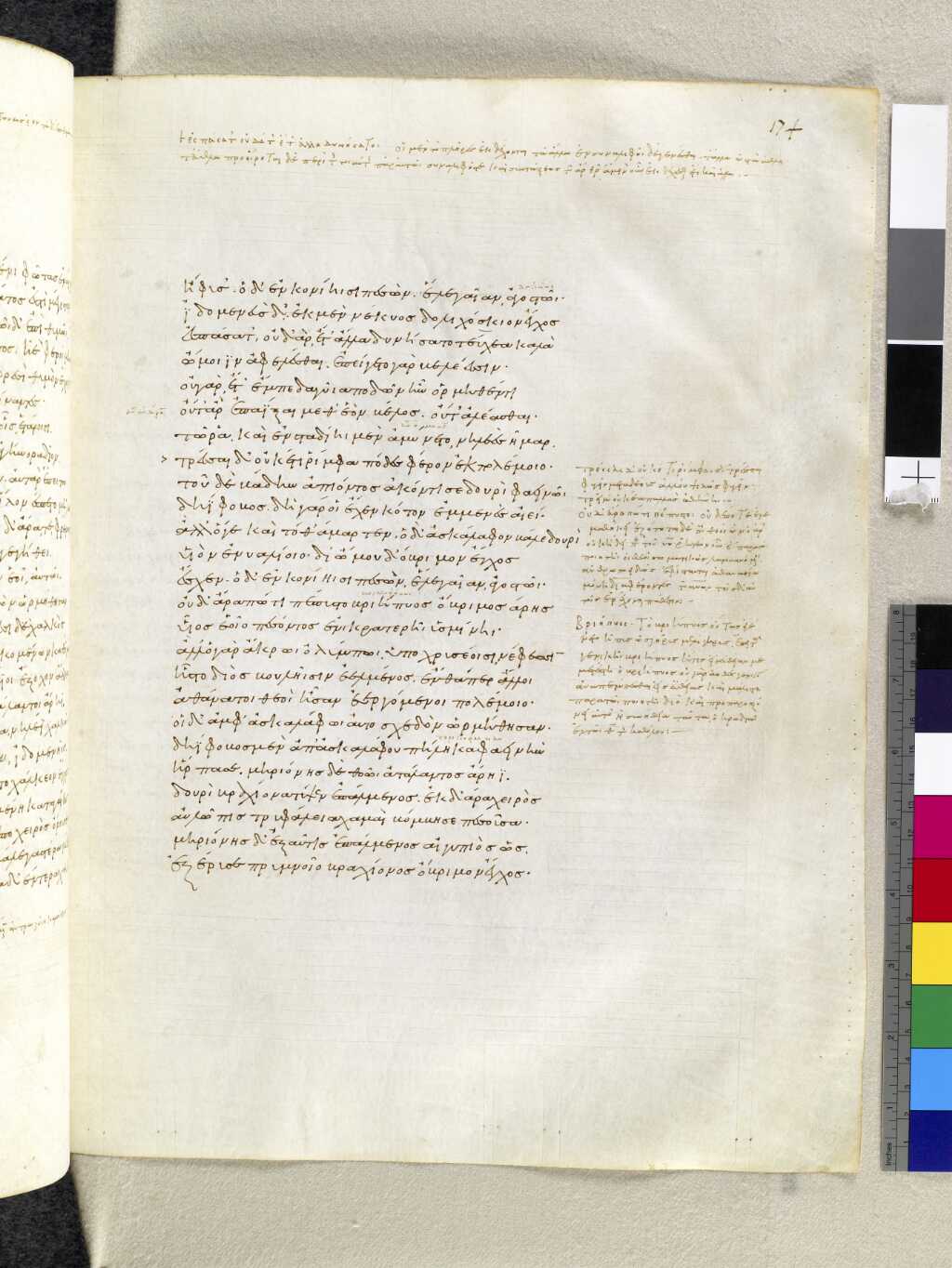
526οἳ δʼ ἀμφʼ Ἀσκαλάφῳ αὐτοσχεδὸν ὁρμήθησαν· 527Δηΐφοβος μὲν ἀπʼ Ἀσκαλάφου πήληκα φαεινὴν 528ἥρπασε, Μηριόνης δὲ θοῷ ἀτάλαντος Ἄρηϊ 529δουρὶ βραχίονα τύψεν ἐπάλμενος, ἐκ δʼ ἄρα χειρὸς 530αὐλῶπις τρυφάλεια χαμαὶ βόμβησε πεσοῦσα. 531Μηριόνης δʼ ἐξ αὖτις ἐπάλμενος αἰγυπιὸς ὣς 532ἐξέρυσε πρυμνοῖο βραχίονος ὄβριμον ἔγχος, 533ἂψ δʼ ἑτάρων εἰς ἔθνος ἐχάζετο. τὸν δὲ Πολίτης 534αὐτοκασίγνητος περὶ μέσσῳ χεῖρε τιτήνας 535ἐξῆγεν πολέμοιο δυσηχέος, ὄφρʼ ἵκεθʼ ἵππους 536ὠκέας, οἵ οἱ ὄπισθε μάχης ἠδὲ πτολέμοιο 537ἕστασαν ἡνίοχόν τε καὶ ἅρματα ποικίλʼ ἔχοντες· 538οἳ τόν γε προτὶ ἄστυ φέρον βαρέα στενάχοντα 539τειρόμενον· κατὰ δʼ αἷμα νεουτάτου ἔρρεε χειρός. 540οἳ δʼ ἄλλοι μάρναντο, βοὴ δʼ ἄσβεστος ὀρώρει. 541ἔνθʼ Αἰνέας Ἀφαρῆα Καλητορίδην ἐπορούσας 542λαιμὸν τύψʼ ἐπὶ οἷ τετραμμένον ὀξέϊ δουρί· 543ἐκλίνθη δʼ ἑτέρωσε κάρη, ἐπὶ δʼ ἀσπὶς ἑάφθη 544καὶ κόρυς, ἀμφὶ δέ οἱ θάνατος χύτο θυμοραϊστής. 545Ἀντίλοχος δὲ Θόωνα μεταστρεφθέντα δοκεύσας 546οὔτασʼ ἐπαΐξας, ἀπὸ δὲ φλέβα πᾶσαν ἔκερσεν, 547ἥ τʼ ἀνὰ νῶτα θέουσα διαμπερὲς αὐχένʼ ἱκάνει· 548τὴν ἀπὸ πᾶσαν ἔκερσεν· ὃ δʼ ὕπτιος ἐν κονίῃσι 549κάππεσεν, ἄμφω χεῖρε φίλοις ἑτάροισι πετάσσας. 550Ἀντίλοχος δʼ ἐπόρουσε, καὶ αἴνυτο τεύχεʼ ἀπʼ ὤμων
With these words he moved the heart of Aeneas, and he went in pursuit of Idomeneus, big with great deeds of valour; but Idomeneus was not to be thus daunted as though he were a mere child; he held his ground as a wild boar at bay upon the mountains, who abides the coming of a great crowd of men in some lonely place—the bristles stand upright on his back, his eyes flash fire, and he whets his tusks in his eagerness to defend himself against hounds and men—even so did famed Idomeneus hold his ground and budge not at the coming of Aeneas. He cried aloud to his comrades looking towards Ascalaphus, Aphareus, Deipyrus, Meriones, and Antilochus, all of them brave soldiers—“Hither my friends,” he cried, “and leave me not single-handed—I go in great fear by fleet Aeneas, who is coming against me, and is a redoubtable dispenser of death battle. Moreover he is in the flower of youth when a man’s strength is greatest; if I was of the same age as he is and in my present mind, either he or I should soon bear away the prize of victory.”
On this, all of them as one man stood near him, shield on shoulder. Aeneas on the other side called to his comrades, looking towards Deiphobus, Paris, and Agenor, who were leaders of the Trojans along with himself, and the people followed them as sheep follow the ram when they go down to drink after they have been feeding, and the heart of the shepherd is glad—even so was the heart of Aeneas gladdened when he saw his people follow him.
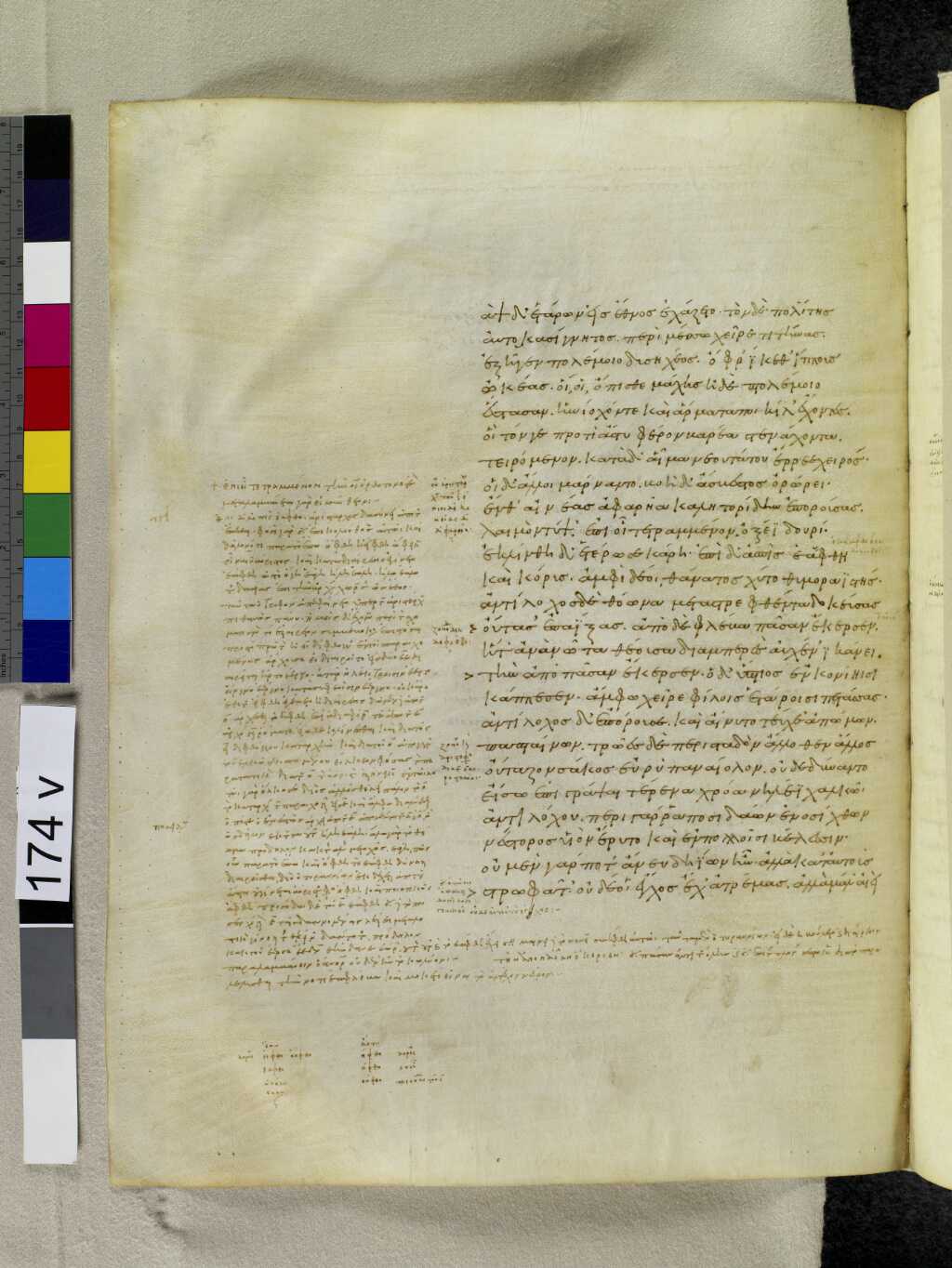
551παπταίνων· Τρῶες δὲ περισταδὸν ἄλλοθεν ἄλλος 552οὔταζον σάκος εὐρὺ παναίολον, οὐδὲ δύναντο 553εἴσω ἐπιγράψαι τέρενα χρόα νηλέϊ χαλκῷ 554Ἀντιλόχου· πέρι γάρ ῥα Ποσειδάων ἐνοσίχθων 555Νέστορος υἱὸν ἔρυτο καὶ ἐν πολλοῖσι βέλεσσιν. 556οὐ μὲν γάρ ποτʼ ἄνευ δηΐων ἦν, ἀλλὰ κατʼ αὐτοὺς 557στρωφᾶτʼ· οὐδέ οἱ ἔγχος ἔχʼ ἀτρέμας, ἀλλὰ μάλʼ αἰεὶ 558σειόμενον ἐλέλικτο· τιτύσκετο δὲ φρεσὶν ᾗσιν 559ἤ τευ ἀκοντίσσαι, ἠὲ σχεδὸν ὁρμηθῆναι. 560ἀλλʼ οὐ λῆθʼ Ἀδάμαντα τιτυσκόμενος καθʼ ὅμιλον 561Ἀσιάδην, ὅ οἱ οὖτα μέσον σάκος ὀξέϊ χαλκῷ 562ἐγγύθεν ὁρμηθείς· ἀμενήνωσεν δέ οἱ αἰχμὴν 563κυανοχαῖτα Ποσειδάων βιότοιο μεγήρας. 564καὶ τὸ μὲν αὐτοῦ μεῖνʼ ὥς τε σκῶλος πυρίκαυστος 565ἐν σάκει Ἀντιλόχοιο, τὸ δʼ ἥμισυ κεῖτʼ ἐπὶ γαίης· 566ἂψ δʼ ἑτάρων εἰς ἔθνος ἐχάζετο κῆρʼ ἀλεείνων· 567Μηριόνης δʼ ἀπιόντα μετασπόμενος βάλε δουρὶ 568αἰδοίων τε μεσηγὺ καὶ ὀμφαλοῦ, ἔνθα μάλιστα 569γίγνετʼ Ἄρης ἀλεγεινὸς ὀϊζυροῖσι βροτοῖσιν. 570ἔνθά οἱ ἔγχος ἔπηξεν· ὃ δʼ ἑσπόμενος περὶ δουρὶ 571ἤσπαιρʼ ὡς ὅτε βοῦς τόν τʼ οὔρεσι βουκόλοι ἄνδρες 572ἰλλάσιν οὐκ ἐθέλοντα βίῃ δήσαντες ἄγουσιν· 573ὣς ὃ τυπεὶς ἤσπαιρε μίνυνθά περ, οὔ τι μάλα δήν, 574ὄφρά οἱ ἐκ χροὸς ἔγχος ἀνεσπάσατʼ ἐγγύθεν ἐλθὼν 575ἥρως Μηριόνης· τὸν δὲ σκότος ὄσσε κάλυψε.
Then they fought furiously in close combat about the body of Alcathous, wielding their long spears; and the bronze armour about their bodies rang fearfully as they took aim at one another in the press of the fight, while the two heroes Aeneas and Idomeneus, peers of Mars, outvied everyone in their desire to hack at each other with sword and spear. Aeneas took aim first, but Idomeneus was on the look-out and avoided the spear, so that it sped from Aeneas’ strong hand in vain, and fell quivering in the ground. Idomeneus meanwhile smote Oenomaus in the middle of his belly, and broke the plate of his corslet, whereon his bowels came gushing out and he clutched the earth in the palms of his hands as he fell sprawling in the dust. Idomeneus drew his spear out of the body, but could not strip him of the rest of his armour for the rain of darts that were showered upon him: moreover his strength was now beginning to fail him so that he could no longer charge, and could neither spring forward to recover his own weapon nor swerve aside to avoid one that was aimed at him; therefore, though he still defended himself in hand-to-hand fight, his heavy feet could not bear him swiftly out of the battle. Deiphobus aimed a spear at him as he was retreating slowly from the field, for his bitterness against him was as fierce as ever, but again he missed him, and hit Ascalaphus, the son of Mars; the spear went through his shoulder, and he clutched the earth in the palms of his hands as he fell sprawling in the dust.
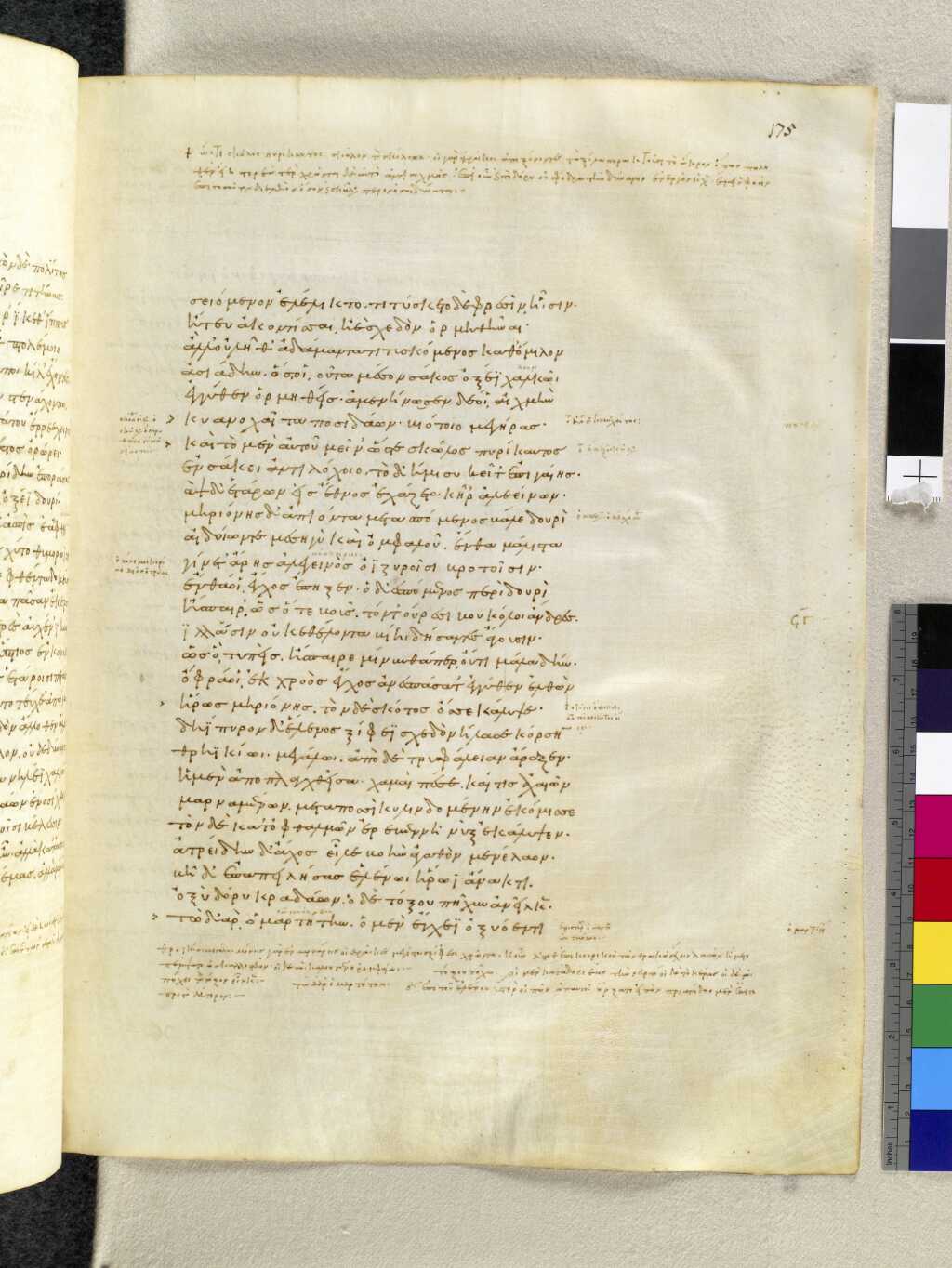
576Δηΐπυρον δʼ Ἕλενος ξίφεϊ σχεδὸν ἤλασε κόρσην 577Θρηϊκίῳ μεγάλῳ, ἀπὸ δὲ τρυφάλειαν ἄραξεν. 578ἣ μὲν ἀποπλαγχθεῖσα χαμαὶ πέσε, καί τις Ἀχαιῶν 579μαρναμένων μετὰ ποσσὶ κυλινδομένην ἐκόμισσε· 580τὸν δὲ κατʼ ὀφθαλμῶν ἐρεβεννὴ νὺξ ἐκάλυψεν. 581Ἀτρεΐδην δʼ ἄχος εἷλε βοὴν ἀγαθὸν Μενέλαον· 582βῆ δʼ ἐπαπειλήσας Ἑλένῳ ἥρωϊ ἄνακτι 583ὀξὺ δόρυ κραδάων· ὃ δὲ τόξου πῆχυν ἄνελκε. 584τὼ δʼ ἄρʼ ὁμαρτήδην ὃ μὲν ἔγχεϊ ὀξυόεντι 585ἵετʼ ἀκοντίσσαι, ὃ δʼ ἀπὸ νευρῆφιν ὀϊστῷ. 586Πριαμίδης μὲν ἔπειτα κατὰ στῆθος βάλεν ἰῷ 587θώρηκος γύαλον, ἀπὸ δʼ ἔπτατο πικρὸς ὀϊστός. 588ὡς δʼ ὅτʼ ἀπὸ πλατέος πτυόφιν μεγάλην κατʼ ἀλωὴν 589θρῴσκωσιν κύαμοι μελανόχροες ἢ ἐρέβινθοι 590πνοιῇ ὕπο λιγυρῇ καὶ λικμητῆρος ἐρωῇ, 591ὣς ἀπὸ θώρηκος Μενελάου κυδαλίμοιο 592πολλὸν ἀποπλαγχθεὶς ἑκὰς ἔπτατο πικρὸς ὀϊστός. 593Ἀτρεΐδης δʼ ἄρα χεῖρα βοὴν ἀγαθὸς Μενέλαος 594τὴν βάλεν ᾗ ῥʼ ἔχε τόξον ἐΰξοον· ἐν δʼ ἄρα τόξῳ 595ἀντικρὺ διὰ χειρὸς ἐλήλατο χάλκεον ἔγχος. 596ἂψ δʼ ἑτάρων εἰς ἔθνος ἐχάζετο κῆρʼ ἀλεείνων 597χεῖρα παρακρεμάσας· τὸ δʼ ἐφέλκετο μείλινον ἔγχος. 598καὶ τὸ μὲν ἐκ χειρὸς ἔρυσεν μεγάθυμος Ἀγήνωρ, 599αὐτὴν δὲ ξυνέδησεν ἐϋστρεφεῖ οἰὸς ἀώτῳ 600σφενδόνῃ, ἣν ἄρα οἱ θεράπων ἔχε ποιμένι λαῶν.
Grim Mars of awful voice did not yet know that his son had fallen, for he was sitting on the summits of Olympus under the golden clouds, by command of Jove, where the other gods were also sitting, forbidden to take part in the battle. Meanwhile men fought furiously about the body. Deiphobus tore the helmet from off his head, but Meriones sprang upon him, and struck him on the arm with a spear so that the visored helmet fell from his hand and came ringing down upon the ground. Thereon Meriones sprang upon him like a vulture, drew the spear from his shoulder, and fell back under cover of his men. Then Polites, own brother of Deiphobus passed his arms around his waist, and bore him away from the battle till he got to his horses that were standing in the rear of the fight with the chariot and their driver. These took him towards the city groaning and in great pain, with the blood flowing from his arm.
The others still fought on, and the battle-cry rose to heaven without ceasing. Aeneas sprang on Aphareus son of Caletor, and struck him with a spear in his throat which was turned towards him; his head fell on one side, his helmet and shield came down along with him, and death, life’s foe, was shed around him. Antilochus spied his chance, flew forward towards Thoon, and wounded him as he was turning round. He laid open the vein that runs all the way up the back to the neck; he cut this vein clean away throughout its whole course, and Thoon fell in the dust face upwards, stretching out his hands imploringly towards his comrades. Antilochus sprang upon him and stripped the armour from his shoulders, glaring round him fearfully as he did so. The Trojans came about him on every side and struck his broad and gleaming shield, but could not wound his body, for Neptune stood guard over the son of Nestor, though the darts fell thickly round him. He was never clear of the foe, but was always in the thick of the fight; his spear was never idle; he poised and aimed it in every direction, so eager was he to hit someone from a distance or to fight him hand to hand.
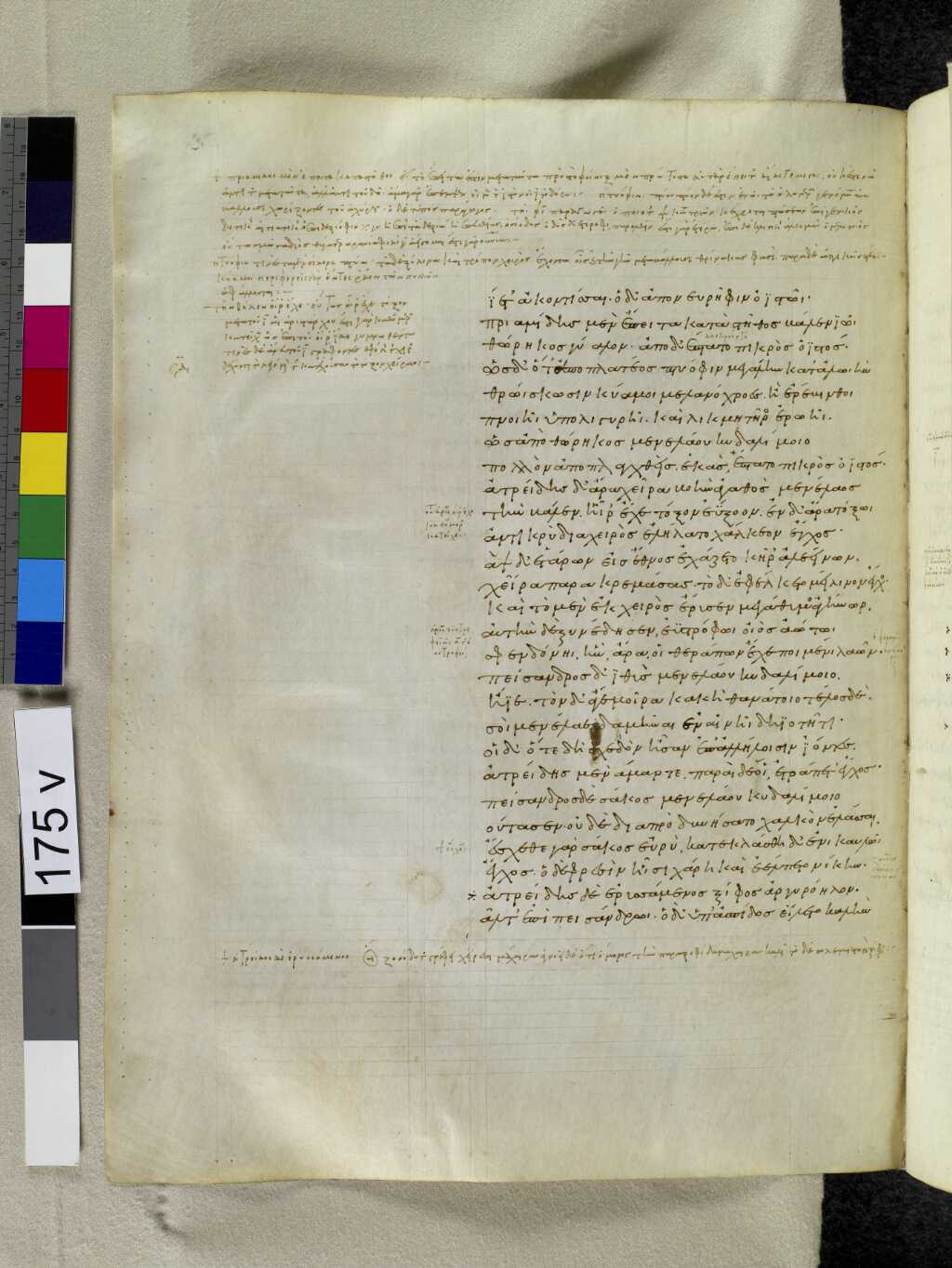
601Πείσανδρος δʼ ἰθὺς Μενελάου κυδαλίμοιο 602ἤϊε· τὸν δʼ ἄγε μοῖρα κακὴ θανάτοιο τέλος δὲ 603σοὶ Μενέλαε δαμῆναι ἐν αἰνῇ δηϊοτῆτι. 604οἳ δʼ ὅτε δὴ σχεδὸν ἦσαν ἐπʼ ἀλλήλοισιν ἰόντες 605Ἀτρεΐδης μὲν ἅμαρτε, παραὶ δέ οἱ ἐτράπετʼ ἔγχος, 606Πείσανδρος δὲ σάκος Μενελάου κυδαλίμοιο 607οὔτασεν, οὐδὲ διὰ πρὸ δυνήσατο χαλκὸν ἐλάσσαι· 608ἔσχεθε γὰρ σάκος εὐρύ, κατεκλάσθη δʼ ἐνὶ καυλῷ 609ἔγχος· ὃ δὲ φρεσὶν ᾗσι χάρη καὶ ἐέλπετο νίκην. 610Ἀτρεΐδης δὲ ἐρυσσάμενος ξίφος ἀργυρόηλον 611ἆλτʼ ἐπὶ Πεισάνδρῳ· ὃ δʼ ὑπʼ ἀσπίδος εἵλετο καλὴν 612ἀξίνην εὔχαλκον ἐλαΐνῳ ἀμφὶ πελέκκῳ 613μακρῷ ἐϋξέστῳ· ἅμα δʼ ἀλλήλων ἐφίκοντο. 614ἤτοι ὃ μὲν κόρυθος φάλον ἤλασεν ἱπποδασείης 615ἄκρον ὑπὸ λόφον αὐτόν, ὃ δὲ προσιόντα μέτωπον 616ῥινὸς ὕπερ πυμάτης· λάκε δʼ ὀστέα, τὼ δέ οἱ ὄσσε 617πὰρ ποσὶν αἱματόεντα χαμαὶ πέσον ἐν κονίῃσιν, 618ἰδνώθη δὲ πεσών· ὃ δὲ λὰξ ἐν στήθεσι βαίνων 619τεύχεά τʼ ἐξενάριξε καὶ εὐχόμενος ἔπος ηὔδα· 620λείψετέ θην οὕτω γε νέας Δαναῶν ταχυπώλων 621Τρῶες ὑπερφίαλοι δεινῆς ἀκόρητοι ἀϋτῆς, 622ἄλλης μὲν λώβης τε καὶ αἴσχεος οὐκ ἐπιδευεῖς 623ἣν ἐμὲ λωβήσασθε κακαὶ κύνες, οὐδέ τι θυμῷ 624Ζηνὸς ἐριβρεμέτεω χαλεπὴν ἐδείσατε μῆνιν 625ξεινίου, ὅς τέ ποτʼ ὔμμι διαφθέρσει πόλιν αἰπήν·
As he was thus aiming among the crowd, he was seen by Adamas, son of Asius, who rushed towards him and struck him with a spear in the middle of his shield, but Neptune made its point without effect, for he grudged him the life of Antilochus. One half, therefore, of the spear stuck fast like a charred stake in Antilochus’s shield, while the other lay on the ground. Adamas then sought shelter under cover of his men, but Meriones followed after and hit him with a spear midway between the private parts and the navel, where a wound is particularly painful to wretched mortals. There did Meriones transfix him, and he writhed convulsively about the spear as some bull whom mountain herdsmen have bound with ropes of withes and are taking away perforce. Even so did he move convulsively for a while, but not for very long, till Meriones came up and drew the spear out of his body, and his eyes were veiled in darkness.
Helenus then struck Deipyrus with a great Thracian sword, hitting him on the temple in close combat and tearing the helmet from his head; the helmet fell to the ground, and one of those who were fighting on the Achaean side took charge of it as it rolled at his feet, but the eyes of Deipyrus were closed in the darkness of death.
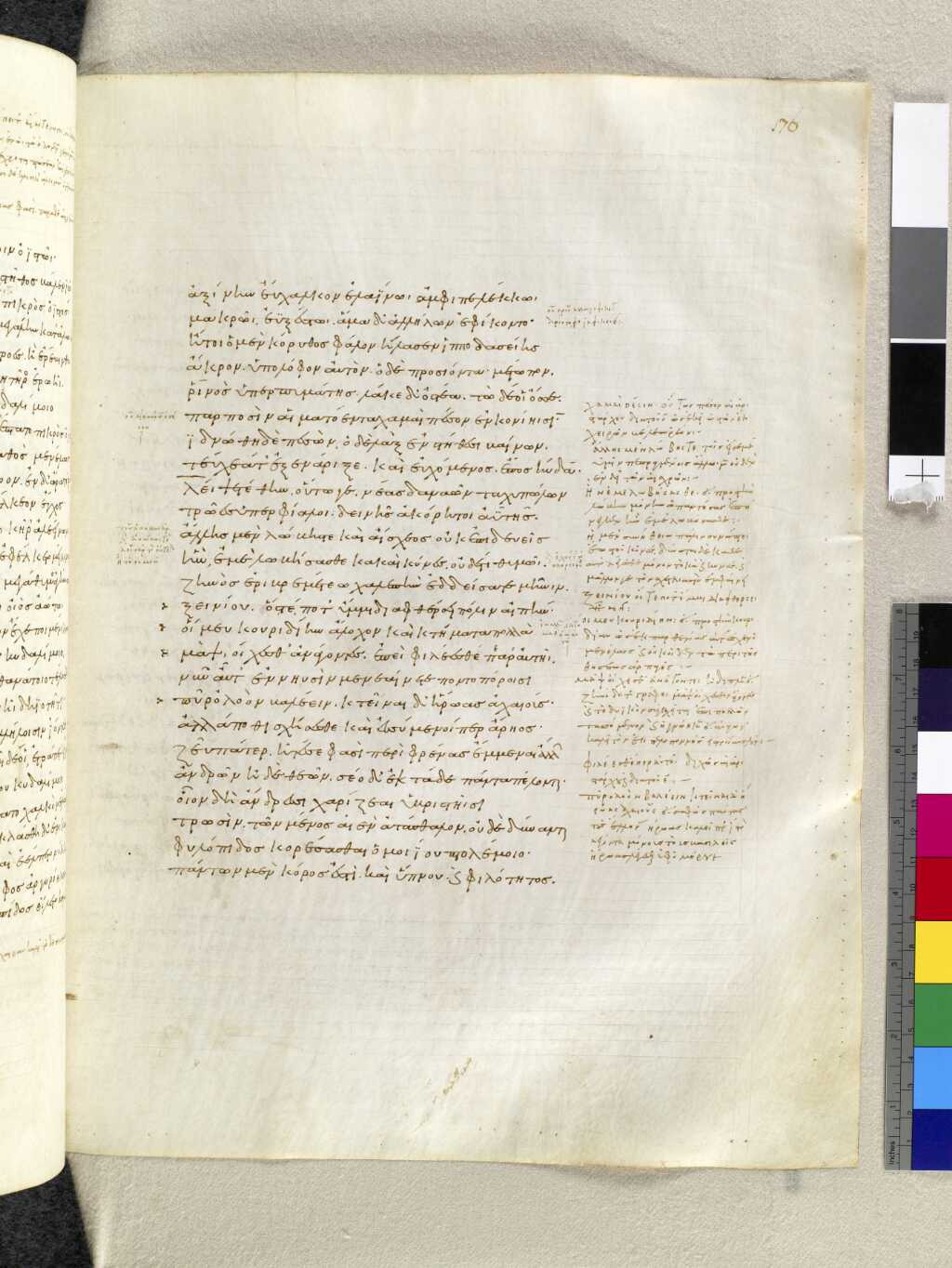
626οἵ μευ κουριδίην ἄλοχον καὶ κτήματα πολλὰ 627μὰψ οἴχεσθʼ ἀνάγοντες, ἐπεὶ φιλέεσθε παρʼ αὐτῇ· 628νῦν αὖτʼ ἐν νηυσὶν μενεαίνετε ποντοπόροισι 629πῦρ ὀλοὸν βαλέειν, κτεῖναι δʼ ἥρωας Ἀχαιούς. 630ἀλλά ποθι σχήσεσθε καὶ ἐσσύμενοί περ Ἄρηος. 631Ζεῦ πάτερ ἦ τέ σέ φασι περὶ φρένας ἔμμεναι ἄλλων 632ἀνδρῶν ἠδὲ θεῶν· σέο δʼ ἐκ τάδε πάντα πέλονται· 633οἷον δὴ ἄνδρεσσι χαρίζεαι ὑβριστῇσι 634Τρωσίν, τῶν μένος αἰὲν ἀτάσθαλον, οὐδὲ δύνανται 635φυλόπιδος κορέσασθαι ὁμοιΐου πτολέμοιο. 636πάντων μὲν κόρος ἐστὶ καὶ ὕπνου καὶ φιλότητος 637μολπῆς τε γλυκερῆς καὶ ἀμύμονος ὀρχηθμοῖο, 638τῶν πέρ τις καὶ μᾶλλον ἐέλδεται ἐξ ἔρον εἷναι 639ἢ πολέμου· Τρῶες δὲ μάχης ἀκόρητοι ἔασιν. 640ὣς εἰπὼν τὰ μὲν ἔντεʼ ἀπὸ χροὸς αἱματόεντα 641συλήσας ἑτάροισι δίδου Μενέλαος ἀμύμων, 642αὐτὸς δʼ αὖτʼ ἐξ αὖτις ἰὼν προμάχοισιν ἐμίχθη. 643ἔνθά οἱ υἱὸς ἐπᾶλτο Πυλαιμένεος βασιλῆος 644Ἁρπαλίων, ὅ ῥα πατρὶ φίλῳ ἕπετο πτολεμίξων 645ἐς τροίην, οὐδʼ αὖτις ἀφίκετο πατρίδα γαῖαν· 646ὅς ῥα τότʼ Ἀτρεΐδαο μέσον σάκος οὔτασε δουρὶ 647ἐγγύθεν, οὐδὲ διὰ πρὸ δυνήσατο χαλκὸν ἐλάσσαι 648ἂψ δʼ ἑτάρων εἰς ἔθνος ἐχάζετο κῆρʼ ἀλεείνων 649πάντοσε παπταίνων μή τις χρόα χαλκῷ ἐπαύρῃ. 650Μηριόνης δʼ ἀπιόντος ἵει χαλκήρεʼ ὀϊστόν,
On this Menelaus was grieved, and made menacingly towards Helenus, brandishing his spear; but Helenus drew his bow, and the two attacked one another at one and the same moment, the one with his spear, and the other with his bow and arrow. The son of Priam hit the breastplate of Menelaus’s corslet, but the arrow glanced from off it. As black beans or pulse come pattering down on to a threshing-floor from the broad winnowing-shovel, blown by shrill winds and shaken by the shovel—even so did the arrow glance off and recoil from the shield of Menelaus, who in his turn wounded the hand with which Helenus carried his bow; the spear went right through his hand and stuck in the bow itself, so that to his life he retreated under cover of his men, with his hand dragging by his side—for the spear weighed it down till Agenor drew it out and bound the hand carefully up in a woollen sling which his esquire had with him.
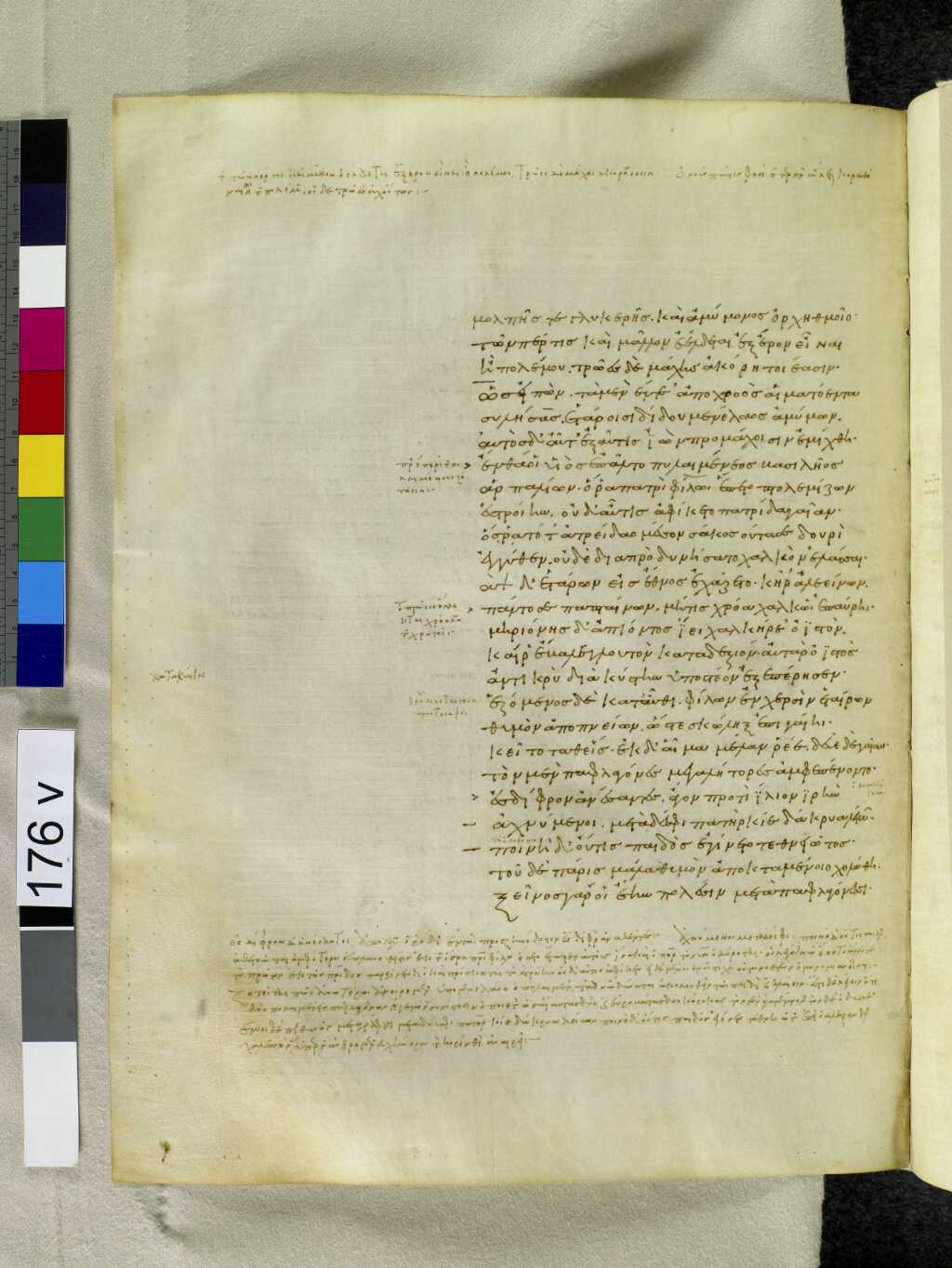
651καί ῥʼ ἔβαλε γλουτὸν κάτα δεξιόν· αὐτὰρ ὀϊστὸς 652ἀντικρὺ κατὰ κύστιν ὑπʼ ὀστέον ἐξεπέρησεν. 653ἑζόμενος δὲ κατʼ αὖθι φίλων ἐν χερσὶν ἑταίρων 654θυμὸν ἀποπνείων, ὥς τε σκώληξ ἐπὶ γαίῃ 655κεῖτο ταθείς· ἐκ δʼ αἷμα μέλαν ῥέε, δεῦε δὲ γαῖαν. 656τὸν μὲν Παφλαγόνες μεγαλήτορες ἀμφεπένοντο, 657ἐς δίφρον δʼ ἀνέσαντες ἄγον προτὶ Ἴλιον ἱρὴν 658ἀχνύμενοι· μετὰ δέ σφι πατὴρ κίε δάκρυα λείβων, 659ποινὴ δʼ οὔ τις παιδὸς ἐγίγνετο τεθνηῶτος. 660τοῦ δὲ Πάρις μάλα θυμὸν ἀποκταμένοιο χολώθη· 661ξεῖνος γάρ οἱ ἔην πολέσιν μετὰ Παφλαγόνεσσι· 662τοῦ ὅ γε χωόμενος προΐει χαλκήρεʼ ὀϊστόν. 663ἦν δέ τις Εὐχήνωρ Πολυΐδου μάντιος υἱὸς 664ἀφνειός τʼ ἀγαθός τε Κορινθόθι οἰκία ναίων, 665ὅς ῥʼ εὖ εἰδὼς κῆρʼ ὀλοὴν ἐπὶ νηὸς ἔβαινε· 666πολλάκι γάρ οἱ ἔειπε γέρων ἀγαθὸς Πολύϊδος 667νούσῳ ὑπʼ ἀργαλέῃ φθίσθαι οἷς ἐν μεγάροισιν, 668ἢ μετʼ Ἀχαιῶν νηυσὶν ὑπὸ Τρώεσσι δαμῆναι· 669τώ ῥʼ ἅμα τʼ ἀργαλέην θωὴν ἀλέεινεν Ἀχαιῶν 670νοῦσόν τε στυγερήν, ἵνα μὴ πάθοι ἄλγεα θυμῷ. 671τὸν βάλʼ ὑπὸ γναθμοῖο. καὶ οὔατος· ὦκα δὲ θυμὸς 672ᾤχετʼ ἀπὸ μελέων, στυγερὸς δʼ ἄρα μιν σκότος εἷλεν. 673ὣς οἳ μὲν μάρναντο δέμας πυρὸς αἰθομένοιο· 674Ἕκτωρ δʼ οὐκ ἐπέπυστο Διῒ φίλος, οὐδέ τι ᾔδη 675ὅττί ῥά οἱ νηῶν ἐπʼ ἀριστερὰ δηϊόωντο
Pisander then made straight at Menelaus—his evil destiny luring him on to his doom, for he was to fall in fight with you, O Menelaus. When the two were hard by one another the spear of the son of Atreus turned aside and he missed his aim; Pisander then struck the shield of brave Menelaus but could not pierce it, for the shield stayed the spear and broke the shaft; nevertheless he was glad and made sure of victory; forthwith, however, the son of Atreus drew his sword and sprang upon him. Pisander then seized the bronze battle-axe, with its long and polished handle of olive wood that hung by his side under his shield, and the two made at one another. Pisander struck the peak of Menelaus’s crested helmet just under the crest itself, and Menelaus hit Pisander as he was coming towards him, on the forehead, just at the rise of his nose; the bones cracked and his two gore-bedrabbled eyes fell by his feet in the dust. He fell backwards to the ground, and Menelaus set his heel upon him, stripped him of his armour, and vaunted over him saying, “Even thus shall you Trojans leave the ships of the Achaeans, proud and insatiate of battle though you be, nor shall you lack any of the disgrace and shame which you have heaped upon myself. Cowardly she-wolves that you are, you feared not the anger of dread Jove, avenger of violated hospitality, who will one day destroy your city; you stole my wedded wife and wickedly carried off much treasure when you were her guest, and now you would fling fire upon our ships, and kill our heroes. A day will come when, rage as you may, you shall be stayed. O father Jove, you, who they say art above all, both gods and men, in wisdom, and from whom all things that befall us do proceed, how can you thus favour the Trojans—men so proud and overweening, that they are never tired of fighting? All things pall after a while—sleep, love, sweet song, and stately dance—still these are things of which a man would surely have his fill rather than of battle, whereas it is of battle that the Trojans are insatiate.”
So saying Menelaus stripped the blood-stained armour from the body of Pisander, and handed it over to his men; then he again ranged himself among those who were in the front of the fight.
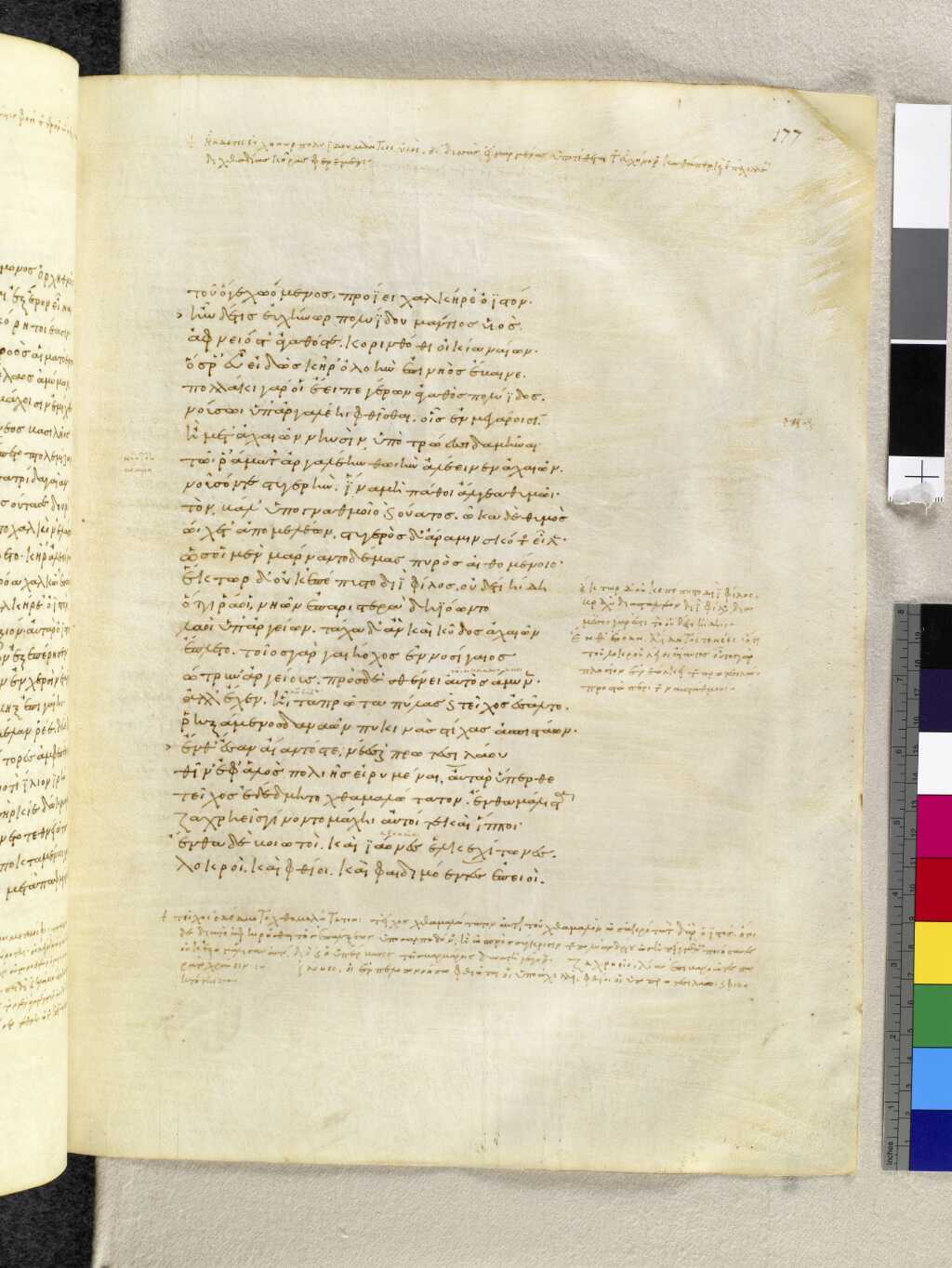
676λαοὶ ὑπʼ Ἀργείων. τάχα δʼ ἂν καὶ κῦδος Ἀχαιῶν 677ἔπλετο· τοῖος γὰρ γαιήοχος ἐννοσίγαιος 678ὄτρυνʼ Ἀργείους, πρὸς δὲ σθένει αὐτὸς ἄμυνεν· 679ἀλλʼ ἔχεν ᾗ τὰ πρῶτα πύλας καὶ τεῖχος ἐσᾶλτο 680ῥηξάμενος Δαναῶν πυκινὰς στίχας ἀσπιστάων, 681ἔνθʼ ἔσαν Αἴαντός τε νέες καὶ Πρωτεσιλάου 682θῖνʼ ἔφʼ ἁλὸς πολιῆς εἰρυμέναι· αὐτὰρ ὕπερθε 683τεῖχος ἐδέδμητο χθαμαλώτατον, ἔνθα μάλιστα 684ζαχρηεῖς γίγνοντο μάχῃ αὐτοί τε καὶ ἵπποι. 685ἔνθα δὲ Βοιωτοὶ καὶ Ἰάονες ἑλκεχίτωνες 686Λοκροὶ καὶ Φθῖοι καὶ φαιδιμόεντες Ἐπειοὶ 687σπουδῇ ἐπαΐσσοντα νεῶν ἔχον, οὐδὲ δύναντο 688ὦσαι ἀπὸ σφείων φλογὶ εἴκελον Ἕκτορα δῖον 689οἳ μὲν Ἀθηναίων προλελεγμένοι· ἐν δʼ ἄρα τοῖσιν 690ἦρχʼ υἱὸς Πετεῶο Μενεσθεύς, οἳ δʼ ἅμʼ ἕποντο 691Φείδας τε Στιχίος τε Βίας τʼ ἐΰς· αὐτὰρ Ἐπειῶν 692Φυλεΐδης τε Μέγης Ἀμφίων τε Δρακίος τε, 693πρὸ Φθίων δὲ Μέδων τε μενεπτόλεμός τε Ποδάρκης. 694ἤτοι ὃ μὲν νόθος υἱὸς Ὀϊλῆος θείοιο 695ἔσκε Μέδων Αἴαντος ἀδελφεός· αὐτὰρ ἔναιεν 696ἐν Φυλάκῃ γαίης ἄπο πατρίδος ἄνδρα κατακτὰς 697γνωτὸν μητρυιῆς Ἐριώπιδος, ἣν ἔχʼ Ὀϊλεύς· 698αὐτὰρ ὃ Ἰφίκλοιο πάϊς τοῦ Φυλακίδαο. 699οἳ μὲν πρὸ Φθίων μεγαθύμων θωρηχθέντες 700ναῦφιν ἀμυνόμενοι μετὰ Βοιωτῶν ἐμάχοντο·
Harpalion son of King Pylaemenes then sprang upon him; he had come to fight at Troy along with his father, but he did not go home again. He struck the middle of Menelaus’s shield with his spear but could not pierce it, and to save his life drew back under cover of his men, looking round him on every side lest he should be wounded. But Meriones aimed a bronze-tipped arrow at him as he was leaving the field, and hit him on the right buttock; the arrow pierced the bone through and through, and penetrated the bladder, so he sat down where he was and breathed his last in the arms of his comrades, stretched like a worm upon the ground and watering the earth with the blood that flowed from his wound. The brave Paphlagonians tended him with all due care; they raised him into his chariot, and bore him sadly off to the city of Troy; his father went also with him weeping bitterly, but there was no ransom that could bring his dead son to life again.
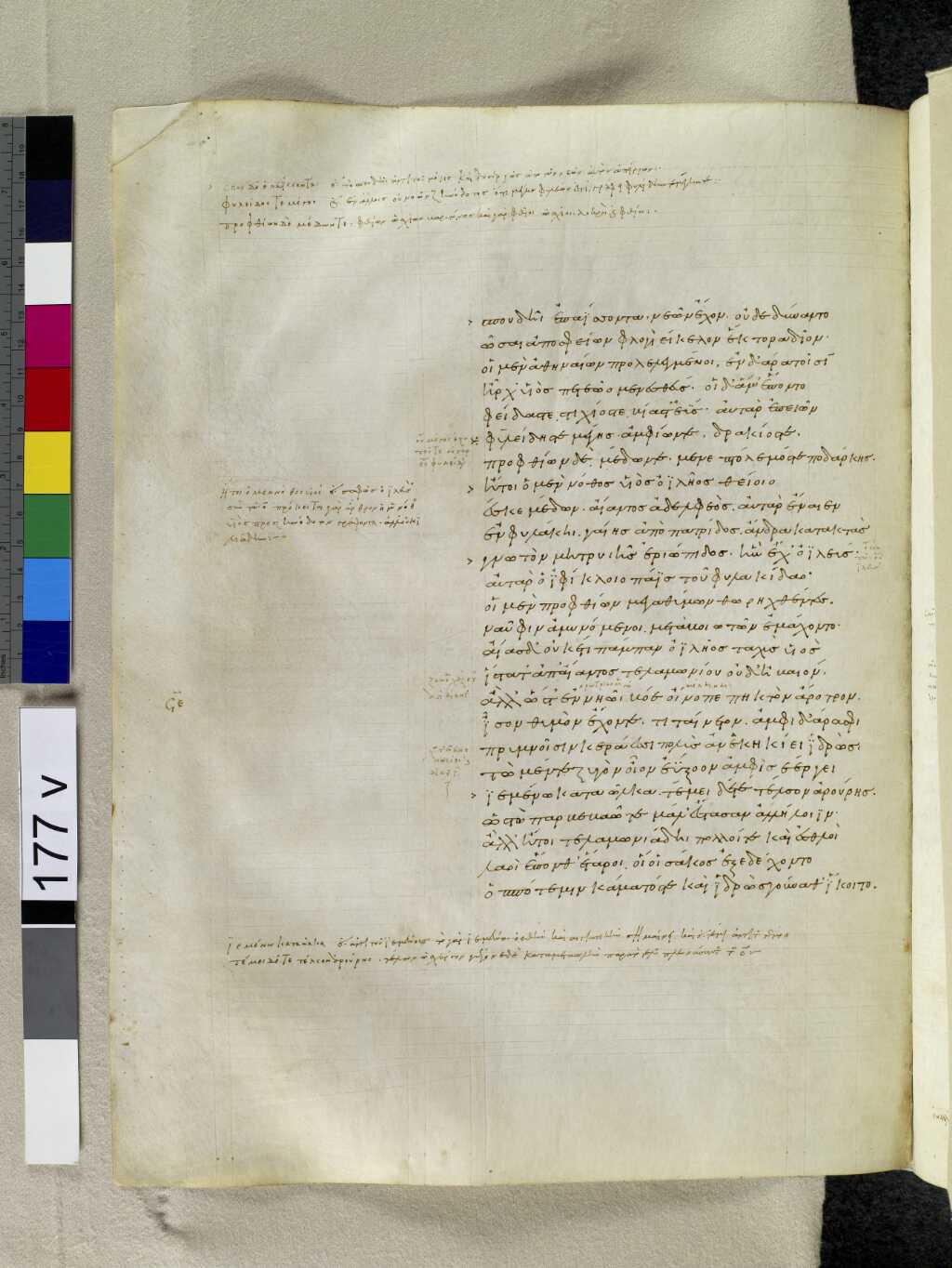
701Αἴας δʼ οὐκέτι πάμπαν Ὀϊλῆος ταχὺς υἱὸς 702ἵστατʼ ἀπʼ Αἴαντος Τελαμωνίου οὐδʼ ἠβαιόν, 703ἀλλʼ ὥς τʼ ἐν νειῷ βόε οἴνοπε πηκτὸν ἄροτρον 704ἶσον θυμὸν ἔχοντε τιταίνετον· ἀμφὶ δʼ ἄρά σφι 705πρυμνοῖσιν κεράεσσι πολὺς ἀνακηκίει ἱδρώς· 706τὼ μέν τε ζυγὸν οἶον ἐΰξοον ἀμφὶς ἐέργει 707ἱεμένω κατὰ ὦλκα· τέμει δέ τε τέλσον ἀρούρης· 708ὣς τὼ παρβεβαῶτε μάλʼ ἕστασαν ἀλλήλοιιν. 709ἀλλʼ ἤτοι Τελαμωνιάδῃ πολλοί τε καὶ ἐσθλοὶ 710λαοὶ ἕπονθʼ ἕταροι, οἵ οἱ σάκος ἐξεδέχοντο 711ὁππότε μιν κάματός τε καὶ ἱδρὼς γούναθʼ ἵκοιτο. 712οὐδʼ ἄρʼ Ὀϊλιάδῃ μεγαλήτορι Λοκροὶ ἕποντο· 713οὐ γάρ σφι σταδίῃ ὑσμίνῃ μίμνε φίλον κῆρ· 714οὐ γὰρ ἔχον κόρυθας χαλκήρεας ἱπποδασείας, 715οὐδʼ ἔχον ἀσπίδας εὐκύκλους καὶ μείλινα δοῦρα, 716ἀλλʼ ἄρα τόξοισιν καὶ ἐϋστρεφεῖ οἶος ἀώτῳ 717Ἴλιον εἰς ἅμʼ ἕποντο πεποιθότες, οἷσιν ἔπειτα 718ταρφέα βάλλοντες Τρώων ῥήγνυντο φάλαγγας· 719δή ῥα τόθʼ οἳ μὲν πρόσθε σὺν ἔντεσι δαιδαλέοισι 720μάρναντο Τρωσίν τε καὶ Ἕκτορι χαλκοκορυστῇ, 721οἳ δʼ ὄπιθεν βάλλοντες ἐλάνθανον· οὐδέ τι χάρμης 722Τρῶες μιμνήσκοντο· συνεκλόνεον γὰρ ὀϊστοί. 723ἔνθά κε λευγαλέως νηῶν ἄπο καὶ κλισιάων 724Τρῶες ἐχώρησαν προτὶ Ἴλιον ἠνεμόεσσαν, 725εἰ μὴ Πουλυδάμας θρασὺν Ἕκτορα εἶπε παραστάς·
Paris was deeply grieved by the death of Harpalion, who was his host when he went among the Paphlagonians; he aimed an arrow, therefore, in order to avenge him. Now there was a certain man named Euchenor, son of Polyidus the prophet, a brave man and wealthy, whose home was in Corinth. This Euchenor had set sail for Troy well knowing that it would be the death of him, for his good old father Polyidus had often told him that he must either stay at home and die of a terrible disease, or go with the Achaeans and perish at the hands of the Trojans; he chose, therefore, to avoid incurring the heavy fine the Achaeans would have laid upon him, and at the same time to escape the pain and suffering of disease. Paris now smote him on the jaw under his ear, whereon the life went out of him and he was enshrouded in the darkness of death.
Thus then did they fight as it were a flaming fire. But Hector had not yet heard, and did not know that the Argives were making havoc of his men on the left wing of the battle, where the Achaeans ere long would have triumphed over them, so vigorously did Neptune cheer them on and help them. He therefore held on at the point where he had first forced his way through the gates and the wall, after breaking through the serried ranks of Danaan warriors. It was here that the ships of Ajax and Protesilaus were drawn up by the sea-shore; here the wall was at its lowest, and the fight both of man and horse raged most fiercely. The Boeotians and the Ionians with their long tunics, the Locrians, the men of Phthia, and the famous force of the Epeans could hardly stay Hector as he rushed on towards the ships, nor could they drive him from them, for he was as a wall of fire. The chosen men of the Athenians were in the van, led by Menestheus son of Peteos, with whom were also Pheidas, Stichius, and stalwart Bias; Meges son of Phyleus, Amphion, and Dracius commanded the Epeans, while Medon and staunch Podarces led the men of Phthia. Of these, Medon was bastard son to Oileus and brother of Ajax, but he lived in Phylace away from his own country, for he had killed the brother of his stepmother Eriopis, the wife of Oileus; the other, Podarces, was the son of Iphiclus, son of Phylacus. These two stood in the van of the Phthians, and defended the ships along with the Boeotians.
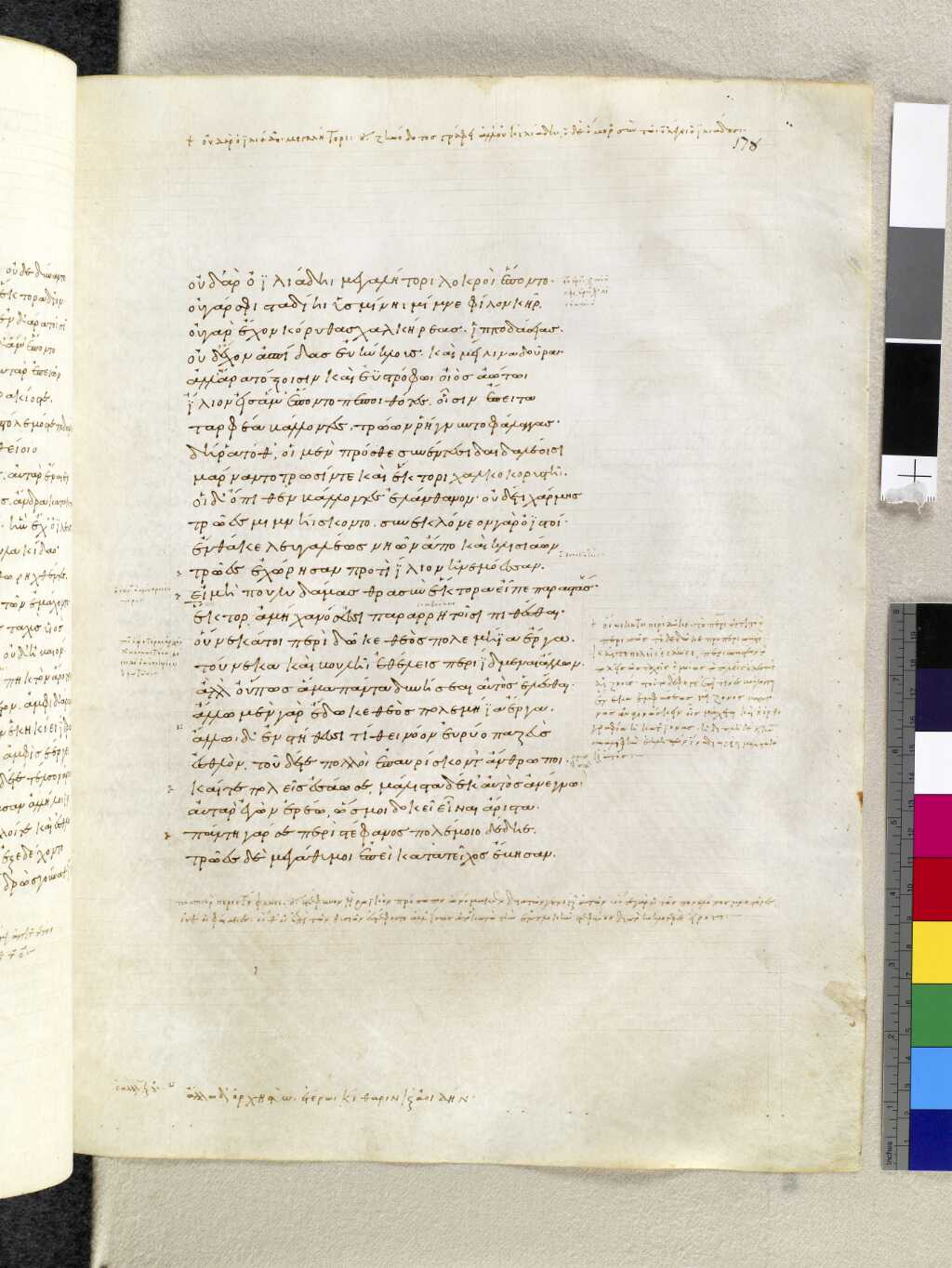
726Ἕκτορ ἀμήχανός ἐσσι παραρρητοῖσι πιθέσθαι. 727οὕνεκά τοι περὶ δῶκε θεὸς πολεμήϊα ἔργα 728τοὔνεκα καὶ βουλῇ ἐθέλεις περιίδμεναι ἄλλων· 729ἀλλʼ οὔ πως ἅμα πάντα δυνήσεαι αὐτὸς ἑλέσθαι. 730ἄλλῳ μὲν γὰρ ἔδωκε θεὸς πολεμήϊα ἔργα, 731ἄλλῳ δʼ ὀρχηστύν, ἑτέρῳ κίθαριν καὶ ἀοιδήν, 732ἄλλῳ δʼ ἐν στήθεσσι τιθεῖ νόον εὐρύοπα Ζεὺς 733ἐσθλόν, τοῦ δέ τε πολλοὶ ἐπαυρίσκοντʼ ἄνθρωποι, 734καί τε πολέας ἐσάωσε, μάλιστα δὲ καὐτὸς ἀνέγνω. 735αὐτὰρ ἐγὼν ἐρέω ὥς μοι δοκεῖ εἶναι ἄριστα· 736πάντῃ γάρ σε περὶ στέφανος πολέμοιο δέδηε· 737Τρῶες δὲ μεγάθυμοι ἐπεὶ κατὰ τεῖχος ἔβησαν 738οἳ μὲν ἀφεστᾶσιν σὺν τεύχεσιν, οἳ δὲ μάχονται 739παυρότεροι πλεόνεσσι κεδασθέντες κατὰ νῆας. 740ἀλλʼ ἀναχασσάμενος κάλει ἐνθάδε πάντας ἀρίστους· 741ἔνθεν δʼ ἂν μάλα πᾶσαν ἐπιφρασσαίμεθα βουλὴν 742ἤ κεν ἐνὶ νήεσσι πολυκλήϊσι πέσωμεν 743αἴ κʼ ἐθέλῃσι θεὸς δόμεναι κράτος, ἦ κεν ἔπειτα 744πὰρ νηῶν ἔλθωμεν ἀπήμονες. ἦ γὰρ ἔγωγε 745δείδω μὴ τὸ χθιζὸν ἀποστήσωνται Ἀχαιοὶ 746χρεῖος, ἐπεὶ παρὰ νηυσὶν ἀνὴρ ἆτος πολέμοιο 747μίμνει, ὃν οὐκέτι πάγχυ μάχης σχήσεσθαι ὀΐω. 748ὣς φάτο Πουλυδάμας, ἅδε δʼ Ἕκτορι μῦθος ἀπήμων, 749αὐτίκα δʼ ἐξ ὀχέων σὺν τεύχεσιν ἆλτο χαμᾶζε 750καί μιν φωνήσας ἔπεα πτερόεντα προσηύδα·
Ajax son of Oileus, never for a moment left the side of Ajax, son of Telamon, but as two swart oxen both strain their utmost at the plough which they are drawing in a fallow field, and the sweat steams upwards from about the roots of their horns—nothing but the yoke divides them as they break up the ground till they reach the end of the field—even so did the two Ajaxes stand shoulder to shoulder by one another. Many and brave comrades followed the son of Telamon, to relieve him of his shield when he was overcome with sweat and toil, but the Locrians did not follow so close after the son of Oileus, for they could not hold their own in a hand-to-hand fight. They had no bronze helmets with plumes of horse-hair, neither had they shields nor ashen spears, but they had come to Troy armed with bows, and with slings of twisted wool from which they showered their missiles to break the ranks of the Trojans. The others, therefore, with their heavy armour bore the brunt of the fight with the Trojans and with Hector, while the Locrians shot from behind, under their cover; and thus the Trojans began to lose heart, for the arrows threw them into confusion.
The Trojans would now have been driven in sorry plight from the ships and tents back to windy Ilius, had not Polydamas presently said to Hector, “Hector, there is no persuading you to take advice. Because heaven has so richly endowed you with the arts of war, you think that you must therefore excel others in counsel; but you cannot thus claim preeminence in all things. Heaven has made one man an excellent soldier; of another it has made a dancer or a singer and player on the lyre; while yet in another Jove has implanted a wise understanding of which men reap fruit to the saving of many, and he himself knows more about it than any one; therefore I will say what I think will be best. The fight has hemmed you in as with a circle of fire, and even now that the Trojans are within the wall some of them stand aloof in full armour, while others are fighting scattered and outnumbered near the ships. Draw back, therefore, and call your chieftains round you, that we may advise together whether to fall now upon the ships in the hope that heaven may vouchsafe us victory, or to beat a retreat while we can yet safely do so. I greatly fear that the Achaeans will pay us their debt of yesterday in full, for there is one abiding at their ships who is never weary of battle, and who will not hold aloof much longer.”
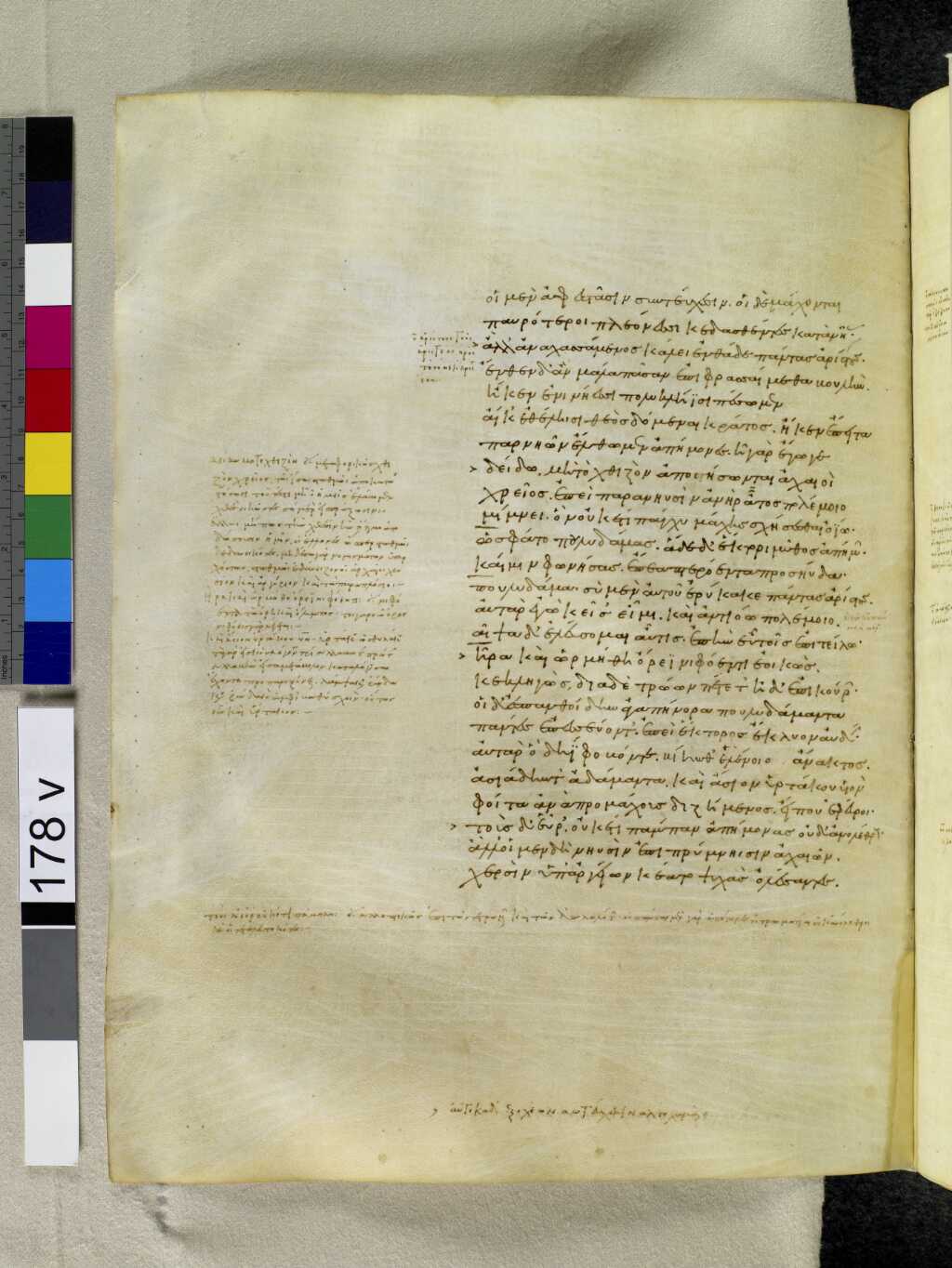
751Πουλυδάμα σὺ μὲν αὐτοῦ ἐρύκακε πάντας ἀρίστους, 752αὐτὰρ ἐγὼ κεῖσʼ εἶμι καὶ ἀντιόω πολέμοιο· 753αἶψα δʼ ἐλεύσομαι αὖτις ἐπὴν εὖ τοῖς ἐπιτείλω. 754ἦ ῥα, καὶ ὁρμήθη ὄρεϊ νιφόεντι ἐοικὼς 755κεκλήγων, διὰ δὲ Τρώων πέτετʼ ἠδʼ ἐπικούρων. 756οἳ δʼ ἐς Πανθοΐδην ἀγαπήνορα Πουλυδάμαντα 757πάντες ἐπεσσεύοντʼ, ἐπεὶ Ἕκτορος ἔκλυον αὐδήν. 758αὐτὰρ ὃ Δηΐφοβόν τε βίην θʼ Ἑλένοιο ἄνακτος 759Ἀσιάδην τʼ Ἀδάμαντα καὶ Ἄσιον Ὑρτάκου υἱὸν 760φοίτα ἀνὰ προμάχους διζήμενος, εἴ που ἐφεύροι. 761τοὺς δʼ εὗρʼ οὐκέτι πάμπαν ἀπήμονας οὐδʼ ἀνολέθρους· 762ἀλλʼ οἳ μὲν δὴ νηυσὶν ἔπι πρυμνῇσιν Ἀχαιῶν 763χερσὶν ὑπʼ Ἀργείων κέατο ψυχὰς ὀλέσαντες, 764οἳ δʼ ἐν τείχει ἔσαν βεβλημένοι οὐτάμενοί τε. 765τὸν δὲ τάχʼ εὗρε μάχης ἐπʼ ἀριστερὰ δακρυοέσσης 766δῖον Ἀλέξανδρον Ἑλένης πόσιν ἠϋκόμοιο 767θαρσύνονθʼ ἑτάρους καὶ ἐποτρύνοντα μάχεσθαι, 768ἀγχοῦ δʼ ἱστάμενος προσέφη αἰσχροῖς ἐπέεσσι· 769Δύσπαρι εἶδος ἄριστε γυναιμανὲς ἠπεροπευτὰ 770ποῦ τοι Δηΐφοβός τε βίη θʼ Ἑλένοιο ἄνακτος 771Ἀσιάδης τʼ Ἀδάμας ἠδʼ Ἄσιος Ὑρτάκου υἱός; 772ποῦ δέ τοι Ὀθρυονεύς; νῦν ὤλετο πᾶσα κατʼ ἄκρης 773Ἴλιος αἰπεινή· νῦν τοι σῶς αἰπὺς ὄλεθρος. 774τὸν δʼ αὖτε προσέειπεν Ἀλέξανδρος θεοειδής· 775Ἕκτορ ἐπεί τοι θυμὸς ἀναίτιον αἰτιάασθαι,
Thus spoke Polydamas, and his words pleased Hector well. He sprang in full armour from his chariot and said, “Polydamas, gather the chieftains here; I will go yonder into the fight, but will return at once when I have given them their orders.”
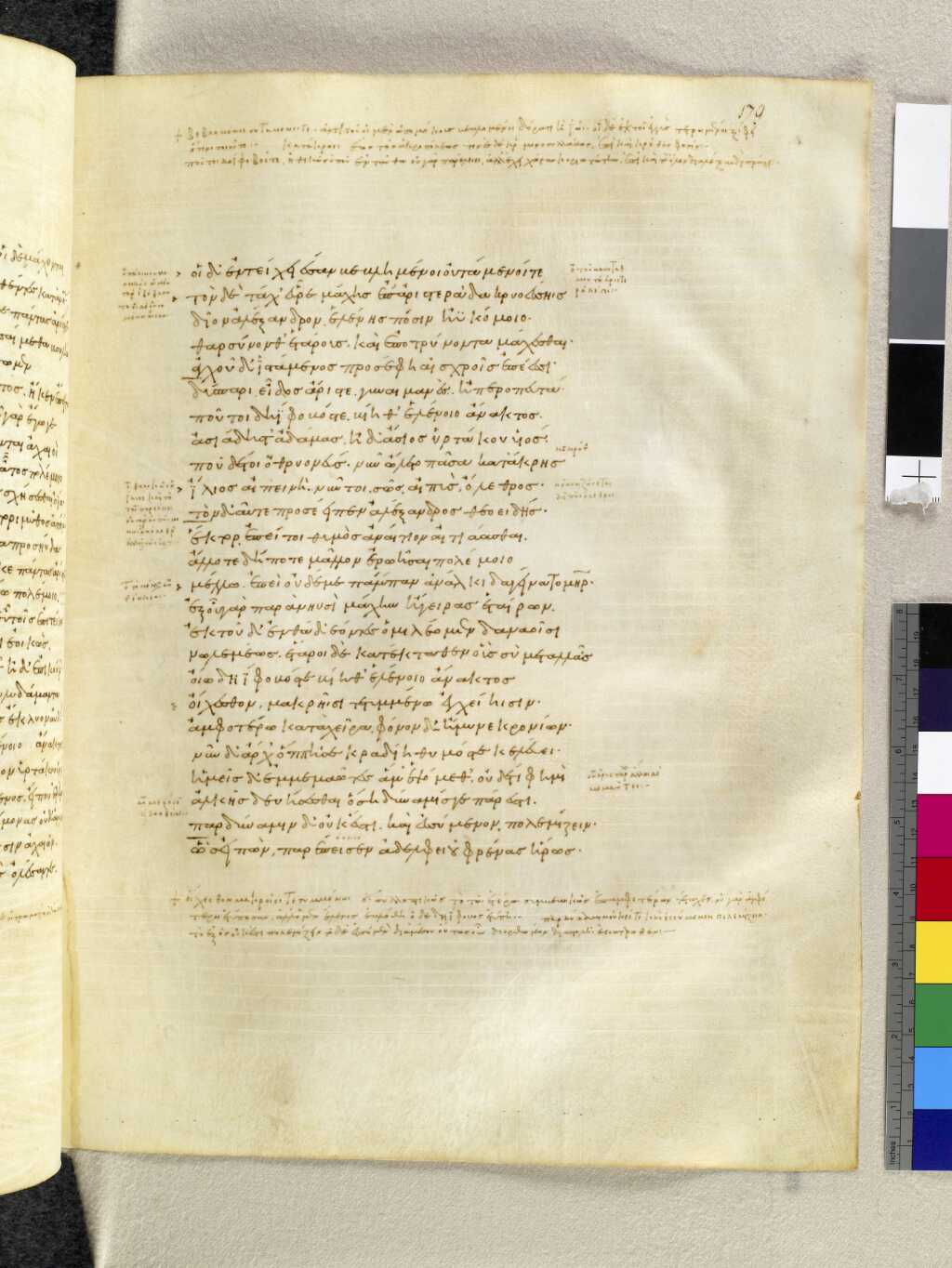
776ἄλλοτε δή ποτε μᾶλλον ἐρωῆσαι πολέμοιο 777μέλλω, ἐπεὶ οὐδʼ ἐμὲ πάμπαν ἀνάλκιδα γείνατο μήτηρ· 778ἐξ οὗ γὰρ παρὰ νηυσὶ μάχην ἤγειρας ἑταίρων, 779ἐκ τοῦ δʼ ἐνθάδʼ ἐόντες ὁμιλέομεν Δαναοῖσι 780νωλεμέως· ἕταροι δὲ κατέκταθεν οὓς σὺ μεταλλᾷς. 781οἴω Δηΐφοβός τε βίη θʼ Ἑλένοιο ἄνακτος 782οἴχεσθον, μακρῇσι τετυμμένω ἐγχείῃσιν 783ἀμφοτέρω κατὰ χεῖρα· φόνον δʼ ἤμυνε Κρονίων. 784νῦν δʼ ἄρχʼ ὅππῃ σε κραδίη θυμός τε κελεύει· 785ἡμεῖς δʼ ἐμμεμαῶτες ἅμʼ ἑψόμεθʼ, οὐδέ τί φημι 786ἀλκῆς δευήσεσθαι, ὅση δύναμίς γε πάρεστι. 787πὰρ δύναμιν δʼ οὐκ ἔστι καὶ ἐσσύμενον πολεμίζειν. 788ὣς εἰπὼν παρέπεισεν ἀδελφειοῦ φρένας ἥρως· 789βὰν δʼ ἴμεν ἔνθα μάλιστα μάχη καὶ φύλοπις ἦεν 790ἀμφί τε Κεβριόνην καὶ ἀμύμονα Πουλυδάμαντα 791Φάλκην Ὀρθαῖόν τε καὶ ἀντίθεον Πολυφήτην 792Πάλμύν τʼ Ἀσκάνιόν τε Μόρυν θʼ υἷʼ Ἱπποτίωνος, 793οἵ ῥʼ ἐξ Ἀσκανίης ἐριβώλακος ἦλθον ἀμοιβοὶ 794ἠοῖ τῇ προτέρῃ· τότε δὲ Ζεὺς ὦρσε μάχεσθαι. 795οἳ δʼ ἴσαν ἀργαλέων ἀνέμων ἀτάλαντοι ἀέλλῃ, 796ἥ ῥά θʼ ὑπὸ βροντῆς πατρὸς Διὸς εἶσι πέδον δέ, 797θεσπεσίῳ δʼ ὁμάδῳ ἁλὶ μίσγεται, ἐν δέ τε πολλὰ 798κύματα παφλάζοντα πολυφλοίσβοιο θαλάσσης 799κυρτὰ φαληριόωντα, πρὸ μέν τʼ ἄλλʼ, αὐτὰρ ἐπʼ ἄλλα· 800ὣς Τρῶες πρὸ μὲν ἄλλοι ἀρηρότες, αὐτὰρ ἐπʼ ἄλλοι,
He then sped onward, towering like a snowy mountain, and with a loud cry flew through the ranks of the Trojans and their allies. When they heard his voice they all hastened to gather round Polydamas, the excellent son of Panthous, but Hector kept on among the foremost, looking everywhere to find Deiphobus and prince Helenus, Adamas son of Asius, and Asius son of Hyrtacus; living, indeed, and scatheless he could no longer find them, for the two last were lying by the sterns of the Achaean ships, slain by the Argives, while the others had been also stricken and wounded by them; but upon the left wing of the dread battle he found Alexandrus, husband of lovely Helen, cheering his men and urging them on to fight. He went up to him and upbraided him. “Paris,” said he, “evil-hearted Paris, fair to see but woman-mad and false of tongue, where are Deiphobus and King Helenus? Where are Adamas son of Asius, and Asius son of Hyrtacus? Where too is Othryoneus? Ilius is undone and will now surely fall!”
Alexandrus answered, “Hector, why find fault when there is no one to find fault with? I should hold aloof from battle on any day rather than this, for my mother bore me with nothing of the coward about me. From the moment when you set our men fighting about the ships we have been staying here and doing battle with the Danaans. Our comrades about whom you ask me are dead; Deiphobus and King Helenus alone have left the field, wounded both of them in the hand, but the son of Saturn saved them alive. Now, therefore, lead on where you would have us go, and we will follow with right goodwill; you shall not find us fail you in so far as our strength holds out, but no man can do more than in him lies, no matter how willing he may be.”
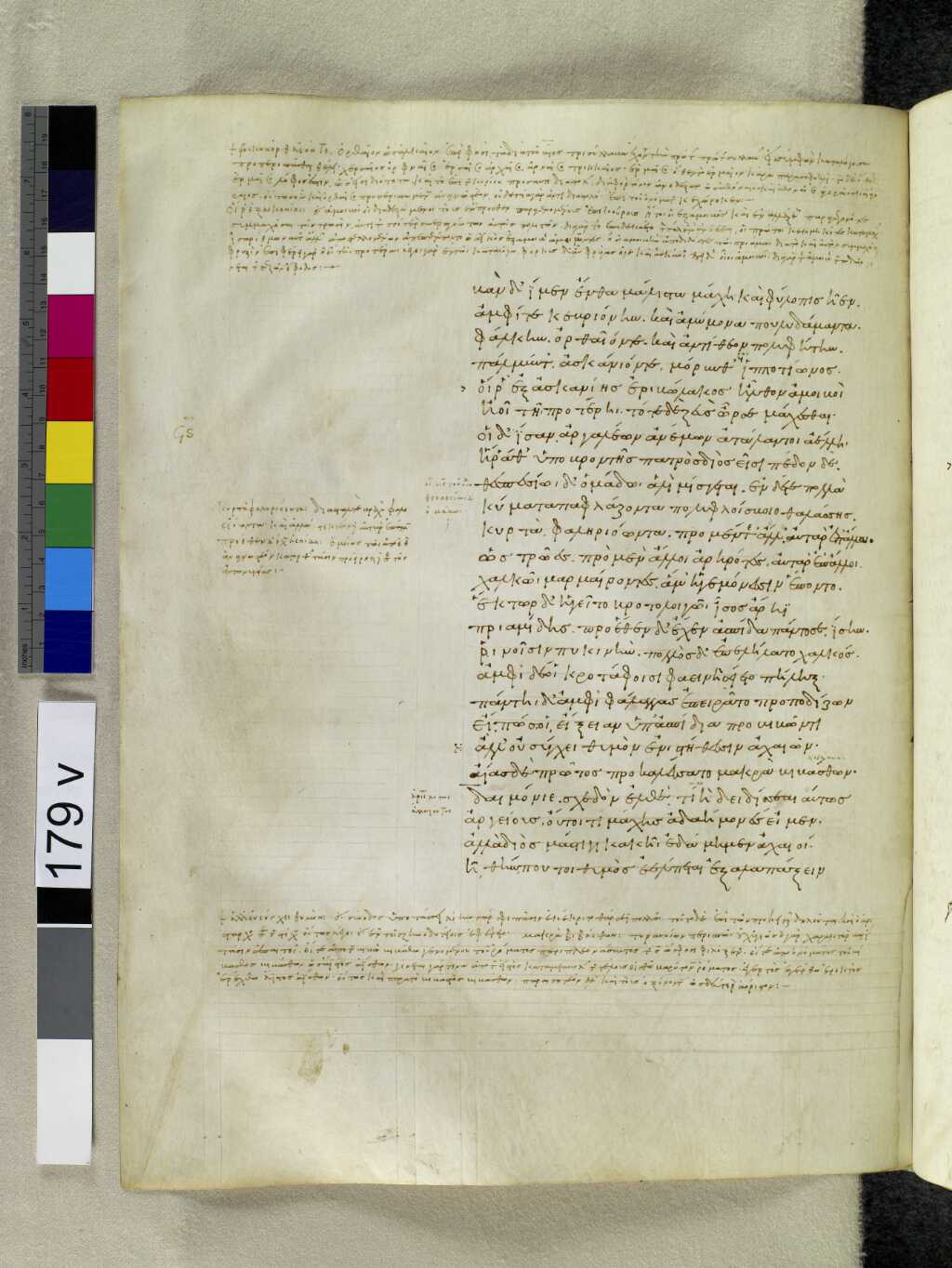
801χαλκῷ μαρμαίροντες ἅμʼ ἡγεμόνεσσιν ἕποντο. 802Ἕκτωρ δʼ ἡγεῖτο βροτολοιγῷ ἶσος Ἄρηϊ 803Πριαμίδης· πρόσθεν δʼ ἔχεν ἀσπίδα πάντοσʼ ἐΐσην 804ῥινοῖσιν πυκινήν, πολλὸς δʼ ἐπελήλατο χαλκός· 805ἀμφὶ δέ οἱ κροτάφοισι φαεινὴ σείετο πήληξ. 806πάντῃ δʼ ἀμφὶ φάλαγγας ἐπειρᾶτο προποδίζων, 807εἴ πώς οἱ εἴξειαν ὑπασπίδια προβιβῶντι· 808ἀλλʼ οὐ σύγχει θυμὸν ἐνὶ στήθεσσιν Ἀχαιῶν. 809Αἴας δὲ πρῶτος προκαλέσσατο μακρὰ βιβάσθων· 810δαιμόνιε σχεδὸν ἐλθέ· τί ἢ δειδίσσεαι αὔτως 811Ἀργείους; οὔ τοί τι μάχης ἀδαήμονές εἰμεν, 812ἀλλὰ Διὸς μάστιγι κακῇ ἐδάμημεν Ἀχαιοί. 813ἦ θήν πού τοι θυμὸς ἐέλπεται ἐξαλαπάξειν 814νῆας· ἄφαρ δέ τε χεῖρες ἀμύνειν εἰσὶ καὶ ἡμῖν. 815ἦ κε πολὺ φθαίη εὖ ναιομένη πόλις ὑμὴ 816χερσὶν ὑφʼ ἡμετέρῃσιν ἁλοῦσά τε περθομένη τε. 817σοὶ δʼ αὐτῷ φημὶ σχεδὸν ἔμμεναι ὁππότε φεύγων 818ἀρήσῃ Διὶ πατρὶ καὶ ἄλλοις ἀθανάτοισι 819θάσσονας ἰρήκων ἔμεναι καλλίτριχας ἵππους, 820οἵ σε πόλιν δʼ οἴσουσι κονίοντες πεδίοιο. 821ὣς ἄρα οἱ εἰπόντι ἐπέπτατο δεξιὸς ὄρνις 822αἰετὸς ὑψιπέτης· ἐπὶ δʼ ἴαχε λαὸς Ἀχαιῶν 823θάρσυνος οἰωνῷ· ὃ δʼ ἀμείβετο φαίδιμος Ἕκτωρ· 824Αἶαν ἁμαρτοεπὲς βουγάϊε ποῖον ἔειπες· 825εἰ γὰρ ἐγὼν οὕτω γε Διὸς πάϊς αἰγιόχοιο
With these words he satisfied his brother, and the two went towards the part of the battle where the fight was thickest, about Cebriones, brave Polydamas, Phalces, Orthaeus, godlike Polyphetes, Palmys, Ascanius, and Morys son of Hippotion, who had come from fertile Ascania on the preceding day to relieve other troops. Then Jove urged them on to fight. They flew forth like the blasts of some fierce wind that strike earth in the van of a thunderstorm—they buffet the salt sea into an uproar; many and mighty are the great waves that come crashing in one after the other upon the shore with their arching heads all crested with foam—even so did rank behind rank of Trojans arrayed in gleaming armour follow their leaders onward. The way was led by Hector son of Priam, peer of murderous Mars, with his round shield before him—his shield of ox-hides covered with plates of bronze—and his gleaming helmet upon his temples. He kept stepping forward under cover of his shield in every direction, making trial of the ranks to see if they would give way before him, but he could not daunt the courage of the Achaeans. Ajax was the first to stride out and challenge him. “Sir,” he cried, “draw near; why do you think thus vainly to dismay the Argives? We Achaeans are excellent soldiers, but the scourge of Jove has fallen heavily upon us. Your heart, forsooth, is set on destroying our ships, but we too have hands that can keep you at bay, and your own fair town shall be sooner taken and sacked by ourselves. The time is near when you shall pray Jove and all the gods in your flight, that your steeds may be swifter than hawks as they raise the dust on the plain and bear you back to your city.”
As he was thus speaking a bird flew by upon his right hand, and the host of the Achaeans shouted, for they took heart at the omen. But Hector answered, “Ajax, braggart and false of tongue, would that I were as sure of being son for evermore to aegis-bearing Jove, with Queen Juno for my mother, and of being held in like honour with Minerva and Apollo, as I am that this day is big with the destruction of the Achaeans; and you shall fall among them if you dare abide my spear; it shall rend your fair body and bid you glut our hounds and birds of prey with your fat and your flesh, as you fall by the ships of the Achaeans.”
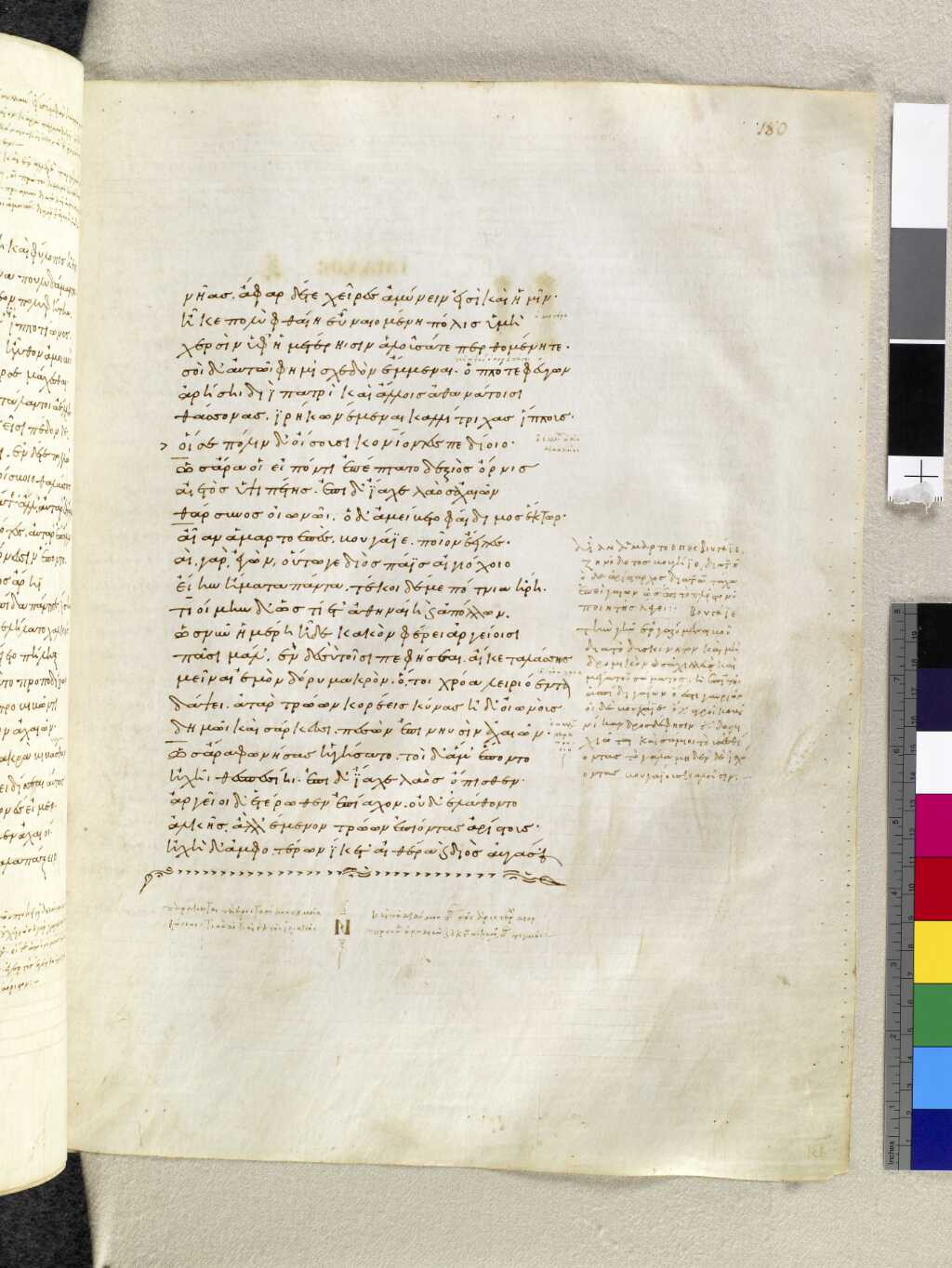
826εἴην ἤματα πάντα, τέκοι δέ με πότνια Ἥρη, 827τιοίμην δʼ ὡς τίετʼ Ἀθηναίη καὶ Ἀπόλλων, 828ὡς νῦν ἡμέρη ἥδε κακὸν φέρει Ἀργείοισι 829πᾶσι μάλʼ, ἐν δὲ σὺ τοῖσι πεφήσεαι, αἴ κε ταλάσσῃς 830μεῖναι ἐμὸν δόρυ μακρόν, ὅ τοι χρόα λειριόεντα 831δάψει· ἀτὰρ Τρώων κορέεις κύνας ἠδʼ οἰωνοὺς 832δημῷ καὶ σάρκεσσι πεσὼν ἐπὶ νηυσὶν Ἀχαιῶν. 833ὣς ἄρα φωνήσας ἡγήσατο· τοὶ δʼ ἅμʼ ἕποντο 834ἠχῇ θεσπεσίῃ, ἐπὶ δʼ ἴαχε λαὸς ὄπισθεν. 835Ἀργεῖοι δʼ ἑτέρωθεν ἐπίαχον, οὐδὲ λάθοντο 836ἀλκῆς, ἀλλʼ ἔμενον Τρώων ἐπιόντας ἀρίστους. 837ἠχὴ δʼ ἀμφοτέρων ἵκετʼ αἰθέρα καὶ Διὸς αὐγάς.
With these words he led the way and the others followed after with a cry that rent the air, while the host shouted behind them. The Argives on their part raised a shout likewise, nor did they forget their prowess, but stood firm against the onslaught of the Trojan chieftains, and the cry from both the hosts rose up to heaven and to the brightness of Jove’s presence.
Cite
Source & Cross-References
- Source text: Venetus A (10th c.) via Homer Multitext IIIF + Perseus Greek + Butler English (PG #2199) — view original
- Critical edition: Munro & Allen (Perseus Digital Library)
← previous · → next · v cycle view · l back to library