John, Chapter 10 (Codex Washingtonianus)
Introduction
John 10 from Codex Washingtonianus (the Freer Gospels, Gregory-Aland 032, Freer Gallery of Art F1906.274), a parchment codex of the four Gospels written in Egypt in the late 4th or early 5th century and bought by Charles Lang Freer from the dealer Ali Arabi at Giza in 1906. It is one of the oldest nearly complete Gospel books in existence. The Gospels stand in the so-called Western order, Matthew, John, Luke, Mark, and the text is famously block-mixed: the copyist drew on several exemplars of different textual character, so the text type changes in blocks within a single Gospel. After Mark 16:14 the codex carries the Freer Logion, a saying found in no other manuscript. Two passages are lost to damage: Mark 15:13-37 and John 14:26-16:6.
- Scan: each section is shown with the actual page of the codex that carries those verses, from the Freer Gallery's own photographs of F1906.274 served by the Smithsonian IIIF service (ids.si.edu). Which page holds which verse comes from the verse index of the Center for the Study of New Testament Manuscripts (CSNTM), whose photographs of the codex are the same shots; every CSNTM page was matched to its Smithsonian image by pixel comparison before use. Where a verse begins on one page and ends on the next, both pages are listed. For this chapter the page of each verse is taken from the transcription itself, which records where every page begins; CSNTM's index confirms which photograph shows that page.
- Greek: the manuscript's own text, from a diplomatic transcription (see Greek text below), with Tischendorf's 8th critical edition (1869) for comparison.
- English: the King James Version (1611, public domain), verbatim from bible-api.com. The KJV translates the later Byzantine text, so it will not always match the Greek shown or the reading of the codex.
Greek text: a diplomatic transcription of Codex Washingtonianus made by the International Greek New Testament Project (IGNTP), transcription of John in GA 032, version 2.1 (2013), published under a Creative Commons Attribution 4.0 licence. It gives the letters as the first scribe wrote them: no accents or breathings, the scribe's own spelling, and the sacred names in their contracted form (θς for θεος, ις for ιησους, κς for κυριος; the overline is not reproduced). A stroke ¯ after a letter (for example μενω¯, το¯) is the scribe's abbreviation for a final ν, kept as the transcription gives it. Corrections by later hands are not shown. Letters in square brackets are not legible on the page and were restored by the transcribers, a dot under a letter marks an uncertain reading, and [...] marks text lost to damage. Beneath each section, for comparison, is Tischendorf's 8th critical edition (1869). Where the two differ, the transcription is what the manuscript says. Each section is shown with the page on which the transcription places its verses.
How was this verified? (Provenance)
Where on the image
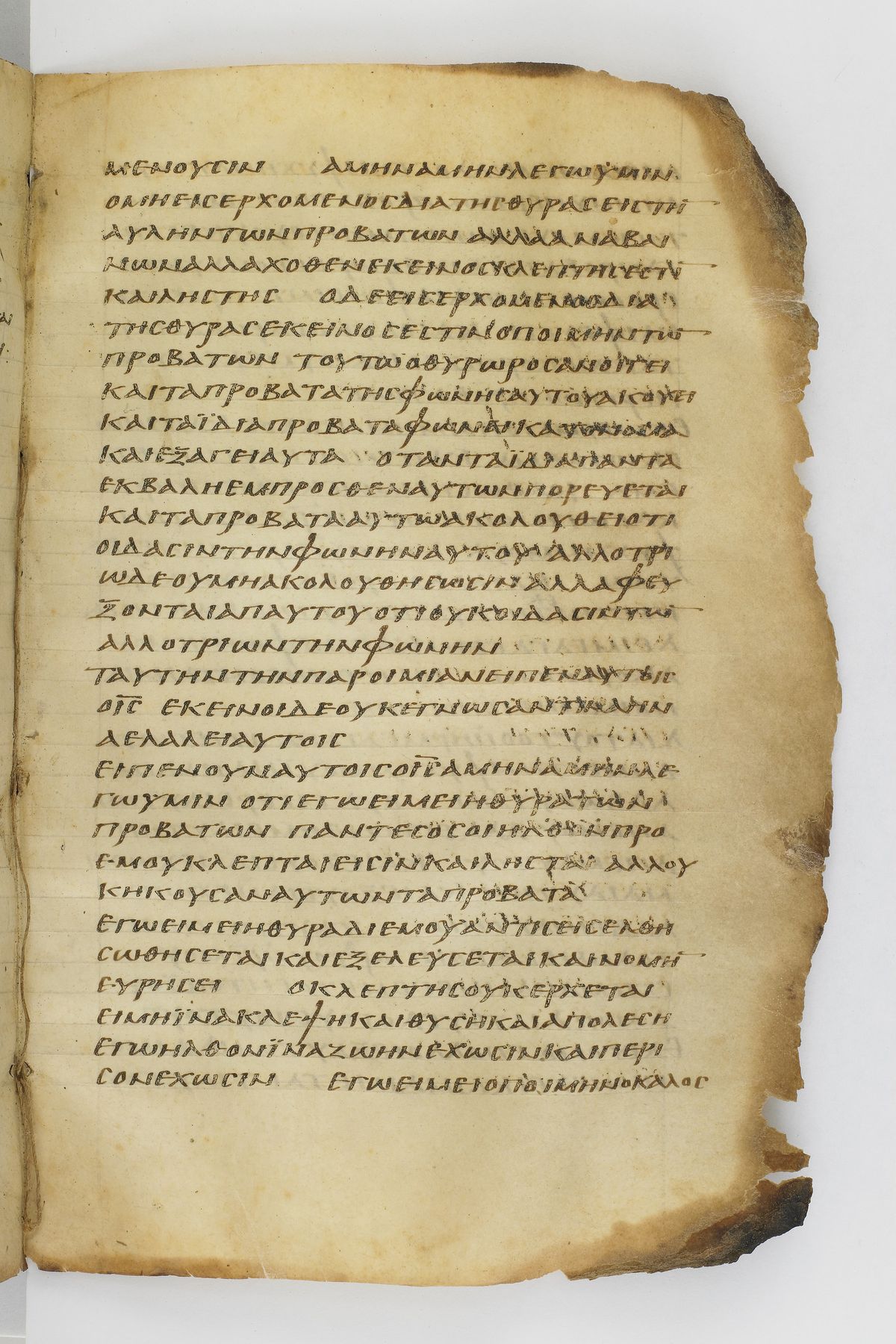
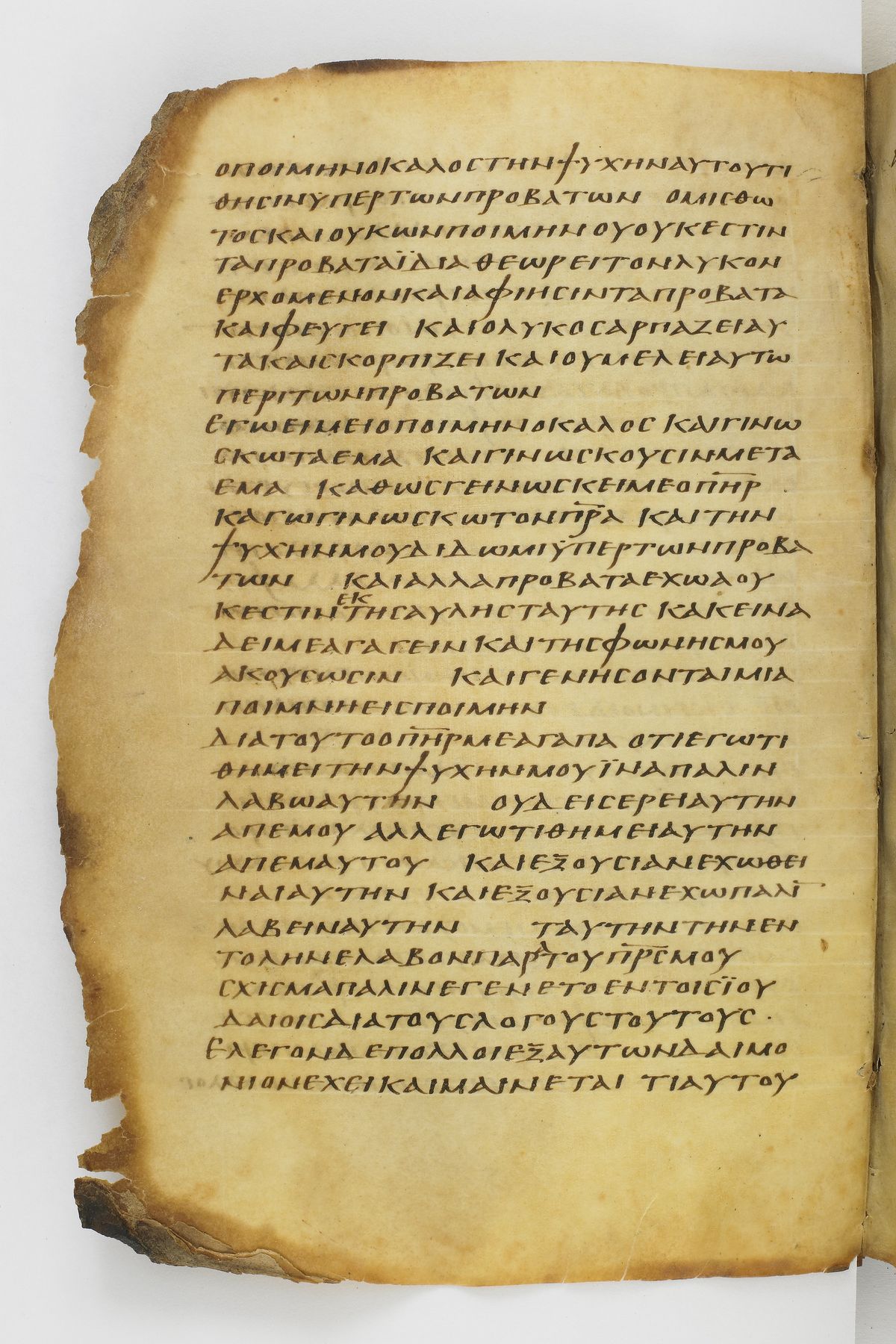
Page from the IGNTP transcription: verses 1-11 on fol. 77r, CSNTM GA_032_0153; verse 11 continues on fol. 77v, CSNTM GA_032_0154 (which begins 'ο ποιμην ο').
1αμην αμην λεγω υμιν ο μη εισερχομενος δια της θυρας εις τη¯ αυλην των προβατων αλλα αναβαινων αλλαχοθεν εκεινος κλεπτης εστι¯ και ληστης 2ο δε εισερχομενος δια της θυρας εκεινος εστιν ο ποιμην τω¯ προβατων 3τουτω ο θυρωρος ανοιγει και τα προβατα της φωνης αυτου ακουει και τα ιδια προβατα φωνει κατ ονομα και εξαγει αυτα 4οταν τα ιδια παντα εκβαλη εμπροσθεν αυτων πορευεται και τα προβατα αυτω ακολουθει οτι οιδασιν την φωνην αυτου 5αλλοτριω δε ου μη ακολουθησωσιν αλλα φευξονται απ αυτου οτι ουκ οιδασιν τω¯ αλλοτριων την φωνην 6ταυτην την παροιμιαν ειπεν αυτοις ο ις εκεινοι δε ουκ εγνωσαν τινα ην α ελαλει αυτοις 7ειπεν ουν αυτοις ο ις αμην αμην λεγω υμιν οτι εγω ειμει η θυρα των προβατων 8παντες οσοι ηλθον προ εμου κλεπται εισιν και λησται αλλ ουκ ηκουσαν αυτων τα προβατα 9εγω ειμει η θυρα δι εμου αν τις εισελθη σωθησεται και εξελευσεται και νομη¯ ευρησει 10ο κλεπτης ουκ ερχεται ει μη ινα κλεψη και θυση και απολεση εγω ηλθον ινα ζωην εχωσιν και περισον εχωσιν 11εγω ειμει ο ποιμην ο καλος ο ποιμην ο καλος την ψυχην αυτου τιθησιν υπερ των προβατων
Compare: Tischendorf 8th edition (1869)
1Ἀμὴν ἀμὴν λέγω ὑμῖν, ὁ μὴ εἰσερχόμενος διὰ τῆς θύρας εἰς τὴν αὐλὴν τῶν προβάτων ἀλλὰ ἀναβαίνων ἀλλαχόθεν, ἐκεῖνος κλέπτης ἐστὶν καὶ λῃστής· 2ὁ δὲ εἰσερχόμενος διὰ τῆς θύρας ποιμήν ἐστιν τῶν προβάτων. 3τούτῳ ὁ θυρωρὸς ἀνοίγει, καὶ τὰ πρόβατα τῆς φωνῆς αὐτοῦ ἀκούει, καὶ τὰ ἴδια πρόβατα φωνεῖ κατ’ ὄνομα καὶ ἐξάγει αὐτά. 4ὅταν τὰ ἴδια πάντα ἐκβάλῃ, ἔμπροσθεν αὐτῶν πορεύεται, καὶ τὰ πρόβατα αὐτῷ ἀκολουθεῖ, ὅτι οἴδασιν τὴν φωνὴν αὐτοῦ· 5ἀλλοτρίῳ δὲ οὐ μὴ ἀκολουθήσουσιν, ἀλλὰ φεύξονται ἀπ’ αὐτοῦ, ὅτι οὐκ οἴδασιν τῶν ἀλλοτρίων τὴν φωνήν. 6Ταύτην τὴν παροιμίαν εἶπεν αὐτοῖς ὁ Ἰησοῦς· ἐκεῖνοι δὲ οὐκ ἔγνωσαν τίνα ἦν ἃ ἐλάλει αὐτοῖς. 7εἶπεν οὖν ὁ Ἰησοῦς· ἀμὴν ἀμὴν λέγω ὑμῖν ὅτι ἐγώ εἰμι ἡ θύρα τῶν προβάτων. 8πάντες ὅσοι ἦλθον κλέπται εἰσὶν καὶ λῃσταί, ἀλλ’ οὐκ ἤκουσαν αὐτῶν τὰ πρόβατα. 9ἐγώ εἰμι ἡ θύρα· δι’ ἐμοῦ ἐάν τις εἰσέλθῃ, σωθήσεται καὶ εἰσελεύσεται καὶ ἐξελεύσεται καὶ νομὴν εὑρήσει. 10ὁ κλέπτης οὐκ ἔρχεται εἰ μὴ ἵνα κλέψῃ καὶ θύσῃ καὶ ἀπολέσῃ· ἐγὼ ἦλθον ἵνα ζωὴν ἔχωσιν καὶ περισσὸν ἔχωσιν. 11ἐγώ εἰμι ὁ ποιμὴν ὁ καλός. ὁ ποιμὴν ὁ καλὸς τὴν ψυχὴν αὐτοῦ τίθησιν ὑπὲρ τῶν προβάτων·
1Verily, verily, I say unto you, He that entereth not by the door into the sheepfold, but climbeth up some other way, the same is a thief and a robber. 2But he that entereth in by the door is the shepherd of the sheep. 3To him the porter openeth; and the sheep hear his voice: and he calleth his own sheep by name, and leadeth them out. 4And when he putteth forth his own sheep, he goeth before them, and the sheep follow him: for they know his voice. 5And a stranger will they not follow, but will flee from him: for they know not the voice of strangers. 6This parable spake Jesus unto them: but they understood not what things they were which he spake unto them. 7Then said Jesus unto them again, Verily, verily, I say unto you, I am the door of the sheep. 8All that ever came before me are thieves and robbers: but the sheep did not hear them. 9I am the door: by me if any man enter in, he shall be saved, and shall go in and out, and find pasture. 10The thief cometh not, but for to steal, and to kill, and to destroy: I am come that they might have life, and that they might have it more abundantly. 11I am the good shepherd: the good shepherd giveth his life for the sheep.
Where on the image
Page from the IGNTP transcription: verses 12-20 on fol. 77v, CSNTM GA_032_0154; verse 20 continues on fol. 78r, CSNTM GA_032_0155 (which begins 'ακουεται').
12ο μισθωτος και ουκ ων ποιμην ου ουκ εστιν τα προβατα ιδια θεωρει τον λυκον ερχομενον και αφιησιν τα προβατα και φευγει και ο λυκος αρπαζει αυτα και σκορπιζει 13και ου μελει αυτω περι των προβατων 14Εγω ειμει ο ποιμην ο καλος και γινωσκω τα εμα και γινωσκουσιν με τα εμα 15καθως γεινωσκει με ο πηρ καγω γινωσκω τον πρα και την ψυχην μου διδωμι υπερ των προβατων 16και αλλα προβατα εχω α ουκ εστιν της αυλης ταυτης κακεινα δει με αγαγειν και της φωνης μου ακουσωσιν και γενησονται μια ποιμνη εις ποιμην 17δια τουτο ο πηρ με αγαπα οτι εγω τιθημει την ψυχην μου ινα παλιν λαβω αυτα 18ουδεις ερει αυτην απ εμου αλλ εγω τιθημει αυτην απ εμαυτου και εξουσιαν εχω θειναι αυτην και εξουσιαν εχω παλι¯ λαβειν αυτην ταυτην την εντολην ελαβον παρ του πρς μου 19σχισμα παλιν εγενετο εν τοις ιουδαιοις δια τους λογους τουτους 20Ελεγον δε πολλοι εξ αυτων δαιμονιον εχει και μαινεται τι αυτου ακουεται
Compare: Tischendorf 8th edition (1869)
12ὁ μισθωτὸς καὶ οὐκ ὢν ποιμήν, οὗ οὐκ ἐστὶν τὰ πρόβατα ἴδια, θεωρεῖ τὸν λύκον ἐρχόμενον καὶ ἀφίησιν τὰ πρόβατα καὶ φεύγει, καὶ ὁ λύκος ἁρπάζει αὐτὰ καὶ σκορπίζει· 13ὅτι μισθωτός ἐστιν, καὶ οὐ μέλει αὐτῷ περὶ τῶν προβάτων. 14ἐγώ εἰμι ὁ ποιμὴν ὁ καλός, καὶ γινώσκω τὰ ἐμά, καὶ γινώσκουσί με τὰ ἐμά, 15καθὼς γινώσκει με ὁ πατὴρ κἀγὼ γινώσκω τὸν πατέρα, καὶ τὴν ψυχήν μου τίθημι ὑπὲρ τῶν προβάτων. 16καὶ ἄλλα πρόβατα ἔχω, ἃ οὐκ ἔστιν ἐκ τῆς αὐλῆς ταύτης· κἀκεῖνα δεῖ με ἀγαγεῖν, καὶ τῆς φωνῆς μου ἀκούσουσιν, καὶ γενήσεται μία ποίμνη, εἷς ποιμήν. 17διὰ τοῦτό με ὁ πατὴρ ἀγαπᾷ, ὅτι ἐγὼ τίθημι τὴν ψυχήν μου, ἵνα πάλιν λάβω αὐτήν. 18οὐδεὶς αἴρει αὐτὴν ἀπ’ ἐμοῦ, ἀλλ’ ἐγὼ τίθημι αὐτὴν ἀπ’ ἐμαυτοῦ. ἐξουσίαν ἔχω θεῖναι αὐτήν, καὶ ἐξουσίαν ἔχω πάλιν λαβεῖν αὐτήν· ταύτην τὴν ἐντολὴν ἔλαβον παρὰ τοῦ πατρός μου. 19σχίσμα πάλιν ἐγένετο ἐν τοῖς Ἰουδαίοις διὰ τοὺς λόγους τούτους. 20ἔλεγον οὖν πολλοὶ ἐξ αὐτῶν· δαιμόνιον ἔχει καὶ μαίνεται· τί αὐτοῦ ἀκούετε;
12But he that is an hireling, and not the shepherd, whose own the sheep are not, seeth the wolf coming, and leaveth the sheep, and fleeth: and the wolf catcheth them, and scattereth the sheep. 13The hireling fleeth, because he is an hireling, and careth not for the sheep. 14I am the good shepherd, and know my sheep, and am known of mine. 15As the Father knoweth me, even so know I the Father: and I lay down my life for the sheep. 16And other sheep I have, which are not of this fold: them also I must bring, and they shall hear my voice; and there shall be one fold, and one shepherd. 17Therefore doth my Father love me, because I lay down my life, that I might take it again. 18No man taketh it from me, but I lay it down of myself. I have power to lay it down, and I have power to take it again. This commandment have I received of my Father. 19There was a division therefore again among the Jews for these sayings. 20And many of them said, He hath a devil, and is mad; why hear ye him?
Where on the image
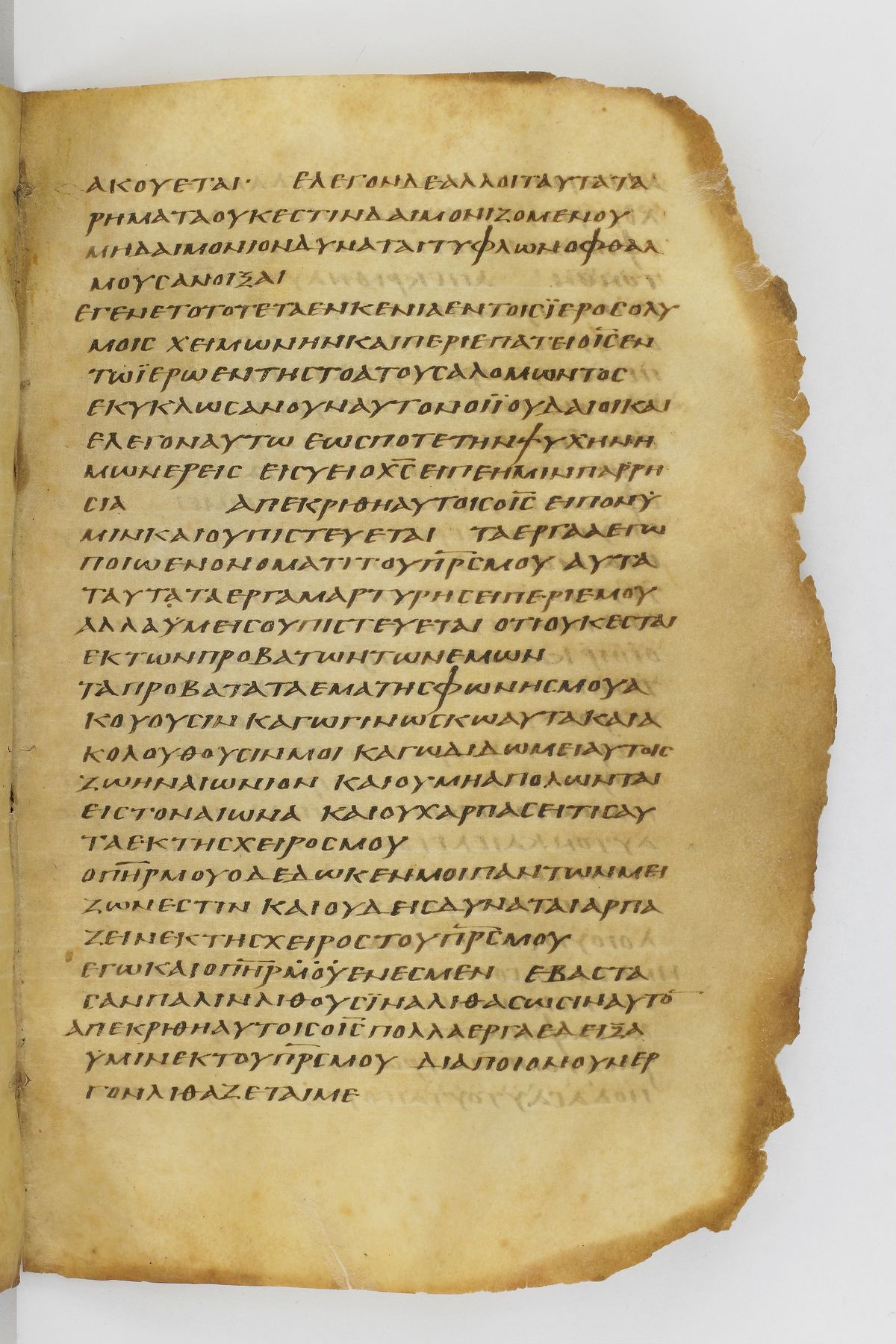
Page from the IGNTP transcription: verses 21-32 on fol. 78r, CSNTM GA_032_0155.
21ελεγον δε αλλοι ταυτα τα ρηματα ουκ εστιν δαιμονιζομενου μη δαιμονιον δυναται τυφλων οφθαλμους ανοιξαι 22Εγενετο τοτε τα ενκενια εν τοις ιεροσολυμοις χειμων ην 23και περιεπατει ο ις εν τω ιερω εν τη στοα του σαλομωντος 24εκυκλωσαν ουν αυτον οι ιουδαιοι και ελεγον αυτω εως ποτε την ψυχην ημων ερεις ει συ ει ο χς ειπε ημιν παρρησια 25απεκριθη αυτοις ο ις ειπον υμιν και ου πιστευεται τα εργα α εγω ποιω εν ονοματι του πρς μου αυτα ταυτα τα εργα μαρτυρησει περι εμου 26αλλα υμεις ου πιστευεται οτι ουκ εσται εκ των προβατων των εμων 27τα προβατα τα εμα της φωνης μου ακουουσιν καγω γινωσκω αυτα και ακολουθουσιν μοι 28καγω διδωμει αυτοις ζωην αιωνιον και ου μη απολωνται εις τον αιωνα και ουχ αρπασει τις αυτα εκ της χειρος μου 29ο πηρ μου ο δεδωκεν μοι παντων μειζων εστιν και ουδεις δυναται αρπαζειν εκ της χειρος του πρς μου 30εγω και ο πηρ μου εν εσμεν 31εβαστασαν παλιν λιθους ινα λιθασωσιν αυτο¯ 32Απεκριθη αυτοις ο ις πολλα εργα εδειξα υμιν εκ του πρς μου δια ποιον ουν εργον λιθαζεται με
Compare: Tischendorf 8th edition (1869)
21ἄλλοι ἔλεγον· ταῦτα τὰ ῥήματα οὐκ ἔστιν δαιμονιζομένου· μὴ δαιμόνιον δύναται τυφλῶν ὀφθαλμοὺς ἀνοῖξαι; 22Ἐγένετο δὲ τὰ ἐνκαίνια ἐν τοῖς Ἱεροσολύμοις· χειμὼν ἦν· 23καὶ περιεπάτει ὁ Ἰησοῦς ἐν τῷ ἱερῷ ἐν τῇ στοᾷ Σολομῶνος. 24ἐκύκλωσαν οὖν αὐτὸν οἱ Ἰουδαῖοι καὶ ἔλεγον αὐτῷ· ἕως πότε τὴν ψυχὴν ἡμῶν αἴρεις; εἰ σὺ εἶ ὁ Χριστός, εἰπὸν ἡμῖν παρρησίᾳ. 25ἀπεκρίθη ὁ Ἰησοῦς· εἶπον ὑμῖν, καὶ οὐ πιστεύετε· τὰ ἔργα ἃ ἐγὼ ποιῶ ἐν τῷ ὀνόματι τοῦ πατρός μου, ταῦτα μαρτυρεῖ περὶ ἐμοῦ· 26ἀλλὰ ὑμεῖς οὐ πιστεύετε, ὅτι οὐκ ἐστὲ ἐκ τῶν προβάτων τῶν ἐμῶν. 27τὰ πρόβατα τὰ ἐμὰ τῆς φωνῆς μου ἀκούουσιν, κἀγὼ γινώσκω αὐτά, καὶ ἀκολουθοῦσίν μοι, 28κἀγὼ δίδωμι αὐτοῖς ζωὴν αἰώνιον, καὶ οὐ μὴ ἀπόλωνται εἰς τὸν αἰῶνα, καὶ οὐχ ἁρπάσει τις αὐτὰ ἐκ τῆς χειρός μου. 29ὁ πατήρ ὃ δέδωκέν μοι πάντων μεῖζόν ἐστιν, καὶ οὐδεὶς δύναται ἁρπάζειν ἐκ τῆς χειρὸς τοῦ πατρός. 30ἐγὼ καὶ ὁ πατὴρ ἕν ἐσμεν. 31Ἐβάστασαν πάλιν λίθους οἱ Ἰουδαῖοι ἵνα λιθάσωσιν αὐτόν. 32ἀπεκρίθη αὐτοῖς ὁ Ἰησοῦς, πολλὰ ἔργα καλὰ ἔδειξα ὑμῖν ἐκ τοῦ πατρός· διὰ ποῖον αὐτῶν ἔργον ἐμὲ λιθάζετε;
21Others said, These are not the words of him that hath a devil. Can a devil open the eyes of the blind? 22And it was at Jerusalem the feast of the dedication, and it was winter. 23And Jesus walked in the temple in Solomon’s porch. 24Then came the Jews round about him, and said unto him, How long dost thou make us to doubt? If thou be the Christ, tell us plainly. 25Jesus answered them, I told you, and ye believed not: the works that I do in my Father’s name, they bear witness of me. 26But ye believe not, because ye are not of my sheep, as I said unto you. 27My sheep hear my voice, and I know them, and they follow me: 28And I give unto them eternal life; and they shall never perish, neither shall any man pluck them out of my hand. 29My Father, which gave them me, is greater than all; and no man is able to pluck them out of my Father’s hand. 30I and my Father are one. 31Then the Jews took up stones again to stone him. 32Jesus answered them, Many good works have I shewed you from my Father; for which of those works do ye stone me?
Where on the image
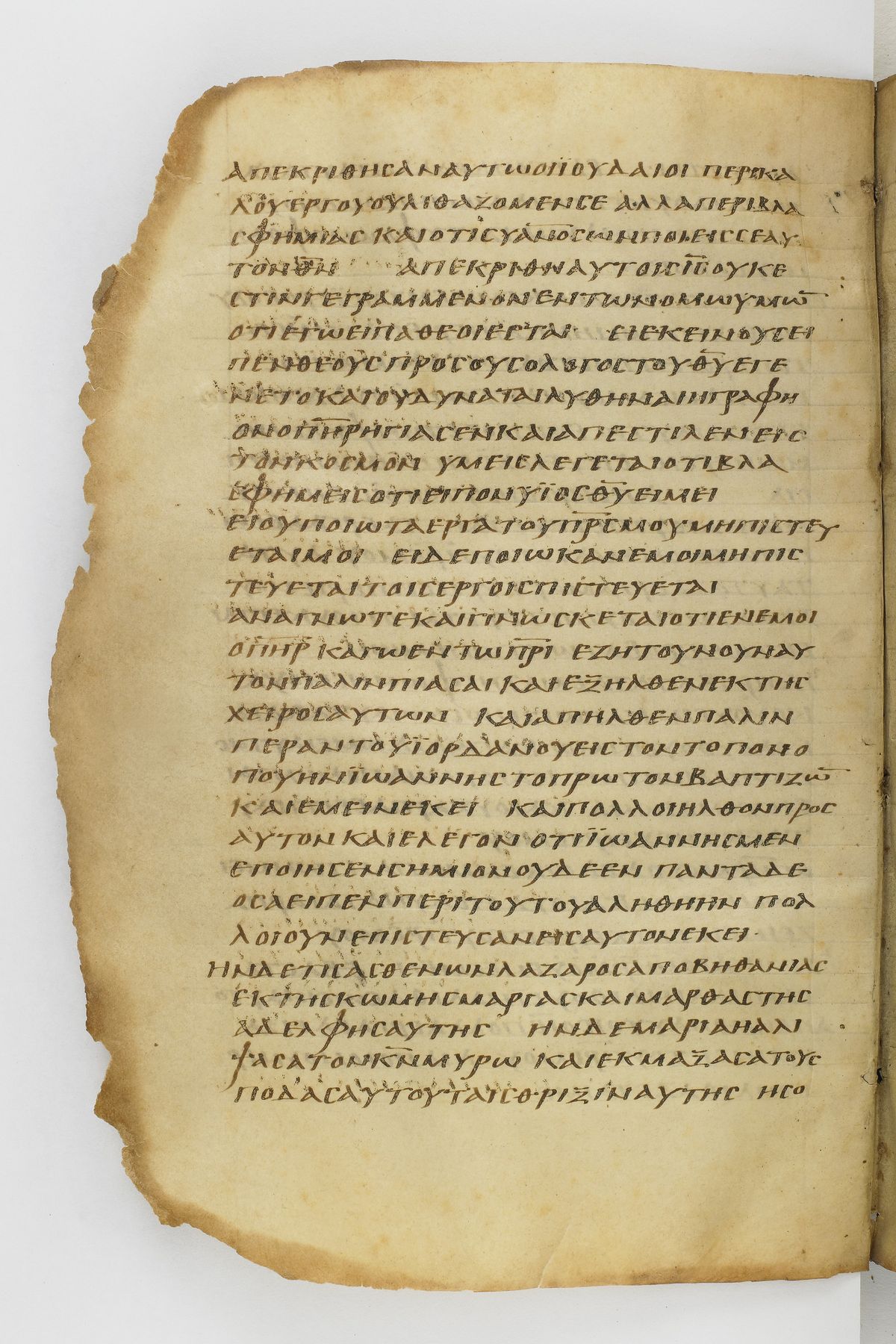
Page from the IGNTP transcription: verses 33-42 on fol. 78v, CSNTM GA_032_0156.
33απεκριθησαν αυτω οι ιουδαιοι περι καλου εργου ου λιθαζομεν σε αλλα περι βλασφημιας και οτι συ ανος ων ποιεις σεαυτον θν 34απεκριθη αυτοις ις ουκ εστιν γεγραμμενον εν τω νομω υμω¯ οτι εγω ειπα θεοι εσται 35ει εκεινους ειπεν θεους προς ους ο λογος του θυ εγενετο και ου δυναται λυθηναι η γραφη 36ον ο πηρ ηγιασεν και απεστιλεν εις τον κοσμον υμεις λεγεται οτι βλασφημεις οτι ειπον υιος θυ ειμει 37ει ου ποιω τα εργα του πρς μου μη πιστευεται μοι 38ει δε ποιω καν εμοι μη πιστευεται τοις εργοις πιστευεται αναγνωτε και γινωσκεται οτι εν εμοι ο πηρ καγω εν τω πρι 39εζητουν ουν αυτον παλιν πιασαι και εξηλθεν εκ της χειρος αυτων 40και απηλθεν παλιν περαν του ιορδανου εις τον τοπον οπου ην ιωαννης το πρωτον βαπτιζω¯ και εμειν εκει 41και πολλοι ηλθον προς αυτον και ελεγον οτι ιωαννης μεν εποιησεν σημιον ουδε εν παντα δε οσα ειπεν περι τουτου αληθη ην 42πολλοι ουν επιστευσαν εις αυτον εκει
Compare: Tischendorf 8th edition (1869)
33ἀπεκρίθησαν αὐτῷ οἱ Ἰουδαῖοι· περὶ καλοῦ ἔργου οὐ λιθάζομέν σε ἀλλὰ περὶ βλασφημίας, καὶ ὅτι σὺ ἄνθρωπος ὢν ποιεῖς σεαυτὸν θεόν. 34ἀπεκρίθη αὐτοῖς ὁ Ἰησοῦς· οὐκ ἔστιν γεγραμμένον ἐν τῷ νόμῳ ὑμῶν ὅτι ἐγὼ εἶπα· θεοί ἐστε; 35εἰ ἐκείνους εἶπεν θεούς, πρὸς οὓς ὁ λόγος ἐγένετο τοῦ θεοῦ, καὶ οὐ δύναται λυθῆναι ἡ γραφή· 36ὃν ὁ πατὴρ ἡγίασεν καὶ ἀπέστειλεν εἰς τὸν κόσμον ὑμεῖς λέγετε ὅτι βλασφημεῖς, ὅτι εἶπον· υἱὸς θεοῦ εἰμι; 37εἰ οὐ ποιῶ τὰ ἔργα τοῦ πατρός μου, μὴ πιστεύετέ μοι· 38εἰ δὲ ποιῶ, κἂν ἐμοὶ μὴ πιστεύητε, τοῖς ἔργοις πιστεύετε, ἵνα γνῶτε καὶ γινώσκητε ὅτι ἐν ἐμοὶ ὁ πατὴρ κἀγὼ ἐν τῷ πατρί. 39Ἐζήτουν οὖν αὐτὸν πιάσαι, καὶ ἐξῆλθεν ἐκ τῆς χειρὸς αὐτῶν. 40Καὶ ἀπῆλθεν πάλιν πέραν τοῦ Ἰορδάνου εἰς τὸν τόπον ὅπου ἦν Ἰωάννης τὸ πρῶτον βαπτίζων, καὶ ἔμεινεν ἐκεῖ. 41καὶ πολλοὶ ἦλθον πρὸς αὐτὸν καὶ ἔλεγον ὅτι Ἰωάννης μὲν σημεῖον ἐποίησεν οὐδέν, πάντα δὲ ὅσα εἶπεν Ἰωάννης περὶ τούτου ἀληθῆ ἦν. 42καὶ πολλοὶ ἐπίστευσαν εἰς αὐτὸν ἐκεῖ.
33The Jews answered him, saying, For a good work we stone thee not; but for blasphemy; and because that thou, being a man, makest thyself God. 34Jesus answered them, Is it not written in your law, I said, Ye are gods? 35If he called them gods, unto whom the word of God came, and the scripture cannot be broken; 36Say ye of him, whom the Father hath sanctified, and sent into the world, Thou blasphemest; because I said, I am the Son of God? 37If I do not the works of my Father, believe me not. 38But if I do, though ye believe not me, believe the works: that ye may know, and believe, that the Father is in me, and I in him. 39Therefore they sought again to take him: but he escaped out of their hand, 40And went away again beyond Jordan into the place where John at first baptized; and there he abode. 41And many resorted unto him, and said, John did no miracle: but all things that John spake of this man were true. 42And many believed on him there.
Cite
Sources
- Source: Codex Washingtonianus page images + IGNTP transcription (CC BY 4.0) + Tischendorf 8th edition + KJV (holding institution)
- Critical edition: Codex Washingtonianus transcription, IGNTP (CC BY 4.0); Tischendorf 8th edition for comparison
← previous · → next · v cycle view · l back to library