John, Chapter 9 (Codex Washingtonianus)
Introduction
John 9 from Codex Washingtonianus (the Freer Gospels, Gregory-Aland 032, Freer Gallery of Art F1906.274), a parchment codex of the four Gospels written in Egypt in the late 4th or early 5th century and bought by Charles Lang Freer from the dealer Ali Arabi at Giza in 1906. It is one of the oldest nearly complete Gospel books in existence. The Gospels stand in the so-called Western order, Matthew, John, Luke, Mark, and the text is famously block-mixed: the copyist drew on several exemplars of different textual character, so the text type changes in blocks within a single Gospel. After Mark 16:14 the codex carries the Freer Logion, a saying found in no other manuscript. Two passages are lost to damage: Mark 15:13-37 and John 14:26-16:6.
- Scan: each section is shown with the actual page of the codex that carries those verses, from the Freer Gallery's own photographs of F1906.274 served by the Smithsonian IIIF service (ids.si.edu). Which page holds which verse comes from the verse index of the Center for the Study of New Testament Manuscripts (CSNTM), whose photographs of the codex are the same shots; every CSNTM page was matched to its Smithsonian image by pixel comparison before use. Where a verse begins on one page and ends on the next, both pages are listed. For this chapter the page of each verse is taken from the transcription itself, which records where every page begins; CSNTM's index confirms which photograph shows that page.
- Greek: the manuscript's own text, from a diplomatic transcription (see Greek text below), with Tischendorf's 8th critical edition (1869) for comparison.
- English: the King James Version (1611, public domain), verbatim from bible-api.com. The KJV translates the later Byzantine text, so it will not always match the Greek shown or the reading of the codex.
Greek text: a diplomatic transcription of Codex Washingtonianus made by the International Greek New Testament Project (IGNTP), transcription of John in GA 032, version 2.1 (2013), published under a Creative Commons Attribution 4.0 licence. It gives the letters as the first scribe wrote them: no accents or breathings, the scribe's own spelling, and the sacred names in their contracted form (θς for θεος, ις for ιησους, κς for κυριος; the overline is not reproduced). A stroke ¯ after a letter (for example μενω¯, το¯) is the scribe's abbreviation for a final ν, kept as the transcription gives it. Corrections by later hands are not shown. Letters in square brackets are not legible on the page and were restored by the transcribers, a dot under a letter marks an uncertain reading, and [...] marks text lost to damage. Beneath each section, for comparison, is Tischendorf's 8th critical edition (1869). Where the two differ, the transcription is what the manuscript says. Each section is shown with the page on which the transcription places its verses.
Manuscript note: Not written in Codex Washingtonianus: verse 38. The English is shown with a bracketed note in the Greek column.
How was this verified? (Provenance)
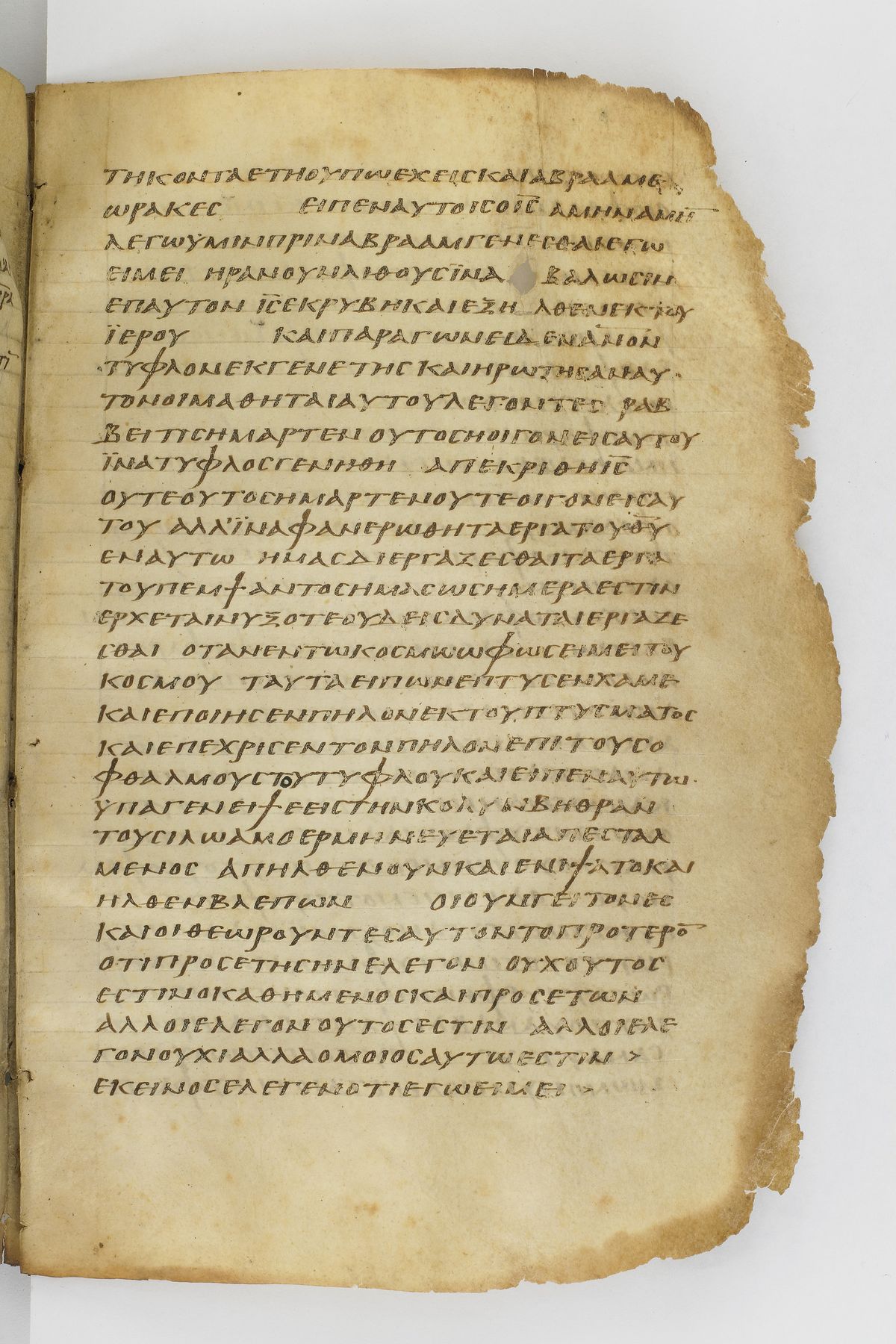
Where on the image
Page from the IGNTP transcription: verses 1-9 on fol. 75r, CSNTM GA_032_0149.
1και παραγων ειδεν ανον τυφλον εκ γενετης 2και ηρωτησαν αυτον οι μαθηται αυτου λεγοντες ραββει τις ημαρτεν ουτος η οι γονεις αυτου ινα τυφλος γενηθη 3απεκριθη ις ουτε ουτος ημαρτεν ουτε οι γονεις αυτου αλλ ινα φανερωθη τα εργα του θυ εν αυτω 4ημας δι εργαζεσθαι τα εργα του πεμψαντος ημας ως ημερα εστιν ερχεται νυξ οτε ουδεις δυναται εργαζεσθαι 5οταν εν τω κοσμω ω φως ειμει του κοσμου 6ταυτα ειπων επτυσεν χαμε και εποιησεν πηλον εκ του πτυσματος και επεχρισεν τον πηλον επι τους οφθαλμους τυ τυφλου 7και ειπεν αυτω υπαγε νειψε εις την κολυνβηθραν του σιλωαμ ο ερμηνευεται απεσταλμενος απηλθεν ουν και ενιψατο και ηλθεν βλεπων 8οι ουν γειτονες και οι θεωρουντες αυτον το προτερο¯ οτι προσετης ην ελεγον ουχ ουτος εστιν ο καθημενος και προσετων 9αλλοι ελεγον ουτος εστιν αλλοι ελεγον ουχι αλλα ομοιος αυτω εστιν εκεινος ελεγεν οτι εγω ειμει
Compare: Tischendorf 8th edition (1869)
1Καὶ παράγων εἶδεν ἄνθρωπον τυφλὸν ἐκ γενετῆς. 2καὶ ἠρώτησαν αὐτὸν οἱ μαθηταὶ αὐτοῦ λέγοντες· ῥαββεί, τίς ἥμαρτεν, οὗτος ἢ οἱ γονεῖς αὐτοῦ, ἵνα τυφλὸς γεννηθῇ; 3ἀπεκρίθη Ἰησοῦς· οὔτε οὗτος ἥμαρτεν οὔτε οἱ γονεῖς αὐτοῦ, ἀλλ’ ἵνα φανερωθῇ τὰ ἔργα τοῦ θεοῦ ἐν αὐτῷ. 4ἡμᾶς δεῖ ἐργάζεσθαι τὰ ἔργα τοῦ πέμψαντός ἡμᾶς ἕως ἡμέρα ἐστίν· ἔρχεται νὺξ ὅτε οὐδεὶς δύναται ἐργάζεσθαι. 5ὅταν ἐν τῷ κόσμῳ ὦ, φῶς εἰμι τοῦ κόσμου. 6ταῦτα εἰπὼν ἔπτυσεν χαμαὶ καὶ ἐποίησεν πηλὸν ἐκ τοῦ πτύσματος, καὶ ἐπέχρισεν αὐτοῦ τὸν πηλὸν ἐπὶ τοὺς ὀφθαλμούς, 7καὶ εἶπεν αὐτῷ· ὕπαγε νίψαι εἰς τὴν κολυμβήθραν τοῦ Σιλωάμ, ὃ ἑρμηνεύεται ἀπεσταλμένος. ἀπῆλθεν οὖν καὶ ἐνίψατο, καὶ ἦλθεν βλέπων. 8Οἱ οὖν γείτονες καὶ οἱ θεωροῦντες αὐτὸν τὸ πρότερον, ὅτι προσαίτης ἦν, ἔλεγον· οὐχ οὗτός ἐστιν ὁ καθήμενος καὶ προσαιτῶν; 9ἄλλοι ἔλεγον ὅτι οὗτός ἐστιν· ἄλλοι ἔλεγον· οὐχί, ἀλλὰ ὅμοιος αὐτῷ ἐστιν. ἐκεῖνος ἔλεγεν ὅτι ἐγώ εἰμι.
1And as Jesus passed by, he saw a man which was blind from his birth. 2And his disciples asked him, saying, Master, who did sin, this man, or his parents, that he was born blind? 3Jesus answered, Neither hath this man sinned, nor his parents: but that the works of God should be made manifest in him. 4I must work the works of him that sent me, while it is day: the night cometh, when no man can work. 5As long as I am in the world, I am the light of the world. 6When he had thus spoken, he spat on the ground, and made clay of the spittle, and he anointed the eyes of the blind man with the clay, 7And said unto him, Go, wash in the pool of Siloam, (which is by interpretation, Sent.) He went his way therefore, and washed, and came seeing. 8The neighbours therefore, and they which before had seen him that he was blind, said, Is not this he that sat and begged? 9Some said, This is he: others said, He is like him: but he said, I am he.
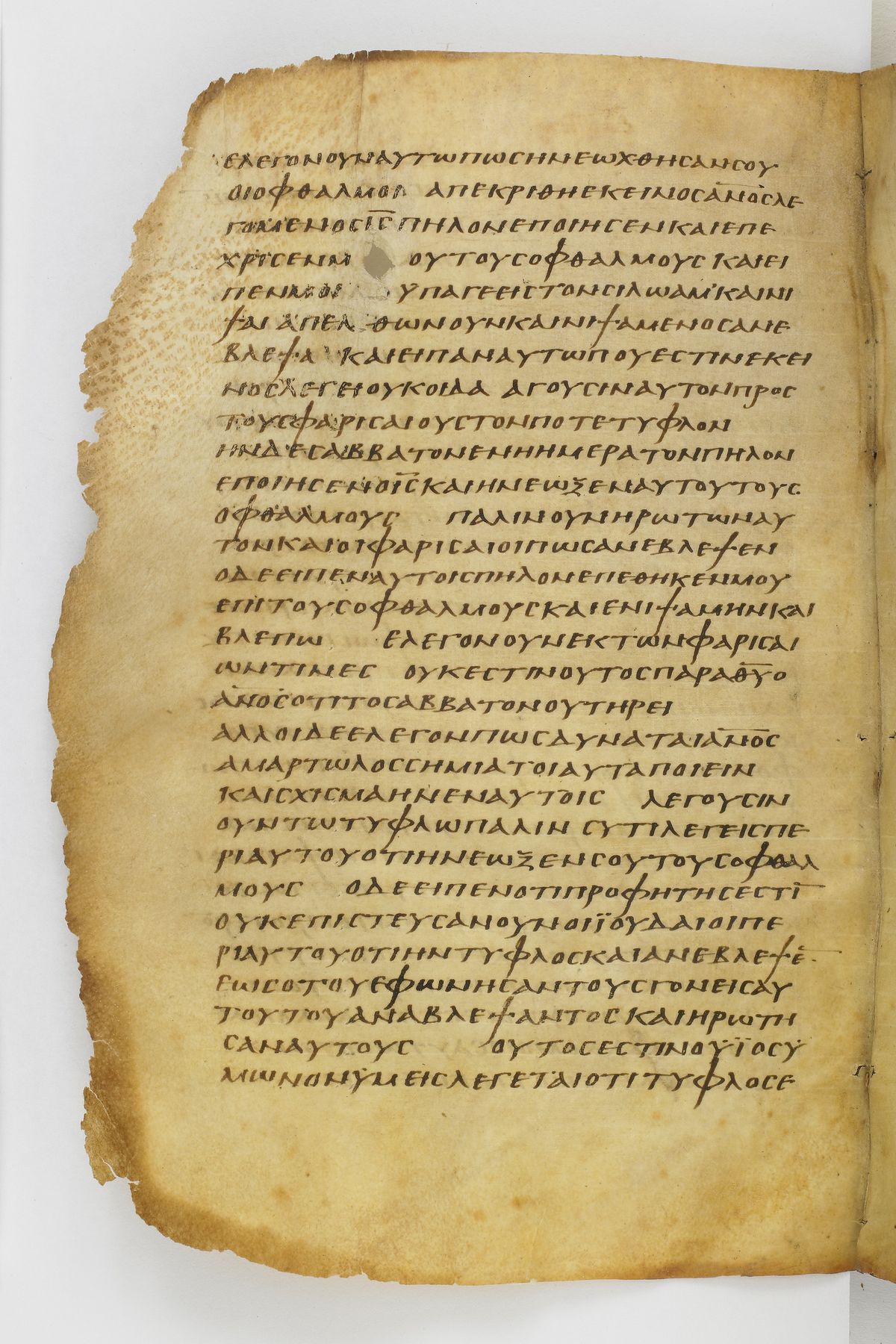
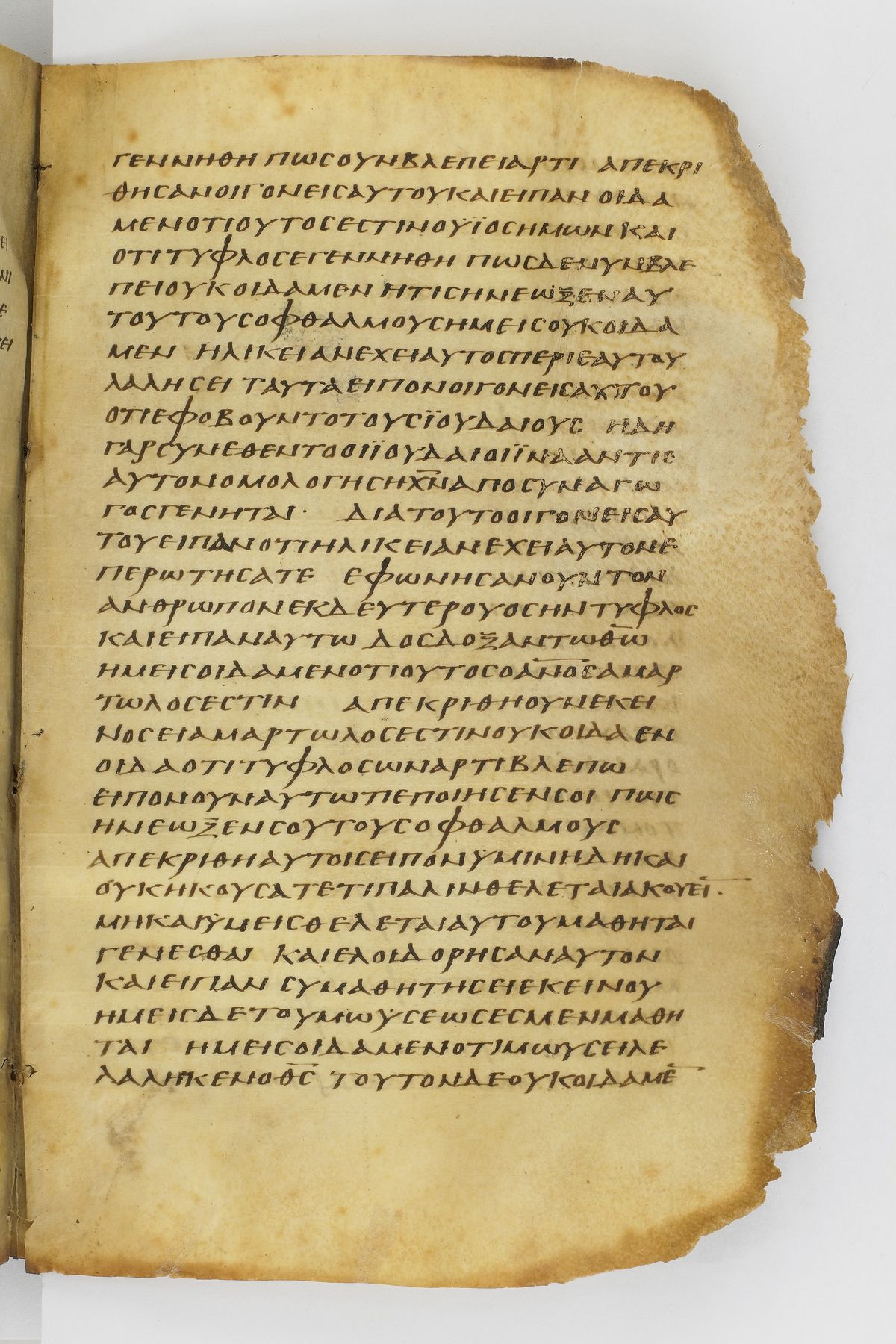
Where on the image
Page from the IGNTP transcription: verses 10-19 on fol. 75v, CSNTM GA_032_0150; verse 19 continues on fol. 76r, CSNTM GA_032_0151 (which begins 'γεννηθη πως ουν').
10ελεγον ουν αυτω πως ηνεωχθησαν σου οι οφθαλμοι 11απεκριθη εκεινος ανος λεγομενος ις πηλον εποιησεν και επεχρισεν μου τους οφθαλμους και ειπεν μοι υπαγε εις τον σιλωαμ και νιψαι απελθων ουν και νιψαμενος ανεβλεψα 12και ειπαν αυτω που εστιν εκεινος λεγει ουκ οιδα 13αγουσιν αυτον προς τους φαρισαιους τον ποτε τυφλον 14ην δε σαββατον εν η ημερα τον πηλον εποιησεν ο ις και ηνεωξεν αυτου τους οφθαλμους 15παλιν ουν ηρωτων αυτον και οι φαρισαιοι πως ανεβλεψεν ο δε ειπεν αυτοις πηλον επεθηκεν μου επι τους οφθαλμους και ενιψαμην και βλεπω 16ελεγον ουν εκ των φαρισαιων τινες ουκ εστιν ουτος παρα θυ ο ανος οτι το σαββατον ου τηρει αλλοι δε ελεγον πως δυναται ανος αμαρτωλος σημια τοιαυτα ποιειν και σχισμα ην εν αυτοις 17λεγουσιν ουν τω τυφλω παλιν συ τι λεγεις περι αυτου οτι ηνεωξεν σου τους οφθαλμους ο δε ειπεν οτι προφητης εστι¯ 18ουκ επιστευσαν ουν οι ιουδαιοι περι αυτου οτι ην τυφλος και ανεβλεψε¯ εως οτου εφωνησαν τους γονεις αυτου του αναβλεψαντος 19και ηρωτησαν αυτους ουτος εστιν ο υιος υμων ον υμεις λεγεται οτι τυφλος εγεννηθη πως ουν βλεπει αρτι
Compare: Tischendorf 8th edition (1869)
10ἔλεγον οὖν αὐτῷ· πῶς οὖν ἠνεῴχθησάν σου οἱ ὀφθαλμοί; 11ἀπεκρίθη ἐκεῖνος· ὁ ἄνθρωπος ὁ λεγόμενος Ἰησοῦς πηλὸν ἐποίησεν καὶ ἐπέχρισέν μου τοὺς ὀφθαλμοὺς καὶ εἶπέν μοι ὅτι ὕπαγε εἰς τὸν Σιλωὰμ καὶ νίψαι· ἀπελθὼν οὖν καὶ νιψάμενος ἀνέβλεψα. 12εἶπαν αὐτῷ· ποῦ ἔστιν ἐκεῖνος; λέγει· οὐκ οἶδα. 13Ἄγουσιν αὐτὸν πρὸς τοὺς Φαρισαίους, τόν ποτε τυφλόν. 14ἦν δὲ σάββατον ἐν ᾗ ἡμέρᾳ τὸν πηλὸν ἐποίησεν ὁ Ἰησοῦς καὶ ἀνέῳξεν αὐτοῦ τοὺς ὀφθαλμούς. 15πάλιν οὖν ἠρώτων αὐτὸν καὶ οἱ Φαρισαῖοι πῶς ἀνέβλεψεν. ὁ δὲ εἶπεν αὐτοῖς· πηλὸν ἐπέθηκέν μου ἐπὶ τοὺς ὀφθαλμούς, καὶ ἐνιψάμην, καὶ βλέπω. 16ἔλεγον οὖν ἐκ τῶν Φαρισαίων τινές· οὐκ ἔστιν οὗτος παρὰ θεοῦ ὁ ἄνθρωπος, ὅτι τὸ σάββατον οὐ τηρεῖ. ἄλλοι ἔλεγον· πῶς δύναται ἄνθρωπος ἁμαρτωλὸς τοιαῦτα σημεῖα ποιεῖν; καὶ σχίσμα ἦν ἐν αὐτοῖς. 17λέγουσιν οὖν τῷ τυφλῷ πάλιν· σὺ τί λέγεις περὶ αὐτοῦ, ὅτι ἤνοιξέν σου τοὺς ὀφθαλμούς; ὁ δὲ εἶπεν ὅτι προφήτης ἐστίν. 18οὐκ ἐπίστευσαν οὖν οἱ Ἰουδαῖοι περὶ αὐτοῦ, ὅτι ἦν τυφλὸς καὶ ἀνέβλεψεν, ἕως ὅτου ἐφώνησαν τοὺς γονεῖς αὐτοῦ τοῦ ἀναβλέψαντος, 19καὶ ἠρώτησαν αὐτοὺς λέγοντες· οὗτός ἐστιν ὁ υἱὸς ὑμῶν, ὃν ὑμεῖς λέγετε ὅτι τυφλὸς ἐγεννήθη; πῶς οὖν βλέπει ἄρτι;
10Therefore said they unto him, How were thine eyes opened? 11He answered and said, A man that is called Jesus made clay, and anointed mine eyes, and said unto me, Go to the pool of Siloam, and wash: and I went and washed, and I received sight. 12Then said they unto him, Where is he? He said, I know not. 13They brought to the Pharisees him that aforetime was blind. 14And it was the sabbath day when Jesus made the clay, and opened his eyes. 15Then again the Pharisees also asked him how he had received his sight. He said unto them, He put clay upon mine eyes, and I washed, and do see. 16Therefore said some of the Pharisees, This man is not of God, because he keepeth not the sabbath day. Others said, How can a man that is a sinner do such miracles? And there was a division among them. 17They say unto the blind man again, What sayest thou of him, that he hath opened thine eyes? He said, He is a prophet. 18But the Jews did not believe concerning him, that he had been blind, and received his sight, until they called the parents of him that had received his sight. 19And they asked them, saying, Is this your son, who ye say was born blind? how then doth he now see?
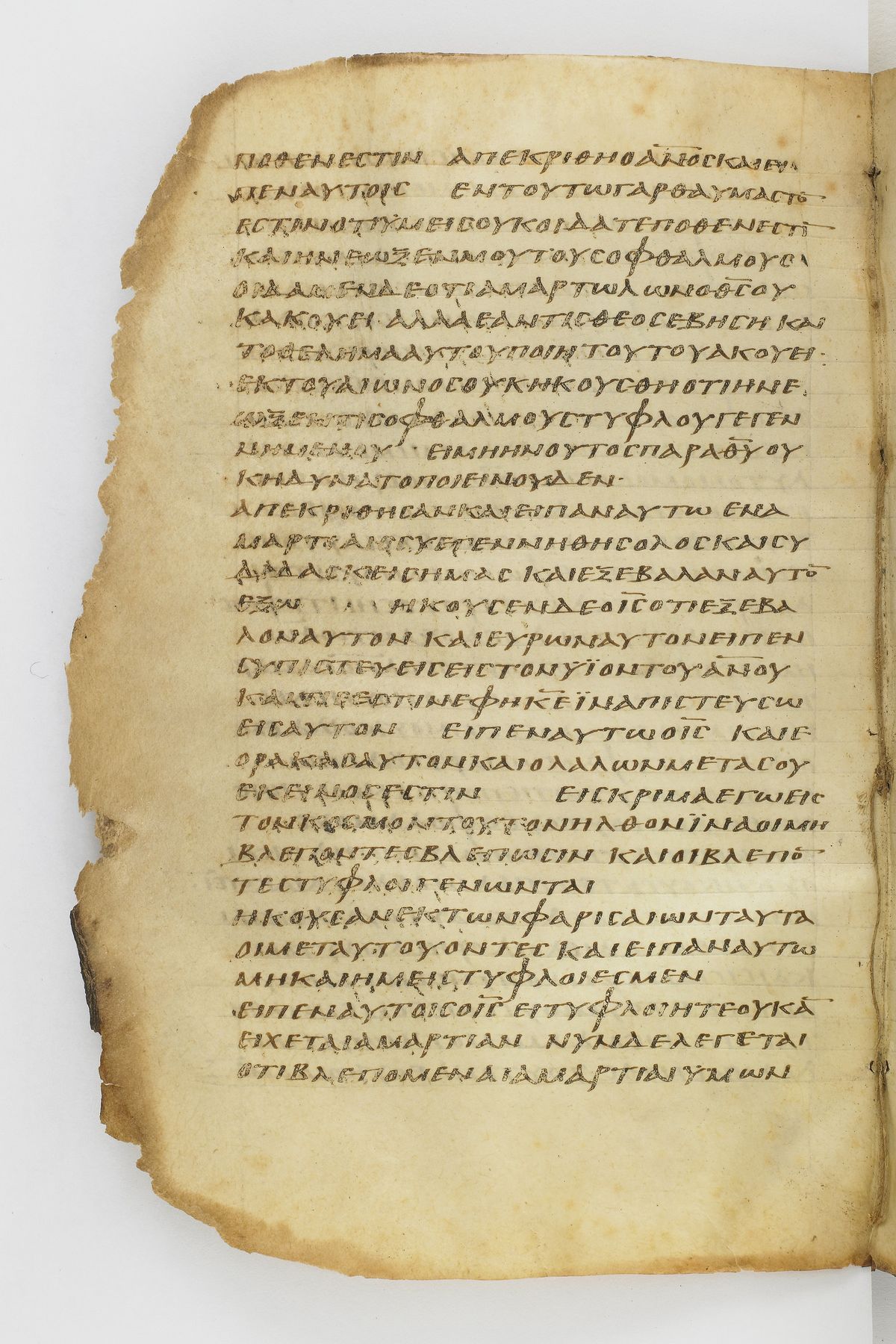
Where on the image
Page from the IGNTP transcription: verses 20-29 on fol. 76r, CSNTM GA_032_0151; verse 29 continues on fol. 76v, CSNTM GA_032_0152 (which begins 'ποθεν εστιν').
20απεκριθησαν οι γονεις αυτου και ειπαν οιδαμεν οτι ουτος εστιν ο υιος ημων και οτι τυφλος εγεννηθη 21πως δε νυν βλεπει ουκ οιδαμεν τις ηνεωξεν αυτου τους οφθαλμους ημεις ουκ οιδαμεν ηλικειαν εχει αυτος περι εαυτου λαλησει 22ταυτα ειπον οι γονεις αυτου οτι εφοβουντο τους ιουδαιους ηδη γαρ συνεθεντο οι ιουδαιοι ινα αν τις αυτον ομολογηση χν αποσυναγωγος γενηται 23δια τουτο οι γονεις αυτου ειπον οτι ηλικειαν εχει αυτον επερωτησατε 24εφωνησαν ουν τον ανθρωπον εκ δευτερου ος ην τυφλος και ειπαν αυτω δος δοξαν τω θω ημεις οιδαμεν οτι ουτος ο ανος αμαρτωλος εστιν 25απεκριθη ουν εκεινος ει αμαρτωλος εστιν ουκ οιδα εν οιδα οτι τυφλος ων αρτι βλεπω 26ειπον ουν αυτω τι εποιησεν σοι πως ηνεωξεν σου τους οφθαλμους 27απεκριθη αυτοις ειπον υμιν ηδη και ουκ ηκουσατε τι παλιν θελεται ακουει¯ μη και υμεις θελεται αυτου μαθηται γενεσθαι 28και ελοιδορησαν αυτον και ειπαν συ μαθητης ει εκεινου ημεις δε του μωυσεως εσμεν μαθηται 29ημεις οιδαμεν οτι μωυσει λελαληκεν ο θς τουτον δε ουκ οιδαμε¯ ποθεν εστιν
Compare: Tischendorf 8th edition (1869)
20ἀπεκρίθησαν οὖν οἱ γονεῖς αὐτοῦ καὶ εἶπαν· οἴδαμεν ὅτι οὗτός ἐστιν ὁ υἱὸς ἡμῶν καὶ ὅτι τυφλὸς ἐγεννήθη· 21πῶς δὲ νῦν βλέπει οὐκ οἴδαμεν, ἢ τίς ἤνοιξεν αὐτοῦ τοὺς ὀφθαλμοὺς ἡμεῖς οὐκ οἴδαμεν· αὐτὸν ἐρωτήσατε, ἡλικίαν ἔχει, αὐτὸς περὶ ἑαυτοῦ λαλήσει. 22ταῦτα εἶπον οἱ γονεῖς αὐτοῦ ὅτι ἐφοβοῦντο τοὺς Ἰουδαίους· ἤδη γὰρ συνετέθειντο οἱ Ἰουδαῖοι ἵνα ἐάν τις αὐτὸν ὁμολογήσῃ Χριστόν, ἀποσυνάγωγος γένηται. 23διὰ τοῦτο οἱ γονεῖς αὐτοῦ εἶπαν ὅτι ἡλικίαν ἔχει, αὐτὸν ἐπερωτήσατε. 24Ἐφώνησαν οὖν τὸν ἄνθρωπον ἐκ δευτέρου, ὃς ἦν τυφλός, καὶ εἶπαν αὐτῷ· δὸς δόξαν τῷ θεῷ· ἡμεῖς οἴδαμεν ὅτι ὁ ἄνθρωπος οὗτος ἁμαρτωλός ἐστιν. 25ἀπεκρίθη οὖν ἐκεῖνος· εἰ ἁμαρτωλός ἐστιν οὐκ οἶδα· ἓν οἶδα, ὅτι τυφλὸς ὢν ἄρτι βλέπω. 26εἶπον οὖν αὐτῷ· τί ἐποίησέν σοι; πῶς ἤνοιξέν σου τοὺς ὀφθαλμούς; 27ἀπεκρίθη αὐτοῖς· εἶπον ὑμῖν ἤδη καὶ οὐκ ἠκούσατε· τί πάλιν θέλετε ἀκούειν; μὴ καὶ ὑμεῖς θέλετε αὐτοῦ μαθηταὶ γενέσθαι; 28ἐλοιδόρησαν αὐτὸν καὶ εἶπαν· σὺ μαθητὴς εἶ ἐκείνου, ἡμεῖς δὲ τοῦ Μωϋσέως ἐσμὲν μαθηταί· 29ἡμεῖς οἴδαμεν ὅτι Μωϋσεῖ λελάληκεν ὁ θεός, τοῦτον δὲ οὐκ οἴδαμεν πόθεν ἐστίν.
20His parents answered them and said, We know that this is our son, and that he was born blind: 21But by what means he now seeth, we know not; or who hath opened his eyes, we know not: he is of age; ask him: he shall speak for himself. 22These words spake his parents, because they feared the Jews: for the Jews had agreed already, that if any man did confess that he was Christ, he should be put out of the synagogue. 23Therefore said his parents, He is of age; ask him. 24Then again called they the man that was blind, and said unto him, Give God the praise: we know that this man is a sinner. 25He answered and said, Whether he be a sinner or no, I know not: one thing I know, that, whereas I was blind, now I see. 26Then said they to him again, What did he to thee? how opened he thine eyes? 27He answered them, I have told you already, and ye did not hear: wherefore would ye hear it again? will ye also be his disciples? 28Then they reviled him, and said, Thou art his disciple; but we are Moses’ disciples. 29We know that God spake unto Moses: as for this fellow, we know not from whence he is.
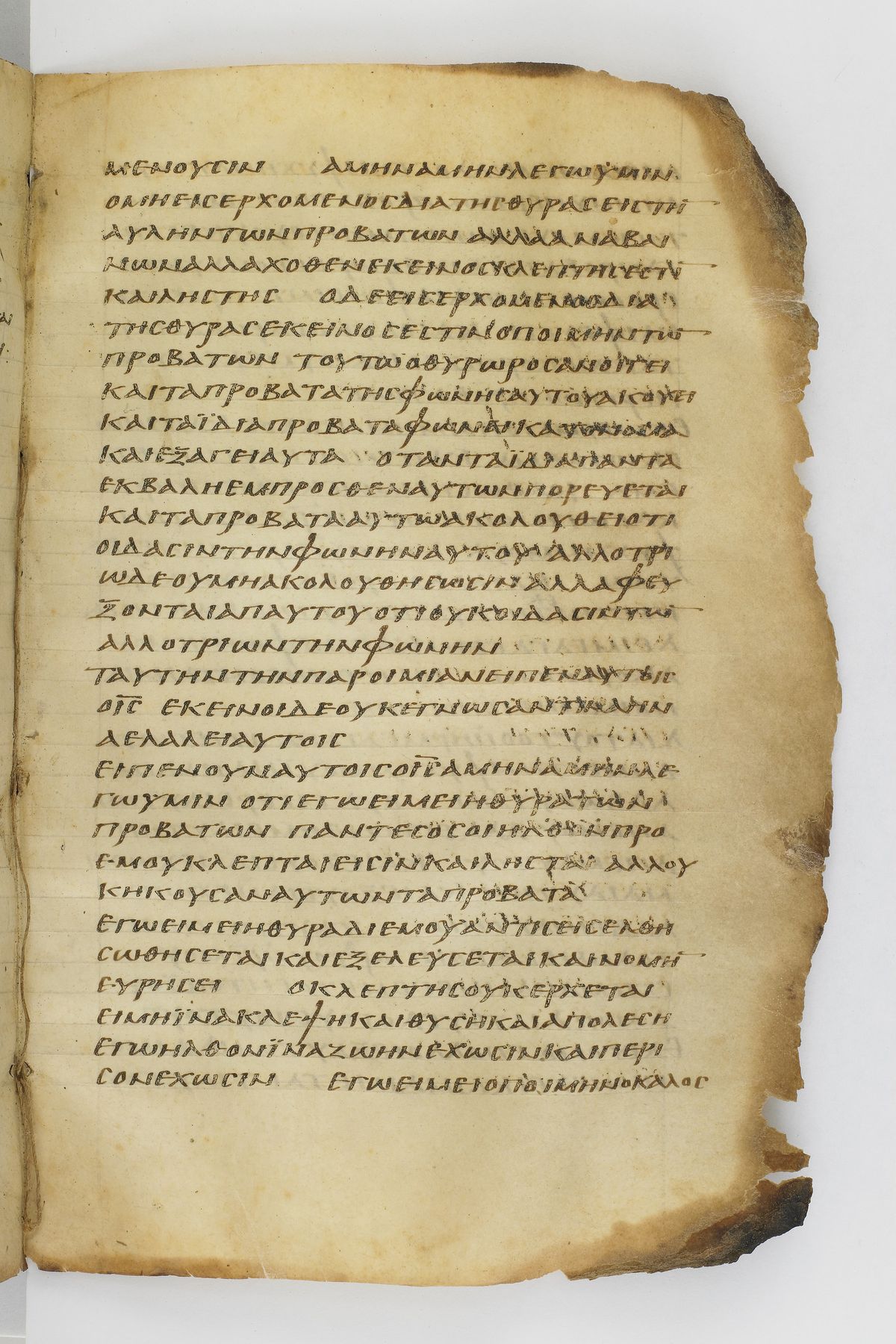
Where on the image
Page from the IGNTP transcription: verses 30-37, 39-41 on fol. 76v, CSNTM GA_032_0152; verse 41 continues on fol. 77r, CSNTM GA_032_0153 (which begins 'μενουσιν'). Verse 38 is not in Codex Washingtonianus; the IGNTP transcription shows the text passing over it on fol. 76v, CSNTM GA_032_0152.
30απεκριθη ο ανος και ειπεν αυτοις εν τουτω γαρ θαυμαστο¯ εστιν οτι υμεις ουκ οιδατε ποθεν εστι¯ και ηνεωξεν μου τους οφθαλμους 31οιδαμεν δε οτι αμαρτωλων ο θς ουκ ακουει αλλα εαν τις θεοσεβης η και το θελημα αυτου ποιη τουτου ακουει 32εκ του αιωνος ουκ ηκουσθη οτι ηνεωξεν τις οφθαλμους τυφλου γεγεννημενου 33ει μη ην ουτος παρα θυ ουκ ηδυνατο ποιειν ουδεν 34απεκριθησαν και ειπαν αυτω εν αμαρτιαις συ εγεννηθης ολος και συ διδασκεις ημας και εξεβαλαν αυτο¯ εξω 35ηκουσεν δε ο ις οτι εξεβαλον αυτον και ευρων αυτον ειπεν συ πιστευεις εις τον υιον του ανου 36και τις εστιν εφη κε ινα πιστευσω εις αυτον 37ειπεν αυτω ο ις και εορακας αυτον και ο λαλων μετα σου εκεινος εστιν 38[not in Codex Washingtonianus] 39εις κριμα εγω εις τον κοσμον τουτον ηλθον ινα οι μη βλεποντες βλεπωσιν και οι βλεπο¯τες τυφλοι γενωνται 40ηκουσαν εκ των φαρισαιων ταυτα οι μετ αυτου οντες και ειπαν αυτω μη και ημεις τυφλοι εσμεν 41ειπεν αυτοις ο ις ει τυφλοι ητε ουκ α¯ ειχεται αμαρτιαν νυν δε λεγεται οτι βλεπομεν αι αμαρτιαι υμων μενουσιν
Compare: Tischendorf 8th edition (1869)
30ἀπεκρίθη ὁ ἄνθρωπος καὶ εἶπεν αὐτοῖς· ἐν τούτῳ γὰρ τὸ θαυμαστόν ἐστιν, ὅτι ὑμεῖς οὐκ οἴδατε πόθεν ἐστίν, καὶ ἤνοιξέν μου τοὺς ὀφθαλμούς. 31οἴδαμεν ὅτι ἁμαρτωλῶν ὁ θεὸς οὐκ ἀκούει, ἀλλ’ ἐάν τις θεοσεβὴς ᾖ καὶ τὸ θέλημα αὐτοῦ ποιῇ, τούτου ἀκούει. 32ἐκ τοῦ αἰῶνος οὐκ ἠκούσθη ὅτι ἤνοιξέν τις ὀφθαλμοὺς τυφλοῦ γεγεννημένου· 33εἰ μὴ ἦν οὗτος παρὰ θεοῦ, οὐκ ἠδύνατο ποιεῖν οὐδέν. 34ἀπεκρίθησαν καὶ εἶπαν αὐτῷ· ἐν ἁμαρτίαις σὺ ἐγεννήθης ὅλος, καὶ σὺ διδάσκεις ἡμᾶς; καὶ ἐξέβαλον αὐτὸν ἔξω. 35Ἤκουσεν Ἰησοῦς ὅτι ἐξέβαλον αὐτὸν ἔξω, καὶ εὑρὼν αὐτὸν εἶπεν· σὺ πιστεύεις εἰς τὸν υἱὸν τοῦ ἀνθρώπου; 36ἀπεκρίθη ἐκεῖνος καὶ εἶπεν· καὶ τίς ἐστιν, κύριε, ἵνα πιστεύσω εἰς αὐτόν; 37εἶπεν αὐτῷ ὁ Ἰησοῦς· καὶ ἑώρακας αὐτόν, καὶ ὁ λαλῶν μετὰ σοῦ ἐκεῖνός ἐστιν. 38ὁ δὲ ἔφη· πιστεύω, κύριε· καὶ προσεκύνησεν αὐτῷ. 39καὶ εἶπεν ὁ Ἰησοῦς· εἰς κρίμα ἐγὼ εἰς τὸν κόσμον τοῦτον ἦλθον, ἵνα οἱ μὴ βλέποντες βλέπωσιν καὶ οἱ βλέποντες τυφλοὶ γένωνται. 40ἤκουσαν ἐκ τῶν Φαρισαίων οἱ μετ’ αὐτοῦ ὄντες, καὶ εἶπαν αὐτῷ· μὴ καὶ ἡμεῖς τυφλοί ἐσμεν; 41εἶπεν αὐτοῖς ὁ Ἰησοῦς· εἰ τυφλοὶ ἦτε, οὐκ ἂν εἴχετε ἁμαρτίαν· νῦν δὲ λέγετε ὅτι βλέπομεν· ἡ ἁμαρτία ὑμῶν μένει.
30The man answered and said unto them, Why herein is a marvellous thing, that ye know not from whence he is, and yet he hath opened mine eyes. 31Now we know that God heareth not sinners: but if any man be a worshipper of God, and doeth his will, him he heareth. 32Since the world began was it not heard that any man opened the eyes of one that was born blind. 33If this man were not of God, he could do nothing. 34They answered and said unto him, Thou wast altogether born in sins, and dost thou teach us? And they cast him out. 35Jesus heard that they had cast him out; and when he had found him, he said unto him, Dost thou believe on the Son of God? 36He answered and said, Who is he, Lord, that I might believe on him? 37And Jesus said unto him, Thou hast both seen him, and it is he that talketh with thee. 38And he said, Lord, I believe. And he worshipped him. 39And Jesus said, For judgment I am come into this world, that they which see not might see; and that they which see might be made blind. 40And some of the Pharisees which were with him heard these words, and said unto him, Are we blind also? 41Jesus said unto them, If ye were blind, ye should have no sin: but now ye say, We see; therefore your sin remaineth.
Cite
Sources
- Source: Codex Washingtonianus page images + IGNTP transcription (CC BY 4.0) + Tischendorf 8th edition + KJV (holding institution)
- Critical edition: Codex Washingtonianus transcription, IGNTP (CC BY 4.0); Tischendorf 8th edition for comparison
← previous · → next · v cycle view · l back to library