John, Chapter 18 (Codex Washingtonianus)
Introduction
John 18 from Codex Washingtonianus (the Freer Gospels, Gregory-Aland 032, Freer Gallery of Art F1906.274), a parchment codex of the four Gospels written in Egypt in the late 4th or early 5th century and bought by Charles Lang Freer from the dealer Ali Arabi at Giza in 1906. It is one of the oldest nearly complete Gospel books in existence. The Gospels stand in the so-called Western order, Matthew, John, Luke, Mark, and the text is famously block-mixed: the copyist drew on several exemplars of different textual character, so the text type changes in blocks within a single Gospel. After Mark 16:14 the codex carries the Freer Logion, a saying found in no other manuscript. Two passages are lost to damage: Mark 15:13-37 and John 14:26-16:6.
- Scan: each section is shown with the actual page of the codex that carries those verses, from the Freer Gallery's own photographs of F1906.274 served by the Smithsonian IIIF service (ids.si.edu). Which page holds which verse comes from the verse index of the Center for the Study of New Testament Manuscripts (CSNTM), whose photographs of the codex are the same shots; every CSNTM page was matched to its Smithsonian image by pixel comparison before use. Where a verse begins on one page and ends on the next, both pages are listed. For this chapter the page of each verse is taken from the transcription itself, which records where every page begins; CSNTM's index confirms which photograph shows that page.
- Greek: the manuscript's own text, from a diplomatic transcription (see Greek text below), with Tischendorf's 8th critical edition (1869) for comparison.
- English: the King James Version (1611, public domain), verbatim from bible-api.com. The KJV translates the later Byzantine text, so it will not always match the Greek shown or the reading of the codex.
Greek text: a diplomatic transcription of Codex Washingtonianus made by the International Greek New Testament Project (IGNTP), transcription of John in GA 032, version 2.1 (2013), published under a Creative Commons Attribution 4.0 licence. It gives the letters as the first scribe wrote them: no accents or breathings, the scribe's own spelling, and the sacred names in their contracted form (θς for θεος, ις for ιησους, κς for κυριος; the overline is not reproduced). A stroke ¯ after a letter (for example μενω¯, το¯) is the scribe's abbreviation for a final ν, kept as the transcription gives it. Corrections by later hands are not shown. Letters in square brackets are not legible on the page and were restored by the transcribers, a dot under a letter marks an uncertain reading, and [...] marks text lost to damage. Beneath each section, for comparison, is Tischendorf's 8th critical edition (1869). Where the two differ, the transcription is what the manuscript says. Each section is shown with the page on which the transcription places its verses.
How was this verified? (Provenance)
Where on the image
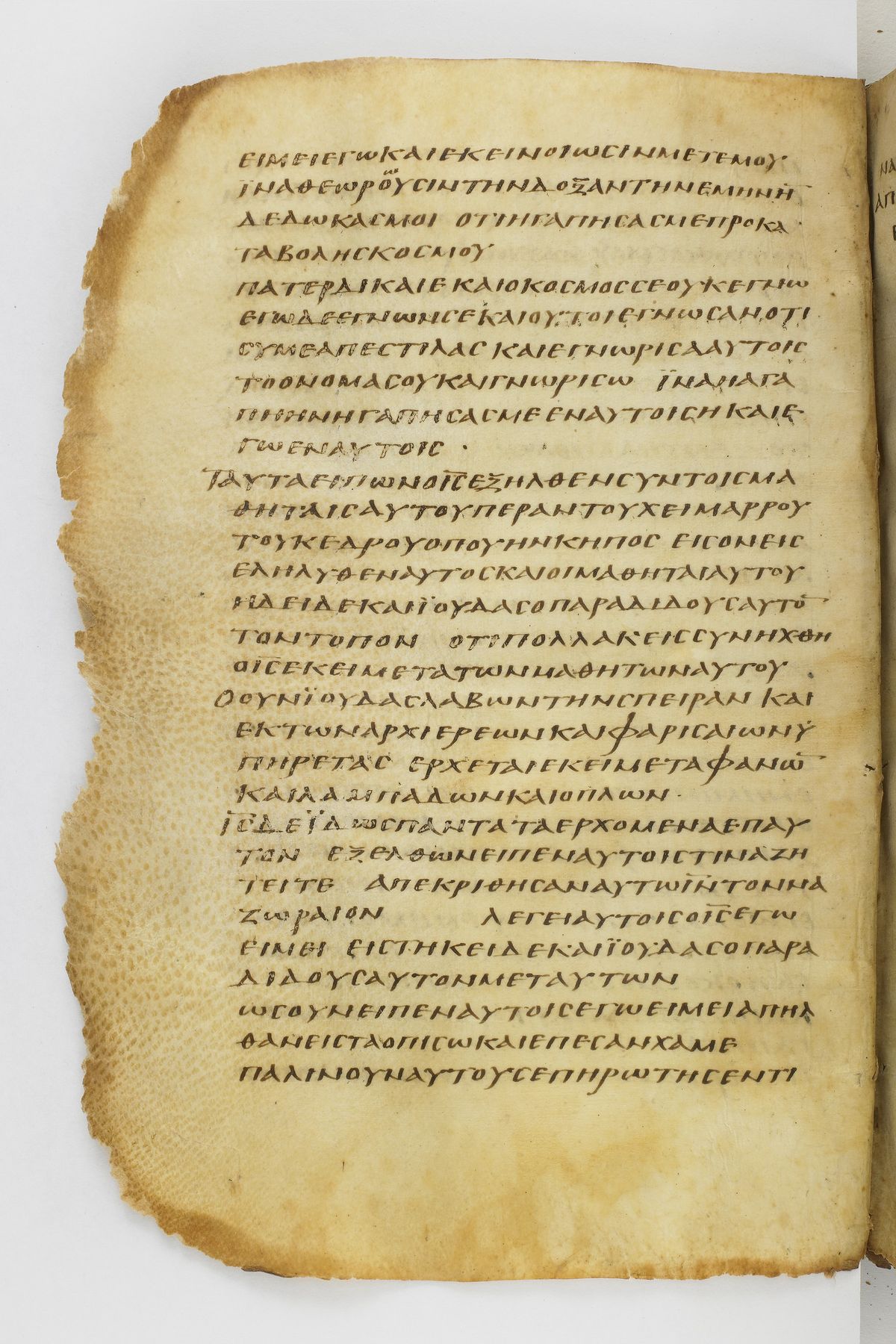
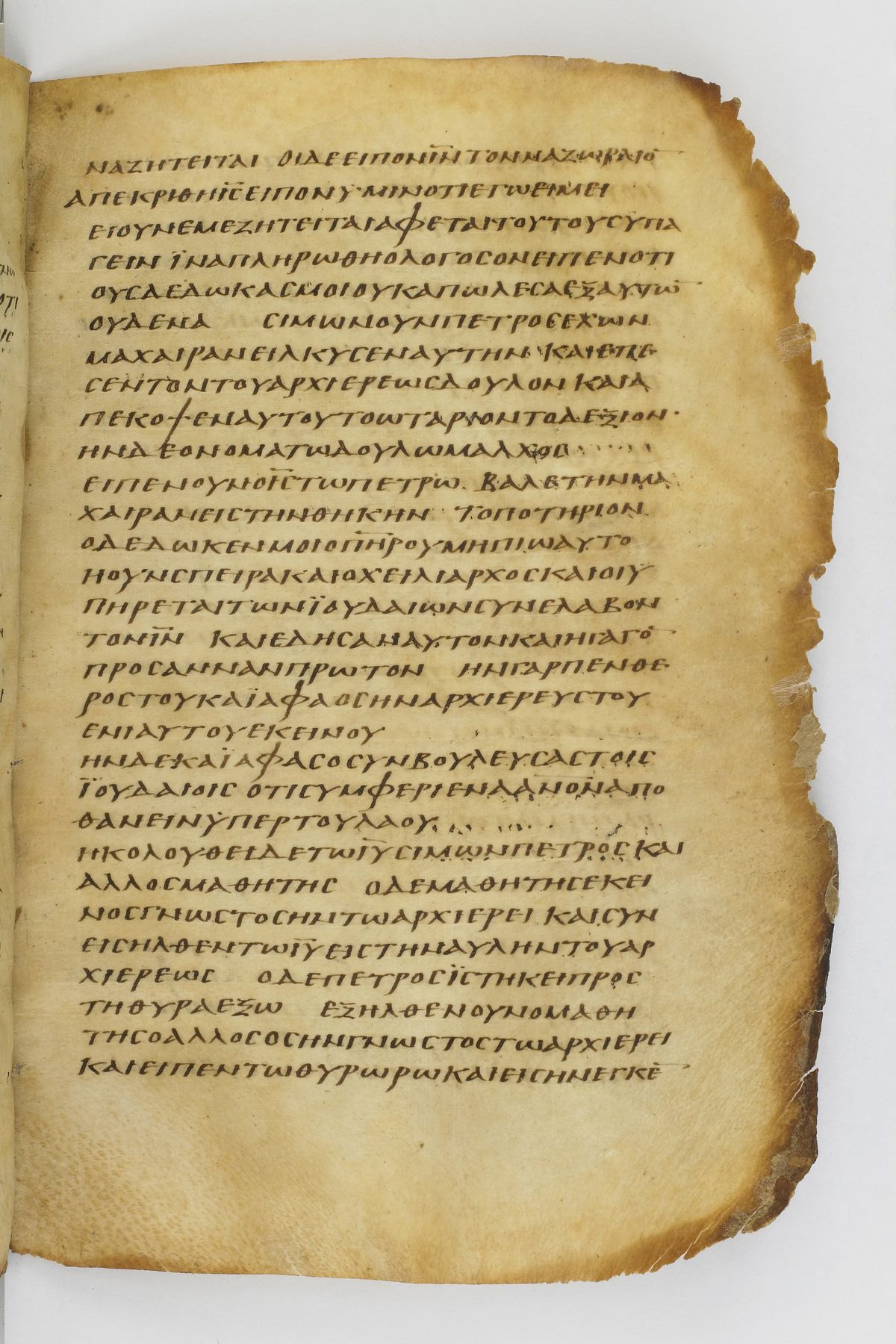
Page from the IGNTP transcription: verses 1-7 on fol. 89v, CSNTM GA_032_0178; verse 7 continues on fol. 90r, CSNTM GA_032_0179 (which begins 'να ζητειται οι').
1ΤΑυτα ειπων ο ις εξηλθεν συν τοις μαθηταις αυτου περαν του χειμαρρου του κεδρου οπου ην κηπος εις ον εισεληλυθεν αυτος και οι μαθηται αυτου 2ηδει δε και ιουδας ο παραδιδους αυτο¯ τον τοπον οτι πολλακεις συνηχθη ο ις εκει μετα των μαθητων αυτου 3Ο ουν ιουδας λαβων την σπειραν και εκ των αρχιερεων και φαρισαιων υπηρετας ερχεται εκει μετα φανω¯ και λαμπαδων και οπλων 4Ις δε ιδως παντα τα ερχομενα επ αυτον εξελθων ειπεν αυτοις τινα ζητειτε 5απεκριθησαν αυτω ιν τον ναζωραιον λεγει αυτοις ο ις εγω ειμει ειστηκει δε και ιουδας ο παραδιδους αυτον μετ αυτων 6ως ουν ειπεν αυτοις εγω ειμει απηλθαν εις τα οπισω και επεσαν χαμε 7παλιν ουν αυτους επηρωτησεν τινα ζητειται οι δε ειπον ιν τον ναζωραιο¯
Compare: Tischendorf 8th edition (1869)
1Ταῦτα εἰπὼν Ἰησοῦς ἐξῆλθεν σὺν τοῖς μαθηταῖς αὐτοῦ πέραν τοῦ χειμάρρου τοῦ κέδρου, ὅπου ἦν κῆπος, εἰς ὃν εἰσῆλθεν αὐτὸς καὶ οἱ μαθηταὶ αὐτοῦ. 2ᾔδει δὲ καὶ Ἰούδας ὁ παραδιδοὺς αὐτὸν τὸν τόπον, ὅτι πολλάκις συνήχθη Ἰησοῦς ἐκεῖ μετὰ τῶν μαθητῶν αὐτοῦ. 3ὁ οὖν Ἰούδας λαβὼν τὴν σπεῖραν καὶ ἐκ τῶν ἀρχιερέων καὶ ἐκ τῶν Φαρισαίων ὑπηρέτας ἔρχεται ἐκεῖ μετὰ φανῶν καὶ λαμπάδων καὶ ὅπλων. 4Ἰησοῦς οὖν εἰδὼς πάντα τὰ ἐρχόμενα ἐπ’ αὐτὸν ἐξῆλθεν καὶ λέγει αὐτοῖς· τίνα ζητεῖτε; 5ἀπεκρίθησαν αὐτῷ Ἰησοῦν τὸν Ναζωραῖον. λέγει αὐτοῖς Ἰησοῦς· ἐγώ εἰμι. εἱστήκει δὲ καὶ Ἰούδας ὁ παραδιδοὺς αὐτὸν μετ’ αὐτῶν. 6ὡς οὖν εἶπεν αὐτοῖς· ἐγώ εἰμι, ἀπῆλθον εἰς τὰ ὀπίσω καὶ ἔπεσαν χαμαί. 7πάλιν οὖν αὐτούς ἐπηρώτησεν· τίνα ζητεῖτε; οἱ δὲ εἶπον· Ἰησοῦν τὸν Ναζωραῖον.
1When Jesus had spoken these words, he went forth with his disciples over the brook Cedron, where was a garden, into the which he entered, and his disciples. 2And Judas also, which betrayed him, knew the place: for Jesus ofttimes resorted thither with his disciples. 3Judas then, having received a band of men and officers from the chief priests and Pharisees, cometh thither with lanterns and torches and weapons. 4Jesus therefore, knowing all things that should come upon him, went forth, and said unto them, Whom seek ye? 5They answered him, Jesus of Nazareth. Jesus saith unto them, I amhe. And Judas also, which betrayed him, stood with them. 6As soon then as he had said unto them, I am he, they went backward, and fell to the ground. 7Then asked he them again, Whom seek ye? And they said, Jesus of Nazareth.
Where on the image
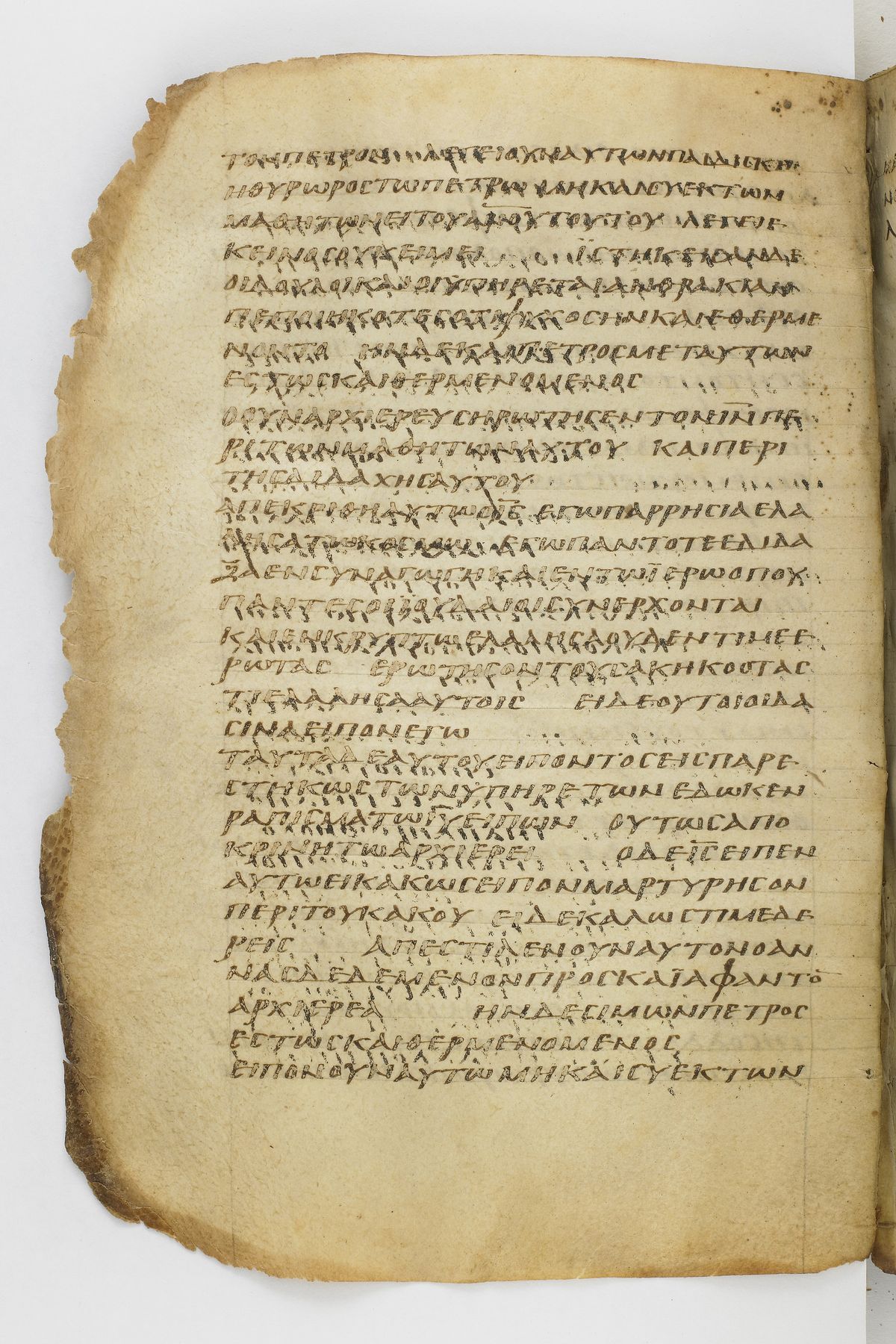
Page from the IGNTP transcription: verses 8-16 on fol. 90r, CSNTM GA_032_0179; verse 16 continues on fol. 90v, CSNTM GA_032_0180 (which begins 'τον πετρον').
8Απεκριθη ις ειπον υμιν οτι εγω ειμει ει ουν εμε ζητειται αφεται τουτους υπαγειν 9ινα πληρωθη ο λογος ον ειπεν οτι ους δεδωκας μοι ουκ απωλεσα εξ αυτω¯ ουδενα 10σιμων ουν πετρος εχων μαχαιραν ειλκυσεν αυτην και επεσεν τον του αρχιερεως δουλον και απεκοψεν αυτου το ωταριον το δεξιον ην δε ονομα τω δουλω μαλχος 11ειπεν ουν ο ις τω πετρω βαλε την μαχαιραν εις την θηκην το ποτηριον ο δεδωκεν μοι ο πηρ ου μη πιω αυτο 12η ουν σπειρα και ο χειλιαρχος και οι υπηρεται των ιουδαιων συνελαβον τον ιν και εδησαν αυτον 13και ηγαγο¯ προς ανναν πρωτον ην γαρ πενθερος του καιαφα ος ην αρχιερευς του ενιαυτου εκεινου 14ην δε καιαφας ο συνβουλευσας τοις ιουδαιοις οτι συμφερι ενα ανον αποθανειν υπερ του λαου 15ηκολουθει δε τω ιυ σιμων πετρος και αλλος μαθητης ο δε μαθητης εκεινος γνωστος ην τω αρχιερει και συνεισηλθεν τω ιυ εις την αυλην του αρχιερεως 16ο δε πετρος ιστηκει προς τη θυρα εξω εξηλθεν ουν ο μαθητης ο αλλος ος ην γνωστος τω αρχιερει και ειπεν τω θυρωρω και εισηνεγκε¯ τον πετρον
Compare: Tischendorf 8th edition (1869)
8ἀπεκρίθη Ἰησοῦς· εἶπον ὑμῖν ὅτι ἐγώ εἰμι· εἰ οὖν ἐμὲ ζητεῖτε, ἄφετε τούτους ὑπάγειν. 9ἵνα πληρωθῇ ὁ λόγος ὃν εἶπεν, ὅτι οὓς δέδωκάς μοι, οὐκ ἀπώλεσα ἐξ αὐτῶν οὐδένα. 10Σίμων οὖν Πέτρος ἔχων μάχαιραν εἵλκυσεν αὐτὴν καὶ ἔπαισεν τὸν τοῦ ἀρχιερέως δοῦλον καὶ ἀπέκοψεν αὐτοῦ τὸ ὠτάριον τὸ δεξιόν· ἦν δὲ ὄνομα τῷ δούλῳ Μάλχος. 11εἶπεν οὖν ὁ Ἰησοῦς τῷ Πέτρῳ· βάλε τὴν μάχαιραν εἰς τὴν θήκην· τὸ ποτήριον ὃ δέδωκέν μοι ὁ πατήρ, οὐ μὴ πίω αὐτό; 12Ἡ οὖν σπεῖρα καὶ ὁ χιλίαρχος καὶ οἱ ὑπηρέται τῶν Ἰουδαίων συνέλαβον τὸν Ἰησοῦν καὶ ἔδησαν αὐτόν, 13καὶ ἤγαγον πρὸς Ἅνναν πρῶτον· ἦν γὰρ πενθερὸς τοῦ Καϊάφα, ὃς ἦν ἀρχιερεὺς τοῦ ἐνιαυτοῦ ἐκείνου· 14ἦν δὲ Καϊάφας ὁ συμβουλεύσας τοῖς Ἰουδαίοις ὅτι συμφέρει ἕνα ἄνθρωπον ἀποθανεῖν ὑπὲρ τοῦ λαοῦ. 15Ἠκολούθει δὲ τῷ Ἰησοῦ Σίμων Πέτρος καὶ ἄλλος μαθητής. ὁ δὲ μαθητὴς ἐκεῖνος ἦν γνωστὸς τῷ ἀρχιερεῖ, καὶ συνεισῆλθεν τῷ Ἰησοῦ εἰς τὴν αὐλὴν τοῦ ἀρχιερέως, 16ὁ δὲ Πέτρος εἱστήκει πρὸς τῇ θύρᾳ ἔξω. ἐξῆλθεν οὖν ὁ μαθητὴς ὁ ἄλλος ὁ γνωστὸς τοῦ ἀρχιερέως καὶ εἶπεν τῇ θυρωρῷ, καὶ εἰσήγαγεν τὸν Πέτρον.
8Jesus answered, I have told you that I am he: if therefore ye seek me, let these go their way: 9That the saying might be fulfilled, which he spake, Of them which thou gavest me have I lost none. 10Then Simon Peter having a sword drew it, and smote the high priest’s servant, and cut off his right ear. The servant’s name was Malchus. 11Then said Jesus unto Peter, Put up thy sword into the sheath: the cup which my Father hath given me, shall I not drink it? 12Then the band and the captain and officers of the Jews took Jesus, and bound him, 13And led him away to Annas first; for he was father in law to Caiaphas, which was the high priest that same year. 14Now Caiaphas was he, which gave counsel to the Jews, that it was expedient that one man should die for the people. 15And Simon Peter followed Jesus, and so did another disciple: that disciple was known unto the high priest, and went in with Jesus into the palace of the high priest. 16But Peter stood at the door without. Then went out that other disciple, which was known unto the high priest, and spake unto her that kept the door, and brought in Peter.
Where on the image
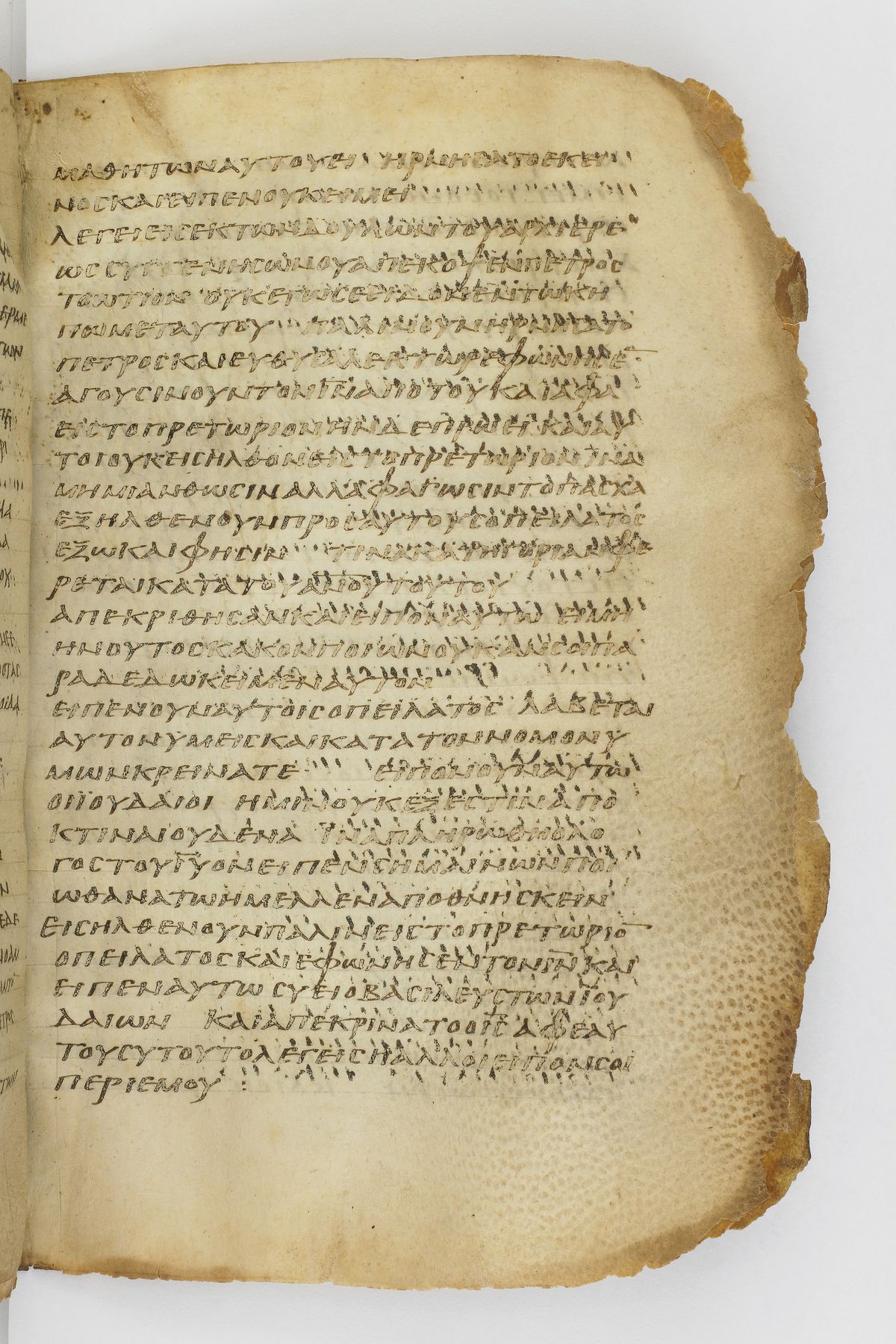
Page from the IGNTP transcription: verses 17-25 on fol. 90v, CSNTM GA_032_0180; verse 25 continues on fol. 91r, CSNTM GA_032_0181 (which begins 'μαθητων αυτου ει').
17λεγει ουν αυτων παιδισκη η θυρωρος τω πετρω μη και συ εκ των μαθητων ει του ανου τουτου λεγει εκεινος ουκ ειμει 18ιστηκεισαν δε οι δουλοι και οι υπηρεται ανθρακιαν πεποιηκοτες οτι ψυχος ην και εθερμενοντο ην δε και πετρος μετ αυτων εστως και θερμενομενος 19ο ουν αρχιερευς ηρωτησεν τον ιν περι των μαθητων αυτου και περι της διδαχης αυτου 20απεκριθη αυτω ο ις εγω παρρησια ελαλησα τω κοσμω εγω παντοτε εδιδαξα εν συναγωγη και εν τω ιερω οπου παντες οι ιουδαιοι συνερχονται και εν κρυπτω ελαλησα ουδεν 21τι με ερωτας ερωτησον τους ακηκοοτας τι ελαλησα αυτοις ειδε ουτοι οιδασιν α ειπον εγω 22ταυτα δε αυτου ειποντος εις παρεστηκως των υπηρετων εδωκεν ραπισμα τω ιυ ειπων ουτως αποκρινη τω αρχιερει 23ο δε ις ειπεν αυτω ει κακως ειπον μαρτυρησον περι του κακου ει δε καλως τι με δερεις 24απεστιλεν ουν αυτον ο αννας δεδεμενον προς καιαφαν το¯ αρχιερεα 25ην δε σιμων πετρος εστως και θερμενομενος ειπον ουν αυτω μη και συ εκ των μαθητων αυτου ει ηρνησατο εκεινος και ειπεν ουκ ειμει
Compare: Tischendorf 8th edition (1869)
17λέγει οὖν τῷ Πέτρῳ ἡ παιδίσκη ἡ θυρωρός, μὴ καὶ σὺ ἐκ τῶν μαθητῶν εἶ τοῦ ἀνθρώπου τούτου; λέγει ἐκεῖνος· οὐκ εἰμί. 18εἱστήκεισαν δὲ οἱ δοῦλοι καὶ οἱ ὑπηρέται ἀνθρακιὰν πεποιηκότες, ὅτι ψῦχος ἦν, καὶ ἐθερμαίνοντο· ἦν δὲ καὶ ὁ Πέτρος μετ’ αὐτῶν ἑστὼς καὶ θερμαινόμενος. 19Ὁ οὖν ἀρχιερεὺς ἠρώτησεν τὸν Ἰησοῦν περὶ τῶν μαθητῶν αὐτοῦ καὶ περὶ τῆς διδαχῆς αὐτοῦ. 20ἀπεκρίθη αὐτῷ Ἰησοῦς· ἐγὼ παρρησίᾳ λελάληκα τῷ κόσμῳ· ἐγὼ πάντοτε ἐδίδαξα ἐν συναγωγῇ καὶ ἐν τῷ ἱερῷ, ὅπου πάντες οἱ Ἰουδαῖοι συνέρχονται, καὶ ἐν κρυπτῷ ἐλάλησα οὐδέν. 21τί με ἐρωτᾷς; ἐρώτησον τοὺς ἀκηκοότας τί ἐλάλησα αὐτοῖς· ἴδε οὗτοι οἴδασιν ἃ εἶπον ἐγώ. 22ταῦτα δὲ αὐτοῦ εἰπόντος εἷς παρεστηκὼς τῶν ὑπηρετῶν ἔδωκεν ῥάπισμα τῷ Ἰησοῦ εἰπών· οὕτως ἀποκρίνῃ τῷ ἀρχιερεῖ; 23ἀπεκρίθη αὐτῷ Ἰησοῦς· εἰ κακῶς ἐλάλησα, μαρτύρησον περὶ τοῦ κακοῦ· εἰ δὲ καλῶς, τί με δέρεις; 24ἀπέστειλεν οὖν αὐτὸν ὁ Ἅννας δεδεμένον πρὸς Καϊάφαν τὸν ἀρχιερέα. 25Ἦν δὲ Σίμων Πέτρος ἑστὼς καὶ θερμαινόμενος. εἶπον οὖν αὐτῷ· μὴ καὶ σὺ ἐκ τῶν μαθητῶν αὐτοῦ εἶ; ἠρνήσατο ἐκεῖνος καὶ εἶπεν· οὐκ εἰμί.
17Then saith the damsel that kept the door unto Peter, Art not thou also one of this man’s disciples? He saith, I am not. 18And the servants and officers stood there, who had made a fire of coals; for it was cold: and they warmed themselves: and Peter stood with them, and warmed himself. 19The high priest then asked Jesus of his disciples, and of his doctrine. 20Jesus answered him, I spake openly to the world; I ever taught in the synagogue, and in the temple, whither the Jews always resort; and in secret have I said nothing. 21Why askest thou me? ask them which heard me, what I have said unto them: behold, they know what I said. 22And when he had thus spoken, one of the officers which stood by struck Jesus with the palm of his hand, saying, Answerest thou the high priest so? 23Jesus answered him, If I have spoken evil, bear witness of the evil: but if well, why smitest thou me? 24Now Annas had sent him bound unto Caiaphas the high priest. 25And Simon Peter stood and warmed himself. They said therefore unto him, Art not thou also one of his disciples? He denied it, and said, I am not.
Where on the image
Page from the IGNTP transcription: verses 26-34 on fol. 91r, CSNTM GA_032_0181.
26λεγει εις εκ των δουλων του αρχιερεως συνγενης ων ου απεκοψεν πετρος το ωτιον ουκ εγω σε ειδον εν τω κηπω μετ αυτου 27παλιν ουν ηρνησατο πετρος και ευθυς αλεκτωρ εφωνησε¯ 28αγουσιν ουν τον ιν απο του καιαφα εις το πρετωριον ην δε πρωει και αυτοι ουκ εισηλθον εις το πρετωριον ινα μη μιανθωσιν αλλα φαγωσιν το πασχα 29εξηλθεν ουν προς αυτους ο πειλατος εξω και φησιν τινα κατηγοριαν φερεται κατα του ανου τουτου 30απεκριθησαν και ειπον αυτω ει μη ην ουτος κακον ποιων ουκ αν σοι παραδεδωκειμεν αυτον 31ειπεν ουν αυτοις ο πειλατος λαβεται αυτον υμεις και κατα τον νομον υμων κρεινατε ειπον ουν αυτω οι ιουδαιοι ημιν ουκ εξεστιν αποκτιναι ουδενα 32ινα πληρωθη ο λογος του ιυ ον ειπεν σημαινων ποιω θανατω ημελλεν αποθνησκειν 33Εισηλθεν ουν παλιν εις το πρετωριο¯ ο πειλατος και εφωνησεν τον ιν και ειπεν αυτω συ ει ο βασιλευς των ιουδαιων 34και απεκρινατο ο ις αφ εαυτου συ τουτο λεγεις η αλλοι ειπον σοι περι εμου
Compare: Tischendorf 8th edition (1869)
26λέγει εἷς ἐκ τῶν δούλων τοῦ ἀρχιερέως, συγγενὴς ὢν οὗ ἀπέκοψεν Πέτρος τὸ ὠτίον· οὐκ ἐγώ σε εἶδον ἐν τῷ κήπῳ μετ’ αὐτοῦ; 27πάλιν οὖν ἠρνήσατο Πέτρος· καὶ εὐθέως ἀλέκτωρ ἐφώνησεν. 28Ἄγουσιν οὖν τὸν Ἰησοῦν ἀπὸ τοῦ Καϊάφα εἰς τὸ πραιτώριον· ἦν δὲ πρωΐ· καὶ αὐτοὶ οὐκ εἰσῆλθον εἰς τὸ πραιτώριον, ἵνα μὴ μιανθῶσιν ἀλλὰ φάγωσιν τὸ πάσχα. 29ἐξῆλθεν οὖν ὁ Πειλᾶτος ἔξω πρὸς αὐτοὺς καὶ φησίν· τίνα κατηγορίαν φέρετε τοῦ ἀνθρώπου τούτου; 30ἀπεκρίθησαν καὶ εἶπαν αὐτῷ· εἰ μὴ ἦν οὗτος κακὸν ποιῶν, οὐκ ἄν σοι παρεδώκαμεν αὐτόν. 31εἶπεν οὖν αὐτοῖς ὁ Πειλᾶτος· λάβετε αὐτὸν ὑμεῖς καὶ κατὰ τὸν νόμον ὑμῶν κρίνατε. εἶπον οὖν αὐτῷ οἱ Ἰουδαῖοι· ἡμῖν οὐκ ἔξεστιν ἀποκτεῖναι οὐδένα. 32ἵνα ὁ λόγος τοῦ Ἰησοῦ πληρωθῇ, ὃν εἶπεν σημαίνων ποίῳ θανάτῳ ἤμελλεν ἀποθνῄσκειν. 33Εἰσῆλθεν οὖν εἰς τὸ πραιτώριον πάλιν ὁ Πειλᾶτος καὶ ἐφώνησεν τὸν Ἰησοῦν καὶ εἶπεν αὐτῷ· σὺ εἶ ὁ βασιλεὺς τῶν Ἰουδαίων; 34ἀπεκρίθη Ἰησοῦς· ἀφ’ ἑαυτοῦ σὺ τοῦτο λέγεις, ἢ ἄλλοι σοι εἶπόν περὶ ἐμοῦ;
26One of the servants of the high priest, being his kinsman whose ear Peter cut off, saith, Did not I see thee in the garden with him? 27Peter then denied again: and immediately the cock crew. 28Then led they Jesus from Caiaphas unto the hall of judgment: and it was early; and they themselves went not into the judgment hall, lest they should be defiled; but that they might eat the passover. 29Pilate then went out unto them, and said, What accusation bring ye against this man? 30They answered and said unto him, If he were not a malefactor, we would not have delivered him up unto thee. 31Then said Pilate unto them, Take ye him, and judge him according to your law. The Jews therefore said unto him, It is not lawful for us to put any man to death: 32That the saying of Jesus might be fulfilled, which he spake, signifying what death he should die. 33Then Pilate entered into the judgment hall again, and called Jesus, and said unto him, Art thou the King of the Jews? 34Jesus answered him, Sayest thou this thing of thyself, or did others tell it thee of me?
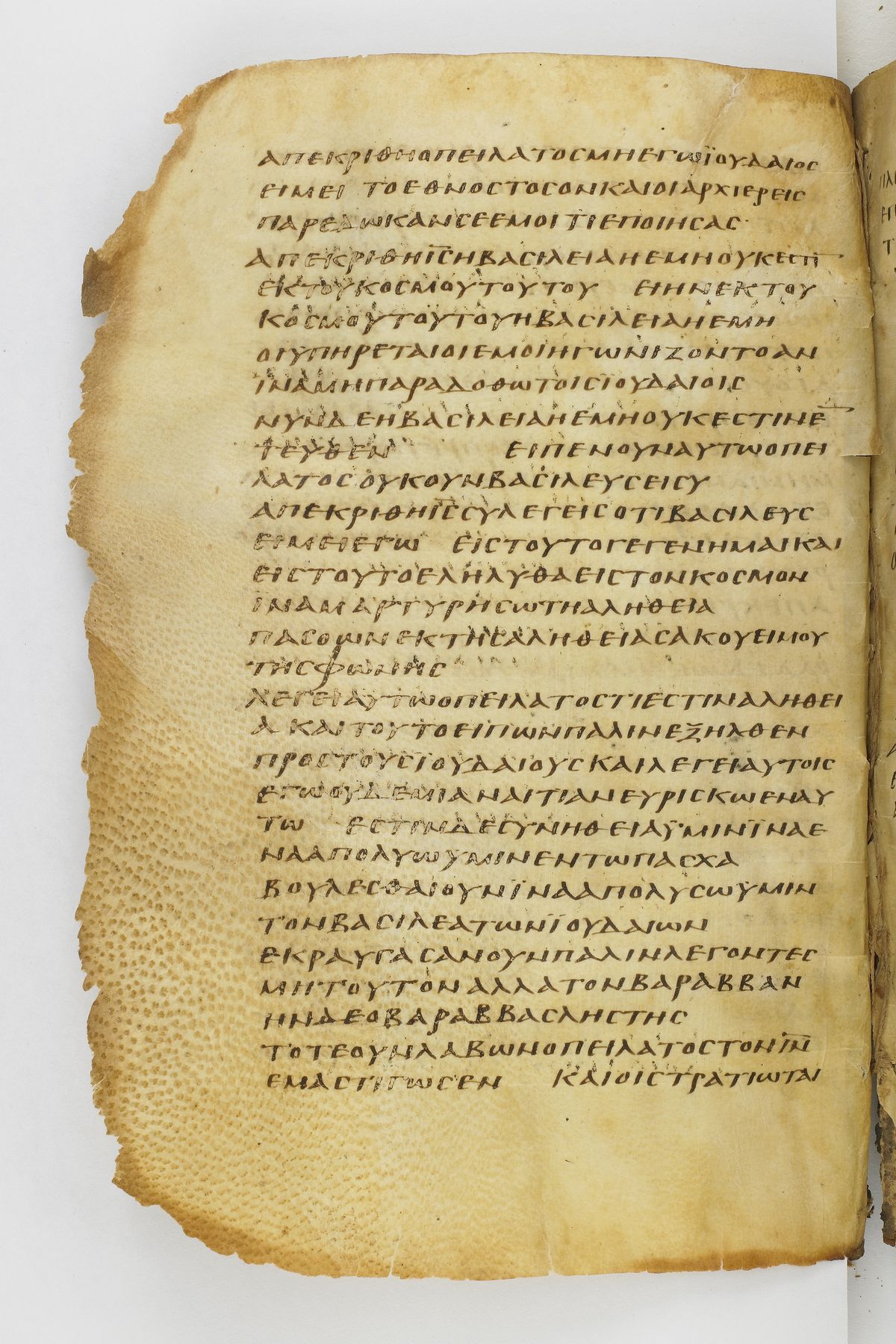
Where on the image
Page from the IGNTP transcription: verses 35-40 on fol. 91v, CSNTM GA_032_0182.
35απεκριθη ο πειλατος μη εγω ιουδαιος ειμει το εθνος το σον και οι αρχιερεις παρεδωκαν σε εμοι τι εποιησας 36Απεκριθη ις η βασιλεια η εμη ουκ εστι¯ εκ του κοσμου τουτου ει ην εκ του κοσμου τουτου η βασιλεια η εμη οι υπηρεται οι εμοι ηγωνιζοντο αν ινα μη παραδοθω τοις ιουδαιοις νυν δε η βασιλεια η εμη ουκ εστιν ε¯τευθεν 37ειπεν ουν αυτω ο πειλατος ουκουν βασιλευς ει συ απεκριθη ις συ λεγεις οτι βασιλευς ειμει εγω εις τουτο γεγενημαι και εις τουτο εληλυθα εις τον κοσμον ινα μαρτυρησω τη αληθεια πας ο ων εκ της αληθειας ακουει μου της φωνης 38λεγει αυτω ο πειλατος τι εστιν αληθεια και τουτο ειπων παλιν εξηλθεν προς τους ιουδαιους και λεγει αυτοις εγω ουδεμιαν αιτιαν ευρισκω εν αυτω 39εστιν δε συνηθεια υμιν ινα ενα απολυω υμιν εν τω πασχα βουλεσθαι ουν ινα απολυσω υμιν τον βασιλεα των ιουδαιων 40εκραυγασαν ουν παλιν λεγοντες μη τουτον αλλα τον βαραββαν ην δε ο βαραββας ληστης
Compare: Tischendorf 8th edition (1869)
35ἀπεκρίθη ὁ Πειλᾶτος· μήτι ἐγὼ Ἰουδαῖός εἰμι; τὸ ἔθνος τὸ σὸν καὶ οἱ ἀρχιερεῖς παρέδωκάν σε ἐμοί· τί ἐποίησας; 36ἀπεκρίθη Ἰησοῦς· ἡ βασιλεία ἡ ἐμὴ οὐκ ἔστιν ἐκ τοῦ κόσμου τούτου· εἰ ἐκ τοῦ κόσμου τούτου ἦν ἡ βασιλεία ἡ ἐμή, οἱ ὑπηρέται ἂν οἱ ἐμοὶ ἠγωνίζοντο, ἵνα μὴ παραδοθῶ τοῖς Ἰουδαίοις· νῦν δὲ ἡ βασιλεία ἡ ἐμὴ οὐκ ἔστιν ἐντεῦθεν. 37εἶπεν οὖν αὐτῷ ὁ Πειλᾶτος· οὐκοῦν βασιλεὺς εἶ σύ; ἀπεκρίθη ὁ Ἰησοῦς· σὺ λέγεις, ὅτι βασιλεύς εἰμι. ἐγὼ εἰς τοῦτο γεγέννημαι καὶ εἰς τοῦτο ἐλήλυθα εἰς τὸν κόσμον, ἵνα μαρτυρήσω τῇ ἀληθείᾳ· πᾶς ὁ ὢν ἐκ τῆς ἀληθείας ἀκούει μου τῆς φωνῆς. 38λέγει αὐτῷ ὁ Πειλᾶτος· τί ἐστιν ἀλήθεια; καὶ τοῦτο εἰπὼν πάλιν ἐξῆλθεν πρὸς τοὺς Ἰουδαίους, καὶ λέγει αὐτοῖς· ἐγὼ οὐδεμίαν εὑρίσκω ἐν αὐτῷ αἰτίαν. 39ἔστιν δὲ συνήθεια ὑμῖν ἵνα ἕνα ἀπολύσω ὑμῖν ἐν τῷ πάσχα· βούλεσθε οὖν ἀπολύσω ὑμῖν τὸν βασιλέα τῶν Ἰουδαίων; 40ἐκραύγασαν οὖν πάλιν λέγοντες· μὴ τοῦτον, ἀλλὰ τὸν Βαραββᾶν. ἦν δὲ ὁ Βαραββᾶς λῃστής.
35Pilate answered, Am I a Jew? Thine own nation and the chief priests have delivered thee unto me: what hast thou done? 36Jesus answered, My kingdom is not of this world: if my kingdom were of this world, then would my servants fight, that I should not be delivered to the Jews: but now is my kingdom not from hence. 37Pilate therefore said unto him, Art thou a king then? Jesus answered, Thou sayest that I am a king. To this end was I born, and for this cause came I into the world, that I should bear witness unto the truth. Every one that is of the truth heareth my voice. 38Pilate saith unto him, What is truth? And when he had said this, he went out again unto the Jews, and saith unto them, I find in him no fault at all. 39But ye have a custom, that I should release unto you one at the passover: will ye therefore that I release unto you the King of the Jews? 40Then cried they all again, saying, Not this man, but Barabbas. Now Barabbas was a robber.
Cite
Sources
- Source: Codex Washingtonianus page images + IGNTP transcription (CC BY 4.0) + Tischendorf 8th edition + KJV (holding institution)
- Critical edition: Codex Washingtonianus transcription, IGNTP (CC BY 4.0); Tischendorf 8th edition for comparison
← previous · → next · v cycle view · l back to library