John, Chapter 4 (Codex Washingtonianus)
Introduction
John 4 from Codex Washingtonianus (the Freer Gospels, Gregory-Aland 032, Freer Gallery of Art F1906.274), a parchment codex of the four Gospels written in Egypt in the late 4th or early 5th century and bought by Charles Lang Freer from the dealer Ali Arabi at Giza in 1906. It is one of the oldest nearly complete Gospel books in existence. The Gospels stand in the so-called Western order, Matthew, John, Luke, Mark, and the text is famously block-mixed: the copyist drew on several exemplars of different textual character, so the text type changes in blocks within a single Gospel. After Mark 16:14 the codex carries the Freer Logion, a saying found in no other manuscript. Two passages are lost to damage: Mark 15:13-37 and John 14:26-16:6.
- Scan: each section is shown with the actual page of the codex that carries those verses, from the Freer Gallery's own photographs of F1906.274 served by the Smithsonian IIIF service (ids.si.edu). Which page holds which verse comes from the verse index of the Center for the Study of New Testament Manuscripts (CSNTM), whose photographs of the codex are the same shots; every CSNTM page was matched to its Smithsonian image by pixel comparison before use. Where a verse begins on one page and ends on the next, both pages are listed. For this chapter the page of each verse is taken from the transcription itself, which records where every page begins; CSNTM's index confirms which photograph shows that page.
- Greek: the manuscript's own text, from a diplomatic transcription (see Greek text below), with Tischendorf's 8th critical edition (1869) for comparison.
- English: the King James Version (1611, public domain), verbatim from bible-api.com. The KJV translates the later Byzantine text, so it will not always match the Greek shown or the reading of the codex.
Greek text: a diplomatic transcription of Codex Washingtonianus made by the International Greek New Testament Project (IGNTP), transcription of John in GA 032, version 2.1 (2013), published under a Creative Commons Attribution 4.0 licence. It gives the letters as the first scribe wrote them: no accents or breathings, the scribe's own spelling, and the sacred names in their contracted form (θς for θεος, ις for ιησους, κς for κυριος; the overline is not reproduced). A stroke ¯ after a letter (for example μενω¯, το¯) is the scribe's abbreviation for a final ν, kept as the transcription gives it. Corrections by later hands are not shown. Letters in square brackets are not legible on the page and were restored by the transcribers, a dot under a letter marks an uncertain reading, and [...] marks text lost to damage. Beneath each section, for comparison, is Tischendorf's 8th critical edition (1869). Where the two differ, the transcription is what the manuscript says. Each section is shown with the page on which the transcription places its verses.
Manuscript note: John 1:1-5:11 in this codex is on a replacement quire (fols. 57-64) written by a later hand; its transcription is the IGNTP file for that supplement (04_032S).
How was this verified? (Provenance)
Where on the image
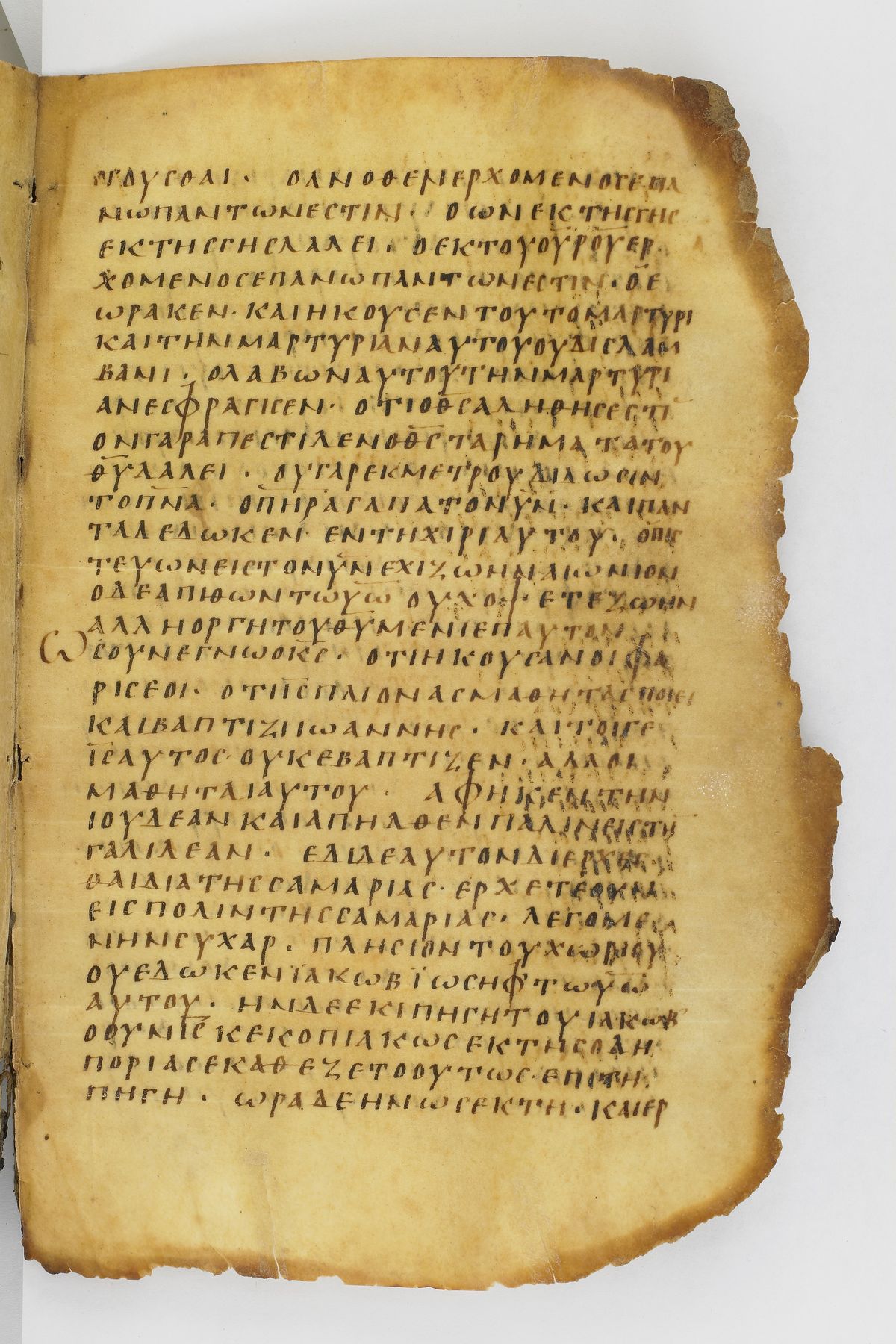
Page from the IGNTP transcription: verses 1-7 on fol. 62r, CSNTM GA_032_0123; verse 7 continues on fol. 62v, CSNTM GA_032_0124 (which begins 'χαιται γυνη εκ').
1Ως ουν εγνω ο κς οτι ηκουσαν οι φαρισεοι οτι ις πλιονας μαθητας ποιει και βαπτιζι ιωαννης 2καιτοιγε ις αυτος ουκ εβαπτιζεν αλλ οι μαθηται αυτου 3αφηκεν την ιουδεαν και απηλθεν παλιν εις τη¯ γαλιλεαν 4εδι δε αυτον διερχεσθαι δια της σαμαριας 5ερχετε ουν εις πολιν της σαμαριας λεγομενην συχαρ πλησιον του χωριου ου εδωκεν ιακωβ ιωσηφ τω υω αυτου 6ην δε εκι πηγη του ιακωβ ο ουν ις κεκοπιακως εκ της οδηποριας εκαθεζετο ουτως επι τη πηγη ωρα δε ην ως εκτη 7και ερχαιται γυνη εκ της σαμαριας αντλησε υδωρ λεγι αυτη ο ις δος μοι πιειν
Compare: Tischendorf 8th edition (1869)
1Ὡς οὖν ἔγνω ὁ Ἰησοῦς ὅτι ἤκουσαν οἱ Φαρισαῖοι ὅτι Ἰησοῦς πλείονας μαθητὰς ποιεῖ καὶ βαπτίζει ἢ Ἰωάννης, 2καίτοιγε Ἰησοῦς αὐτὸς οὐκ ἐβάπτιζεν ἀλλ’ οἱ μαθηταὶ αὐτοῦ, 3ἀφῆκεν τὴν Ἰουδαίαν καὶ ἀπῆλθεν πάλιν εἰς τὴν Γαλιλαίαν. 4ἔδει δὲ αὐτὸν διέρχεσθαι διὰ τῆς Σαμαρίας. 5ἔρχεται οὖν εἰς πόλιν τῆς Σαμαρίας λεγομένην Συχάρ, πλησίον τοῦ χωρίου ὃ ἔδωκεν Ἰακὼβ Ἰωσὴφ τῷ υἱῷ αὐτοῦ. 6ἦν δὲ ἐκεῖ πηγὴ τοῦ Ἰακώβ. ὁ οὖν Ἰησοῦς κεκοπιακὼς ἐκ τῆς ὁδοιπορίας ἐκαθέζετο οὕτως ἐπὶ τῇ πηγῇ· ὥρα ἦν ὡς ἕκτη. 7ἔρχεται γυνὴ ἐκ τῆς Σαμαρίας ἀντλῆσαι ὕδωρ. λέγει αὐτῇ ὁ Ἰησοῦς, δός μοι πεῖν·
1When therefore the Lord knew how the Pharisees had heard that Jesus made and baptized more disciples than John, 2(Though Jesus himself baptized not, but his disciples,) 3He left Judaea, and departed again into Galilee. 4And he must needs go through Samaria. 5Then cometh he to a city of Samaria, which is called Sychar, near to the parcel of ground that Jacob gave to his son Joseph. 6Now Jacob’s well was there. Jesus therefore, being wearied with his journey, sat thus on the well: and it was about the sixth hour. 7There cometh a woman of Samaria to draw water: Jesus saith unto her, Give me to drink.
Where on the image
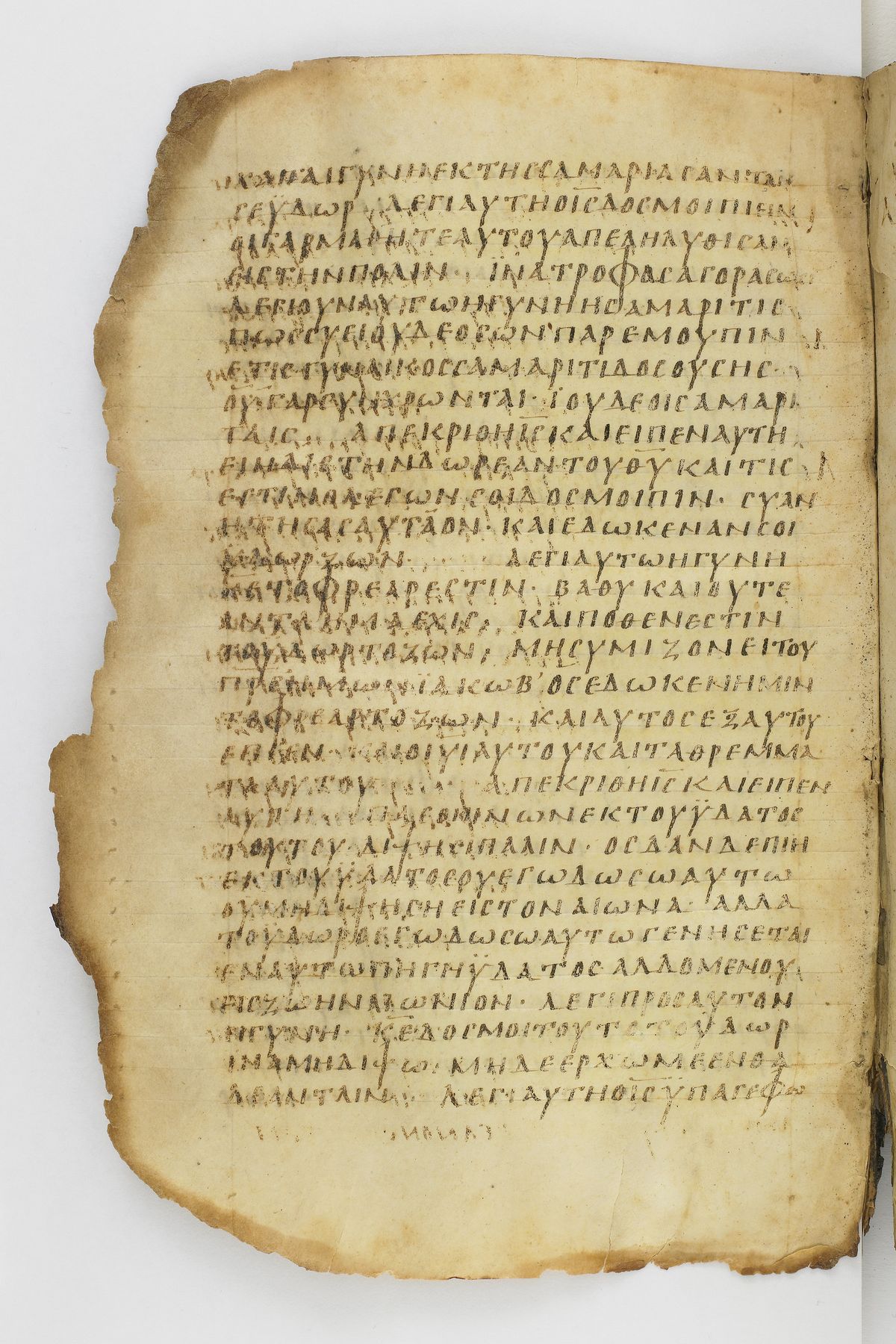
Page from the IGNTP transcription: verses 8-16 on fol. 62v, CSNTM GA_032_0124; verse 16 continues on fol. 63r, CSNTM GA_032_0125 (which begins 'νησον τον ανδρα').
8οι γαρ μαθητε αυτου απεληλυθισαν εις την πολιν ινα τροφας αγορασωσι¯ 9λεγι ουν αυτω η γυνη η σαμαριτις πως συ ειουδεος ων παρ εμου πιν ετις γυναικος σαμαριτιδος ουσης ου γαρ συνχρωνται ιουδεοι σαμαριταις 10απεκριθη ις και ειπεν αυτη ει ηδις την δωρεαν του θυ και τις εστιν ο λεγων σοι δος μοι πιν συ αν ητησας αυτα και εδωκεν αν σοι υδωρ ζων 11λεγι αυτω η γυνη κε το φρεαρ εστιν βαθυ και ουτε αντλημα εχις και ποθεν εστιν το υδωρ το ζων 12μη συ μιζον ει του πρς ημων ιακωβ ος εδωκεν ημιν το φρεαρ το ζων και αυτος εξ αυτου επιεν κ̣α̣ι οι υι αυτου και τα θρεμματα αυτου 13απεκριθη ις και ειπεν αυτη πας ο πινων εκ του υδατος τουτου διψησι παλιν 14ος δ αν δε πιη εκ του υδατος ου εγω δωσω αυτω ου μη διψηση εις τον αιωνα αλλα το υδωρ ο εγω δωσω αυτω γενησεται εν αυτω πηγη υδατος αλλομενου εις ζωην αιωνιον 15λεγι προς αυτον η γυνη κε δος μοι τουτο το υδωρ ινα μη διψω μηδε ερχωμε ενθαδε αντλιν 16λεγι αυτη ο ις υπαγε φωνησον τον ανδρα σου και ελθε ενθαδε
Compare: Tischendorf 8th edition (1869)
8οἱ γὰρ μαθηταὶ αὐτοῦ ἀπεληλύθεισαν εἰς τὴν πόλιν, ἵνα τροφὰς ἀγοράσωσιν. 9λέγει αὐτῷ ἡ γυνὴ ἡ Σαμαρῖτις· πῶς σὺ Ἰουδαῖος ὢν παρ’ ἐμοῦ πεῖν αἰτεῖς γυναικὸς Σαμαρίτιδος οὔσης; 10ἀπεκρίθη Ἰησοῦς καὶ εἶπεν αὐτῇ· εἰ ᾔδεις τὴν δωρεὰν τοῦ θεοῦ, καὶ τίς ἐστιν ὁ λέγων σοι· δός μοι πεῖν, σὺ ἂν ᾔτησας αὐτὸν καὶ ἔδωκεν ἄν σοι ὕδωρ ζῶν. 11λέγει αὐτῷ ἡ γυνή· κύριε, οὔτε ἄντλημα ἔχεις καὶ τὸ φρέαρ ἐστὶν βαθύ· πόθεν ἔχεις τὸ ὕδωρ τὸ ζῶν; 12μὴ σὺ μείζων εἶ τοῦ πατρὸς ἡμῶν Ἰακώβ, ὃς ἔδωκεν ἡμῖν τὸ φρέαρ, καὶ αὐτὸς ἐξ αὐτοῦ ἔπιεν καὶ οἱ υἱοὶ αὐτοῦ καὶ τὰ θρέμματα αὐτοῦ; 13ἀπεκρίθη Ἰησοῦς καὶ εἶπεν αὐτῇ· πᾶς ὁ πίνων ἐκ τοῦ ὕδατος τούτου διψήσει πάλιν· 14ὃς δ’ ἂν πίῃ ἐκ τοῦ ὕδατος οὗ ἐγὼ δώσω αὐτῷ, οὐ μὴ διψήσει εἰς τὸν αἰῶνα, ἀλλὰ τὸ ὕδωρ ὃ ἐγὼ δώσω αὐτῷ γενήσεται ἐν αὐτῷ πηγὴ ὕδατος ἁλλομένου εἰς ζωὴν αἰώνιον. 15λέγει πρὸς αὐτὸν ἡ γυνή· κύριε, δός μοι τοῦτο τὸ ὕδωρ, ἵνα μὴ διψῶ μηδὲ διέρχωμαι ἐνθάδε ἀντλεῖν. 16λέγει αὐτῇ· ὕπαγε φώνησον τὸν ἄνδρα σου καὶ ἐλθὲ ἐνθάδε.
8(For his disciples were gone away unto the city to buy meat.) 9Then saith the woman of Samaria unto him, How is it that thou, being a Jew, askest drink of me, which am a woman of Samaria? for the Jews have no dealings with the Samaritans. 10Jesus answered and said unto her, If thou knewest the gift of God, and who it is that saith to thee, Give me to drink; thou wouldest have asked of him, and he would have given thee living water. 11The woman saith unto him, Sir, thou hast nothing to draw with, and the well is deep: from whence then hast thou that living water? 12Art thou greater than our father Jacob, which gave us the well, and drank thereof himself, and his children, and his cattle? 13Jesus answered and said unto her, Whosoever drinketh of this water shall thirst again: 14But whosoever drinketh of the water that I shall give him shall never thirst; but the water that I shall give him shall be in him a well of water springing up into everlasting life. 15The woman saith unto him, Sir, give me this water, that I thirst not, neither come hither to draw. 16Jesus saith unto her, Go, call thy husband, and come hither.
Where on the image
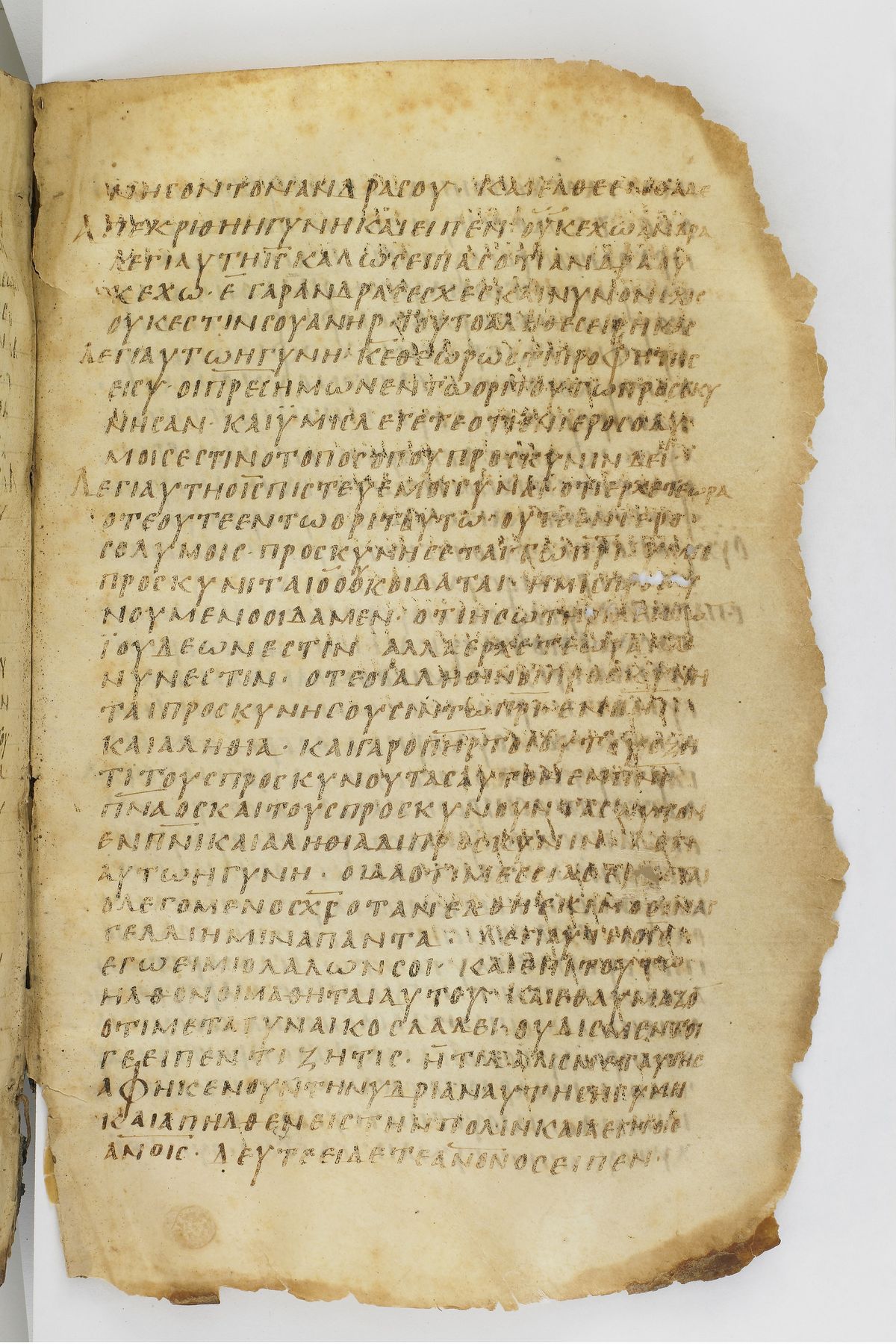
Page from the IGNTP transcription: verses 17-23 on fol. 63r, CSNTM GA_032_0125.
17Απεκριθη η γυνη και ειπεν ουκ εχω ανδρα λεγι αυτη ις καλως ειπας οτι ανδρα ουκ εχω 18ε γαρ ανδρας εσχες και νυν ον εχις ουκ εστιν σου ανηρ τουτο αληθες ειρηκας 19Λεγι αυτω η γυνη κε θεωρω οτι προφητης ει συ 20οι πρες ημων εν τω ορι τουτω προσεκυνησαν και υμις λεγετε οτι εν ιεροσολυμοις εστιν ο τοπος οπου προσκυνιν δει 21Λεγι αυτη ο ις πιστευε μοι γυναι οτι ερχετε ωρα οτε ουτε εν τω ορι τουτω ουτε εν ιεροσολυμοις προσκυνησεται τω πρι 22υμις προσκυνηται ο οοκ οιδαται ημις προσκυνουμεν ο οιδαμεν οτι η σωτηρια εκ τω¯ ιουδεων εστιν 23αλλα ερχετε ωρα και νυν εστιν οτε οι αληθινοι προσκυνηται προσκυνησουσιν τω πρι εν πνι και αληθια και γαρ ο πηρ τοιουτους ζητι τους προσκυνουτας αυτον εν πνι
Compare: Tischendorf 8th edition (1869)
17ἀπεκρίθη ἡ γυνὴ καὶ εἶπεν· ἄνδρα οὐκ ἔχω. λέγει αὐτῇ ὁ Ἰησοῦς· καλῶς εἶπες ὅτι ἄνδρα οὐκ ἔχω· 18πέντε γὰρ ἄνδρας ἔσχες, καὶ νῦν ὃν ἔχεις οὐκ ἔστιν σου ἀνήρ· τοῦτο ἀληθὲς εἴρηκας. 19λέγει αὐτῷ ἡ γυνή· κύριε, θεωρῶ ὅτι προφήτης εἶ σύ. 20οἱ πατέρες ἡμῶν ἐν τῷ ὄρει τούτῳ προσεκύνησαν· καὶ ὑμεῖς λέγετε ὅτι ἐν Ἱεροσολύμοις ἐστὶν ὁ τόπος ὅπου προσκυνεῖν δεῖ. 21λέγει αὐτῇ ὁ Ἰησοῦς· πίστευέ μοι, γύναι, ὅτι ἔρχεται ὥρα ὅτε οὔτε ἐν τῷ ὄρει τούτῳ οὔτε ἐν Ἱεροσολύμοις προσκυνήσετε τῷ πατρί. 22ὑμεῖς προσκυνεῖτε ὃ οὐκ οἴδατε, ἡμεῖς προσκυνοῦμεν ὃ οἴδαμεν, ὅτι ἡ σωτηρία ἐκ τῶν Ἰουδαίων ἐστίν· 23ἀλλὰ ἔρχεται ὥρα καὶ νῦν ἐστιν, ὅτε οἱ ἀληθινοὶ προσκυνηταὶ προσκυνήσουσιν τῷ πατρὶ ἐν πνεύματι καὶ ἀληθείᾳ· καὶ γὰρ ὁ πατὴρ τοιούτους ζητεῖ τοὺς προσκυνοῦντας αὐτόν.
17The woman answered and said, I have no husband. Jesus said unto her, Thou hast well said, I have no husband: 18For thou hast had five husbands; and he whom thou now hast is not thy husband: in that saidst thou truly. 19The woman saith unto him, Sir, I perceive that thou art a prophet. 20Our fathers worshipped in this mountain; and ye say, that in Jerusalem is the place where men ought to worship. 21Jesus saith unto her, Woman, believe me, the hour cometh, when ye shall neither in this mountain, nor yet at Jerusalem, worship the Father. 22Ye worship ye know not what: we know what we worship: for salvation is of the Jews. 23But the hour cometh, and now is, when the true worshippers shall worship the Father in spirit and in truth: for the Father seeketh such to worship him.
Where on the image
Page from the IGNTP transcription: verses 24-29 on fol. 63r, CSNTM GA_032_0125; verse 29 continues on fol. 63v, CSNTM GA_032_0126 (which begins 'παντα οσα εποιησα').
24πνα ος και τους προσκυνουντας αυτον εν πνι και αληθια δι προσκυνιν 25λ̣εγι αυτω η γυνη οιδα οτι μεσσιας ερχ̣εται ο λεγομενος χρ οταν ελθη εκινος αναγγελλι ημιν απαντα 26λεγι αυτη ο ις εγω ειμι ο λαλων σοι 27και επι τουτω ηλθον οι μαθηται αυτου και εθαυμαζο¯ οτι μετα γυναικος λαλει ουδις μεντοι γε ειπεν τι ζητις η τι λαλις μετ αυτης 28αφηκεν ουν την υδριαν αυτης η γυνη και απηλθεν εις την πολιν και λεγι τοις ανοις 29δευτε ειδετε ανον ος ειπεν παντα οσα εποιησα μητι ουτος εστιν ο χς
Compare: Tischendorf 8th edition (1869)
24πνεῦμα ὁ θεός, καὶ τοὺς προσκυνοῦντας ἐν πνεύματι καὶ ἀληθείᾳ προσκυνεῖν δεῖ. 25λέγει αὐτῷ ἡ γυνή· οἶδα ὅτι Μεσσίας ἔρχεται, ὁ λεγόμενος Χριστός· ὅταν ἔλθῃ ἐκεῖνος, ἀναγγελεῖ ἡμῖν ἅπαντα. 26λέγει αὐτῇ ὁ Ἰησοῦς· ἐγώ εἰμι, ὁ λαλῶν σοι. 27Καὶ ἐπὶ τούτῳ ἦλθαν οἱ μαθηταὶ αὐτοῦ, καὶ ἐθαύμαζον ὅτι μετὰ γυναικὸς ἐλάλει· οὐδεὶς μέντοι εἶπεν· τί ζητεῖς ἤ τί λαλεῖς μετ’ αὐτῆς; 28ἀφῆκεν οὖν τὴν ὑδρίαν αὐτῆς ἡ γυνὴ καὶ ἀπῆλθεν εἰς τὴν πόλιν, καὶ λέγει τοῖς ἀνθρώποις· 29δεῦτε ἴδετε ἄνθρωπον ὃς εἶπέν μοι πάντα ἃ ἐποίησα· μήτι οὗτός ἐστιν ὁ Χριστός;
24God is a Spirit: and they that worship him must worship him in spirit and in truth. 25The woman saith unto him, I know that Messias cometh, which is called Christ: when he is come, he will tell us all things. 26Jesus saith unto her, I that speak unto thee am he. 27And upon this came his disciples, and marvelled that he talked with the woman: yet no man said, What seekest thou? or, Why talkest thou with her? 28The woman then left her waterpot, and went her way into the city, and saith to the men, 29Come, see a man, which told me all things that ever I did: is not this the Christ?
Where on the image
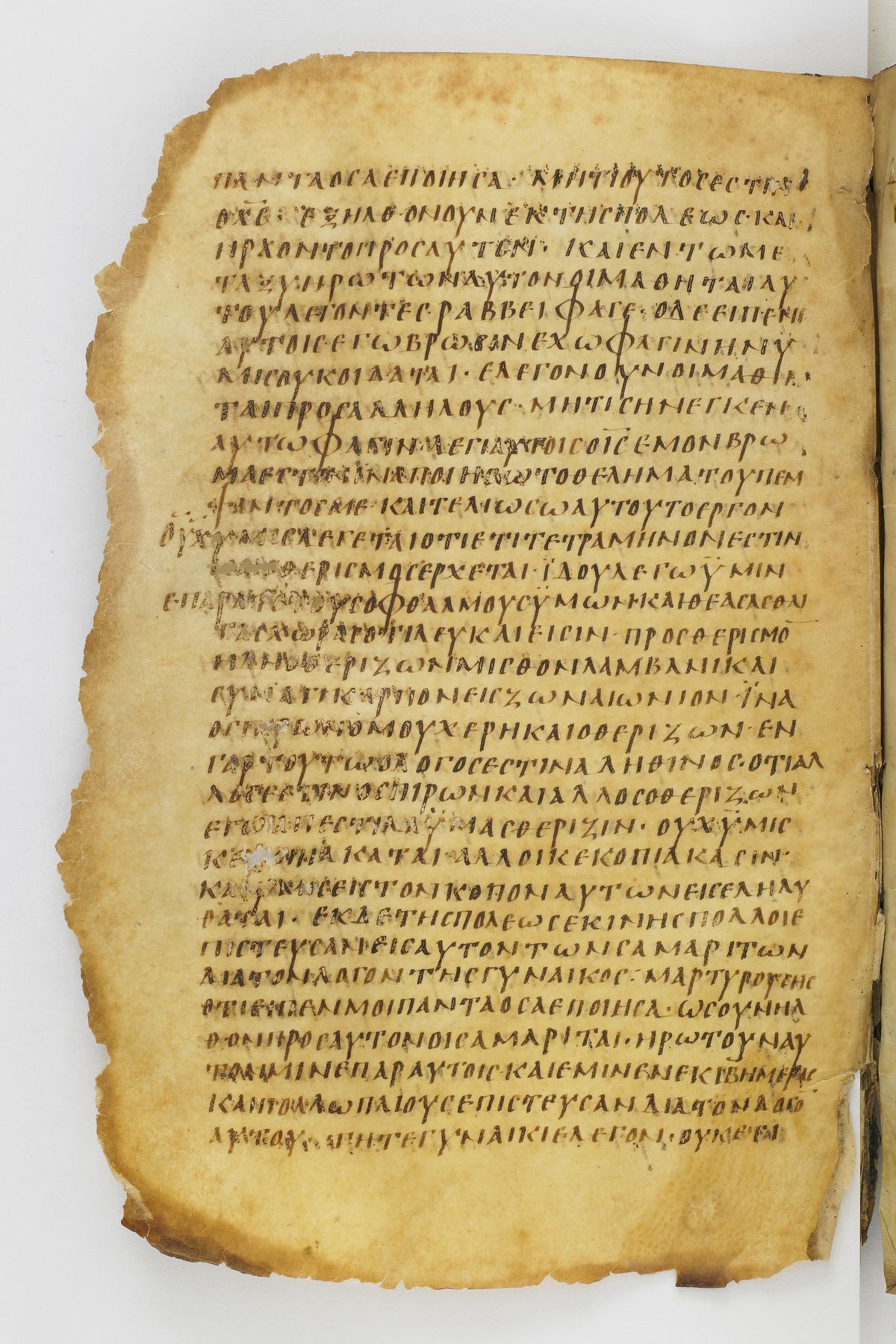
Page from the IGNTP transcription: verses 30-36 on fol. 63v, CSNTM GA_032_0126.
30εξηλθον ουν εκ της πολεως και ηρχοντο προς αυτον 31και εν τω μεταξυ ηρωτων αυτον οι μαθηται αυτου λεγοντες ραββει φαγε 32ο δε ειπεν αυτοις εγω βρωσιν εχω φαγιν ην υμις ουκ οιδαται 33ελεγον ουν οι μαθηται προς αλληλους μη τις ηνεγκεν αυτω φαγιν 34λεγι αυτοις ο ις εμον βρωμα εστιν ινα ποιησω το θελημα του πεμψαντος με και τελιωσω αυτου το εργον 35ουχ υμις λεγεται οτι ετι τετραμηνον εστιν και ο θερισμος ερχεται ιδου λεγω υμιν επαρατε τους οφθαλμους υμων και θεασασθαι τας χωρας οτι λευκαι εισιν προς θερισμο¯ ηδη 36ο θεριζων μισθον λαμβανι και συναγι καρπον εις ζων αιωνιον ινα ο σπι̣ρων ομου χερη και ο θεριζων
Compare: Tischendorf 8th edition (1869)
30ἐξῆλθον ἐκ τῆς πόλεως, καὶ ἤρχοντο πρὸς αὐτόν. 31Ἐν τῷ μεταξὺ ἠρώτων αὐτὸν οἱ μαθηταὶ λέγοντες· ῥαββεί, φάγε. 32ὁ δὲ εἶπεν αὐτοῖς· ἐγὼ βρῶσιν ἔχω φαγεῖν ἣν ὑμεῖς οὐκ οἴδατε. 33ἔλεγον οὖν οἱ μαθηταὶ πρὸς ἀλλήλους, μή τις ἤνεγκεν αὐτῷ φαγεῖν; 34λέγει αὐτοῖς ὁ Ἰησοῦς· ἐμὸν βρῶμά ἐστιν ἵνα ποιῶ τὸ θέλημα τοῦ πέμψαντός με καὶ τελειώσω αὐτοῦ τὸ ἔργον. 35οὐχ ὑμεῖς λέγετε ὅτι ἔτι τετράμηνός ἐστιν καὶ ὁ θερισμὸς ἔρχεται; ἰδοὺ λέγω ὑμῖν, ἐπάρατε τοὺς ὀφθαλμοὺς ὑμῶν καὶ θεάσασθε τὰς χώρας, ὅτι λευκαί εἰσίν πρὸς θερισμόν. 36ἤδη ὁ θερίζων μισθὸν λαμβάνει καὶ συνάγει καρπὸν εἰς ζωὴν αἰώνιον, ἵνα καὶ ὁ σπείρων ὁμοῦ χαίρῃ καὶ ὁ θερίζων.
30Then they went out of the city, and came unto him. 31In the mean while his disciples prayed him, saying, Master, eat. 32But he said unto them, I have meat to eat that ye know not of. 33Therefore said the disciples one to another, Hath any man brought him ought to eat? 34Jesus saith unto them, My meat is to do the will of him that sent me, and to finish his work. 35Say not ye, There are yet four months, and then cometh harvest? behold, I say unto you, Lift up your eyes, and look on the fields; for they are white already to harvest. 36And he that reapeth receiveth wages, and gathereth fruit unto life eternal: that both he that soweth and he that reapeth may rejoice together.
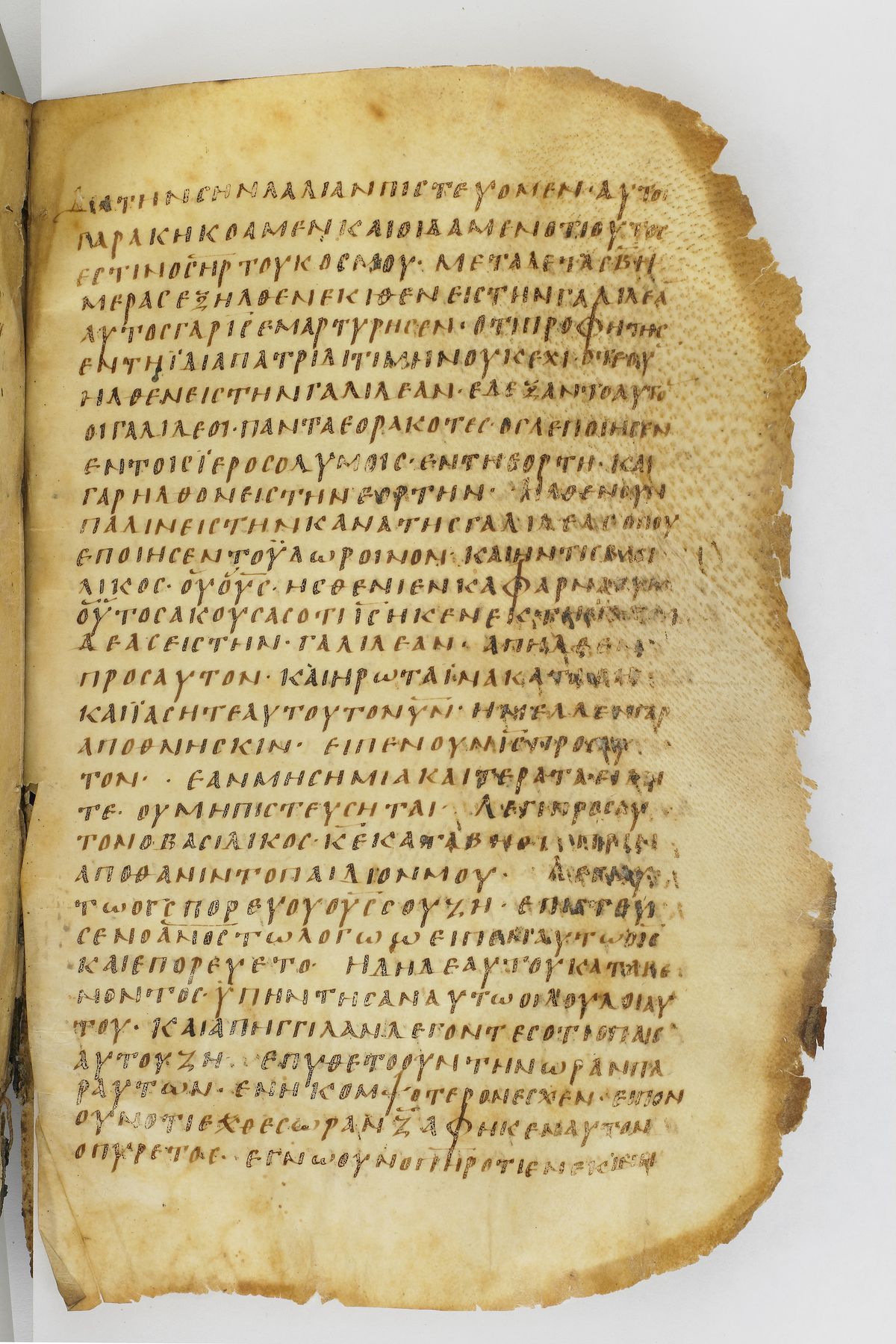
Where on the image
Page from the IGNTP transcription: verses 37-42 on fol. 63v, CSNTM GA_032_0126; verse 42 continues on fol. 64r, CSNTM GA_032_0127 (which begins 'δια την σην').
37εν γαρ τουτω ο λογος εστιν αληθινος οτι αλλος εστιν ο σπιρων και αλλος ο θεριζων 38εγω απεστιλα υμας θεριζιν ουχ υμις κεκ̣ο̣πιακαται αλλοι κεκοπιακασιν και υμις εις τον κοπον αυτων εισεληλυθαται 39εκ δε της πολεως εκινης πολλοι επιστευσαν εις αυτον των σαμαριτων δια τον λογον της γυναικος μαρτυρουσης οτι ειπεν μοι παντα οσα εποιησα 40ως ουν ηλθον προς αυτον οι σαμαριται ηρωτουν αυτον μινε παρ αυτοις και εμινεν εκι β ημερας 41και πολλω πλιους επιστευσαν δια τον λογο¯ αυτου 42τη τε γυναικι ελεγον ουκετι δια την σην λαλιαν πιστευομεν αυτοι γαρ ακηκοαμεν και οιδαμεν οτι ουτος εστιν ο σηρ του κοσμου
Compare: Tischendorf 8th edition (1869)
37ἐν γὰρ τούτῳ ὁ λόγος ἐστὶν ἀληθινός, ὅτι ἄλλος ἐστὶν ὁ σπείρων καὶ ἄλλος ὁ θερίζων. 38ἐγὼ ἀπέσταλκα ὑμᾶς θερίζειν ὃ οὐχ ὑμεῖς κεκοπιάκατε· ἄλλοι κεκοπιάκασιν, καὶ ὑμεῖς εἰς τὸν κόπον αὐτῶν εἰσεληλύθατε. 39Ἐκ δὲ τῆς πόλεως ἐκείνης πολλοὶ ἐπίστευσαν εἰς αὐτὸν τῶν Σαμαριτῶν διὰ τὸν λόγον τῆς γυναικὸς μαρτυρούσης ὅτι εἶπέν μοι πάντα ἃ ἐποίησα. 40ὡς οὖν ἦλθον πρὸς αὐτὸν οἱ Σαμαρῖται, ἠρώτων αὐτὸν μεῖναι παρ’ αὐτοῖς· καὶ ἔμεινεν ἐκεῖ δύο ἡμέρας. 41καὶ πολλῷ πλείους ἐπίστευσαν διὰ τὸν λόγον αὐτοῦ, 42τῇ τε γυναικὶ ἔλεγον ὅτι οὐκέτι διὰ τὴν σὴν λαλιὰν πιστεύομεν· αὐτοὶ γὰρ ἀκηκόαμεν, καὶ οἴδαμεν ὅτι οὗτός ἐστιν ἀληθῶς ὁ σωτὴρ τοῦ κόσμου.
37And herein is that saying true, One soweth, and another reapeth. 38I sent you to reap that whereon ye bestowed no labour: other men laboured, and ye are entered into their labours. 39And many of the Samaritans of that city believed on him for the saying of the woman, which testified, He told me all that ever I did. 40So when the Samaritans were come unto him, they besought him that he would tarry with them: and he abode there two days. 41And many more believed because of his own word; 42And said unto the woman, Now we believe, not because of thy saying: for we have heard him ourselves, and know that this is indeed the Christ, the Saviour of the world.
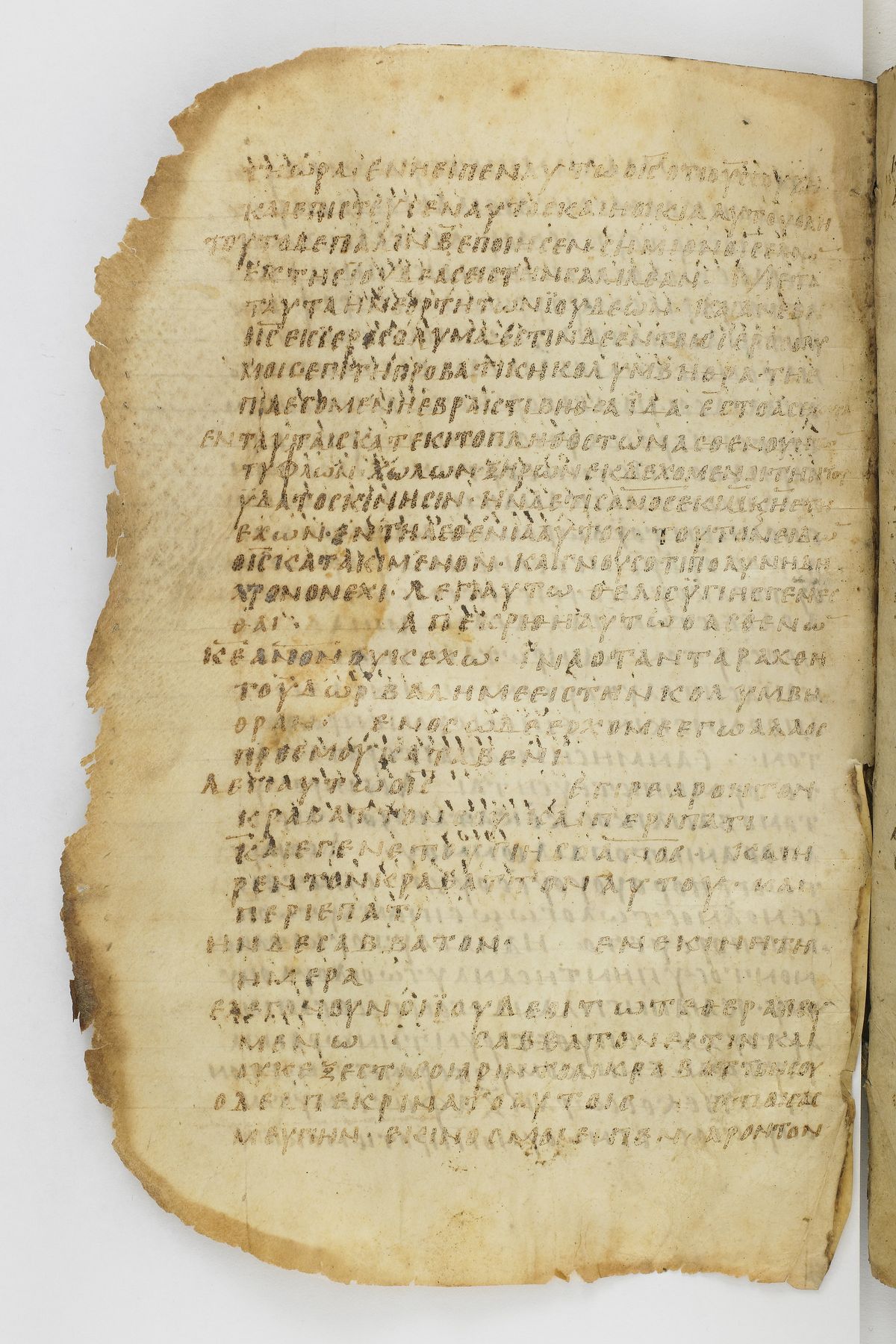
Where on the image
Page from the IGNTP transcription: verses 43-53 on fol. 64r, CSNTM GA_032_0127; verse 53 continues on fol. 64v, CSNTM GA_032_0128 (which begins 'τη ωρα εν').
43μετα δε τας β ημερας εξηλθεν εκιθεν εις την γαλιλεα¯ 44αυτος γαρ ις εμαρτυρησεν οτι προφητης εν τη ιδια πατριδι τιμην ουκ εχι 45οτε ου¯ ηλθεν εις την γαλιλεαν εδεξαντο αυτο¯ οι γαλιλεοι παντα εορακοτες οσα εποιησεν εν τοις ιεροσολυμοις εν τη εορτη και γαρ ηλθον εις την εορτην 46ηλθεν ουν παλιν εις την κανα της γαλιλεας οπου εποιησεν το υδωρ οινον και ην τις βασιλικος ου ο υς ησθενι εν καφαρναουμ 47ουτος ακουσας οτι ις ηκεν εκ της ιο̣υ̣δεας εις την γαλιλεαν απηλθεν προς αυτον και ηρωτα ινα καταβη και ιασητε αυτου τον υν ημελλεν γαρ αποθνησκιν 48ειπεν ουν ις προς αυτον εαν μη σημια και τερατα ειδητε ου μη πιστευσηται 49λεγι προς αυτον ο βασιλικος κε καταβηθι πριν αποθανιν το παιδεον μου 50λεγι αυτω ο ις πορευου ο υς σου ζη επιστευσεν ο ανος τω λογω ω ειπεν αυτω ο ις και επορευετο 51ηδη δε αυτου καταβενοντος υπηντησαν αυτω οι δουλοι αυτου και απηγγιλαν λεγοντες οτι ο παις αυτου ζη 52επυθετο ουν την ωραν παρ αυτων εν η κομψοτερον εσχεν ειπον ουν οτι εχθες ωραν ζ αφηκεν αυτον ο πυρετος 53εγνω ουν ο πηρ οτι εν εκινη τη ωρα εν η ειπεν αυτω ο ις οτι ο υς σου ζη και επιστευσεν αυτος και η οικια αυτου ολη
Compare: Tischendorf 8th edition (1869)
43Μετὰ δὲ τὰς δύο ἡμέρας ἐξῆλθεν ἐκεῖθεν εἰς τὴν Γαλιλαίαν· 44αὐτὸς γὰρ Ἰησοῦς ἐμαρτύρησεν ὅτι προφήτης ἐν τῇ ἰδίᾳ πατρίδι τιμὴν οὐκ ἔχει. 45ὡς οὖν ἦλθεν εἰς τὴν Γαλιλαίαν, ἐδέξαντο αὐτὸν οἱ Γαλιλαῖοι, πάντα ἑωρακότες ἅ ἐποίησεν ἐν Ἱεροσολύμοις ἐν τῇ ἑορτῇ· καὶ αὐτοὶ γὰρ ἦλθον εἰς τὴν ἑορτήν. 46ἦλθεν οὖν πάλιν εἰς τὴν Κανὰ τῆς Γαλιλαίας, ὅπου ἐποίησεν τὸ ὕδωρ οἶνον. Ἦν δέ βασιλικός, οὗ ὁ υἱὸς ἠσθένει, ἐν Καφαρναούμ· 47οὗτος ἀκούσας ὅτι Ἰησοῦς ἥκει ἐκ τῆς Ἰουδαίας εἰς τὴν Γαλιλαίαν, ἀπῆλθεν πρὸς αὐτόν, καὶ ἠρώτα ἵνα καταβῇ καὶ ἰάσηται αὐτοῦ τὸν υἱόν· ἤμελλεν γὰρ ἀποθνῄσκειν. 48εἶπεν οὖν ὁ Ἰησοῦς πρὸς αὐτόν· ἐὰν μὴ σημεῖα καὶ τέρατα ἴδητε, οὐ μὴ πιστεύσητε. 49λέγει πρὸς αὐτὸν ὁ βασιλικός· κύριε, κατάβηθι πρὶν ἀποθανεῖν τὸ παιδίον μου. 50λέγει αὐτῷ ὁ Ἰησοῦς· πορεύου· ὁ υἱός σου ζῇ. ἐπίστευσεν ὁ ἄνθρωπος τῷ λόγῳ ὃν εἶπεν αὐτῷ ὁ Ἰησοῦς καὶ ἐπορεύετο. 51ἤδη δὲ αὐτοῦ καταβαίνοντος οἱ δοῦλοι ὑπήντησαν αὐτῷ καὶ ἤγγειλαν ὅτι ὁ παῖς αὐτοῦ ζῇ. 52ἐπύθετο οὖν τὴν ὥραν παρ’ αὐτῶν ἐν ᾗ κομψότερον ἔσχεν· εἶπον οὖν αὐτῷ ὅτι ἐχθὲς ὥραν ἑβδόμην ἀφῆκεν αὐτὸν ὁ πυρετός. 53ἔγνω οὖν ὁ πατὴρ ὅτι ἐκείνῃ τῇ ὥρᾳ ἐν ᾗ εἶπεν αὐτῷ ὁ Ἰησοῦς· ὁ υἱός σου ζῇ· καὶ ἐπίστευσεν αὐτὸς καὶ ἡ οἰκία αὐτοῦ ὅλη.
43Now after two days he departed thence, and went into Galilee. 44For Jesus himself testified, that a prophet hath no honour in his own country. 45Then when he was come into Galilee, the Galilaeans received him, having seen all the things that he did at Jerusalem at the feast: for they also went unto the feast. 46So Jesus came again into Cana of Galilee, where he made the water wine. And there was a certain nobleman, whose son was sick at Capernaum. 47When he heard that Jesus was come out of Judaea into Galilee, he went unto him, and besought him that he would come down, and heal his son: for he was at the point of death. 48Then said Jesus unto him, Except ye see signs and wonders, ye will not believe. 49The nobleman saith unto him, Sir, come down ere my child die. 50Jesus saith unto him, Go thy way; thy son liveth. And the man believed the word that Jesus had spoken unto him, and he went his way. 51And as he was now going down, his servants met him, and told him, saying, Thy son liveth. 52Then enquired he of them the hour when he began to amend. And they said unto him, Yesterday at the seventh hour the fever left him. 53So the father knew that it was at the same hour, in the which Jesus said unto him, Thy son liveth: and himself believed, and his whole house.
Where on the image
Page from the IGNTP transcription: verse 54 on fol. 64v, CSNTM GA_032_0128.
54τουτο δε παλιν β εποιησεν σημιον ο ις ελθω¯ εκ της ιουδεας εις την γαλιλεαν
Compare: Tischendorf 8th edition (1869)
54Τοῦτο πάλιν δεύτερον σημεῖον ἐποίησεν ὁ Ἰησοῦς ἐλθὼν ἐκ τῆς Ἰουδαίας εἰς τὴν Γαλιλαίαν.
54This is again the second miracle that Jesus did, when he was come out of Judaea into Galilee.
Cite
Sources
- Source: Codex Washingtonianus page images + IGNTP transcription (CC BY 4.0) + Tischendorf 8th edition + KJV (holding institution)
- Critical edition: Codex Washingtonianus transcription, IGNTP (CC BY 4.0); Tischendorf 8th edition for comparison
← previous · → next · v cycle view · l back to library