Classic of Changes, Great Treatise, Part 1, Chapter 10 (Ming print of 1596)
Introduction
The Great Treatise (繫辭傳 Xici zhuan, "Commentary on the Appended Statements"; Legge's "Great Appendix") is the longest of the Ten Wings, the commentaries attached to the Classic of Changes. It is an essay in two parts on how the hexagrams were made, how the yarrow stalks are counted, and how the book reflects the workings of heaven and earth. Tradition ascribed it to Confucius; it is now generally dated to the late Warring States period (4th to 3rd century BCE), and part of it is preserved on the Mawangdui silk manuscript of 168 BCE. This is chapter 10 of part 1 (上), in the chapter division of Zhu Xi (1130-1200), which Legge follows; Legge numbers his paragraphs straight through each part (here 59-65).
The photographs are of the first volume of a Five Classics printed in Nanjing with the main text only and punctuation circles, with a postface by Li Deng dated Wanli 24 (1596); the National Diet Library, Tokyo, holds the only known copy of these five volumes (call no. WA35-19). The Great Treatise follows the 64 hexagrams in this volume, from canvas 106 to canvas 128, and its passages stand in the order of Zhu Xi's edition. In this copy the chapter runs from canvas 113, left-hand page to canvas 114, left-hand page. Each section gathers the paragraphs that begin on one page and links to that page and to any page the last paragraph runs onto; the page boundaries were found by reading the first characters of every column on the photographs and aligning them to the text.
The Chinese is the received text from Wikisource. The English is James Legge's translation in Sacred Books of the East, volume 16 (1882), Appendix III, Section I, Chapter 10; his notes are not reproduced. Legge adds words in parentheses to make the sense plain; they are his.
How was this verified? (Provenance)
Where on the image
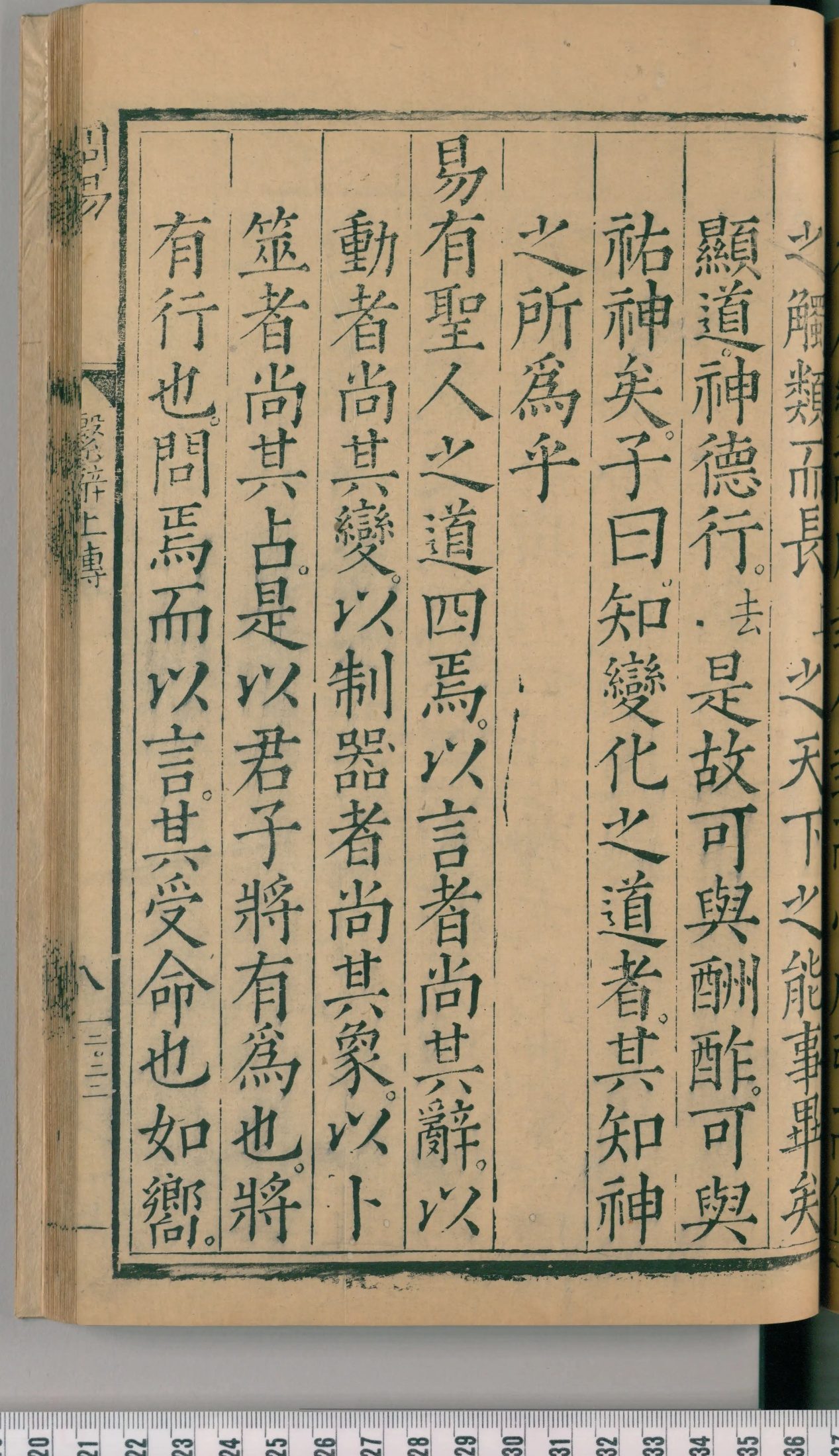
National Diet Library WA35-19 [五經白文], vol. 1 (周易), IIIF canvas 113, left-hand page: 8 columns, main text with punctuation circles and small sound glosses. Checked on the image (column openings aligned to the text): paragraph 59 opens column 5 ‹易有聖人›; paragraph 60 begins within column 7, which opens ‹筮者尚其›. Paragraph 60 runs on to canvas 114, right-hand page (first column ‹无有遠近›). The Chinese shown is the received text from Wikisource, not a transcription of this print.
59易有聖人之道四焉:以言者尚其辭,以動者尚其變,以制器者尚其象,以卜筮者尚其占。
60是以君子將有為也,將有行也,問焉而以言,其受命也如響,无有遠近幽深,遂知來物。非天下之至精,其孰能與於此!
59In the Yî there are four things characteristic of the way of the sages. We should set the highest value on its explanations to guide us in speaking; on its changes for (the initiation of) our movements; on its emblematic figures for (definite action as in) the construction of implements; and on its prognostications for our practice of divination.
60Therefore, when a superior man is about to take action of a more private or of a public character, he asks (the Yî), making his inquiry in words. It receives his order, and the answer comes as the echo's response. Be the subject remote or near, mysterious or deep, he forthwith knows of what kind will be the coming result. (If the Yî) were not the most exquisite thing under heaven, would it be concerned in such an operation as this?
Where on the image
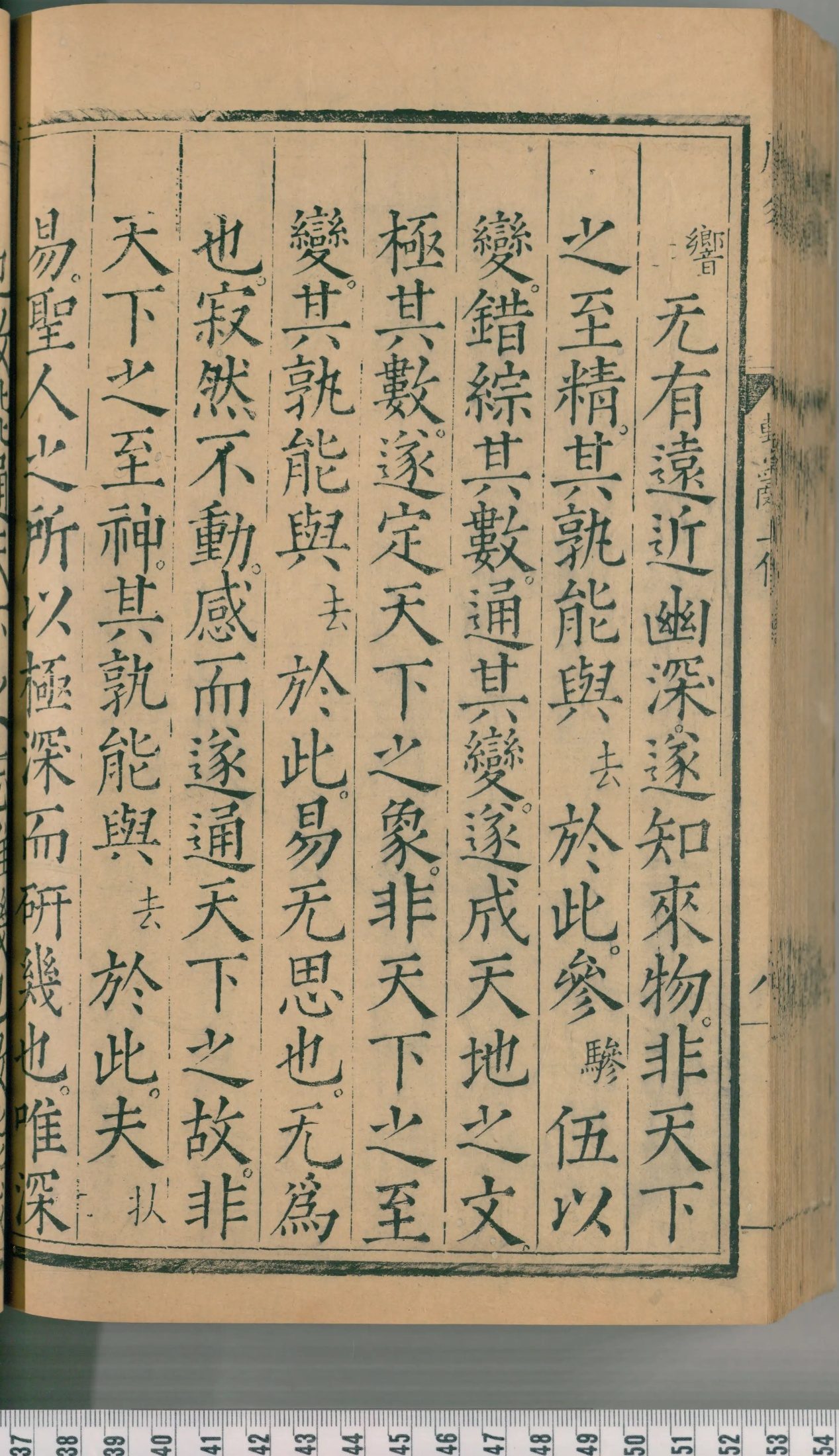
National Diet Library WA35-19 [五經白文], vol. 1 (周易), IIIF canvas 114, right-hand page: 8 columns, main text with punctuation circles and small sound glosses. Checked on the image (column openings aligned to the text): paragraph 61 begins within column 2, which opens ‹之至精其›; paragraph 62 begins within column 5, which opens ‹變其孰能›; paragraph 63 begins within column 7, which opens ‹天下之至›; paragraph 64 begins within column 8, which opens ‹易聖人之›. Paragraph 64 runs on to canvas 114, left-hand page (first column ‹也故能通›). The Chinese shown is the received text from Wikisource, not a transcription of this print.
61參伍以變,錯綜其數,通其變,遂成天下之文,極其數,遂定天下之象;非天下之至變,其孰能與於此!
62易,无思也,无為也,寂然不動,感而遂通天下之故。非天下之至神,其孰能與於此!
63夫易,聖人之所以極深而研幾也!
64唯深也,故能通天下之志;唯幾也,故能成天下之務;唯神也,故不疾而速,不行而至。
61(The stalks) are manipulated by threes and fives to determine (one) change; they are laid on opposite sides, and placed one up, one down, to make sure of their numbers; and the (three necessary) changes are gone through with in this way, till they form the figures pertaining to heaven or to earth. Their numbers are exactly determined, and the emblems of (all things) under the sky are fixed. (If the Yî) were not the thing most capable of change of all things under heaven, how could it effect such a result as this?
62In (all these operations forming) the Yî, there is no thought and no action. It is still and without movement; but, when acted on, it penetrates forthwith to all phenomena and events under the sky. If it were not the most spirit-like thing under the sky, how could it be found doing this?
63The (operations forming the) Yî are the method by which the sages searched out exhaustively what was deep, and investigated the minutest springs (of things).
64'Those operations searched out what was deep:'—therefore they could penetrate to the views of all under the sky. 'They made apparent the minutest springs of (things):'—therefore they could bring to a completion all undertakings under the sky. 'Their action was spirit-like:'—therefore they could make speed without hurry, and reached their destination without travelling.
Where on the image
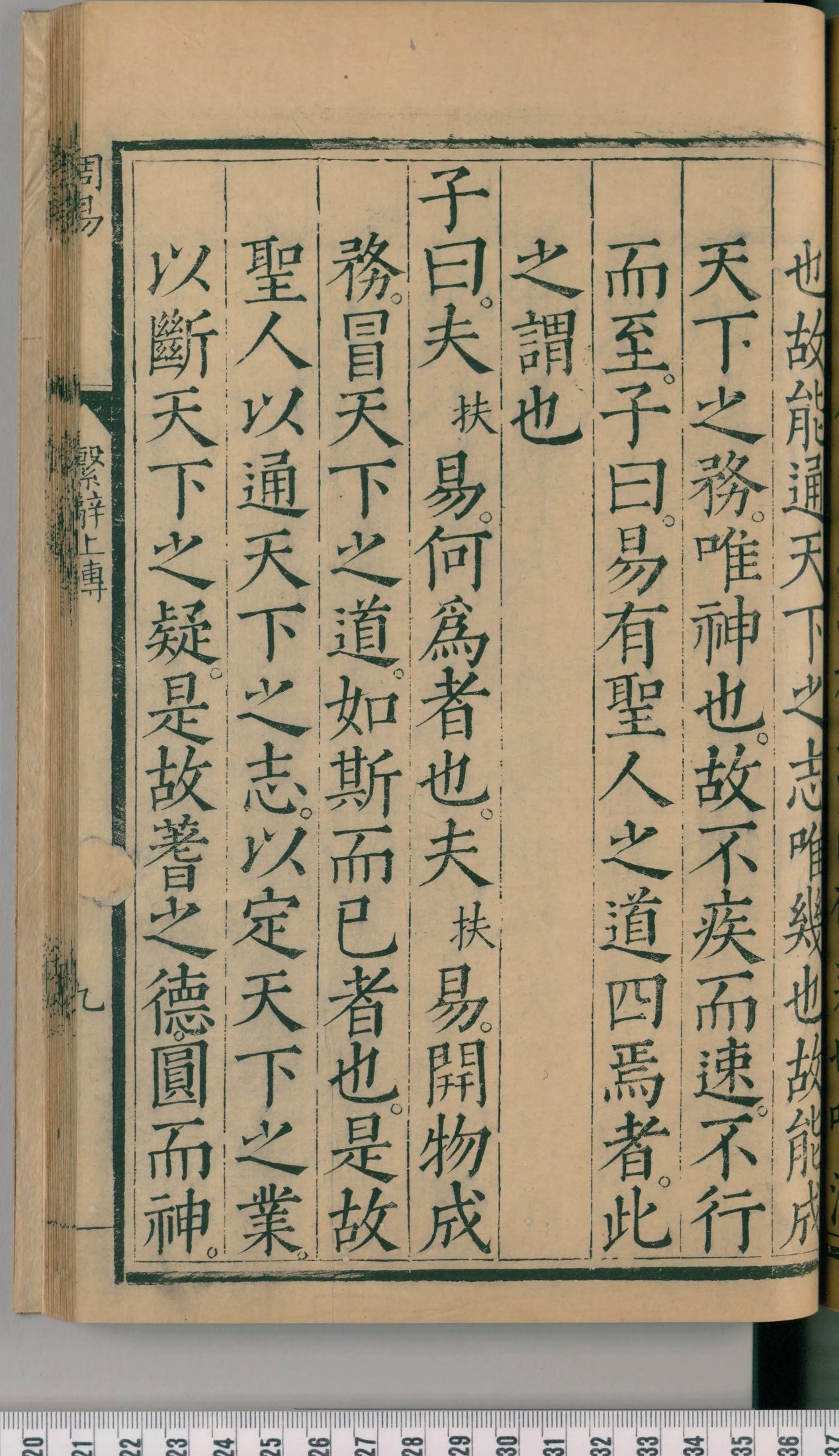
National Diet Library WA35-19 [五經白文], vol. 1 (周易), IIIF canvas 114, left-hand page: 8 columns, main text with punctuation circles and small sound glosses. Checked on the image (column openings aligned to the text): paragraph 65 begins within column 3, which opens ‹而至子曰›. The Chinese shown is the received text from Wikisource, not a transcription of this print.
65子曰「易有聖人之道四焉」者,此之謂也。
65This is the import of what the Master said, that 'In the Yî there are four things indicating the way of the sages.'
Notes
- English: James Legge, The Yî King, Sacred Books of the East vol. 16 (1882), Appendix III (The Great Appendix), Section I, Chapter 10, paragraphs 59-65.
- Legge's notes after each chapter are left out. Where one numbered paragraph is printed as several paragraphs, they are kept as printed.
Cite
Sources
- Source: National Diet Library WA35-19 (Ming Five Classics print with postface of 1596, vol. 1, Zhouyi) + Wikisource received text + James Legge, Sacred Books of the East 16 (1882), Appendix III (holding institution)
- Critical edition: Received text (Wikisource)
← previous · → next · v cycle view · l back to library