Classic of Changes, Great Treatise, Part 1, Chapter 11 (Ming print of 1596)
Introduction
The Great Treatise (繫辭傳 Xici zhuan, "Commentary on the Appended Statements"; Legge's "Great Appendix") is the longest of the Ten Wings, the commentaries attached to the Classic of Changes. It is an essay in two parts on how the hexagrams were made, how the yarrow stalks are counted, and how the book reflects the workings of heaven and earth. Tradition ascribed it to Confucius; it is now generally dated to the late Warring States period (4th to 3rd century BCE), and part of it is preserved on the Mawangdui silk manuscript of 168 BCE. This is chapter 11 of part 1 (上), in the chapter division of Zhu Xi (1130-1200), which Legge follows; Legge numbers his paragraphs straight through each part (here 66-74).
The photographs are of the first volume of a Five Classics printed in Nanjing with the main text only and punctuation circles, with a postface by Li Deng dated Wanli 24 (1596); the National Diet Library, Tokyo, holds the only known copy of these five volumes (call no. WA35-19). The Great Treatise follows the 64 hexagrams in this volume, from canvas 106 to canvas 128, and its passages stand in the order of Zhu Xi's edition. In this copy the chapter runs from canvas 114, left-hand page to canvas 116, right-hand page. Each section gathers the paragraphs that begin on one page and links to that page and to any page the last paragraph runs onto; the page boundaries were found by reading the first characters of every column on the photographs and aligning them to the text.
The Chinese is the received text from Wikisource. The English is James Legge's translation in Sacred Books of the East, volume 16 (1882), Appendix III, Section I, Chapter 11; his notes are not reproduced. Legge adds words in parentheses to make the sense plain; they are his.
How was this verified? (Provenance)
Where on the image
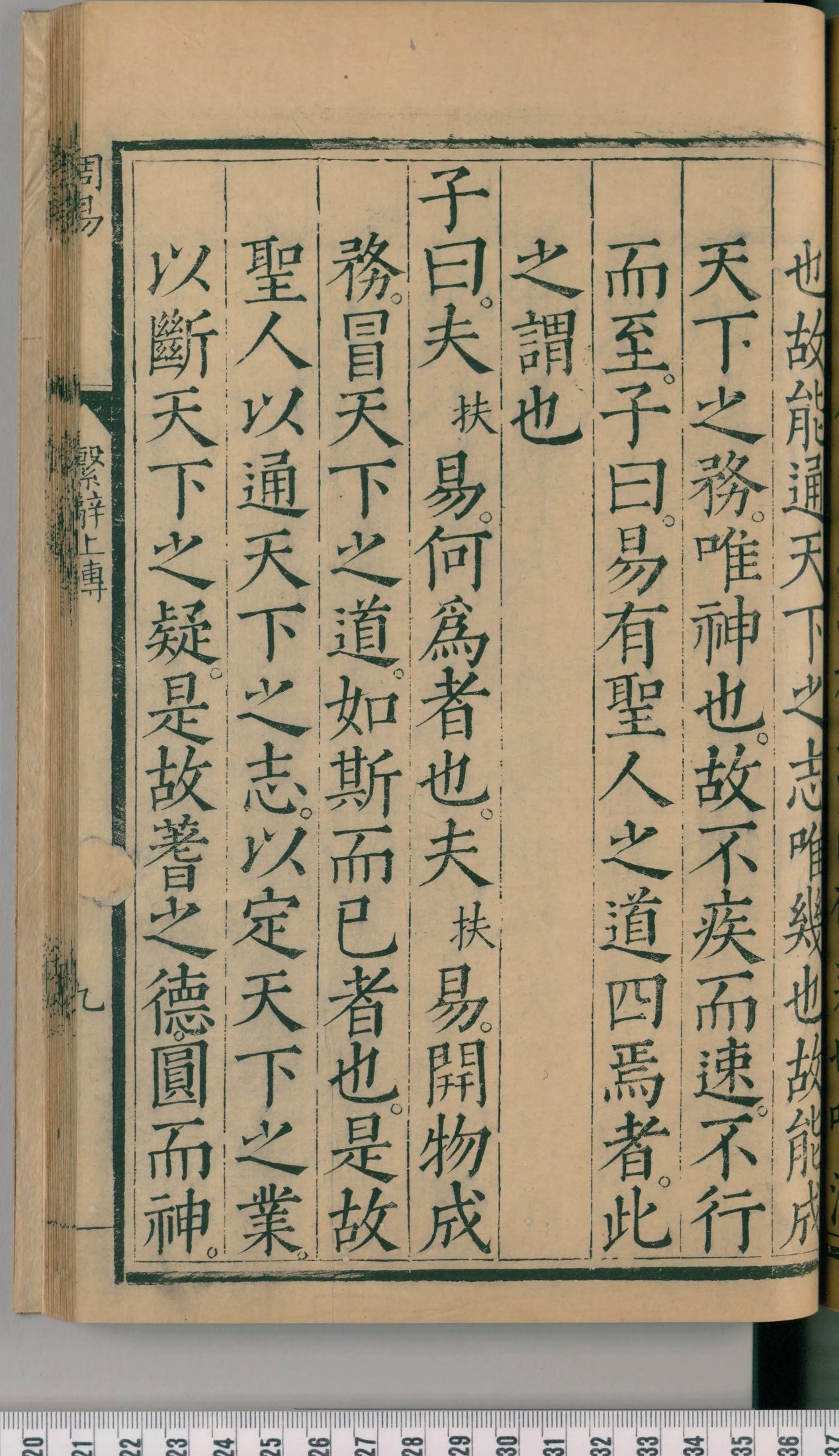
National Diet Library WA35-19 [五經白文], vol. 1 (周易), IIIF canvas 114, left-hand page: 8 columns, main text with punctuation circles and small sound glosses. Checked on the image (column openings aligned to the text): paragraph 66 opens column 5 ‹子曰夫易›; paragraph 67 begins within column 8, which opens ‹以斷天下›. Paragraph 67 runs on to canvas 115, right-hand page (first column ‹卦之德方›). Column openings that differ from the received text: canvas 115, right-hand page, column 4 reads ‹與於此哉› where the received text has ‹與此哉古›. The Chinese shown is the received text from Wikisource, not a transcription of this print.
66子曰:「夫易,何為者也?夫易,開物成務,冒天下之道,如斯而已者也。」是故聖人以通天下之志,以定天下之業,以斷天下之疑。
67是故蓍之德圓而神,卦之德方以知,六爻之義易以貢;聖人以此洗心,退藏於密,吉凶與民同患,神以知來,知以藏往,其孰能與此哉?古之聦明叡知神武而不殺者夫!
66The Master said:—'What is it that the Yî does? The Yî opens up (the knowledge of the issues of) things, accomplishes the undertakings (of men), and embraces under it (the way of) all things under the sky. This and nothing more is what the Yî does. Thereby the sages, through (divination by) it, would give their proper course to the aims of all under the sky, would give stability to their undertakings, and determine their doubts.'
67Therefore the virtue of the stalks is versatile and spirit-like; that of the diagrams is exact and wise; and the meaning given by the six lines is changeful to give (the proper information to men). The sages having, by their possession of these (three virtues), cleansed their minds, retired and laid them up in the secrecy (of their own consciousness). But their sympathies were with the people in regard both to their good fortune and evil. By their spirit-like ability they knew (the character of) coming events, and their wisdom had stored up (all experiences of) the past. Who could be able to accomplish all this? (Only our) ancient sages, quick in apprehension and clear in discernment, of far-reaching intelligence, and all-embracing knowledge, and with a majesty, going spirit-like to its objects;—it was only they who could do so.
Where on the image
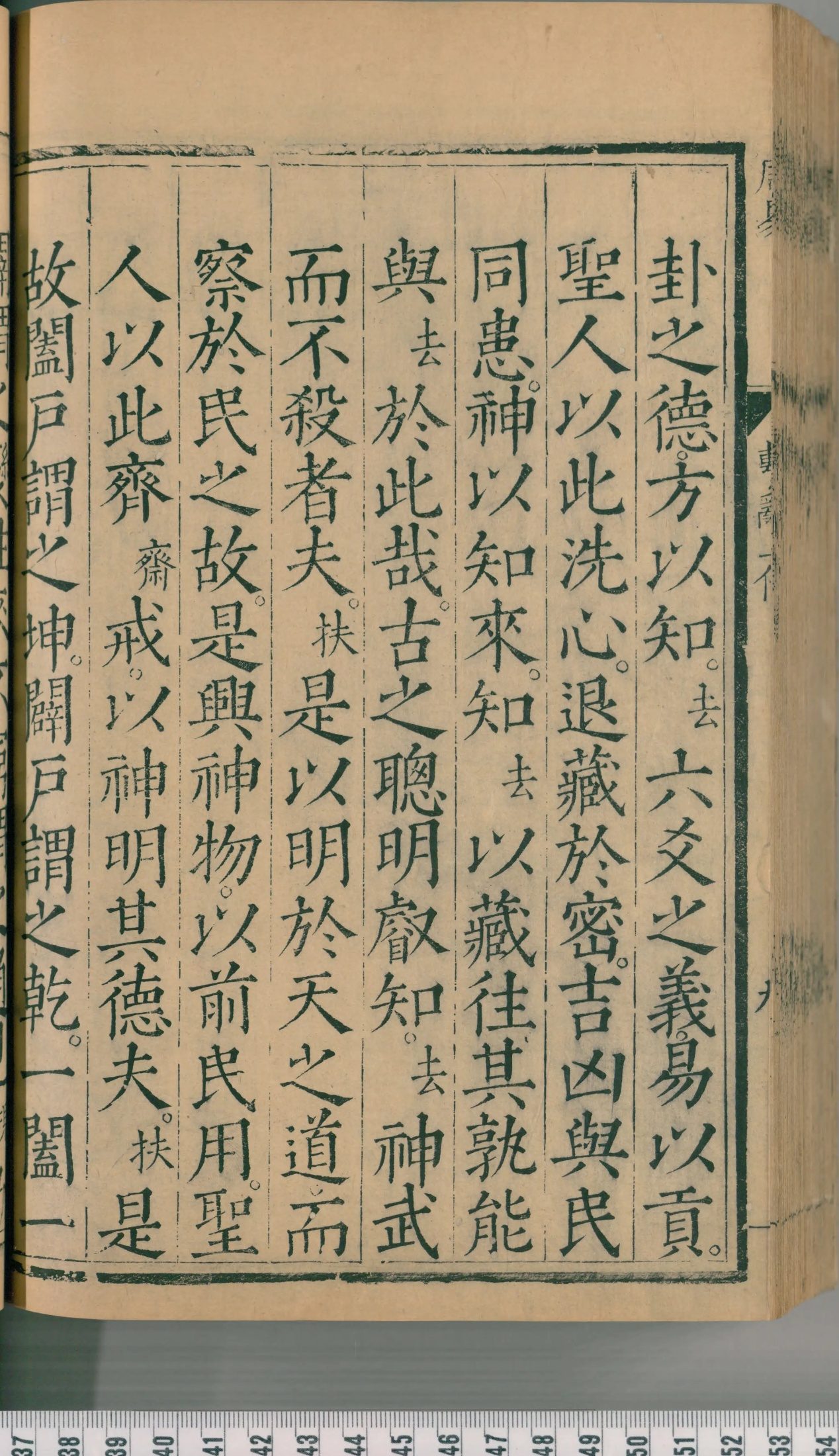
National Diet Library WA35-19 [五經白文], vol. 1 (周易), IIIF canvas 115, right-hand page: 8 columns, main text with punctuation circles and small sound glosses. Checked on the image (column openings aligned to the text): paragraph 68 begins within column 5, which opens ‹而不殺者›; paragraph 69 begins within column 7, which opens ‹人以此齊›. Paragraph 69 runs on to canvas 115, left-hand page (first column ‹闢謂之變›). The Chinese shown is the received text from Wikisource, not a transcription of this print.
68是以明於天之道,而察於民之故,是興神物以前民用;聖人以此齊戒以神明其德夫!
69是故闔戶謂之坤,闢戶謂之乾,一闔一闢謂之變;往來不窮謂之通,見乃謂之象,形乃謂之器,制而用之謂之法,利用出入,民咸用之謂之神。
68Therefore (those sages), fully understanding the way of Heaven, and having clearly ascertained the experience of the people, instituted (the employment of) these spirit-like things, as a provision for the use of the people. The sages went about the employment of them (moreover) by purifying their hearts and with reverent caution, thereby giving (more) spirituality and intelligence to their virtue.
69Thus, a door shut may be pronounced (analogous to) Khwăn (or the inactive condition), and the opening of the door (analogous to) Khien (or the active condition). The opening succeeding the being shut may be pronounced (analogous to what we call) a change; and the passing from one of these states to the other may be called the constant course (of things).
The (first) appearance of anything (as a bud) is what we call a semblance; when it has received its complete form, we call it a definite thing.
(The divining-plant having been produced, the sages) set it apart and laid down the method of its employment,—what we call the laws (of divination). The advantage arising from it in external and internal matters, so that the people all use it, stamps it with a character which we call spirit-like.
Where on the image
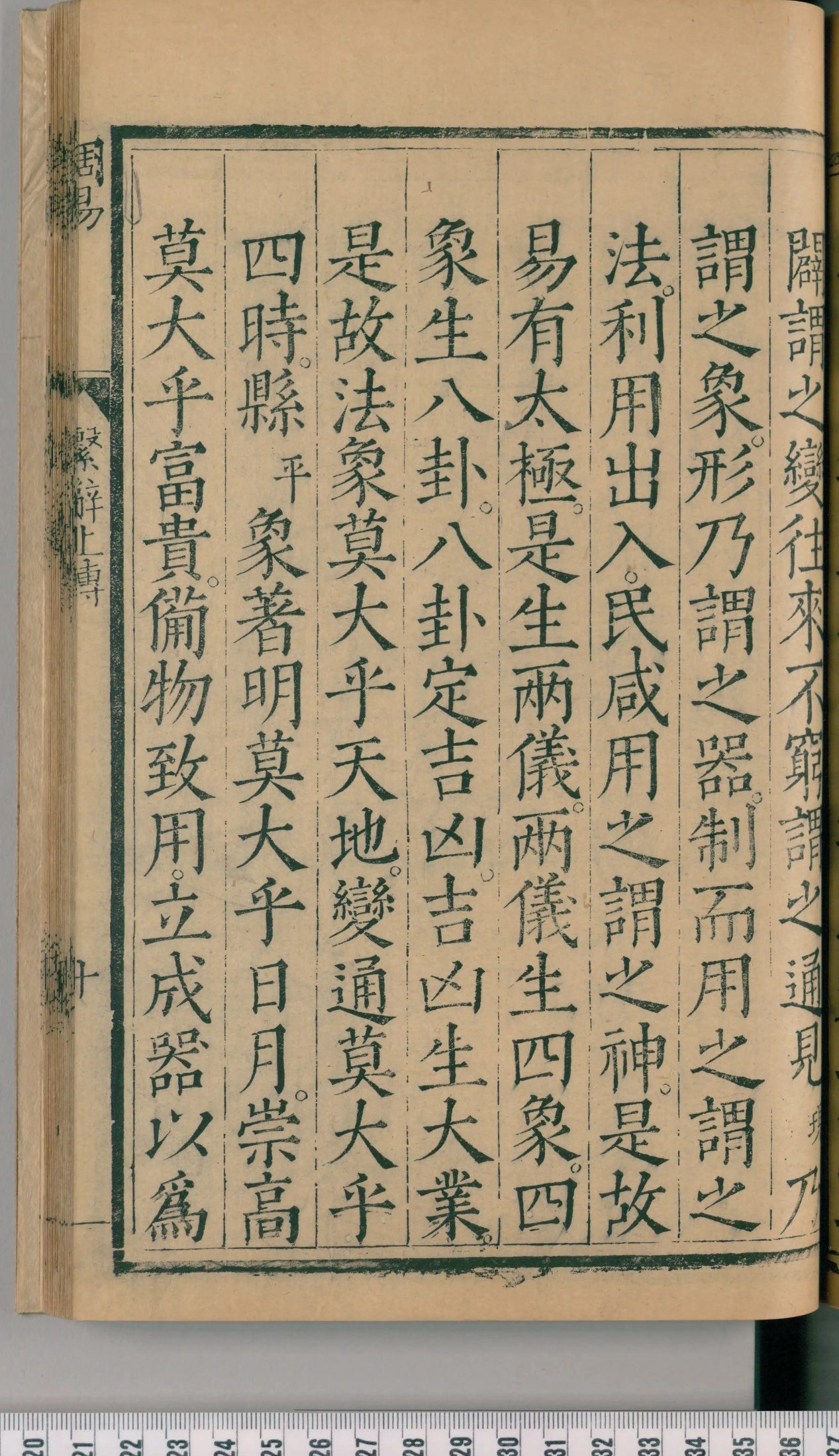
National Diet Library WA35-19 [五經白文], vol. 1 (周易), IIIF canvas 115, left-hand page: 8 columns, main text with punctuation circles and small sound glosses. Checked on the image (column openings aligned to the text): paragraph 70 begins within column 3, which opens ‹法利用出›; paragraph 71 begins within column 5, which opens ‹象生八卦›; paragraph 72 opens column 6 ‹是故法象›. Paragraph 72 runs on to canvas 116, right-hand page (first column ‹天下利莫›). The Chinese shown is the received text from Wikisource, not a transcription of this print.
70是故易有太極,是生兩儀,兩儀生四象,四象生八卦,
71八卦定吉凶,吉凶生大業。
72是故法象莫大乎天地;變通莫大乎四時;縣象著明莫大乎日月;崇高莫大乎富貴;備物致用,立成器以為天下利,莫大乎聖人;探賾索隱,鉤深致遠,以定天下之吉凶,成天下之亹亹者,莫大乎蓍龜。
70Therefore in (the system of) the Yî there is the Grand Terminus, which produced the two elementary Forms. Those two Forms produced the Four emblematic Symbols, which again produced the eight Trigrams.
71The eight trigrams served to determine the good and evil (issues of events), and from this determination was produced the (successful prosecution of the) great business (of life).
72Therefore of all things that furnish models and visible figures there are none greater than heaven and earth; of things that change and extend an influence (on others) there are none greater than the four seasons; of things suspended (in the sky) with their figures displayed clear and bright, there are none greater than the sun and moon; of the honoured and exalted there are none greater than he who is the rich and noble (one); in preparing things for practical use, and inventing and making instruments for the benefit of all under the sky, there are none greater than the sages; to explore what is complex, search out what is hidden, to hook up what lies deep, and reach to what is distant, thereby determining (the issues) for good or ill of all events under the sky, and making all men under heaven full of strenuous endeavours, there are no (agencies) greater than those of the stalks and the tortoise-shell.
Where on the image
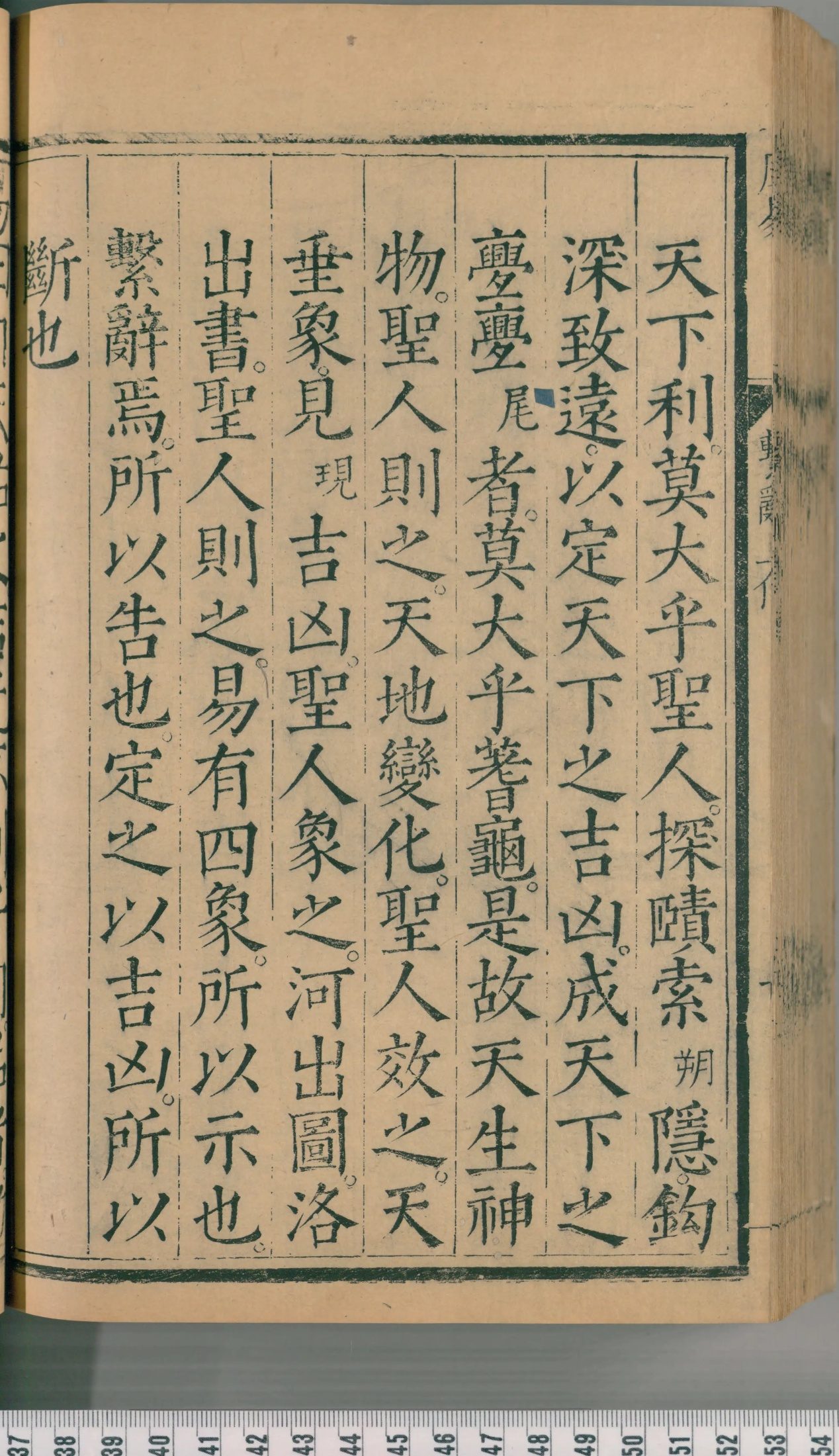
National Diet Library WA35-19 [五經白文], vol. 1 (周易), IIIF canvas 116, right-hand page: 8 columns, main text with punctuation circles and small sound glosses. Checked on the image (column openings aligned to the text): paragraph 73 begins within column 3, which opens ‹亹亹者莫›; paragraph 74 begins within column 6, which opens ‹出書聖人›. The Chinese shown is the received text from Wikisource, not a transcription of this print.
73是故天生神物,聖人則之。天地變化,聖人效之。天垂象,見吉凶,聖人象之。河出圖,洛出書,聖人則之。
74易有四象,所以示也。繫辭焉,所以告也。定之以吉凶,所以斷也。
73Therefore Heaven produced the spirit-like things, and the sages took advantage of them. (The operations of) heaven and earth are marked by (so many) changes and transformations; and the sages imitated them (by means of the Yî). Heaven hangs out its (brilliant) figures from which are seen good fortune and bad, and the sages made their emblematic interpretations accordingly. The Ho gave forth the map, and the Lo the writing, of (both of) which the sages took advantage.
74In the (scheme of the) Yî there are the four symbolic figures by which they inform men (in divining of the lines making up the diagrams); the explanations appended to them convey the significance (of the diagrams and lines); and the determination (of the divination) as fortunate or the reverse, to settle the doubts (of men).
Notes
- English: James Legge, The Yî King, Sacred Books of the East vol. 16 (1882), Appendix III (The Great Appendix), Section I, Chapter 11, paragraphs 66-74.
- Legge's notes after each chapter are left out. Where one numbered paragraph is printed as several paragraphs, they are kept as printed.
Cite
Sources
- Source: National Diet Library WA35-19 (Ming Five Classics print with postface of 1596, vol. 1, Zhouyi) + Wikisource received text + James Legge, Sacred Books of the East 16 (1882), Appendix III (holding institution)
- Critical edition: Received text (Wikisource)
← previous · → next · v cycle view · l back to library