Classic of Changes, Great Treatise, Part 1, Chapter 12 (Ming print of 1596)
Introduction
The Great Treatise (繫辭傳 Xici zhuan, "Commentary on the Appended Statements"; Legge's "Great Appendix") is the longest of the Ten Wings, the commentaries attached to the Classic of Changes. It is an essay in two parts on how the hexagrams were made, how the yarrow stalks are counted, and how the book reflects the workings of heaven and earth. Tradition ascribed it to Confucius; it is now generally dated to the late Warring States period (4th to 3rd century BCE), and part of it is preserved on the Mawangdui silk manuscript of 168 BCE. This is chapter 12 of part 1 (上), in the chapter division of Zhu Xi (1130-1200), which Legge follows; Legge numbers his paragraphs straight through each part (here 75-81).
The photographs are of the first volume of a Five Classics printed in Nanjing with the main text only and punctuation circles, with a postface by Li Deng dated Wanli 24 (1596); the National Diet Library, Tokyo, holds the only known copy of these five volumes (call no. WA35-19). The Great Treatise follows the 64 hexagrams in this volume, from canvas 106 to canvas 128, and its passages stand in the order of Zhu Xi's edition. In this copy the chapter runs from canvas 116, left-hand page to canvas 117, left-hand page. Each section gathers the paragraphs that begin on one page and links to that page and to any page the last paragraph runs onto; the page boundaries were found by reading the first characters of every column on the photographs and aligning them to the text.
The Chinese is the received text from Wikisource. The English is James Legge's translation in Sacred Books of the East, volume 16 (1882), Appendix III, Section I, Chapter 12; his notes are not reproduced. Legge adds words in parentheses to make the sense plain; they are his.
How was this verified? (Provenance)
Where on the image
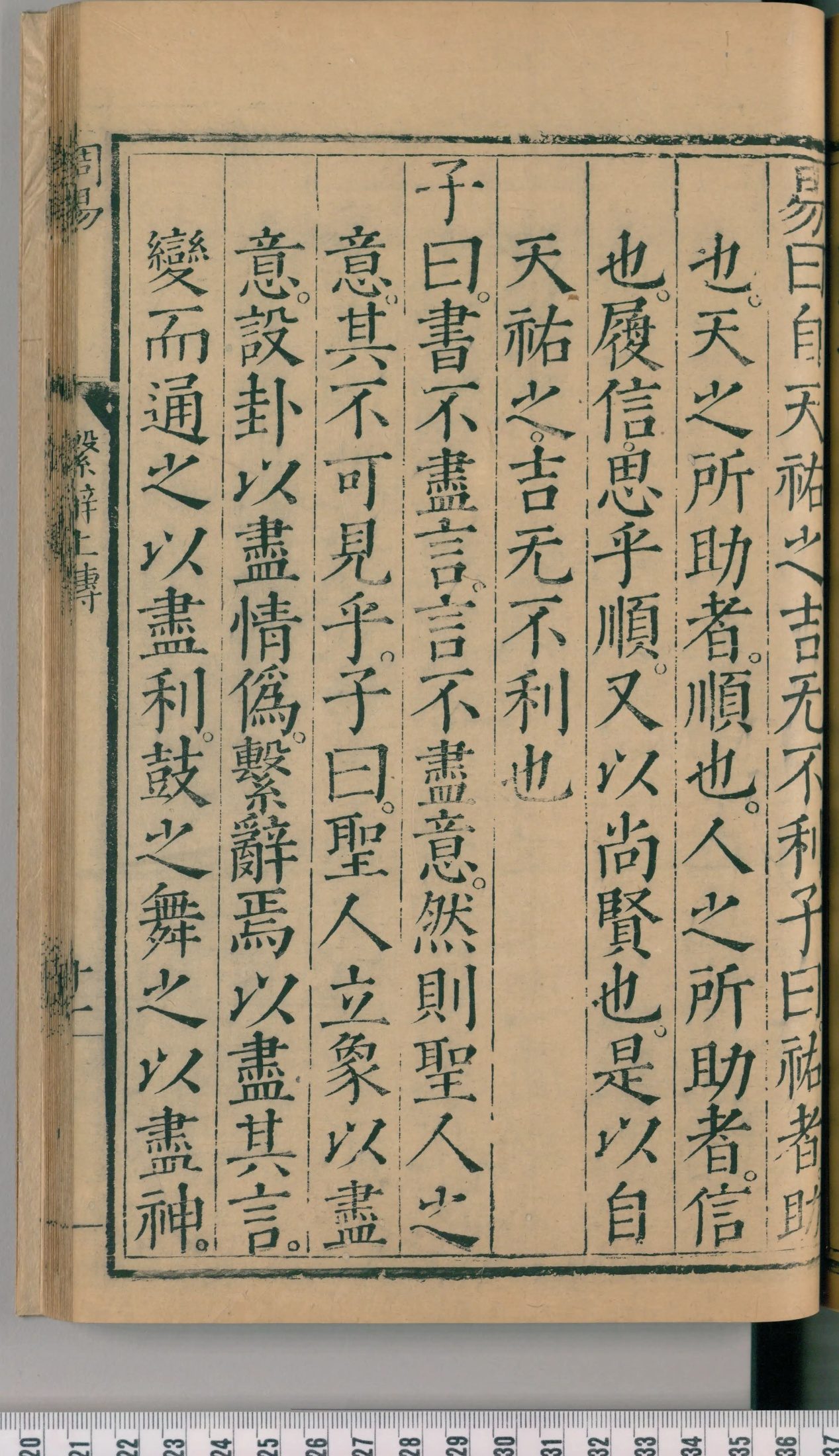
National Diet Library WA35-19 [五經白文], vol. 1 (周易), IIIF canvas 116, left-hand page: 8 columns, main text with punctuation circles and small sound glosses. Checked on the image (column openings aligned to the text): paragraph 75 opens column 1 ‹易曰自天›; paragraph 76 opens column 5 ‹子曰書不›. The Chinese shown is the received text from Wikisource, not a transcription of this print.
75易曰:「自天祐之,吉无不利」。子曰:「祐者,助也。天之所助者,順也。人之所助者,信也。履信思乎順,又以尚賢也,是以『自天祐之,吉无不利。』也。」
76子曰:「書不盡言,言不盡意。」然則聖人之意,其不可見乎?子曰:「聖人立象以盡意,設卦以盡情偽,繫辭以盡其言,變而通之以盡利,鼓之舞之以盡神。」
75It is said in the Yî, 'Help is given to him from Heaven. There will be good fortune; advantage in every respect.' The Master said:—'Yû (祐) is the symbol of assisting. He whom Heaven assists is observant (of what is right); he whom men assist is sincere. The individual here indicated treads the path of sincerity and desires to be observant (of what is right), and studies to exalt the worthy. Hence "Help is given to him from Heaven. There will be good fortune, advantage in every respect."'
76The Master said:—'The written characters are not the full exponent of speech, and speech is not the full expression of ideas;—is it impossible then to discover the ideas of the sages?' The Master said:—'The sages made their emblematic symbols to set forth fully their ideas; appointed (all) the diagrams to show fully the truth and falsehood (of things); appended their explanations to give the full expression of their words; and changed (the various lines) and made general the method of doing so, to exhibit fully what was advantageous. They (thus) stimulated (the people) as by drums and dances, thereby completely developing the spirit-like (character of the Yî).'
Where on the image
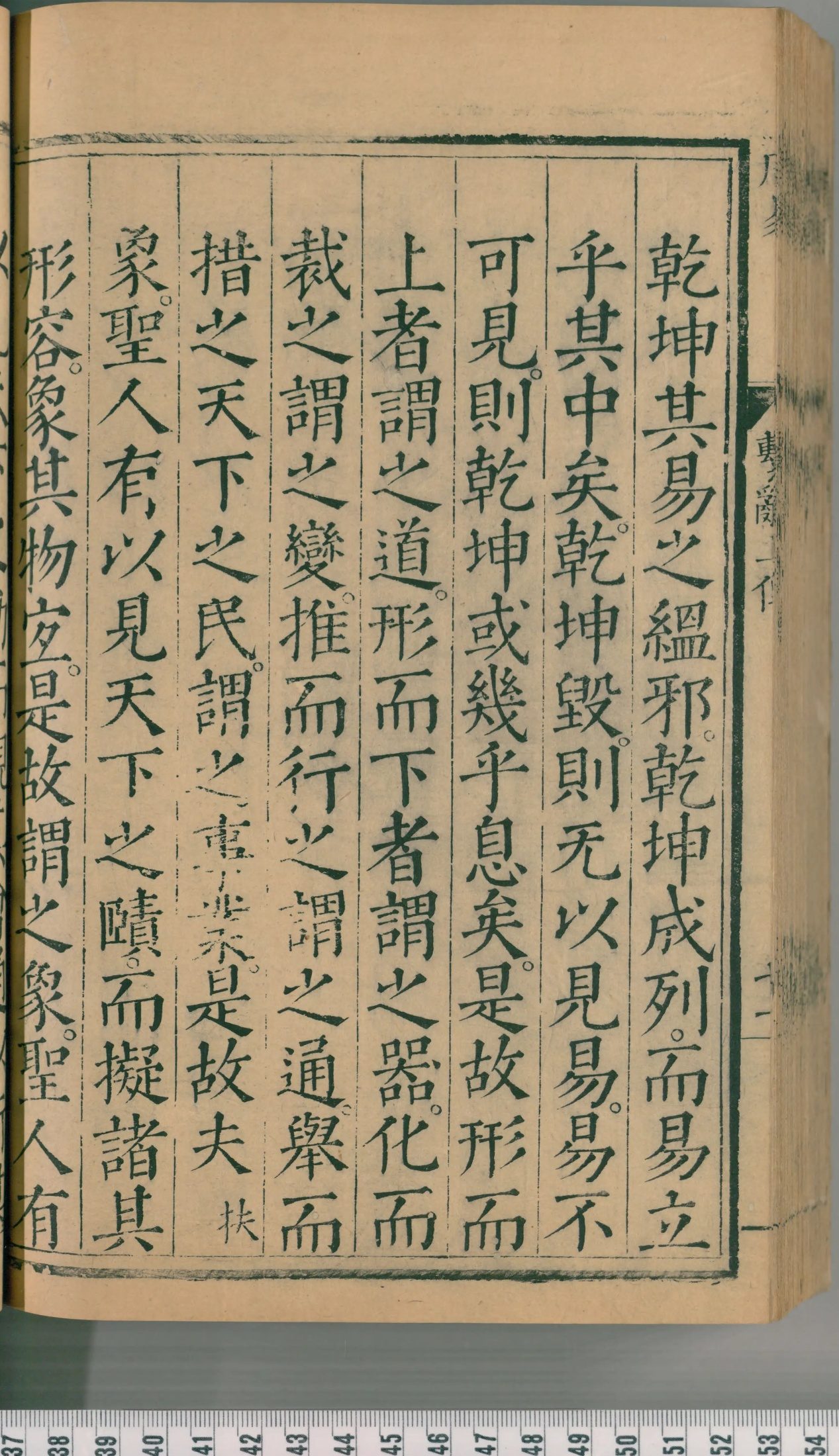
National Diet Library WA35-19 [五經白文], vol. 1 (周易), IIIF canvas 117, right-hand page: 8 columns, main text with punctuation circles and small sound glosses. Checked on the image (column openings aligned to the text): paragraph 77 opens column 1 ‹乾坤其易›; paragraph 78 begins within column 3, which opens ‹可見則乾›; paragraph 79 begins within column 6, which opens ‹措之天下›. Paragraph 79 runs on to canvas 117, left-hand page (first column ‹以見天下›). The Chinese shown is the received text from Wikisource, not a transcription of this print.
77乾坤,其易之縕邪!乾坤成列,而易立乎其中矣。乾坤毀,則无以見易,易不可見,則乾坤或幾乎息矣。
78是故形而上者謂之道,形而下者謂之器,化而裁之謂之變,推而行之謂之通,舉而錯之天下之民謂之事業。
79是故夫象,聖人有以見天下之賾,而擬諸其形容,象其物宜,是故謂之象。聖人有以見天下之動,而觀其會通,以行其典禮,繫辭焉以斷其吉凶,是故謂之爻。
77May we not say that Khien and Khwăn [= the yang and yin, or the undivided and divided lines] are the secret and substance of the Yî? Khien and Khwăn being established in their several places, the system of changes was thereby constituted. If Khien and Khwăn were taken away, there would be no means of seeing that system; and if that system were not seen, Khien and Khwăn would almost cease to act.
78Hence that which is antecedent to the material form exists, we say, as an ideal method, and that which is subsequent to the material form exists, we say, as a definite thing.
Transformation and shaping is what we call change; carrying this out and operating with it is what we call generalising the method; taking the result and setting it forth for all the people under heaven is, we say, (securing the success of) the business of life.
79Hence, to speak of the emblematic figures:—(The sage) was able to survey all the complex phenomena under the sky. He then considered in his mind how they could be figured, and (by means of the diagrams) represented their material forms and their character. Hence those (diagrams) are denominated Semblances. A (later) sage was able to survey the motive influences working all under the sky. He contemplated them in their common action and special nature, in order to bring out the standard and proper tendency of each. He then appended his explanation (to each line), to determine the good or evil indicated by it. Hence those (lines with their explanations) are denominated Imitations (the Yâo).
Where on the image
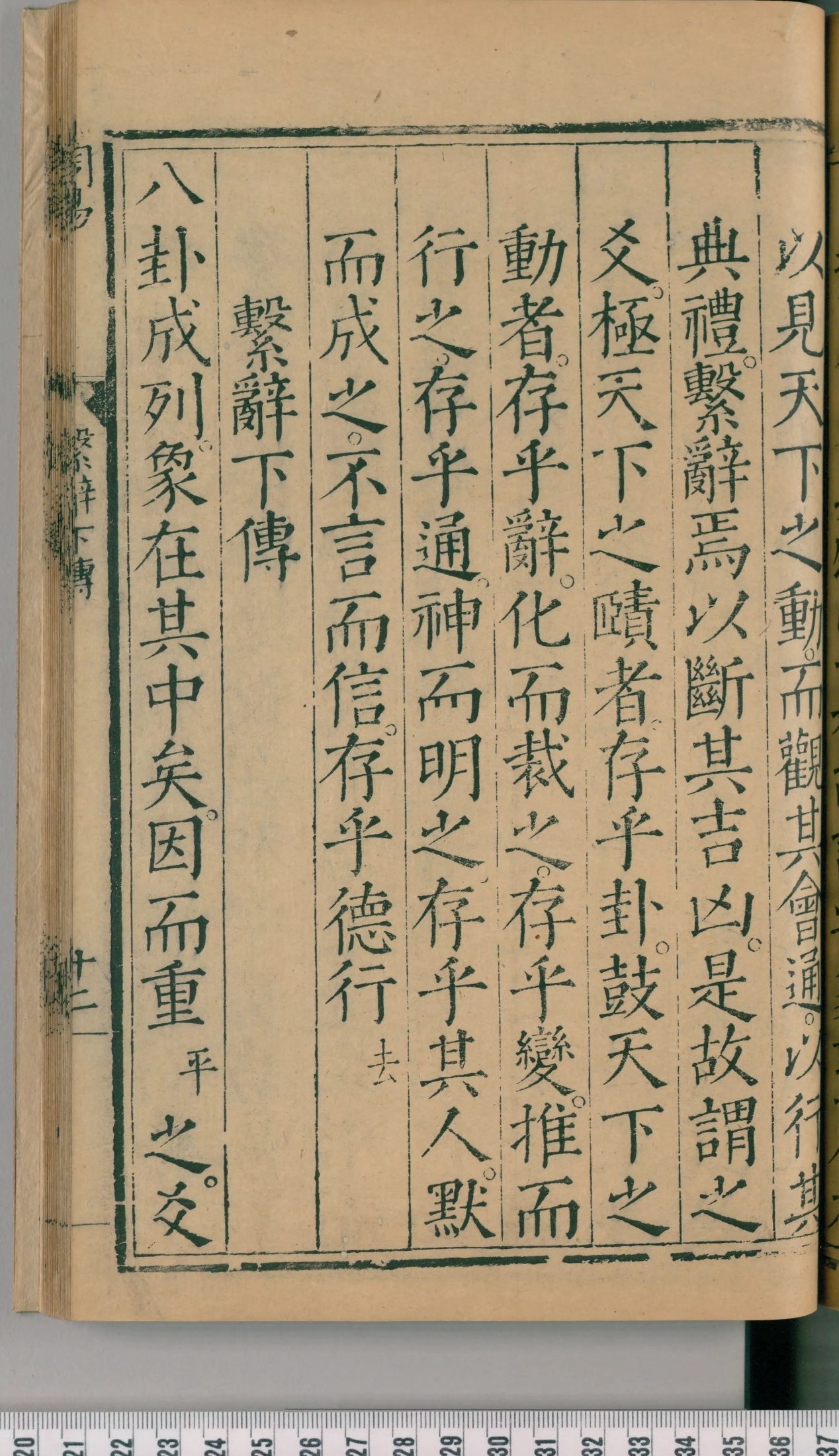
National Diet Library WA35-19 [五經白文], vol. 1 (周易), IIIF canvas 117, left-hand page: 8 columns, main text with punctuation circles and small sound glosses. On this page column 7 carries the heading 繫辭下傳. Checked on the image (column openings aligned to the text): paragraph 80 begins within column 3, which opens ‹爻極天下›; paragraph 81 begins within column 4, which opens ‹動者存乎›. The Chinese shown is the received text from Wikisource, not a transcription of this print.
80極天下之賾者存乎卦;鼓天下之動者存乎辭;
81化而裁之存乎變;推而行之存乎通;神而明之,存乎其人;默而成之,不言而信,存乎德行。
80The most thorough mastery of all the complex phenomena under the sky is obtained from the diagrams. The greatest stimulus to movement in adaptation to all affairs under the sky is obtained from the explanations.
81The transformations and shaping that take place are obtained from the changes (of the lines); the carrying this out and operating with it is obtained from the general method (that has been established). The seeing their spirit-like intimations and understanding them depended on their being the proper men; and the completing (the study of) them by silent meditation, and securing the faith of others without the use of words, depended on their virtuous conduct.
Notes
- English: James Legge, The Yî King, Sacred Books of the East vol. 16 (1882), Appendix III (The Great Appendix), Section I, Chapter 12, paragraphs 75-81.
- Legge's notes after each chapter are left out. Where one numbered paragraph is printed as several paragraphs, they are kept as printed.
Cite
Sources
- Source: National Diet Library WA35-19 (Ming Five Classics print with postface of 1596, vol. 1, Zhouyi) + Wikisource received text + James Legge, Sacred Books of the East 16 (1882), Appendix III (holding institution)
- Critical edition: Received text (Wikisource)
← previous · → next · v cycle view · l back to library