Classic of Changes, Great Treatise, Part 2, Chapter 7 (Ming print of 1596)
Introduction
The Great Treatise (繫辭傳 Xici zhuan, "Commentary on the Appended Statements"; Legge's "Great Appendix") is the longest of the Ten Wings, the commentaries attached to the Classic of Changes. It is an essay in two parts on how the hexagrams were made, how the yarrow stalks are counted, and how the book reflects the workings of heaven and earth. Tradition ascribed it to Confucius; it is now generally dated to the late Warring States period (4th to 3rd century BCE), and part of it is preserved on the Mawangdui silk manuscript of 168 BCE. This is chapter 7 of part 2 (下), in the chapter division of Zhu Xi (1130-1200), which Legge follows; Legge numbers his paragraphs straight through each part (here 49-52).
The photographs are of the first volume of a Five Classics printed in Nanjing with the main text only and punctuation circles, with a postface by Li Deng dated Wanli 24 (1596); the National Diet Library, Tokyo, holds the only known copy of these five volumes (call no. WA35-19). The Great Treatise follows the 64 hexagrams in this volume, from canvas 106 to canvas 128, and its passages stand in the order of Zhu Xi's edition. In this copy the chapter runs from canvas 125, right-hand page to canvas 125, left-hand page. Each section gathers the paragraphs that begin on one page and links to that page and to any page the last paragraph runs onto; the page boundaries were found by reading the first characters of every column on the photographs and aligning them to the text.
The Chinese is the received text from Wikisource. The English is James Legge's translation in Sacred Books of the East, volume 16 (1882), Appendix III, Section II, Chapter 7; his notes are not reproduced. Legge adds words in parentheses to make the sense plain; they are his.
How was this verified? (Provenance)
Where on the image
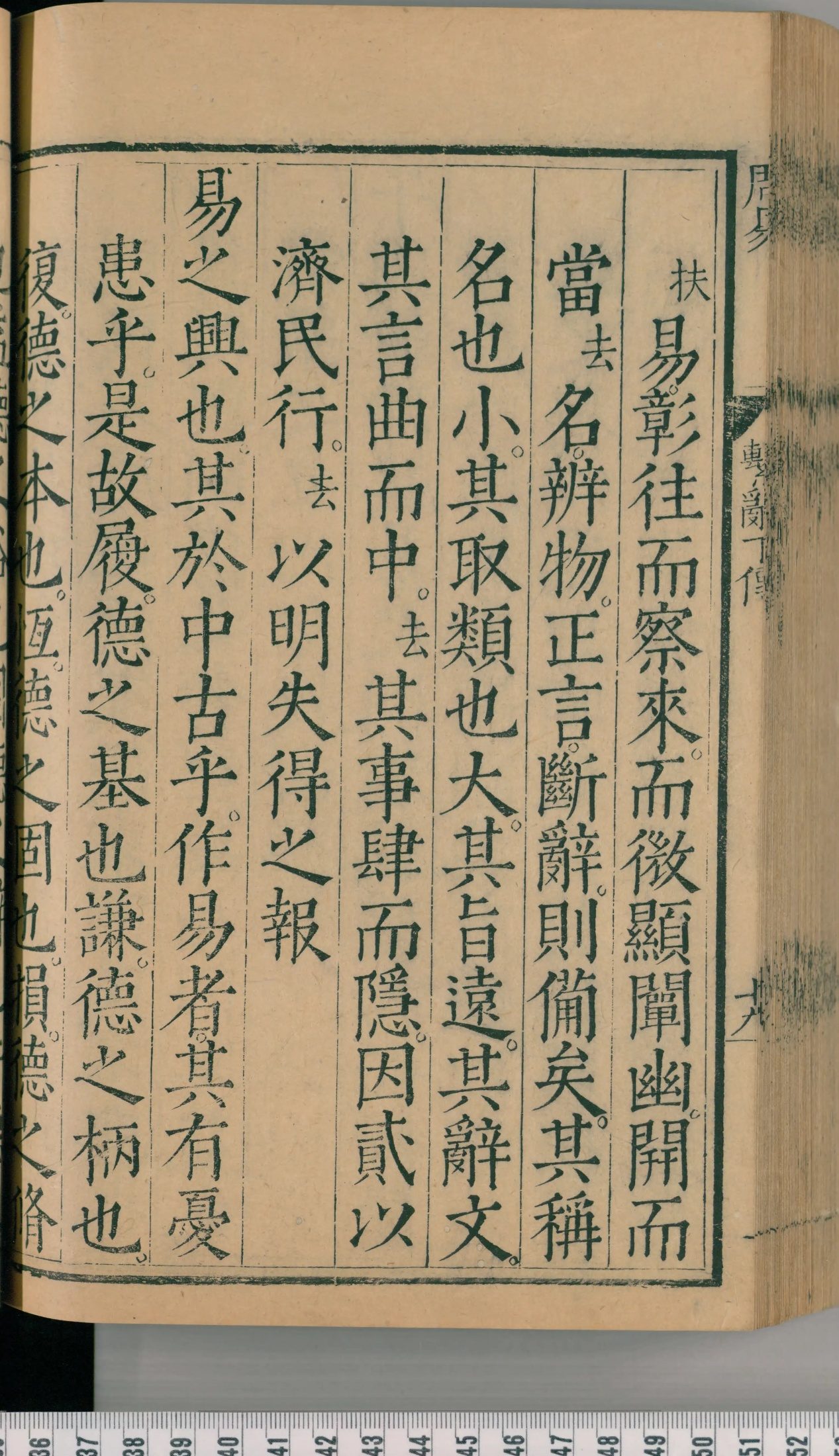
National Diet Library WA35-19 [五經白文], vol. 1 (周易), IIIF canvas 125, right-hand page: 8 columns, main text with punctuation circles and small sound glosses. Checked on the image (column openings aligned to the text): paragraph 49 opens column 6 ‹易之興也›; paragraph 50 begins within column 7, which opens ‹患乎是故›. Paragraph 50 runs on to canvas 125, left-hand page (first column ‹也益德之›). The Chinese shown is the received text from Wikisource, not a transcription of this print.
49易之興也,其於中古乎!作易者,其有憂患乎!
50是故:履,德之基也。謙,德之柄也。復,德之本也。恒,德之固也。損,德之脩也。益,德之裕也。困,德之辨也。井,德之地也。巽,德之制也。
49Was it not in the middle period of antiquity that the Yî began to flourish? Was not he who made it familiar with anxiety and calamity?
50Therefore (the 10th diagram), Lî, shows us the foundation of virtue; (the 15th), Hsien, its handle; (the 24th), Fû, its root; (the 32nd), Hăng, its solidity; (the 41st), Sun, its cultivation; (the 42nd), Yî, its abundance; (the 47th), Khwăn, its exercise of discrimination; (the 48th), Ȝing, its field; and (the 57th), Sun, its regulation.
Where on the image
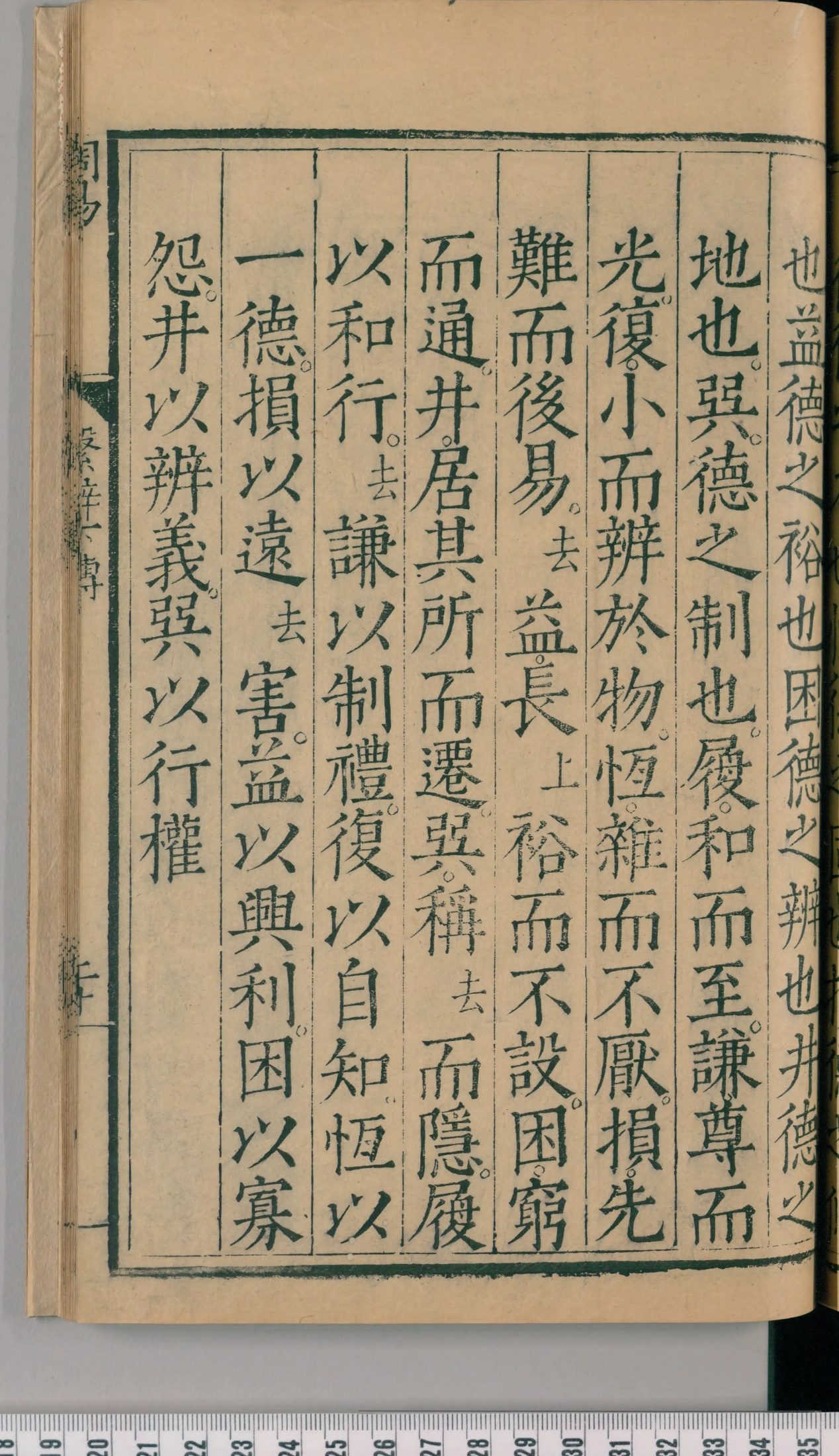
National Diet Library WA35-19 [五經白文], vol. 1 (周易), IIIF canvas 125, left-hand page: 8 columns, main text with punctuation circles and small sound glosses. Checked on the image (column openings aligned to the text): paragraph 51 begins within column 2, which opens ‹地也巽德›; paragraph 52 begins within column 5, which opens ‹而通井居›. Column openings that differ from the received text: canvas 125, left-hand page, column 8 reads ‹怨井以辨› where the received text has ‹怨井以辯›. The Chinese shown is the received text from Wikisource, not a transcription of this print.
51履,和而至。謙,尊而光。復,小而辨於物。恒,雜而不厭。損,先難而後易。益,長裕而不没。困,窮而通。井,居其所而遷。巽,稱而隱。
52履,以和行。謙,以制禮。復,以自知。恒,以一德。損,以遠害。益,以興利。困,以寡怨。井,以辯義。巽,以行權。
51In Lî we have the perfection of harmony; in Hsien, we have the giving honour to others, and the distinction thence arising; in Fû we have what is small (at first), but there is in it a (nice) discrimination of (the qualities of) things; in Hăng we have a mixed experience, but without any weariness; in Sun we have difficulty in the beginning and ease in the end; in Yî we have abundance of growth without any contrivance; in Khwăn we have the pressure of extreme difficulty, ending in a free course; in Ȝing we have abiding in one's place and at the same time removal (to meet the movement of others); and in Sun we have the weighing of things (and action accordingly), but secretly and unobserved.
52(The use of) Lî appears in the harmony of the conduct; of Hsien, in the regulation of ceremonies; of Fû, in self-knowledge; of Hăng, in uniformity of virtue; of Sun, in keeping what is harmful at a distance; of Yî, in the promotion of what is advantageous; of Khwăn, in the diminution of resentments; of Ȝing, in the discrimination of what is righteous; and of Sun, in the doing of what is appropriate to time and to circumstances.
Notes
- English: James Legge, The Yî King, Sacred Books of the East vol. 16 (1882), Appendix III (The Great Appendix), Section II, Chapter 7, paragraphs 49-52.
- Legge's notes after each chapter are left out. Where one numbered paragraph is printed as several paragraphs, they are kept as printed.
Cite
Sources
- Source: National Diet Library WA35-19 (Ming Five Classics print with postface of 1596, vol. 1, Zhouyi) + Wikisource received text + James Legge, Sacred Books of the East 16 (1882), Appendix III (holding institution)
- Critical edition: Received text (Wikisource)
← previous · → next · v cycle view · l back to library