2 Corinthians, Chapter 4 (Codex Alexandrinus)
Introduction
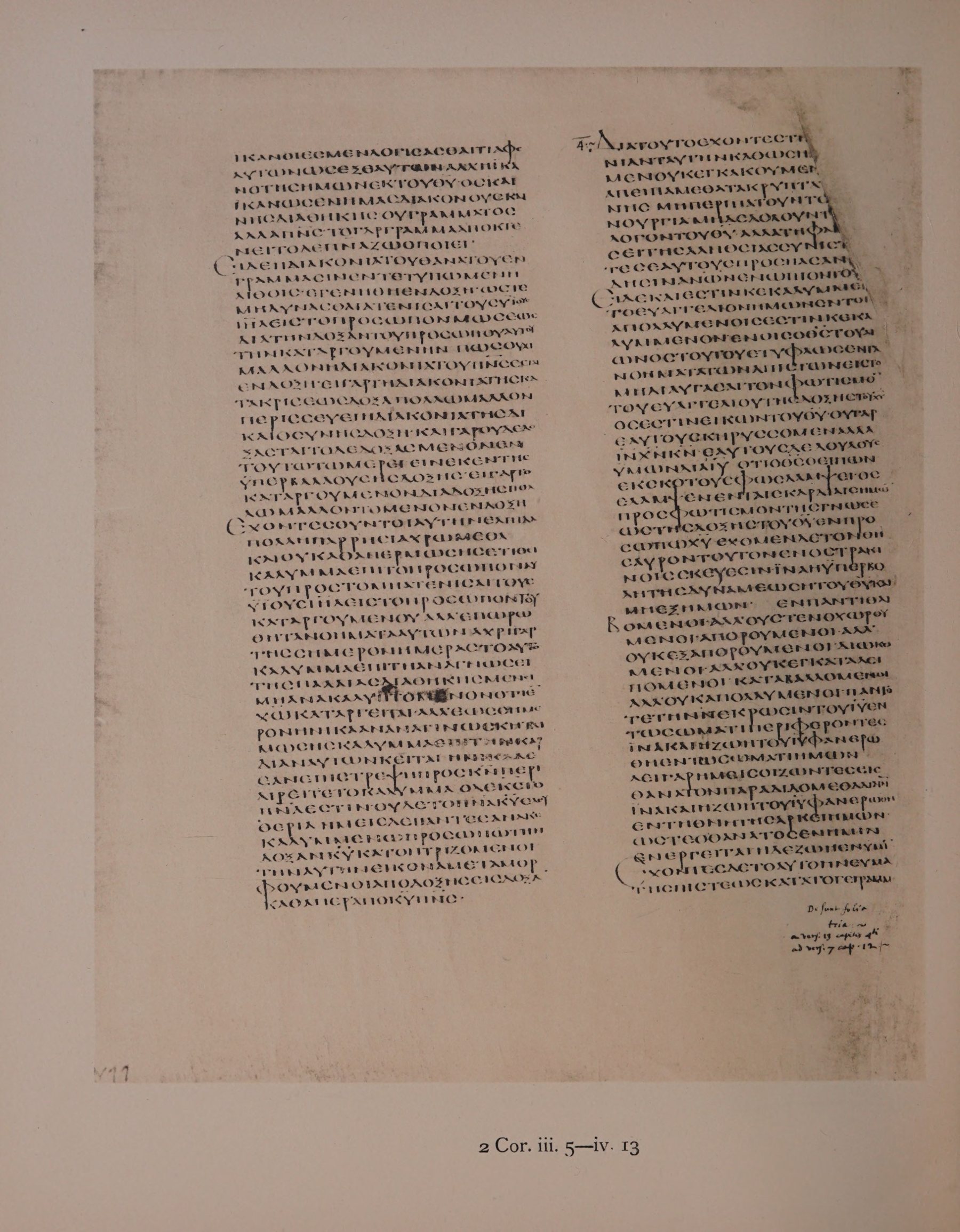
2 Corinthians 4 from Codex Alexandrinus (GA 02), a fifth-century Greek Bible held by the British Library (Royal MS 1 D. VIII). In the New Testament it is the chief witness to the Byzantine text in the Gospels and to the Alexandrian text in the rest of the New Testament. Its New Testament volume lacks Matthew 1:1-25:5, John 6:50-8:52 and 2 Corinthians 4:13-12:6.
Lacuna: verses 14-18 of this chapter are not extant in Codex Alexandrinus (the leaves are lost); only the verses that survive on the pages shown are published here.
This entry meets the strict three-criteria standard of the Theosis Library:
- Manuscript scan: the actual page(s) of Codex Alexandrinus containing this passage (folio 126v), reproduced from the British Museum's 1909 photographic facsimile edited by F. G. Kenyon, as digitised by the Getty Research Institute for the Internet Archive. The facsimile prints the verse range beneath each plate; that printed range was read for every page used and agrees with the INTF's NTVMR verse-level page index (CC BY 4.0). The page for each section now comes from the NTVMR transcription itself, which records the page and column on which every verse is written.
- Original text: the manuscript's own text, from a diplomatic transcription (see Greek text below), with Tischendorf's 8th critical edition (1869) for comparison.
- English translation: the King James Version (1611), retrieved verbatim from the public-domain bible-api.com endpoint.
Greek text: a diplomatic transcription of Codex Alexandrinus made by the Institut für Neutestamentliche Textforschung (INTF), Münster, for the New Testament Virtual Manuscript Room (NTVMR), published under a Creative Commons Attribution 4.0 licence. It gives the letters as the first scribe wrote them: no accents or breathings, the scribe's own spelling, and the sacred names in their contracted form (θς for θεος, ις for ιησους, κς for κυριος; the overline is not reproduced). Corrections by later hands are not shown. Letters in square brackets are not legible on the page and were restored by the transcribers, a dot under a letter marks an uncertain reading, and [...] marks text lost to damage. Beneath each section, for comparison, is Tischendorf's 8th critical edition (1869). Where the two differ, the transcription is what the manuscript says. Each section is shown with the page on which the transcription places its verses.
Manuscript note: Fol. 126v ends inside 2 Corinthians 4:13 (κατα το γεγραμμε[νον]); the rest of the chapter is lost with the missing leaves (the codex resumes in 12:6). The partly preserved verse is marked in both columns.
How was this verified? (Provenance)
Where on the image
Page from the NTVMR transcription (docID 20002): verses 1-7 on fol. 126v (facsimile leaf 214), col. 2.
1δια τουτο εχοντες τη[ν] [διακο]νιαν ταυτην καθως η[λεηθη]μεν ουκ εγκακουμεν̣ 2[αλλα] απειπαμεθα τα κρυπτα τ̣[ης] [αισχυ]νης μη περιπατουντε[ς] [εν] [πα]νουργια · μηδε δολουντ[ες] [τον] λογον του θυ · αλλα τη φα[νερω]σει της αληθειας συνιστ̣[...] τες εαυτους προς πασαν [συνει]δησιν ανων ενωπιον του̣ [θυ] 3ει δε και εστιν κεκαλυμμε[νον] το ευαγγελιον ημων εν τοι[ς] απολλυμενοις εστιν κεκαλυμμενον · 4εν οις ο θς του αιωνος τουτου ετυφλωσεν τα νοηματα των απιστων εις το μη διαυγασαι τον φωτισμον του ευαγγελιου της δοξης του χυ ος εστιν εικων του θυ · 5ου γαρ εαυτους κηρυσσομεν αλλα ιν χν κν · εαυτους δε δουλους υμων δια ιν 6οτι ο θς ο ειπων εκ σκοτους φως λαμψει · ος ελαμψεν εν ταις καρδιαις ημων προς φωτισμον της γνωσεως της δοξης του θυ εν προσωπω χυ · 7εχομεν δε τον θησαυρον τουτον εν οστρακινοις σκευεσιν · ινα η υπερβολη της δυναμεως η του θυ και μη εξ ημων ·
Compare: Tischendorf 8th edition (1869)
1Διὰ τοῦτο ἔχοντες τὴν διακονίαν ταύτην, καθὼς ἠλεήθημεν, οὐκ ἐγκακοῦμεν, 2ἀλλὰ ἀπειπάμεθα τὰ κρυπτὰ τῆς αἰσχύνης, μὴ περιπατοῦντες ἐν πανουργίᾳ μηδὲ δολοῦντες τὸν λόγον τοῦ θεοῦ, ἀλλὰ τῇ φανερώσει τῆς ἀληθείας συνιστάντες ἑαυτοὺς πρὸς πᾶσαν συνείδησιν ἀνθρώπων ἐνώπιον τοῦ θεοῦ. 3εἰ δὲ καὶ ἔστιν κεκαλυμμένον τὸ εὐαγγέλιον ἡμῶν, ἐν τοῖς ἀπολλυμένοις ἐστὶν κεκαλυμμένον, 4ἐν οἷς ὁ θεὸς τοῦ αἰῶνος τούτου ἐτύφλωσεν τὰ νοήματα τῶν ἀπίστων εἰς τὸ μὴ αὐγάσαι τὸν φωτισμὸν τοῦ εὐαγγελίου τῆς δόξης τοῦ Χριστοῦ, ὅς ἐστιν εἰκὼν τοῦ θεοῦ. 5οὐ γὰρ ἑαυτοὺς κηρύσσομεν ἀλλὰ Χριστὸν Ἰησοῦν κύριον, ἑαυτοὺς δὲ δούλους ὑμῶν διὰ Ἰησοῦν. 6ὅτι ὁ θεὸς ὁ εἰπών, ἐκ σκότους φῶς λάμψει, ὃς ἔλαμψεν ἐν ταῖς καρδίαις ἡμῶν πρὸς φωτισμὸν τῆς γνώσεως τῆς δόξης τοῦ θεοῦ ἐν προσώπῳ Χριστοῦ. 7Ἔχομεν δὲ τὸν θησαυρὸν τοῦτον ἐν ὀστρακίνοις σκεύεσιν, ἵνα ἡ ὑπερβολὴ τῆς δυνάμεως ᾖ τοῦ θεοῦ καὶ μὴ ἐξ ἡμῶν·
1Therefore seeing we have this ministry, as we have received mercy, we faint not; 2But have renounced the hidden things of dishonesty, not walking in craftiness, nor handling the word of God deceitfully; but by manifestation of the truth commending ourselves to every man’s conscience in the sight of God. 3But if our gospel be hid, it is hid to them that are lost: 4In whom the god of this world hath blinded the minds of them which believe not, lest the light of the glorious gospel of Christ, who is the image of God, should shine unto them. 5For we preach not ourselves, but Christ Jesus the Lord; and ourselves your servants for Jesus’ sake. 6For God, who commanded the light to shine out of darkness, hath shined in our hearts, to give the light of the knowledge of the glory of God in the face of Jesus Christ. 7But we have this treasure in earthen vessels, that the excellency of the power may be of God, and not of us.
Where on the image
Page from the NTVMR transcription (docID 20002): verses 8-13 on fol. 126v (facsimile leaf 214), col. 2.
8εν παντι θλιβομενοι · αλλ ου στενοχωρουμενοι · απορουμενοι · αλλ ουκ εξαπορουμενοι · 9διωκομενοι · αλλ ουκ εγκαταλειπομενοι · καταβαλλομενοι αλλ ουκ απολλυμενοι · 10παντοτε την νεκρωσιν του ιυ εν τω σωματι περιφεροντες ινα και η ζωη του ιυ φανερωθη εν τω σωματι ημων 11αει γαρ ημεις οι ζωντες εις θανατον παραδιδομεθα δια ιν ινα και η ζωη του ιυ φανερωθη εν τη θνητη σαρκει ημων · 12ωστε ο θανατος εν ημιν ενεργειται · η δε ζωη εν υμιν 13εχοντες δε το αυτο πνευμα της πιστεως κατα το γεγραμμε̣ [the rest of this verse is lost with the missing leaves (2 Corinthians 4:13-12:6)]
Compare: Tischendorf 8th edition (1869)
8ἐν παντὶ θλιβόμενοι ἀλλ’ οὐ στενοχωρούμενοι, ἀπορούμενοι ἀλλ’ οὐκ ἐξαπορούμενοι, 9διωκόμενοι ἀλλ’ οὐκ ἐγκαταλειπόμενοι, καταβαλλόμενοι ἀλλ’ οὐκ ἀπολλύμενοι, 10πάντοτε τὴν νέκρωσιν τοῦ Ἰησοῦ ἐν τῷ σώματι περιφέροντες, ἵνα καὶ ἡ ζωὴ τοῦ Ἰησοῦ ἐν τοῖς σώμασιν ἡμῶν φανερωθῇ. 11ἀεὶ γὰρ ἡμεῖς οἱ ζῶντες εἰς θάνατον παραδιδόμεθα διὰ Ἰησοῦν, ἵνα καὶ ἡ ζωὴ τοῦ Ἰησοῦ φανερωθῇ ἐν τῇ θνητῇ σαρκὶ ἡμῶν. 12ὥστε ὁ θάνατος ἐν ἡμῖν ἐνεργεῖται, ἡ δὲ ζωὴ ἐν ὑμῖν. 13ἔχοντες δὲ τὸ αὐτὸ πνεῦμα τῆς πίστεως, κατὰ τὸ γεγραμμένον, ἐπίστευσα, διὸ καὶ ἐλάλησα, καὶ ἡμεῖς πιστεύομεν, διὸ καὶ λαλοῦμεν,
8We are troubled on every side, yet not distressed; we are perplexed, but not in despair; 9Persecuted, but not forsaken; cast down, but not destroyed; 10Always bearing about in the body the dying of the Lord Jesus, that the life also of Jesus might be made manifest in our body. 11For we which live are alway delivered unto death for Jesus’ sake, that the life also of Jesus might be made manifest in our mortal flesh. 12So then death worketh in us, but life in you. 13We having the same spirit of faith, according as it is written, [the rest of this verse, "I believed, and therefore have I spoken; we also believe, and therefore speak;", is lost with the missing leaves]
Cite
Sources
- Source: Codex Alexandrinus page images + NTVMR transcription (CC BY 4.0) + Tischendorf 8th edition + KJV (holding institution)
- Critical edition: Codex Alexandrinus transcription, NTVMR (INTF Münster, CC BY 4.0); Tischendorf 8th edition for comparison
← previous · → next · v cycle view · l back to library