Book of the Dead, Spell 112: Chapter of Knowing the Spirits of Tu [An] (papyrus of Iuefankh)
Introduction
The Book of the Dead, in Egyptian the spells for going forth by day, is a collection of funerary spells written on papyrus rolls and placed in burials from the New Kingdom to the Roman period. Each roll was made for one person, with spells taken from a large repertoire and illustrated with drawings (vignettes). This library gives one complete roll: the papyrus of Iuefankh in the Museo Egizio, Turin (Cat. 1791), written in the Ptolemaic period (332-30 BCE) and coming from Thebes. Richard Lepsius published it in 1842 and divided it into 165 chapters; his numbering is still the standard numbering of the spells, and it is used here.
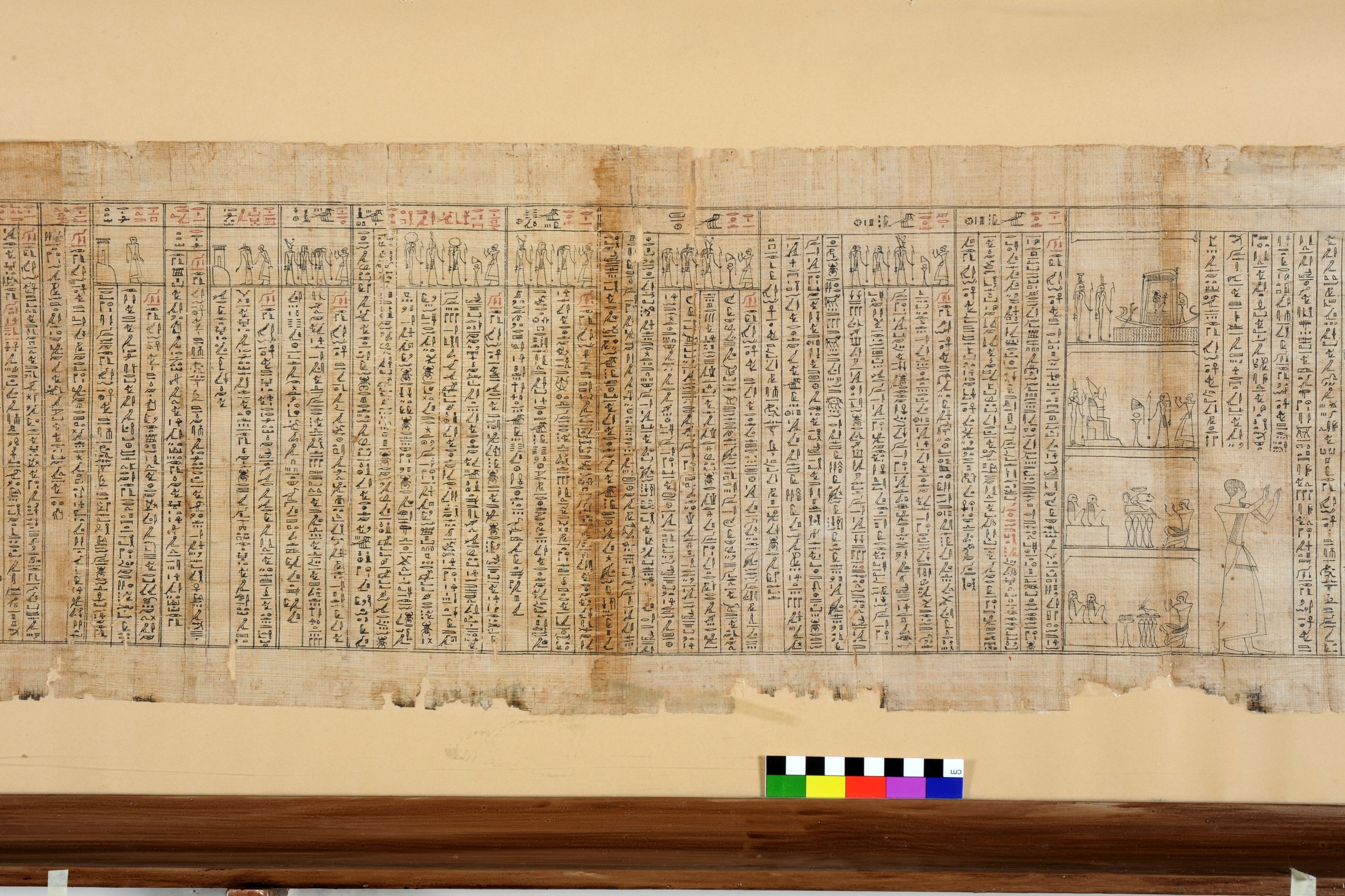
Spell 112 (Birch: 'The Chapter of Knowing the Spirits of Tu [An].') is on Lepsius's plate XLIII and on photograph 17 of the 31 Museo Egizio photographs of the roll.
The Egyptian is the transliteration of the Thesaurus Linguae Aegyptiae (edition by Burkhard Backes), with the column number of the spell before each column; the numbers are those of Lepsius's plates. On the papyrus the text runs in vertical columns of cursive hieroglyphs from right to left along the roll; titles and some words are written in red. Signs restored by the editor are in square brackets, signs the scribe left out in angle brackets, superfluous signs in braces and damaged signs in half brackets. The English is the translation by Samuel Birch, published in 1867 and made from Lepsius's copy of this papyrus, so the English and the Egyptian come from the same manuscript. It was the first complete English translation of the Book of the Dead; many passages are now understood differently. Birch's own square brackets give his alternatives and explanations. The photographs are by the Museo Egizio; each shows a stretch of the roll, and the note of each section says where the spell stands on it.
How was this verified? (Provenance)
Where on the image
Turin 1791, Spell 112 (TLA Tb 112: title line, columns 1-9; Lepsius 1842, pl. XLIII). Photograph 17 of 31 (Commons Book_of_the_Dead_of_Iuefankh,_papyrus_-_Museo_Egizio_Turin_C_1791_p018.jpg): the gods at 63-71% (Lepsius pl. XLIII). Checked by eye: the photographs were matched to Lepsius's plates by their vignettes, red titles and framed compartments, and the overlapping edges of neighbouring photographs were compared.
titlek〈y〉 rʾ n〈,j〉 rḫ bꜣ,pl-Pi̯
1ḏd-mdw jn Wsjr […] mꜣꜥ-ḫrw ẖꜣ,tj jm,j ḥꜣ,t-mḥi̯,t ꜥnp〈,t〉 sḫt,y jrf m Pi̯ sms〈,w〉.pl jw:ḫmi̯.pl jwi̯ pꜣs,wt qrḥ.pl
2qn.tj{tj} ⸢dq⸣ jn-jw =ṯn rḫ =ṯn rḏi̯.tw Pi̯ n Ḥr,w ḥr =s jw =j rḫ.kw s〈j〉 jn Rꜥ,w rḏi̯ n =f sw m jsw 〈j〉ꜣtj m jr,t =f m nw
3ḏd.n Rꜥ,w n Ḥr,w ḏi̯! =k mꜣꜣ =j nn ḫpr m jr,t.du =k mꜣꜣ =f sw ḏd.jn Rꜥ,w n Ḥr,w dgꜣ mi̯ r pfj rrj km〈m〉 wnn =f ḥr dgꜣ =f
4ꜥḥꜥ〈,n〉 〈n〉ky n〈,j〉 jr,t =f nšnj〈.w〉 wr ḏd.jn Ḥr,w n Rꜥ,w m =k jr,t =j mj sqr pw jri̯.tn Jnp,w r jr,t =j ꜥḥꜥ,n ꜥm.n =f jb =f ḏd.jn Rꜥ,w n
5nn n〈,j〉 nṯr.pl bw,t šꜣj n Ḥr,w jḫ snb =f ḫpr bw,t šꜣj ꜥꜣ ḏd {j}n Ḥr,w n nn n〈,j〉 nṯr.pl n,tj m-ḫt =f m-ḫt wnn Ḥr,w m
6nḫn =f ḫpr ḫr,y m nṯr.pl m jḥ.pl =f m ꜥw,t.pl =f m šꜣj.pl =f jr Jmsṯ Ḥpy Dwꜣ-mw,t≡f Qbḥ-sn,pl≡f jti̯ =sn pw Ḥr,w mw,t =sn pw ꜣs,t
7ḏd.jn Ḥr,w n Rꜥ,w ḏi̯! =k n =j sn =j m Pi̯ sn =j m Nḫn m ẖ,t =j ḥnꜥ wnn ḥnꜥ =j m sjp-nḥḥ wꜣḏ z ꜥḫm ḫnnj ḫpr rn =f
8n〈,j〉 Ḥr,w ḥr,j wꜣḏ =f jw =j rḫ.kw bꜣ,pl-Pi̯ Ḥr,w pw Jmsṯ Ḥpy pw fꜣi̯ ḥr =ṯn nṯr.pl jm,j.w-Dꜣ,t
9n Wsjr […] mꜣꜥ-ḫrw pn m sw ḫpr〈.w〉 m nṯr-ꜥꜣ
CXII. The Chapter of Knowing the Spirits of Tu [An].
[Vignette. — Deceased adoring Horus, Amset, and Hapi.]
The Oxyrhynchite in Oxyrhyncopolis and in An, and the chiefs spread nets for him in Tu.... A preparer of drink and cook of food do not come. Say ye who have known what is done in An to Horus, who is in it. I have known it; [Said] by Ra. He placed him in a chamber without [hurt in] his eye. Horus says to Ra: Let me see the same as thou seest with thy Eye. Thus he sees it. Says Ra to Horus: Look with this eye at the black Boar; he is regarding him. There stands a second without [hurt in] his eye, very hostile. Says Horus to Ra: Make my Eye as the scratch made by Anubis to my Eye when he ate his heart. Ra says to the Gods who follow after him: Hateful is the pig of Horus turning his shape [?], transforming into the abomination of a great pig. Says Horus to the Gods who follow after him: Wheb [I placed him in his place, he went, and he has been transformed into a black pig (Rit. Cadet)']. Horus was in his childhood, he turned the cows of the Gods into his cattle, his goats, and his pigs. They are Amset, Hapi, Tuautmutf, and Kabhsenuf; their father is Horus, their mother is Isis. Says Horus to Ra: Give thou me my brother in Tu, my brother in An, and my race to be made with me for ever. A person supplies a censer [to] the conductors, upon its handle is placed the name of Horus. I know the Spirits of Tu. They are Horus, Amset, and Hapi. Lift up your faces, oh Gods of the Empyreal Gate, to the Osiris! Let him be as a Great God.
Notes
- Birch's English was taken from three scans of Bunsen's Egypt's Place in Universal History, vol. V (1867), on the Internet Archive. The three OCR texts were aligned word by word and each word was settled by their agreement; running heads, page numbers, footnote markers and footnotes were removed. Some OCR errors may remain, chiefly in proper names.
- Birch uses the terms and name forms of his time: Hades, Aahlu (Elysium), Tum for Atum, Seb for Geb, Anup for Anubis, Phoenix or Bennu for the heron.
- Labels such as 'title line' or 'gate 1' before a line of the Egyptian translate the position labels of the TLA.
- The TLA has no hieroglyphic encoding for these texts, so only the transliteration is shown.
Cite
Sources
- Source: Papyrus of Iuefankh, Turin, Museo Egizio Cat. 1791 (Museo Egizio photographs, CC0) + TLA transliteration (ed. B. Backes, CC BY-SA 4.0) + English of Samuel Birch (1867, public domain) (holding institution)
- Critical edition: Thesaurus Linguae Aegyptiae, ed. Burkhard Backes (2018 data, AED-TEI)
← previous · → next · v cycle view · l back to library