Book of the Dead, Spell 146: Commencement of the Gates of the House of Osiris in the Fields of the ... (papyrus of Iuefankh)
Introduction
The Book of the Dead, in Egyptian the spells for going forth by day, is a collection of funerary spells written on papyrus rolls and placed in burials from the New Kingdom to the Roman period. Each roll was made for one person, with spells taken from a large repertoire and illustrated with drawings (vignettes). This library gives one complete roll: the papyrus of Iuefankh in the Museo Egizio, Turin (Cat. 1791), written in the Ptolemaic period (332-30 BCE) and coming from Thebes. Richard Lepsius published it in 1842 and divided it into 165 chapters; his numbering is still the standard numbering of the spells, and it is used here.
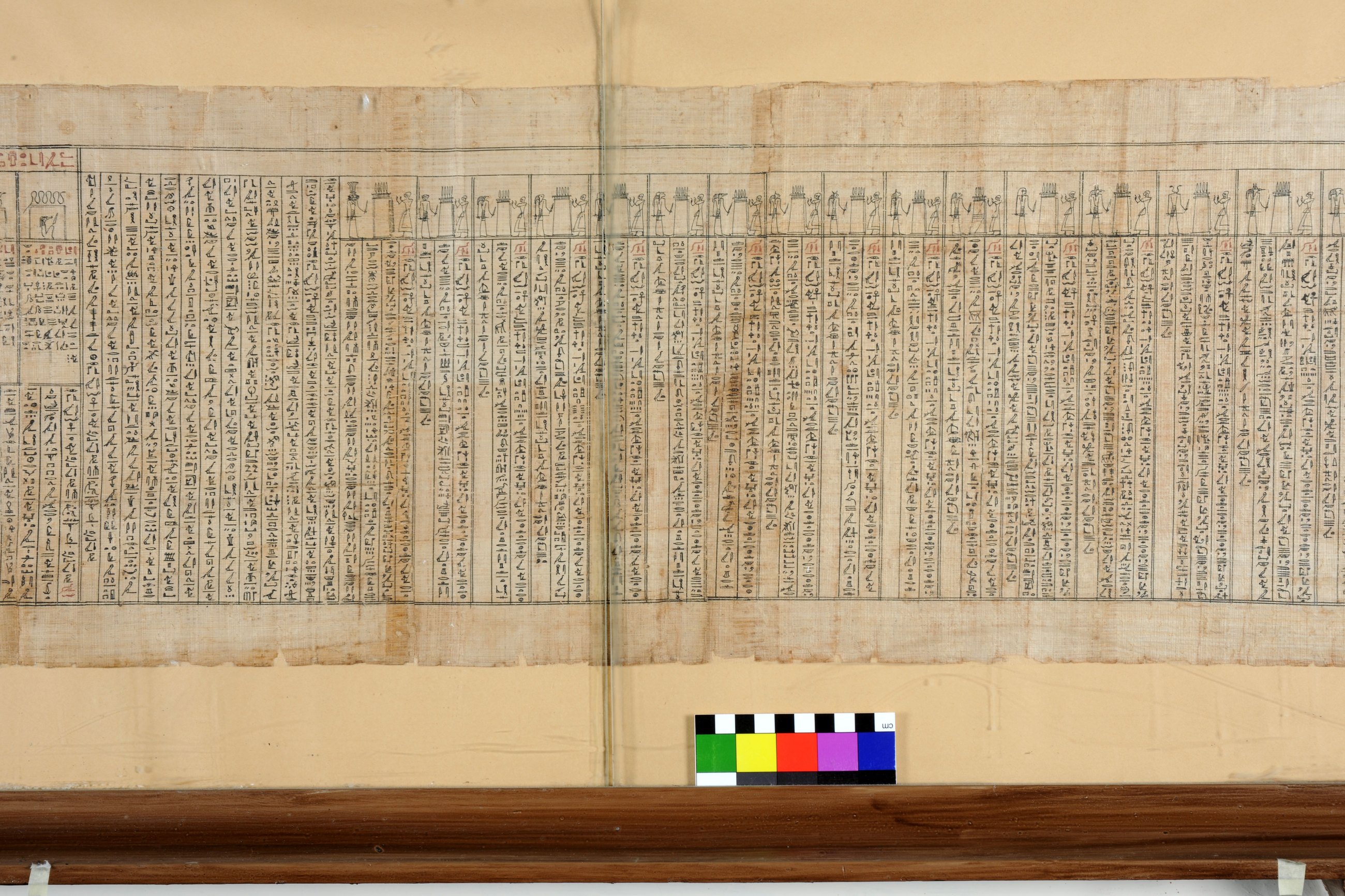
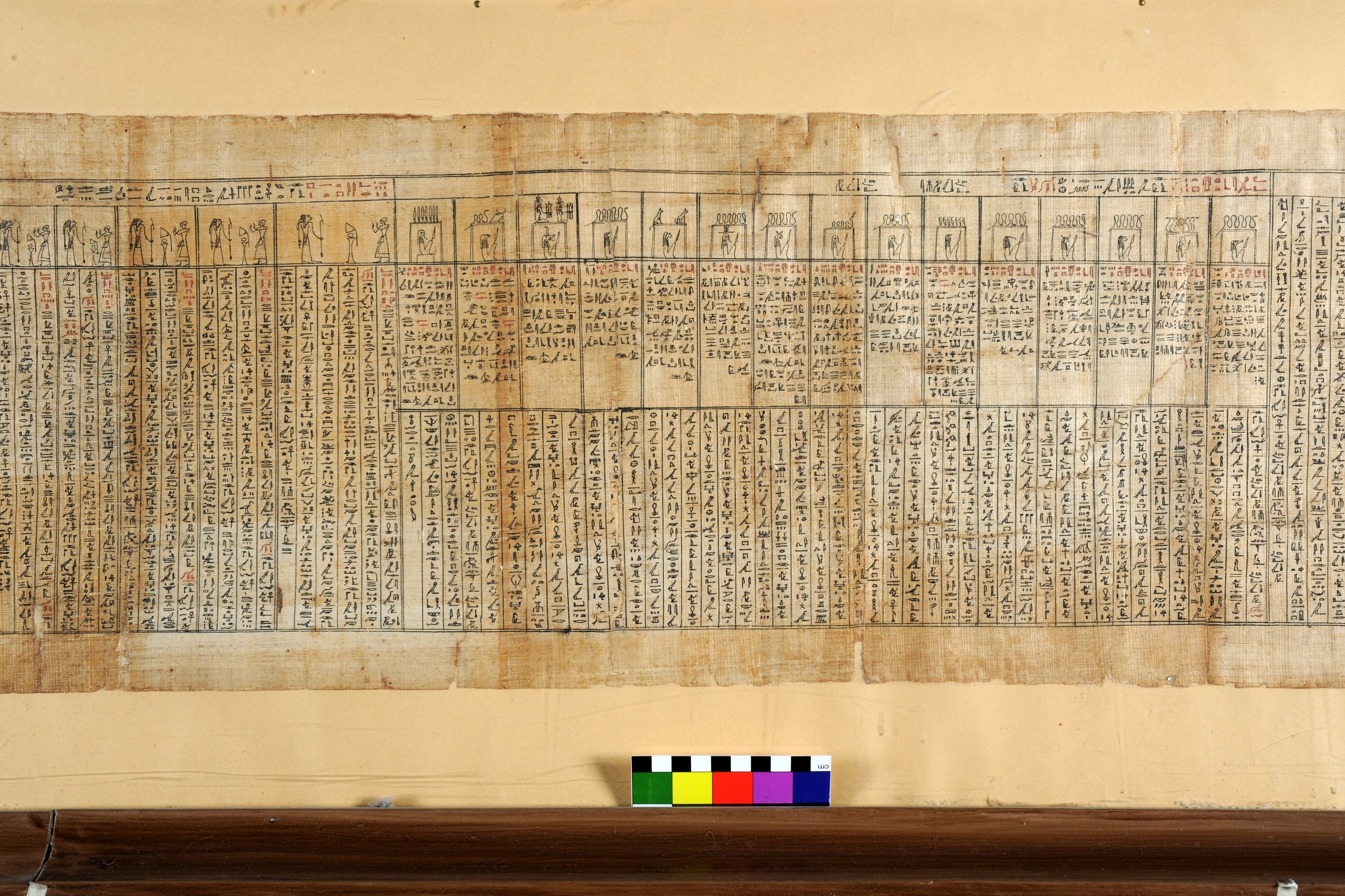
Spell 146 (Birch: 'The Commencement of the Gates of the House of Osiris in the Fields of the Aahlu, said by the Deceased.') is on Lepsius's plates LXV-LXVII and on photographs 25, 26 of the 31 Museo Egizio photographs of the roll. The TLA gives the names of the portals (gates 1-15) and the following columns as two texts; they are given here together.
The Egyptian is the transliteration of the Thesaurus Linguae Aegyptiae (edition by Burkhard Backes), with the column number of the spell before each column; the numbers are those of Lepsius's plates. On the papyrus the text runs in vertical columns of cursive hieroglyphs from right to left along the roll; titles and some words are written in red. Signs restored by the editor are in square brackets, signs the scribe left out in angle brackets, superfluous signs in braces and damaged signs in half brackets. The English is the translation by Samuel Birch, published in 1867 and made from Lepsius's copy of this papyrus, so the English and the Egyptian come from the same manuscript. It was the first complete English translation of the Book of the Dead; many passages are now understood differently. Birch's own square brackets give his alternatives and explanations. The photographs are by the Museo Egizio; each shows a stretch of the roll, and the note of each section says where the spell stands on it.
How was this verified? (Provenance)
Where on the image
Turin 1791, Spell 146 (TLA Tb 146〈1〉, Tb 146〈2〉: title line, columns 1-45; Lepsius 1842, pl. LXV-LXVII). Photograph 25 of 31 (Commons Book_of_the_Dead_of_Iuefankh,_papyrus_-_Museo_Egizio_Turin_C_1791_p010.jpg): its red title and first portal at the left-hand edge (0-6%; Lepsius pl. LXV); it continues on photograph 26. Photograph 26 of 31 (Commons Book_of_the_Dead_of_Iuefankh,_papyrus_-_Museo_Egizio_Turin_C_1791_p09.jpg): red title at 67-94% and its portals (shrines with a serpent frieze, short red-headed lines) at 29-90% (Lepsius pl. LXV-LXVII). Checked by eye: the photographs were matched to Lepsius's plates by their vignettes, red titles and framed compartments, and the overlapping edges of neighbouring photographs were compared. Birch numbers this spell CXLVII (his numbers run one ahead of Lepsius's from 145 on).
titleḥꜣ,t-ꜥ-m sbḫ,t.pl n.t pr Wsjr m sḫ,t-jꜣl ḏd-mdw jn Wsjr […] mꜣꜥ-ḫrw
gate 1sbḫ,t tp,nw〈t〉!! nb,t-snḏ qꜣi̯ znb,t.pl ḥr〈,j.t〉-tp nb,t ḫbḫb sr.t md,t ḫsf〈.t〉-ꜥ nšnj.pl nḥm〈.t〉 ꜥwꜣ,y rn ={n}〈s〉 wꜣi̯.w rn n jr,j-ꜥꜣ =s Nrjw ky-ḏd ṯni̯.w r b〈w〉-nb
gate 2sbḫ,t sn,nw〈.t〉 nb,t p,t ḥn,wt-Tꜣ,du ꜣsb.y〈t〉 nb,t n.t tmm,pl ky-ḏd m ṯnw ⸢bḥ⸣.pl qmꜣ〈.t〉 ḥr-nb rn =s rn n jr,j-ꜥꜣ =s Ms Ptḥ
gate 3sbḫ,t 3,nw〈.t〉 nb,t ḫꜣ{ꜣ}〈w〉〈,t〉.pl ꜥꜣ〈.t〉 ꜥꜣb,t snḏm.〈t〉n nṯr nb jm =s hrw ḫnti̯.t r ꜣbḏ,w rn =s rn n jr,j-ꜥꜣ =s Sb〈ꜣ〉q
gate 4sbḫ,t 4,nw.t sḫm〈.t〉 ds{.t} ḥn,wt-Tꜣ,du ḥḏi̯ ḫfti̯.pl n.w wrḏ,w-jb jrr!.{pl}〈t〉 sꜣr{.pl} šw〈.pl〉 m jw rn =s rn n jr,j-ꜥꜣ =s ḥwi̯ ngꜣ
gate 5sbḫ,t 5,nw〈.t〉 ḫ,t nb,t-ṯꜣw r šrj dbḥw.tw =s nn ꜥq r =s wnn =f tp tꜣ rn =s rn n jr,j-ꜥꜣ =s ḥntj rqꜣ
gate 6sbḫ,t 6,nw〈.t〉 nb,t kz〈,w〉 ky-ḏd nb,t snk,t ꜥꜣ hmhm nn rḫ =tw ꜣw =s r wsḫ =s nn gmi̯.tw qd =s m šꜣꜥ =s jw ḥfj ḥr =s n rḫ ṯnw msi̯.ntw =f!! ẖr-ḥꜣ,t wrḏ-jb rn =s rn n〈,j〉 jr,j-ꜥꜣ =s zmꜣ.pl!!
gate 7sbḫ,t 7,nw〈.t〉 jgp gꜣy ḥbs bꜣg jꜣkb,y〈t〉 mri̯.wt sḥꜣp.w rn =s rn n jr,j-ꜥꜣ =s Jkn,tj
gate 8sbḫ,t 8,nw〈.t〉 rkḥ.w bs jw,tj ꜥḫm ḏꜣw,t spd〈.t〉 pꜥ〈w〉 ḫꜣḫ ḏr,t smꜣ nḏnḏ jw,tj swꜣ ḥr =s n snḏ nhmhm =s rn =s rn n jr,j-ꜥꜣ =s ḫwj ḏ,t =f
gate 9sbḫ,t 9,nw〈.t〉 jm,j〈.t〉-ḥꜣ,t nb,t wsr.pl hru̯ ms,tj.w nb{,t} =s n-sj ḫt 320 m pẖr =s stj〈.t〉 m wꜣḏ.pl šmꜥi̯.pl ṯzi̯.t bz n Ḥbs-bꜣg pfꜣw nb{,t} =s rꜥ,w-nb rn =s rn n jr,j-ꜥꜣ =s Ḏd s⸢〈t〉⸣
gate 10sbḫ,t 10,nw〈.t〉 qꜣi̯ ḫrw nhzi̯ dny sbḥ〈.t〉 ꜥꜣ nrjw nb,t šf〈y〉,t nn ḏrj,w n n,tj m-ẖnw =s rn =s rn n jr,j-ꜥꜣ =s Zḫn-wr
gate 11sbḫ,t 11,nw〈.t〉 mds.t wbd.t sbj.w ḥri̯ n sbḫ,t nb〈.t〉 jri̯ hꜣy hn〈w〉 hrw sḏm jw.pl jw =ṯ ẖr sjp,t n〈.t〉 Ḥbs-bꜣg
gate 12sbḫ,t 12,nw〈.t〉 njs Tꜣ,du ski̯ jy m nhp qꜣy.t nb〈,t〉 ꜣḫ,w km〈.t〉 nb =s rꜥ,w-nb jw =s ẖr sjp,t n〈.t〉 Ḥbs-bꜣg
gate 13sbḫ,t 13,nw〈.t〉 sṯꜣ ꜣs,t ꜥ.wj =s ḥr sḥḏ Ḥꜥpi̯ m jmn =f jw =s ẖr sjp,t n〈.t〉 Ḥbs-bꜣg
gate 14sbḫ,t 14,nw〈.t〉 nb,t dndn ḫbi̯.t ḥr dšr ky-ḏd jrj =s h〈ꜣ〉kr jdn.du sdꜣ〈.w〉 ky-ḏd jrj ⸢htꜣ⸣ k{.t}〈y〉 hrw sḏm jw jw =s ẖr sjp n Ḥbs-bꜣg
gate 15sbḫ,t 15,nw〈.t〉 bꜣi̯.y dšr.t gmḥ,wt.du jꜣrr pri̯ m grḥ n ḏrj ky-ḏd dr sbj.w qmꜣ =f ḥr Rꜥ,w rḏi̯.t ꜥ.wj =s n wrḏ,w-jb m ꜣ,t =f jrr! šm〈,w〉 =s jw =s ẖr sjp,t n〈.t〉 Ḥbs-bꜣg
1Wsjr […] mꜣꜥ-ḫrw ḏd =f
2jnk wnḫ jꜣ,t pri̯ m wrr,w jni̯.n =j smn.{t}n =j
3〈j〉ḫ,t m ꜣbḏ,w {r}〈jw〉 wpi̯.n =j wꜣ,t m Rʾ-sṯꜣ,w snḏm.n =j
4mn n Wsjr jy.n =j mjn ḥr sbꜣ n jmḥ,t
5jmn jri̯ n =j wꜣ,t jnk Ḥr,w-nḏ-ḥr-jti̯≡f
6zꜣ ꜣs,t jwꜥ n Wsjr jy.n =j dr =〈j〉 ḏnḥ!!.du =k […] ḥr
7Wsjr jy.n =j mjn ḥr sbꜣ n ḥ〈ꜣ〉b ky-ḏd hꜣi̯ r hd
8gmḥ.wdu,t jri̯ n =j wꜣ,t jnk Ḥr,w-nḏ-ḥr-jti̯≡f
9jy.n =j nḥm.n =j ꜣhꜣ m-ꜥ jrj s〈w〉 jy.n =j mjn ḥr
10sbꜣ n {j}〈ḥ〉p〈t〉 wr ḥr,j.w-ẖ,t≡sn jri̯ n =j wꜣ,t
11jnk Ḥr,w mꜣꜥ-ḫrw jy.n =j nḏ.n =j jti̯ =j
12Wsjr-wnn-nfr,w mꜣꜥ-ḫrw zꜣ Gbb msi̯.n Nw,t ḏi̯ =j wnn nṯr.pl
13ḥr ẖnm m mꜣꜣ sw nṯr.pl m ḥw,t-ꜥꜣ,t ḏi̯ =sn n =f jꜣ,w
14jy.n =j mjn ḥr sbꜣ n jmn,tt ky-ḏd sbꜣ nb.w
15n dꜣ,t jri̯ n =j wꜣ,t jnk Ḥr,w-nḏ-ḥr-jti̯≡f jy.n =j
16ḫsr.n =j ḏw ḥr jti̯ =j Wsjr bḥn.n =j ḫfti̯.pl =f
17ḥr ṯz{,t} pwy Ndy,t {p}〈t〉wy n pš
18ꜥꜣ.t jy.n =j mjn ḥr sbꜣ n msms nb.w ḫꜣw,t =ṯn
19jri̯ n =j wꜣ,t jnk Ḥr,w zꜣ Wsjr
20mw,t =j ꜣs,t ḥr mki̯.t =j jy.n =j jni̯.n =j ꜥnḫ wꜣs
21n jti̯ =j Wsjr jy.n =j mjn ḥr sbꜣ n ṯpḥw,t
22rḫ.kw sštꜣ n,tj jm =s jy.n =j mjn
23ḥr sbꜣ n nb qꜣ,w nb.w-nḥḥ jri̯ n =j wꜣ,t jnk
24Ḥr,w zꜣ Wsjr jwꜥ n Wnn-nfr,w jy.n =j mjn ẖr sšp⸢.du⸣
25wbꜣ.n =j kk,w jy.n =j mjn ḥr sbꜣ
26n ṯḥn jm,j Ṯnn,t jri̯ n =j wꜣ,t jnk
27nḫḫ jm,j-ḥꜣ,t wjꜣ jy r stp-zꜣ
28ḥr Wsjr jy.n =j mjn ḥr sbꜣ{w} n hꜣy nb.w
29hꜣy jri̯ n =j wꜣ,t jnk Ḥr,w zꜣ-mr≡f
30jy.n =j mjn di̯ m nʾ,t wr.t jnk Rꜥ,w m dwꜣ,w
31ḏi̯ =j ṯꜣw n ꜥnḫ n Wsjr jy.n =j mjn
32ḥr sbꜣ{w} qꜣi̯.w jwi̯.y ⸢Rꜥ,w⸣ ky-ḏd Srq,t rḫ.kw ⸢sw⸣
33hrw jy.n =j mjn ḥr sbꜣ{w} n nb.w H̱r,j-ꜥḥꜣw
34ḥnꜥ sr.ypl n.w nb-〈r-〉ḏr jri̯ n =j
35wꜣ,t jy.n =j mjn ḥr sbꜣ{w} n sḏ,t ⸢sdꜣdꜣ⸣!! Ḥꜥpi̯
36ms kk,w jri̯ n =j wꜣ,t jy.n =j mjn ḥr sbꜣ{w}
37n Ḥkꜣ,w ḫꜣ ⸢ḏꜣ⸣ khb.w n,tj r-gs =f
38jri̯ n =j wꜣ,t jy.n =j mjn ḥr sbꜣ{w} n mr-gr{g}≡s
39gš,y ky-ḏd jqr,ywt ḫnt,j
40jr,w mki̯.tw =j ḥr jwi̯〈.t〉 n =k ḥr zḫn jr,t-Ḥr,w
41ḥr,j.w nʾ,t jri̯ n =j wꜣ,t ḥm sšmi̯{=j}.tw =j
42wꜥb zp-2 Wsjr […] mꜣꜥ-ḫrw
43zp-4 yꜥi̯ =f ḥr =f m ḥz,t n.t Rꜥ,w hrw pwy
44n wpi̯-rnp,t jw jri̯.n =f ꜣḫ,w jqr m-bꜣḥ Wsjr m ḥ〈ꜣ〉b =f
45nfr{.t} n{.t} ẖnm ḥḏ,t
CXLVII. The Commencement of the Gates of the House of Osiris in the Fields of the Aahlu, said by the Deceased.
First Gate.
[ Vignette. — Crocodile-headed God, seated, holding a Sword in a Gate above which is a Snake.]
The First Gate is of the Mistress of Terror, Tall walls, mistress destroying those falsifying words, stopping opposers, taking robbers. Its name is Length; the name of its guardian is Vulture [Victory], or Creating [counting] the persons of all places.
Second Gate.
[Vignette. — God having four Snakes on the Head, seated in a Gateway surmounted by an Emblem of Life and six Snakes.]
The Second Gate is of the Mistress of Heaven and Regent of the Earth, destroyer, mistress of created beings, or producer of .... men, creator of all persons, is its name. The name of its doorkeeper is Born of Ptah.
Third Gate.
[Vignette.— Ape-headed God holding a Sword, seated in a Gate surmounted by a Snake.)
The Third Gate is of the Mistress of Altars, great One of Sacrifices, delighting each God in it the day of passing to Abydos, is its name. Subduer is the name of its doorkeeper.
Fourth Gate.
[Vignette. — Cow-headed God holding a Sword, seated In a Gate surmounted by a Snake.)
The Fourth Gate is that of Hard mace. Regent of the Earth, who afflicts the enemies of the Meek-hearted, who binds those failing through sin, is its name. The name of its guardian is Bull-smiter. Fifth Gate.
[Vignette. — Ibis-headed God holding a Sword, seated in a Gate surmounted by a Snake.]
The Fifth Gate is that of Fire, mistress of the breath of the Nostril, warning that no one who has been on earth should go into it, is its name. The name of its doorkeeper is Returner of the Profane.
Sixth Gate.
Vignette. — Snake-headed God holding a Sword, seated in a Gate surmounted by seven Snakes.]
The Sixth Gate is of the Mistress of Supplication, or of the Mistress of Generations greatest of the roarers, unknown is its length or its breadth, inconceivable how it was formed at first. There are snakes in it; their number is unknown. Produced before the Meek-hearted is its name. The name of its guardian is Conspirator.
Seventh Gate.
[Vignette. — God holding a Sword, seated in a Gate surmounted by a disked and horned Uraeus
Snake.]
The Seventh Gate of Ruin, holding the clad and naked. [?] Grieving those loving concealment is its name. The name of its guardian is Destroyer.
Eighth Gate.
Vignette. — God holding a Sword, seated in a Gate surmounted by a Snake.]
The Eighth Gate is of the Fire which burns inextinguishably, the burning which prepares dissolution, the hand smiting (reaching) to kill the defenders. Impassable through terror of its roaring is its name. The name of its doorkeeper is Protector of his Body [Eye].
Ninth Gate.
[ Vignette. — Hare-headed God holding a Sword, seated In a Gate surmounted by a Serpent.)
The Ninth Gate is of him who belongs to the forepart [beginning], Mistress of Limbs, the day of every birth. It is about 320 cubits in circumference. Radiating or shooting with Southern felspar, conducting the journeyer of the poorly clad, blowing on its mistress daily, is its name. The name of its guardian is Pride.
Tenth Gate.
[Vignette. — God wearing disk, plumes, and horns, holding s Sword, seated in a Gate surmounted by a Snake.]
The Tenth Gate is of Loud Words, exciter of divisions, reproacher, greatly victorious Lord of Fear, in which no being has been created, that is its name. The name of its doorkeeper is Great Clasper.
Eleventh Gate.
Vignette. — Ape-headed God holding a Sword, seated in a Gate surmounted bjr two Cats.]
The Eleventh Gate is of Stone[IIard]-face, boiling the wicked, terrifier of the Gate, the Lord making wrath and anger, the day of listening to lies. It is holding the judgment of the clothed and naked. [?]
Twelfth Gate.
[Vignette. — Snakeheaded God holding a Sword, seated in a Gate surmounted by a Snake.)
The Twelfth Gate is of the Questioner of the Earth, the smiter of him who comes with complaints. Tall one, lord of Spirits, listening to its lord daily. It is holding the judgment of the clothed and naked. [?]
Thirteenth Gate.
Vignette.— Crocodile-headed God holding a sword, seated in a Gate surmounted by the two
Nltaa.J
The Thirteenth Gate is that in which Isis places her hands to light the Nile in his hidden course. It is holding the judgment of the clothed and naked. [?] Fourteenth Gate.
[Vignette. — H a k -headed Cod holding a Sword, seated in a Gate surmounted by a Serpent and
Cow’ head
The Fourteenth Gate is of the Mistress of Exultation, trampling in the gore, or making curses to the ears, or making another address the day of hearing lies. It is holding the judgment of the clothed and naked. [?]
Fifteenth Gate.
Vignette. — God seated on a block holding a Sword, above Cornice of six Decorations.)
The Fifteenth Gate is that of Souls of the Red-haired, the Eye [Form] coming out the night of working or of correcting the wicked, created by the Sun, giving its arms to the Meek-hearted at the moment he walks in it. It is holding a judgment of the clothed and naked. [?]
I am the strap of the hole [?] which comes out of the crown. I have brought, I have prepared the things in Abydos, for I led the road from Rusta. I alleviated the ills of Osiris. I came like the Sun in the Gate of the hidden lintel. I have made my way. I am Horus, the defender of his father, son of Isis, issue of Osiris. I have come. I have corrected the fugitives for Osiris. I have come like the Sun through the Gate of the Festival.
Another version. go to frighten Locks [Athor]. I have made road. I am Horus, the defender of his father, son of Isis, issue of Osiris. I have come. I have taken the Cow out of [evil from] what she was about. I have come like the Sun in the Gate of the Great Judge, on their bellies are [fallen] beasts, reptiles, and fishes. I have made my way. I Horus, the justified. I have come. I have aided my father Osiris, the Good being, the justified, son of Seb, born of Nuhar. I let the Gods follow, and see him. The Gods in the great house they give glory to him. ’I have come like the Sun through the Gate of the West, or the Gateway.
Oh Lords of the Gate! I have made way. I Horus, the defender of his father. I have come, I have chased away evil from my father Osiris, I have slashed his accusers in the bend of the great Void. I have come like the Sun through the Gate of Confusion.
Oh ye Lords of the Altars! I have made my way. I am Horus, the son of Osiris; my mother is Isis, my protectress. I have come, I have brought life and health to my father Osiris. I have come like the Sun through the Gate of the Gateway. I know the secrets which are in it. I have come like the Sun in the Gate of the Tall One.
Oh Eternal Lords! I have made my way. I am Horus, the son of Isis, born of the Good being. I have come like the Sun, having light. [?] I have passed through the darkness. I have come like the Sun through the Gate of. .. in.. have made my way.. he who wounds in the forepart of the boat of the Sun. I have come for protection to Osiris. I have come like the Sun in the Gate of the Hailers.
Oh Hailers! I have made my way. I Horus, his beloved son. I have come like the Sun journeying from the great land. I am like the Sun in the Gate. I give the breath of life to Osiris. I have come like the Sun through the Gate of the Sun-goers, otherwise called the Scorpion. I know the time the day I came like the Sun through the Gate of the Lords of Kal, with the chiefs of the Universal Lord. I have made iny way, like the Sun, through the Gate of Fire, lighting the Hapi or Nile born in darkness. I have made a road. I have come like the Sun through the Gate of the Magician. I have attacked him who is in its place. I have made way. I have come like the Sun through the Gate of the One who likes to deceive and destroy, otherwise called Viper, dwelling in the placeof the Figure. I have been protected when thou hast gone to embrace the Eye of Horus, and those over the district of reptiles. I have made my way, I have bruised, and have passed pure [Pure is] the Osiris [four times], he washes his face in the water [basin] of the Sun, the day of the festival of the Adjustment of the Year. He has been made a wise Spirit before Osiris on his good festival of the wearing of the upper crown.
Notes
- Birch's English was taken from three scans of Bunsen's Egypt's Place in Universal History, vol. V (1867), on the Internet Archive. The three OCR texts were aligned word by word and each word was settled by their agreement; running heads, page numbers, footnote markers and footnotes were removed. Some OCR errors may remain, chiefly in proper names.
- Birch uses the terms and name forms of his time: Hades, Aahlu (Elysium), Tum for Atum, Seb for Geb, Anup for Anubis, Phoenix or Bennu for the heron.
- Labels such as 'title line' or 'gate 1' before a line of the Egyptian translate the position labels of the TLA.
- The TLA has no hieroglyphic encoding for these texts, so only the transliteration is shown.
Cite
Sources
- Source: Papyrus of Iuefankh, Turin, Museo Egizio Cat. 1791 (Museo Egizio photographs, CC0) + TLA transliteration (ed. B. Backes, CC BY-SA 4.0) + English of Samuel Birch (1867, public domain) (holding institution)
- Critical edition: Thesaurus Linguae Aegyptiae, ed. Burkhard Backes (2018 data, AED-TEI)
← previous · → next · v cycle view · l back to library