Herodotus, Histories 1.107-122: Astyages and the birth of Cyrus
Introduction
Herodotus of Halicarnassus wrote the Histories in the third quarter of the 5th century BCE, an inquiry into the deeds of Greeks and barbarians and the causes of the wars between them, later divided into nine books. Book 1 tells how the conflict between Greeks and barbarians began, the history of Lydia from Gyges to Croesus, the rise of the Medes and of Cyrus the Persian, the conquest of the Greeks of Asia, the capture of Babylon and the death of Cyrus.
The photographs are of Florence, Biblioteca Medicea Laurenziana, Plut. 70.3 (parchment, 10th century, 374 folios, 31 lines a page), Herodotus, Histories (codex A of the editors), the oldest surviving manuscript of the complete Histories, from the Teca Digitale of the Biblioteca Medicea Laurenziana. Each section below is the text of one page, or of the part of a page that falls within these chapters. The first and last words of every page were read on the photograph and located in the Greek, and every page break was checked against the next page; the notes quote these words. Readers' notes in the margins are not part of the text and are mentioned where they occur.
The Greek is the text printed in A. D. Godley's Loeb edition (1920-1925), from Perseus; it is the edited text, not a transcription of the manuscript, whose wording differs in places. The English is Godley's translation as printed, from Wikisource. Godley's English carries only chapter numbers; the section numbers shown in it were placed by comparison with the Perseus version of his translation. Each page's English is cut at the end of one of Godley's sentences, so it can begin or end a few lines away from the Greek of the page; each note gives the exact ranges.
This entry covers chapters 1.107-122, on fol. 28v to 33r.
How was this verified? (Provenance)
Where on the image
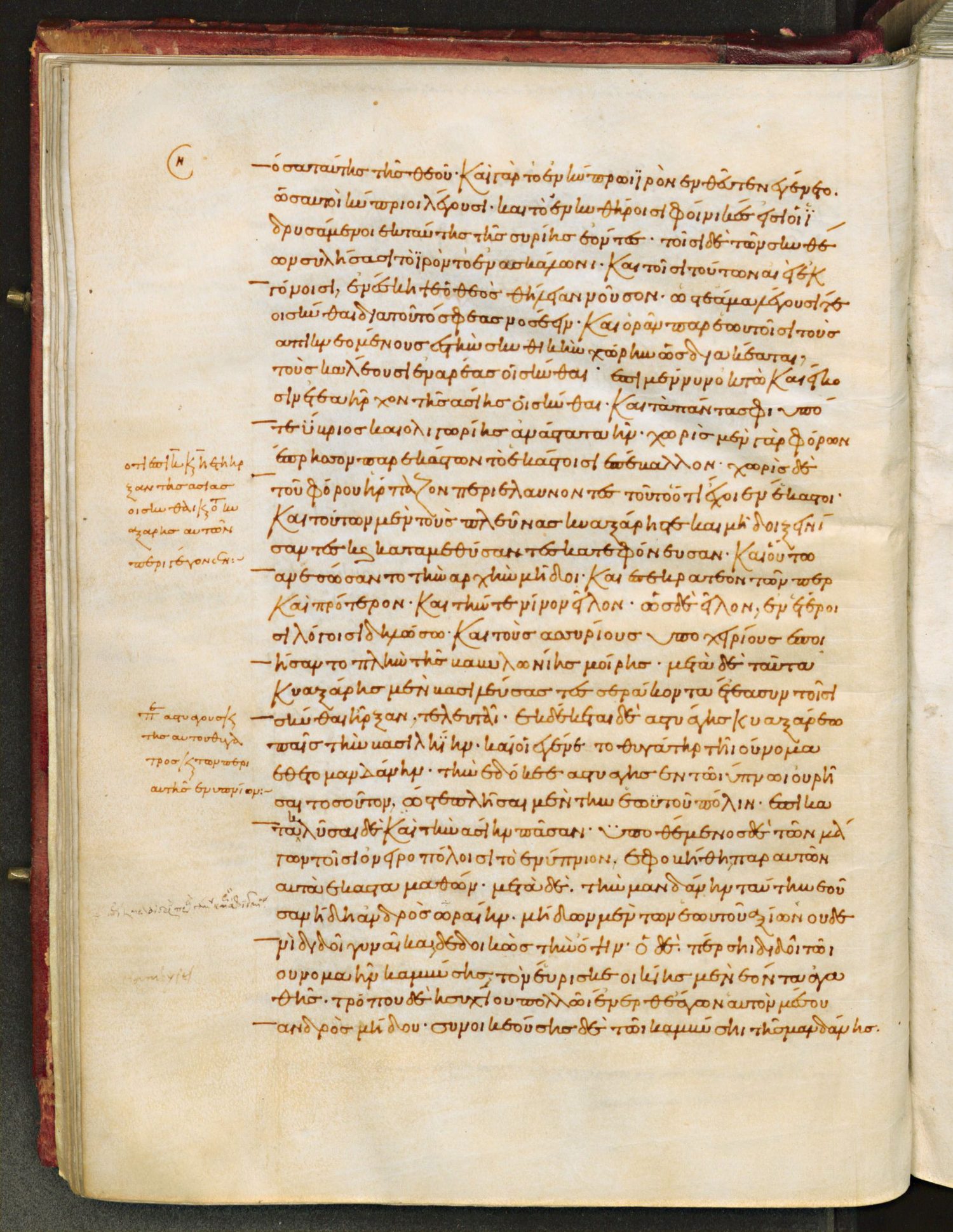
Laur. Plut. 70.3, fol. 28v: Greek here 1.107.1 to 1.108.1. Checked on the image (first and last words read and located in the Greek; each break checked against the neighbouring page): fol. 28v begins ‹ὅσα ταύτης τῆς θεοῦ·› (1.105.3), ends ‹τῷ Καμβύσῃ τῆς Μανδάνης› (1.108.1). English here: 1.107.1 to 1.107.2 (Godley's sentences for the sections whose Greek lies mostly on this page).
1.107.1μετὰ δὲ ταῦτα Κυαξάρης μέν, βασιλεύσας τεσσεράκοντα ἔτεα σὺν τοῖσι Σκύθαι ἦρξαν, τελευτᾷ, ἐκδέκεται δὲ Ἀστυάγης Κυαξάρεω παῖς τὴν βασιληίην. Καὶ οἱ ἐγένετο θυγάτηρ τῇ οὔνομα ἔθετο Μανδάνην· τὴν ἐδόκεε Ἀστυάγης ἐν τῷ ὕπνῳ οὐρῆσαι τοσοῦτον ὥστε πλῆσαι μὲν τὴν ἑωυτοῦ πόλιν, ἐπικατακλύσαι δὲ καὶ τὴν Ἀσίην πᾶσαν. ὑπερθέμενος δὲ τῶν Μάγων τοῖσι ὀνειροπόλοισι τὸ ἐνύπνιον, ἐφοβήθη παρʼ αὐτῶν αὐτὰ ἕκαστα μαθών. 1.107.2μετὰ δὲ τὴν Μανδάνην ταύτην ἐοῦσαν ἤδη ἀνδρὸς ὡραίην Μήδων μὲν τῶν ἑωυτοῦ ἀξίων οὐδενὶ διδοῖ γυναῖκα, δεδοικὼς τὴν ὄψιν· ὁ δὲ Πέρσῃ διδοῖ τῷ οὔνομα ἦν Καμβύσης, τὸν εὕρισκε οἰκίης μὲν ἐόντα ἀγαθῆς τρόπου δὲ ἡσυχίου, πολλῷ ἔνερθε ἄγων αὐτὸν μέσου ἀνδρὸς Μήδου. 1.108.1συνοικεούσης δὲ τῷ Καμβύσῃ τῆς Μανδάνης,
1.107.1Afterwards Cyaxares died after a reign of forty years (among which I count the years of the Scythian domination): and his son Astyages reigned in his stead. Astyages had a daughter, whom he called Mandane: concerning whom he had a dream, that enough water flowed from her to fill his city and overflow all Asia. He imparted this vision to those of the Magi who interpreted dreams, and when he heard what they told him he was terrified: 1.107.2and presently, Mandane being now of marriageable age, he feared the vision too much to give her to any Median worthy to mate with his family, but wedded her to a Persian called Cambyses, a man whom he knew to be well born and of a quiet temper: for Astyages held Cambyses to be much lower than a Mede of middle estate.
Where on the image
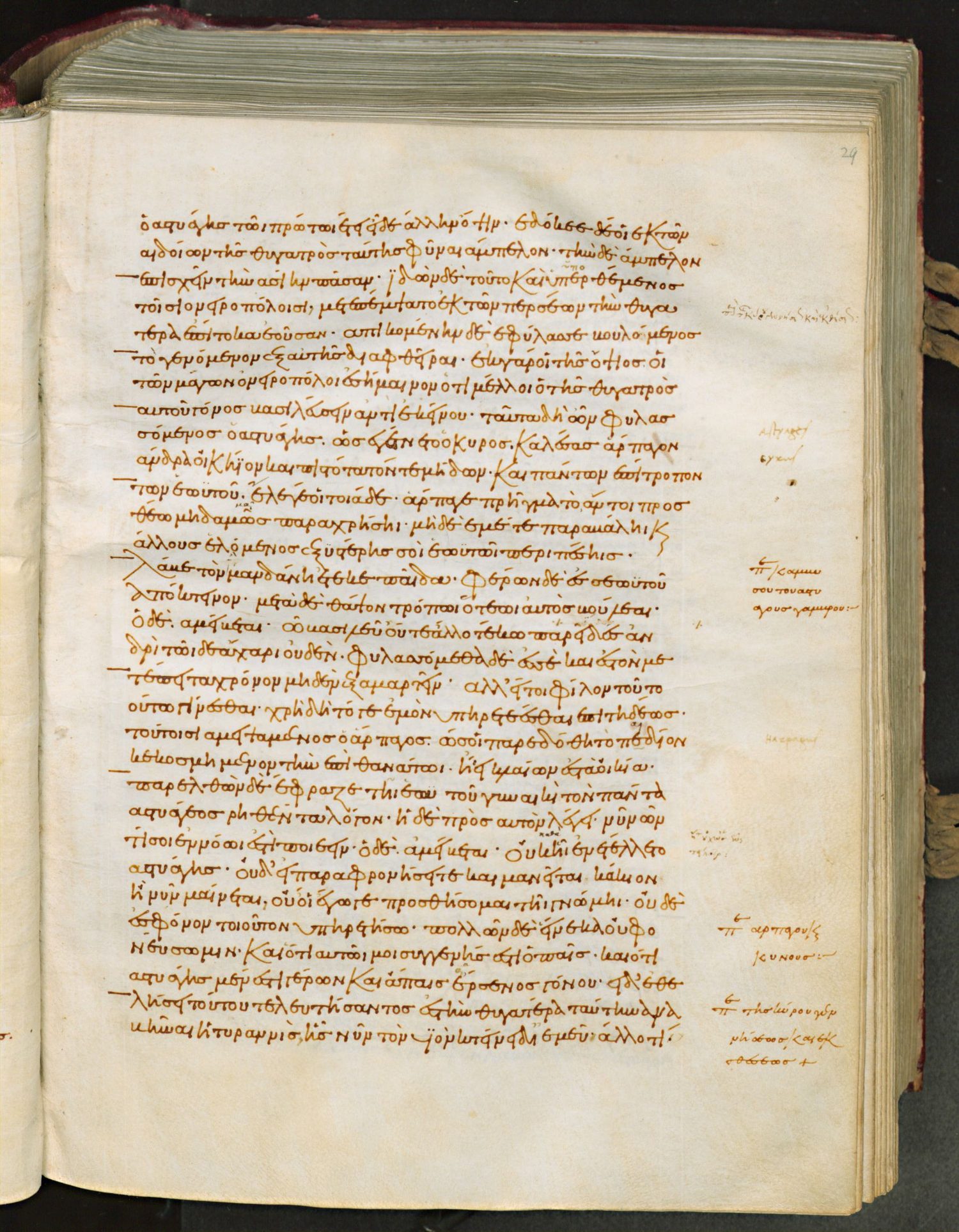
Laur. Plut. 70.3, fol. 29r: Greek here 1.108.1 to 1.109.4. Checked on the image (first and last words read and located in the Greek; each break checked against the neighbouring page): fol. 29r begins ‹ὁ Ἀστυάγης τῷ πρώτῳ› (1.108.1), ends ‹διʼ ἐμεῦ, ἄλλο τι› (1.109.4). English here: 1.108.1 to 1.109.4 (Godley's sentences for the sections whose Greek lies mostly on this page).
1.108.1ὁ Ἀστυάγης τῷ πρώτῳ ἔτεϊ εἶδε ἄλλην ὄψιν, ἐδόκεε δέ οἱ ἐκ τῶν αἰδοίων τῆς θυγατρὸς ταύτης φῦναι ἄμπελον, τὴν δὲ ἄμπελον ἐπισχεῖν τὴν Ἀσίην πᾶσαν. 1.108.2ἰδὼν δὲ τοῦτο καὶ ὑπερθέμενος τοῖσι ὀνειροπόλοισι, μετεπέμψατο ἐκ τῶν Περσέων τὴν θυγατέρα ἐπίτεκα ἐοῦσαν, ἀπικομένην δὲ ἐφύλασσε βουλόμενος τὸ γενόμενον ἐξ αὐτῆς διαφθεῖραι· ἐκ γάρ οἱ τῆς ὄψιος οἱ τῶν Μάγων ὀνειροπόλοι ἐσήμαινον ὅτι μέλλοι ὁ τῆς θυγατρὸς αὐτοῦ γόνος βασιλεύσειν ἀντὶ ἐκείνου. 1.108.3ταῦτα δὴ ὦν φυλασσόμενος ὁ Ἀστυάγης, ὡς ἐγένετο ὁ Κῦρος, καλέσας Ἅρπαγον ἄνδρα οἰκήιον καὶ πιστότατόν τε Μήδων καὶ πάντων ἐπίτροπον τῶν ἑωυτοῦ, ἔλεγὲ οἱ τοιάδε. 1.108.4Ἅρπαγε, πρῆγμα τὸ ἄν τοι προσθέω, μηδαμῶς παραχρήσῃ, μηδὲ ἐμέ τε παραβάλῃ καὶ ἄλλους ἑλόμενος ἐξ ὑστέρης σοὶ αὐτῷ περιπέσῃς· λάβε τὸν Μανδάνη ἔτεκε παῖδα, φέρων δὲ ἐς σεωυτοῦ ἀπόκτεινον, μετὰ δὲ θάψον τρόπῳ ὅτεῳ αὐτὸς βούλεαι. 1.108.5ὁ δὲ ἀμείβεται ὦ βασιλεῦ, οὔτε ἄλλοτε κω παρεῖδες ἀνδρὶ τῷδε ἄχαρι οὐδέν, φυλασσόμεθα δὲ ἐς σὲ καὶ ἐς τὸν μετέπειτα χρόνον μηδὲν ἐξαμαρτεῖν. ἀλλʼ εἲ τοι φίλον τοῦτο οὕτω γίνεσθαι, χρὴ δὴ τό γε ἐμὸν ὑπηρετέεσθαι ἐπιτηδέως. 1.109.1τούτοισι ἀμειψάμενος ὁ Ἅρπαγος, ὥς οἱ παρεδόθη τὸ παιδίον κεκοσμημένον τὴν ἐπὶ θανάτῳ ἤιε κλαίων ἐς τὰ οἰκία· παρελθὼν δὲ ἔφραζε τῇ ἑωυτοῦ γυναικὶ τὸν πάντα Ἀστυάγεος ῥηθέντα λόγον. 1.109.2ἣ δὲ πρὸς αὐτὸν λέγει νῦν ὦν τί σοὶ ἐν νόῳ ἐστὶ ποιέειν; ὁ δὲ ἀμείβεται οὐ τῇ ἐνετέλλετο Ἀστυάγης, οὐδʼ εἰ παραφρονήσει τε καὶ μανέεται κάκιον ἢ νῦν μαίνεται, οὔ οἱ ἔγωγε προσθήσομαι τῇ γνώμῃ οὐδὲ ἐς φόνον τοιοῦτον ὑπηρετήσω. 1.109.3πολλῶν δὲ εἵνεκα οὐ φονεύσω μιν, καὶ ὅτι αὐτῷ μοι συγγενής ἐστὶ ὁ παῖς, καὶ ὅτι Ἀστυάγης μὲν ἐστὶ γέρων καὶ ἅπαις ἔρσενος γόνου· 1.109.4εἰ δʼ ἐθελήσει τούτου τελευτήσαντος ἐς τὴν θυγατέρα ταύτην ἀναβῆναι ἡ τυραννίς, τῆς νῦν τὸν υἱὸν κτείνει διʼ ἐμεῦ, ἄλλο τι
1.108.1But in the first year of Mandane’s marriage to Cambyses Astyages saw a second vision. He dreamt that there grew from his daughter a vine, which covered the whole of Asia. 1.108.2Having seen this vision, and imparted it to the interpreters of dreams, he sent to the Persians for his daughter, then near her time, and when she came kept her guarded, desiring to kill whatever child she might bear: for the interpreters declared that the meaning of his dream was that his daughter’s offspring should rule in his place. 1.108.3Wishing to prevent this, Astyages on the birth of Cyrus summoned to him a man of his household called Harpagus, who was his faith fullest servant among the Medes and was 1.108.4steward of all his possessions: then he said, “Do not mishandle this command of mine, Harpagus, nor forsake me for the service of others, lest hereafter it be the worse for yourself. Take the boy whom Mandane has borne, and carry him to your house and kill him: and then bury him in what manner you yourself will.” 1.108.5“King,” Harpagus answered, “never yet have you seen me do aught unpleasing to you; and I will ever be careful not to offend against you. But if it is your will that this should so be done, then it behoves that for my part I render you fitting service.” 1.109.1Thus answered Harpagus. The child was then given to him, adorned for its death, and he went to his house weeping. When he came in he told his wife all the command given him by Astyages. 1.109.2“Now, therefore,” said she to him, “what purpose you to do?” “Not,” he answered, “to obey Astyages’ behest, no, not though he lose his wits and be more frantic than now he is: even so I myself will not serve his purpose, nor be his instrument for such a murder. 1.109.3There are many reasons why I will not kill the child: he is akin to myself, and further, Astyages is old, and has no male issue: 1.109.4now if after his death the sovereignty passes to this daughter of his, whose son he is now using me to slay, what is left for me but the greatest of all dangers? Nay, for my safety I must see that the boy dies, but the deed must be done by some one of Astyages’ own men and not of mine.”
Where on the image
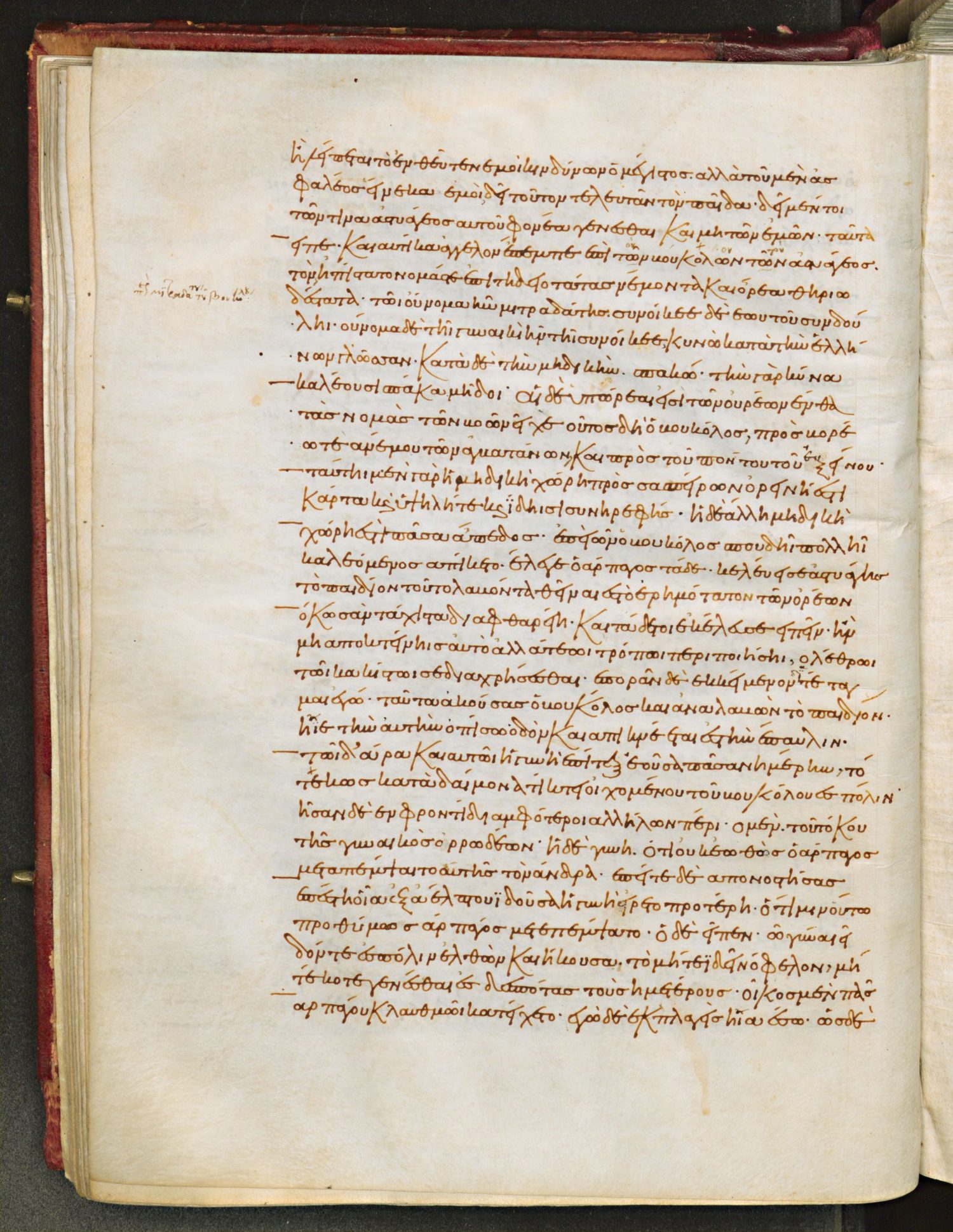
Laur. Plut. 70.3, fol. 29v: Greek here 1.109.4 to 1.111.3. Checked on the image (first and last words read and located in the Greek; each break checked against the neighbouring page): fol. 29v begins ‹ἢ λείπεται τὸ ἐνθεῦτεν› (1.109.4), ends ‹ἐκπλαγεὶς ἤια ἔσω.ὡς δὲ› (1.111.3). English here: 1.110.1 to 1.111.3 (Godley's sentences for the sections whose Greek lies mostly on this page).
1.109.4ἢ λείπεται τὸ ἐνθεῦτεν ἐμοὶ κινδύνων ὁ μέγιστος; ἀλλὰ τοῦ μὲν ἀσφαλέος εἵνεκα ἐμοὶ δεῖ τοῦτον τελευτᾶν τὸν παῖδα, δεῖ μέντοι τῶν τινα Ἀστυάγεος αὐτοῦ φονέα γενέσθαι καὶ μὴ τῶν ἐμῶν. 1.110.1ταῦτα εἶπε καὶ αὐτίκα ἄγγελον ἔπεμπε ἐπὶ τῶν βουκόλων τῶν Ἀστυάγεος τὸν ἠπίστατο νομάς τε ἐπιτηδεοτάτας νέμοντα καὶ ὄρεα θηριωδέστατα· τῷ οὔνομα ἦν Μιτραδάτης, συνοίκεε δὲ ἑωυτοῦ συνδούλῃ, οὔνομα δὲ τῇ γυναικὶ ἦν τῇ συνοίκεε Κυνὼ κατὰ τὴν Ἑλλήνων γλῶσσαν, κατὰ δὲ τὴν Μηδικὴν Σπακώ· τὴν γὰρ κύνα καλέουσι σπάκα Μῆδοι. 1.110.2αἱ δὲ ὑπώρεαί εἰσὶ τῶν ὀρέων, ἔνθα τὰς νομὰς τῶν βοῶν εἶχε οὗτος δὴ ὁ βουκόλος, πρὸς βορέω τε ἀνέμου τῶν Ἀγβατάνων καὶ πρὸς τοῦ πόντου τοῦ Εὐξείνου· ταύτῃ μὲν γὰρ ἡ Μηδικὴ χωρῇ πρὸς Σασπείρων ὀρεινή ἐστι κάρτα καὶ ὑψηλή τε καὶ ἴδῃσι συνηρεφής, ἡ δὲ ἄλλη Μηδικὴ χωρῇ ἐστὶ πᾶσα ἄπεδος. 1.110.3ἐπεὶ ὦν ὁ βουκόλος σπουδῇ πολλῇ καλεόμενος ἀπίκετο, ἔλεγε ὁ Ἅρπαγος τάδε. κελεύει σε Ἀστυάγης τὸ παιδίον τοῦτο λαβόντα θεῖναι ἐς τὸ ἐρημότατον τῶν ὀρέων, ὅκως ἂν τάχιστα διαφθαρείη· καὶ τάδε τοὶ ἐκέλευσε εἰπεῖν, ἢν μὴ ἀποκτείνῃς αὐτὸ ἀλλὰ τεῷ τρόπῳ περιποιήσῃς, ὀλέθρῳ τῷ κακίστῳ σε διαχρήσεσθαι. ἐπορᾶν δὲ ἐκκείμενον τέταγμαι ἐγώ. 1.111.1ταῦτα ἀκούσας ὁ βουκόλος καὶ ἀναλαβὼν τὸ παιδίον ἤιε τὴν αὐτὴν ὀπίσω ὁδὸν καὶ ἀπικνέεται ἐς τὴν ἔπαυλιν. τῷ δʼ ἄρα καὶ αὐτῷ ἡ γυνή, ἐπίτεξ ἐοῦσα πᾶσαν ἡμέρην, τότε κως κατὰ δαίμονα τίκτει οἰχομένου τοῦ βουκόλου ἐς πόλιν. ἦσαν δὲ ἐν φροντίδι ἀμφότεροι ἀλλήλων πέρι, ὃ μὲν τοῦ τόκου τῆς γυναικὸς ἀρρωδέων, ἡ δὲ γυνὴ ὅ τι οὐκ ἐωθὼς ὁ Ἅρπαγος μεταπέμψαιτο αὐτῆς τὸν ἄνδρα. 1.111.2ἐπείτε δὲ ἀπονοστήσας ἐπέστη, οἷα ἐξ ἀέλπτου ἰδοῦσα ἡ γυνὴ εἴρετο προτέρη ὅ τι μιν οὕτω προθύμως Ἅρπαγος μετεπέμψατο. ὁ δὲ εἶπε ὤ γύναι, εἶδόν τε ἐς πόλιν ἐλθὼν καὶ ἤκουσα τὸ μήτε ἰδεῖν ὄφελον μήτε κοτὲ γενέσθαι ἐς δεσπότας τοὺς ἡμετέρους. οἶκος μὲν πᾶς Ἁρπάγου κλαυθμῷ κατείχετο, ἐγὼ δὲ ἐκπλαγεὶς ἤια ἔσω. 1.111.3ὡς δὲ
1.110.1So saying, he sent forthwith a messenger to that one of Astyages’ cowherds whom he knew to pasture his herds in the likeliest places and where the mountains were most haunted of wild beasts. The man’s name was Mitradates, and his wife was a slave like him; her name was in the Greek language Cyno, in the Median Spako: for “spax” is the Median name for a dog. 1.110.2The foothills of the mountains where this cowherd pastured his kine are to the north of Agbatana, towards the Euxine sea: for the rest of Media is everywhere a level plain, but here, on the side of the Saspires, the land is very high and mountainous and covered with woods. 1.110.3So when the cowherd came with all speed at the summons, Harpagus said: “Astyages bids you take this child and lay it in the most desolate part of the mountains, that it may thus perish as soon as may be. And he bids me say, that if you kill not the child, but in any way save it alive, you shall die a terrible death: and it is I who am ordered to see it exposed.” 1.111.1Hearing this, the cowherd took up the child and returned by the same way and came to his steading. Now it chanced that his wife too had been expecting her time every day, and providence so ordained that she was brought to bed while her man was away in the city. Each of them was anxious for the other, the husband being afraid about his wife’s travail, and the wife because she knew not why Harpagus had so unwontedly sent for her husband. 1.111.2So when he returned and came before her, she was startled by the unexpected sight and asked him before he could speak why Harpagus had so instantly summoned him. “Wife,” he said, “when I came to the city, I saw and heard what I would I had never seen, and what I would had never happened to our masters. All the house of Harpagus was full of weeping; and I was astonished, and entered in; 1.111.3and immediately I saw a child laid there struggling and crying, decked out with gold and many-coloured raiment. And when Harpagus saw me, he bade me take the child with all speed and bear it away and lay it where there are most wild beasts in the mountains: it was Astyages, he said, who laid this command on me, and Harpagus threatened me grievously if I did not do his will.
Where on the image
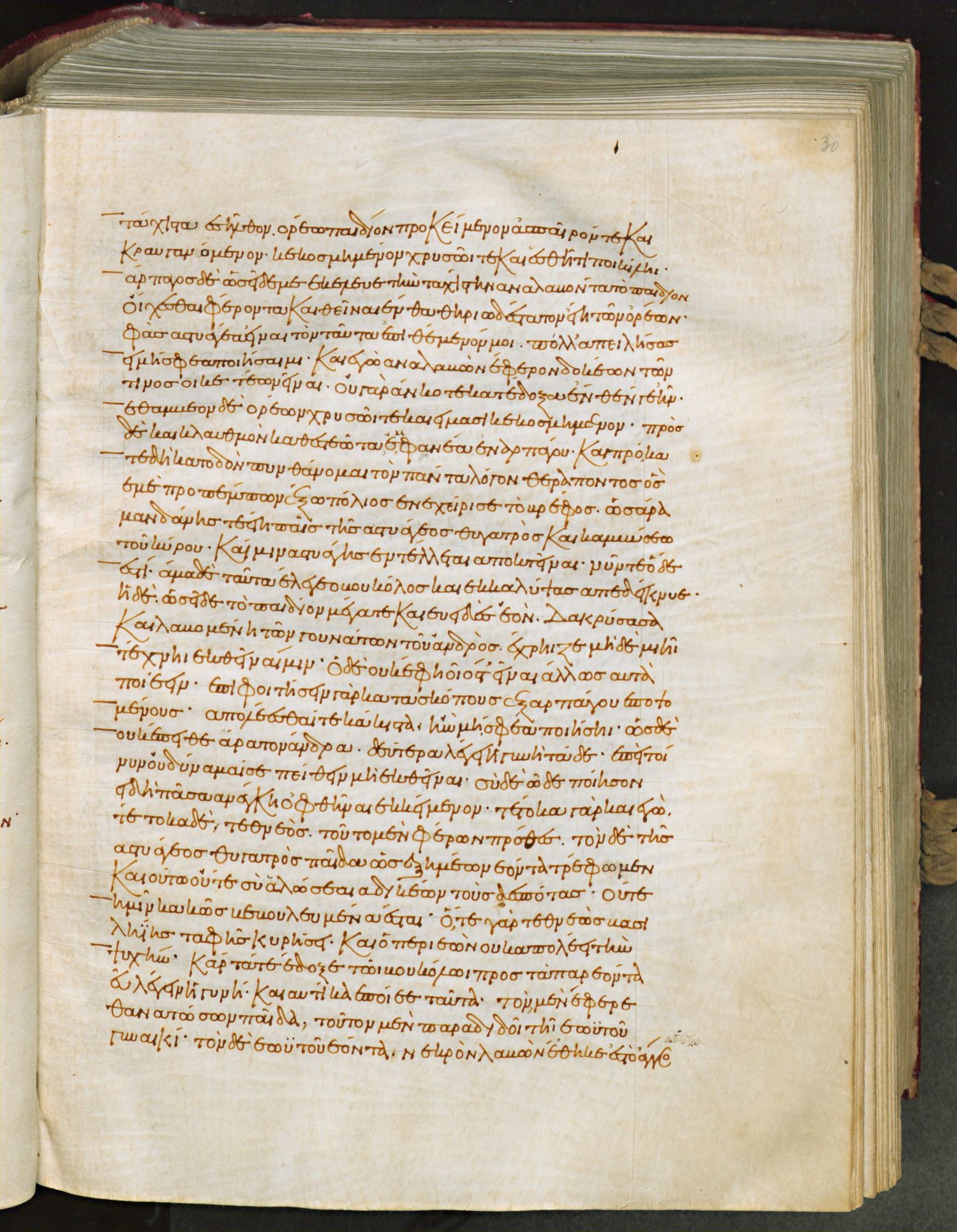
Laur. Plut. 70.3, fol. 30r: Greek here 1.111.3 to 1.113.1. Checked on the image (first and last words read and located in the Greek; each break checked against the neighbouring page): fol. 30r begins ‹τάχιστα ἐσῆλθον, ὁρέω παιδίον› (1.111.3), ends ‹ἔθηκε ἐς τὸ ἄγγος› (1.113.1). English here: 1.111.4 to 1.113.2 (Godley's sentences for the sections whose Greek lies mostly on this page).
1.111.3τάχιστα ἐσῆλθον, ὁρέω παιδίον προκείμενον ἀσπαῖρόν τε καὶ κραυγανόμενον, κεκοσμημένον χρυσῷ τε καὶ ἐσθῆτι ποικίλῃ. Ἅρπαγος δὲ ὡς εἶδέ με, ἐκέλευε τὴν ταχίστην ἀναλαβόντα τὸ παιδίον οἴχεσθαι φέροντα καὶ θεῖναι ἔνθα θηριωδέστατον εἴη τῶν ὀρέων, φὰς Ἀστυάγεα εἶναι τὸν ταῦτα ἐπιθέμενόν μοι, πόλλʼ ἀπειλήσας εἰ μή σφεα ποιήσαιμι. 1.111.4καὶ ἐγὼ ἀναλαβὼν ἔφερον, δοκέων τῶν τινος οἰκετέων εἶναι· οὐ γὰρ ἂν κοτὲ κατέδοξα ἔνθεν γε ἦν. ἐθάμβεον δὲ ὁρέων χρυσῷ τε καὶ εἵμασι κεκοσμημένον, πρὸς δὲ καὶ κλαυθμὸν κατεστεῶτα ἐμφανέα ἐν Ἁρπάγου. 1.111.5καὶ πρόκατε δὴ κατʼ ὁδὸν πυνθάνομαι τὸν πάντα λόγον θεράποντος, ὃς ἐμὲ προπέμπων ἔξω πόλιος ἐνεχείρισε τὸ βρέφος, ὡς ἄρα Μανδάνης τε εἴη παῖς τῆς Ἀστυάγεος θυγατρὸς καὶ Καμβύσεω τοῦ Κύρου, καί μιν Ἀστυάγης ἐντέλλεται ἀποκτεῖναι. νῦν τε ὅδε ἐστί. 1.112.1ἅμα δὲ ταῦτα ἔλεγε ὁ βουκόλος καὶ ἐκκαλύψας ἀπεδείκνυε. ἣ δὲ ὡς εἶδε τὸ παιδίον μέγα τε καὶ εὐειδὲς ἐόν, δακρύσασα καὶ λαβομένη τῶν γουνάτων τοῦ ἀνδρὸς ἐχρήιζε μηδεμιῇ τέχνῃ ἐκθεῖναί μιν. 1.112.2ὁ δὲ οὐκ ἔφη οἷός τʼ εἶναι ἄλλως αὐτὰ ποιέειν· ἐπιφοιτήσειν γὰρ κατασκόπους ἐξ Ἁρπάγου ἐποψομένους, ἀπολέεσθαί τε κάκιστα ἢν μὴ σφεα ποιήσῃ. ὡς δὲ οὐκ ἔπειθε ἄρα τὸν ἄνδρα, δευτέρα λέγει ἡ γυνὴ τάδε. ἐπεὶ τοίνυν οὐ δύναμαί σε πείθειν μὴ ἐκθεῖναι, σὺ δὲ ὧδε ποίησον, εἰ δὴ πᾶσα ἀνάγκη ὀφθῆναι ἐκκείμενον. τέτοκα γὰρ καὶ ἐγώ, τέτοκα δὲ τεθνεός. 1.112.3τοῦτο μὲν φέρων πρόθες, τὸν δὲ τῆς Ἀστυάγεος θυγατρὸς παῖδα ὡς ἐξ ἡμέων ἐόντα τρέφωμεν. καὶ οὕτω οὔτε σὺ ἁλώσεαι ἀδικέων τοὺς δεσπότας οὔτε ἡμῖν κακῶς βεβουλευμένα ἔσται· ὅ τε γὰρ τεθνεὼς βασιληίης ταφῆς κυρήσει καὶ ὁ περιεὼν οὐκ ἀπολέει τὴν ψυχήν. 1.113.1κάρτα τε ἔδοξε τῷ βουκόλῳ πρὸς τὰ παρεόντα εὖ λέγειν ἡ γυνή, καὶ αὐτίκα ἐποίεε ταῦτα· τὸν μὲν ἔφερε θανατώσων παῖδα, τοῦτον μὲν παραδιδοῖ τῇ ἑωυτοῦ γυναικί, τὸν δὲ ἑωυτοῦ ἐόντα νεκρὸν λαβὼν ἔθηκε ἐς τὸ ἄγγος
1.111.4So I took up the child and bore him away, supposing him to be the child of someone in the household; for I could never have guessed whose he was. But I was amazed at seeing him decked with gold and raiment, and at hearing moreover the manifest sound of weeping in the house of Harpagus. 1.111.5Very soon on the way I heard all the story from a servant who brought me out of the city and gave the child into my charge: to wit, that it was the son of Mandane the king’s daughter and Cambyses the son of Cyrus, and that Astyages bade him slay the child. And now, here is the child.” 1.112.1And with that the cowherd uncovered it and showed it. But when the woman saw how fine and fair the child was, she fell a-weeping and laid hold of the man’s knees and entreated him by no means to expose him. But the husband said he could do no other; for, he said, there would be comings of spies from Harpagus to see what was done, and he must die a terrible death if he did not obey. 1.112.2So then being unable to move her husband, the woman said next: “Since I cannot move you from your purpose to expose, then do you do this, if needs must that a child be seen exposed. 1.112.3Know that I too have borne a child, but it was dead; take it now and lay it out, but, for the child of the daughter of Astyages, let us rear it as it were our own; so shall you escape punishment for offending against our masters, and we shall have taken no evil counsel. For the child that is dead will have royal burial, and he that is alive will not lose his life.” 1.113.1Thinking that his wife counselled him exceeding well in his present strait, the cowherd straightway did as she said. He gave his wife the child whom he had brought to kill him, and his own dead child he put into the chest wherein he carried the other, 1.113.2and decked it with all the other child’s adornment and laid it out in the most desolate part of the mountains. Then on the third day after the laying out of the child, the cowherd left one of his herdsmen to guard it and went to the city, where he came to Harpagus’ house and said he was ready to show the child’s dead body.
Where on the image
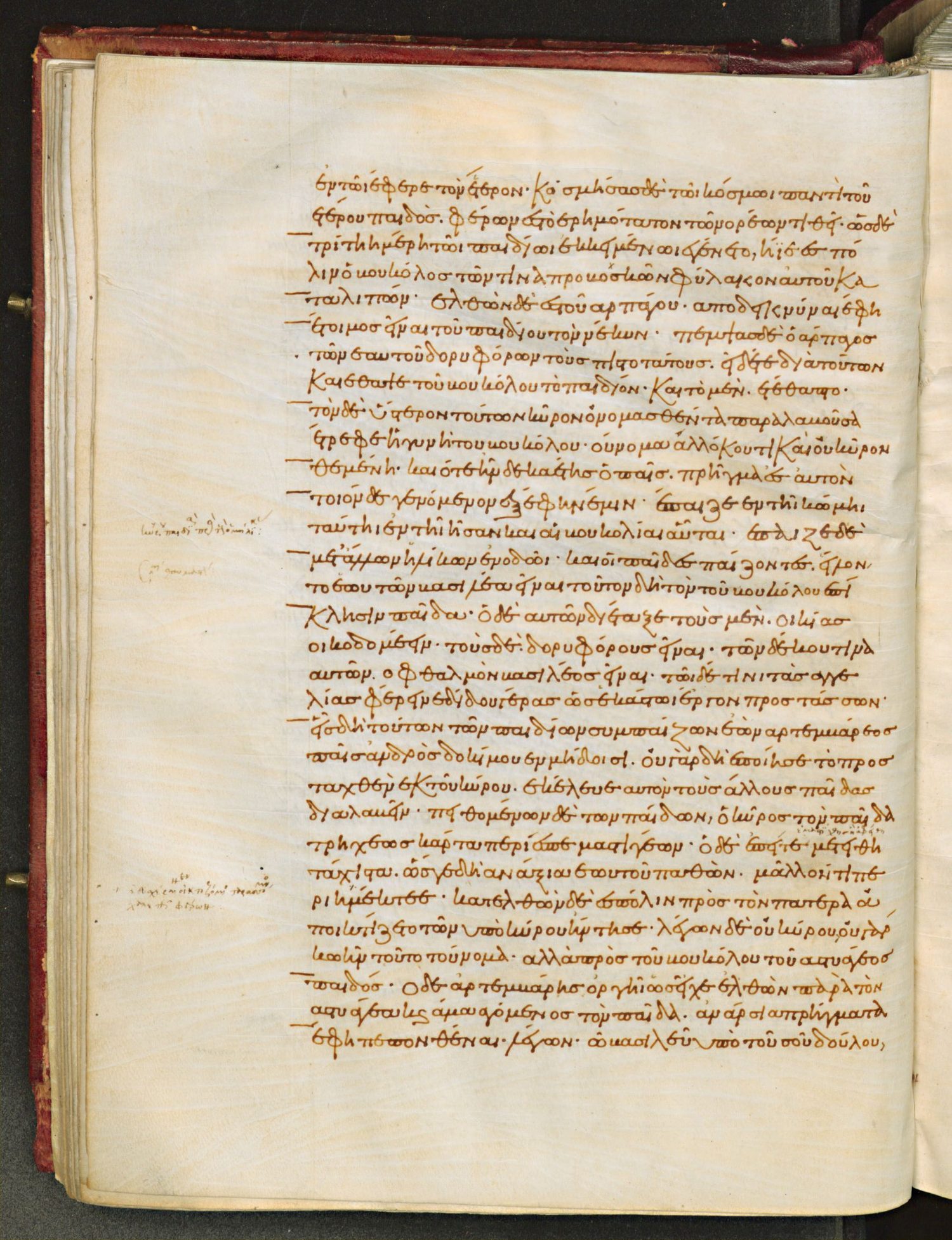
Laur. Plut. 70.3, fol. 30v: Greek here 1.113.1 to 1.114.5. Checked on the image (first and last words read and located in the Greek; each break checked against the neighbouring page): fol. 30v begins ‹ἐν τῷ ἔφερε τὸν› (1.113.1), ends ‹ὑπὸ τοῦ σοῦ δούλου› (1.114.5). English here: 1.113.3 to 1.114.5 (Godley's sentences for the sections whose Greek lies mostly on this page).
1.113.1ἐν τῷ ἔφερε τὸν ἕτερον· 1.113.2κοσμήσας δὲ τῷ κόσμῳ παντὶ τοῦ ἑτέρου παιδός, φέρων ἐς τὸ ἐρημότατον τῶν ὀρέων τίθει. ὡς δὲ τρίτη ἡμέρη τῷ παιδίῳ ἐκκειμένῳ ἐγένετο, ἤιε ἐς πόλιν ὁ βουκόλος, τῶν τινα προβοσκῶν φύλακον αὐτοῦ καταλιπών, ἐλθὼν δὲ ἐς τοῦ Ἁρπάγου ἀποδεικνύναι ἔφη ἕτοιμος εἶναι τοῦ παιδίου τὸν νέκυν. 1.113.3πέμψας δὲ ὅ Ἅρπαγος τῶν ἑωυτοῦ δορυφόρων τοὺς πιστοτάτους εἶδέ τε διὰ τούτων καὶ ἔθαψε τοῦ βουκόλου τὸ παιδίον, καὶ τὸ μὲν ἐτέθαπτο, τὸν δὲ ὕστερον τούτων Κῦρον ὀνομασθέντα παραλαβοῦσα ἔτρεφε ἡ γυνὴ τοῦ βουκόλου, οὔνομα ἄλλο κού τι καὶ οὐ Κῦρον θεμένη. 1.114.1καὶ ὅτε ἦν δεκαέτης ὁ παῖς, πρῆγμα ἐς αὑτὸν τοιόνδε γενόμενον ἐξέφηνέ μιν. ἔπαιζε ἐν τῇ κώμῃ ταύτῃ ἐν τῇ ἦσαν καὶ αἱ βουκολίαι αὗται, ἔπαιζε δὲ μετʼ ἄλλων ἡλίκων ἐν ὁδῷ. καὶ οἱ παῖδες παίζοντες εἵλοντο ἑωυτῶν βασιλέα εἶναι τοῦτον δὴ τὸν τοῦ βουκόλου ἐπίκλησιν παῖδα. 1.114.2ὁ δὲ αὐτῶν διέταξε τοὺς μὲν οἰκίας οἰκοδομέειν, τοὺς δὲ δορυφόρους εἶναι, τὸν δέ κου τινὰ αὐτῶν ὀφθαλμὸν βασιλέος εἶναι, τῷ δὲ τινὶ τὰς ἀγγελίας φέρειν ἐδίδου γέρας, ὡς ἑκάστῳ ἔργον προστάσσων. 1.114.3εἷς δὴ τούτων τῶν παίδων συμπαίζων, ἐὼν Ἀρτεμβάρεος παῖς ἀνδρὸς δοκίμου ἐν Μήδοισι, οὐ γὰρ δὴ ἐποίησε τὸ προσταχθὲν ἐκ τοῦ Κύρου, ἐκέλευε αὐτὸν τοὺς ἄλλους παῖδας διαλαβεῖν, πειθομένων δὲ τῶν παίδων ὁ Κῦρος τὸν παῖδα τρηχέως κάρτα περιέσπε μαστιγέων. 1.114.4ὁ δὲ ἐπείτε μετείθη τάχιστα, ὡς γε δὴ ἀνάξια ἑωυτοῦ παθών, μᾶλλόν τι περιημέκτεε, κατελθὼν δὲ ἐς πόλιν πρὸς τὸν πατέρα ἀποικτίζετο τῶν ὑπὸ Κύρου ἤντησε, λέγων δὲ οὐ Κύρου (οὐ γάρ κω ἦν τοῦτο τοὔνομα), ἀλλὰ πρὸς τοῦ βουκόλου τοῦ Ἀστυάγεος παιδός. 1.114.5ὁ δὲ Ἀρτεμβάρης ὀργῇ ὡς εἶχε ἐλθὼν παρὰ τὸν Ἀστυάγεα καὶ ἅμα ἀγόμενος τὸν παῖδα ἀνάρσια πρήγματα ἔφη πεπονθέναι, λέγων ὦ βασιλεῦ, ὑπὸ τοῦ σοῦ δούλου,
1.113.3Harpagus sent the most trusty of his bodyguard, and these saw for him and buried the cowherd’s child. So it was buried: and the cowherd’s wife took and reared the boy who was afterwards named Cyrus; but she gave him not that but some other name. 1.114.1Now when the boy was ten years old, it was revealed in some such wise as this who he was. He was playing in the village where these herdsmen’s quarters were: there he was playing in the road with others of his age. The boys in their play chose for their king that one who passed for the son of the cowherd. 1.114.2Then he set them severally to their tasks, some to the building of houses, some to be his bodyguard, one (as I suppose) to be the King’s Eye; to another he gave the right’ of bringing him messages; to each he gave his proper work. 1.114.3Now one of these boys who played with him was son to Artembares, a notable Median; as he did not obey the command Cyrus gave him, Cyrus bade the other boys seize him, and when they did so he dealt very roughly with the boy and scourged him. 1.114.4As soon as he was loosed, very angry at the wrong done him, he went down to his father in the city and complained of what he had met with at the hands of the son of Astyages’ cowherd,—not calling him Cyrus, for that name had not yet been given. 1.114.5Artembares went with his anger fresh upon him to Astyages, bringing his son and telling of the cruel usage he had had: “O King,” said he, “see the outrage done to us by the son of your slave, the son of a cowherd!” and with that he showed his son’s shoulders.
Where on the image
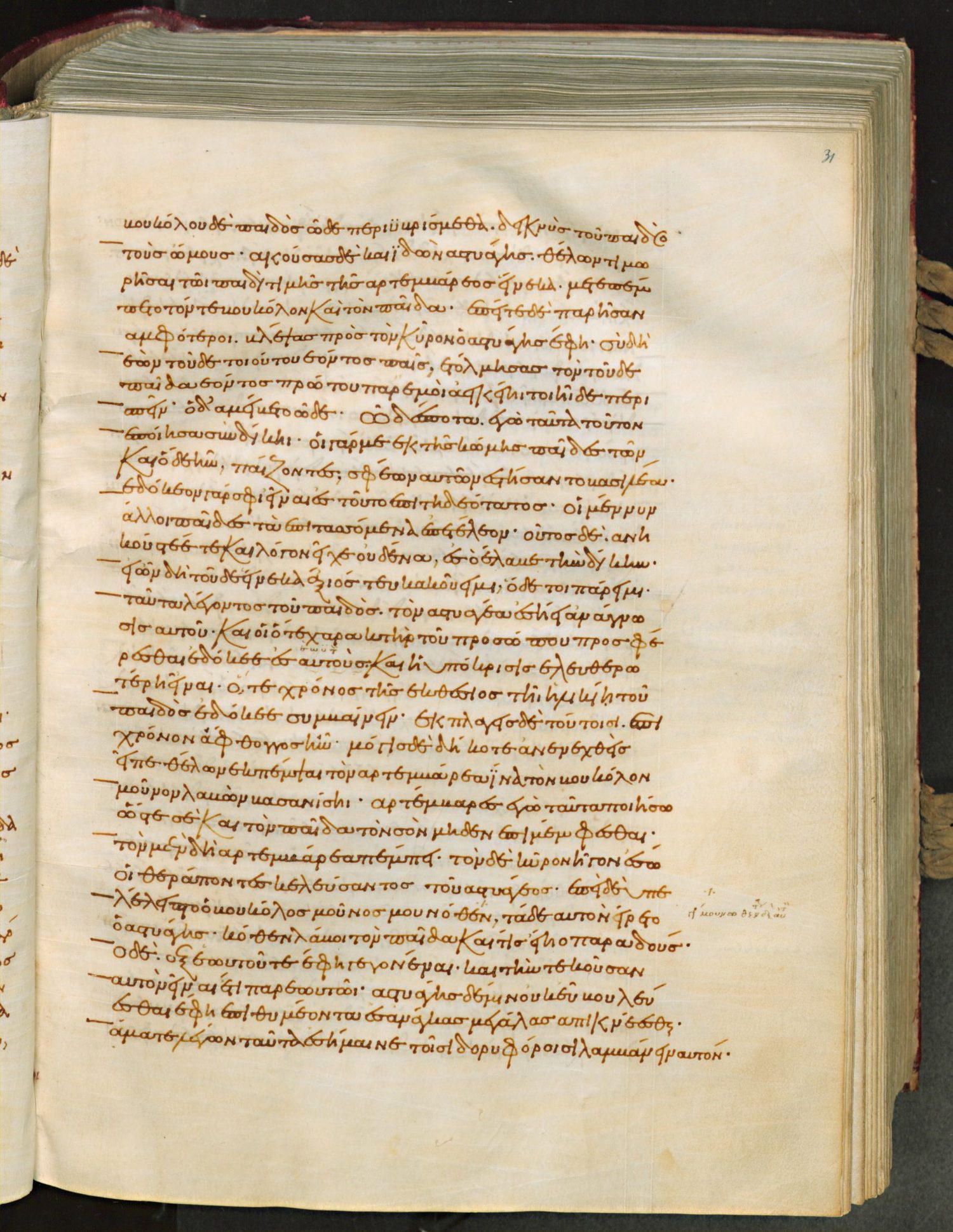
Laur. Plut. 70.3, fol. 31r: Greek here 1.114.5 to 1.116.4. Checked on the image (first and last words read and located in the Greek; each break checked against the neighbouring page): fol. 31r begins ‹βουκόλου δὲ παιδὸς ὧδε› (1.114.5), ends ‹τοῖσι δορυφόροισι λαμβάνειν αὐτόν› (1.116.4). English here: 1.115.1 to 1.116.4 (Godley's sentences for the sections whose Greek lies mostly on this page).
1.114.5βουκόλου δὲ παιδὸς ὧδε περιυβρίσμεθα, δεικνὺς τοῦ παιδὸς τοὺς ὤμους. 1.115.1ἀκούσας δὲ καὶ ἰδὼν Ἀστυάγης, θέλων τιμωρῆσαι τῷ παιδὶ τιμῆς τῆς Ἀρτεμβάρεος εἵνεκα, μετεπέμπετο τόν τε βουκόλον καὶ τὸν παῖδα. ἐπείτε δὲ παρῆσαν ἀμφότεροι, βλέψας πρὸς τὸν Κῦρον ὁ Ἀστυάγης ἔφη 1.115.2σὺ δὴ ἐὼν τοῦδε τοιούτου ἐόντος παῖς ἐτόλμησας τὸν τοῦδε παῖδα ἐόντος πρώτου παρʼ ἐμοὶ ἀεικείῃ τοιῇδε περισπεῖν; ὁ δὲ ἀμείβετο ὧδε. ὦ δέσποτα, ἐγὼ ταῦτα τοῦτον ἐποίησα σὺν δίκῃ. οἱ γάρ με ἐκ τῆς κώμης παῖδες, τῶν καὶ ὅδε ἦν, παίζοντες σφέων αὐτῶν ἐστήσαντο βασιλέα· ἐδόκεον γὰρ σφι εἶναι ἐς τοῦτο ἐπιτηδεότατος. 1.115.3οἱ μέν νυν ἄλλοι παῖδες τὰ ἐπιτασσόμενα ἐπετέλεον, οὗτος δὲ ἀνηκούστεέ τε καὶ λόγον εἶχε οὐδένα, ἐς ὃ ἔλαβὲ τὴν δίκην. εἰ ὦν δὴ τοῦδε εἵνεκα ἄξιός τευ κακοῦ εἰμί, ὅδε τοὶ πάρειμι. 1.116.1ταῦτα λέγοντος τοῦ παιδὸς τὸν Ἀστυάγεα ἐσήιε ἀνάγνωσις αὐτοῦ, καὶ οἱ ὅ τε χαρακτὴρ τοῦ προσώπου προσφέρεσθαι ἐδόκεε ἐς ἑωυτὸν καὶ ἡ ὑπόκρισις ἐλευθερωτέρη εἶναι, ὅ τε χρόνος τῆς ἐκθέσιος τῇ ἡλικίῃ τοῦ παιδὸς ἐδόκεε συμβαίνειν. 1.116.2ἐκπλαγεὶς δὲ τούτοισι ἐπὶ χρόνον ἄφθογγος ἦν· μόγις δὲ δή κοτε ἀνενειχθεὶς εἶπε, θέλων ἐκπέμψαι τὸν Ἀρτεμβάρεα, ἵνα τὸν βουκόλον μοῦνον λαβὼν βασανίσῃ, Ἀρτέμβαρες, ἐγὼ ταῦτα ποιήσω ὥστε σὲ καὶ τὸν παῖδα τὸν σὸν μηδὲν ἐπιμέμφεσθαι. 1.116.3τὸν μὲν δὴ Ἀρτεμβάρεα πέμπει, τὸν δὲ Κῦρον ἦγον ἔσω οἱ θεράποντες κελεύσαντος τοῦ Ἀστυάγεος, ἐπεὶ δὲ ὑπελέλειπτο ὁ βουκόλος μοῦνος μουνόθεν, τάδε αὐτὸν εἴρετο ὁ Ἀστυάγεος, κόθεν λάβοι τὸν παῖδα καὶ τίς εἴη ὁ παραδούς. 1.116.4ὁ δὲ ἐξ ἑωυτοῦ τε ἔφη γεγονέναι καὶ τὴν τεκοῦσαν αὐτὸν εἶναι ἔτι παρʼ ἑωυτῷ. Ἀστυάγης δὲ μιν οὐκ εὖ βουλεύεσθαι ἔφη ἐπιθυμέοντα ἐς ἀνάγκας μεγάλας ἀπικνέεσθαι, ἅμα τε λέγων ταῦτα ἐσήμαινε τοῖσι δορυφόροισι λαμβάνειν αὐτόν.
1.115.1When Astyages heard and saw, he was ready to avenge the boy in justice to Artembares’ rank: so he sent for the cowherd and his son. When they were both present, Astyages said, fixing his eyes on Cyrus, “ 1.115.2Is it you, then, the son of such a father, who have dared to deal so despitefully with the son of the greatest of my courtiers?” “Nay, master,” answered Cyrus, “what I did to him I did with justice. The boys of the village, of whom he was one, chose me in their play to be their king: for they thought me the fittest to rule. 1.115.3The other boys then did as I bid them: but this one was disobedient and cared nothing for me, till he got his deserts. So now if I deserve punishment for this, here am I to take it.” 1.116.1While he spoke, it seemed to Astyages that he recognised Cyrus; the fashion of the boy’s countenance was like (he thought) to his own, and his manner of answering was freer than customary: and the time of the exposure seemed to agree with Cyrus’ age. 1.116.2Being thereby astonished, he sat awhile silent; but when at last with difficulty he could collect his wits, he said (for he desired to rid himself of Artembares and question the cowherd with none present), “I will so act, Artembares, that you and your son shall have no cause of complaint.” 1.116.3So he sent Artembares away, and the servants led Cyrus within at Astyages’ bidding. Then, the cowherd being left quite alone, Astyages asked him whence he had got the boy and from whose hands. 1.116.4The cowherd answered that Cyrus was his own son and that the mother was still in his house. “You are ill advised,” said Astyages, “desiring, as you do, to find yourself in a desperate strait,”—and with that he made a sign to the guard to seize him.
Where on the image
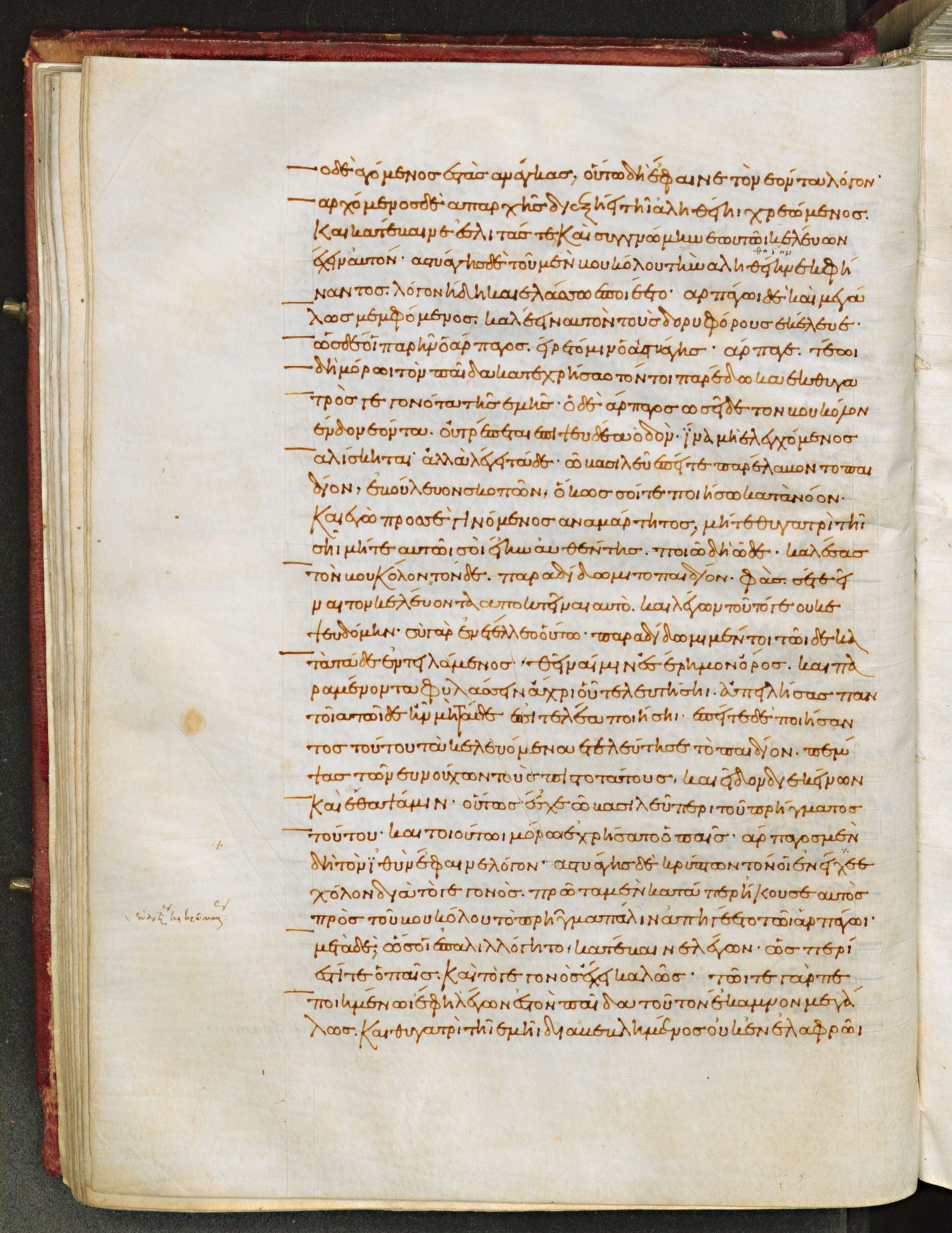
Laur. Plut. 70.3, fol. 31v: Greek here 1.116.5 to 1.118.2. Checked on the image (first and last words read and located in the Greek; each break checked against the neighbouring page): fol. 31v begins ‹ὁ δὲ ἀγόμενος ἐς› (1.116.5), ends ‹διαβεβλημένος οὐκ ἐν ἐλαφρῷ› (1.118.2). English here: 1.116.5 to 1.118.1 (Godley's sentences for the sections whose Greek lies mostly on this page).
1.116.5ὁ δὲ ἀγόμενος ἐς τὰς ἀνάγκας οὕτω δὴ ἔφαινε τὸν ἐόντα λόγον· ἀρχόμενος δὲ ἀπʼ ἀρχῆς διεξήιε τῇ ἀληθείῃ χρεώμενος, καὶ κατέβαινε ἐς λιτάς τε καὶ συγγνώμην ἑωυτῷ κελεύων ἔχειν αὐτόν. 1.117.1Ἀστυάγης δὲ τοῦ μὲν βουκόλου τὴν ἀληθείην ἐκφήναντος λόγον ἤδη καὶ ἐλάσσω ἐποιέετο, Ἁρπάγῳ δὲ καὶ μεγάλως μεμφόμενος καλέειν αὐτὸν τοὺς δορυφόρους ἐκέλευε. 1.117.2ὡς δέ οἱ παρῆν ὁ Ἅρπαγος, εἴρετό μιν ὁ Ἀστυάγης Ἅρπαγε, τέῳ δὴ μόρῳ τὸν παῖδα κατεχρήσαο τόν τοι παρέδωκα ἐκ θυγατρὸς γεγονότα τῆς ἐμῆς; ὁ δὲ Ἅρπαγος ὡς εἶδε τὸν βουκόλον ἔνδον ἐόντα, οὐ τρέπεται ἐπὶ ψευδέα ὁδόν, ἵνα μὴ ἐλεγχόμενος ἁλίσκηται, ἀλλὰ λέγει τάδε. 1.117.3ὦ βασιλεῦ, ἐπείτε παρέλαβον τὸ παιδίον, ἐβούλευον σκοπέων ὅκως σοί τε ποιήσω κατὰ νόον, καὶ ἐγὼ πρὸς σὲ γινόμενος ἀναμάρτητος μήτε θυγατρὶ τῇ σῇ μήτε αὐτῷ σοὶ εἴην αὐθέντης. 1.117.4ποιέω δὴ ὧδε· καλέσας τὸν βουκόλον τόνδε παραδίδωμι τὸ παιδίον, φὰς σέ τε εἶναι τὸν κελεύοντα ἀποκτεῖναι αὐτό. καὶ λέγων τοῦτό γε οὐκ ἐψευδόμην· σὺ γὰρ ἐνετέλλεο οὕτω. παραδίδωμι μέντοι τῷδε κατὰ τάδε ἐντειλάμενος, θεῖναὶ μιν ἐς ἔρημον ὄρος καὶ παραμένοντα φυλάσσειν ἄχρι οὗ τελευτήσῃ, ἀπειλήσας παντοῖα τῷδε ἢν μὴ τάδε ἐπιτελέα ποιήσῃ. 1.117.5ἐπείτε δὲ ποιήσαντος τούτου τὰ κελευόμενα ἐτελεύτησε τὸ παιδίον, πέμψας τῶν εὐνούχων τοὺς πιστοτάτους καὶ εἶδον διʼ ἐκείνων καὶ ἔθαψά μιν. οὕτω ἔσχε ὦ βασιλεῦ περὶ τοῦ πρήγματος τούτου, καὶ τοιούτῳ μόρῳ ἐχρήσατο ὁ παῖς. 1.118.1Ἅρπαγος μὲν δὴ τὸν ἰθὺν ἔφαινε λόγον· Ἀστυάγης δὲ κρύπτων τὸν οἱ ἐνεῖχε χόλον διὰ τὸ γεγονός, πρῶτα μέν, κατά περ ἤκουσε αὐτὸς πρὸς τοῦ βουκόλου τὸ πρῆγμα, πάλιν ἀπηγέετο τῷ Ἁρπάγῳ, μετὰ δὲ ὣς οἱ ἐπαλιλλόγητο, κατέβαινε λέγων ὡς περίεστί τε ὁ παῖς καὶ τὸ γεγονὸς ἔχει καλῶς· 1.118.2τῷ τε γὰρ πεποιημένῳ ἔφη λέγων ἐς τὸν παῖδα τοῦτον ἔκαμνον μεγάλως, καὶ θυγατρὶ τῇ ἐμῇ διαβεβλημένος οὐκ ἐν ἐλαφρῷ
1.116.5Then under stress of necessity the cowherd declared to him all the story, telling all truly as it had happened from the beginning: and at the last he prayed and entreated that the king would pardon him. 1.117.1When the truth had been so declared Astyages took thereafter less account of the cowherd, but he was very wroth with Harpagus and bade the guards summon him. 1.117.2Harpagus came, and Astyages asked him, “Harpagus, in what manner did you kill the boy, my daughter’s son, whom I gave you?” Harpagus saw the cowherd in the house, and did not take the way of falsehood, lest he should be caught and confuted: “ 1.117.3O King,” he said, “when, I took the boy, I thought and considered how I should do you pleasure, and not offend against you, yet not be held a murderer by your daughter or yourself. 1.117.4This then I did: I called to me yonder cowherd, and gave over the child to him, telling him that it was you who gave the command to kill it. And that was the truth; for such was your command. But I gave the child with the charge that the cowherd should lay it on a desolate mountainside, and wait there and watch till it be dead; and I threatened him with all punishments if he did not accomplish this. 1.117.5Then, when he had done what he was bid, and the child was dead, I sent the trustiest of my eunuchs and by them I saw and buried the body. This, O king, is the tale of the matter, and such was the end of the boy.” 1.118.1So Harpagus spoke the plain truth. Astyages hid the anger that he had against him for what had been done, and first he related the story again to Harpagus as he had heard it from the cowherd, then, after so repeating it, he made an end by saying that the boy was alive and good had come of it all.
Where on the image
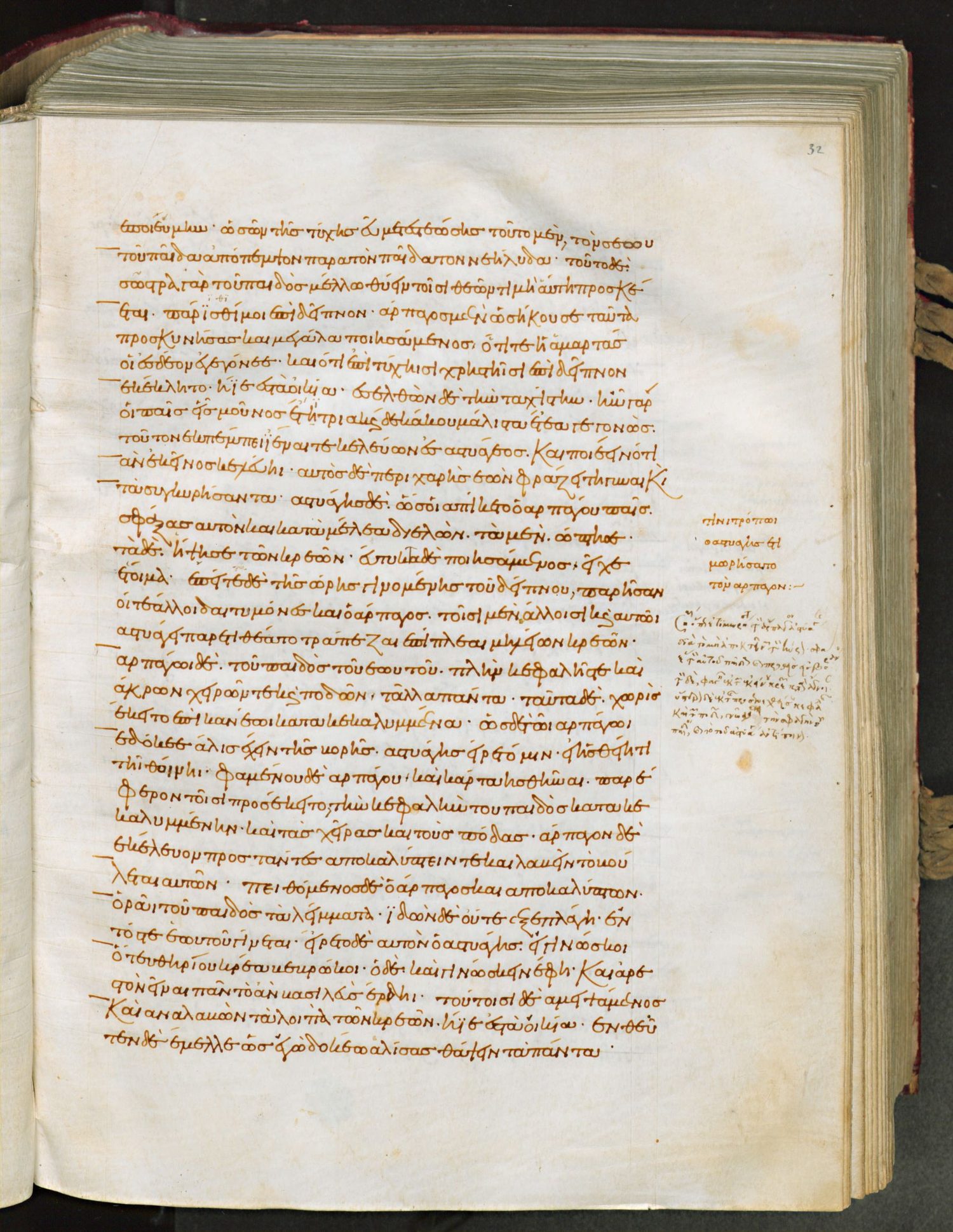
Laur. Plut. 70.3, fol. 32r: Greek here 1.118.2 to 1.119.7. Checked on the image (first and last words read and located in the Greek; each break checked against the neighbouring page): fol. 32r begins ‹ἐποιεύμην. ὡς ὦν τῆς› (1.118.2), ends ‹ἁλίσας θάψειν τὰ πάντα› (1.119.7). English here: 1.118.2 to 1.119.7 (Godley's sentences for the sections whose Greek lies mostly on this page).
1.118.2ἐποιεύμην. ὡς ὦν τῆς τύχης εὖ μετεστεώσης, τοῦτο μὲν τὸν σεωυτοῦ παῖδα ἀπόπεμψον παρὰ τὸν παῖδα τὸν νεήλυδα, τοῦτο δὲ (σῶστρα γὰρ τοῦ παιδὸς μέλλω θύειν τοῖσι θεῶν τιμὴ αὕτη προσκέεται) πάρισθί μοι ἐπὶ δεῖπνον. 1.119.1Ἅρπαγος μὲν ὡς ἤκουσε ταῦτα, προσκυνήσας καὶ μεγάλα ποιησάμενος ὅτι τε ἡ ἁμαρτὰς οἱ ἐς δέον ἐγεγόνεε καὶ ὅτι ἐπὶ τύχῃσι χρηστῇσι ἐπὶ δεῖπνον ἐκέκλητο, ἤιε ἐς τὰ οἰκία. 1.119.2ἐσελθὼν δὲ τὴν ταχίστην, ἦν γὰρ οἱ παῖς εἷς μοῦνος ἔτεα τρία καὶ δέκα κου μάλιστα γεγονώς, τοῦτον ἐκπέμπεν ἰέναι τε κελεύων ἐς Ἀστυάγεος καὶ ποιέειν ὅ τι ἂν ἐκεῖνος κελεύῃ, αὐτὸς δὲ περιχαρὴς ἐὼν φράζει τῇ γυναικὶ τὰ συγκυρήσαντα. 1.119.3Ἀστυάγης δέ, ὥς οἱ ἀπίκετο ὁ Ἁρπάγου παῖς, σφάξας αὐτὸν καὶ κατὰ μέλεα διελὼν τὰ μὲν ὤπτησε τὰ δὲ ἥψησε τῶν κρεῶν, εὔτυκα δὲ ποιησάμενος εἶχε ἕτοιμα. 1.119.4ἐπείτε δὲ τῆς ὥρης γινομένης τοῦ δείπνου παρῆσαν οἵ τε ἄλλοι δαιτυμόνες καὶ ὁ Ἅρπαγος, τοῖσι μὲν ἄλλοισι καὶ αὐτῷ Ἀστυάγεϊ παρετιθέατο τράπεζαι ἐπίπλεαι μηλέων κρεῶν, Ἁρπάγῳ δὲ τοῦ παιδὸς τοῦ ἑωυτοῦ, πλὴν κεφαλῆς τε καὶ ἄκρων χειρῶν τε καὶ ποδῶν, τἄλλα πάντα· ταῦτα δὲ χωρὶς ἔκειτο ἐπὶ κανέῳ κατακεκαλυμμένα, 1.119.5ὡς δὲ τῷ Ἁρπάγῳ ἐδόκεε ἅλις ἔχειν τῆς βορῆς, Ἀστυάγης εἴρετό μιν εἰ ἡσθείη τι τῇ θοίνῃ. φαμένου δὲ Ἁρπάγου καὶ κάρτα ἡσθῆναι, παρέφερον τοῖσι προσέκειτο τὴν κεφαλὴν τοῦ παιδὸς κατακεκαλυμμένην καὶ τὰς χεῖρας καὶ τοὺς πόδας, Ἅρπαγον δὲ ἐκέλευον προσστάντες ἀποκαλύπτειν τε καὶ λαβεῖν τὸ βούλεται αὐτῶν. 1.119.6πειθόμενος δὲ ὁ Ἅρπαγος καὶ ἀποκαλύπτων ὁρᾷ τοῦ παιδὸς τὰ λείμματα, ἰδὼν δὲ οὔτε ἐξεπλάγη ἐντός τε ἑωυτοῦ γίνεται. εἴρετο δὲ αὐτὸν ὁ Ἀστυάγης εἰ γινώσκοι ὅτευ θηρίου κρέα βεβρώκοι. 1.119.7ὁ δὲ καὶ γινώσκειν ἔφη καὶ ἀρεστὸν εἶναι πᾶν τὸ ἂν βασιλεὺς ἔρδῃ. τούτοισι δὲ ἀμειψάμενος καὶ ἀναλαβὼν τὰ λοιπὰ τῶν κρεῶν ἤιε ἐς τὰ οἰκία, ἐνθεῦτεν δὲ ἔμελλε, ὡς ἐγὼ δοκέω, ἁλίσας θάψειν τὰ πάντα.
1.118.2“For,” so he said in his speech, “I was greatly afflicted by what had been done to this boy, and it weighed heavily on me that I was estranged from my daughter. Now, therefore, in this lucky turn of fortune, send your own son to the boy who is newly come, and come hither to dine with me, for I am about to make sacrifice for the safety of my grandson to the gods to whom this honour is due.” 1.119.1When Harpagus heard this he did obeisance and went to his home, greatly pleased to find that his offence had served the needful end and that he was invited to dinner in honour of this fortunate day. 1.119.2Coming in, he bade his only son, a boy of about thirteen years of age, to go to Astyages’ palace and do whatever the king commanded, and in his great joy he told his wife all that had happened. 1.119.3But when Harpagus’ son came, Astyages cut his throat and tearing him limb from limb roasted some and boiled some of the flesh, and the work being finished kept all in readiness. 1.119.4So when it came to the hour for dinner and Harpagus was present among the rest of the guests, dishes of sheeps’ flesh were set before Astyages and the others, but Harpagus was served with the flesh of his own son, all but the head and hands and feet, which lay apart covered up in a basket. 1.119.5And when Harpagus seemed to have eaten his fill, Astyages asked him, “Are you pleased with your meal, Harpagus?” “Exceeding well pleased,” Harpagus answered. Then those whose business it was brought him in the covered basket the head and hands and feet of his son, and they stood before Harpagus and bade him uncover and take of them what he would. 1.119.6Harpagus did so; he uncovered and saw what was left of his son: this he saw, but he mastered himself and was not dismayed. Astyages asked him, “Know you what beast’s flesh you have eaten?” 1.119.7“Yea,” he said, “I know, and all that the king does is pleasing to me.” With that answer he took the rest of the flesh and went to his house, purposing then, as I suppose, to collect and bury all.
Where on the image
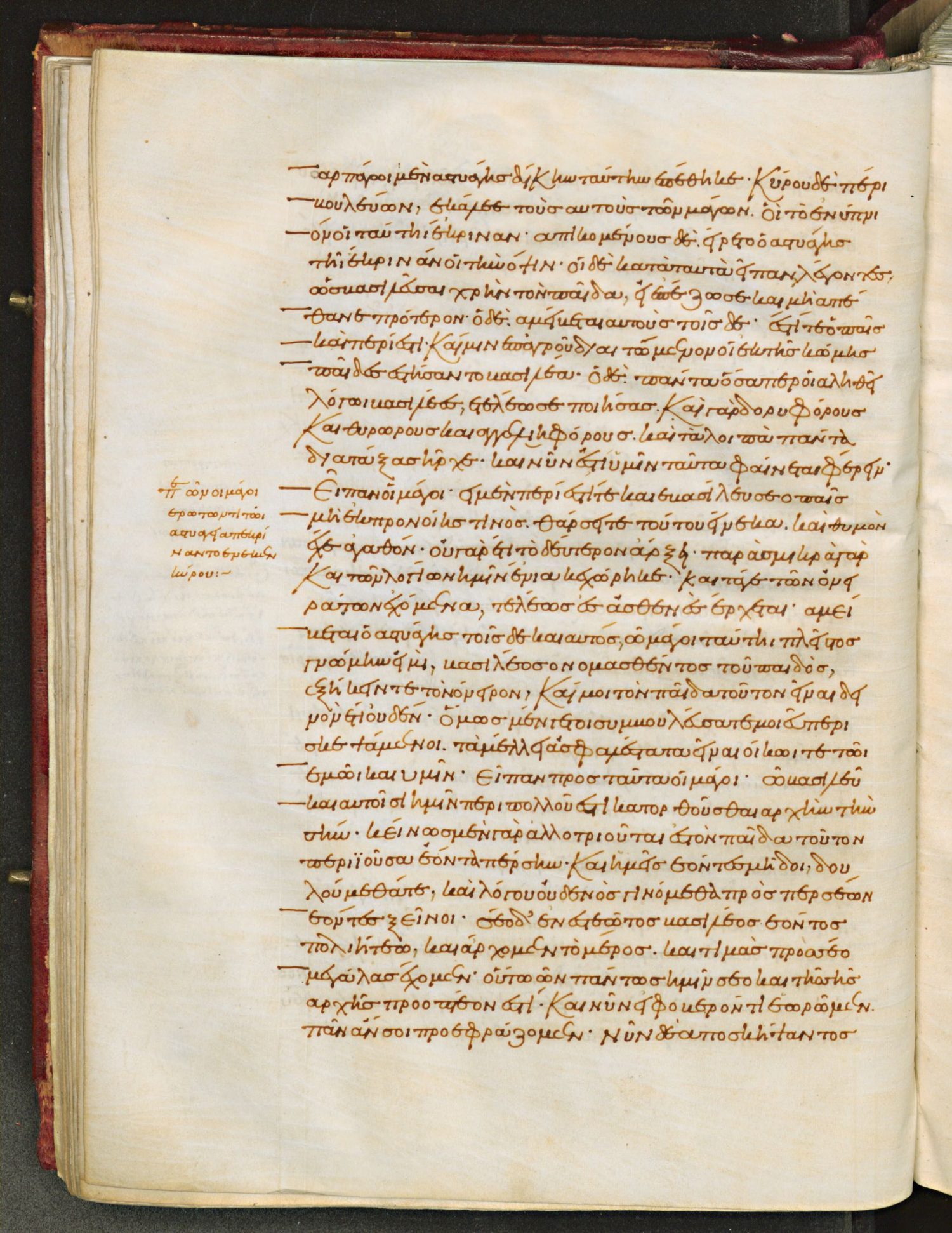
Laur. Plut. 70.3, fol. 32v: Greek here 1.120.1 to 1.120.6. Checked on the image (first and last words read and located in the Greek; each break checked against the neighbouring page): fol. 32v begins ‹Ἁρπάγῳ μὲν Ἀστυάγης δίκην› (1.120.1), ends ‹προεφράζομεν. νῦν δὲ ἀποσκήψαντος› (1.120.6). English here: 1.120.1 to 1.120.5 (Godley's sentences for the sections whose Greek lies mostly on this page).
1.120.1Ἁρπάγῳ μὲν Ἀστυάγης δίκην ταύτην ἐπέθηκε, Κύρου δὲ πέρι βουλεύων ἐκάλεε τοὺς αὐτοὺς τῶν Μάγων οἳ τὸ ἐνύπνιὸν οἱ ταύτῃ ἔκριναν. ἀπικομένους δὲ εἴρετο ὁ Ἁστυάγης τῇ ἔκρινάν οἱ τὴν ὄψιν. οἳ δὲ κατὰ ταὐτὰ εἶπαν λέγοντες ὡς βασιλεῦσαι χρῆν τὸν παῖδα, εἰ ἐπέζωσε καὶ μὴ ἀπέθανε πρότερον. 1.120.2ὁ δὲ ἀμείβεται αὐτοὺς τοῖσιδε. ἔστι τε ὁ παῖς καὶ περίεστι, καί μιν ἐπʼ ἀγροῦ διαιτώμενον οἱ ἐκ τῆς κώμης παῖδες ἐστήσαντο βασιλέα. ὁ δὲ πάντα ὅσα περ οἱ ἀληθέι λόγῳ βασιλέες ἐτελέωσε ποιήσας· καὶ γὰρ δορυφόρους καὶ θυρωροὺς καὶ ἀγγελιηφόρους καὶ τὰ λοιπὰ πάντα διατάξας ἦρχε. 1.120.3καὶ νῦν ἐς τί ὑμῖν ταῦτα φαίνεται φέρειν; εἶπαν οἱ Μάγοι εἰ μὲν περίεστί τε καὶ ἐβασίλευσε ὁ παῖς μὴ ἐκ προνοίης τινός, θάρσεέ τε τούτου εἵνεκα καὶ θυμὸν ἔχε ἀγαθόν· οὐ γὰρ ἔτι τὸ δεύτερον ἄρχει. παρὰ σμικρὰ γὰρ καὶ τῶν λογίων ἡμῖν ἔνια κεχώρηκε, καὶ τά γε τῶν ὀνειράτων ἐχόμενα τελέως ἐς ἀσθενὲς ἔρχεται. 1.120.4ἀμείβεται ὁ Ἀστυάγης τοῖσιδε. καὶ αὐτὸς ὦ Μάγοι ταύτῃ πλεῖστος γνώμην εἰμί, βασιλέος ὀνομασθέντος τοῦ παιδὸς ἐξήκειν τε τὸν ὄνειρον καί μοι τὸν παῖδα τοῦτον εἶναι δεινὸν ἔτι οὐδέν. ὅμως μέν γέ τοι συμβουλεύσατέ μοι εὖ περισκεψάμενοι τὰ μέλλει ἀσφαλέστατα εἶναι οἴκῳ τε τῷ ἐμῷ καὶ ὑμῖν. 1.120.5εἶπαν πρὸς ταῦτα οἱ Μάγοι ὦ βασιλεῦ, καὶ αὐτοῖσι ἡμῖν περὶ πολλοῦ ἐστι κατορθοῦσθαι ἀρχὴν τὴν σήν. κείνως μὲν γὰρ ἀλλοτριοῦται ἐς τὸν παῖδα τοῦτον περιιοῦσα ἐόντα Πέρσην, καὶ ἡμεῖς ἐόντες Μῆδοι δουλούμεθά τε καὶ λόγου οὐδενὸς γινόμεθα πρὸς Περσέων, ἐόντες ξεῖνοι· σέο δʼ ἐνεστεῶτος βασιλέος, ἐόντος πολιήτεω, καὶ ἄρχομεν τὸ μέρος καὶ τιμὰς πρὸς σέο μεγάλας ἔχομεν. 1.120.6οὕτω ὦν πάντως ἡμῖν σέο καὶ τῆς σῆς ἀρχῆς προοπτέον ἐστί. καὶ νῦν εἰ φοβερόν τι ἐνωρῶμεν, πᾶν ἂν σοὶ προεφράζομεν. νῦν δὲ ἀποσκήψαντος
1.120.1Thus did Astyages punish Harpagus. But, to aid him to resolve about Cyrus, he called to him the same Magians who had interpreted his dream as I have said: and when they came Astyages asked them how they had interpreted his vision. They answered as before, and said that the boy must have been made king had he lived and not died first. 1.120.2Then said Astyages, “The boy is saved and alive, and when he was living in the country the boys of his village made him king, and he did duly all that is done by true kings: for he assigned to each severally the places of bodyguards and sentinels and messengers and all else, and so ruled. And to what, think you, does this tend?” 1.120.3“If the boy is alive,” said the Magians, “and has been made king without foreknowledge, then fear not for aught that he can do but keep a good heart: he will not be made king a second time. Know that even in our prophecies it is often but a small thing that has been foretold, and the perfect fulfilment of the dream is but a trifling matter,” “ 1.120.4I too, ye Magians,” said Astyages, “am much of your mind—that the dream came true when the boy was called king, and that I have no more to fear from him. Nevertheless consider well and advise me what shall be safest both for my house and for you.” 1.120.5The Magians said, “King, we too are much concerned that your sovereignty should stand: for in the other case it goes away from your nation to this boy who is a Persian, and so we Medes are enslaved and deemed of no account by the Persians, being as we are of another blood, but while you are established king, who are our countryman, we have our share of power, and great honour is paid us by you.
Where on the image
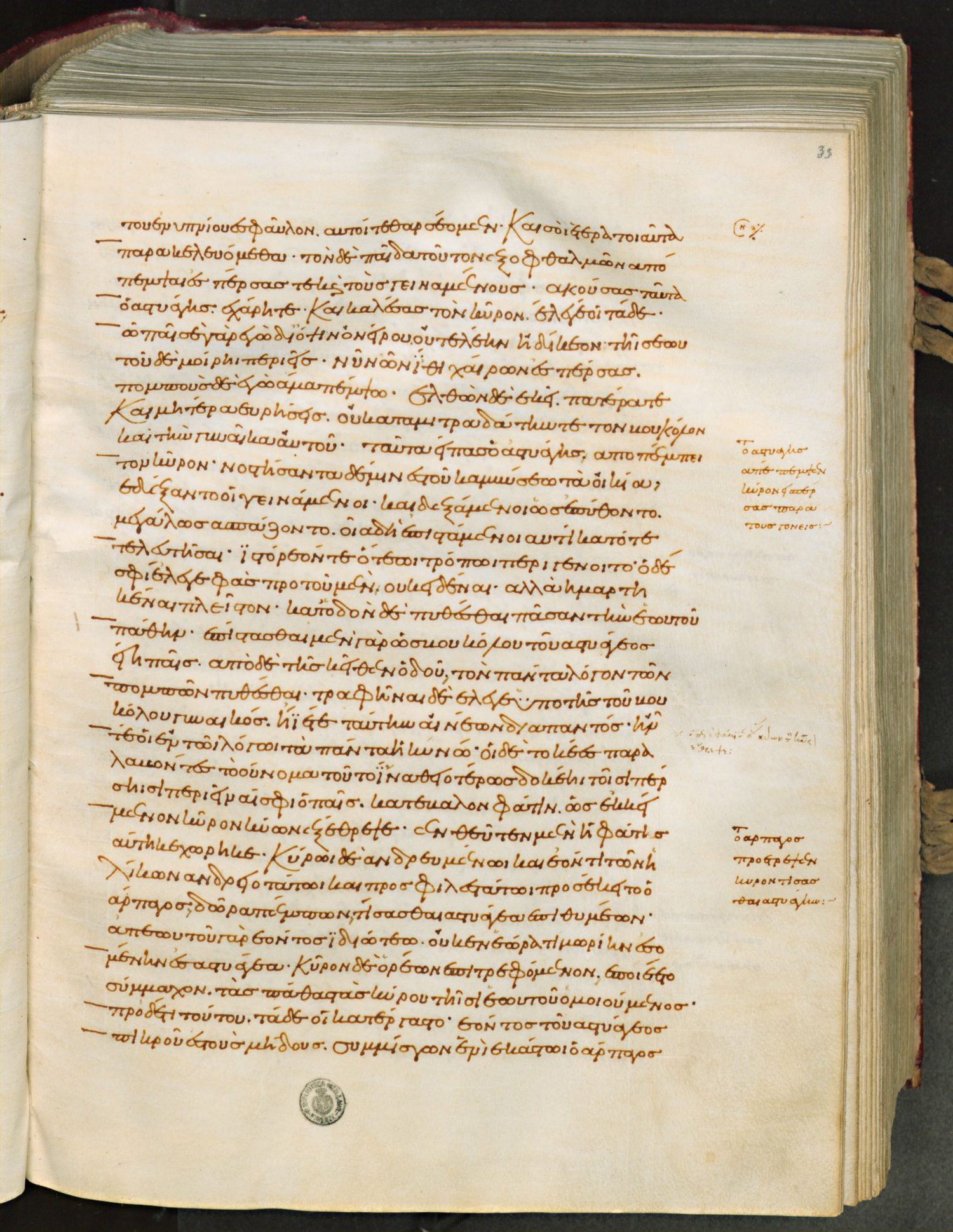
Laur. Plut. 70.3, fol. 33r: Greek here 1.120.6 to 1.122.3. Checked on the image (first and last words read and located in the Greek; each break checked against the neighbouring page): fol. 33r begins ‹τοῦ ἐνυπνίου ἐς φαῦλον,› (1.120.6), ends ‹ἑνὶ ἑκάστῳ ὁ Ἅρπαγος› (1.123.2). English here: 1.120.6 to 1.122.3 (Godley's sentences for the sections whose Greek lies mostly on this page).
1.120.6τοῦ ἐνυπνίου ἐς φαῦλον, αὐτοί τε θαρσέομεν καὶ σοὶ ἕτερα τοιαῦτα παρακελευόμεθα. τὸν δὲ παῖδα τοῦτον ἐξ ὀφθαλμῶν ἀπόπεμψαι ἐς Πέρσας τε καὶ τοὺς γειναμένους. 1.121.1ἀκούσας ταῦτα ὁ Ἀστυάγης ἐχάρη τε καὶ καλέσας τὸν Κῦρον ἔλεγέ οἱ τάδε. ὦ παῖ, σὲ γὰρ ἐγὼ διʼ ὄψιν ὀνείρου οὐ τελέην ἠδίκεον, τῇ σεωυτοῦ δὲ μοίρῃ περίεις· νῦν ὦν ἴθι χαίρων ἐς Πέρσας, πομποὺς δὲ ἐγὼ ἅμα πέμψω. ἐλθὼν δὲ ἐκεῖ πατέρα τε καὶ μητέρα εὑρήσεις οὐ κατὰ Μιτραδάτην τε τὸν βουκόλον καὶ τὴν γυναῖκα αὐτοῦ. 1.122.1ταῦτα εἶπας ὁ Ἀστυάγης ἀποπέμπει τὸν Κῦρον. νοστήσαντα δέ μιν ἐς τοῦ Καμβύσεω τὰ οἰκία ἐδέξαντο οἱ γεινάμενοι, καὶ δεξάμενοι ὡς ἐπύθοντο, μεγάλως ἀσπάζοντο οἷα δὴ ἐπιστάμενοι αὐτίκα τότε τελευτῆσαι, ἱστόρεόν τε ὅτεῳ τρόπῳ περιγένοιτο. 1.122.2ὁ δέ σφι ἔλεγε, φὰς πρὸ τοῦ μὲν οὐκ εἰδέναι ἀλλʼ ἡμαρτηκέναι πλεῖστον, κατʼ ὁδὸν δὲ πυθέσθαι πᾶσαν τὴν ἑωυτοῦ πάθην· ἐπίστασθαι μὲν γὰρ ὡς βουκόλου τοῦ Ἀστυάγεος εἴη παῖς, ἀπὸ δὲ τῆς κεῖθεν ὁδοῦ τὸν πάντα λόγον τῶν πομπῶν πυθέσθαι. 1.122.3τραφῆναι δὲ ἔλεγε ὑπὸ τῆς τοῦ βουκόλου γυναικός, ἤιέ τε ταύτην αἰνέων διὰ παντός, ἦν τέ οἱ ἐν τῷ λόγῳ τὰ πάντα ἡ Κυνώ. οἱ δὲ τοκέες παραλαβόντες τὸ οὔνομα τοῦτο, ἵνα θειοτέρως δοκέῃ τοῖσι Πέρσῃσι περιεῖναί σφι ὁ παῖς, κατέβαλον φάτιν ὡς ἐκκείμενον Κῦρον κύων ἐξέθρεψε.
1.120.6Thus, then, it behoves us by all means to take thought for you and your sovereignty. And at the present time if we saw any danger we would declare all to you: but now the dream has had but a trifling end, and we ourselves have confidence and counsel you to be like-minded. As for this boy, send him away from your sight to the Persians and to his parents.” 1.121.1Hearing this, Astyages was glad, and calling Cyrus, “My lad,” he said, “I did you wrong by reason of the vision I had in a dream, that meant naught, but by your own destiny you still live; now therefore, get you to the Persians, and good luck go with you; I will send those that shall guide you. When you are there you shall find a father and mother of other estate than Mitradates the cowherd and his wife.” 1.122.1So said Astyages and sent Cyrus away. When he returned to Cambyses’ house, his parents received him there, and learning who he was they welcomed him heartily, for they had supposed that long ago he had straightway been killed, and they asked him how his life had been saved. 1.122.2Then he told them, and said that till now he had known nothing but been greatly deceived, but that on the way he had heard all the story of his misfortune; for he had thought, he said, that Astyages’ cowherd was his father, but in his journey from the city his escort had told him all the tale. 1.122.3And he had been reared, he said, by the cowherd’s wife, and he was full of her praises, and in his tale he was ever speaking of Cyno. Hearing this name, his parents set about a story that Cyrus when exposed was suckled by a bitch, thinking thereby to make the story of his saving seem the more marvellous to the Persians.
Notes
- Greek: the text printed in A. D. Godley's Loeb edition, via Perseus (tlg0016.tlg001.perseus-grc2). Square brackets mark words the editor considers later additions; [...] marks a gap the editor indicates. Perseus note markers are omitted.
- English: A. D. Godley, Herodotus vol. 1 (1920) (Loeb Classical Library), as transcribed on Wikisource. Godley's footnotes are omitted.
- Section numbers in the English were placed by comparing Godley's text with the Perseus version of his translation; where a section begins inside one of Godley's sentences, the English is kept with the page that holds the start of that sentence.
Cite
Sources
- Source: Florence, Laur. Plut. 70.3 (10th c.) via BML Teca Digitale + Greek of Godley's Loeb (Perseus) + English of A. D. Godley (Loeb, Wikisource) (holding institution)
- Critical edition: Greek of A. D. Godley's Loeb edition (1920-1925), via Perseus
← previous · → next · v cycle view · l back to library