Herodotus, Histories 1.95-106: The Medes from Deioces to Cyaxares
Introduction
Herodotus of Halicarnassus wrote the Histories in the third quarter of the 5th century BCE, an inquiry into the deeds of Greeks and barbarians and the causes of the wars between them, later divided into nine books. Book 1 tells how the conflict between Greeks and barbarians began, the history of Lydia from Gyges to Croesus, the rise of the Medes and of Cyrus the Persian, the conquest of the Greeks of Asia, the capture of Babylon and the death of Cyrus.
The photographs are of Florence, Biblioteca Medicea Laurenziana, Plut. 70.3 (parchment, 10th century, 374 folios, 31 lines a page), Herodotus, Histories (codex A of the editors), the oldest surviving manuscript of the complete Histories, from the Teca Digitale of the Biblioteca Medicea Laurenziana. Each section below is the text of one page, or of the part of a page that falls within these chapters. The first and last words of every page were read on the photograph and located in the Greek, and every page break was checked against the next page; the notes quote these words. Readers' notes in the margins are not part of the text and are mentioned where they occur.
The Greek is the text printed in A. D. Godley's Loeb edition (1920-1925), from Perseus; it is the edited text, not a transcription of the manuscript, whose wording differs in places. The English is Godley's translation as printed, from Wikisource. Godley's English carries only chapter numbers; the section numbers shown in it were placed by comparison with the Perseus version of his translation. Each page's English is cut at the end of one of Godley's sentences, so it can begin or end a few lines away from the Greek of the page; each note gives the exact ranges.
This entry covers chapters 1.95-106, on fol. 26r to 28v.
How was this verified? (Provenance)
Where on the image
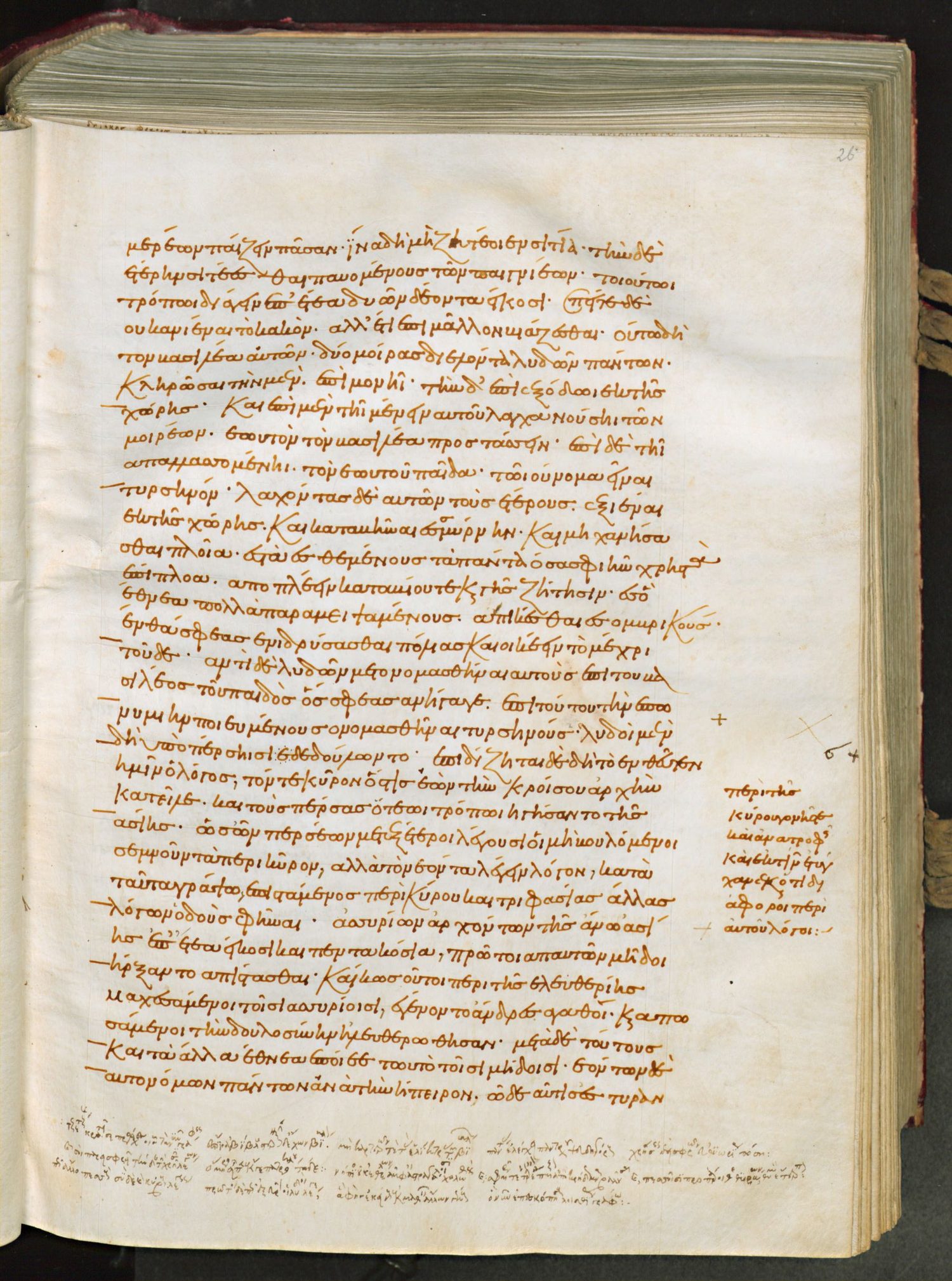
Laur. Plut. 70.3, fol. 26r: Greek here 1.95.1 to 1.96.1. Checked on the image (first and last words read and located in the Greek; each break checked against the neighbouring page): fol. 26r begins ‹-μερέων παίζειν πᾶσαν, ἵνα› (1.94.4), ends ‹ὧδε αὖτις ἐς τυραν-› (1.96.1). The word ‹ἡμερέων› is divided between fol. 25v and fol. 26r; it is given with fol. 25v. The lower margin is filled with readers' notes in small script. English here: 1.95.1 to 1.95.2 (Godley's sentences for the sections whose Greek lies mostly on this page).
1.95.1ἐπιδίζηται δὲ δὴ τὸ ἐνθεῦτεν ἡμῖν ὁ λόγος τόν τε Κῦρον ὅστις ἐὼν τὴν Κροίσου ἀρχὴν κατεῖλε, καὶ τοὺς Πέρσας ὅτεῳ τρόπῳ ἡγήσαντο τῆς Ἀσίης. ὡς ὦν Περσέων μετεξέτεροι λέγουσι, οἱ μὴ βουλόμενοι σεμνοῦν τὰ περὶ Κῦρον ἀλλὰ τὸν ἐόντα λέγειν λόγον, κατὰ ταῦτα γράψω, ἐπιστάμενος περὶ Κύρου καὶ τριφασίας ἄλλας λόγων ὁδοὺς φῆναι. 1.95.2Ἀσσυρίων ἀρχόντων τῆς ἄνω Ἀσίης ἐπʼ ἔτεα εἴκοσι καὶ πεντακόσια, πρῶτοι ἀπʼ αὐτῶν Μῆδοι ἤρξαντο ἀπίστασθαι, καὶ κως οὗτοι περὶ τῆς ἐλευθερίης μαχεσάμενοι τοῖσι Ἀσσυρίοισι ἐγένοντο ἄνδρες ἀγαθοί, καὶ ἀπωσάμενοι τὴν δουλοσύνην ἐλευθερώθησαν. μετὰ δὲ τούτους καὶ τὰ ἄλλα ἔθνεα ἐποίεε τὠυτὸ τοῖσι Μήδοισι. 1.96.1ἐόντων δὲ αὐτονόμων πάντων ἀνὰ τὴν ἤπειρον, ὧδε αὖτις ἐς τυραννίδα
1.95.1But it is next the business of my history to inquire who this Cyrus was who brought down the power of Croesus, and how the Persians came to be rulers of Asia. I mean then to be guided in what I write by some of the Persians who desire not to make a fine tale of the story of Cyrus but to tell the truth, though there are no less than three other accounts of Cyrus which I could give. 1.95.2When the Assyrians had ruled Upper Asia for five hundred and twenty years their subjects began to revolt from them: first of all, the Medes. These, it would seem, proved their valour in fighting for freedom against the Assyrians; they cast off their slavery and won freedom. Afterwards the other subject nations too did the same as the Medes.
Where on the image
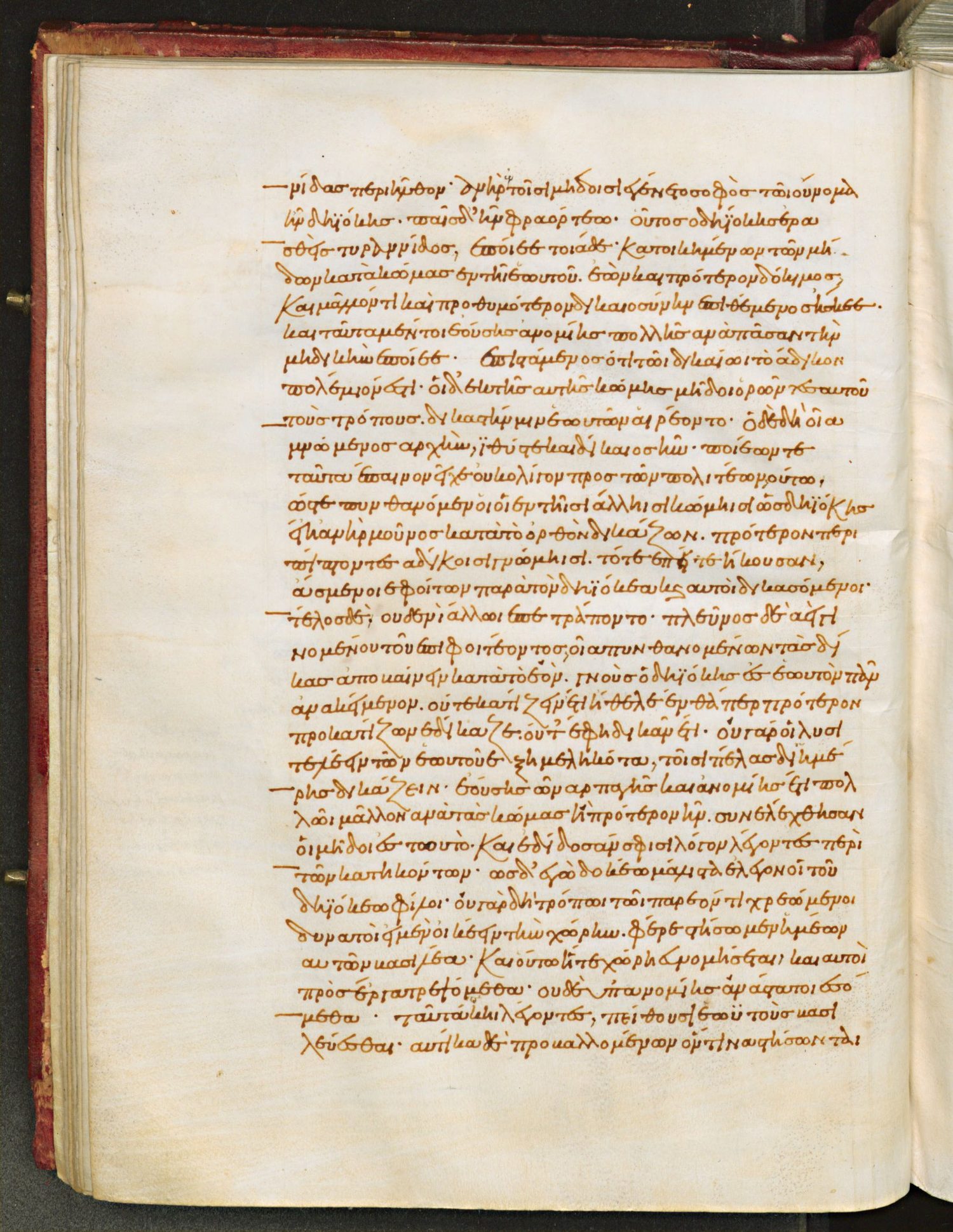
Laur. Plut. 70.3, fol. 26v: Greek here 1.96.1 to 1.98.1. Checked on the image (first and last words read and located in the Greek; each break checked against the neighbouring page): fol. 26v begins ‹-νίδα περιῆλθον. ἀνὴρ ἐν› (1.96.1), ends ‹δὲ προβαλλομένων ὅντινα στήσονται› (1.98.1). The word ‹τυραννίδα› is divided between fol. 26r and fol. 26v; it is given with fol. 26r. English here: 1.96.1 to 1.97.3 (Godley's sentences for the sections whose Greek lies mostly on this page).
1.96.1περιῆλθον. ἀνὴρ ἐν τοῖσι Μήδοισι ἐγένετο σοφὸς τῷ οὔνομα ἦν Δηιόκης, παῖς δʼ ἦν Φραόρτεω. 1.96.2οὗτος ὁ Δηιόκης ἐρασθεὶς τυραννίδος ἐποίεε τοιάδε. κατοικημένων τῶν Μήδων κατὰ κώμας, ἐν τῇ ἑωυτοῦ ἐὼν καὶ πρότερον δόκιμος καὶ μᾶλλόν τι καὶ προθυμότερον δικαιοσύνην ἐπιθέμενος ἤσκεε· καὶ ταῦτα μέντοι ἐούσης ἀνομίης πολλῆς ἀνὰ πᾶσαν τὴν Μηδικὴν ἐποίεε, ἐπιστάμενος ὅτι τῷ δικαίῳ τὸ ἄδικον πολέμιον ἐστί. οἱ δʼ ἐκ τῆς αὐτῆς κώμης Μῆδοι ὁρῶντες αὐτοῦ τοὺς τρόπους δικαστήν μιν ἑωυτῶν αἱρέοντο. ὁ δὲ δή, οἷα μνώμενος ἀρχήν, ἰθύς τε καὶ δίκαιος ἦν, 1.96.3ποιέων τε ταῦτα ἔπαινον εἶχε οὐκ ὀλίγον πρὸς τῶν πολιητέων, οὕτω ὥστε πυνθανόμενοι οἱ ἐν τῇσι ἄλλῃσι κώμῃσι ὡς Δηιόκης εἴη ἀνὴρ μοῦνος κατὰ τὸ ὀρθὸν δικάζων, πρότερον περιπίπτοντες ἀδίκοισι γνώμῃσι, τότε ἐπείτε ἤκουσαν ἄσμενοι, ἐφοίτων παρὰ τὸν Δηιόκεα καὶ αὐτοὶ δικασόμενοι, τέλος δὲ οὐδενὶ ἄλλῳ ἐπετράποντο. 1.97.1πλεῦνος δὲ αἰεὶ γινομένου τοῦ ἐπιφοιτέοντος, οἷα πυνθανομένων τὰς δίκας ἀποβαίνειν κατὰ τὸ ἐόν, γνοὺς ὁ Δηιόκης ἐς ἑωυτὸν πᾶν ἀνακείμενον οὔτε κατίζειν ἔτι ἤθελε ἔνθα περ πρότερον προκατίζων ἐδίκαζε, οὔτʼ ἔφη δίκαν ἔτι· οὐ γὰρ οἱ λυσιτελέειν τῶν ἑωυτοῦ ἐξημεληκότα τοῖσι πέλας διʼ ἡμέρης δικάζειν. 1.97.2ἐούσης ὦν ἁρπαγῆς καὶ ἀνομίης ἔτι πολλῷ μᾶλλον ἀνὰ τὰς κώμας ἢ πρότερον ἦν, συνελέχθησαν οἱ Μῆδοι ἐς τὠυτὸ καὶ ἐδίδοσαν σφίσι λόγον, λέγοντες περὶ τῶν κατηκόντων. ὡς δʼ ἐγὼ δοκέω, μάλιστα ἔλεγον οἱ τοῦ Δηιόκεω φίλοι 1.97.3οὐ γὰρ δὴ τρόπῳ τῷ παρεόντι χρεώμενοι δυνατοὶ εἰμὲν οἰκέειν τὴν χώρην, φέρε στήσωμεν ἡμέων αὐτῶν βασιλέα· καὶ οὕτω ἥ τε χώρη εὐνομήσεται καὶ αὐτοὶ πρὸς ἔργα τρεψόμεθα, οὐδὲ ὑπʼ ἀνομίης ἀνάστατοι ἐσόμεθα. ταῦτά κῃ λέγοντες πείθουσι ἑωυτοὺς βασιλεύεσθαι. 1.98.1αὐτίκα δὲ προβαλλομένων ὅντινα στήσονται
1.96.1All of those on the mainland were now free men; but they came once more to be ruled by monarchs as I will now relate. There was among the Medians a clever man called Deioces: he was the son of Phraortes. 1.96.2Deioces was enamoured of sovereignty, and thus he set about gaining it. Being already a notable man in his own township (one of the many townships into which Media was parcelled), he began to profess and practise justice more constantly and zealously than ever, and this he did although there was much lawlessness in all the land of Media, and though he knew that injustice is ever the foe of justice. Then the Medes of the same township, seeing his dealings, chose him to be their judge, and he (for he coveted sovereign power) was honest and just. 1.96.3By so acting he won no small praise from his fellow townsmen, insomuch that when the men of the other townships learned that Deioces alone gave righteous judgments (they having before suffered from unjust decisions) they, then, on hearing this, came often and gladly to plead before Deioces; and at last they would submit to no arbitrament but his. 1.97.1The number of those who came grew ever greater, for they heard that each case ended as accorded with the truth. Then Deioces, seeing that all was now entrusted to him, would not sit in his former seat of judgment, and said he would give no more decisions; for it was of no advantage to him (he said) to leave his own business and spend all the day judging the cases of his neighbours. 1.97.2This caused robbery and lawlessness to increase greatly in the townships; and the Medes gathering together conferred about their present affairs, and said (here, as I suppose, the chief speakers were Deioces’ friends), “ 1.97.3Since we cannot with our present manner of life dwell peacefully in the country, come, let us set up a king for ourselves; thus will the country be well governed, and we ourselves shall betake ourselves to our business, and cease to be undone by lawlessness” By such words they persuaded themselves to be ruled by a king.
Where on the image
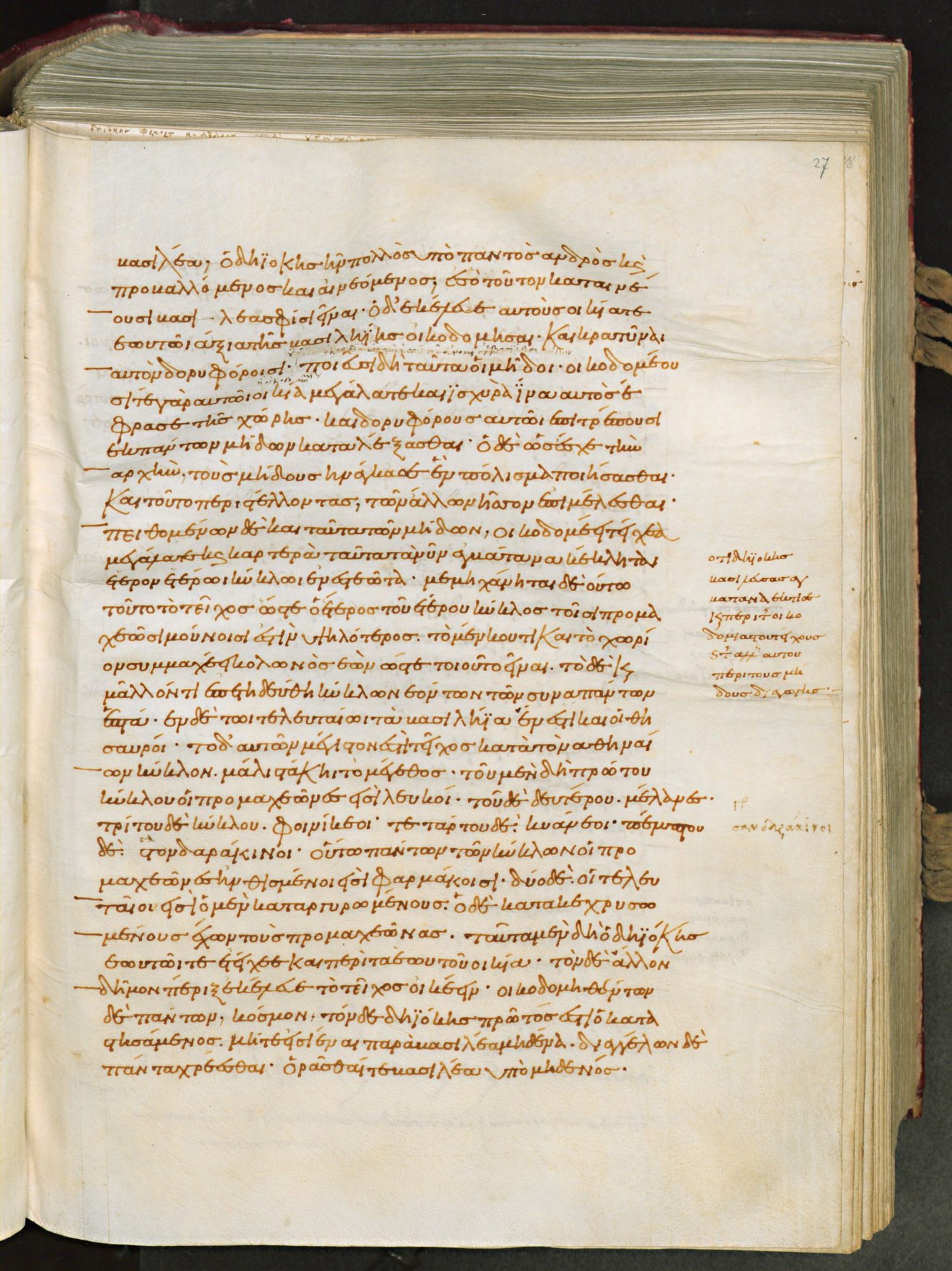
Laur. Plut. 70.3, fol. 27r: Greek here 1.98.1 to 1.99.1. Checked on the image (first and last words read and located in the Greek; each break checked against the neighbouring page): fol. 27r begins ‹βασιλέα, ὁ Δηιόκης ἦν› (1.98.1), ends ‹τε βασιλέα ὑπὸ μηδενός› (1.99.1). English here: 1.98.1 to 1.99.1 (Godley's sentences for the sections whose Greek lies mostly on this page).
1.98.1βασιλέα, ὁ Δηιόκης ἦν πολλὸς ὑπὸ παντὸς ἀνδρὸς καὶ προβαλλόμενος καὶ αἰνεόμενος, ἐς ὃ τοῦτον καταινέουσι βασιλέα σφίσι εἶναι. 1.98.2ὃ δʼ ἐκέλευε αὐτοὺς οἰκία τε ἑωυτῷ ἄξια τῆς βασιληίης οἰκοδομῆσαι καὶ κρατῦναι αὐτὸν δορυφόροισι· ποιεῦσι δὴ ταῦτα οἱ Μῆδοι. οἰκοδομέουσί τε γὰρ αὐτῷ οἰκία μεγάλα τε καὶ ἰσχυρά, ἵνα αὐτὸς ἔφρασε τῆς χώρης, καὶ δορυφόρους αὐτῷ ἐπιτρέπουσι ἐκ πάντων Μήδων καταλέξασθαι. 1.98.3ὁ δὲ ὡς ἔσχε τὴν ἀρχήν, τοὺς Μήδους ἠνάγκασε ἓν πόλισμα ποιήσασθαι καὶ τοῦτο περιστέλλοντας τῶν ἄλλων ἧσσον ἐπιμέλεσθαι. πειθομένων δὲ καὶ ταῦτα τῶν Μήδων οἰκοδομέει τείχεα μεγάλα τε καὶ καρτερὰ ταῦτα τὰ νῦν Ἀγβάτανα κέκληται, ἕτερον ἑτέρῳ κύκλῳ ἐνεστεῶτα. 1.98.4μεμηχάνηται δὲ οὕτω τοῦτο τὸ τεῖχος ὥστε ὁ ἕτερος τοῦ ἑτέρου κύκλος τοῖσι προμαχεῶσι μούνοισι ἐστι ὑψηλότερος. τὸ μέν κού τι καὶ τὸ χωρίον συμμαχέει κολωνὸς ἐὼν ὥστε τοιοῦτο εἶναι, τὸ δὲ καὶ μᾶλλόν τι ἐπετηδεύθη. 1.98.5κύκλων δʼ ἐόντων τῶν συναπάντων ἑπτά, ἐν δὴ τῷ τελευταίῳ τὰ βασιλήια ἔνεστι καὶ οἱ θησαυροί. τὸ δʼ αὐτῶν μέγιστον ἐστὶ τεῖχος κατὰ τὸν Ἀθηνέων κύκλον μάλιστά κῃ τὸ μέγαθος. τοῦ μὲν δὴ πρώτου κύκλου οἱ προμαχεῶνες εἰσὶ λευκοί, τοῦ δὲ δευτέρου μέλανες, τρίτου δὲ κύκλου φοινίκεοι, τετάρτου δὲ κυάνεοι, πέμπτου δὲ σανδαράκινοι. 1.98.6οὕτω τῶν πέντε κύκλων οἱ προμαχεῶνες ἠνθισμένοι εἰσὶ φαρμάκοισι· δύο δὲ οἱ τελευταῖοί εἰσὶ ὃ μὲν καταργυρωμένους ὁ δὲ κατακεχρυσωμένους ἔχων τοὺς προμαχεῶνας. 1.99.1ταῦτα μὲν δὴ ὁ Δηιόκης ἑωυτῷ τε ἐτείχεε καὶ περὶ τὰ ἑωυτοῦ οἰκία, τὸν δὲ ἄλλον δῆμον πέριξ ἐκέλευε τὸ τεῖχος οἰκέειν. οἰκοδομηθέντων δὲ πάντων κόσμον τόνδε Δηιόκης πρῶτος ἐστὶ ὁ καταστησάμενος, μήτε ἐσιέναι παρὰ βασιλέα μηδένα, διʼ ἀγγέλων δὲ πάντα χρᾶσθαι, ὁρᾶσθαι τε βασιλέα ὑπὸ μηδενός,
1.98.1The question was forthwith propounded: Whom should they make king? Then every man was loud in putting Deioces forward and praising Deioces, till they agreed that he should be their king. 1.98.2He bade them build him houses worthy of his royal power, and arm him with a bodyguard: the Medes did so; they built him great and strong houses at what places soever in the country he showed them, and suffered him to choose a bodyguard out of all their people. 1.98.3But having obtained the power, he constrained the Medes to make him one stronghold and to fortify this more strongly than all the rest. This too the Medes did for him: so he built the great and mighty circles of walls within walls which are now called Agbatana. 1.98.4This fortress is so planned that each circle of walls is higher than the next outer circle by no more than the height of its battlements; to which end the site itself, being on a hill in the plain, somewhat helps, but chiefly it was accomplished by art. 1.98.5There are seven circles in all; within the innermost circle are the king’s dwellings and the treasuries; and the longest wall is about the length of the wall that surrounds the city of Athens. The battlements of the first circle are white, of the second black, of the third circle purple, of the fourth blue, and of the fifth orange: 1.98.6thus the battlements of five circles are painted with colours; and the battlements of the last two circles are coated, these with silver and those with gold. 1.99.1Deioces built these walls for himself and around his own palace; the people were to dwell without the wall. And when all was built, it was Deioces first who established the rule that no one should come into the presence of the king, but all should be dealt with by the means of messengers; that the king should be seen by no man; and moreover that it should be in particular a disgrace for any to laugh or to spit in his presence.
Where on the image
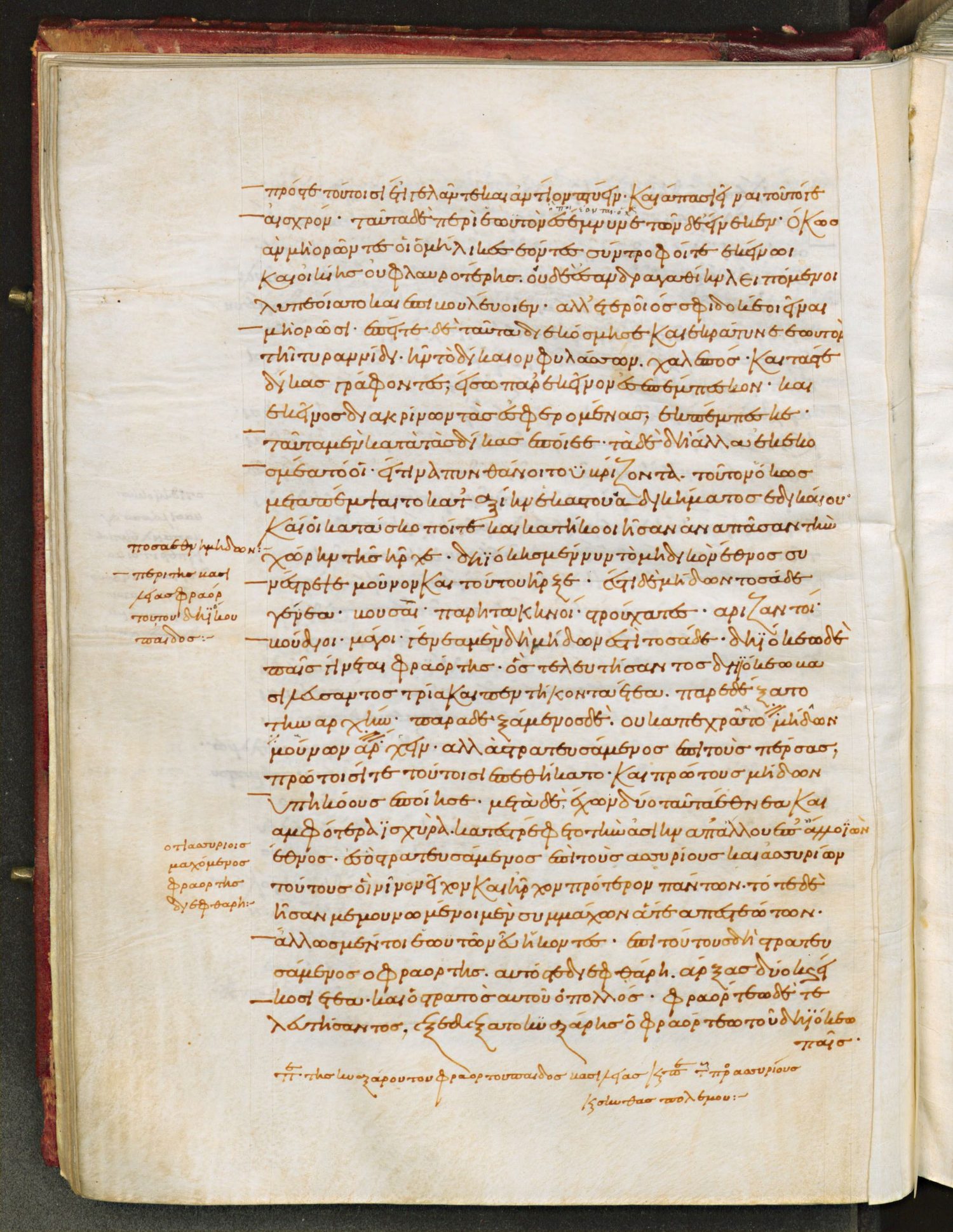
Laur. Plut. 70.3, fol. 27v: Greek here 1.99.1 to 1.103.1. Checked on the image (first and last words read and located in the Greek; each break checked against the neighbouring page): fol. 27v begins ‹πρός τε τούτοισι ἔτι› (1.99.1), ends ‹Φραόρτεω τοῦ Δηιόκεω παῖς› (1.103.1). Below the text, a reader's note on the reign of Cyaxares and his war with the Assyrians. English here: 1.99.2 to 1.102.2 (Godley's sentences for the sections whose Greek lies mostly on this page).
1.99.1πρός τε τούτοισι ἔτι γελᾶν τε καὶ ἀντίον πτύειν καὶ ἅπασι εἶναι τοῦτό γε αἰσχρόν. 1.99.2ταῦτα δὲ περὶ ἑωυτὸν ἐσέμνυνε τῶνδε εἵνεκεν, ὅκως ἂν μὴ ὁρῶντες οἱ ὁμήλικες, ἐόντες σύντροφοί τε ἐκείνῳ καὶ οἰκίης οὐ φλαυροτέρης οὐδὲ ἐς ἀνδραγαθίην λειπόμενοι, λυπεοίατο καὶ ἐπιβουλεύοιεν, ἀλλʼ ἑτεροῖός σφι δοκέοι εἶναι μὴ ὁρῶσι. 1.100.1ἐπείτε δὲ ταῦτα διεκόσμησε καὶ ἐκράτυνε ἑωυτὸν τῇ τυραννίδι, ἦν τὸ δίκαιον φυλάσσων χαλεπός· καὶ τάς τε δίκας γράφοντες ἔσω παρʼ ἐκεῖνον ἐσπέμπεσκον, καὶ ἐκεῖνος διακρίνων τὰς ἐσφερομένας ἐκπέμπεσκε. 1.100.2ταῦτα μὲν κατὰ τὰς δίκας ἐποίεε, τάδε δὲ ἄλλα ἐκεκοσμέατὸ οἱ· εἴ τινα πυνθάνοιτο ὑβρίζοντα, τοῦτον ὅκως μεταπέμψαιτο κατʼ ἀξίην ἑκάστου ἀδικήματος ἐδικαίευ, καὶ οἱ κατάσκοποί τε καὶ κατήκοοι ἦσαν ἀνὰ πᾶσαν τὴν χώρην τῆς ἦρχε. 1.101.1Δηιόκης μέν νυν τὸ Μηδικὸν ἔθνος συνέστρεψε μοῦνον καὶ τοῦτον ἦρξε· ἔστι δὲ Μήδων τοσάδε γένεα, Βοῦσαι Παρητακηνοὶ Στρούχατες Ἀριζαντοὶ Βούδιοι Μάγοι. γένεα μὲν δὴ Μήδων ἐστὶ τοσάδε. 1.102.1Δηιόκεω δὲ παῖς γίνεται Φραόρτης, ὃς τελευτήσαντος Δηιόκεω, βασιλεύσαντος τρία καὶ πεντήκοντα ἔτεα, παρεδέξατο τὴν ἀρχήν, παραδεξάμενος δὲ οὐκ ἀπεχρᾶτο μούνων Μήδων ἄρχειν, ἀλλὰ στρατευσάμενος ἐπὶ τοὺς Πέρσας πρώτοισί τε τούτοισι ἐπεθήκατο καὶ πρώτους Μήδων ὑπηκόους ἐποίησε. 1.102.2μετὰ δὲ ἔχων δύο ταῦτα ἔθνεα καὶ ἀμφότερα ἰσχυρά, κατεστρέφετο τὴν Ἀσίην ἀπʼ ἄλλου ἐπʼ ἄλλο ἰὼν ἔθνος, ἐς ὃ στρατευσάμενος ἐπὶ τοὺς Ἀσσυρίους καὶ Ἀσσυρίων, τούτους οἳ Νίνον εἶχον καὶ ἦρχον πρότερον πάντων, τότε δὲ ἦσαν μεμουνωμένοι μὲν συμμάχων ἅτε ἀπεστεώτων, ἄλλως μέντοι ἑωυτῶν εὖ ἥκοντες, ἐπὶ τούτους δὴ στρατευσάμενος ὁ Φραόρτης αὐτός τε διεφθάρη, ἄρξας δύο καὶ εἴκοσι ἔτεα, καὶ ὁ στρατὸς αὐτοῦ ὁ πολλός. 1.103.1Φραόρτεω δὲ τελευτήσαντος ἐξεδέξατο Κυαξάρης ὁ Φραόρτεω τοῦ Δηιόκεω παῖς.
1.99.2He was careful to hedge himself with all this state in order that the men of his own age (who had been bred up with him and were as nobly born as he and his equals in manly excellence), instead of seeing him and being thereby vexed and haply moved to plot against him, might by reason of not seeing him deem him to be changed from what he had been. 1.100.1Having ordered all these matters and strongly armed himself with sovereign power, he was a hard man in the observance of justice. They would write down their pleas and send them in to him; then would he adjudge upon what was brought him and send his judgments out. 1.100.2This was his manner of deciding cases at law, and he took order too about other matters; for when he heard that a man was doing violence he would send for him and punish him as befitted each offence: and he had spies and eavesdroppers everywhere in his dominions. 1.101.1Deioces, then, united the Median nation, and no other, and ruled it. The Median tribes are these—the Busae, the Paretaceni, the Struchates, the Arizanti, the Budii, the Magi: so many are their tribes. 1.102.1Deioces had a son, Phraortes, who inherited the throne at Deioces’ death after a reign of fifty-three years. Having so inherited, he was not content to rule the Medes alone: marching against the Persians, he attacked them first, and they were the first whom he made subject to the Medes. 1.102.2Then, with these two strong nations at his back, he subdued one nation of Asia after another, till he marched against the Assyrians, to wit, those of the Assyrians who held Ninus. These had formerly been rulers of all; but now their allies had dropped from them and they were left alone, yet in themselves a prosperous people: marching then against these Assyrians, Phraortes himself and the greater part of his army perished, after he had reigned twenty-two years.
Where on the image
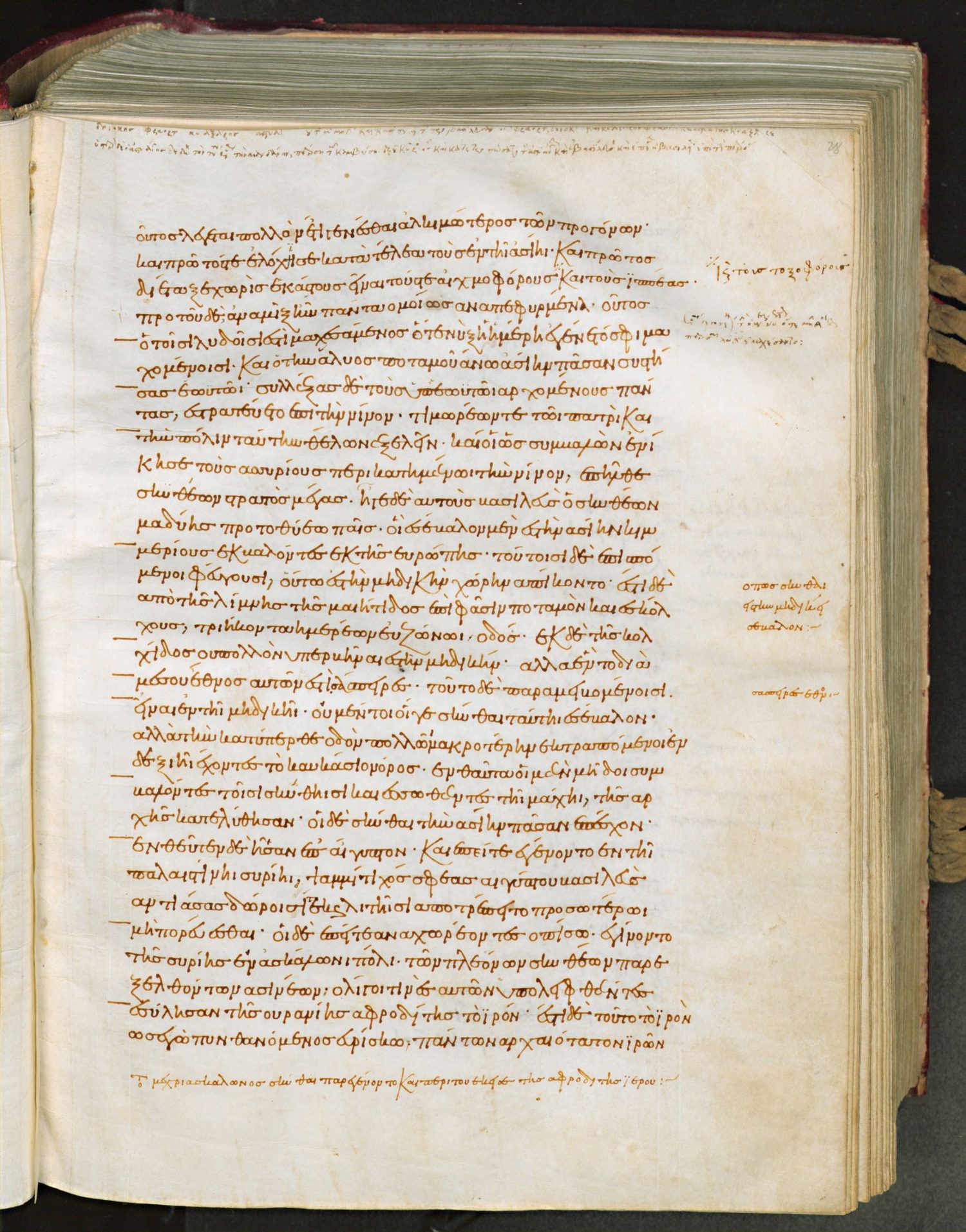
Laur. Plut. 70.3, fol. 28r: Greek here 1.103.1 to 1.105.3. Checked on the image (first and last words read and located in the Greek; each break checked against the neighbouring page): fol. 28r begins ‹οὗτος λέγεται πολλὸν ἔτι› (1.103.1), ends ‹εὑρίσκω, πάντων ἀρχαιότατον ἱρῶν› (1.105.3). Below the text, a reader's note on the temple of Aphrodite. English here: 1.103.1 to 1.105.2 (Godley's sentences for the sections whose Greek lies mostly on this page).
1.103.1οὗτος λέγεται πολλὸν ἔτι γενέσθαι ἀλκιμώτερος τῶν προγόνων, καὶ πρῶτός τε ἐλόχισε κατὰ τέλεα τοὺς ἐν τῇ Ἀσίῃ καὶ πρῶτος διέταξε χωρὶς ἑκάστους εἶναι, τούς τε αἰχμοφόρους καὶ τοὺς τοξοφόρους καὶ τοὺς ἱππέας· πρὸ τοῦ δὲ ἀναμὶξ ἦν πάντα ὁμοίως ἀναπεφυρμένα. 1.103.2οὗτος ὁ τοῖσι Λυδοῖσι ἐστὶ μαχεσάμενος ὅτε νὺξ ἡ ἡμέρη ἐγένετό σφι μαχομένοισι, καὶ ὁ τὴν Ἅλυος ποταμοῦ ἄνω Ἀσίην πᾶσαν συστήσας ἑωυτῷ. συλλέξας δὲ τοὺς ὑπʼ ἑωυτῷ ἀρχομένους πάντας ἐστρατεύετο ἐπὶ τὴν Νίνον, τιμωρέων τε τῷ πατρὶ καὶ τὴν πόλιν ταύτην θέλων ἐξελεῖν. 1.103.3καί οἱ, ὡς συμβαλὼν ἐνίκησε τοὺς Ἀσσυρίους, περικατημένῳ τὴν Νίνον ἐπῆλθε Σκυθέων στρατὸς μέγας, ἦγε δὲ αὐτοὺς βασιλεὺς ὁ Σκυθέων Μαδύης Προτοθύεω παῖς· οἳ ἐσέβαλον μὲν ἐς τὴν Ἀσίην Κιμμερίους ἐκβαλόντες ἐκ τῆς Εὐρώπης, τούτοισι δὲ ἐπισπόμενοι φεύγουσι οὕτω ἐς τὴν Μηδικὴν χώρην ἀπίκοντο. 1.104.1ἔστι δὲ ἀπὸ τῆς λίμνης τῆς Μαιήτιδος ἐπὶ Φᾶσιν ποταμὸν καὶ ἐς Κόλχους τριήκοντα ἡμερέων εὐζώνῳ ὁδός, ἐκ δὲ τῆς Κολχίδος οὐ πολλὸν ὑπερβῆναι ἐς τὴν Μηδικήν, ἀλλʼ ἓν τὸ διὰ μέσου ἔθνος αὐτῶν ἐστι, Σάσπειρες, τοῦτο δὲ παραμειβομένοισι εἶναι ἐν τῇ Μηδικῇ. 1.104.2οὐ μέντοι οἵ γε Σκύθαι ταύτῃ ἐσέβαλον, ἀλλὰ τὴν κατύπερθε ὁδὸν πολλῷ μακροτέρην ἐκτραπόμενοι, ἐν δεξιῇ ἔχοντες τὸ Καυκάσιον ὄρος. ἐνθαῦτα οἱ μὲν Μῆδοι συμβαλόντες τοῖσι Σκύθῃσι καὶ ἑσσωθέντες τῇ μάχῃ τῆς ἀρχῆς κατελύθησαν. οἱ δὲ Σκύθαι τὴν Ἀσίην πᾶσαν ἐπέσχον. 1.105.1ἐνθεῦτεν δὲ ἤισαν ἐπʼ Αἴγυπτον. καὶ ἐπείτε ἐγένοντο ἐν τῇ Παλαιστίνῃ Συρίῃ, Ψαμμήτιχος σφέας Αἰγύπτου βασιλεὺς ἀντιάσας δώροισί τε καὶ λιτῇσι ἀποτράπει τὸ προσωτέρω μὴ πορεύεσθαι. 1.105.2οἳ δὲ ἐπείτε ἀναχωρέοντες ὀπίσω ἐγένοντο τῆς Συρίης ἐν Ἀσκάλωνι πόλι, τῶν πλεόνων Σκυθέων παρεξελθόντων ἀσινέων, ὀλίγοι τινὲς αὐτῶν ὑπολειφθέντες ἐσύλησαν τῆς οὐρανίης Ἀφροδίτης τὸ ἱρόν. 1.105.3ἔστι δὲ τοῦτο τὸ ἱρόν, ὡς ἐγὼ πυνθανόμενος εὑρίσκω, πάντων ἀρχαιότατον ἱρῶν
1.103.1At his death he was succeeded by his son Cyaxares. He is said to have been a much greater warrior than his fathers: it was he who first arrayed the men of Asia in companies and set each kind in bands apart, the spearmen and the archers and the horsemen: before this they were all blended alike confusedly together. 1.103.2This was the king who fought against the Lydians when the day was turned to night in the battle, and who united under his dominion all Asia that is beyond the river Halys. Collecting all his subjects, he marched against Ninus, wishing to avenge his father and to destroy the city. 1.103.3He defeated the Assyrians in battle; but while he was besieging their city there came down upon him a great army of Scythians, led by their king Madyes son of Protothyes. These had invaded Asia after they had driven the Cimmerians out of Europe: pursuing them in their flight the Scythians came to the Median country. 1.104.1It is thirty days’ journey for an unburdened man from the Maeetian lake to the river Phasis and the land of the Colchi; from the Colchi it is an easy matter to cross into Media: there is but one nation between, the Saspires; to pass these is to be in Media, 1.104.2Nevertheless it was not by this way that the Scythians entered; they turned aside and came by the upper and much longer road, having on their right the Caucasian mountains. There the Medes met the Scythians, who worsted them in battle and deprived them of their rule, and made themselves masters of all Asia. 1.105.1Thence they marched against Egypt: and when they were in the part of Syria called Palestine, Psammetichus king of Egypt met them and persuaded them with gifts and prayers to come no further. 1.105.2So they turned back, and when they came on their way to the city of Ascalon in Syria, most of the Scythians passed by and did no harm, but a few remained behind and plundered the temple of Heavenly Aphrodite.
Where on the image
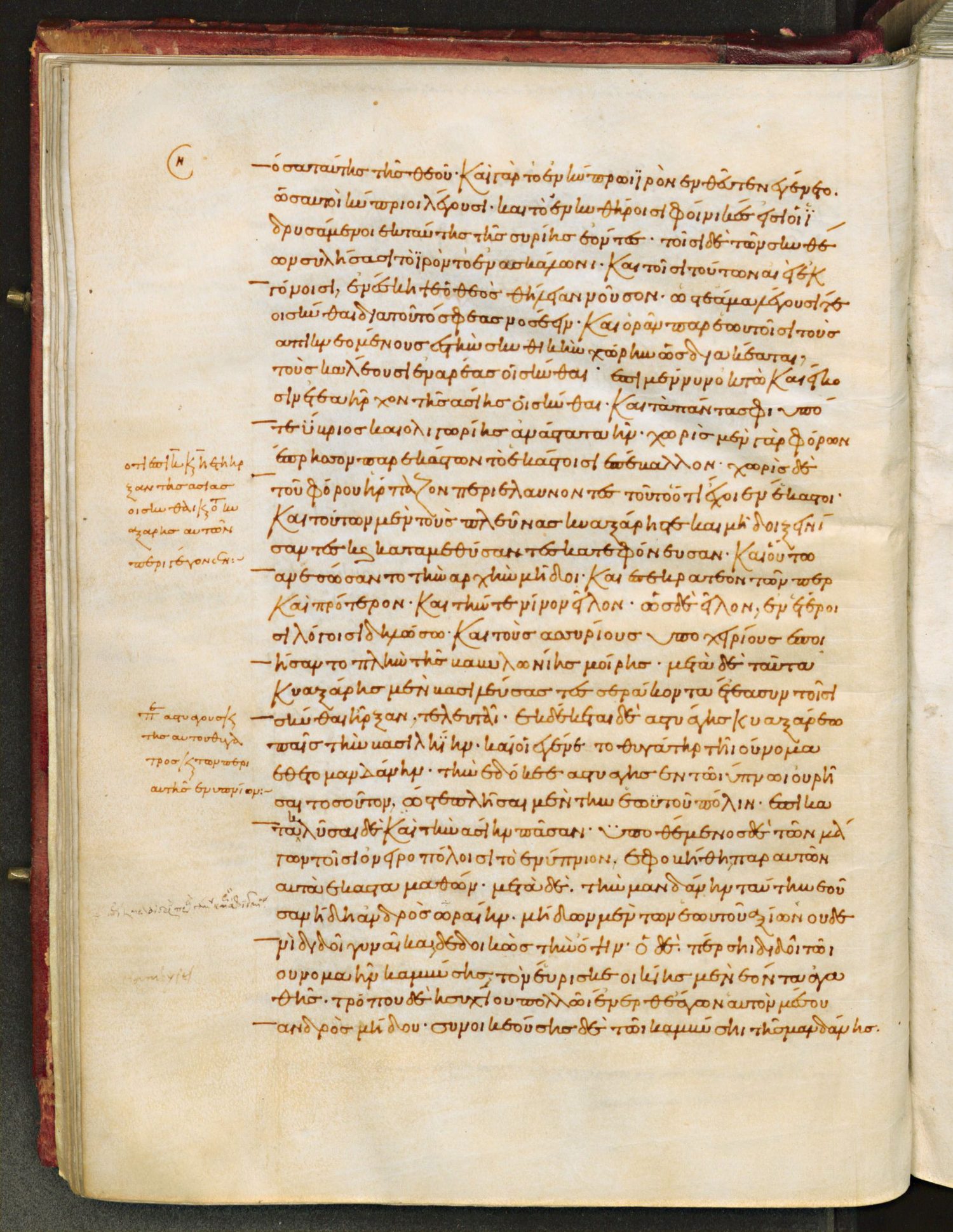
Laur. Plut. 70.3, fol. 28v: Greek here 1.105.3 to 1.106.2. Checked on the image (first and last words read and located in the Greek; each break checked against the neighbouring page): fol. 28v begins ‹ὅσα ταύτης τῆς θεοῦ·› (1.105.3), ends ‹τῷ Καμβύσῃ τῆς Μανδάνης› (1.108.1). English here: 1.105.3 to 1.106.2 (Godley's sentences for the sections whose Greek lies mostly on this page).
1.105.3ὅσα ταύτης τῆς θεοῦ· καὶ γὰρ τὸ ἐν Κύπρῳ ἱρὸν ἐνθεῦτεν ἐγένετο, ὡς αὐτοὶ Κύπριοι λέγουσι, καὶ τὸ ἐν Κυθήροισι Φοίνικές εἰσὶ οἱ ἱδρυσάμενοι ἐκ ταύτης τῆς Συρίης ἐόντες. 1.105.4τοῖσι δὲ τῶν Σκυθέων συλήσασι τὸ ἱρὸν τὸ ἐν Ἀσκάλωνι καὶ τοῖσι τούτων αἰεὶ ἐκγόνοισι ἐνέσκηψε ὁ θεὸς θήλεαν νοῦσον· ὥστε ἅμα λέγουσί τε οἱ Σκύθαι διὰ τοῦτο σφέας νοσέειν, καὶ ὁρᾶν παρʼ ἑωυτοῖσι τοὺς ἀπικνεομένους ἐς τὴν Σκυθικὴν χώρην ὡς διακέαται τοὺς καλέουσι Ἐνάρεας οἱ Σκύθαι. 1.106.1ἐπὶ μέν νυν ὀκτὼ καὶ εἴκοσι ἔτεα ἦρχον τῆς Ἀσίης οἱ Σκύθαι, καὶ τὰ πάντα σφι ὑπό τε ὕβριος καὶ ὀλιγωρίης ἀνάστατα ἦν· χωρὶς μὲν γὰρ φόρον ἔπρησσον παρʼ ἑκάστων τὸν ἑκάστοισι ἐπέβαλλον, χωρὶς δὲ τοῦ φόρου ἥρπαζον περιελαύνοντες τοῦτο ὅ τι ἔχοιεν ἕκαστοι. 1.106.2καὶ τούτων μὲν τοὺς πλεῦνας Κυαξάρης τε καὶ Μῆδοι ξεινίσαντες καὶ καταμεθύσαντες κατεφόνευσαν, καὶ οὕτω ἀνεσώσαντο τὴν ἀρχὴν Μῆδοι καὶ ἐπεκράτεον τῶν περ καὶ πρότερον, καὶ τήν τε Νίνον εἷλον (ὡς δὲ εἷλον ἐν ἑτέροισι λόγοισι δηλώσω) καὶ τοὺς Ἀσσυρίους ὑποχειρίους ἐποιήσαντο πλὴν τῆς Βαβυλωνίης μοίρης.
1.105.3This temple, as I learn from what I hear, is the oldest of all the temples of the goddess, for the temple in Cyprus was founded from it, as the Cyprians themselves say: and the temple on Cythera was founded by Phoenicians from this same land of Syria. 1.105.4But the Scythians who pillaged the temple, and all their descendants after them, were afflicted by the goddess with the “female” sickness: insomuch that the Scythians say that this is the cause of their disease, and that those who come to Scythia can see there the plight of the men whom they call “Enareis.” 1.106.1The Scythians, then, ruled Asia for twenty-eight years: and all the land was wasted by reason of their violence and their pride, for, besides that they exacted from each the tribute which was laid upon him, they rode about the land carrying off all men’s possessions. 1.106.2The greater number of them were entertained and made drunk and then slain by Cyaxares and the Medes: so thus the Medes won back their empire and all that they had formerly possessed; and they took Ninus (in what manner I will show in a later part of my history), and brought all Assyria except the province of Babylon under their rule.
Notes
- Greek: the text printed in A. D. Godley's Loeb edition, via Perseus (tlg0016.tlg001.perseus-grc2). Square brackets mark words the editor considers later additions; [...] marks a gap the editor indicates. Perseus note markers are omitted.
- English: A. D. Godley, Herodotus vol. 1 (1920) (Loeb Classical Library), as transcribed on Wikisource. Godley's footnotes are omitted.
- Section numbers in the English were placed by comparing Godley's text with the Perseus version of his translation; where a section begins inside one of Godley's sentences, the English is kept with the page that holds the start of that sentence.
Cite
Sources
- Source: Florence, Laur. Plut. 70.3 (10th c.) via BML Teca Digitale + Greek of Godley's Loeb (Perseus) + English of A. D. Godley (Loeb, Wikisource) (holding institution)
- Critical edition: Greek of A. D. Godley's Loeb edition (1920-1925), via Perseus
← previous · → next · v cycle view · l back to library