Herodotus, Histories 1.123-130: Harpagus and the revolt of the Persians
Introduction
Herodotus of Halicarnassus wrote the Histories in the third quarter of the 5th century BCE, an inquiry into the deeds of Greeks and barbarians and the causes of the wars between them, later divided into nine books. Book 1 tells how the conflict between Greeks and barbarians began, the history of Lydia from Gyges to Croesus, the rise of the Medes and of Cyrus the Persian, the conquest of the Greeks of Asia, the capture of Babylon and the death of Cyrus.
The photographs are of Florence, Biblioteca Medicea Laurenziana, Plut. 70.3 (parchment, 10th century, 374 folios, 31 lines a page), Herodotus, Histories (codex A of the editors), the oldest surviving manuscript of the complete Histories, from the Teca Digitale of the Biblioteca Medicea Laurenziana. Each section below is the text of one page, or of the part of a page that falls within these chapters. The first and last words of every page were read on the photograph and located in the Greek, and every page break was checked against the next page; the notes quote these words. Readers' notes in the margins are not part of the text and are mentioned where they occur.
The Greek is the text printed in A. D. Godley's Loeb edition (1920-1925), from Perseus; it is the edited text, not a transcription of the manuscript, whose wording differs in places. The English is Godley's translation as printed, from Wikisource. Godley's English carries only chapter numbers; the section numbers shown in it were placed by comparison with the Perseus version of his translation. Each page's English is cut at the end of one of Godley's sentences, so it can begin or end a few lines away from the Greek of the page; each note gives the exact ranges.
This entry covers chapters 1.123-130, on fol. 33r to 35r.
How was this verified? (Provenance)
Where on the image
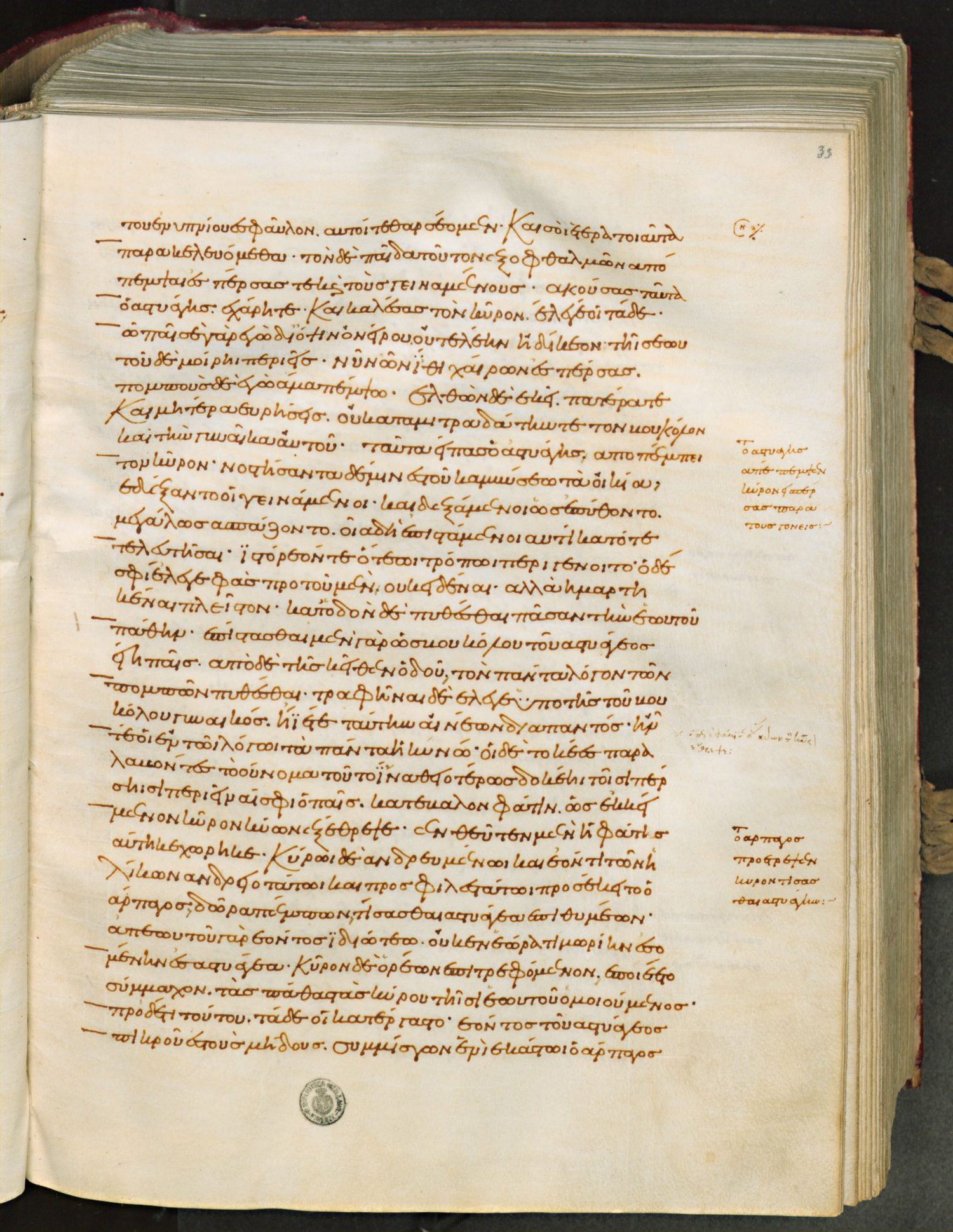
Laur. Plut. 70.3, fol. 33r: Greek here 1.123.1 to 1.123.2. Checked on the image (first and last words read and located in the Greek; each break checked against the neighbouring page): fol. 33r begins ‹τοῦ ἐνυπνίου ἐς φαῦλον,› (1.120.6), ends ‹ἑνὶ ἑκάστῳ ὁ Ἅρπαγος› (1.123.2). English here: 1.123.1 to 1.123.2 (Godley's sentences for the sections whose Greek lies mostly on this page).
1.123.1ἐνθεῦτεν μὲν ἡ φάτις αὕτη κεχώρηκε. Κύρῳ δὲ ἀνδρευμένῳ καὶ ἐόντι τῶν ἡλίκων ἀνδρηιοτάτῳ καὶ προσφιλεστάτῳ προσέκειτο ὁ Ἅρπαγος δῶρα πέμπων, τίσασθαι Ἀστυάγεα ἐπιθυμέων· ἀπʼ ἑωυτοῦ γὰρ ἐόντος ἰδιώτεω οὐκ ἐνώρα τιμωρίην ἐσομένην ἐς Ἀστυάγεα, Κῦρον δὲ ὁρέων ἐπιτρεφόμενον ἐποιέετο σύμμαχον, τὰς πάθας τὰς Κύρου τῇσι ἑωυτοῦ ὁμοιούμενος. 1.123.2πρὸ δʼ ἔτι τούτου τάδε οἱ κατέργαστο· ἐόντος τοῦ Ἀστυάγεος πικροῦ ἐς τοὺς Μήδους, συμμίσγων ἑνὶ ἑκάστῳ ὁ Ἅρπαγος
1.123.1This then was the beginning of that legend. But as Cyrus grew to man’s estate, being the manliest and best loved of his peers, Harpagus courted him and sent him gifts, wishing to be avenged on Astyages; for he saw no hope of a private man like himself punishing Astyages, but as he saw Cyrus growing up he sought to make him an ally, for he likened Cyrus’ misfortune to his own. 1.123.2He had already brought matters so far that—since Astyages dealt harshly with the Medians—he consorted with each of the chief Medians and persuaded them to make Cyrus their leader and depose Astyages.
Where on the image
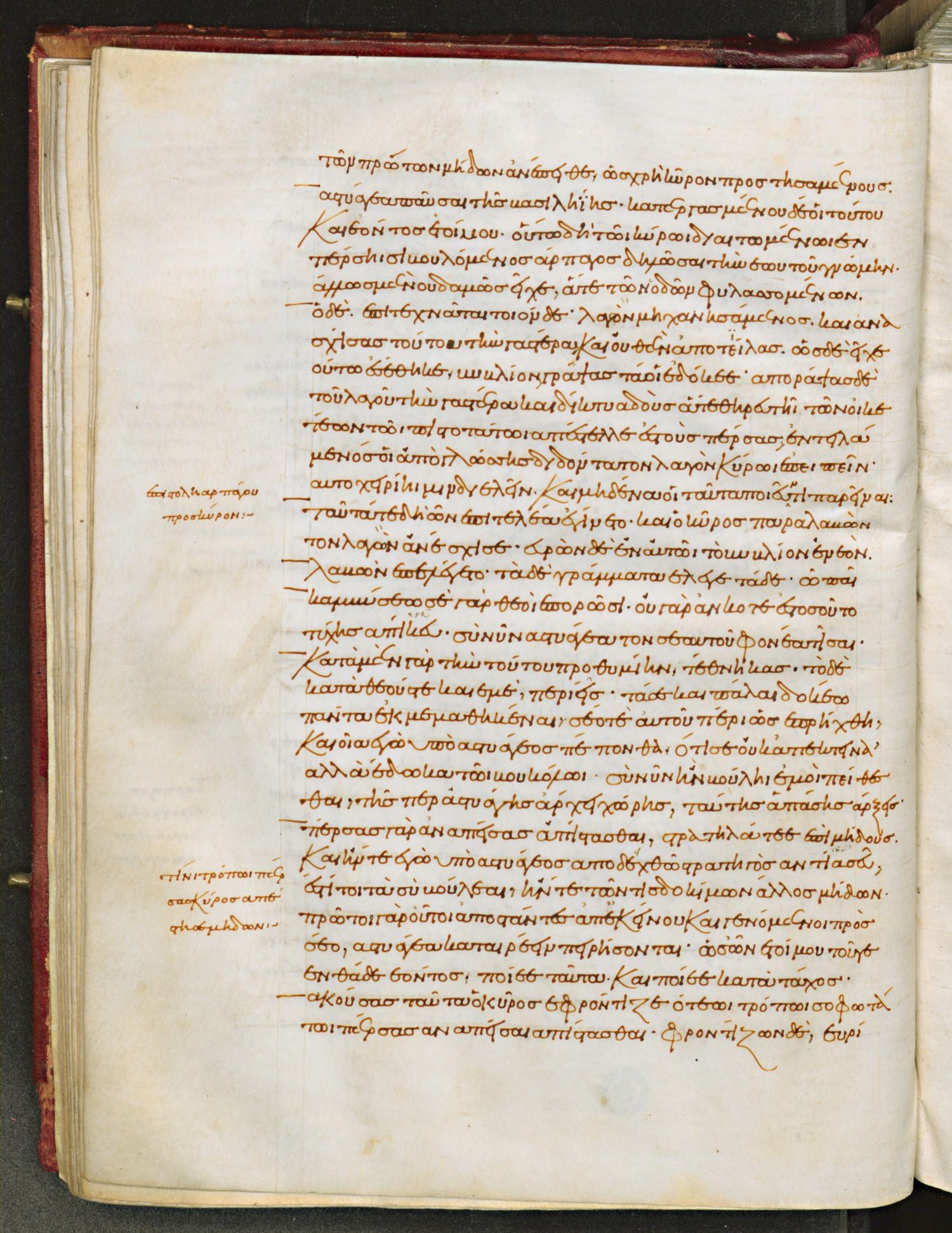
Laur. Plut. 70.3, fol. 33v: Greek here 1.123.2 to 1.125.1. Checked on the image (first and last words read and located in the Greek; each break checked against the neighbouring page): fol. 33v begins ‹τῶν πρώτων Μήδων ἀνέπειθε› (1.123.2), ends ‹ἀπίστασθαι, φροντίζων δὲ εὑρί-› (1.125.1). English here: 1.123.3 to 1.125.2 (Godley's sentences for the sections whose Greek lies mostly on this page).
1.123.2τῶν πρώτων Μήδων ἀνέπειθε ὡς χρὴ Κῦρον προστησαμένους Ἀστυάγεα παῦσαι τῆς βασιληίης. 1.123.3κατεργασμένου δέ οἱ τούτου καὶ ἐόντος ἑτοίμου, οὕτω δὴ τῷ Κύρῳ διαιτωμένῳ ἐν Πέρσῃσι βουλόμενος Ἅρπαγος δηλῶσαι τὴν ἑωυτοῦ γνώμην ἄλλως μὲν οὐδαμῶς εἶχε ἅτε τῶν ὁδῶν φυλασσομενέων, ὁ δὲ ἐπιτεχνᾶται τοιόνδε· 1.123.4λαγὸν μηχανησάμενος, καὶ ἀνασχίσας τούτου τὴν γαστέρα καὶ οὐδὲν ἀποτίλας, ὡς δὲ εἶχε οὕτω ἐσέθηκε βυβλίον, γράψας τά οἱ ἐδόκεε· ἀπορράψας δὲ τοῦ λαγοῦ τὴν γαστέρα, καὶ δίκτυα δοὺς ἅτε θηρευτῇ τῶν οἰκετέων τῷ πιστοτάτῳ, ἀπέστελλε ἐς τοὺς Πέρσας, ἐντειλάμενὸς οἱ ἀπὸ γλώσσης διδόντα τὸν λαγὸν Κύρῳ ἐπειπεῖν αὐτοχειρίῃ μιν διελεῖν καὶ μηδένα οἱ ταῦτα ποιεῦντι παρεῖναι. 1.124.1ταῦτά τε δὴ ὦν ἐπιτελέα ἐγίνετο καὶ ὁ Κῦρος παραλαβὼν τὸν λαγὸν ἀνέσχισε· εὑρὼν δὲ ἐν αὐτῷ τὸ βυβλίον ἐνεὸν λαβὼν ἐπελέγετο, τὰ δὲ γράμματα ἔλεγε τάδε. ὦ παῖ Καμβύσεω, σὲ γὰρ θεοὶ ἐπορῶσι· οὐ γὰρ ἂν κοτὲ ἐς τοσοῦτο τύχης ἀπίκευ· σύ νυν Ἀστυάγεα τὸν σεωυτοῦ φονέα τῖσαι. 1.124.2κατὰ μὲν γὰρ τὴν τούτου προθυμίην τέθνηκας, τὸ δὲ κατὰ θεούς τε καὶ ἐμὲ περίεις· τά σε καὶ πάλαι δοκέω πάντα ἐκμεμαθηκέναι, σέο τε αὐτοῦ περὶ ὡς ἐπρήχθη, καὶ οἷα ἐγὼ ὑπὸ Ἀστυάγεος πέπονθα, ὅτι σε οὐκ ἀπέκτεινα ἀλλὰ ἔδωκα τῷ βουκόλῳ. σύ νυν, ἢν βούλῃ ἐμοὶ πείθεσθαι, τῆς περ Ἀστυάγης ἄρχει χώρης, ταύτης ἁπάσης ἄρξεις. Πέρσας γὰρ ἀναπείσας ἀπίστασθαι στρατηλάτεε ἐπὶ Μήδους· 1.124.3καὶ ἤν τε ἐγὼ ὑπὸ Ἀστυάγεος ἀποδεχθέω στρατηγὸς ἀντία σεῦ, ἔστι τοι τὰ σὺ βούλεαι, ἤν τε τῶν τις δοκίμων ἄλλος Μήδων· πρῶτοι γὰρ οὗτοι ἀποστάντες ἀπʼ ἐκείνου καὶ γενόμενοι πρὸς σέο Ἀστυάγεα καταιρέειν πειρήσονται. ὡς ὦν ἑτοίμου τοῦ γε ἐνθάδε ἐόντος, ποίεε ταῦτα καὶ ποίεε κατὰ τάχος. 1.125.1ἀκούσας ταῦτα ὁ Κῦρος ἐφρόντιζε ὅτεῳ τρόπῳ σοφωτάτῳ Πέρσας ἀναπείσει ἀπίστασθαι, φροντίζων δὲ εὑρίσκεται
1.123.3So much being ready and done, Harpagus desired to make known his intent to Cyrus, then dwelling among the Persians; but the roads were guarded, and he had no plan for sending a message but this— 1.123.4he artfully slit the belly of a hare, and then leaving it as it was without further harm he put into it a paper on which he wrote what he thought fit. Then he sewed up the hare’s belly, and sent it to Persia by the trustiest of his servants, giving him nets to carry as if he were a huntsman. The messenger was charged to give Cyrus the hare and bid him by word of mouth cut it open with his own hands, none other being present. 1.124.1All this was done. Cyrus took the hare and slit it and read the paper which was in it; the writing was as follows: “Son of Cambyses, seeing that the gods watch over you (for else you had not so prospered) do you now avenge yourself on Astyages, your murderer; 1.124.2for according to his intent you are dead; it is by the gods’ doing, and mine, that you live. Methinks you have long ago heard the story of what was done concerning yourself and how Astyages entreated me because I slew you not but gave you to the cowherd. If then you will be counselled by me, you shall rule all the country which is now ruled by Astyages. Persuade the Persians to rebel, and lead their army against the Medes; 1.124.3then you have your desire, whether I be appointed to command the army against you or some other notable man among the Medians; for they will of themselves revolt from Astyages and join you and endeavour to pull him down. Seeing then that all here is ready, do as I say and do it quickly.” 1.125.1When Cyrus heard this, he considered how most cunningly he might persuade the Persians to revolt; and this he thought most apt to the occasion, and this he did: 1.125.2writing what he would on a paper, he gathered an assembly of the Persians, and then unfolded the paper and declared that therein Astyages appointed him leader of the Persian armies. “Now,” said he in his speech, “I bid you all, men of Persia, to come each of you with a sickle.”
Where on the image
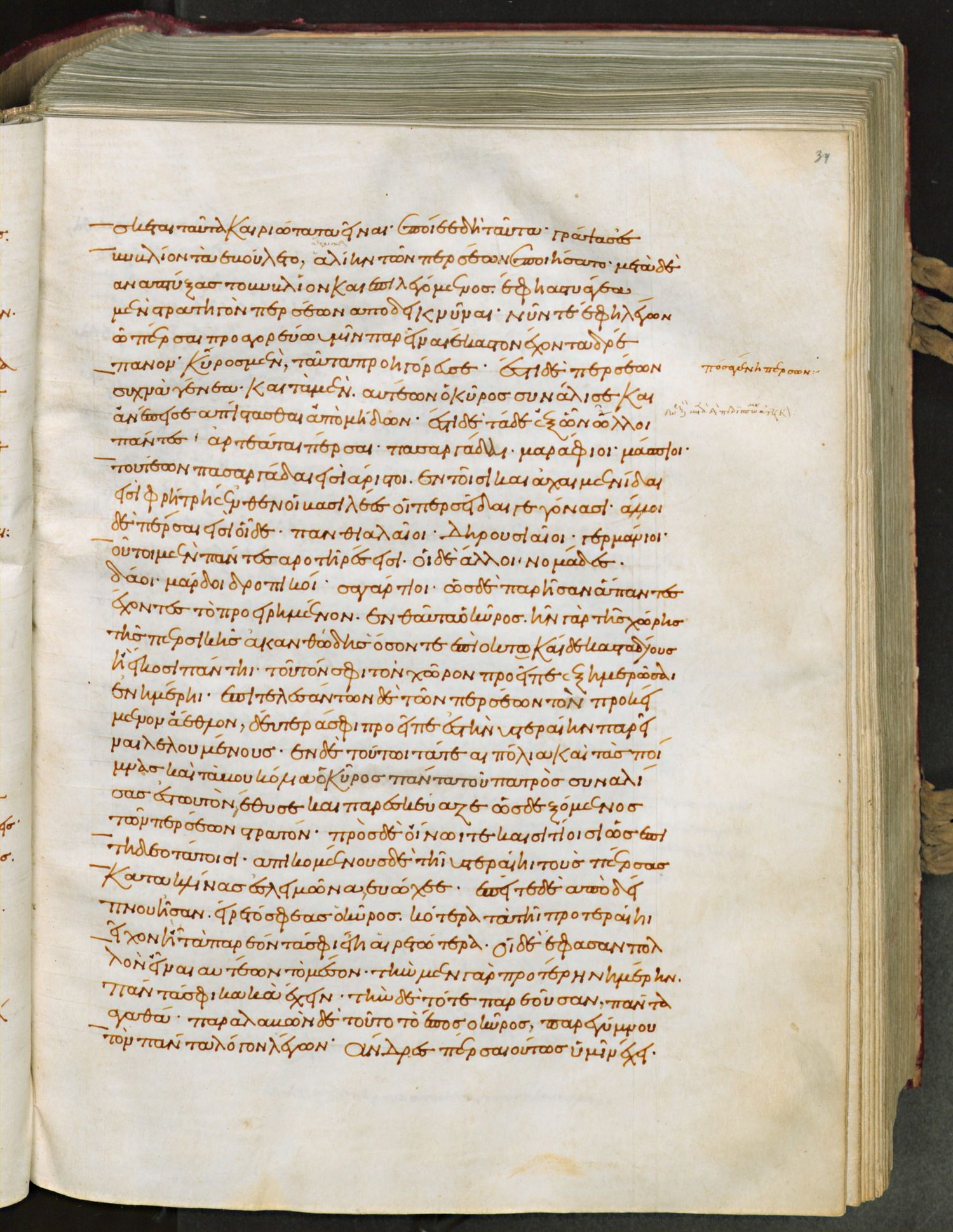
Laur. Plut. 70.3, fol. 34r: Greek here 1.125.1 to 1.126.5. Checked on the image (first and last words read and located in the Greek; each break checked against the neighbouring page): fol. 34r begins ‹-σκεται ταῦτα καιριώτατα εἶναι·› (1.125.1), ends ‹Πέρσαι, οὕτω ὑμῖν ἔχει› (1.126.5). The word ‹εὑρίσκεται› is divided between fol. 33v and fol. 34r; it is given with fol. 33v. English here: 1.125.3 to 1.126.5 (Godley's sentences for the sections whose Greek lies mostly on this page).
1.125.1ταῦτα καιριώτατα εἶναι· ἐποίεε δὴ ταῦτα. 1.125.2γράψας ἐς βυβλίον τὰ ἐβούλετο, ἁλίην τῶν Περσέων ἐποιήσατο, μετὰ δὲ ἀναπτύξας τὸ βυβλίον καὶ ἐπιλεγόμενος ἔφη Ἀστυάγεά μιν στρατηγὸν Περσέων ἀποδεικνύναι. νῦν τε, ἔφη λέγων, ὦ Πέρσαι, προαγορεύω ὑμῖν παρεῖναι ἕκαστον ἔχοντα δρέπανον. Κῦρος μὲν ταῦτα προηγόρευσε. ἔστι δὲ Πέρσεων συχνὰ γένεα, καὶ τὰ μὲν αὐτῶν ὁ Κῦρος συνάλισε καὶ ἀνέπεισε ἀπίστασθαι ἀπὸ Μήδων. 1.125.3ἔστι δὲ τάδε, ἐξ ὧν ὧλλοι πάντες ἀρτέαται Πέρσαι, Πασαργάδαι Μαράφιοι Μάσπιοι. τούτων Πασαργάδαι εἰσὶ ἄριστοι, ἐν τοῖσι καὶ Ἀχαιμενίδαι εἰσὶ φρήτρη, ἔνθεν οἱ βασιλέες οἱ Περσεῖδαι γεγόνασι. 1.125.4ἄλλοι δὲ Πέρσαι εἰσὶ οἵδε, Πανθιαλαῖοι Δηρουσιαῖοι Γερμάνιοι. οὗτοι μὲν πάντες ἀροτῆρες εἰσί, οἱ δὲ ἄλλοι νομάδες, Δάοι Μάρδοι Δροπικοὶ Σαγάρτιοι. 1.126.1ὡς δὲ παρῆσαν ἅπαντες ἔχοντες τὸ προειρημένον, ἐνθαῦτα ὁ Κῦρος, ἦν γάρ τις χῶρος τῆς Περσικῆς ἀκανθώδης ὅσον τε ἐπὶ ὀκτωκαίδεκα σταδίους ἢ εἴκοσι πάντῃ, τοῦτον σφι τὸν χῶρον προεῖπε ἐξημερῶσαι ἐν ἡμέρῃ. 1.126.2ἐπιτελεσάντων δὲ τῶν Περσέων τὸν προκείμενον ἄεθλον, δεύτερα σφι προεῖπε ἐς τὴν ὑστεραίην παρεῖναι λελουμένους. ἐν δὲ τούτῳ τά τε αἰπόλια καὶ τὰς ποίμνας καὶ τὰ βουκόλια ὁ Κῦρος πάντα τοῦ πατρὸς συναλίσας ἐς τὠυτὸ ἔθυσε καὶ παρεσκεύαζε ὡς δεξόμενος τὸν Περσέων στρατόν, πρὸς δὲ οἴνῳ τε καὶ σιτίοισι ὡς ἐπιτηδεοτάτοισι. 1.126.3ἀπικομένους δὲ τῇ ὑστεραίῃ τοὺς Πέρσας κατακλίνας ἐς λειμῶνα εὐώχεε. ἐπείτε δὲ ἀπὸ δείπνου ἦσαν, εἴρετο σφέας ὁ Κῦρος κότερα τὰ τῇ προτεραίῃ εἶχον ἢ τὰ παρεόντα σφι εἴη αἱρετώτερα. 1.126.4οἳ δὲ ἔφασαν πολλὸν εἶναι αὐτῶν τὸ μέσον· τὴν μὲν γὰρ προτέρην ἡμέρην πάντα σφι κακὰ ἔχειν, τὴν δὲ τότε παρεοῦσαν πάντα ἀγαθά. παραλαβὼν δὲ τοῦτο τὸ ἔπος ὁ Κῦρος παρεγύμνου τὸν πάντα λόγον, λέγων 1.126.5ἄνδρες Πέρσαι, οὕτω ὑμῖν ἔχει.
1.125.3(There are many tribes in Persia: those of them whom Cyrus assembled and persuaded to revolt from the Medes were the Pasargadae, the Maraphii, and the Maspii. On these hang all the other Persians. The chief tribe is that of the Pasargadae; to them belongs the clan of the Achaemenidae, the royal house of Persia. 1.125.4The other Persian tribes are the Panthialaei, the Derusiaei, and the Germanii, all tillers of the soil, and the Dai, the Mardi, the Dropici, the Sagartii, all wandering herdsmen.) 1.126.1So when they all came with sickles as commanded, Cyrus bade them clear and make serviceable in one day a certain thorny tract of Persia, of eighteen or twenty furlongs each way in extent. 1.126.2The Persians accomplished the appointed task; Cyrus then commanded them to wash themselves and come on the next day; and meanwhile, gathering together his father’s goats and sheep and oxen in one place, he slew and prepared them as a feast for the Persian host, providing also wine and all foods that were most suitable. 1.126.3When the Persians came on the next day he made them sit and feast in a meadow. After dinner he asked them which pleased them best, their task of yesterday or their present state. 1.126.4They answered that the difference was great: all yesterday they had had nought but evil, to-day nought but good. Then taking their word from their mouths Cyrus laid bare all his purpose, and said: “ 1.126.5This is your case, men of Persia: obey me and you shall have these good things and ten thousand others besides with no toil and slavery; but if you will not obey me you will have labours unnumbered, like to your toil of yesterday.
Where on the image
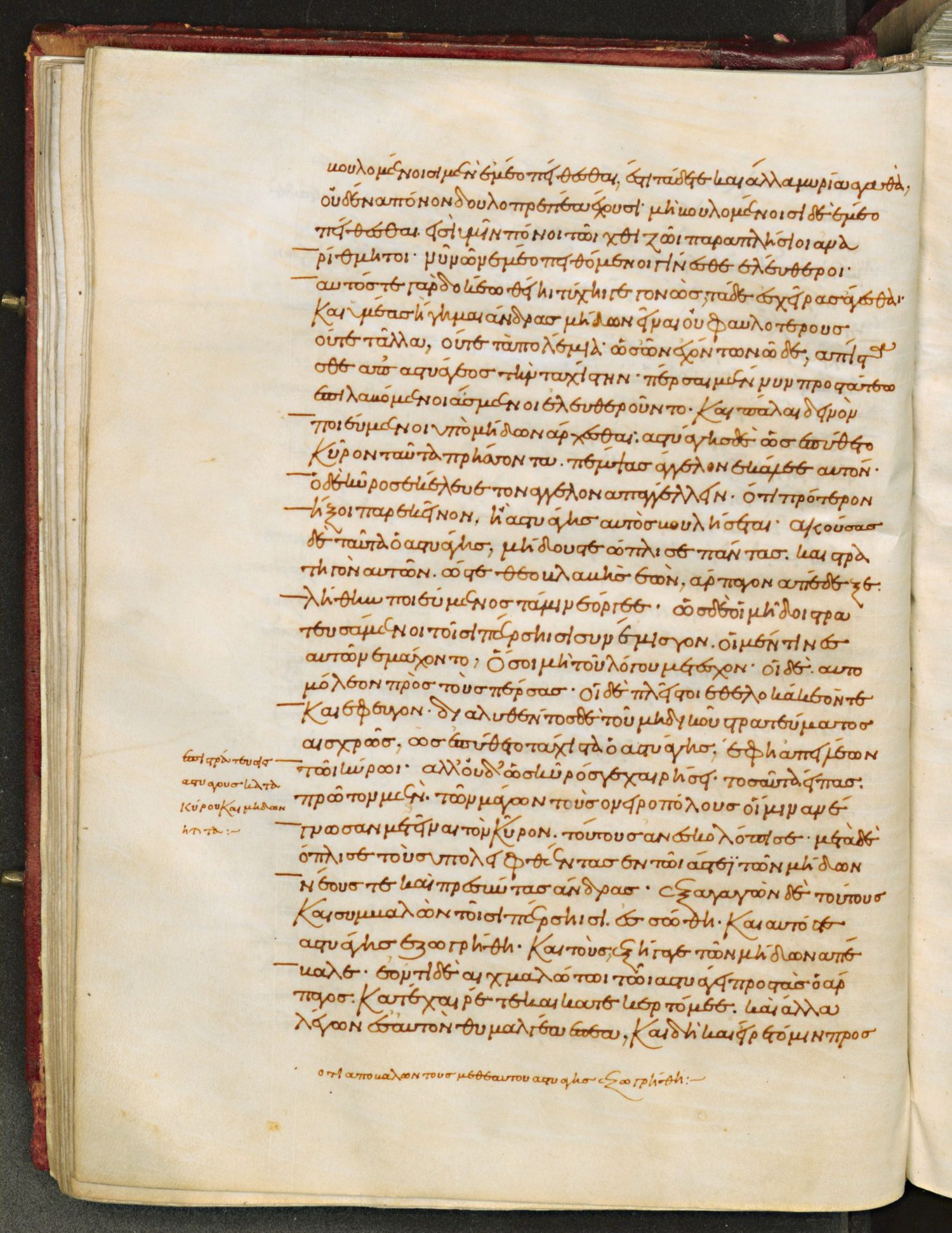
Laur. Plut. 70.3, fol. 34v: Greek here 1.126.5 to 1.129.1. Checked on the image (first and last words read and located in the Greek; each break checked against the neighbouring page): fol. 34v begins ‹βουλομένοισι μὲν ἐμέο πείθεσθαί› (1.126.5), ends ‹καὶ εἴρετό μιν πρὸς› (1.129.1). Below the text, a reader's note on the Persian feast. English here: 1.126.6 to 1.129.1 (Godley's sentences for the sections whose Greek lies mostly on this page).
1.126.5βουλομένοισι μὲν ἐμέο πείθεσθαί ἔστι τάδε τε καὶ ἄλλα μυρία ἀγαθά, οὐδένα πόνον δουλοπρεπέα ἔχουσι, μὴ βουλομένοισι δὲ ἐμέο πείθεσθαι εἰσὶ ὑμῖν πόνοι τῷ χθιζῷ παραπλήσιοι ἀναρίθμητοι. 1.126.6νῦν ὦν ἐμέο πειθόμενοι γίνεσθε ἐλεύθεροι. αὐτός τε γὰρ δοκέω θείῃ τύχῃ γεγονὼς τάδε ἐς χεῖρας ἄγεσθαι, καὶ ὑμέας ἥγημαι ἄνδρας Μήδων εἶναι οὐ φαυλοτέρους οὔτε τἄλλα οὔτε τὰ πολέμια. ὡς ὦν ἐχόντων ὧδε, ἀπίστασθε ἀπʼ Ἀστυάγεος τὴν ταχίστην. 1.127.1πέρσαι μέν νυν προστάτεω ἐπιλαβόμενοι ἄσμενοὶ ἐλευθεροῦντο, καὶ πάλαι δεινὸν ποιεύμενοι ὑπὸ Μήδων ἄρχεσθαι. Ἀστυάγης δὲ ὡς ἐπύθετο Κῦρον ταῦτα πρήσσοντα, πέμψας ἄγγελον ἐκάλεε αὐτόν. 1.127.2ὁ δὲ Κῦρος ἐκέλευε τὸν ἄγγελον ἀπαγγέλλειν ὅτι πρότερον ἥξοι παρʼ ἐκεῖνον ἢ Ἀστυάγης αὐτὸς βουλήσεται. ἀκούσας δὲ ταῦτα ὁ Ἀστυάγης Μήδους τε ὥπλισε πάντας, καὶ στρατηγὸν αὐτῶν ὥστε θεοβλαβὴς ἐὼν Ἅρπαγον ἀπέδεξε, λήθην ποιεύμενος τά μιν ἐόργεε. 1.127.3ὡς δὲ οἱ Μῆδοι στρατευσάμενοι τοῖσι Πέρσῃσι συνέμισγον, οἳ μέν τινὲς αὐτῶν ἐμάχοντο, ὅσοι μὴ τοῦ λόγου μετέσχον, οἳ δὲ αὐτομόλεον πρὸς τοὺς Πέρσας, οἱ δὲ πλεῖστοι ἐθελοκάκεόν τε καὶ ἔφευγον. 1.128.1διαλυθέντος δὲ τοῦ Μηδικοῦ στρατεύματος αἰσχρῶς, ὡς ἐπύθετο τάχιστα ὁ Ἀστυάγης, ἔφη ἀπειλέων τῷ Κύρῳ ἀλλʼ οὐδʼ ὣς Κῦρός γε χαιρήσει. 1.128.2τοσαῦτα εἶπας πρῶτον μὲν τῶν Μάγων τοὺς ὀνειροπόλους, οἵ μιν ἀνέγνωσαν μετεῖναι τὸν Κῦρον, τούτους ἀνεσκολόπισε, μετὰ δὲ ὥπλισε τοὺς ὑπολειφθέντας ἐν τῷ ἄστεϊ τῶν Μήδων, νέους τε καὶ πρεσβύτας ἄνδρας. 1.128.3ἐξαγαγὼν δὲ τούτους καὶ συμβαλὼν τοῖσι Πέρῃσι ἑσσώθη, καὶ αὐτός τε Ἀστυάγης ἐζωγρήθη καὶ τοὺς ἐξήγαγε τῶν Μήδων ἀπέβαλε. 1.129.1ἐόντι δὲ αἰχμαλώτῳ τῷ Ἀστυάγεϊ προσστὰς ὁ Ἅρπαγος κατέχαιρέ τε καὶ κατεκερτόμεε, καὶ ἄλλα λέγων ἐς αὐτὸν θυμαλγέα ἔπεα, καὶ δὴ καὶ εἴρετό μιν πρὸς
1.126.6Now, therefore, do as I bid you, and win your freedom. For I think that I myself was born by a marvellous providence to take this work in hand; and I deem you full as good men as the Medes in war and in all else. All this is true wherefore now revolt from Astyages with all speed!” 1.127.1The Persians had long been ill content that the Medes should rule them, and now having got them a champion they were glad to win their freedom. But when Astyages heard that Cyrus was at this business, he sent a messenger to summon him; 1.127.2Cyrus bade the messenger bring back word that Astyages would see him sooner than he desired. Hearing this, Astyages armed all his Medians, and was so infatuated that he forgot what he had done to Harpagus, and appointed him to command the army. 1.127.3So no sooner had the Medes marched out and joined battle with the Persians than some of them deserted to the enemy, but most of them of set purpose played the coward and fled; those only fought who had not shared Harpagus’ counsels. 1.128.1Thus the Median army was foully scattered. Astyages, hearing this, sent a threatening message to Cyrus, “that even so he should not go unpunished”; 1.128.2and with that he took the Magians who interpreted dreams and had persuaded him to let Cyrus go free, and impaled them; then he armed the Medes who were left in the city, the youths and old men. 1.128.3Leading these out, and encountering the Persians, he was worsted: Astyages himself was taken prisoner, and lost the Median army which he led. 1.129.1He being then a captive, Harpagus came and exulted over him and taunted him, and with much other bitter mockery he brought to mind his banquet, when Astyages had fed Harpagus on his son’s flesh, and asked Astyages what it was to be a slave after having been a king.
Where on the image
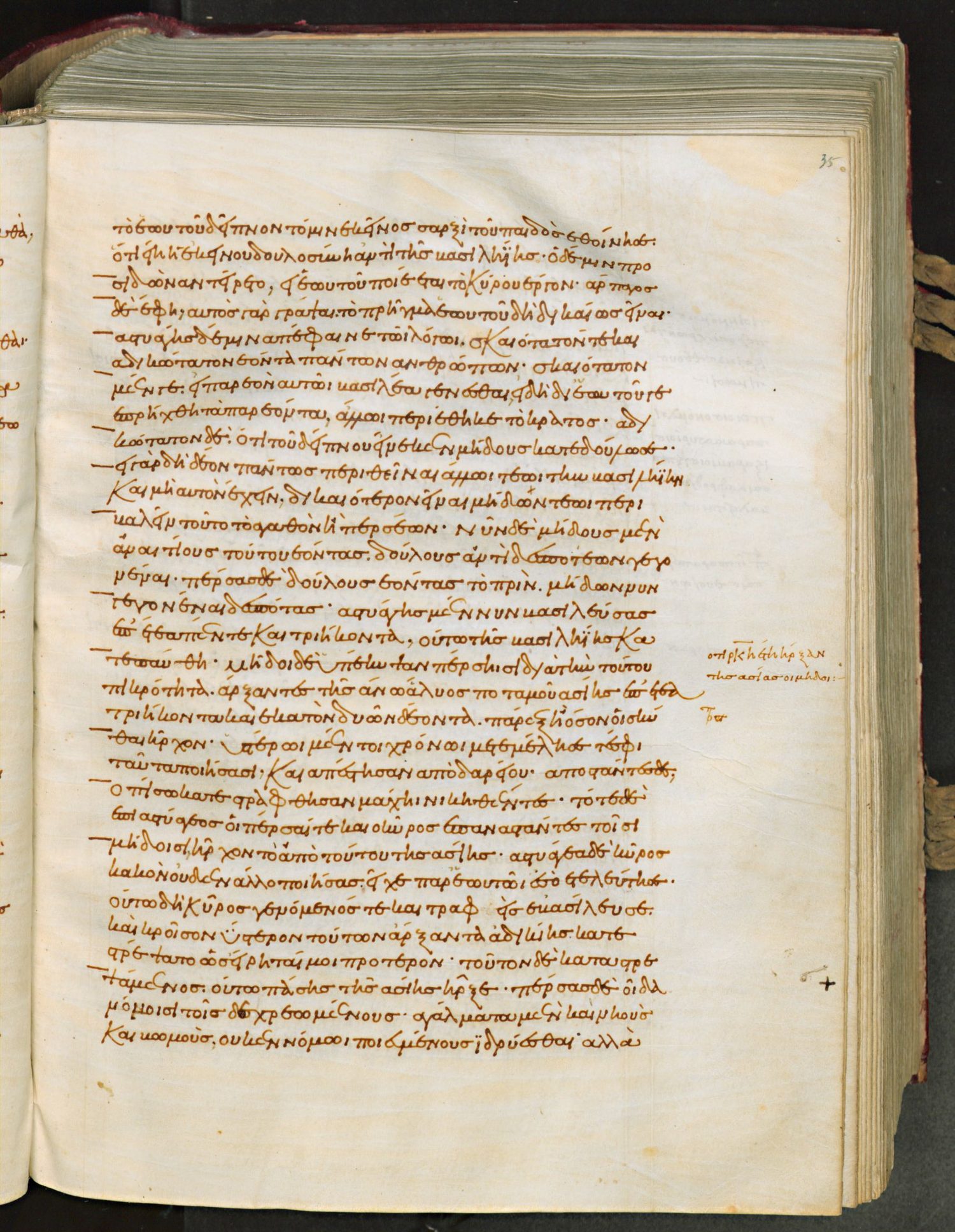
Laur. Plut. 70.3, fol. 35r: Greek here 1.129.1 to 1.130.3. Checked on the image (first and last words read and located in the Greek; each break checked against the neighbouring page): fol. 35r begins ‹τὸ ἑωυτοῦ δεῖπνον, τὸ› (1.129.1), ends ‹νόμῳ ποιευμένους ἱδρύεσθαι, ἀλλὰ› (1.131.1). English here: 1.129.2 to 1.130.3 (Godley's sentences for the sections whose Greek lies mostly on this page).
1.129.1τὸ ἑωυτοῦ δεῖπνον, τὸ μιν ἐκεῖνος σαρξὶ τοῦ παιδὸς ἐθοίνησε, ὅ τι εἴη ἡ ἐκείνου δουλοσύνη ἀντὶ τῆς βασιληίης. 1.129.2ὁ δέ μιν προσιδὼν ἀντείρετο εἰ ἑωυτοῦ ποιέεται τὸ Κύρου ἔργον. Ἅρπαγος δὲ ἔφη, αὐτὸς γὰρ γράψαι, τὸ πρῆγμα ἑωυτοῦ δὴ δικαίως εἶναι. 1.129.3Ἀστυάγης δέ μιν ἀπέφαινε τῷ λόγῳ σκαιότατόν τε καὶ ἀδικώτατον ἐόντα πάντων ἀνθρώπων, σκαιότατον μέν γε, εἰ παρεὸν αὐτῷ βασιλέα γενέσθαι, εἰ δὴ διʼ ἑωυτοῦ γε ἐπρήχθη τὰ παρεόντα, ἄλλῳ περιέθηκε τὸ κράτος, ἀδικώτατον δέ, ὅτι τοῦ δείπνου εἵνεκεν Μήδους κατεδούλωσε. 1.129.4εἰ γὰρ δὴ δεῖν πάντως περιθεῖναι ἄλλῳ τεῷ τὴν βασιληίην καὶ μὴ αὐτὸν ἔχειν, δικαιότερον εἶναι Μήδων τεῷ περιβαλεῖν τοῦτο τὸ ἀγαθὸν ἢ Περσέων. νῦν δὲ Μήδους μὲν ἀναιτίους τούτου ἐόντας δούλους ἀντὶ δεσποτέων γεγονέναι, Πέρσας δὲ δούλους ἐόντας τὸ πρὶν Μήδων νῦν γεγονέναι δεσπότας. 1.130.1Ἀστυάγης μέν νυν βασιλεύσας ἐπʼ ἔτεα πέντε καὶ τριήκοντα οὕτω τῆς βασιληίης κατεπαύσθη, Μῆδοι δὲ ὑπέκυψαν Πέρσῃσι διὰ τὴν τούτου πικρότητα, ἄρξαντες τῆς ἄνω Ἅλυος ποταμοῦ Ἀσίης ἐπʼ ἔτεα τριήκοντα καὶ ἑκατὸν δυῶν δέοντα, πάρεξ ἢ ὅσον οἱ Σκύθαι ἦρχον. 1.130.2ὑστέρῳ μέντοι χρόνῳ μετεμέλησέ τέ σφι ταῦτα ποιήσασι καὶ ἀπέστησαν ἀπὸ Δαρείου, ἀποστάντες δὲ ὀπίσω κατεστράφθησαν μάχῃ νικηθέντες. τότε δὲ ἐπὶ Ἀστυάγεος οἱ Πέρσαι τε καὶ ὁ Κῦρος ἐπαναστάντες τοῖσι Μήδοισι ἦρχον τὸ ἀπὸ τούτου τῆς Ἀσίης. 1.130.3Ἀστυάγεα δὲ Κῦρος κακὸν οὐδὲν ἄλλο ποιήσας εἶχε παρʼ ἑωυτῷ, ἐς ὃ ἐτελεύτησε. οὕτω δὴ Κῦρος γενόμενός τε καὶ τραφεὶς ἐβασίλευσε καὶ Κροῖσον ὕστερον τούτων ἄρξαντα ἀδικίης κατεστρέψατο, ὡς εἴρηταί μοι πρότερον, τοῦτον δὲ καταστρεψάμενος οὕτω πάσης τῆς Ἀσίης ἦρξε.
1.129.2Fixing his gaze on Harpagus, Astyages asked, “Think you that this, which Cyrus has done, is your work?” “It was I,” said the other, “who wrote the letter; the accomplishment of the work is justly mine.” 1.129.3“Then” said Astyages, “you stand confessed the most foolish and most unjust man on earth; most foolish, in giving another the throne which you might have had for yourself, if the present business be indeed your doing most unjust, in enslaving the Medes by reason of that banquet. 1.129.4For if at all hazards another and not yourself must possess the royal power, then in justice some Mede should enjoy it, not a Persian: but now you have made the Medes, who did you no harm, slaves instead of masters and the Persians, who were the slaves, are now the masters of the Medes.” 1.130.1Thus Astyages was deposed from his sovereignty after a reign of thirty-five years: and the Medians were made to bow down before the Persians by reason of Astyages’ cruelty. They had ruled all Asia beyond the Halys for one hundred and twenty-eight years, from which must be taken the time when the Scythians held sway. 1.130.2At a later time they repented of what they now did, and rebelled against Darius; but they were defeated in battle and brought back into subjection. But now, in Astyages’ time, Cyrus and the Persians rose in revolt against the Medes, and from this time ruled Asia. 1.130.3As for Astyages, Cyrus did him no further harm, and kept him in his own house till Astyages died. This is the story of the birth and upbringing of Cyrus, and thus he became king; and afterwards, as I have already related, he subdued Croesus in punishment for the unprovoked wrong done him; and after this victory he became sovereign of all Asia.
Notes
- Greek: the text printed in A. D. Godley's Loeb edition, via Perseus (tlg0016.tlg001.perseus-grc2). Square brackets mark words the editor considers later additions; [...] marks a gap the editor indicates. Perseus note markers are omitted.
- English: A. D. Godley, Herodotus vol. 1 (1920) (Loeb Classical Library), as transcribed on Wikisource. Godley's footnotes are omitted.
- Section numbers in the English were placed by comparing Godley's text with the Perseus version of his translation; where a section begins inside one of Godley's sentences, the English is kept with the page that holds the start of that sentence.
Cite
Sources
- Source: Florence, Laur. Plut. 70.3 (10th c.) via BML Teca Digitale + Greek of Godley's Loeb (Perseus) + English of A. D. Godley (Loeb, Wikisource) (holding institution)
- Critical edition: Greek of A. D. Godley's Loeb edition (1920-1925), via Perseus
← previous · → next · v cycle view · l back to library