Herodotus, Histories 1.131-140: Persian customs
Introduction
Herodotus of Halicarnassus wrote the Histories in the third quarter of the 5th century BCE, an inquiry into the deeds of Greeks and barbarians and the causes of the wars between them, later divided into nine books. Book 1 tells how the conflict between Greeks and barbarians began, the history of Lydia from Gyges to Croesus, the rise of the Medes and of Cyrus the Persian, the conquest of the Greeks of Asia, the capture of Babylon and the death of Cyrus.
The photographs are of Florence, Biblioteca Medicea Laurenziana, Plut. 70.3 (parchment, 10th century, 374 folios, 31 lines a page), Herodotus, Histories (codex A of the editors), the oldest surviving manuscript of the complete Histories, from the Teca Digitale of the Biblioteca Medicea Laurenziana. Each section below is the text of one page, or of the part of a page that falls within these chapters. The first and last words of every page were read on the photograph and located in the Greek, and every page break was checked against the next page; the notes quote these words. Readers' notes in the margins are not part of the text and are mentioned where they occur.
The Greek is the text printed in A. D. Godley's Loeb edition (1920-1925), from Perseus; it is the edited text, not a transcription of the manuscript, whose wording differs in places. The English is Godley's translation as printed, from Wikisource. Godley's English carries only chapter numbers; the section numbers shown in it were placed by comparison with the Perseus version of his translation. Each page's English is cut at the end of one of Godley's sentences, so it can begin or end a few lines away from the Greek of the page; each note gives the exact ranges.
This entry covers chapters 1.131-140, on fol. 35r to 37r.
How was this verified? (Provenance)
Where on the image
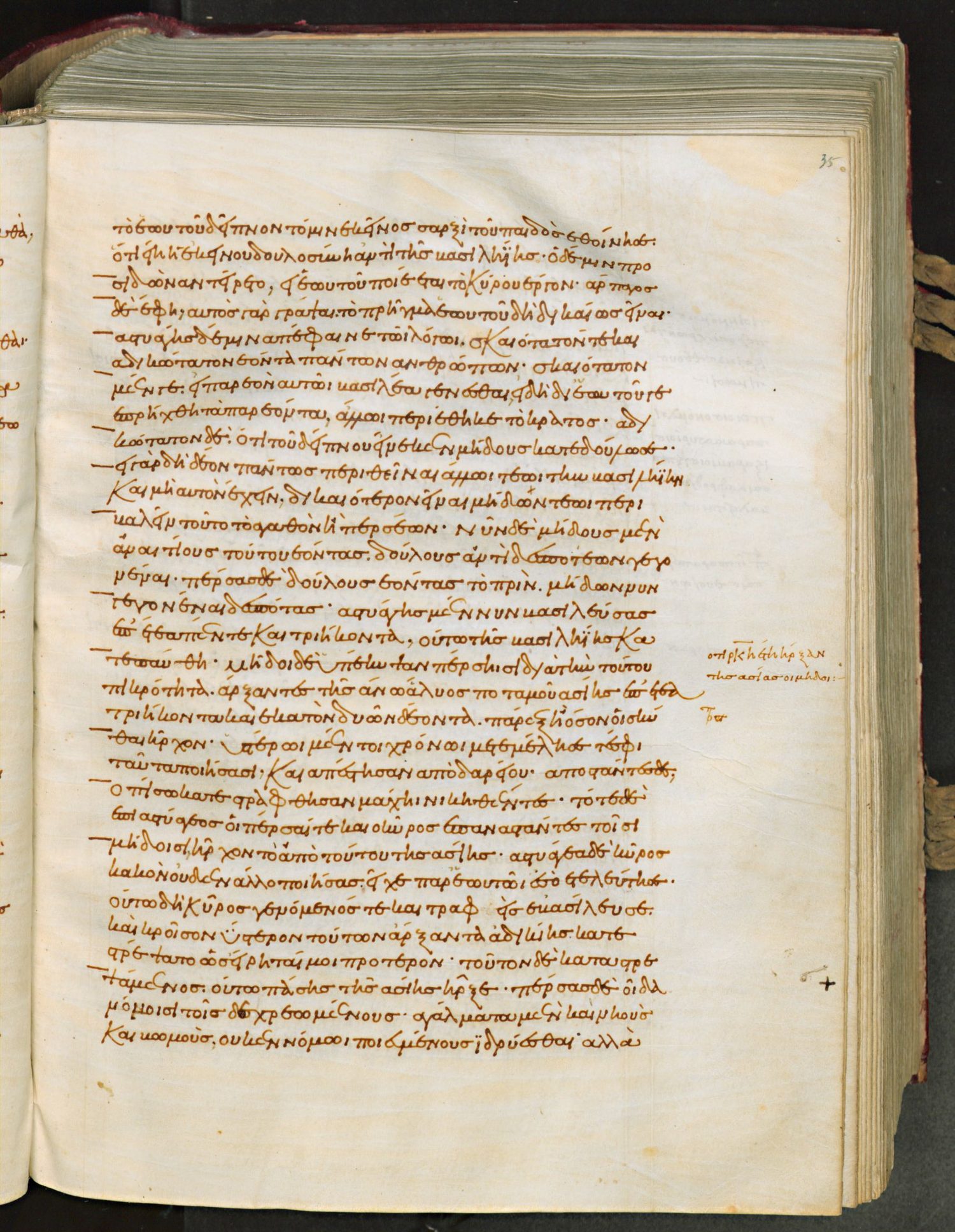
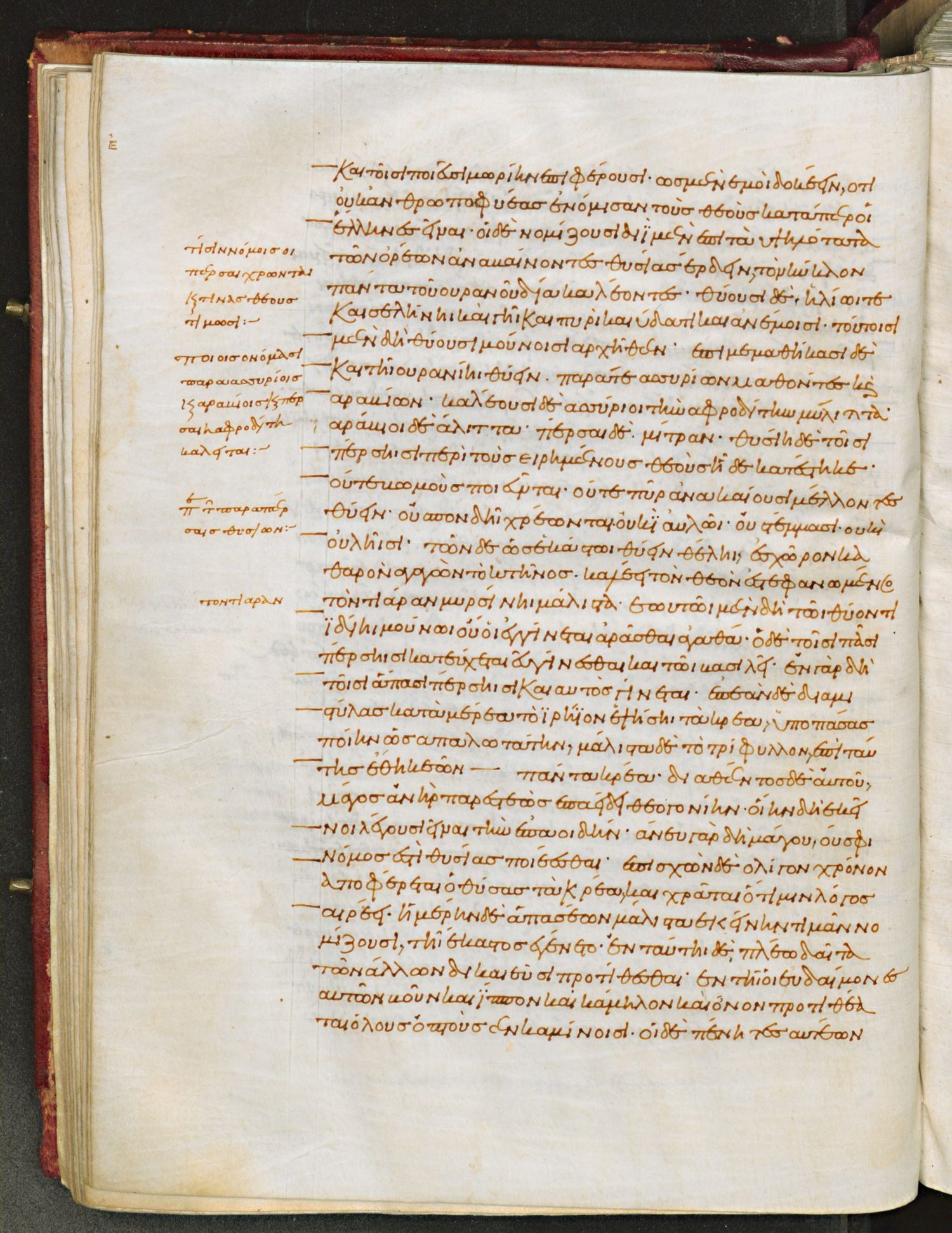
Laur. Plut. 70.3, fol. 35r, 35v: Greek here 1.131.1 to 1.133.1. Checked on the image (first and last words read and located in the Greek; each break checked against the neighbouring page): fol. 35r begins ‹τὸ ἑωυτοῦ δεῖπνον, τὸ› (1.129.1), ends ‹νόμῳ ποιευμένους ἱδρύεσθαι, ἀλλὰ› (1.131.1). fol. 35v begins ‹καὶ τοῖσι ποιεῦσι μωρίην› (1.131.1), ends ‹οἱ δὲ πένητες αὐτῶν› (1.133.1). This section joins the text of fol. 35r and 35v that belongs to these chapters, because the part on one of the pages is too short to carry any of Godley's sentences on its own. English here: 1.131.1 to 1.133.1 (Godley's sentences for the sections whose Greek lies mostly on this page).
1.131.1Πέρσας δὲ οἶδα νόμοισι τοιοῖσιδε χρεωμένους, ἀγάλματα μὲν καὶ νηοὺς καὶ βωμοὺς οὐκ ἐν νόμῳ ποιευμένους ἱδρύεσθαι, ἀλλὰ καὶ τοῖσι ποιεῦσι μωρίην ἐπιφέρουσι, ὡς μὲν ἐμοὶ δοκέειν, ὅτι οὐκ ἀνθρωποφυέας ἐνόμισαν τοὺς θεοὺς κατά περ οἱ Ἕλληνες εἶναι· 1.131.2οἳ δὲ νομίζουσι Διὶ μὲν ἐπὶ τὰ ὑψηλότατα τῶν ὀρέων ἀναβαίνοντες θυσίας ἔρδειν, τὸν κύκλον πάντα τοῦ οὐρανοῦ Δία καλέοντες· θύουσι δὲ ἡλίῳ τε καὶ σελήνῃ καὶ γῇ καὶ πυρὶ καὶ ὕδατι καὶ ἀνέμοισι. 1.131.3τούτοισι μὲν δὴ θύουσι μούνοισι ἀρχῆθεν, ἐπιμεμαθήκασι δὲ καὶ τῇ Οὐρανίῃ θύειν, παρά τε Ἀσσυρίων μαθόντες καὶ Ἀραβίων. καλέουσι δὲ Ἀσσύριοι τὴν Ἀφροδίτην Μύλιττα, Ἀράβιοι δὲ Ἀλιλάτ, Πέρσαι δὲ Μίτραν. 1.132.1θυσίη δὲ τοῖσι Πέρσῃσι περὶ τοὺς εἰρημένους θεοὺς ἥδε κατέστηκε· οὔτε βωμοὺς ποιεῦνται οὔτε πῦρ ἀνακαίουσι μέλλοντες θύειν, οὐ σπονδῇ χρέωνται, οὐκὶ αὐλῷ, οὐ στέμμασι, οὐκὶ οὐλῇσι· τῶν δὲ ὡς ἑκάστῳ θύειν θέλῃ, ἐς χῶρον καθαρὸν ἀγαγὼν τὸ κτῆνος καλέει τὸν θεόν, ἐστεφανωμένος τὸν τιάραν μυρσίνῃ μάλιστα. 1.132.2ἑωυτῷ μὲν δὴ τῷ θύοντι ἰδίῃ μούνῳ οὔ οἱ ἐγγίνεται ἀρᾶσθαι ἀγαθά, ὁ δὲ τοῖσι πᾶσι Πέρσῃσι κατεύχεται εὖ γίνεσθαι καὶ τῷ βασιλέι· ἐν γὰρ δὴ τοῖσι ἅπασι Πέρσῃσι καὶ αὐτὸς γίνεται. ἐπεὰν δὲ διαμιστύλας κατὰ μέλεα τὸ ἱρήιον ἑψήσῃ τὰ κρέα ὑποπάσας ποίην ὡς ἁπαλωτάτην, μάλιστα δὲ τὸ τρίφυλλον, ἐπὶ ταύτης ἔθηκε ὦν πάντα τὰ κρέα. 1.132.3διαθέντος δὲ αὐτοῦ Μάγος ἀνὴρ παρεστεὼς ἐπαείδει θεογονίην, οἵην δὴ ἐκεῖνοι λέγουσι εἶναι τὴν ἐπαοιδήν· ἄνευ γὰρ δὴ Μάγου οὔ σφι νόμος ἐστὶ θυσίας ποιέεσθαι. ἐπισχὼν δὲ ὀλίγον χρόνον ἀποφέρεται ὁ θύσας τὰ κρέα καὶ χρᾶται ὅ τι μιν λόγος αἱρέει. 1.133.1ἡμέρην δὲ ἁπασέων μάλιστα ἐκείνην τιμᾶν νομίζουσι τῇ ἕκαστος ἐγένετο. ἐν ταύτῃ δὲ πλέω δαῖτα τῶν ἀλλέων δικαιεῦσι προτίθεσθαι· ἐν τῇ οἱ εὐδαίμονες αὐτῶν βοῦν καὶ ἵππον καὶ κάμηλον καὶ ὄνον προτιθέαται ὅλους ὀπτοὺς ἐν καμίνοισι, οἱ δὲ πένητες αὐτῶν
1.131.1As to the usages of the Persians, I know them to be these. It is not their custom to make and set up statues and temples and altars, but those who make such they deem foolish, as I suppose, because they never believed the gods, as do the Greeks, to be in the likeness of men; 1.131.2but they call the whole circle of heaven Zeus, and to him they offer sacrifice on the highest peaks of the mountains; they sacrifice also to the sun and moon and earth and fire and water and winds. 1.131.3These are the only gods to whom they have ever sacrificed from the beginning; they have learnt later, to sacrifice to the “heavenly” Aphrodite, from the Assyrians and Arabians. She is called by the Assyrians Mylitta, by the Arabians Alilat, by the Persians Mitra. 1.132.1And this is their fashion of sacrifice to the aforesaid gods: when about to sacrifice they neither build altars nor kindle fire, they use no libations, nor music, nor fillets, nor barley meal; but to whomsoever of the gods a man will sacrifice, he leads the beast to an open space and then calls on the god, himself wearing a wreath on his cap, of myrtle for choice. 1.132.2To pray for blessings for himself alone is not lawful for the sacrificer; rather he prays that it may be well with the king and all the Persians for he reckons himself among them, He then cuts the victim limb from limb into portions, and having boiled the flesh spreads the softest grass, trefoil by choice, and places all of it on this. 1.132.3When he has so disposed it a Magian comes near and chants over it the song of the birth of the gods, as the Persian tradition relates it; for no sacrifice can be offered without a Magian. Then after a little while the sacrificer carries away the flesh and uses it as he pleases. 1.133.1The day which every man most honours is his own birthday. On this he thinks it right to serve a more abundant meal than on other days; before the rich are set oxen or horses or camels or asses, roasted whole in ovens; the poorer serve up the lesser kinds of cattle.
Where on the image
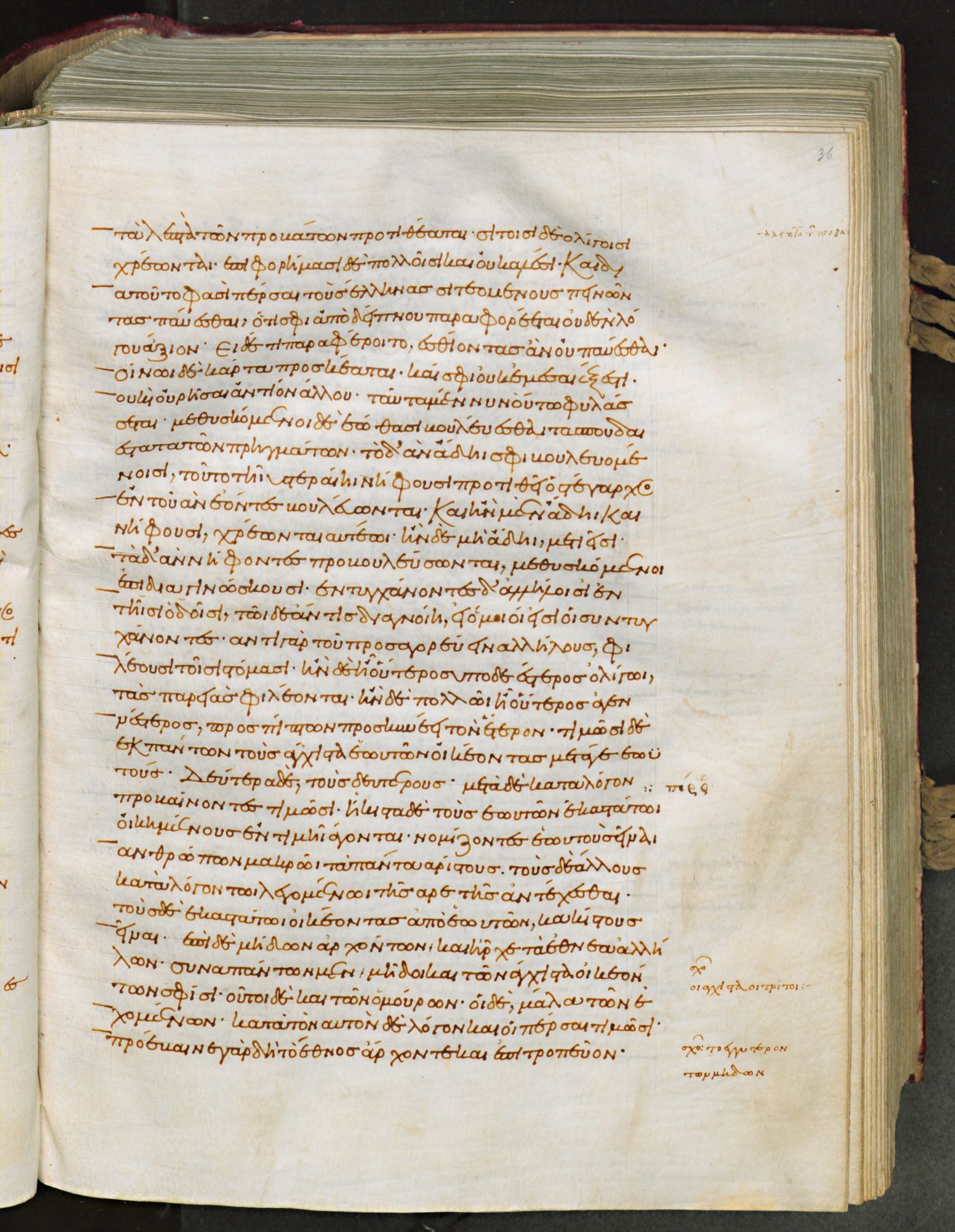
Laur. Plut. 70.3, fol. 36r: Greek here 1.133.1 to 1.134.3. Checked on the image (first and last words read and located in the Greek; each break checked against the neighbouring page): fol. 36r begins ‹τὰ λεπτὰ τῶν προβάτων› (1.133.1), ends ‹ἄρχον τε καὶ ἐπιτροπεῦον› (1.134.3). English here: 1.133.2 to 1.134.3 (Godley's sentences for the sections whose Greek lies mostly on this page).
1.133.1τὰ λεπτὰ τῶν προβάτων προτιθέαται. 1.133.2σίτοισι δὲ ὀλίγοισι χρέωνται, ἐπιφορήμασι δὲ πολλοῖσι καὶ οὐκ ἁλέσι· καὶ διὰ τοῦτο φασὶ Πέρσαι τοὺς Ἕλληνας σιτεομένους πεινῶντας παύεσθαι, ὅτι σφι ἀπὸ δείπνου παραφορέεται οὐδὲν λόγου ἄξιον· εἰ δέ τι παραφέροιτο, ἐσθίοντας ἂν οὐ παύεσθαι. 1.133.3οἴνῳ δὲ κάρτα προσκέαται, καί σφι οὐκ ἐμέσαι ἔξεστι, οὐκὶ οὐρῆσαι ἀντίον ἄλλου. ταῦτα μέν νυν οὕτω φυλάσσεται, μεθυσκόμενοι δὲ ἐώθασι βουλεύεσθαι τὰ σπουδαιέστατα τῶν πρηγμάτων· 1.133.4τὸ δʼ ἂν ἅδῃ σφι βουλευομένοισι, τοῦτο τῇ ὑστεραίῃ νήφουσι προτιθεῖ ὁ στέγαρχος, ἐν τοῦ ἂν ἐόντες βουλεύωνται, καὶ ἢν μὲν ἅδῃ καὶ νήφουσι, χρέωνται αὐτῷ, ἢν δὲμὴ ἅδῃ, μετιεῖσι. τὰ δʼ ἂν νήφοντες προβουλεύσωνται, μεθυσκόμενοι ἐπιδιαγινώσκουσι. 1.134.1ἐντυγχάνοντες δʼ ἀλλήλοισι ἐν τῇσι ὁδοῖσι, τῷδε ἄν τις διαγνοίη εἰ ὅμοιοί εἰσὶ οἱ συντυγχάνοντες· ἀντὶ γὰρ τοῦ προσαγορεύειν ἀλλήλους φιλέουσι τοῖσι στόμασι· ἢν δὲ ᾖ οὕτερος ὑποδεέστερος ὀλίγῳ, τὰς παρειὰς φιλέονται· ἢν δὲ πολλῷ ᾖ οὕτερος ἀγεννέστερος, προσπίπτων προσκυνέει τὸν ἕτερον. 1.134.2τιμῶσι δὲ ἐκ πάντων τοὺς ἄγχιστα ἑωυτῶν οἰκέοντας μετά γε ἑωυτούς, δευτέρα δὲ τοὺς δευτέρους· μετὰ δὲ κατὰ λόγον προβαίνοντες τιμῶσι· ἥκιστα δὲ τοὺς ἑωυτῶν ἑκαστάτω οἰκημένους ἐν τιμῇ ἄγονται, νομίζοντες ἑωυτοὺς εἶναι ἀνθρώπων μακρῷ τὰ πάντα ἀρίστους, τοὺς δὲ ἄλλους κατὰ λόγον τῆς ἀρετῆς ἀντέχεσθαι, τοὺς δὲ ἑκαστάτω οἰκέοντας ἀπὸ ἑωυτῶν κακίστους εἶναι. 1.134.3ἐπὶ δὲ Μήδων ἀρχὸν τῶν καὶ ἦρχε τὰ ἔθνεα ἀλλήλων, συναπάντων μὲν Μῆδοι καὶ τῶν ἄγχιστα οἰκεόντων σφίσι, οὗτοι δὲ καὶ τῶν ὁμούρων, οἳ δὲ μάλα τῶν ἐχομένων, κατὰ τὸν αὐτὸν δὴ λόγον καὶ οἱ Πέρσαι τιμῶσι· προέβαινε γὰρ δὴ τὸ ἔθνος ἄρχον τε καὶ ἐπιτροπεῦον.
1.133.2Their courses are few, the dainties that follow are many and not all served together. This is why the Persians say of the Greeks, that they rise from table still hungry, because not much dessert is set before them: were this too given to the Greek (say the Persians) he would never cease eating. 1.133.3They are greatly given to wine; none may vomit or make water in another’s presence. This then is prohibited among them. Moreover it is their custom to deliberate about the gravest matters when they are drunk; 1.133.4and what they approve in their counsels is proposed to them the next day by the master of the house where they deliberate, when they are now sober and if being sober they still approve it, they act thereon, but if not, they cast it aside. And when they have taken counsel about a matter when sober, they decide upon it when they are drunk. 1.134.1When one man meets another in the way, it is easy to see if the two are equals; for then without speaking they kiss each other on the lips if the difference in rank be but little, it is the cheek that is kissed; if it be great, the humbler bows down and does obeisance to the other. 1.134.2They honour most of all those who dwell nearest them, next those who are next farthest removed, and so going ever onwards they assign honour by this rule; those who dwell farthest off they hold least honourable of all; for they deem themselves to be in all regards by far the best of all men, the rest to have but a proportionate claim to merit, till those who dwell farthest away have least merit of all. 1.134.3Under the rule of the Medes one tribe would even govern another; the Medes held sway over all alike and specially over those who dwelt nearest to themselves; these ruled their neighbours, and the neighbours again those who came next to them, on the same plan whereby the Persians assign honour; for according as the Median nation advanced its dominion farther from home, such was the measure of its rule and suzerainty.
Where on the image
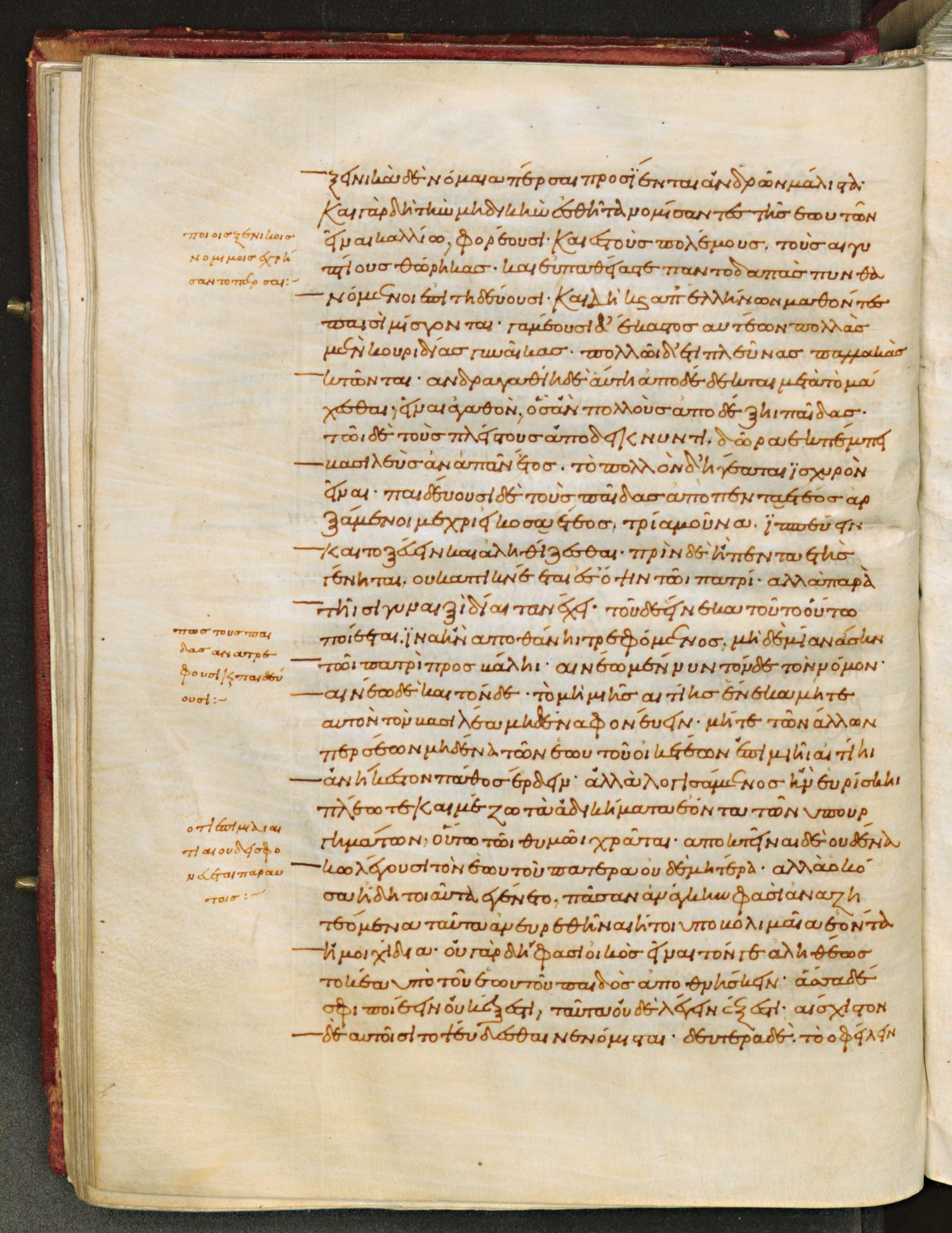
Laur. Plut. 70.3, fol. 36v: Greek here 1.135.1 to 1.138.1. Checked on the image (first and last words read and located in the Greek; each break checked against the neighbouring page): fol. 36v begins ‹ξεινικὰ δὲ νόμαια Πέρσαι› (1.135.1), ends ‹δεύτερα δὲ τὸ ὀφείλειν› (1.138.1). English here: 1.135.1 to 1.137.2 (Godley's sentences for the sections whose Greek lies mostly on this page).
1.135.1ξεινικὰ δὲ νόμαια Πέρσαι προσίενται ἀνδρῶν μάλιστα. καὶ γὰρ δὴ τὴν Μηδικὴν ἐσθῆτα νομίσαντες τῆς ἑωυτῶν εἶναι καλλίω φορέουσι, καὶ ἐς τοὺς πολέμους τοὺς Αἰγυπτίους θώρηκας· καὶ εὐπαθείας τε παντοδαπὰς πυνθανόμενοι ἐπιτηδεύουσι, καὶ δὴ καὶ ἀπʼ Ἑλλήνων μαθόντες παισὶ μίσγονται. γαμέουσι δὲ ἕκαστος αὐτῶν πολλὰς μὲν κουριδίας γυναῖκας, πολλῷ δʼ ἔτι πλεῦνας παλλακὰς κτῶνται. 1.136.1ἀνδραγαθίη δὲ αὕτη ἀποδέδεκται, μετὰ τὸ μάχεσθαι εἶναι ἀγαθόν, ὃς ἂν πολλοὺς ἀποδέξῃ παῖδας· τῷ δὲ τοὺς πλείστους ἀποδεικνύντι δῶρα ἐκπέμπει βασιλεὺς ἀνὰ πᾶν ἔτος. τὸ πολλὸν δʼ ἡγέαται ἰσχυρὸν εἶναι. 1.136.2παιδεύουσι δὲ τοὺς παῖδας ἀπὸ πενταέτεος ἀρξάμενοι μέχρι εἰκοσαέτεος τρία μοῦνα, ἰππεύειν καὶ τοξεύειν καὶ ἀληθίζεσθαι. πρὶν δὲ ἢ πενταέτης γένηται, οὐκ ἀπικνέεται ἐς ὄψιν τῷ πατρί, ἀλλὰ παρὰ τῇσι γυναιξὶ δίαιταν ἔχει. τοῦδε δὲ εἵνεκα τοῦτο οὕτω ποιέεται, ἵνα ἢν ἀποθάνῃ τρεφόμενος, μηδεμίαν ἄσην τῷ πατρὶ προσβάλῃ. 1.137.1αἰνέω μέν νυν τόνδε τὸν νόμον, αἰνέω δὲ καὶ τόνδε, τὸ μὴ μιῆς αἰτίης εἵνεκα μήτε αὐτὸν τὸν βασιλέα μηδένα φονεύειν, μήτε τῶν ἄλλων Περσέων μηδένα τῶν ἑωυτοῦ οἰκετέων ἐπὶ μιῇ αἰτίῃ ἀνήκεστον πάθος ἔρδειν· ἀλλὰ λογισάμενος ἢν εὑρίσκῃ πλέω τε καὶ μέζω τὰ ἀδικήματα ἐόντα τῶν ὑπουργημάτων, οὕτω τῷ θυμῷ χρᾶται. 1.137.2ἀποκτεῖναι δὲ οὐδένα κω λέγουσι τὸν ἑωυτοῦ πατέρα οὐδὲ μητέρα, ἀλλὰ ὁκόσα ἤδη τοιαῦτα ἐγένετο, πᾶσαν ἀνάγκην φασὶ ἀναζητεόμενα ταῦτα ἀνευρεθῆναι ἤτοι ὑποβολιμαῖα ἐόντα ἢ μοιχίδια· οὐ γὰρ δή φασι οἰκὸς εἶναι τόν γε ἀληθέως τοκέα ὑπὸ τοῦ ἑωυτοῦ παιδὸς ἀποθνήσκειν. 1.138.1ἅσσα δέ σφι ποιέειν οὐκ ἔξεστι, ταῦτα οὐδὲ λέγειν ἔξεστι. αἴσχιστον δὲ αὐτοῖσι τὸ ψεύδεσθαι νενόμισται, δεύτερα δὲ τὸ ὀφείλειν
1.135.1But of all men the Persians most welcome foreign customs. They wear the Median dress, deeming it more beautiful than their own, and the Egyptian cuirass in war. Their luxurious practices are of all kinds, and all borrowed; the Greeks taught them unnatural vices. Every Persian marries many lawful wives, and keeps still more concubines. 1.136.1After valour in battle it is most reckoned as manly merit to show the greatest number of sons: the king sends gifts yearly to him who can show most. Numbers, they hold, are strength. 1.136.2They educate their boys from five to twenty years old, and teach them three things only, riding and archery and truth-telling. A boy is not seen by his father before he is five years old, but lives with the women: the reason of this is that, if the boy should die in the time of his rearing, the father may suffer no dolour. 1.137.1This is a law which I praise; and it is a praiseworthy law too which suffers not the king himself to slay any man for one offence, nor any other Persian for one offence to do incurable hurt to one of his servants. Not till reckoning shows that the offender’s wrongful acts are more and greater than his services may a man give vent to his anger. 1.137.2They say that none has ever yet killed his father or mother; when suchlike deeds have been done, it cannot be but that on inquest made the doer is shown to be a child falsely substituted or born of a concubine for it is not to be believed (say they) that a son should kill his true parent.
Where on the image
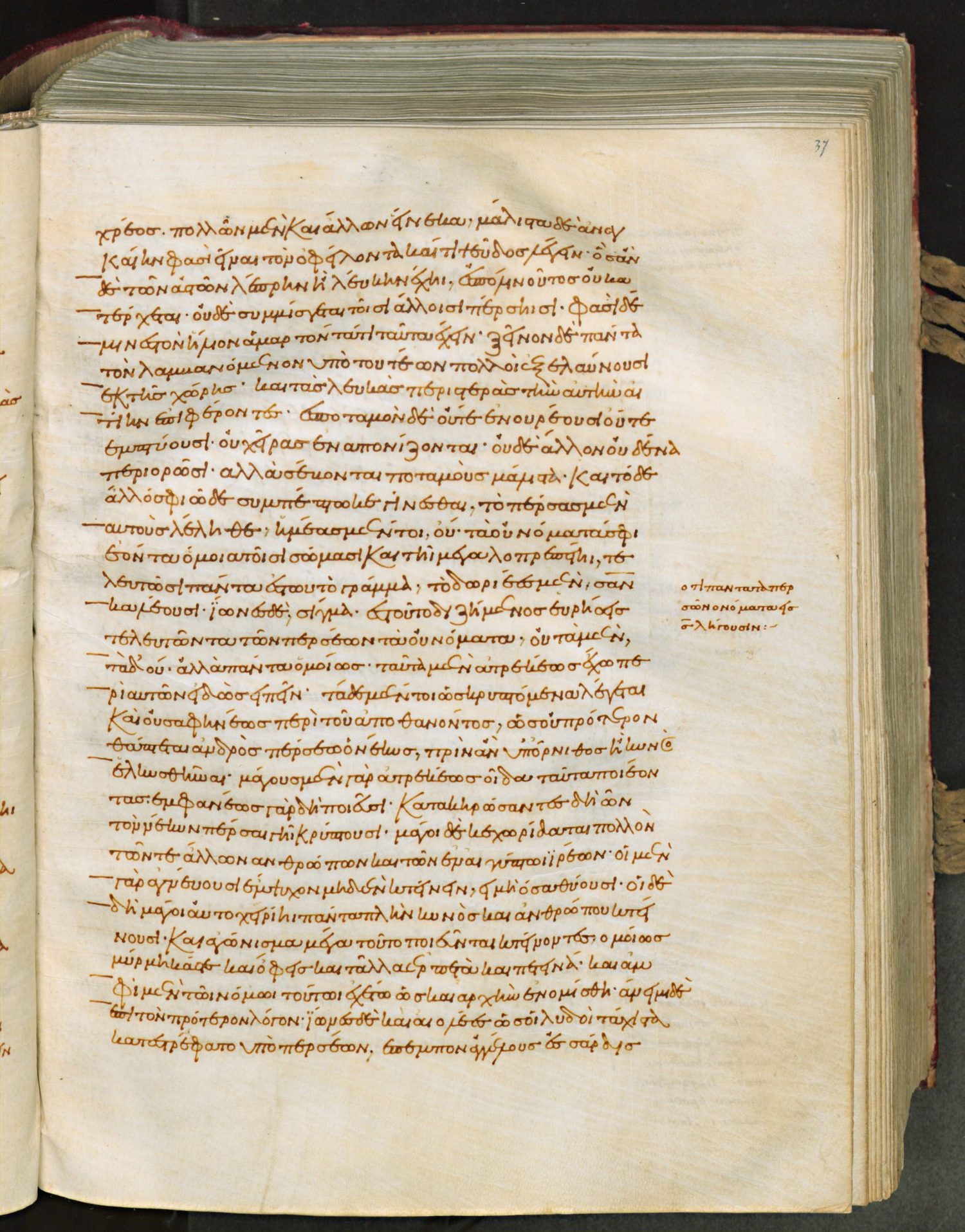
Laur. Plut. 70.3, fol. 37r: Greek here 1.138.1 to 1.140.3. Checked on the image (first and last words read and located in the Greek; each break checked against the neighbouring page): fol. 37r begins ‹χρέος, πολλῶν μὲν καὶ› (1.138.1), ends ‹ἔπεμπον ἀγγέλους ἐς Σάρδις› (1.141.1). English here: 1.138.1 to 1.140.3 (Godley's sentences for the sections whose Greek lies mostly on this page).
1.138.1χρέος, πολλῶν μὲν καὶ ἄλλων εἵνεκα, μάλιστα δὲ ἀναγκαίην φασὶ εἶναι τὸν ὀφείλοντα καί τι ψεῦδος λέγειν. ὃς ἂν δὲ τῶν ἀστῶν λέπρην ἢ λεύκην ἔχῃ, ἐς πόλιν οὗτος οὐ κατέρχεται οὐδὲ συμμίσγεται τοῖσι ἄλλοισι Πέρσῃσι· φασὶ δέ μιν ἐς τὸν ἥλιον ἁμαρτόντα τι ταῦτα ἔχειν. 1.138.2ξεῖνον δὲ πάντα τὸν λαμβανόμενον ὑπὸ τουτέων πολλοὶ ἐξελαύνουσι ἐκ τῆς χώρης, καὶ τὰς λευκὰς περιστεράς, τὴν αὐτὴν αἰτίην ἐπιφέροντες. ἐς ποταμὸν δὲ οὔτε ἐνουρέουσι οὔτε ἐμπτύουσι, οὐ χεῖρας ἐναπονίζονται, οὐδὲ ἄλλον οὐδένα περιορῶσι, ἀλλὰ σέβονται ποταμοὺς μάλιστα. 1.139.1καὶ τόδε ἄλλο σφι ὧδε συμπέπτωκε γίνεσθαι, τὸ Πέρσας μὲν αὐτοὺς λέληθε, ἡμέας μέντοι οὔ· τὰ οὐνόματά σφι ἐόντα ὅμοια τοῖσι σώμασι καὶ τῇ μεγαλοπρεπείῃ τελευτῶσι πάντα ἐς τὠυτὸ γράμμα, τὸ Δωριέες μὲν σὰν καλέουσι, Ἴωνες δὲ σίγμα· ἐς τοῦτο διζήμενος εὑρήσεις τελευτῶντα τῶν Περσέων τὰ οὐνόματα, οὐ τὰ μὲν τὰ δʼ οὔ, ἀλλὰ πάντα ὁμοίως. 1.140.1ταῦτα μὲν ἀτρεκέως ἔχω περὶ αὐτῶν εἰδὼς εἰπεῖν· τάδε μέντοι ὡς κρυπτόμενα λέγεται καὶ οὐ σαφηνέως περὶ τοῦ ἀποθανόντος, ὡς οὐ πρότερον θάπτεται ἀνδρὸς Πέρσεω ὁ νέκυς πρὶν ἂν ὑπʼ ὄρνιθος ἢ κυνὸς ἑλκυσθῇ. 1.140.2Μάγους μὲν γὰρ ἀτρεκέως οἶδα ταῦτα ποιέοντας· ἐμφανέως γὰρ δὴ ποιεῦσι. κατακηρώσαντες δὲ ὦν τὸν νέκυν Πέρσαι γῇ κρύπτουσι. Μάγοι δὲ κεχωρίδαται πολλὸν τῶν τε ἄλλων ἀνθρώπων καὶ τῶν ἐν Αἰγύπτῳ ἱρέων. 1.140.3οἳ μὲν γὰρ ἁγνεύουσι ἔμψυχον μηδὲν κτείνειν, εἰ μὴ ὅσα θύουσι· οἱ δὲ δὴ Μάγοι αὐτοχειρίῃ πάντα πλὴν κυνὸς καὶ ἀνθρώπου κτείνουσι, καὶ ἀγώνισμα μέγα τοῦτο ποιεῦνται, κτείνοντες ὁμοίως μύρμηκάς τε καὶ ὄφις καὶ τἆλλα ἑρπετὰ καὶ πετεινά. καὶ ἀμφὶ μὲν τῷ νόμῳ τούτῳ ἐχέτω ὡς καὶ ἀρχὴν ἐνομίσθη, ἄνειμι δὲ ἐπὶ τὸν πρότερον λόγον.
1.138.1Moreover of what they may not do neither may they speak. They hold lying to be foulest of all, and next to that debt; for which they have many other reasons, but this in especial, that the debtor must needs (so they say) speak some falsehood. The citizen who has leprosy or the white sickness may not come into a town or consort with other Persians. They say that he is so afflicted because he has sinned in some wise against the sun. 1.138.2Many drive every stranger, who takes such a disease, out of the country; and so they do to white doves, for the reason aforesaid. Rivers they chiefly reverence; they will neither make water nor spit nor wash their hands therein, nor suffer anyone so to do. 1.139.1There is another thing which always happens among them; we have noted it though the Persians have not: their names, which agree with the nature of their persons and their nobility, all end in the same letter, that which the Dorians call san, and the lonians sigma; you shall find, if you search, that not some but all Persian names alike end in this letter. 1.140.1So much I can say of them of my own certain knowledge. But there are other matters concerning the dead which are secretly and obscurely told—how the dead bodies of Persians are not buried before they have been mangled by bird or dog. 1.140.2That this is the way of the Magians I know for a certainty; for they do not conceal the practice. But this is certain, that before the Persians bury the body in earth they embalm it in wax. These Magians are much unlike to the priests of Egypt, as to all other men: 1.140.3for the priests count it sacrilege to kill aught that lives, save what they sacrifice; but the Magians kill with their own hands every creature, save only dogs and men; they kill all alike, ants and snakes, creeping and flying things, and take much pride therein. Leaving this custom to be such as it has been from the first, I return now to my former story.
Notes
- Greek: the text printed in A. D. Godley's Loeb edition, via Perseus (tlg0016.tlg001.perseus-grc2). Square brackets mark words the editor considers later additions; [...] marks a gap the editor indicates. Perseus note markers are omitted.
- English: A. D. Godley, Herodotus vol. 1 (1920) (Loeb Classical Library), as transcribed on Wikisource. Godley's footnotes are omitted.
- Section numbers in the English were placed by comparing Godley's text with the Perseus version of his translation; where a section begins inside one of Godley's sentences, the English is kept with the page that holds the start of that sentence.
Cite
Sources
- Source: Florence, Laur. Plut. 70.3 (10th c.) via BML Teca Digitale + Greek of Godley's Loeb (Perseus) + English of A. D. Godley (Loeb, Wikisource) (holding institution)
- Critical edition: Greek of A. D. Godley's Loeb edition (1920-1925), via Perseus
← previous · → next · v cycle view · l back to library