Herodotus, Histories 1.141-151: The Ionians and Aeolians
Introduction
Herodotus of Halicarnassus wrote the Histories in the third quarter of the 5th century BCE, an inquiry into the deeds of Greeks and barbarians and the causes of the wars between them, later divided into nine books. Book 1 tells how the conflict between Greeks and barbarians began, the history of Lydia from Gyges to Croesus, the rise of the Medes and of Cyrus the Persian, the conquest of the Greeks of Asia, the capture of Babylon and the death of Cyrus.
The photographs are of Florence, Biblioteca Medicea Laurenziana, Plut. 70.3 (parchment, 10th century, 374 folios, 31 lines a page), Herodotus, Histories (codex A of the editors), the oldest surviving manuscript of the complete Histories, from the Teca Digitale of the Biblioteca Medicea Laurenziana. Each section below is the text of one page, or of the part of a page that falls within these chapters. The first and last words of every page were read on the photograph and located in the Greek, and every page break was checked against the next page; the notes quote these words. Readers' notes in the margins are not part of the text and are mentioned where they occur.
The Greek is the text printed in A. D. Godley's Loeb edition (1920-1925), from Perseus; it is the edited text, not a transcription of the manuscript, whose wording differs in places. The English is Godley's translation as printed, from Wikisource. Godley's English carries only chapter numbers; the section numbers shown in it were placed by comparison with the Perseus version of his translation. Each page's English is cut at the end of one of Godley's sentences, so it can begin or end a few lines away from the Greek of the page; each note gives the exact ranges.
This entry covers chapters 1.141-151, on fol. 37r to 39v.
How was this verified? (Provenance)
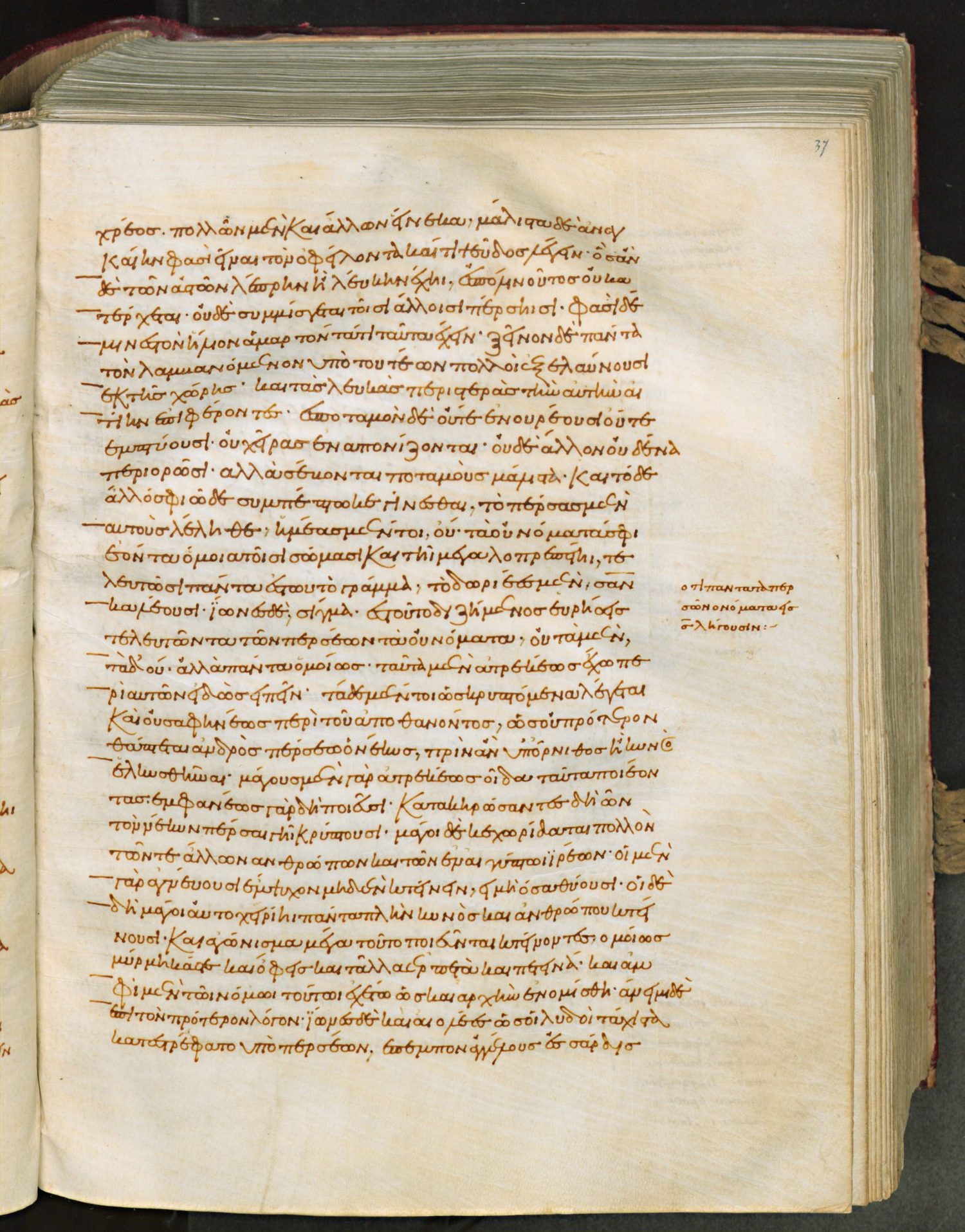
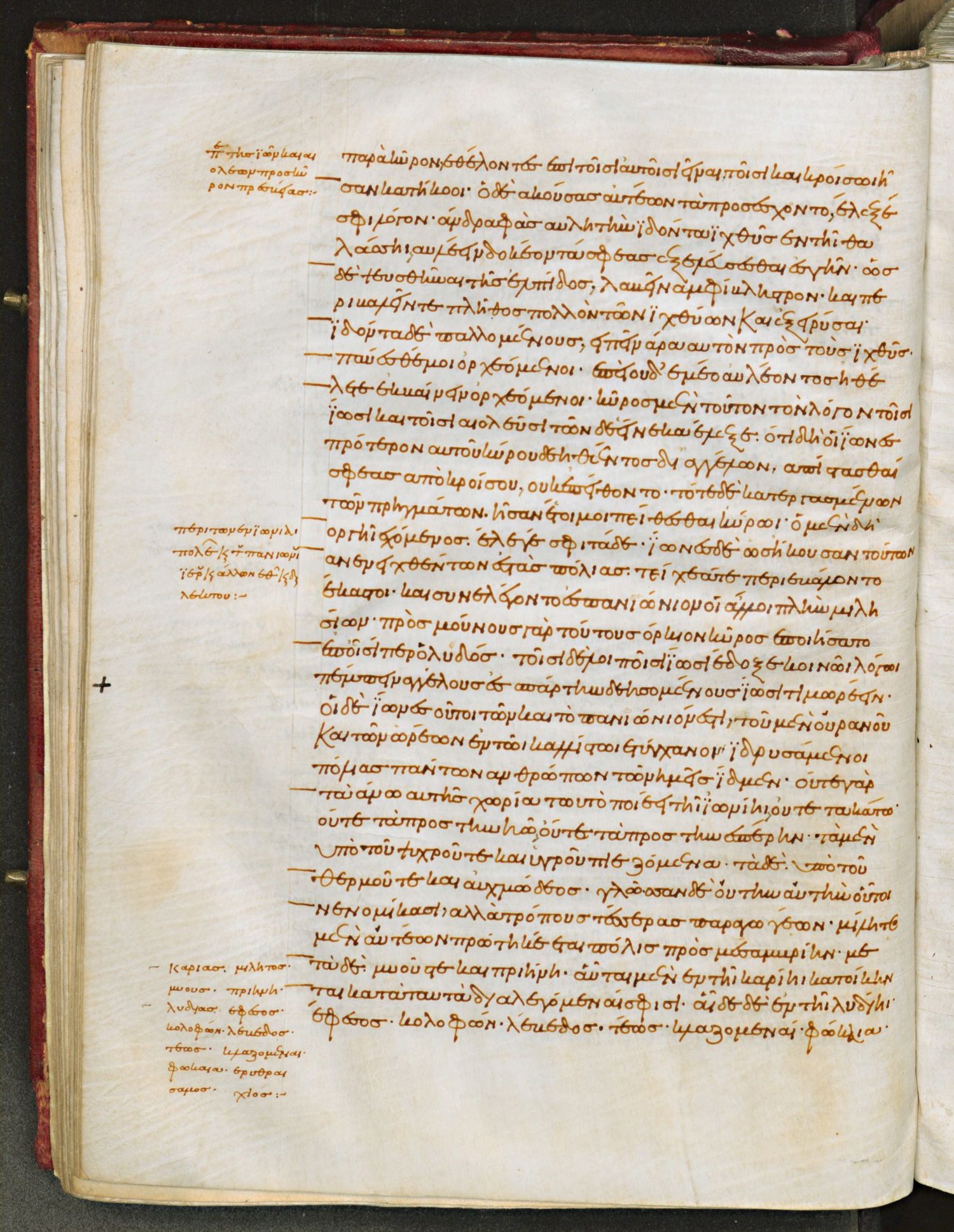
Where on the image
Laur. Plut. 70.3, fol. 37r, 37v: Greek here 1.141.1 to 1.142.4. Checked on the image (first and last words read and located in the Greek; each break checked against the neighbouring page): fol. 37r begins ‹χρέος, πολλῶν μὲν καὶ› (1.138.1), ends ‹ἔπεμπον ἀγγέλους ἐς Σάρδις› (1.141.1). fol. 37v begins ‹παρὰ Κῦρον, ἐθέλοντες ἐπὶ› (1.141.1), ends ‹Λέβεδος Τέως Κλαζομεναὶ Φώκαια› (1.142.4). This section joins the text of fol. 37r and 37v that belongs to these chapters, because the part on one of the pages is too short to carry any of Godley's sentences on its own. English here: 1.141.1 to 1.142.4 (Godley's sentences for the sections whose Greek lies mostly on this page).
1.141.1Ἴωνες δὲ καὶ Αἰολέες, ὡς οἱ Λυδοὶ τάχιστα κατεστράφατο ὑπὸ Περσέων, ἔπεμπον ἀγγέλους ἐς Σάρδις παρὰ Κῦρον, ἐθέλοντες ἐπὶ τοῖσι αὐτοῖσι εἶναι τοῖσι καὶ Κροίσῳ ἦσαν κατήκοοι. ὁ δὲ ἀκούσας αὐτῶν τὰ προΐσχοντο ἔλεξέ σφι λόγον, ἄνδρα φὰς αὐλητὴν ἰδόντα ἰχθῦς ἐν τῇ θαλάσσῃ αὐλέειν, δοκέοντα σφέας ἐξελεύσεσθαι ἐς γῆν· 1.141.2ὡς δὲ ψευσθῆναι τῆς ἐλπίδος, λαβεῖν ἀμφίβληστρον καὶ περιβαλεῖν τε πλῆθος πολλὸν τῶν ἰχθύων καὶ ἐξειρύσαι, ἰδόντα δὲ παλλομένους εἰπεῖν ἄρα αὐτὸν πρὸς τοὺς ἰχθῦς παύεσθέ μοι ὀρχεόμενοι, ἐπεῖ οὐδʼ ἐμέο αὐλέοντος ἠθέλετε ἐκβαίνειν ὀρχεόμενοι. 1.141.3Κῦρος μὲν τοῦτον τὸν λόγον τοῖσι Ἴωσι καὶ τοῖσι Αἰολεῦσι τῶνδε εἵνεκα ἔλεξε, ὅτι δὴ οἱ Ἴωνες πρότερον αὐτοῦ Κύρου δεηθέντος διʼ ἀγγέλων ἀπίστασθαι σφέας ἀπὸ Κροίσου οὐκ ἐπείθοντο, τότε δὲ κατεργασμένων τῶν πρηγμάτων ἦσαν ἕτοιμοι πείθεσθαι Κύρῳ. 1.141.4ὃ μὲν δὴ ὀργῇ ἐχόμενος ἔλεγέ σφι τάδε· Ἴωνες δὲ ὡς ἤκουσαν τούτων ἀνενειχθέντων ἐς τὰς πόλιας, τείχεά τε περιεβάλοντο ἕκαστοι καὶ συνελέγοντο ἐς Πανιώνιον οἱ ἄλλοι, πλὴν Μιλησίων· πρὸς μούνους γὰρ τούτους ὅρκιον Κῦρος ἐποιήσατο ἐπʼ οἷσί περ ὁ Λυδός. τοῖσι δὲ λοιποῖσι Ἴωσι ἔδοξε κοινῷ λόγῳ πέμπειν ἀγγέλους ἐς Σπάρτην δεησομένους Ἴωσι τιμωρέειν. 1.142.1οἱ δὲ Ἴωνες οὗτοι, τῶν καὶ τὸ Πανιώνιον ἐστί, τοῦ μὲν οὐρανοῦ καὶ τῶν ὡρέων ἐν τῷ καλλίστῳ ἐτύγχανον ἱδρυσάμενοι πόλιας πάντων ἀνθρώπων τῶν ἡμεῖς ἴδμεν· 1.142.2οὔτε γὰρ τὰ ἄνω αὐτῆς χωρία τὠυτὸ ποιέει τῇ Ἰωνίῃ οὔτε τὰ κάτω οὔτε τὰ πρὸς τὴν ἠῶ οὔτε τὰ πρὸς τὴν ἑσπέρην, τὰ μὲν ὑπὸ τοῦ ψυχροῦ τε καὶ ὑγροῦ πιεζόμενα, τὰ δὲ ὑπὸ τοῦ θερμοῦ τε καὶ αὐχμώδεος. 1.142.3γλῶσσαν δὲ οὐ τὴν αὐτὴν οὗτοι νενομίκασι, ἀλλὰ τρόπους τέσσερας παραγωγέων. Μίλητος μὲν αὐτέων πρώτη κέεται πόλις πρὸς μεσαμβρίην, μετὰ δὲ Μυοῦς τε καὶ Πριήνη. 1.142.4αὗται μὲν ἐν τῇ Καρίῃ κατοίκηνται κατὰ ταὐτὰ διαλεγόμεναι σφίσι, αἵδε δὲ ἐν τῇ Λυδίῃ, Ἔφεσος Κολοφὼν Λέβεδος Τέως Κλαζομεναὶ Φώκαια·
1.141.1As soon as the Lydians had been subdued by the Persians, the Ionians and Aeolians sent messengers to Cyrus, offering to be his subjects on the same terms as those which they had under Croesus, Having heard what they proposed, Cyrus told them a story. Once, he said, there was a flute-player who saw fishes in the sea and played upon his flute, thinking that so they would come out on to the land. 1.141.2Being disappointed of his hope, he took a net and gathered in and drew out a great multitude of the fishes; and seeing them leaping, “You had best” said he, “cease from your dancing now; you would not come out and dance then, when I played to you.” 1.141.3The reason why Cyrus told the story to the Ionians and Aeolians was that the Ionians, who were ready to obey him when the victory was won, had before refused when he sent a message asking them to revolt from Croesus. 1.141.4So he answered them in his anger. But when the message came to the Ionians in their cities, they fortified themselves severally with walls, and assembled in the Panionion, all except the Milesians, with whom alone Cyrus had made a treaty on the same terms as that which they had with the Lydians. The rest of the Ionians resolved to send envoys in the name of them all to Sparta, to ask help for the Ionians. 1.142.1Now these Ionians, who possessed the Panionion, had set their cities in places more favoured by skies and seasons than any country known to us. 1.142.2For neither to the north of them nor to the south nor to the east nor to the west does the land accomplish the same effect as Ionia, being afflicted here by the cold and wet, there by the heat and drought. 1.142.3They use not all the same speech but four different dialects. Miletus lies farthest south among them, and next to it come Myus and Priene; these are settlements in Caria, and they use a common language; Ephesus, Colophon, Lebedos, Teos, Clazomenae, Phocaea, all of them being in Lydia, 1.142.4have a language in common which is wholly different from the speech of the three cities aforementioned. There are yet three Ionian cities, two of them situate on the islands of Samos and Chios, and one, Erythrae, on the mainland; the Chians and Erythraeans speak alike, but the Samians have a language which is their own and none other’s. It is thus seen that there are four fashions of speech.
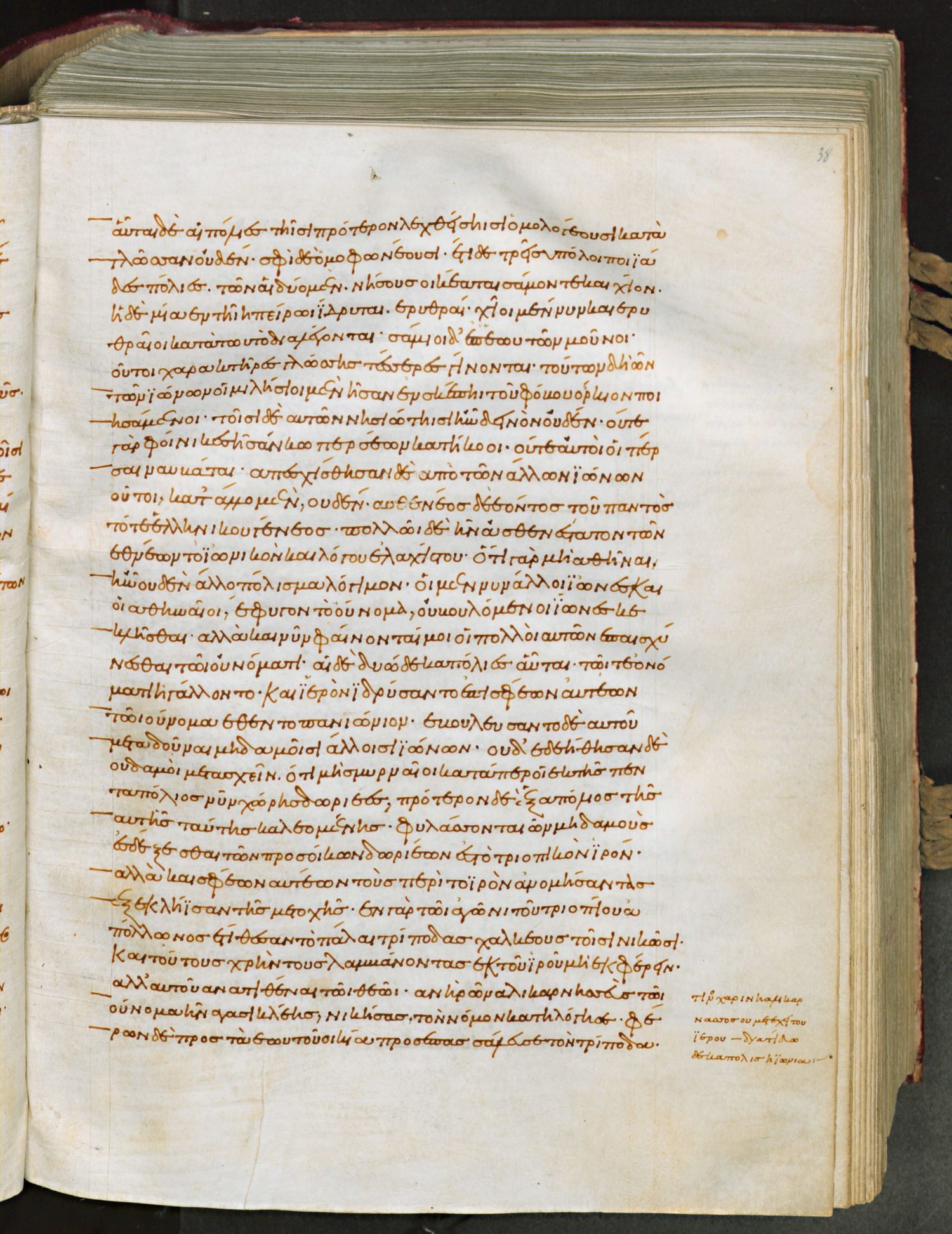
Where on the image
Laur. Plut. 70.3, fol. 38r: Greek here 1.142.4 to 1.144.3. Checked on the image (first and last words read and located in the Greek; each break checked against the neighbouring page): fol. 38r begins ‹αὗται δὲ αἱ πόλιες› (1.142.4), ends ‹οἰκία προσεπασσάλευσε τὸν τρίποδα› (1.144.3). English here: 1.143.1 to 1.144.2 (Godley's sentences for the sections whose Greek lies mostly on this page).
1.142.4αὗται δὲ αἱ πόλιες τῇσι πρότερον λεχθείσῃσι ὁμολογέουσι κατὰ γλῶσσαν οὐδέν, σφισι δὲ ὁμοφωνέουσι. ἔτι δὲ τρεῖς ὑπόλοιποι Ἰάδες πόλιες, τῶν αἱ δύο μὲν νήσους οἰκέαται, Σάμον τε καὶ Χίον, ἡ δὲ μία ἐν τῇ ἠπείρῳ ἵδρυται, Ἐρυθραί. Χῖοι μέν νυν καὶ Ἐρυθραῖοι κατὰ τὠυτὸ διαλέγονται, Σάμιοι δὲ ἐπʼ ἑωυτῶν μοῦνοι. οὗτοι χαρακτῆρες γλώσσης τέσσερες γίνονται. 1.143.1τούτων δὴ ὦν τῶν Ἰώνων οἱ Μιλήσιοι μὲν ἦσαν ἐν σκέπῃ τοῦ φόβου, ὅρκιον ποιησάμενοι, τοῖσι δὲ αὐτῶν νησιώτῃσι ἦν δεινὸν οὐδέν· οὔτε γὰρ Φοίνικες ἦσαν κω Περσέων κατήκοοι οὔτε αὐτοὶ οἱ Πέρσαι ναυβάται. 1.143.2ἀπεσχίσθησαν δὲ ἀπὸ τῶν ἄλλων Ἰώνων οὗτοι κατʼ ἄλλο μὲν οὐδέν, ἀσθενέος δὲ ἐόντος τοῦ παντὸς τότε Ἑλληνικοῦ γένεος, πολλῷ δὴ ἦν ἀσθενέστατον τῶν ἐθνέων τὸ Ἰωνικὸν καὶ λόγου ἐλαχίστου· ὅτι γὰρ μὴ Ἀθῆναι, ἦν οὐδὲν ἄλλο πόλισμα λόγιμον. 1.143.3οἱ μέν νυν ἄλλοι Ἴωνες καὶ οἱ Ἀθηναῖοι ἔφυγον τὸ οὔνομα, οὐ βουλόμενοι Ἴωνες κεκλῆσθαι, ἀλλὰ καὶ νῦν φαίνονταί μοι οἱ πολλοὶ αὐτῶν ἐπαισχύνεσθαι τῷ οὐνόματι· αἱ δὲ δυώδεκα πόλιες αὗται τῷ τε οὐνόματι ἠγάλλοντο καὶ ἱρὸν ἱδρύσαντο ἐπὶ σφέων αὐτέων, τῷ οὔνομα ἔθεντο Πανιώνιον, ἐβουλεύσαντο δὲ αὐτοῦ μεταδοῦναι μηδαμοῖσι ἄλλοισι Ἰώνων (οὐδʼ ἐδεήθησαν δὲ οὐδαμοὶ μετασχεῖν ὅτι μὴ Σμυρναῖοι)· 1.144.1κατά περ οἱ ἐκ τῆς πενταπόλιος νῦν χώρης Δωριέες, πρότερον δὲ ἑξαπόλιος τῆς αὐτῆς ταύτης καλεομένης, φυλάσσονται ὦν μηδαμοὺς ἐσδέξασθαι τῶν προσοίκων Δωριέων ἐς τὸ Τριοπικὸν ἱρόν, ἀλλὰ καὶ σφέων αὐτῶν τοὺς περὶ τὸ ἱρόν ἀνομήσαντας ἐξεκλήισαν τῆς μετοχῆς, 1.144.2ἐν γὰρ τῷ ἀγῶνι τοῦ Τριοπίου Ἀπόλλωνος ἐτίθεσαν τὸ πάλαι τρίποδας χαλκέους τοῖσι νικῶσι, καὶ τούτους χρῆν τοὺς λαμβάνοντας ἐκ τοῦ ἱροῦ μὴ ἐκφέρειν ἀλλʼ αὐτοῦ ἀνατιθέναι τῷ θεῷ. 1.144.3ἀνὴρ ὦν Ἁλικαρνησσεύς, τῷ οὔνομα ἦν Ἀγασικλέης, νικήσας τὸν νόμον κατηλόγησε, φέρων δὲ πρὸς τὰ ἑωυτοῦ οἰκία προσεπασσάλευσε τὸν τρίποδα.
1.143.1Among these Ionians, the Milesians were sheltered from the danger (for they had made a treaty), and the islanders among them had nothing to fear; for the Phoenicians were not yet subjects of the Persians, nor were the Persians themselves shipmen. 1.143.2But they of Asia were cut off from the rest of the Ionians in no other way save as I shall show. The whole Hellenic race was then but small, and the least of all its parts, and the least regarded, was the Ionian stock; for saving Athens it had no considerable city. 1.143.3Now the Athenians and the rest would not be called Ionians, but spurned the name; nay, even now the greater number of them seem to me to be ashamed of it; but the twelve cities aforesaid gloried in this name, and founded a holy place for themselves which they called the Panionion, and agreed among them to allow no other Ionians to use it (nor indeed did any save the men of Smyrna ask to be admitted); 1.144.1even as the Dorians of what is now the country of the “Five Cities”—the same being formerly called the country of the “Six Cities”—forbid the admitting of any of the neighbouring Dorians to the Triopian temple, nay, they barred from sharing the use of it even those of their own body who had broken the temple law. 1.144.2For long ago in the games in honour of Triopian Apollo they offered certain bronze tripods to the victors; and those who won these must not carry them away from the temple but dedicate them there to the god.
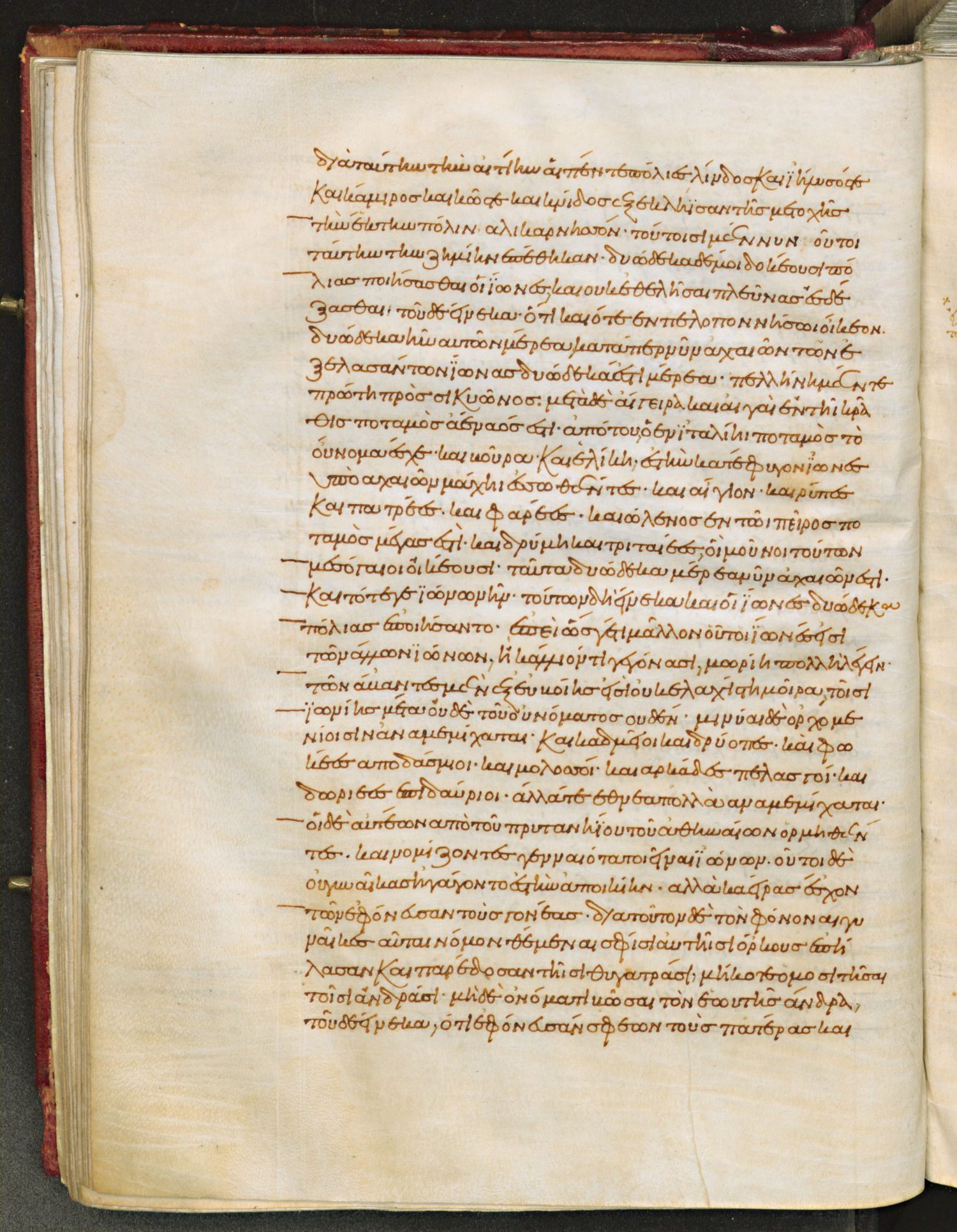
Where on the image
Laur. Plut. 70.3, fol. 38v: Greek here 1.144.3 to 1.146.3. Checked on the image (first and last words read and located in the Greek; each break checked against the neighbouring page): fol. 38v begins ‹διὰ ταύτην τὴν αἰτίην› (1.144.3), ends ‹σφέων τοὺς πατέρας καὶ› (1.146.3). English here: 1.144.3 to 1.146.3 (Godley's sentences for the sections whose Greek lies mostly on this page).
1.144.3διὰ ταύτην τὴν αἰτίην αἱ πέντε πόλιες, Λίνδος καὶ Ἰήλυσός τε καὶ Κάμειρος καὶ Κῶς τε καὶ Κνίδος ἐξεκλήισαν τῆς μετοχῆς τὴν ἕκτην πόλιν Ἁλικαρνησσόν. τούτοισι μέν νυν οὗτοι ταύτην τὴν ζημίην ἐπέθηκαν. 1.145.1δυώδεκα δὲ μοι δοκέουσι πόλιας ποιήσασθαι οἱ Ἴωνες καὶ οὐκ ἐθελῆσαι πλεῦνας ἐσδέξασθαι τοῦδε εἵνεκα, ὅτι καὶ ὅτε ἐν Πελοποννήσῳ οἴκεον, δυώδεκα ἦν αὐτῶν μέρεα, κατά περ νῦν Ἀχαιῶν τῶν ἐξελασάντων Ἴωνας δυώδεκα ἐστὶ μέρεα, Πελλήνη μέν γε πρώτη πρὸς Σικυῶνος, μετὰ δὲ Αἴγειρα καὶ Αἰγαί, ἐν τῇ Κρᾶθις ποταμὸς ἀείναος ἐστί, ἀπʼ ὅτευ ὁ ἐν Ἰταλίῃ ποταμὸς τὸ οὔνομα ἔσχε, καὶ Βοῦρα καὶ Ἑλίκη, ἐς τὴν κατέφυγον Ἴωνες ὑπὸ Ἀχαιῶν μάχῃ ἑσσωθέντες, καὶ Αἴγίον καὶ Ῥύπες καὶ Πατρέες καὶ Φαρέες καὶ Ὤλενος, ἐν τῷ Πεῖρος ποταμὸς μέγας ἐστί, καὶ Δύμη καὶ Τριταιέες, οἳ μοῦνοι τούτων μεσόγαιοι οἰκέουσι. ταῦτα δυώδεκα μέρεα νῦν Ἀχαιῶν ἐστὶ καὶ τότε γε Ἰώνων ἦν. 1.146.1τούτων δὴ εἵνεκα καὶ οἱ Ἴωνες δυώδεκα πόλιας ἐποιήσαντο· ἐπεὶ ὥς γέ τι μᾶλλον οὗτοι Ἴωνες εἰσὶ τῶν ἄλλων Ἰώνων ἢ κάλλιόν τι γεγόνασι, μωρίη πολλὴ λέγειν· τῶν Ἄβαντες μὲν ἐξ Εὐβοίες εἰσὶ οὐκ ἐλαχίστη μοῖρα, τοῖσι Ἰωνίης μέτα οὐδὲ τοῦ οὐνόματος οὐδέν, Μινύαι δὲ Ὀρχομένιοί σφι ἀναμεμίχαται καὶ Καδμεῖοι καὶ Δρύοπες καὶ Φωκέες ἀποδάσμιοι καὶ Μολοσσοὶ καὶ Ἀρκάδες Πελασγοὶ καὶ Δωριέες Ἐπιδαύριοι, ἄλλα τε ἔθνεα πολλὰ ἀναμεμίχαται· 1.146.2οἱ δὲ αὐτῶν ἀπὸ τοῦ πρυτανηίου τοῦ Ἀθηναίων ὁρμηθέντες καὶ νομίζοντες γενναιότατοι εἶναι Ἰώνων, οὗτοι δὲ οὐ γυναῖκας ἠγάγοντο ἐς τὴν ἀποικίην ἀλλὰ Καείρας ἔσχον, τῶν ἐφόνευσαν τοὺς γονέας. 1.146.3διὰ τοῦτὸν δὲ τὸν φόνον αἱ γυναῖκες αὗται νόμον θέμεναι σφίσι αὐτῇσι ὅρκους ἐπήλασαν καὶ παρέδοσαν τῇσι θυγατράσι, μή κοτε ὁμοσιτῆσαι τοῖσι ἀνδράσι μηδὲ οὐνόματι βῶσαι τὸν ἑωυτῆς ἄνδρα, τοῦδε εἵνεκα ὅτι ἐφόνευσαν σφέων τοὺς πατέρας καὶ
1.144.3Now a man of Halicarnassus called Agasicles, being a winner, disregarded this law, and carrying the tripod away nailed it to the wall of his own house. For this offence the five cities, Lindus, Ialysus, Camirus, Cos, and Cnidus, forbade the sixth city, Halicarnassus, to share in the use of the temple. Such was the penalty imposed on the Halicarnassians. 1.145.1As for the Ionians, the reason why they made twelve cities and would admit no more was in my judgment this, that there were twelve divisions of them when they dwelt in Peloponnesus, just as there are twelve divisions of the Achaeans who drove the Ionians out, Pellene nearest to Sicyon, then Aegira and Aegae, where is the never-failing river Crathis, from which the river in Italy took its name; Bura and Helice, whither the Ionians fled when they were worsted in battle by the Achaeans; Aegion, Rhype, Patrae, Phareae, and Olenus, where is the great river Pirus; Dyme and Tritaeae, the only inland city of all these; these were the twelve divisions of the Ionians, as they are now of the Achaeans. 1.146.1For this reason the Ionians too made twelve cities, and for no other; for it were but foolishness to say that these are more truly Ionian or better born than the other Ionians; seeing that not the least part of them are Abantes from Euboea, who are not Ionians even in name, and that there are mingled with them Minyans of Orchomenus, Cadmeans, Dryopians, Phocian seceders from their nation, Molossians, Pelasgian Arcadians, Dorians of Epidaurus, and many other tribes; 1.146.2and as for those who came from the very town hall of Athens and deem themselves the best born of the Ionians, these did not bring wives with them to their settlements, but married Carian women whose parents they had put to death. 1.146.3For this slaughter, these women made a custom and bound themselves by oath (and enjoined the same on their daughters) that none would sit at meat with her husband nor call him by his name, because the men had married them after slaying their fathers and husbands and sons.
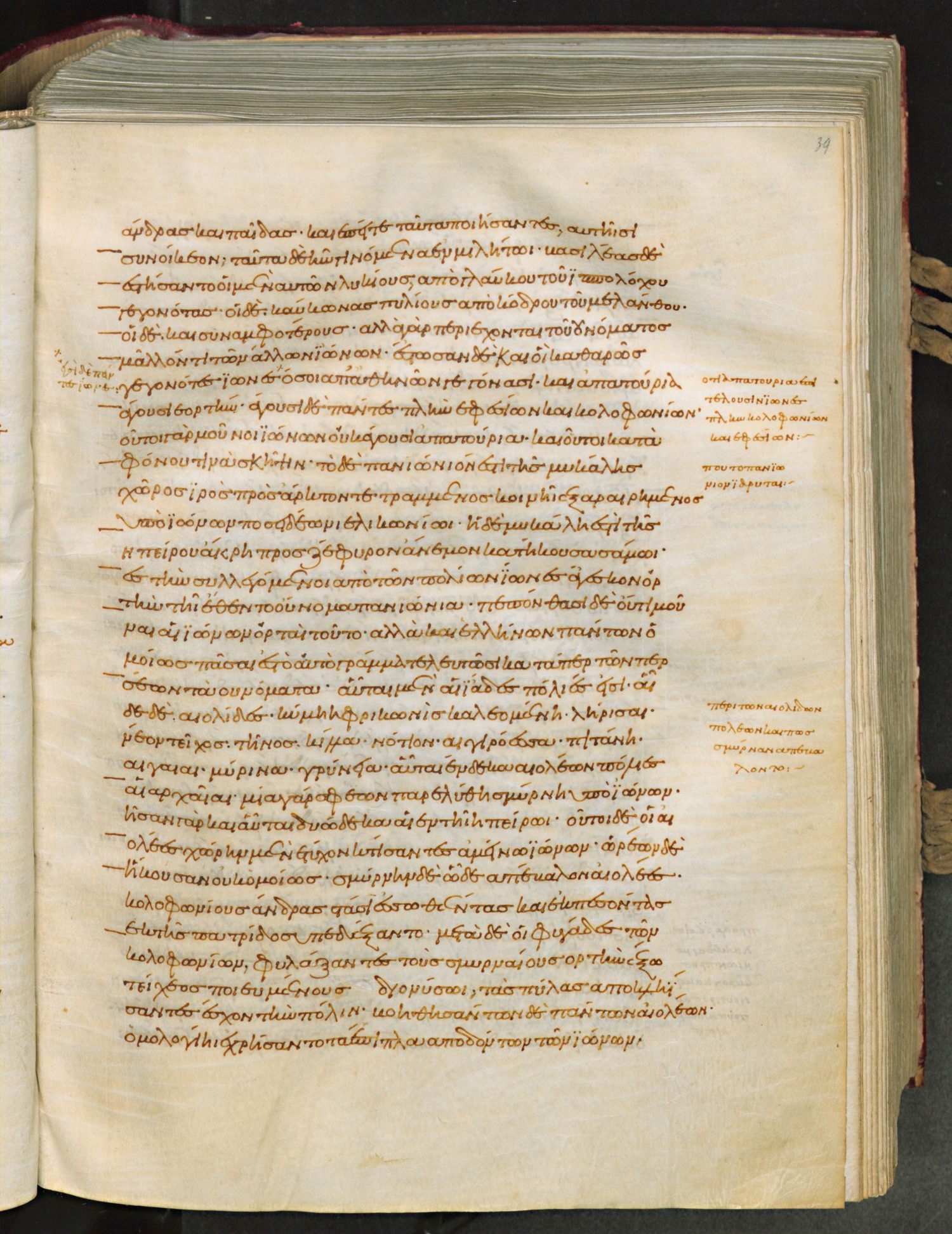
Where on the image
Laur. Plut. 70.3, fol. 39r: Greek here 1.146.3 to 1.150.2. Checked on the image (first and last words read and located in the Greek; each break checked against the neighbouring page): fol. 39r begins ‹ἄνδρας καὶ παῖδας καὶ› (1.146.3), ends ‹ἔπιπλα ἀποδόντων τῶν Ἰώνων› (1.150.2). English here: 1.147.1 to 1.150.1 (Godley's sentences for the sections whose Greek lies mostly on this page).
1.146.3ἄνδρας καὶ παῖδας καὶ ἔπειτα ταῦτα ποιήσαντες αὐτῇσι συνοίκεον. 1.147.1ταῦτα δὲ ἦν γινόμενα ἐν Μιλήτῳ. βασιλέας δὲ ἐστήσαντο οἳ μὲν αὐτῶν Λυκίους ἀπὸ Γλαύκου τοῦ Ἱππολόχου γεγονότας, οἳ δὲ Καύκωνας Πυλίους ἀπὸ Κόδρου τοῦ Μελάνθου, οἳ δὲ καὶ συναμφοτέρους. ἀλλὰ γὰρ περιέχονται τοῦ οὐνόματος μᾶλλόν τι τῶν ἄλλων Ἰώνων, ἔστωσαν δὴ καὶ οἱ καθαρῶς γεγονότες Ἴωνες. 1.147.2εἰσὶ δὲ πάντες Ἴωνες ὅσοι ἀπʼ Ἀθηνέων γεγόνασι καὶ Ἀπατούρια ἄγουσι ὁρτήν. ἄγουσι δὲ πάντες πλὴν Ἐφεσίων καὶ Κολοφωνίων· οὗτοι γὰρ μοῦνοι Ἰώνων οὐκ ἄγουσι Ἀπατούρια, καὶ οὗτοι κατὰ φόνου τινὰ σκῆψιν. 1.148.1τὸ δὲ Πανιώνιον ἐστὶ τῆς Μυκάλης χῶρος ἱρὸς πρὸς ἄρκτον τετραμμένος, κοινῇ ἐξαραιρημένος ὑπὸ Ἰώνων Ποσειδέωνι Ἑλικωνίῳ. ἡ δὲ Μυκάλη ἐστὶ τῆς ἠπείρου ἄκρη πρὸς ζέφυρον ἄνεμον κατήκουσα Σάμῳ καταντίον, ἐς τὴν συλλεγόμενοι ἀπὸ τῶν πολίων Ἴωνες ἄγεσκον ὁρτὴν τῇ ἔθεντο οὔνομα Πανιώνια. 1.148.2[πεπόνθασι δὲ οὔτι μοῦναι αἱ Ἰώνων ὁρταὶ τοῦτο, ἀλλὰ καὶ Ἑλλήνων πάντων ὁμοίως πᾶσαι ἐς τὠυτὸ γράμμα τελευτῶσι, κατά περ τῶν Περσέων τὰ οὐνόματα.] 1.149.1αὗται μὲν αἱ Ἰάδες πόλιες εἰσί, αἵδε δὲ αἱ Αἰολίδες, Κύμη ἡ Φρικωνὶς καλεομένη, Λήρισαι, Νέον τεῖχος, Τῆμνος, Κίλλα, Νότιον, Αἰγιρόεσσα, Πιτάνη, Αἰγαῖαι, Μύρινα, Γρύνεια. αὗται ἕνδεκα Αἰολέων πόλιες αἱ ἀρχαῖαι· μία γὰρ σφέων παρελύθη Σμύρνη ὑπὸ Ἰώνων· ἦσαν γὰρ καὶ αὗται δυώδεκα αἱ ἐν τῆ ἠπείρῳ. 1.149.2οὗτοι δὲ οἱ Αἰολέες χώρην μὲν ἔτυχον κτίσαντες ἀμείνω Ἰώνων, ὡρέων δὲ ἥκουσαν οὐκ ὁμοίως. 1.150.1σμύρνην δὲ ὧδε ἀπέβαλον Αἰολέες. Κολοφωνίους ἄνδρας στάσι ἑσσωθέντας καὶ ἐκπεσόντας ἐκ τῆς πατρίδος ὑπεδέξαντο. μετὰ δὲ οἱ φυγάδες τῶν Κολοφωνίων φυλάξαντες τοὺς Σμυρναίους ὁρτὴν ἔξω τείχεος ποιευμένους Διονύσῳ, τὰς πύλας ἀποκληίσαντες ἔσχον τὴν πόλιν. 1.150.2βοηθησάντων δὲ πάντων Αἰολέων, ὁμολογίῃ ἐχρήσαντο τὰ ἔπιπλα ἀποδόντων τῶν Ἰώνων
1.147.1This happened at Miletus. And for kings some of them chose Lycian descendants of Glaucus son of Hippolochus, and some Caucones of Pylus, descendants of Codrus son of Melanthus, and some both. Yet seeing that they set more store by the name than the rest of the Ionians, let it be granted that those of pure birth are Ionians; 1.147.2and all are Ionians who are of Athenian descent and keep the feast Apaturia. All do so keep it, saving the men of Ephesus and Colophon; these are the only Ionians who do not keep it, and these by reason, they say, of a certain deed of blood. 1.148.1The Panionion is a sacred ground in Mycale, facing the north; it was set apart for Poseidon of Helicon by the joint will of the Ionians. Mycale is a western promontory of the mainland opposite to Samos; the Ionians were wont to assemble there from their cities and keep the festival to which they gave the name of Panionia. 1.148.2[The names of all the Greek festivals, not the Ionian alone, end alike in the same letter, just as do the names of the Persians.] 1.149.1I have now told of the Ionian cities. The Aeolian cities are these:—Cyme (called “Phriconian”), Lerisae, “the New Fort,” Temnos, Cilia, Notium, Aegiroessa, Pitana, Aegaeae, Myrina, Grynea. These are the ancient Aeolian cities, eleven in number; these, too, the mainland cities, were once twelve; but one of them, Smyrna, was taken away by the Ionians. 1.149.2These Aeolians had settled where the land was better than the Ionian territory, but the climate was not so good. 1.150.1Now this is how the Aeolians lost Smyrna. Certain men of Colophon, worsted in civil strife and banished from their country, had been received by them into the town. These Colophonian exiles waited for the time when the men of Smyrna were holding a festival to Dionysus outside the walls; they then shut the gates and so won the city.
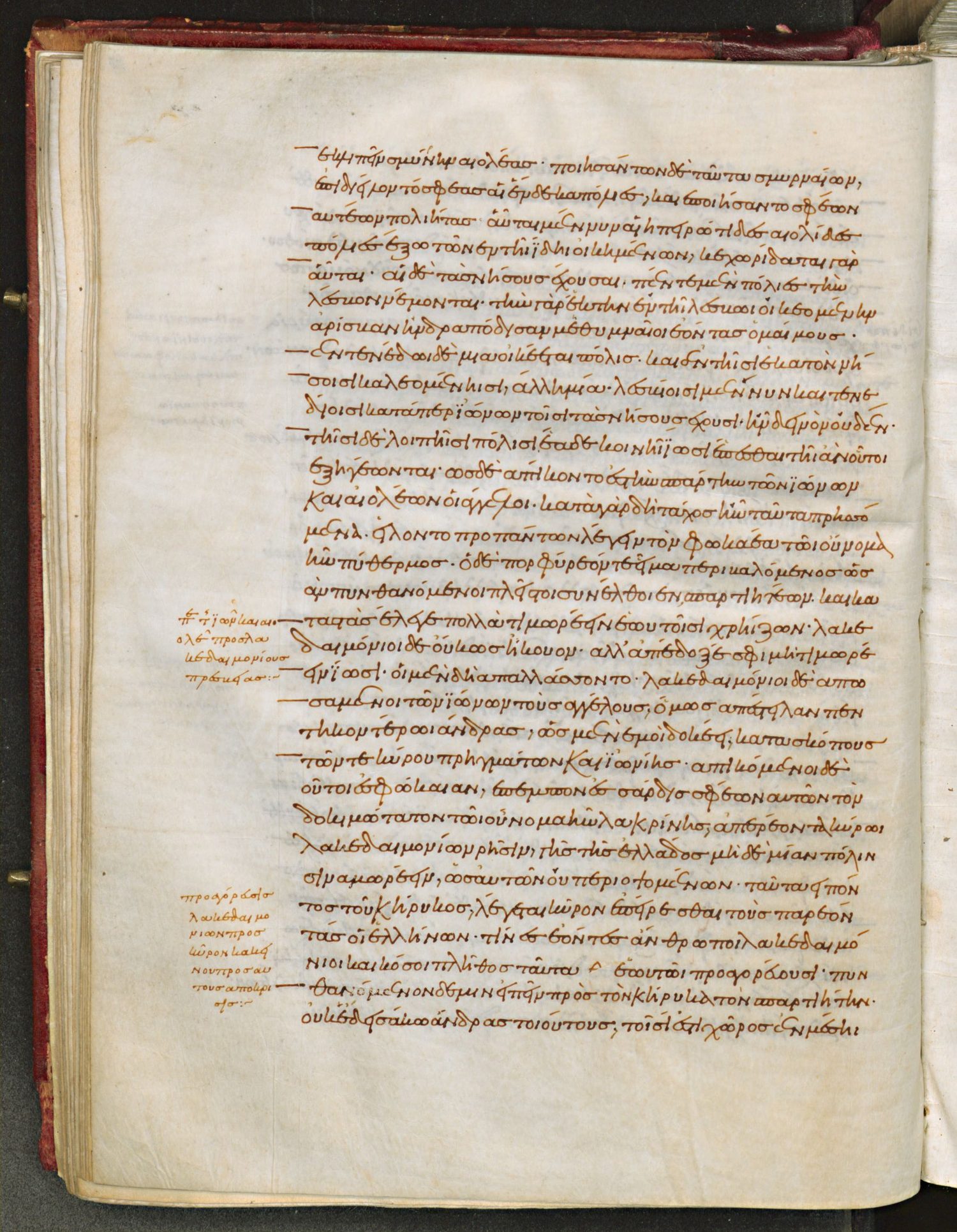
Where on the image
Laur. Plut. 70.3, fol. 39v: Greek here 1.150.2 to 1.151.3. Checked on the image (first and last words read and located in the Greek; each break checked against the neighbouring page): fol. 39v begins ‹ἐκλιπεῖν Σμύρνην Αἰολέας. ποιησάντων› (1.150.2), ends ‹ἐστι χῶρος ἐν μέσῃ› (1.153.1). English here: 1.150.2 to 1.151.3 (Godley's sentences for the sections whose Greek lies mostly on this page).
1.150.2ἐκλιπεῖν Σμύρνην Αἰολέας. ποιησάντων δὲ ταῦτα Σμυρναίων ἐπιδιείλοντο σφέας αἱ ἕνδεκα πόλιες καὶ ἐποιήσαντο σφέων αὐτέων πολιήτας. 1.151.1αὗται μέν νυν αἱ ἠπειρώτιδες Αἰολίδες πόλιες, ἔξω τῶν ἐν τῇ Ἴδῃ οἰκημενέων· κεχωρίδαται γὰρ αὗται. 1.151.2αἱ δὲ τὰς νήσους ἔχουσαι πέντε μὲν πόλιες τὴν Λέσβον νέμονται (τὴν γὰρ ἕκτην ἐν τῇ Λέσβῳ οἰκημένην Ἀρίσβαν ἠνδραπόδισαν Μηθυμναῖοι ἐόντας ὁμαίμους), ἐν Τενέδῳ δὲ μία οἴκηται πόλις, καὶ ἐν τῇσι Ἑκατὸν νήσοισι καλεομένῃσι ἄλλη μία. 1.151.3Λεσβίοισι μέν νῦν καὶ Τενεδίοισι, κατά περ Ἰώνων τοῖσι τὰς νήσους ἔχουσι, ἦν δεινὸν οὐδέν· τῇσι δὲ λοιπῇσι πόλισι ἕαδε κοινῇ Ἴωσι ἕπεσθαι τῇ ἂν οὗτοι ἐξηγέωνται.
1.150.2Then all the Aeolians came to recover it; and an agreement was made, whereby the Aeolians should receive back their movable goods from the Ionians, and quit the city. This being done, the other eleven cities divided the Smyrnaeans among themselves and made them citizens of their own. 1.151.1These then are the Aeolian cities of the mainland, besides those that are situate on Ida, and are separate. 1.151.2Among those on the islands, five divide Lesbos among them (there was a sixth on Lesobs, Arisba, but its people were enslaved by their kinsfolk of Methymna); there is one on Tenedos, and one again in the “Hundred isles” as they are called. 1.151.3The men of Lesbos and Tenedos, then, like the Ionian islanders, had nothing to fear. The rest of the cities took counsel together and resolved to follow whither the Ionians should lead.
Notes
- Greek: the text printed in A. D. Godley's Loeb edition, via Perseus (tlg0016.tlg001.perseus-grc2). Square brackets mark words the editor considers later additions; [...] marks a gap the editor indicates. Perseus note markers are omitted.
- English: A. D. Godley, Herodotus vol. 1 (1920) (Loeb Classical Library), as transcribed on Wikisource. Godley's footnotes are omitted.
- Section numbers in the English were placed by comparing Godley's text with the Perseus version of his translation; where a section begins inside one of Godley's sentences, the English is kept with the page that holds the start of that sentence.
Cite
Sources
- Source: Florence, Laur. Plut. 70.3 (10th c.) via BML Teca Digitale + Greek of Godley's Loeb (Perseus) + English of A. D. Godley (Loeb, Wikisource) (holding institution)
- Critical edition: Greek of A. D. Godley's Loeb edition (1920-1925), via Perseus
← previous · → next · v cycle view · l back to library