Herodotus, Histories 1.152-161: Sparta's warning to Cyrus; the revolt of Pactyes
Introduction
Herodotus of Halicarnassus wrote the Histories in the third quarter of the 5th century BCE, an inquiry into the deeds of Greeks and barbarians and the causes of the wars between them, later divided into nine books. Book 1 tells how the conflict between Greeks and barbarians began, the history of Lydia from Gyges to Croesus, the rise of the Medes and of Cyrus the Persian, the conquest of the Greeks of Asia, the capture of Babylon and the death of Cyrus.
The photographs are of Florence, Biblioteca Medicea Laurenziana, Plut. 70.3 (parchment, 10th century, 374 folios, 31 lines a page), Herodotus, Histories (codex A of the editors), the oldest surviving manuscript of the complete Histories, from the Teca Digitale of the Biblioteca Medicea Laurenziana. Each section below is the text of one page, or of the part of a page that falls within these chapters. The first and last words of every page were read on the photograph and located in the Greek, and every page break was checked against the next page; the notes quote these words. Readers' notes in the margins are not part of the text and are mentioned where they occur.
The Greek is the text printed in A. D. Godley's Loeb edition (1920-1925), from Perseus; it is the edited text, not a transcription of the manuscript, whose wording differs in places. The English is Godley's translation as printed, from Wikisource. Godley's English carries only chapter numbers; the section numbers shown in it were placed by comparison with the Perseus version of his translation. Each page's English is cut at the end of one of Godley's sentences, so it can begin or end a few lines away from the Greek of the page; each note gives the exact ranges.
This entry covers chapters 1.152-161, on fol. 39v to 41v.
How was this verified? (Provenance)
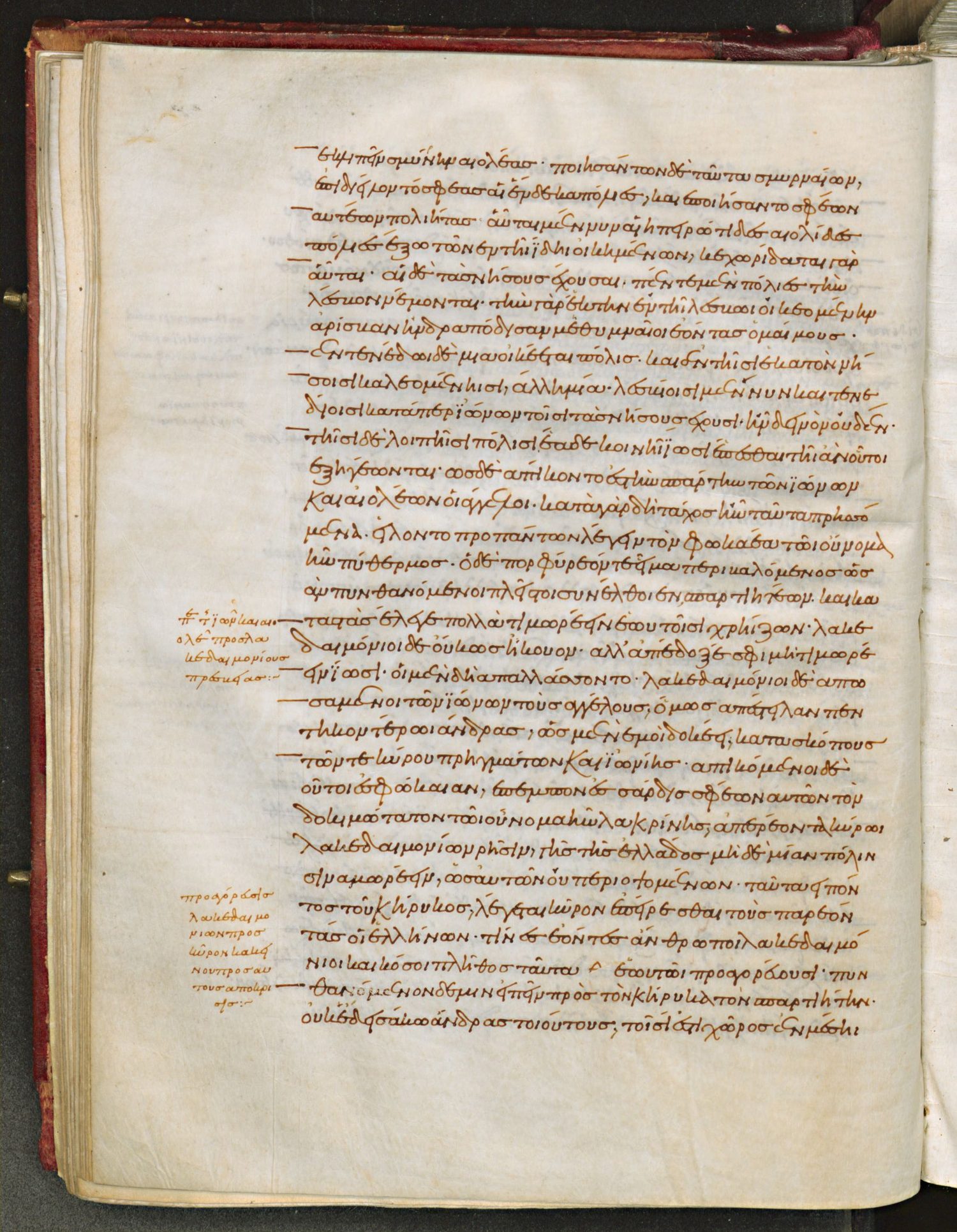
Where on the image
Laur. Plut. 70.3, fol. 39v: Greek here 1.152.1 to 1.153.1. Checked on the image (first and last words read and located in the Greek; each break checked against the neighbouring page): fol. 39v begins ‹ἐκλιπεῖν Σμύρνην Αἰολέας. ποιησάντων› (1.150.2), ends ‹ἐστι χῶρος ἐν μέσῃ› (1.153.1). English here: 1.152.1 to 1.153.1 (Godley's sentences for the sections whose Greek lies mostly on this page).
1.152.1ὡς δὲ ἀπίκοντο ἐς τὴν Σπάρτην τῶν Ἰώνων καὶ Αἰολέων οἱ ἄγγελοι (κατὰ γὰρ δὴ τάχος ἦν ταῦτα πρησσόμενα), εἵλοντο πρὸ πάντων λέγειν τὸν Φωκαέα, τῷ οὔνομα ἦν Πύθερμος. ὁ δὲ πορφύρεόν τε εἷμα περιβαλόμενος, ὡς ἂν πυνθανόμενοι πλεῖστοι συνέλθοιεν Σπαρτιητέων, καὶ καταστὰς ἔλεγε πολλὰ τιμωρέειν ἑωυτοῖσι χρηίζων. 1.152.2Λακεδαιμόνιοι δὲ οὔ κως ἐσήκουον, ἀλλʼ ἀπέδοξέ σφι μὴ τιμωρέειν Ἴωσι. οἳ μὲν δὴ ἀπαλλάσσοντο, Λακεδαιμόνιοι δὲ ἀπωσάμενοι τῶν Ἰώνων τοὺς ἀγγέλους ὅμως ἀπέστειλαν πεντηκοντέρῳ ἄνδρας, ὡς μὲν ἐμοὶ δοκέει, κατασκόπους τῶν τε Κύρου πρηγμάτων καὶ Ἰωνίης. 1.152.3ἀπικόμενοι δὲ οὗτοι ἐς Φώκαιαν ἔπεμπον ἐς Σάρδις σφέων αὐτῶν τὸν δοκιμώτατον, τῷ οὔνομα ἦν Λακρίνης, ἀπερέοντα Κύρῳ Λακεδαιμονίων ῥῆσιν, γῆς τῆς Ἑλλάδος μηδεμίαν πόλιν σιναμωρέειν, ὡς αὐτῶν οὐ περιοψομένων. 1.153.1ταῦτα εἰπόντος τοῦ κήρυκος, λέγεται Κῦρον ἐπειρέσθαι τοὺς παρεόντας οἱ Ἑλλήνων τίνες ἐόντες ἄνθρωποι Λακεδαιμόνιοι καὶ κόσοι πλῆθος ταῦτα ἑωυτῷ προαγορεύουσι· πυνθανόμενον δέ μιν εἰπεῖν πρὸς τὸν κήρυκα τὸν Σπαρτιήτην· οὐκ ἔδεισά κω ἄνδρας τοιούτους, τοῖσι ἐστι χῶρος ἐν μέσῃ
1.152.1So when the envoys of the Ionians and Aeolians came to Sparta (for this was set afoot with all speed) they chose the Phocaean, whose name was Pythermos, to speak for all. He then put on a purple cloak, that as many Spartans as possible might assemble to hear him, and stood up and made a long speech asking aid for his people. 1.152.2But the Lacedaemonians would not listen to him and refused to aid the Ionians. So the Ionians departed; but the Lacedaemonians, though they had rejected their envoys, did nevertheless send men in a ship of fifty oars to see (as I suppose) how it fared with Cyrus and Ionia. 1.152.3These, coming to Phocaea, sent Lacrines, who was the most esteemed among them, to Sardis, to repeat there to Cyrus a proclamation of the Lacedaemonians, that he must harm no city on Greek territory else the Lacedaemonians would punish him. 1.153.1When the herald had so spoken, Cyrus (it is said) asked the Greeks that were present who and how many in number were these Lacedaemonians who made him this declaration. When he was told, he said to the Spartan herald, “I never yet feared men who have a place set apart in the midst of their city where they perjure themselves and deceive each other. These, if I keep my health, shall have their own mishaps to talk of, not those of the Ionians.”
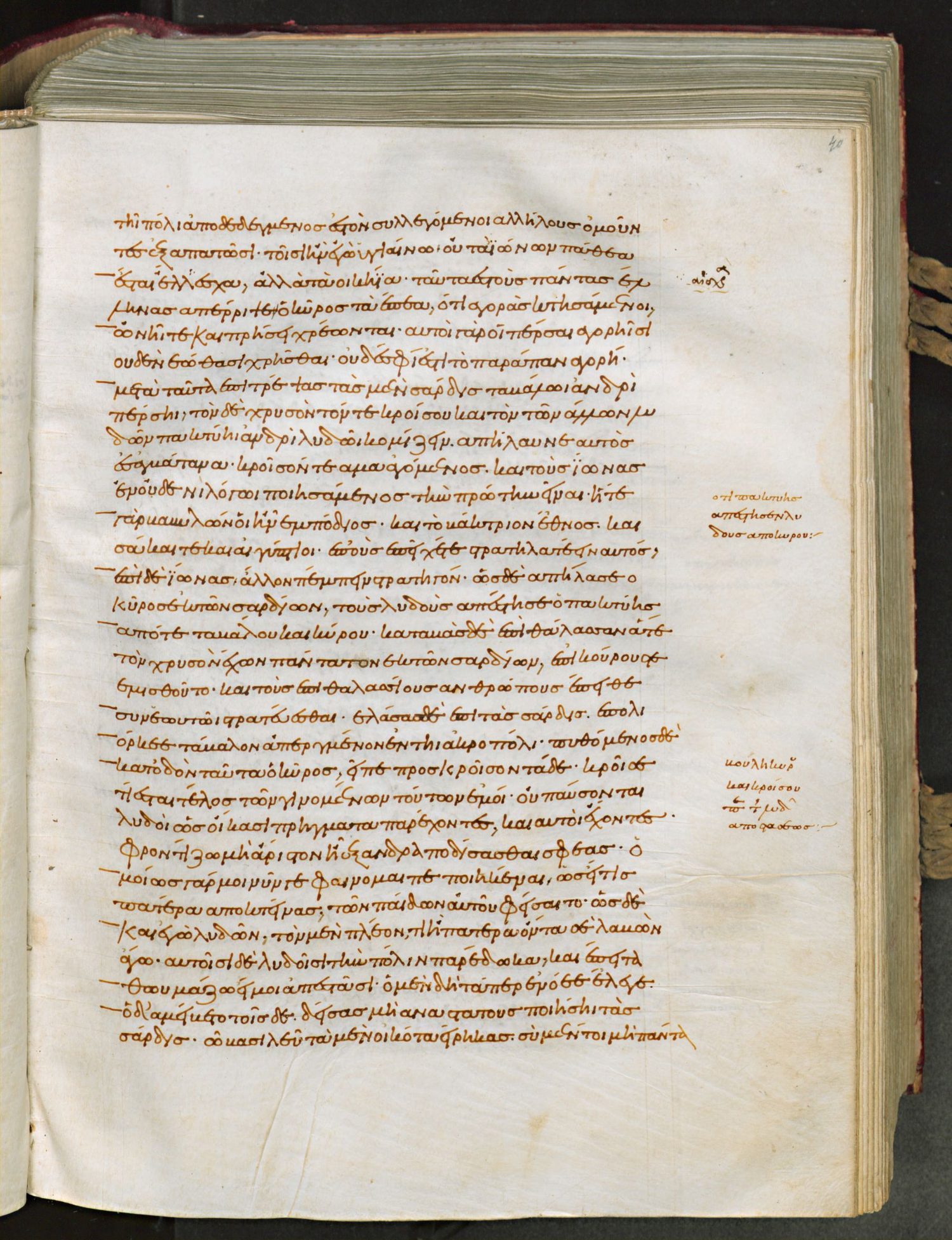
Where on the image
Laur. Plut. 70.3, fol. 40r: Greek here 1.153.1 to 1.155.3. Checked on the image (first and last words read and located in the Greek; each break checked against the neighbouring page): fol. 40r begins ‹τῇ πόλι ἀποδεδεγμένος ἐς› (1.153.1), ends ‹σὺ μέντοι μὴ πάντα› (1.155.3). English here: 1.153.2 to 1.155.2 (Godley's sentences for the sections whose Greek lies mostly on this page).
1.153.1τῇ πόλι ἀποδεδεγμένος ἐς τὸν συλλεγόμενοι ἀλλήλους ὀμνύντες ἐξαπατῶσι· τοῖσι, ἢν ἐγὼ ὑγιαίνω, οὐ τὰ Ἰώνων πάθεα ἔσται ἔλλεσχα ἀλλὰ τὰ οἰκήια. 1.153.2ταῦτα ἐς τοὺς πάντας Ἕλληνας ἀπέρριψε ὁ Κῦρος τὰ ἔπεα, ὅτι ἀγορὰς στησάμενοι ὠνῇ τε καὶ πρήσι χρέωνται· αὐτοὶ γὰρ οἱ Πέρσαι ἀγορῇσι οὐδὲν ἐώθασι χρᾶσθαι, οὐδέ σφι ἐστὶ τὸ παράπαν ἀγορή. 1.153.3μετὰ ταῦτα ἐπιτρέψας τὰς μὲν Σάρδις Ταβάλῳ ἀνδρὶ Πέρσῃ, τὸν δὲ χρυσὸν τόν τε Κροίσου καὶ τὸν τῶν ἄλλων Λυδῶν Πακτύῃ ἀνδρὶ Λυδῷ κομίζειν, ἀπήλαυνε αὐτὸς ἐς Ἀγβάτανα, Κροῖσόν τε ἅμα ἀγόμενος καὶ τοὺς Ἴωνας ἐν οὐδενὶ λόγῳ ποιησάμενος τὴν πρώτην εἶναι. 1.153.4ἡ τε γὰρ Βαβυλών οἱ ἦν ἐμπόδιος καὶ τὸ Βάκτριον ἔθνος καὶ Σάκαι τε καὶ Αἰγύπτιοι, ἐπʼ οὓς ἐπεῖχέ τε στρατηλατέειν αὐτός, ἐπὶ δὲ Ἴωνας ἄλλον πέμπειν στρατηγόν. 1.154.1ὡς δὲ ἀπήλασε ὁ Κῦρος ἐκ τῶν Σαρδίων, τοὺς Λυδοὺς ἀπέστησε ὁ Πακτύης ἀπό τε Ταβάλου καὶ Κύρου, καταβὰς δὲ ἐπὶ θάλασσαν, ἅτε τὸν χρυσὸν ἔχων πάντα τὸν ἐκ τῶν Σαρδίων, ἐπικούρους τε ἐμισθοῦτο καὶ τοὺς ἐπιθαλασσίους ἀνθρώπους ἔπειθε σὺν ἑωυτῷ στρατεύεσθαι. ἐλάσας δὲ ἐπὶ τὰς Σάρδις ἐπολιόρκεε Τάβαλον ἀπεργμένον ἐν τῇ ἀκροπόλι. 1.155.1πυθόμενος δὲ κατʼ ὁδὸν ταῦτα ὁ Κῦρος εἶπε πρὸς Κροῖσον τάδε. Κροῖσε, τί ἔσται τέλος τῶν γινομένων τούτων ἐμοί; οὐ παύσονται Λυδοί, ὡς οἴκασι, πρήγματα παρέχοντες καὶ αὐτοὶ ἔχοντες. φροντίζω μὴ ἄριστον ᾖ ἐξανδραποδίσασθαι σφέας. ὁμοίως γὰρ μοι νῦν γε φαίνομαι πεποιηκέναι ὡς εἴ τις πατέρα ἀποκτείνας τῶν παίδων αὐτοῦ φείσατο· 1.155.2ὡς δὲ καὶ ἐγὼ Λυδῶν τὸν μὲν πλέον τι ἢ πατέρα ἐόντα σὲ λαβὼν ἄγω, αὐτοῖσι δὲ Λυδοῖσι τὴν πόλιν παρέδωκα, καὶ ἔπειτα θωμάζω εἰ μοι ἀπεστᾶσι. ὃ μὲν δὴ τά περ ἐνόεε ἔλεγε, ὃ δʼ ἀμείβετο τοῖσιδε, δείσας μὴ ἀναστάτους ποιήσῃ τὰς Σάρδις. 1.155.3ὦ βασιλεῦ, τὰ μὲν οἰκότα εἴρηκας, σὺ μέντοι μὴ πάντα
1.153.2This threat he uttered against the whole Greek nation, because they have market-places and buy and sell there; for the Persians themselves use no market-places, nor have they such at all. 1.153.3Presently, entrusting Sardis to a Persian called Tabalus, and charging Pactyes, a Lydian, to take charge of the gold of Croesus and the Lydians, he himself marched away to Agbatana, taking with him Croesus, and at first making no account of the Ionians. 1.153.4For he had Babylon on his hands and the Bactrian nation and the Sacae and Egyptians; he was minded to lead an army himself against these and to send another commander against the Ionians. 1.154.1But no sooner had Cyrus marched away from Sardis than Pactyes made the Lydians to revolt from Tabalus and Cyrus; and he went down to the sea, where, as he had all the gold of Sardis, he hired soldiers and persuaded the men of the coast to join his army. Then marching to Sardis he penned Tabalus in the citadel and besieged him there. 1.155.1When Cyrus had news of this on his journey, he said to Croesus, “What end am I to make, Croesus, of this business? it seems that the Lydians will never cease making trouble for me and for themselves. It is in my mind that it may be best to make slaves of them; for now methinks I have done like one that should slay the father and spare the children. 1.155.2So likewise I have taken with me you who were more than a father to the Lydians, and handed the city over to the Lydians themselves; and then forsooth I marvel that they revolt! “So Cyrus uttered his thought; but Croesus feared that he would destroy Sardis, and thus answered him: “O King, what you say is but reasonable.
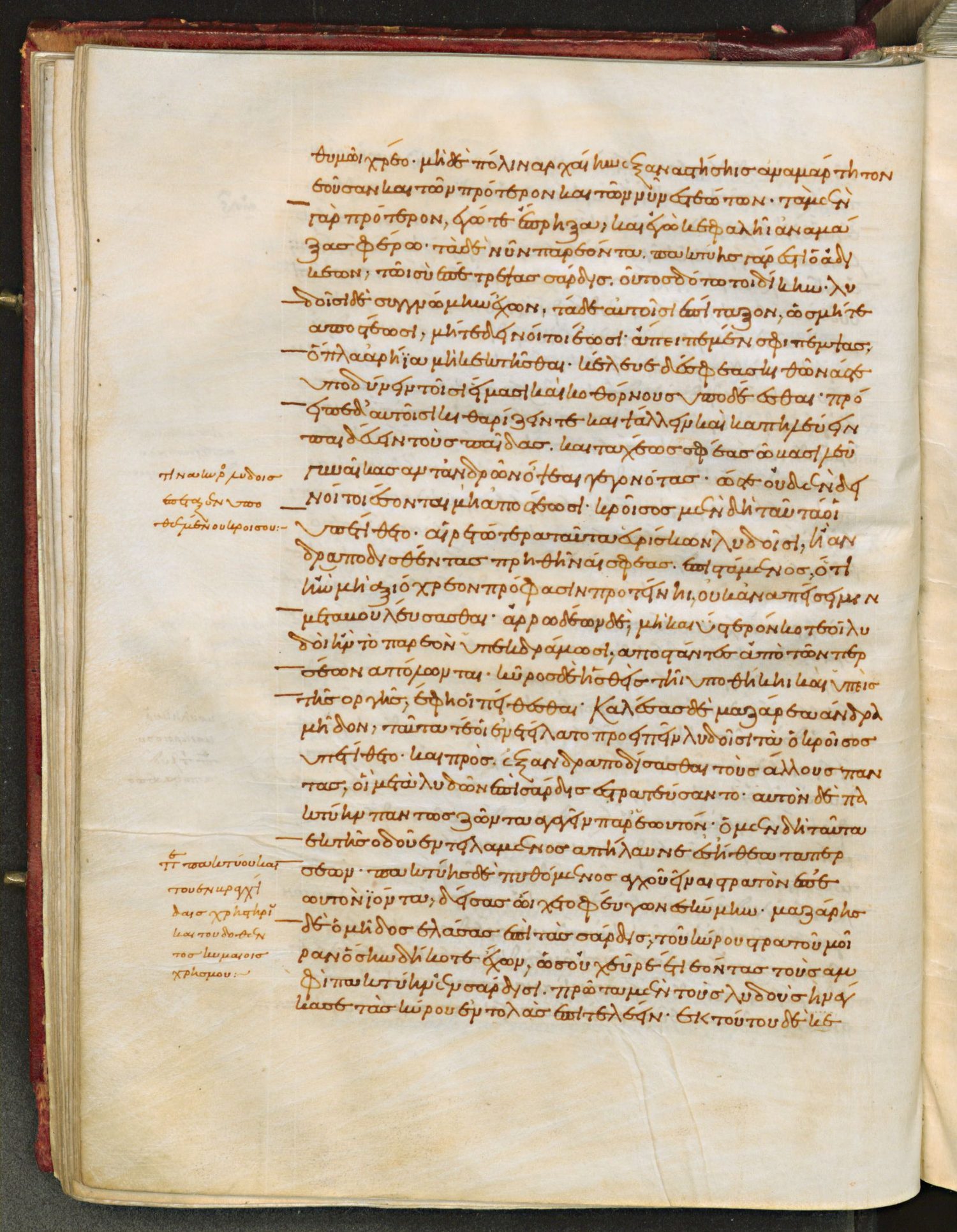
Where on the image
Laur. Plut. 70.3, fol. 40v: Greek here 1.155.3 to 1.157.2. Checked on the image (first and last words read and located in the Greek; each break checked against the neighbouring page): fol. 40v begins ‹θυμῷ χρέο, μηδὲ πόλιν› (1.155.3), ends ‹ἐκ τούτου δὲ κε-› (1.157.2). English here: 1.155.3 to 1.157.2 (Godley's sentences for the sections whose Greek lies mostly on this page).
1.155.3θυμῷ χρέο, μηδὲ πόλιν ἀρχαίην ἐξαναστήσῃς ἀναμάρτητον ἐοῦσαν καὶ τῶν πρότερον καὶ τῶν νῦν ἑστεώτων. τὰ μὲν γὰρ πρότερον ἐγώ τε ἔπρηξα καὶ ἐγὼ κεφαλῇ ἀναμάξας φέρω· τὰ δὲ νῦν παρεόντα Πακτύης γὰρ ἐστὶ ὁ ἀδικέων, τῷ σὺ ἐπέτρεψας Σάρδις, οὗτος δότω τοι δίκην. 1.155.4Λυδοῖσι δὲ συγγνώμην ἔχων τάδε αὐτοῖσι ἐπίταξον, ὡς μήτε ἀποστέωσι μήτε δεινοί τοι ἔωσι· ἄπειπε μέν σφι πέμψας ὅπλα ἀρήια μὴ ἐκτῆσθαι, κέλευε δὲ σφέας κιθῶνάς τε ὑποδύνειν τοῖσι εἵμασι καὶ κοθόρνους ὑποδέεσθαι, πρόειπε δʼ αὐτοῖσι κιθαρίζειν τε καὶ ψάλλειν καὶ καπηλεύειν παιδεύειν τοὺς παῖδας. καὶ ταχέως σφέας ὦ βασιλεῦ γυναῖκας ἀντʼ ἀνδρῶν ὄψεαι γεγονότας, ὥστε οὐδὲν δεινοί τοι ἔσονται μὴ ἀποστέωσι. 1.156.1Κροῖσος μὲν δὴ ταῦτά οἱ ὑπετίθετο, αἱρετώτερα ταῦτα εὑρίσκων Λυδοῖσι ἢ ἀνδραποδισθέντας πρηθῆναι σφέας, ἐπιστάμενος ὅτι ἢν μὴ ἀξιόχρεον πρόφασιν προτείνῃ, οὐκ ἀναπείσει μιν μεταβουλεύσασθαι, ἀρρωδέων δὲ μὴ καὶ ὕστερον κοτὲ οἱ Λυδοί, ἢν τὸ παρεὸν ὑπεκδράμωσι, ἀποστάντες ἀπὸ τῶν Περσέων ἀπόλωνται. 1.156.2Κῦρος δὲ ἡσθεὶς τῇ ὑποθήκῃ καὶ ὑπεὶς τῆς ὀργῆς ἔφη οἱ πείθεσθαι. καλέσας δὲ Μαζάρεα ἄνδρα Μῆδον, ταῦτά τέ οἱ ἐνετείλατο προειπεῖν Λυδοῖσι τὰ ὁ Κροῖσος ὑπετίθετο, καὶ πρὸς ἐξανδραποδίσασθαι τοὺς ἄλλους πάντας οἳ μετὰ Λυδῶν ἐπὶ Σάρδις ἐστρατεύσαντο, αὐτὸν δὲ Πακτύην πάντως ζῶντα ἀγαγεῖν παρʼ ἑωυτόν. 1.157.1ὃ μὲν δὴ ταῦτα ἐκ τῆς ὁδοῦ ἐντειλάμενος ἀπήλαυνε ἐς ἤθεα τὰ Περσέων, Πακτύης δὲ πυθόμενος ἀγχοῦ εἶναι στρατὸν ἐπʼ ἑωυτὸν ἰόντα δείσας οἴχετο φεύγων ἐς Κύμην. 1.157.2Μαζάρης δὲ ὁ Μῆδος ἐλάσας ἐπὶ τὰς Σάρδις τοῦ Κύρου στρατοῦ μοῖραν ὅσην δή κοτε ἔχων, ὡς οὐκ εὗρε ἔτι ἐόντας τοὺς ἀμφὶ Πακτύην ἐν Σάρδισι, πρῶτα μὲν τοὺς Λυδοὺς ἠνάγκασε τὰς Κύρου ἐντολὰς ἐπιτελέειν, ἐκ τούτου δὲ κελευσμοσύνης
1.155.3Yet do not ever the former and of the latter offence. For the beginning was my work, and on my head is the penalty; but it is Pactyes, in whose charge you left Sardis, who does this present wrong; let him therefore be punished. 1.155.4But let the Lydians be pardoned; and lay on them this command, that they may not revolt or be dangerous to you; send, I say, and forbid them to possess weapons of war, and command them to wear tunics under their cloaks and buskins on their feet, and to teach their sons lyre-playing and song and dance and huckstering. Then, O king, you will soon see them turned to women instead of men; and thus you need not fear lest they revolt.” 1.156.1Such counsel Croesus gave Cyrus, because he thought this was better for the Lydians than to be sold as slaves; he knew that without some reasonable plea he could not change the king’s purpose, and feared that even if the Lydians should now escape they might afterwards revolt and be destroyed by the Persians. 1.156.2Cyrus was pleased by this counsel; he abated his anger and said he would follow Croesus’ advice. Then calling Mazares, a Mede, he charged him to give the Lydians the commands which Croesus advised; further, to enslave all the others who had joined the Lydians in attacking Sardis; and as for Pactyes himself, to bring him by whatever means into his presence alive. 1.157.1Having given these commands on his journey, he marched away into the Persian country. But Pactyes, learning that an army sent against him was drawing near, was affrighted and fled to Cyme. yield to anger, nor destroy an ancient city that is guiltless both of 1.157.2Mazares the Mede, when he came to Sardis with whatever part he had of Cyrus’ army and found Pactyes’ followers no longer there, first of all compelled the Lydians to carry out Cyrus’ commands; and by his order they changed their whole manner of life.
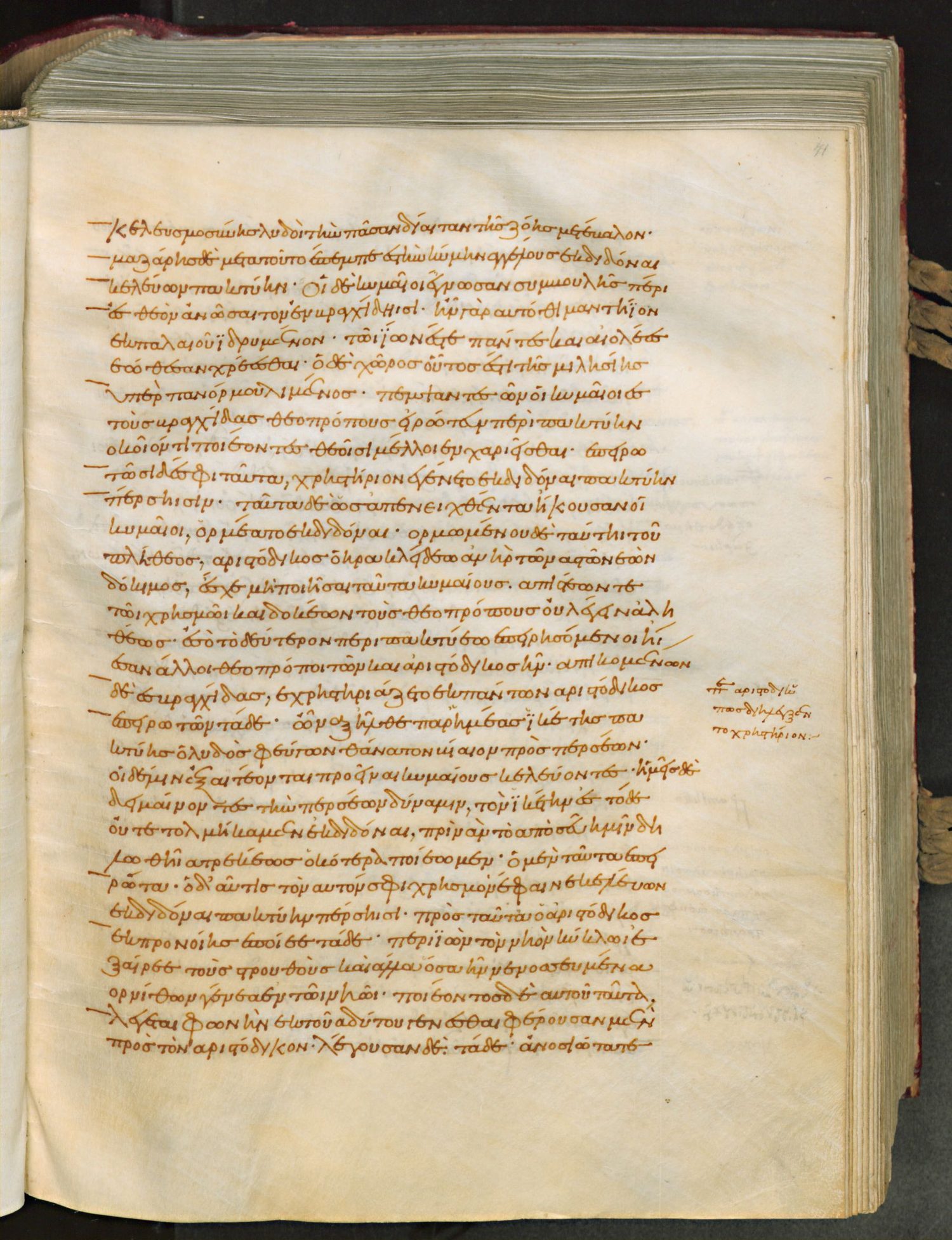
Where on the image
Laur. Plut. 70.3, fol. 41r: Greek here 1.157.2 to 1.159.3. Checked on the image (first and last words read and located in the Greek; each break checked against the neighbouring page): fol. 41r begins ‹-λευσμοσύνης Λυδοὶ τὴν πᾶσαν› (1.157.2), ends ‹λέγουσαν δὲ τάδε ἀνοσιώτατε› (1.159.3). The word ‹κελευσμοσύνης› is divided between fol. 40v and fol. 41r; it is given with fol. 40v. English here: 1.157.3 to 1.159.3 (Godley's sentences for the sections whose Greek lies mostly on this page).
1.157.2Λυδοὶ τὴν πᾶσαν δίαιταν τῆς ζόης μετέβαλον. 1.157.3Μαζάρης δὲ μετὰ τοῦτο ἔπεμπε ἐς τὴν Κύμην ἀγγέλους ἐκδιδόναι κελεύων Πακτύην. οἱ δὲ Κυμαῖοι ἔγνωσαν συμβουλῆς πέρι ἐς θεὸν ἀνοῖσαι τὸν ἐν Βραγχίδῃσι· ἦν γὰρ αὐτόθι μαντήιον ἐκ παλαιοῦ ἱδρυμένον, τῷ Ἴωνές τε πάντες καὶ Αἰολέες ἐώθεσαν χρᾶσθαι. ὁ δὲ χῶρος οὗτος ἐστὶ τῆς Μιλησίης ὑπὲρ Πανόρμου λιμένος. 1.158.1πέμψαντες ὦν οἱ Κυμαῖοι ἐς τοὺς Βραγχίδας θεοπρόπους εἰρώτευν περὶ Πακτύην ὁκοῖόν τι ποιέοντες θεοῖσι μέλλοιεν χαριεῖσθαι. ἐπειρωτῶσι δέ σφι ταῦτα χρηστήριον ἐγένετο ἐκδιδόναι Πακτύην Πέρσῃσι. ταῦτα δὲ ὡς ἀπενειχθέντα ἤκουσαν οἱ Κυμαῖοι, ὁρμέατο ἐκδιδόναι· 1.158.2ὁρμημένου δὲ ταύτῃ τοῦ πλήθεος, Ἀριστόδικος ὁ Ἡρακλείδεω ἀνὴρ τῶν ἀστῶν ἐὼν δόκιμος ἔσχε μὴ ποιῆσαι ταῦτα Κυμαίους, ἀπιστέων τε τῷ χρησμῷ καὶ δοκέων τοὺς θεοπρόπους οὐ λέγειν ἀληθέως, ἐς ὃ τὸ δεύτερον περὶ Πακτύεω ἐπειρησόμενοι ἤισαν ἄλλοι θεοπρόποι, τῶν καὶ Ἀριστόδικος ἦν. 1.159.1ἀπικομένων δὲ ἐς Βραγχίδας ἐχρηστηριάζετο ἐκ πάντων Ἀριστόδικος ἐπειρωτῶν τάδε. ὦναξ, ἦλθε παρʼ ἡμέας ἱκέτης Πακτύης ὁ Λυδός, φεύγων θάνατον βίαιον πρὸς Περσέων· οἳ δέ μιν ἐξαιτέονται, προεῖναι Κυμαίους κελεύοντες. 1.159.2ἡμεῖς δὲ δειμαίνοντες τὴν Περσέων δύναμιν τὸν ἱκέτην ἐς τόδε οὐ τετολμήκαμεν ἐκδιδόναι, πρὶν ἂν τὸ ἀπὸ σεῦ ἡμῖν δηλωθῇ ἀτρεκέως ὁκότερα ποιέωμεν. ὃ μὲν ταῦτα ἐπειρώτα, ὃ δʼ αὖτις τὸν αὐτόν σφι χρησμὸν ἔφαινε, κελεύων ἐκδιδόναι Πακτύην Πέρσῃσι. 1.159.3πρὸς ταῦτα ὁ Ἀριστόδικος ἐκ προνοίης ἐποίεε τάδε· περιιὼν τὸν νηὸν κύκλῳ ἐξαίρεε τοὺς στρουθοὺς καὶ ἄλλα ὅσα ἦν νενοσσευμένα ὀρνίθων γένεα ἐν τῷ νηῷ. ποιέοντος δὲ αὐτοῦ ταῦτα λέγεται φωνὴν ἐκ τοῦ ἀδύτου γενέσθαι φέρουσαν μὲν πρὸς τὸν Ἀριστόδικον, λέγουσαν δὲ τάδε ἀνοσιώτατε
1.157.3After this, he sent messengers to Cyme demanding that Pactyes be given up. The Cymaeans resolved to make the god at Branchidae their judge as to what counsel they should take; for there was there an ancient place of divination, which all the Ionians and Aeolians were wont to consult; the place is in the land of Miletus, above the harbour of Panormus. 1.158.1The men of Cyme then sent to Branchidae to inquire of the shrine what they should do in the matter of Pactyes that should be most pleasing to the gods; and the oracle replied that they must give Pactyes up to the Persians. 1.158.2When this answer came back to them, they set about giving him up. But while the greater part were for doing this, Aristodicus son of Heraclides, a notable man among the citizens, stayed the men of Cyme from this deed; for he disbelieved the oracle and thought that those who had inquired of the god spoke untruly; till at last a second band of inquirers was sent to inquire concerning Pactyes, among whom was Aristodicus. 1.159.1When they came to Branchidae Aristodicus speaking for all put this question to the oracle: “O King, Pactyes the Lydian hath fled to us for refuge to save him from a violent death at the hands of the Persians; and they demand him of us, bidding the men of Cyme to give him up. 1.159.2But we, for all that we fear the Persian power, have not made bold to give up this our suppliant, until thy will be clearly made known to us, whether we shall do this or not.” Thus Aristodicus questioned; and the god gave again the same answer, that Pactyes should be delivered up to the Persians. 1.159.3With that Aristodicus did as he had already purposed; he went round about the temple, and stole away the sparrows and all other families of nesting birds that were in it. But while he so did, a voice (they say) came out of the inner shrine calling to Aristodicus, and saying, “Thou wickedest of men, wherefore darest thou do this? wilt thou rob my temple of those that take refuge with me?”
Where on the image
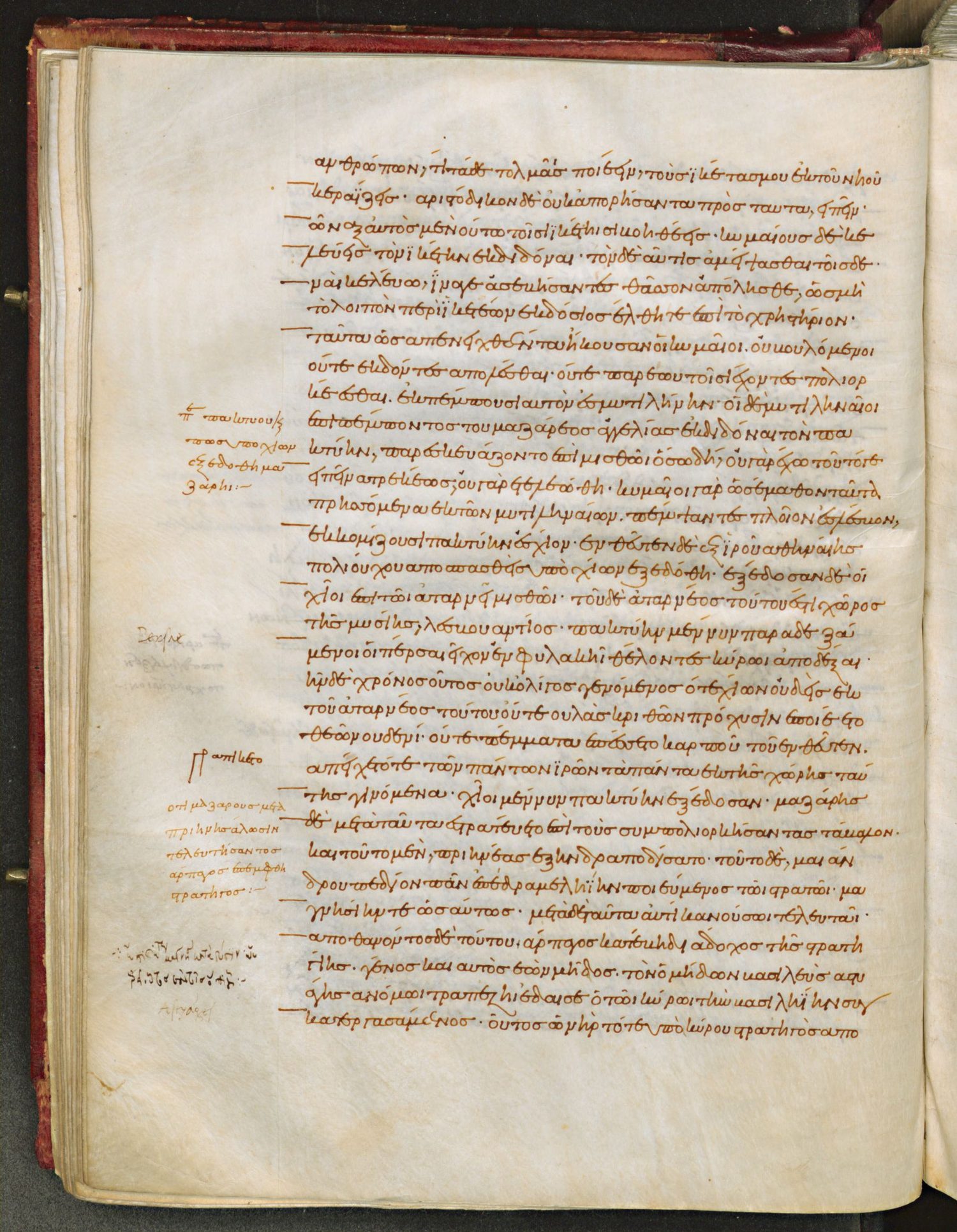
Laur. Plut. 70.3, fol. 41v: Greek here 1.159.3 to 1.161.1. Checked on the image (first and last words read and located in the Greek; each break checked against the neighbouring page): fol. 41v begins ‹ἀνθρώπων, τί τάδε τολμᾷς› (1.159.3), ends ‹ὑπὸ Κύρου στρατηγὸς ἀπο-› (1.162.2). English here: 1.159.4 to 1.161.1 (Godley's sentences for the sections whose Greek lies mostly on this page).
1.159.3ἀνθρώπων, τί τάδε τολμᾷς ποιέειν; τοὺς ἱκέτας μου ἐκ τοῦ νηοῦ κεραΐζεις; 1.159.4Ἀριστόδικον δὲ οὐκ ἀπορήσαντα πρὸς ταῦτα εἰπεῖν ὦναξ, αὐτὸς μὲν οὕτω τοῖσι ἱκέτῃσι βοηθέεις, Κυμαίους δὲ κελεύεις τὸν ἱκέτην ἐκδιδόναι; τὸν δὲ αὖτις ἀμείψασθαι τοῖσιδε ναὶ κελεύω, ἵνα γε ἀσεβήσαντες θᾶσσον ἀπόλησθε, ὡς μὴ τὸ λοιπὸν περὶ ἱκετέων ἐκδόσιος ἔλθητε ἐπὶ τὸ χρηστήριον. 1.160.1ταῦτα ὡς ἀπενειχθέντα ἤκουσαν οἱ Κυμαῖοι, οὐ βουλόμενοι οὔτε ἐκδόντες ἀπολέσθαι οὔτε παρʼ ἑωυτοῖσι ἔχοντες πολιορκέεσθαι, ἐκπέμπουσι αὐτὸν ἐς Μυτιλήνην. 1.160.2οἱ δὲ Μυτιληναῖοι ἐπιπέμποντος τοῦ Μαζάρεος ἀγγελίας ἐκδιδόναι τὸν Πακτύην παρεσκευάζοντο ἐπὶ μισθῷ ὅσῳ δή· οὐ γὰρ ἔχω τοῦτό γε εἰπεῖν ἀτρεκέως· οὐ γὰρ ἐτελεώθη. 1.160.3Κυμαῖοι γὰρ ὡς ἔμαθον ταῦτα πρησσόμενα ἐκ τῶν Μυτιληναίων, πέμψαντες πλοῖον ἐς Λέσβον ἐκκομίζουσι Πακτύην ἐς Χίον. ἐνθεῦτεν δὲ ἐξ ἱροῦ Ἀθηναίης πολιούχου ἀποσπασθεὶς ὑπὸ Χίων ἐξεδόθη· ἐξέδοσαν δὲ οἱ Χῖοι ἐπὶ τῷ Ἀταρνέι μισθῷ· 1.160.4τοῦ δὲ Ἀταρνέος τούτου ἐστὶ χῶρος τῆς Μυσίης, Λέσβου ἀντίος. Πακτύην μέν νυν παραδεξάμενοι οἱ Πέρσαι εἶχον ἐν φυλακῇ, θέλοντες Κύρῳ ἀποδέξαι. 1.160.5ἦν δὲ χρόνος οὗτος οὐκ ὀλίγος γινόμενος, ὅτε Χίων οὐδεὶς ἐκ τοῦ Ἀταρνέος τούτου οὔτε οὐλὰς κριθέων πρόχυσιν ἐποιέετο θεῶν οὐδενὶ οὔτε πέμματα ἐπέσσετο καρποῦ τοῦ ἐνθεῦτεν, ἀπείχετο τε τῶν πάντων ἱρῶν τὰ πάντα ἐκ τῆς χώρης ταύτης γινόμενα. 1.161.1Χῖοι μέν νυν Πακτύην ἐξέδοσαν. Μαζάρης δὲ μετὰ ταῦτα ἐστρατεύετο ἐπὶ τοὺς συμπολιορκήσαντας Τάβαλον, καὶ τοῦτο μὲν Πριηνέας ἐξηνδραποδίσατο, τοῦτο δὲ Μαιάνδρου πεδίον πᾶν ἐπέδραμε ληίην ποιεύμενος τῷ στρατῷ, Μαγνησίην τε ὡσαύτως. μετὰ δὲ ταῦτα αὐτίκα νούσῳ τελευτᾷ.
1.159.4Then Aristodicus had his answer ready: “O King,” said he, “wilt thou thus save thine own suppliants, yet bid the men of Cyme deliver up theirs?” But the god made answer, “Yea, I do bid them, that ye may the sooner perish for your impiety, and never again come to inquire of my oracle concerning the giving up of them that seek refuge with you.” 1.160.1When this answer was brought to the hearing of the Cymaeans they sent Pactyes away to Mytilene; for they desired neither to perish for delivering him up nor to be besieged for keeping him with them. 1.160.2Then Mazares sent a message to Mytilene demanding the surrender of Pactyes, and the Mytilenaeans prepared to give him, for a price; I cannot say with exactness how much it was, for the bargain was never fulfilled; 1.160.3for when the Cymaeans learnt that the Mytilenaeans had this in hand, they sent a ship to Lesbos and brought Pactyes away to Chios. Thence he was dragged out of the temple of City-guarding Athene and delivered up by the Chians, 1.160.4they receiving in return Atarneus, which is a district in Mysia over against Lesbos. The Persians thus received Pactyes and kept him guarded, that they might show him to Cyrus; 1.160.5and for a long time no Chian would offer sacrifice of barley meal from this land of Atarneus to any god, or make sacrificial cakes of what grew there; nothing that came from that country might be used for any sacred rite. 1.161.1Pactyes being then delivered up by the Chians, Mazares presently led his army against those who had helped to besiege Tabalus, and he enslaved the people of Priene, and overran the plain of the Maeandrus, giving it up to his army to pillage, and Magnesia likewise. Immediately after this he died of a sickness.
Notes
- Greek: the text printed in A. D. Godley's Loeb edition, via Perseus (tlg0016.tlg001.perseus-grc2). Square brackets mark words the editor considers later additions; [...] marks a gap the editor indicates. Perseus note markers are omitted.
- English: A. D. Godley, Herodotus vol. 1 (1920) (Loeb Classical Library), as transcribed on Wikisource. Godley's footnotes are omitted.
- Section numbers in the English were placed by comparing Godley's text with the Perseus version of his translation; where a section begins inside one of Godley's sentences, the English is kept with the page that holds the start of that sentence.
Cite
Sources
- Source: Florence, Laur. Plut. 70.3 (10th c.) via BML Teca Digitale + Greek of Godley's Loeb (Perseus) + English of A. D. Godley (Loeb, Wikisource) (holding institution)
- Critical edition: Greek of A. D. Godley's Loeb edition (1920-1925), via Perseus
← previous · → next · v cycle view · l back to library