Herodotus, Histories 1.26-45: Croesus, Solon, and the death of Atys
Introduction
Herodotus of Halicarnassus wrote the Histories in the third quarter of the 5th century BCE, an inquiry into the deeds of Greeks and barbarians and the causes of the wars between them, later divided into nine books. Book 1 tells how the conflict between Greeks and barbarians began, the history of Lydia from Gyges to Croesus, the rise of the Medes and of Cyrus the Persian, the conquest of the Greeks of Asia, the capture of Babylon and the death of Cyrus.
The photographs are of Florence, Biblioteca Medicea Laurenziana, Plut. 70.3 (parchment, 10th century, 374 folios, 31 lines a page), Herodotus, Histories (codex A of the editors), the oldest surviving manuscript of the complete Histories, from the Teca Digitale of the Biblioteca Medicea Laurenziana. Each section below is the text of one page, or of the part of a page that falls within these chapters. The first and last words of every page were read on the photograph and located in the Greek, and every page break was checked against the next page; the notes quote these words. Readers' notes in the margins are not part of the text and are mentioned where they occur.
The Greek is the text printed in A. D. Godley's Loeb edition (1920-1925), from Perseus; it is the edited text, not a transcription of the manuscript, whose wording differs in places. The English is Godley's translation as printed, from Wikisource. Godley's English carries only chapter numbers; the section numbers shown in it were placed by comparison with the Perseus version of his translation. Each page's English is cut at the end of one of Godley's sentences, so it can begin or end a few lines away from the Greek of the page; each note gives the exact ranges.
This entry covers chapters 1.26-45, on fol. 6v to 11r.
How was this verified? (Provenance)
Where on the image
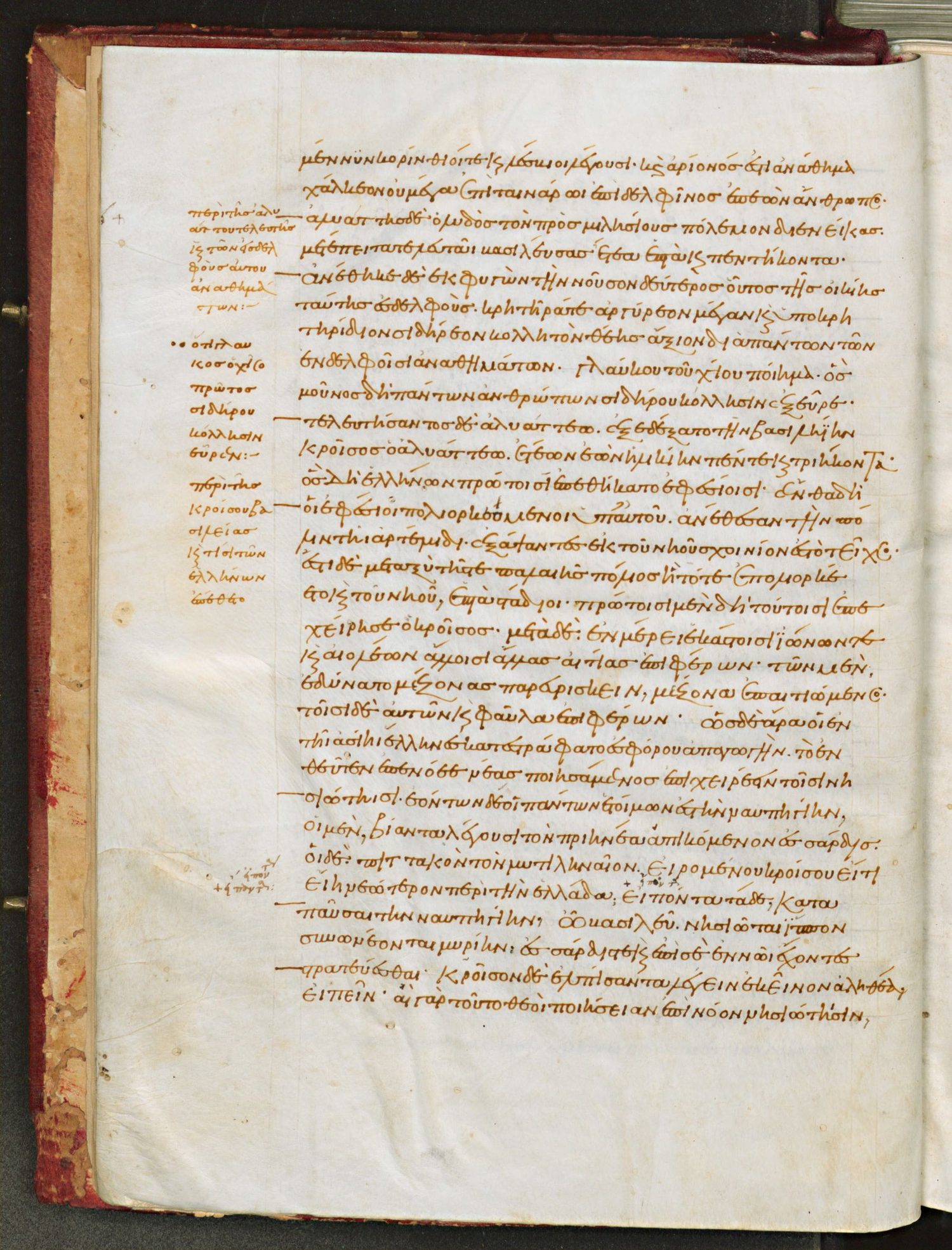
Laur. Plut. 70.3, fol. 6v: Greek here 1.26.1 to 1.27.3. Checked on the image (first and last words read and located in the Greek; each break checked against the neighbouring page): fol. 6v begins ‹μέν νυν Κορίνθιοί τε› (1.24.8), ends ‹ποιήσειαν ἐπὶ νόον νησιώτῃσι› (1.27.3). English here: 1.26.1 to 1.27.3 (Godley's sentences for the sections whose Greek lies mostly on this page).
1.26.1τελευτήσαντος δὲ Ἀλυάττεω ἐξεδέξατο τὴν βασιληίην Κροῖσος ὁ Ἀλυάττεω, ἐτέων ἐὼν ἡλικίην πέντε καὶ τριήκοντα· ὃς δὴ Ἑλλήνων πρώτοισι ἐπεθήκατο Ἐφεσίοισι. 1.26.2ἔνθα δὴ οἱ Ἐφέσιοι πολιορκεόμενοι ὑπʼ αὐτοῦ ἀνέθεσαν τὴν πόλιν τῇ Ἀρτέμιδι, ἐξάψαντες ἐκ τοῦ νηοῦ σχοινίον ἐς τὸ τεῖχος. ἔστι δὲ μεταξὺ τῆς τε παλαιῆς πόλιος, ἣ τότε ἐπολιορκέετο, καὶ τοῦ νηοῦ ἑπτὰ στάδιοι. 1.26.3πρώτοισι μὲν δὴ τούτοισι ἐπεχείρησε ὁ Κροῖσος, μετὰ δὲ ἐν μέρεϊ ἑκάστοισι Ἰώνων τε καὶ Αἰολέων, ἄλλοισι ἄλλας αἰτίας ἐπιφέρων, τῶν μὲν ἐδύνατο μέζονας παρευρίσκειν, μέζονα ἐπαιτιώμενος, τοῖσι δὲ αὐτῶν καὶ φαῦλα ἐπιφέρων. 1.27.1ὡς δὲ ἄρα οἱ ἐν τῇ Ἀσίῃ Ἕλληνες κατεστράφατο ἐς φόρου ἀπαγωγήν, τὸ ἐνθεῦτεν ἐπενόεε νέας ποιησάμενος ἐπιχειρέειν τοῖσι νησιώτῃσι. 1.27.2ἐόντων δέ οἱ πάντων ἑτοίμων ἐς τὴν ναυπηγίην, οἳ μὲν Βίαντα λέγουσι τὸν Πριηνέα ἀπικόμενον ἐς Σάρδις, οἳ δὲ Πιττακὸν τὸν Μυτιληναῖον, εἰρομένου Κροίσου εἴ τι εἴη νεώτερον περὶ τὴν Ἑλλάδα, εἰπόντα τάδε καταπαῦσαι τὴν ναυπηγίην· 1.27.3ὦ βασιλεῦ, νησιῶται ἵππον συνωνέονται μυρίην, ἐς Σάρδις τε καὶ ἐπὶ σὲ ἐν νόῳ ἔχοντες στρατεύεσθαι. Κροῖσον δὲ ἐλπίσαντα λέγειν ἐκεῖνον ἀληθέα εἰπεῖν αἲ γὰρ τοῦτο θεοὶ ποιήσειαν ἐπὶ νόον νησιώτῃσι,
1.26.1After the death of Alyattes Croesus his son came to the throne, being then thirty-five years of age. The first Greeks whom he attacked were the Ephesians. 1.26.2These, being besieged by him, dedicated their city to Artemis; this they did by attaching a rope to the city wall from the temple of the goddess, standing seven furlongs away from the ancient city, which was then being besieged. 1.26.3These were the first whom Croesus attacked; afterwards he made war on the Ionian and Aeolian cities in turn, each on its separate indictment: he found graver charges where he could, but sometimes alleged very paltry grounds of offence. 1.27.1Then, when he had subdued and made tributary to himself all the Asiatic Greeks of the mainland, he planned to build ships and attack the islanders; 1.27.2but when his preparations for shipbuilding were ready, either Bias of Priene or Pittacus of Mytilene (the story is told of both) came to Sardis, and being asked by Croesus for news about Hellas, put an end to the shipbuilding by giving the following 1.27.3answer: “King, the islanders are buying ten thousand horse, with intent to march against you to Sardis.” Croesus, thinking that he spoke the truth, said: “Would that the gods may put it in the minds of the island men to come on horseback against the sons of the Lydians!”
Where on the image
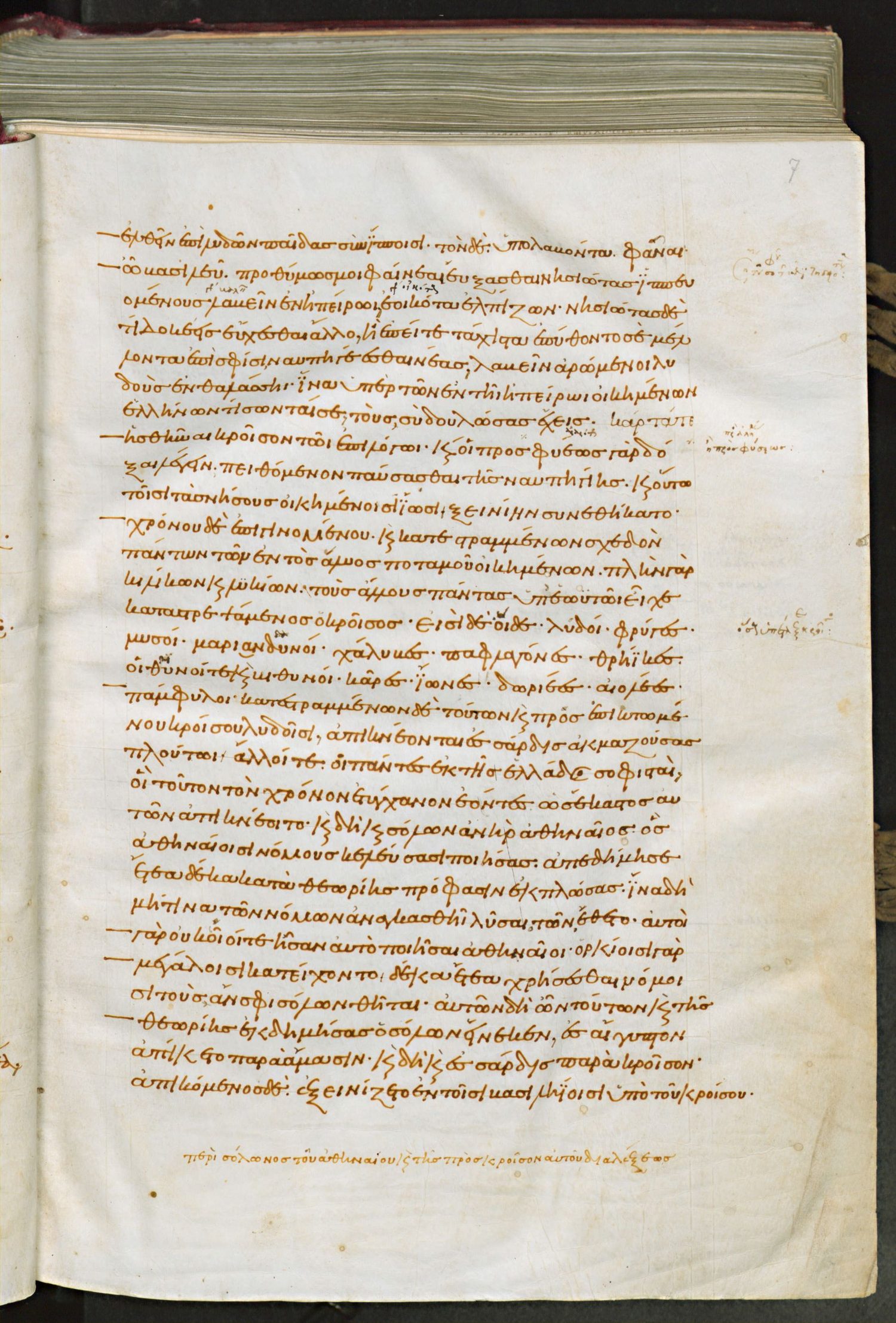
Laur. Plut. 70.3, fol. 7r: Greek here 1.27.3 to 1.30.1. Checked on the image (first and last words read and located in the Greek; each break checked against the neighbouring page): fol. 7r begins ‹ἐλθεῖν ἐπὶ Λυδῶν παῖδας› (1.27.3), ends ‹βασιληίοισι ὑπὸ τοῦ Κροίσου› (1.30.1). A later heading in the lower margin: περὶ Σόλωνος τοῦ Ἀθηναίου καὶ τῆς πρὸς Κροῖσον αὐτοῦ διαλέξεως. English here: 1.27.4 to 1.30.2 (Godley's sentences for the sections whose Greek lies mostly on this page).
1.27.3ἐλθεῖν ἐπὶ Λυδῶν παῖδας σὺν ἵπποισι. 1.27.4τὸν δὲ ὑπολαβόντα φάναι ὦ βασιλεῦ, προθύμως μοι φαίνεαι εὔξασθαι νησιώτας ἱππευομένους λαβεῖν ἐν ἠπείρῳ, οἰκότα ἐλπίζων. νησιώτας δὲ τί δοκέεις εὔχεσθαι ἄλλο ἤ, ἐπείτε τάχιστα ἐπύθοντό σε μέλλοντα ἐπὶ σφίσι ναυπηγέεσθαι νέας, λαβεῖν ἀρώμενοι Λυδούς ἐν θαλάσσῃ, ἵνα ὓπερ τῶν ἐν τῇ ἠπείρῳ οἰκημένων Ἑλλήνων τίσωνταί σε, τοὺς σὺ δουλώσας ἔχεις; 1.27.5κάρτα τε ἡσθῆναι Κροῖσον τῷ ἐπιλόγῳ καί οἱ, προσφυέως γὰρ δόξαι λέγειν, πειθόμενον παύσασθαι τῆς ναυπηγίης. καὶ οὕτω τοῖσι τὰς νήσους οἰκημένοισι Ἴωσι ξεινίην συνεθήκατο. 1.28.1χρόνου δὲ ἐπιγινομένου καὶ κατεστραμμένων σχεδὸν πάντων τῶν ἐντὸς Ἅλυος ποταμοῦ οἰκημένων· πλὴν γὰρ Κιλίκων καὶ Λυκίων τοὺς ἄλλους πάντας ὑπʼ ἑωυτῷ εἶχε καταστρεψάμενος ὁ Κροῖσος. εἰσὶ δὲ οἵδε, Λυδοί, Φρύγες, Μυσοί, Μαριανδυνοί, Χάλυβες, Παφλαγόνες, Θρήικες οἱ Θυνοί τε καὶ Βιθυνοί, Κᾶρες, Ἴωνες, Δωριέες, Αἰολέες, Πάμφυλοι κατεστραμμένων δὲ τούτων καὶ προσεπικτωμένου Κροίσου Λυδοῖσι, 1.29.1ἀπικνέονται ἐς Σάρδις ἀκμαζούσας πλούτῳ ἄλλοι τε οἱ πάντες ἐκ τῆς Ἑλλάδος σοφισταί, οἳ τοῦτον τὸν χρόνον ἐτύγχανον ἐόντες, ὡς ἕκαστος αὐτῶν ἀπικνέοιτο, καὶ δὴ καὶ Σόλων ἀνὴρ Ἀθηναῖος, ὃς Ἀθηναίοισι νόμους κελεύσασι ποιήσας ἀπεδήμησε ἔτεα δέκα κατά θεωρίης πρόφασιν ἐκπλώσας,ἵνα δὴ μή τινα τῶν νόμων ἀναγκασθῇ, λῦσαι τῶν ἔθετο. 1.29.2αὐτοὶ γὰρ οὐκ οἷοί τε ἦσαν αὐτὸ ποιῆσαι Ἀθηναῖοι· ὁρκίοισι γὰρ μεγάλοισι κατείχοντο δέκα ἔτεα χρήσεσθαι νόμοισι τοὺς ἄν σφι Σόλων θῆται. 1.30.1αὐτῶν δὴ ὦν τούτων καὶ τῆς θεωρίης ἐκδημήσας ὁ Σόλων εἵνεκεν ἐς Αἴγυπτον ἀπίκετο παρὰ Ἄμασιν καὶ δὴ καὶ ἐς Σάρδις παρὰ Κροῖσον. ἀπικόμενος δὲ ἐξεινίζετο ἐν τοῖσι βασιληίοισι ὑπὸ τοῦ Κροίσου·
1.27.4Then the other answered and said: “King, I see that you earnestly pray that you may catch the islanders riding horses on the mainland, and what you expect is but natural. And the islanders, now they have heard that you are building ships to attack them therewith, think you that they pray for aught else than that they may catch Lydians on the seas, and thereby be avenged on you for having enslaved the Greeks who dwell on the mainland?” 1.27.5Croesus was well pleased with this conclusion, for it seemed to him that the man spoke but reasonably; so he took the advice and built no more ships. Thus it came about that he made friends of the Ionian islanders. 1.28.1As time went on, Croesus subdued well-nigh all the nations west of the Halys and held them in subjection, except only the Cilicians and Lycians: the rest, Lydians, Phrygians, Mysians, Mariandynians, Chalybes, Paphlagonians, Thymians and Bithynians (who are Thracians), Carians, Ionians, Dorians, Aeolians, Pamphylians, were subdued and became subjects of Croesus like the Lydians, and Sardis was at the height of its wealth. 1.29.1There came to the city all the teachers from Hellas who then lived, in this or that manner; and among them came Solon of Athens: he, having made laws for the Athenians at their request, left his home for ten years and set out on a voyage to see the world, as he said. This he did, lest he should be compelled to repeal any of the laws he had made, 1.29.2since the Athenians themselves could not repeal them, for they were bound by solemn oaths to abide for ten years by such laws as Solon should make. 1.30.1For this reason, and to see the world, Solon left Athens and visited Amasis in Egypt and Croesus at Sardis: and when he had come, Croesus entertained him in his palace. Now on the third or fourth day after his coming Croesus bade his servants lead Solon round among his treasures, and they showed him all that was there, the greatness and the prosperous state of it; and 1.30.2when he had seen and considered all, Croesus when occasion served thus questioned him: “Our Athenian guest, we have heard much of you, by reason of your wisdom and your wanderings, how that you have travelled far to seek knowledge and to see the world. Now therefore I am fain to ask you, if you have ever seen a man more blest than all his fellows.”
Where on the image
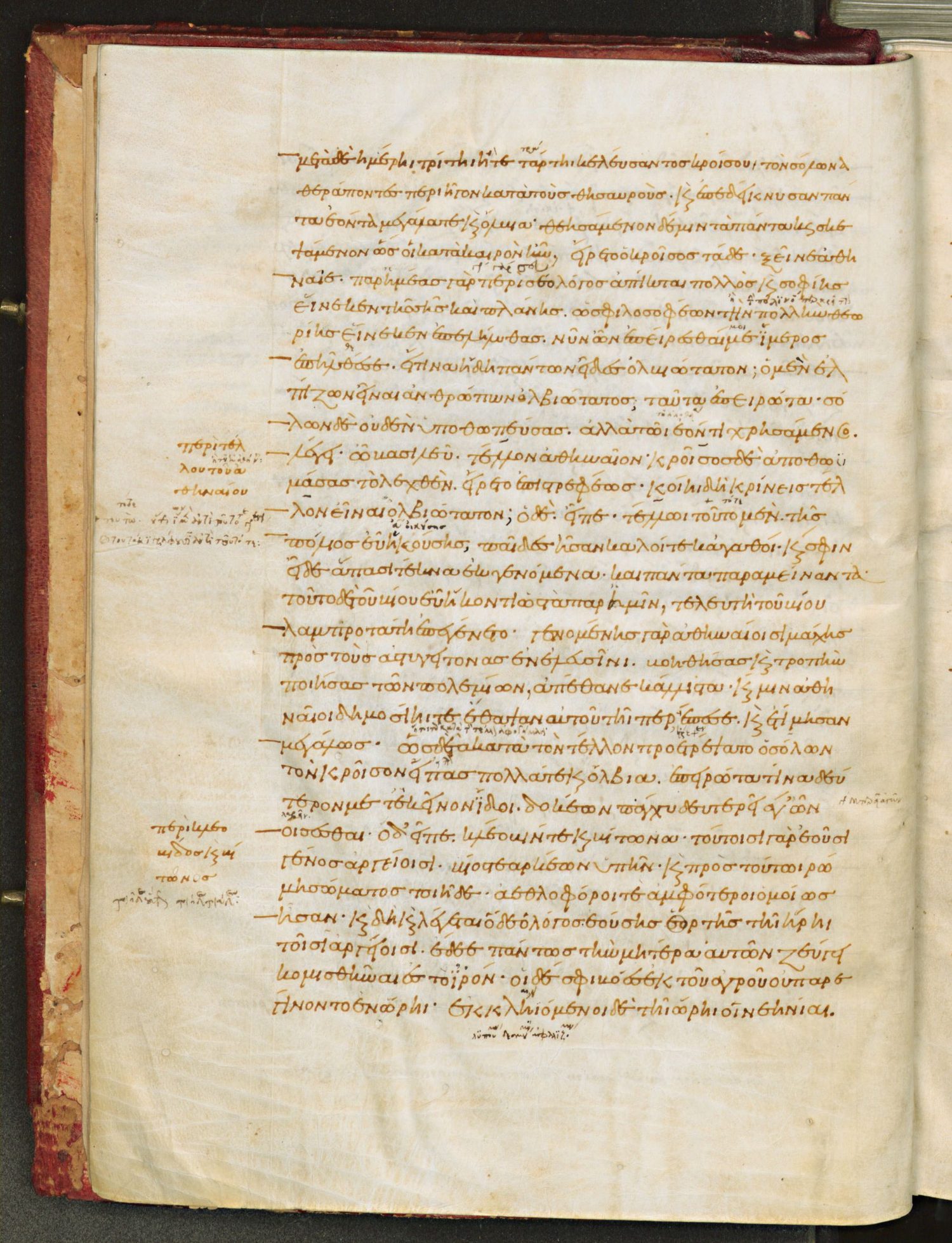
Laur. Plut. 70.3, fol. 7v: Greek here 1.30.1 to 1.31.2. Checked on the image (first and last words read and located in the Greek; each break checked against the neighbouring page): fol. 7v begins ‹μετὰ δὲ ἡμέρῃ τρίτῃ› (1.30.1), ends ‹τῇ ὥρῃ οἱ νεηνίαι› (1.31.2). English here: 1.30.3 to 1.31.2 (Godley's sentences for the sections whose Greek lies mostly on this page).
1.30.1μετὰ δὲ ἡμέρῃ τρίτῃ ἢ τετάρτῃ κελεύσαντος Κροίσου τὸν Σόλωνα θεράποντες περιῆγον κατὰ τοὺς θησαυρούς, καὶ ἐπεδείκνυσαν πάντα ἐόντα μεγάλα τε καὶ ὄλβια. 1.30.2θεησάμενον δέ μιν τὰ πάντα καὶ σκεψάμενον ὥς οἱ κατὰ καιρὸν ἦν, εἴρετο ὁ Κροῖσος τάδε. ξεῖνε Ἀθηναῖε, παρʼ ἡμέας γὰρ περὶ σέο λόγος ἀπῖκται πολλὸς καὶ σοφίης εἵνεκεν τῆς σῆς καὶ πλάνης, ὡς φιλοσοφέων γῆν πολλὴν θεωρίης εἵνεκεν ἐπελήλυθας· νῦν ὦν ἐπειρέσθαι με ἵμερος ἐπῆλθέ σε εἴ τινα ἤδη πάντων εἶδες ὀλβιώτατον. 1.30.3ὃ μὲν ἐλπίζων εἶναι ἀνθρώπων ὀλβιώτατος ταῦτα ἐπειρώτα· Σόλων δὲ οὐδὲν ὑποθωπεύσας ἀλλὰ τῷ ἐόντι χρησάμενος λέγει ὦ βασιλεῦ, Τέλλον Ἀθηναῖον. 1.30.4ἀποθωμάσας δὲ Κροῖσος τὸ λεχθὲν εἴρετο ἐπιστρεφέως· κοίῃ δὴ κρίνεις Τέλλον εἶναι ὀλβιώτατον; ὁ δὲ εἶπε Τέλλῳ τοῦτο μὲν τῆς πόλιος εὖ ἡκούσης παῖδες ἦσαν καλοί τε κἀγαθοί, καί σφι εἶδε ἅπασι τέκνα ἐκγενόμενα καὶ πάντα παραμείναντα· τοῦτο δὲ τοῦ βίου εὖ ἥκοντι, ὡς τὰ παρʼ ἡμῖν, τελευτὴ τοῦ βίου λαμπροτάτη ἐπεγένετο· 1.30.5γενομένης γὰρ Ἀθηναίοισι μάχης πρὸς τοὺς ἀστυγείτονας ἐν Ἐλευσῖνι, βοηθήσας καὶ τροπὴν ποιήσας τῶν πολεμίων ἀπέθανε κάλλιστα, καί μιν Ἀθηναῖοι δημοσίῃ τε ἔθαψαν αὐτοῦ τῇ περ ἔπεσε καὶ ἐτίμησαν μεγάλως. 1.31.1ὣς δὲ τὰ κατὰ τὸν Τέλλον προετρέψατο ὁ Σόλων τὸν Κροῖσον εἴπας πολλά τε καὶ ὀλβία, ἐπειρώτα τίνα δεύτερον μετʼ ἐκεῖνον ἴδοι, δοκέων πάγχυ δευτερεῖα γῶν οἴσεσθαι. ὃ δʼ εἶπε Κλέοβίν τε καὶ Βίτωνα. 1.31.2τούτοισι γὰρ ἐοῦσι γένος Ἀργείοισι βίος τε ἀρκέων ὑπῆν, καὶ πρὸς τούτῳ ῥώμη σώματος τοιήδε· ἀεθλοφόροι τε ἀμφότεροι ὁμοίως ἦσαν, καὶ δὴ καὶ λέγεται ὅδε ὁ λόγος. ἐούσης ὁρτῆς τῇ Ἥρῃ τοῖσι Ἀργείοισι ἔδεε πάντως τὴν μητέρα αὐτῶν ζεύγεϊ κομισθῆναι ἐς τὸ ἱρόν, οἱ δέ σφι βόες ἐκ τοῦ ἀγροῦ οὐ παρεγίνοντο ἐν ὥρῃ· ἐκκληιόμενοι δὲ τῇ ὥρῃ οἱ νεηνίαι
1.30.3So Croesus inquired, supposing himself to be blest beyond all men. But Solon spoke the truth without flattery: “Such an one, O King,” he said, “I have seen—Tellus of Athens.” 1.30.4Croesus wondered at this, and sharply asked Solon “How do you judge Tellus to be most blest?” Solon replied: “Tellus’ city was prosperous, and he was the father of noble sons, and he saw children born to all of them and their state well stablished; moreover, having then as much wealth as a man may among us, he crowned his life with a most glorious death: for in a battle 1.30.5between the Athenians and their neighbours at Eleusis he attacked and routed the enemy and most nobly there died; and the Athenians gave him public burial where he fell and paid him great honour.” 1.31.1Now when Solon had roused the curiosity of Croesus by recounting the many ways in which Tellus was blest, the king further asked him whom he placed second after Tellus, thinking that assuredly the second prize at least would be his. Solon answered: “Cleobis and Biton. These were Argives, and besides sufficient wealth they had such strength of body as I will show. 1.31.2Both were prize winners; and this story too is related of them. There was a festival of Here toward among the Argives, and their mother must by all means be drawn to the temple by a yoke of oxen. But the oxen did not come in time from the fields; so the young men, being thus thwarted by lack of time, put themselves to the yoke and drew the carriage with their mother sitting thereon: for five and forty furlongs they drew it till they came to the temple.
Where on the image
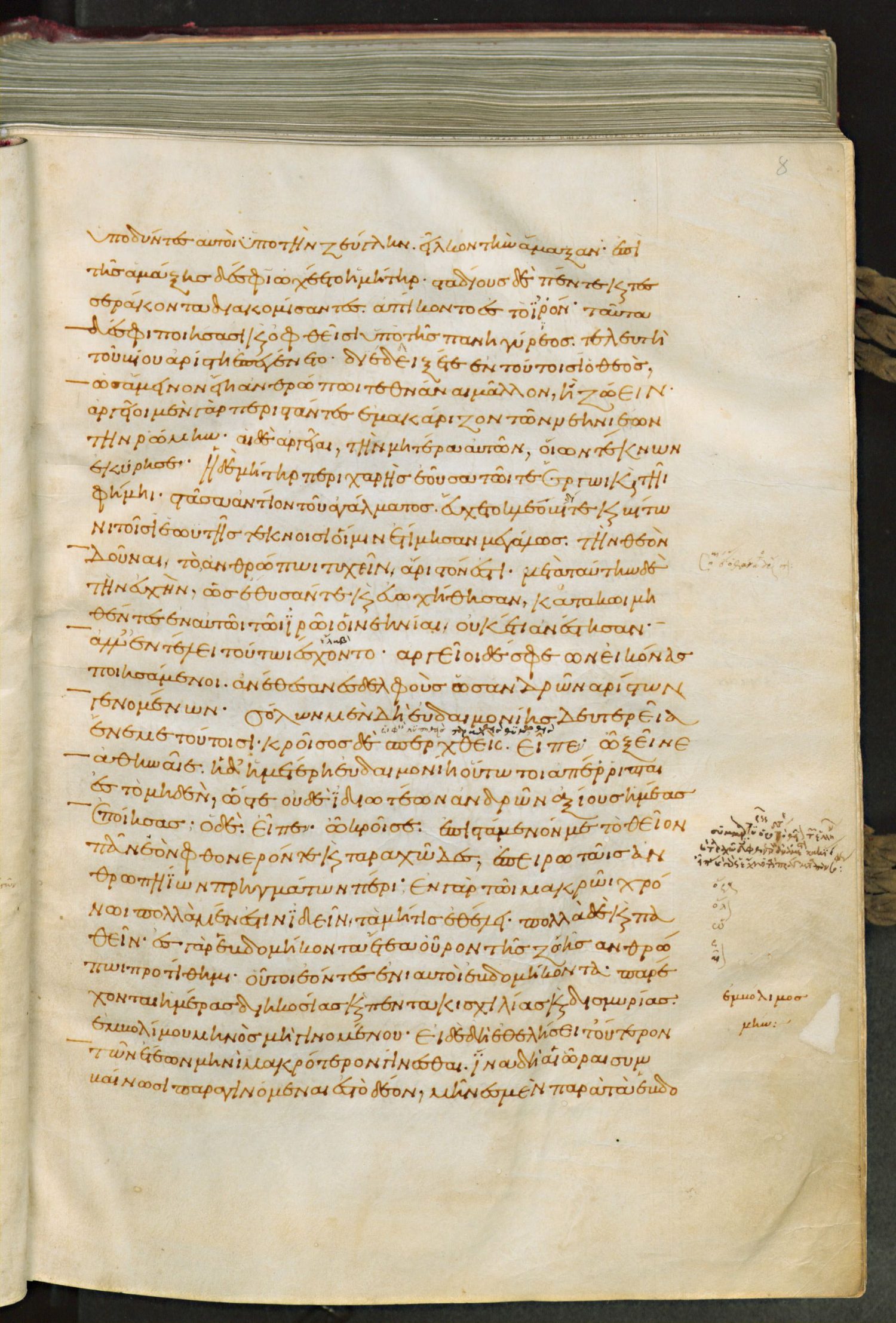
Laur. Plut. 70.3, fol. 8r: Greek here 1.31.2 to 1.32.3. Checked on the image (first and last words read and located in the Greek; each break checked against the neighbouring page): fol. 8r begins ‹ὑποδύντες αὐτοὶ ὑπὸ τὴν› (1.31.2), ends ‹μὲν παρὰ τὰ ἑβδο-› (1.32.3). English here: 1.31.3 to 1.32.4 (Godley's sentences for the sections whose Greek lies mostly on this page).
1.31.2ὑποδύντες αὐτοὶ ὑπὸ τὴν ζεύγλην εἷλκον τὴν ἅμαξαν, ἐπὶ τῆς ἁμάξης δέ σφι ὠχέετο ἡ μήτηρ· σταδίους δὲ πέντε καὶ τεσσεράκοντα διακομίσαντες ἀπίκοντο ἐς τὸ ἱρόν. 1.31.3ταῦτα δέ σφι ποιήσασι καὶ ὀφθεῖσι ὑπὸ τῆς πανηγύριος τελευτὴ τοῦ βίου ἀρίστη ἐπεγένετο, διέδεξέ τε ἐν τούτοισι ὁ θεὸς ὡς ἄμεινον εἴη ἀνθρώπῳ τεθνάναι μᾶλλον ἢ ζώειν. Ἀργεῖοι μὲν γὰρ περιστάντες ἐμακάριζον τῶν νεηνιέων τὴν ῥώμην, αἱ δὲ Ἀργεῖαι τὴν μητέρα αὐτῶν, οἵων τέκνων ἐκύρησε· 1.31.4ἡ δὲ μήτηρ περιχαρής ἐοῦσα τῷ τε ἔργῳ καὶ τῇ φήμῃ, στᾶσα ἀντίον τοῦ ἀγάλματος εὔχετο Κλεόβι τε καὶ Βίτωνι τοῖσι ἑωυτῆς τέκνοισι, οἵ μιν ἐτίμησαν μεγάλως, τὴν θεὸν δοῦναι τὸ ἀνθρώπῳ τυχεῖν ἄριστον ἐστί. 1.31.5μετὰ ταύτην δὲ τὴν εὐχὴν ὡς ἔθυσάν τε καὶ εὐωχήθησαν, κατακοιμηθέντες ἐν αὐτῷ τῷ ἱρῷ οἱ νεηνίαι οὐκέτι ἀνέστησαν ἀλλʼ ἐν τέλεϊ τούτῳ ἔσχοντο. Ἀργεῖοι δὲ σφέων εἰκόνας ποιησάμενοι ἀνέθεσαν ἐς Δελφοὺς ὡς ἀριστῶν γενομένων. 1.32.1Σόλων μὲν δὴ εὐδαιμονίης δευτερεῖα ἔνεμε τούτοισι, Κροῖσος δὲ σπερχθεὶς εἶπε ὦ ξεῖνε Ἀθηναῖε, ἡ δʼ ἡμετέρη εὐδαιμονίη οὕτω τοι ἀπέρριπται ἐς τὸ μηδὲν ὥστε οὐδὲ ἰδιωτέων ἀνδρῶν ἀξίους ἡμέας ἐποίησας; ὁ δὲ εἶπε ὦ Κροῖσε, ἐπιστάμενόν με τὸ θεῖον πᾶν ἐὸν φθονερόν τε καὶ ταραχῶδες ἐπειρωτᾷς ἀνθρωπηίων πρηγμάτων πέρι. 1.32.2ἐν γὰρ τῷ μακρῷ χρόνῳ πολλὰ μὲν ἐστὶ ἰδεῖν τὰ μή τις ἐθέλει, πολλὰ δὲ καὶ παθεῖν. ἐς γὰρ ἑβδομήκοντα ἔτεα οὖρον τῆς ζόης ἀνθρώπῳ προτίθημι. 1.32.3οὗτοι ἐόντες ἐνιαυτοὶ ἑβδομήκοντα παρέχονται ἡμέρας διηκοσίας καὶ πεντακισχιλίας καὶ δισμυρίας, ἐμβολίμου μηνὸς μὴ γινομένου· εἰ δὲ δὴ ἐθελήσει τοὔτερον τῶν ἐτέων μηνὶ μακρότερον γίνεσθαι, ἵνα δὴ αἱ ὧραι συμβαίνωσι παραγινόμεναι ἐς τὸ δέον, μῆνες μὲν παρὰ τὰ ἑβδομήκοντα
1.31.3Having done this, and been seen by the assembly, they made a most excellent end of their lives, and the god showed by these men how that it was better for a man to die than to live. For the men of Argos came round and gave the youths joy of their strength, and so likewise did the women to their mother, for the excellence of her sons. 1.31.4She then in her joy at what was done and said, came before the image of the goddess and prayed that her sons Cleobis and Biton, who had done such great honour to the goddess, should be given the best boon that a man may receive. 1.31.5After the prayer the young men sacrificed and ate of the feast; then they lay down to sleep in the temple itself and never rose up more, but here ended their lives. Then the Argives made and set up at Delphi images of them because of their excellence.” 1.32.1So Solon gave to Cleobis and Biton the second prize of happiness. But Croesus said in anger, “Guest from Athens! is our prosperity, then, held by you so worthless that you match us not even with common men?” “Croesus,” said Solon, “you ask me concerning the lot of man; well I know how jealous is Heaven and how it loves to trouble us. 1.32.2In a man’s length of days he may see and suffer many things that he much mislikes. 1.32.3For I set the limit of man’s life at seventy years; in these seventy are days twenty-five thousand and two hundred, if we count not the intercalary month. But if every second year be lengthened by a month so that the seasons and the calendar may rightly accord, then the intercalary months are five and thirty, over and above the seventy years: and the days of these months are one thousand and fifty; so then all the days 1.32.4together of the seventy years are seen to be twenty-six thousand two hundred and fifty; and one may well say that no one of all these days is like another in that which it brings. Thus then, Croesus, the whole of man is but chance.
Where on the image
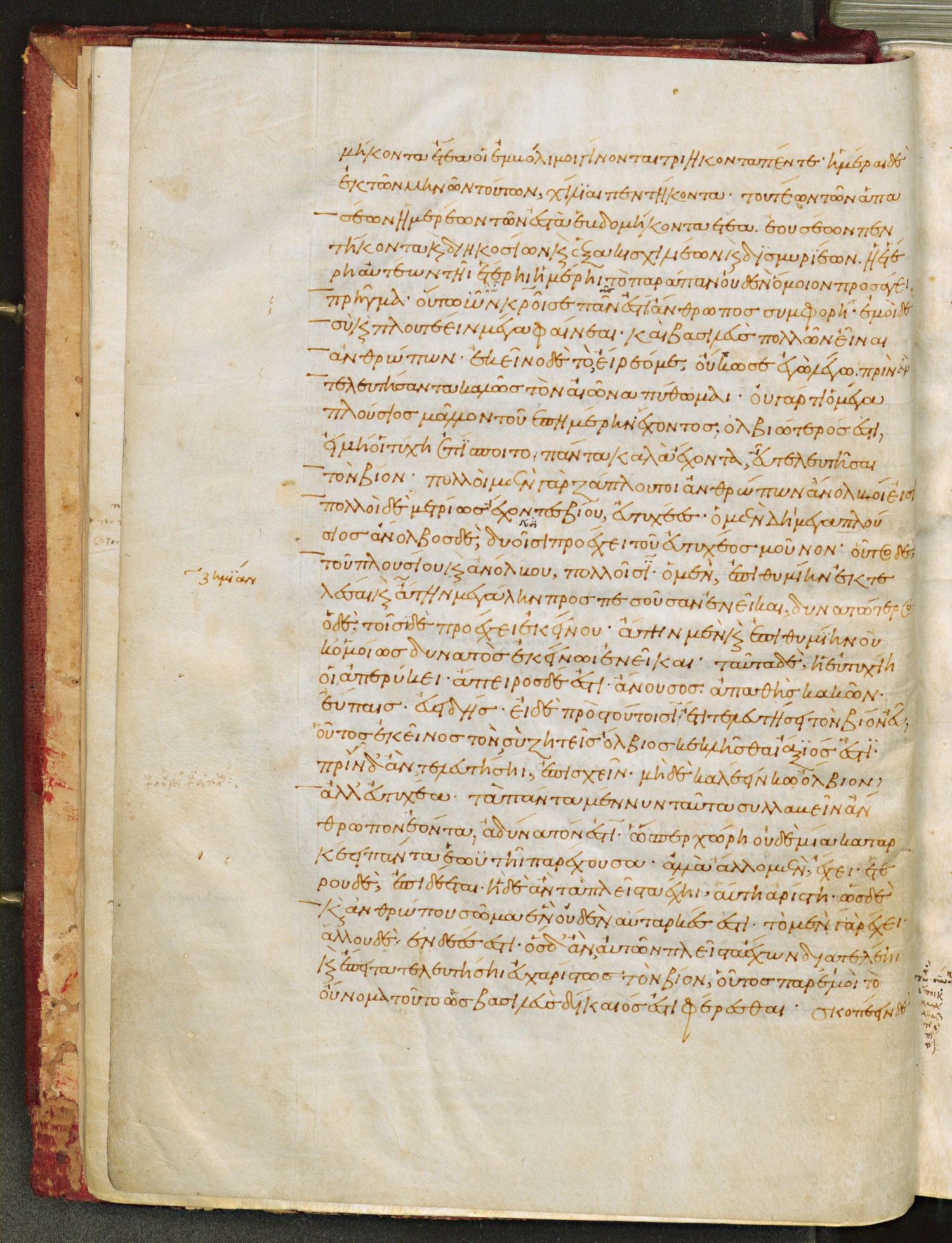
Laur. Plut. 70.3, fol. 8v: Greek here 1.32.3 to 1.32.9. Checked on the image (first and last words read and located in the Greek; each break checked against the neighbouring page): fol. 8v begins ‹-μήκοντα ἔτεα οἱ ἐμβόλιμοι› (1.32.3), ends ‹ἐστὶ φέρεσθαι. σκοπέειν δὲ› (1.32.9). The word ‹ἑβδομήκοντα› is divided between fol. 8r and fol. 8v; it is given with fol. 8r. English here: 1.32.5 to 1.32.9 (Godley's sentences for the sections whose Greek lies mostly on this page).
1.32.3ἔτεα οἱ ἐμβόλιμοι γίνονται τριήκοντα πέντε, ἡμέραι δὲ ἐκ τῶν μηνῶν τούτων χίλιαι πεντήκοντα. 1.32.4τουτέων τῶν ἁπασέων ἡμερέων τῶν ἐς τὰ ἑβδομήκοντα ἔτεα, ἐουσέων πεντήκοντα καὶ διηκοσιέων καὶ ἑξακισχιλιέων καὶ δισμυριέων, ἡ ἑτέρη αὐτέων τῇ ἑτέρῃ ἡμέρῃ τὸ παράπαν οὐδὲν ὅμοιον προσάγει πρῆγμα. οὕτω ὦν Κροῖσε πᾶν ἐστὶ ἄνθρωπος συμφορή. 1.32.5ἐμοὶ δὲ σὺ καὶ πλουτέειν μέγα φαίνεαι καὶ βασιλεὺς πολλῶν εἶναι ἀνθρώπων· ἐκεῖνο δὲ τὸ εἴρεό με, οὔκω σε ἐγὼ λέγω, πρὶν τελευτήσαντα καλῶς τὸν αἰῶνα πύθωμαι. οὐ γάρ τι ὁ μέγα πλούσιος μᾶλλον τοῦ ἐπʼ ἡμέρην ἔχοντος ὀλβιώτερος ἐστί, εἰ μή οἱ τύχη ἐπίσποιτο πάντα καλὰ ἔχοντα εὖ τελευτῆσαὶ τὸν βίον. πολλοὶ μὲν γὰρ ζάπλουτοι ἀνθρώπων ἀνόλβιοι εἰσί, πολλοὶ δὲ μετρίως ἔχοντες βίου εὐτυχέες. 1.32.6ὁ μὲν δὴ μέγα πλούσιος ἀνόλβιος δὲ δυοῖσι προέχει τοῦ εὐτυχέος μοῦνον, οὗτος δὲ τοῦ πλουσίου καὶ ἀνόλβου πολλοῖσι· ὃ μὲν ἐπιθυμίην ἐκτελέσαι καί ἄτην μεγάλην προσπεσοῦσαν ἐνεῖκαι δυνατώτερος, ὁ δὲ τοῖσιδε προέχει ἐκείνου· ἄτην μὲν καὶ ἐπιθυμίην οὐκ ὁμοίως δυνατὸς ἐκείνῳ ἐνεῖκαι, ταῦτα δὲ ἡ εὐτυχίη οἱ ἀπερύκει, ἄπηρος δὲ ἐστί, ἄνουσος, ἀπαθὴς κακῶν, εὔπαις, εὐειδής. 1.32.7εἰ δὲ πρὸς τούτοισι ἔτι τελευτήσῃ τὸν βίον εὖ, οὗτος ἐκεῖνος τὸν σὺ ζητέεις, ὁ ὄλβιος κεκλῆσθαι ἄξιος ἐστί· πρὶν δʼ ἂν τελευτήσῃ, ἐπισχεῖν, μηδὲ καλέειν κω ὄλβιον ἀλλʼ εὐτυχέα. 1.32.8τὰ πάντα μέν νυν ταῦτα συλλαβεῖν ἄνθρωπον ἐόντα ἀδύνατον ἐστί, ὥσπερ χωρῇ οὐδεμία καταρκέει πάντα ἑωυτῇ παρέχουσα, ἀλλὰ ἄλλο μὲν ἔχει ἑτέρου δὲ ἐπιδέεται· ἣ δὲ ἂν τὰ πλεῖστα ἔχῃ, αὕτη ἀρίστη. ὣς δὲ καὶ ἀνθρώπου σῶμα ἓν οὐδὲν αὔταρκες ἐστί· τὸ μὲν γὰρ ἔχει, ἄλλου δὲ ἐνδεές ἐστι· 1.32.9ὃς δʼ ἂν αὐτῶν πλεῖστα ἔχων διατελέῃ καὶ ἔπειτα τελευτήσῃ εὐχαρίστως τὸν βίον, οὗτος παρʼ ἐμοὶ τὸ οὔνομα τοῦτο ὦ βασιλεῦ δίκαιος ἐστὶ φέρεσθαι. σκοπέειν δὲ
1.32.5Now if I am to speak of you, I say that I see you very rich and the king of many men. But I cannot yet answer your question, before I hear that you have ended your life well. For he who is very rich is not more blest than he who has but enough for the day, unless fortune so attend him that he ends his life well, having all good things about him. Many men of great wealth are unblest, and many that have no great substance are fortunate. 1.32.6Now the very rich man who is yet unblest has but two advantages over the fortunate man, but the fortunate man has many advantages over the rich but unblest: for this latter is the stronger to accomplish his desire and to bear the stroke of great calamity; but these are the advantages of the fortunate man, that though he be not so strong as the other to deal with calamity and desire, yet these are kept far from him by his good fortune, and he is free from deformity, sickness, and all evil, and happy in his children and his comeliness. 1.32.7If then such a man besides all this shall also end his life well, then he is the man whom you seek, and is worthy to be called blest; but we must wait till he be dead, and call him not yet blest, but fortunate. 1.32.8Now no one (who is but man) can have all these good things together, just as no land is altogether self-sufficing in what it produces: one thing it has, another it lacks, and the best land is that which has most; so too no single person is sufficient for himself: one thing he has, another he lacks; but 1.32.9whoever continues in the possession of most things, and at last makes a gracious end of his life, such a man, O King, I deem worthy of this title. We must look to the conclusion of every matter, and see how it shall end, for there are many to whom heaven has given a vision of blessedness, and yet afterwards brought them to utter ruin.”
Where on the image
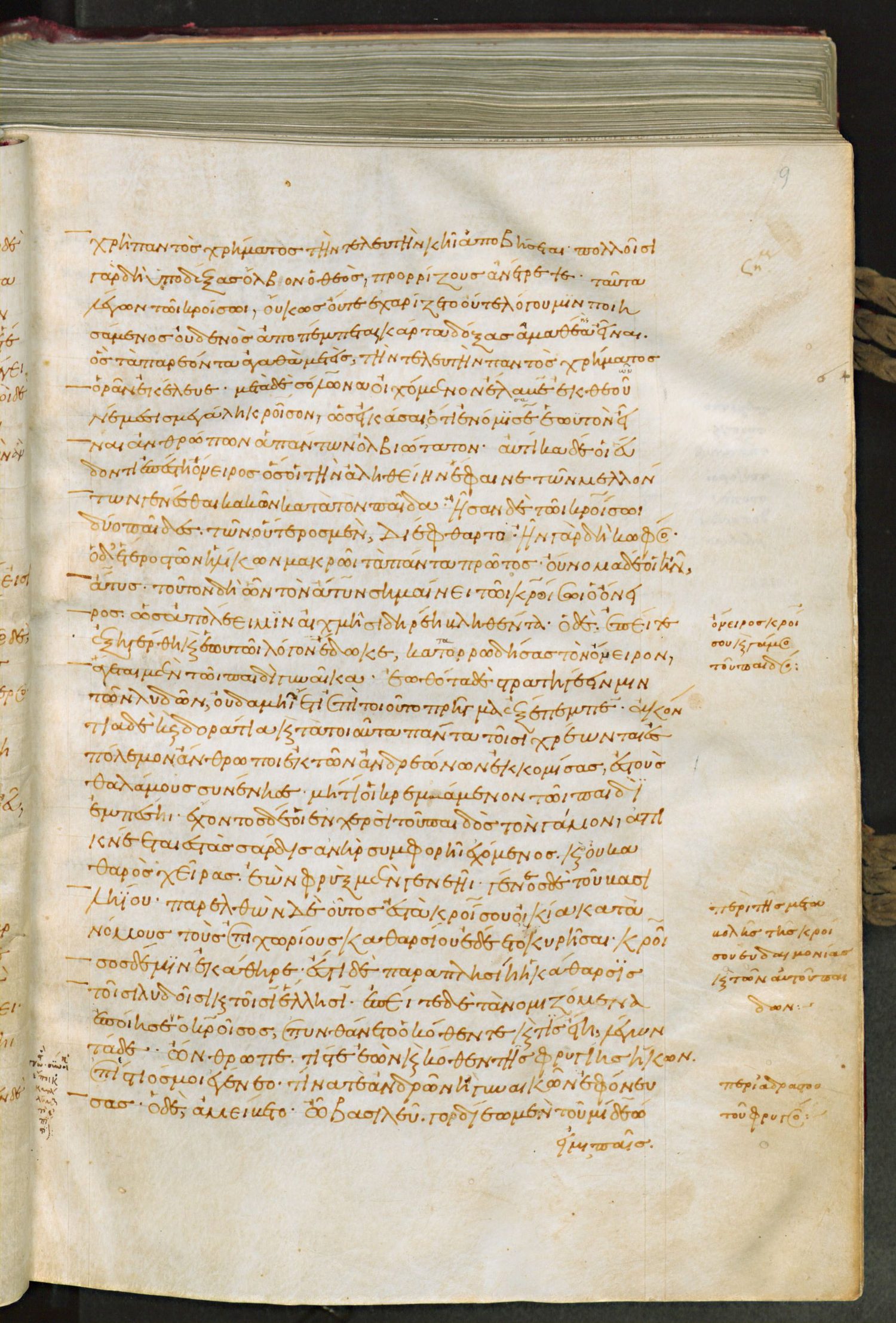
Laur. Plut. 70.3, fol. 9r: Greek here 1.32.9 to 1.35.3. Checked on the image (first and last words read and located in the Greek; each break checked against the neighbouring page): fol. 9r begins ‹χρὴ παντὸς χρήματος τὴν› (1.32.9), ends ‹Γορδίεω μὲν τοῦ Μίδεω› (1.35.3). Fol. 9r ends Γορδίεω μὲν τοῦ Μίδεω and fol. 9v begins ὀνομάζομαι: the edition's εἰμὶ παῖς (1.35.3) is not at the page break. English here: 1.33.1 to 1.35.3 (Godley's sentences for the sections whose Greek lies mostly on this page).
1.32.9χρὴ παντὸς χρήματος τὴν τελευτήν, κῇ ἀποβήσεται· πολλοῖσι γὰρ δὴ ὑποδέξας ὄλβον ὁ θεὸς προρρίζους ἀνέτρεψε. 1.33.1ταῦτα λέγων τῷ Κροίσῳ οὔ κως οὔτε ἐχαρίζετο, οὔτε λόγου μιν ποιησάμενος οὐδενὸς ἀποπέμπεται, κάρτα δόξας ἀμαθέα εἶναι, ὃς τὰ παρεόντα ἀγαθὰ μετεὶς τὴν τελευτὴν παντὸς χρήματος ὁρᾶν ἐκέλευε. 1.34.1μετὰ δὲ Σόλωνα οἰχόμενον ἔλαβέ ἐκ θεοῦ νέμεσις μεγάλη Κροῖσον, ὡς εἰκάσαι, ὅτι ἐνόμισε ἑωυτὸν εἶναι ἀνθρώπων ἁπάντων ὀλβιώτατον. αὐτίκα δέ οἱ εὕδοντι ἐπέστη ὄνειρος, ὅς οἱ τὴν ἀληθείην ἔφαινε τῶν μελλόντων γενέσθαι κακῶν κατὰ τὸν παῖδα. 1.34.2ἦσαν δὲ τῷ Κροίσῳ δύο παῖδες, τῶν οὕτερος μὲν διέφθαρτο, ἦν γὰρ δὴ κωφός, ὁ δὲ ἕτερος τῶν ἡλίκων μακρῷ τὰ πάντα πρῶτος· οὔνομα δέ οἱ ἦν Ἄτυς. τοῦτον δὴ ὦν τὸν Ἄτυν σημαίνει τῷ Κροίσῳ ὁ ὄνειρος, ὡς ἀπολέει μιν αἰχμῇ σιδηρέῃ βληθέντα. 1.34.3ὃ δʼ ἐπείτε ἐξηγέρθη καὶ ἑωυτῷ λόγον ἔδωκε, καταρρωδήσας τὸν ὄνειρον ἄγεται μὲν τῷ παιδὶ γυναῖκα, ἐωθότα δὲ στρατηγέειν μιν τῶν Λυδῶν οὐδαμῇ ἔτι ἐπὶ τοιοῦτο πρῆγμα ἐξέπεμπε· ἀκόντια δὲ καὶ δοράτια καὶ τά τοιαῦτα πάντα τοῖσι χρέωνται ἐς πόλεμον ἄνθρωποι, ἐκ τῶν ἀνδρεώνων ἐκκομίσας ἐς τοὺς θαλάμους συνένησε, μή τί οἱ κρεμάμενον τῷ παιδὶ ἐμπέσῃ. 1.35.1ἔχοντι δέ οἱ ἐν χερσὶ τοῦ παιδὸς τὸν γάμον, ἀπικνέεται ἐς τὰς Σάρδις ἀνὴρ συμφορῇ ἐχόμενος καὶ οὐ καθαρὸς χεῖρας, ἐὼν Φρὺξ μὲν γενεῇ, γένεος δὲ τοῦ βασιληίου. παρελθὼν δὲ οὗτος ἐς τὰ Κροίσου οἰκία κατὰ νόμους τοὺς ἐπιχωρίους καθαρσίου ἐδέετο κυρῆσαι, Κροῖσος δέ μιν ἐκάθηρε. 1.35.2ἔστι δὲ παραπλησίη ἡ κάθαρσις τοῖσι Λυδοῖσι καὶ τοῖσι Ἕλλησι. ἐπείτε δὲ τὰ νομιζόμενα ἐποίησε ὁ Κροῖσος, ἐπυνθάνετο ὁκόθεν τε καὶ τίς εἴη, λέγων τάδε· 1.35.3ὤνθρωπε, τίς τε ἐὼν καὶ κόθεν τῆς Φρυγίης ἥκων ἐπίστιός μοι ἐγένεο; τίνα τε ἀνδρῶν ἢ γυναικῶν ἐφόνευσας; ὁ δὲ ἀμείβετο ὦ βασιλεῦ, Γορδίεω μὲν τοῦ Μίδεω εἰμὶ παῖς,
1.33.1So spoke Solon: Croesus therefore gave him no largess, but sent him away as a man of no account, for he thought that man to be very foolish who disregarded present prosperity and bade him look rather to the end of every matter. 1.34.1But after Solon’s departure, the divine anger fell heavily on Croesus: as I guess, because he supposed himself to be blest beyond all other men. Presently, as he slept, he was visited by a dream, which foretold truly to him the evil which should befall his son. 1.34.2He had two sons, one of whom was wholly undone, for he was deaf and dumb, but the other, whose name was Atys, was in every way far pre-eminent over all of his years. The dream then showed to Croesus that Atys should be smitten and killed by a spear of iron. 1.34.3So Croesus, when he woke and considered the dream with himself, was greatly affrighted by it; and first he made a marriage for his son, and moreover, whereas Atys was wont to lead the Lydian armies, Croesus now would not suffer him to go out on any such enterprise, while he took the javelins and spears and all such instruments of war from the men’s apartments and piled them up in his storehouse, lest any of them should fall upon his son from where it hung. 1.35.1Now while Croesus was busied about the marriage of his son, there came to Sardis a Phrygian of the royal house, in great distress and with hands unclean. This man came to Croesus’ house, and entreated that he might be purified after the custom of the country; so Croesus purified him ( 1.35.2the Lydians use the same manner of purification as do the Greeks), and when he had done all according to usage, he inquired of the Phrygian whence he came and who he was: “ 1.35.3Friend,” said he, “who are you, and from what place in Phrygia do you come to be my suppliant? and what man or woman have you slain?” “O King,” the man answered, “I am the son of Gordias the son of Midas, and my name is Adrastus; by no will of mine, I slew my brother, and hither I am come, banished by my father and bereft of all.
Where on the image
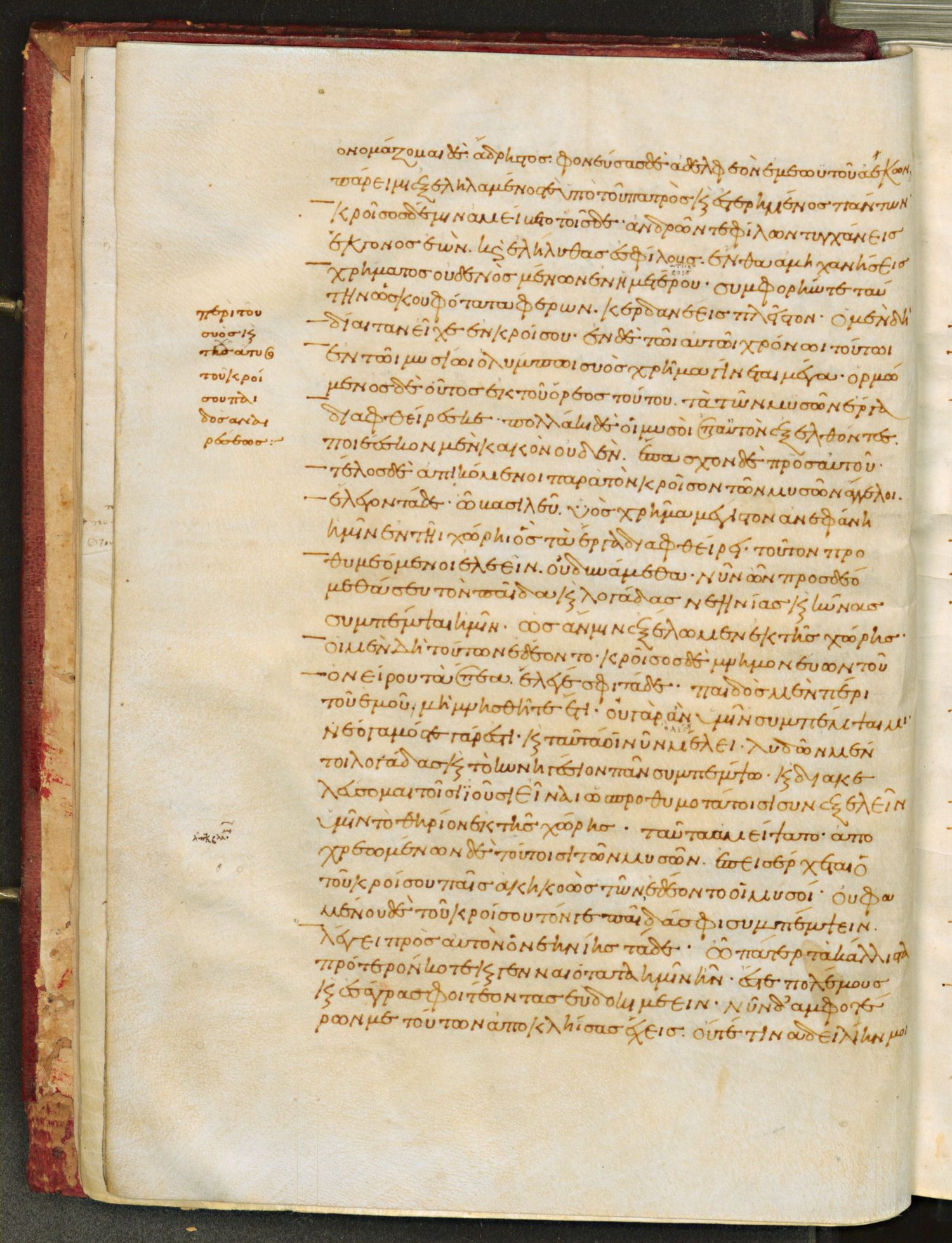
Laur. Plut. 70.3, fol. 9v: Greek here 1.35.3 to 1.37.2. Checked on the image (first and last words read and located in the Greek; each break checked against the neighbouring page): fol. 9v begins ‹ὀνομάζομαι δὲ Ἄδρηστος, φονεύσας› (1.35.3), ends ‹οὔτε τινὰ δειλίην μοι› (1.37.2). Fol. 9r ends Γορδίεω μὲν τοῦ Μίδεω and fol. 9v begins ὀνομάζομαι: the edition's εἰμὶ παῖς (1.35.3) is not at the page break. English here: 1.35.4 to 1.37.2 (Godley's sentences for the sections whose Greek lies mostly on this page).
1.35.3ὀνομάζομαι δὲ Ἄδρηστος, φονεύσας δὲ ἀδελφεὸν ἐμεωυτοῦ ἀέκων πάρειμι ἐξεληλαμένος τε ὑπὸ τοῦ πατρὸς καὶ ἐστερημένος πάντων. 1.35.4Κροῖσος δέ μιν ἀμείβετο τοῖσιδε· ἀνδρῶν τε φίλων τυγχάνεις ἔκγονος ἐὼν καὶ ἐλήλυθας ἐς φίλους, ἔνθα ἀμηχανήσεις χρήματος οὐδενὸς μένων ἐν ἡμετέρου, συμφορήν τε ταύτην ὡς κουφότατα φέρων κερδανέεις πλεῖστον. 1.36.1ὃ μὲν δὴ δίαιταν εἶχε ἐν Κροίσου. ἐν δὲ τῷ αὐτῷ χρόνῳ τούτῳ ἐν τῷ Μυσίῳ Ὀλύμπῳ ὑὸς χρῆμα γίνεται μέγα· ὁρμώμενος δὲ οὗτος ἐκ τοῦ ὄρεος τούτου τὰ τῶν Μυσῶν ἔργα διαφθείρεσκε. πολλάκις δὲ οἱ Μυσοὶ ἐπʼ αὐτὸν ἐξελθόντες ποιέεσκον μὲν κακὸν οὐδέν, ἔπασχον δὲ πρὸς αὐτοῦ. 1.36.2τέλος δὲ ἀπικόμενοι παρὰ τὸν Κροῖσον τῶν Μυσῶν ἄγγελοι ἔλεγον τάδε. ὦ βασιλεῦ, ὑὸς χρῆμα μέγιστον ἀνεφάνη ἡμῖν ἐν τῇ χώρῃ, ὃς τὰ ἔργα διαφθείρει. τοῦτον προθυμεόμενοι ἑλεῖν οὐ δυνάμεθα. νῦν ὦν προσδεόμεθά σευ τὸν παῖδα καὶ λογάδας νεηνίας καὶ κύνας συμπέμψαι ἡμῖν, ὡς ἄν μιν ἐξέλωμεν ἐκ τῆς χώρης. 1.36.3οἳ μὲν δὴ τούτων ἐδέοντο, Κροῖσος δὲ μνημονεύων τοῦ ὀνείρου τὰ ἔπεα ἔλεγέ σφι τάδε. παιδὸς μὲν πέρι τοῦ ἐμοῦ μὴ μνησθῆτε ἔτι· οὐ γὰρ ἂν ὑμῖν συμπέμψαιμι· νεόγαμός τε γὰρ ἐστὶ καὶ ταῦτά οἱ νῦν μέλει. Λυδῶν μέντοι λογάδας καὶ τὸ κυνηγέσιον πᾶν συμπέμψω, καὶ διακελεύσομαι τοῖσι ἰοῦσι εἶναι ὡς προθυμοτάτοισι συνεξελεῖν ὑμῖν τὸ θηρίον ἐκ τῆς χώρης. 1.37.1ταῦτα ἀμείψατο· ἀποχρεωμένων δὲ τούτοισι τῶν Μυσῶν, ἐπεσέρχεται ὁ τοῦ Κροίσου παῖς ἀκηκοὼς τῶν ἐδέοντο οἱ Μυσοί. οὐ φαμένου δὲ τοῦ Κροίσου τόν γε παῖδά σφι συμπέμψειν, λέγει πρὸς αὐτὸν ὁ νεηνίης τάδε. 1.37.2ὦ πάτερ, τὰ κάλλιστα πρότερον κοτὲ καὶ γενναιότατα ἡμῖν ἦν ἔς τε πολέμους καὶ ἐς ἄγρας φοιτέοντας εὐδοκιμέειν· νῦν δὲ ἀμφοτέρων με τούτων ἀποκληίσας ἔχεις, οὔτε τινὰ δειλίην μοι
1.35.4“Croesus answered, “All of your family are my friends, and to friends you have come, among whom you shall lack nothing but abide in my house. And for your misfortune, bear it as lightly as may be and you will be the more profited.” 1.36.1So Adrastus lived in Croesus’ house. About this same time there appeared on the Mysian Olympus a great monster of a boar, who would issue out from that mountain and ravage the fields of the Mysians. Often had the Mysians gone out against him: but they never did him any harm and rather were themselves hurt thereby. 1.36.2At last they sent messengers to Croesus, with this message: “King, a great monster of a boar has appeared in the land, who destroys our fields; for all our attempts, we cannot kill him; now therefore, we beseech you, send with us your son, and chosen young men and dogs, that we may rid the country of him.” 1.36.3Such was their entreaty, but Croesus remembered the prophecy of his dream and thus answered them: “Say no more about my son: I will not send him with you: he is newly married, and that is his present business. But I will send chosen men of the Lydians, and all the hunt, and I will bid those who go to use all zeal in aiding you to rid the country of this beast.” 1.37.1So he replied, and the Mysians were satisfied with this. But the son of Croesus now came in, who had heard the request of the Mysians; and when Croesus refused to send his son with them, “Father,” said the young 1.37.2man, “it was formerly held fairest and noblest that we princes should go constantly to war and the chase and win thereby renown; but now you have barred me from both of these, not for any sign that you have seen in me of a coward or craven spirit. With what face can I thus show myself whenever I go to and from the market-place?
Where on the image
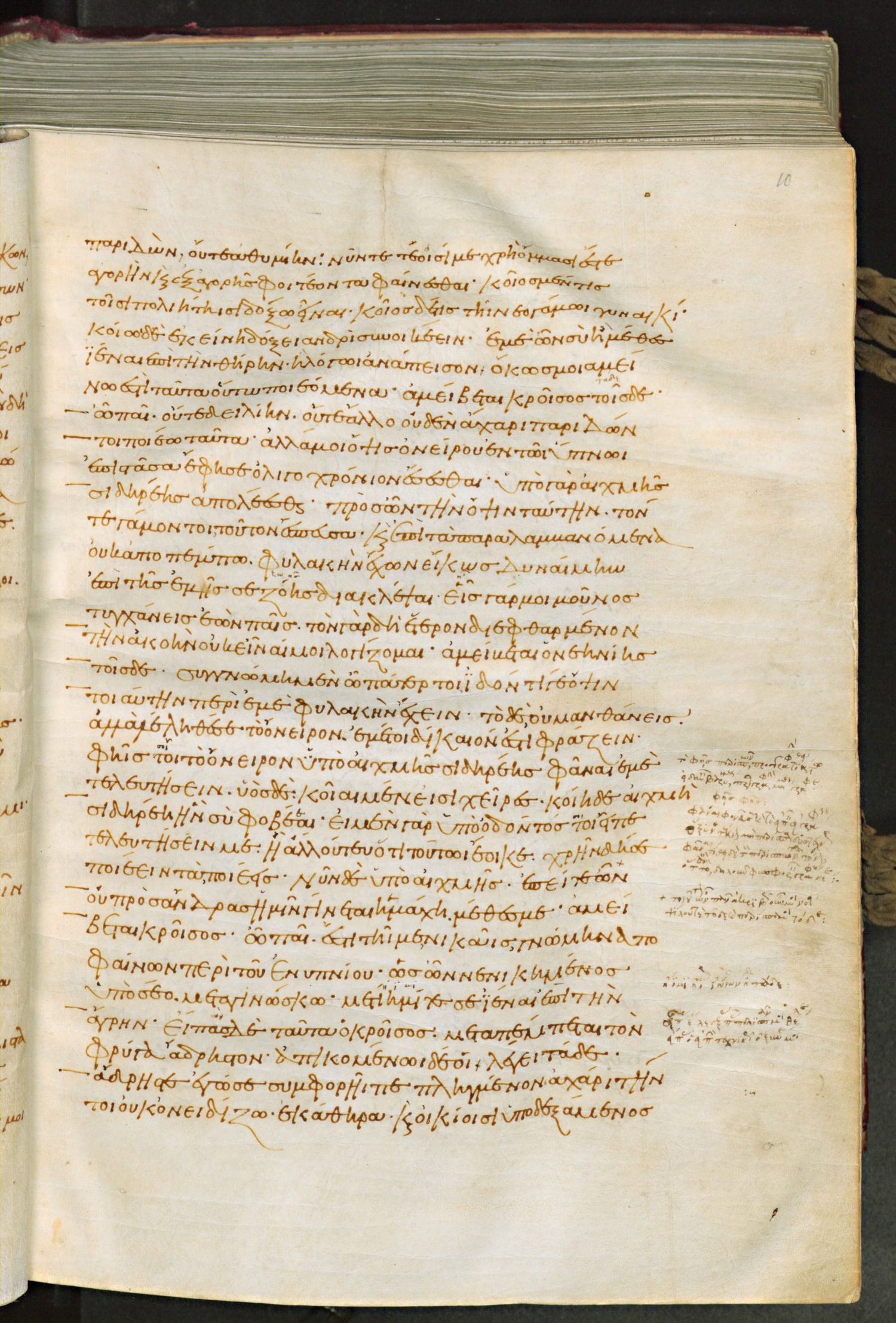
Laur. Plut. 70.3, fol. 10r: Greek here 1.37.2 to 1.41.1. Checked on the image (first and last words read and located in the Greek; each break checked against the neighbouring page): fol. 10r begins ‹παριδὼν οὔτε ἀθυμίην νῦν› (1.37.2), ends ‹ἐκάθηρα καὶ οἰκίοισι ὑποδεξάμενος› (1.41.1). English here: 1.37.3 to 1.41.1 (Godley's sentences for the sections whose Greek lies mostly on this page).
1.37.2παριδὼν οὔτε ἀθυμίην νῦν τε τέοισί με χρὴ ὄμμασι ἔς τε ἀγορὴν καὶ ἐξ ἀγορῆς φοιτέοντα φαίνεσθαι; 1.37.3κοῖος μέν τις τοῖσι πολιήτῃσι δόξω εἶναι, κοῖος δέ τις τῇ νεογάμῳ γυναικί; κοίῳ δὲ ἐκείνη δόξει ἀνδρὶ συνοικέειν; ἐμὲ ὦν σὺ ἢ μέτες ἰέναι ἐπὶ τὴν θήρην, ἢ λόγῳ ἀνάπεισον ὅκως μοι ἀμείνω ἐστὶ ταῦτα οὕτω ποιεόμενα. 1.38.1ἀμείβεται Κροῖσος τοῖσιδε. ὦ παῖ, οὔτε δειλίην οὔτε ἄλλο οὐδὲν ἄχαρι παριδών, τοι ποιέω ταῦτα, ἀλλά μοι ὄψις ὀνείρου ἐν τῷ ὕπνῳ ἐπιστᾶσα ἔφη σε ὀλιγοχρόνιον ἔσεσθαι· ὑπὸ γὰρ αἰχμῆς σιδηρέης ἀπολέεσθαι. 1.38.2πρὸς ὧν τὴν ὄψιν ταύτην τόν τε γάμον τοι τοῦτον ἔσπευσα καὶ ἐπὶ τὰ παραλαμβανόμενα οὐκ ἀποπέμπω, φυλακὴν ἔχων, εἴ κως δυναίμην ἐπὶ τῆς ἐμῆς σε ζόης διακλέψαι. εἷς γὰρ μοι μοῦνος τυγχάνεις ἐὼν παῖς· τὸν γὰρ δὴ ἕτερον διεφθαρμένον τὴν ἀκοὴν οὐκ εἶναί μοι λογίζομαι. 1.39.1ἀμείβεται ὁ νεηνίης τοῖσιδε. συγγνώμη μὲν ὦ πάτερ τοι, ἰδόντι γε ὄψιν τοιαύτην, περὶ ἐμὲ φυλακὴν ἔχειν· τὸ δὲ οὐ μανθάνεις ἀλλὰ λέληθέ σε τὸ ὄνειρον, ἐμέ τοί δίκαιον ἐστί φράζειν. 1.39.2φής τοι τὸ ὄνειρον ὑπὸ αἰχμῆς σιδηρέης φάναι ἐμὲ τελευτήσειν. ὑὸς δὲ κοῖαι μὲν εἰσὶ χεῖρες, κοίη δὲ αἰχμὴ σιδηρέη τὴν σὺ φοβέαι; εἰ μὲν γὰρ ὑπὸ ὀδόντος τοι εἶπε τελευτήσειν με, ἢ ἄλλου τευ ὅ τι τούτῳ ἔοικε, χρῆν δή σε ποιέειν τὰ ποιέεις· νῦν δὲ ὑπὸ αἰχμῆς. ἐπείτε ὦν οὐ πρὸς ἄνδρας ἡμῖν γίνεται ἡ μάχη, μέτες με. 1.40.1ἀμείβεται Κροῖσος ὦ παῖ, ἔστι τῇ με νικᾷς γνώμην ἀποφαίνων περὶ τοῦ ἐνυπνίου. ὡς ὦν νενικημένος ὑπὸ σέο μεταγινώσκω, μετίημί τε σὲ ἰέναι ἐπὶ τὴν ἄγρην. 1.41.1εἴπας δὲ ταῦτα ὁ Κροῖσος μεταπέμπεται τὸν Φρύγα Ἄδρηστον, ἀπικομένῳ δέ οἱ λέγει τάδε. Ἄδρηστε, ἐγώ σε συμφορῇ, πεπληγμένον ἀχάρι, τήν τοι οὐκ ὀνειδίζω, ἐκάθηρα καὶ οἰκίοισι ὑποδεξάμενος
1.37.3What will the men of the city think of me, and what my new-wedded wife? With what manner of man will she think that she dwells? Nay, do you either let me go to this hunt, or show me by reason good that what you are doing is best for me.” 1.38.1“My son,” answered Croesus, “if I do this, it is not that I have seen cowardice or aught unseemly in you; no, but the vision of a dream stood over me in my sleep, and told me that your life should be short, for you should be slain by a spear of iron. 1.38.2It is for that vision that I was careful to make your marriage, and send you on no enterprise that I have in hand, but keep guard over you, so that haply I may trick death of you through my lifetime. You are my only son: for that other, since his hearing is lost to him, I count no son of mine.” 1.39.1“Father,” the youth replied, “none can blame you for keeping guard over me, when you have seen such a vision; but it is my right to show you this which you do not perceive, and wherein you mistake the meaning of the dream. 1.39.2You say that the dream told you that I should be killed by a spear of iron; but has a boar hands? Has it that iron spear which you dread? Had the dream said I should be slain by a tusk or some other thing belonging to a boar, you had been right in acting as you act; but no, it was to be a spear. Therefore, since it is not against men that we are to fight, suffer me to go.” 1.40.1Croesus answered, “My son, your judgment concerning the dream does somewhat overpersuade me; and being so convinced by you I change my purpose and permit you to go to the chase.” 1.41.1Having said this, Croesus sent for Adrastus the Phrygian and when he came thus addressed him: “Adrastus, when you were smitten by grievous misfortune, for which I blame you not, it was I who cleansed you, and received and still keep you in my house, defraying all your charges.
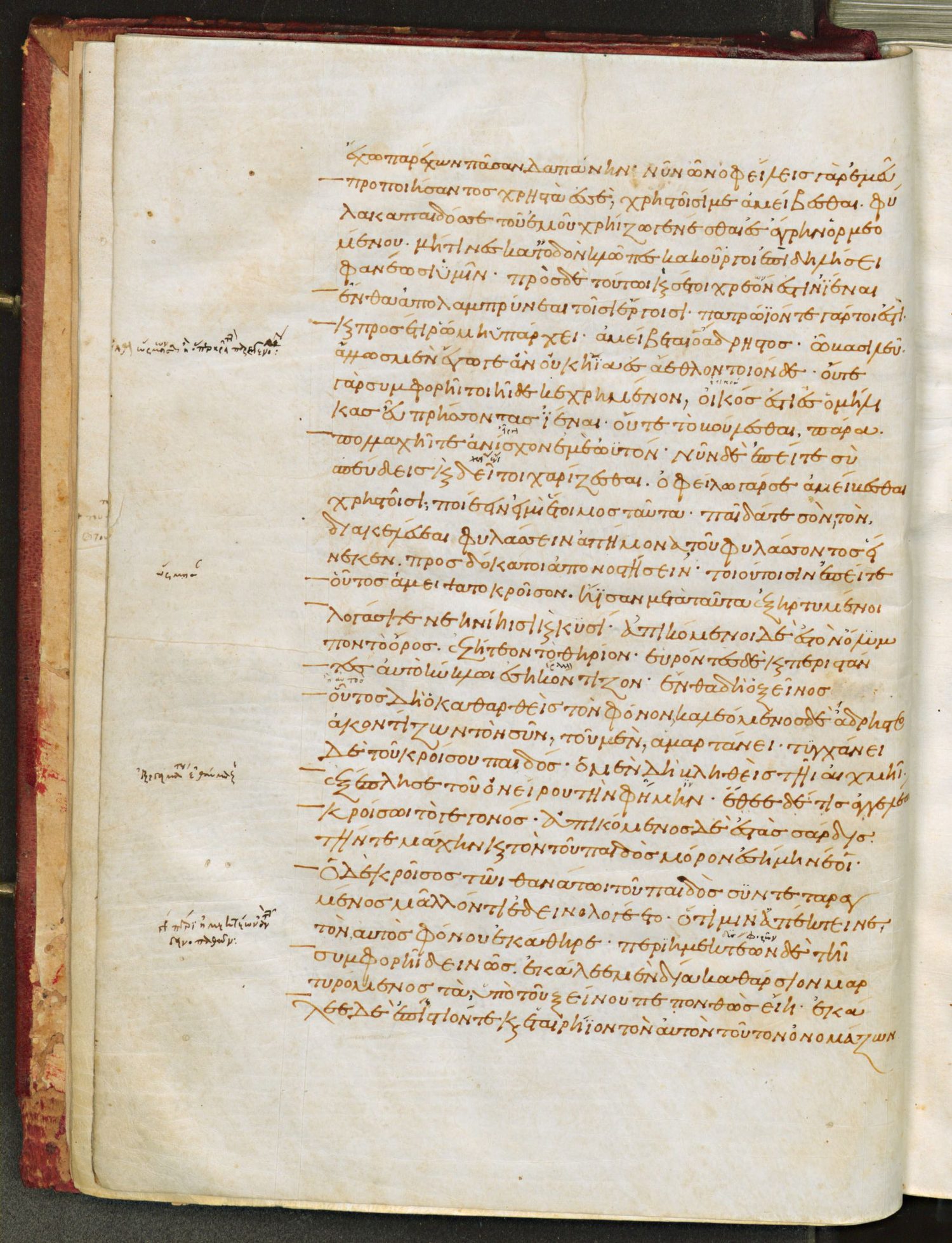
Where on the image
Laur. Plut. 70.3, fol. 10v: Greek here 1.41.1 to 1.44.2. Checked on the image (first and last words read and located in the Greek; each break checked against the neighbouring page): fol. 10v begins ‹ἔχω, παρέχων πᾶσαν δαπάνην.νῦν› (1.41.1), ends ‹τὸν αὐτὸν τοῦτον ὀνομάζων› (1.44.2). English here: 1.41.2 to 1.44.2 (Godley's sentences for the sections whose Greek lies mostly on this page).
1.41.1ἔχω, παρέχων πᾶσαν δαπάνην. 1.41.2νῦν ὦν (ὀφείλεις γὰρ ἐμοῦ προποιήσαντος χρηστὰ ἐς σὲ χρηστοῖσί με ἀμείβεσθαι) φύλακα παιδός σε τοῦ ἐμοῦ χρηίζω γενέσθαι ἐς ἄγρην ὁρμωμένου, μή τινες κατʼ ὁδὸν κλῶπες κακοῦργοι ἐπὶ δηλήσι φανέωσι ὑμῖν. 1.41.3πρὸς δὲ τούτῳ καὶ σέ τοι χρεόν ἐστι ἰέναι ἔνθα ἀπολαμπρυνέαι τοῖσι ἔργοισι· πατρώιόν τε γάρ τοι ἐστὶ καὶ προσέτι ῥώμη ὑπάρχει. 1.42.1ἀμείβεται ὁ Ἄδρηστος ὦ βασιλεῦ, ἄλλως μὲν ἔγωγε ἂν οὐκ ἤια ἐς ἄεθλον τοιόνδε· οὔτε γὰρ συμφορῇ τοιῇδε κεχρημένον οἰκός ἐστι ἐς ὁμήλικας εὖ πρήσσοντας ἰέναι, οὔτε τὸ βούλεσθαι πάρα, πολλαχῇ τε ἂν ἶσχον ἐμεωυτόν. 1.42.2νῦν δέ, ἐπείτε σὺ σπεύδεις καὶ δεῖ τοί χαρίζεσθαι, ὀφείλω γάρ σε ἀμείβεσθαι χρηστοῖσἰ, ποιέειν εἰμὶ ἕτοιμος ταῦτα, παῖδα τε σόν, τὸν διακελεύεαι φυλάσσειν, ἀπήμονα τοῦ φυλάσσοντος εἵνεκεν προσδόκα τοι ἀπονοστήσειν. 1.43.1τοιούτοισι ἐπείτε οὗτος ἀμείψατο Κροῖσον, ἤισαν μετὰ ταῦτα ἐξηρτυμένοι λογάσι τε νεηνίῃσι καὶ κυσί. ἀπικόμενοι δὲ ἐς τὸν Ὄλυμπον τὸ ὄρος ἐζήτεον τὸ θηρίον, εὑρόντες δὲ καὶ περιστάντες αὐτὸ κύκλῳ ἐσηκόντιζον. 1.43.2ἔνθα δὴ ὁ ξεῖνος, οὗτος δὴ ὁ καθαρθεὶς τὸν φόνον, καλεόμενος δὲ Ἄδρηστος, ἀκοντίζων τὸν ὗν τοῦ μὲν ἁμαρτάνει, τυγχάνει δὲ τοῦ Κροίσου παιδός. 1.43.3ὃ μὲν δὴ βληθεὶς τῇ αἰχμῇ ἐξέπλησε τοῦ ὀνείρου τὴν φήμην, ἔθεε δέ τις ἀγγελέων τῷ Κροίσῳ τὸ γεγονός, ἀπικόμενος δὲ ἐς τὰς Σάρδις τὴν τε μάχην καὶ τὸν τοῦ παιδὸς μόρον ἐσήμηνέ οἱ. 1.44.1ὁ δὲ Κροῖσος τῳ θανάτῳ τοῦ παιδὸς συντεταραγμένος μᾶλλον τι ἐδεινολογέετο ὅτι μιν ἀπέκτεινε τὸν αὐτὸς φόνου ἐκάθηρε· 1.44.2περιημεκτέων δὲ τῇ συμφορῇ δεινῶς ἐκάλεε μὲν Δία καθάρσιον μαρτυρόμενος τὰ ὑπὸ τοῦ ξείνου πεπονθὼς εἴη ἐκάλεε δὲ ἐπίστιόν τε καὶ ἑταιρήιον, τὸν αὐτὸν τοῦτον ὀνομάζων
1.41.2Now therefore (as you owe me a return of good service for the benefits which I have done you) I ask you to watch over my son as he goes out to the chase. See to it that no ruffian robbers meet you on the way, to do you harm. 1.41.3Moreover it is but right that you too should go where you can win renown by your deeds. That is fitting for your father’s son; and you are strong enough withal.” 1.42.1“O King,” Adrastus answered, “had it been otherwise, I would not have gone forth on this enterprise. One so unfortunate as I should not consort with the prosperous among his peers; nor have I the wish so to do, and for many reasons I would have held back. 1.42.2But now, since you so desire and I must do your pleasure (owing you as I do a requital of good service), I am ready to obey you in this; and for your son, in so far as I can protect him, look for his coming back unharmed.” 1.43.1So when Adrastus had thus answered Croesus they went out presently equipped with a company of chosen young men and dogs. When they had come to Mount Olympus they hunted for the beast, and having found him they made a ring and threw their spears at him: 1.43.2then the guest called Adrastus, the man who had been cleansed of the deed of blood, missed the boar with his spear and hit the son of Croesus. 1.43.3So Atys was smitten by the spear and fulfilled the utterance of the dream. One ran to bring Croesus word of what had been done, and came to Sardis, where he told the king of the fight and the manner of his son’s end. 1.44.1Croesus, distraught by the death of his son, cried out the more vehemently because the slayer was one whom he himself had cleansed of a bloody deed, 1.44.2and in his great and terrible grief at this mischance he called on Zeus by three names—Zeus the Purifier, Zeus of the Hearth, Zeus of Comrades: the first, because he would have the god know what evil his guest had wrought him; the second, because he had received the guest into his house and thus unwittingly entertained the slayer of his son; and the third, because he had found his worst foe in the man whom he sent as a protector.
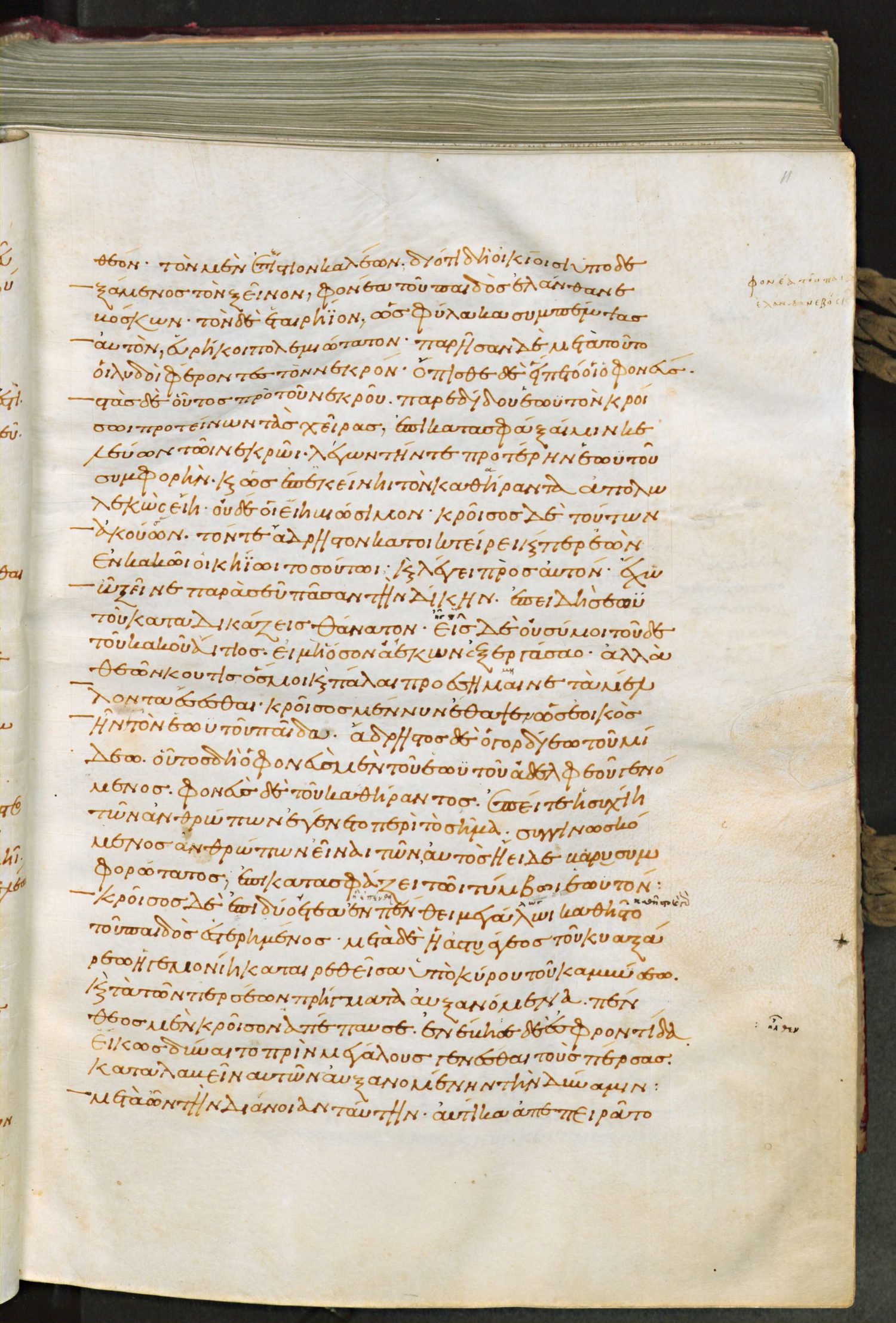
Where on the image
Laur. Plut. 70.3, fol. 11r: Greek here 1.44.2 to 1.45.3. Checked on the image (first and last words read and located in the Greek; each break checked against the neighbouring page): fol. 11r begins ‹θεόν, τὸν μὲν ἐπίστιον› (1.44.2), ends ‹διάνοιαν ταύτην αὐτίκα ἀπεπειρᾶτο› (1.46.2). English here: 1.45.1 to 1.45.3 (Godley's sentences for the sections whose Greek lies mostly on this page).
1.44.2θεόν, τὸν μὲν ἐπίστιον καλέων, διότι δὴ οἰκίοισι ὑποδεξάμενος τὸν ξεῖνον φονέα τοῦ παιδὸς ἐλάνθανε βόσκων, τὸν δὲ ἑταιρήιον, ὡς φύλακα συμπέμψας αὐτὸν εὑρήκοι πολεμιώτατον. 1.45.1παρῆσαν δὲ μετὰ τοῦτο οἱ Λυδοὶ φέροντες τὸν νεκρόν, ὄπισθε δὲ εἵπετό οἱ ὁ φονεύς. στὰς δὲ οὗτος πρὸ τοῦ νεκροῦ παρεδίδου ἑωυτὸν Κροίσῳ προτείνων τὰς χεῖρας, ἐπικατασφάξαι μιν κελεύων τῷ νεκρῷ, λέγων τήν τε προτέρην ἑωυτοῦ συμφορήν, καὶ ὡς ἐπʼ ἐκείνῃ τὸν καθήραντα ἀπολωλεκὼς εἴη, οὐδέ οἱ εἴη βιώσιμον. 1.45.2Κροῖσος δὲ τούτων ἀκούσας τόν τε Ἄδρηστον κατοικτείρει, καίπερ ἐὼν ἐν κακῷ οἰκηίῳ τοσούτῳ καὶ λέγει πρὸς αὐτόν ἔχω ὦ ξεῖνε παρὰ σεῦ πᾶσαν τὴν δίκην, ἐπειδὴ σεωυτοῦ καταδικάζεις θάνατον. εἶς δὲ οὐ σύ μοι τοῦδε τοῦ κακοῦ αἴτιος, εἰ μὴ ὅσον ἀέκων ἐξεργάσαο, ἀλλὰ θεῶν κού τις, ὅς μοι καὶ πάλαι προεσήμαινε τὰ μέλλοντα ἔσεσθαι. 1.45.3Κροῖσος μέν νυν ἔθαψε ὡς οἰκὸς ἦν τὸν ἑωυτοῦ παῖδα· Ἄδρηστος δὲ ὁ Γορδίεω τοῦ Μίδεω, οὗτος δὴ ὁ φονεὺς μὲν τοῦ ἑωυτοῦ ἀδελφεοῦ γενόμενος φονεὺς δὲ τοῦ καθήραντος, ἐπείτε ἡσυχίη τῶν ἀνθρώπων ἐγένετο περὶ τὸ σῆμα, συγγινωσκόμενος ἀνθρώπων εἶναι τῶν αὐτὸς ᾔδεε βαρυσυμφορώτατος, ἐπικατασφάζει τῷ τύμβῳ ἑωυτόν.
1.45.1Soon came the Lydians, bearing the dead corpse, with the slayer following after. He then came and stood before the body and gave himself wholly into Croesus’ power, holding out his hands and praying the king to slay him where he stood by the dead man: “Remember,” he said, “my former mischance, and see how besides that I have undone him who purified me; indeed, it is not fit that I should live.” 1.45.2On hearing this Croesus, though his own sorrow was so great, took pity on Adrastus and said to him, “Friend, I have from you all that justice asks, since you deem yourself worthy of death. But it is not you that I hold the cause of this evil, save in so far as you were the unwilling doer of it: rather it is the work of a god, the same who told me long ago what was to be.” 1.45.3So Croesus buried his own son in such manner as was fitting. But Adrastus, son of Gordias who was son of Midas, this Adrastus, the slayer of his own brother and of the man who purified him, when the tomb was undisturbed by the presence of men, slew himself there by the sepulchre, seeing now clearly that he was the most ill-fated wretch of all men whom he knew.
Notes
- Greek: the text printed in A. D. Godley's Loeb edition, via Perseus (tlg0016.tlg001.perseus-grc2). Square brackets mark words the editor considers later additions; [...] marks a gap the editor indicates. Perseus note markers are omitted.
- English: A. D. Godley, Herodotus vol. 1 (1920) (Loeb Classical Library), as transcribed on Wikisource. Godley's footnotes are omitted.
- Section numbers in the English were placed by comparing Godley's text with the Perseus version of his translation; where a section begins inside one of Godley's sentences, the English is kept with the page that holds the start of that sentence.
Cite
Sources
- Source: Florence, Laur. Plut. 70.3 (10th c.) via BML Teca Digitale + Greek of Godley's Loeb (Perseus) + English of A. D. Godley (Loeb, Wikisource) (holding institution)
- Critical edition: Greek of A. D. Godley's Loeb edition (1920-1925), via Perseus
← previous · → next · v cycle view · l back to library