Herodotus, Histories 1.162-177: Harpagus conquers Ionia, Caria and Lycia
Introduction
Herodotus of Halicarnassus wrote the Histories in the third quarter of the 5th century BCE, an inquiry into the deeds of Greeks and barbarians and the causes of the wars between them, later divided into nine books. Book 1 tells how the conflict between Greeks and barbarians began, the history of Lydia from Gyges to Croesus, the rise of the Medes and of Cyrus the Persian, the conquest of the Greeks of Asia, the capture of Babylon and the death of Cyrus.
The photographs are of Florence, Biblioteca Medicea Laurenziana, Plut. 70.3 (parchment, 10th century, 374 folios, 31 lines a page), Herodotus, Histories (codex A of the editors), the oldest surviving manuscript of the complete Histories, from the Teca Digitale of the Biblioteca Medicea Laurenziana. Each section below is the text of one page, or of the part of a page that falls within these chapters. The first and last words of every page were read on the photograph and located in the Greek, and every page break was checked against the next page; the notes quote these words. Readers' notes in the margins are not part of the text and are mentioned where they occur.
The Greek is the text printed in A. D. Godley's Loeb edition (1920-1925), from Perseus; it is the edited text, not a transcription of the manuscript, whose wording differs in places. The English is Godley's translation as printed, from Wikisource. Godley's English carries only chapter numbers; the section numbers shown in it were placed by comparison with the Perseus version of his translation. Each page's English is cut at the end of one of Godley's sentences, so it can begin or end a few lines away from the Greek of the page; each note gives the exact ranges.
This entry covers chapters 1.162-177, on fol. 41v to 45v.
How was this verified? (Provenance)
Where on the image
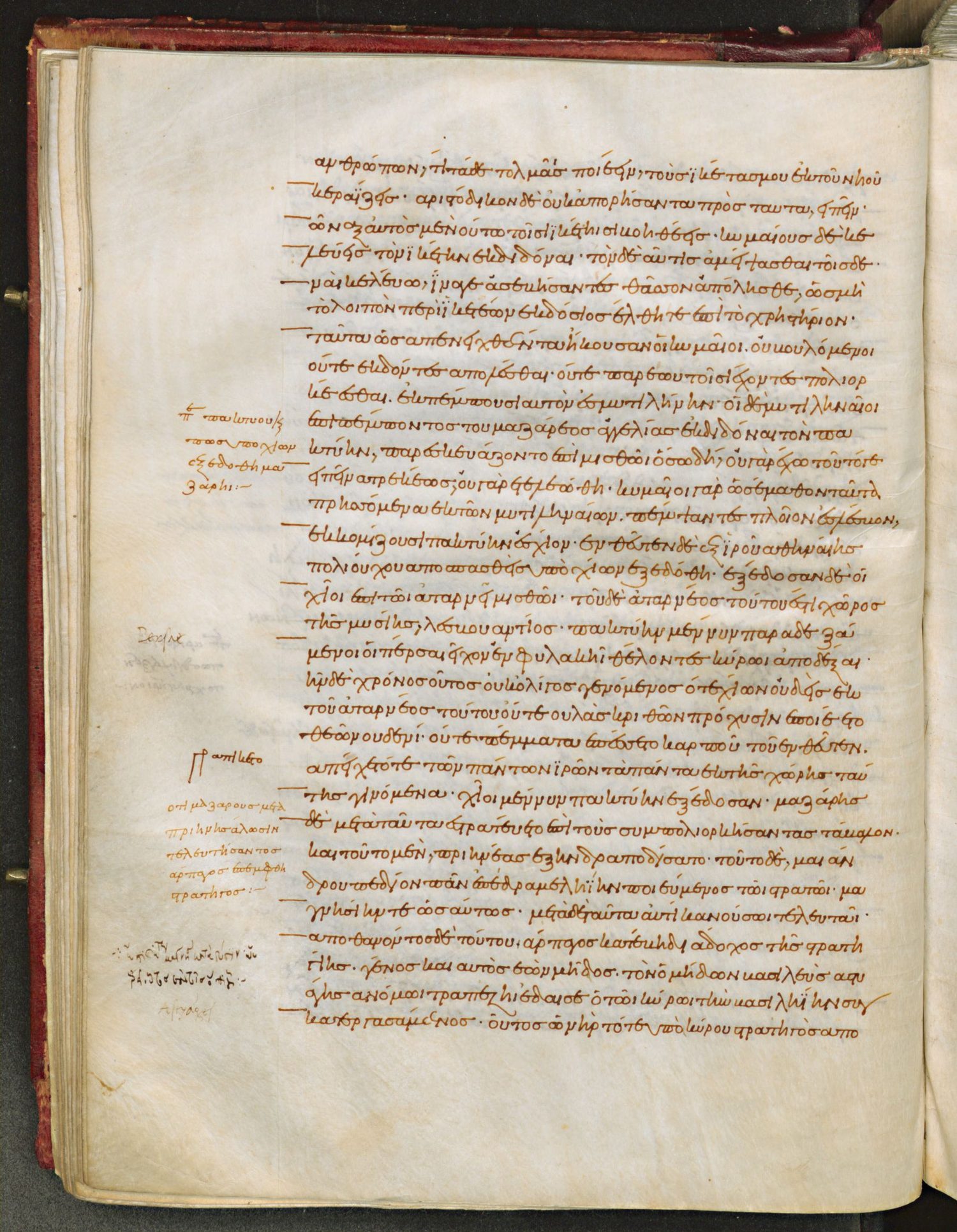
Laur. Plut. 70.3, fol. 41v: Greek here 1.162.1 to 1.162.2. Checked on the image (first and last words read and located in the Greek; each break checked against the neighbouring page): fol. 41v begins ‹ἀνθρώπων, τί τάδε τολμᾷς› (1.159.3), ends ‹ὑπὸ Κύρου στρατηγὸς ἀπο-› (1.162.2). English here: 1.162.1 (Godley's sentences for the sections whose Greek lies mostly on this page).
1.162.1ἀποθανόντος δὲ τούτου, Ἅρπαγος κατέβη διάδοχος τῆς στρατηγίης, γένος καὶ αὐτὸς ἐὼν Μῆδος, τὸν ὁ Μήδων βασιλεὺς Ἀστυάγης ἀνόμῳ τραπέζῃ ἔδαισε, ὁ τῷ Κύρῳ τὴν βασιληίην συγκατεργασάμενος. 1.162.2οὗτος ὡνὴρ τότε ὑπὸ Κύρου στρατηγὸς ἀποδεχθεὶς
1.162.1After his death Harpagus came down to succeed him in his command, a Median like Mazares; this is that Harpagus who was entertained by Astyages the Median king at that unnatural feast, and who helped to win the kingship for Cyrus.
Where on the image
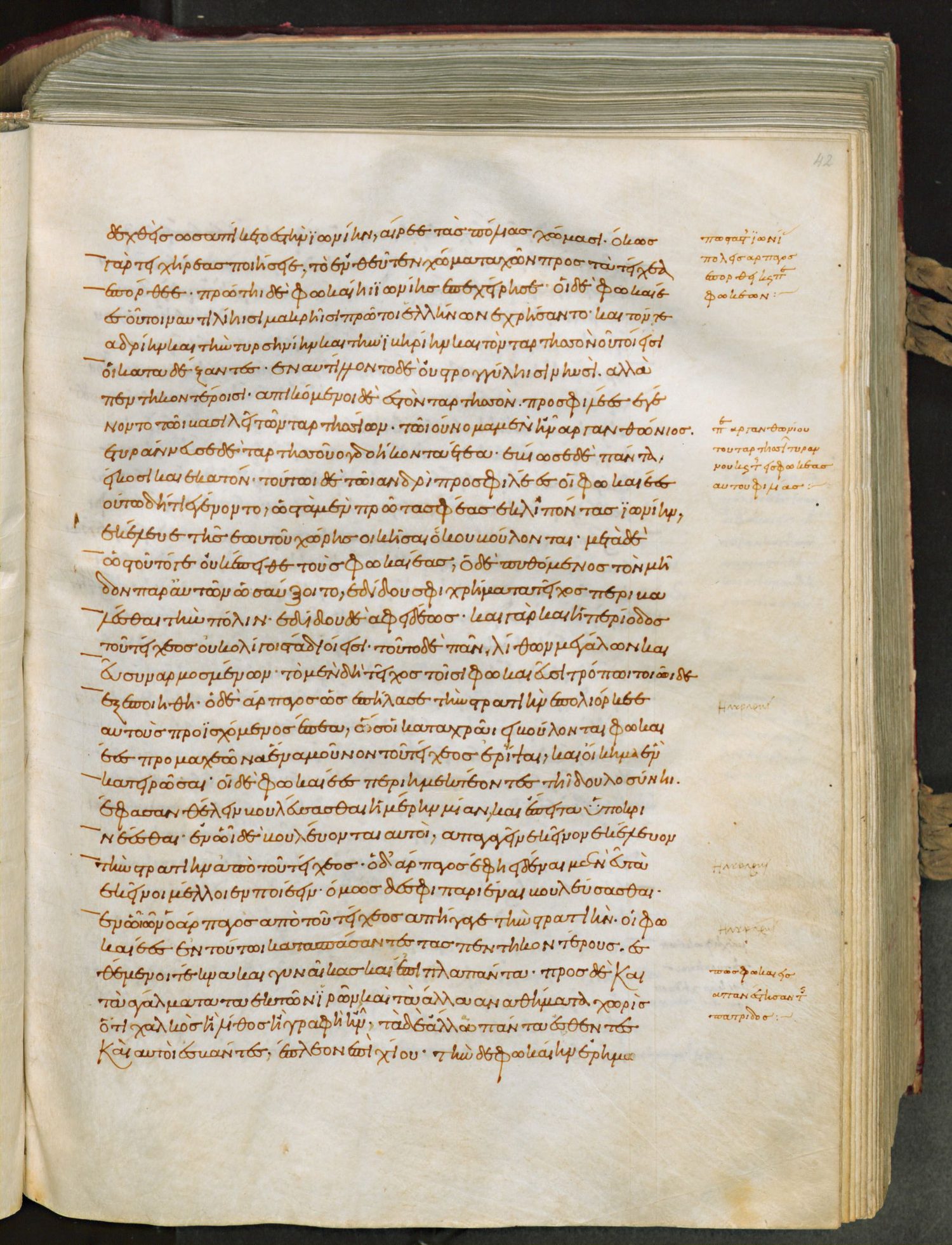
Laur. Plut. 70.3, fol. 42r: Greek here 1.162.2 to 1.164.3. Checked on the image (first and last words read and located in the Greek; each break checked against the neighbouring page): fol. 42r begins ‹-δεχθεὶς ὡς ἀπίκετο ἐς› (1.162.2), ends ‹τὴν δὲ Φωκαίην ἐρημω-› (1.164.3). The word ‹ἀποδεχθεὶς› is divided between fol. 41v and fol. 42r; it is given with fol. 41v. English here: 1.162.2 to 1.164.3 (Godley's sentences for the sections whose Greek lies mostly on this page).
1.162.2ὡς ἀπίκετο ἐς τὴν Ἰωνίην, αἵρεε τὰς πόλιας χώμασι· ὅκως γὰρ τειχήρεας ποιήσειε, τὸ ἐνθεῦτεν χώματα χῶν πρὸς τὰ τείχεα ἐπόρθεε. 1.163.1πρώτῃ δὲ Φωκαίῃ Ἰωνίης ἐπεχείρησε. οἱ δὲ Φωκαιέες οὗτοι ναυτιλίῃσι μακρῇσι πρῶτοι Ἑλλήνων ἐχρήσαντο, καὶ τὸν τε Ἀδρίην καὶ τὴν Τυρσηνίην καὶ τὴν Ἰβηρίην καὶ τὸν Ταρτησσὸν οὗτοι εἰσὶ οἱ καταδέξαντες· 1.163.2ἐναυτίλλοντο δὲ οὐ στρογγύλῃσι νηυσὶ ἀλλὰ πεντηκοντέροισι. ἀπικόμενοι δὲ ἐς τὸν Ταρτησσὸν προσφιλέες ἐγένοντο τῷ βασιλέι τῶν Ταρτησσίων, τῷ οὔνομα μὲν ἦν, Ἀργανθώνιος, ἐτυράννευσε δὲ Ταρτησσοῦ ὀγδώκοντα ἔτεα, ἐβίωσε δὲ πάντα εἴκοσι καὶ ἑκατόν. 1.163.3τούτῳ δὴ τῷ ἀνδρὶ προσφιλέες οἱ Φωκαιέες οὕτω δή τι ἐγένοντο ὡς τὰ μὲν πρῶτα σφέας ἐκλιπόντας Ἰωνίην ἐκέλευε τῆς ἑωυτοῦ χώρης οἰκῆσαι ὅκου βούλονται· μετὰ δέ, ὡς τοῦτό γε οὐκ ἔπειθε τοὺς Φωκαιέας, ὁ δὲ πυθόμενος τὸν Μῆδον παρʼ αὐτῶν ὡς αὔξοιτο, ἐδίδου σφι χρήματα τεῖχος περιβαλέσθαι τὴν πόλιν, 1.163.4ἐδίδου δὲ ἀφειδέως· καὶ γὰρ καὶ ἡ περίοδος τοῦ τείχεος οὐκ ὀλίγοι στάδιοι εἰσί, τοῦτο δὲ πᾶν λίθων μεγάλων καὶ εὖ συναρμοσμένων. 1.164.1τὸ μὲν δὴ τεῖχος τοῖσι Φωκαιεῦσι τρόπῳ τοιῷδε ἐξεποιήθη. ὁ δὲ Ἅρπαγος ὡς ἐπήλασε τὴν στρατιήν, ἐπολιόρκεε αὐτούς, προισχόμενος ἔπεα ὥς οἱ καταχρᾷ εἰ βούλονται Φωκαιέες προμαχεῶνα ἕνα μοῦνον τοῦ τείχεος ἐρεῖψαι καὶ οἴκημα ἓν κατιρῶσαι. 1.164.2οἱ δὲ Φωκαιέες περιημεκτέοντες τῇ δουλοσύνη ἔφασαν θέλειν βουλεύσασθαι ἡμέρην μίαν καὶ ἔπειτα ὑποκρινέεσθαι· 1.164.3ἐν ᾧ δὲ βουλεύονται αὐτοί, ἀπαγαγεῖν ἐκεῖνον ἐκέλευον τὴν στρατιὴν ἀπὸ τοῦ τείχεος. ὁ δʼ Ἅρπαγος ἔφη εἰδέναι μὲν εὖ τὰ ἐκεῖνοι μέλλοιεν ποιέειν, ὅμως δὲ σφι παριέναι βουλεύσασθαι. ἐν ᾧ ὦν ὁ Ἅρπαγος ἀπὸ τοῦ τείχεος ἀπήγαγε τὴν στρατιήν, οἱ Φωκαιέες ἐν τούτῳ κατασπάσαντες τὰς πεντηκοντέρους, ἐσθέμενοι τέκνα καὶ γυναῖκας καὶ ἔπιπλα πάντα, πρὸς δὲ καὶ τὰ ἀγάλματα τὰ ἐν τῶν ἱρῶν καὶ τὰ ἄλλα ἀναθήματα, χωρὶς ὅ τι χαλκὸς ἢ λίθος ἢ γραφὴ ἦν, τὰ δὲ ἄλλα πάντα ἐσθέντες καὶ αὐτοὶ εἰσβάντες ἔπλεον ἐπὶ Χίου. τὴν δὲ Φωκαίην ἐρημωθεῖσαν
1.162.2This man was now made general by Cyrus. When he came to Ionia, he took the cities by building mounds; he would drive the men within their walls and then build mounds against the walls and so take the cities. 1.163.1Phocaea was the first Ionian town that he assailed. These Phocaeans were the earliest of the Greeks to make long sea-voyages: it was they who discovered the Adriatic Sea, and Tyrrhenia, and Iberia, and Tartessus, 1.163.2not sailing in round freight-ships but in fifty-oared vessels. When they came to Tartessus they made friends with the king of the Tartessians, whose name was Arganthonius; he ruled Tartessus for eighty years and lived an hundred and twenty. 1.163.3The Phocaeans so won this man’s friendship that he first entreated them to leave Ionia and settle in his country where they would; and then, when he could not persuade them to that, and learnt from them how the Median power was increasing, he gave them money to build a wall round their city therewith. 1.163.4Without stint he gave it; for the circuit of the wall is of many furlongs, and all this is made of great stones well fitted together. 1.164.1In such a manner was the Phocaeans’ wall fully made. Harpagus marched against the city and besieged it, but he made overtures, and said that it would suffice him if the Phocaeans would demolish one bastion of the wall and dedicate one house. 1.164.2But the Phocaeans, very wroth at the thought of slavery, said they desired to take counsel for one day, and then they would answer; but while they were consulting, Harpagus must, they said, withdraw his army from the walls. Harpagus said that he knew well what they purposed to do, but that nevertheless he would suffer them to take counsel. 1.164.3So while Harpagus withdrew his army from the walls, the Phocaeans launched their fifty-oared ships, placed in them their children and women and all movable goods, besides the statues from the temples and all things therein dedicated save bronze or stonework or painting, and then themselves embarked and set sail for Chios; and the Persians took Phocaea, thus left uninhabited.
Where on the image
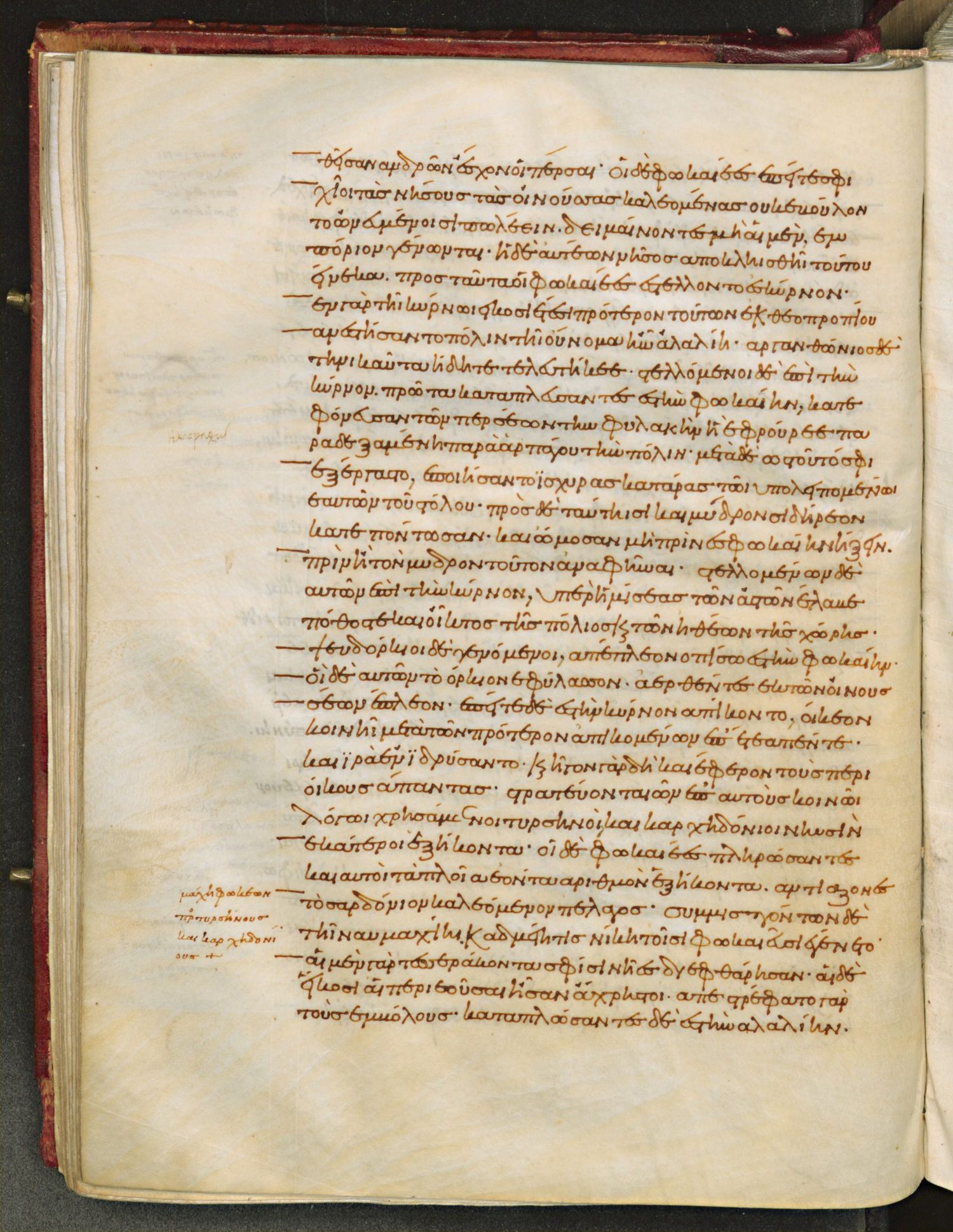
Laur. Plut. 70.3, fol. 42v: Greek here 1.164.3 to 1.166.3. Checked on the image (first and last words read and located in the Greek; each break checked against the neighbouring page): fol. 42v begins ‹-θεῖσαν ἀνδρῶν ἔσχον οἱ› (1.164.3), ends ‹δὲ ἐς τὴν Ἀλαλίην› (1.166.3). The word ‹ἐρημωθεῖσαν› is divided between fol. 42r and fol. 42v; it is given with fol. 42r. English here: 1.165.1 to 1.166.2 (Godley's sentences for the sections whose Greek lies mostly on this page).
1.164.3ἀνδρῶν ἔσχον οἱ Πέρσαι. 1.165.1οἱ δὲ Φωκαιέες, ἐπείτε σφι Χῖοι τὰς νήσους τὰς Οἰνούσσας καλεομένας οὐκ ἐβούλοντο ὠνευμένοισι πωλέειν, δειμαίνοντες μὴ αἳ μὲν ἐμπόριον γένωνται, ἡ δὲ αὐτῶν νῆσος ἀποκληισθῇ τούτου εἵνεκα, πρὸς ταῦτα οἱ Φωκαίες ἐστέλλοντο ἐς Κύρνον· ἐν γὰρ τῇ Κύρνῳ εἴκοσι ἔτεσι πρότερον τούτων ἐκ θεοπροπίου ἀνεστήσαντο πόλιν, τῇ οὔνομα ἦν Ἀλαλίη. 1.165.2Ἀργανθώνιος δὲ τηνικαῦτα ἤδη τετελευτήκεε. στελλόμενοι δὲ ἐπὶ τὴν Κύρνον, πρῶτα καταπλεύσαντες ἐς τὴν Φωκαίην κατεφόνευσαν τῶν Περσέων τὴν φυλακήν, ἣ ἐφρούρεε παραδεξαμένη παρὰ Ἁρπάγου τὴν πόλιν. μετὰ δέ, ὡς τοῦτο σφι ἐξέργαστο, ἐποιήσαντο ἰσχυρὰς κατάρας τῷ ὑπολειπομένῳ ἑωυτῶν τοῦ στόλου, 1.165.3πρὸς δὲ ταύτῃσι καὶ μύδρον σιδήρεον κατεπόντωσαν καὶ ὤμοσαν μὴ πρὶν ἐς Φωκαίην ἥξειν πρὶν ἢ τὸν μύδρον τοῦτον ἀναφανῆναι. στελλομένων δὲ αὐτῶν ἐπὶ τὴν Κύρνον, ὑπερημίσεας τῶν ἀστῶν ἔλαβε πόθος τε καὶ οἶκτος τῆς πόλιος καὶ τῶν ἠθέων τῆς χώρης, ψευδόρκιοι δὲ γενόμενοι ἀπέπλεον ὀπίσω ἐς τὴν Φωκαίην. οἳ δὲ αὐτῶν τὸ ὅρκιον ἐφύλασσον, ἀερθέντες ἐκ τῶν Οἰνουσσέων ἔπλεον. 1.166.1ἐπείτε δὲ ἐς τὴν Κύρνον ἀπίκοντο, οἴκεον κοινῇ μετὰ τῶν πρότερον ἀπικομένων ἐπʼ ἔτεα πέντε, καὶ ἱρὰ ἐνιδρύσαντο. καὶ ἦγον γὰρ δὴ καὶ ἔφερον τοὺς περιοίκους ἅπαντας, στρατεύονται ὦν ἐπʼ αὐτοὺς κοινῷ λόγῳ χρησάμενοι Τυρσηνοὶ καὶ Καρχηδόνιοι, νηυσὶ ἑκάτεροι ἑξήκόντα. 1.166.2οἱ δὲ Φωκαιέες πληρώσαντες καὶ αὐτοὶ τὰ πλοῖα, ἐόντα ἀριθμὸν ἑξήκοντα, ἀντίαζον ἐς τὸ Σαρδόνιον καλεόμενον πέλαγος. συμμισγόντων δὲ τῇ ναυμαχίῃ Καδμείη τις νίκη τοῖσι Φωκαιεῦσι ἐγένετο· αἱ μὲν γὰρ τεσσεράκοντά σφι νέες διεφθάρησαν, αἱ δὲ εἴκοσι αἱ περιεοῦσαι ἦσαν ἄχρηστοι· ἀπεστράφατο γὰρ τοὺς ἐμβόλους. 1.166.3καταπλώσαντες δὲ ἐς τὴν Ἀλαλίην
1.165.1The Phocaeans would have bought of the Chians the islands called Oenussae; but the Chians would not sell them, because they feared that the islands would become a market and so their own island be cut off from its trade: so the Phocaeans made ready to sail to Cyrnus, where at the command of an oracle they had twenty years before this built a city called Alalia. 1.165.2Arganthonius was by this time dead. While making ready for their voyage, they first sailed to Phocaea, where they slew the Persian guard to whom Harpagus had entrusted the defence of the city; and this being done, they called down mighty curses on whosoever of themselves should stay behind when the rest sailed. 1.165.3Not only so, but they sank in the sea a mass of iron, and swore never to return to Phocaea before the iron should again appear. But while they prepared to voyage to Cyrnus, more than half of the citizens were taken with a longing and a pitiful sorrow for the city and the life of their land, and they broke their oath and sailed back to Phocaea. Those of them who kept the oath set out to sea from the Oenussae. 1.166.1And when they came to Cyrnus they dwelt there for five years as one body with those who had first come, and they founded temples there. But they harried and plundered all their neighbours: wherefore the Tyrrhenians and Carchedonians made common cause against them, and sailed to attack them each with sixty ships. 1.166.2The Phocaeans also manned their ships, sixty in number, and met the enemy in the sea called Sardonian. They joined battle, and the Phocaeans won, yet it was but a Cadmean victory; for they lost forty of their ships, and the twenty that remained were useless, their rams being twisted awry.
Where on the image
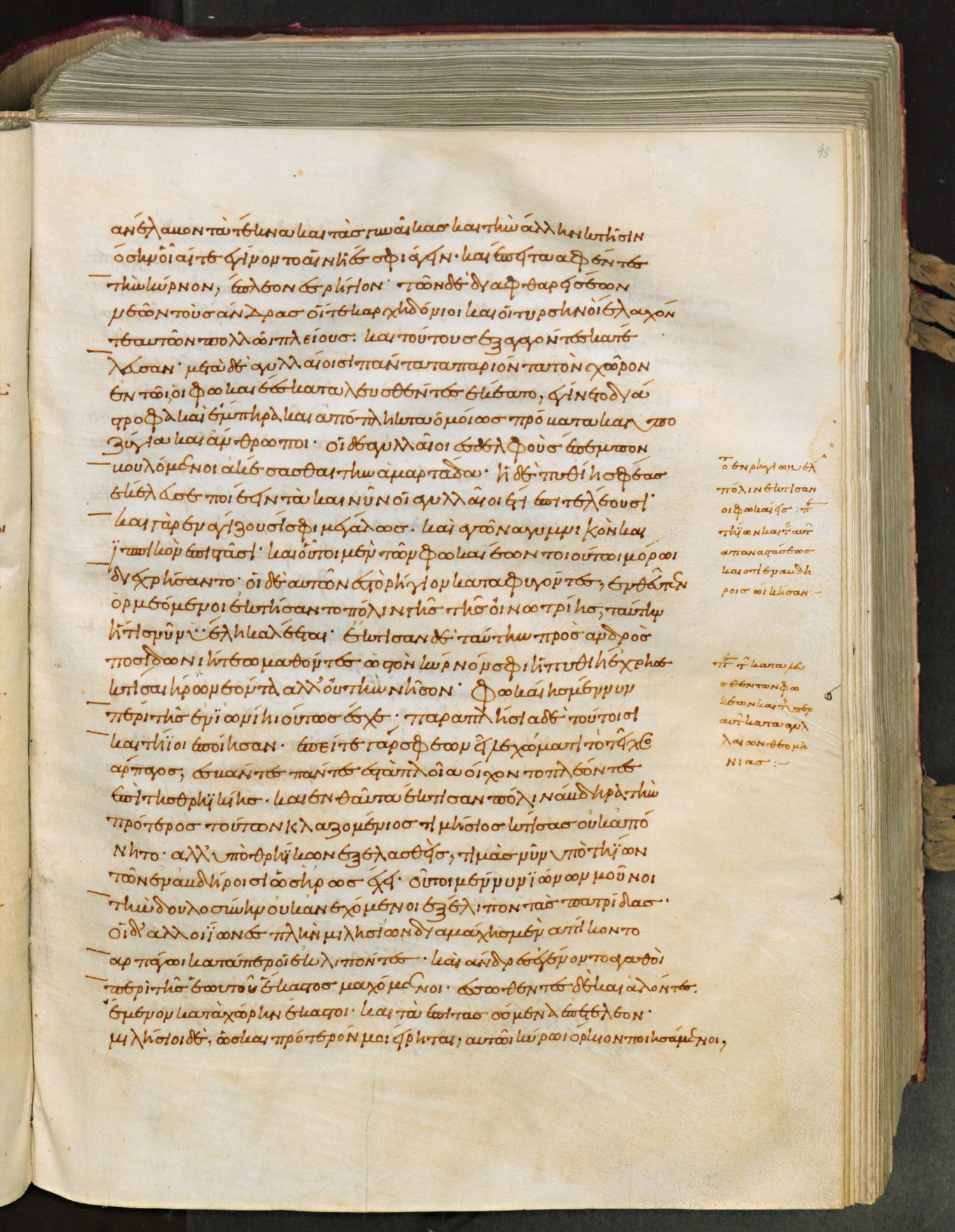
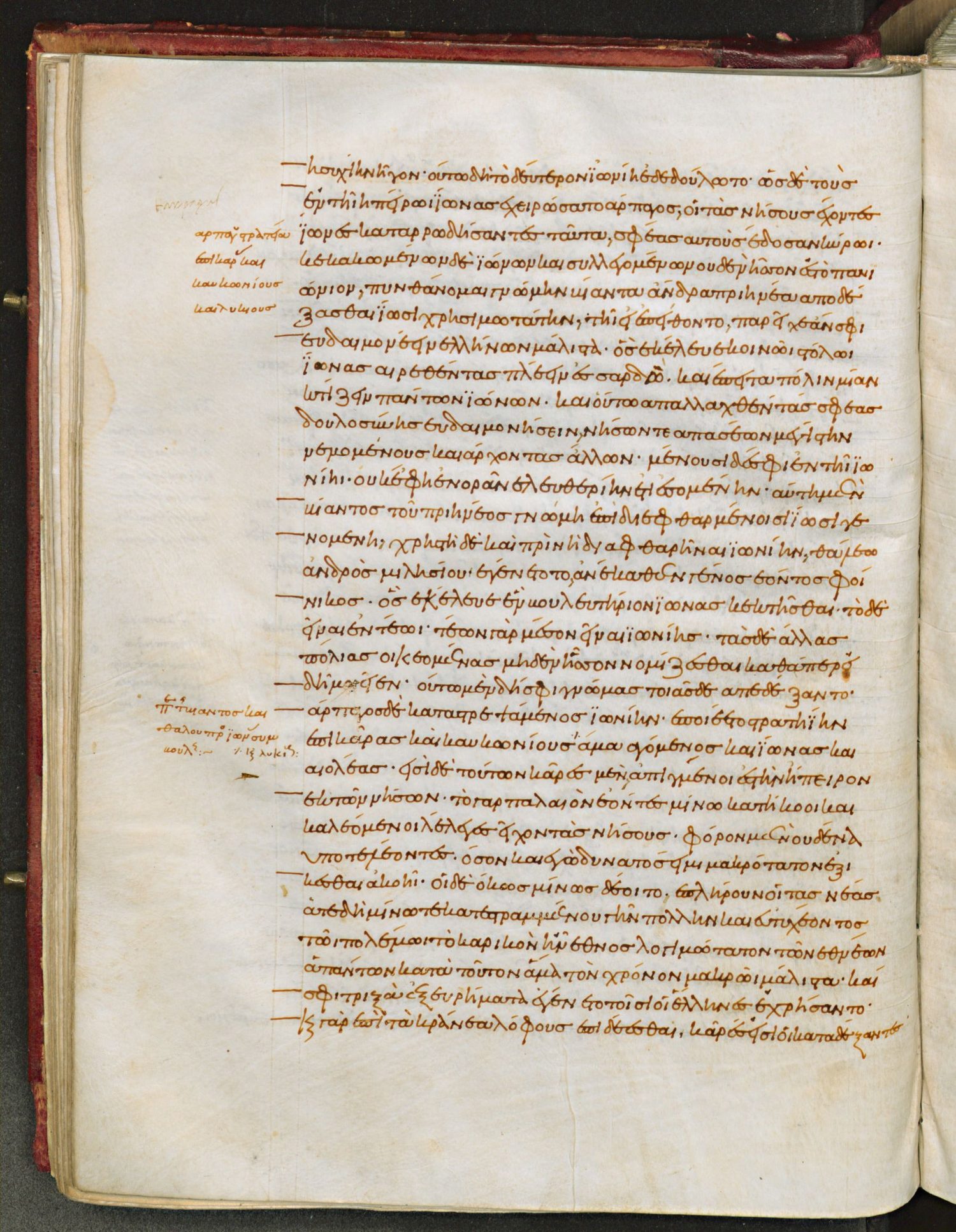
Laur. Plut. 70.3, fol. 43r: Greek here 1.166.3 to 1.169.2. Checked on the image (first and last words read and located in the Greek; each break checked against the neighbouring page): fol. 43r begins ‹ἀνέλαβον τὰ τέκνα καὶ› (1.166.3), ends ‹αὐτῷ Κύρῳ ὅρκιον ποιησάμενοι› (1.169.2). English here: 1.166.3 to 1.169.1 (Godley's sentences for the sections whose Greek lies mostly on this page).
1.166.3ἀνέλαβον τὰ τέκνα καὶ τὰς γυναῖκας καὶ τὴν ἄλλην κτῆσιν ὅσην οἷαι τε ἐγίνοντο αἱ νέες σφι ἄγειν, καὶ ἔπειτα ἀπέντες τὴν Κύρνον ἔπλεον ἐς Ῥήγιον. 1.167.1τῶν δὲ διαφθαρεισέων νεῶν τοὺς ἄνδρας οἱ τε Καρχηδόνιοι καὶ οἱ Τυρσηνοὶ [διέλαχον, τῶν δὲ Τυρσηνῶν οἱ Ἀγυλλαῖοι] ἔλαχόν τε αὐτῶν πολλῷ πλείστους καὶ τούτους ἐξαγαγόντες κατέλευσαν. μετὰ δὲ Ἀγυλλαίοισι πάντα τὰ παριόντα τὸν χῶρον, ἐν τῶ οἱ Φωκαιέες καταλευσθέντες ἐκέατο, ἐγίνετο διάστροφα καὶ ἔμπηρα καὶ ἀπόπληκτα, ὁμοίως πρόβατα καὶ ὑποζύγια καὶ ἄνθρωποι. 1.167.2οἱ δὲ Ἀγυλλαῖοι ἐς Δελφοὺς ἔπεμπον βουλόμενοι ἀκέσασθαι τὴν ἁμαρτάδα. ἡ δὲ Πυθίη σφέας ἐκέλευσε ποιέειν τὰ καὶ νῦν οἱ Ἀγυλλαῖοι ἔτι ἐπιτελέουσι· καὶ γὰρ ἐναγίζουσί σφι μεγάλως καὶ ἀγῶνα γυμνικὸν καὶ ἱππικὸν ἐπιστᾶσι. 1.167.3καὶ οὗτοι μὲν τῶν Φωκαιέων τοιούτῳ μόρῳ διεχρήσαντο, οἱ δὲ αὐτῶν ἐς τὸ Ῥήγιον καταφυγόντες ἐνθεῦτεν ὁρμώμενοι ἐκτήσαντο πόλιν γῆς τῆς Οἰνωτρίης ταύτην ἥτις νῦν Ὑέλη καλέεται· 1.167.4ἔκτισαν δὲ ταύτην πρὸς ἀνδρὸς Ποσειδωνιήτεω μαθόντες ὡς τὸν Κύρνον σφι ἡ Πυθίη ἔχρησε κτίσαι ἥρων ἐόντα, ἀλλʼ οὐ τὴν νῆσον. 1.168.1Φωκαίης μέν νυν πέρι τῆς ἐν Ἰωνίῃ οὕτω ἔσχε παραπλήσια δὲ τούτοισι καὶ Τήιοι ἐποίησαν. ἐπείτε γὰρ σφέων εἷλε χώματι τὸ τεῖχος Ἅρπαγος, ἐσβάντες πάντες ἐς τὰ πλοῖα οἴχοντο πλέοντες ἐπὶ τῆς Θρηίκης, καὶ ἐνθαῦτα ἔκτισαν πόλιν Ἄβδηρα, τὴν πρότερος τούτων Κλαζομένιος Τιμήσιος κτίσας οὐκ ἀπόνητο, ἀλλʼ ὑπὸ Θρηίκων ἐξελασθεὶς τιμὰς νῦν ὑπὸ Τηίων τῶν ἐν Ἀβδήροισι ὡς ἥρως ἔχει. 1.169.1οὗτοὶ μέν νυν Ἰώνων μοῦνοι τὴν δουλοσύνην οὐκ ἀνεχόμενοι ἐξέλιπον τὰς πατρίδας· οἱ δʼ ἄλλοι Ἴωνες πλὴν Μιλησίων διὰ μάχης μὲν ἀπίκοντο Ἁρπάγῳ κατά περ οἱ ἐκλιπόντες, καὶ ἄνδρες ἐγένοντο ἀγαθοὶ περὶ τῆς ἑωυτοῦ ἕκαστος μαχόμενοι, ἑσσωθέντες δὲ καὶ ἁλόντες ἔμενον κατὰ χώρην ἕκαστοι καὶ τὰ ἐπιτασσόμενα ἐπετέλεον. 1.169.2Μιλήσιοι δέ, ὡς καὶ πρότερόν μοι ἔρηται, αὐτῷ Κύρῳ ὅρκιον ποιησάμενοι
1.166.3Then sailing to Alalia they took on board their children and women and all of their possessions that their ships could hold, and leaving Cyrnus they sailed to Rhegium. 1.167.1As for the crews of the destroyed ships, the Carchedonians and Tyrrhenians drew lots for them: and by far the greater share of them falling to the Tyrrhenian city of Agylla, the Agyllaeans led them out and stoned them to death. But after this all from Agylla, whether sheep or beasts of burden or men, that passed the place where the stoned Phocaeans lay, became distorted and crippled and palsied. 1.167.2The Agyllaeans sent to Delphi, desiring to heal their offence; and the Pythian priestess bade them do what the people of Agylla to this day perform: for they pay great honours to the Phocaeans, with religious rites and games, and horse-races. 1.167.3Such was the end of this portion of the Phocaeans. Those of them who fled to Rhegium set out from thence and gained possession of that Oenotrian city which is now called Hyele; this 1.167.4they founded because they learnt from a man of Posidonia that when the Pythian priestess spoke of founding a settlement and of Cyrnus, it was the hero that she signified and not the island. 1.168.1Thus, then, it fared with the Ionian Phocaea. The Teians did in like manner with the Phocaeans: when Harpagus had taken their walled city by building a mound, they all embarked on shipboard and sailed away for Thrace. There they founded a city, Abdera, which before this had been founded by Timesius of Clazomenae; yet he got no good of it, but was driven out by the Thracians. This Timesius is now honoured as a hero by the Teians of Abdera. 1.169.1These were the only Ionians who, being unable to endure slavery, left their native lands. The rest of the Ionians, except the Milesians, though they faced Harpagus in battle as did the exiles, and bore themselves gallantly, each fighting for his own country, yet, when they were worsted and their cities taken, remained each where he was and did as they were commanded.
Where on the image
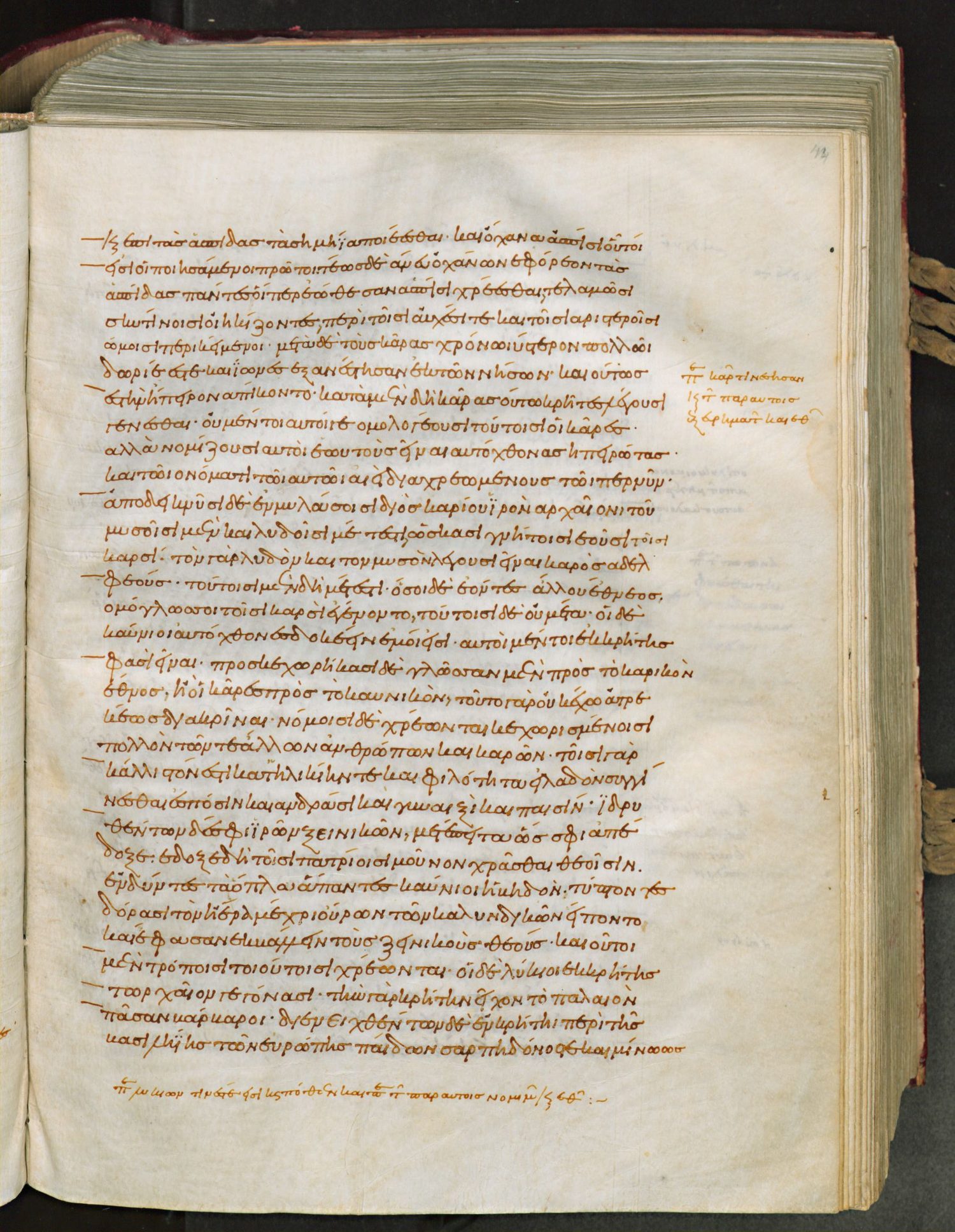
Laur. Plut. 70.3, fol. 43v: Greek here 1.169.2 to 1.171.4. Checked on the image (first and last words read and located in the Greek; each break checked against the neighbouring page): fol. 43v begins ‹ἡσυχίην ἦγον. οὕτω δὴ› (1.169.2), ends ‹Κᾶρες εἰσὶ οἱ καταδέξαντες› (1.171.4). English here: 1.169.2 to 1.171.3 (Godley's sentences for the sections whose Greek lies mostly on this page).
1.169.2ἡσυχίην ἦγον. οὕτω δὴ τὸ δεύτερον Ἰωνίη ἐδεδούλωτο. ὡς δὲ τοὺς ἐν τῇ ἠπείρῳ Ἴωνας ἐχειρώσατο Ἅρπαγος, οἱ τὰς νήσους ἔχοντες Ἴωνες καταρρωδήσαντες ταῦτα σφέας αὐτοὺς ἔδοσαν Κύρῳ. 1.170.1κεκακωμένων δὲ Ἰώνων καὶ συλλεγομένων οὐδὲν ἧσσον ἐς τὸ Πανιώνιον, πυνθάνομαι γνώμην Βίαντα ἄνδρα Πριηνέα ἀποδέξασθαι Ἴωσι χρησιμωτάτην, τῇ εἰ ἐπείθοντο, παρεῖχε ἂν σφι εὐδαιμονέειν Ἑλλήνων μάλιστα· 1.170.2ὃς ἐκέλευε κοινῷ στόλῳ Ἴωνας ἀερθέντας πλέειν ἐς Σαρδὼ καὶ ἔπειτα πόλιν μίαν κτίζειν πάντων Ἰώνων, καὶ οὕτω ἀπαλλαχθέντας σφέας δουλοσύνης εὐδαιμονήσειν, νήσων τε ἁπασέων μεγίστην νεμομένους καὶ ἄρχοντας ἄλλων· μένουσι δέ σφι ἐν τῇ Ἰωνίῃ οὐκ ἔφη ἐνορᾶν ἐλευθερίην ἔτι ἐσομένην. 1.170.3αὕτη μὲν Βίαντος τοῦ Πριηνέος γνώμη ἐπὶ διεφθαρμένοισι Ἴωσι γενομένη, χρηστὴ δὲ καὶ πρὶν ἢ διαφθαρῆναι Ἰωνίην Θάλεω ἀνδρὸς Μιλησίου ἐγένετο, τὸ ἀνέκαθεν γένος ἐόντος Φοίνικος, ὃς ἐκέλευε ἓν βουλευτήριον Ἴωνας ἐκτῆσθαι, τὸ δὲ εἶναι ἐν Τέῳ (Τέων γὰρ μέσον εἶναι Ἰωνίης), τὰς δὲ ἄλλας πόλιας οἰκεομένας μηδὲν ἧσσον νομίζεσθαι κατά περ ἐς δῆμοι εἶεν· οὗτοι μὲν δή σφι γνώμας τοιάσδε ἀπεδέξαντο. 1.171.1Ἅρπαγος δὲ καταστρεψάμενος Ἰωνίην ἐποιέετο στρατηίην ἐπὶ Κᾶρας καὶ Καυνίους καὶ Λυκίους, ἅμα ἀγόμενος καὶ Ἴωνας καὶ Αἰολέας. 1.171.2εἰσὶ δὲ τούτων Κᾶρες μὲν ἀπιγμένοι ἐς τὴν ἤπειρον ἐκ τῶν νήσων. τὸ γὰρ παλαιὸν ἐόντες Μίνω κατήκοοι καὶ καλεόμενοι Λέλεγες εἶχον τὰς νήσους, φόρον μὲν οὐδένα ὑποτελέοντες, ὅσον καὶ ἐγὼ δυνατός εἰμι ἐπὶ μακρότατον ἐξικέσθαι ἀκοῇ· οἳ δέ, ὅκως Μίνως δέοιτο, ἐπλήρουν οἱ τὰς νέας. 1.171.3ἅτε δὴ Μίνω τε κατεστραμμένου γῆν πολλὴν καὶ εὐτυχέοντος τῷ πολέμῳ, τὸ Καρικὸν ἦν ἔθνος λογιμώτατον τῶν ἐθνέων ἁπάντων κατὰ τοῦτον ἅμα τὸν χρόνον μακρῷ μάλιστα. 1.171.4καί σφι τριξὰ ἐξευρήματα ἐγένετο, τοῖσι οἱ Ἕλληνες ἐχρήσαντο· καὶ γὰρ ἐπὶ τὰ κράνεα λόφους ἐπιδέεσθαι Κᾶρες εἰσὶ οἱ καταδέξαντες
1.169.2The Milesians, as I have already said, made a treaty with Cyrus himself and struck no blow. Thus was Ionia for the second time enslaved: and when Harpagus had conquered the Ionians of the mainland, the Ionians of the islands, fearing the same fate, surrendered themselves to Cyrus. 1.170.1When the Ionians, despite their evil plight, did nevertheless assemble at the Panionion, Bias of Priene, as I have heard, gave them very useful advice, which had they followed they might have been the most prosperous of all Greeks: 1.170.2for he counselled them to put out to sea and sail all together to Sardo and then found one city for all Ionians: thus, possessing the greatest island in the world and bearing rule over others, they would be rid of slavery and win prosperity; but if they stayed in Ionia he could see (he said) no hope of freedom for them. 1.170.3Such was the counsel which Bias of Priene gave after the destruction of the Ionians; and good also was that given before the destruction by Thales of Miletus, a Phoenician by descent; he would have had the Ionians make one common place of counsel, which should be in Teos, for that was the centre of Ionia; and the state of the other cities should be held to be no other than if they were but townships. Thus Bias and Thales advised. 1.171.1Harpagus, after subduing Ionia, made an expedition against the Carians, Caunians, and Lycians, taking with him Ionians and Aeolians. 1.171.2Now among these the Carians were a people who had come to the mainland from the islands; for in old time they were islanders, called Leleges and under the rule of Minos, not (as far as I can learn by hearsay) paying him tribute, but manning ships for him when he needed them. 1.171.3Seeing then that Minos had subdued much territory to himself and was victorious in war, this made the Carians too at that time to be very far the most regarded of all nations.
Where on the image
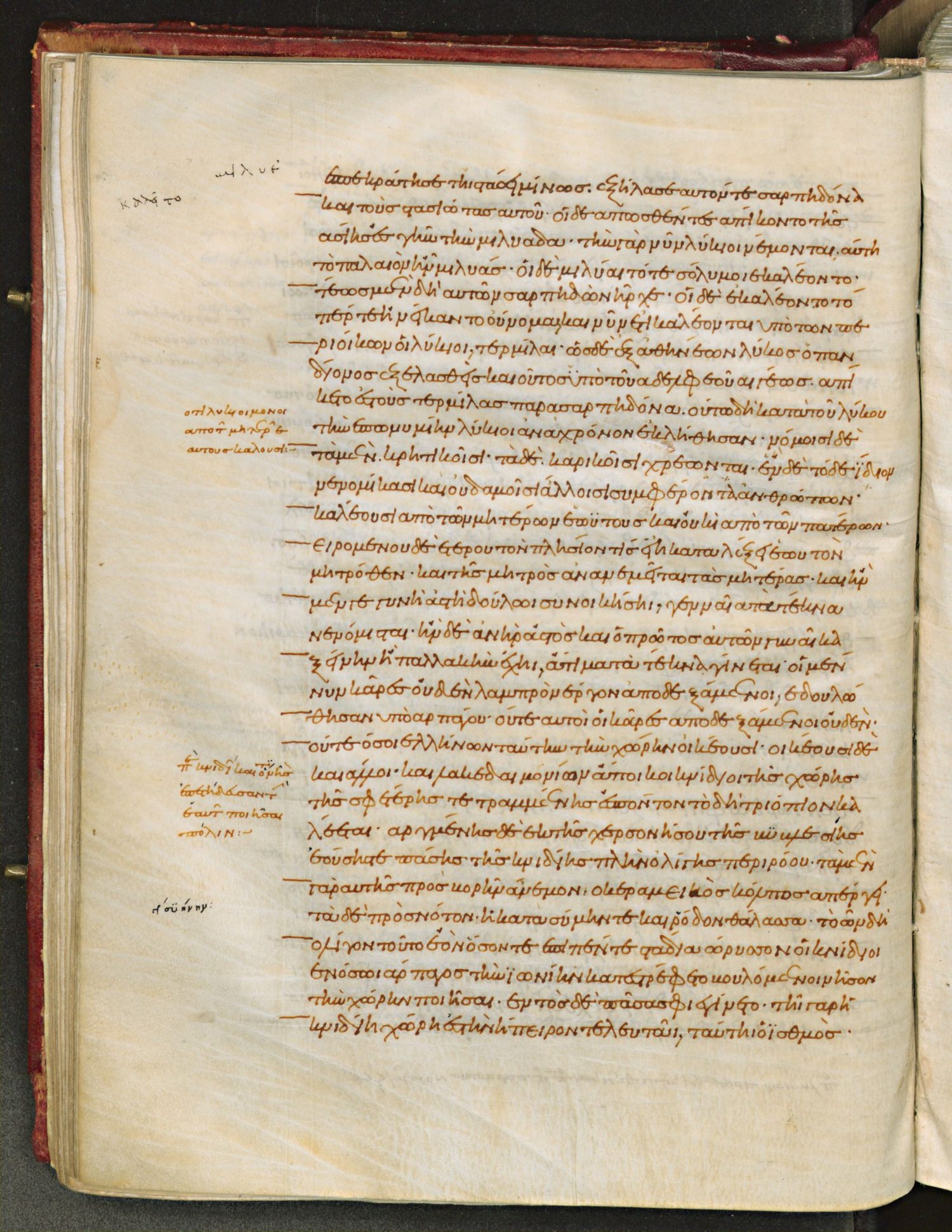
Laur. Plut. 70.3, fol. 44r: Greek here 1.171.4 to 1.173.2. Checked on the image (first and last words read and located in the Greek; each break checked against the neighbouring page): fol. 44r begins ‹καὶ ἐπὶ τὰς ἀσπίδας› (1.171.4), ends ‹Σαρπηδόνος τε καὶ Μίνω› (1.173.2). Below the text, a reader's note on the customs of the Lycians. English here: 1.171.4 to 1.173.1 (Godley's sentences for the sections whose Greek lies mostly on this page).
1.171.4καὶ ἐπὶ τὰς ἀσπίδας τὰ σημήια ποιέεσθαι, καὶ ὄχανα ἀσπίσι οὗτοι εἰσὶ οἱ ποιησάμενοι πρῶτοι· τέως δὲ ἄνευ ὀχάνων ἐφόρεον τὰς ἀσπίδας πάντες οἳ περ ἐώθεσαν ἀσπίσι χρᾶσθαι, τελαμῶσι σκυτίνοισι οἰηκίζοντες, περὶ τοῖσι αὐχέσι τε καὶ τοῖσι ἀριστεροῖσι ὤμοισι περικείμενοι. 1.171.5μετὰ δὲ τοὺς Κᾶρας χρόνῳ ὕστερον πολλῷ Δωριέες τε καὶ Ἴωνες ἐξανέστησαν ἐκ τῶν νήσων, καὶ οὕτω ἐς τὴν ἤπειρον ἀπίκοντο. κατὰ μὲν δὴ Κᾶρας οὕτω Κρῆτες λέγουσι γενέσθαι· οὐ μέντοι αὐτοί γε ὁμολογέουσι τούτοισι οἱ Κᾶρες, ἀλλὰ νομίζουσι αὐτοὶ ἑωυτοὺς εἶναι αὐτόχθονας ἠπειρώτας, καὶ τῷ οὐνόματι τῷ αὐτῷ αἰεὶ διαχρεωμένους τῷ περ νῦν. 1.171.6ἀποδείκνῦσι δὲ ἐν Μυλάσοισι Διὸς Καρίου ἱρὸν ἀρχαῖον, τοῦ Μυσοῖσι μὲν καὶ Λυδοῖσι μέτεστι ὡς κασιγνήτοισι ἐοῦσι τοῖσι Καρσί· τὸν γὰρ Λυδὸν καὶ τὸν Μυσὸν λέγουσι εἶναι Καρὸς ἀδελφεούς. τούτοισι μὲν δὴ μέτεστι, ὅσοι δὲ ἐόντες ἄλλου ἔθνεος ὁμόγλωσσοι τοῖσι Καρσὶ ἐγένοντο, τούτοισι δὲ οὐ μέτα. 1.172.1οἱ δὲ Καύνιοι αὐτόχθονες δοκέειν ἐμοὶ εἰσί, αὐτοὶ μέντοι ἐκ Κρήτης φασὶ εἶναι. προσκεχωρήκασι δὲ γλῶσσαν μὲν πρὸς τὸ Καρικὸν ἔθνος, ἢ οἱ Κᾶρες πρὸς τὸ Καυνικόν (τοῦτο γὰρ οὐκ ἔχω ἀτρεκέως διακρῖναι), νόμοισι δὲ χρέωνται κεχωρισμένοισι πολλὸν τῶν τε ἄλλων ἀνθρώπων καὶ Καρῶν. τοῖσι γὰρ κάλλιστον ἐστὶ κατʼ ἡλικίην τε καὶ φιλότητα εἰλαδὸν συγγίνεσθαι ἐς πόσιν, καὶ ἀνδράσι καὶ γυναιξὶ καὶ παισί. 1.172.2ἱδρυθέντων δέ σφι ἱρῶν ξεινικῶν, μετέπειτα ὥς σφι ἀπέδοξε, ἔδοξέ δὲ τοῖσι πατρίοισι μοῦνον χέασθαι θεοῖσι, ἐνδύντες τὰ ὅπλα ἅπαντες Καύνιοι ἡβηδόν, τύπτοντες δόρασι τὸν ἠέρα, μέχρι οὔρων τῶν Καλυνδικῶν εἵποντο, καὶ ἔφασαν ἐκβάλλειν τοὺς ξεινικοὺς θεούς. 1.173.1καὶ οὗτοι μὲν τρόποισι τοιούτοισι χρέωνται, οἱ δὲ Λύκιοι ἐκ Κρήτης τὠρχαῖον γεγόνασι (τὴν γὰρ Κρήτην εἶχον τὸ παλαιὸν πᾶσαν βάρβαροι)· 1.173.2διενειχθέντων δὲ ἐν Κρήτῃ περὶ τῆς βασιληίης τῶν Εὐρώπης παίδων Σαρπηδόνος τε καὶ Μίνω,
1.171.4Three things they invented in which they were followed by the Greeks: it was the Carians who first taught the wearing of crests on their helmets and devices on their shields, and who first made for their shields holders; till then all who used shields carried them without these holders, and guided them with leathern baldrics which they slung round the neck and over the left shoulder. 1.171.5Then, a long time afterwards, the Carians were driven from the islands by Dorians and Ionians and so came to the mainland. This is the Cretan story about the Carians; but they themselves do not consent to it, but hold that they are aboriginal dwellers on the mainland and ever bore the name which they bear now; 1.171.6and they point to an ancient shrine of Carian Zeus at Mylasa, whereto Mysians and Lydians, as brethren of the Carians (for Lydus and Mysus, they say, were brothers of Car), are admitted, but none of any other nation, though they learned to speak the same language as the Carians. 1.172.1The Caunians, to my mind, are aborigines of the soil; but they themselves say that they came from Crete. Their speech has grown like to the Carian, or the Carian to theirs (for that I cannot clearly determine), but in their customs they are widely severed from the Carians, as from all other men. Their chief pleasure is to assemble for drinking-bouts in such companies as accord with their ages and friendships—men, women, and children. 1.172.2Certain foreign rites of worship were established among them; but presently when they were otherwise minded, and would worship only the gods of their fathers, all Caunian men of full age put on their armour and went together as far as the boundaries of Calynda, smiting the air with their spears and saying that they were casting out the stranger gods. 1.173.1Such are their fashions. The Lycians were of Crete in ancient times (for of old none that dwelt in Crete were Greek).
Where on the image
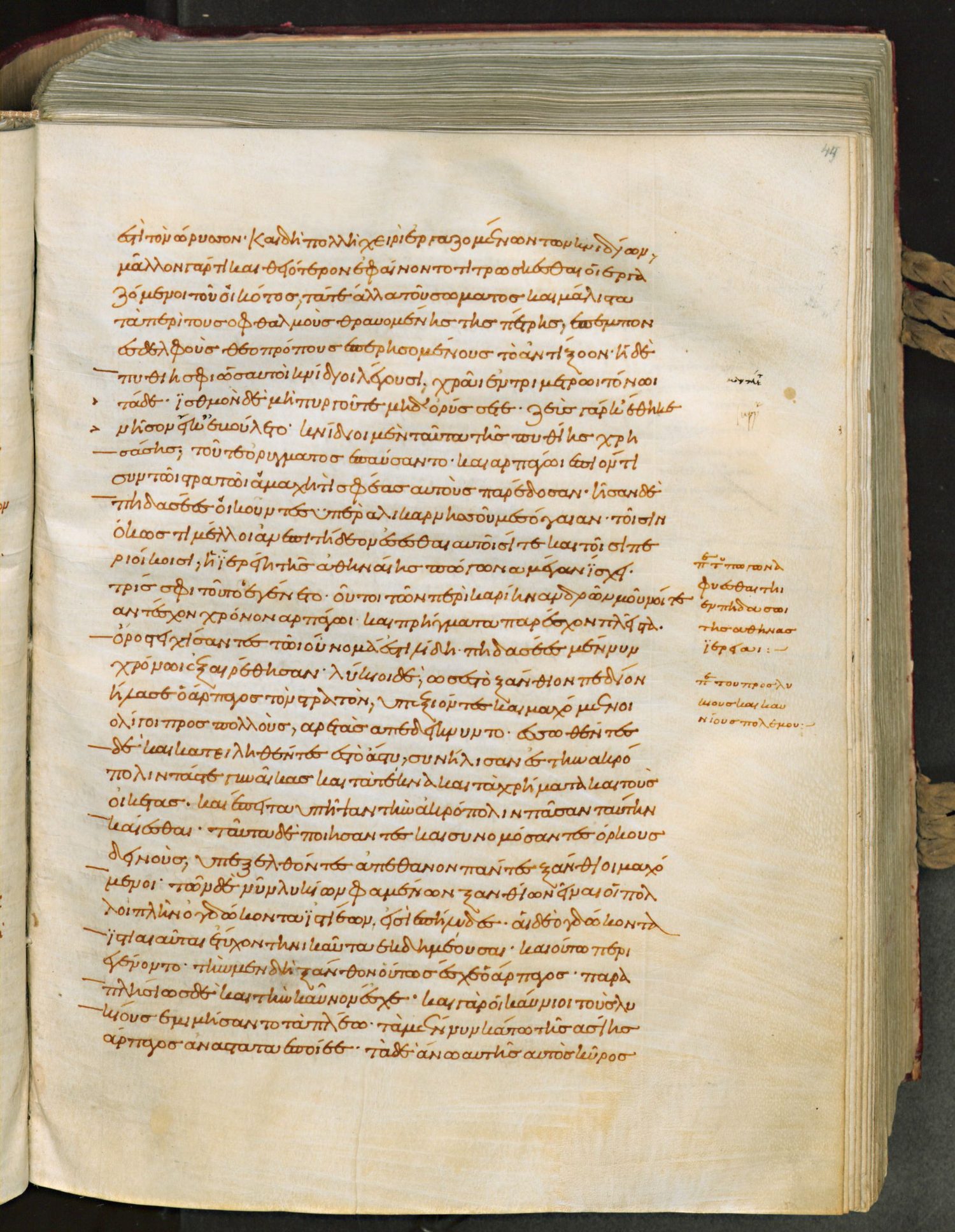
Laur. Plut. 70.3, fol. 44v: Greek here 1.173.2 to 1.174.3. Checked on the image (first and last words read and located in the Greek; each break checked against the neighbouring page): fol. 44v begins ‹ὡς ἐπεκράτησε τῇ στάσι› (1.173.2), ends ‹τελευτᾷ, ταύτῃ ὁ ἰσθμός› (1.174.3). English here: 1.173.2 to 1.174.3 (Godley's sentences for the sections whose Greek lies mostly on this page).
1.173.2ὡς ἐπεκράτησε τῇ στάσι Μίνως, ἐξήλασε αὐτόν τε Σαρπηδόνα καὶ τοὺς στασιώτας αὐτοῦ, οἳ δὲ ἀπωσθέντες ἀπίκοντο τῆς Ἀσίης ἐς γῆν τὴν Μιλυάδα· τὴν γὰρ νῦν Λύκιοι νέμονται, αὕτη τὸ παλαιὸν ἦν Μιλυάς, οἱ δὲ Μιλύαι τότε Σόλυμοι ἐκαλέοντο. 1.173.3ἕως μὲν δὴ αὐτῶν Σαρπηδὼν ἦρχε, οἳ δὲ ἐκαλέοντο τό πέρ τε ἠνείκαντο οὔνομα καὶ νυν ἔτι καλέονται ὑπὸ τῶν περιοίκων οἱ Λύκιοι Τερμίλαι· ὡς δὲ ἐξ Ἀθηνέων Λύκος ὁ Πανδίονος, ἐξελασθεὶς καὶ οὗτος ὑπὸ τοῦ ἀδελφεοῦ Αἰγέος, ἀπίκετο ἐς τοὺς Τερμίλας παρὰ Σαρπηδόνα, οὕτω δὴ κατὰ τοῦ Λύκου τὴν ἐπωνυμίην Λύκιοι ἀνὰ χρόνον ἐκλήθησαν. 1.173.4νόμοισι δὲ τὰ μὲν Κρητικοῖσι τὰ δὲ Καρικοῖσι χρέωνται. ἓν δὲ τόδε ἴδιον νενομίκασι καὶ οὐδαμοῖσι ἄλλοισι συμφέρονται ἀνθρώπων· καλέουσι ἀπὸ τῶν μητέρων ἑωυτοὺς καὶ οὐκὶ ἀπὸ τῶν πατέρων· 1.173.5εἰρομένου δὲ ἑτέρου τὸν πλησίον τίς εἴη, καταλέξει ἑωυτὸν μητρόθεν καὶ τῆς μητρὸς ἀνανεμέεται τὰς μητέρας. καὶ ἢν μέν γε γυνὴ ἀστὴ δούλῳ συνοικήσῃ, γενναῖα τὰ τέκνα νενόμισται· ἢν δὲ ἀνὴρ ἀστὸς καὶ ὁ πρῶτος αὐτῶν γυναῖκα ξείνην ἢ παλλακὴν ἔχῃ, ἄτιμα τὰ τέκνα γίνεται. 1.174.1οἱ μέν νυν Κᾶρες οὐδὲν λαμπρὸν ἔργον ἀποδεξάμενοι ἐδουλώθησαν ὑπὸ Ἁρπάγου, οὔτε αὐτοὶ οἱ Κᾶρες ἀποδεξάμενοι οὐδέν, οὔτε ὅσοι Ἑλλήνων ταύτην τὴν χώρην οἰκέουσι· 1.174.2οἰκέουσι δὲ καὶ ἄλλοι καὶ Λακεδαιμονίων ἄποικοι Κνίδιοι. οἳ τῆς χώρης τῆς σφετέρης τετραμμένης ἐς πόντον, τὸ δὴ Τριόπιον καλέεται, ἀργμένης δὲ ἐκ τῆς Χερσονήσου τῆς Βυβασσίης, ἐούσης τε πάσης τῆς Κνιδίης πλὴν ὀλίγης περιρρόου 1.174.3(τὰ μὲν γὰρ αὐτῆς πρὸς βορέην ἄνεμον ὁ Κεραμεικὸς κόλπος ἀπέργει, τὰ δὲ πρὸς νότον ἡ κατὰ Σύμην τε καὶ Ῥόδον θάλασσα), τὸ ὦν δὴ ὀλίγον τοῦτο, ἐὸν ὅσον τε ἐπὶ πέντε στάδια, ὤρυσσον οἱ Κνίδιοι ἐν ὅσῳ Ἅρπαγος τὴν Ἰωνίην κατεστρέφετο, βουλόμενοι νῆσον τὴν χώρην ποιῆσαι. ἐντὸς δὲ πᾶσά σφι ἐγίνετο· τῇ γὰρ ἡ Κνιδίη χώρη ἐς τὴν ἤπειρον τελευτᾷ, ταύτῃ ὁ ἰσθμός
1.173.2Now there was a dispute in Crete about the royal power between Sarpedon and Minos, sons of Europe; Minos prevailed in this division and drove out Sarpedon and his partisans; who, being thrust out, came to the Milyan land in Asia. What is now possessed by the Lycians was of old Milyan, and the Milyans were then called Solymi. 1.173.3For a while Sarpedon ruled them, and the people were called Termilae, which was the name that they had brought with them and that is still given to the Lycians by their neighbours; but after the coming from Athens of Lycus son of Pandion—another exile, another exile, banished by his brother Aegeus—to join Sarpedon in the land of the Termilae, they came in time to be called Lycians after Lycus. 1.173.4Their customs are in part Cretan and in part Carian. But they have one which is their own and shared by no other men; they take their names not from their fathers but from their mothers; 1.173.5and when one is asked by his neighbour who he is, he will say that he is the son of such a mother, and recount the mothers of his mother. Nay, if a woman of full rights marry a slave, her children are deemed pure-born; and if a true-born Lycian man take a stranger wife or concubine, the children are dishonoured, though he be the first in the land. 1.174.1Neither then the Carians nor any Greeks who dwell in this country did any deed of note before they were all enslaved by Harpagus. 1.174.2Among those who inhabit it are certain Cnidians, colonists from Lacedaemon. Their country (it is called the Triopion) lies between the sea and that part of the peninsula which belongs to Bubassus, and all but a little part of the Cnidian territory is sea-girt; 1.174.3for it is bounded on the north by the gulf of Ceramicus, and on the south by the sea off Syme and Rhodes. Now while Harpagus was conquering Ionia, the Cnidians dug a trench across this little space, which is about five furlongs wide, in order that so their country might be an island. So they brought it all within the entrenchment; for the frontier between the Cnidian country and the mainland is on the isthmus across which they dug.
Where on the image
Laur. Plut. 70.3, fol. 45r: Greek here 1.174.3 to 1.177.1. Checked on the image (first and last words read and located in the Greek; each break checked against the neighbouring page): fol. 45r begins ‹ἐστι τὸν ὤρυσσον.καὶ δὴ› (1.174.3), ends ‹ἄνω αὐτῆς αὐτὸς Κῦρος› (1.177.1). English here: 1.174.4 to 1.176.3 (Godley's sentences for the sections whose Greek lies mostly on this page).
1.174.3ἐστι τὸν ὤρυσσον. 1.174.4καὶ δὴ πολλῇ χειρὶ ἐργαζομένων τῶν Κνιδίων, μᾶλλον γάρ τι καὶ θειότερον ἐφαίνοντο τιτρώσκεσθαι οἱ ἐργαζόμενοι τοῦ οἰκότος τά τε ἄλλα τοῦ σώματος καὶ μάλιστα τὰ περὶ τοὺς ὀφθαλμοὺς θραυομένης τῆς πέτρης, ἔπεμπον ἐς Δελφοὺς θεοπρόπους ἐπειρησομένους τὸ ἀντίξοον. 1.174.5ἡ δὲ Πυθίη σφι, ὡς αὐτοὶ Κνίδιοι λέγουσι, χρᾷ ἐν τριμέτρῳ τόνῳ τάδε.
Ἰσθμὸν δὲ μὴ πυργοῦτε μηδʼ ὀρύσσετε·
Ζεὺς γάρ κʼ ἔθηκε νῆσον, εἴ κʼ ἐβούλετο. 1.174.6Κνίδιοι μὲν ταῦτα τῆς Πυθίης χρησάσης τοῦ τε ὀρύγματος ἐπαύσαντο καὶ Ἁρπάγῳ ἐπιόντι σὺν τῷ στρατῷ ἀμαχητὶ σφέας αὐτοὺς παρέδοσαν. 1.175.1ἦσαν δὲ Πηδασέες οἰκέοντες ὑπὲρ Ἁλικαρνησσοῦ μεσόγαιαν· τοῖσι ὅκως τι μέλλοι ἀνεπιτήδεον ἔσεσθαι, αὐτοῖσί τε καὶ τοῖσι περιοίκοισι, ἡ ἱρείη τῆς Ἀθηναίης πώγωνα μέγαν ἴσχε. τρὶς σφι τοῦτο ἐγένετο. οὗτοι τῶν περὶ Καρίην ἀνδρῶν μοῦνοί τε ἀντέσχον χρόνον Ἁρπάγῳ καὶ πρήγματα παρέσχον πλεῖστα, ὄρος τειχίσαντες τῷ οὔνομα ἐστὶ Λίδη. 1.176.1Πηδασέες μέν νυν χρόνῳ ἐξαιρέθησαν. Λύκιοι δέ, ὡς ἐς τὸ Ξάνθιον πεδίον ἤλασε ὁ Ἅρπαγος τὸν στρατόν, ἐπεξιόντες καὶ μαχόμενοι ὀλίγοι πρὸς πολλοὺς ἀρετᾶς ἀπεδείκνυντο, ἑσσωθέντες δὲ καὶ κατειληθέντες ἐς τὸ ἄστυ συνήλισαν ἐς τὴν ἀκρόπολιν τάς τε γυναῖκας καὶ τὰ τέκνα καὶ τὰ χρήματα καὶ τοὺς οἰκέτας, καὶ ἔπειτα ὑπῆψαν τὴν ἀκρόπολιν πᾶσαν ταύτην καίεσθαι. 1.176.2ταῦτα δὲ ποιήσαντες καὶ συνομόσαντες ὅρκους δεινούς, ἐπεξελθόντες ἀπέθανον πάντες Ξάνθιοι μαχόμενοι. 1.176.3τῶν δὲ νῦν Λυκίων φαμένων Ξανθίων εἶναι οἱ πολλοί, πλὴν ὀγδώκοντα ἱστιέων, εἰσὶ ἐπήλυδες· αἱ δὲ ὀγδώκοντα ἱστίαι αὗται ἔτυχον τηνικαῦτα ἐκδημέουσι καὶ οὕτω περιεγένοντο. τὴν μὲν δὴ Ξάνθον οὕτω ἔσχε ὁ Ἅρπαγος, παραπλησίως δὲ καὶ τὴν Καῦνον ἔσχε· καὶ γὰρ οἱ Καύνιοι τοὺς Λυκίους ἐμιμήσαντο τὰ πλέω. 1.177.1τὰ μέν νυν κάτω τῆς Ἀσίης Ἅρπαγος ἀνάστατα ἐποίεε, τὰ δὲ ἄνω αὐτῆς αὐτὸς Κῦρος,
1.174.4Many of them were at this work; and seeing that the workers were more often hurt and less naturally than ordinary, some in other parts, but most in the eyes, by the breaking of stones, the Cnidians sent envoys to Delphi to inquire what it was that so hindered them. 1.174.5Then, as they themselves say, the priestess gave them this answer in iambic verse: “Nor wall nor dig across your isthmus; long ago Your land had been an isle, if Zeus had willed it so.” 1.174.6At this answer from the priestess the Cnidians ceased from their digging, and when Harpagus came against them with his army they surrendered to him without resistance. 1.175.1There were also certain folk of Pedasa, dwelling inland of Halicarnassus; when any misfortune was coming upon them or their neighbours, the priestess of Athene grew a great beard. This had happened to them thrice. These were the only men near Caria who held out for long against Harpagus, and they gave him the most trouble; they fortified a hill called Lide. 1.176.1The Pedasian stronghold being at length taken, and Harpagus having led his army into the plain of Xanthus, the Lycians came out to meet him, and did valorous deeds in their battle against odds; but being worsted and driven into the city they gathered into the citadel their wives and children and goods and servants, and then set the whole citadel on fire. 1.176.2Then they swore each other great oaths, and sallying out they fell fighting, all the men of Xanthus. 1.176.3Of the Xanthians who claim now to be Lycians the greater number—all saving eighty households—are of foreign descent; these eighty families as it chanced were at that time away from the city, and thus they survived. Thus Harpagus gained Xanthus, and Caunus too in somewhat like manner, the Caunians following for the most part the example of the Lycians.
Where on the image
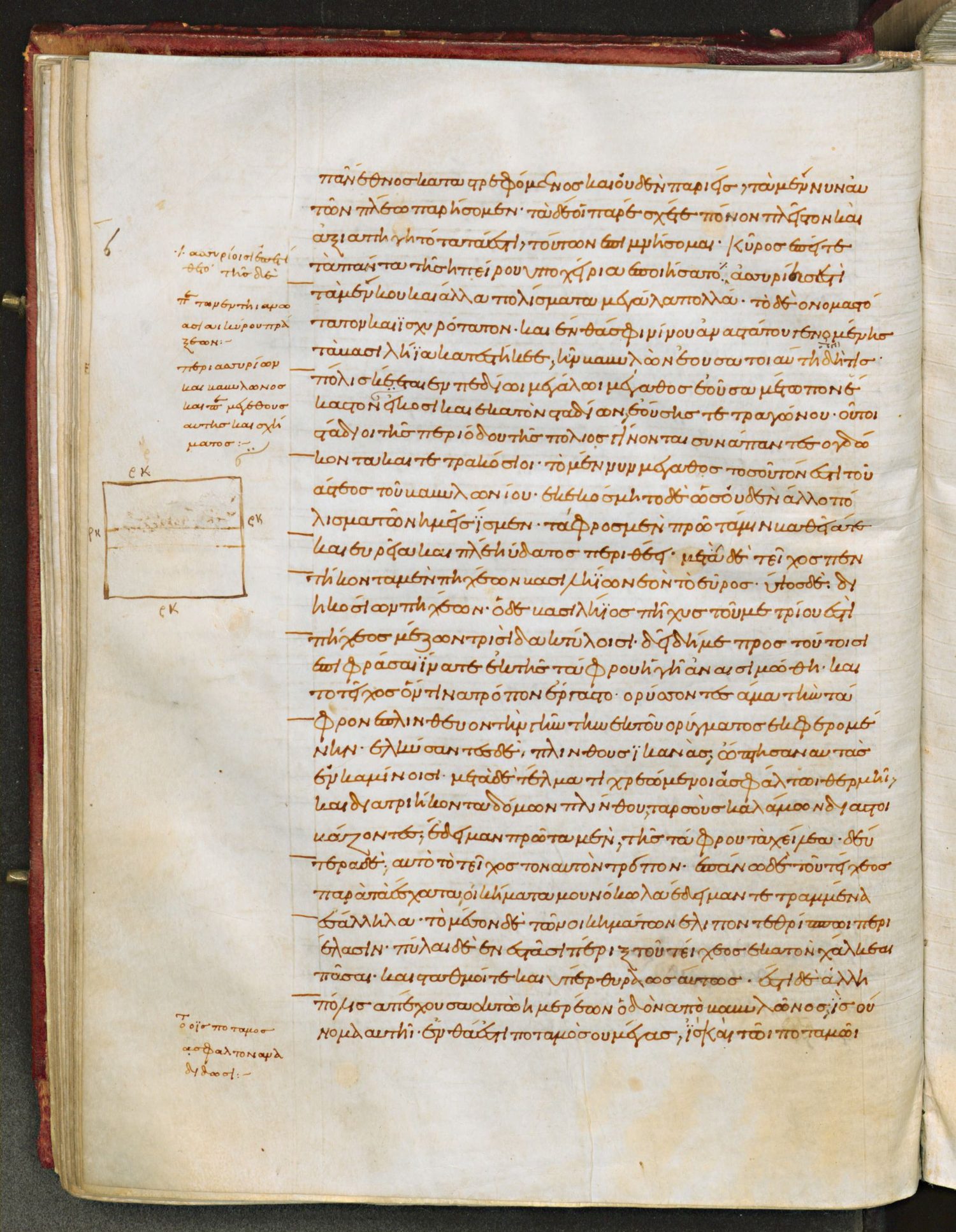
Laur. Plut. 70.3, fol. 45v: Greek here 1.177.1. Checked on the image (first and last words read and located in the Greek; each break checked against the neighbouring page): fol. 45v begins ‹πᾶν ἔθνος καταστρεφόμενος καὶ› (1.177.1), ends ‹Ἲς καὶ τῷ ποταμῷ› (1.179.4). English here: 1.177.1 (Godley's sentences for the sections whose Greek lies mostly on this page).
1.177.1πᾶν ἔθνος καταστρεφόμενος καὶ οὐδὲν παριείς. τὰ μέν νυν αὐτῶν πλέω παρήσομεν· τὰ δὲ οἱ παρέσχε τε πόνον πλεῖστον καὶ ἀξιαπηγητότατα ἐστί, τούτων ἐπιμνήσομαι.
1.177.1Harpagus then made havoc of lower Asia; in the upper country Cyrus himself subdued every nation, leaving none untouched. Of the greater part of these I will say nothing, but will speak only of those which gave Cyrus most trouble and are worthiest to be described.
Notes
- Greek: the text printed in A. D. Godley's Loeb edition, via Perseus (tlg0016.tlg001.perseus-grc2). Square brackets mark words the editor considers later additions; [...] marks a gap the editor indicates. Perseus note markers are omitted.
- English: A. D. Godley, Herodotus vol. 1 (1920) (Loeb Classical Library), as transcribed on Wikisource. Godley's footnotes are omitted.
- Section numbers in the English were placed by comparing Godley's text with the Perseus version of his translation; where a section begins inside one of Godley's sentences, the English is kept with the page that holds the start of that sentence.
Cite
Sources
- Source: Florence, Laur. Plut. 70.3 (10th c.) via BML Teca Digitale + Greek of Godley's Loeb (Perseus) + English of A. D. Godley (Loeb, Wikisource) (holding institution)
- Critical edition: Greek of A. D. Godley's Loeb edition (1920-1925), via Perseus
← previous · → next · v cycle view · l back to library