Herodotus, Histories 1.178-187: Babylon and its queens
Introduction
Herodotus of Halicarnassus wrote the Histories in the third quarter of the 5th century BCE, an inquiry into the deeds of Greeks and barbarians and the causes of the wars between them, later divided into nine books. Book 1 tells how the conflict between Greeks and barbarians began, the history of Lydia from Gyges to Croesus, the rise of the Medes and of Cyrus the Persian, the conquest of the Greeks of Asia, the capture of Babylon and the death of Cyrus.
The photographs are of Florence, Biblioteca Medicea Laurenziana, Plut. 70.3 (parchment, 10th century, 374 folios, 31 lines a page), Herodotus, Histories (codex A of the editors), the oldest surviving manuscript of the complete Histories, from the Teca Digitale of the Biblioteca Medicea Laurenziana. Each section below is the text of one page, or of the part of a page that falls within these chapters. The first and last words of every page were read on the photograph and located in the Greek, and every page break was checked against the next page; the notes quote these words. Readers' notes in the margins are not part of the text and are mentioned where they occur.
The Greek is the text printed in A. D. Godley's Loeb edition (1920-1925), from Perseus; it is the edited text, not a transcription of the manuscript, whose wording differs in places. The English is Godley's translation as printed, from Wikisource. Godley's English carries only chapter numbers; the section numbers shown in it were placed by comparison with the Perseus version of his translation. Each page's English is cut at the end of one of Godley's sentences, so it can begin or end a few lines away from the Greek of the page; each note gives the exact ranges.
This entry covers chapters 1.178-187, on fol. 45v to 48r.
How was this verified? (Provenance)
Where on the image
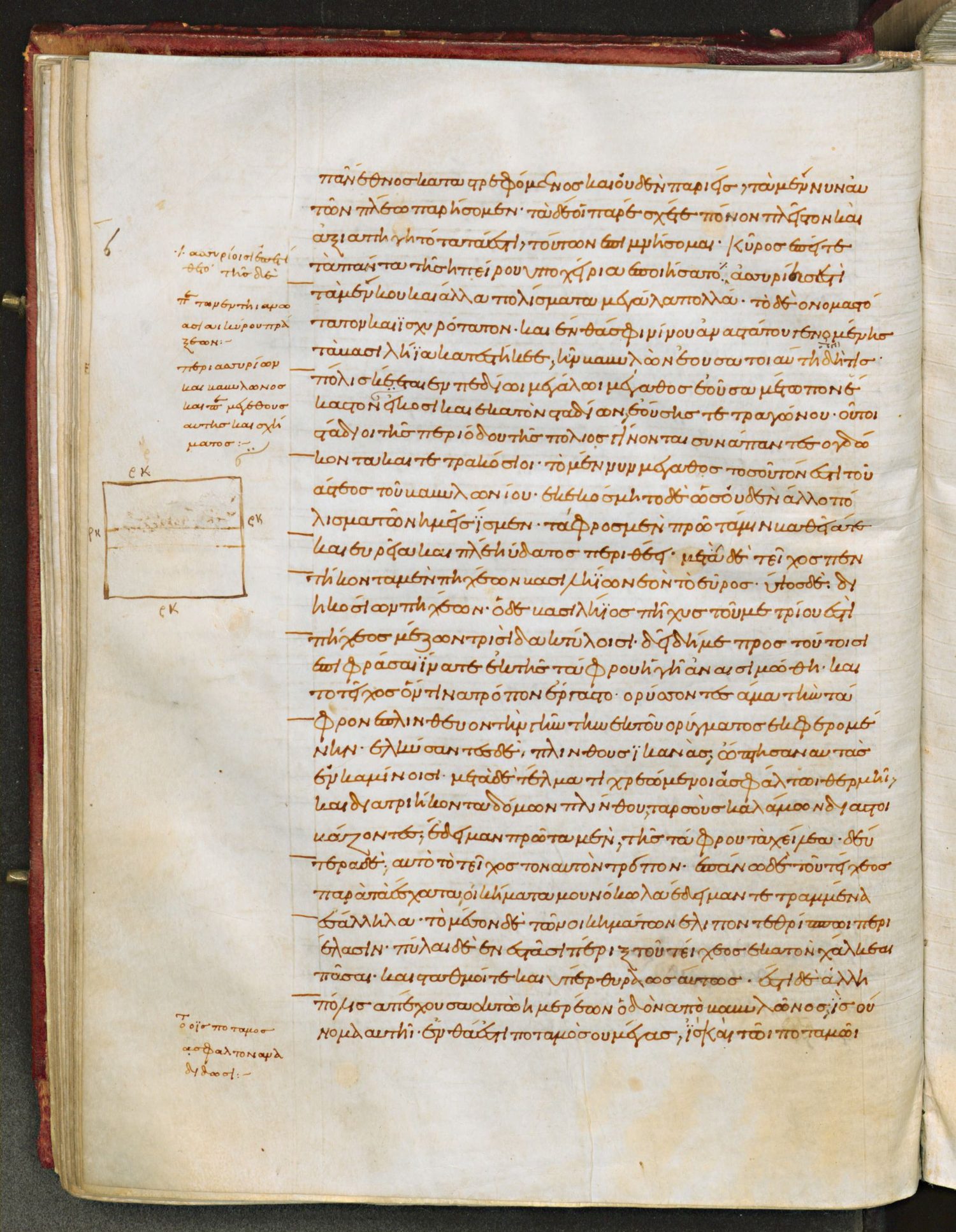
Laur. Plut. 70.3, fol. 45v: Greek here 1.178.1 to 1.179.4. Checked on the image (first and last words read and located in the Greek; each break checked against the neighbouring page): fol. 45v begins ‹πᾶν ἔθνος καταστρεφόμενος καὶ› (1.177.1), ends ‹Ἲς καὶ τῷ ποταμῷ› (1.179.4). English here: 1.178.1 to 1.179.3 (Godley's sentences for the sections whose Greek lies mostly on this page).
1.178.1Κῦρος ἐπείτε τὰ πάντα τῆς ἠπείρου ὑποχείρια ἐποιήσατο, Ἀσσυρίοισι ἐπετίθετο. τῆς δὲ Ἀσσυρίης ἐστὶ μὲν κου καὶ ἄλλα πολίσματα μεγάλα πολλά, τὸ δὲ ὀνομαστότατον καὶ ἰσχυρότατον καὶ ἔνθα σφι Νίνου ἀναστάτου γενομένης τὰ βασιλήια κατεστήκεε, ἦν Βαβυλών, ἐοῦσα τοιαύτη δή τις πόλις. 1.178.2κέεται ἐν πεδίῳ μεγάλῳ, μέγαθος ἐοῦσα μέτωπον ἕκαστον εἴκοσι καὶ ἑκατὸν σταδίων, ἐούσης τετραγώνου· οὗτοι στάδιοι τῆς περιόδου τῆς πόλιος γίνονται συνάπαντες ὀγδώκοντα καὶ τετρακόσιοι, τὸ μέν νυν μέγαθος τοσοῦτον ἐστὶ τοῦ ἄστεος τοῦ Βαβυλωνίου, ἐκεκόσμητο δὲ ὡς οὐδὲν ἄλλο πόλισμα τῶν ἡμεῖς ἴδμεν. 1.178.3τάφρος μὲν πρῶτά μιν βαθέα τε καὶ εὐρέα καὶ πλέη ὕδατος περιθέει, μετὰ δὲ τεῖχος πεντήκοντα μὲν πηχέων βασιληίων ἐὸν τὸ εὖρος, ὕψος δὲ διηκοσίων πηχέων· ὁ δὲ βασιλήιος πῆχυς τοῦ μετρίου ἐστὶ πήχεος μέζων τρισὶ δακτύλοισι. 1.179.1δεῖ δή με πρὸς τούτοισι ἔτι φράσαι ἵνα τε ἐκ τῆς τάφρου ἡ γῆ ἀναισιμώθη, καὶ τὸ τεῖχος ὅντινα τρόπον ἔργαστο. ὀρύσσοντες ἅμα τὴν τάφρον ἐπλίνθευον τὴν γῆν τὴν ἐκ τοῦ ὀρύγματος ἐκφερομένην, ἑλκύσαντες δὲ πλίνθους ἱκανὰς ὤπτησαν αὐτὰς ἐν καμίνοισι· 1.179.2μετὰ δὲ τέλματι χρεώμενοι ἀσφάλτῳ θερμῇ καὶ διὰ τριήκοντα δόμων πλίνθου ταρσοὺς καλάμων διαστοιβάζοντες, ἔδειμαν πρῶτα μὲν τῆς τάφου τὰ χείλεα, δευτέρα δὲ αὐτὸ τὸ τεῖχος τὸν αὐτὸν τρόπον. 1.179.3ἐπάνω δὲ τοῦ τείχεος παρὰ τὰ ἔσχατα οἰκήματα μουνόκωλα ἔδειμαν, τετραμμένα ἐς ἄλληλα· τὸ μέσον δὲ τῶν οἰκημάτων ἔλιπον τεθρίππῳ περιέλασιν. πύλαι δὲ ἐνεστᾶσι πέριξ τοῦ τείχεος ἑκατόν, χάλκεαι πᾶσαι, καὶ σταθμοί τε καὶ ὑπέρθυρα ὡσαύτως. 1.179.4ἔστι δὲ ἄλλη πόλις ἀπέχουσα ὀκτὼ ἡμερέων ὁδὸν ἀπὸ Βαβυλῶνος· Ἲς οὔνομα αὐτῇ. ἔνθα ἐστὶ ποταμὸς οὐ μέγας· Ἲς καὶ τῷ ποταμῷ
1.178.1When Cyrus had brought all the mainland under his sway, he attacked the Assyrians. There are in Assyria many other great cities; but the most famous and the strongest was Babylon, where the royal dwelling had been set after the destruction of Ninus. Babylon was a city such as I will now describe. 1.178.2It lies in a great plain, and is in shape a square, each side an hundred and twenty furlongs in length; thus four hundred and eighty furlongs make the complete circuit of the city. Such is the size of the city of Babylon; and it was planned like no other city whereof we know. 1.178.3Round it runs first a fosse deep and wide and full of water, and then a wall of fifty royal cubits’ thickness and two hundred cubits’ height. The royal cubit is greater by three fingers’ breadth than the common cubit. 1.179.1Further, I must show where the earth was used as it was taken from the fosse and in what manner the wall was wrought. As they dug the fosse, they made bricks of the earth which was carried out of the place they dug, and when they had moulded bricks enough they baked them in ovens; 1.179.2then using hot bitumen for cement and interposing layers of wattled reeds at every thirtieth course of bricks, they built first the border of the fosse and then the wall itself in the same fashion. 1.179.3On the top, along the edges of the wall, they built houses of a single chamber, facing each other, with space enough between for the driving of a four-horse chariot. There are an hundred gates in the circle of the wall, all of bronze, with posts and lintels of the same.
Where on the image
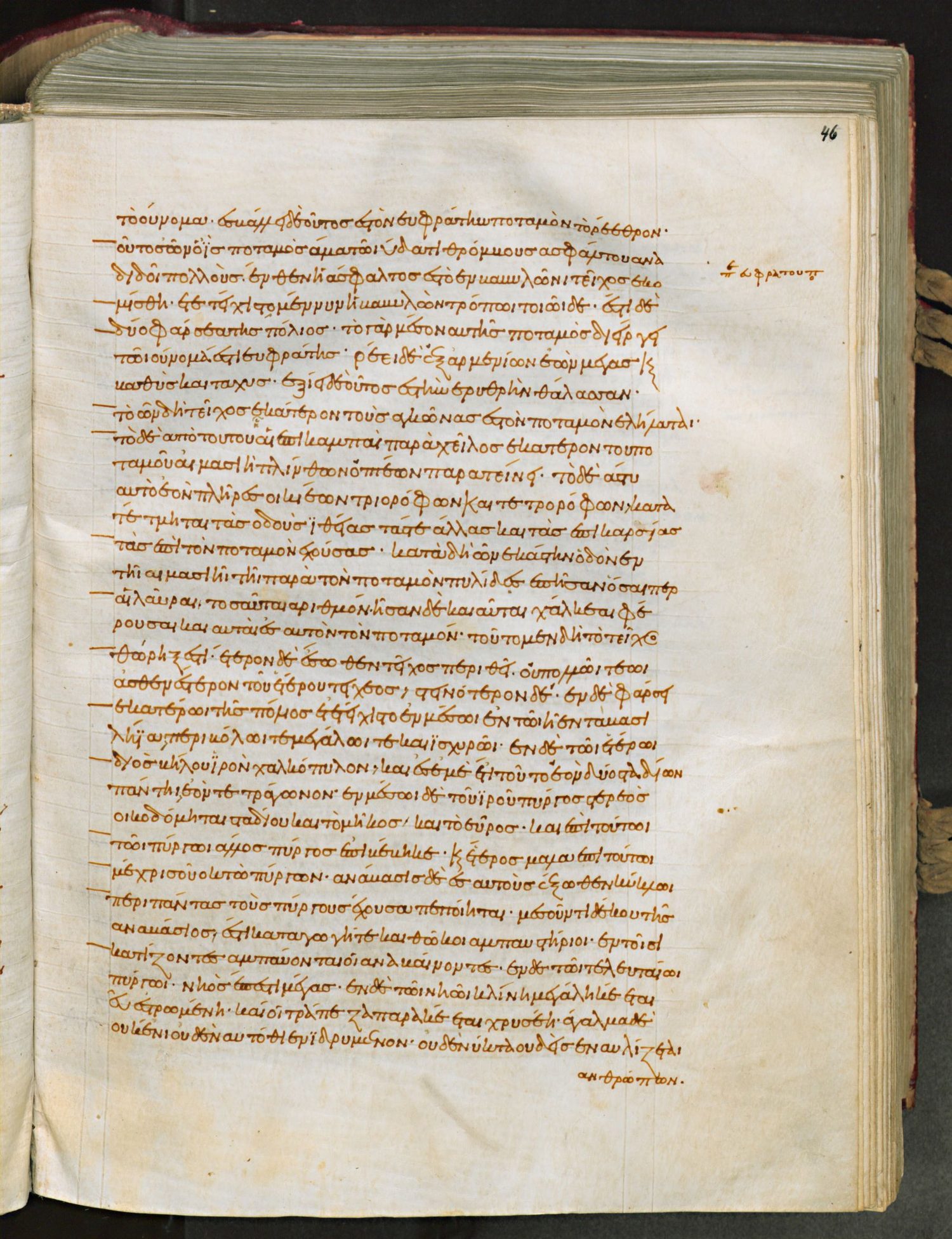
Laur. Plut. 70.3, fol. 46r: Greek here 1.179.4 to 1.181.5. Checked on the image (first and last words read and located in the Greek; each break checked against the neighbouring page): fol. 46r begins ‹τὸ οὔνομα· ἐσβάλλει δὲ› (1.179.4), ends ‹οὐδὲ νύκτα οὐδεὶς ἐναυλίζεται› (1.181.5). Fol. 46r ends οὐδεὶς ἐναυλίζεται and fol. 46v begins ὅτι μὴ γυνή: the edition's ἀνθρώπων (1.181.5) is not at the page break. English here: 1.179.4 to 1.181.5 (Godley's sentences for the sections whose Greek lies mostly on this page).
1.179.4τὸ οὔνομα· ἐσβάλλει δὲ οὗτος ἐς τὸν Εὐφρήτην ποταμὸν τὸ ῥέεθρον. οὗτος ὦν ὁ Ἲς ποταμὸς ἅμα τῷ ὕδατι θρόμβους ἀσφάλτου ἀναδιδοῖ πολλούς, ἔνθεν ἡ ἄσφαλτος ἐς τὸ ἐν Βαβυλῶνι τεῖχος ἐκομίσθη. 1.180.1ἐτετείχιστο μέν νυν ἡ Βαβυλὼν τρόπῳ τοιῷδε, ἔστι δὲ δύο φάρσεα τῆς πόλιος. τὸ γὰρ μέσον αὐτῆς ποταμὸς διέργει, τῷ οὔνομα ἐστὶ Εὐφρήτης· ῥέει δὲ ἐξ Ἀρμενίων, ἐὼν μέγας καὶ βαθὺς καὶ ταχύς· ἐξιεῖ δὲ οὗτος ἐς τὴν Ἐρυθρὴν θάλασσαν. 1.180.2τὸ ὦν δὴ τεῖχος ἑκάτερον τοὺς ἀγκῶνας ἐς τὸν ποταμὸν ἐλήλαται· τὸ δὲ ἀπὸ τούτου αἱ ἐπικαμπαὶ παρὰ χεῖλος ἑκάτερον τοῦ ποταμοῦ αἱμασιὴ πλίνθων ὀπτέων παρατείνει. 1.180.3τὸ δὲ ἄστυ αὐτό, ἐὸν πλῆρες οἰκιέων τριωρόφων καὶ τετρωρόφων, κατατέτμηται τὰς ὁδοὺς ἰθέας τάς τε ἄλλας καὶ τὰς ἐπικαρσίας τὰς ἐπὶ τὸν ποταμὸν ἐχούσας. 1.180.4κατὰ δὴ ὦν ἑκάστην ὁδὸν ἐν τῇ αἱμασιῇ τῇ παρὰ τὸν ποταμὸν πυλίδες ἐπῆσαν, ὅσαι περ αἱ λαῦραι, τοσαῦται ἀριθμόν· ἦσαν δὲ καὶ αὗται χάλκεαι […] φέρουσαι [καὶ αὐταὶ] ἐς αὐτὸν τὸν ποταμόν. 1.181.1τοῦτο μὲν δὴ τὸ τεῖχος θώρηξ ἐστί, ἕτερον δὲ ἔσωθεν τεῖχος περιθέει, οὐ πολλῷ τεῳ ἀσθενέστερον τοῦ ἑτέρου τείχεος, στεινότερον δέ. 1.181.2ἐν δὲ φάρσεϊ ἑκατέρῳ τῆς πόλιος ἐτετείχιστο ἐν μέσῳ ἐν τῷ μὲν τὰ βασιλήια περιβόλῳ μεγάλῳ τε καὶ ἰσχυρῷ, ἐν δὲ τῷ ἑτέρῳ Διὸς Βήλου ἱρὸν χαλκόπυλον, καὶ ἐς ἐμὲ ἔτι τοῦτο ἐόν, δύο σταδίων πάντῃ, ἐὸν τετράγωνον. 1.181.3ἐν μέσῳ δὲ τοῦ ἱροῦ πύργος στερεὸς οἰκοδόμηται, σταδίου καὶ τὸ μῆκος καὶ τὸ εὖρος, καὶ ἐπὶ τούτῳ τῷ πύργῳ ἄλλος πύργος ἐπιβέβηκε, καὶ ἕτερος μάλα ἐπὶ τούτῳ, μέχρι οὗ ὀκτὼ πύργων. 1.181.4ἀνάβασις δὲ ἐς αὐτοὺς ἔξωθεν κύκλῳ περὶ πάντας τοὺς πύργους ἔχουσα πεποίηται. μεσοῦντι δέ κου τῆς ἀναβάσιος ἐστὶ καταγωγή τε καὶ θῶκοι ἀμπαυστήριοι, ἐν τοῖσι κατίζοντες ἀμπαύονται οἱ ἀναβαίνοντες. 1.181.5ἐν δὲ τῷ τελευταίῳ πύργῳ νηὸς ἔπεστι μέγας· ἐν δὲ τῷ νηῷ κλίνη μεγάλη κέεται εὖ ἐστρωμένη, καὶ οἱ τράπεζα παρακέεται χρυσέη. ἄγαλμα δὲ οὐκ ἔνι οὐδὲν αὐτόθι ἐνιδρυμένον, οὐδὲ νύκτα οὐδεὶς ἐναυλίζεται ἀνθρώπων
1.179.4There is another city, called Is, eight days’ journey from Babylon, where is a little river, also named Is, a tributary stream of the river Euphrates; from the source of this river Is rise with the water many gouts of bitumen; and from thence the bitumen was brought for the wall of Babylon. 1.180.1Thus then was this wall built; the city is divided into two parts; for it is cut in half by a river named Euphrates, a wide, deep, and swift river, flowing from Armenia and issuing into the Red Sea. 1.180.2The ends of the wall, then, on either side are built quite down to the river; here they turn, and hence a fence of baked bricks runs along each bank of the stream. 1.180.3The city itself is full of houses three and four stories high; and the ways which traverse it—those that run crosswise towards the river, and the rest—are all straight. 1.180.4Further, at the end of each road there was a gate in the riverside fence, one gate for each alley; these gates also were of bronze, and these too opened on the river. 1.181.1These walls are the city’s outer armour; within them there is another encircling wall, well-nigh as strong as the other, but narrower. 1.181.2In the midmost of one division of the city stands the royal palace, surrounded by a high and strong wall; and in the midmost of the other is still to this day the sacred enclosure of Zeus Belus, a square of two furlongs each way, with gates of bronze. 1.181.3In the centre of this enclosure a solid tower has been built, of one furlong’s length and breadth; a second tower rises from this, and from it yet another, till at last there are eight. 1.181.4The way up to them mounts spirally outside all the towers; about halfway in the ascent is a halting place, with seats for repose, where those who ascend sit down and rest. 1.181.5In the last tower there is a great shrine; and in it a great and well-covered couch is laid, and a golden table set hard by. But no image has been set up in the shrine, nor does any human creature lie therein for the night, except one native woman, chosen from all women by the god, as say the Chaldaeans, who are priests of this god.
Where on the image
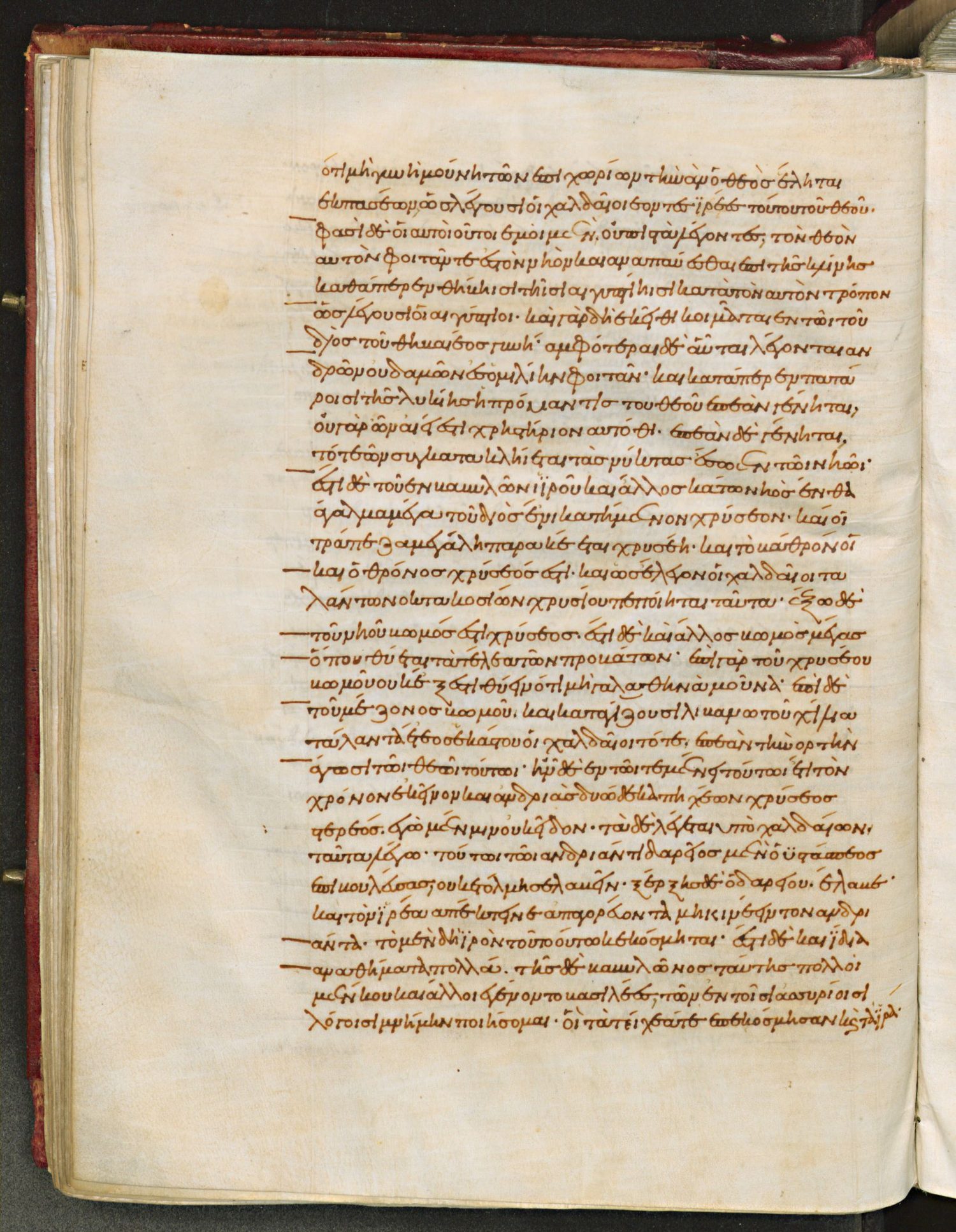
Laur. Plut. 70.3, fol. 46v: Greek here 1.181.5 to 1.184.1. Checked on the image (first and last words read and located in the Greek; each break checked against the neighbouring page): fol. 46v begins ‹ὅτι μὴ γυνὴ μούνη› (1.181.5), ends ‹ἐπεκόσμησαν καὶ τὰ ἱρά› (1.184.1). Fol. 46r ends οὐδεὶς ἐναυλίζεται and fol. 46v begins ὅτι μὴ γυνή: the edition's ἀνθρώπων (1.181.5) is not at the page break. English here: 1.182.1 to 1.183.3 (Godley's sentences for the sections whose Greek lies mostly on this page).
1.181.5ὅτι μὴ γυνὴ μούνη τῶν ἐπιχωρίων, τὴν ἂν ὁ θεὸς ἕληται ἐκ πασέων, ὡς λέγουσι οἱ Χαλδαῖοι ἐόντες ἱρέες τούτου τοῦ θεοῦ. 1.182.1φασὶ δὲ οἱ αὐτοὶ οὗτοι, ἐμοὶ μὲν οὐ πιστὰ λέγοντες, τὸν θεὸν αὐτὸν φοιτᾶν τε ἐς τὸν νηὸν καὶ ἀμπαύεσθαι ἐπὶ τῆς κλίνης, κατά περ ἐν Θήβῃσι τῇσι Αἰγυπτίῃσι κατὰ τὸν αὐτὸν τρόπον, ὡς λέγουσι οἱ Αἰγύπτιοι· 1.182.2καὶ γὰρ δὴ ἐκεῖθι κοιμᾶται ἐν τῷ τοῦ Διὸς τοῦ Θηβαιέος γυνή, ἀμφότεραι δὲ αὗται λέγονται ἀνδρῶν οὐδαμῶν ἐς ὁμιλίην φοιτᾶν· καὶ κατά περ ἐν Πατάροισι τῆς Λυκίης ἡ πρόμαντις τοῦ θεοῦ, ἐπεὰν γένηται· οὐ γὰρ ὦν αἰεί ἐστι χρηστήριον αὐτόθι· ἐπεὰν δὲ γένηται τότε ὦν συγκατακληίεται τὰς νύκτας ἔσω ἐν τῷ νηῷ. 1.183.1ἔστι δὲ τοῦ ἐν Βαβυλῶνι ἱροῦ καὶ ἄλλος κάτω νηός, ἔνθα ἄγαλμα μέγα τοῦ Διὸς ἔνι κατήμενον χρύσεον, καὶ οἱ τράπεζα μεγάλη παρακέεται χρυσέη, καὶ τὸ βάθρον οἱ καὶ ὁ θρόνος χρύσεος ἐστί· καὶ ὡς ἔλεγον οἱ Χαλδαῖοι, ταλάντων ὀκτακοσίων χρυσίου πεποίηται ταῦτα. 1.183.2ἔξω δὲ τοῦ νηοῦ βωμός ἐστι χρύσεος, ἔστι δὲ καὶ ἄλλος βωμὸς μέγας, ἐπʼ οὗ θύεται τὰ τέλεα τῶν προβάτων· ἐπὶ γὰρ τοῦ χρυσέου βωμοῦ οὐκ ἔξεστι θύειν ὅτι μὴ γαλαθηνὰ μούνα, ἐπὶ δὲ τοῦ μέζονος βωμοῦ καὶ καταγίζουσι λιβανωτοῦ χίλια τάλαντα ἔτεος ἑκάστου οἱ Χαλδαῖοι τότε ἐπεὰν τὴν ὁρτὴν ἄγωσι τῷ θεῷ τούτῳ. ἦν δὲ ἐν τῷ τεμένεϊ τούτῳ ἔτι τὸν χρόνον ἐκεῖνον καὶ ἀνδριὰς δυώδεκα πηχέων χρύσεος στερεός· 1.183.3ἐγὼ μέν μιν οὐκ εἶδον, τὰ δὲ λέγεται ὑπὸ Χαλδαίων, ταῦτα λέγω. τούτῳ τῷ ἀνδριάντι Δαρεῖος μὲν ὁ Ὑστάσπεος ἐπιβουλεύσας οὐκ ἐτόλμησε λαβεῖν, Ξέρξης δὲ ὁ Δαρείου ἔλαβε καὶ τὸν ἱρέα ἀπέκτεινε ἀπαγορεύοντα μὴ κινέειν τὸν ἀνδριάντα. τὸ μὲν δὴ ἱρὸν τοῦτο οὕτω κεκόσμηται, ἔστι δὲ καὶ ἴδια ἀναθήματα πολλά. 1.184.1τῆς δὲ Βαβυλῶνος ταύτης πολλοὶ μέν κου καὶ ἄλλοι ἐγένοντο βασιλέες, τῶν ἐν τοῖσι Ἀσσυρίοισι λόγοισι μνήμην ποιήσομαι, οἳ τὰ τείχεά τε ἐπεκόσμησαν καὶ τὰ ἱρά,
1.182.1These same Chaldaeans say (but I do not believe them) that the god himself is wont to visit the shrine and rest upon the couch, even as in Thebes of Egypt, as the Egyptians say ( 1.182.2for there too a woman sleeps in the temple of Theban Zeus, and neither the Egyptian nor the Babylonian woman, it is said, has intercourse with men), and as it is likewise with the prophetess of the god at Patara in Lycia, whenever she be appointed; for there is not always a place of divination there; but when she is appointed she is shut up in the temple during the night. 1.183.1In the Babylonian temple there is another shrine below, where is a great golden image of Zeus, sitting at a great golden table, and the footstool and the chair are also of gold; the gold of the whole was said by the Chaldeans to be of eight hundred talents’ weight. 1.183.2Outside of the temple is a golden altar. There is also another great altar, whereon are sacrificed the full-grown of the flocks; only sucklings may be sacrificed on the golden altar, but on the greater altar the Chaldeans even offer a thousand talents’ weight of frankincense yearly, when they keep the festival of this god; and in the days of Cyrus there was still in this sacred demesne a statue of solid gold twelve cubits high. 1.183.3I myself have not seen it, but I tell what is told by the Chaldeans. Darius son of Hystaspes purposed to take this statue but dared not; Xerxes his son took it, and slew the priest who warned him not to move the statue. Such is the adornment of this temple, and there are many private offerings besides.
Where on the image
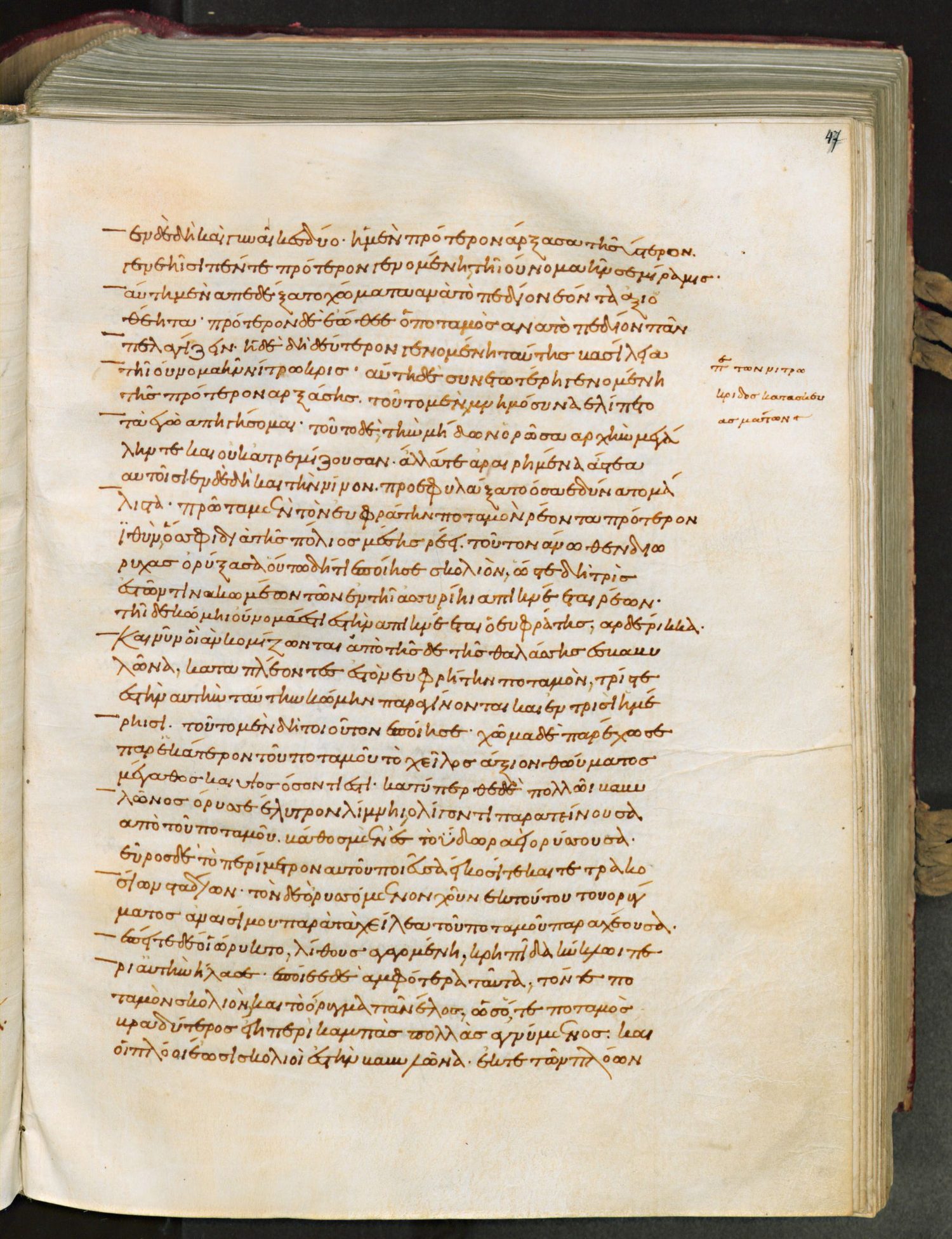
Laur. Plut. 70.3, fol. 47r: Greek here 1.184.1 to 1.185.6. Checked on the image (first and last words read and located in the Greek; each break checked against the neighbouring page): fol. 47r begins ‹ἐν δὲ δὴ καὶ› (1.184.1), ends ‹ἔκ τε τῶν πλόων› (1.185.6). English here: 1.184.1 to 1.185.6 (Godley's sentences for the sections whose Greek lies mostly on this page).
1.184.1ἐν δὲ δὴ καὶ γυναῖκες δύο. ἡ μὲν πρότερον ἄρξασα, τῆς ὕστερον γενεῇσι πέντε πρότερον γενομένη, τῇ οὔνομα ἦν Σεμίραμις, αὕτη μὲν ἀπεδέξατο χώματα ἀνὰ τὸ πεδίον ἐόντα ἀξιοθέητα· πρότερον δὲ ἐώθεε ὁ ποταμὸς ἀνὰ τὸ πεδίον πᾶν πελαγίζειν. 1.185.1ἡ δὲ δὴ δεύτερον γενομένη ταύτης βασίλεια, τῇ οὔνομα ἦν Νίτωκρις, αὕτη δὲ συνετωτέρη γενομένη τῆς πρότερον ἀρξάσης τοῦτο μὲν μνημόσυνα ἐλίπετο τὰ ἐγὼ ἀπηγήσομαι, τοῦτο δὲ τὴν Μήδων ὁρῶσα ἀρχὴν μεγάλην τε καὶ οὐκ ἀτρεμίζουσαν, ἀλλʼ ἄλλα τε ἀραιρημένα ἄστεα αὐτοῖσι, ἐν δὲ δὴ καὶ τὴν Νίνον, προεφυλάξατο ὅσα ἐδύνατο μάλιστα. 1.185.2πρῶτα μὲν τὸν Εὐφρήτην ποταμὸν ῥέοντα πρότερον ἰθύν, ὅς σφι διὰ τῆς πόλιος μέσης ῥέει, τοῦτον ἄνωθεν διώρυχας ὀρύξασα οὕτω δή τι ἐποίησε σκολιὸν ὥστε δὴ τρὶς ἐς τῶν τινα κωμέων τῶν ἐν τῇ Ἀσσυρίῃ ἀπικνέεται ῥέων· τῇ δὲ κώμῃ οὔνομα ἐστί, ἐς τὴν ἀπικνέεται ὁ Εὐφρήτης, Ἀρδέρικκα. καὶ νῦν οἳ ἂν κομίζωνται ἀπὸ τῆσδε τῆς θαλάσσης ἐς Βαβυλῶνα, καταπλέοντες τὸν Εὐφρήτην ποταμὸν τρίς τε ἐς τὴν αὐτὴν ταύτην κώμην παραγίνονται καὶ ἐν τρισὶ ἡμέρῃσι. 1.185.3τοῦτο μὲν δὴ τοιοῦτον ἐποίησε, χῶμα δὲ παρέχωσε παρʼ ἑκάτερον τοῦ ποταμοῦ τὸ χεῖλος ἄξιον θώματος μέγαθος καὶ ὕψος ὅσον τι ἐστί. 1.185.4κατύπερθε δὲ πολλῷ Βαβυλῶνος ὤρυσσε ἔλυτρον λίμνῃ, ὀλίγον τι παρατείνουσα ἀπὸ τοῦ ποταμοῦ, βάθος μὲν ἐς τὸ ὕδωρ αἰεὶ ὀρύσσουσα, εὖρος δὲ τὸ περίμετρον αὐτοῦ ποιεῦσα εἴκοσί τε καὶ τετρακοσίων σταδίων· τὸν δὲ ὀρυσσόμενον χοῦν ἐκ τούτου τοῦ ὀρύγματος ἀναισίμου παρὰ τὰ χείλεα τοῦ ποταμοῦ παραχέουσα. 1.185.5ἐπείτε δέ οἱ ὀρώρυκτο, λίθους ἀγαγομένη κρηπῖδα κύκλῳ περὶ αὐτὴν ἤλασε. 1.185.6ἐποίεε δὲ ἀμφότερα ταῦτα, τόν τε ποταμὸν σκολιὸν καὶ τὸ ὄρυγμα πᾶν ἕλος, ὡς ὅ τε ποταμὸς βραδύτερος εἴη περὶ καμπὰς πολλὰς ἀγνύμενος, καὶ οἱ πλόοι ἔωσι σκολιοὶ ἐς τὴν Βαβυλῶνα, ἔκ τε τῶν πλόων
1.184.1Now among the many rulers of this city of Babylon (of whom I shall make mention in my Assyrian history), who finished the building of the walls and the temples, there were two that were women. The first of these lived five generations earlier than the second, and her name was Semiramis: it was she who built dykes on the plain, a notable work; before that the whole plain was wont to be flooded by the river. 1.185.1The second queen, whose name was Nitocris, was a wiser woman than the first. She left such monuments as I shall record; and moreover, seeing that the rulers of Media were powerful and unresting, insomuch that Ninus itself among other cities had fallen before them, she took such care as she could for her protection. 1.185.2First she dealt with the river Euphrates, which flows through the middle of her city; this had before been straight; but by digging canals higher up she made the river so crooked that its course now passes thrice by one of the Assyrian villages; the village which is so approached by the Euphrates is called Ardericca. And now those who travel from our seas to Babylon must as they float down the Euphrates spend three days in coming thrice to the same village. 1.185.3Such was this work; and she built an embankment along either shore of the river, marvellous for its greatness and height. 1.185.4Then a long way above Babylon she dug the basin of a lake, a little way aside from the river, digging always deep enough to find water, and making the circuit of the lake a distance of four hundred and twenty furlongs; all that was dug out of the basin she used to embank either edge of the river; 1.185.5and when she had it all dug, she brought stones and made therewith a coping all round the basin. 1.185.6Her purpose in making the river to wind and turning the basin into a marsh was this—that the current might be slower by reason of the many windings that broke its force, and that the passages to Babylon might be crooked, and that next after them should come also the long circuit of the lake.
Where on the image
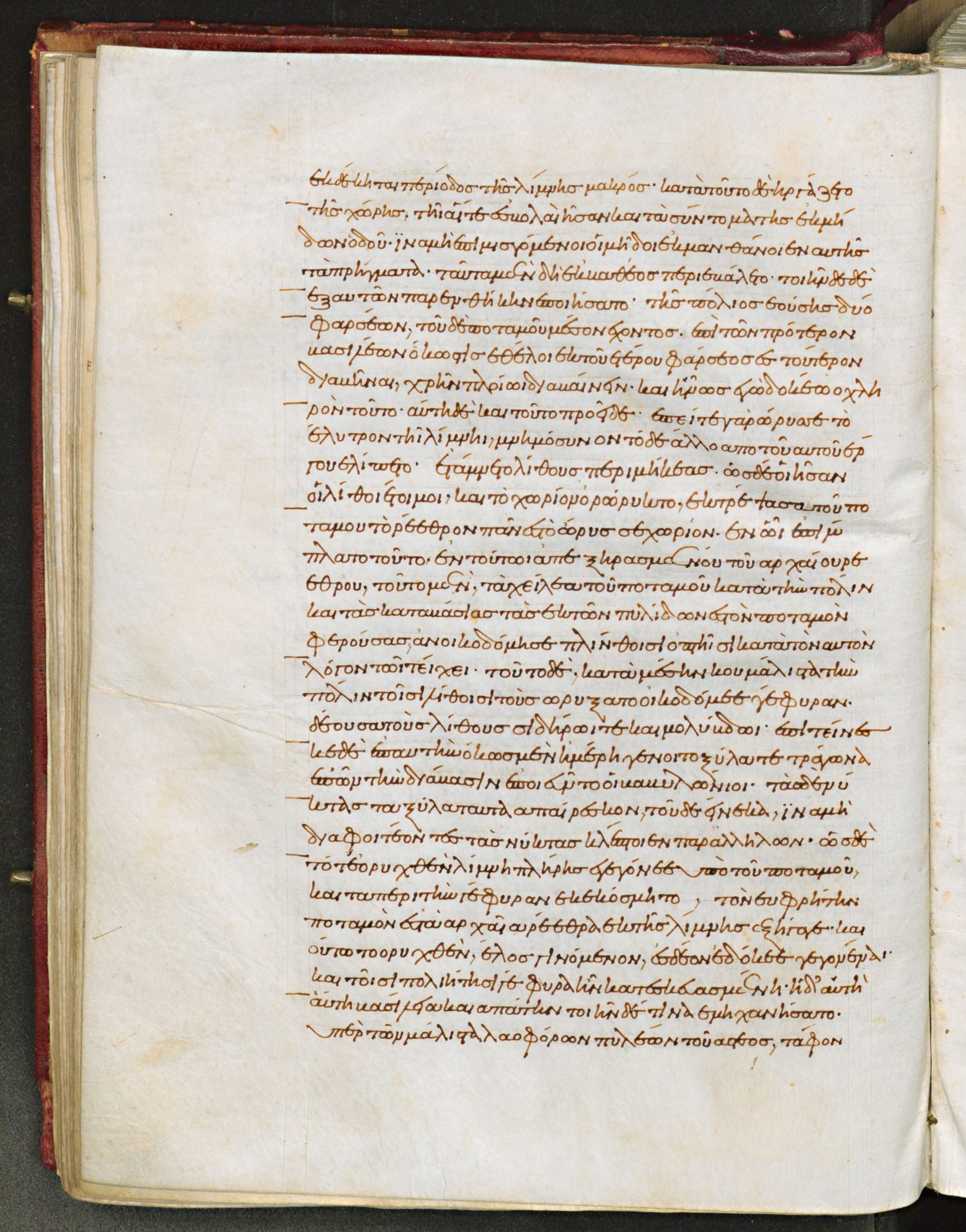
Laur. Plut. 70.3, fol. 47v: Greek here 1.185.6 to 1.187.1. Checked on the image (first and last words read and located in the Greek; each break checked against the neighbouring page): fol. 47v begins ‹ἐκδέκηται περίοδος τῆς λίμνης› (1.185.6), ends ‹πυλέων τοῦ ἄστεος τάφον› (1.187.1). English here: 1.185.7 to 1.187.2 (Godley's sentences for the sections whose Greek lies mostly on this page).
1.185.6ἐκδέκηται περίοδος τῆς λίμνης μακρή. 1.185.7κατὰ τοῦτο δὲ ἐργάζετο τῆς χώρης τῇ αἵ τε ἐσβολαὶ ἦσαν καὶ τὰ σύντομα τῆς ἐκ Μήδων ὁδοῦ, ἵνα μὴ ἐπιμισγόμενοι οἱ Μῆδοι ἐκμανθάνοιεν αὐτῆς τὰ πρήγματα. 1.186.1ταῦτα μὲν δὴ ἐκ βάθεος περιεβάλετο, τοιήνδε δὲ ἐξ αὐτῶν παρενθήκην ἐποιήσατο. τῆς πόλιος ἐούσης δύο φαρσέων, τοῦ δὲ ποταμοῦ μέσον ἔχοντος, ἐπὶ τῶν πρότερον βασιλέων ὅκως τις ἐθέλοι ἐκ τοῦ ἑτέρου φάρσεος ἐς τοὔτερον διαβῆναι, χρῆν πλοίῳ διαβαίνειν, καὶ ἦν, ὡς ἐγὼ δοκέω, ὀχληρὸν τοῦτο. αὕτη δὲ καὶ τοῦτο προεῖδε. ἐπείτε γὰρ ὤρυσσε τὸ ἔλυτρον τῇ λίμνῃ, μνημόσυνον τόδε ἄλλο ἀπὸ τοῦ αὐτοῦ ἔργου ἐλίπετο· 1.186.2ἐτάμνετο λίθους περιμήκεας, ὡς δέ οἱ ἦσαν οἱ λίθοι ἕτοιμοι καὶ τὸ χωρίον ὀρώρυκτο, ἐκτρέψασα τοῦ ποταμοῦ τὸ ῥέεθρον πᾶν ἐς τὸ ὤρυσσε χωρίον, ἐν ᾧ ἐπίμπλατο τοῦτο, ἐν τούτω ἀπεξηρασμένου τοῦ ἀρχαίου ῥεέθρου τοῦτο μὲν τὰ χείλεα τοῦ ποταμοῦ κατὰ τὴν πόλιν καὶ τὰς καταβάσιας τὰς ἐκ τῶν πυλίδων ἐς τὸν ποταμὸν φερούσας ἀνοικοδόμησε πλίνθοισι ὀπτῇσι κατὰ τὸν αὐτὸν λόγον τῷ τείχεϊ, τοῦτο δὲ κατὰ μέσην κου μάλιστα τὴν πόλιν τοῖσι λίθοισι τοὺς ὠρύξατο οἰκοδόμεε γέφυραν, δέουσα τοὺς λίθους σιδήρῳ τε καὶ μολύβδῳ. 1.186.3ἐπιτείνεσκε δὲ ἐπʼ αὐτήν, ὅκως μὲν ἡμέρη γίνοιτο, ξύλα τετράγωνα, ἐπʼ ὧν τὴν διάβασιν ἐποιεῦντο οἱ Βαβυλώνιοι· τὰς δὲ νύκτας τὰ ξύλα ταῦτα ἀπαιρέεσκον τοῦδε εἵνεκα, ἵνα μὴ διαφοιτέοντες τὰς νύκτας κλέπτοιεν παρʼ ἀλλήλων. 1.186.4ὡς δὲ τό τε ὀρυχθὲν λίμνη πλήρης ἐγεγόνεε ὑπὸ τοῦ ποταμοῦ καὶ τὰ περὶ τὴν γέφυραν ἐκεκόσμητο, τὸν Εὐφρήτην ποταμὸν ἐς τὰ ἀρχαῖα ῥέεθρα ἐκ τῆς λίμνης ἐξήγαγε, καὶ οὕτω τὸ ὀρυχθὲν ἕλος γενόμενον ἐς δέον ἐδόκεε γεγονέναι καὶ τοῖσι πολιήτῃσι γέφυρα ἦν κατεσκευασμένη. 1.187.1ἡ δʼ αὐτὴ αὕτη βασίλεια καὶ ἀπάτην τοιήνδε τινὰ ἐμηχανήσατο· ὕπερ τῶν μάλιστα λεωφόρων πυλέων τοῦ ἄστεος τάφον
1.185.7All this work was done in that part of the country where are the passes and the shortest road from Media, that the Medes might not mix with her people and learn of her affairs. 1.186.1So she made the deep river her protection; and from this work grew another which she added to it. Her city was divided into two portions by the river which flowed through the centre. Whenever in the days of the former rulers one would pass over from one part to the other, he must cross in a boat; and this, as I suppose, was troublesome. But the queen provided also for this; when the digging of the basin of the lake was done, she made another monument of her reign out of this same work. 1.186.2She had very long blocks of stone hewn; and when these were ready and the place was dug, she turned the course of the river wholly into it, and while it was filling, the former channel being now dry, she bricked with baked bricks, like those of the wall, the borders of the river in the city and the descents from the gates leading down to the river; also about the middle of the city she built a bridge with the stones which had been dug up, binding them together with iron and lead. 1.186.3She laid across it square-hewn logs each morning, whereon the Babylonians crossed; but these logs were taken away for the night, lest folk should be ever crossing over and stealing from each other. 1.186.4Then, when the basin she had made for a lake was filled by the river and the bridge was finished, Nitocris brought the Euphrates back to its former channel out of the lake; thus she had served her purpose, as she thought, by making a swamp of the basin, and her citizens had a bridge ready for them. 1.187.1There was a trick, moreover, which this same queen contrived. She had a tomb made for herself and set high over the very gate of that entrance or the city which was most used, with a writing graven on the tomb, which was this: “ 1.187.2If any king of Babylon in future time lack money, let him open this tomb and take what so money he desires: but let him not open it except he lack; for it will be the worse for him.”
Where on the image
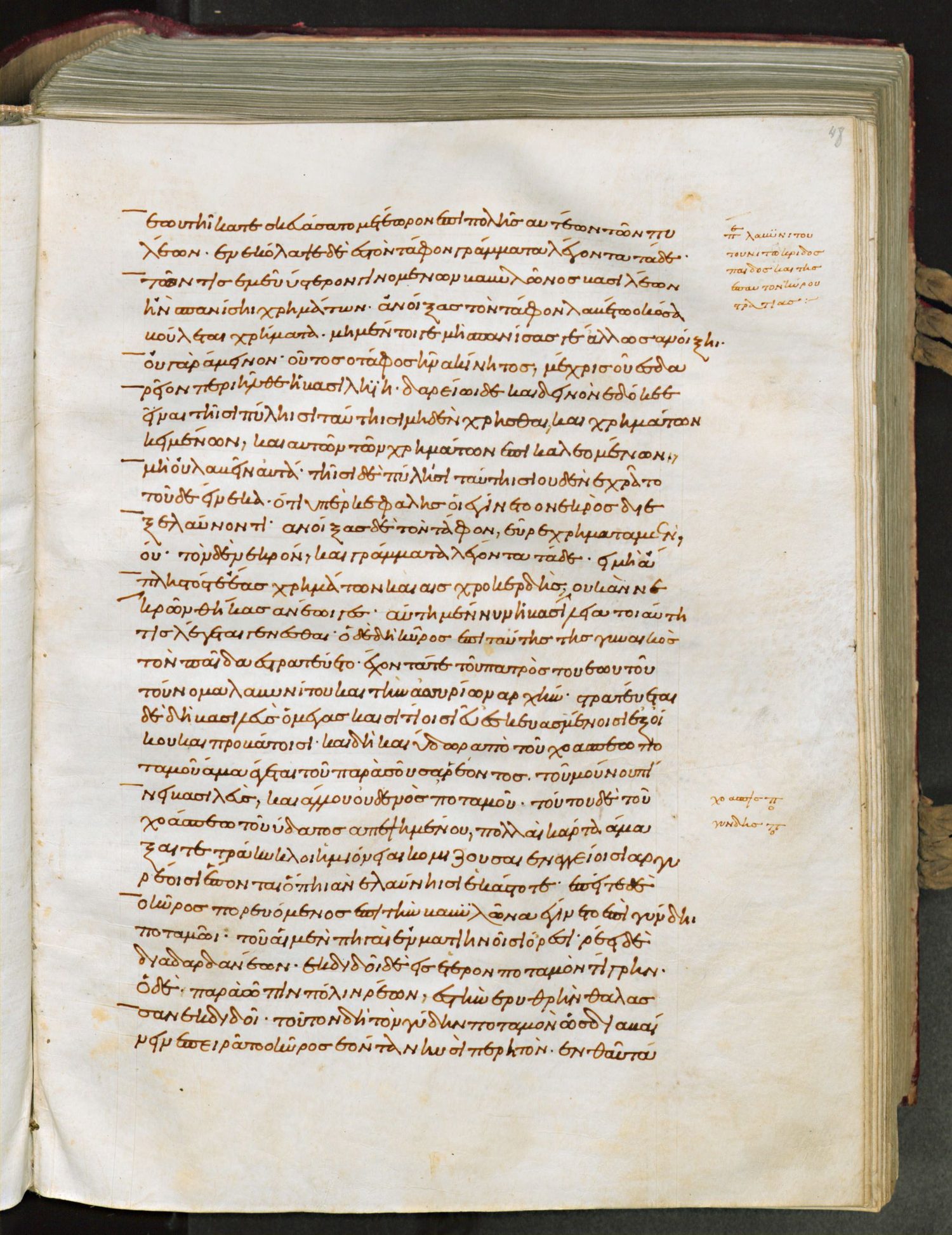
Laur. Plut. 70.3, fol. 48r: Greek here 1.187.1 to 1.187.5. Checked on the image (first and last words read and located in the Greek; each break checked against the neighbouring page): fol. 48r begins ‹ἑωυτῇ κατεσκευάσατο μετέωρον ἐπιπολῆς› (1.187.1), ends ‹Κῦρος ἐόντα νηυσιπέρητον, ἐνθαῦτά› (1.189.1). English here: 1.187.3 to 1.187.5 (Godley's sentences for the sections whose Greek lies mostly on this page).
1.187.1ἑωυτῇ κατεσκευάσατο μετέωρον ἐπιπολῆς αὐτέων τῶν πυλέων, ἐνεκόλαψε δὲ ἐς τὸν τάφον γράμματα λέγοντα τάδε. 1.187.2τῶν τις ἐμεῦ ὕστερον γινομένων Βαβυλῶνος βασιλέων ἢν σπανίσῃ χρημάτων, ἀνοίξας τὸν τάφον λαβέτω ὁκόσα βούλεται χρήματα· μὴ μέντοι γε μὴ σπανίσας γε ἄλλως ἀνοίξῃ· οὐ γὰρ ἄμεινον· 1.187.3οὗτος ὁ τάφος ἦν ἀκίνητος μέχρι οὗ ἐς Δαρεῖον περιῆλθε ἡ βασιληίη· Δαρείῳ δὲ καὶ δεινὸν ἐδόκεε εἶναι τῇσι πύλῃσι ταύτῃσι μηδὲν χρᾶσθαι, καὶ χρημάτων κειμένων καὶ αὐτῶν τῶν γραμμάτων ἐπικαλεομένων, μὴ οὐ λαβεῖν αὐτά· 1.187.4τῇσι δὲ πύλῃσι ταύτῃσι οὐδὲν ἐχρᾶτο τοῦδε εἵνεκα, ὅτι ὕπερ κεφαλῆς οἱ ἐγίνετο ὁ νεκρὸς διεξελαύνοντι. 1.187.5ἀνοίξας δὲ τὸν τάφον εὗρε χρήματα μὲν οὔ, τὸν δὲ νεκρὸν καὶ γράμματα λέγοντα τάδε· εἰ μὴ ἄπληστός τε ἔας χρημάτων καὶ αἰσχροκερδής, οὐκ ἂν νεκρῶν θήκας ἀνέῳγες. αὕτη μέν νυν ἡ βασίλεια τοιαύτη τις λέγεται γενέσθαι.
1.187.3This tomb remained untouched till the kingship fell to Darius. He thought it a very strange thing that he should never use this gate, nor take the money when it lay there and the writing itself invited him to the deed. 1.187.4The cause of his not using the gate was that the dead body must be over his head as he passed through. 1.187.5Having opened the tomb, he found there no money, but only the dead body, with this writing: “Wert thou not insatiate of wealth and basely desirous of gain, thou hadst not opened the coffins of the dead.” Such a woman, it is recorded, was this queen.
Notes
- Greek: the text printed in A. D. Godley's Loeb edition, via Perseus (tlg0016.tlg001.perseus-grc2). Square brackets mark words the editor considers later additions; [...] marks a gap the editor indicates. Perseus note markers are omitted.
- English: A. D. Godley, Herodotus vol. 1 (1920) (Loeb Classical Library), as transcribed on Wikisource. Godley's footnotes are omitted.
- Section numbers in the English were placed by comparing Godley's text with the Perseus version of his translation; where a section begins inside one of Godley's sentences, the English is kept with the page that holds the start of that sentence.
Cite
Sources
- Source: Florence, Laur. Plut. 70.3 (10th c.) via BML Teca Digitale + Greek of Godley's Loeb (Perseus) + English of A. D. Godley (Loeb, Wikisource) (holding institution)
- Critical edition: Greek of A. D. Godley's Loeb edition (1920-1925), via Perseus
← previous · → next · v cycle view · l back to library