Herodotus, Histories 1.188-200: The capture of Babylon; Babylonian customs
Introduction
Herodotus of Halicarnassus wrote the Histories in the third quarter of the 5th century BCE, an inquiry into the deeds of Greeks and barbarians and the causes of the wars between them, later divided into nine books. Book 1 tells how the conflict between Greeks and barbarians began, the history of Lydia from Gyges to Croesus, the rise of the Medes and of Cyrus the Persian, the conquest of the Greeks of Asia, the capture of Babylon and the death of Cyrus.
The photographs are of Florence, Biblioteca Medicea Laurenziana, Plut. 70.3 (parchment, 10th century, 374 folios, 31 lines a page), Herodotus, Histories (codex A of the editors), the oldest surviving manuscript of the complete Histories, from the Teca Digitale of the Biblioteca Medicea Laurenziana. Each section below is the text of one page, or of the part of a page that falls within these chapters. The first and last words of every page were read on the photograph and located in the Greek, and every page break was checked against the next page; the notes quote these words. Readers' notes in the margins are not part of the text and are mentioned where they occur.
The Greek is the text printed in A. D. Godley's Loeb edition (1920-1925), from Perseus; it is the edited text, not a transcription of the manuscript, whose wording differs in places. The English is Godley's translation as printed, from Wikisource. Godley's English carries only chapter numbers; the section numbers shown in it were placed by comparison with the Perseus version of his translation. Each page's English is cut at the end of one of Godley's sentences, so it can begin or end a few lines away from the Greek of the page; each note gives the exact ranges.
This entry covers chapters 1.188-200, on fol. 48r to 51v.
How was this verified? (Provenance)
Where on the image
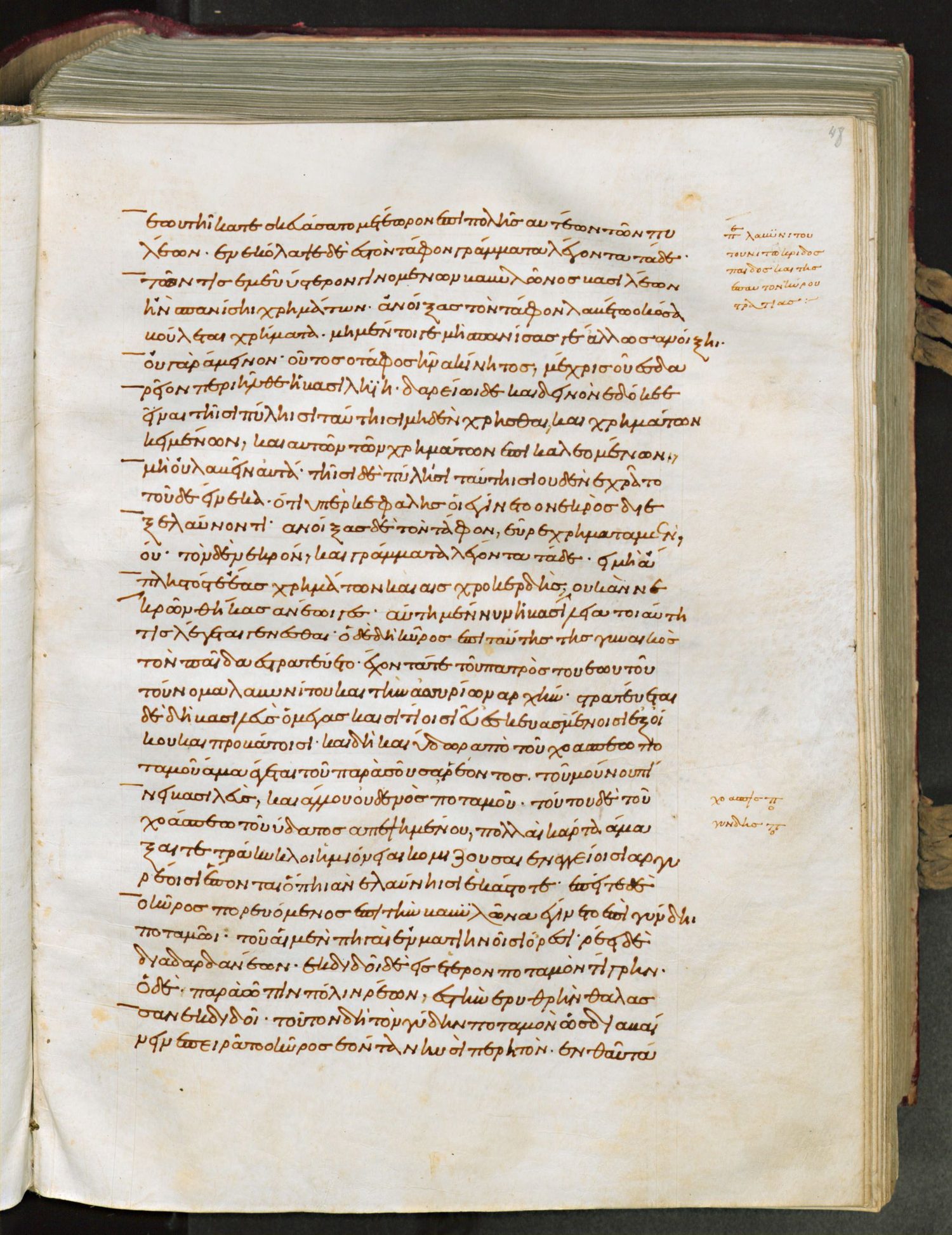
Laur. Plut. 70.3, fol. 48r: Greek here 1.188.1 to 1.189.1. Checked on the image (first and last words read and located in the Greek; each break checked against the neighbouring page): fol. 48r begins ‹ἑωυτῇ κατεσκευάσατο μετέωρον ἐπιπολῆς› (1.187.1), ends ‹Κῦρος ἐόντα νηυσιπέρητον, ἐνθαῦτά› (1.189.1). English here: 1.188.1 to 1.189.1 (Godley's sentences for the sections whose Greek lies mostly on this page).
1.188.1ὁ δὲ δὴ Κῦρος ἐπὶ ταύτης τῆς γυναικὸς τὸν παῖδα ἐστρατεύετο, ἔχοντά τε τοῦ πατρὸς τοῦ ἑωυτοῦ τοὔνομα Λαβυνήτου καὶ τὴν Ἀσσυρίων ἀρχήν. στρατεύεται δὲ δὴ βασιλεὺς ὁ μέγας καὶ σιτίοισι εὖ ἐσκευασμένος ἐξ οἴκου καὶ προβάτοῖσι, καὶ δὴ καὶ ὕδωρ ἀπὸ τοῦ Χοάσπεω ποταμοῦ ἅμα ἄγεται τοῦ παρὰ Σοῦσα ῥέοντος, τοῦ μούνου πίνει βασιλεὺς καὶ ἄλλου οὐδενὸς ποταμοῦ. 1.188.2τούτου δὲ τοῦ Χοάσπεω τοῦ ὕδατος ἀπεψημένου πολλαὶ κάρτα ἅμαξαι τετράκυκλοι ἡμιόνεαι κομίζουσαι ἐν ἀγγηίοισι ἀργυρέοισι ἕπονται, ὅκῃ ἂν ἐλαύνῃ ἑκάστοτε. 1.189.1ἐπείτε δὲ ὁ Κῦρος πορευόμενος ἐπὶ τὴν Βαβυλῶνα ἐγίνετο ἐπὶ Γύνδῃ ποταμῷ, τοῦ αἱ μὲν πηγαὶ ἐν Ματιηνοῖσι ὄρεσι, ῥέει δὲ διὰ Δαρδανέων, ἐκδιδοῖ δὲ ἐς ἕτερον ποταμὸν Τίγρην, ὁ δὲ παρὰ Ὦπιν πόλιν ῥέων ἐς τὴν Ἐρυθρὴν θάλασσαν ἐκδιδοῖ, τοῦτον δὴ τὸν Γύνδην ποταμὸν ὡς διαβαίνειν ἐπειρᾶτο ὁ Κῦρος ἐόντα νηυσιπέρητον, ἐνθαῦτά
1.188.1Cyrus, then, marched against Nitocris’ son, who inherited the name of his father Labynetus and the sovereignty of Assyria. Now when the Great King marches he goes well provided with food and flocks from home; and water from the Choaspes which flows past Susa is carried with him, whereof alone, and of none other, the king drinks. 1.188.2This water of the Choaspes is boiled, and very many four wheeled waggons drawn by mules carry it in silver vessels, following the king whithersoever he goes at any time. 1.189.1When Cyrus on his way to Babylon came to the river Gyndes, which rises in the mountains of the Matieni and flows through the Dardanean country into another river, the Tigris, which again passes the city of Opis and issues into the Red Sea—when Cyrus, I say, essayed to cross the Gyndes, it being there navigable, one of his sacred white horses dashed recklessly into the river that he might win through it, but the stream whelmed him and swept him under and away.
Where on the image
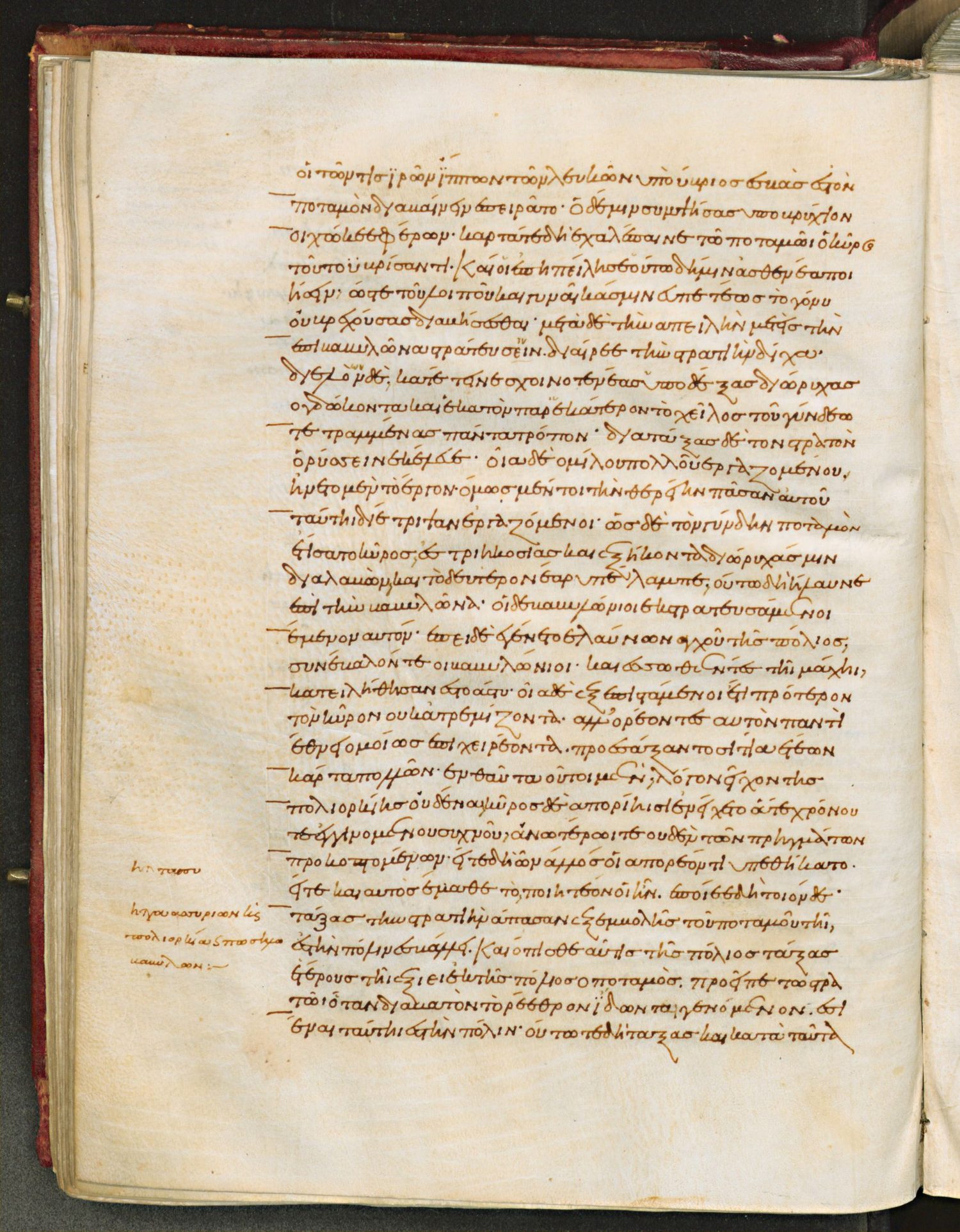
Laur. Plut. 70.3, fol. 48v: Greek here 1.189.1 to 1.191.2. Checked on the image (first and last words read and located in the Greek; each break checked against the neighbouring page): fol. 48v begins ‹οἱ τῶν τις ἱρῶν› (1.189.1), ends ‹τάξας καὶ κατὰ ταῦτα› (1.191.2). English here: 1.189.2 to 1.191.3 (Godley's sentences for the sections whose Greek lies mostly on this page).
1.189.1οἱ τῶν τις ἱρῶν ἵππων τῶν λευκῶν ὑπὸ ὕβριος ἐσβὰς ἐς τὸν ποταμὸν διαβαίνειν ἐπειρᾶτο, ὁ δέ μιν συμψήσας ὑποβρύχιον οἰχώκεε φέρων. 1.189.2κάρτα τε δὴ ἐχαλέπαινε τῷ ποταμῷ ὁ Κῦρος τοῦτο ὑβρίσαντι, καί οἱ ἐπηπείλησε οὕτω δή μιν ἀσθενέα ποιήσειν ὥστε τοῦ λοιποῦ καὶ γυναῖκας μιν εὐπετέως τὸ γόνυ οὐ βρεχούσας διαβήσεσθαι. 1.189.3μετὰ δὲ τὴν ἀπειλὴν μετεὶς τὴν ἐπὶ Βαβυλῶνα στράτευσιν διαίρεε τὴν στρατιὴν δίχα, διελὼν δὲ κατέτεινε σχοινοτενέας ὑποδέξας διώρυχας ὀγδώκοντα καὶ ἑκατὸν παρʼ ἑκάτερον τὸ χεῖλος τοῦ Γύνδεω τετραμμένας πάντα τρόπον, διατάξας δὲ τὸν στρατὸν ὀρύσσειν ἐκέλευε. 1.189.4οἷα δὲ ὁμίλου πολλοῦ ἐργαζομένου ἤνετο μὲν τὸ ἔργον, ὅμως μέντοι τὴν θερείην πᾶσαν αὐτοῦ ταύτῃ διέτριψαν ἐργαζόμενοι. 1.190.1ὡς δὲ τὸν Γύνδην ποταμὸν ἐτίσατο Κῦρος ἐς τριηκοσίας καὶ ἑξήκοντα διώρυχάς μιν διαλαβών, καὶ τὸ δεύτερον ἔαρ ὑπέλαμπε, οὕτω δὴ ἤλαυνε ἐπὶ τὴν Βαβυλῶνα. οἱ δὲ Βαβυλώνιοι ἐκστρατευσάμενοι ἔμενον αὐτόν. ἐπεὶ δὲ ἐγένετο ἐλαύνων ἀγχοῦ τῆς πόλιος, συνέβαλόν τε οἱ Βαβυλώνιοι καὶ ἑσσωθέντες τῇ μάχῃ κατειλήθησαν ἐς τὸ ἄστυ. 1.190.2οἷα δὲ ἐξεπιστάμενοι ἔτι πρότερον τὸν Κῦρον οὐκ ἀτρεμίζοντα, ἀλλʼ ὁρέοντες αὐτὸν παντὶ ἔθνεϊ ὁμοίως ἐπιχειρέοντα, προεσάξαντο σιτία ἐτέων κάρτα πολλῶν. ἐνθαῦτα οὗτοι μὲν λόγον εἶχον τῆς πολιορκίης οὐδένα, Κῦρος δὲ ἀπορίῃσι ἐνείχετο, ἅτε χρόνου τε ἐγγινομένου συχνοῦ ἀνωτέρω τε οὐδὲν τῶν πρηγμάτων προκοπτομένων. 1.191.1εἴτε δὴ ὦν ἄλλος οἱ ἀπορέοντι ὑπεθήκατο, εἴτε καὶ αὐτὸς ἔμαθε τὸ ποιητέον οἱ ἦν, ἐποίεε δὴ τοιόνδε. 1.191.2τάξας τὴν στρατιὴν ἅπασαν ἐξ ἐμβολῆς τοῦ ποταμοῦ, τῇ ἐς τὴν πόλιν ἐσβάλλει, καὶ ὄπισθε αὖτις τῆς πόλιος τάξας ἑτέρους, τῇ ἐξιεῖ ἐκ τῆς πόλιος ὁ ποταμός, προεῖπε τῷ στρατῷ, ὅταν διαβατὸν τὸ ῥέεθρον ἴδωνται γενόμενον, ἐσιέναι ταύτῃ ἐς τὴν πόλιν. οὕτω τε δὴ τάξας καὶ κατὰ ταῦτα
1.189.2At this violent deed of the river Cyrus was very wroth, and he threatened it that he would make it so weak that women should ever after cross it easily without wetting their knees. 1.189.3Having so threatened he ceased from his march against Babylon, and dividing his army into two parts he drew lines planning out a hundred and eighty canals running every way from either bank of the Gyndes; then he arrayed his army along the lines and bade them dig. 1.189.4Since a great multitude was at the work it went with all speed; yet they spent the whole summer there before it was finished. 1.190.1Then at the opening of the second spring, when Cyrus had punished the Gyndes by parting it among the three hundred and sixty canals, he marched at last against Babylon. The Babylonians sallied out and awaited him; and when in his march he came near to their city, they joined battle, but they were worsted and driven within the city. 1.190.2There, because they knew already that Cyrus was no man of peace, and saw that he attacked all nations alike, they had stored provision enough for very many years; so now they cared nothing for the siege; and Cyrus knew not what to do, being so long delayed and gaining no advantage. 1.191.1Whether, then, someone advised him in his difficulty, or he perceived for himself what to do, I know not, but this he did: 1.191.2he posted his army at the place where the river enters the city, and another part of it where the stream issues from the city, and bade his men enter the city by the channel of the Euphrates when they should see it to be fordable. Having so arrayed them and given this command, he himself marched away with those of his army who could not fight; 1.191.3and when he came to the lake, Cyrus dealt with it and with the river just as had the Babylonian queen; drawing off the river by a canal into the lake, which was till now a marsh, he made the stream to sink till its former channel could be forded.
Where on the image
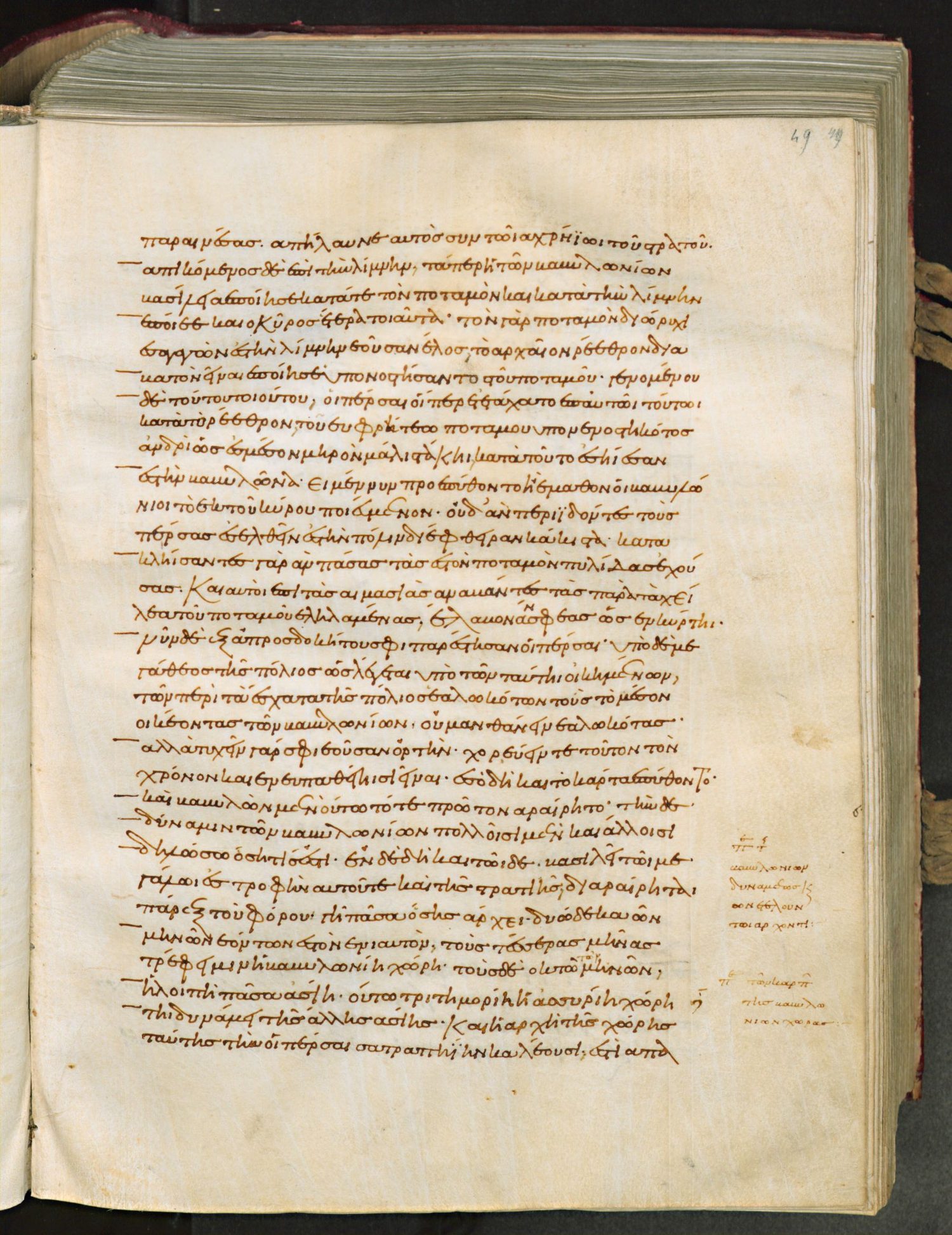
Laur. Plut. 70.3, fol. 49r: Greek here 1.191.2 to 1.192.2. Checked on the image (first and last words read and located in the Greek; each break checked against the neighbouring page): fol. 49r begins ‹παραινέσας ἀπήλαυνε αὐτὸς σὺν› (1.191.2), ends ‹σατραπηίην καλέουσι, ἐστὶ ἁπα-› (1.192.2). English here: 1.191.4 to 1.192.1 (Godley's sentences for the sections whose Greek lies mostly on this page).
1.191.2παραινέσας ἀπήλαυνε αὐτὸς σὺν τῷ ἀχρηίῳ τοῦ στρατοῦ. 1.191.3ἀπικόμενος δὲ ἐπὶ τὴν λίμνην, τά περ ἡ τῶν Βαβυλωνίων βασίλεια ἐποίησε κατά τε τὸν ποταμὸν καὶ κατὰ τὴν λίμνην, ἐποίεε καὶ ὁ Κῦρος ἕτερα τοιαῦτα· τὸν γὰρ ποταμὸν διώρυχι ἐσαγαγὼν ἐς τὴν λίμνην ἐοῦσαν ἕλος, τὸ ἀρχαῖον ῥέεθρον διαβατὸν εἶναι ἐποίησε, ὑπονοστήσαντος τοῦ ποταμοῦ. 1.191.4γενομένου δὲ τούτου τοιούτου, οἱ Πέρσαι οἵ περ ἐτετάχατο ἐπʼ αὐτῷ τούτῳ κατὰ τὸ ῥέεθρον τοῦ Εὐφρήτεω ποταμοῦ ὑπονενοστηκότος ἀνδρὶ ὡς ἐς μέσον μηρὸν μάλιστά κῃ, κατὰ τοῦτο ἐσήισαν ἐς τὴν Βαβυλῶνα. 1.191.5εἰ μέν νυν προεπύθοντο ἢ ἔμαθον οἱ Βαβυλώνιοι τὸ ἐκ τοῦ Κύρου ποιεύμενον, οἳ δʼ ἂν περιιδόντες τοὺς Πέρσας ἐσελθεῖν ἐς τὴν πόλιν διέφθειραν ἂν κάκιστα· κατακληίσαντες γὰρ ἂν πάσας τὰς ἐς τὸν ποταμὸν πυλίδας ἐχούσας καὶ αὐτοὶ ἐπὶ τὰς αἱμασιὰς ἀναβάντες τὰς παρὰ τὰ χείλεα τοῦ ποταμοῦ ἐληλαμένας, ἔλαβον ἂν σφέας ὡς ἐν κύρτῃ. 1.191.6νῦν δὲ ἐξ ἀπροσδοκήτου σφι παρέστησαν οἱ Πέρσαι. ὑπὸ δὲ μεγάθεος τῆς πόλιος, ὡς λέγεται ὑπὸ τῶν ταύτῃ οἰκημένων, τῶν περὶ τὰ ἔσχατα τῆς πόλιος ἑαλωκότων τοὺς τὸ μέσον οἰκέοντας τῶν Βαβυλωνίων οὐ μανθάνειν ἑαλωκότας, ἀλλὰ τυχεῖν γάρ σφι ἐοῦσαν ὁρτήν, χορεύειν τε τοῦτον τὸν χρόνον καὶ ἐν εὐπαθείῃσι εἶναι, ἐς ὃ δὴ καὶ τὸ κάρτα ἐπύθοντο. 1.192.1καὶ Βαβυλὼν μὲν οὕτω τότε πρῶτον ἀραίρητο. τὴν δὲ δύναμιν τῶν Βαβυλωνίων πολλοῖσι μὲν καὶ ἄλλοισι δηλώσω ὅση τις ἐστί, ἐν δὲ δὴ καὶ τῷδε. βασιλέι τῷ μεγάλῳ ἐς τροφὴν αὐτοῦ τε καὶ τῆς στρατιῆς διαραίρηται, πάρεξ τοῦ φόρου, γῆ πᾶσα ὅσης ἄρχει· δυώδεκα ὦν μηνῶν ἐόντων ἐς τὸν ἐνιαυτὸν τοὺς τέσσερας μῆνας τρέφει μιν ἡ Βαβυλωνίη χωρῇ, τοὺς δὲ ὀκτὼ τῶν μηνῶν ἡ λοιπὴ πᾶσα Ἀσίη. 1.192.2οὕτω τριτημορίη ἡ Ἀσσυρίη χώρη τῇ δυνάμι τῆς ἄλλης Ἀσίης. καὶ ἡ ἀρχὴ τῆς χώρης ταύτης, τὴν οἱ Πέρσαι σατραπηίην καλέουσι, ἐστὶ ἁπασέων
1.191.4When this happened, the Persians who were posted with this intent made their way into Babylon by the channel of the Euphrates, which had now sunk about to the height of the middle of a man’s thigh. 1.191.5Now if the Babylonians had known beforehand or learnt what Cyrus was planning, they would have suffered the Persians to enter the city and brought them to a miserable end; for then they would have shut all the gates that opened on the river and themselves mounted up on to the walls that ran along the river banks, and so caught their enemies as in a trap. 1.191.6But as it was, the Persians were upon them unawares, and by reason of the great size of the city—so say those who dwell there—those in the outer parts of it were overcome, yet the dwellers in the middle part knew nothing of it; all this time they were dancing and making merry at a festival which chanced to be toward, till they learnt the truth but too well. 1.192.1Thus was Babylon then for the first time taken. There are many proofs of the wealth of Babylon, but this in especial. All the land ruled by the great King is parcelled out for the provisioning of himself and his army, besides that it pays tribute: now the territory of Babylon feeds him for four out of the twelve months in the year, the whole of the rest of Asia providing for the other eight.
Where on the image
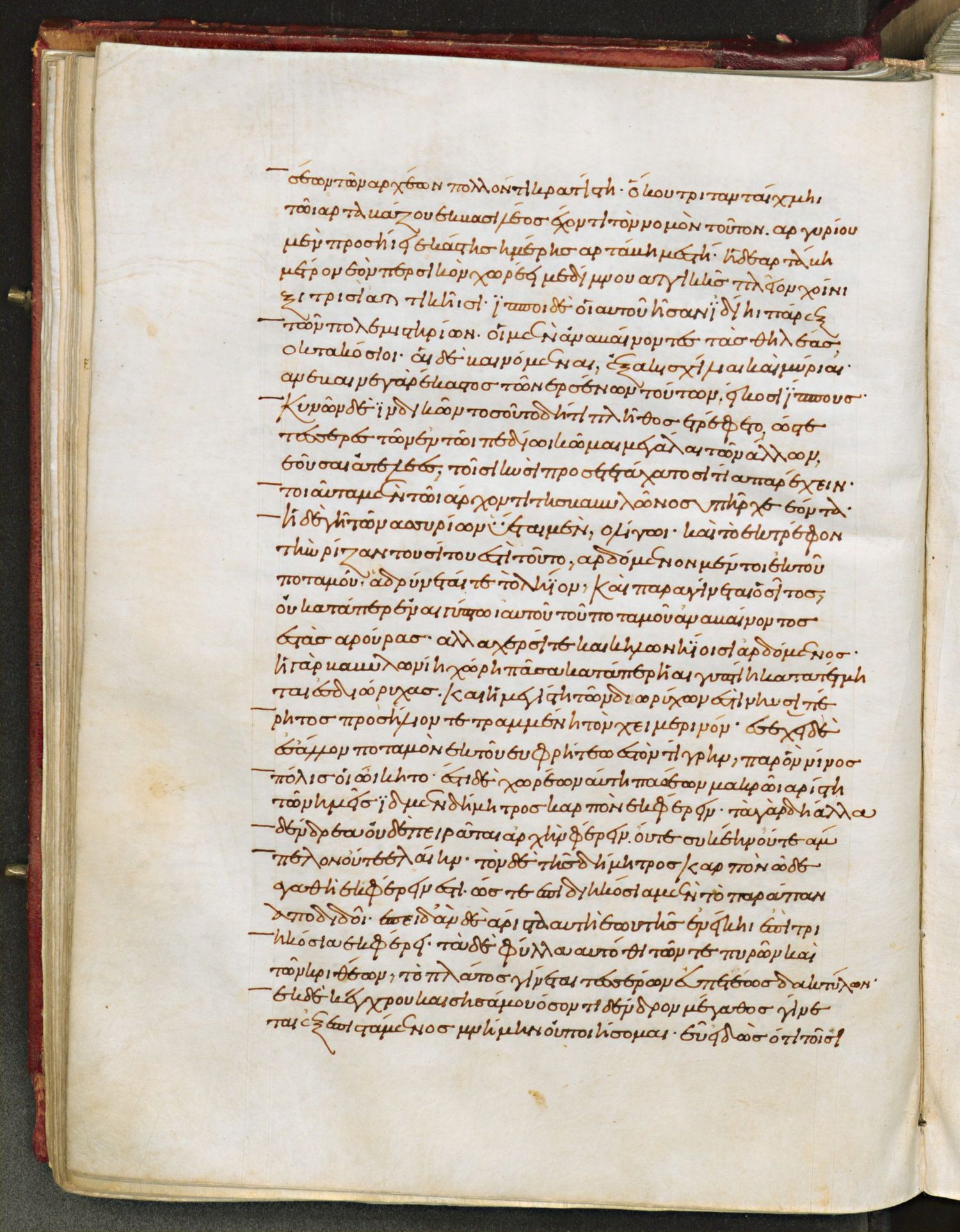
Laur. Plut. 70.3, fol. 49v: Greek here 1.192.2 to 1.193.4. Checked on the image (first and last words read and located in the Greek; each break checked against the neighbouring page): fol. 49v begins ‹-σέων τῶν ἀρχέων πολλόν› (1.192.2), ends ‹εὖ εἰδὼς ὅτι τοῖσι› (1.193.4). The word ‹ἁπασέων› is divided between fol. 49r and fol. 49v; it is given with fol. 49r. English here: 1.192.2 to 1.193.4 (Godley's sentences for the sections whose Greek lies mostly on this page).
1.192.2τῶν ἀρχέων πολλόν τι κρατίστη, ὅκου Τριτανταίχμῃ τῷ Ἀρταβάζου ἐκ βασιλέος ἔχοντι τὸν νομὸν τοῦτον ἀργυρίου μὲν προσήιε ἑκάστης ἡμέρης ἀρτάβη μεστή. 1.192.3ἡ δὲ ἀρτάβη, μέτρον ἐὸν Περσικόν, χωρέει μεδίμνου Ἀττικοῦ πλέον χοίνιξι τρισὶ Ἀττικῇσι, ἵπποι δὲ οἱ αὐτοῦ ἦσαν ἰδίῃ, πάρεξ τῶν πολεμιστηρίων, οἱ μὲν ἀναβαίνοντες τὰς θηλέας ὀκτακόσιοι, αἱ δὲ βαινόμεναι ἑξακισχίλιαι καὶ μυρίαι· ἀνέβαινε γὰρ ἕκαστος τῶν ἐρσένων τούτων εἴκοσι ἵππους. 1.192.4κυνῶν δὲ Ἰνδικῶν τοσοῦτο δή τι πλῆθος ἐτρέφετο ὥστε τέσσερες τῶν ἐν τῷ πεδίῳ κῶμαι μεγάλαι, τῶν ἄλλων ἐοῦσαι ἀτελέες, τοῖσι κυσὶ προσετετάχατο σιτία παρέχειν. τοιαῦτα μὲν τῷ ἄρχοντι τῆς Βαβυλῶνος ὑπῆρχε ἐόντα. 1.193.1ἡ δὲ γῆ τῶν Ἀσσυρίων ὕεται μὲν ὀλίγῳ, καὶ τὸ ἐκτρέφον τὴν ῥίζαν τοῦ σίτου ἐστὶ τοῦτο· ἀρδόμενον μέντοι ἐκ τοῦ ποταμοῦ ἁδρύνεταί τε τὸ λήιον καὶ παραγίνεται ὁ σῖτος, οὐ κατὰ περ ἐν Αἰγύπτῳ αὐτοῦ τοῦ ποταμοῦ ἀναβαίνοντος ἐς τὰς ἀρούρας, ἀλλὰ χερσί τε καὶ κηλωνηίοισι ἀρδόμενος. 1.193.2ἡ γὰρ Βαβυλωνίη χώρη πᾶσα, κατά περ ἡ Αἰγυπτίη, κατατέτμηται ἐς διώρυχας· καὶ ἡ μεγίστη τῶν διωρύχων ἐστὶ νηυσιπέρητος, πρὸς ἥλιον τετραμμένη τὸν χειμερινόν, ἐσέχει δὲ ἐς ἄλλον ποταμὸν ἐκ τοῦ Εὐφρήτεω, ἐς τὸν Τίγρην, παρʼ ὃν Νίνος πόλις οἴκητο. ἔστι δὲ χωρέων αὕτη πασέων μακρῷ ἀρίστη τῶν ἡμεῖς ἴδμεν Δήμητρος καρπὸν ἐκφέρειν […] 1.193.3τὰ γὰρ δὴ ἄλλα δένδρεα οὐδὲ πειρᾶται ἀρχὴν φέρειν, οὔτε συκέην οὔτε ἄμπελον οὔτε ἐλαίην. τὸν δὲ τῆς Δήμητρος καρπὸν ὧδε ἀγαθὴ ἐκφέρειν ἐστὶ ὥστε ἐπὶ διηκόσια μὲν τὸ παράπαν ἀποδιδοῖ, ἐπειδὰν δὲ ἄριστα αὐτὴ ἑωυτῆς ἐνείκῃ, ἐπὶ τριηκόσια ἐκφέρει. τὰ δὲ φύλλα αὐτόθι τῶν τε πυρῶν καὶ τῶν κριθέων τὸ πλάτος γίνεται τεσσέρων εὐπετέως δακτύλων. 1.193.4ἐκ δὲ κέγχρου καὶ σησάμου ὅσον τι δένδρον μέγαθος γίνεται, ἐξεπιστάμενος μνήμην οὐ ποιήσομαι, εὖ εἰδὼς ὅτι τοῖσι
1.192.2Thus the wealth of Assyria is one third of the whole wealth of Asia. The governorship, which the Persians call “satrapy,” of this land is by far the greatest of all the governorships; seeing that the daily revenue of Tritantaechmes son of Artabazus, governing this province by the king’s will, was an artaba full of silver ( 1.192.3the artaba is a Persian measure, containing more by three Attic choenixes than an Attic medimnus), and besides war chargers he had in his stables eight hundred stallions, and sixteen thousand brood mares, each stallion serving twenty mares. 1.192.4Moreover he kept so great a number of Indian dogs that four great villages of the plain were appointed to provide food for the dogs and eased from all other burdens. Such were the riches of the governor of Babylon. 1.193.1There is but little rain in Assyria. It is this which nourishes the roots of the corn; but it is irrigation from the river that ripens the crop and brings the grain to fulness: it is not as in Egypt, where the river itself rises and floods the fields: in Assyria they are watered by hand and by swinging beams. 1.193.2For the whole land of Babylon, like Egypt, is cut across by canals. The greatest of these is navigable: it runs towards where the sun rises in winter, from the Euphrates to another river, the Tigris, by which stood the city of Ninus. This land is of all known to us by far the most fertile in corn. 1.193.3Trees it does not even essay to grow, fig, vine, or olive, but its corn is so abundant that it yields for the most part two hundred fold, and even three hundred fold when the harvest is best. The blades of the wheat and barley there are easily four fingers broad; 1.193.4and for millet and sesame, I will not say, though it is known to me, to what a height they grow; for I am well aware that even what I have said respecting corn is wholly disbelieved by those who have never visited Babylonia. They use no oil save what they make from sesame. There are palm trees there growing all over the plain, most of them yielding fruit, from which food is made and wine and honey.
Where on the image
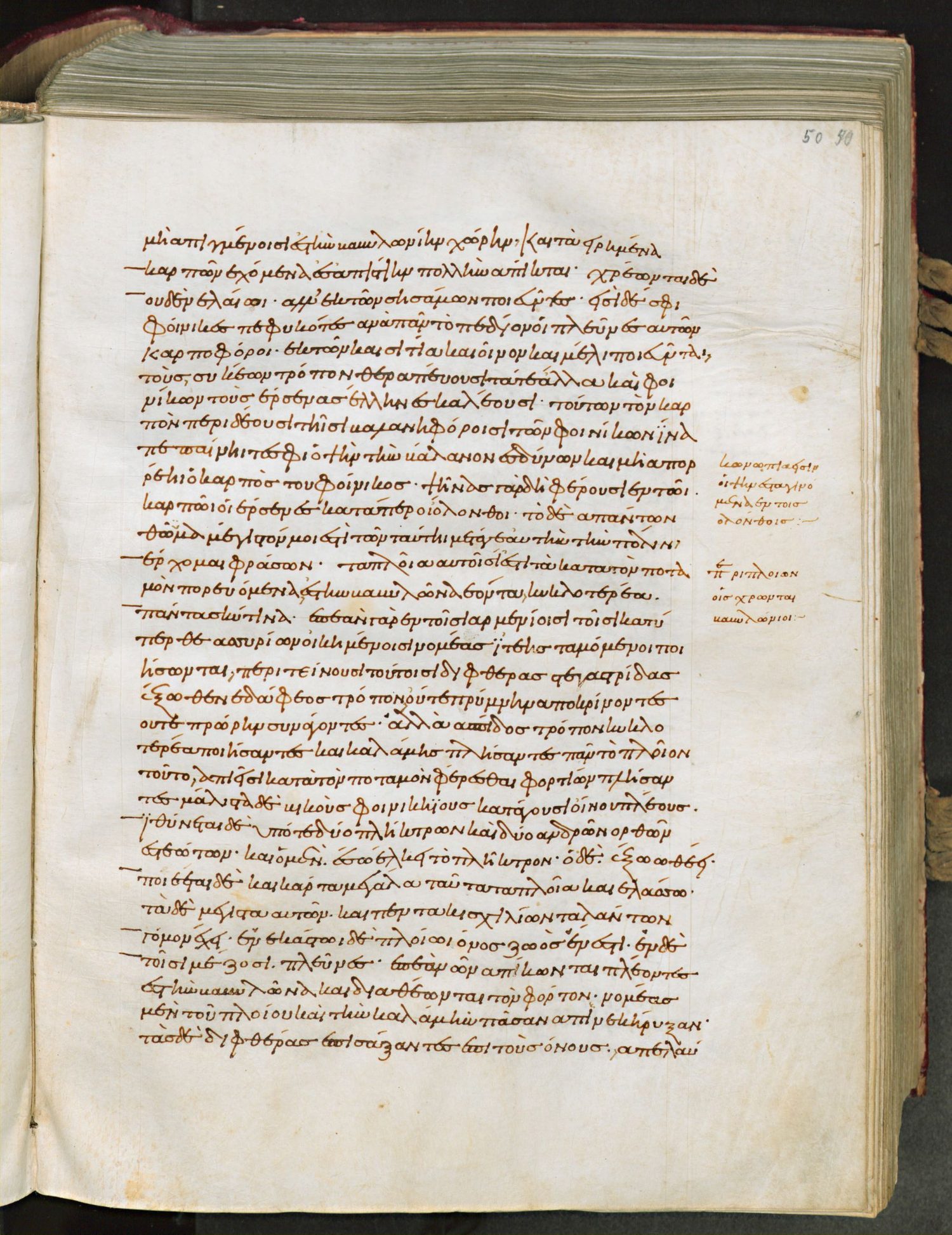
Laur. Plut. 70.3, fol. 50r: Greek here 1.193.4 to 1.194.4. Checked on the image (first and last words read and located in the Greek; each break checked against the neighbouring page): fol. 50r begins ‹μὴ ἀπιγμένοισι ἐς τὴν› (1.193.4), ends ‹ἐπὶ τοὺς ὄνους ἀπελαύ-› (1.194.4). English here: 1.193.5 to 1.194.5 (Godley's sentences for the sections whose Greek lies mostly on this page).
1.193.4μὴ ἀπιγμένοισι ἐς τὴν Βαβυλωνίην χώρην καὶ τὰ εἰρημένα καρπῶν ἐχόμενα ἐς ἀπιστίην πολλὴν ἀπῖκται. χρέωνται δὲ οὐδὲν ἐλαίῳ ἀλλʼ ἢ ἐκ τῶν σησάμων ποιεῦντες. εἰσὶ δέ σφι φοίνικες πεφυκότες ἀνὰ πᾶν τὸ πεδίον, οἱ πλεῦνες αὐτῶν καρποφόροι, ἐκ τῶν καὶ σιτία καὶ οἶνον καὶ μέλι ποιεῦνται· 1.193.5τοὺς συκέων τρόπον θεραπεύουσι τά τε ἄλλα καὶ φοινίκων τοὺς ἔρσενας Ἕλληνὲς καλέουσι, τούτων τὸν καρπὸν περιδέουσι τῇσι βαλανηφόροισι τὸν φοινίκων, ἵνα πεπαίνῃ τε σφι ὁ ψὴν τὴν βάλανον ἐσδύνων καὶ μὴ ἀπορρέῃ ὁ καρπὸς τοῦ φοίνικος· ψῆνας γὰρ δὴ φέρουσι ἐν τῷ καρπῷ οἱ ἔρσενες κατά περ δὴ οἱ ὄλυνθοι. 1.194.1τὸ δὲ ἁπάντων θῶμα μέγιστόν μοι ἐστὶ τῶν ταύτῃ μετά γε αὐτὴν τὴν πόλιν, ἔρχομαι φράσων· τὰ πλοῖα αὐτοῖσι ἐστὶ τὰ κατὰ τὸν ποταμὸν πορευόμενα ἐς τὴν Βαβυλῶνα, ἐόντα κυκλοτερέα, πάντα σκύτινα. 1.194.2ἐπεὰν γὰρ ἐν τοῖσι Ἀρμενίοισι τοῖσι κατύπερθε Ἀσσυρίων οἰκημένοισι νομέας ἰτέης ταμόμενοι ποιήσωνται, περιτείνουσι τούτοισι διφθέρας στεγαστρίδας ἔξωθεν ἐδάφεος τρόπον, οὔτε πρύμνην ἀποκρίνοντες οὔτε πρῴρην συνάγοντες, ἀλλʼ ἀσπίδος τρόπον κυκλοτερέα ποιήσαντες καὶ καλάμης πλήσαντες πᾶν τὸ πλοῖον τοῦτο ἀπιεῖσι κατὰ τὸν ποταμὸν φέρεσθαι, φορτίων πλήσαντες· μάλιστα δὲ βίκους φοινικηίους κατάγουσι οἴνου πλέους. 1.194.3ἰθύνεται δὲ ὑπό τε δύο πλήκτρων καὶ δύο ἀνδρῶν ὀρθῶν ἑστεώτων, καὶ ὃ μὲν ἔσω ἕλκει τὸ πλῆκτρον ὁ δὲ ἔξω ὠθέει. ποιέεται δὲ καὶ κάρτα μεγάλα ταῦτα τὰ πλοῖα καὶ ἐλάσσω· τὰ δὲ μέγιστα αὐτῶν καὶ πεντακισχιλίων ταλάντων γόμον ἔχει. ἐν ἑκάστῳ δὲ πλοίῳ ὄνος ζωὸς ἔνεστι, ἐν δὲ τοῖσι μέζοσι πλεῦνες. 1.194.4ἐπεὰν ὦν ἀπίκωνται πλέοντες ἐς τὴν Βαβυλῶνα καὶ διαθέωνται τὸν φόρτον, νομέας μὲν τοῦ πλοίου καὶ τὴν καλάμην πᾶσαν ἀπʼ ὦν ἐκήρυξαν, τὰς δὲ διφθέρας ἐπισάξαντες ἐπὶ τοὺς ὄνους ἀπελαύνουσι
1.193.5The Assyrians tend these like figs, and chiefly in this respect, that they tie the fruit of the palm called male by the Greeks to the date-bearing palm, that so the gall-fly may enter the dates and cause them to ripen, and that the fruit of the palm may not fall; for the male palms, like unripened figs, have gall-flies in their fruit. 1.194.1I will now show what seems to me to be the most marvellous thing in the country, next to the city itself. Their boats which ply on the river and go to Babylon are all of skins, and round. 1.194.2They make these in Armenia, higher up the stream than Assyria. First they cut frames of willow, then they stretch hides over these for a covering, making as it were a hold; they neither broaden the stern nor narrow the prow, but the boat is round, like a shield. They then fill it with reeds and send it floating down the river with a cargo; and it is for the most part palm wood casks of wine that they carry down. 1.194.3Two men standing upright steer the boat, each with a paddle, one drawing it to him, the other thrusting it from him. These boats are of all sizes, some small, some very great; the greatest of them are even of five thousand talents burden. There is a live ass in each boat, or more than one in the larger. 1.194.4So when they have floated down to Babylon and disposed of their cargo, they sell the framework of the boat and all the reeds; the hides are set on the backs of asses, which are then driven back to Armenia, 1.194.5for it is not by any means possible to go up stream by water, by reason of the swiftness of the current; it is for this reason that they make their boats of hides and not of wood. When they have driven their asses back into Armenia they make more boats in the same way.
Where on the image
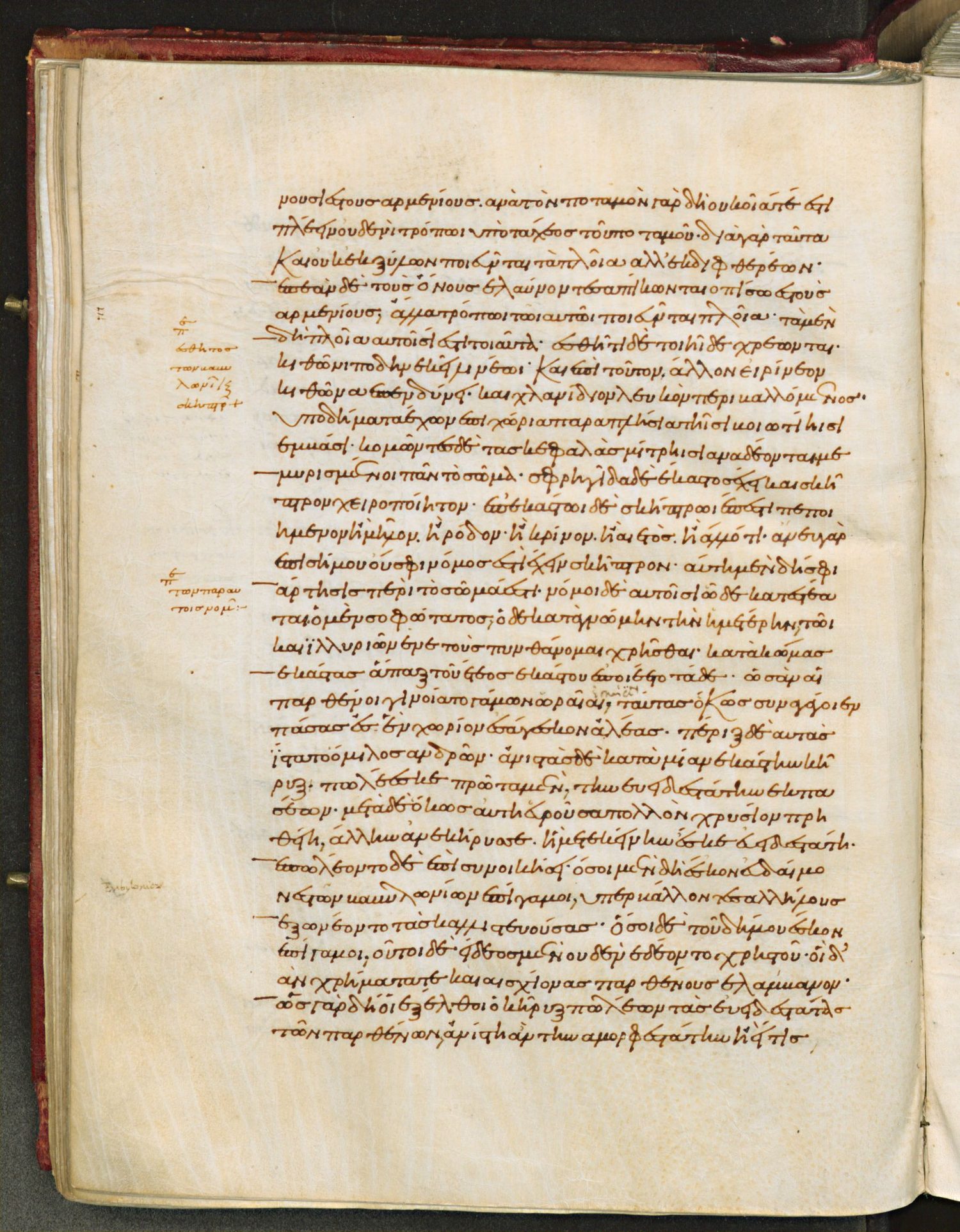
Laur. Plut. 70.3, fol. 50v: Greek here 1.194.4 to 1.196.3. Checked on the image (first and last words read and located in the Greek; each break checked against the neighbouring page): fol. 50v begins ‹-νουσι ἐς τοὺς Ἀρμενίους.ἀνὰ› (1.194.4), ends ‹ἀμορφεστάτην, ἢ εἴ τις› (1.196.3). The word ‹ἀπελαύνουσι› is divided between fol. 50r and fol. 50v; it is given with fol. 50r. English here: 1.195.1 to 1.196.3 (Godley's sentences for the sections whose Greek lies mostly on this page).
1.194.4ἐς τοὺς Ἀρμενίους. 1.194.5ἀνὰ τὸν ποταμὸν γὰρ δὴ οὐκ οἷά τε ἐστὶ πλέειν οὐδενὶ τρόπῳ ὑπὸ τάχεος τοῦ ποταμοῦ· διὰ γὰρ ταῦτα καὶ οὐκ ἐκ ξύλων ποιεῦνται τὰ πλοῖα ἀλλʼ ἐκ διφθερέων. ἐπεὰν δὲ τοὺς ὄνους ἐλαύνοντες ἀπίκωνται ὀπίσω ἐς τοὺς Ἀρμενίους, ἄλλα τρόπῳ τῷ αὐτῷ ποιεῦνται πλοῖα. 1.195.1τὰ μὲν δὴ πλοῖα αὐτοῖσι ἐστὶ τοιαῦτα· ἐσθῆτι δὲ τοιῇδε χρέωνται, κιθῶνι ποδηνεκέι λινέῳ, καὶ ἐπὶ τοῦτον ἄλλον εἰρίνεον κιθῶνα ἐπενδύνει καὶ χλανίδιον λευκὸν περιβαλλόμενος, ὑποδήματα ἔχων ἐπιχώρια, παραπλήσια τῇσι Βοιωτίῃσι ἐμβάσι. κομῶντες δὲ τὰς κεφαλὰς μίτρῃσι ἀναδέονται, μεμυρισμένοι πᾶν τὸ σῶμα. 1.195.2σφρηγῖδα δὲ ἕκαστος ἔχει καὶ σκῆπτρον χειροποίητον· ἐπʼ ἑκάστῳ δὲ σκήπτρῳ ἔπεστι πεποιημένον ἢ μῆλον ἢ ῥόδον ἢ κρίνον ἢ αἰετὸς ἢ ἄλλο τι· ἄνευ γὰρ ἐπισήμου οὔ σφι νόμος ἐστὶ ἔχειν σκῆπτρον. 1.196.1αὕτη μὲν δή σφι ἄρτισις περὶ τὸ σῶμα ἐστί· νόμοι δὲ αὐτοῖσι ὧδε κατεστᾶσι, ὁ μὲν σοφώτατος ὅδε κατὰ γνώμην τὴν ἡμετέρην, τῷ καὶ Ἰλλυριῶν Ἐνετοὺς πυνθάνομαι χρᾶσθαι. κατὰ κώμας ἑκάστας ἅπαξ τοῦ ἔτεος ἑκάστου ἐποιέετο τάδε· ὡς ἂν αἱ παρθένοι γενοίατο γάμων ὡραῖαι, ταύτας ὅκως συναγάγοιεν πάσας, ἐς ἓν χωρίον ἐσάγεσκον ἁλέας, πέριξ δὲ αὐτὰς ἵστατο ὅμιλος ἀνδρῶν, 1.196.2ἀνιστὰς δὲ κατὰ μίαν ἑκάστην κῆρυξ πωλέεσκε, πρῶτα μὲν τὴν εὐειδεστάτην ἐκ πασέων· μετὰ δέ, ὅκως αὕτη εὑροῦσα πολλὸν χρυσίον πρηθείη, ἄλλην ἂν ἐκήρυσσε ἣ μετʼ ἐκείνην ἔσκε εὐειδεστάτη· ἐπωλέοντο δὲ ἐπὶ συνοικήσι. ὅσοι μὲν δὴ ἔσκον εὐδαίμονες τῶν Βαβυλωνίων ἐπίγαμοι, ὑπερβάλλοντες ἀλλήλους ἐξωνέοντο τὰς καλλιστευούσας· ὅσοι δὲ τοῦ δήμου ἔσκον ἐπίγαμοι, οὗτοι δὲ εἴδεος μὲν οὐδὲν ἐδέοντο χρηστοῦ, οἳ δʼ ἂν χρήματά τε καὶ αἰσχίονας παρθένους ἐλάμβανον. 1.196.3ὡς γὰρ δὴ διεξέλθοι ὁ κῆρυξ πωλέων τὰς εὐειδεστάτας τῶν παρθένων ἀνίστη ἂν τὴν ἀμορφεστάτην, ἢ εἴ τις
1.195.1Such then are their boats. For clothing, they wear a linen tunic, reaching to the feet; over this the Babylonian puts on another tunic, of wool, and wraps himself in a white mantle; he wears the shoes of his country, which are like Boeotian sandals. Their hair is worn long, and covered by caps; the whole body is perfumed. 1.195.2Every man has a seal and a carven staff, and on every staff is some image, such as that of an apple or a rose or a lily or an eagle: no one carries a staff without a device. 1.196.1Such is the equipment of their persons. I will now speak of their established customs. The wisest of these, in my judgment, is one which as I have heard is also a custom of the Eneti in Illyria. It is this: once a year in every village all the maidens as they came to marriageable age were collected and brought together into one place, with a crowd of men standing round. 1.196.2Then a crier would display and offer them for sale one by one, first the fairest of all; and then when she had fetched a great price he put up for sale the next comeliest, selling all the maidens as lawful wives. Rich men of Assyria who desired to marry would outbid each other for the fairest; the commonalty, who desired to marry and cared nothing for beauty, could take the ill-favoured damsels and money therewith; 1.196.3for when the crier had sold all the comeliest, he would put up her that was least beautiful, or crippled, and offer her to whosoever would take her to wife for the least sum, till she fell to him who promised to accept least; the money came from the sale of the comely damsels, and so they paid the dowry of the ill-favoured and the cripples. But a man might not give his daughter in marriage to whomsoever he would, nor might he that bought the girl take her away without giving security that he would indeed make her his wife.
Where on the image
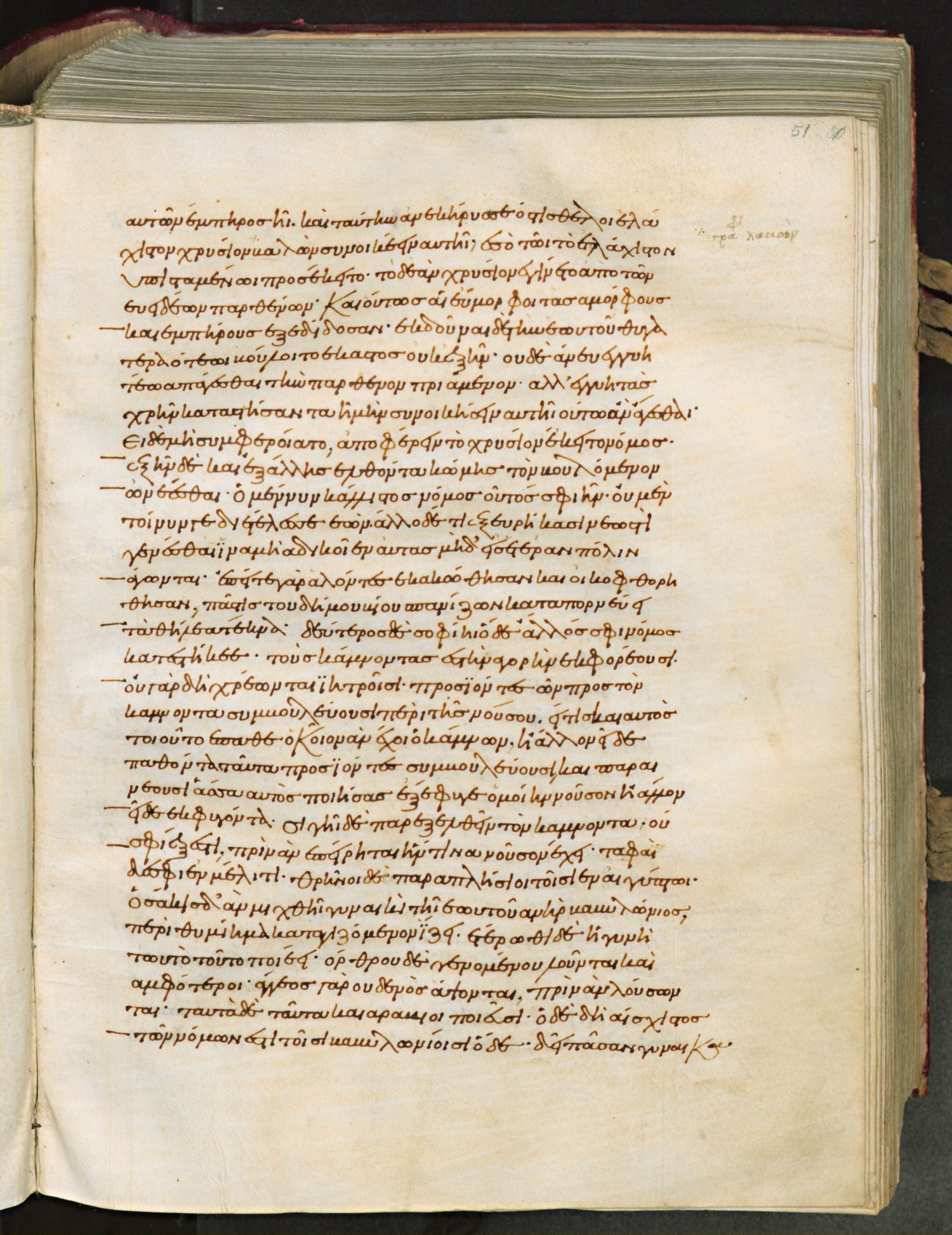
Laur. Plut. 70.3, fol. 51r: Greek here 1.196.3 to 1.199.1. Checked on the image (first and last words read and located in the Greek; each break checked against the neighbouring page): fol. 51r begins ‹αὐτέων ἔμπηρος εἴη, καὶ› (1.196.3), ends ‹ὅδε· δεῖ πᾶσαν γυναῖκα› (1.199.1). English here: 1.196.4 to 1.198.1 (Godley's sentences for the sections whose Greek lies mostly on this page).
1.196.3αὐτέων ἔμπηρος εἴη, καὶ ταύτην ἂν ἐκήρυσσε, ὅστις θέλοι ἐλάχιστον χρυσίον λαβὼν συνοικέειν αὐτῇ, ἐς ὃ τῷ τὸ ἐλάχιστον ὑπισταμένῳ προσέκειτο. τὸ δὲ ἂν χρυσίον ἐγίνετο ἀπὸ τῶν εὐειδέων παρθένων καὶ οὕτω αἱ εὔμορφοι τὰς ἀμόρφους καὶ ἐμπήρους ἐξεδίδοσαν. ἐκδοῦναι δὲ τὴν ἑωυτοῦ θυγατέρα ὅτεῳ βούλοιτο ἕκαστος οὐκ ἐξῆν, οὐδὲ ἄνευ ἐγγυητέω ἀπάγεσθαι τὴν παρθένον πριάμενον, ἀλλʼ ἐγγυητὰς χρῆν καταστήσαντα ἦ μὲν συνοικήσειν αὐτῇ, οὕτω ἀπάγεσθαι. 1.196.4εἰ δὲ μὴ συμφεροίατο, ἀποφέρειν τὸ χρυσίον ἔκειτο νόμος. ἐξῆν δὲ καὶ ἐξ ἄλλης ἐλθόντα κώμης τὸν βουλόμενον ὠνέεσθαι. 1.196.5ὁ μέν νυν κάλλιστος νόμος οὗτός σφι ἦν, οὐ μέντοι νῦν γε διατελέει ἐών, ἄλλο δέ τι ἐξευρήκασι νεωστὶ γενέσθαι [ἵνα μὴ ἀδικοῖεν αὐτὰς μηδʼ εἰς ἑτέραν πόλιν ἄγωνται]· ἐπείτε γὰρ ἁλόντες ἐκακώθησαν καὶ οἰκοφθορήθησαν, πᾶς τις τοῦ δήμου βίου σπανίζων καταπορνεύει τὰ θήλεα τέκνα. 1.197.1δεύτερος δὲ σοφίῃ ὅδε ἄλλος σφι νόμος κατέστηκε· τοὺς κάμνοντας ἐς τὴν ἀγορὴν ἐκφορέουσι· οὐ γὰρ δὴ χρέωνται ἰητροῖσι. προσιόντες ὦν πρὸς τὸν κάμνοντα συμβουλεύουσι περὶ τῆς νούσου, εἴ τις καὶ αὐτὸς τοιοῦτο ἔπαθε ὁκοῖον ἂν ἔχῃ ὁ κάμνων ἢ ἄλλον εἶδε παθόντα, ταῦτα προσιόντες συμβουλεύουσι καὶ παραινέουσι ἅσσα αὐτὸς ποιήσας ἐξέφυγε ὁμοίην νοῦσον ἢ ἄλλον εἶδε ἐκφυγόντα. σιγῇ δὲ παρεξελθεῖν τὸν κάμνοντα οὔ σφι ἔξεστι, πρὶν ἂν ἐπείρηται ἥντινα νοῦσον ἔχει. 1.198.1ταφαὶ δέ σφι ἐν μέλιτι, θρῆνοι δὲ παραπλήσιοι τοῖσι ἐν Αἰγύπτῳ. ὁσάκις δʼ ἂν μιχθῇ γυναικὶ τῇ ἑωυτοῦ ἀνὴρ Βαβυλώνιος, περὶ θυμίημα καταγιζόμενον ἵζει, ἑτέρωθι δὲ ἡ γυνὴ τὠυτὸ τοῦτο ποιέει, ὄρθρου δὲ γενομένου λοῦνται καὶ ἀμφότεροι· ἄγγεος γὰρ οὐδενὸς ἅψονται πρὶν ἂν λούσωνται. ταὐτὰ δὲ ταῦτα καὶ Ἀράβιοι ποιεῦσι. 1.199.1ὁ δὲ δὴ αἴσχιστος τῶν νόμων ἐστὶ τοῖσι Βαβυλωνίοισι ὅδε· δεῖ πᾶσαν γυναῖκα
1.196.4And if the two could not agree, it was a law that the money be returned. Men might also come from other villages to buy if they so desired. 1.196.5This then was their best custom; but it does not continue at this time; they have invented a new one lately [that the woman might not be wronged or taken to another city]; since the conquest of Babylon made them afflicted and poor, everyone of the commonalty that lacks a livelihood makes prostitutes of his daughters. 1.197.1I come now to the next wisest of their customs: having no use for physicians, they carry the sick into the market-place; then those who have been afflicted themselves by the same ill as the sick man’s, or seen others in like case, come near and advise him about his disease and comfort him, telling him by what means they have themselves recovered of it or seen others so recover. None may pass by the sick man without speaking and asking what is his sickness. 1.198.1The dead are embalmed in honey for burial, and their dirges are like to the dirges of Egypt. Whenever a Babylonian has had intercourse with his wife, they both sit before a burnt offering of incense, and at dawn they wash themselves; they will touch no vessel before this is done. This is the custom also in Arabia.
Where on the image
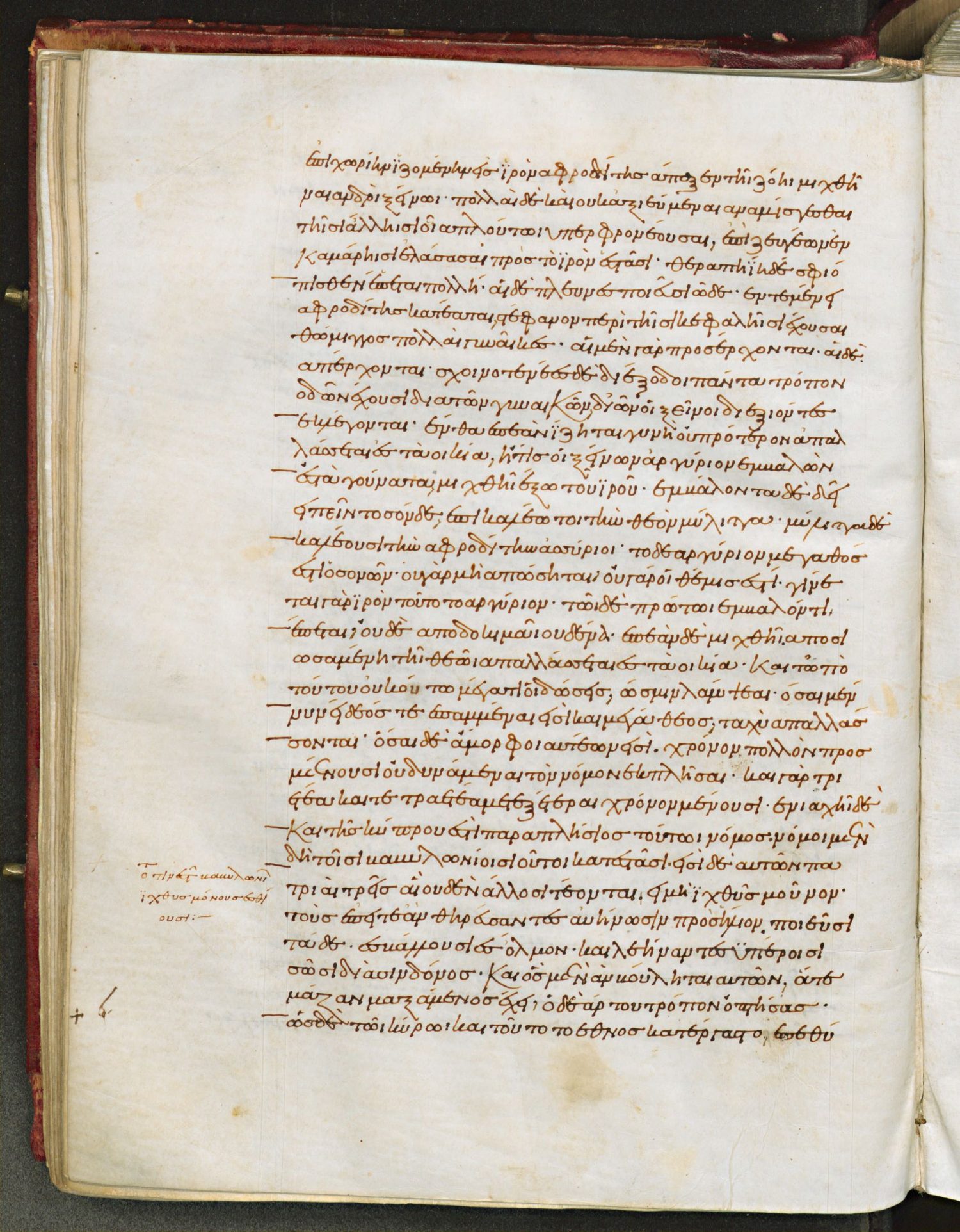
Laur. Plut. 70.3, fol. 51v: Greek here 1.199.1 to 1.200.1. Checked on the image (first and last words read and located in the Greek; each break checked against the neighbouring page): fol. 51v begins ‹ἐπιχωρίην ἱζομένην ἐς ἱρὸν› (1.199.1), ends ‹τὸ ἔθνος κατέργαστο, ἐπεθύ-› (1.201.1). English here: 1.199.1 to 1.200.1 (Godley's sentences for the sections whose Greek lies mostly on this page).
1.199.1ἐπιχωρίην ἱζομένην ἐς ἱρὸν Ἀφροδίτης ἅπαξ ἐν τῇ ζόῃ μιχθῆναι ἀνδρὶ ξείνῳ. πολλαὶ δὲ καὶ οὐκ ἀξιούμεναι ἀναμίσγεσθαι τῇσι ἄλλῃσι, οἷα πλούτῳ ὑπερφρονέουσαι, ἐπὶ ζευγέων ἐν καμάρῃσι ἐλάσασαι πρὸς τὸ ἱρὸν ἑστᾶσι· θεραπηίη δέ σφι ὄπισθε ἕπεται πολλή. 1.199.2αἱ δὲ πλεῦνες ποιεῦσι ὧδε· ἐν τεμένεϊ Ἀφροδίτης κατέαται στέφανον περὶ τῇσι κεφαλῇσι ἔχουσαι θώμιγγος πολλαὶ γυναῖκες· αἳ μὲν γὰρ προσέρχονται, αἳ δὲ ἀπέρχονται. σχοινοτενέες δὲ διέξοδοι πάντα τρόπον ὁδῶν ἔχουσι διὰ τῶν γυναικῶν, διʼ ὧν οἱ ξεῖνοι διεξιόντες ἐκλέγονται· 1.199.3ἔνθα ἐπεὰν ἵζηται γυνή, οὐ πρότερον ἀπαλλάσσεται ἐς τὰ οἰκία ἤ τίς οἱ ξείνων ἀργύριον ἐμβαλὼν ἐς τὰ γούνατα μιχθῇ ἔξω τοῦ ἱροῦ· ἐμβαλόντα δὲ δεῖ εἰπεῖν τοσόνδε· ἐπικαλέω τοι τὴν θεὸν Μύλιττα. Μύλιττα δὲ καλέουσι τὴν Ἀφροδίτην Ἀσσύριοι. 1.199.4τὸ δὲ ἀργύριον μέγαθος ἐστὶ ὅσον ὦν· οὐ γὰρ μὴ ἀπώσηται· οὐ γάρ οἱ θέμις ἐστί· γίνεται γὰρ ἱρὸν τοῦτο τὸ ἀργύριον. τῷ δὲ πρώτῳ ἐμβαλόντι ἕπεται οὐδὲ ἀποδοκιμᾷ οὐδένα. ἐπεὰν δὲ μιχθῇ, ἀποσιωσαμένη τῇ θεῷ ἀπαλλάσσεται ἐς τὰ οἰκία, καὶ τὠπὸ τούτου οὐκ οὕτω μέγα τί οἱ δώσεις ὥς μιν λάμψεαι. 1.199.5ὅσσαι μέν νυν εἴδεός τε ἐπαμμέναι εἰσὶ καὶ μεγάθεος, ταχὺ ἀπαλλάσσονται, ὅσαι δὲ ἄμορφοι αὐτέων εἰσί, χρόνον πολλὸν προσμένουσι οὐ δυνάμεναι τὸν νόμον ἐκπλῆσαι· καὶ γὰρ τριέτεα καὶ τετραέτεα μετεξέτεραι χρόνον μένουσι. ἐνιαχῇ δὲ καὶ τῆς Κύπρου ἐστὶ παραπλήσιος τούτῳ νόμος. 1.200.1νόμοι μὲν δὴ τοῖσι Βαβυλωνίοισι οὗτοι κατεστᾶσι· εἰσὶ δὲ αὐτῶν πατριαὶ τρεῖς αἳ οὐδὲν ἄλλο σιτέονται εἰ μὴ ἰχθὺς μοῦνον, τοὺς ἐπείτε ἂν θηρεύσαντες αὐήνωσι πρὸς ἥλιον, ποιεῦσι τάδε· ἐσβάλλουσι ἐς ὅλμον καὶ λεήναντες ὑπέροισι σῶσι διὰ σινδόνος, καὶ ὃς μὲν ἂν βούληται αὐτῶν ἅτε μᾶζαν μαξάμενος ἔχει, ὁ δὲ ἄρτου τρόπον ὀπτήσας.
1.199.1The foulest Babylonian custom is that which compels every woman of the land once in her life to sit in the temple of Aphrodite and have intercourse with some stranger. Many women who are rich and proud and disdain to consort with the rest, drive to the temple in covered carriages drawn by teams, and there stand with a great retinue of attendants. 1.199.2But most sit down in the sacred plot of Aphrodite, with crowns of cord on their heads; there is a great multitude of women coming and going; passages marked by line run every way through the crowd, by which the stranger men pass and make their choice. 1.199.3When a woman has once taken her place there she goes not away to her home before some stranger has cast money into her lap and had intercourse with her outside the temple; but while he casts the money, he must say, “I demand thee in the name of Mylitta” (that is the Assyrian name for Aphrodite). 1.199.4It matters not what be the sum of the money; the woman will never refuse, for that were a sin, the money being by this act made sacred. So she follows the first man who casts it and rejects none. After their intercourse she has made herself holy in the goddess’s sight and goes away to her home; and thereafter there is no bribe however great that will get her. 1.199.5So then the women that are fair and tall are soon free to depart, but the uncomely have long to wait because they cannot fulfil the law; for some of them remain for three years, or four. There is a custom like to this in some parts of Cyprus. 1.200.1These are established customs among the Babylonians. Moreover, there are in the country three tribes that eat nothing but fish, which they catch and dry in the sun; then after casting them into a mortar they bray them with pestles and strain all through linen. Then whoever so desires kneads as it were a cake of it and eats it; others bake it like bread.
Notes
- Greek: the text printed in A. D. Godley's Loeb edition, via Perseus (tlg0016.tlg001.perseus-grc2). Square brackets mark words the editor considers later additions; [...] marks a gap the editor indicates. Perseus note markers are omitted.
- English: A. D. Godley, Herodotus vol. 1 (1920) (Loeb Classical Library), as transcribed on Wikisource. Godley's footnotes are omitted.
- Section numbers in the English were placed by comparing Godley's text with the Perseus version of his translation; where a section begins inside one of Godley's sentences, the English is kept with the page that holds the start of that sentence.
Cite
Sources
- Source: Florence, Laur. Plut. 70.3 (10th c.) via BML Teca Digitale + Greek of Godley's Loeb (Perseus) + English of A. D. Godley (Loeb, Wikisource) (holding institution)
- Critical edition: Greek of A. D. Godley's Loeb edition (1920-1925), via Perseus
← previous · → next · v cycle view · l back to library