Herodotus, Histories 1.201-216: Cyrus against the Massagetae; the death of Cyrus
Introduction
Herodotus of Halicarnassus wrote the Histories in the third quarter of the 5th century BCE, an inquiry into the deeds of Greeks and barbarians and the causes of the wars between them, later divided into nine books. Book 1 tells how the conflict between Greeks and barbarians began, the history of Lydia from Gyges to Croesus, the rise of the Medes and of Cyrus the Persian, the conquest of the Greeks of Asia, the capture of Babylon and the death of Cyrus.
The photographs are of Florence, Biblioteca Medicea Laurenziana, Plut. 70.3 (parchment, 10th century, 374 folios, 31 lines a page), Herodotus, Histories (codex A of the editors), the oldest surviving manuscript of the complete Histories, from the Teca Digitale of the Biblioteca Medicea Laurenziana. Each section below is the text of one page, or of the part of a page that falls within these chapters. The first and last words of every page were read on the photograph and located in the Greek, and every page break was checked against the next page; the notes quote these words. Readers' notes in the margins are not part of the text and are mentioned where they occur.
The Greek is the text printed in A. D. Godley's Loeb edition (1920-1925), from Perseus; it is the edited text, not a transcription of the manuscript, whose wording differs in places. The English is Godley's translation as printed, from Wikisource. Godley's English carries only chapter numbers; the section numbers shown in it were placed by comparison with the Perseus version of his translation. Each page's English is cut at the end of one of Godley's sentences, so it can begin or end a few lines away from the Greek of the page; each note gives the exact ranges.
This entry covers chapters 1.201-216, on fol. 51v to 55v.
How was this verified? (Provenance)
Where on the image
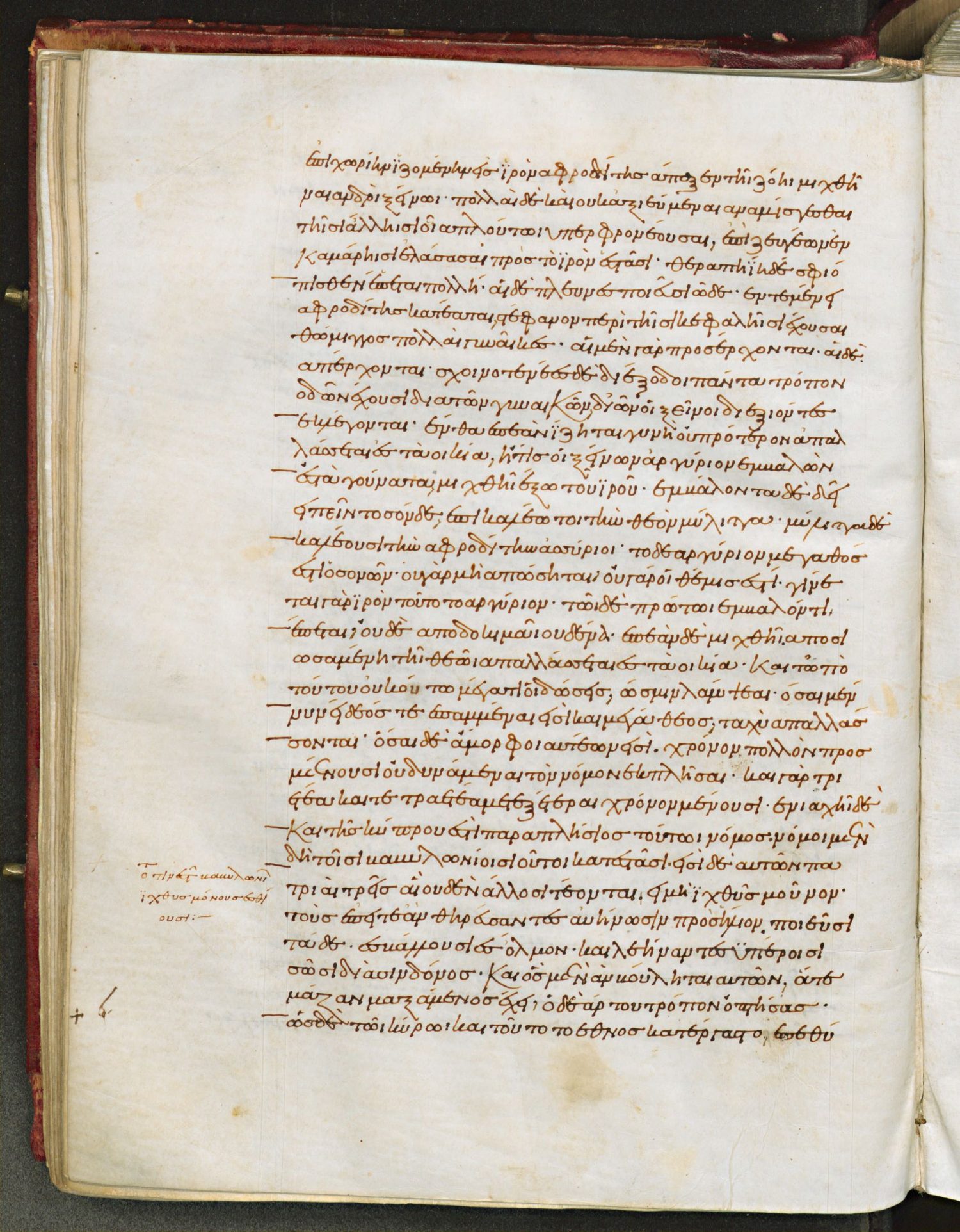
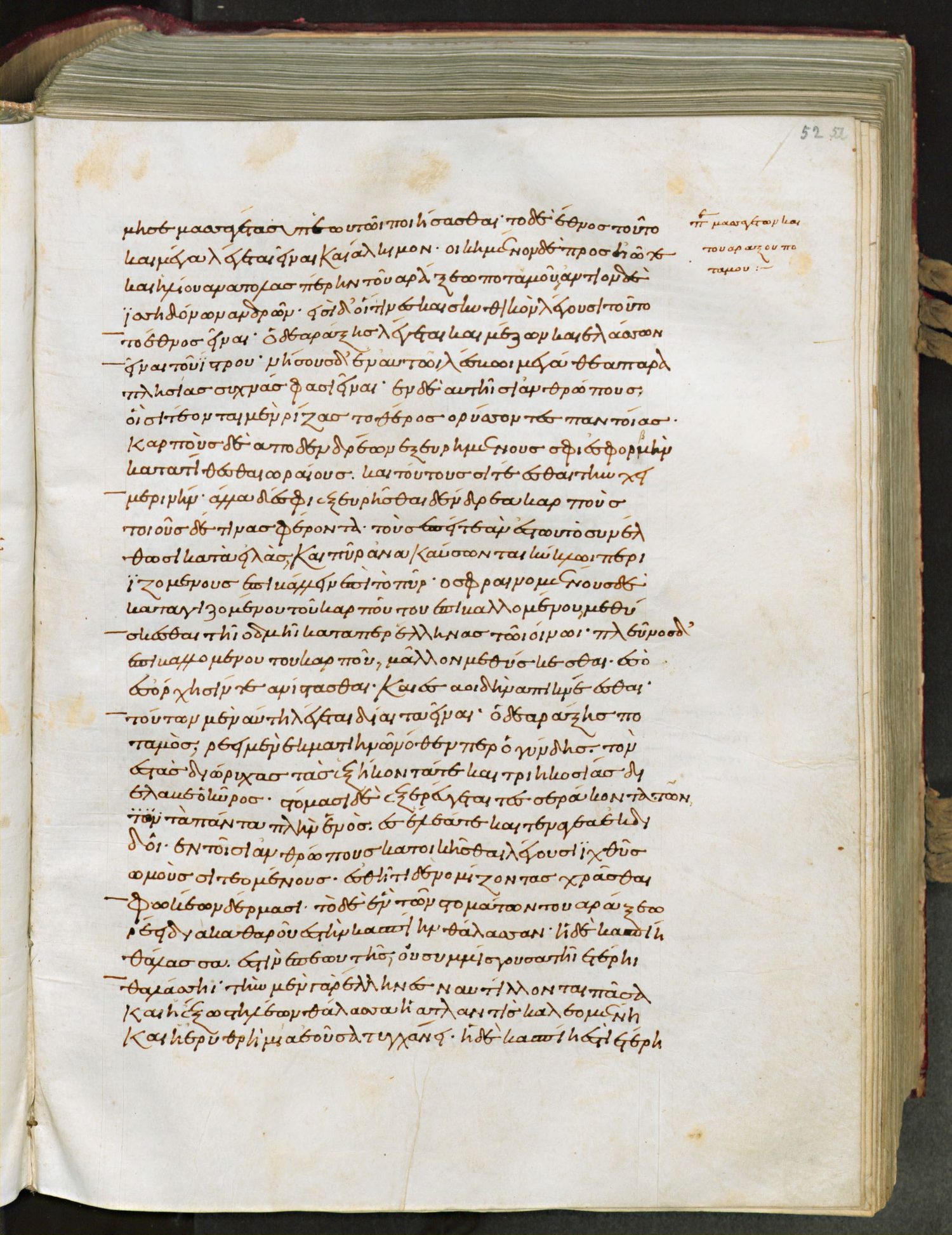
Laur. Plut. 70.3, fol. 51v, 52r: Greek here 1.201.1 to 1.203.1. Checked on the image (first and last words read and located in the Greek; each break checked against the neighbouring page): fol. 51v begins ‹ἐπιχωρίην ἱζομένην ἐς ἱρὸν› (1.199.1), ends ‹τὸ ἔθνος κατέργαστο, ἐπεθύ-› (1.201.1). fol. 52r begins ‹-μησε Μασσαγέτας ὑπʼ ἑωυτῷ› (1.201.1), ends ‹ἡ δὲ Κασπίη ἐ-› (1.203.1). The word ‹ἐπεθύμησε› is divided between fol. 51v and fol. 52r; it is given with fol. 51v. Fol. 52r ends ἡ δὲ Κασπίη ἑτέρη and fol. 52v begins ἐπʼ ἑωυτῆς: the edition's ἐστὶ before ἑτέρη (1.203.1) was not read at the page break. This section joins the text of fol. 51v and 52r that belongs to these chapters, because the part on one of the pages is too short to carry any of Godley's sentences on its own. English here: 1.201.1 to 1.202.4 (Godley's sentences for the sections whose Greek lies mostly on this page).
1.201.1ὡς δὲ τῷ Κύρῳ καὶ τοῦτο τὸ ἔθνος κατέργαστο, ἐπεθύμησε Μασσαγέτας ὑπʼ ἑωυτῷ ποιήσασθαι. τὸ δὲ ἔθνος τοῦτο καὶ μέγα λέγεται εἶναι καὶ ἄλκιμον, οἰκημένον δὲ πρὸς ἠῶ τε καὶ ἡλίου ἀνατολάς, πέρην τοῦ Ἀράξεω ποταμοῦ, ἀντίον δὲ Ἰσσηδόνων ἀνδρῶν. εἰσὶ δὲ οἵτινες καὶ Σκυθικὸν λέγουσι τοῦτο τὸ ἔθνος εἶναι. 1.202.1ὁ δὲ Ἀράξης λέγεται καὶ μέζων καὶ ἐλάσσων εἶναι τοῦ Ἴστρου· νήσους δὲ ἐν αὐτῷ Λέσβῳ μεγάθεα παραπλησίας συχνάς φασι εἶναι, ἐν δὲ αὐτῇσι ἀνθρώπους οἳ σιτέονται μὲν ῥίζας τὸ θέρος ὀρύσσοντες παντοίας· καρποὺς δὲ ἀπὸ δενδρέων ἐξευρημένους σφι ἐς φορβὴν κατατίθεσθαι ὡραίους, καὶ τούτους σιτέεσθαι τὴν χειμερινήν. 1.202.2ἄλλα δέ σφι ἐξευρῆσθαι δένδρεα καρποὺς τοιούσδε τινὰς φέροντα, τοὺς ἐπείτε ἂν ἐς τὠυτὸ συνέλθωσι κατὰ εἴλας καὶ πῦρ ἀνακαύσωνται κύκλῳ περιιζομένους ἐπιβάλλειν ἐπὶ τὸ πῦρ, ὀσφραινομένους δὲ καταγιζομένου τοῦ καρποῦ τοῦ ἐπιβαλλομένου μεθύσκεσθαι τῇ ὀσμῇ κατά περ Ἕλληνας τῷ οἴνῳ πλεῦνος δὲ ἐπιβαλλομένου τοῦ καρποῦ μᾶλλον μεθύσκεσθαι, ἐς ὃ ἐς ὄρχησίν τε ἀνίστασθαι καὶ ἐς ἀοιδὴν ἀπικνέεσθαι. τούτων μὲν αὕτη λέγεται δίαιτᾳ εἶναι. 1.202.3ὁ δὲ Ἀράξης ποταμὸς ῥέει μὲν ἐκ Ματιηνῶν, ὅθεν περ ὁ Γύνδης τὸν ἐς τὰς διώρυχας τὰς ἑξήκοντά τε καὶ τριηκοσίας διέλαβε ὁ Κῦρος, στόμασι δὲ ἐξερεύγεται τεσσεράκοντα, τῶν τὰ πάντα πλὴν ἑνὸς ἐς ἕλεά τε καὶ τενάγεα ἐκδιδοῖ· ἐν τοῖσι ἀνθρώπους κατοικῆσθαι λέγουσι ἰχθῦς ὠμοὺς σιτεομένους, ἐσθῆτι δὲ νομίζοντας χρᾶσθαι φωκέων δέρμασι. 1.202.4τὸ δὲ ἓν τῶν στομάτων τοῦ Ἀράξεω ῥέει διὰ καθαροῦ ἐς τὴν Κασπίην θάλασσαν. 1.203.1ἡ δὲ Κασπίη θάλασσα ἐστὶ ἐπʼ ἑωυτῆς, οὐ συμμίσγουσα τῇ ἑτέρῃ θαλάσσῃ. τὴν μὲν γὰρ Ἕλληνὲς ναυτίλλονται πᾶσα καὶ ἡ ἔξω στηλέων θάλασσα ἡ Ἀτλαντὶς καλεομένη καὶ ἡ Ἐρυθρὴ μία ἐοῦσα τυγχάνει. ἡ δὲ Κασπίη ἐστὶ ἑτέρη
1.201.1When Cyrus had conquered this nation also, he desired to subdue the Massagetae. These are said to be a great people and a mighty, dwelling towards the east and the sunrise, beyond the Araxes and over against the Issedones; and some say that they are a Scythian people. 1.202.1The Araxes is by some said to be greater and by some less than the Ister. It is reported that there are many islands in it as big as Lesbos, and men thereon who in summer live on roots of all kinds that they dig up, and in winter on fruit that they get from trees and store when it is ripe for food; 1.202.2and they know (it is said) of trees which have a fruit whereof this is the effect: assembling in companies and kindling a fire, the people sit round it and throw the fruit into the flames, then the smell of it as it burns makes them drunk as the Greeks are with wine, and more and more drunk as more fruit is thrown on the fire, till at last they rise up to dance and even sing. Such is said to be their way of life. 1.202.3The Araxes flows from the country of the Matieni—as does the Gyndes, which Cyrus divided into the three hundred and sixty channels—and empties itself through forty mouths, whereof all except one issue into bogs and swamps, where men are said to live whose food is raw fish, and their customary dress sealskins. 1.202.4The one remaining stream of the Araxes flows in a clear channel into the Caspian sea.
Where on the image
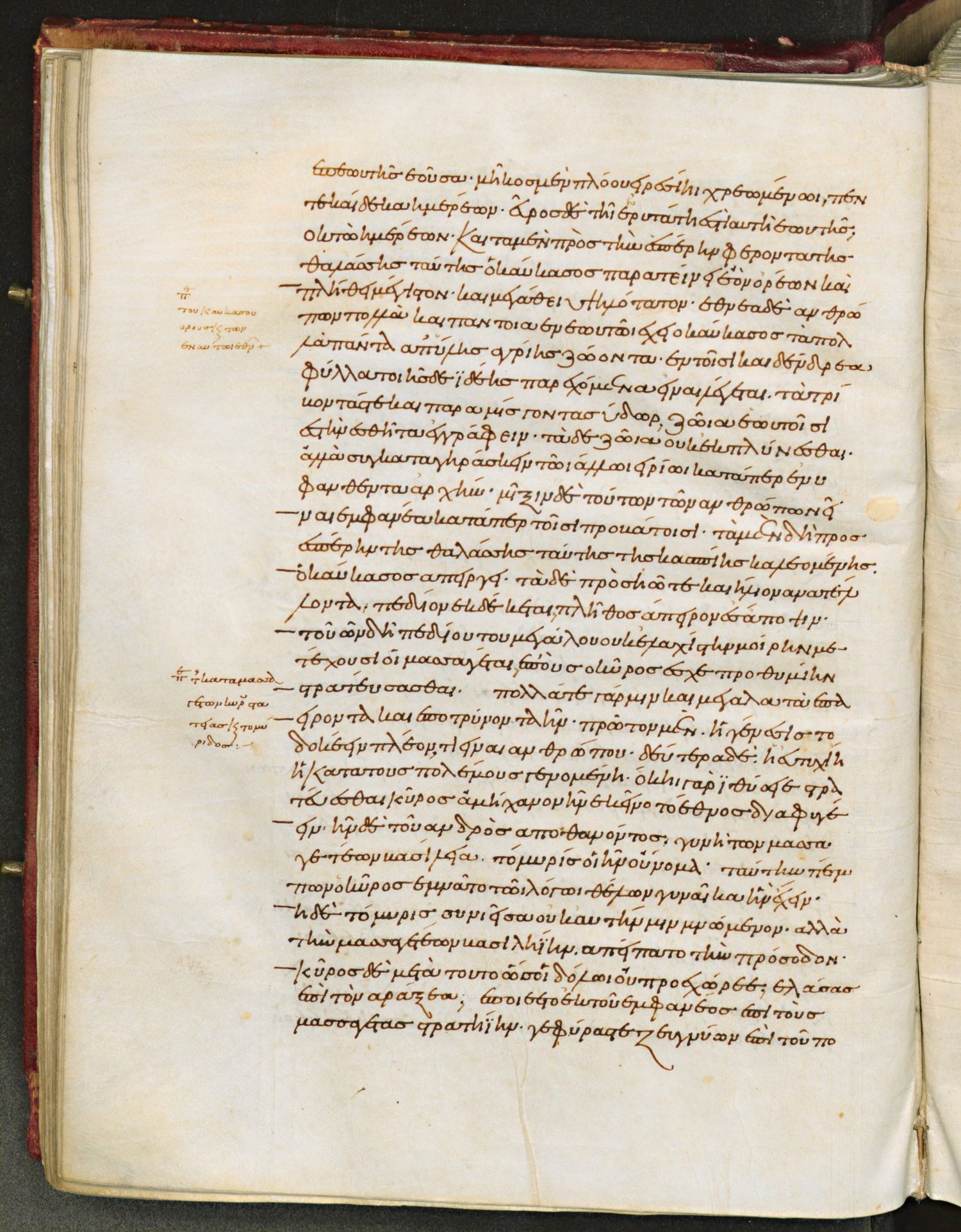
Laur. Plut. 70.3, fol. 52v: Greek here 1.203.1 to 1.205.2. Checked on the image (first and last words read and located in the Greek; each break checked against the neighbouring page): fol. 52v begins ‹ἐπʼ ἑωυτῆς, ἐοῦσα μῆκος› (1.203.1), ends ‹ζευγνύων ἐπὶ τοῦ πο-› (1.205.2). Fol. 52r ends ἡ δὲ Κασπίη ἑτέρη and fol. 52v begins ἐπʼ ἑωυτῆς: the edition's ἐστὶ before ἑτέρη (1.203.1) was not read at the page break. English here: 1.203.1 to 1.205.2 (Godley's sentences for the sections whose Greek lies mostly on this page).
1.203.1ἐπʼ ἑωυτῆς, ἐοῦσα μῆκος μὲν πλόου εἰρεσίῃ χρεωμένῳ πεντεκαίδεκα ἡμερέων, εὖρος δέ, τῇ εὐρυτάτη ἐστὶ αὐτὴ ἑωυτῆς, ὀκτὼ ἡμερέων. καὶ τὰ μὲν πρὸς τὴν ἑσπέρην φέροντα τῆς θαλάσσης ταύτης ὁ Καύκασος παρατείνει, ἐὸν ὀρέων καὶ πλήθεϊ μέγιστον καὶ μεγάθεϊ ὑψηλότατον. ἔθνεα δὲ ἀνθρώπων πολλὰ καὶ παντοῖα ἐν ἑωυτῷ ἔχει ὁ Καύκασος, τὰ πολλὰ πάντα ἀπʼ ὕλης ἀγρίης ζώοντα· 1.203.2ἐν τοῖσι καὶ δένδρεα φύλλα τοιῆσδε ἰδέης παρεχόμενα εἶναι λέγεται, τὰ τρίβοντάς τε καὶ παραμίσγοντας ὕδωρ ζῷα ἑωυτοῖσι ἐς τὴν ἐσθῆτα ἐγγράφειν· τὰ δὲ ζῷα οὐκ ἐκπλύνεσθαι, ἀλλὰ συγκαταγηράσκειν τῷ ἄλλῳ εἰρίῳ κατὰ περ ἐνυφανθέντα ἀρχήν. μῖξιν δὲ τούτων τῶν ἀνθρώπων εἶναι ἐμφανέα κατὰ περ τοῖσι προβάτοισι. 1.204.1τὰ μὲν δὴ πρὸς ἑσπέρην τῆς θαλάσσης ταύτης τῆς Κασπίης καλεομένης ὁ Καύκασος ἀπέργει, τὰ δὲ πρὸς ἠῶ τε καὶ ἥλιον ἀνατέλλοντα πεδίον ἐκδέκεται πλῆθος ἄπειρον ἐς ἄποψιν. τοῦ ὦν δὴ πεδίου τούτου τοῦ μεγάλου οὐκ ἐλαχίστην μοῖραν μετέχουσι οἱ Μασσαγέται, ἐπʼ οὓς ὁ Κῦρος ἔσχε προθυμίην στρατεύσασθαι. 1.204.2πολλά τε γάρ μιν καὶ μεγάλα τὰ ἐπαείροντα καὶ ἐποτρύνοντα ἦν, πρῶτον μὲν ἡ γένεσις, τὸ δοκέειν πλέον τι εἶναι ἀνθρώπου, δευτέρα δὲ ἡ εὐτυχίη ἡ κατὰ τοὺς πολέμους γενομένη· ὅκῃ γὰρ ἰθύσειε στρατεύεσθαι Κῦρος, ἀμήχανον ἦν ἐκεῖνο τὸ ἔθνος διαφυγεῖν. 1.205.1ἦν δὲ τοῦ ἀνδρὸς ἀποθανόντος γυνὴ τῶν Μασσαγετέων βασίλεια. Τόμυρίς οἱ ἦν οὔνομα. ταύτην πέμπων ὁ Κῦρος ἐμνᾶτο τῷ λόγῳ θέλων γυναῖκα ἣν ἔχειν. ἡ δὲ Τόμυρις συνιεῖσα οὐκ αὐτήν μιν μνώμενον ἀλλὰ τὴν Μασαγετέων βασιληίην, ἀπείπατο τὴν πρόσοδον. 1.205.2Κῦρος δὲ μετὰ τοῦτο, ὥς οἱ δόλῳ οὐ προεχώρεε, ἐλάσας ἐπὶ τὸν Ἀράξεα ἐποιέετο ἐκ τοῦ ἐμφανέος ἐπὶ τοὺς Μασσαγέτας στρατηίην, γεφύρας τε ζευγνύων ἐπὶ τοῦ ποταμοῦ
1.203.1This is a sea by itself, not joined to the other sea. For that whereon the Greeks sail, and the sea beyond the pillars of Heracles, which they call Atlantic, and the Red Sea, are all one: but the Caspian is separate and by itself. Its length is what a ship rowed by oars can traverse in fifteen days, and its breadth, where it is broadest, is an eight days’ journey. Along its western shore stretches the range of Caucasus, which has more and higher mountains than any other range. Many and all manner of nations dwell in the Caucasus, and the most of them live on the fruits of the wild wood. 1.203.2Here, it is said, are trees growing leaves that men crush and mix with water and use for the painting of figures on their clothing; these figures cannot be washed out, but last as long as the wool, as if they had been woven into it from the first. Men and women here (they say) have intercourse openly, like beasts of the flock. 1.204.1This sea called Caspian is hemmed in to the west by the Caucasus: towards the east and the sunrise there stretches from its shores a boundless plain as far as sight can reach. The greater part of this wide plain is the country of the Massagetae, against whom Cyrus was eager to lead his army. 1.204.2For there were many reasons of weight that heartened and encouraged him so to do: first, his birth, whereby he seemed to be something more than mortal man, and next, his victories in his wars; for no nation that Cyrus undertook to attack could escape from him. 1.205.1Now at this time the Massagetae were ruled by a queen, called Tomyris, whose husband was dead. Cyrus sent a message with a pretence of wooing her for his wife, but Tomyris would have none of this advance, well understanding that he wooed not her but the kingdom of the Massagetae. 1.205.2So when guile availed him nothing Cyrus marched to the Araxes and openly prepared to attack the Massagetae; he bridged the river that his army might cross, and built towers on the pontoons that should carry his men over.
Where on the image
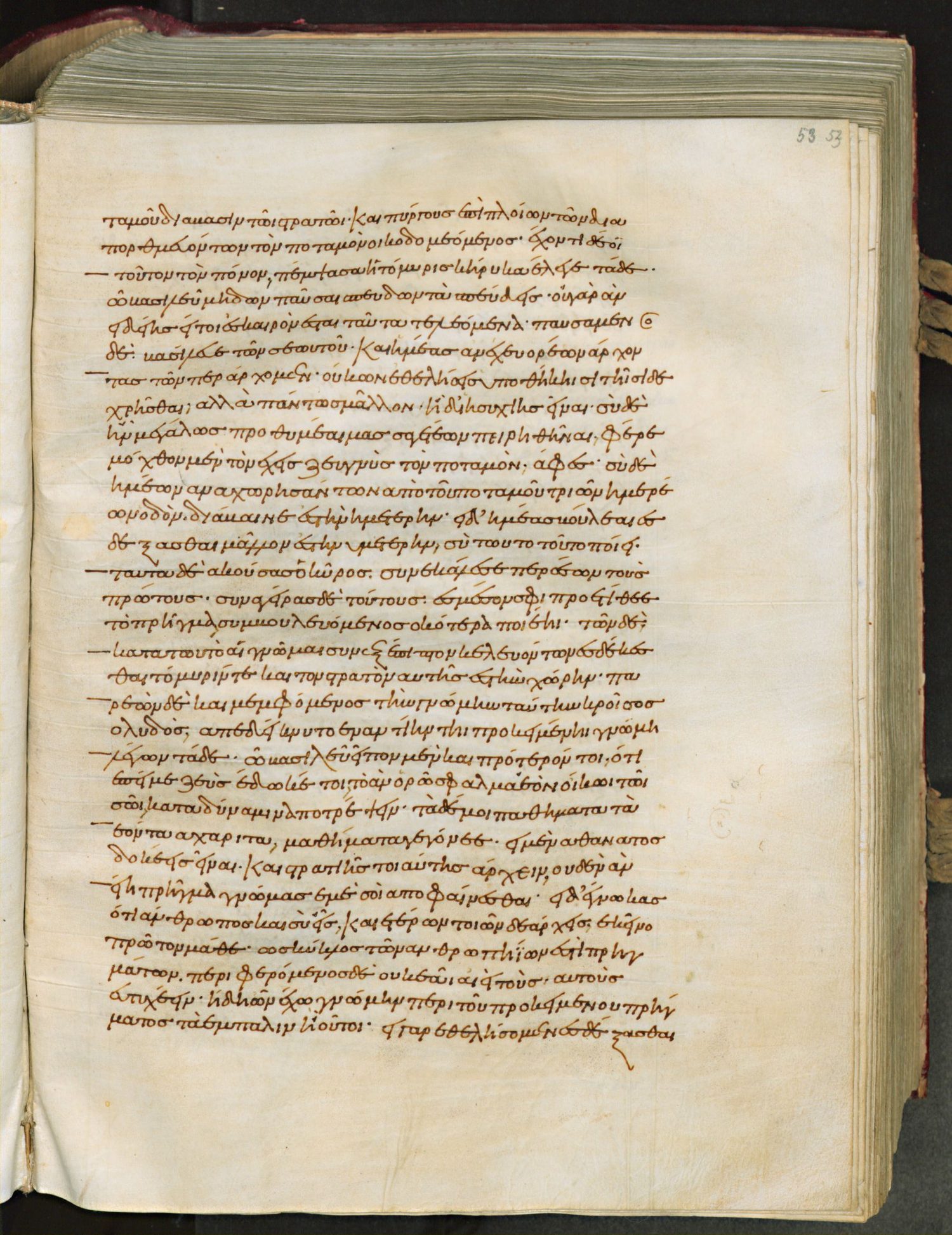
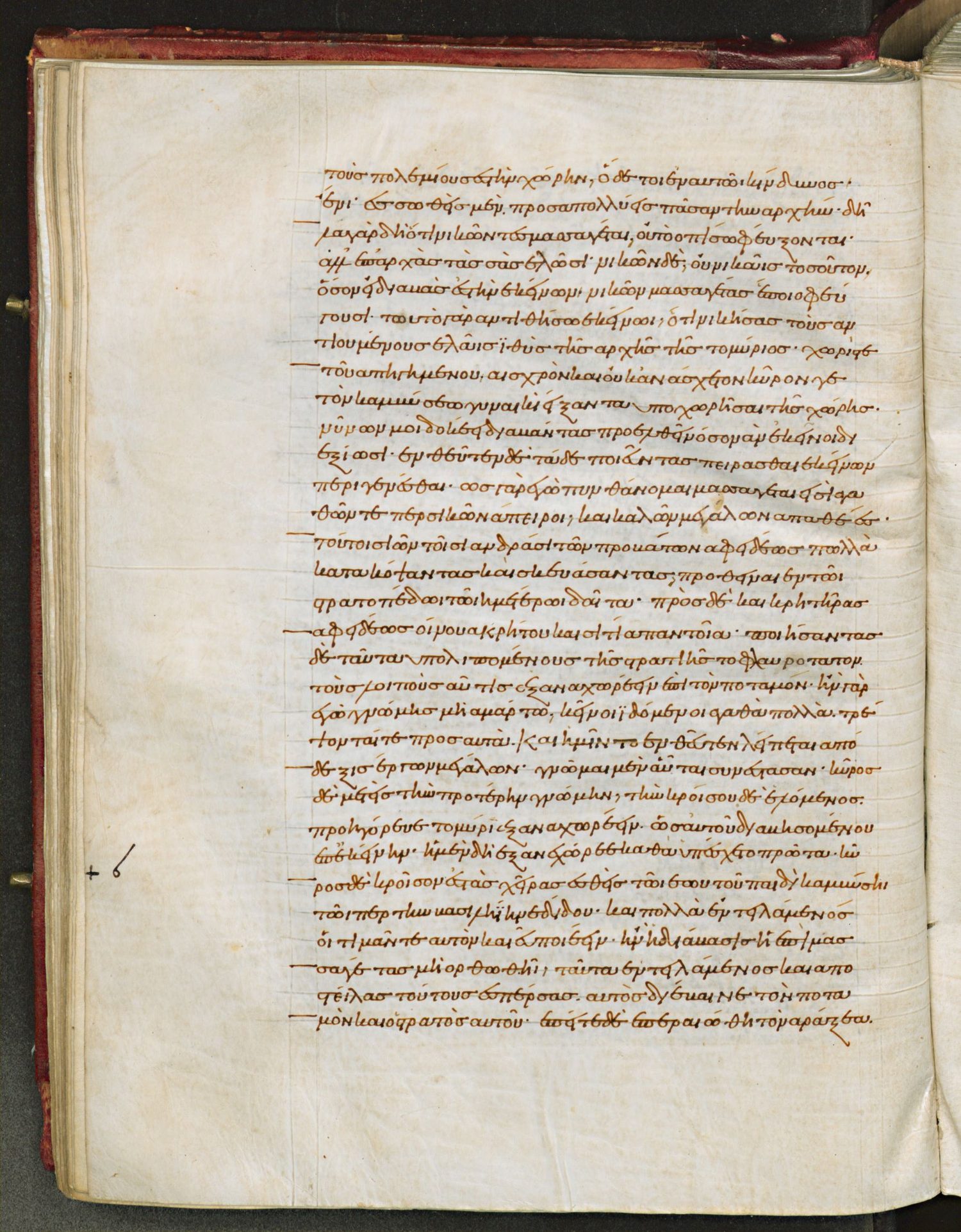
Laur. Plut. 70.3, fol. 53r: Greek here 1.205.2 to 1.207.3. Checked on the image (first and last words read and located in the Greek; each break checked against the neighbouring page): fol. 53r begins ‹-ταμοῦ διάβασιν τῷ στρατῷ,› (1.205.2), ends ‹εἰ γὰρ ἐθελήσομεν ἐσδέξασθαι› (1.207.3). The word ‹ποταμοῦ› is divided between fol. 52v and fol. 53r; it is given with fol. 52v. English here: 1.206.1 to 1.207.2 (Godley's sentences for the sections whose Greek lies mostly on this page).
1.205.2διάβασιν τῷ στρατῷ, καὶ πύργους ἐπὶ πλοίων τῶν διαπορθμευόντων τὸν ποταμὸν οἰκοδομεόμενος. 1.206.1ἔχοντι δέ οἱ τοῦτον τὸν πόνον πέμψασα ἡ Τόμυρις κήρυκα ἔλεγε τάδε. ὦ βασιλεῦ Μήδων, παῦσαι σπεύδων τὰ σπεύδεις· οὐ γὰρ ἂν εἰδείης εἴ τοι ἐς καιρὸν ἔσται ταῦτα τελεόμενα· παυσάμενος δὲ βασίλευε τῶν σεωυτοῦ, καὶ ἡμέας ἀνέχευ ὁρέων ἄρχοντας τῶν περ ἄρχομεν. 1.206.2οὔκων ἐθελήσεις ὑποθήκῃσι τῇσιδε χρᾶσθαι, ἀλλὰ πάντως μᾶλλον ἢ διʼ ἡσυχίης εἶναι· σὺ δὴ εἰ μεγάλως προθυμέαι Μασσαγετέων πειρηθῆναι, φέρε μόχθον μὲν τὸν ἔχεις ζευγνὺς τὸν ποταμὸν ἄπες, σὺ δὲ ἡμέων ἀναχωρησάντων ἀπὸ τοῦ ποταμοῦ τριῶν ἡμερέων ὁδὸν διάβαινε ἐς τὴν ἡμετέρην· 1.206.3εἰ δʼ ἡμέας βούλεαι ἐσδέξασθαι μᾶλλον ἐς τὴν ὑμετέρην, σὺ τὠυτὸ τοῦτο ποίεε. ταῦτα δὲ ἀκούσας ὁ Κῦρος συνεκάλεσε Περσέων τοὺς πρώτους, συναγείρας δὲ τούτους ἐς μέσον σφι προετίθεε τὸ πρῆγμα, συμβουλευόμενος ὁκότερα ποιέῃ. τῶν δὲ κατὰ τὠυτὸ αἱ γνῶμαι συνεξέπιπτον κελευόντων ἐσδέκεσθαι Τόμυρίν τε καὶ τὸν στρατὸν αὐτῆς ἐς τὴν χώρην. 1.207.1παρεὼν δὲ καὶ μεμφόμενος τὴν γνώμην ταύτην Κροῖσος ὁ Λυδὸς ἀπεδείκνυτο ἐναντίην τῇ προκειμένῃ γνώμῃ, λέγων τάδε. ὦ βασιλεῦ, εἶπον μὲν καὶ πρότερόν τοι ὅτι ἐπεί με Ζεὺς ἔδωκέ τοι, τὸ ἂν ὁρῶ σφάλμα ἐὸν οἴκῳ τῷ σῷ κατὰ δύναμιν ἀποτρέψειν· τὰ δὲ μοι παθήματα ἐόντα ἀχάριτα μαθήματα γέγονε. 1.207.2εἰ μὲν ἀθάνατος δοκέεις εἶναι καὶ στρατιῆς τοιαύτης ἄρχειν, οὐδὲν ἂν εἴη πρῆγμα γνώμας ἐμὲ σοὶ ἀποφαίνεσθαι· εἰ δʼ ἔγνωκας ὅτι ἄνθρωπος καὶ σὺ εἶς καὶ ἑτέρων τοιῶνδε ἄρχεις, ἐκεῖνο πρῶτον μάθε, ὡς κύκλος τῶν ἀνθρωπηίων ἐστὶ πρηγμάτων, περιφερόμενος δὲ οὐκ ἐᾷ αἰεὶ τοὺς αὐτοὺς εὐτυχέειν. 1.207.3ἤδη ὦν ἔχω γνώμην περὶ τοῦ προκειμένου πρήγματος τὰ ἔμπαλιν ἢ οὗτοι. εἰ γὰρ ἐθελήσομεν ἐσδέξασθαι
1.206.1But while he was at this work Tomyris sent a herald to him with this message: “Cease, king of the Medes, from that on which you are intent; for you cannot know if the completion of this work will be for your advantage. Cease, and be king of your own country; and be patient to see us ruling those whom we rule. 1.206.2But if you will not take this counsel, and will do all rather than remain at peace, then if you so greatly desire to essay the strength of the Massagetae, do you quit your present labour of bridging the river, and suffer us to draw off three days’ journey from the Araxes; and when that is done, cross into our country. 1.206.3Or if you desire rather to receive us into your country, do you then yourself withdraw as I have said.” Hearing this, Cyrus assembled the chief among the Persians and laid the matter before them, asking them to advise him which he should do. They all spoke to the same purpose, urging him to suffer Tomyris and her army to enter his country. 1.207.1But Croesus the Lydian, who was present, was displeased by their counsel and spoke against it. “Sire,” said he, “you have ere now heard from me that since Zeus has given me to you I will to the best of my power turn aside whatever mischance I see threatening your house. And disaster has been my teacher. 1.207.2Now if you deem yourself and the army that you lead to be immortal, it is not for me to give you advice; but if you know that you and those whom you rule are but men, then I must first teach you this: men’s fortunes are on a wheel, which in its turning suffers not the same man to prosper for ever.
Where on the image
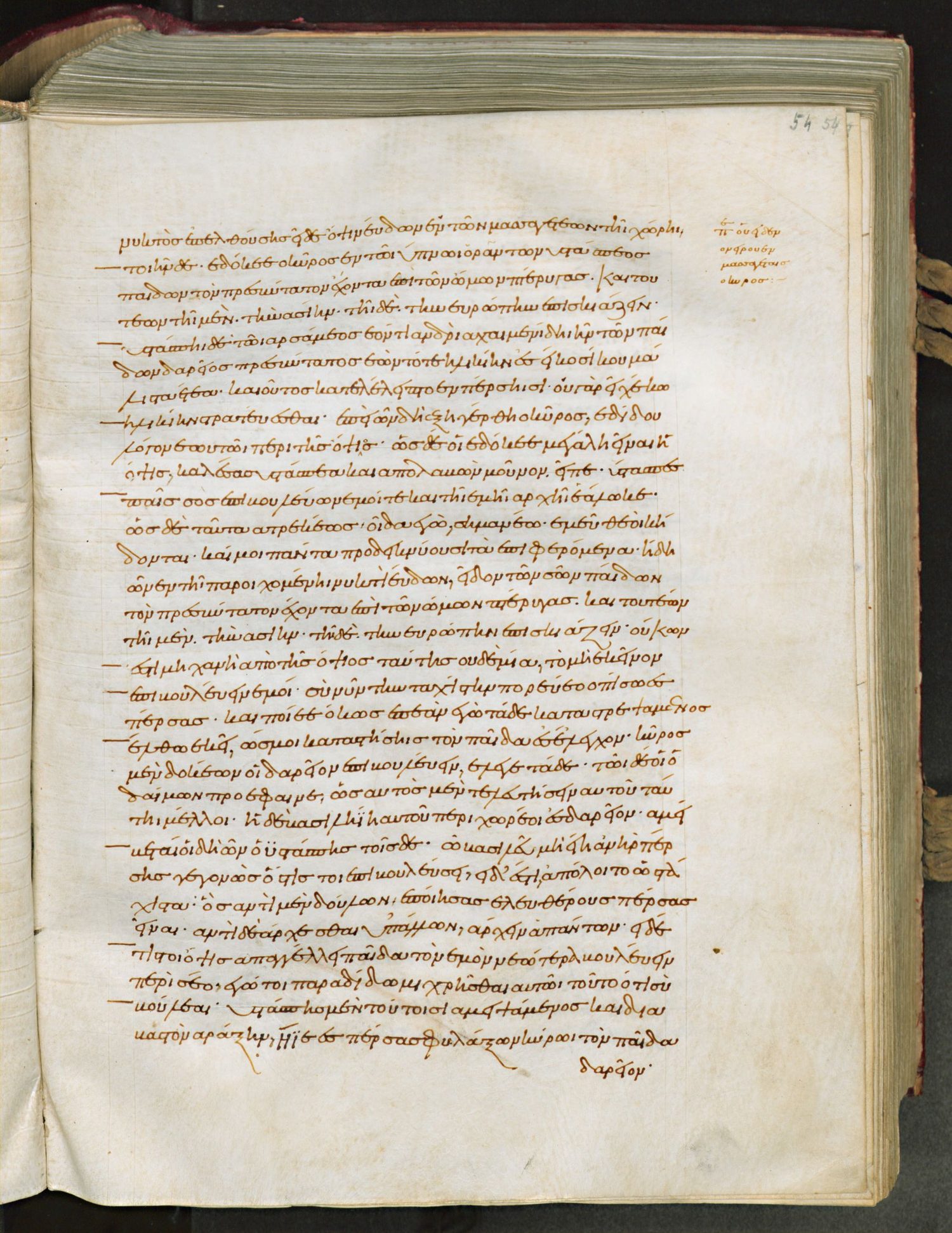
Laur. Plut. 70.3, fol. 53v: Greek here 1.207.3 to 1.209.1. Checked on the image (first and last words read and located in the Greek; each break checked against the neighbouring page): fol. 53v begins ‹τοὺς πολεμίους ἐς τὴν› (1.207.3), ends ‹δὲ ἐπεραιώθη τὸν Ἀράξεα› (1.209.1). English here: 1.207.3 to 1.208.1 (Godley's sentences for the sections whose Greek lies mostly on this page).
1.207.3τοὺς πολεμίους ἐς τὴν χώρην, ὅδε τοι ἐν αὐτῷ κίνδυνος ἔνι· ἑσσωθεὶς μὲν προσαπολλύεις πᾶσαν τὴν ἀρχήν. δῆλα γὰρ δὴ ὅτι νικῶντες Μασσαγέται οὐ τὸ ὀπίσω φεύξονται ἀλλʼ ἐπʼ ἀρχὰς τὰς σὰς ἐλῶσι. 1.207.4νικῶν δὲ οὐ νικᾷς τοσοῦτον ὅσον εἰ διαβὰς ἐς τὴν ἐκείνων, νικῶν Μασσαγέτας, ἕποιο φεύγουσι. τὠυτὸ γὰρ ἀντιθήσω ἐκείνῳ, ὅτι νικήσας τοὺς ἀντιουμένους ἐλᾷς ἰθὺ τῆς ἀρχῆς τῆς Τομύριος. 1.207.5χωρίς τε τοῦ ἀπηγημένου αἰσχρὸν καὶ οὐκ ἀνασχετὸν Κῦρόν γε τὸν Καμβύσεω γυναικὶ εἴξαντα ὑποχωρῆσαι τῆς χώρης. νῦν ὦν μοι δοκέει διαβάντας προελθεῖν ὅσον ἂν ἐκεῖνοι ὑπεξίωσι, ἐνθεῦτεν δὲ τάδε ποιεῦντας πειρᾶσθαι ἐκείνων περιγενέσθαι. 1.207.6ὡς γὰρ ἐγὼ πυνθάνομαι, Μασσαγέται εἰσὶ ἀγαθῶν τε Περσικῶν ἄπειροι καὶ καλῶν μεγάλων ἀπαθέες. τούτοισι ὦν τοῖσι ἀνδράσι τῶν προβάτων ἀφειδέως πολλὰ κατακόψαντας καὶ σκευάσαντας προθεῖναι ἐν τῷ στρατοπέδῳ τῷ ἡμετέρῳ δαῖτα, πρὸς δὲ καὶ κρητῆρας ἀφειδέως οἴνου ἀκρήτου καὶ σιτία παντοῖα· 1.207.7ποιήσαντας δὲ ταῦτα, ὑπολιπομένους τῆς στρατιῆς τὸ φλαυρότατον, τοὺς λοιποὺς αὖτις ἐξαναχωρέειν ἐπὶ τὸν ποταμόν. ἢν γὰρ ἐγὼ γνώμης μὴ ἁμάρτω, κεῖνοι ἰδόμενοι ἀγαθὰ πολλὰ τρέψονταί τε πρὸς αὐτὰ καὶ ἡμῖν τὸ ἐνθεῦτεν λείπεται ἀπόδεξις ἔργων μεγάλων. 1.208.1γνῶμαι μὲν αὗται συνέστασαν· Κῦρος δὲ μετεὶς τὴν προτέρην γνώμην, τὴν Κροίσου δὲ ἑλόμενος, προηγόρευε Τομύρι ἐξαναχωρέειν ὡς αὐτοῦ διαβησομένου ἐπʼ ἐκείνην. ἣ μὲν δὴ ἐξανεχώρεε κατὰ ὑπέσχετο πρῶτα· Κῦρος δὲ Κροῖσον ἐς τὰς χεῖρας ἐσθεὶς τῷ ἑωυτοῦ παιδὶ Καμβύσῃ, τῷ περ τὴν βασιληίην ἐδίδου, καὶ πολλὰ ἐντειλάμενὸς οἱ τιμᾶν τε αὐτὸν καὶ εὖ ποιέειν, ἢν ἡ διάβασις ἡ ἐπὶ Μασσαγέτας μὴ ὀρθωθῇ, ταῦτα ἐντειλάμενος καὶ ἀποστείλας τούτους ἐς Πέρσας, αὐτὸς διέβαινε τὸν ποταμὸν καὶ ὁ στρατὸς αὐτοῦ. 1.209.1ἐπείτε δὲ ἐπεραιώθη τὸν Ἀράξεα,
1.207.3Then, if that be true, I am not of the same mind on the business in hand as these your other counsellors. This is the danger if we agree to suffer the enemy to enter your country: if you lose the battle you lose your empire also, for it is plain that if the Massagetae win they will not retreat back but will march against your provinces. 1.207.4And if you conquer them it is a lesser victory than if you crossed into their country and routed the Massagetae and pursued them; for I balance your chances against theirs, and suppose that when you have worsted your adversaries you will march for the seat of Tomyris’ power. 1.207.5And besides what I have shown, it were a thing shameful and not to be borne that Cyrus the son of Cambyses should yield and give ground before a woman. Now therefore it is in my mind that we should cross and go forward as far as they go back, and that then we should endeavour to overcome them by doing as I shall show. 1.207.6As I learn, the Massagetae have no experience of the good things of Persia, nor have they ever fared well in respect of what is gr I counsel you to cut up the flesh of many of your sheep and goats into portions unstintingly, and to cook it and serve it as a feast in our camp, providing many bowls of unmixed wine withal and all manner of food. 1.207.7Then let your army withdraw to the river again, leaving behind that part of it which is of least account. For if I err not in my judgment, when the Massagetae see so many good things they will betake them to feasting thereon; and it will be for us then to achieve mighty deeds.” 1.208.1So these opinions contended; and Cyrus set aside his former plan and chose that of Croesus; wherefore he bade Tomyris draw her army off, for he would cross (he said) and attack her; so she withdrew as she had promised before. Then he gave Croesus to the care of his own son Cambyses, to whom he purposed to leave his sovereignty, charging Cambyses to honour Croesus and entreat him well, if the crossing of the river against the Massagetae should not prosper. With this charge he sent the two back to Persia, and crossed the river, he and his army.
Where on the image
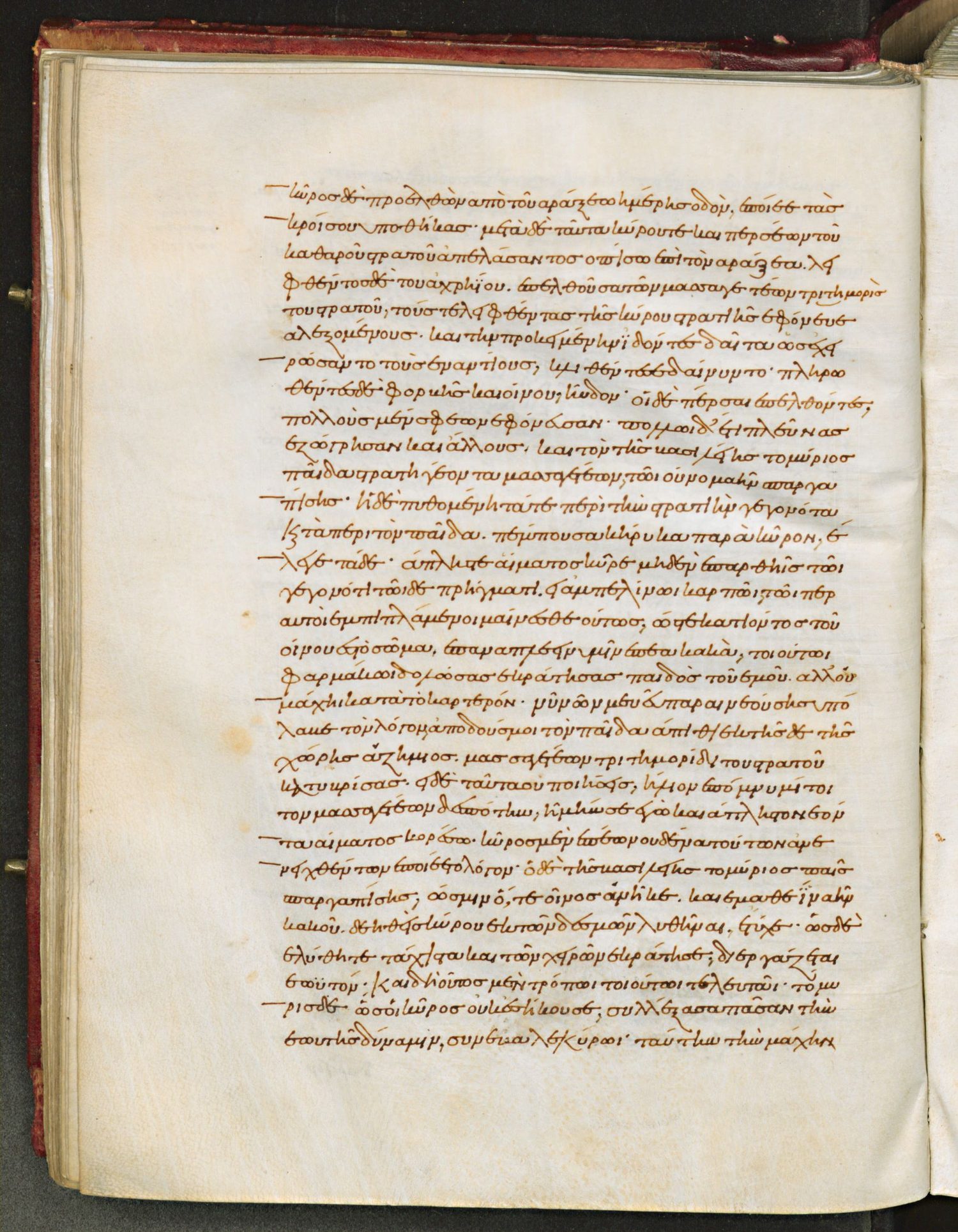
Laur. Plut. 70.3, fol. 54r: Greek here 1.209.1 to 1.211.1. Checked on the image (first and last words read and located in the Greek; each break checked against the neighbouring page): fol. 54r begins ‹νυκτὸς ἐπελθούσης εἶδε ὄψιν› (1.209.1), ends ‹Κύρῳ τὸν παῖδα Δαρεῖον› (1.211.1). English here: 1.209.1 to 1.211.1 (Godley's sentences for the sections whose Greek lies mostly on this page).
1.209.1νυκτὸς ἐπελθούσης εἶδε ὄψιν εὕδων ἐν τῶν Μασσαγετέων τῇ χωρῇ τοιήνδε· ἐδόκεε ὁ Κῦρος ἐν τῷ ὕπνῳ ὁρᾶν τῶν Ὑστάσπεος παίδων τὸν πρεσβύτατον ἔχοντα ἐπὶ τῶν ὤμων πτέρυγας καὶ τουτέων τῇ μὲν τὴν Ἀσίην τῇ δὲ τὴν Εὐρώπην ἐπισκιάζειν. 1.209.2Ὑστάσπεϊ δὲ τῷ Ἀρσάμεος ἐόντι ἀνδρὶ Ἀχαιμενίδῃ ἦν τῶν παίδων Δαρεῖος πρεσβύτατος, ἐὼν τότε ἡλικίην ἐς εἴκοσί κου μάλιστα ἔτεα, καὶ οὗτος κατελέλειπτο ἐν Πέρσῃσι· οὐ γὰρ εἶχέ κω ἡλικίην στρατεύεσθαι. 1.209.3ἐπεὶ ὦν δὴ ἐξηγέρθη ὁ Κῦρος, ἐδίδου λόγον ἑωυτῷ περὶ τῆς ὄψιος. ὡς δέ οἱ ἐδόκεε μεγάλη εἶναι ἡ ὄψις, καλέσας Ὑστάσπεα καὶ ἀπολαβὼν μοῦνον εἶπε Ὕστασπες, παῖς σὸς ἐπιβουλεύων ἐμοί τε καὶ τῇ ἐμῇ ἀρχῇ ἑάλωκε. ὡς δὲ ταῦτα ἀτρεκέως οἶδα, ἐγὼ σημανέω· 1.209.4ἐμεῦ θεοὶ κήδονται καί μοι πάντα προδεικνύουσι τὰ ἐπιφερόμενα. ἤδη ὦν ἐν τῇ παροιχομένῃ νυκτὶ εὕδων εἶδον τῶν σῶν παίδων τὸν πρεσβύτατον ἔχοντα ἐπὶ τῶν ὤμων πτέρυγας καὶ τουτέων τῇ μὲν τὴν Ἀσίην τῇ δὲ τὴν Εὐρώπην ἐπισκιάζειν. 1.209.5οὔκων ἐστὶ μηχανὴ ἀπὸ τῆς ὄψιος ταύτης οὐδεμία τὸ μὴ ἐκεῖνον ἐπιβουλεύειν ἐμοί· σύ νυν τὴν ταχίστην πορεύεο ὀπίσω ἐς Πέρσας καὶ ποίεε ὅκως, ἐπεὰν ἐγὼ τάδε καταστρεψάμενος ἔλθω ἐκεῖ, ὥς μοι καταστήσεις τὸν παῖδα ἐς ἔλεγχον. 1.210.1Κῦρος μὲν δοκέων οἱ Δαρεῖον ἐπιβουλεύειν ἔλεγε τάδε· τῷ δὲ ὁ δαίμων προέφαινε ὡς αὐτὸς μὲν τελευτήσειν αὐτοῦ ταύτῃ μέλλοι, ἡ δὲ βασιληίη αὐτοῦ περιχωρέοι ἐς Δαρεῖον. 1.210.2ἀμείβεται δὴ ὦν ὁ Ὑστάσπης τοῖσιδε. ὦ βασιλεῦ, μὴ εἴη ἀνὴρ Πέρσης γεγονὼς ὅστις τοὶ ἐπιβουλεύσειε, εἰ δʼ ἐστί, ἀπόλοιτο ὡς τάχιστα· ὃς ἀντὶ μὲν δούλων ἐποίησας ἐλευθέρους Πέρσας εἶναι, ἀντὶ δὲ ἄρχεσθαι ὑπʼ ἄλλων ἄρχειν ἁπάντων. 1.210.3εἰ δέ τις τοὶ ὄψις ἀπαγγέλλει παῖδα τὸν ἐμὸν νεώτερα βουλεύειν περὶ σέο, ἐγώ τοι παραδίδωμι χρᾶσθαι αὐτῷ τοῦτο ὅ τι σὺ βούλεαι. 1.211.1Ὑστάσπης μὲν τούτοισι ἀμειψάμενος καὶ διαβὰς τὸν Ἀράξεα ἤιε ἐς Πέρσας φυλάξων Κύρῳ τὸν παῖδα Δαρεῖον,
1.209.1Then, being now across the Araxes, he dreamt at night while sleeping in the country of the Massagetae, that he saw the eldest of the sons of Hystaspes wearing wings on his shoulders, the one wing overshadowing Asia and the other Europe. 1.209.2(Hystaspes son of Arsames was an Achaemenid, and Darius was the eldest of his sons, being then about twenty years old; this Darius had been left behind in Persia, being not yet of an age to follow the army.) 1.209.3So when eatly desirable. For these men, therefore, Cyrus awoke he considered his vision, and because it seemed to him to be of great import, he sent for Hystaspes and said to him privately, “I find, Hystaspes, that your son is guilty of plotting against me and my sovereignty; and I will tell you how I know this for a certainty. 1.209.4I am a man for whom the gods take thought, and show me beforehand all that is coming. Now this being so, I have seen in a dream in the past night your eldest son with wings on his shoulders, overshadowing Asia with the one and Europe with the other; wherefore it is 1.209.5from this vision most certain that he is plotting against me. Do you therefore go with all speed back to Persia, and so act that when I come thither after subduing this country you shall bring your son before me to be questioned of this.” 1.210.1So spoke Cyrus, thinking that Darius was plotting against him; but in truth heaven was showing him that he himself was to die in the land where he was, and Darius to inherit his kingdom. 1.210.2So then Hystaspes answered him thus:—“Sire, the gods forbid that any Persian born should plot against you! but if such there be, may he speedily perish; for you have made the Persians freemen instead of slaves and rulers of all instead of subjects. 1.210.3But if your vision does indeed tell that my son is planning aught to your hurt, take him; he is yours to use as pleases you.” 1.211.1Having so answered, Hystaspes returned across the Araxes to Persia to watch Darius for Cyrus; and Cyrus, going forward a day’s journey from the Araxes, did according to Croesus’ advice.
Where on the image
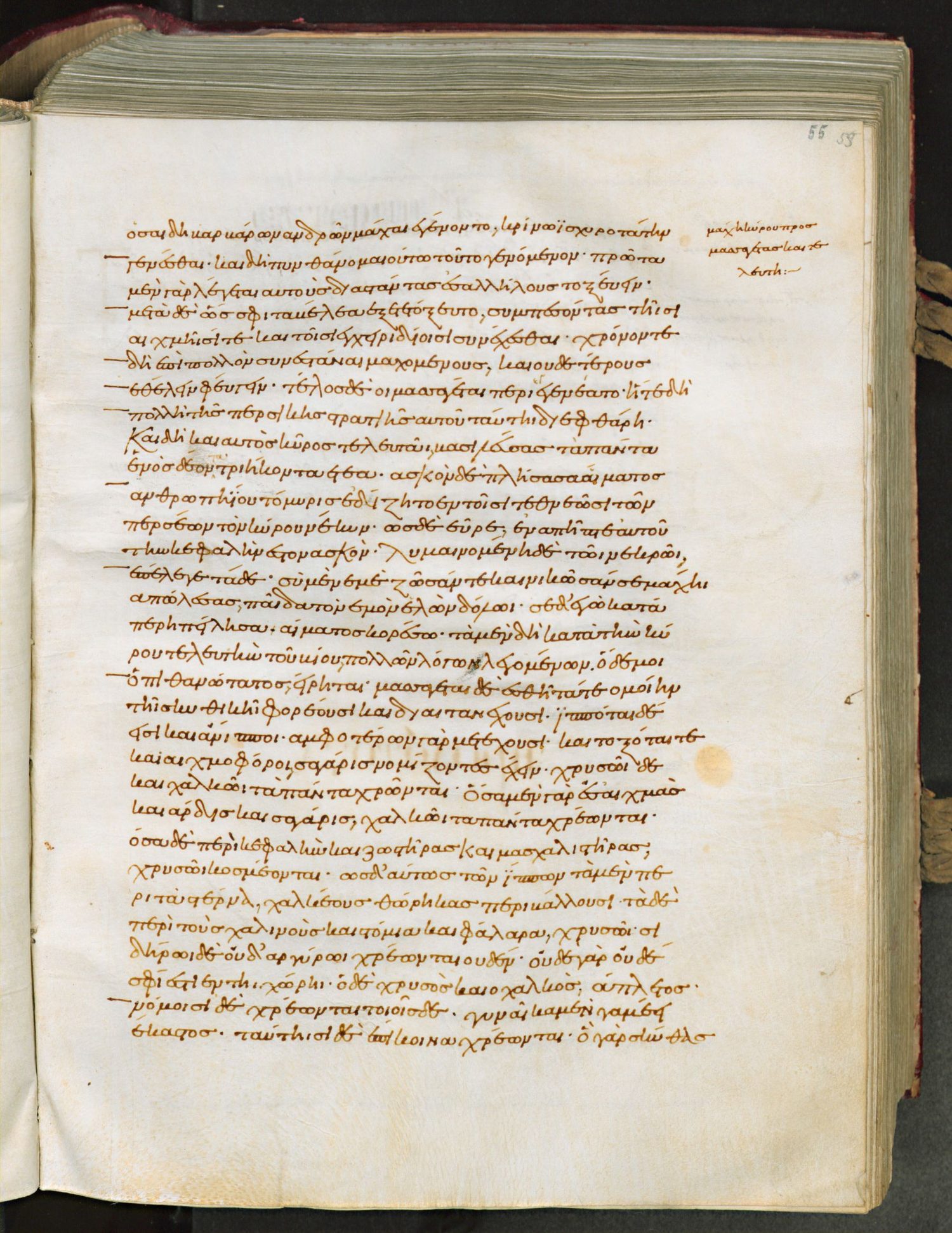
Laur. Plut. 70.3, fol. 54v: Greek here 1.211.1 to 1.214.1. Checked on the image (first and last words read and located in the Greek; each break checked against the neighbouring page): fol. 54v begins ‹Κῦρος δὲ προελθὼν ἀπὸ› (1.211.1), ends ‹Κύρῳ. ταύτην τὴν μάχην› (1.214.1). English here: 1.211.2 to 1.214.1 (Godley's sentences for the sections whose Greek lies mostly on this page).
1.211.1Κῦρος δὲ προελθὼν ἀπὸ τοῦ Ἀράξεω ἡμέρης ὁδὸν ἐποίεε κατὰ τὰς Κροίσου ὑποθήκας. 1.211.2μετὰ δὲ ταῦτα Κύρου τε καὶ Περσέων τοῦ καθαροῦ στρατοῦ ἀπελάσαντος ὀπίσω ἐπὶ τὸν Ἀράξεα, λειφθέντος δὲ τοῦ ἀχρηίου, ἐπελθοῦσα τῶν Μασσαγετέων τριτημορὶς τοῦ στρατοῦ τούς τε λειφθέντας τῆς Κύρου στρατιῆς ἐφόνευε ἀλεξομένους καὶ τὴν προκειμένην ἰδόντες δαῖτα, ὡς ἐχειρώσαντο τοὺς ἐναντίους, κλιθέντες ἐδαίνυντο, πληρωθέντες δὲ φορβῆς καὶ οἴνου ηὗδον. 1.211.3οἱ δὲ Πέρσαι ἐπελθόντες πολλοὺς μὲν σφέων ἐφόνευσαν, πολλῷ δʼ ἔτι πλεῦνας ἐζώγρησαν καὶ ἄλλους καὶ τὸν τῆς βασιλείης Τομύριος παῖδα στρατηγέοντα Μασσαγετέων, τῷ οὔνομα ἦν Σπαργαπίσης. 1.212.1ἣ δὲ πυθομένη τά τε περὶ τὴν στρατιὴν γεγονότα καὶ τὰ περὶ τὸν παῖδα, πέμπουσα κήρυκα παρὰ Κῦρον ἔλεγε τάδε. 1.212.2ἄπληστε αἵματος Κῦρε, μηδὲν ἐπαερθῇς τῷ γεγονότι τῷδε πρήγματι, εἰ ἀμπελίνῳ καρπῷ, τῷ περ αὐτοὶ ἐμπιπλάμενοι μαίνεσθε οὕτω ὥστε κατιόντος τοῦ οἴνου ἐς τὸ σῶμα ἐπαναπλέειν ὑμῖν ἔπεα κακά, τοιούτῳ φαρμάκῳ δολώσας ἐκράτησας παιδὸς τοῦ ἐμοῦ, ἀλλʼ οὐ μάχῃ κατὰ τὸ καρτερόν. 1.212.3νῦν ὦν μευ εὖ παραινεούσης ὑπόλαβε τὸν λόγον· ἀποδούς μοι τὸν παῖδα ἄπιθι ἐκ τῆσδε τῆς χώρης ἀζήμιος, Μασσαγετέων τριτημορίδι τοῦ στρατοῦ κατυβρίσας. εἰ δὲ ταῦτα οὐ ποιήσεις, ἥλιον ἐπόμνυμί τοι τὸν Μασσαγετέων δεσπότην, ἦ μέν σε ἐγὼ καὶ ἄπληστον ἐόντα αἵματος κορέσω. 1.213.1Κῦρος μὲν ἐπέων οὐδένα τούτων ἀνενειχθέντων ἐποιέετο λόγον· ὁ δὲ τῆς βασιλείης Τομύριος παῖς Σπαργαπίσης, ὥς μιν ὅ τε οἶνος ἀνῆκε καὶ ἔμαθε ἵνα ἦν κακοῦ, δεηθεὶς Κύρου ἐκ τῶν δεσμῶν λυθῆναι ἔτυχε, ὡς δὲ ἐλύθη τε τάχιστα καὶ τῶν χειρῶν ἐκράτησε, διεργάζεται ἑωυτόν. 1.214.1καὶ δὴ οὗτος μὲν τρόπῳ τοιούτῳ τελευτᾷ· Τόμυρις δέ, ὥς οἱ Κῦρος οὐκ ἐσήκουσε, συλλέξασα πᾶσαν τὴν ἑωυτῆς δύναμιν συνέβαλε Κύρῳ. ταύτην τὴν μάχην,
1.211.2After this Cyrus and the sound part of the Persian army marched away back to the Araxes, leaving behind those that were useless; whereupon a third part of the host of the Massagetae attacked those of the army who were left behind and slew them despite resistance; then, seeing the banquet spread, when they had overcome their enemies they sat down and feasted, and after they had taken their fill of food and wine they fell asleep. 1.211.3Then the Persians came upon them and slew many and took many more alive, among whom was the son of Tomyris the queen, Spargapises by name, the leader of the Massagetae. 1.212.1When Tomyris heard what had befallen her army and her son, she sent a herald to Cyrus with this message:—“Bloodthirsty 1.212.2Cyrus, be not uplifted by this that you have done; it is no matter for pride if the fruit of the vine—that fruit whereof you Persians drink even to madness, so that the wine passing into your bodies makes evil words to rise in a flood to your lips—has served you as a drug to master my son withal, by guile and not in fair fight. 1.212.3Now therefore take this word of good counsel from me: give me back my son and depart unpunished from this country; it is enough that you have done despite to a third part of the host of the Massagetae. But if you will not do this, then I swear by the sun, the lord of the Massagetae, that for all you are so insatiate of blood, I will give you your fill thereof.” 1.213.1This message was brought to Cyrus, who cared nothing for it. But Spargapises, the son of the queen Tomyris, when his drunkenness left him and he knew his evil plight, entreated Cyrus that he might be loosed from his bonds; and this was granted him; but no sooner was he loosed and had the use of his hands, than he made away with himself. 1.214.1Such was the end of Spargapises. Tomyris, when Cyrus would not listen to her, collected all her power and joined battle with him. This fight I judge to have been the stubbornest of all fights that were ever fought by men that were not Greek; and indeed I have learnt that this was so.
Where on the image
Laur. Plut. 70.3, fol. 55r: Greek here 1.214.1 to 1.216.1. Checked on the image (first and last words read and located in the Greek; each break checked against the neighbouring page): fol. 55r begins ‹ὅσαι δὴ βαρβάρων ἀνδρῶν› (1.214.1), ends ‹χρέωνται· τὸ γὰρ Σκύθας› (1.216.1). English here: 1.214.2 to 1.215.2 (Godley's sentences for the sections whose Greek lies mostly on this page).
1.214.1ὅσαι δὴ βαρβάρων ἀνδρῶν μάχαι ἐγένοντο, κρίνω ἰσχυροτάτην γενέσθαι, καὶ δὴ καὶ πυνθάνομαι οὕτω τοῦτο γενόμενον. 1.214.2πρῶτα μὲν γὰρ λέγεται αὐτοὺς διαστάντας ἐς ἀλλήλους τοξεύειν, μετὰ δὲ ὥς σφι τὰ βέλεα ἐξετετόξευτο, συμπεσόντας τῇσι αἰχμῇσί τε καὶ τοῖσι ἐγχειριδίοισι συνέχεσθαι. χρόνον τε δὴ ἐπὶ πολλὸν συνεστάναι μαχομένους καὶ οὐδετέρους ἐθέλειν φεύγειν. τέλος δὲ οἱ Μασσαγέται περιεγένοντο, 1.214.3ἥ τε δὴ πολλὴ τῆς Περσικῆς στρατιῆς αὐτοῦ ταύτῃ διεφθάρη καὶ δὴ καὶ αὐτὸς Κῦρος τελευτᾷ, βασιλεύσας τὰ πάντα ἑνὸς δέοντα τριήκοντα ἔτεα. 1.214.4ἀσκὸν δὲ πλήσασα αἵματος ἀνθρωπηίου Τόμυρις ἐδίζητο ἐν τοῖσι τεθνεῶσι τῶν Περσέων τὸν Κύρου νέκυν, ὡς δὲ εὗρε, ἐναπῆκε αὐτοῦ τὴν κεφαλὴν ἐς τὸν ἀσκόν, λυμαινομένη δὲ τῷ νεκρῷ ἐπέλεγε τάδε· 1.214.5σὺ μὲν ἐμὲ ζῶσάν τε καὶ νικῶσάν σε μάχῃ ἀπώλεσας, παῖδα τὸν ἐμὸν ἑλὼν δόλῳ· σὲ δʼ ἐγώ, κατά περ ἠπείλησα, αἵματος κορέσω. τὰ μὲν δὴ κατὰ τὴν Κύρου τελευτὴν τοῦ βίου, πολλῶν λόγων λεγομένων, ὅδε μοι ὁ πιθανώτατος εἴρηται. 1.215.1Μασσαγέται δὲ ἐσθῆτά τε ὁμοίην τῇ Σκυθικῇ φορέουσι καὶ δίαιταν ἔχουσι, ἱππόται δὲ εἰσὶ καὶ ἄνιπποι (ἀμφοτέρων γὰρ μετέχουσι) καὶ τοξόται τε καὶ αἰχμοφόροι, σαγάρις νομίζοντες ἔχειν. χρυσῷ δὲ καὶ χαλκῷ τὰ πάντα χρέωνται· ὅσα μὲν γὰρ ἐς αἰχμὰς καὶ ἄρδις καὶ σαγάρις, χαλκῷ τὰ πάντα χρέωνται, ὅσα δὲ περὶ κεφαλὴν καὶ ζωστῆρας καὶ μασχαλιστῆρας, χρυσῷ κοσμέονται. 1.215.2ὣς δʼ αὕτως τῶν ἵππων τὰ μὲν περὶ τὰ στέρνα χαλκέους θώρηκας περιβάλλουσι, τὰ δὲ περὶ τοὺς χαλινοὺς καὶ στόμια καὶ φάλαρα χρυσῷ. σιδήρῳ δὲ οὐδʼ ἀργύρῳ χρέωνται οὐδέν· οὐδὲ γὰρ οὐδέ σφι ἐστὶ ἐν τῇ χωρῇ, ὁ δὲ χρυσὸς καὶ ὁ χαλκὸς ἄπλετος. 1.216.1νόμοισι δὲ χρέωνται τοιοῖσιδε. γυναῖκα μὲν γαμέει ἕκαστος, ταύτῃσι δὲ ἐπίκοινα χρέωνται· τὸ γὰρ Σκύθας
1.214.2For first (it is said) they shot at each other from a distance with arrows; presently, their arrows being all shot away, they rushed upon each other and fought at grips with their spears and their daggers; and for a long time they battled foot to foot and neither would give ground; but at last the Massagetae had the mastery. 1.214.3There perished the greater part of the Persian army, and there fell Cyrus himself, having reigned thirty years in all save one. 1.214.4Tomyris filled a skin with human blood, and sought for Cyrus’ body among the Persian dead; when she found it, she put his head into the skin, and spoke these words of insult to the dead man: “ 1.214.5Though I live and conquer thee, thou hast undone me, overcoming my son by guile; but even as I threatened, so will I do, and give thee thy fill of blood.” Many stories are related of Cyrus’ death; this, that I have told, is the worthiest of credence. 1.215.1These Massagetae are like the Scythians in their dress and manner of life. They are both horsemen and footmen (having some of each kind), and spearmen and bowmen; and it is their custom to carry battle-axes. They ever use gold and bronze; all their spear-points and arrow-heads and battle-axes are of bronze, and gold is the adornment of their headgear and belts and girdles. 1.215.2They treat their horses in like manner, arming their forehands with bronze breastplates and putting gold on reins, bits, and cheekplates. But iron and silver they never use; for there is none at all in their country, but gold and bronze abounds.
Where on the image
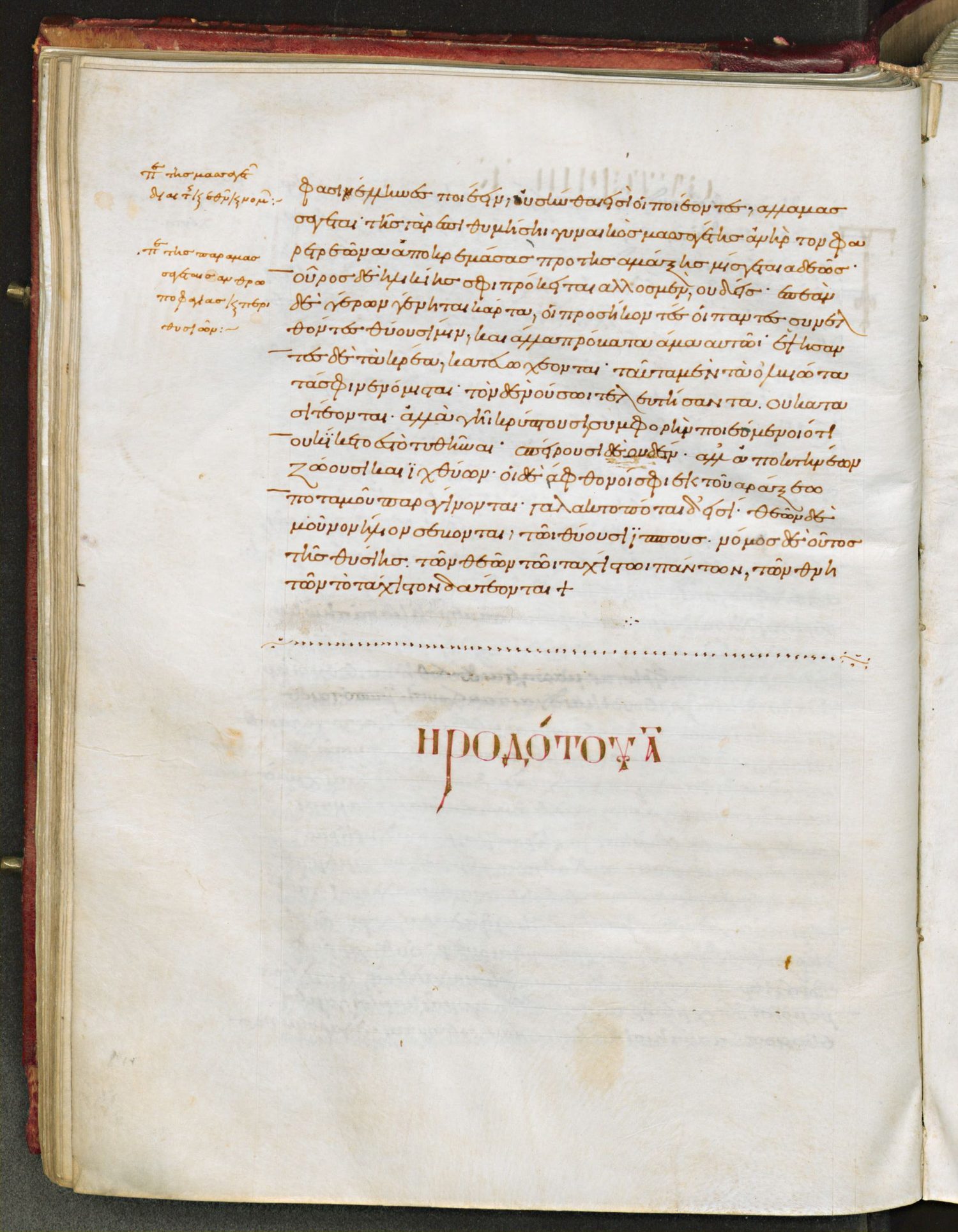
Laur. Plut. 70.3, fol. 55v: Greek here 1.216.1 to 1.216.4. Checked on the image (first and last words read and located in the Greek; each break checked against the neighbouring page): fol. 55v begins ‹φασὶ Ἕλληνες ποιέειν, οὐ› (1.216.1), ends ‹θνητῶν τὸ τάχιστον δατέονται› (1.216.4). Book 1 ends in line 17; below it, after a decorative line, the subscription Ἡροδότου α´ in red. English here: 1.216.1 to 1.216.4 (Godley's sentences for the sections whose Greek lies mostly on this page).
1.216.1φασὶ Ἕλληνες ποιέειν, οὐ Σκύθαι εἰσὶ οἱ ποιέοντες ἀλλὰ Μασσαγέται· τῆς γὰρ ἐπιθυμήσῃ γυναικὸς Μασσαγέτης ἀνήρ, τὸν φαρετρεῶνα ἀποκρεμάσας πρὸ τῆς ἁμάξης μίσγεται ἀδεῶς. 1.216.2οὖρος δὲ ἡλικίης σφι πρόκειται ἄλλος μὲν οὐδείς· ἐπεὰν δὲ γέρων γένηται κάρτα, οἱ προσήκοντές οἱ πάντες συνελθόντες θύουσί μιν καὶ ἄλλα πρόβατα ἅμα αὐτῷ, ἑψήσαντες δὲ τὰ κρέα κατευωχέονται. 1.216.3ταῦτα μὲν τὰ ὀλβιώτατά σφι νενόμισται, τὸν δὲ νούσῳ τελευτήσαντα οὐ κατασιτέονται ἀλλʼ γῇ κρύπτουσι, συμφορὴν ποιεύμενοι ὅτι οὐκ ἵκετο ἐς τὸ τυθῆναι. σπείρουσι δὲ οὐδέν, ἀλλʼ ἀπὸ κτηνέων ζώουσι καὶ ἰχθύων· οἳ δὲ ἄφθονοί σφι ἐκ τοῦ Ἀράξεω ποταμοῦ παραγίνονται· 1.216.4γαλακτοπόται δʼ εἰσί. θεῶν δὲ μοῦνον ἥλιον σέβονται, τῷ θύουσι ἵππους. νόος δὲ οὗτος τῆς θυσίης· τῶν θεῶν τῷ ταχίστῳ πάντων τῶν θνητῶν τὸ τάχιστον δατέονται.
1.216.1Now, for their customs: each man marries a wife, but the wives are common to all. The Greeks say this is a Scythian custom; it is not so, but a custom of the Massagetae. There, when a man desires a woman, he hangs his quiver before her waggon, and has intercourse with her, none hindering. 1.216.2Though they set no certain term to life, yet when a man is very old all his kin meet together and kill him, with beasts of the flock besides, then boil the flesh and feast on it. 1.216.3This is held to be the happiest death; when a man dies of a sickness they do not eat him, but bury him in the earth, and lament that he would not live to be killed. They never sow; their fare is their live-stock and the fish which they have in abundance from the Araxes. 1.216.4Their drink is milk. The sun is the only god whom they worship; to him they sacrifice horses; the reason of it is that he is the swiftest of the gods and therefore they give him the swiftest of mortal things.
Notes
- Greek: the text printed in A. D. Godley's Loeb edition, via Perseus (tlg0016.tlg001.perseus-grc2). Square brackets mark words the editor considers later additions; [...] marks a gap the editor indicates. Perseus note markers are omitted.
- English: A. D. Godley, Herodotus vol. 1 (1920) (Loeb Classical Library), as transcribed on Wikisource. Godley's footnotes are omitted.
- Section numbers in the English were placed by comparing Godley's text with the Perseus version of his translation; where a section begins inside one of Godley's sentences, the English is kept with the page that holds the start of that sentence.
Cite
Sources
- Source: Florence, Laur. Plut. 70.3 (10th c.) via BML Teca Digitale + Greek of Godley's Loeb (Perseus) + English of A. D. Godley (Loeb, Wikisource) (holding institution)
- Critical edition: Greek of A. D. Godley's Loeb edition (1920-1925), via Perseus
← previous · → next · v cycle view · l back to library