Herodotus, Histories 2.1-18: Psammetichus' experiment; the land of Egypt
Introduction
Herodotus of Halicarnassus wrote the Histories in the third quarter of the 5th century BCE, an inquiry into the deeds of Greeks and barbarians and the causes of the wars between them, later divided into nine books. Book 2 is Herodotus' account of Egypt, written as background to Cambyses' invasion: the land and the Nile, the customs and religion of the Egyptians, and the history of their kings as the priests told it, down to Amasis.
The photographs are of Florence, Biblioteca Medicea Laurenziana, Plut. 70.3 (parchment, 10th century, 374 folios, 31 lines a page), Herodotus, Histories (codex A of the editors), the oldest surviving manuscript of the complete Histories, from the Teca Digitale of the Biblioteca Medicea Laurenziana. Each section below is the text of one page, or of the part of a page that falls within these chapters. The first and last words of every page were read on the photograph and located in the Greek, and every page break was checked against the next page; the notes quote these words. Readers' notes in the margins are not part of the text and are mentioned where they occur.
The Greek is the text printed in A. D. Godley's Loeb edition (1920-1925), from Perseus; it is the edited text, not a transcription of the manuscript, whose wording differs in places. The English is Godley's translation as printed, from Wikisource. Godley's English carries only chapter numbers; the section numbers shown in it were placed by comparison with the Perseus version of his translation. Each page's English is cut at the end of one of Godley's sentences, so it can begin or end a few lines away from the Greek of the page; each note gives the exact ranges.
This entry covers chapters 2.1-18, on fol. 56r to 60r.
How was this verified? (Provenance)
Where on the image
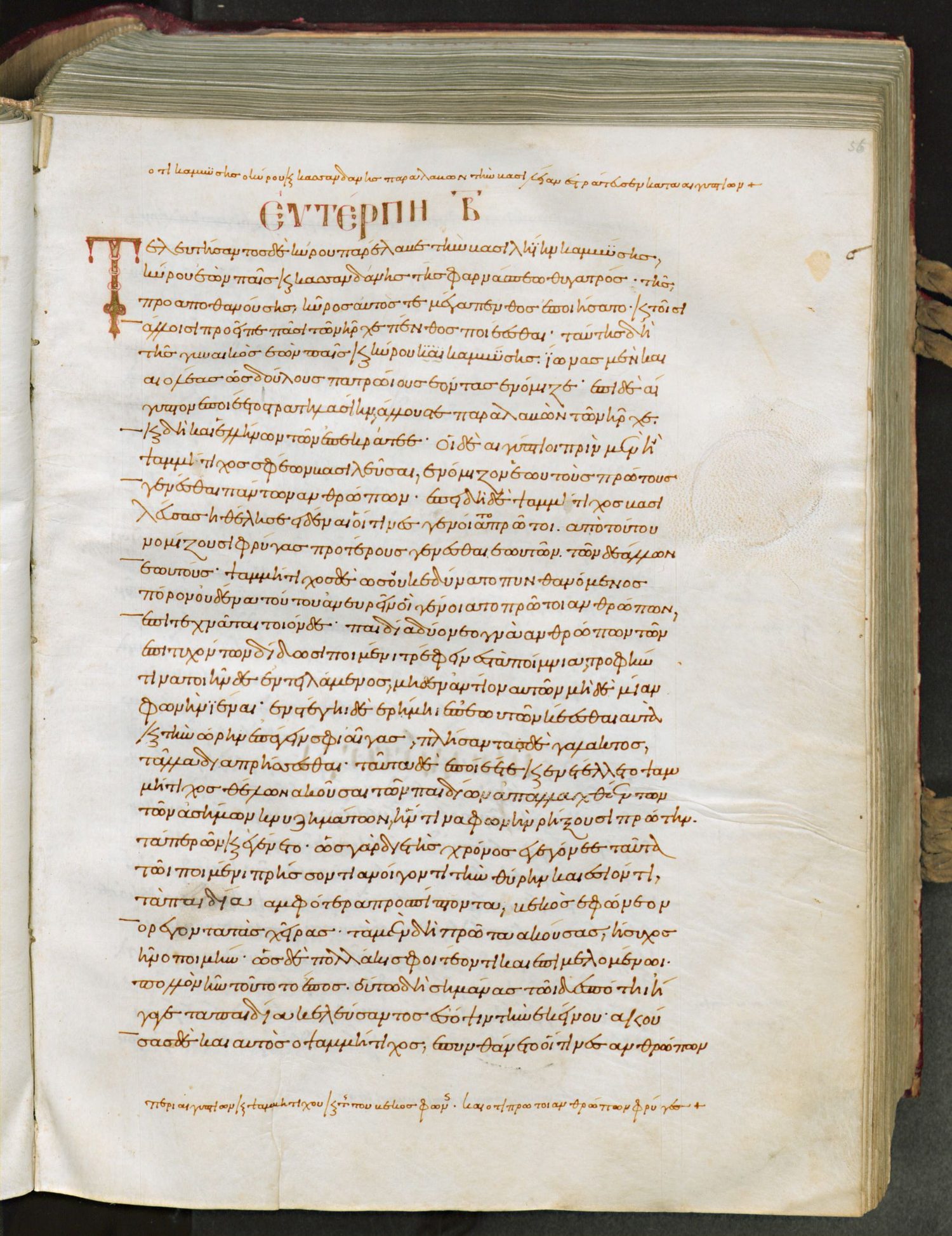
Laur. Plut. 70.3, fol. 56r: Greek here 2.1.1 to 2.2.4. Checked on the image (first and last words read and located in the Greek; each break checked against the neighbouring page): fol. 56r begins ‹τελευτήσαντος δὲ Κύρου παρέλαβε› (2.1.1), ends ‹Ψαμμήτιχος ἐπυνθάνετο οἵτινες ἀνθρώπων› (2.2.4). Book 2 begins under the red title Εὐτέρπη β´ with a decorated initial Τ; a later hand has written a summary note above the title, and a reader's note stands below the text. English here: 2.1.1 to 2.2.4 (Godley's sentences for the sections whose Greek lies mostly on this page).
2.1.1τελευτήσαντος δὲ Κύρου παρέλαβε τὴν βασιληίην Καμβύσης, Κύρου ἐὼν παῖς καὶ Κασσανδάνης τῆς Φαρνάσπεω θυγατρός, τῆς προαποθανούσης Κῦρος αὐτός τε μέγα πένθος ἐποιήσατο καὶ τοῖσι ἄλλοισι προεῖπε πᾶσι τῶν ἦρχε πένθος ποιέεσθαι. 2.1.2ταύτης δὴ τῆς γυναικὸς ἐὼν παῖς καὶ Κύρου Καμβύσης Ἴωνας μὲν καὶ Αἰολέας ὡς δούλους πατρωίους ἐόντας ἐνόμιζε, ἐπὶ δὲ Αἴγυπτον ἐποιέετο στρατηλασίην ἄλλους τε παραλαβὼν τῶν ἦρχε καὶ δὴ καὶ Ἑλλήνων τῶν ἐπεκράτεε. 2.2.1οἱ δὲ Αἰγύπτιοι, πρὶν μὲν ἢ Ψαμμήτιχον σφέων βασιλεῦσαι, ἐνόμιζον ἑωυτοὺς πρώτους γενέσθαι πάντων ἀνθρώπων· ἐπειδὴ δὲ Ψαμμήτιχος βασιλεύσας ἠθέλησε εἰδέναι οἵτινες γενοίατο πρῶτοι, ἀπὸ τούτου νομίζουσι Φρύγας προτέρους γενέσθαι ἑωυτῶν, τῶν δὲ ἄλλων ἑωυτούς. 2.2.2Ψαμμήτιχος δὲ ὡς οὐκ ἐδύνατο πυνθανόμενος πόρον οὐδένα τούτου ἀνευρεῖν, οἳ γενοίατο πρῶτοι ἀνθρώπων, ἐπιτεχνᾶται τοιόνδε. παιδία δύο νεογνὰ ἀνθρώπων τῶν ἐπιτυχόντων δίδωσι ποιμένι τρέφειν ἐς τὰ ποίμνια τροφήν τινα τοιήνδε, ἐντειλάμενος μηδένα ἀντίον αὐτῶν μηδεμίαν φωνὴν ἱέναι, ἐν στέγῃ δὲ ἐρήμῃ ἐπʼ ἑωυτῶν κέεσθαι αὐτά, καὶ τὴν ὥρην ἐπαγινέειν σφι αἶγας, πλήσαντα δὲ γάλακτος τἆλλα διαπρήσσεσθαι· 2.2.3ταῦτα δὲ ἐποίεέ τε καὶ ἐνετέλλετο Ψαμμήτιχος θέλων ἀκοῦσαι τῶν παιδίων, ἀπαλλαχθέντων τῶν ἀσήμων κνυζημάτων, ἥντινα φωνὴν ῥήξουσι πρώτην· τά περ ὦν καὶ ἐγένετο. ὡς γὰρ διέτης χρόνος ἐγεγόνεε ταῦτα τῷ ποιμένι πρήσσοντι, ἀνοίγοντι τὴν θύρην καὶ ἐσιόντι τὰ παιδία ἀμφότερα προσπίπτοντα βεκὸς ἐφώνεον, ὀρέγοντα τὰς χεῖρας. 2.2.4τὰ μὲν δὴ πρῶτα ἀκούσας ἥσυχος ἦν ὁ ποιμήν· ὡς δὲ πολλάκις φοιτέοντι καὶ ἐπιμελομένῳ πολλὸν ἦν τοῦτο τὸ ἔπος, οὕτω δὴ σημήνας τῷ δεσπότῃ ἤγαγε τὰ παιδία κελεύσαντος ἐς ὄψιν τὴν ἐκείνου. ἀκούσας δὲ καὶ αὐτὸς ὁ Ψαμμήτιχος ἐπυνθάνετο οἵτινες ἀνθρώπων
2.1.1After the death of Cyrus Cambyses inherited his throne. He was the son of Cyrus and Cassandane daughter of Pharnaspes, for whom, when she died before him, Cyrus himself mourned deeply and bade all his subjects mourn also. 2.1.2Cambyses was the son of this woman and Cyrus. He considered the Ionians and Aeolians as slaves inherited from his father, and prepared an expedition against Egypt, taking with him, with others subject to him, some of the Greeks over whom he held sway. 2.2.1Now before Psammetichus became king of Egypt, the Egyptians deemed themselves to be the oldest nation on earth. But ever since he desired to learn, on becoming king, what nation was oldest, they have considered that, though they came before all other nations, the Phrygians are older still. 2.2.2Psammetichus, being nowise able to discover by inquiry what men had first come into being, devised a plan whereby he took two newborn children of common men and gave them to a shepherd to bring up among his flocks. He gave charge that none should speak any word in their hearing; they were to lie by themselves in a lonely hut, and in due season the shepherd was to bring goats and give the children their milk and do all else needful. 2.2.3Psammetichus did this, and gave this charge, because he desired to hear what speech would first break from the children, when they were past the age of indistinct babbling. And he had his wish; for when the shepherd had done as he was bidden for two years, one day as he opened the door and entered both the children ran to him stretching out their hands and calling “Bekos.” 2.2.4When he first heard this he said nothing of it; but coming often and taking careful note, he was ever hearing this same word, till at last he told the matter to his master, and on command brought the children into the king’s presence. Psammetichus heard them himself, and inquired to what language this word Bekos might belong; he found it to be a Phrygian word signifying bread.
Where on the image
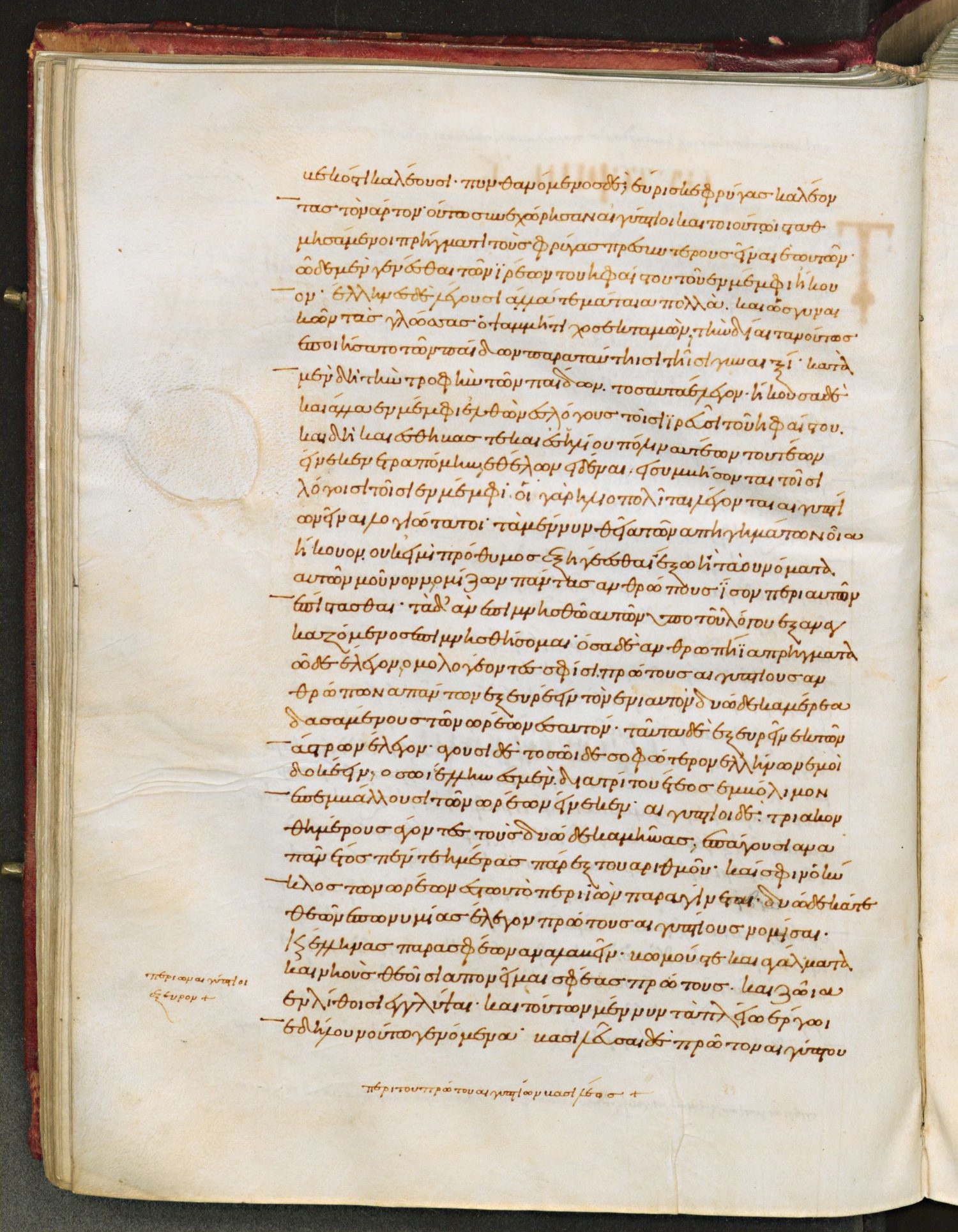
Laur. Plut. 70.3, fol. 56v: Greek here 2.2.4 to 2.4.2. Checked on the image (first and last words read and located in the Greek; each break checked against the neighbouring page): fol. 56v begins ‹βεκός τι καλέουσι, πυνθανόμενος› (2.2.4), ends ‹βασιλεῦσαι δὲ πρῶτον Αἰγύπτου› (2.4.2). Below the text, a reader's note on the first king of Egypt. English here: 2.2.5 to 2.4.2 (Godley's sentences for the sections whose Greek lies mostly on this page).
2.2.4βεκός τι καλέουσι, πυνθανόμενος δὲ εὕρισκε Φρύγας καλέοντας τὸν ἄρτον. 2.2.5οὕτω συνεχώρησαν Αἰγύπτιοι καὶ τοιούτῳ σταθμησάμενοι πρήγματι τοὺς Φρύγας πρεσβυτέρους εἶναι ἑωυτῶν. ὧδε μὲν γενέσθαι τῶν ἱρέων τοῦ Ἡφαίστου τοῦ ἐν Μέμφι ἤκουον· Ἕλληνες δὲ λέγουσι ἄλλα τε μάταια πολλὰ καὶ ὡς γυναικῶν τὰς γλώσσας ὁ Ψαμμήτιχος ἐκταμὼν τὴν δίαιταν οὕτω ἐποιήσατο τῶν παίδων παρὰ ταύτῃσι τῇσι γυναιξί. 2.3.1κατὰ μὲν δὴ τὴν τροφὴν τῶν παίδων τοσαῦτα ἔλεγον, ἤκουσα δὲ καὶ ἄλλα ἐν Μέμφι ἐλθὼν ἐς λόγους τοῖσι ἱρεῦσι τοῦ Ἡφαίστου. καὶ δὴ καὶ ἐς Θήβας τε καὶ ἐς Ἡλίου πόλιν αὐτῶν τούτων εἵνεκεν ἐτραπόμην, ἐθέλων εἰδέναι εἰ συμβήσονται τοῖσι λόγοισι τοῖσι ἐν Μέμφι· οἱ γὰρ Ἡλιοπολῖται λέγονται Αἰγυπτίων εἶναι λογιώτατοι. 2.3.2τὰ μέν νυν θεῖα τῶν ἀπηγημάτων οἷα ἤκουον οὐκ εἰμὶ πρόθυμος ἐξηγέεσθαι, ἔξω ἢ τὰ οὐνόματα αὐτῶν μοῦνον, νομίζων πάντας ἀνθρώπους ἴσον περὶ αὐτῶν ἐπίστασθαι· τὰ δʼ ἂν ἐπιμνησθέω αὐτῶν, ὑπὸ τοῦ λόγου ἐξαναγκαζόμενος ἐπιμνησθήσομαι. 2.4.1ὅσα δὲ ἀνθρωπήια πρήγματα, ὧδε ἔλεγον ὁμολογέοντες σφίσι, πρώτους Αἰγυπτίους ἀνθρώπων ἁπάντων ἐξευρεῖν τὸν ἐνιαυτόν, δυώδεκα μέρεα δασαμένους τῶν ὡρέων ἐς αὐτόν· ταῦτα δὲ ἐξευρεῖν ἐκ τῶν ἀστέρων ἔλεγον· ἄγουσι δὲ τοσῷδε σοφώτερον Ἑλλήνων, ἐμοὶ δοκέειν, ὅσῳ Ἕλληνες μὲν διὰ τρίτου ἔτεος ἐμβόλιμον ἐπεμβάλλουσι τῶν ὡρέων εἵνεκεν, Αἰγύπτιοι δὲ τριηκοντημέρους ἄγοντες τοὺς δυώδεκα μῆνας ἐπάγουσι ἀνὰ πᾶν ἔτος πέντε ἡμέρας πάρεξ τοῦ ἀριθμοῦ, καί σφι ὁ κύκλος τῶν ὡρέων ἐς τὠυτὸ περιιὼν παραγίνεται. 2.4.2δυώδεκά τε θεῶν ἐπωνυμίας ἔλεγον πρώτους Αἰγυπτίους νομίσαι καὶ Ἕλληνας παρὰ σφέων ἀναλαβεῖν, βωμούς τε καὶ ἀγάλματα καὶ νηοὺς θεοῖσι ἀπονεῖμαι σφέας πρώτους καὶ ζῷα ἐν λίθοισι ἐγγλύψαι. καὶ τούτων μέν νυν τὰ πλέω ἔργῳ ἐδήλουν οὕτω γενόμενα. βασιλεῦσαι δὲ πρῶτον Αἰγύπτου
2.2.5Reasoning from this fact the Egyptians confessed that the Phrygians were older than they. This is the story which I heard from the priests of Hephaestus’ temple at Memphis; the Greeks relate (among many foolish tales) that Psammetichus made the children to be reared by women whose tongues he had cut out. 2.3.1Besides this story of the rearing of the children, I heard also other things at Memphis, in converse with the priests of Hephaestus; and I visited Thebes too and Heliopolis for this very purpose, because I desired to know if the people of those places would tell me the same tale as the priests at Memphis; for the people of Heliopolis are said to be the most learned of the Egyptians. 2.3.2Now, for the stories which I heard about the gods, I am not desirous to relate them, saving only the names of the deities; for I hold that no man knows about the gods more than another; and I will say no more about them than what I am constrained to say by the course of my history. 2.4.1But as regarding human affairs, this was the account in which they all agreed: the Egyptians, they said, were the first men who reckoned by years and made the year to consist of twelve divisions of the seasons. They discovered this from the stars (so they said). And their reckoning is, to my mind, a juster one than that of the Greeks; for the Greeks add an intercalary month every other year, so that the seasons may agree; but the Egyptians, reckoning thirty days to each of the twelve months, add five days in every year over and above the number, and so the completed circle of seasons is made to agree with the calendar. 2.4.2Further, the Egyptians (said they) first used the appellations of twelve gods (which the Greeks afterwards borrowed from them); and it was they who first assigned to the several gods their altars and images and temples, and first carved figures on stone. They showed me most of this by plain proof. The first human king of Egypt, they said, was Min.
Where on the image
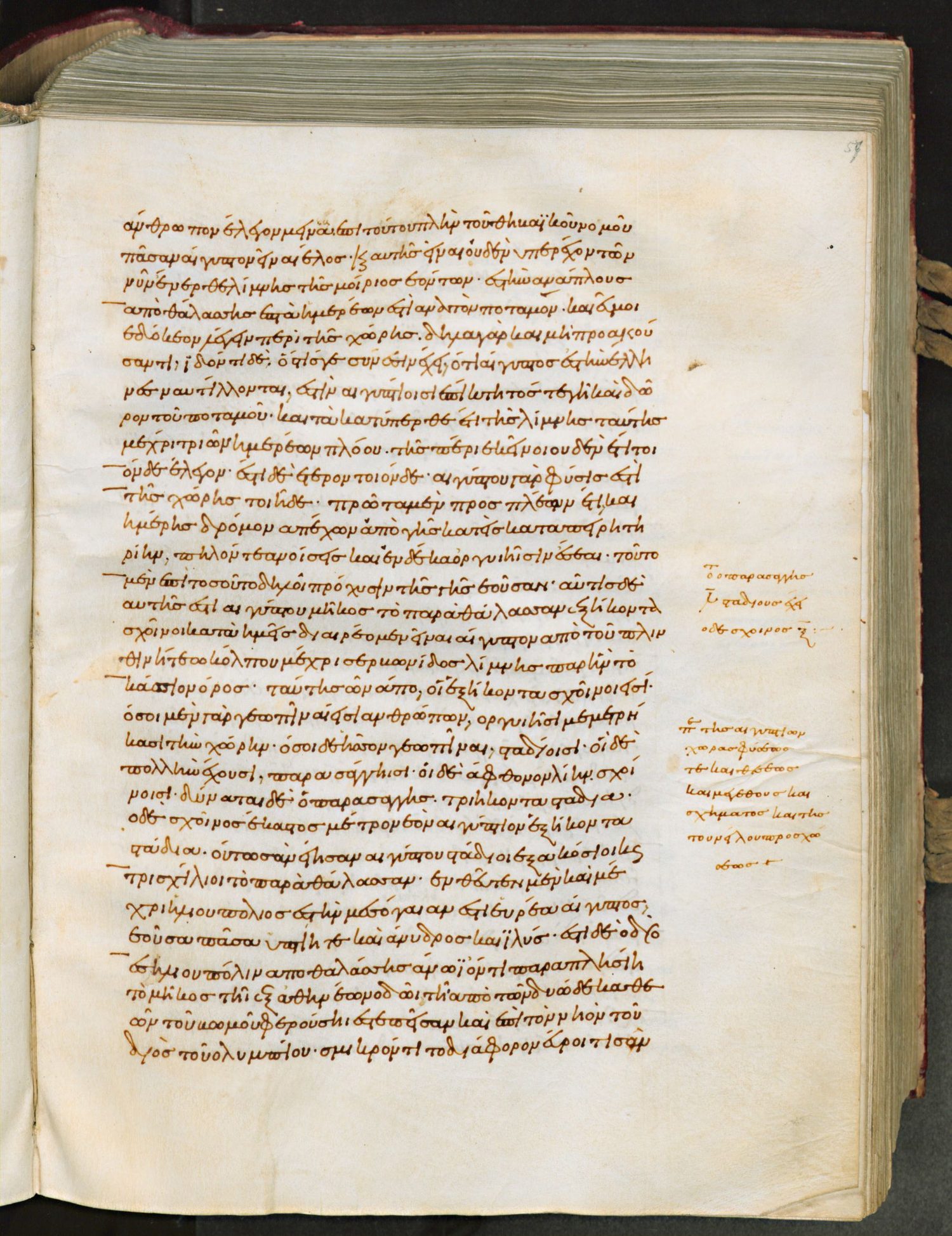
Laur. Plut. 70.3, fol. 57r: Greek here 2.4.2 to 2.7.2. Checked on the image (first and last words read and located in the Greek; each break checked against the neighbouring page): fol. 57r begins ‹ἄνθρωπον ἔλεγον Μῖνα·ἐπὶ τούτου,› (2.4.2), ends ‹διάφορον εὕροι τις ἂν› (2.7.2). English here: 2.4.3 to 2.7.1 (Godley's sentences for the sections whose Greek lies mostly on this page).
2.4.2ἄνθρωπον ἔλεγον Μῖνα· 2.4.3ἐπὶ τούτου, πλὴν τοῦ Θηβαϊκοῦ νομοῦ, πᾶσαν Αἴγυπτον εἶναι ἕλος, καὶ αὐτῆς εἶναι οὐδὲν ὑπερέχον τῶν νῦν ἔνερθε λίμνης τῆς Μοίριος ἐόντων, ἐς τὴν ἀνάπλοος ἀπὸ θαλάσσης ἑπτὰ ἡμερέων ἐστὶ ἀνὰ τὸν ποταμόν. 2.5.1καὶ εὖ μοι ἐδόκεον λέγειν περὶ τῆς χώρης· δῆλα γὰρ δὴ καὶ μὴ προακούσαντι ἰδόντι δέ, ὅστις γε σύνεσιν ἔχει, ὅτι Αἴγυπτος, ἐς τὴν Ἕλληνες ναυτίλλονται, ἐστὶ Αἰγυπτίοισι ἐπίκτητός τε γῆ καὶ δῶρον τοῦ ποταμοῦ, καὶ τὰ κατύπερθε ἔτι τῆς λίμνης ταύτης μέχρι τριῶν ἡμερέων πλόου, τῆς πέρι ἐκεῖνοι οὐδὲν ἔτι τοιόνδε ἔλεγον, ἔστι δὲ ἕτερον τοιόνδε. 2.5.2Αἰγύπτου γὰρ φύσις ἐστὶ τῆς χώρης τοιήδε. πρῶτα μὲν προσπλέων ἔτι καὶ ἡμέρης δρόμον ἀπέχων ἀπὸ γῆς, κατεὶς καταπειρητηρίην πηλόν τε ἀνοίσεις καὶ ἐν ἕνδεκα ὀργυιῇσι ἔσεαι. τοῦτο μὲν ἐπὶ τοσοῦτο δηλοῖ πρόχυσιν τῆς γῆς ἐοῦσαν. 2.6.1αὖτις δὲ αὐτῆς ἐστι Αἰγύπτου μῆκος τὸ παρὰ θάλασσαν ἑξήκοντα σχοῖνοι, κατὰ ἡμεῖς διαιρέομεν εἶναι Αἴγυπτον ἀπὸ τοῦ Πλινθινήτεω κόλπου μέχρι Σερβωνίδος λίμνης, παρʼ ἣν τὸ Κάσιον ὄρος τείνει· ταύτης ὦν ἄπο οἱ ἑξήκοντα σχοῖνοι εἰσί. 2.6.2ὅσοι μὲν γὰρ γεωπεῖναι εἰσὶ ἀνθρώπων, ὀργυιῇσι μεμετρήκασι τὴν χώρην, ὅσοι δὲ ἧσσον γεωπεῖναι, σταδίοισι, οἳ δὲ πολλὴν ἔχουσι, παρασάγγῃσι, οἳ δὲ ἄφθονον λίην, σχοίνοισι. 2.6.3δύναται δὲ ὁ παρασάγγης τριήκοντα στάδια, ὁ δὲ σχοῖνος, μέτρον ἐὸν Αἰγύπτιον, ἑξήκοντα στάδια. 2.7.1οὕτω ἂν εἴησαν Αἰγύπτου στάδιοι ἑξακόσιοι καὶ τρισχίλιοι τὸ παρὰ θάλασσαν. ἐνθεῦτεν μὲν καὶ μέχρι Ἡλίου πόλιος ἐς τὴν μεσόγαιαν ἐστὶ εὐρέα Αἴγυπτος, ἐοῦσα πᾶσα ὑπτίη τε καὶ ἔνυδρος καὶ ἰλύς. ἔστι δὲ ὁδὸς ἐς Ἡλίου πόλιν ἀπὸ θαλάσσης ἄνω ἰόντι παραπλησίη τὸ μῆκος τῇ ἐξ Ἀθηνέων ὁδῷ τῇ ἀπὸ τῶν δυώδεκα θεῶν τοῦ βωμοῦ φερούσῃ ἔς τε Πῖσαν καὶ ἐπὶ τὸν νηὸν τοῦ Διὸς τοῦ Ὀλυμπίου. 2.7.2σμικρόν τι τὸ διάφορον εὕροι τις ἂν
2.4.3In his time all Egypt save the Thebaic province was a marsh: all the country that we now see was then covered by water, north of the lake Moeris, which lake is seven days’ journey up the river from the sea. 2.5.1And I think that their account of the country was true. For even though a man has not before been told it he can at once see, if he have sense, that that Egypt to which the Greeks sail is land acquired by the Egyptians, given them by the river—not only the lower country but even all the land to three days’ voyage above the aforesaid lake, which is of the same nature as the other, though the priests added not this to what they said. 2.5.2For this is the nature of the land of Egypt: firstly, when you approach to it from the sea and are yet a day’s run from land, if you then let down a sounding line you will bring up mud and find a depth of eleven fathoms. This shows that the deposit from the land reaches thus far. 2.6.1Further, the length of the seacoast of Egypt itself is sixty “schoeni,” that is of Egypt as we judge it to be, reaching from the Plinthinete gulf to the Serbonian marsh, which is under the Casian mountain; between these there is this length of sixty schoeni. 2.6.2Men that have scanty land measure by fathoms; those that have more, by furlongs; those that have much land, by parasangs; and those who have great abundance of it, by schoeni. 2.6.3The parasang is of thirty furlongs’ length, and the schoenus, which is an Egyptian measure, is of sixty. 2.7.1By this reckoning then the seaboard of Egypt will be three thousand and six hundred furlongs in length. Inland from the sea as far as Heliopolis Egypt is a wide land, all flat and watery and marshy. From the sea up to Heliopolis it is a journey about as long as the way from the altar of the twelve gods at Athens to the temple of Olympian Zeus at Pisa.
Where on the image
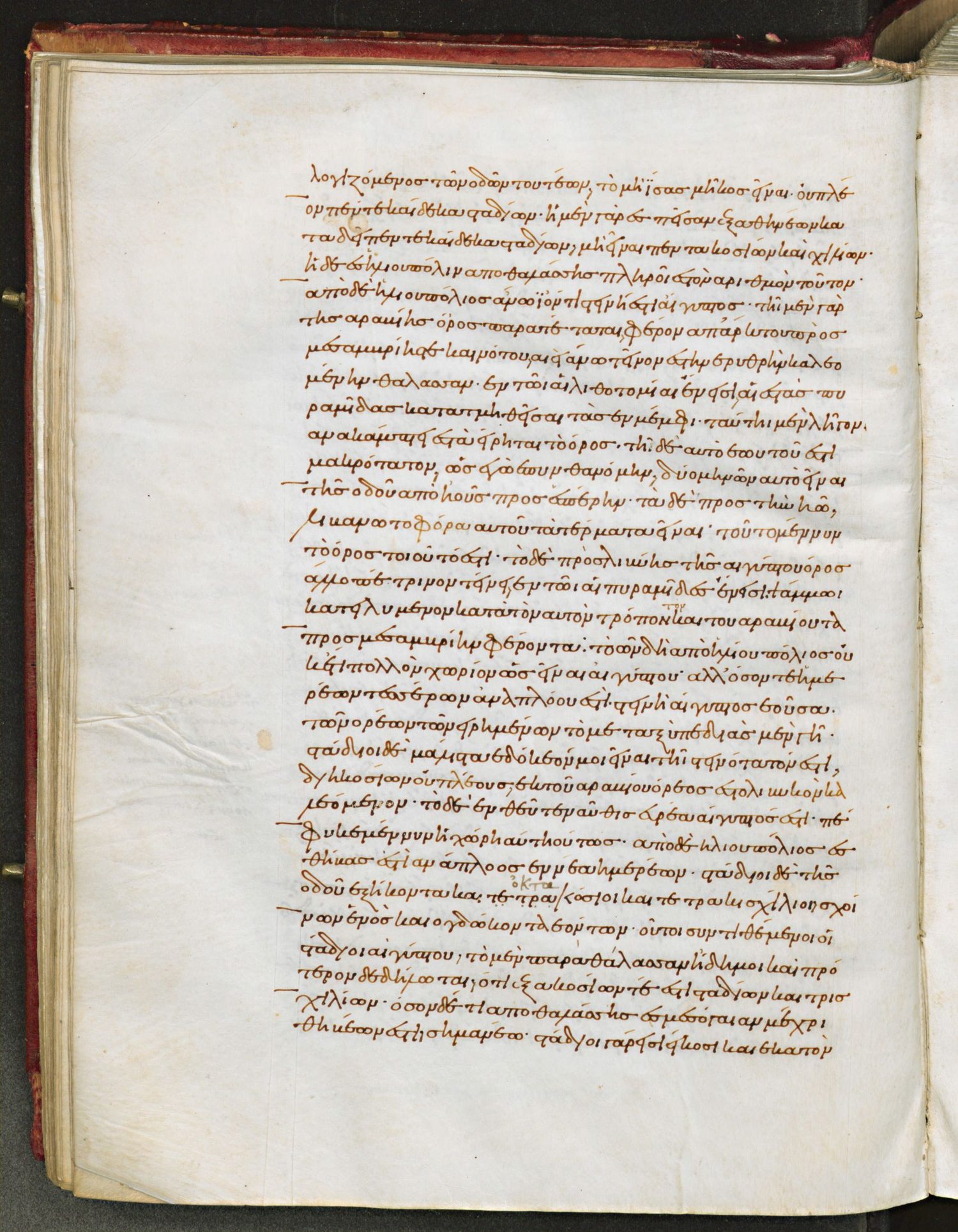
Laur. Plut. 70.3, fol. 57v: Greek here 2.7.2 to 2.9.2. Checked on the image (first and last words read and located in the Greek; each break checked against the neighbouring page): fol. 57v begins ‹λογιζόμενος τῶν ὁδῶν τουτέων› (2.7.2), ends ‹εἰσὶ εἴκοσι καὶ ἑκατὸν› (2.9.2). English here: 2.7.2 to 2.9.2 (Godley's sentences for the sections whose Greek lies mostly on this page).
2.7.2λογιζόμενος τῶν ὁδῶν τουτέων τὸ μὴ ἴσας μῆκος εἶναι, οὐ πλέον πεντεκαίδεκα σταδίων· ἡ μὲν γὰρ ἐς Πῖσαν ἐξ Ἀθηνέων καταδεῖ πεντεκαίδεκα σταδίων μὴ εἶναι πεντακοσίων καὶ χιλίων, ἡ δὲ ἐς Ἡλίου πόλιν ἀπὸ θαλάσσης πληροῖ ἐς τὸν ἀριθμὸν τοῦτον. 2.8.1ἀπὸ δὲ Ἡλίου πόλιος ἄνω ἰόντι στεινή ἐστι Αἴγυπτος. τῇ μὲν γὰρ τῆς Ἀραβίης ὄρος παρατέταται, φέρον ἀπʼ ἄρκτου πρὸς μεσαμβρίην τε καὶ νότον, αἰεὶ ἄνω τεῖνον ἐς τὴν Ἐρυθρὴν καλεομένην θάλασσαν· ἐν τῷ αἱ λιθοτομίαι ἔνεισι αἱ ἐς τὰς πυραμίδας κατατμηθεῖσαι τὰς ἐν Μέμφι. ταύτῃ μὲν λῆγον ἀνακάμπτει ἐς τὰ εἴρηται τὸ ὄρος· τῇ δὲ αὐτὸ ἑωυτοῦ ἐστι μακρότατον, ὡς ἐγὼ ἐπυνθανόμην, δύο μηνῶν αὐτὸ εἶναι τῆς ὁδοῦ ἀπὸ ἠοῦς πρὸς ἑσπέρην, τὰ δὲ πρὸς τὴν ἠῶ λιβανωτοφόρα αὐτοῦ τὰ τέρματα εἶναι. 2.8.2τοῦτο μέν νυν τὸ ὄρος τοιοῦτο ἐστί, τὸ δὲ πρὸς Λιβύης τῆς Αἰγύπτου ὄρος ἄλλο πέτρινον τείνει, ἐν τῷ αἱ πυραμίδες ἔνεισι, ψάμμῳ κατειλυμένον, κατὰ τὸν αὐτὸν τρόπον καὶ τοῦ Ἀραβίου τὰ πρὸς μεσαμβρίην φέροντα. 2.8.3τὸ ὦν δὴ ἀπὸ Ἡλίου πόλιος οὐκέτι πολλὸν χωρίον ὡς εἶναι Αἰγύπτου, ἀλλʼ ὅσον τε ἡμερέων τεσσέρων καὶ δέκα ἀναπλόου ἐστὶ στεινὴ Αἴγυπτος, ἐοῦσα τῶν ὀρέων τῶν εἰρημένων τὸ μεταξὺ πεδιὰς μὲν γῆ, στάδιοι δὲ μάλιστα ἐδόκεόν μοι εἶναι, τῇ στεινότατον ἐστί, διηκοσίων οὐ πλέους ἐκ τοῦ Ἀραβίου ὄρεος ἐς τὸ Λιβυκὸν καλεόμενον. τὸ δʼ ἐνθεῦτεν αὖτις εὐρέα Αἴγυπτος ἐστί. πέφυκε μέν νυν ἡ χώρη αὕτη οὕτω. 2.9.1ἀπὸ δὲ Ἡλίου πόλιος ἐς Θήβας ἐστὶ ἀνάπλοος ἐννέα ἡμερέων, στάδιοι δὲ τῆς ὁδοῦ ἑξήκοντα καὶ ὀκτακόσιοι καὶ τετρακισχίλιοι, σχοίνων ἑνὸς καὶ ὀγδώκοντα ἐόντων. 2.9.2οὗτοι συντιθέμενοι οἱ στάδιοι Αἰγύπτου τὸ μὲν παρὰ θάλασσαν ἤδη μοι καὶ πρότερον δεδήλωται ὅτι ἑξακοσίων τε ἐστὶ σταδίων καὶ τρισχιλίων, ὅσον δέ τι ἀπὸ θαλάσσης ἐς μεσόγαιαν μέχρι Θηβέων ἐστί, σημανέω· στάδιοι γὰρ εἰσὶ εἴκοσι καὶ ἑκατὸν
2.7.2If a reckoning be made there will be seen to be but a little difference of length, not more than fifteen furlongs, between these two journeys; for the journey from Athens to Pisa is fifteen furlongs short of fifteen hundred, which is the tale of furlongs between the sea and Heliopolis. 2.8.1Beyond and above Heliopolis Egypt is a narrow land. For it is bounded on the one side by the mountains of Arabia, which bear from the north to the south, ever stretching southward towards the sea called the Red Sea. In these mountains are the quarries that were hewn out for the making of the pyramids at Memphis. This way then the mountains turn, and end in the places of which I have spoken; their greatest breadth from east to west, as I learnt, is a two months’ journey, and their easternmost boundaries yield frankincense. 2.8.2Such are these mountains. On the side of Libya Egypt is bounded by another range of rocky mountains, wherein are the pyramids; this is all covered with sand, and it runs in the same direction as those Arabian hills that bear southward. 2.8.3Beyond Heliopolis there is no great distance, that is, in Egypt; the narrow land has but a length of fourteen days’ journey up the river. Between the mountain ranges aforesaid the land is level, and where the plain is narrowest it seemed to me that there were no more than two hundred furlongs between the Arabian mountains and those that are called Libyan. Beyond this Egypt is a wide land again. Such is the nature of this country. 2.9.1From Heliopolis to Thebes it is nine days’ journey by river, and the distance is four thousand eight hundred and sixty furlongs, or eighty-one schoeni. 2.9.2This then is a full statement of all the furlongs in Egypt: the seaboard is three thousand six hundred furlongs long; and I will now declare the distance inland from the sea to Thebes: it is six thousand one hundred and twenty furlongs. And between Thebes and the city called Elephantine there are eighteen hundred furlongs.
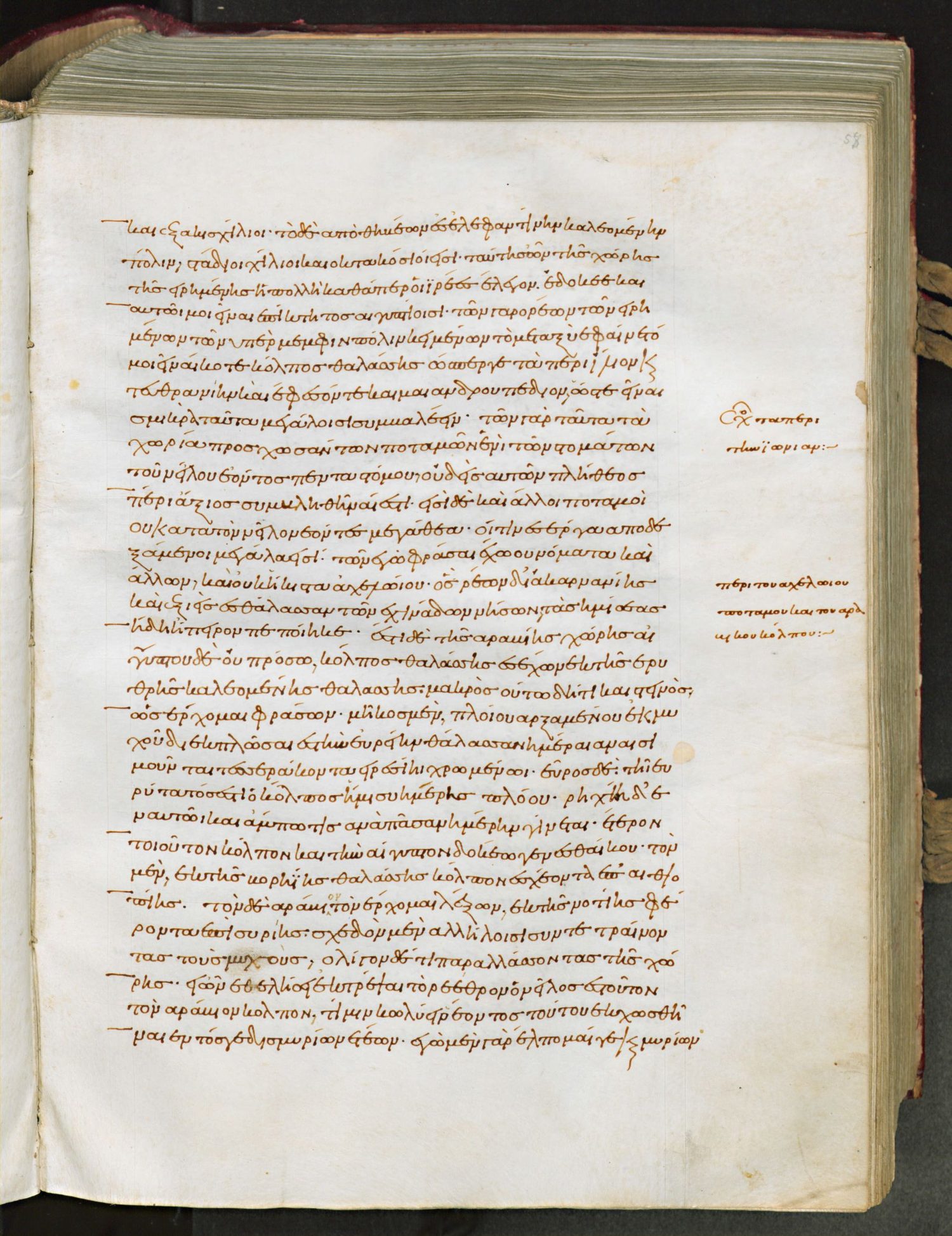
Where on the image
Laur. Plut. 70.3, fol. 58r: Greek here 2.9.2 to 2.11.4. Checked on the image (first and last words read and located in the Greek; each break checked against the neighbouring page): fol. 58r begins ‹καὶ ἑξακισχίλιοι. τὸ δὲ› (2.9.2), ends ‹ἔλπομαί γε καὶ μυρίων› (2.11.4). English here: 2.10.1 to 2.11.4 (Godley's sentences for the sections whose Greek lies mostly on this page).
2.9.2καὶ ἑξακισχίλιοι. τὸ δὲ ἀπὸ Θηβέων ἐς Ἐλεφαντίνην καλεομένην πόλιν στάδιοι χίλιοι καὶ ὀκτακόσιοι εἰσί. 2.10.1ταύτης ὦν τῆς χώρης τῆς εἰρημένης ἡ πολλή, κατά περ οἱ ἱρέες ἔλεγον, ἐδόκεε καὶ αὐτῷ μοι εἶναι ἐπίκτητος Αἰγυπτίοισι. τῶν γὰρ ὀρέων τῶν εἰρημένων τῶν ὑπὲρ Μέμφιν πόλιν κειμένων τὸ μεταξὺ ἐφαίνετό μοι εἶναι κοτὲ κόλπος θαλάσσης, ὥσπερ γε τὰ περὶ Ἴλιον καὶ Τευθρανίην καὶ Ἔφεσόν τε καὶ Μαιάνδρου πεδίον, ὥς γε εἶναι σμικρὰ ταῦτα μεγάλοισι συμβαλεῖν· 2.10.2τῶν γὰρ ταῦτα τὰ χωρία προσχωσάντων ποταμῶν ἑνὶ τῶν στομάτων τοῦ Νείλου, ἐόντος πενταστόμου, οὐδεὶς αὐτῶν πλήθεος πέρι ἄξιος συμβληθῆναι ἐστί. 2.10.3εἰσὶ δὲ καὶ ἄλλοι ποταμοί, οὐ κατὰ τὸν Νεῖλον ἐόντες μεγάθεα, οἵτινες ἔργα ἀποδεξάμενοι μεγάλα εἰσί· τῶν ἐγὼ φράσαι ἔχω οὐνόματα καὶ ἄλλων καὶ οὐκ ἥκιστα Ἀχελῴου, ὃς ῥέων διʼ Ἀκαρνανίης καὶ ἐξιεὶς ἐς θάλασσαν τῶν Ἐχινάδων νήσων τὰς ἡμισέας ἤδη ἤπειρον πεποίηκε. 2.11.1ἔστι δὲ τῆς Ἀραβίης χώρης, Αἰγύπτου δὲ οὐ πρόσω, κόλπος θαλάσσης ἐσέχων ἐκ τῆς Ἐρυθρῆς καλεομένης θαλάσσης, μακρὸς οὕτω δή τι καὶ στεινὸς ὡς ἔρχομαι φράσων· 2.11.2μῆκος μὲν πλόου ἀρξαμένῳ ἐκ μυχοῦ διεκπλῶσαι ἐς τὴν εὐρέαν θάλασσαν ἡμέραι ἀναισιμοῦνται τεσσεράκοντα εἰρεσίῃ χρεωμένῳ· εὖρος δέ, τῇ εὐρύτατος ἐστὶ ὁ κόλπος, ἥμισυ ἡμέρης πλόου. ῥηχίη δʼ ἐν αὐτῷ καὶ ἄμπωτις ἀνὰ πᾶσαν ἡμέρην γίνεται. 2.11.3ἕτερον τοιοῦτον κόλπον καὶ τὴν Αἴγυπτον δοκέω γενέσθαι κοτέ, τὸν μὲν ἐκ τῆς βορηίης θαλάσσης κόλπον ἐσέχοντα ἐπʼ Αἰθιοπίης, τὸν δὲ Ἀράβιον, τὸν ἔρχομαι λέξων, ἐκ τῆς νοτίης φέροντα ἐπὶ Συρίης, σχεδὸν μὲν ἀλλήλοισι συντετραίνοντας τοὺς μυχούς, ὀλίγον δέ τι παραλλάσσοντας τῆς χώρης. 2.11.4εἰ ὦν ἐθελήσει ἐκτρέψαι τὸ ῥέεθρον ὁ Νεῖλος ἐς τοῦτον τὸν Ἀράβιον κόλπον, τί μιν κωλύει ῥέοντος τούτου ἐκχωσθῆναι ἐντός γε δισμυρίων ἐτέων; ἐγὼ μὲν γὰρ ἔλπομαί γε καὶ μυρίων
2.10.1The greater portion, then, of this country whereof I have spoken was (as the priests told me, and I myself formed the same judgment) land acquired by the Egyptians all that lies between the ranges of mountains above Memphis to which I have referred seemed to me to have been once a gulf of the sea, just as the country about Ilion and Teuthrania and Ephesus and the plain of the Maeander, to compare these small things with great. 2.10.2For of the rivers that brought down the stuff to make these lands there is none worthy to be compared for greatness with one of the mouths of the Nile; and the Nile has five mouths. 2.10.3There are also other rivers, not so great as the Nile, that have wrought great effects; I could declare their names, but chief among them is Achelous, which, flowing through Acarnania and issuing into the sea, has already made half of the Echinades islands to be mainland. 2.11.1Now in Arabia, not far from Egypt, there is a gulf of the sea entering in from the sea called Red, of which the length and narrowness is such as I shall show: 2.11.2for length, it is a forty days’ voyage for a ship rowed by oars from its inner end out to the wide sea and for breadth, it is half a day’s voyage at the widest. Every day the tide ebbs and flows therein. 2.11.3I hold that where now is Egypt there was once another such gulf; one entered from the northern sea towards Aethiopia, and the other, the Arabian gulf of which I will speak, bore from the south towards Syria; the ends of these gulfs pierced into the country near to each other, and but a little space of land divided them. 2.11.4Now if the Nile choose to turn his waters into this Arabian gulf, what hinders that it be not silted up by his stream in twenty thousand years? nay, I think that ten thousand would suffice for it. Is it then to be believed that in the ages before my birth a gulf even much greater than this could not be silted up by a river so great and so busy?
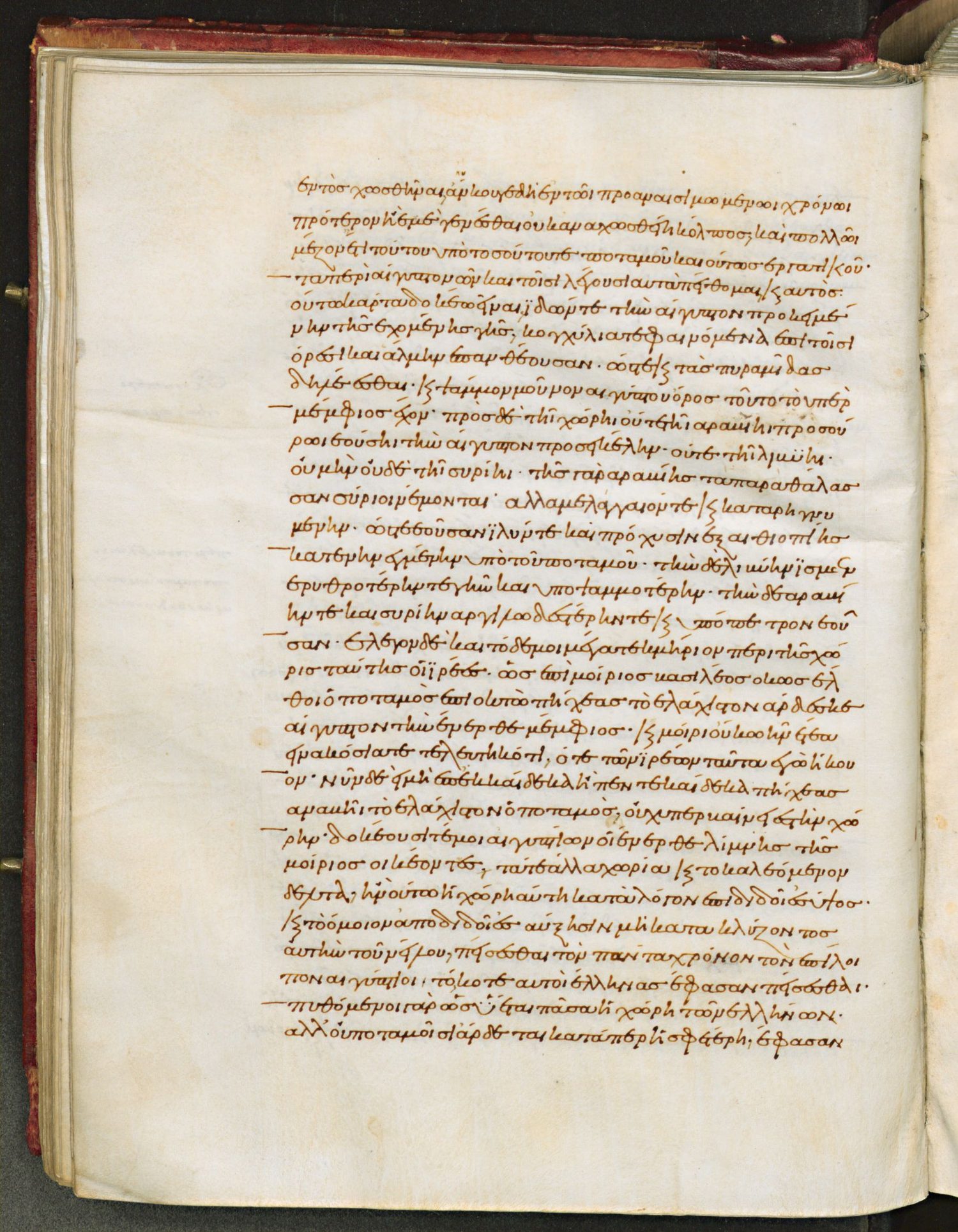
Where on the image
Laur. Plut. 70.3, fol. 58v: Greek here 2.11.4 to 2.13.3. Checked on the image (first and last words read and located in the Greek; each break checked against the neighbouring page): fol. 58v begins ‹ἐντὸς χωσθῆναι ἄν· κοῦ› (2.11.4), ends ‹περ ἡ σφετέρη, ἔφασαν› (2.13.3). English here: 2.12.1 to 2.13.3 (Godley's sentences for the sections whose Greek lies mostly on this page).
2.11.4ἐντὸς χωσθῆναι ἄν· κοῦ γε δὴ ἐν τῷ προαναισιμωμένῳ χρόνῳ πρότερον ἢ ἐμὲ γενέσθαι οὐκ ἂν χωσθείη κόλπος καὶ πολλῷ μέζων ἔτι τούτου ὑπὸ τοσούτου τε ποταμοῦ καὶ οὕτω ἐργατικοῦ; 2.12.1τὰ περὶ Αἴγυπτον ὦν καὶ τοῖσι λέγουσι αὐτὰ πείθομαι καὶ αὐτὸς οὕτω κάρτα δοκέω εἶναι, ἰδών τε τὴν Αἴγυπτον προκειμένην τῆς ἐχομένης γῆς κογχύλιά τε φαινόμενα ἐπὶ τοῖσι ὄρεσι καὶ ἅλμην ἐπανθέουσαν, ὥστε καὶ τὰς πυραμίδας δηλέεσθαι, καὶ ψάμμον μοῦνον Αἰγύπτου ὄρος τοῦτο τὸ ὑπὲρ Μέμφιος ἔχον, 2.12.2πρὸς δὲ τῇ χώρῃ οὔτε τῇ Ἀραβίῃ προσούρῳ ἐούσῃ τὴν Αἴγυπτον προσεικέλην οὔτε τῇ Λιβύῃ, οὐ μὲν οὐδὲ τῇ Συρίῃ (τῆς γὰρ Ἀραβίης τὰ παρὰ θάλασσαν Σύροι νέμονται), ἀλλὰ μελάγγαιόν τε καὶ καταρρηγνυμένην, ὥστε ἐοῦσαν ἰλύν τε καὶ πρόχυσιν ἐξ Αἰθιοπίης κατενηνειγμένην ὑπὸ τοῦ ποταμοῦ. 2.12.3τὴν δὲ Λιβύην ἴδμεν ἐρυθροτέρην τε γῆν καὶ ὑποψαμμοτέρην, τὴν δὲ Ἀραβίην τε καὶ Συρίην ἀργιλωδεστέρην τε καὶ ὑπόπετρον ἐοῦσαν. 2.13.1ἔλεγον δὲ καὶ τόδε μοι μέγα τεκμήριον περὶ τῆς χώρης ταύτης οἱ ἱρέες, ὡς ἐπὶ Μοίριος βασιλέος, ὅκως ἔλθοι ὁ ποταμὸς ἐπὶ ὀκτὼ πήχεας τὸ ἐλάχιστον, ἄρδεσκε Αἴγυπτον τὴν ἔνερθε Μέμφιος· καὶ Μοίρι οὔκω ἦν ἔτεα εἰνακόσια τετελευτηκότι ὅτε τῶν ἱρέων ταῦτα ἐγὼ ἤκουον. νῦν δὲ εἰ μὴ ἐπʼ ἑκκαίδεκα ἢ πεντεκαίδεκα πήχεας ἀναβῇ τὸ ἐλάχιστον ὁ ποταμός, οὐκ ὑπερβαίνει ἐς τὴν χώρην. 2.13.2δοκέουσί τέ μοι Αἰγυπτίων οἱ ἔνερθε λίμνης τῆς Μοίριος οἰκέοντες τά τε ἄλλα χωρία καὶ τὸ καλεόμενον Δέλτα, ἢν οὕτω ἡ χώρη αὕτη κατὰ λόγον ἐπιδιδῷ ἐς ὕψος καὶ τὸ ὅμοιον ἀποδιδῷ ἐς αὔξησιν, μὴ κατακλύζοντος αὐτὴν τοῦ Νείλου πείσεσθαι τὸν πάντα χρόνον τὸν ἐπίλοιπον Αἰγύπτιοι τὸ κοτὲ αὐτοὶ Ἕλληνας ἔφασαν πείσεσθαι. 2.13.3πυθόμενοι γὰρ ὡς ὕεται πᾶσα ἡ χώρη τῶν Ἑλλήνων ἀλλʼ οὐ ποταμοῖσι ἄρδεται κατά περ ἡ σφετέρη, ἔφασαν
2.12.1Therefore, as to Egypt, I believe those who so speak, and I am myself fully so persuaded; for I have seen that Egypt projects into the sea beyond the neighbouring land, and shells are plain to view on the mountains and things are coated with salt (insomuch that the very pyramids are wasted thereby), and the only sandy mountain in Egypt is that which is above Memphis; 2.12.2moreover, Egypt is like neither to the neighbouring land of Arabia, nor to Libya, no, nor to Syria (for the seaboard of Arabia is inhabited by Syrians); it is a land of black and crumbling earth, as if it were alluvial deposit carried down the river from Aethiopia; 2.12.3but we know that the soil of Libya is redder and somewhat sandy, and Arabia and Syria are lands rather of clay and stones. 2.13.1This too that the priests told me concerning Egypt is a strong proof; when Moeris was king, if the river rose as much as eight cubits, it watered all Egypt below Memphis. Moeris was not yet nine hundred years dead when I heard this from the priests. But now, if the river rise not at the least to sixteen or fifteen cubits, the land is not flooded. 2.13.2And, to my thinking, the Egyptians who dwell lower down the river than the lake Moeris, and chiefly those who inhabit what is called the Delta—these, if thus this land of theirs rises in such proportion and likewise increases in extent, will (the Nile no longer flooding it) be ever after in the same plight which they themselves once said would be the case of the Greeks; 2.13.3for learning that all the Greek land is watered by rain, and not, like theirs, by river, they said that some day the Greeks would be disappointed of their high hopes, and miserably starve: signifying thereby that should it be heaven’s will to send the Greeks no rain and afflict them with drought, famine must come upon them, as receiving all this water from Zeus and having no other resource.
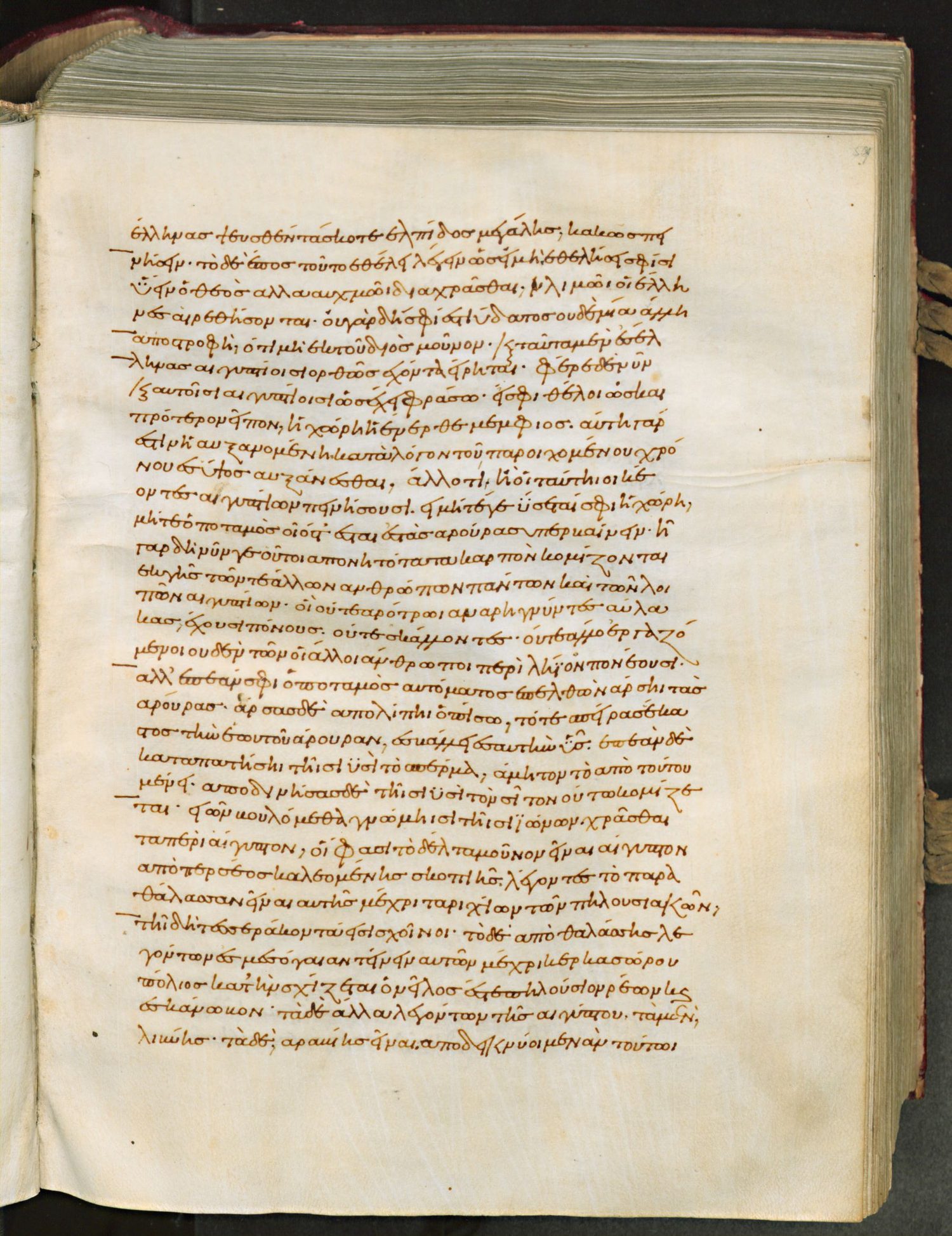
Where on the image
Laur. Plut. 70.3, fol. 59r: Greek here 2.13.3 to 2.15.1. Checked on the image (first and last words read and located in the Greek; each break checked against the neighbouring page): fol. 59r begins ‹Ἕλληνας ψευσθέντας κοτὲ ἐλπίδος› (2.13.3), ends ‹εἶναι, ἀποδεικνύοιμεν ἂν τούτῳ› (2.15.1). English here: 2.14.1 to 2.15.2 (Godley's sentences for the sections whose Greek lies mostly on this page).
2.13.3Ἕλληνας ψευσθέντας κοτὲ ἐλπίδος μεγάλης κακῶς πεινήσειν. τὸ δὲ ἔπος τοῦτο ἐθέλει λέγειν ὡς, εἰ μὴ ἐθελήσει σφι ὕειν ὁ θεὸς ἀλλὰ αὐχμῷ διαχρᾶσθαι, λιμῷ οἱ Ἕλληνες αἱρεθήσονται· οὐ γὰρ δή σφι ἐστὶ ὕδατος οὐδεμία ἄλλη ἀποστροφὴ ὅτι μὴ ἐκ τοῦ Διὸς μοῦνον. 2.14.1καὶ ταῦτα μὲν ἐς Ἕλληνας Αἰγυπτίοισι ὀρθῶς ἔχοντα εἴρηται· φέρε δὲ νῦν καὶ αὐτοῖσι Αἰγυπτίοισι ὡς ἔχει φράσω· εἴ σφι θέλοι, ὡς καὶ πρότερον εἶπον, ἡ χώρη ἡ ἔνερθε Μέμφιος (αὕτη γὰρ ἐστὶ ἡ αὐξανομένη) κατὰ λόγον τοῦ παροιχομένου χρόνου ἐς ὕψος αὐξάνεσθαι, ἄλλο τι ἢ οἱ ταύτῃ οἰκέοντες Αἰγυπτίων πεινήσουσι; εἰ μήτε γε ὕσεταί σφι ἡ χώρη μήτε ὁ ποταμὸς οἷός τʼ ἔσται ἐς τὰς ἀρούρας ὑπερβαίνειν. 2.14.2ἦ γὰρ δὴ νῦν γε οὗτοι ἀπονητότατα καρπὸν κομίζονται ἐκ γῆς τῶν τε ἄλλων ἀνθρώπων πάντων καὶ τῶν λοιπῶν Αἰγυπτίων· οἳ οὔτε ἀρότρῳ ἀναρρηγνύντες αὔλακας ἔχουσι πόνους οὔτε σκάλλοντες οὔτε ἄλλο ἐργαζόμενοι οὐδὲν τῶν οἱ ἄλλοι ἄνθρωποι περὶ λήιον πονέουσι, ἀλλʼ ἐπεάν σφι ὁ ποταμὸς αὐτόματος ἐπελθὼν ἄρσῃ τὰς ἀρούρας, ἄρσας δὲ ἀπολίπῃ ὀπίσω, τότε σπείρας ἕκαστος τὴν ἑωυτοῦ ἄρουραν ἐσβάλλει ἐς αὐτὴν ὗς, ἐπεὰν δὲ καταπατήσῃ τῇσι ὑσὶ τὸ σπέρμα, ἄμητον τὸ ἀπὸ τούτου μένει, ἀποδινήσας δὲ τῇσι ὑσὶ τὸν σῖτον οὕτω κομίζεται. 2.15.1εἰ ὦν βουλόμεθα γνώμῃσι τῇσι Ἰώνων χρᾶσθαι τὰ περὶ Αἴγυπτον, οἳ φασὶ τὸ Δέλτα μοῦνον εἶναι Αἴγυπτον, ἀπὸ Περσέος καλεομένης σκοπιῆς λέγοντες τὸ παρὰ θάλασσαν εἶναι αὐτῆς μέχρι Ταριχηίων τῶν Πηλουσιακῶν, τῇ δὴ τεσσεράκοντα εἰσὶ σχοῖνοι, τὸ δὲ ἀπὸ θαλάσσης λεγόντων ἐς μεσόγαιαν τείνειν αὐτὴν μέχρι Κερκασώρου πόλιος, κατʼ ἣν σχίζεται ὁ Νεῖλος ἔς τε Πηλούσιον ῥέων καὶ ἐς Κάνωβον, τὰ δὲ ἄλλα λεγόντων τῆς Αἰγύπτου τὰ μὲν Λιβύης τὰ δὲ Ἀραβίης εἶναι, ἀποδεικνύοιμεν ἂν τούτῳ
2.14.1And this saying of the Egyptians about the Greeks was true enough. But now let me show what is the case of the Egyptians themselves: if (as I have already said) the country below Memphis—for it is this which rises—should increase in height in the same degree as formerly, will not the Egyptians who dwell in it go hungry, there being no rain in their country and the river being unable to inundate their fields? 2.14.2Now, indeed, there are no men, neither in the rest of Egypt, nor in the whole world, who gain from the soil with so little labour they have not the toil of breaking up the land with the plough, nor of hoeing, nor of any other work which other men do to get them a crop; the river rises of itself, waters the fields, and then sinks back again; thereupon each man sows his field and sends swine into it to tread down the seed, and waits for the harvest; then he makes the swine to thresh his grain, and so garners it. 2.15.1Now if we agree with the opinion of the Ionians, namely that nothing but the Delta is Egypt, whereof the seaboard reaches, according to them, from what is called the watchtower of Perseus, forty schoeni to the salting factories of Pelusium, while inland it stretches as far as the city of Cercasorus, where the Nile divides and flows thence to Pelusium and Canobus (all the rest of Egypt being, they say, partly Libya and partly Arabia): if we follow this account, we can show that there was once no country for the Egyptians; 2.15.2for we have seem that (as the Egyptians themselves say, and as I myself judge) the Delta is alluvial land and but lately (so to say) come into being. Then if there was once no country for them, it was but a useless thought that they were the oldest nation on earth, and they needed not to make that trial to see what language the children would first utter.
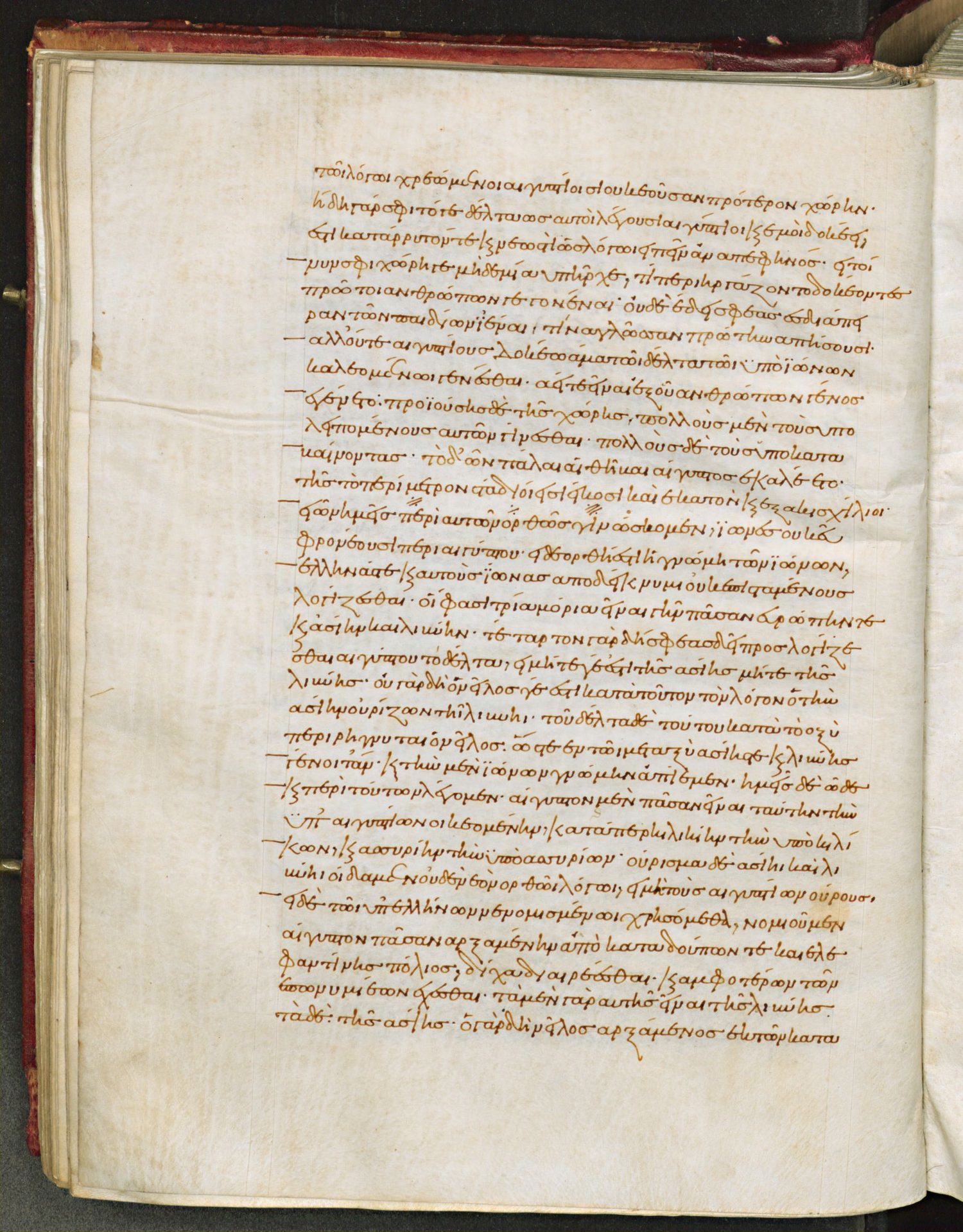
Where on the image
Laur. Plut. 70.3, fol. 59v: Greek here 2.15.1 to 2.17.3. Checked on the image (first and last words read and located in the Greek; each break checked against the neighbouring page): fol. 59v begins ‹τῷ λόγῳ χρεώμενοι Αἰγυπτίοισι› (2.15.1), ends ‹ἀρξάμενος ἐκ τῶν Κατα-› (2.17.3). English here: 2.15.3 to 2.17.2 (Godley's sentences for the sections whose Greek lies mostly on this page).
2.15.1τῷ λόγῳ χρεώμενοι Αἰγυπτίοισι οὐκ ἐοῦσαν πρότερον χώρην. 2.15.2ἤδη γάρ σφι τό γε Δέλτα, ὡς αὐτοὶ λέγουσι Αἰγύπτιοι καὶ ἐμοὶ δοκέει, ἐστὶ κατάρρυτόν τε καὶ νεωστὶ ὡς λόγῳ εἰπεῖν ἀναπεφηνός. εἰ τοίνυν σφι χώρη γε μηδεμία ὑπῆρχε, τί περιεργάζοντο δοκέοντες πρῶτοι ἀνθρώπων γεγονέναι; οὐδὲ ἔδει σφέας ἐς διάπειραν τῶν παιδίων ἰέναι, τίνα γλῶσσαν πρώτην ἀπήσουσι. 2.15.3ἀλλʼ οὔτε Αἰγυπτίους δοκέω ἅμα τῷ Δέλτα τῷ ὑπὸ Ἰώνων καλεομένῳ γενέσθαι αἰεί τε εἶναι ἐξ οὗ ἀνθρώπων γένος ἐγένετο, προϊούσης δὲ τῆς χώρης πολλοὺς μὲν τοὺς ὑπολειπομένους αὐτῶν γενέσθαι πολλοὺς δὲ τοὺς ὑποκαταβαίνοντας. τὸ δʼ ὦν πάλαι αἱ Θῆβαι Αἴγυπτος ἐκαλέετο, τῆς τὸ περίμετρον στάδιοι εἰσὶ εἴκοσι καὶ ἑκατὸν καὶ ἑξακισχίλιοι. 2.16.1εἰ ὦν ἡμεῖς ὀρθῶς περὶ αὐτῶν γινώσκομεν, Ἴωνες οὐκ εὖ φρονέουσι περὶ Αἰγύπτου· εἰ δὲ ὀρθή ἐστι ἡ γνώμη τῶν Ἰώνων, Ἕλληνάς τε καὶ αὐτοὺς Ἴωνας ἀποδείκνυμι οὐκ ἐπισταμένους λογίζεσθαι, οἳ φασὶ τρία μόρια εἶναι γῆν πᾶσαν, Εὐρώπην τε καὶ Ἀσίην καὶ Λιβύην. 2.16.2τέταρτον γὰρ δή σφεας δεῖ προσλογίζεσθαι Αἰγύπτου τὸ Δέλτα, εἰ μήτε γε ἐστὶ τῆς Ἀσίης μήτε τῆς Λιβύης· οὐ γὰρ δὴ ὁ Νεῖλός γε ἐστὶ κατὰ τοῦτον τὸν λόγον ὁ τὴν Ἀσίην οὐρίζων τῇ Λιβύῃ, τοῦ Δέλτα δὲ τούτου κατὰ τὸ ὀξὺ περιρρήγνυται ὁ Νεῖλος, ὥστε ἐν τῷ μεταξὺ Ἀσίης τε καὶ Λιβύης γίνοιτʼ ἄν. 2.17.1καὶ τὴν μὲν Ἰώνων γνώμην ἀπίεμεν, ἡμεῖς δὲ ὧδε καὶ περὶ τούτων λέγομεν, Αἴγυπτον μὲν πᾶσαν εἶναι ταύτην τὴν ὑπʼ Αἰγυπτίων οἰκεομένην κατά περ Κιλικίην τὴν ὑπὸ Κιλίκων καὶ Ἀσσυρίην τὴν ὑπὸ Ἀσσυρίων, οὔρισμα δὲ Ἀσίῃ καὶ Λιβύῃ οἴδαμεν οὐδὲν ἐὸν ὀρθῷ λόγῳ εἰ μὴ τοὺς Αἰγυπτίων οὔρους. 2.17.2εἰ δὲ τῷ ὑπʼ Ἑλλήνων νενομισμένῳ χρησόμεθα, νομιοῦμεν Αἴγυπτον πᾶσαν ἀρξαμένην ἀπὸ Καταδούπων τε καὶ Ἐλεφαντίνης πόλιος δίχα διαιρέεσθαι καὶ ἀμφοτερέων τῶν ἐπωνυμιέων ἔχεσθαι· τὰ μὲν γὰρ αὐτῆς εἶναι τῆς Λιβύης τὰ δὲ τῆς Ἀσίης. 2.17.3ὁ γὰρ δὴ Νεῖλος ἀρξάμενος ἐκ τῶν Καταδούπων
2.15.3I hold rather that the Egyptians did not come into being with the making of that which Ionians call the Delta: they ever existed since men were first made; and as the land grew in extent many of them spread down over it, and many stayed behind. Be that as it may, the Theban province, a land of six thousand one hundred and twenty furlongs in circuit, was of old called Egypt. 2.16.1If then our judgment of this be right, the Ionians are in error concerning Egypt; but if their opinion be right, then it is plain that they and the rest of the Greeks cannot reckon truly, when they divide the whole earth into three parts, Europe, Asia, and Libya; 2.16.2they must add to these yet a fourth part, the Delta of Egypt, if it belong neither to Asia nor to Libya; for by their showing the Nile is not the river that separates Asia and Libya; the Nile divides at the extreme angle of this Delta, so that this land must be between Asia and Libya. 2.17.1Nay, we put the Ionians’ opinion aside; and our own judgment concerning the matter is this: Egypt is all that country which is inhabited by Egyptians, even as Cilicia and Assyria are the countries inhabited by Cilicians and Assyrians severally; and we know of no frontier (rightly so called) below Asia and Libya save only the borders of the Egyptians. 2.17.2But if we follow the belief of the Greeks, we shall consider all Egypt, down from the Cataracts and the city Elephantine, to be divided into two parts, and to claim both the names, the one part belonging to Libya and the other to Asia.
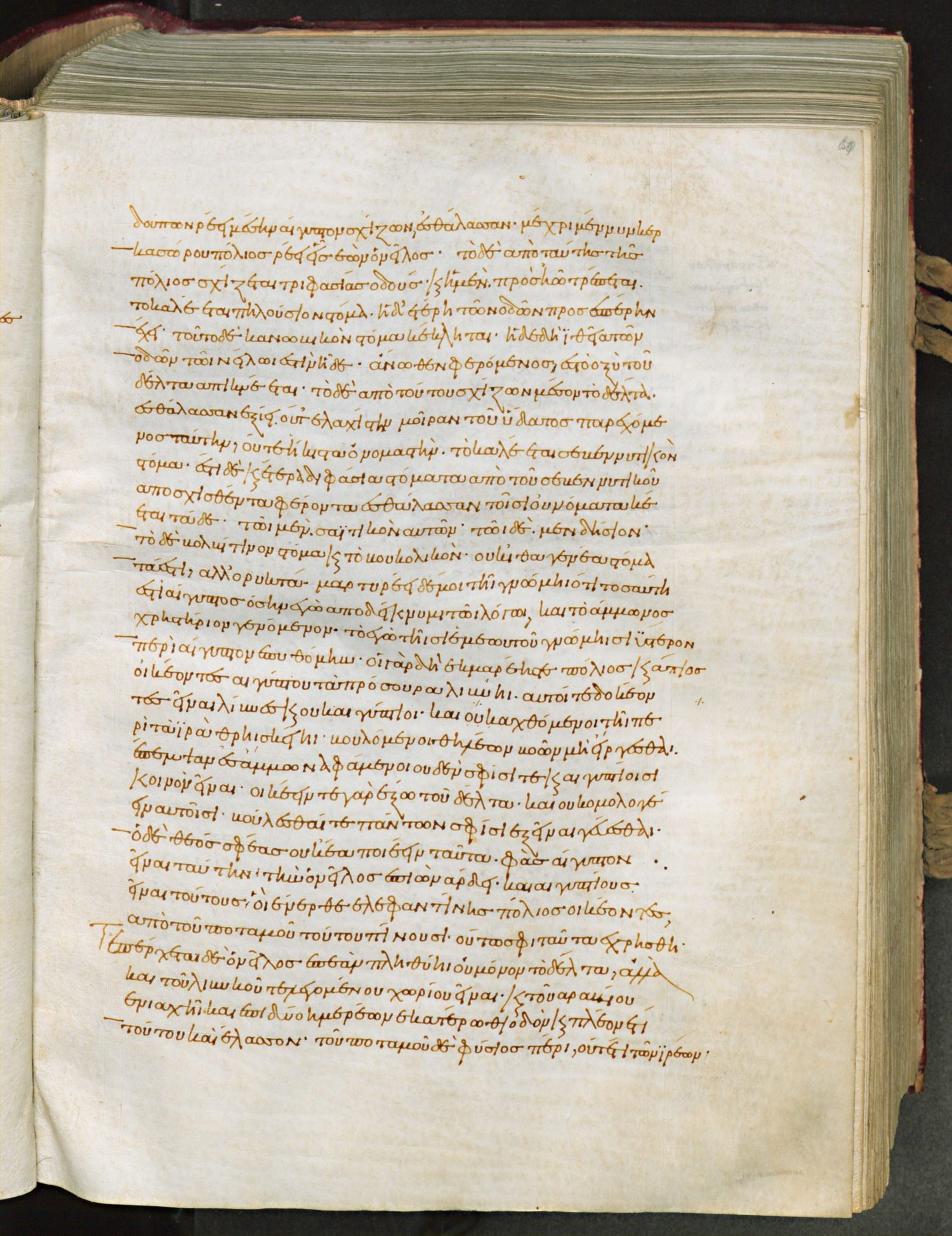
Where on the image
Laur. Plut. 70.3, fol. 60r: Greek here 2.17.3 to 2.18.3. Checked on the image (first and last words read and located in the Greek; each break checked against the neighbouring page): fol. 60r begins ‹-δούπων ῥέει μέσην Αἴγυπτον› (2.17.3), ends ‹οὔτε τι τῶν ἱρέων› (2.19.1). The word ‹Καταδούπων› is divided between fol. 59v and fol. 60r; it is given with fol. 59v. English here: 2.17.3 to 2.18.3 (Godley's sentences for the sections whose Greek lies mostly on this page).
2.17.3ῥέει μέσην Αἴγυπτον σχίζων ἐς θάλασσαν. μέχρι μέν νυν Κερκασώρου πόλιος ῥέει εἷς ἐὼν ὁ Νεῖλος, τὸ δὲ ἀπὸ ταύτης τῆς πόλιος σχίζεται τριφασίας ὁδούς. 2.17.4καὶ ἣ μὲν πρὸς ἠῶ τρέπεται, τὸ καλέεται Πηλούσιον στόμα, ἡ δὲ ἑτέρη τῶν ὁδῶν πρὸς ἑσπέρην ἔχει· τοῦτο δὲ Κανωβικὸν στόμα κέκληται. ἡ δὲ δὴ ἰθέα τῶν ὁδῶν τῷ Νείλῳ ἐστὶ ἥδε· ἄνωθεν φερόμενος ἐς τὸ ὀξὺ τοῦ Δέλτα ἀπικνέεται, τὸ δὲ ἀπὸ τούτου σχίζων μέσον τὸ Δέλτα ἐς θάλασσαν ἐξιεῖ, οὔτε ἐλαχίστην μοῖραν τοῦ ὕδατος παρεχόμενος ταύτην οὔτε ἥκιστα ὀνομαστήν· τὸ καλέεται Σεβεννυτικὸν στόμα. 2.17.5ἔστι δὲ καὶ ἕτερα διφάσια στόματα ἀπὸ τοῦ Σεβεννυτικοῦ ἀποσχισθέντα, φέροντα ἐς θάλασσαν· τοῖσι οὐνόματα κέεται τάδε, τῷ μὲν Σαϊτικὸν αὐτῶν τῷ δὲ Μενδήσιον. 2.17.6τὸ δὲ Βολβίτινον στόμα καὶ τὸ Βουκολικὸν οὐκ ἰθαγενέα στόματα ἐστὶ ἀλλʼ ὀρυκτά. 2.18.1μαρτυρέει δέ μοι τῇ γνώμῃ, ὅτι τοσαύτη ἐστὶ Αἴγυπτος ὅσην τινὰ ἐγὼ ἀποδείκνυμι τῷ λόγῳ, καὶ τὸ Ἄμμωνος χρηστήριον γενόμενον· τὸ ἐγὼ τῆς ἐμεωυτοῦ γνώμης ὕστερον περὶ Αἴγυπτον ἐπυθόμην. 2.18.2οἱ γὰρ δὴ ἐκ Μαρέης τε πόλιος καὶ Ἄπιος, οἰκέοντες Αἰγύπτου τὰ πρόσουρα Λιβύῃ, αὐτοί τε δοκέοντες εἶναι Λίβυες καὶ οὐκ Αἰγύπτιοι καὶ ἀχθόμενοι τῇ περὶ τὰ ἱρὰ θρησκηίῃ, βουλόμενοι θηλέων βοῶν μὴ ἔργεσθαι, ἔπεμψαν ἐς Ἄμμωνα φάμενοι οὐδὲν σφίσι τε καὶ Αἰγυπτίοισι κοινὸν εἶναι· οἰκέειν τε γὰρ ἔξω τοῦ Δέλτα καὶ οὐδὲν ὁμολογέειν αὐτοῖσι, βούλεσθαί τε πάντων σφίσι ἐξεῖναι γεύεσθαι. 2.18.3ὁ δὲ θεός σφεας οὐκ ἔα ποιέειν ταῦτα, φὰς Αἴγυπτον εἶναι ταύτην τὴν ὁ Νεῖλος ἐπιὼν ἄρδει, καὶ Αἰγυπτίους εἶναι τούτους οἳ ἔνερθε Ἐλεφαντίνης πόλιος οἰκέοντες ἀπὸ τοῦ ποταμοῦ τούτου πίνουσι. οὕτω σφι ταῦτα ἐχρήσθη.
2.17.3For the Nile, beginning from the Cataracts, divides Egypt into two parts as it flows to the sea. Now as far as the city Cercasorus the Nile flows in one channel, but after that it parts into three. 2.17.4One of these, which is called the Pelusian mouth, flows eastwards; the second flows westwards, and is called the Canobic mouth. But the direct channel of the Nile, when the river in its downward course reaches the sharp point of the Delta, flows thereafter clean through the middle of the Delta into the sea; in this is seen the greatest and most famous part of its waters, and it is called the Sebennytic mouth. 2.17.5There are also two channels which separate themselves from the Sebennytic and so flow into the sea, by name the Saïtic and the Mendesian. 2.17.6The Bolbitine and Bucolic mouths are not natural but dug channels. 2.18.1My opinion, that the extent of Egypt is such as my argument shows, is attested by the answer which (my judgment being already formed) I heard to have been given concerning Egypt by the oracle of Ammon. 2.18.2The men of the cities of Marea and Apis, in the part of Egypt bordering on Libya, thinking themselves to be not Egyptians but Libyans, and misliking the observance of the religious law which forbade them to eat cows’ flesh, sent to Ammon saying that they had no part or lot with Egypt: for they dwelt (said they) outside the Delta and did not consent to the ways of its people, and they wished to be suffered to eat of all foods. 2.18.3But the god forbade them: all the land, he said, watered by the Nile in its course was Egypt, and all who dwelt lower down than the city Elephantine and drank of that rivers water were Egyptians. Such was the oracle given to them.
Notes
- Greek: the text printed in A. D. Godley's Loeb edition, via Perseus (tlg0016.tlg001.perseus-grc2). Square brackets mark words the editor considers later additions; [...] marks a gap the editor indicates. Perseus note markers are omitted.
- English: A. D. Godley, Herodotus vol. 1 (1920) (Loeb Classical Library), as transcribed on Wikisource. Godley's footnotes are omitted.
- Section numbers in the English were placed by comparing Godley's text with the Perseus version of his translation; where a section begins inside one of Godley's sentences, the English is kept with the page that holds the start of that sentence.
Cite
Sources
- Source: Florence, Laur. Plut. 70.3 (10th c.) via BML Teca Digitale + Greek of Godley's Loeb (Perseus) + English of A. D. Godley (Loeb, Wikisource) (holding institution)
- Critical edition: Greek of A. D. Godley's Loeb edition (1920-1925), via Perseus
← previous · → next · v cycle view · l back to library