Herodotus, Histories 1.46-56: Croesus tests the oracles
Introduction
Herodotus of Halicarnassus wrote the Histories in the third quarter of the 5th century BCE, an inquiry into the deeds of Greeks and barbarians and the causes of the wars between them, later divided into nine books. Book 1 tells how the conflict between Greeks and barbarians began, the history of Lydia from Gyges to Croesus, the rise of the Medes and of Cyrus the Persian, the conquest of the Greeks of Asia, the capture of Babylon and the death of Cyrus.
The photographs are of Florence, Biblioteca Medicea Laurenziana, Plut. 70.3 (parchment, 10th century, 374 folios, 31 lines a page), Herodotus, Histories (codex A of the editors), the oldest surviving manuscript of the complete Histories, from the Teca Digitale of the Biblioteca Medicea Laurenziana. Each section below is the text of one page, or of the part of a page that falls within these chapters. The first and last words of every page were read on the photograph and located in the Greek, and every page break was checked against the next page; the notes quote these words. Readers' notes in the margins are not part of the text and are mentioned where they occur.
The Greek is the text printed in A. D. Godley's Loeb edition (1920-1925), from Perseus; it is the edited text, not a transcription of the manuscript, whose wording differs in places. The English is Godley's translation as printed, from Wikisource. Godley's English carries only chapter numbers; the section numbers shown in it were placed by comparison with the Perseus version of his translation. Each page's English is cut at the end of one of Godley's sentences, so it can begin or end a few lines away from the Greek of the page; each note gives the exact ranges.
This entry covers chapters 1.46-56, on fol. 11r to 13v.
How was this verified? (Provenance)
Where on the image
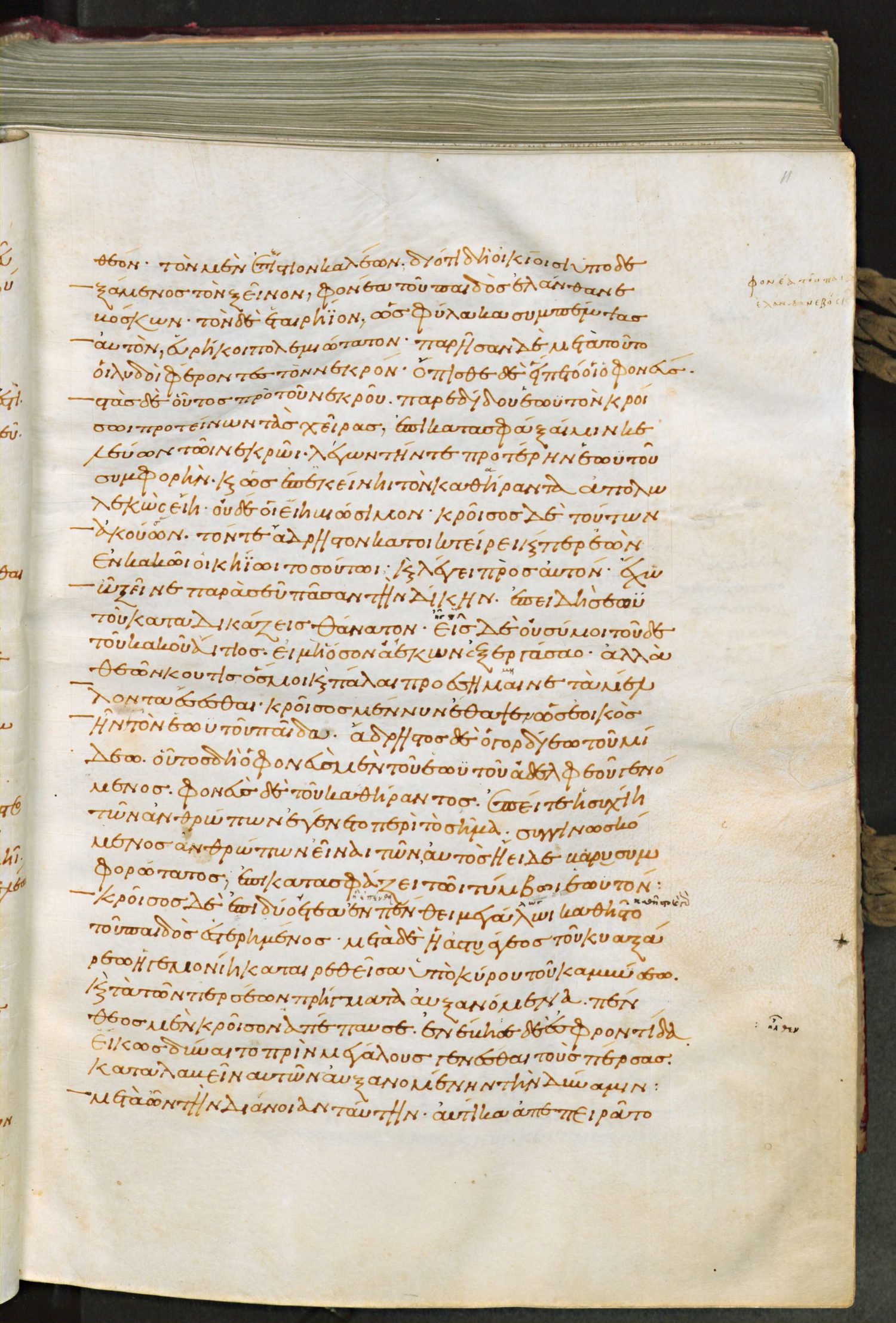
Laur. Plut. 70.3, fol. 11r: Greek here 1.46.1 to 1.46.2. Checked on the image (first and last words read and located in the Greek; each break checked against the neighbouring page): fol. 11r begins ‹θεόν, τὸν μὲν ἐπίστιον› (1.44.2), ends ‹διάνοιαν ταύτην αὐτίκα ἀπεπειρᾶτο› (1.46.2). English here: 1.46.1 (Godley's sentences for the sections whose Greek lies mostly on this page).
1.46.1Κροῖσος δὲ ἐπὶ δύο ἔτεα ἐν πένθεϊ μεγάλῳ κατῆστο τοῦ παιδὸς ἐστερημένος. μετὰ δὲ ἡ Ἀστυάγεος τοῦ Κυαξάρεω ἡγεμονίη καταιρεθεῖσα ὑπὸ Κύρου τοῦ Καμβύσεω καὶ τὰ τῶν Περσέων πρήγματα αὐξανόμενα πένθεος μὲν Κροῖσον ἀπέπαυσε, ἐνέβησε δὲ ἐς φροντίδα, εἴ κως δύναιτο, πρὶν μεγάλους γενέσθαι τοὺς Πέρσας, καταλαβεῖν αὐτῶν αὐξανομένην τὴν δύναμιν. 1.46.2μετὰ ὦν τὴν διάνοιαν ταύτην αὐτίκα ἀπεπειρᾶτο
1.46.1Croesus, after the loss of his son, sat in deep sorrow for two years. After this time, the destruction by Cyrus son of Cambyses of the sovereignty of Astyages son of Cyaxares, and the growth of the power of the Persians, caused him to cease from his mourning; and he resolved, if he could, to forestall the increase of the Persian power before they grew to greatness.
Where on the image
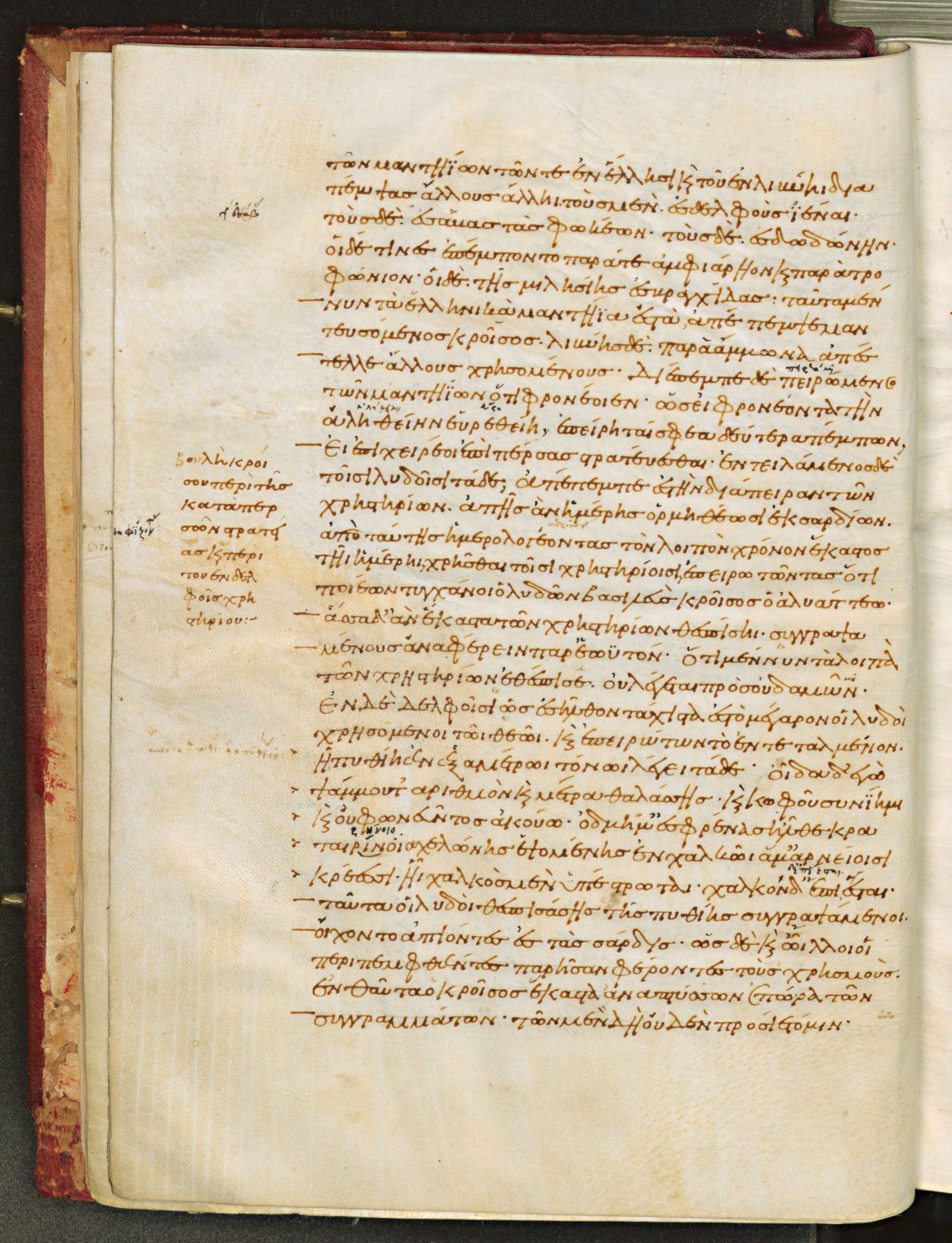
Laur. Plut. 70.3, fol. 11v: Greek here 1.46.2 to 1.48.1. Checked on the image (first and last words read and located in the Greek; each break checked against the neighbouring page): fol. 11v begins ‹τῶν μαντείων τῶν τε› (1.46.2), ends ‹δὴ οὐδὲν προσίετό μιν› (1.48.1). English here: 1.46.2 to 1.48.1 (Godley's sentences for the sections whose Greek lies mostly on this page).
1.46.2τῶν μαντείων τῶν τε ἐν Ἕλλησι καὶ τοῦ ἐν Λιβύῃ, διαπέμψας ἄλλους ἄλλῃ, τοὺς μὲν ἐς Δελφοὺς ἰέναι, τοὺς δὲ ἐς Ἄβας τὰς Φωκέων, τοὺς δὲ ἐς Δωδώνην· οἳ δὲ τινὲς ἐπέμποντο παρὰ τε Ἀμφιάρεων καὶ παρὰ Τροφώνιον, οἳ δὲ τῆς Μιλησίης ἐς Βραγχίδας. 1.46.3ταῦτα μέν νυν τὰ Ἑλληνικὰ μαντήια ἐς τὰ ἀπέπεμψε μαντευσόμενος Κροῖσος· Λιβύης δὲ παρὰ Ἄμμωνα ἀπέστελλε ἄλλους χρησομένους. διέπεμπε δὲ πειρώμενος τῶν μαντηίων ὅ τι φρονέοιεν, ὡς εἰ φρονέοντα τὴν ἀληθείην εὑρεθείη, ἐπείρηται σφέα δεύτερα πέμπων εἰ ἐπιχειρέοι ἐπὶ Πέρσας στρατεύεσθαι. 1.47.1ἐντειλάμενος δὲ τοῖσι Λυδοῖσι τάδε ἀπέπεμπε ἐς τὴν διάπειραν τῶν χρηστηρίων, ἀπʼ ἧς ἂν ἡμέρης ὁρμηθέωσι ἐκ Σαρδίων, ἀπὸ ταύτης ἡμερολογέοντας τὸν λοιπὸν χρόνον ἑκατοστῇ ἡμέρῃ χρᾶσθαι τοῖσι χρηστηρίοισι, ἐπειρωτῶντας ὅ τι ποιέων τυγχάνοι ὁ Λυδῶν βασιλεὺς Κροῖσος ὁ Ἀλυάττεω· ἅσσα δʼ ἂν ἕκαστα τῶν χρηστηρίων θεσπίσῃ, συγγραψαμένους ἀναφέρειν παρʼ ἑωυτόν. 1.47.2ὅ τι μέν νυν τὰ λοιπὰ τῶν χρηστηρίων ἐθέσπισε, οὐ λέγεται πρὸς οὐδαμῶν· ἐν δὲ Δελφοῖσι ὡς ἐσῆλθον τάχιστα ἐς τὸ μέγαρον οἱ Λυδοὶ χρησόμενοι τῷ θεῷ καὶ ἐπειρώτων τὸ ἐντεταλμένον, ἡ Πυθίη ἐν ἑξαμέτρῳ τόνῳ λέγει τάδε. 1.47.3οἶδα δʼ ἐγὼ ψάμμου τʼ ἀριθμὸν καὶ μέτρα θαλάσσης,
καὶ κωφοῦ συνίημι, καὶ οὐ φωνεῦντος ἀκούω.
ὀδμή μʼ ἐς φρένας ἦλθε κραταιρίνοιο χελώνης
ἑψομένης ἐν χαλκῷ ἅμʼ ἀρνείοισι κρέεσσιν,
ᾗ χαλκὸς μὲν ὑπέστρωται, χαλκὸν δʼ ἐπιέσται. 1.48.1ταῦτα οἱ Λυδοὶ θεσπισάσης τῆς Πυθίης συγγραψάμενοι οἴχοντο ἀπιόντες ἐς τὰς Σάρδις. ὡς δὲ καὶ ὧλλοι οἱ περιπεμφθέντες παρῆσαν φέροντες τοὺς χρησμούς, ἐνθαῦτα ὁ Κροῖσος ἕκαστα ἀναπτύσσων ἐπώρα τῶν συγγραμμάτων, τῶν μὲν δὴ οὐδὲν προσίετό μιν·
1.46.2Having thus determined, he straightway made trial of the Greek and Libyan oracles, sending messengers separately to Delphi, to Abae in Phocia, and to Dodona, while others again were despatched to Amphiaraus and Trophonius, and others to Branchidae in the Milesian country. 1.46.3These are the Greek oracles to which Croesus sent for divination: and he bade others go to inquire of Ammon in Libya. His intent in sending was to test the knowledge of the oracles, so that, if they should be found to know the truth, he might send again and ask if he should take in hand an expedition against the Persians. 1.47.1And when he sent to make trial of these shrines he gave the Lydians this charge: they were to keep count of the time from the day of their leaving Sardis, and on the hundredth day inquire of the oracles what Croesus, king of Lydia, son of Alyattes, was then doing; then they were to write down whatever were the oracular answers and bring them back to him. 1.47.2Now none relate what answer was given by the rest of the oracles. But at Delphi, no sooner had the Lydians entered the hall to inquire of the god and asked the question with which they were charged, than the Pythian 1.47.3priestess uttered the following hexameter verses: “Grains of sand I reckon and measure the spaces of ocean, Hear when dumb men speak, and mark the speech of the silent. What is it now that I smell? ’tis a tortoise mightily armoured Sodden in vessel of bronze, with a lamb’s flesh mingled together: Bronze thereunder is laid and a mantle of bronze is upon it.” 1.48.1Having written down this inspired utterance of the Pythian priestess, the Lydians went away back to Sardis. When the others as well who had been sent to divers places came bringing their oracles, Croesus then unfolded and surveyed all the writings. Some of them in no wise satisfied him. But when he heard the Delphian message, he acknowledged it with worship and welcome, considering that Delphi was the only true place of divination, because it had discovered what he himself had done.
Where on the image
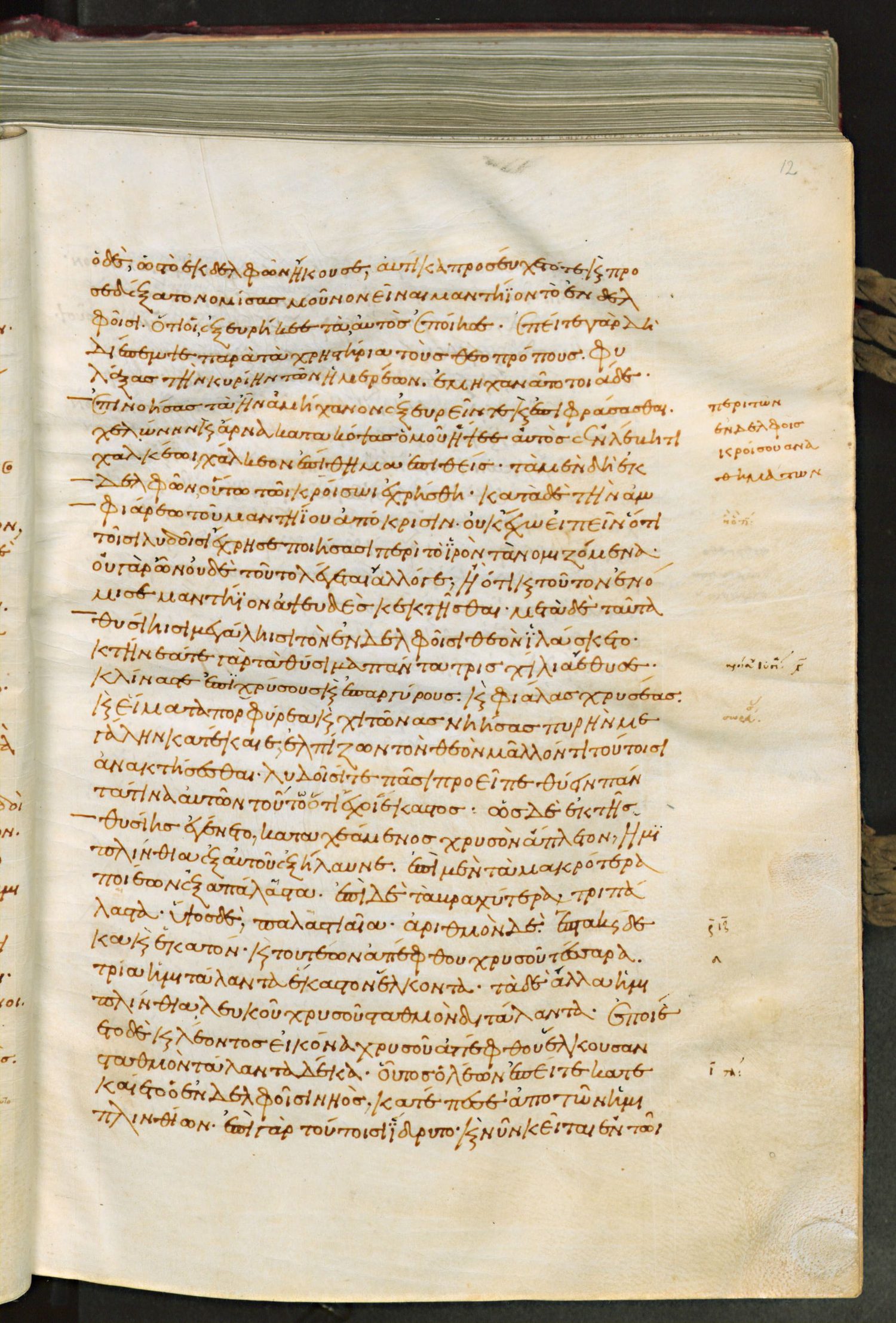
Laur. Plut. 70.3, fol. 12r: Greek here 1.48.1 to 1.50.3. Checked on the image (first and last words read and located in the Greek; each break checked against the neighbouring page): fol. 12r begins ‹ὁ δὲ ὡς τὸ› (1.48.1), ends ‹νῦν κεῖται ἐν τ-› (1.50.3). Fol. 12r ends καὶ νῦν κεῖται ἐν τοῖ- and fol. 12v begins Κορινθίων θησαυροῖσι: the manuscript has ἐν τοῖσι Κορινθίων θησαυροῖσι where the edition prints ἐν τῷ Κορινθίων θησαυρῷ (1.50.3). English here: 1.48.2 to 1.50.3 (Godley's sentences for the sections whose Greek lies mostly on this page).
1.48.1ὁ δὲ ὡς τὸ ἐκ Δελφῶν ἤκουσε, αὐτίκα προσεύχετό τε καὶ προσεδέξατο, νομίσας μοῦνον εἶναι μαντήιον τὸ ἐν Δελφοῖσι, ὅτι οἱ ἐξευρήκεε τὰ αὐτὸς ἐποίησε. 1.48.2ἐπείτε γὰρ δὴ διέπεμψε παρὰ τὰ χρηστήρια τοὺς θεοπρόπους, φυλάξας τὴν κυρίην τῶν ἡμερέων ἐμηχανᾶτο τοιάδε· ἐπινοήσας τὰ ἦν ἀμήχανον ἐξευρεῖν τε καὶ ἐπιφράσασθαι, χελώνην καὶ ἄρνα κατακόψας ὁμοῦ ἧψε αὐτὸς ἐν λέβητι χαλκέῳ, χάλκεον ἐπίθημα ἐπιθείς. 1.49.1τὰ μὲν δὴ ἐκ Δελφῶν οὕτω τῷ, Κροίσῳ ἐχρήσθη· κατὰ δὲ τὴν Ἀμφιάρεω τοῦ μαντηίου ὑπόκρισιν, οὐκ ἔχω εἰπεῖν ὅ τι τοῖσι Λυδοῖσι ἔχρησε ποιήσασι περὶ τὸ ἱρὸν τὰ νομιζόμενα (οὐ γὰρ ὦν οὐδὲ τοῦτο λέγεται), ἄλλο γε ἢ ὅτι καὶ τοῦτο ἐνόμισε μαντήιον ἀψευδὲς ἐκτῆσθαι. 1.50.1μετὰ δὲ ταῦτα θυσίῃσι μεγάλῃσι τὸν ἐν Δελφοῖσι θεὸν ἱλάσκετο· κτήνεά τε γὰρ τὰ θύσιμα πάντα τρισχίλια ἔθυσε, κλίνας τε ἐπιχρύσους καὶ ἐπαργύρους καὶ φιάλας χρυσέας καὶ εἵματα πορφύρεα καὶ κιθῶνας, νήσας πυρὴν μεγάλην, κατέκαιε, ἐλπίζων τὸν θεὸν μᾶλλον τι τούτοισι ἀνακτήσεσθαι· Λυδοῖσι τε πᾶσι προεῖπε θύειν πάντα τινὰ αὐτῶν τούτῳ ὅ τι ἔχοι ἕκαστος. 1.50.2ὡς δὲ ἐκ τῆς θυσίης ἐγένετο, καταχεάμενος χρυσὸν ἄπλετον ἡμιπλίνθια ἐξ αὐτοῦ ἐξήλαυνε, ἐπὶ μὰν τὰ μακρότερα ποιέων ἑξαπάλαιστα, ἐπὶ δὲ τὰ βραχύτερα τριπάλαιστα, ὕψος δὲ παλαιστιαῖα. ἀριθμὸν δὲ ἑπτακαίδεκα καὶ ἑκατόν, καὶ τούτων ἀπέφθου χρυσοῦ τέσσερα, τρίτον ἡμιτάλαντον ἕκαστον ἕλκοντα, τὰ δὲ ἄλλα ἡμιπλίνθια λευκοῦ χρυσοῦ, σταθμὸν διτάλαντα. 1.50.3ἐποιέετο δὲ καὶ λέοντος εἰκόνα χρυσοῦ ἀπέφθου ἕλκουσαν σταθμὸν τάλαντα δέκα. οὗτος ὁ λέων, ἐπείτε κατεκαίετο ὁ ἐν Δελφοῖσι νηός, κατέπεσε ἀπὸ τῶν ἡμιπλινθίων (ἐπὶ γὰρ τούτοισι ἵδρυτο), καὶ νῦν κεῖται ἐν τῷ
1.48.2For after sending his envoys to the oracles, he bethought him of a device which no conjecture could discover, and carried it out on the appointed day: namely, he cut up a tortoise and a lamb, and then himself boiled them in a caldron of bronze covered with a lid of the same. 1.49.1Such then was the answer from Delphi delivered to Croesus. As to the reply which the Lydians received from the oracle of Amphiaraus when they had followed the due custom of the temple, I cannot say what it was, for nothing is recorded of it, saving that Croesus held that from this oracle too he had obtained a true answer. 1.50.1After this, he strove to win the favour of the Delphian god with great sacrifices. He offered up three thousand beasts from each kind fit for sacrifice, and he burnt on a great pyre couches covered with gold and silver, golden goblets, and purple cloaks and tunics; by these means he hoped the better to win the aid of the god, to whom he also commanded that every Lydian should sacrifice what he could. 1.50.2When the sacrifice was over, he melted down a vast store of gold and made of it ingots of which the longer sides were of six and the shorter of three palms’ length, and the height was one palm. These were an hundred and seventeen in number. Four of them were of refined gold, each weighing two talents and a half; the rest were of gold with silver alloy, each of two talents’ weight. 1.50.3He bade also to be made a figure of a lion of refined gold, weighing ten talents. When the temple of Delphi was burnt, this lion fell from the ingots which were the base whereon it stood; and now it lies in the treasury of the Corinthians, but weighs only six talents and a half, for the fire melted away three and a half talents.
Where on the image
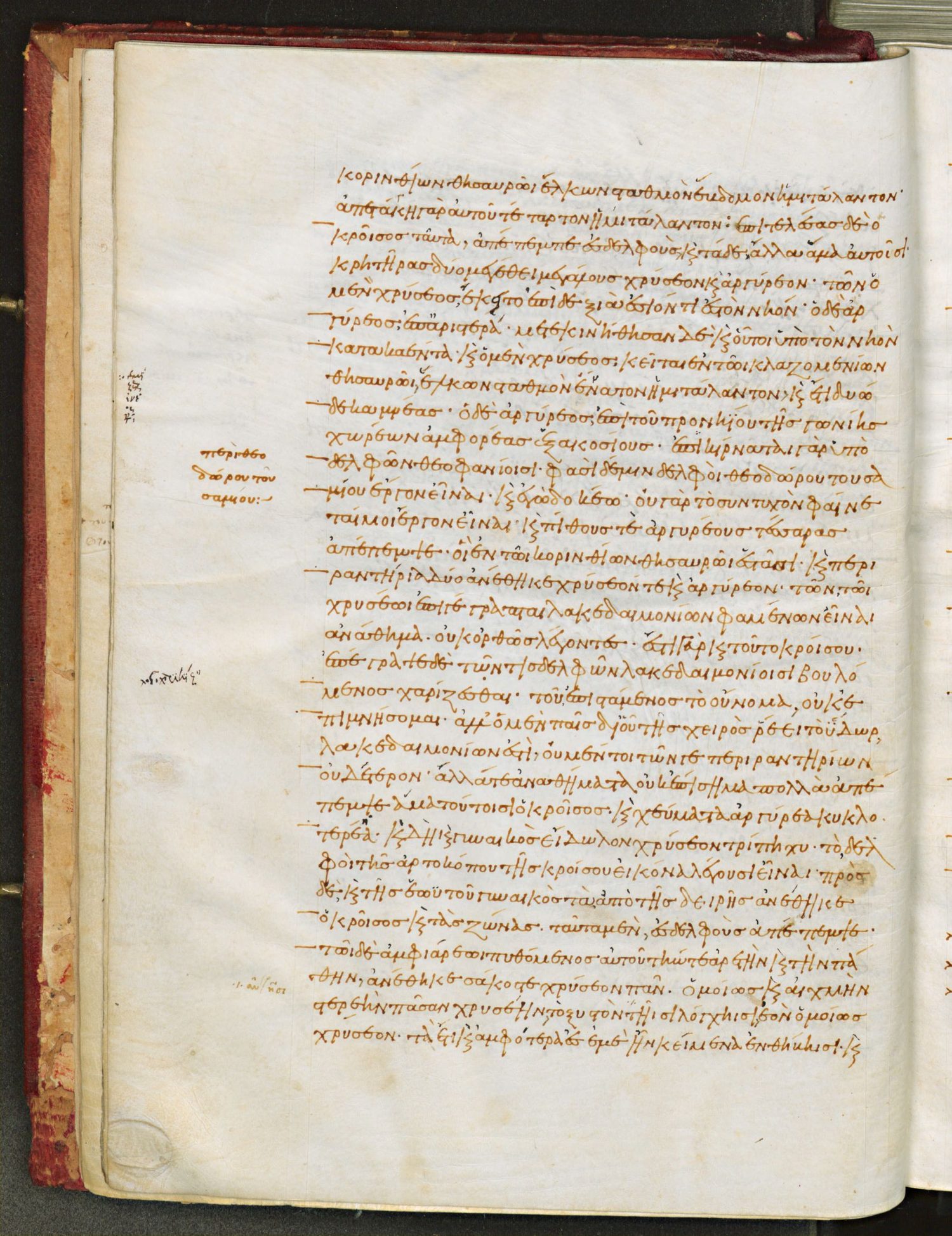
Laur. Plut. 70.3, fol. 12v: Greek here 1.50.3 to 1.52.1. Checked on the image (first and last words read and located in the Greek; each break checked against the neighbouring page): fol. 12v begins ‹Κορινθίων θησαυρῷ, ἕλκων σταθμὸν› (1.50.3), ends ‹κείμενα ἐν Θήβῃσι καὶ› (1.52.1). Fol. 12r ends καὶ νῦν κεῖται ἐν τοῖ- and fol. 12v begins Κορινθίων θησαυροῖσι: the manuscript has ἐν τοῖσι Κορινθίων θησαυροῖσι where the edition prints ἐν τῷ Κορινθίων θησαυρῷ (1.50.3). English here: 1.51.1 to 1.52.1 (Godley's sentences for the sections whose Greek lies mostly on this page).
1.50.3Κορινθίων θησαυρῷ, ἕλκων σταθμὸν ἕβδομον ἡμιτάλαντον· ἀπετάκη γὰρ αὐτοῦ τέταρτον ἡμιτάλαντον. 1.51.1ἐπιτελέσας δὲ ὁ Κροῖσος ταῦτα ἀπέπεμπε ἐς Δελφούς, καὶ τάδε ἄλλα ἅμα τοῖσι, κρητῆρας δύο μεγάθεϊ μεγάλους, χρύσεον καὶ ἀργύρεον, τῶν ὁ μὲν χρύσεος ἔκειτο ἐπὶ δεξιὰ ἐσιόντι ἐς τὸν νηόν, ὁ δὲ ἀργύρεος ἐπʼ ἀριστερά. 1.51.2μετεκινήθησαν δὲ καὶ οὗτοι ὑπὸ τὸν νηὸν κατακαέντα καὶ ὁ μὲν χρύσεος κεῖται ἐν τῷ Κλαζομενίων θησαυρῷ, ἕλκων σταθμὸν εἴνατον ἡμιτάλαντον καὶ ἔτι δυώδεκα μνέας, ὁ δὲ ἀργύρεος ἐπὶ τοῦ προνηίου τῆς γωνίης, χωρέων ἀμφορέας ἑξακοσίους· ἐπικίρναται γὰρ ὑπὸ Δελφῶν Θεοφανίοισι. 1.51.3φασὶ δὲ μιν Δελφοὶ Θεοδώρου τοῦ Σαμίου ἔργον εἶναι, καὶ ἐγὼ δοκέω· οὐ γὰρ τὸ συντυχὸν φαίνεταί μοι ἔργον εἶναι. καὶ πίθους τε ἀργυρέους τέσσερας ἀπέπεμψε, οἳ ἐν τῷ Κορινθίων θησαυρῷ ἑστᾶσι, καὶ περιρραντήρια δύο ἀνέθηκε, χρύσεόν τε καὶ ἀργύρεον, τῶν τῷ χρυσέῳ ἐπιγέγραπται Λακεδαιμονίων φαμένων εἶναι ἀνάθημα, οὐκ ὀρθῶς λέγοντες· 1.51.4ἔστι γὰρ καὶ τοῦτο Κροίσου, ἐπέγραψε δὲ τῶν τις Δελφῶν Λακεδαιμονίοισι βουλόμενος χαρίζεσθαι, τοῦ ἐπιστάμενος τὸ οὔνομα οὐκ ἐπιμνήσομαι. ἀλλʼ ὁ μὲν παῖς, διʼ οὗ τῆς χειρὸς ῥέει τὸ ὕδωρ, Λακεδαιμονίων ἐστί, οὐ μέντοι τῶν γε περιρραντηρίων οὐδέτερον. 1.51.5ἄλλα τε ἀναθήματα οὐκ ἐπίσημα πολλὰ ἀπέπεμψε ἅμα τούτοισι ὁ Κροῖσος, καὶ χεύματα ἀργύρεα κυκλοτερέα, καὶ δὴ καὶ γυναικὸς εἴδωλον χρύσεον τρίπηχυ, τὸ Δελφοὶ τῆς ἀρτοκόπου τῆς Κροίσου εἰκόνα λέγουσι εἶναι. πρὸς δὲ καὶ τῆς ἑωυτοῦ γυναικὸς τὰ ἀπὸ τῆς δειρῆς ἀνέθηκε ὁ Κροῖσος καὶ τὰς ζώνας. 1.52.1ταῦτα μὲν ἐς Δελφοὺς ἀπέπεμψε, τῷ δὲ Ἀμφιάρεῳ, πυθόμενος αὐτοῦ τήν τε ἀρετὴν καὶ τὴν πάθην, ἀνέθηκε σάκος τε χρύσεον πᾶν ὁμοίως καὶ αἰχμὴν στερεὴν πᾶσαν χρυσέην, τὸ ξυστὸν τῇσι λόγχῃσι ἐὸν ὁμοίως χρύσεον· τὰ ἔτι καὶ ἀμφότερα ἐς ἐμὲ ἦν κείμενα ἐν Θήβῃσι καὶ
1.51.1When these offerings were fully made, Croesus sent them to Delphi, with other gifts besides, namely, two very great bowls, one of gold and one of silver. The golden bowl stood to the right, the silvern to the left, of the temple entrance. 1.51.2These too were removed about the time of the temple’s burning, and now the golden bowl, which weighs eight talents and a half, and twelve minae, lies in the treasury of the Clazomenians, and the silver bowl at the corner of the forecourt of the temple. This bowl holds six hundred nine-gallon measures: for the Delphians use it for a mixing-bowl at the feast of the Divine Appearance. 1.51.3It is said by the Delphians to be the work of Theodorus of Samos, and I believe them, for it seems to me to be of no common workmanship. Moreover, Croesus sent four silver casks, which stand in the treasury of the Corinthians, and dedicated two sprinkling-vessels, one of gold, one of silver. The golden vessel bears the inscription “Given by the Lacedaemonians,” who claim it as their offering. 1.51.4But they are wrong, for this, too, is Croesus’ gift. The inscription was made by a certain Delphian, whose name I know but will not reveal, out of his desire to please the Lacedaemonians. The figure of a boy, through whose hand the water runs, is indeed a Lacedaemonian gift; but they did not give either of the sprinkling-vessels. 1.51.5Along with these Croesus sent, besides many other offerings of no great mark, certain round basins of silver, and a golden female figure three cubits high, which the Delphians assert to be the statue of the woman who was Croésus’ baker. Moreover he dedicated his own wife’s necklaces and girdles. 1.52.1Such were the gifts which he sent to Delphi. To Amphiaraus, having learnt of his valour and his fate, he dedicated a shield made entirely of gold and a spear all of solid gold, point and shaft alike. Both of these lay till my time at Thebes, in the Theban temple of Ismenian Apollo.
Where on the image
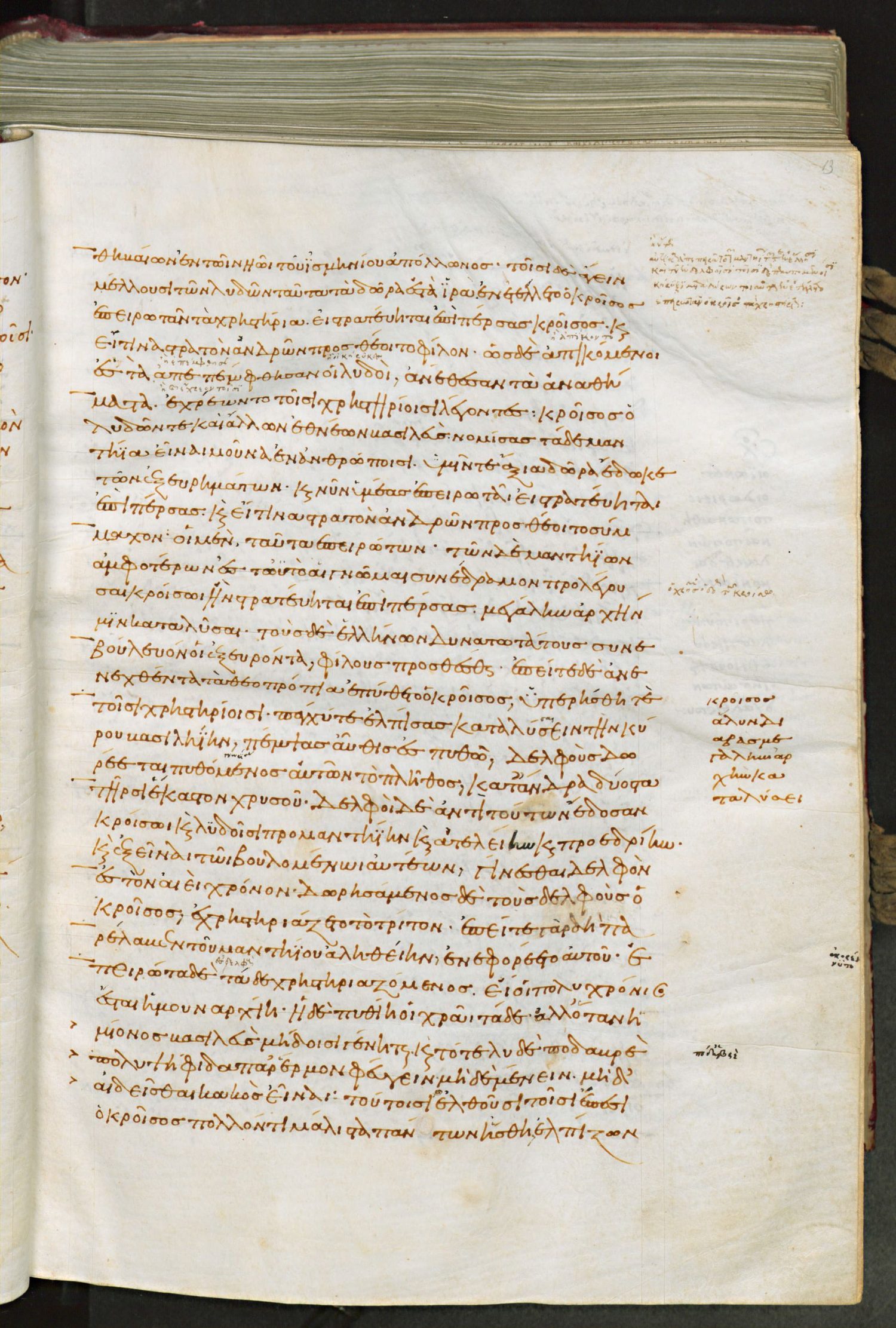
Laur. Plut. 70.3, fol. 13r: Greek here 1.52.1 to 1.56.1. Checked on the image (first and last words read and located in the Greek; each break checked against the neighbouring page): fol. 13r begins ‹Θηβέων ἐν τῳ νηῷ› (1.52.1), ends ‹μάλιστα πάντων ἥσθη, ἐλπίζων› (1.56.1). English here: 1.53.1 to 1.55.2 (Godley's sentences for the sections whose Greek lies mostly on this page).
1.52.1Θηβέων ἐν τῳ νηῷ τοῦ Ἰσμηνίου Ἀπόλλωνος. 1.53.1τοῖσι δὲ ἄγειν μέλλουσι τῶν Λυδῶν ταῦτα τὰ δῶρα ἐς τὰ ἱρὰ ἐνετέλλετο ὁ Κροῖσος ἐπειρωτᾶν τὰ χρηστήρια εἰ στρατεύηται ἐπὶ Πέρσας Κροῖσος καὶ εἴ τινα στρατὸν ἀνδρῶν προσθέοιτο φίλον, 1.53.2ὡς δὲ ἀπικόμενοι ἐς τὰ ἀπεπέμφθησαν, οἱ Λυδοὶ ἀνέθεσαν τὰ ἀναθήματα, ἐχρέωντο τοῖσι χρηστηρίοισι λέγοντες Κροῖσος ὁ Λυδῶν τε καὶ ἄλλων ἐθνέων βασιλεύς, νομίσας τάδε μαντήια εἶναι μοῦνα ἐν ἀνθρώποισι, ὑμῖν τε ἄξια δῶρα ἔδωκε τῶν ἐξευρημάτων, καὶ νῦν ὑμέας ἐπειρωτᾷ εἰ στρατεύηται ἐπὶ Πέρσας καὶ εἴ τινα στρατὸν ἀνδρῶν προσθέοιτο σύμμαχον. 1.53.3οἳ μὲν ταῦτα ἐπειρώτων, τῶν δὲ μαντηίων ἀμφοτέρων ἐς τὠυτὸ αἱ γνῶμαι συνέδραμον, προλέγουσαι Κροίσῳ, ἢν στρατεύηται ἐπὶ Πέρσας, μεγάλην ἀρχὴν μιν καταλύσειν· τοὺς δὲ Ἑλλήνων δυνατωτάτους συνεβούλευόν οἱ ἐξευρόντα φίλους προσθέσθαι. 1.54.1ἐπείτε δὲ ἀνενειχθέντα τὰ θεοπρόπια ἐπύθετο ὁ Κροῖσος, ὑπερήσθη τε τοῖσι χρηστηρίοισι, πάγχυ τε ἐλπίσας καταλύσειν τὴν Κύρου βασιληίην, πέμψας αὖτις ἐς Πυθὼ Δελφοὺς δωρέεται, πυθόμενος αὐτῶν τὸ πλῆθος, κατʼ ἄνδρα δύο στατῆρσι ἕκαστον χρυσοῦ. 1.54.2Δελφοὶ δὲ ἀντὶ τούτων ἔδοσαν Κροίσῳ καὶ Λυδοῖσι προμαντηίην καὶ ἀτελείην καὶ προεδρίην, καὶ ἐξεῖναι τῷ βουλομένῳ αὐτῶν γίνεσθαι Δελφὸν ἐς τὸν αἰεὶ χρόνον. 1.55.1δωρησάμενος δὲ τοὺς Δελφοὺς ὁ Κροῖσος ἐχρηστηριάζετο τὸ τρίτον· ἐπείτε γὰρ δὴ παρέλαβε τοῦ μαντείου ἀληθείην, ἐνεφορέετο αὐτοῦ. ἐπειρώτα δὲ τάδε χρηστηριαζόμενος, εἴ οἱ πολυχρόνιος ἔσται ἡ μουναρχίη. 1.55.2ἡ δὲ Πυθίη οἱ χρᾷ τάδε.
ἀλλʼ ὅταν ἡμίονος βασιλεὺς Μήδοισι γένηται,
καὶ τότε, Λυδὲ ποδαβρέ, πολυψήφιδα παρʼ Ἕρμον
φεύγειν μηδὲ μένειν μηδʼ αἰδεῖσθαι κακός εἶναι. 1.56.1τούτοισι ἐλθοῦσι τοῖσι ἔπεσι ὁ Κροῖσος πολλόν τι μάλιστα πάντων ἥσθη, ἐλπίζων
1.53.1The Lydians who were to bring these gifts to the temples were charged by Croesus to inquire of the oracles, “Shall Croesus send an army against the Persians: and shall he take to himself any allied host?” 1.53.2When the Lydians came to the places whither they were sent, they made present of the offerings, and inquired of the oracles, in these words: “Croesus, king of Lydia and other nations, seeing that he deems that here are the only true places of divination among men, endows you with such gifts as your wisdom merits. And now he would ask you, if he shall send an army against the Persians, and if he shall take to himself any allied host.” 1.53.3Such was their inquiry; and the judgment given to Croesus by each of the two oracles was the same, to wit, that if he should send an army against the Persians he would destroy a great empire. And they counselled him to discover the mightiest of the Greeks and make them his friends. 1.54.1When the divine answers had been brought back and Croesus learnt of them, he was greatly pleased with the oracles. So, being fully persuaded that he would destroy the kingdom of Cyrus, he sent once again to Pytho and endowed the Delphians with two gold staters apiece, according to his knowledge of their number. 1.54.2The Delphians, in return, gave Croesus and all Lydians the right of first consulting the oracle, freedom from all charges, the chief seats at festivals, and perpetual right of Delphian citizenship to whosoever should wish. 1.55.1Then Croesus after his gifts to the Delphians made a third inquiry of the oracle, for he would use it to the full, having received true answers from it; and the question which he asked in his inquest was whether his sovereignty should be of long duration. To this the Pythian priestess answered as follows: “Lydian, beware of the day 1.55.2when a mule is lord of the Medians: Then with thy delicate feet by the stone-strewn channel of Hermus Flee for thy life, nor abide, nor blush for the name of a craven.”
Where on the image
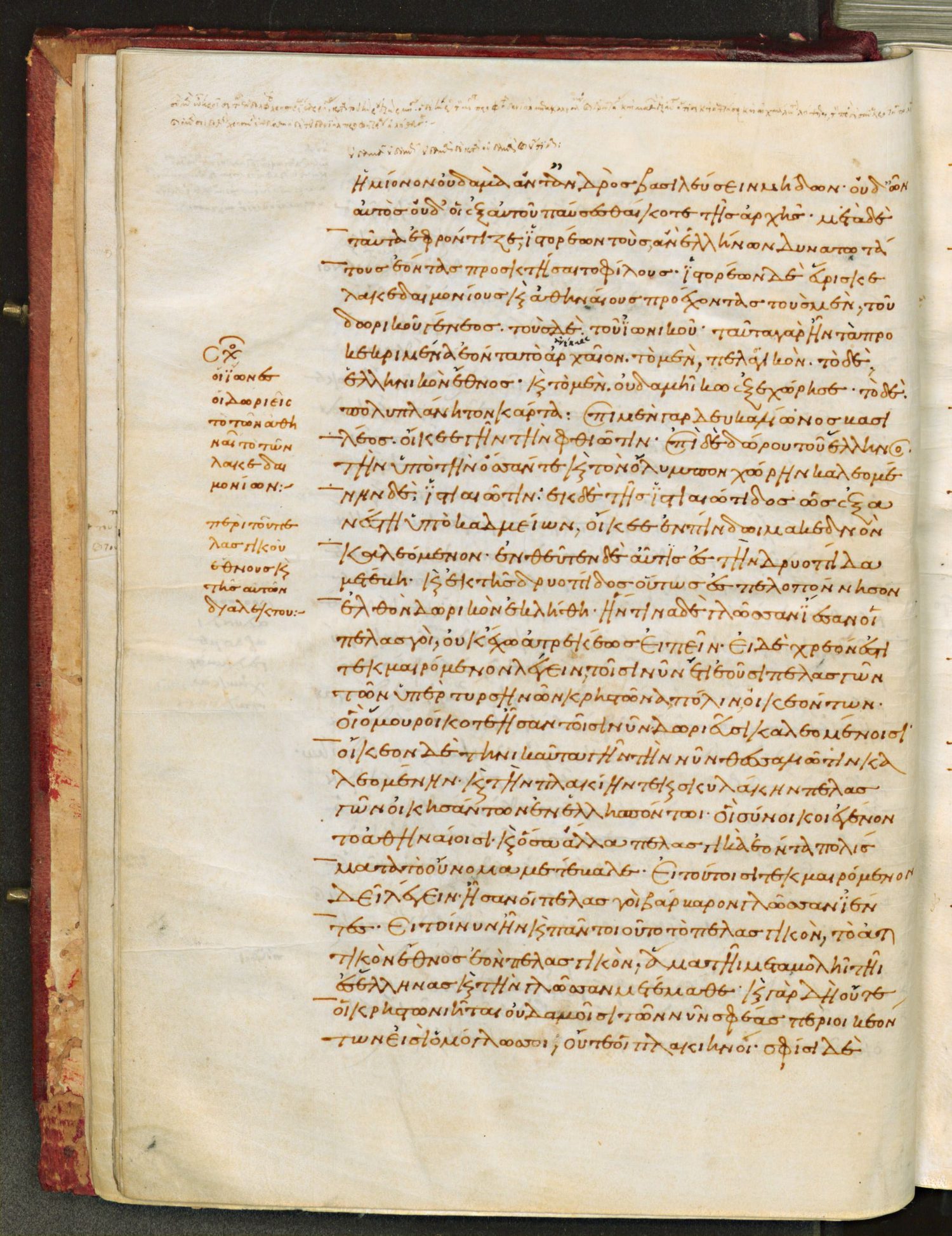
Laur. Plut. 70.3, fol. 13v: Greek here 1.56.1 to 1.56.3. Checked on the image (first and last words read and located in the Greek; each break checked against the neighbouring page): fol. 13v begins ‹ἡμίονον οὐδαμὰ ἀντʼ ἀνδρὸς› (1.56.1), ends ‹οἱ Πλακιηνοί, σφίσι δὲ› (1.57.3). English here: 1.56.1 to 1.56.3 (Godley's sentences for the sections whose Greek lies mostly on this page).
1.56.1ἡμίονον οὐδαμὰ ἀντʼ ἀνδρὸς βασιλεύσειν Μήδων, οὐδʼ ὦν αὐτὸς οὐδὲ οἱ ἐξ αὐτοῦ παύσεσθαι κοτὲ τῆς ἀρχῆς. μετὰ δὲ ταῦτα ἐφρόντιζε ἱστορέων τοὺς ἂν Ἑλλήνων δυνατωτάτους ἐόντας προσκτήσαιτο φίλους, 1.56.2ἱστορέων δὲ εὕρισκε Λακεδαιμονίους καὶ Ἀθηναίους προέχοντας τοὺς μὲν τοῦ Δωρικοῦ γένεος τοὺς δὲ τοῦ Ἰωνικοῦ. ταῦτα γὰρ ἦν τὰ προκεκριμένα, ἐόντα τὸ ἀρχαῖον τὸ μὲν Πελασγικὸν τὸ δὲ Ἑλληνικὸν ἔθνος. καὶ τὸ μὲν οὐδαμῇ κω ἐξεχώρησε, τὸ δὲ πολυπλάνητον κάρτα. 1.56.3ἐπὶ μὲν γὰρ Δευκαλίωνος βασιλέος οἴκεε γῆν τὴν Φθιῶτιν, ἐπὶ δὲ Δώρου τοῦ Ἕλληνος τὴν ὑπὸ τὴν Ὄσσαν τε καὶ τὸν Ὄλυμπον χώρην, καλεομένην δὲ Ἱστιαιῶτιν· ἐκ δὲ τῆς Ἱστιαιώτιδος ὡς ἐξανέστη ὑπὸ Καδμείων, οἴκεε ἐν Πίνδῳ Μακεδνὸν καλεόμενον· ἐνθεῦτεν δὲ αὖτις ἐς τὴν Δρυοπίδα μετέβη καὶ ἐκ τῆς Δρυοπίδος οὕτω ἐς Πελοπόννησον ἐλθὸν Δωρικὸν ἐκλήθη.
1.56.1When he heard these verses Croesus was pleased with them above all, for he thought that a mule would never be king of the Medians in place of a man, and so that he and his posterity would never lose his empire. Then he sought very carefully to discover who were the mightiest of the Greeks whom he should make his friends. 1.56.2He found by inquiry that the chief peoples were the Lacedaemonians among those of Doric, and the Athenians among those of Ionic stock. These races, Ionian and Dorian, were the foremost in ancient time, the first a Pelasgian and the second an Hellenic people. The Pelasgian stock has never yet left its habitation, the Hellenic has wandered often and afar. 1.56.3For in the days of king Deucalion it inhabited the land of Phthia, then in the time of Dorus son of Hellen the country called Histiaean, under Ossa and Olympus; driven by the Cadmeans from this Histiaean country it settled about Pindus in the parts called Macednian; thence again it migrated to Dryopia, and at last came from Dryopia into Peloponnesus, where it took the name of Dorian.
Notes
- Greek: the text printed in A. D. Godley's Loeb edition, via Perseus (tlg0016.tlg001.perseus-grc2). Square brackets mark words the editor considers later additions; [...] marks a gap the editor indicates. Perseus note markers are omitted.
- English: A. D. Godley, Herodotus vol. 1 (1920) (Loeb Classical Library), as transcribed on Wikisource. Godley's footnotes are omitted.
- Section numbers in the English were placed by comparing Godley's text with the Perseus version of his translation; where a section begins inside one of Godley's sentences, the English is kept with the page that holds the start of that sentence.
Cite
Sources
- Source: Florence, Laur. Plut. 70.3 (10th c.) via BML Teca Digitale + Greek of Godley's Loeb (Perseus) + English of A. D. Godley (Loeb, Wikisource) (holding institution)
- Critical edition: Greek of A. D. Godley's Loeb edition (1920-1925), via Perseus
← previous · → next · v cycle view · l back to library