Herodotus, Histories 1.57-70: The Pelasgians; Athens under Peisistratus; Sparta
Introduction
Herodotus of Halicarnassus wrote the Histories in the third quarter of the 5th century BCE, an inquiry into the deeds of Greeks and barbarians and the causes of the wars between them, later divided into nine books. Book 1 tells how the conflict between Greeks and barbarians began, the history of Lydia from Gyges to Croesus, the rise of the Medes and of Cyrus the Persian, the conquest of the Greeks of Asia, the capture of Babylon and the death of Cyrus.
The photographs are of Florence, Biblioteca Medicea Laurenziana, Plut. 70.3 (parchment, 10th century, 374 folios, 31 lines a page), Herodotus, Histories (codex A of the editors), the oldest surviving manuscript of the complete Histories, from the Teca Digitale of the Biblioteca Medicea Laurenziana. Each section below is the text of one page, or of the part of a page that falls within these chapters. The first and last words of every page were read on the photograph and located in the Greek, and every page break was checked against the next page; the notes quote these words. Readers' notes in the margins are not part of the text and are mentioned where they occur.
The Greek is the text printed in A. D. Godley's Loeb edition (1920-1925), from Perseus; it is the edited text, not a transcription of the manuscript, whose wording differs in places. The English is Godley's translation as printed, from Wikisource. Godley's English carries only chapter numbers; the section numbers shown in it were placed by comparison with the Perseus version of his translation. Each page's English is cut at the end of one of Godley's sentences, so it can begin or end a few lines away from the Greek of the page; each note gives the exact ranges.
This entry covers chapters 1.57-70, on fol. 13v to 18r.
How was this verified? (Provenance)
Where on the image
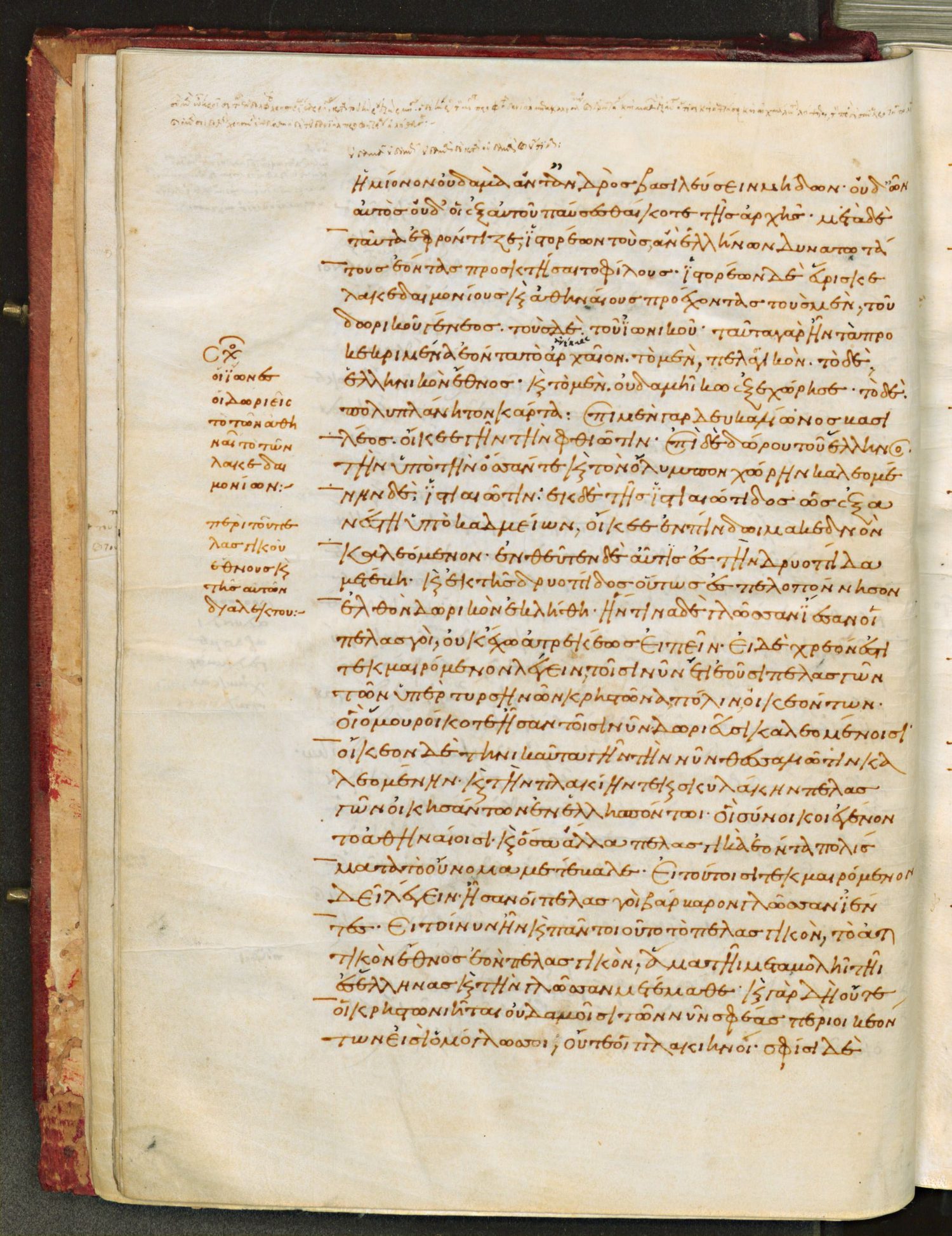
Laur. Plut. 70.3, fol. 13v: Greek here 1.57.1 to 1.57.3. Checked on the image (first and last words read and located in the Greek; each break checked against the neighbouring page): fol. 13v begins ‹ἡμίονον οὐδαμὰ ἀντʼ ἀνδρὸς› (1.56.1), ends ‹οἱ Πλακιηνοί, σφίσι δὲ› (1.57.3). English here: 1.57.1 to 1.57.3 (Godley's sentences for the sections whose Greek lies mostly on this page).
1.57.1ἥντινα δὲ γλῶσσαν ἵεσαν οἱ Πελασγοί, οὐκ ἔχω ἀτρεκέως εἰπεῖν. εἰ δὲ χρεόν ἐστι τεκμαιρόμενον λέγειν τοῖσι νῦν ἔτι ἐοῦσι Πελασγῶν τῶν ὑπὲρ Τυρσηνῶν Κρηστῶνα πόλιν οἰκεόντων, οἳ ὅμουροι κοτὲ ἦσαν τοῖσι νῦν Δωριεῦσι καλεομένοισι (οἴκεον δὲ τηνικαῦτα γῆν τὴν νῦν Θεσσαλιῶτιν καλεομένην), 1.57.2καὶ τῶν Πλακίην τε καὶ Σκυλάκην Πελασγῶν οἰκησάντων ἐν Ἑλλησπόντῳ, οἳ σύνοικοι ἐγένοντο Ἀθηναίοισι, καὶ ὅσα ἄλλα Πελασγικὰ ἐόντα πολίσματα τὸ οὔνομα μετέβαλε· εἰ τούτοισι τεκμαιρόμενον δεῖ λέγειν, ἦσαν οἱ Πελασγοὶ βάρβαρον γλῶσσαν ἱέντες. 1.57.3εἰ τοίνυν ἦν καὶ πᾶν τοιοῦτο τὸ Πελασγικόν, τὸ Ἀττικὸν ἔθνος ἐὸν Πελασγικὸν ἅμα τῇ μεταβολῇ τῇ ἐς Ἕλληνας καὶ τὴν γλῶσσαν μετέμαθε. καὶ γὰρ δὴ οὔτε οἱ Κρηστωνιῆται οὐδαμοῖσι τῶν νῦν σφέας περιοικεόντων εἰσὶ ὁμόγλωσσοι οὔτε οἱ Πλακιηνοί, σφίσι δὲ
1.57.1What language the Pelasgians spoke I cannot accurately say. But if one may judge by those that still remain of the Pelasgians who dwell above the Tyrrheni in the city of Creston—who were once neighbours of the people now called Dorians, and at that time inhabited the country which now is called Thessalian— 1.57.2and of the Pelasgians who inhabited Placia and Scylace on the Hellespont, who came to dwell among the Athenians, and by other towns too which were once Pelasgian and afterwards took a different name:—if (I say) one may judge by these, the Pelasgians spoke a language which was not Greek. 1.57.3If then all the Pelasgian stock so spoke, then the Attic nation, being of Pelasgian blood, must have changed its language too at the time when it became part of the Hellenes. For the people of Creston and Placia have a language of their own in common, which is not the language of their neighbours; and it is plain that they still preserve the fashion of speech which they brought with them in their migration into the places where they dwell.
Where on the image
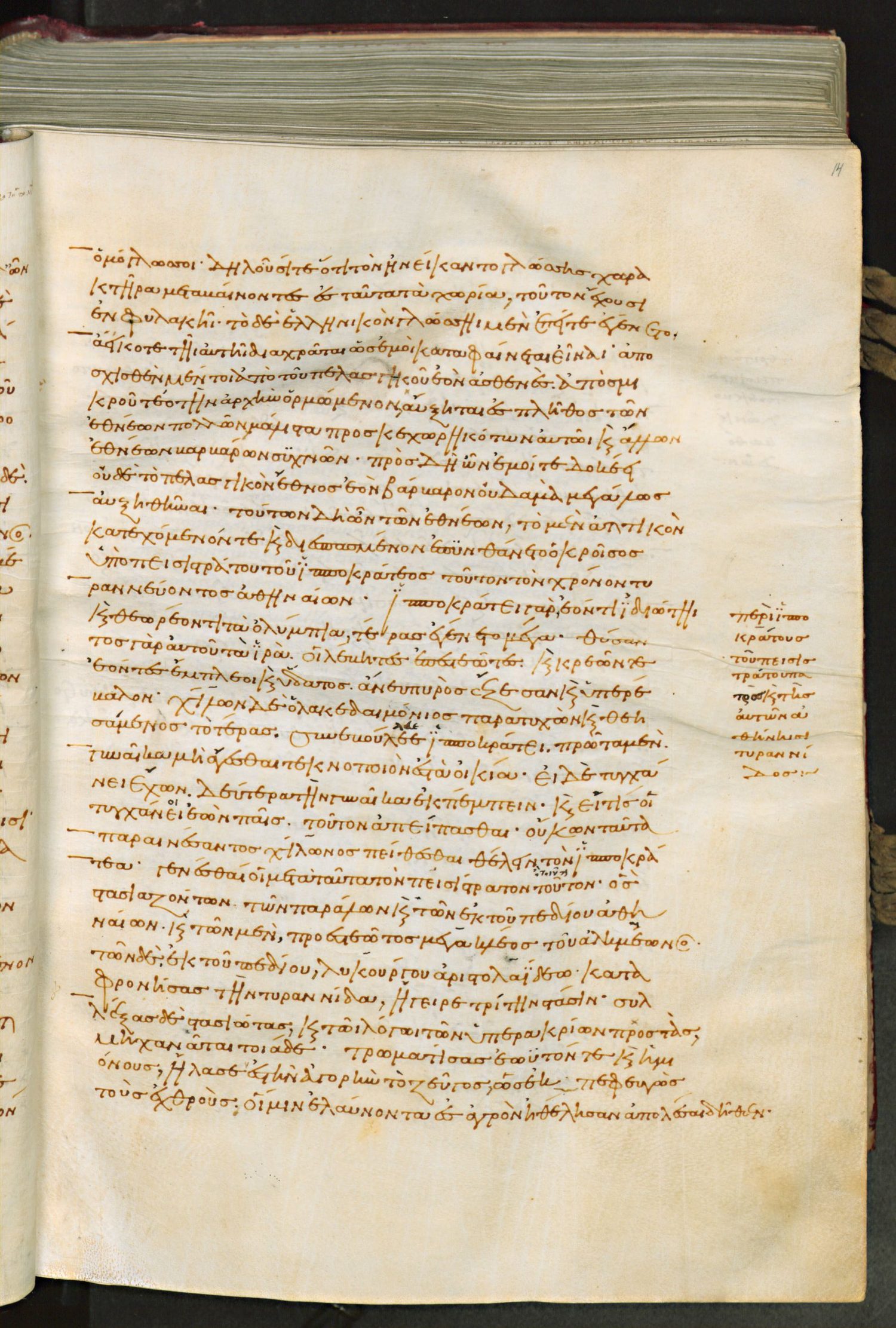
Laur. Plut. 70.3, fol. 14r: Greek here 1.57.3 to 1.59.4. Checked on the image (first and last words read and located in the Greek; each break checked against the neighbouring page): fol. 14r begins ‹ὁμόγλωσσοι· δηλοῦσί τε ὅτι› (1.57.3), ends ‹ἀγρὸν ἠθέλησαν ἀπολέσαι δῆθεν› (1.59.4). English here: 1.58.1 to 1.59.3 (Godley's sentences for the sections whose Greek lies mostly on this page).
1.57.3ὁμόγλωσσοι· δηλοῦσί τε ὅτι τὸν ἠνείκαντο γλώσσης χαρακτῆρα μεταβαίνοντες ἐς ταῦτα τὰ χωρία, τοῦτον ἔχουσι ἐν φυλακῇ. 1.58.1τὸ δὲ Ἑλληνικὸν γλώσσῃ μὲν ἐπείτε ἐγένετο αἰεί κοτε τῇ αὐτῇ διαχρᾶται, ὡς ἐμοὶ καταφαίνεται εἶναι· ἀποσχισθὲν μέντοι ἀπὸ τοῦ Πελασγικοῦ ἐόν ἀσθενές, ἀπό σμικροῦ τεο τὴν ἀρχὴν ὁρμώμενον αὔξηται ἐς πλῆθος τῶν ἐθνέων, Πελασγῶν μάλιστα προσκεχωρηκότων αὐτῷ καὶ ἄλλων ἐθνέων βαρβάρων συχνῶν. πρόσθε δὲ ὦν ἔμοιγε δοκέει οὐδὲ τὸ Πελασγικὸν ἔθνος, ἐὸν βάρβαρον, οὐδαμὰ μεγάλως αὐξηθῆναι. 1.59.1τούτων δὴ ὦν τῶν ἐθνέων τὸ μὲν Ἀττικὸν κατεχόμενόν τε καὶ διεσπασμένον ἐπυνθάνετο ὁ Κροῖσος ὑπὸ Πεισιστράτου τοῦ Ἱπποκράτεος τοῦτον τὸν χρόνον τυραννεύοντος Ἀθηναίων. Ἱπποκράτεϊ γὰρ ἐόντι ἰδιώτῃ καὶ θεωρέοντι τὰ Ὀλύμπια τέρας ἐγένετο μέγα· θύσαντος γὰρ αὐτοῦ τὰ ἱρὰ οἱ λέβητες ἐπεστεῶτες καὶ κρεῶν τε ἐόντες ἔμπλεοι καὶ ὕδατος ἄνευ πυρὸς ἔζεσαν καὶ ὑπερέβαλον. 1.59.2Χίλων δὲ ὁ Λακεδαιμόνιος παρατυχὼν καὶ θεησάμενος τὸ τέρας συνεβούλευε Ἱπποκράτεϊ πρῶτα μὲν γυναῖκα μὴ ἄγεσθαι τεκνοποιὸν ἐς τὰ οἰκία, εἰ δὲ τυγχάνει ἔχων, δευτέρα τὴν γυναῖκα ἐκπέμπειν, καὶ εἴ τίς οἱ τυγχάνει ἐὼν παῖς, τοῦτον ἀπείπασθαι. 1.59.3οὔκων ταῦτα παραινέσαντος Χίλωνος πείθεσθαι θέλειν τὸν Ἱπποκράτεα· γενέσθαι οἱ μετὰ ταῦτα τὸν Πεισίστρατον τοῦτον, ὃς στασιαζόντων τῶν παράλων καὶ τῶν ἐκ τοῦ πεδίου Ἀθηναίων, καὶ τῶν μὲν προεστεῶτος Μεγακλέος τοῦ Ἀλκμέωνος, τῶν δὲ ἐκ τοῦ πεδίου Λυκούργου Ἀριστολαΐδεω, καταφρονήσας τὴν τυραννίδα ἤγειρε τρίτην στάσιν· συλλέξας δὲ στασιώτας καὶ τῷ λόγῳ τῶν ὑπερακρίων προστὰς μηχανᾶται τοιάδε. 1.59.4τρωματίσας ἑωυτόν τε καὶ ἡμιόνους ἤλασε ἐς τὴν ἀγορὴν τὸ ζεῦγος ὡς ἐκπεφευγὼς τοὺς ἐχθρούς, οἵ μιν ἐλαύνοντα ἐς ἀγρὸν ἠθέλησαν ἀπολέσαι δῆθεν,
1.58.1But the Hellenic stock, as to me seems clear, has ever used the same language since its beginning; yet being, when separated from the Pelasgians, but few in number, they have grown from a small beginning to comprise a multitude of nations, chiefly because the Pelasgians and many other foreign peoples united themselves with them. Before that, as I think, the Pelasgic stock nowhere increased greatly in number while it was of foreign speech. 1.59.1Now, of these two peoples, Croesus learned that the Attic was held in subjection and divided into factions by Pisistratus son of Hippocrates, who at that time was sovereign over the Athenians. This Hippocrates was but a private man when a great marvel happened to him as he was at Olympia to see the games: when he had offered the sacrifice, the vessels, standing there full of meat and water, boiled without fire till they overflowed. 1.59.2Chilon the Lacedaemonian, who chanced to be there and saw this marvel, counselled Hippocrates not to take into his house a childbearing wife, if so might be: but if he had one already, then at least to send her away, and if he had a son, to disown him. 1.59.3Hippocrates refused to follow the counsel of Chilon, and presently there was born to him this Pisistratus aforesaid. In course of time there was a feud between the Athenians of the coast under Megacles son of Alcmeon and the Athenians of the plain under Lycurgus son of Aristolaïdes. Pisistratus then, having an eye to the sovereign power, raised up a third faction. He collected partisans and pretended to champion the hillmen; and this was his plan.
Where on the image
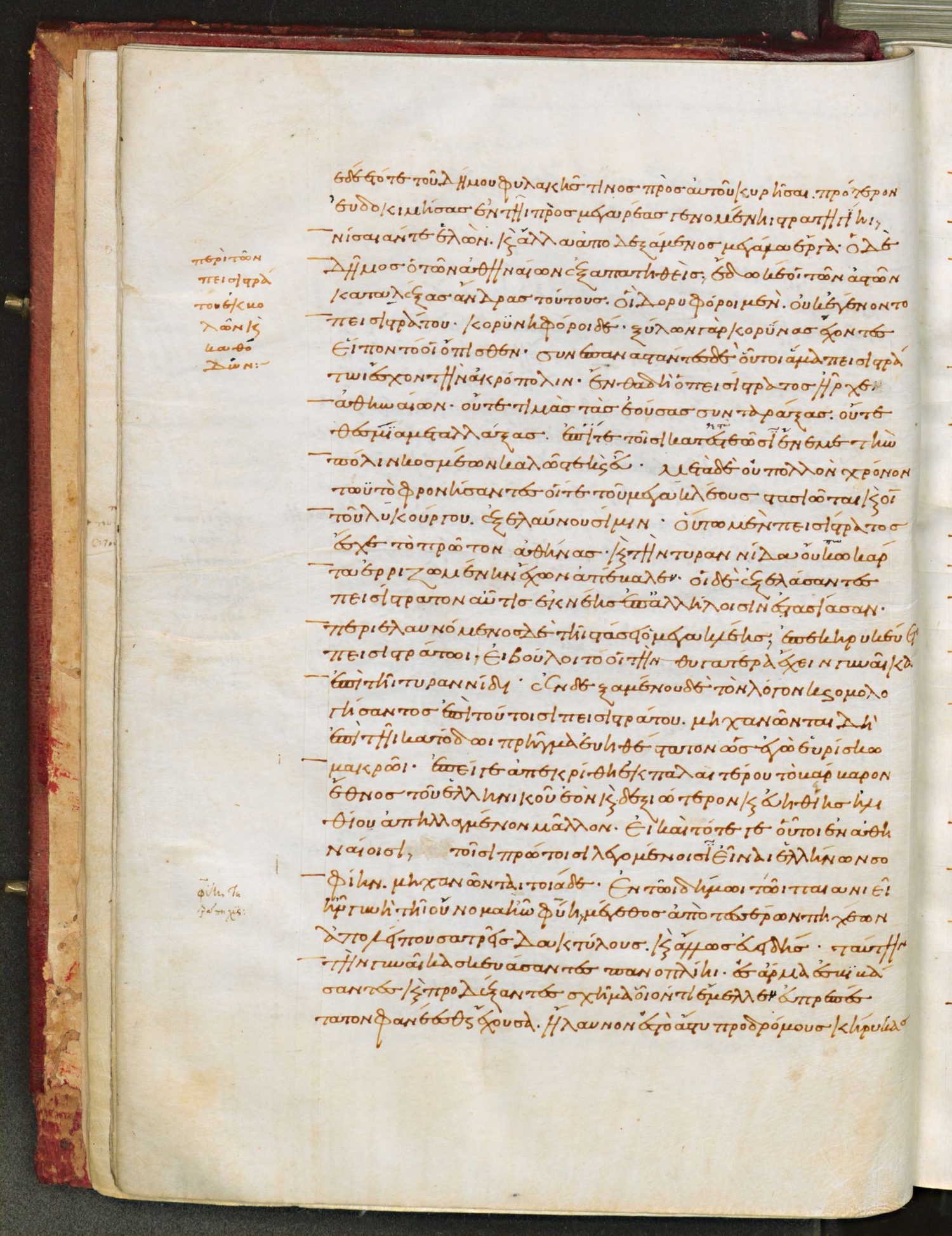
Laur. Plut. 70.3, fol. 14v: Greek here 1.59.4 to 1.60.4. Checked on the image (first and last words read and located in the Greek; each break checked against the neighbouring page): fol. 14v begins ‹ἐδέετό τε τοῦ δήμου› (1.59.4), ends ‹τὸ ἄστυ, προδρόμους κήρυκας› (1.60.4). English here: 1.59.4 to 1.60.5 (Godley's sentences for the sections whose Greek lies mostly on this page).
1.59.4ἐδέετό τε τοῦ δήμου φυλακῆς τινος πρὸς αὐτοῦ κυρῆσαι, πρότερον εὐδοκιμήσας ἐν τῇ πρὸς Μεγαρέας γενομένῃ στρατηγίῃ, Νίσαιάν τε ἑλὼν καὶ ἄλλα ἀποδεξάμενος μεγάλα ἔργα. 1.59.5ὁ δὲ δῆμος ὁ τῶν Ἀθηναίων ἐξαπατηθεὶς ἔδωκέ οἱ τῶν ἀστῶν καταλέξας ἄνδρας τούτους οἳ δορυφόροι μὲν οὐκ ἐγένοντο Πεισιστράτου, κορυνηφόροι δέ· ξύλων γὰρ κορύνας ἔχοντες εἵποντό οἱ ὄπισθε. 1.59.6συνεπαναστάντες δὲ οὗτοι ἅμα Πεισιστράτῳ ἔσχον τὴν ἀκρόπολιν. ἔνθα δὴ ὁ Πεισίστρατος ἦρχε Ἀθηναίων, οὔτε τιμὰς τὰς ἐούσας συνταράξας οὔτε θέσμια μεταλλάξας, ἐπί τε τοῖσι κατεστεῶσι ἔνεμε τὴν πόλιν κοσμέων καλῶς τε καὶ εὖ. 1.60.1μετὰ δὲ οὐ πολλὸν χρόνον τὠυτὸ φρονήσαντες οἵ τε τοῦ Μεγακλέος στασιῶται καὶ οἱ τοῦ Λυκούργου ἐξελαύνουσί μιν. οὕτω μὲν Πεισίστρατος ἔσχε τὸ πρῶτον Ἀθήνας, καὶ τὴν τυραννίδα οὔκω κάρτα ἐρριζωμένην ἔχων ἀπέβαλε. οἳ δὲ ἐξελάσαντες Πεισίστρατον αὖτις ἐκ νέης ἐπʼ ἀλλήλοισι ἐστασίασαν. 1.60.2περιελαυνόμενος δὲ τῇ στάσι ὁ Μεγακλέης ἐπεκηρυκεύετο Πεισιστράτῳ, εἰ βούλοιτό οἱ τὴν θυγατέρα ἔχειν γυναῖκα ἐπὶ τῇ τυραννίδι. 1.60.3ἐνδεξαμένου δὲ τὸν λόγον καὶ ὁμολογήσαντος ἐπὶ τούτοισι Πεισιστράτου, μηχανῶνται δὴ ἐπὶ τῇ κατόδῳ πρῆγμα εὐηθέστατον, ὡς ἐγὼ εὑρίσκω, μακρῷ, ἐπεί γε ἀπεκρίθη ἐκ παλαιτέρου τοῦ βαρβάρου ἔθνεος τὸ Ἑλληνικὸν ἐὸν καὶ δεξιώτερον καὶ εὐηθείης ἠλιθίου ἀπηλλαγμένον μᾶλλον, εἰ καὶ τότε γε οὗτοι ἐν Ἀθηναίοισι τοῖσι πρώτοισι λεγομένοισι εἶναι Ἑλλήνων σοφίην μηχανῶνται τοιάδε. 1.60.4ἐν τῷ δήμῳ τῷ Παιανιέι ἦν γυνὴ τῇ οὔνομα ἦν Φύη, μέγαθος ἀπὸ τεσσέρων πηχέων ἀπολείπουσα τρεῖς δακτύλους καὶ ἄλλως εὐειδής· ταύτην τὴν γυναῖκα σκευάσαντες πανοπλίῃ, ἐς ἅρμα ἐσβιβάσαντες καὶ προδέξαντες σχῆμα οἷόν τι ἔμελλε εὐπρεπέστατον φανέεσθαι ἔχουσα, ἤλαυνον ἐς τὸ ἄστυ, προδρόμους κήρυκας
1.59.4Wounding himself and his mules, he drove his carriage into the market place with a tale that he had escaped from his enemies, who would have slain him (so he said) as he was driving into the country. So he besought the people that he might have a guard from them: and indeed he had won himself reputation in his command of the army against the Megarians, when he had taken Nisaea and performed other great exploits. 1.59.5Thus deceived, the Athenian people gave him a chosen guard of citizens, of whom Pisistratus made not spearmen but clubmen: for the retinue that followed him bore wooden clubs. 1.59.6These with Pisistratus rose and took the Acropolis; and Pisistratus ruled the Athenians, disturbing in no way the order of offices nor changing the laws, but governing the city according to its established constitution and ordering all things fairly and well. 1.60.1But after no long time the faction of Megacles and Lycurgus made common cause and drove him out. Thus did Pisistratus first win Athens, and thus did he lose his sovereignty, which was not yet firmly rooted. Presently his enemies who had driven him out began once more to be at feud together. 1.60.2Megacles then, being buffeted about by faction, sent a message to Pisistratus offering him his daughter to wife and the sovereign power besides. 1.60.3This offer being accepted by Pisistratus, who agreed on these terms with Megacles, they devised a plan to bring Pisistratus back, which, to my mind, was so exceeding foolish that it is strange (seeing that from old times the Hellenic has ever been distinguished from the foreign stock by its greater cleverness and its freedom from silly foolishness) that these men should devise such a plan to deceive Athenians, said to be the cunningest of the Greeks. 1.60.4There was in the Paeanian deme a woman called Phya, three fingers short of four cubits in stature, and for the rest fair to look upon. This woman they equipped in full armour, and put her in a chariot, giving her all such appurtenances as would make the seemliest show, and so drove into the city; heralds ran before them, and when they came into the town made proclamation as they were charged, bidding the 1.60.5Athenians “to give a hearty welcome to Pisistratus, whom Athene herself honoured beyond all men and was bringing back to her own citadel.” So the heralds went about and spoke thus: immediately it was reported in the demes that Athene was bringing Pisistratus back, and the townsfolk, persuaded that the woman was indeed the goddess, worshipped this human creature and welcomed Pisistratus.
Where on the image
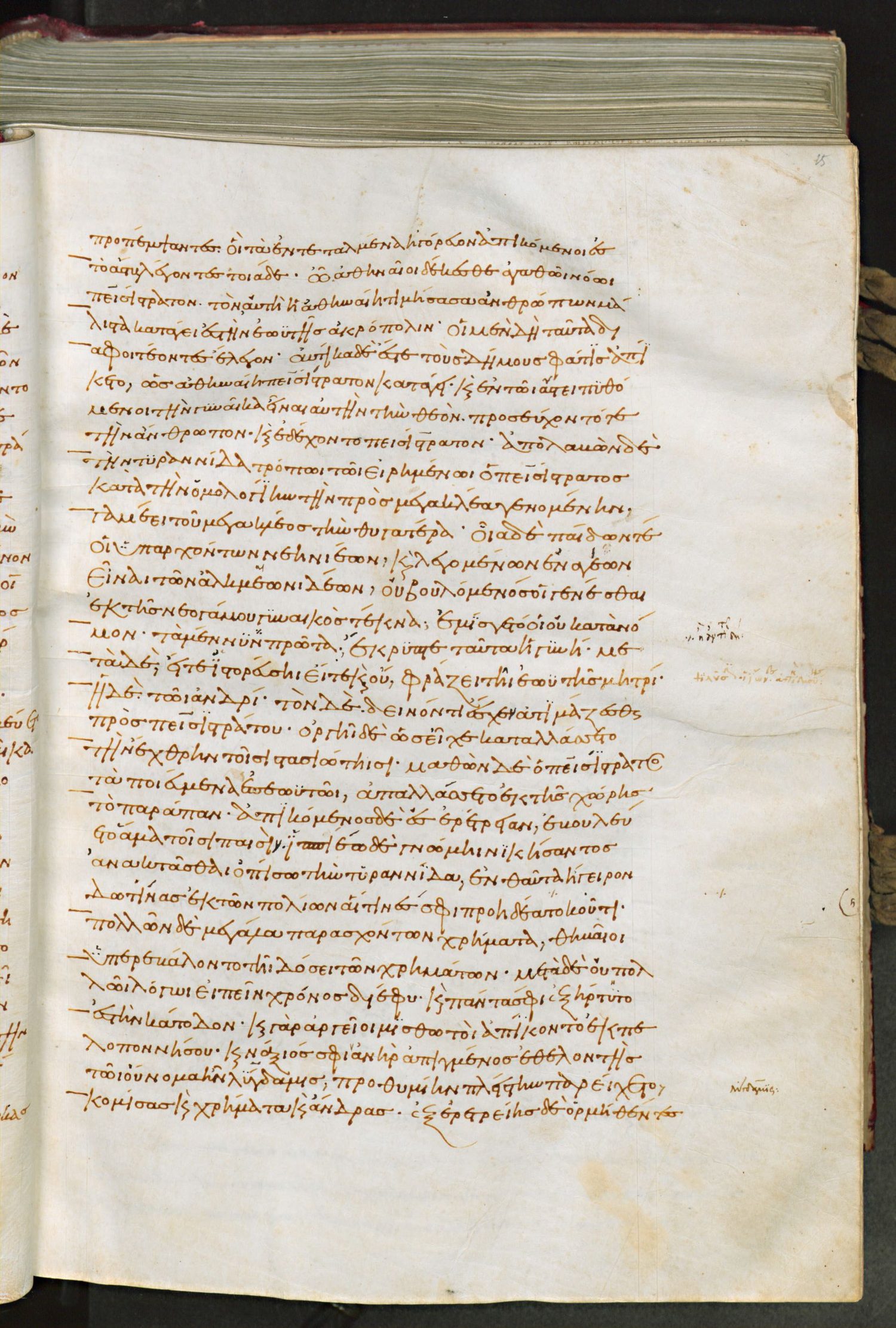
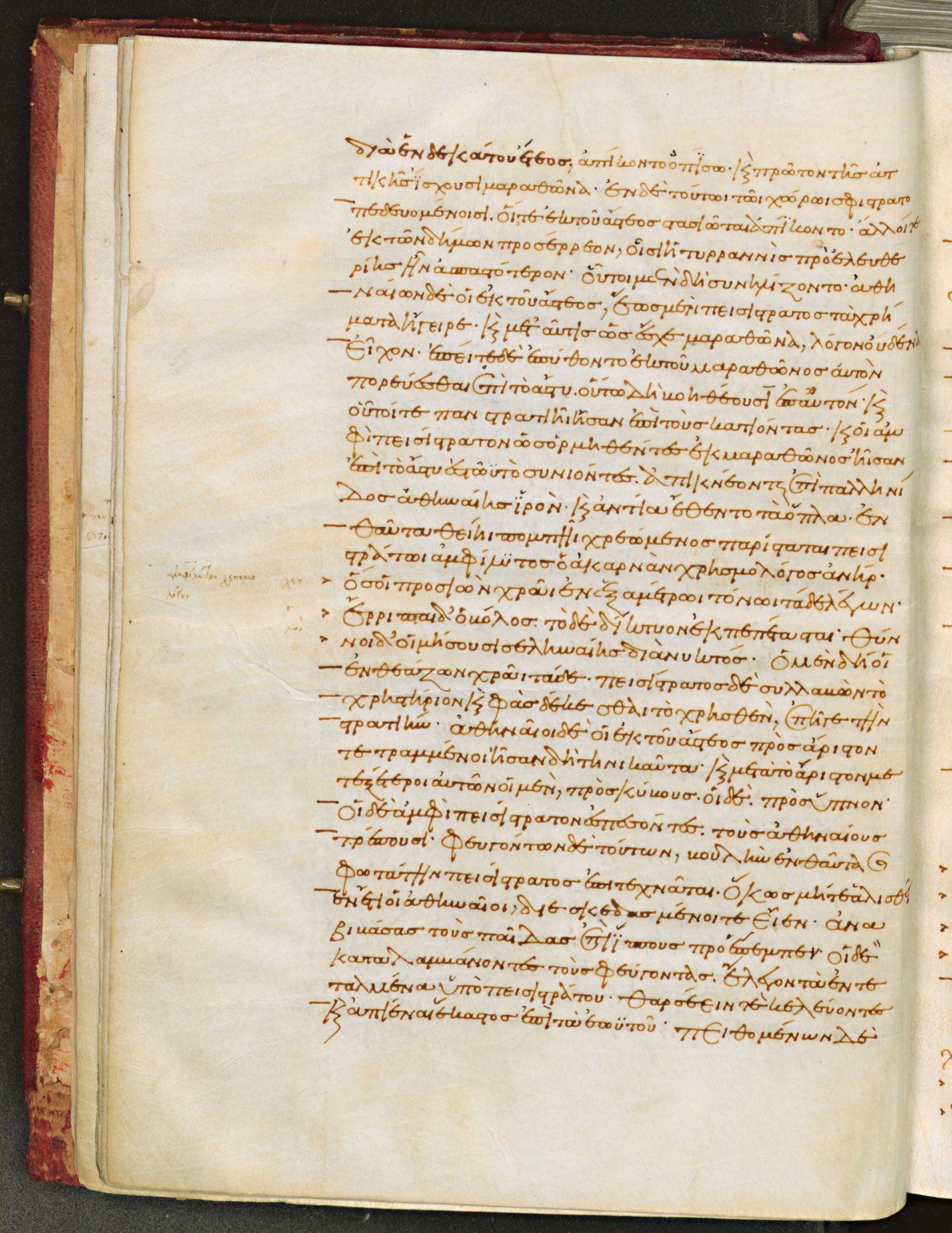
Laur. Plut. 70.3, fol. 15r: Greek here 1.60.4 to 1.62.1. Checked on the image (first and last words read and located in the Greek; each break checked against the neighbouring page): fol. 15r begins ‹προπέμψαντες· οἳ τὰ ἐντεταλμένα› (1.60.4), ends ‹ἄνδρας.ἐξ Ἐρετρίης δὲ ὁρμηθέντες› (1.62.1). English here: 1.61.1 to 1.61.4 (Godley's sentences for the sections whose Greek lies mostly on this page).
1.60.4προπέμψαντες· οἳ τὰ ἐντεταλμένα ἠγόρευον ἀπικόμενοι ἐς τὸ ἄστυ, λέγοντες τοιάδε· 1.60.5ὦ Ἀθηναῖοι, δέκεσθε ἀγαθῷ νόῳ Πεισίστρατον, τὸν αὐτὴ ἡ Ἀηθναίη τιμήσασα ἀνθρώπων μάλιστα κατάγει ἐς τὴν ἑωυτῆς ἀκρόπολιν. οἳ μὲν δὴ ταῦτα διαφοιτέοντες ἔλεγον· αὐτίκα δὲ ἔς τε τοὺς δήμους φάτις ἀπίκετο ὡς Ἀθηναίη Πεισίστρατον κατάγει, καὶ οἱ ἐν τῷ ἄστεϊ πειθόμενοι τὴν γυναῖκα εἶναι αὐτὴν τὴν θεὸν προσεύχοντό τε τὴν ἄνθρωπον καὶ ἐδέκοντο Πεισίστρατον. 1.61.1ἀπολαβὼν δὲ τὴν τυραννίδα τρόπῳ τῷ εἰρημένῳ ὁ Πεισίστρατος κατὰ τὴν ὁμολογίην τὴν πρὸς Μεγακλέα γενομένην γαμέει τοῦ Μεγακλέος τὴν θυγατέρα. οἷα δὲ παίδων τέ οἱ ὑπαρχόντων νεηνιέων καὶ λεγομένων ἐναγέων εἶναι τῶν Ἀλκμεωνιδέων, οὐ βουλόμενός οἱ γενέσθαι ἐκ τῆς νεογάμου γυναικὸς τέκνα ἐμίσγετό οἱ οὐ κατὰ νόμον. 1.61.2τὰ μέν νυν πρῶτα ἔκρυπτε ταῦτα ἡ γυνή, μετὰ δὲ εἴτε ἱστορεύσῃ εἴτε καὶ οὒ φράζει τῇ ἑωυτῆς μητρί, ἣ δὲ τῷ ἀνδρί. ὀργῇ δὲ ὡς εἶχε καταλλάσσετο τὴν ἔχθρην τοῖσι στασιώτῃσι. μαθὼν δὲ ὁ Πεισίστρατος τὰ ποιεύμενα ἐπʼ ἑωυτῷ ἀπαλλάσσετο ἐκ τῆς χώρης τὸ παράπαν, ἀπικόμενος δὲ ἐς Ἐρέτριαν ἐβουλεύετο ἅμα τοῖσι παισί. 1.61.3Ἱππίεω δὲ γνώμῃ νικήσαντος ἀνακτᾶσθαι ὀπίσω τὴν τυραννίδα, ἐνθαῦτα ἤγειρον δωτίνας ἐκ τῶν πολίων αἵτινές σφι προαιδέοντό κού τι. πολλῶν δὲ μεγάλα παρασχόντων χρήματα, Θηβαῖοι ὑπερεβάλοντο τῇ δόσι τῶν χρημάτων. 1.61.4μετὰ δέ, οὐ πολλῷ λόγῳ εἰπεῖν, χρόνος διέφυ καὶ πάντα σφι ἐξήρτυτο ἐς τὴν κάτοδον· καὶ γὰρ Ἀργεῖοι μισθωτοὶ ἀπίκοντο ἐκ Πελοποννήσου, καὶ Νάξιός σφι ἀνὴρ ἀπιγμένος ἐθελοντής, τῷ οὔνομα ἦν Λύγδαμις, προθυμίην πλείστην παρείχετο, κομίσας καὶ χρήματα καὶ ἄνδρας. 1.62.1ἐξ Ἐρετρίης δὲ ὁρμηθέντες
1.61.1Having won back his sovereignty in the manner which I have shown, Pisistratus married Megacles’ daughter according to his agreement with Megacles. But as he had already young sons, and the Alcmeonid family were said to be under a curse, he had no wish that his newly wed wife should bear him children, and therefore had wrongful intercourse with her. 1.61.2At first the woman hid the matter: presently she told her mother (whether being asked or not, I know not) and the mother told her husband. Megacles was very angry that Pisistratus should do him dishonour: and in his wrath he made up his quarrel with the other faction. Pisistratus, learning what was afoot, went by himself altogether away from the country, and came to Eretria, where he took counsel with his sons. 1.61.3The counsel of Hippias prevailing, that they should recover the sovereignty, they set to collecting gifts from all cities which owed them some requital. 1.61.4Many of these gave great sums, the Thebans more than any, and in course of time, not to make a long story, all was ready for their return: for they brought Argive mercenaries from Peloponnesus, and there came also of his own free will a man of Naxos called Lygdamis, who was most zealous in their cause and brought them money and men.
Where on the image
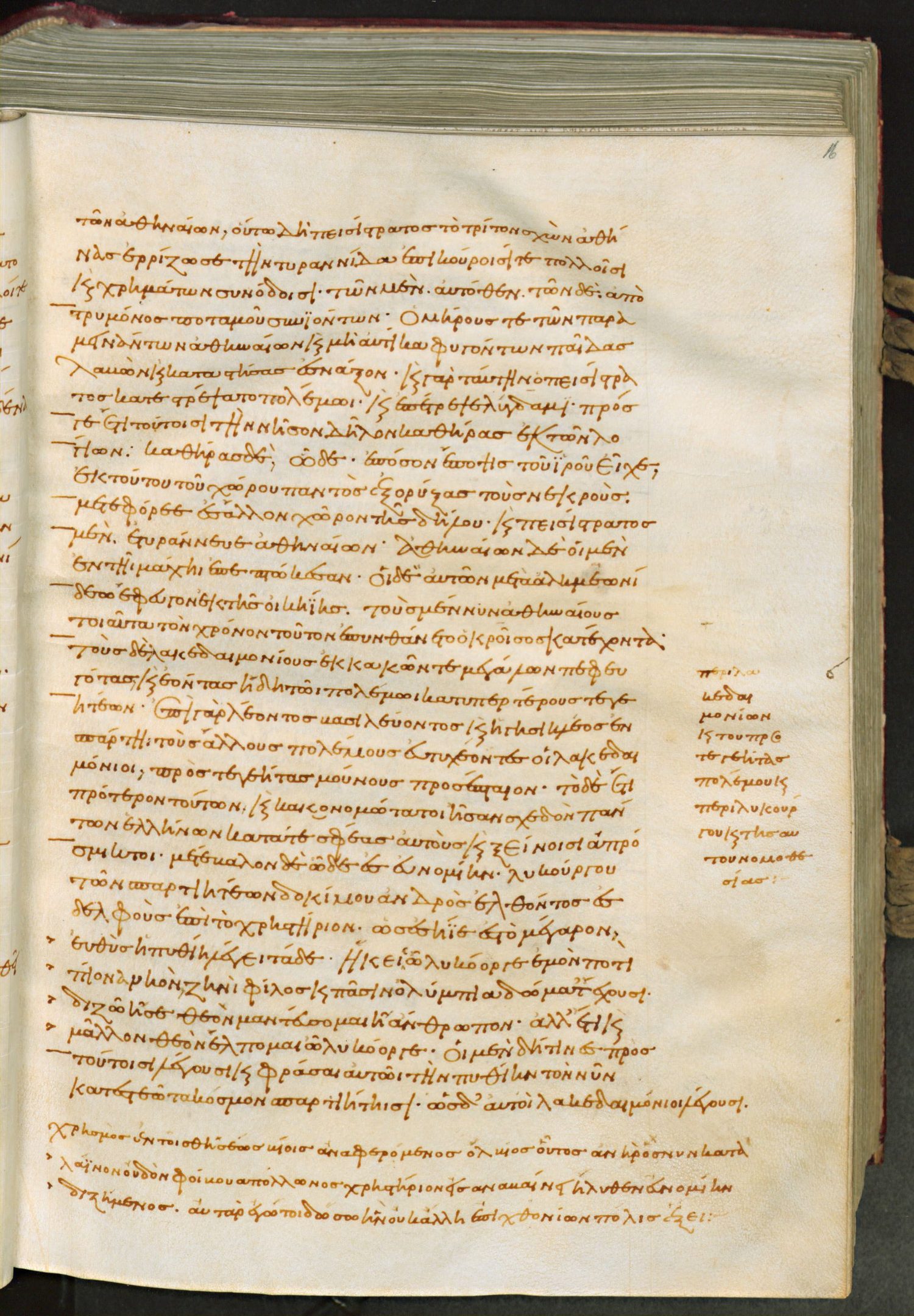
Laur. Plut. 70.3, fol. 15v: Greek here 1.62.1 to 1.64.1. Checked on the image (first and last words read and located in the Greek; each break checked against the neighbouring page): fol. 15v begins ‹διὰ ἑνδεκάτου ἔτεος ἀπίκοντο› (1.62.1), ends ‹ἐπὶ τὰ ἑωυτοῦ.πειθομένων δὲ› (1.64.1). English here: 1.62.1 to 1.63.2 (Godley's sentences for the sections whose Greek lies mostly on this page).
1.62.1διὰ ἑνδεκάτου ἔτεος ἀπίκοντο ὀπίσω, καὶ πρῶτον τῆς Ἀττικῆς ἴσχουσι Μαραθῶνα. ἐν δὲ τούτῳ τῷ χώρῳ σφι στρατοπεδευομένοισι οἵ τε ἐκ τοῦ ἄστεος στασιῶται ἀπίκοντο ἄλλοι τε ἐκ τῶν δήμων προσέρρεον, τοῖσι ἡ τυραννὶς πρὸ ἐλευθερίης ἦν ἀσπαστότερον. 1.62.2οὗτοι μὲν δὴ συνηλίζοντο, Ἀθηναίων δὲ οἱ ἐκ τοῦ ἄστεος, ἕως μὲν Πεισίστρατος τὰ χρήματα ἤγειρε, καὶ μεταῦτις ὡς ἔσχε Μαραθῶνα, λόγον οὐδένα εἶχον· ἐπείτε δὲ ἐπύθοντο ἐκ τοῦ Μαραθῶνος αὐτὸν πορεύεσθαι ἐπὶ τὸ ἄστυ, οὕτω δὴ βοηθέουσι ἐπʼ αὐτόν. 1.62.3καὶ οὗτοί τε πανστρατιῇ ἤισαν ἐπὶ τοὺς κατιόντας καὶ οἱ ἀμφὶ Πεισίστρατον, ὡς ὁρμηθέντες ἐκ Μαραθῶνος ἤισαν ἐπὶ τὸ ἄστυ, ἐς τὠυτὸ συνιόντες ἀπικνέονται ἐπὶ Παλληνίδος Ἀθηναίης ἱρόν, καὶ ἀντία ἔθεντο τὰ ὅπλα. 1.62.4ἐνθαῦτα θείῃ πομπῇ χρεώμενος παρίσταται Πεισιστράτῳ Ἀμφίλυτος ὁ Ἀκαρνὰν χρησμολόγος ἀνήρ, ὅς οἱ προσιὼν χρᾷ ἐν ἑξαμέτρῳ τόνῳ τάδε λέγων·
ἔρριπται δʼ ὁ βόλος, τὸ δὲ δίκτυον ἐκπεπέτασται,
θύννοι δʼ οἰμήσουσι σεληναίης διὰ νυκτός. 1.63.1ὃ μὲν δή οἱ ἐνθεάζων χρᾷ τάδε, Πεισίστρατος δὲ συλλαβὼν τὸ χρηστήριον καὶ φὰς δέκεσθαι τὸ χρησθὲν ἐπῆγε τὴν στρατιήν. Ἀθηναῖοι δὲ οἱ ἐκ τοῦ ἄστεος πρὸς ἄριστον τετραμμένοι ἦσαν δὴ τηνικαῦτα, καὶ μετὰ τὸ ἄριστον μετεξέτεροι αὐτῶν οἳ μὲν πρὸς κύβους οἳ δὲ πρὸς ὕπνον. οἱ δὲ ἀμφὶ Πεισίστρατον ἐσπεσόντες τοὺς Ἀθηναίους τρέπουσι. 1.63.2φευγόντων δὲ τούτων βουλὴν ἐνθαῦτα σοφωτάτην Πεισίστρατος ἐπιτεχνᾶται, ὅκως μήτε ἁλισθεῖεν ἔτι οἱ Ἀθηναῖοι διεσκεδασμένοι τε εἶεν· ἀναβιβάσας τοὺς παῖδας ἐπὶ ἵππους προέπεμπε, οἳ δὲ καταλαμβάνοντες τοὺς φεύγοντας ἔλεγον τὰ ἐντεταλμένα ὑπὸ Πεισιστράτου, θαρσέειν τε κελεύοντες καὶ ἀπιέναι ἕκαστον ἐπὶ τὰ ἑωυτοῦ. 1.64.1πειθομένων δὲ
1.62.1So after ten years they set out from Eretria and returned home. The first place in Attica which they took and held was Marathon: and while encamped there they were joined by their partisans from the city, and by others who flocked to them from the country demes—men who loved the rule of one more than freedom. 1.62.2These, then, assembled; but the Athenians in the city, who, while Pisistratus was collecting money and afterwards when he had taken Marathon, made no account of it, did now, when they learnt that he was marching from Marathon against Athens, set out to attack him. 1.62.3They came out with all their force to meet the returning exiles. Pisistratus’ men, in their march from Marathon towards the city, encountered the enemy when they had reached the temple of Pallenian Athene, and encamped face to face with them. 1.62.4There (by the providence of heaven) Pisistratus met Amphilytus the Acarnanian, a diviner, who came to him and prophesied as follows in hexameter verses: “Now hath the cast been thrown and the net of the fisher is outspread: All in the moonlight clear shall the tunny-fish come for the taking.” 1.63.1So spoke Amphilytus, being inspired; Pisistratus understood him, and, saying that he received the prophecy, led his army against the enemy. The Athenians of the city had at this time gone to their breakfast, and after breakfast some betook themselves to dicing and some to sleep: they were attacked by Pisistratus’ men and put to flight. 1.63.2So they fled, and Pisistratus devised a very subtle plan to keep them scattered and prevent their assembling again: he mounted his sons and bade them ride forward: they overtook the fugitives and spoke to them as they were charged by Pisistratus, bidding them take heart and depart each man to his home.
Where on the image
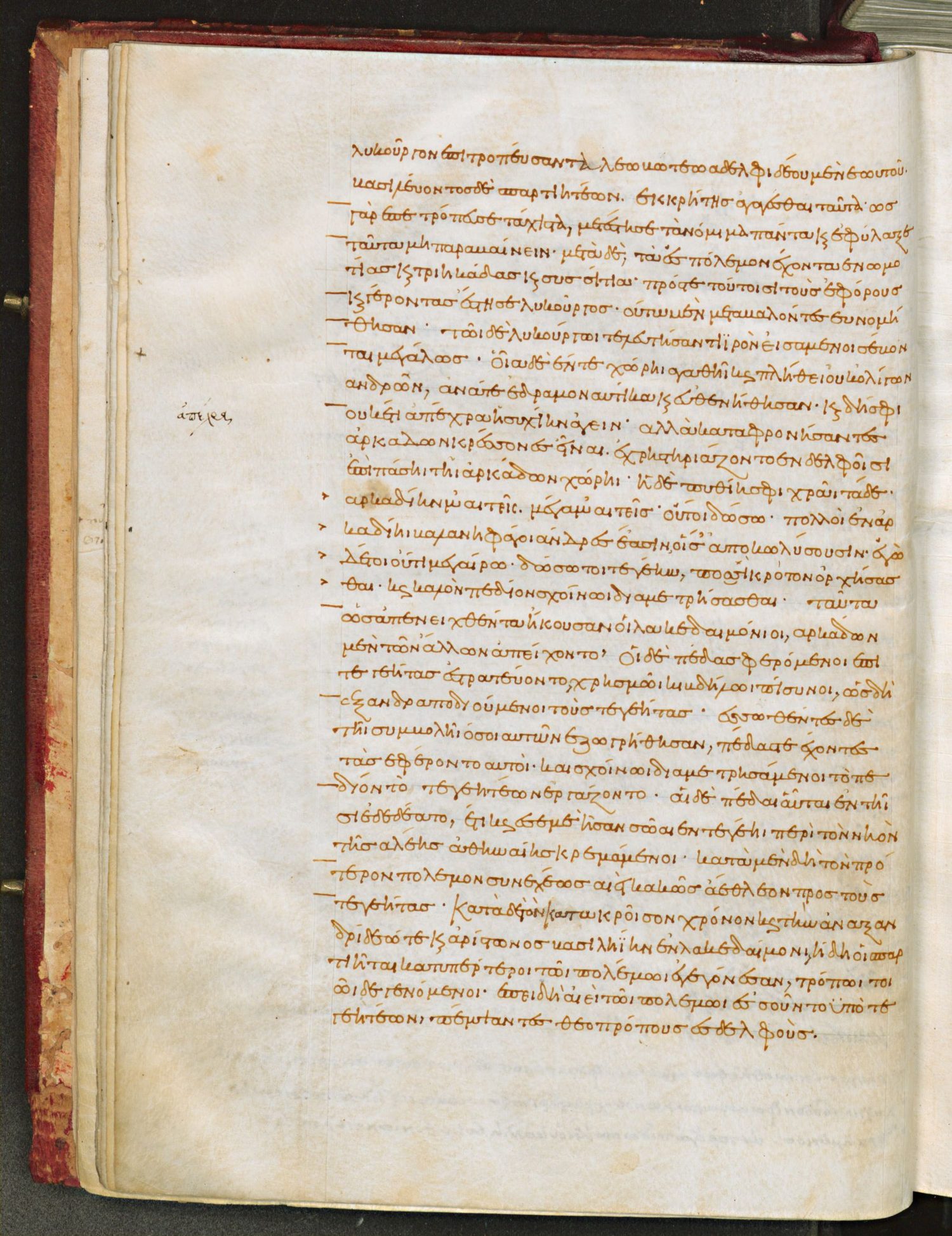
Laur. Plut. 70.3, fol. 16r: Greek here 1.64.1 to 1.65.4. Checked on the image (first and last words read and located in the Greek; each break checked against the neighbouring page): fol. 16r begins ‹τῶν Ἀθηναίων, οὕτω δὴ› (1.64.1), ends ‹δʼ αὐτοὶ Λακεδαιμόνιοι λέγουσι› (1.65.4). Three lines in the lower margin, below the text, hold a reader's note quoting an oracle in hexameters. English here: 1.64.1 to 1.65.4 (Godley's sentences for the sections whose Greek lies mostly on this page).
1.64.1τῶν Ἀθηναίων, οὕτω δὴ Πεισίστρατος τὸ τρίτον σχὼν Ἀθήνας ἐρρίζωσε τὴν τυραννίδα ἐπικούροισί τε πολλοῖσι καὶ χρημάτων συνόδοισι, τῶν μὲν αὐτόθεν τῶν δὲ ἀπὸ Στρυμόνος ποταμοῦ συνιόντων, ὁμήρους τε τῶν παραμεινάντων Ἀθηναίων καὶ μὴ αὐτίκα φυγόντων παῖδας λαβὼν καὶ καταστήσας ἐς Νάξον 1.64.2(καὶ γὰρ ταύτην ὁ Πεισίστρατος κατεστρέψατο πολέμῳ καὶ ἐπέτρεψε Λυγδάμι) πρὸς τε ἔτι τούτοισι τὴν νῆσον Δῆλον καθήρας ἐκ τῶν λογίων καθήρας δὲ ὧδε· ἐπʼ ὅσον ἔποψις τοῦ ἱροῦ εἶχε, ἐκ τούτου τοῦ χώρου παντὸς ἐξορύξας τοὺς νεκροὺς μετεφόρεε ἐς ἄλλον χῶρον τῆς Δήλου. 1.64.3καὶ Πεισίστρατος μὲν ἐτυράννευε Ἀθηνέων, Ἀθηναίων δὲ οἳ μὲν ἐν τῇ μάχη ἐπεπτώκεσαν, οἳ δὲ αὐτῶν μετʼ Ἀλκμεωνιδέων ἔφευγον ἐκ τῆς οἰκηίης. 1.65.1τοὺς μέν νυν Ἀθηναίους τοιαῦτα τὸν χρόνον τοῦτον ἐπυνθάνετο ὁ Κροῖσος κατέχοντα, τοὺς δὲ Λακεδαιμονίους ἐκ κακῶν τε μεγάλων πεφευγότας καὶ ἐόντας ἤδη τῷ πολέμῳ κατυπερτέρους Τεγεητέων. ἐπὶ γὰρ Λέοντος βασιλεύοντος καὶ Ἡγησικλέος ἐν Σπάρτῃ τοὺς ἄλλους πολέμους εὐτυχέοντες οἱ Λακεδαιμόνιοι πρὸς Τεγεήτας μούνους προσέπταιον. 1.65.2τὸ δὲ ἔτι πρότερον τούτων καί κακονομώτατοι ἦσαν σχεδὸν πάντων Ἑλλήνων κατά τε σφέας αὐτοὺς καὶ ξείνοισι ἀπρόσμικτοι· μετέβαλον δὲ ὧδε ἐς εὐνομίην. Λυκούργου τῶν Σπαρτιητέων δοκίμου ἀνδρὸς ἐλθόντος ἐς Δελφοὺς ἐπὶ τὸ χρηστήριον, ὡς ἐσήιε ἐς τὸ μέγαρον, εὐθὺς ἡ Πυθίη λέγει τάδε. 1.65.3ἥκεις ὦ Λυκόοργε ἐμὸν ποτὶ πίονα νηόν
Ζηνὶ φίλος καὶ πᾶσιν Ὀλύμπια δώματʼ ἔχουσι.
δίζω ἤ σε θεὸν μαντεύσομαι ἢ ἄνθρωπον.
ἀλλʼ ἔτι καὶ μᾶλλον θεὸν ἔλπομαι, ὦ Λυκόοργε. 1.65.4οἳ μὲν δή τινες πρὸς τούτοισι λέγουσι καὶ φράσαι αὐτῷ τὴν Πυθίην τὸν νῦν κατεστεῶτα κόσμον Σπαρτιήτῃσι. ὡς δʼ αὐτοὶ Λακεδαιμόνιοι λέγουσι,
1.64.1This the Athenians did; and by this means Pisistratus gained Athens for the third time, where, that his sovereignty might be well rooted, he made himself a strong guard and collected revenue both from Athens and from the district of the river Strymon, and took as hostages the sons of the Athenians who remained and did not at once leave the city, and placed these in Naxos. 1.64.2(He had conquered Naxos too and given it in charge to Lygdamis.) Moreover, he purified the island of Delos according to the bidding of the oracles, and this is how he did it: he removed all the dead that were buried in ground within sight of the temple and carried them to another part of Delos. 1.64.3So Pisistratus was sovereign of Athens: and as for the Athenians, some had fallen in the battle, and some, with the Alcmeonids, were exiles from their native land. 1.65.1Croesus learnt, then, that such at this time was the plight of the Athenians: the Lacedaemonians, as he heard, had escaped from great calamities, and had by this time got the upper hand of the men of Tegea in their war; for in the kingship of Leon and Hegesicles at Sparta, the Lacedaemonians were victorious in their other wars, but against Tegea alone they met with no success. 1.65.2And not only so, but before this they were the worst governed of well nigh all the Greeks, having little intercourse among themselves or with strangers. Thus then they changed their laws for the better:—Lycurgus, a notable Spartan, visited the oracle at Delphi, and when he entered the temple hall, straightway the priestess gave him this response: “Dear to Zeus 1.65.3thou hast come to my well-stored temple, Lycurgus, Dear to Zeus and to all who dwell in the courts of Olympus. Art thou a man or a god? ’Tis a god I deem thee, Lycurgus.” 1.65.4Some say that the priestess moreover declared to him the whole governance of Sparta which is now established; but the Lacedaemonians themselves relate that it was from Crete that Lycurgus brought these changes, he being then guardian of Leobotes his nephew, king of Sparta.
Where on the image
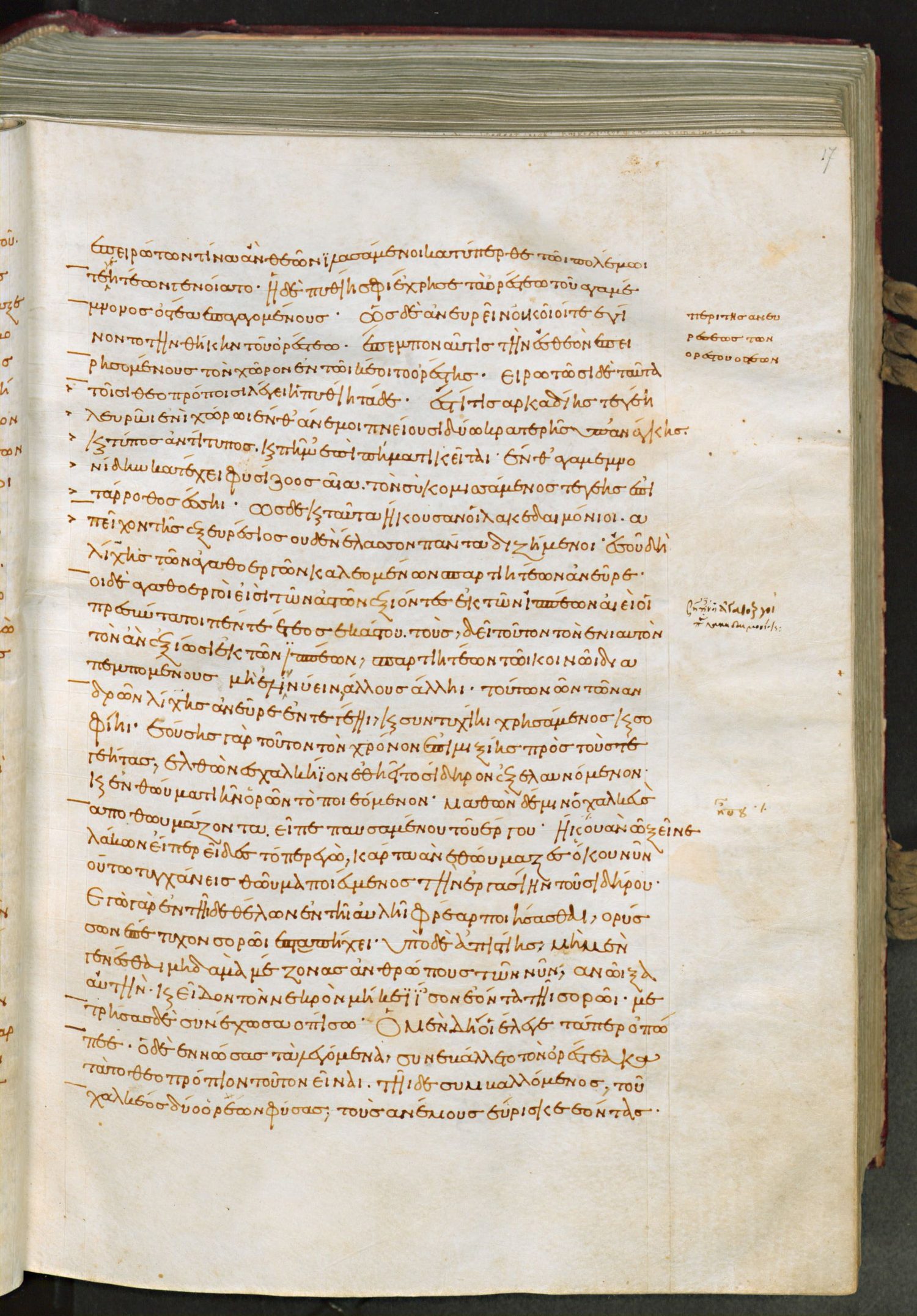
Laur. Plut. 70.3, fol. 16v: Greek here 1.65.4 to 1.67.2. Checked on the image (first and last words read and located in the Greek; each break checked against the neighbouring page): fol. 16v begins ‹Λυκοῦργον ἐπιτροπεύσαντα Λεωβώτεω, ἀδελφιδέου› (1.65.4), ends ‹πέμψαντες θεοπρόπους ἐς Δελφοὺς› (1.67.2). English here: 1.65.5 to 1.67.1 (Godley's sentences for the sections whose Greek lies mostly on this page).
1.65.4Λυκοῦργον ἐπιτροπεύσαντα Λεωβώτεω, ἀδελφιδέου μὲν ἑωυτοῦ βασιλεύοντος δὲ Σπαρτιητέων, ἐκ Κρήτης ἀγαγέσθαι ταῦτα. 1.65.5ὡς γὰρ ἐπετρόπευσε τάχιστα, μετέστησε τὰ νόμιμα πάντα, καὶ ἐφύλαξε ταῦτα μὴ παραβαίνειν· μετὰ δὲ τὰ ἐς πόλεμον ἔχοντα, ἐνωμοτίας καὶ τριηκάδας καὶ συσσίτια, πρός τε τούτοισι τοὺς ἐφόρους καὶ γέροντας ἔστησε Λυκοῦργος. 1.66.1οὕτω μὲν μεταβαλόντες εὐνομήθησαν, τῷ δὲ Λυκούργῳ τελευτήσαντι ἱρὸν εἱσάμενοι σέβονται μεγάλως. οἷα δὲ ἐν τε χώρῃ ἀγαθῇ καὶ πλήθεϊ οὐκ ὀλίγων ἀνδρῶν, ἀνά τε ἔδραμον αὐτίκα καὶ εὐθηνήθησαν, καὶ δή σφι οὐκέτι ἀπέχρα ἡσυχίην ἄγειν, ἀλλὰ καταφρονήσαντες Ἀρκάδων κρέσσονες εἶναι ἐχρηστηριάζοντο ἐν Δελφοῖσι ἐπὶ πάσῃ τῇ Ἀρκάδων χωρῇ. 1.66.2ἡ δὲ Πυθίη σφι χρᾷ τάδε.
Ἀρκαδίην μʼ αἰτεῖς· μέγα μʼ αἰτεῖς· οὐ τοι δώσω.
πολλοὶ ἐν Ἀρκαδίῃ βαλανηφάγοι ἄνδρες ἔασιν,
οἵ σʼ ἀποκωλύσουσιν. ἐγὼ δὲ τοι οὔτι μεγαίρω·
δώσω τοί Τεγέην ποσσίκροτον ὀρχήσασθαι
καὶ καλὸν πεδίον σχοίνῳ διαμετρήσασθαι. 1.66.3ταῦτα ὡς ἀπενειχθέντα ἤκουσαν οἱ Λακεδαιμόνιοι,Ἀρκάδων μὲν τῶν ἄλλων ἀπείχοντο, οἳ δὲ πέδας φερόμενοι ἐπὶ Τεγεήτας ἐστρατεύοντο, χρησμῷ κιβδήλῳ πίσυνοι, ὡς δὴ ἐξανδραποδιούμενοι τοὺς Τεγεήτας. 1.66.4ἑσσωθέντες δὲ τῇ συμβολῇ, ὅσοι αὐτῶν ἐζωγρήθησαν, πέδας τε ἔχοντες τὰς ἐφέροντο αὐτοὶ καὶ σχοίνῳ διαμετρησάμενοι τὸ πεδίον τὸ Τεγεητέων ἐργάζοντο. αἱ δὲ πέδαι αὗται ἐν τῇσι ἐδεδέατο ἔτι καὶ ἐς ἐμὲ ἦσαν σόαι ἐν Τεγέῃ περὶ τὸν νηὸν τῆς Ἀλέης Ἀθηναίης κρεμάμεναι. 1.67.1κατὰ μὲν δὴ τὸν πρότερον πόλεμον συνεχέως αἰεὶ κακῶς ἀέθλεον πρὸς τοὺς Τεγεήτας, κατὰ δὲ τὸν κατὰ Κροῖσον χρόνον καὶ τὴν Ἀναξανδρίδεώ τε καὶ Ἀρίστωνος βασιληίην ἐν Λακεδαίμονι ἤδη οἱ Σπαρτιῆται κατυπέρτεροι τῷ πολέμῳ ἐγεγόνεσαν, τρόπῳ τοιῷδε γενόμενοι. 1.67.2ἐπειδὴ αἰεὶ τῷ πολέμῳ ἑσσοῦντο ὑπὸ Τεγεητέων, πέμψαντες θεοπρόπους ἐς Δελφοὺς
1.65.5As soon as he became guardian he changed all the laws of the country and was careful that none should transgress his ordinances, and afterwards it was Lycurgus who established all that related to war, the sworn companies, and the bands of thirty, and the common meals: and besides these, the ephors, and the council of elders. 1.66.1So they changed their bad laws for good ones, and when Lycurgus died they built him a shrine and now greatly revere him. Then, since their land was good and their men were many, very soon they began to flourish and prosper. Nor were they satisfied to remain at peace: but being assured that they were stronger than the Arcadians, they inquired of the oracle at Delphi, with their minds set on the whole of Arcadia. 1.66.2The Pythian priestess gave them this reply: “Askest Arcadia from me? ’Tis a boon too great for the giving. Many Arcadians there are, stout heroes, eaters of acorns,— These shall hinder thee sore. Yet ’tis not I that begrudge thee: Lands Tegeaean I’ll give thee, to smite with feet in the dancing, Also the fertile plain with line I’ll give thee to measure.” 1.66.3When this was brought back to the ears of the Lacedaemonians, they let the rest of the Arcadians be, and marched against the men of Tegea carrying fetters with them; for they trusted in the quibbling oracle and thought they would enslave the Tegeans. 1.66.4But they were worsted in the encounter, and those of them who were taken captive were made to till the Tegean plain, wearing the fetters which they themselves had brought and measuring the land with a line. These fetters, in which they were bound, were still in my time kept safe at Tegea, where they were hung round the temple of Athene Alea. 1.67.1In the former war, then, the Lacedaemonians were unceasingly defeated in their contest with Tegea; but in the time of Croesus, and the kingship of Anaxandrides and Ariston at Sparta, the Spartans had now gained the upper hand; and this is how it came about.
Where on the image
Laur. Plut. 70.3, fol. 17r: Greek here 1.67.2 to 1.68.4. Checked on the image (first and last words read and located in the Greek; each break checked against the neighbouring page): fol. 17r begins ‹ἐπειρώτων τίνα ἂν θεῶν› (1.67.2), ends ‹τοὺς ἀνέμους εὕρισκε ἐόντας› (1.68.4). English here: 1.67.2 to 1.68.4 (Godley's sentences for the sections whose Greek lies mostly on this page).
1.67.2ἐπειρώτων τίνα ἂν θεῶν ἱλασάμενοι κατύπερθε τῷ πολέμῳ Τεγεητέων γενοίατο. ἡ δὲ Πυθίη σφι ἔχρησε τὰ Ὀρέστεω τοῦ Ἀγαμέμνονος ὀστέα ἐπαγαγομένους. 1.67.3ὡς δὲ ἀνευρεῖν οὐκ οἷοί τε ἐγίνοντο τὴν θήκην τοῦ Ὀρέστεω ἔπεμπον αὖτις τὴν ἐς θεὸν ἐπειρησομένους τὸν χῶρον ἐν τῷ κέοιτο Ὀρέστης. εἰρωτῶσι δὲ ταῦτα τοῖσι θεοπρόποισι λέγει ἡ Πυθίη τάδε. 1.67.4ἔστι τις Ἀρκαδίης Τεγέη λευρῷ ἐνὶ χώρῳ,
ἔνθʼ ἄνεμοι πνείουσι δύω κρατερῆς ὑπʼ ἀνάγκης,
καὶ τύπος ἀντίτυπος, καὶ πῆμʼ ἐπὶ πήματι κεῖται.
ἔνθʼ Ἀγαμεμνονίδην κατέχει φυσίζοος αἶα,
τὸν σὺ κομισσάμενος Τεγέης ἐπιτάρροθος ἔσσῃ. 1.67.5ὡς δὲ καὶ ταῦτα ἤκουσαν οἱ Λακεδαιμόνιοι, ἀπεῖχον τῆς ἐξευρέσιος οὐδὲν ἔλασσον, πάντα διζήμενοι, ἐς οὗ δὴ Λίχης τῶν ἀγαθοεργῶν καλεομένων Σπαρτιητέων ἀνεῦρε, οἱ δὲ ἀγαθοεργοὶ εἰσὶ τῶν ἀστῶν, ἐξιόντες ἐκ τῶν ἱππέων αἰεὶ οἱ πρεσβύτατοι, πέντε ἔτεος ἑκάστου· τοὺς δεῖ τοῦτὸν τὸν ἐνιαυτόν, τὸν ἂν ἐξίωσι ἐκ τῶν ἱππέων, Σπαρτιητέων τῷ κοινῷ διαπεμπομένους μὴ ἐλινύειν ἄλλους ἄλλῃ. 1.68.1τούτων ὦν τῶν ἀνδρῶν Λίχης ἀνεῦρε ἐν Τεγέῃ καὶ συντυχίῃ χρησάμενος καὶ σοφίῃ. ἐούσης γὰρ τοῦτον τὸν χρόνον ἐπιμιξίης πρὸς τοὺς Τεγεήτας, ἐλθὼν ἐς χαλκήιον ἐθηεῖτο σίδηρον ἐξελαυνόμενον, καὶ ἐν θώματι ἦν ὀρέων τὸ ποιεόμενον. 1.68.2μαθὼν, δέ μιν ὁ χαλκεὺς ἀποθωμάζοντα εἶπε παυσάμενος τοῦ ἔργου ἦ κου ἄν, ὦ ξεῖνε Λάκων εἴ περ εἶδες τό περ ἐγώ, κάρτα ἂν ἐθώμαζες, ὅκου νῦν οὕτω τυγχάνεις θῶμα ποιεύμενος τὴν ἐργασίην τοῦ σιδήρου. 1.68.3ἐγὼ γὰρ ἐν τῇδε θέλων τῇ αὐλῇ φρέαρ ποιήσασθαι, ὀρύσσων ἐπέτυχον σορῷ ἑπταπήχεϊ· ὑπὸ δὲ ἀπιστίης μὴ μὲν γενέσθαι μηδαμὰ μέζονας ἀνθρώπους τῶν νῦν ἄνοιξα αὐτὴν καὶ εἶδον τὸν νεκρὸν μήκεϊ ἴσον ἐόντα τῇ σορῷ· μετρήσας δὲ συνέχωσα ὀπίσω. ὃ μὲν δή οἱ ἔλεγε τά περ ὀπώπεε, ὁ δὲ ἐννώσας τὰ λεγόμενα συνεβάλλετο τὸν Ὀρέστεα κατὰ τὸ θεοπρόπιον τοῦτον εἶναι, τῇδε συμβαλλόμενος· 1.68.4τοῦ χαλκέος δύο ὁρέων φύσας τοὺς ἀνέμους εὕρισκε ἐόντας,
1.67.2Being always worsted by the Tegeatae, they sent inquirers to Delphi and asked what god they should propitiate so as to gain the mastery over Tegea in war. The Pythian priestess declared that they must bring home the bones of Orestes son of Agamemnon. 1.67.3Being unable to discover Orestes’ tomb, they sent their messengers again to the god to ask of the place where Orestes lay: and the priestess said in answer to their question: “ 1.67.4There is a place, Tegeē, in the level plain of Arcadia, Where by stark stress driven twain winds are ever a-blowing, Shock makes answer to shock, and anguish is laid upon anguish. There in the nourishing earth Agamemnon’s son lieth buried: Bring him, and so thou shalt be the lord of the land of thy foemen.” 1.67.5When the Lacedaemonians heard this too, they were no nearer finding what they sought, though they made search everywhere, till at last Lichas, one of the Spartans who are called Benefactors, discovered it. These Benefactors are the Spartan citizens who pass out of the ranks of the knights, the five oldest in each year; for the year in which they pass out from the knights they are sent on divers errands by the Spartan state, and must use all despatch. 1.68.1Lichas, then, one of these men, by good luck and cleverness found the tomb at Tegea. At that time there was free intercourse with Tegea; so, entering a smithy, he watched the forging of iron and marvelled at the work which he saw. 1.68.2When the smith perceived that he was much astonished, he ceased from working, and said, “Laconian, you wonder at the working of iron, but had you seen what I have seen you would have indeed had somewhat to marvel at. 1.68.3For I was making me a well in this courtyard, when in my digging I chanced upon a coffin seven cubits long. As I could not believe that there had ever been men taller than those of our time, I opened the coffin, and found within it the corpse as long as itself; I measured it, and buried it in earth again.” So the smith told what he had seen; Lichas marked what he said, and argued from the oracle that this must be Orestes, reasoning 1.68.4that the Smith’s two bellows which he saw were the winds, the anvil and hammer the shock and counter-shock, and the forged iron the anguish laid upon anguish. What led him so to guess was that the discovery of iron has been to men’s hurt.
Where on the image
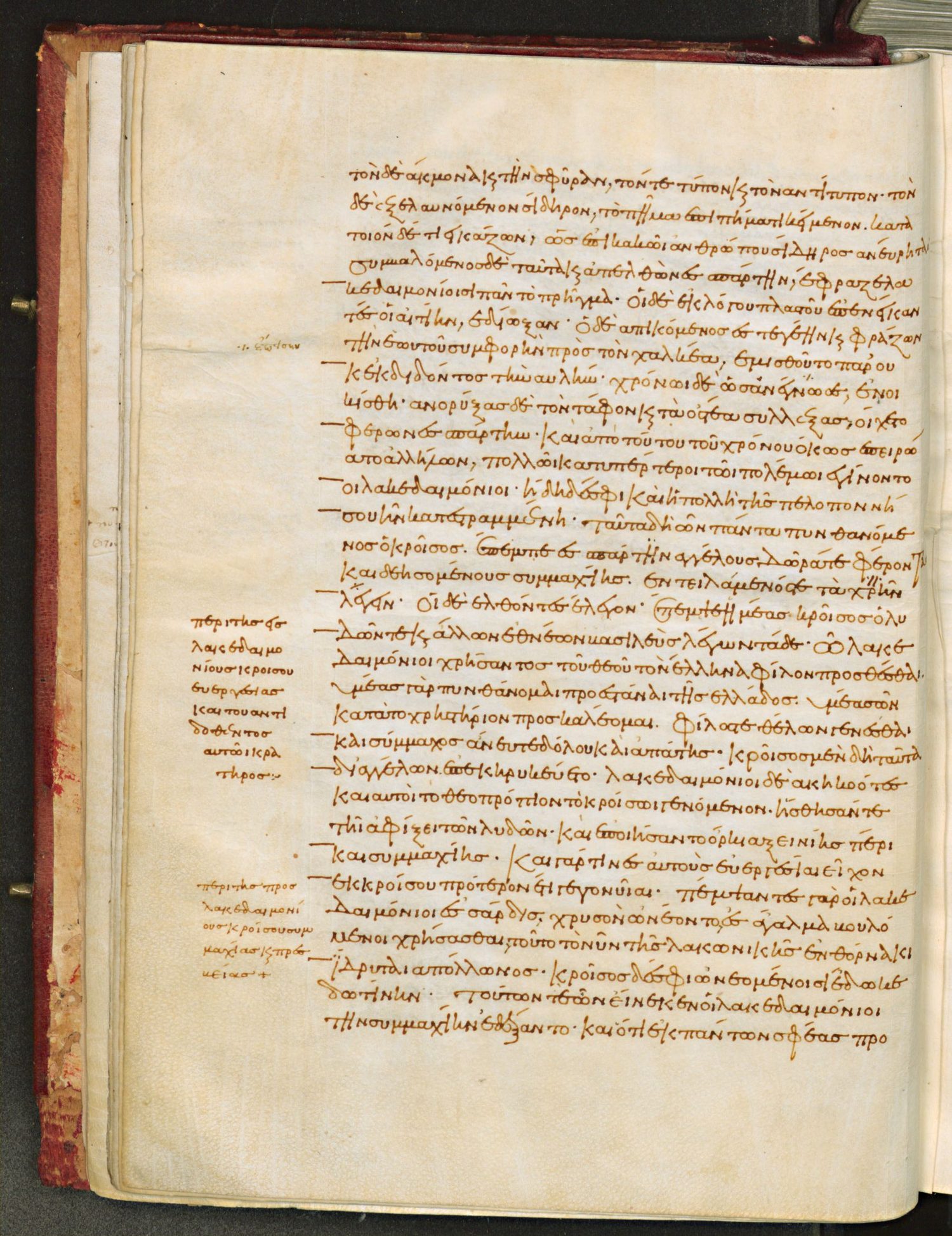
Laur. Plut. 70.3, fol. 17v: Greek here 1.68.4 to 1.70.1. Checked on the image (first and last words read and located in the Greek; each break checked against the neighbouring page): fol. 17v begins ‹τὸν δὲ ἄκμονα καὶ› (1.68.4), ends ‹ἐκ πάντων σφέας προ-› (1.70.1). English here: 1.68.5 to 1.69.4 (Godley's sentences for the sections whose Greek lies mostly on this page).
1.68.4τὸν δὲ ἄκμονα καὶ τὴν σφῦραν τόν τε τύπον καὶ τὸν ἀντίτυπον, τὸν δὲ ἐξελαυνόμενον σίδηρον τὸ πῆμα ἐπὶ πήματι κείμενον, κατὰ τοιόνδε τι εἰκάζων, ὡς ἐπὶ κακῷ ἀνθρώπου σίδηρος ἀνεύρηται. 1.68.5συμβαλόμενος δὲ ταῦτα καὶ ἀπελθὼν ἐς Σπάρτην ἔφραζε Λακεδαιμονίοσσι πᾶν τὸ πρῆγμα. οἳ δὲ ἐκ λόγου πλαστοῦ ἐπενείκαντὲς οἱ αἰτίην ἐδίωξαν. ὁ δὲ ἀπικόμενος ἐς Τεγέην καὶ φράζων τὴν ἑωυτοῦ συμφορὴν πρὸς τὸν χαλκέα ἐμισθοῦτο παρʼ οὐκ ἐκδιδόντος τὴν αὐλήν· 1.68.6χρόνῳ δὲ ὡς ἀνέγνωσε, ἐνοικίσθη, ἀνορύξας δὲ τὸν τάφον καὶ τὰ ὀστέα συλλέξας οἴχετο φέρων ἐς Σπάρτην. καὶ ἀπὸ τούτου τοῦ χρόνου, ὅκως πειρῴατο ἀλλήλων, πολλῷ κατυπέρτεροι τῷ πολέμῳ ἐγίνοντο οἱ Λακεδαιμόνιοι· ἤδη δέ σφι καὶ ἡ πολλὴ τῆς Πελοποννήσου ἦν κατεστραμμένη. 1.69.1ταῦτα δὴ ὦν πάντα πυνθανόμενος ὁ Κροῖσος ἔπεμπε ἐς Σπάρτην ἀγγέλους δῶρά τε φέροντας καὶ δεησομένους συμμαχίης, ἐντειλάμενός τε τὰ λέγειν χρῆν. οἳ δὲ ἐλθόντες ἔλεγον 1.69.2ἔπεμψε ἡμέας Κροῖσος ὁ Λυδῶν τε καὶ ἄλλων ἐθνέων βασιλεύς, λέγων τάδε. ὦ Λακεδαιμόνιοι, χρήσαντος τοῦ θεοῦ τὸν Ἕλληνα φίλον προσθέσθαι, ὑμέας γὰρ πυνθάνομαι προεστάναι τῆς Ἑλλάδος, ὑμέας ὦν κατὰ τὸ χρηστήριον προσκαλέομαι φίλος τε θέλων γενέσθαι καὶ σύμμαχος ἄνευ τε δόλου καὶ ἀπάτης. 1.69.3Κροῖσος μὲν δὴ ταῦτα διʼ ἀγγέλων ἐπεκηρυκεύετο, Λακεδαιμόνιοι δὲ ἀκηκοότες καὶ αὐτοὶ τὸ θεοπρόπιον τὸ Κροίσῳ γενόμενον ἥσθησάν τε τῇ ἀπίξι τῶν Λυδῶν καὶ ἐποιήσαντο ὅρκια ξεινίης πέρι καὶ συμμαχίης· καὶ γὰρ τινὲς αὐτοὺς εὐεργεσίαι εἶχον ἐκ Κροίσου πρότερον ἔτι γεγονυῖαι. 1.69.4πέμψαντες γὰρ οἱ Λακεδαιμόνιοι ἐς Σάρδις χρυσὸν ὠνέοντο, ἐς ἄγαλμα βουλόμενοι χρήσασθαι τοῦτο τὸ νῦν τῆς Λακωνικῆς ἐν Θόρνακι ἵδρυται Ἀπόλλωνος· Κροῖσος δέ σφι ὠνεομένοισι ἔδωκε δωτίνην. 1.70.1τούτων τε ὦν εἵνεκεν οἱ Λακεδαιμόνιοι τὴν συμμαχίην ἐδέξαντο, καὶ ὅτι ἐκ πάντων σφέας προκρίνας
1.68.5Thus he reasoned, and returning to Sparta told all the matter to the Lacedaemonians. They made pretence of bringing a charge against him and banishing him; so he went to Tegea, where he told the smith of his misfortune, and tried to hire the courtyard from him. 1.68.6The smith would not consent, but at last Lichas over-persuaded him, and taking up his abode there, opened the tomb and collected the bones and went away with them to Sparta. Ever after this time the Lacedaemonians got much the better of the men of Tegea in all their battles; and they had already subdued the greater part of the Peloponnesus. 1.69.1Croesus, then, being made aware of all this sent messengers to Sparta with gifts, to ask an alliance in words with which he charged them. 1.69.2They came, and said: “Croesus, King of Lydia and other nations, has sent us with this message: ‘Lacedaemonians! the god has declared that I should make the Greek my friend; now, therefore, as I learn that you are the leaders of Hellas, I do so invite you, as the oracle bids; I would fain be your friend and ally, without deceit or guile.’” 1.69.3Thus Croesus proposed by the mouth of his messengers: and the Lacedaemonians, who had already heard of the oracle given to Croesus, welcomed the coming of the Lydians and swore to be his friends and allies; and indeed they were bound by certain benefits which they had before received from the king. 1.69.4For the Lacedaemonians had sent to Sardis to buy gold, with intent to use it for the statue of Apollo which now stands on Thornax in Laconia; and Croesus, when they would buy it, made a free gift of it to them.
Where on the image
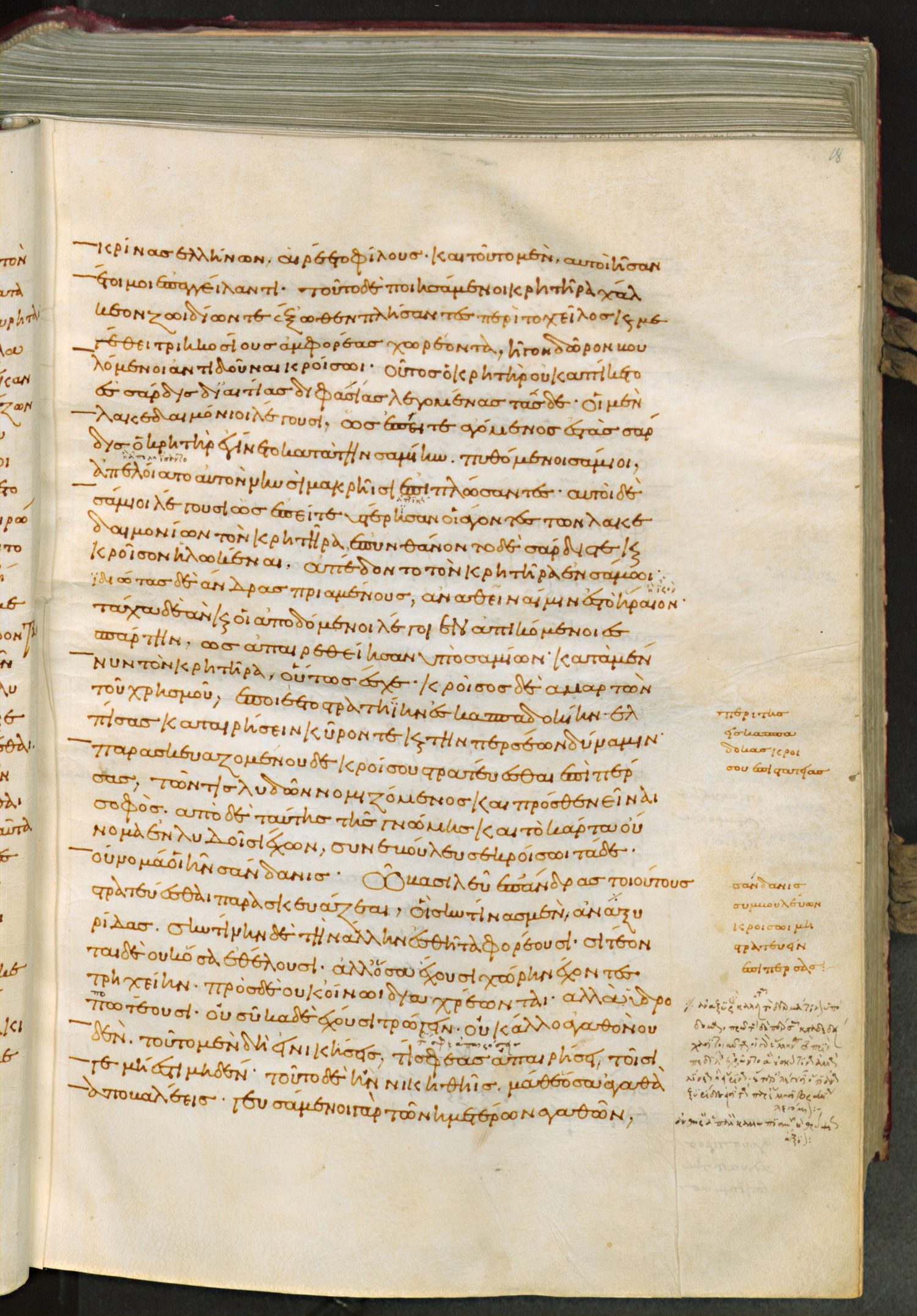
Laur. Plut. 70.3, fol. 18r: Greek here 1.70.1 to 1.70.3. Checked on the image (first and last words read and located in the Greek; each break checked against the neighbouring page): fol. 18r begins ‹-κρίνας Ἑλλήνων αἱρέετο φίλους.› (1.70.1), ends ‹γὰρ τῶν ἡμετέρων ἀγαθῶν› (1.71.3). The word ‹προκρίνας› is divided between fol. 17v and fol. 18r; it is given with fol. 17v. English here: 1.70.1 to 1.70.3 (Godley's sentences for the sections whose Greek lies mostly on this page).
1.70.1Ἑλλήνων αἱρέετο φίλους. καὶ τοῦτο μὲν αὐτοὶ ἦσαν ἕτοιμοι ἐπαγγείλαντι, τοῦτο δὲ ποιησάμενοι κρητῆρα χάλκεον ζῳδίων τε ἔξωθεν πλήσαντες περὶ τὸ χεῖλος καὶ μεγάθεϊ τριηκοσίους ἀμφορέας χωρέοντα ἦγον, δῶρον βουλόμενοι ἀντιδοῦναι Κροίσῳ. 1.70.2οὗτος ὁ κρητὴρ οὐκ ἀπίκετο ἐς Σάρδις διʼ αἰτίας διφασίας λεγομένας τάσδε· οἱ μὲν Λακεδαιμόνιοι λέγουσι ὡς ἐπείτε ἀγόμενος ἐς τὰς Σάρδις ὁ κρητὴρ ἐγίνετο κατὰ τὴν Σαμίην, πυθόμενοι Σάμιοι ἀπελοίατο αὐτὸν νηυσὶ μακρῇσι ἐπιπλώσαντες· 1.70.3αὐτοὶ δὲ Σάμιοι λέγουσι ὡς ἐπείτε ὑστέρησαν οἱ ἄγοντες τῶν Λακεδαιμονίων τὸν κρητῆρα, ἐπυνθάνοντο δὲ Σάρδις τε καὶ Κροῖσον ἡλωκέναι, ἀπέδοντο τὸν κρητῆρα ἐν Σάμῳ, ἰδιώτας δὲ ἄνδρας πριαμένους ἀναθεῖναί μιν ἐς τὸ Ἥραιον. τάχα δὲ ἂν καὶ οἱ ἀποδόμενοι λέγοιεν ἀπικόμενοι ἐς Σπάρτην ὡς ἀπαιρεθείησαν ὑπὸ Σαμίων. κατὰ μέν νυν τὸν κρητῆρα οὕτω ἔσχε.
1.70.1For this cause, and because he had chosen them as his friends before all other Greeks, the Lacedaemonians accepted the alliance. So they declared themselves ready to serve him when he should require, and moreover they made a bowl of bronze, graven outside round the rim with figures, and large enough to hold twenty-seven hundred gallons, and brought it with the intent to make a gift of requital to Croesus. 1.70.2This bowl never came to Sardis, and for this two reasons are given: the Lacedaemonians say that when the bowl was near Samos on its way to Sardis, the Samians descended upon them in warships and carried it off; 1.70.3but the Samians themselves say that the Lacedaemonians who were bringing the bowl, being too late, and learning that Sardis and Croesus were taken, sold it in Samos to certain private men, who set it up in the the temple of Here. And it may be that the sellers of the bowl, when they returned to Sparta, said that they had been robbed of it by the Samians. Such are the tales about the bowl.
Notes
- Greek: the text printed in A. D. Godley's Loeb edition, via Perseus (tlg0016.tlg001.perseus-grc2). Square brackets mark words the editor considers later additions; [...] marks a gap the editor indicates. Perseus note markers are omitted.
- English: A. D. Godley, Herodotus vol. 1 (1920) (Loeb Classical Library), as transcribed on Wikisource. Godley's footnotes are omitted.
- Section numbers in the English were placed by comparing Godley's text with the Perseus version of his translation; where a section begins inside one of Godley's sentences, the English is kept with the page that holds the start of that sentence.
Cite
Sources
- Source: Florence, Laur. Plut. 70.3 (10th c.) via BML Teca Digitale + Greek of Godley's Loeb (Perseus) + English of A. D. Godley (Loeb, Wikisource) (holding institution)
- Critical edition: Greek of A. D. Godley's Loeb edition (1920-1925), via Perseus
← previous · → next · v cycle view · l back to library