Herodotus, Histories 1.71-85: Croesus' war with Cyrus and the fall of Sardis
Introduction
Herodotus of Halicarnassus wrote the Histories in the third quarter of the 5th century BCE, an inquiry into the deeds of Greeks and barbarians and the causes of the wars between them, later divided into nine books. Book 1 tells how the conflict between Greeks and barbarians began, the history of Lydia from Gyges to Croesus, the rise of the Medes and of Cyrus the Persian, the conquest of the Greeks of Asia, the capture of Babylon and the death of Cyrus.
The photographs are of Florence, Biblioteca Medicea Laurenziana, Plut. 70.3 (parchment, 10th century, 374 folios, 31 lines a page), Herodotus, Histories (codex A of the editors), the oldest surviving manuscript of the complete Histories, from the Teca Digitale of the Biblioteca Medicea Laurenziana. Each section below is the text of one page, or of the part of a page that falls within these chapters. The first and last words of every page were read on the photograph and located in the Greek, and every page break was checked against the next page; the notes quote these words. Readers' notes in the margins are not part of the text and are mentioned where they occur.
The Greek is the text printed in A. D. Godley's Loeb edition (1920-1925), from Perseus; it is the edited text, not a transcription of the manuscript, whose wording differs in places. The English is Godley's translation as printed, from Wikisource. Godley's English carries only chapter numbers; the section numbers shown in it were placed by comparison with the Perseus version of his translation. Each page's English is cut at the end of one of Godley's sentences, so it can begin or end a few lines away from the Greek of the page; each note gives the exact ranges.
This entry covers chapters 1.71-85, on fol. 18r to 22v.
How was this verified? (Provenance)
Where on the image
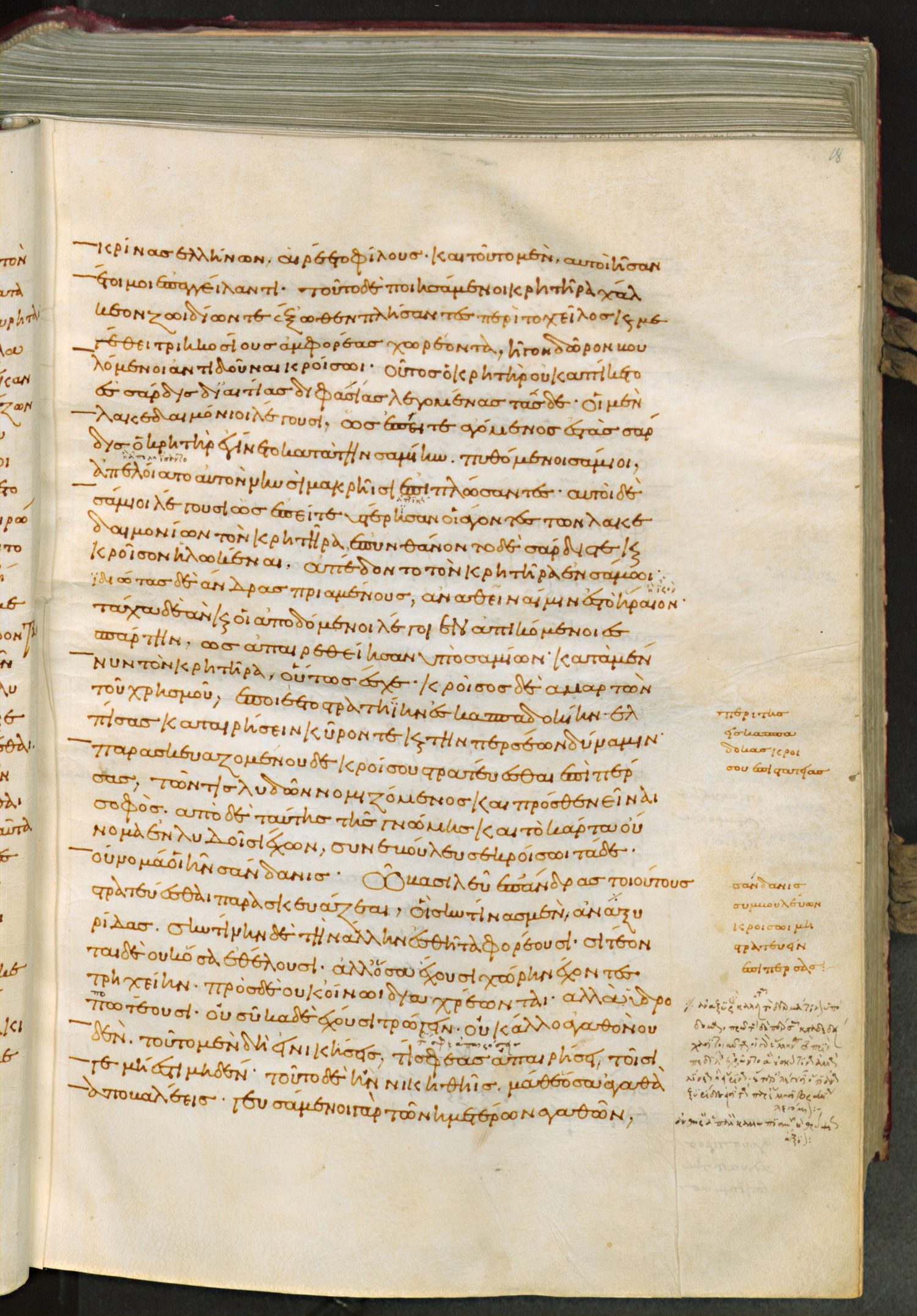
Laur. Plut. 70.3, fol. 18r: Greek here 1.71.1 to 1.71.3. Checked on the image (first and last words read and located in the Greek; each break checked against the neighbouring page): fol. 18r begins ‹-κρίνας Ἑλλήνων αἱρέετο φίλους.› (1.70.1), ends ‹γὰρ τῶν ἡμετέρων ἀγαθῶν› (1.71.3). The word ‹προκρίνας› is divided between fol. 17v and fol. 18r; it is given with fol. 17v. English here: 1.71.1 to 1.71.3 (Godley's sentences for the sections whose Greek lies mostly on this page).
1.71.1Κροῖσος δὲ ἁμαρτὼν τοῦ χρησμοῦ ἐποιέετο στρατηίην ἐς Καππαδοκίην, ἐλπίσας καταιρήσειν Κῦρόν τε καὶ τὴν Περσέων δύναμιν. 1.71.2παρασκευαζομένου δὲ Κροίσου στρατεύεσθαι ἐπὶ Πέρσας, τῶν τις Λυδῶν νομιζόμενος καὶ πρόσθε εἶναι σοφός, ἀπὸ δὲ ταύτης τῆς γνώμης καὶ τὸ κάρτα οὔνομα ἐν Λυδοῖσι ἔχων, συνεβούλευσε Κροίσῳ τάδε· οὔνομά οἱ ἦν Σάνδανις. ὦ βασιλεῦ, ἐπʼ ἄνδρας τοιούτους στρατεύεσθαι παρασκευάζεαι, οἳ σκυτίνας μὲν ἀναξυρίδας σκυτίνην δὲ τὴν ἄλλην ἐσθῆτα φορέουσι, σιτέονται δὲ οὐκ ὅσα ἐθέλουσι ἀλλʼ ὅσα ἔχουσι, χώρην ἔχοντες τρηχέαν. 1.71.3πρὸς δὲ οὐκ οἴνῳ διαχρέωνται ἀλλὰ ὑδροποτέουσι, οὐ σῦκα δὲ ἔχουσι τρώγειν, οὐκ ἄλλο ἀγαθὸν οὐδέν. τοῦτο μὲν δή, εἰ νικήσεις, τί σφέας ἀπαιρήσεαι, τοῖσί γε μὴ ἔστι μηδέν; τοῦτο δέ, ἢν νικηθῇς, μάθε ὅσα ἀγαθὰ ἀποβαλέεις· γευσάμενοι γὰρ τῶν ἡμετέρων ἀγαθῶν
1.71.1Croesus, mistaking the meaning of the oracle, invaded Cappadocia, thinking to destroy Cyrus and the Persian power. 1.71.2But while he was preparing to march against the Persians, a certain Lydian, who was already held to be a wise man, and from the advice which he now gave won great renown among the Lydians, thus counselled him (his name was Sandanis): “O King, you are making ready to march against men who wear breeches of leather and their other garments of the same, and whose fare is not what they desire but what they have; for their land is stony. 1.71.3Further they use no wine, but are water-drinkers, nor have they figs to eat, nor aught else that is good. Now if you conquer them, of what will you deprive them, seeing that they have nothing? But if on the other hand you are conquered, then see how many good things you will lose; for once they have tasted of our blessings they will cling so close to them that nothing will thrust them away.
Where on the image
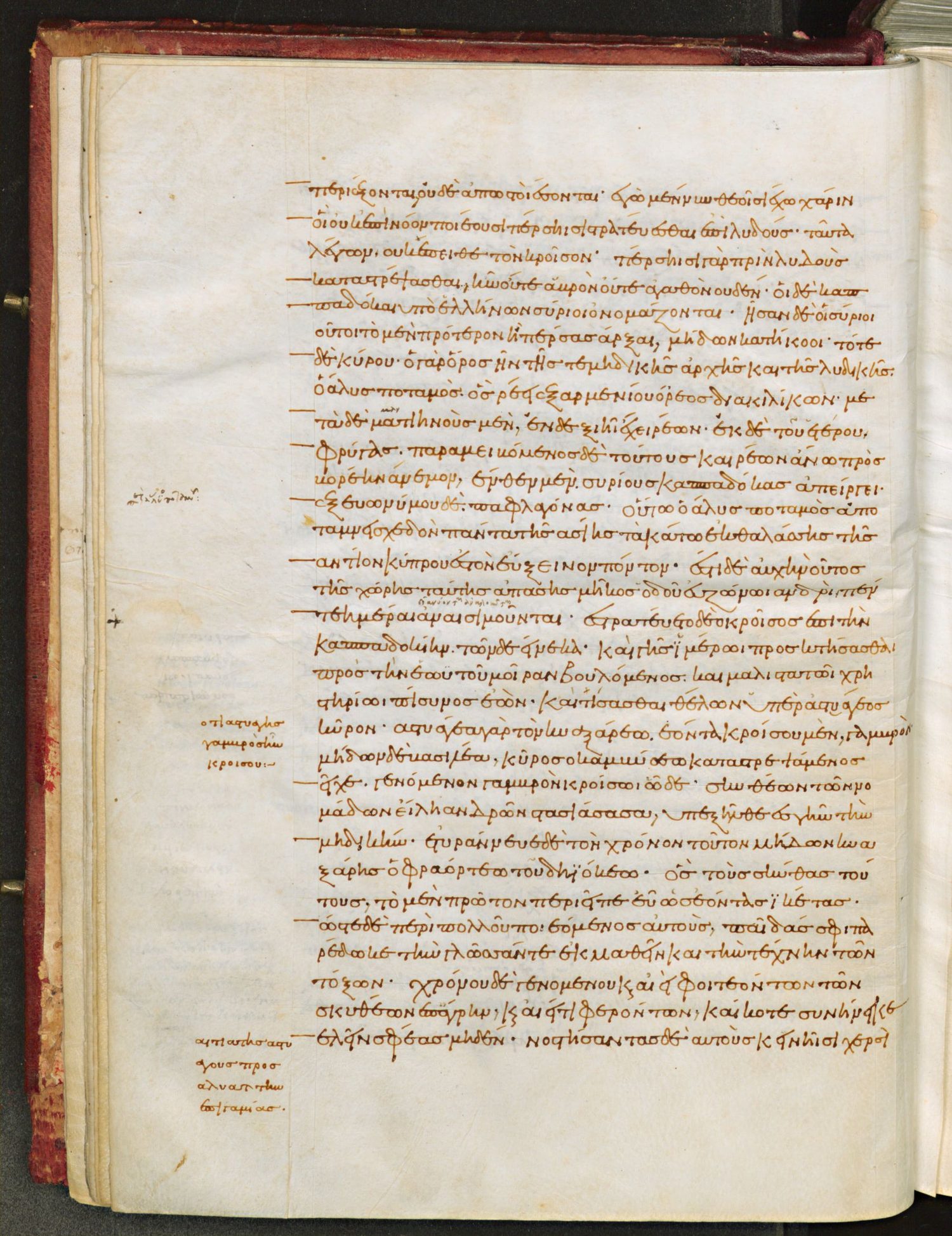
Laur. Plut. 70.3, fol. 18v: Greek here 1.71.3 to 1.73.4. Checked on the image (first and last words read and located in the Greek; each break checked against the neighbouring page): fol. 18v begins ‹περιέξονται οὐδὲ ἀπωστοὶ ἔσονται.ἐγὼ› (1.71.3), ends ‹δὲ αὐτοὺς κεινῇσι χερσὶ› (1.73.4). English here: 1.71.4 to 1.73.4 (Godley's sentences for the sections whose Greek lies mostly on this page).
1.71.3περιέξονται οὐδὲ ἀπωστοὶ ἔσονται. 1.71.4ἐγὼ μέν νυν θεοῖσι ἔχω χάριν, οἳ οὐκ ἐπὶ νόον ποιέουσι Πέρσῃσι στρατεύεσθαι ἐπὶ Λυδούς. ταῦτα λέγων οὐκ ἔπειθε τὸν Κροῖσον. Πέρσῃσι γάρ, πρὶν Λυδοὺς καταστρέψασθαι, ἦν οὔτε ἁβρὸν οὔτε ἀγαθὸν οὐδέν. 1.72.1οἱ δὲ Καππαδόκαι ὑπὸ Ἑλλήνων Σύριοι ὀνομάζονται· ἦσαν δὲ οἱ Σύριοι οὗτοι τὸ μὲν πρότερον ἢ Πέρσας ἄρξαι Μήδων κατήκοοι, τότε δὲ Κύρου. 1.72.2ὁ γὰρ οὖρος ἦν τῆς τε Μηδικῆς ἀρχῆς καὶ τῆς Λυδικῆς ὁ Ἅλυς ποταμός, ὃς ῥέει ἐξ Ἀρμενίου ὄρεος διὰ Κιλίκων, μετὰ δὲ Ματιηνοὺς μὲν ἐν δεξιῇ ἔχει ῥέων, ἐκ δὲ τοῦ ἑτέρου Φρύγας· παραμειβόμενος δὲ τούτους καὶ ῥέων ἄνω πρὸς βορέην ἄνεμον ἔνθεν μὲν Συρίους Καππαδόκας ἀπέργει, ἐξ εὐωνύμου δὲ Παφλαγόνας. 1.72.3οὕτω ὁ Ἅλυς ποταμὸς ἀποτάμνει σχεδὸν πάντα τῆς Ἀσίης τὰ κάτω ἐκ θαλάσσης τῆς ἀντίον Κύπρου ἐς τὸν Εὔξεινον πόντον. ἔστι δὲ αὐχὴν οὗτος τῆς χώρης ταύτης ἁπάσης· μῆκος ὁδοῦ εὐζώνῳ ἀνδρὶ πέντε ἡμέραι ἀναισιμοῦνται. 1.73.1ἐστρατεύετο δὲ ὁ Κροῖσος ἐπὶ τὴν Καππαδοκίην τῶνδε εἵνεκα, καὶ γῆς ἱμέρῳ προσκτήσασθαι πρὸς τὴν ἑωυτοῦ μοῖραν βουλόμενος, καὶ μάλιστα τῷ χρηστηρίῳ πίσυνος ἐὼν καὶ τίσασθαι θέλων ὑπὲρ Ἀστυάγεος Κῦρον. 1.73.2Ἀστυάγεα γὰρ τὸν Κυαξάρεω, ἐόντα Κροίσου μὲν γαμβρὸν Μήδων δὲ βασιλέα, Κῦρος ὁ Καμβύσεω καταστρεψάμενος εἶχε, γενόμενον γαμβρὸν Κροίσῳ ὧδε. 1.73.3Σκυθέων τῶν νομάδων εἴλῃ ἀνδρῶν στασιάσασα ὑπεξῆλθε ἐς γῆν τὴν Μηδικήν· ἐτυράννευε δὲ τὸν χρόνον τοῦτον Μήδων Κυαξάρης ὁ Φραόρτεω τοῦ Δηιόκεω, ὃς τοὺς Σκύθας τούτους τὸ μὲν πρῶτον περιεῖπε εὖ ὡς ἐόντας ἱκέτας· ὥστε δὲ περὶ πολλοῦ ποιεόμενος αὐτούς, παῖδάς σφι παρέδωκε τὴν γλῶσσάν τε ἐκμαθεῖν καὶ τὴν τέχνην τῶν τόξων. 1.73.4χρόνου δὲ γενομένου, καὶ αἰεὶ φοιτεόντων τῶν Σκυθέων ἐπʼ ἄγρην καὶ αἰεί τι φερόντων, καὶ κοτε συνήνεικε ἑλεῖν σφεας μηδέν· νοστήσαντας δὲ αὐτοὺς κεινῇσι χερσὶ
1.71.4For myself, then, I thank the gods that they do not put it in the hearts of the Persians to march against the Lydians.” Thus spoke Sandanis; for the Persians, before they subdued the Lydians, had no luxury and no comforts; but he did not move Croesus. 1.72.1Now the Cappadocians are called by the Greeks Syrians, and these Syrians before the Persian rule were subjects of the Medes, and, at this time, of Cyrus. 1.72.2For the boundary of the Median and Lydian empires was the river Halys; which flows from the Armenian mountains first through Cilicia and afterwards between the Matieni on the right and the Phrygians on the other hand; then passing these and flowing still northwards it separates the Cappadocian Syrians on the right from the Paphlagonians on the left. 1.72.3Thus the Halys river cuts off wellnigh the whole of the lower part of Asia, from the Cyprian to the Euxine sea. Here is the narrowest neck of all this land; the length of the journey across is five days, for a man going unburdened. 1.73.1The reasons of Croesus’ expedition against Cappadocia were these: he desired to gain territory in addition to his own share, and (these were the chief causes) he trusted the oracle, and wished to avenge Astyages on Cyrus; for Cyrus, son of Cambyses, had subdued Astyages and held him in subjection. 1.73.2Now Astyages, king of Media, son of Cyaxares, was Croesus’ brother-in-law: and this is how he came to be so. 1.73.3A tribe of wandering Scythians separated itself from the rest, and escaped into Median territory. This was then ruled by Cyaxares, son of Phraortes, son of Deioces. Cyaxares at first treated the Scythians kindly, as being suppliants for his mercy; and as he held them in high regard he entrusted boys to their charge to be taught their language and the craft of archery. 1.73.4As time went on, it chanced that the Scythians, who were wont to go hunting and ever to bring something back, once had taken nothing, and when they returned empty-handed, Cyaxares (being, as hereby appeared, prone to anger) treated them very roughly and despitefully.
Where on the image
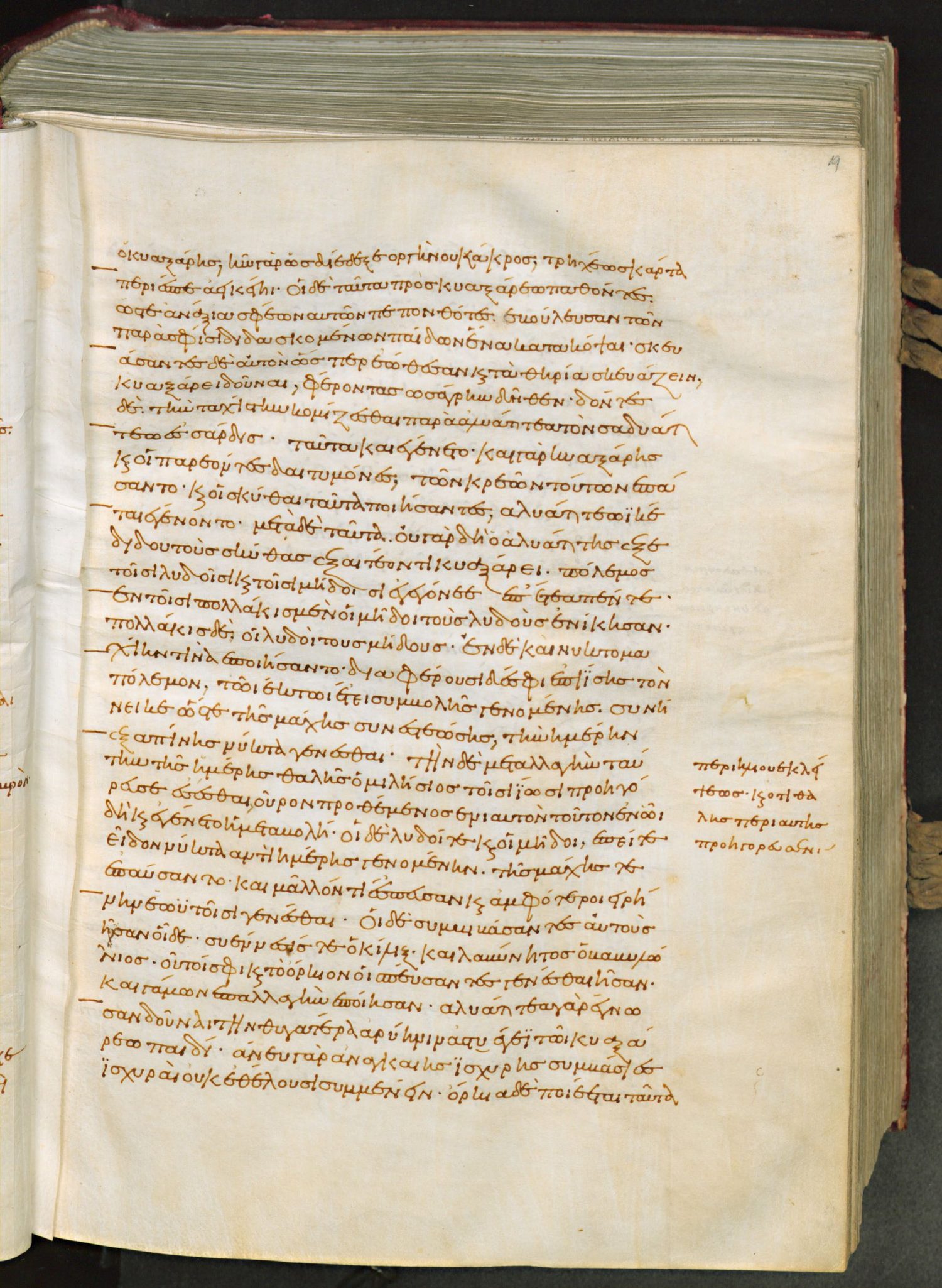
Laur. Plut. 70.3, fol. 19r: Greek here 1.73.4 to 1.74.5. Checked on the image (first and last words read and located in the Greek; each break checked against the neighbouring page): fol. 19r begins ‹ὁ Κυαξάρης (ἦν γάρ,› (1.73.4), ends ‹συμμένειν.ὅρκια δὲ ποιέεται ταῦτα› (1.74.5). English here: 1.73.5 to 1.74.4 (Godley's sentences for the sections whose Greek lies mostly on this page).
1.73.4ὁ Κυαξάρης (ἦν γάρ, ὡς διέδεξε, ὀργὴν ἄκρος) τρηχέως κάρτα περιέσπε ἀεικείῃ. 1.73.5οἳ δὲ ταῦτα πρὸς Κυαξάρεω παθόντες, ὥστε ἀνάξια σφέων αὐτῶν πεπονθότες, ἐβούλευσαν τῶν παρὰ σφίσι διδασκομένων παίδων ἕνα κατακόψαι, σκευάσαντες δὲ αὐτὸν ὥσπερ ἐώθεσαν καὶ τὰ θηρία σκευάζειν, Κυαξάρῃ δοῦναι φέροντες ὡς ἄγρην δῆθεν, δόντες δὲ τὴν ταχίστην κομίζεσθαι παρὰ Ἀλυάττεα τὸν Σαδυάττεω ἐς Σάρδις. 1.73.6ταῦτα καὶ ἐγένετο. καὶ γὰρ Κυαξάρης καὶ οἱ παρεόντες δαιτυμόνες τῶν κρεῶν τούτων ἐπάσαντο, καὶ οἱ Σκύθαι ταῦτα ποιήσαντες Ἀλυάττεω ἱκέται ἐγένοντο. 1.74.1μετὰ δὲ ταῦτα, οὐ γὰρ δὴ ὁ Ἀλυάττης ἐξεδίδου τοὺς Σκύθας ἐξαιτέοντι Κυαξάρῃ, πόλεμος τοῖσι Λυδοῖσι καὶ τοῖσι Μήδοισι ἐγεγόνεε ἐπʼ ἔτεα πέντε, ἐν τοῖσι πολλάκις μὲν οἱ Μῆδοι τοὺς Λυδοὺς ἐνίκησαν, πολλάκις δὲ οἱ Λυδοὶ τοὺς Μήδους, ἐν δὲ καὶ νυκτομαχίην τινὰ ἐποιήσαντο· 1.74.2διαφέρουσι δέ σφι ἐπὶ ἴσης τὸν πόλεμον τῷ ἕκτῳ ἔτεϊ συμβολῆς γενομένης συνήνεικε ὥστε τῆς μάχης συνεστεώσης τὴν ἡμέρην ἐξαπίνης νύκτα γενέσθαι. τὴν δὲ μεταλλαγὴν ταύτην τῇ ἡμέρης Θαλῆς ὁ Μιλήσιος τοῖσι Ἴωσι προηγόρευσε ἔσεσθαι, οὖρον προθέμενος ἐνιαυτὸν τοῦτον ἐν τῷ δὴ καὶ ἐγένετο ἡ μεταβολή. 1.74.3οἱ δὲ Λυδοί τε καὶ οἱ Μῆδοι ἐπείτε εἶδον νύκτα ἀντὶ ἡμέρης γενομένην, τῆς μάχης τε ἐπαύσαντο καὶ μᾶλλόν τι ἔσπευσαν καὶ ἀμφότεροι εἰρήνην ἑωυτοῖσι γενέσθαι. οἱ δὲ συμβιβάσαντες αὐτοὺς ἦσαν οἵδε, Συέννεσίς τε ὁ Κίλιξ καὶ Λαβύνητος ὁ Βαβυλώνιος. 1.74.4οὗτοί σφι καὶ τὸ ὅρκιον οἱ σπεύσαντες γενέσθαι ἦσαν καὶ γάμων ἐπαλλαγὴν ἐποίησαν· Ἀλυάττεα γὰρ ἔγνωσαν δοῦναι τὴν θυγατέρα Ἀρύηνιν Ἀστυάγεϊ τῷ Κυαξάρεω παιδί· ἄνευ γὰρ ἀναγκαίης ἰσχυρῆς συμβάσιες ἰσχυραὶ οὐκ ἐθέλουσι συμμένειν. 1.74.5ὅρκια δὲ ποιέεται ταῦτα
1.73.5The Scythians, deeming themselves wronged by the usage they had from Cyaxares, plotted to take one of the boys who were their pupils and cut him in pieces, then, dressing the flesh as they were wont to dress the animals which they killed, to bring and give it to Cyaxares as if it were the spoils of the chase; and after that, to make their way with all speed to Alyattes son of Sadyattes at Sardis. All this they did. 1.73.6Cyaxares and the guests who feasted with him ate of the boy’s flesh, and the Scythians, having done as they planned, fled to Alyattes for protection. 1.74.1After this, seeing that Alyattes would not give up the Scythians to Cyaxares at his demand, there was war between the Lydians and the Medes for five years; each won many victories over the other, and once they fought a battle by night. 1.74.2They were still warring with equal success, when it chanced, at an encounter which happened in the sixth year, that during the battle the day was suddenly turned to night. Thales of Miletus had foretold this loss of daylight to the Ionians, fixing it within the year in which the change did indeed happen. 1.74.3So when the Lydians and Medes saw the day turned to night they ceased from fighting, and both were the more zealous to make peace. Those who reconciled them were Syennesis the Cilician and Labynetus the Babylonian; 1.74.4they it was who brought it about that there should be a sworn agreement and an exchange of wedlock between them: they adjudged that Alyattes should give his daughter Aryenis to Astyages, son of Cyaxares; for without a strong bond agreements will not keep their strength.
Where on the image
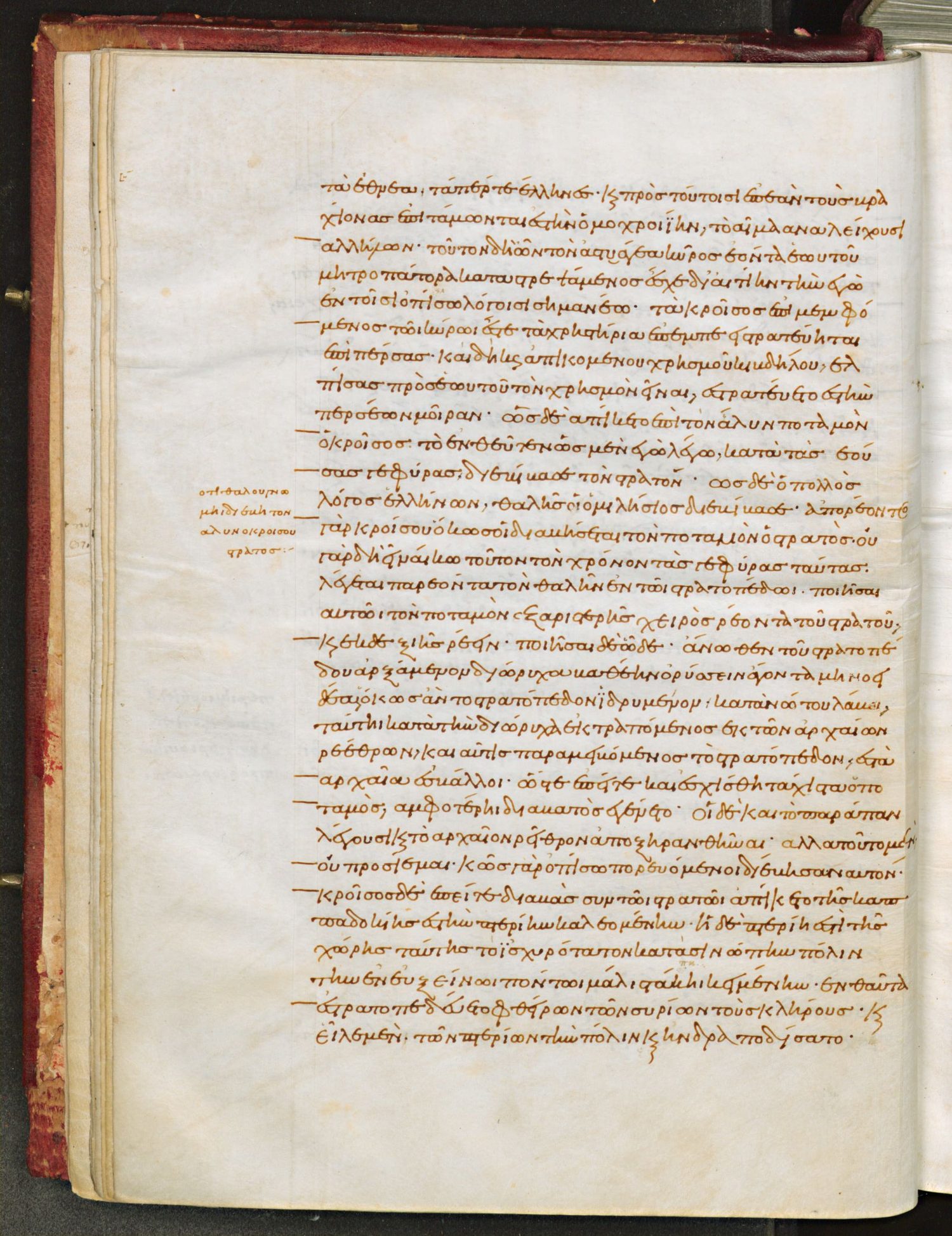
Laur. Plut. 70.3, fol. 19v: Greek here 1.74.5 to 1.76.2. Checked on the image (first and last words read and located in the Greek; each break checked against the neighbouring page): fol. 19v begins ‹τὰ ἔθνεα τὰ πέρ› (1.74.5), ends ‹τὴν πόλιν καὶ ἠνδραποδίσατο› (1.76.2). English here: 1.74.5 to 1.76.2 (Godley's sentences for the sections whose Greek lies mostly on this page).
1.74.5τὰ ἔθνεα τὰ πέρ τε Ἕλληνες, καὶ πρὸς τούτοισι, ἐπεὰν τοὺς βραχίονας ἐπιτάμωνται ἐς τὴν ὁμοχροίην, τὸ αἷμα ἀναλείχουσι ἀλλήλων. 1.75.1τοῦτον δὴ ὦν τὸν Ἀστυάγεα Κῦρος ἐόντα ἑωυτοῦ μητροπάτορα καταστρεψάμενος ἔσχε διʼ αἰτίην τὴν ἐγὼ ἐν τοῖσι ὀπίσω λόγοισι σημανέω· 1.75.2τὰ Κροῖσος ἐπιμεμφόμενος τῷ Κύρῳ ἔς τε τὰ χρηστήρια ἔπεμπε εἰ στρατεύηται ἐπὶ Πέρσας, καὶ δὴ καὶ ἀπικομένου χρησμοῦ κιβδήλου, ἐλπίσας πρὸς ἑωυτοῦ τὸν χρησμὸν εἶναι, ἐστρατεύετο ἐς τὴν Περσέων μοῖραν. 1.75.3ὡς δὲ ἀπίκετο ἐπὶ τὸν Ἅλυν ποταμὸν ὁ Κροῖσος, τὸ ἐνθεῦτεν, ὡς μὲν ἐγὼ λέγω, κατὰ τὰς ἐούσας γεφύρας διεβίβασε τὸν στρατόν, ὡς δὲ ὁ πολλὸς λόγος Ἑλλήνων, Θαλῆς οἱ ὁ Μιλήσιος διεβίβασε. 1.75.4ἀπορέοντος γὰρ Κροίσου ὅκως οἱ διαβήσεται τὸν ποταμὸν ὁ στρατός (οὐ γὰρ δὴ εἶναι κω τοῦτον τὸν χρόνον τὰς γεφύρας ταύτας) λέγεται παρεόντα τὸν Θαλῆν ἐν τῷ στρατοπέδῳ ποιῆσαι αὐτῷ τὸν ποταμὸν ἐξ ἀριστερῆς χειρὸς ῥέοντα τοῦ στρατοῦ καὶ ἐκ δεξιῆς ῥέειν, ποιῆσαι δὲ ὧδε· 1.75.5ἄνωθεν τοῦ στρατοπέδου ἀρξάμενον διώρυχα βαθέαν ὀρύσσειν, ἄγοντα μηνοειδέα, ὅκως ἂν τὸ στρατόπεδον ἱδρυμένον κατὰ νώτου λάβοι, ταύτῃ κατὰ τὴν διώρυχα ἐκτραπόμενος ἐκ τῶν ἀρχαίων ῥεέθρων, καὶ αὖτις παραμειβόμενος τὸ στρατόπεδον ἐς τὰ ἀρχαῖα ἐσβάλλοι· ὥστε ἐπείτε καὶ ἐσχίσθη τάχιστα ὁ ποταμός, ἀμφοτέρῃ διαβατὸς ἐγένετο, 1.75.6οἳ δὲ καὶ τὸ παράπαν λέγουσι καὶ τὸ ἀρχαῖον ῥέεθρον ἀποξηρανθῆναι. ἀλλὰ τοῦτο μὲν οὐ προσίεμαι· κῶς γὰρ ὀπίσω πορευόμενοι διέβησαν αὐτόν; 1.76.1Κροῖσος δὲ ἐπείτε διαβὰς σὺν τῷ στρατῷ ἀπίκετο τῆς Καππαδοκίης ἐς τὴν Πτερίην καλεομένην (ἡ δὲ Πτερίη ἐστὶ τῆς χώρης ταύτης τὸ ἰσχυρότατον, κατὰ Σινώπην πόλιν τὴν ἐν Εὐξείνῳ πόντῳ μάλιστά κῃ κειμένη), ἐνθαῦτα ἐστρατοπεδεύετο φθείρων τῶν Συρίων τοὺς κλήρους· 1.76.2καὶ εἷλε μὲν τῶν Πτερίων τὴν πόλιν καὶ ἠνδραποδίσατο,
1.74.5These nations make sworn compacts as do the Greeks; moreover, they cut the skin of their arms and lick each other’s blood. 1.75.1This Astyages then was Cyrus’ mother’s father, and was by him subdued and held subject for the reason which I shall presently declare. 1.75.2Having this cause of quarrel with Cyrus, Croesus sent to ask the oracles if he should march against the Persians; and when a quibbling answer came he thought it to be favourable to him, and so led his army to the Persian territory. 1.75.3When he came to the river Halys, he transported his army across it,—by the bridges, as I hold, which then were there; but the general belief of the Greeks is that the army was carried across by Thales of Miletus. 1.75.4This is the story: As the bridges aforesaid did not then yet exist, Croesus knew not how his army should pass the river: then Thales, being in the encampment, made the river, which flowed on the left hand, flow also on the right of the army in the following way. 1.75.5Starting from a point on the river higher up than the camp, he dug a deep semicircular trench, so that the stream, turned from its ancient course, should flow in the trench to the rear of the camp, and, again passing it, should issue into its former bed, so that, as soon as the river was thus divided into two, both channels could be forded. 1.75.6Some even say that the ancient channel was altogether dried up. But I do not believe this; for how then did they pass the river when they were returning? 1.76.1Croesus then passing over with his army came to the part of Cappadocia called Pteria (it is the strongest part of this country and lies nearest to the city of Sinope on the Euxine sea), where he encamped, and laid waste the farms of the Syrians; 1.76.2and he took and enslaved the city of the Pterians, and took also all the places about it, and drove the Syrians from their homes, though they had done him no harm. Cyrus, mustering his army, and gathering to him all those who dwelt upon his way, went to meet Croesus.
Where on the image
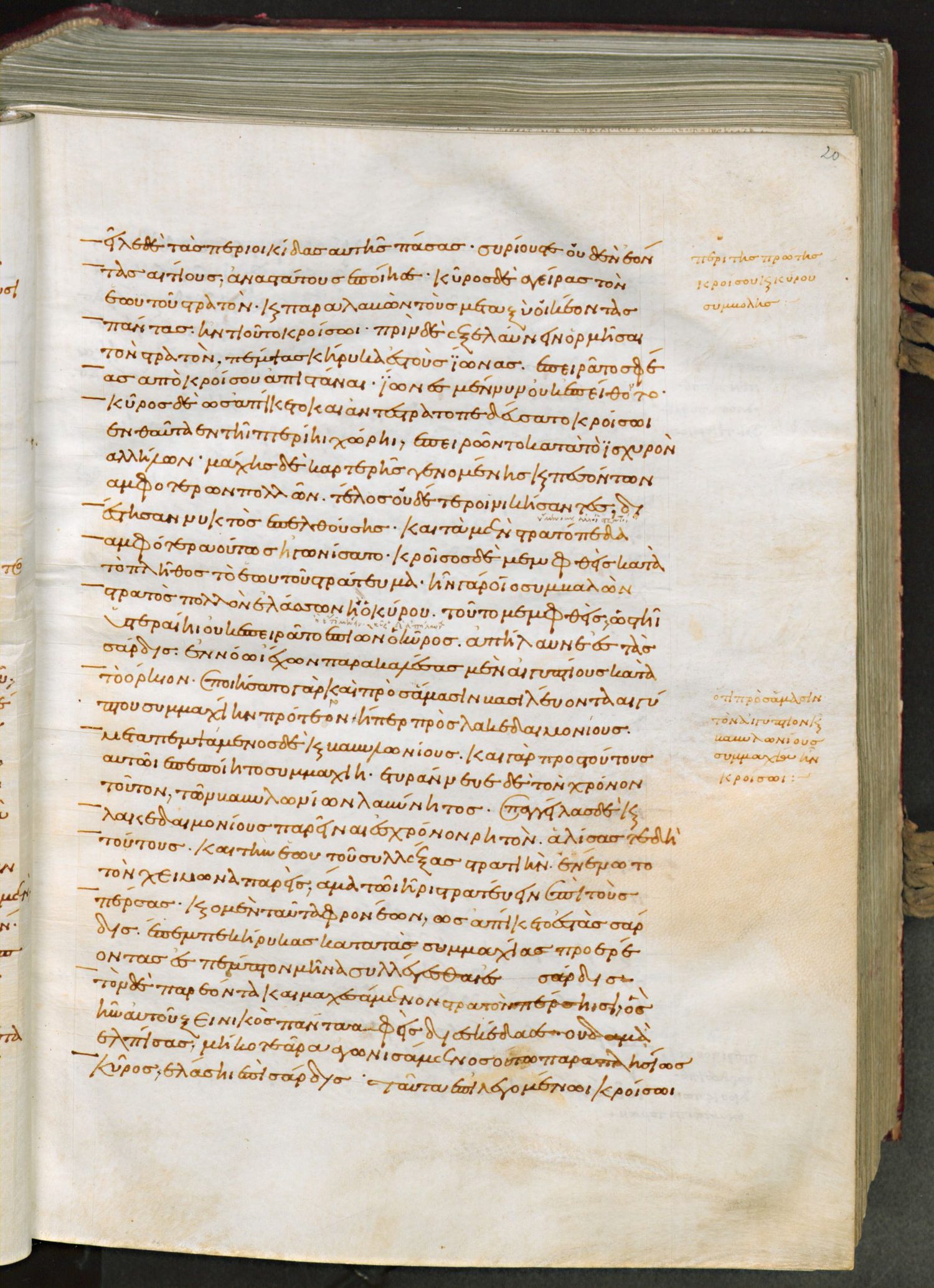
Laur. Plut. 70.3, fol. 20r: Greek here 1.76.2 to 1.78.1. Checked on the image (first and last words read and located in the Greek; each break checked against the neighbouring page): fol. 20r begins ‹εἷλε δὲ τὰς περιοικίδας› (1.76.2), ends ‹ἐπὶ Σάρδις.ταῦτα ἐπιλεγομένῳ Κροίσῳ› (1.78.1). English here: 1.76.3 to 1.77.4 (Godley's sentences for the sections whose Greek lies mostly on this page).
1.76.2εἷλε δὲ τὰς περιοικίδας αὐτῆς πάσας, Συρίους τε οὐδὲν ἐόντας αἰτίους ἀναστάτους ἐποίησε. Κῦρος δὲ ἀγείρας τὸν ἑωυτοῦ στρατὸν καὶ παραλαβὼν τοὺς μεταξὺ οἰκέοντας πάντας ἠντιοῦτο Κροίσῳ. 1.76.3πρὶν δὲ ἐξελαύνειν ὁρμῆσαι τὸν στρατόν, πέμψας κήρυκας ἐς τοὺς Ἴωνας ἐπειρᾶτο σφέας ἀπὸ Κροίσου ἀπιστάναι. Ἴωνες μέν νυν οὐκ ἐπείθοντο. Κῦρος δὲ ὡς ἀπίκετο καὶ ἀντεστρατοπεδεύσατο Κροίσῳ, ἐνθαῦτα ἐν τῇ Πτερίῃ χωρῇ ἐπειρῶντο κατὰ τὸ ἰσχυρὸν ἀλλήλων. 1.76.4μάχης δὲ καρτερῆς γενομένης καὶ πεσόντων ἀμφοτέρων πολλῶν, τέλος οὐδέτεροι νικήσαντες διέστησαν νυκτὸς ἐπελθούσης. καὶ τὰ μὲν στρατόπεδα ἀμφότερα οὕτω ἠγωνίσατο. 1.77.1Κροῖσος δὲ μεμφθεὶς κατὰ τὸ πλῆθος τὸ ἑωυτοῦ στράτευμα (ἦν γάρ οἱ ὁ συμβαλὼν στρατὸς πολλὸν ἐλάσσων ἢ ὁ Κύρου), τοῦτο μεμφθείς, ὡς τῇ ὑστεραίῃ οὐκ ἐπειρᾶτο ἐπιὼν ὁ Κῦρος, ἀπήλαυνε ἐς τὰς Σάρδις ἐν νόῳ ἔχων παρακαλέσας μὲν Αἰγυπτίους κατὰ τὸ ὅρκιον 1.77.2(ἐποιήσατο γὰρ καὶ πρὸς Ἄμασιν βασιλεύοντα Αἰγύπτου συμμαχίην πρότερον ἤ περ πρὸς Λακεδαιμονίους), μεταπεμψάμενος δὲ καὶ Βαβυλωνίους (καὶ γὰρ πρὸς τούτους αὐτῷ ἐπεποίητο συμμαχίη, ἐτυράννευε δὲ τὸν χρόνον τοῦτον τῶν Βαβυλωνίων Λαβύνητος), 1.77.3ἐπαγγείλας δὲ καὶ Λακεδαιμονίοισι παρεῖναι ἐς χρόνον ῥητόν ἁλίσας τε δὴ τούτους καὶ τὴν ἑωυτοῦ συλλέξας στρατιὴν ἐνένωτο τὸν χειμῶνα παρείς, ἅμα τῷ ἔαρι στρατεύειν ἐπὶ τοὺς Πέρσας. 1.77.4καὶ ὃ μὲν ταῦτα φρονέων, ὡς ἀπίκετο ἐς τὰς Σάρδις, ἔπεμπε κήρυκας κατὰ τὰς συμμαχίας προερέοντας ἐς πέμπτον μῆνα συλλέγεσθαι ἐς Σάρδις· τὸν δὲ παρεόντα καὶ μαχεσάμενον στρατὸν Πέρσῃσι, ὃς ἦν αὐτοῦ ξεινικός, πάντα ἀπεὶς διεσκέδασε οὐδαμὰ ἐλπίσας μὴ κοτε ἄρα ἀγωνισάμενος οὕτω παραπλησίως Κῦρος ἐλάσῃ ἐπὶ Σάρδις. 1.78.1ταῦτα ἐπιλεγομένῳ Κροίσῳ
1.76.3But before beginning his march he sent heralds to the Ionians to try to draw them away from Croesus. The Ionians would not be persuaded; but when Cyrus had come, and encamped face to face with Croesus, the armies made trial of each other’s strength with might and main in the Pterian country. 1.76.4The battle was stubborn; many on both sides fell, and when they were parted at nightfall neither had the advantage. With such fortune did the two armies contend. 1.77.1Croesus was not content with the number of his force, for his army which had fought was by far smaller than that of Cyrus; therefore, seeing that on the day after the battle Cyrus essayed no second attack, he marched away to Sardis, intending to invite help from the Egyptians in fulfilment of their pledge ( 1.77.2for before making an alliance with the Lacedaemonians he had made one also with Amasis king of Egypt), and to send for the Babylonians also (for with these too he had made an alliance, Labynetus being at this time their sovereign), 1.77.3and to summon the Lacedaemonians to join him at a fixed time. It was in his mind to muster all these forces and assemble his own army, then to wait till the winter was over and march against the Persians at the beginning of spring. 1.77.4With such intent, as soon as he returned to Sardis, he sent heralds to all his allies, summoning them to assemble at Sardis in five months’ time; and as for the soldiers whom he had with him, who had fought with the Persians, all of them who were not of his nation he disbanded, never thinking that after so equal an issue of the contest Cyrus would march against Sardis.
Where on the image
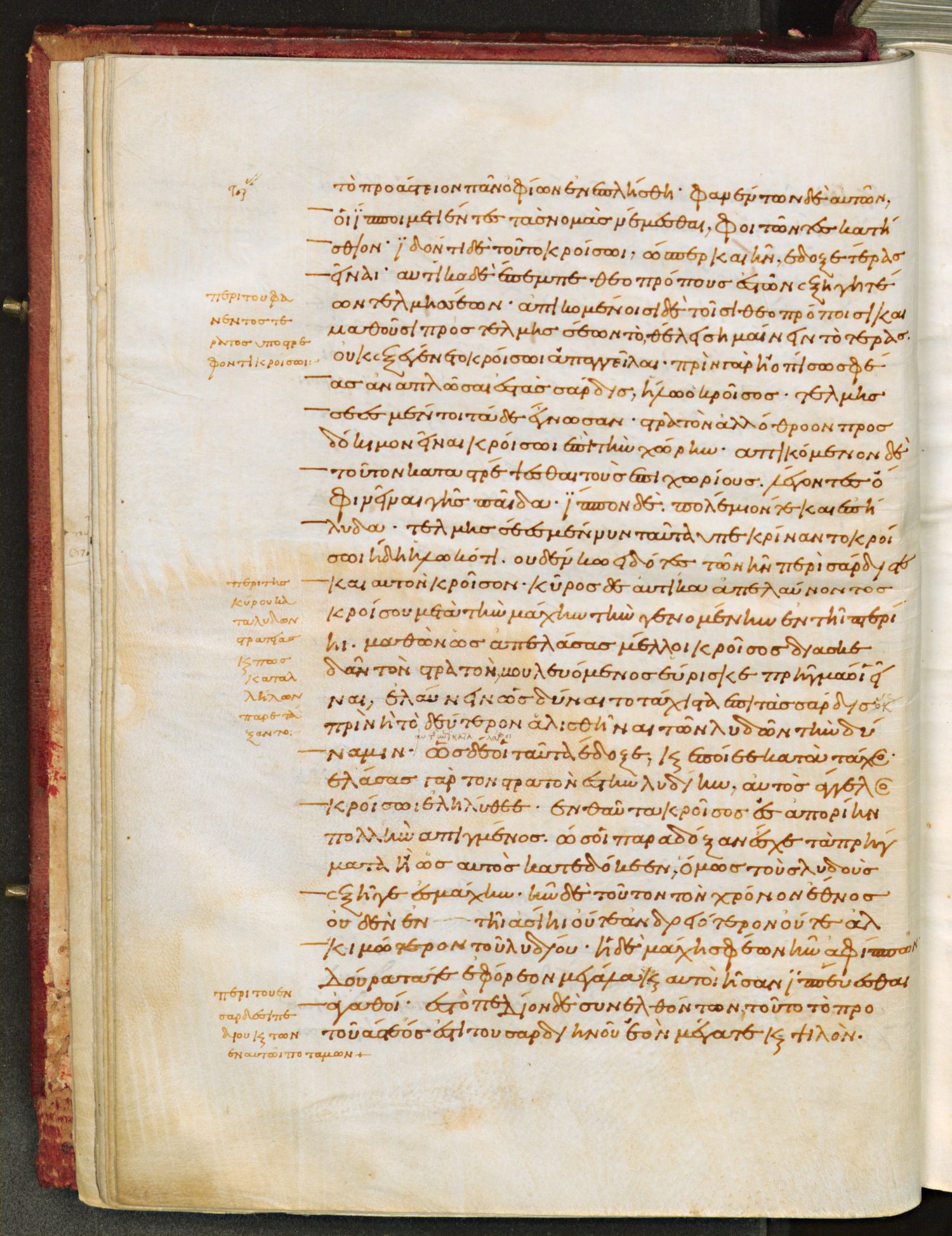
Laur. Plut. 70.3, fol. 20v: Greek here 1.78.1 to 1.80.1. Checked on the image (first and last words read and located in the Greek; each break checked against the neighbouring page): fol. 20v begins ‹τὸ προάστειον πᾶν ὀφίων› (1.78.1), ends ‹μέγα τε καὶ ψιλὸν› (1.80.1). English here: 1.78.1 to 1.79.3 (Godley's sentences for the sections whose Greek lies mostly on this page).
1.78.1τὸ προάστειον πᾶν ὀφίων ἐνεπλήσθη· φανέντων δὲ αὐτῶν οἱ ἵπποι μετιέντες τὰς νομὰς νέμεσθαι φοιτέοντες κατήσθιον. ἰδόντι δὲ τοῦτο Κροίσῳ, ὥσπερ καὶ ἦν ἔδοξε τέρας εἶναι· 1.78.2αὐτίκα δὲ ἔπεμπε θεοπρόπους ἐς τῶν ἐξηγητέων Τελμησσέων. ἀπικομένοισι δὲ τοῖσι θεοπρόποισι καὶ μαθοῦσι πρὸς Τελμησσέων τὸ θέλει σημαίνειν τὸ τέρας, οὐκ ἐξεγένετο Κροίσῳ ἀπαγγεῖλαι· πρὶν γὰρ ἢ ὀπίσω σφέας ἀναπλῶσαι ἐς τὰς Σάρδις ἥλω ὁ Κροῖσος. 1.78.3Τελμησσέες μέντοι τάδε ἔγνωσαν, στρατὸν ἀλλόθροον προσδόκιμον εἶναι Κροίσῳ ἐπὶ τὴν χώρην, ἀπικόμενον δὲ τοῦτον καταστρέψεσθαι τοὺς ἐπιχωρίους, λέγοντες ὄφιν εἶναι γῆς παῖδα, ἵππον δὲ πολέμιόν τε καὶ ἐπήλυδα. Τελμησσέες μέν νυν ταῦτα ὑπεκρίναντο Κροίσῳ ἤδη ἡλωκότι, οὐδὲν κω εἰδότες τῶν ἦν περὶ Σάρδις τε καὶ αὐτὸν Κροῖσον. 1.79.1Κῦρος δὲ αὐτίκα ἀπελαύνοντος Κροίσου μετὰ τὴν μάχην τὴν γενομένην ἐν τῇ Πτερίῃ, μαθὼν ὡς ἀπελάσας μέλλοι Κροῖσος διασκεδᾶν τὸν στρατόν, βουλευόμενος εὕρισκε πρῆγμά οἷ εἶναι ἐλαύνειν ὡς δύναιτο τάχιστα ἐπὶ τὰς Σάρδις, πρὶν ἢ τὸ δεύτερον ἁλισθῆναι τῶν Λυδῶν τὴν δύναμιν. 1.79.2ὡς δέ οἱ ταῦτα ἔδοξε, καὶ ἐποίεε κατὰ τάχος· ἐλάσας γὰρ τὸν στρατὸν ἐς τὴν Λυδίην αὐτὸς ἄγγελος Κροίσῳ ἐληλύθεε. ἐνθαῦτα Κροῖσος ἐς ἀπορίην πολλὴν ἀπιγμένος, ὥς οἱ παρὰ δόξαν ἔσχε τὰ πρήγματα ἢ ὡς αὐτὸς κατεδόκεε, ὅμως τοὺς Λυδοὺς ἐξῆγε ἐς μάχην. 1.79.3ἦν δὲ τοῦτον τὸν χρόνον ἔθνος οὐδὲν ἐν τῇ Ἀσίῃ οὔτε ἀνδρηιότερον οὔτε ἀλκιμώτερον τοῦ Λυδίου. ἡ δὲ μάχη σφέων ἦν ἀπʼ ἵππων, δόρατά τε ἐφόρεον μεγάλα, καὶ αὐτοὶ ἦσαν ἱππεύεσθαι ἀγαθοί. 1.80.1ἐς τὸ πεδίον δὲ συνελθόντων τοῦτο τὸ πρὸ τοῦ ἄστεος ἐστὶ τοῦ Σαρδιηνοῦ, ἐὸν μέγα τε καὶ ψιλὸν
1.78.1Thus Croesus reasoned. Meantime it chanced that snakes began to swarm in the outer part of the city; and when they appeared the horses would ever leave their accustomed pasture and devour them. When Croesus saw this he thought it to be a portent, and so it was. 1.78.2Forthwith he sent to the abodes of the Telmessian interpreters, to inquire concerning it; but though his messengers came and learnt from the Telmessians what the portent should signify, they could never bring back word to Croesus, for he was a prisoner before they could make their voyage back to Sardis. 1.78.3Howbeit, this was the judgment of the Telmessians—that Croesus must expect a foreign army to attack his country, and that when it came it would subdue the dwellers in the land: for the snake, they said, was the child of the earth, but the horse was a foe and a foreigner. Such was the answer which the Telmessians gave Croesus, knowing as yet nothing of the fate of Sardis and the king himself; but when they gave it Croesus was already taken. 1.79.1When Croesus marched away after the battle in the Pterian country, Cyrus, learning that Croesus had gone with intent to disband his army, took counsel and perceived thereby that it was his business to march with all speed against Sardis, before the power of the Lydians could again be assembled. 1.79.2So he resolved and so he did speedily; he marched his army into Lydia and so himself came to bring the news of it to Croesus. All had turned out contrariwise to Croesus’ expectation, and he was in a great quandary; nevertheless, he led out the Lydians to battle. 1.79.3Now at this time there was no nation in Asia more valiant or warlike than the Lydian. It was their custom to fight on horseback, carrying long spears, and they were skilled in the management of horses.
Where on the image
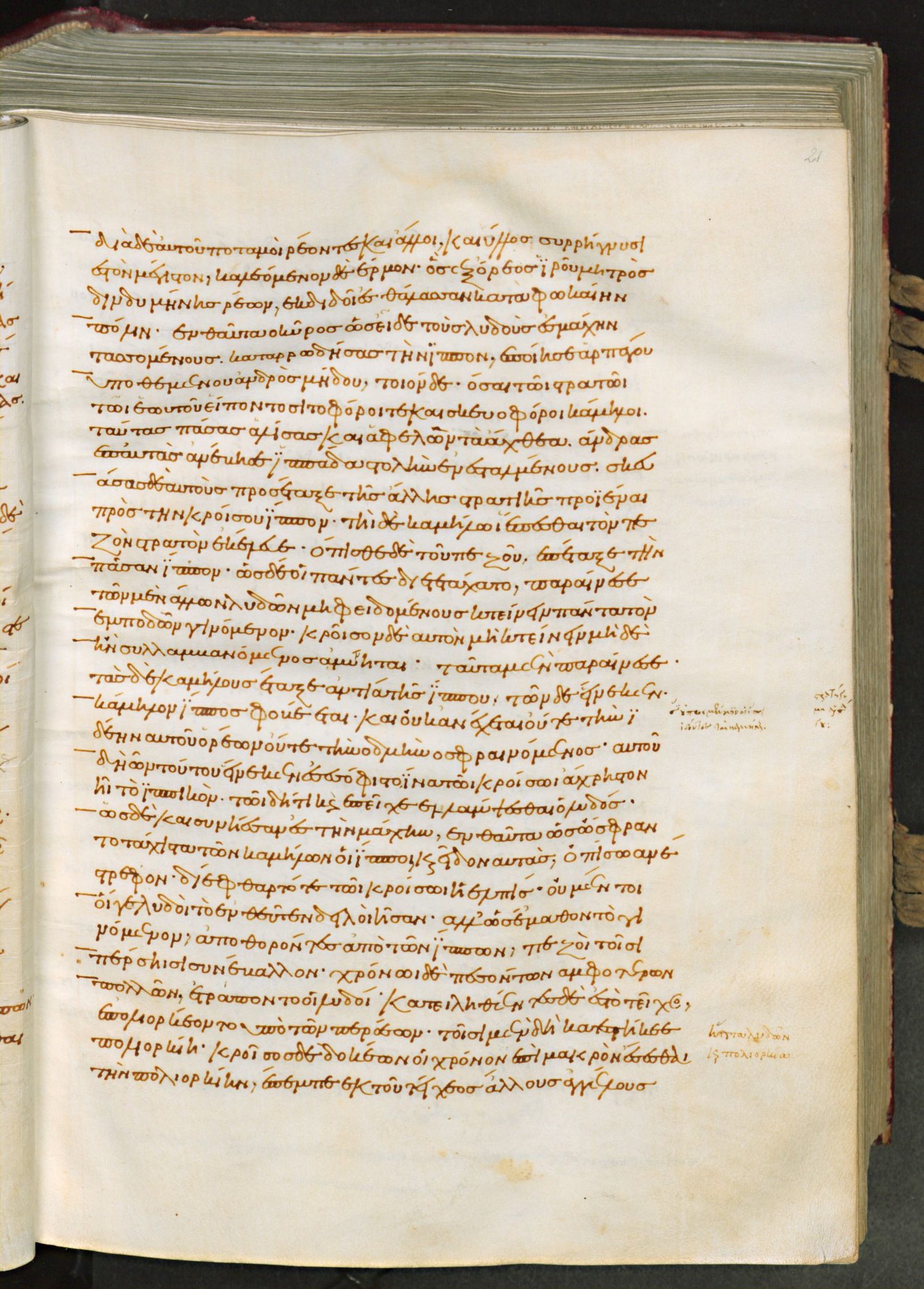
Laur. Plut. 70.3, fol. 21r: Greek here 1.80.1 to 1.81.1. Checked on the image (first and last words read and located in the Greek; each break checked against the neighbouring page): fol. 21r begins ‹διὰ δὲ αὐτοῦ ποταμοὶ› (1.80.1), ends ‹τοῦ τείχεος ἄλλους ἀγγέλους› (1.81.1). English here: 1.80.1 to 1.80.6 (Godley's sentences for the sections whose Greek lies mostly on this page).
1.80.1(διὰ δὲ αὐτοῦ ποταμοὶ ῥέοντες καὶ ἄλλοι καὶ Ὕλλος συρρηγνῦσι ἐς τὸν μέγιστον, καλεόμενον δὲ Ἕρμον, ὃς ἐξ ὄρεος ἱροῦ μητρὸς Δινδυμήνης ῥέων ἐκδιδοῖ ἐς θάλασσαν κατὰ Φωκαίην πόλιν), 1.80.2ἐνθαῦτα ὁ Κῦρος ὡς εἶδε τοὺς Λυδοὺς ἐς μάχην τασσομένους, καταρρωδήσας τὴν ἵππον ἐποίησε Ἁρπάγου ὑποθεμένου ἀνδρὸς Μήδου τοιόνδε· ὅσαι τῷ στρατῷ τῷ ἑωυτοῦ εἵποντο σιτοφόροι τε καὶ σκευοφόροι κάμηλοι, ταύτας πάσας ἁλίσας καὶ ἀπελὼν τὰ ἄχθεα ἄνδρας ἐπʼ αὐτὰς ἀνέβησε ἱππάδα στολὴν ἐνεσταλμένους, σκευάσας δὲ αὐτοὺς προσέταξε τῆς ἄλλης στρατιῆς προϊέναι πρὸς τὴν Κροίσου ἵππον, τῇ δὲ καμήλῳ ἕπεσθαι τὸν πεζὸν στρατὸν ἐκέλευσε, ὄπισθε δὲ τοῦ πεζοῦ ἐπέταξε τὴν πᾶσαν ἵππον. 1.80.3ὡς δέ οἱ πάντες διετετάχατο, παραίνεσε τῶν μὲν ἄλλων Λυδῶν μὴ φειδομένους κτείνειν πάντα τὸν ἐμποδὼν γινόμενον, Κροῖσον δὲ αὐτὸν μὴ κτείνειν, μηδὲ ἢν συλλαμβανόμενος ἀμύνηται. 1.80.4ταῦτα μὲν παραίνεσε, τὰς δὲ καμήλους ἔταξε ἀντία τῆς ἵππου τῶνδε εἵνεκεν· κάμηλον ἵππος φοβέεται, καὶ οὐκ ἀνέχεται οὔτε τὴν ἰδέην αὐτοῦ ὁρέων οὔτε τὴν ὀδμὴν ὀσφραινόμενος. αὐτοῦ δὴ ὦν τούτου εἵνεκεν ἐσεσόφιστο, ἵνα τῷ Κροίσῳ ἄχρηστον ᾖ τὸ ἱππικόν, τῷ δή τι καὶ ἐπεῖχε ἐλλάμψεσθαι ὁ Λυδός. 1.80.5ὡς δὲ καὶ συνήισαν ἐς τὴν μάχην, ἐνθαῦτα ὡς ὤσφροντο τάχιστα τῶν καμήλων οἱ ἵπποι καὶ εἶδον αὐτάς, ὀπίσω ἀνέστρεφον, διέφθαρτό τε τῷ Κροίσῳ ἡ ἐλπίς. 1.80.6οὐ μέντοι οἵ γε Λυδοὶ τὸ ἐνθεῦτεν δειλοὶ ἦσαν, ἀλλʼ ὡς ἔμαθον τὸ γινόμενον, ἀποθορόντες ἀπὸ τῶν ἵππων πεζοὶ τοῖσι Πέρσῃσι συνέβαλλον. χρόνῳ δὲ πεσόντων ἀμφοτέρων πολλῶν ἐτράποντο οἱ Λυδοί, κατειληθέντες δὲ ἐς τὸ τεῖχος ἐπολιορκέοντο ὑπὸ τῶν Περσέων. 1.81.1τοῖσι μὲν δὴ κατεστήκεε πολιορκίη. Κροῖσος δὲ δοκέων οἱ χρόνον ἐπὶ μακρὸν ἔσεσθαι τὴν πολιορκίην ἔπεμπε ἐκ τοῦ τείχεος ἄλλους ἀγγέλους
1.80.1So the armies met in the plain, wide and bare, which is before the city of Sardis: the Hyllus and other rivers flow across it and rush violently together into the greatest of them, which is called Hermus (this flows from the mountain sacred to the Mother Dindymene and issues into the sea near the city of Phocaea). 1.80.2Here when Cyrus saw the Lydians arraying their battle, he was afraid of their horse, and therefore did as I will show by the counsel of one Harpagus, a Mede. Assembling all the camels that followed his army bearing food and baggage, he took off their burdens and set men upon them equipped like cavalrymen; having so equipped them he ordered them to advance before his army against Croesus’ horse; he charged the infantry to follow the camels, and set all his horse behind the infantry. 1.80.3When they were all arrayed, he commanded them to kill all other Lydians who came in their way, and spare none, but not to kill Croesus himself, even if he should defend himself against capture. 1.80.4Such was his command. The reason of his posting the camels to face the cavalry was this: horses fear camels and can endure neither the sight nor the smell of them; this then was the intent of his device, that Croesus’ cavalry, on which the Lydian relied for the winning of some glory, might be of no use. 1.80.5So when battle was joined, as soon as the horses smelt and saw the camels they turned to flight, and all Croesus’ hope was lost. 1.80.6Nevertheless the Lydians were no cowards; when they saw what was happening they leaped from their horses and fought the Persians on foot. Many of both armies fell; at length the Lydians were routed and driven within their city wall, where they were besieged by the Persians.
Where on the image
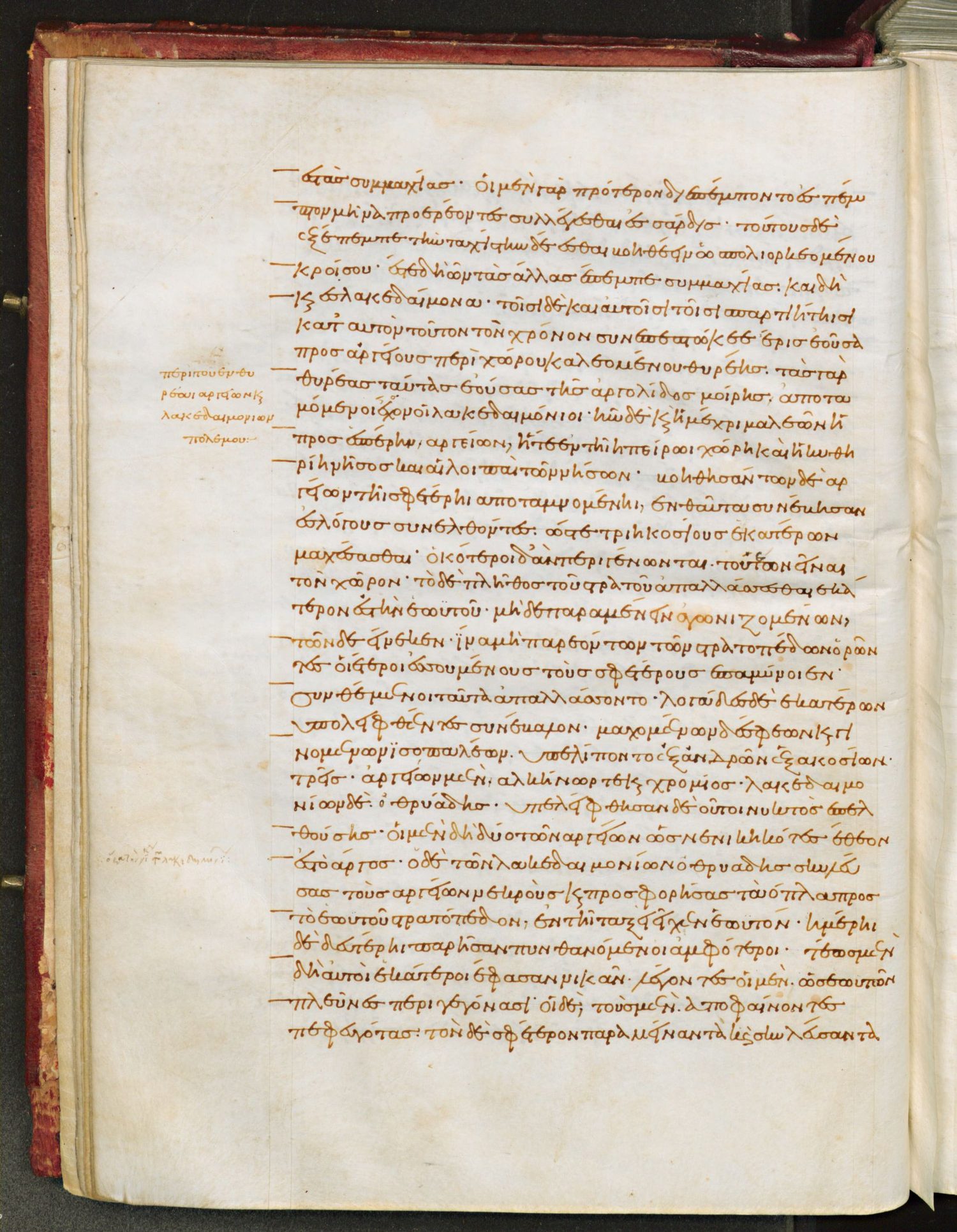
Laur. Plut. 70.3, fol. 21v: Greek here 1.81.1 to 1.82.6. Checked on the image (first and last words read and located in the Greek; each break checked against the neighbouring page): fol. 21v begins ‹ἐς τὰς συμμαχίας. οἱ› (1.81.1), ends ‹σφέτερον παραμείναντα καὶ σκυλεύσαντα› (1.82.6). English here: 1.81.1 to 1.82.6 (Godley's sentences for the sections whose Greek lies mostly on this page).
1.81.1ἐς τὰς συμμαχίας. οἱ μὲν γὰρ πρότεροι διεπέμποντο ἐς πέμπτον μῆνα προερέοντες συλλέγεσθαι ἐς Σάρδις, τούτους δὲ ἐξέπεμπε τὴν ταχίστην δέεσθαι βοηθέειν ὡς πολιορκεομένου Κροίσου. 1.82.1ἔς τε δὴ ὦν τὰς ἄλλας ἔπεμπε συμμαχίας καὶ δὴ καὶ ἐς Λακεδαίμονα. τοῖσι δὲ καὶ αὐτοῖσι τοῖσι Σπαρτιήτῃσι κατʼ αὐτὸν τοῦτον τὸν χρόνον συνεπεπτώκεε ἔρις ἐοῦσα πρὸς Ἀργείους περὶ χώρου καλεομένου Θυρέης· 1.82.2τὰς γὰρ Θυρέας ταύτας ἐούσας τῆς Ἀργολίδος μοίρης ἀποταμόμενοι ἔσχον οἱ Λακεδαιμόνιοι. ἦν δὲ καὶ ἡ μέχρι Μαλέων ἡ πρὸς ἑσπέρην Ἀργείων, ἥ τε ἐν τῇ ἠπείρῳ χώρῇ καὶ ἡ Κυθηρίη νῆσος καὶ αἱ λοιπαὶ τῶν νήσων. 1.82.3βοηθησάντων δὲ Ἀργείων τῇ σφετέρῃ ἀποταμνομένῃ, ἐνθαῦτα συνέβησαν ἐς λόγους συνελθόντες ὥστε τριηκοσίους ἑκατέρων μαχέσασθαι, ὁκότεροι δʼ ἂν περιγένωνται, τούτων εἶναι τὸν χῶρον· τὸ δὲ πλῆθος τοῦ στρατοῦ ἀπαλλάσσεσθαι ἑκάτερον ἐς τὴν ἑωυτοῦ μηδὲ παραμένειν ἀγωνιζομένων, τῶνδε εἵνεκεν ἵνα μὴ παρεόντων τῶν στρατοπέδων ὁρῶντες οἱ ἕτεροι ἑσσουμένους τοὺς σφετέρους ἀπαμύνοιεν. 1.82.4συνθέμενοι ταῦτα ἀπαλλάσσοντο, λογάδες δὲ ἑκατέρων ὑπολειφθέντες συνέβαλον. μαχομένων δὲ σφέων καὶ γινομένων ἰσοπαλέων ὑπελείποντο ἐξ ἀνδρῶν ἑξακοσίων τρεῖς, Ἀργείων μὲν Ἀλκήνωρ τε καὶ Χρομίος, Λακεδαιμονίων δὲ Ὀθρυάδης· ὑπελείφθησαν δὲ οὗτοι νυκτὸς ἐπελθούσης. 1.82.5οἱ μὲν δὴ δύο τῶν Ἀργείων ὡς νενικηκότες ἔθεον ἐς τὸ Ἄργος, ὁ δὲ τῶν Λακεδαιμονίων Ὀθρυάδης σκυλεύσας τοὺς Ἀργείων νεκροὺς καὶ προσφορήσας τὰ ὅπλα πρὸς τὸ ἑωυτοῦ στρατόπεδον ἐν τῇ τάξι εἶχε ἑωυτόν. ἡμέρῃ δὲ δευτέρῃ παρῆσαν πυνθανόμενοι ἀμφότεροι. 1.82.6τέως μὲν δὴ αὐτοὶ ἑκάτεροι ἔφασαν νικᾶν, λέγοντες οἳ μὲν ὡς ἑωυτῶν πλεῦνες περιγεγόνασι, οἳ δὲ τοὺς μὲν ἀποφαίνοντες πεφευγότας, τὸν δὲ σφέτερον παραμείναντα καὶ σκυλεύσαντα
1.81.1So then they were beleaguered. But Croesus, supposing that the siege would last a long time, sent messengers again from the city to his allies; whereas the former envoys had been sent to summon them to muster at Sardis in five months’ time, these were to announce that Croesus was besieged and to entreat help with all speed. 1.82.1So he sent to the Lacedaemonians as well as the rest of the allies. Now at this very time the Spartans themselves had a feud on hand with the Argives, in respect of the country called Thyrea; 1.82.2for this was a part of the Argive territory which the Lacedaemonians had cut off and occupied. (All the land towards the west, as far as Malea, belonged then to the Argives, and not the mainland only, but the island of Cythera and the other islands.) 1.82.3The Argives came out to save their territory from being cut off; then after debate the two armies agreed that three hundred of each side should fight, and whichever party won should possess the land. The rest of each army was to go away to its own country and not be present at the battle; for it was feared that if the armies remained on the field, the men of either party would render help to their comrades if they saw them losing. 1.82.4Having thus agreed, the armies drew off, and picked men of each side were left and fought. Neither could gain advantage in the battle; at last, of six hundred there were left only three, Alcenor and Chromios of the Argives, Othryades of the Lacedaemonians: these three were left alive at nightfall. 1.82.5Then the two Argives, deeming themselves victors, ran to Argos; but Othryades, the Lacedaemonian, spoiled the Argive dead, bore the armour to his own army’s camp and remained in his place. On the next day both armies came to learn the issue. 1.82.6For a while both claimed the victory, the Argives pleading that more of their men had survived, the Lacedaemonians showing that the Argives had fled, while their man had stood his ground and despoiled the enemy dead.
Where on the image
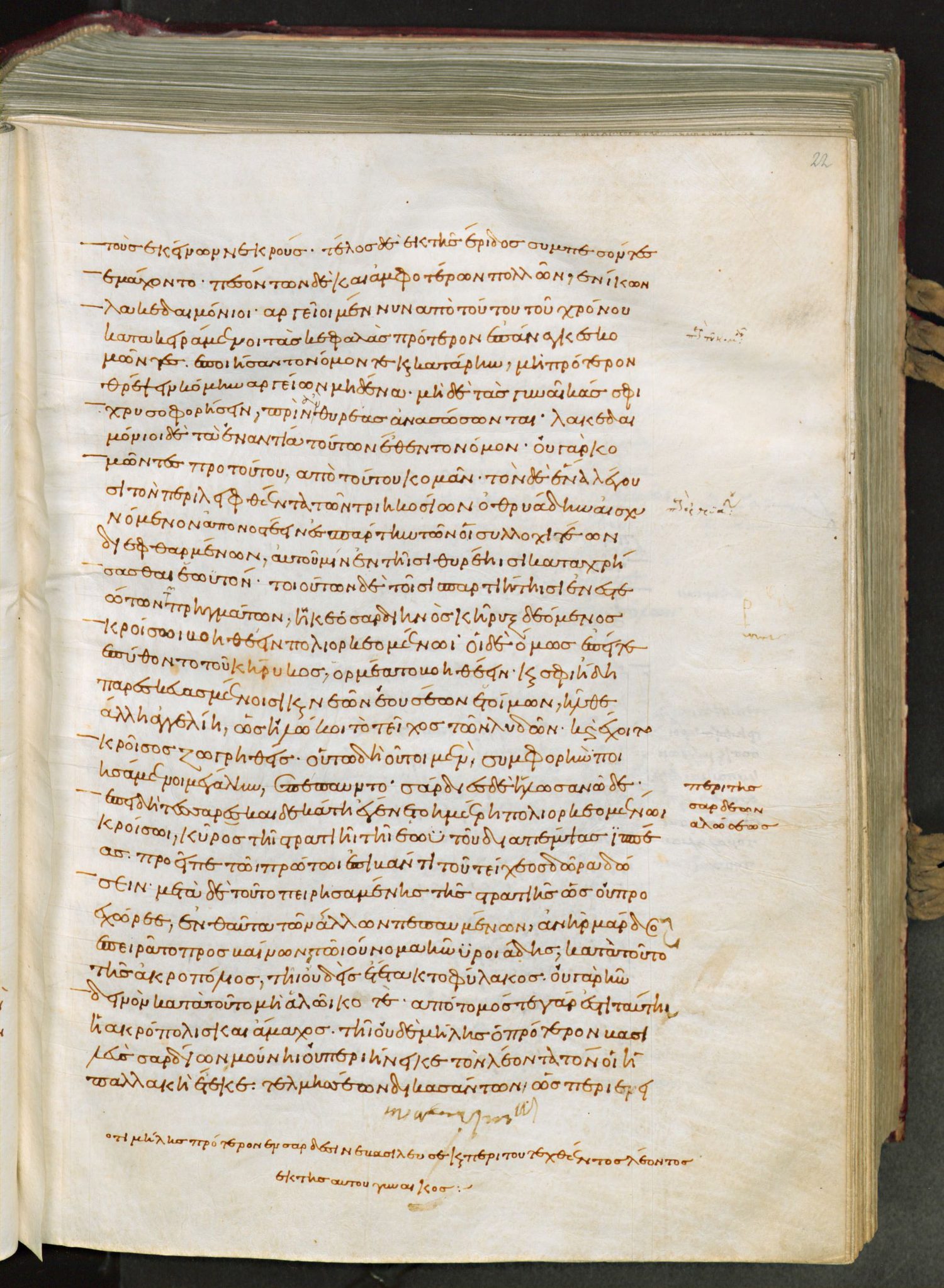
Laur. Plut. 70.3, fol. 22r: Greek here 1.82.6 to 1.84.3. Checked on the image (first and last words read and located in the Greek; each break checked against the neighbouring page): fol. 22r begins ‹τοὺς ἐκείνων νεκρούς·τέλος δὲ› (1.82.6), ends ‹Τελμησσέων δικασάντων ὡς περιενειχθέντος› (1.84.3). Below the text, a reader's notes on the lion carried round the wall and on Meles' concubine. English here: 1.82.7 to 1.84.3 (Godley's sentences for the sections whose Greek lies mostly on this page).
1.82.6τοὺς ἐκείνων νεκρούς· 1.82.7τέλος δὲ ἐκ τῆς ἔριδος συμπεσόντες ἐμάχοντο, πεσόντων δὲ καὶ ἀμφοτέρων πολλῶν ἐνίκων Λακεδαιμόνιοι. Ἀργεῖοι μέν νυν ἀπὸ τούτου τοῦ χρόνου κατακειράμενοι τὰς κεφαλάς, πρότερον ἐπάναγκες κομῶντες, ἐποιήσαντο νόμον τε καὶ κατάρην μὴ πρότερον θρέψειν κόμην Ἀργείων μηδένα, μηδὲ τὰς γυναῖκάς σφι χρυσοφορήσειν, πρὶν Θυρέας ἀνασώσωνται. 1.82.8Λακεδαιμόνιοι δὲ τὰ ἐναντία τούτων ἔθεντο νόμον· οὐ γὰρ κομῶντες πρὸ τούτου ἀπὸ τούτου κομᾶν. τὸν δὲ ἕνα λέγουσι τὸν περιλειφθέντα τῶν τριηκοσίων Ὀθρυάδην, αἰσχυνόμενον ἀπονοστέειν ἐς Σπάρτην τῶν οἱ συλλοχιτέων διεφθαρμένων, αὐτοῦ μιν ἐν τῇσι Θυρέῃσι καταχρήσασθαι ἑωυτόν. 1.83.1τοιούτων δὲ τοῖσι Σπαρτιήτῃσι ἐνεστεώτων πρηγμάτων ἧκε ὁ Σαρδιηνὸς κῆρυξ δεόμενος Κροίσῳ βοηθέειν πολιορκεομένῳ. οἳ δὲ ὅμως, ἐπείτε ἐπύθοντο τοῦ κήρυκος, ὁρμέατο βοηθέειν. καί σφι ἤδη παρεσκευασμένοισι καὶ νεῶν ἐουσέων ἑτοίμων ἦλθε ἄλλη ἀγγελίη, ὡς ἡλώκοι τὸ τεῖχος τῶν Λυδῶν καὶ ἔχοιτο Κροῖσος ζωγρηθείς. οὕτω δὴ οὗτοι μὲν συμφορὴν ποιησάμενοι μεγάλην ἐπέπαυντο. 1.84.1Σάρδιες δὲ ἥλωσαν ὧδε. ἐπειδὴ τεσσερεσκαιδεκάτη ἐγένετο ἡμέρη πολιορκεομένῳ Κροίσῳ, Κῦρος τῇ στρατιῇ τῇ ἑωυτοῦ διαπέμψας ἱππέας προεῖπε τῷ πρώτῳ ἐπιβάντι τοῦ τείχεος δῶρα δώσειν. 1.84.2μετὰ δὲ τοῦτο πειρησαμένης τῆς στρατιῆς ὡς οὐ προεχώρεε, ἐνθαῦτα τῶν ἄλλων πεπαυμένων ἀνὴρ Μάρδος ἐπειρᾶτο προσβαίνων, τῷ οὔνομα ἦν Ὑροιάδης, κατὰ τοῦτο τῆς ἀκροπόλιος τῇ οὐδεὶς ἐτέτακτο φύλακος· οὐ γὰρ ἦν δεινὸν κατὰ τοῦτο μὴ ἁλῷ κοτέ. 1.84.3ἀπότομός τε γὰρ ἐστὶ ταύτῃ ἡ ἀκρόπολις καὶ ἄμαχος· τῇ οὐδὲ Μήλης ὁ πρότερον βασιλεὺς Σαρδίων μούνῃ οὐ περιήνεικε τὸν λέοντα τὸν οἱ ἡ παλλακὴ ἔτεκε, Τελμησσέων δικασάντων ὡς περιενειχθέντος
1.82.7At last the dispute so ended that they joined battle and fought; many of both sides fell, but the Lacedaemonians had the victory. Ever after this the Argives, who before had worn their hair long by fixed custom, shaved their heads, and made a law, with a curse added thereto, that no Argive should grow his hair, and no Argive woman should wear gold, till they should recover Thyreae; 1.82.8and the Lacedaemonians made a contrary law, that ever after they should wear their hair long; for till now they had not so worn it. Othryades, the one survivor of the three hundred, was ashamed, it is said, to return to Sparta after all the men of his company had been slain, and killed himself on the spot at Thyreae. 1.83.1All this had befallen the Spartans when the Sardian herald came to entreat their help for Croesus, now besieged; yet for all that, when they heard the herald they prepared to send help; but when they were already equipped and their ships ready, there came a second message which told that the fortress of the Lydians was taken and Croesus held a prisoner. Then indeed, though greatly grieved, they ceased from their enterprise. 1.84.1Now this is how Sardis was taken. When Croesus had been besieged for fourteen days, Cyrus sent horsemen about in his army to promise rewards to him who should first mount the wall. 1.84.2After this the army made an assault, but with no success. Then, all the rest being at a stand, a certain Mardian called Hyroeades essayed to mount by a part of the citadel where no guard had been set; for here the height on which the citadel stood was sheer and hardly 1.84.3to be assaulted, and none feared that it could be taken by an attack made here. This was the only place where Meles the former king of Sardis had not carried the lion which his concubine had borne him, the Telmessians having declared that if this lion were carried round the walls Sardis could never be taken. Meles then carried the lion round the rest of the wall of the acropolis where it could be assaulted, but neglected this place, because the height was sheer and defied attack. It is on the side of the city which faces towards Tmolus.
Where on the image
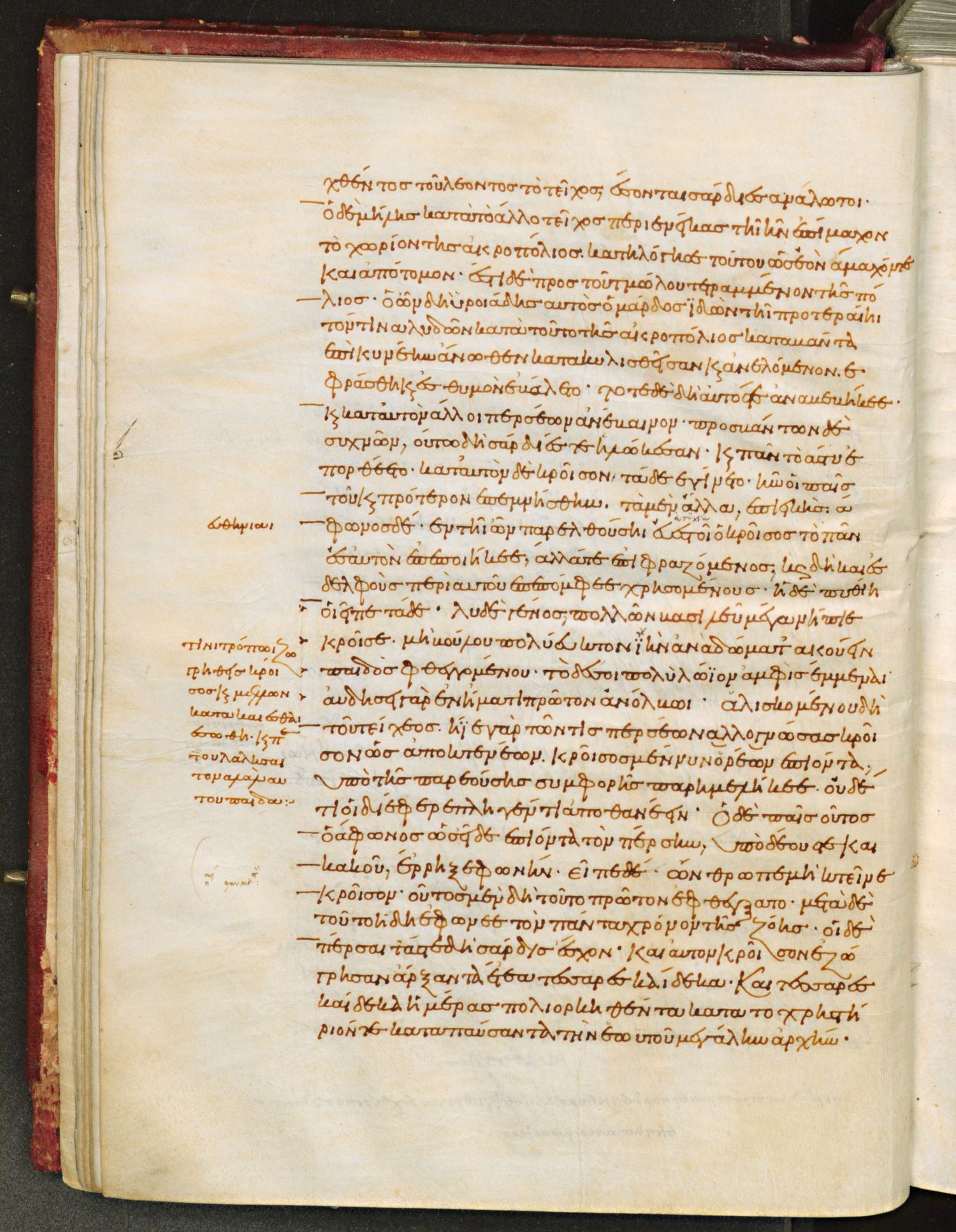
Laur. Plut. 70.3, fol. 22v: Greek here 1.84.3 to 1.85.4. Checked on the image (first and last words read and located in the Greek; each break checked against the neighbouring page): fol. 22v begins ‹τοῦ λέοντος τὸ τεῖχος› (1.84.3), ends ‹τὴν ἑωυτοῦ μεγάλην ἀρχήν› (1.86.1). English here: 1.84.4 to 1.85.4 (Godley's sentences for the sections whose Greek lies mostly on this page).
1.84.3τοῦ λέοντος τὸ τεῖχος ἔσονται Σάρδιες ἀνάλωτοι. ὁ δὲ Μήλης κατὰ τὸ ἄλλο τεῖχος περιενείκας, τῇ ἦν ἐπίμαχον τὸ χωρίον τῆς ἀκροπόλιος, κατηλόγησε τοῦτο ὡς ἐὸν ἄμαχόν τε καὶ ἀπότομον· ἔστι δὲ πρὸς τοῦ Τμώλου τετραμμένον τῆς πόλιος. 1.84.4ὁ ὦν δὴ Ὑροιάδης οὗτος ὁ Μάρδος ἰδὼν τῇ προτεραίῃ τῶν τινα Λυδῶν κατὰ τοῦτο τῆς ἀκροπόλιος καταβάντα ἐπὶ κυνέην ἄνωθεν κατακυλισθεῖσαν καὶ ἀνελόμενον, ἐφράσθη καὶ ἐς θυμὸν ἐβάλετο· 1.84.5τότε δὲ δὴ αὐτός τε ἀναβεβήκεε καὶ κατʼ αὐτὸν ἄλλοι Περσέων ἀνέβαινον· προσβάντων δὲ συχνῶν οὕτω δὴ Σάρδιές τε ἡλώκεσαν καὶ πᾶν τὸ ἄστυ ἐπορθέετο. 1.85.1κατʼ αὐτὸν δὲ Κροῖσον τάδε ἐγίνετο. ἦν οἱ παῖς, τοῦ καὶ πρότερον ἐπεμνήσθην, τὰ μὲν ἄλλα ἐπιεικής, ἄφωνος δέ. ἐν τῇ ὦν παρελθούσῃ εὐεστοῖ ὁ Κροῖσος τὸ πᾶν ἐς αὐτὸν ἐπεποιήκεε, ἄλλα τε ἐπιφραζόμενος, καὶ δὴ καὶ ἐς Δελφοὺς περὶ αὐτοῦ ἐπεπόμφεε χρησομένους. 1.85.2ἡ δὲ Πυθίη οἱ εἶπε τάδε.
Λυδὲ γένος, πολλῶν βασιλεῦ, μέγα νήπιε Κροῖσε,
μὴ βούλου πολύευκτον ἰὴν ἀνὰ δώματʼ ἀκούειν
παιδὸς φθεγγομένου. τὸ δέ σοι πολὺ λώιον ἀμφὶς
ἔμμεναι· αὐδήσει γὰρ ἐν ἤματι πρῶτον ἀνόλβῳ. 1.85.3ἁλισκομένου δὴ τοῦ τείχεος, ἤιε γὰρ τῶν τις Περσέων ἀλλογνώσας Κροῖσον ὡς ἀποκτενέων, Κροῖσος μέν νυν ὁρέων ἐπιόντα ὑπὸ τῆς παρεούσης συμφορῆς παρημελήκεε, οὐδὲ τί οἱ διέφερε πληγέντι ἀποθανεῖν· 1.85.4ὁ δὲ παῖς οὗτος ὁ ἄφωνος ὡς εἶδε ἐπιόντα τὸν Πέρσην, ὑπὸ δέους τε καὶ κακοῦ ἔρρηξε φωνήν, εἶπε δὲ ὤνθρώπε, μὴ κτεῖνε Κροῖσον. οὗτος μὲν δὴ τοῦτο πρῶτον ἐφθέγξατο, μετὰ δὲ τοῦτο ἤδη ἐφώνεε τὸν πάντα χρόνον τῆς ζόης.
1.84.4So then it chanced that on the day before this Mardian, Hyroeades, had seen one of the Lydians descend by this part of the citadel after a helmet that had fallen down, and fetch it; he took note of this and considered it, 1.84.5and now he himself climbed up, and other Persians after him. Many ascended, and thus was Sardis taken and all the city like to be sacked. 1.85.1I will now tell what befell Croesus himself. He had a son, of whom I have already spoken, a likely youth enough save that he was dumb. Now in his past days of prosperity Croesus had done all that he could for his son; and besides resorting to other plans he had sent to Delphi to inquire of the oracle concerning him. 1.85.2The Pythian priestess thus answered him: “Lydian, of many the lord, thou know’st not the boon that thou askest. Wish not nor pray that the voice of thy son may be heard in the palace; Better it were for thee that dumb he abide as aforetime; Luckless that day shall be when first thou hearest him speaking.” 1.85.3So at the taking of the fortress a certain Persian, not knowing who Croesus was, came at him with intent to kill him. Croesus saw him coming, but by stress of misfortune he was past caring, and would as soon be smitten to death as not; 1.85.4but this dumb son, seeing the Persian coming, in his fear and his grief broke into speech and cried, “Man, do not kill Croesus!” This was the first word he uttered; and after that for all the days of his life he had power of speech.
Notes
- Greek: the text printed in A. D. Godley's Loeb edition, via Perseus (tlg0016.tlg001.perseus-grc2). Square brackets mark words the editor considers later additions; [...] marks a gap the editor indicates. Perseus note markers are omitted.
- English: A. D. Godley, Herodotus vol. 1 (1920) (Loeb Classical Library), as transcribed on Wikisource. Godley's footnotes are omitted.
- Section numbers in the English were placed by comparing Godley's text with the Perseus version of his translation; where a section begins inside one of Godley's sentences, the English is kept with the page that holds the start of that sentence.
Cite
Sources
- Source: Florence, Laur. Plut. 70.3 (10th c.) via BML Teca Digitale + Greek of Godley's Loeb (Perseus) + English of A. D. Godley (Loeb, Wikisource) (holding institution)
- Critical edition: Greek of A. D. Godley's Loeb edition (1920-1925), via Perseus
← previous · → next · v cycle view · l back to library