Herodotus, Histories 1.86-94: Croesus on the pyre; the Lydians
Introduction
Herodotus of Halicarnassus wrote the Histories in the third quarter of the 5th century BCE, an inquiry into the deeds of Greeks and barbarians and the causes of the wars between them, later divided into nine books. Book 1 tells how the conflict between Greeks and barbarians began, the history of Lydia from Gyges to Croesus, the rise of the Medes and of Cyrus the Persian, the conquest of the Greeks of Asia, the capture of Babylon and the death of Cyrus.
The photographs are of Florence, Biblioteca Medicea Laurenziana, Plut. 70.3 (parchment, 10th century, 374 folios, 31 lines a page), Herodotus, Histories (codex A of the editors), the oldest surviving manuscript of the complete Histories, from the Teca Digitale of the Biblioteca Medicea Laurenziana. Each section below is the text of one page, or of the part of a page that falls within these chapters. The first and last words of every page were read on the photograph and located in the Greek, and every page break was checked against the next page; the notes quote these words. Readers' notes in the margins are not part of the text and are mentioned where they occur.
The Greek is the text printed in A. D. Godley's Loeb edition (1920-1925), from Perseus; it is the edited text, not a transcription of the manuscript, whose wording differs in places. The English is Godley's translation as printed, from Wikisource. Godley's English carries only chapter numbers; the section numbers shown in it were placed by comparison with the Perseus version of his translation. Each page's English is cut at the end of one of Godley's sentences, so it can begin or end a few lines away from the Greek of the page; each note gives the exact ranges.
This entry covers chapters 1.86-94, on fol. 22v to 26r.
How was this verified? (Provenance)
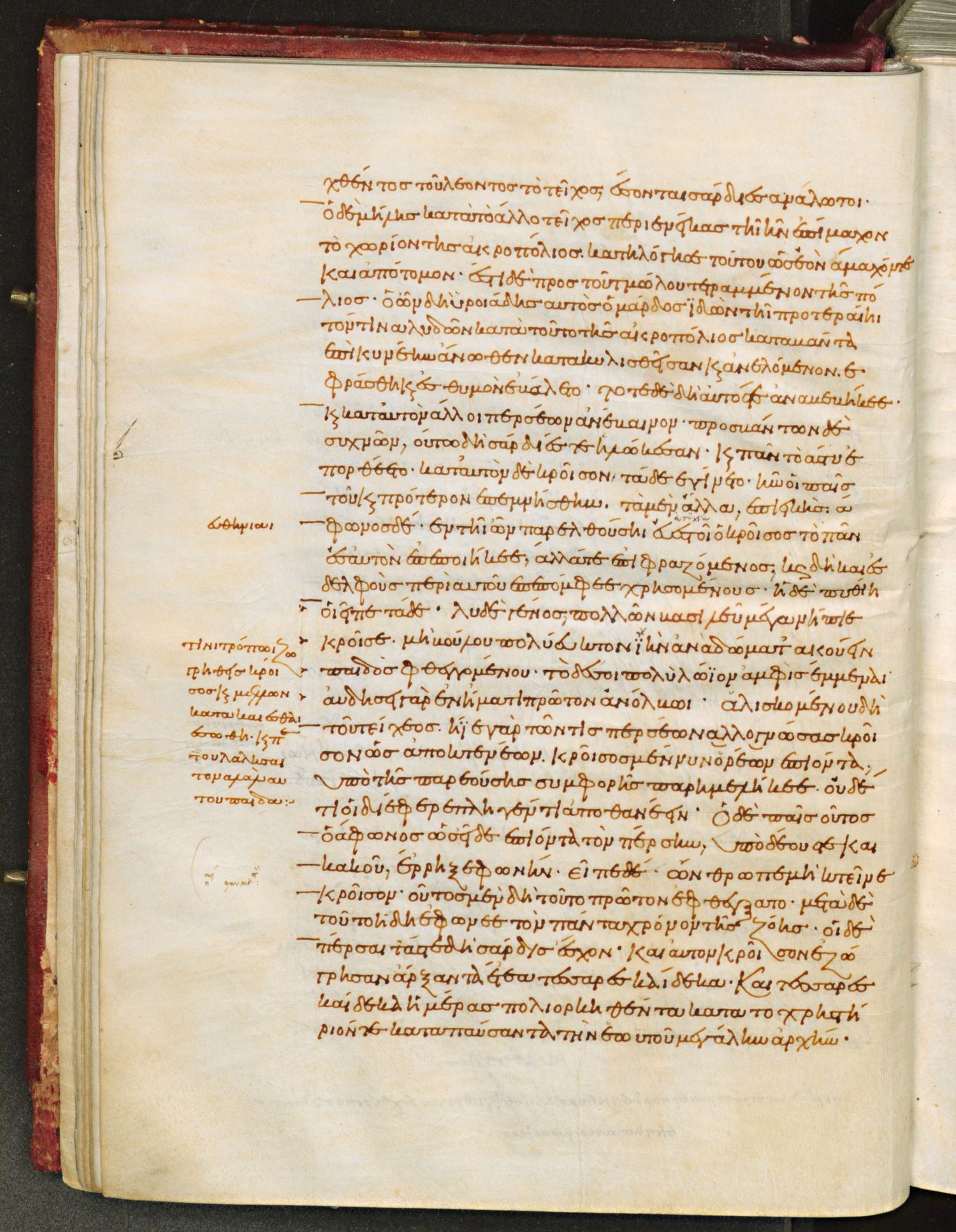
Where on the image
Laur. Plut. 70.3, fol. 22v: Greek here 1.86.1. Checked on the image (first and last words read and located in the Greek; each break checked against the neighbouring page): fol. 22v begins ‹τοῦ λέοντος τὸ τεῖχος› (1.84.3), ends ‹τὴν ἑωυτοῦ μεγάλην ἀρχήν› (1.86.1). English here: 1.86.1 (Godley's sentences for the sections whose Greek lies mostly on this page).
1.86.1οἱ δὲ Πέρσαι τάς τε δὴ Σάρδις ἔσχον καὶ αὐτὸν Κροῖσον ἐζώγρησαν, ἄρξαντα ἔτεα τεσσερεσκαίδεκα καὶ τεσσερεσκαίδεκα ἡμέρας πολιορκηθέντα, κατὰ τὸ χρηστήριόν τε καταπαύσαντα τὴν ἑωυτοῦ μεγάλην ἀρχήν.
1.86.1So the Persians took Sardis and made Croesus himself prisoner, he having reigned fourteen years and been besieged fourteen days, and, as the oracle foretold, brought his own great empire to an end. Having then taken him they led him to Cyrus.
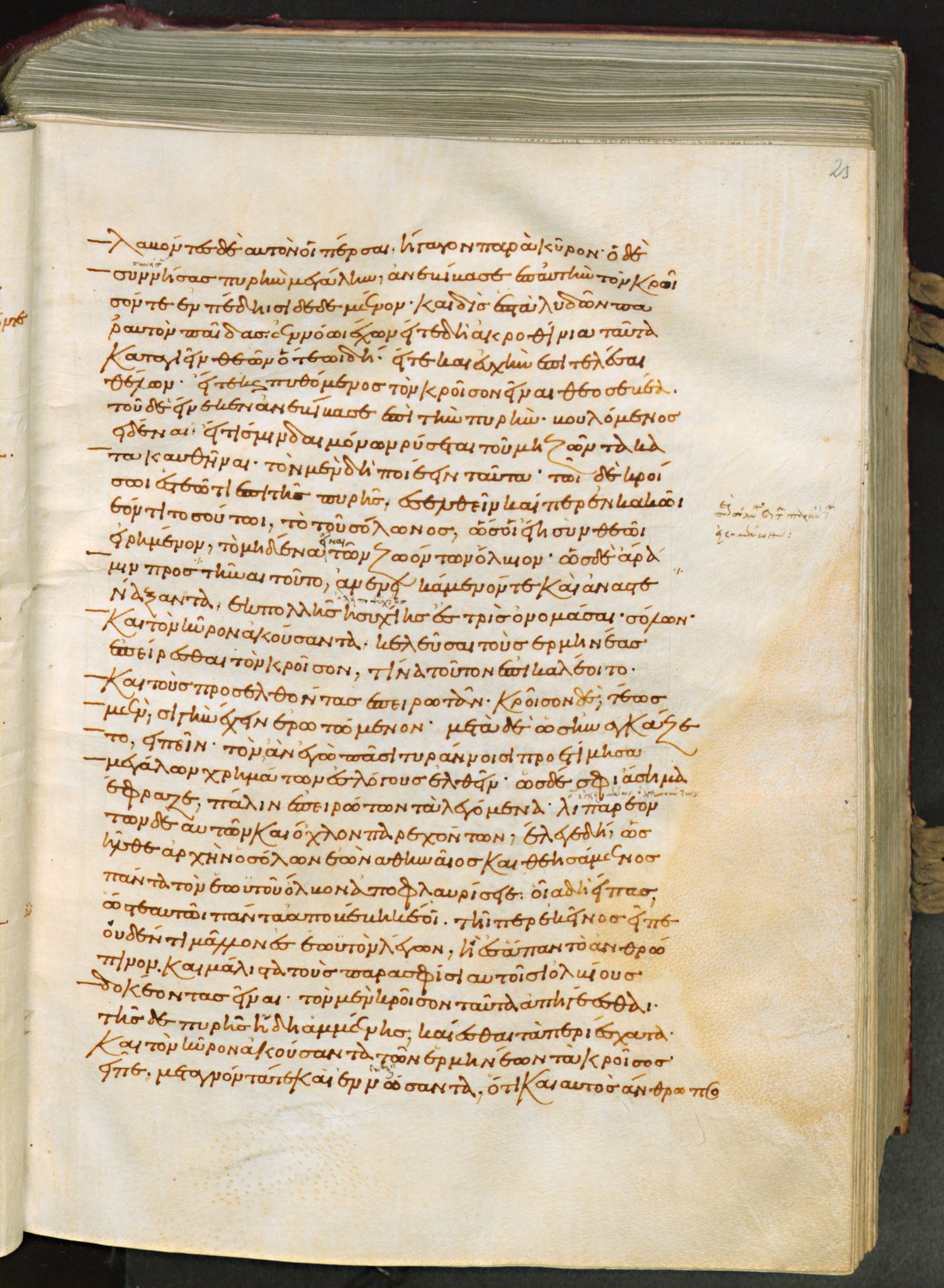
Where on the image
Laur. Plut. 70.3, fol. 23r: Greek here 1.86.1 to 1.86.6. Checked on the image (first and last words read and located in the Greek; each break checked against the neighbouring page): fol. 23r begins ‹λαβόντες δὲ αὐτὸν οἱ› (1.86.1), ends ‹ὅτι καὶ αὐτὸς ἄνθρωπος› (1.86.6). English here: 1.86.2 to 1.86.5 (Godley's sentences for the sections whose Greek lies mostly on this page).
1.86.1λαβόντες δὲ αὐτὸν οἱ Πέρσαι ἤγαγον παρὰ Κῦρον. 1.86.2ὁ δὲ συννήσας πυρὴν μεγάλην ἀνεβίβασε ἐπʼ αὐτὴν τὸν Κροῖσόν τε ἐν πέδῃσι δεδεμένον καὶ δὶς ἑπτὰ Λυδῶν παρʼ αὐτὸν παῖδας, ἐν νόῳ ἔχων εἴτε δὴ ἀκροθίνια ταῦτα καταγιεῖν θεῶν ὅτεῳ δή, εἴτε καὶ εὐχὴν ἐπιτελέσαι θέλων, εἴτε καὶ πυθόμενος τὸν Κροῖσον εἶναι θεοσεβέα τοῦδε εἵνεκεν ἀνεβίβασε ἐπὶ τὴν πυρήν, βουλόμενος εἰδέναι εἴ τίς μιν δαιμόνων ῥύσεται τοῦ μὴ ζῶντα κατακαυθῆναι. 1.86.3τὸν μὲν δὴ ποιέειν ταῦτα· τῷ δὲ Κροίσῳ ἑστεῶτι ἐπὶ τῆς πυρῆς ἐσελθεῖν, καίπερ ἐν κακῷ ἐόντι τοσούτῳ, τὸ τοῦ Σόλωνος ὥς οἱ εἴη σὺν θεῷ εἰρημένον, τὸ μηδένα εἶναι τῶν ζωόντων ὄλβιον. ὡς δὲ ἄρα μιν προσστῆναι τοῦτο, ἀνενεικάμενόν τε καὶ ἀναστενάξαντα ἐκ πολλῆς ἡσυχίης ἐς τρὶς ὀνομάσαι Σόλων. 1.86.4καὶ τὸν Κῦρον ἀκούσαντα κελεῦσαι τοὺς ἑρμηνέας ἐπειρέσθαι τὸν Κροῖσον τίνα τοῦτον ἐπικαλέοιτο, καὶ τοὺς προσελθόντας ἐπειρωτᾶν· Κροῖσον δὲ τέως μὲν σιγὴν ἔχειν εἰρωτώμενον, μετὰ δὲ ὡς ἠναγκάζετο, εἰπεῖν τὸν ἂν ἐγὼ πᾶσι τυράννοισι προετίμησα μεγάλων χρημάτων ἐς λόγους ἐλθεῖν. ὡς δέ σφι ἄσημα ἔφραζε, πάλιν ἐπειρώτων τὰ λεγόμενα. 1.86.5λιπαρεόντων δὲ αὐτῶν καὶ ὄχλον παρεχόντων, ἔλεγε δὴ ὡς ἦλθε ἀρχὴν ὁ Σόλων ἐὼν Ἀθηναῖος, καὶ θεησάμενος πάντα τὸν ἑωυτοῦ ὄλβον ἀποφλαυρίσειε οἷα δὴ εἶπας, ὥς τε αὐτῷ πάντα ἀποβεβήκοι τῇ περ ἐκεῖνος εἶπε, οὐδέν τι μᾶλλον ἐς ἑωυτὸν λέγων ἢ οὐκ ἐς ἅπαν τὸ ἀνθρώπινον καὶ μάλιστα τοὺς παρὰ σφίσι αὐτοῖσι ὀλβίους δοκέοντας εἶναι. τὸν μὲν Κροῖσον ταῦτα ἀπηγέεσθαι, τῆς δὲ πυρῆς ἤδη ἁμμένης καίεσθαι τὰ περιέσχατα. 1.86.6καὶ τὸν Κῦρον ἀκούσαντα τῶν ἑρμηνέων τὰ Κροῖσος εἶπε, μεταγνόντα τε καὶ ἐννώσαντα ὅτι καὶ αὐτὸς ἄνθρωπος
1.86.2Cyrus had a great pyre built, on which he set Croesus, bound in chains, and twice seven Lydian boys beside him: either his intent was to sacrifice these firstfruits to some one of his gods, or he desired to fulfil a vow, or it may be that, learning that Croesus was a god-fearing man, he set him for this cause on the pyre, because he would fain know if any deity would save him from being burnt alive. 1.86.3It is related then that he did this; but Croesus, as he stood on the pyre, remembered even in his evil plight how divinely inspired was that saying of Solon, that no living man was blest. When this came to his mind, having till now spoken no word, he sighed deeply and groaned, and thrice uttered the name of Solon. 1.86.4Cyrus heard it, and bade his interpreters ask Croesus who was this on whom he called; they came near and asked him; Croesus at first would say nothing in answer, but presently, being compelled, he said, “It is one with whom I would have given much wealth that all sovereigns should hold converse.” This was a dark saying to them, and again they questioned him of the words which he spoke. 1.86.5As they were instant, and troubled him, he told them then how Solon, an Athenian, had first come, and how he had seen all his royal state and made light of it (saying thus and thus), and how all had happened to Croesus as Solon said, though he spoke with less regard to Croesus than to mankind in general and chiefly those who deemed themselves blest. While Croesus thus told his story, the pyre had already been kindled and the outer parts of it were burning.
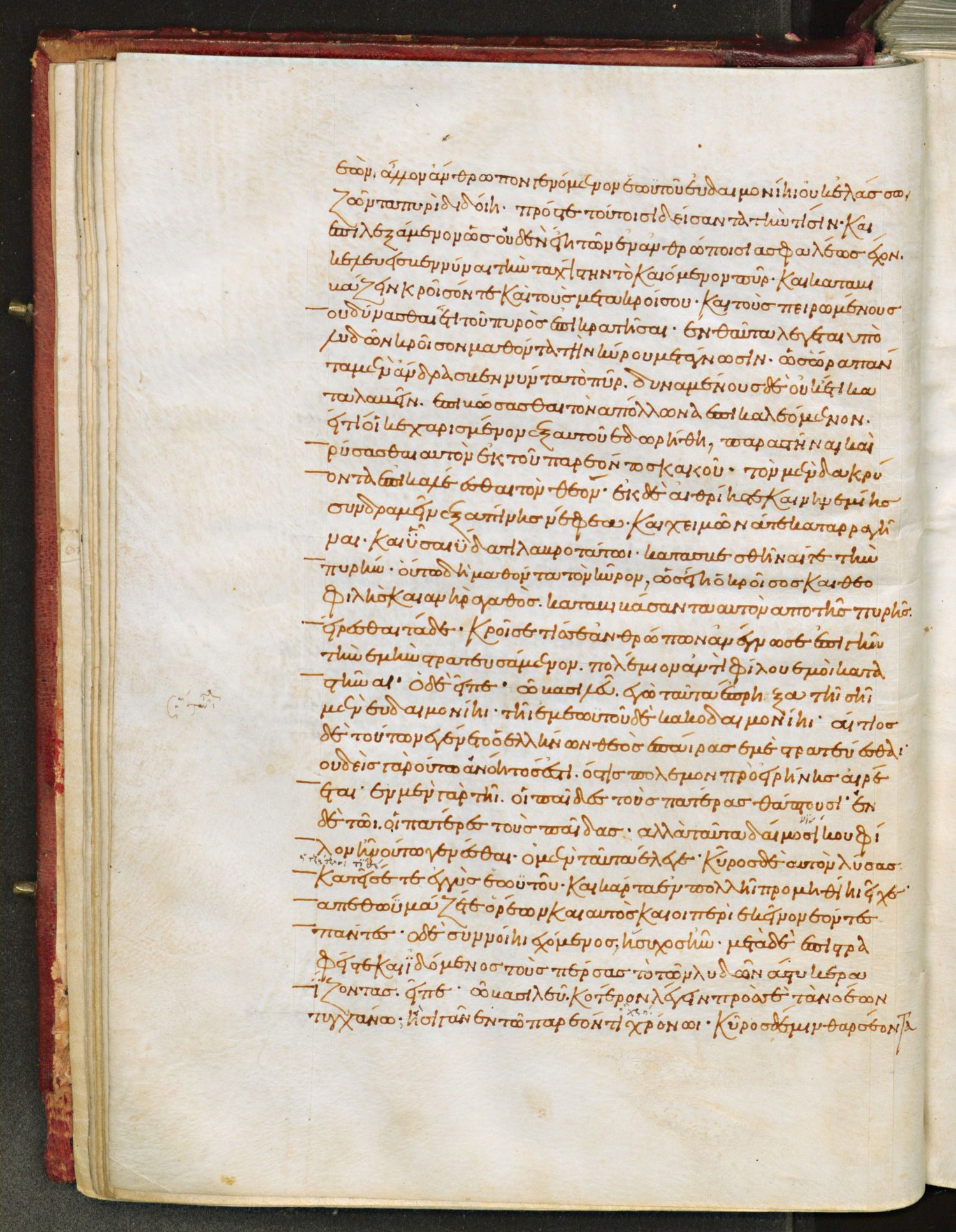
Where on the image
Laur. Plut. 70.3, fol. 23v: Greek here 1.86.6 to 1.88.2. Checked on the image (first and last words read and located in the Greek; each break checked against the neighbouring page): fol. 23v begins ‹ἐὼν ἄλλον ἄνθρωπον, γενόμενον› (1.86.6), ends ‹Κῦρος δέ μιν θαρσέοντα› (1.88.2). English here: 1.86.6 to 1.88.3 (Godley's sentences for the sections whose Greek lies mostly on this page).
1.86.6ἐὼν ἄλλον ἄνθρωπον, γενόμενον ἑωυτοῦ εὐδαιμονίῃ οὐκ ἐλάσσω, ζῶντα πυρὶ διδοίη, πρός τε τούτοισι δείσαντα τὴν τίσιν καὶ ἐπιλεξάμενον ὡς οὐδὲν εἴη τῶν ἐν ἀνθρώποισι ἀσφαλέως ἔχον, κελεύειν σβεννύναι τὴν ταχίστην τὸ καιόμενον πῦρ καὶ καταβιβάζειν Κροῖσόν τε καὶ τοὺς μετὰ Κροίσου. καὶ τοὺς πειρωμένους οὐ δύνασθαι ἔτι τοῦ πυρὸς ἐπικρατῆσαι. 1.87.1ἐνθαῦτα λέγεται ὑπὸ Λυδῶν Κροῖσον μαθόντα τὴν Κύρου μετάγνωσιν, ὡς ὥρα πάντα μὲν ἄνδρα σβεννύντα τὸ πῦρ, δυναμένους δὲ οὐκέτι καταλαβεῖν, ἐπιβώσασθαι τὸν Ἀπόλλωνα ἐπικαλεόμενον, εἴ τί οἱ κεχαρισμένον ἐξ αὐτοῦ ἐδωρήθη, παραστῆναι καὶ ῥύσασθαι αὐτὸν ἐκ τοῦ παρεόντος κακοῦ. 1.87.2τὸν μὲν δακρύοντα ἐπικαλέεσθαι τὸν θεόν, ἐκ δὲ αἰθρίης τε καὶ νηνεμίης συνδραμεῖν ἐξαπίνης νέφεα καὶ χειμῶνά τε καταρραγῆναι καὶ ὗσαι ὕδατι λαβροτάτῳ, κατασβεσθῆναί τε τὴν πυρήν. οὕτω δὴ μαθόντα τὸν Κῦρον ὡς εἴη ὁ Κροῖσος καὶ θεοφιλὴς καὶ ἀνὴρ ἀγαθός, καταβιβάσαντα αὐτὸν ἀπὸ τῆς πυρῆς εἰρέσθαι τάδε. 1.87.3Κροῖσε, τίς σε ἀνθρώπων ἀνέγνωσε ἐπὶ γῆν τὴν ἐμὴν στρατευσάμενον πολέμιον ἀντὶ φίλου ἐμοὶ καταστῆναι; ὁ δὲ εἶπε ὦ βασιλεῦ, ἐγὼ ταῦτα ἔπρηξα τῇ σῇ μὲν εὐδαιμονίῃ, τῇ ἐμεωυτοῦ δὲ κακοδαιμονίῃ, αἴτιος δὲ τούτων ἐγένετο ὁ Ἑλλήνων θεὸς ἐπαείρας ἐμὲ στρατεύεσθαι. 1.87.4οὐδεὶς γὰρ οὕτω ἀνόητος ἐστὶ ὅστις πόλεμον πρὸ εἰρήνης αἱρέεται· ἐν μὲν γὰρ τῇ οἱ παῖδες τοὺς πατέρας θάπτουσι, ἐν δὲ τῷ οἱ πατέρες τοὺς παῖδας. ἀλλὰ ταῦτα δαίμοσί κου φίλον ἦν οὕτω γενέσθαι. 1.88.1ὅ μὲν ταῦτα ἔλεγε, Κῦρος δὲ αὐτὸν λύσας κατεῖσέ τε ἐγγὺς ἑωυτοῦ καὶ κάρτα ἐν πολλῇ προμηθίῃ εἶχε, ἀπεθώμαζέ τε ὁρέων καὶ αὐτὸς καὶ οἱ περὶ ἐκεῖνον ἐόντες πάντες. ὁ δὲ συννοίῃ ἐχόμενος ἥσυχος ἦν· 1.88.2μετὰ δὲ ἐπιστραφείς τε καὶ ἰδόμενος τοὺς Πέρσας τὸ τῶν Λυδῶν ἄστυ κεραΐζοντας εἶπε ὦ βασιλεῦ, κότερον λέγειν πρὸς σὲ τὰ νοέων τυγχάνω ἢ σιγᾶν ἐν τῷ παρεόντι χρή; Κῦρος δέ μιν θαρσέοντα
1.86.6Then Cyrus, when he heard from the interpreters what Croesus said, repented of his purpose. He bethought him that he, being also a man, was burning alive another man who had once been as fortunate as himself; moreover, he feared the retribution, and it came to his mind that there was no stability in human affairs; wherefore he gave command to quench the burning fire with all speed and bring Croesus and those with him down from the pyre. But his servants could not for all their endeavour now master the fire. 1.87.1Then (so the Lydians relate), when Croesus was aware of Cyrus’ repentance and saw all men striving to quench the fire but no longer able to check it, he cried aloud to Apollo, praying that if the god had ever been pleased with any gift of his offering he would now come to his aid and save him from present destruction. 1.87.2Thus with weeping he invoked the god: and suddenly in a clear and windless sky clouds gathered and a storm burs and there was a most violent rain, so that the pyre was quenched. Then indeed Cyrus perceived that Croesus was a good man and one beloved of the gods; and bringing him down from the pyre, he questioned him, 1.87.3saying, “What man persuaded you, Croesus, to attack my country with an army, and be my enemy instead of my friend?” “O King,” said Croesus, “it was I who did it, and brought thereby good fortune to you and ill to myself: but the cause of all was the god of the Greeks, in that he encouraged me to send my army. 1.87.4No man is so foolish as to desire war more than peace: for in peace sons bury their fathers, but in war fathers bury their sons. But I must believe that heaven willed all this so to be.” 1.88.1So said Croesus. Then Cyrus loosed him and set him near to himself and took much thought for him, and both he and all that were with him were astonished when they looked upon Croesus. He for his part was silent, deep in thought. 1.88.2Presently he turned and said (for he saw the Persians sacking the city of the Lydians), “O King, am I to say to you now what is in my mind, or keep silence?” Cyrus bidding him to say boldly what he would, Croesus asked, “ 1.88.3Yonder multitude, what is this whereon they are so busily engaged?” “They are plundering,” said Cyrus, “your city and carrying off your possessions.” “Nay,” Croesus answered, “not my city, nor my possessions; for I have no longer any share of all this; it is your wealth that they are ravishing.”
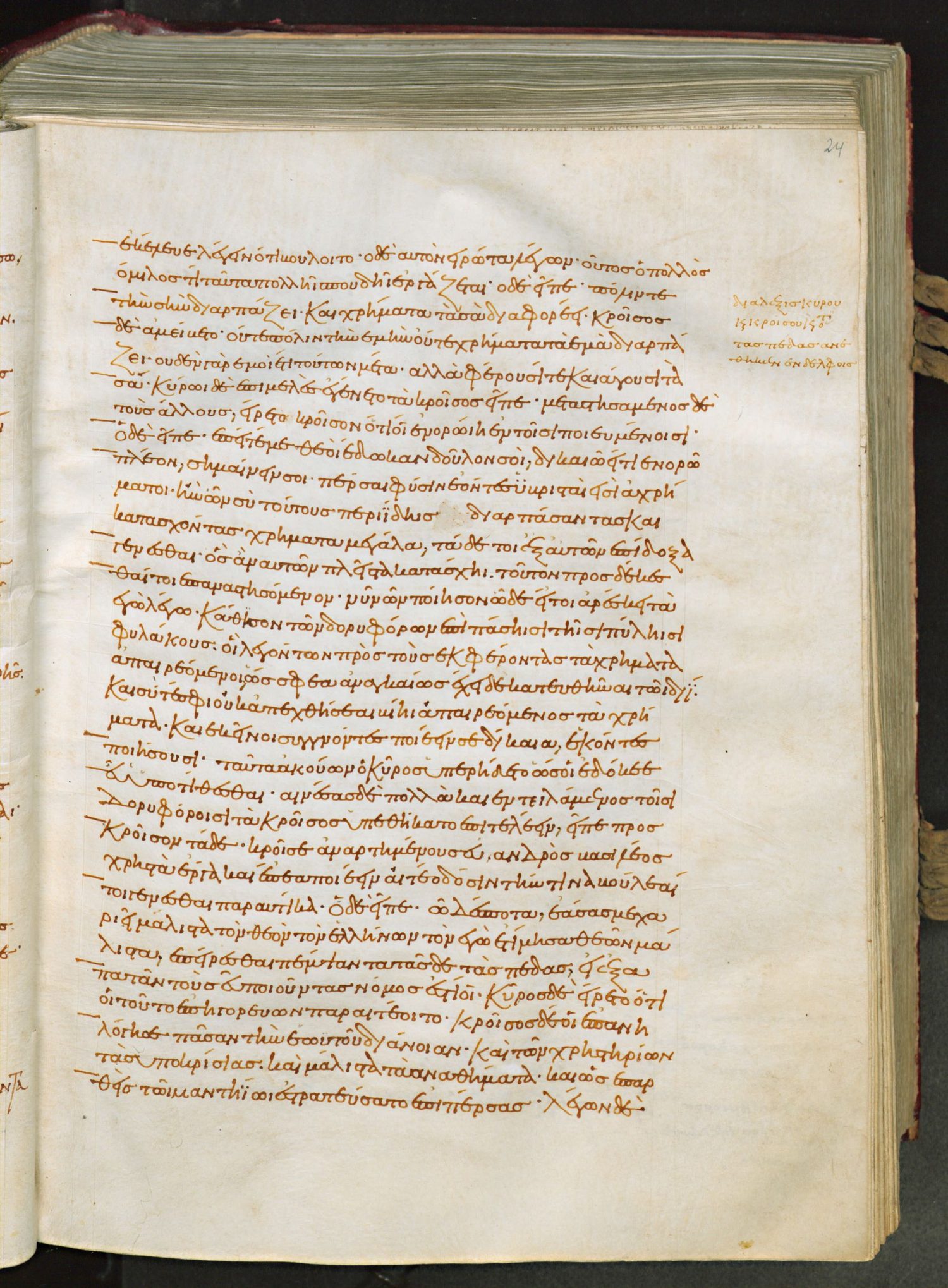
Where on the image
Laur. Plut. 70.3, fol. 24r: Greek here 1.88.2 to 1.90.3. Checked on the image (first and last words read and located in the Greek; each break checked against the neighbouring page): fol. 24r begins ‹ἐκέλευε λέγειν ὅ τι› (1.88.2), ends ‹ἐπὶ Πέρσας· λέγων δὲ› (1.90.3). English here: 1.89.1 to 1.90.3 (Godley's sentences for the sections whose Greek lies mostly on this page).
1.88.2ἐκέλευε λέγειν ὅ τι βούλοιτο. ὁ δὲ αὐτὸν εἰρώτα λέγων 1.88.3οὗτος ὁ πολλὸς ὅμιλος τί ταῦτα πολλῇ σπουδῇ ἐργάζεται; ὁ δὲ εἶπε πόλιν τε τὴν σὴν διαρπάζει καὶ χρήματα τὰ σὰ διαφορέει. Κροῖσος δὲ ἀμείβετο οὔτε πόλιν τὴν ἐμὴν οὔτε χρήματα τὰ ἐμὰ διαρπάζει· οὐδὲν γὰρ ἐμοὶ ἔτι τούτων μέτα· ἀλλὰ φέρουσί τε καὶ ἄγουσι τὰ σά. 1.89.1Κύρῳ δὲ ἐπιμελὲς ἐγένετο τὰ Κροῖσος εἶπε· μεταστησάμενος δὲ τοὺς ἄλλους, εἴρετο Κροῖσον ὅ τι οἱ ἐνορῴη ἐν τοῖσι ποιευμένοισι. ὁ δὲ εἶπε ἐπείτε με θεοὶ ἔδωκαν δοῦλον σοί, δικαιῶ, εἴ τι ἐνορέω πλέον, σημαίνειν σοί. 1.89.2Πέρσαι φύσιν ἐόντες ὑβρισταὶ εἰσὶ ἀχρήματοι. ἢν ὦν σὺ τούτους περιίδῃς διαρπάσαντας καὶ κατασχόντας χρήματα μεγάλα, τάδε τοὶ ἐξ αὐτῶν ἐπίδοξα γενέσθαι. ὃς ἂν αὐτῶν πλεῖστα κατάσχῃ, τοῦτον προσδέκεσθαί τοι ἐπαναστησόμενον. νῦν ὦν ποίησον ὧδε, εἲ τοι ἀρέσκει τὰ ἐγὼ λέγω· 1.89.3κάτισον τῶν δορυφόρων ἐπὶ πάσῃσι τῇσι πύλῃσι φυλάκους, οἳ λεγόντων πρὸς τοὺς ἐκφέροντας τὰ χρήματα ἀπαιρεόμενοι ὡς σφέα ἀναγκαίως ἔχει δεκατευθῆναι τῷ Διί. καὶ σύ τέ σφι οὐκ ἀπεχθήσεαι βίῃ ἀπαιρεόμενος τὰ χρήματα, καὶ ἐκεῖνοι συγγνόντες ποιέειν σε δίκαια ἑκόντες προήσουσι. 1.90.1ταῦτα ἀκούων ὁ Κῦρος ὑπερήδετο, ὥς οἱ ἐδόκεε εὖ ὑποτίθεσθαι· αἰνέσας δὲ πολλά, καὶ ἐντειλάμενος τοῖσι δορυφόροισι τὰ Κροῖσος ὑπεθήκατο ἐπιτελέειν, εἶπε πρὸς Κροῖσον τάδε. Κροῖσε, ἀναρτημένου σεῦ ἀνδρὸς βασιλέος χρηστὰ ἔργα καὶ ἔπεα ποιέειν, αἰτέο δόσιν ἥντινα βούλεαί τοι γενέσθαι παραυτίκα. 1.90.2ὁ δὲ εἶπε ὦ δέσποτα, ἐάσας με χαριεῖ μάλιστα τὸν θεὸν τῶν Ἑλλήνων, τὸν ἐγὼ ἐτίμησα θεῶν μάλιστα, ἐπειρέσθαι πέμψαντα τάσδε τὰς πέδας, εἰ ἐξαπατᾶν τοὺς εὖ ποιεῦντας νόμος ἐστί οἱ. Κῦρος δὲ εἴρετο ὅ τι οἱ τοῦτο ἐπηγορέων παραιτέοιτο. 1.90.3Κροῖσος δέ οἱ ἐπαλιλλόγησε πᾶσαν τὴν ἑωυτοῦ διάνοιαν καὶ τῶν χρηστηρίων τὰς ὑποκρίσιας καὶ μάλιστα τὰ ἀναθήματα, καὶ ὡς ἐπαερθεὶς τῷ μαντηίῳ ἐστρατεύσατο ἐπὶ Πέρσας· λέγων δὲ
1.89.1Cyrus thought upon what Croesus said, and bidding the rest withdraw he asked Croesus what fault he saw in what was being done. “Since the gods,” replied the Lydian, “have given me to be your slave, it is right that if I have any clearer sight of wrong done I should declare it to you. 1.89.2The Persians are violent men by nature, and poor withal; if then you suffer them to seize and hold great possessions, you may expect that he who has won most will rise in revolt against you. Now therefore do this, if what I say finds favour with you. 1.89.3Set men of your guard to watch all the gates; let them take the spoil from those who are carrying it out, and say that it must be paid as tithe to Zeus. Thus shall you not be hated by them for taking their wealth by force, and they for their part will acknowledge that you act justly, and will give up the spoil willingly.” 1.90.1When Cyrus heard this he was exceedingly pleased, for he deemed the counsel good; and praising him greatly, and bidding his guards to act as Croesus had counselled, he said: “Croesus, now that you, a king, are resolved to act and to speak aright, ask me now for whatever boon you desire forthwith.” 1.90.2“Master,” said Croesus, “you will best please me if you suffer me to send these my chains to that god of the Greeks whom I chiefly honoured, and to ask him if it be his custom to deceive those who serve him well.” Cyrus then asking him what charge he brought against the god that he made this request, 1.90.3Croesus repeated to him the tale of all his own intent, and the answers of the oracles, and more especially his offerings, and how it was the oracle that had heartened him to attack the Persians; and so saying he once more instantly entreated that he might be suffered to reproach the god for this. At this Cyrus smiled, and replied, “This I will grant you, Croesus, and what other boon soever you may at any time ask me.”
Where on the image
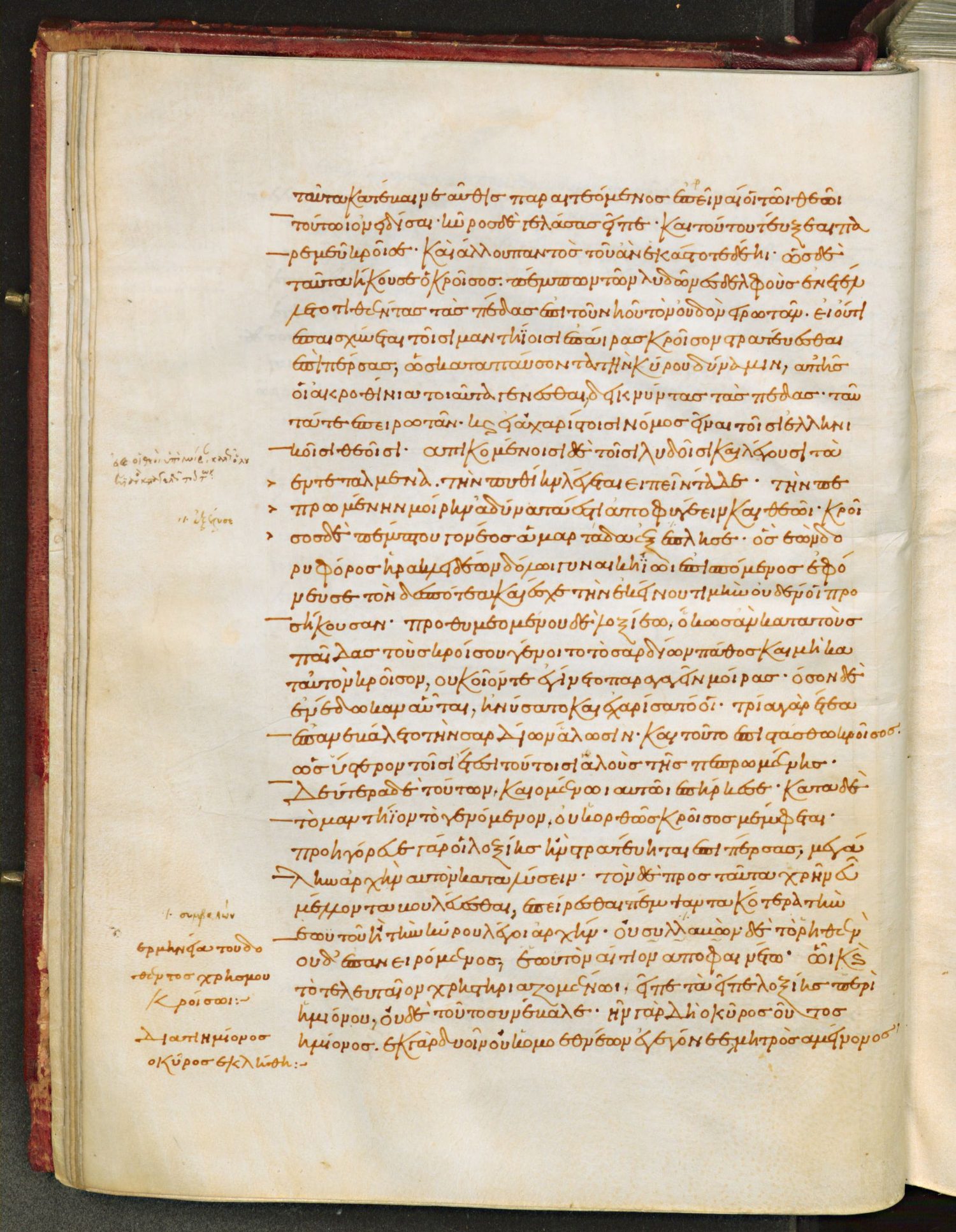
Laur. Plut. 70.3, fol. 24v: Greek here 1.90.3 to 1.91.5. Checked on the image (first and last words read and located in the Greek; each break checked against the neighbouring page): fol. 24v begins ‹ταῦτα κατέβαινε αὖτις παραιτεόμενος› (1.90.3), ends ‹ὁμοεθνέων ἐγεγόνεε, μητρὸς ἀμείνονος› (1.91.5). English here: 1.90.4 to 1.91.6 (Godley's sentences for the sections whose Greek lies mostly on this page).
1.90.3ταῦτα κατέβαινε αὖτις παραιτεόμενος ἐπεῖναί οἱ τῷ θεῷ τοῦτο ὀνειδίσαι. Κῦρος δὲ γελάσας εἶπε καὶ τούτου τεύξεαι παρʼ ἐμεῦ, Κροῖσε, καὶ ἄλλου παντὸς τοῦ ἂν ἑκάστοτε δέῃ. 1.90.4ὡς δὲ ταῦτα ἤκουσε ὁ Κροῖσος, πέμπων τῶν Λυδῶν ἐς Δελφοὺς ἐνετέλλετο τιθέντας τὰς πέδας ἐπὶ τοῦ νηοῦ τὸν οὐδὸν εἰρωτᾶν εἰ οὔ τι ἐπαισχύνεται τοῖσι μαντηίοισι ἐπαείρας Κροῖσον στρατεύεσθαι ἐπὶ Πέρσας ὡς καταπαύσοντα τὴν Κύρου δύναμιν, ἀπʼ ἧς οἱ ἀκροθίνια τοιαῦτα γενέσθαι, δεικνύντας τὰς πέδας· ταῦτά τε ἐπειρωτᾶν, καὶ εἰ ἀχαρίστοισι νόμος εἶναι τοῖσι Ἑλληνικοῖσι θεοῖσι. 1.91.1ἀπικομένοισι δὲ τοῖσι Λυδοῖσι καὶ λέγουσι τὰ ἐντεταλμένα τὴν Πυθίην λέγεται εἰπεῖν τάδε. τὴν πεπρωμένην μοῖραν ἀδύνατα ἐστὶ ἀποφυγεῖν καὶ θεῷ· Κροῖσος δὲ πέμπτου γονέος ἁμαρτάδα ἐξέπλησε, ὃς ἐὼν δορυφόρος Ἡρακλειδέων, δόλῳ γυναικηίῳ ἐπισπόμενος ἐφόνευσε τὸν δεσπότεα καὶ ἔσχε τὴν ἐκείνου τιμὴν οὐδέν οἱ προσήκουσαν. 1.91.2προθυμεομένου δὲ Λοξίεω ὅκως ἂν κατὰ τοὺς παῖδας τοῦ Κροίσου γένοιτο τὸ Σαρδίων πάθος καὶ μὴ κατʼ αὐτὸν Κροῖσον, οὐκ οἷόν τε ἐγίνετο παραγαγεῖν μοίρας. 1.91.3ὅσον δὲ ἐνέδωκαν αὗται, ἤνυσέ τε καὶ ἐχαρίσατό οἱ· τρία γὰρ ἔτεα ἐπανεβάλετο τὴν Σαρδίων ἅλωσιν, καὶ τοῦτο ἐπιστάσθω Κροῖσος ὡς ὕστερον τοῖσι ἔτεσι τούτοισι ἁλοὺς τῆς πεπρωμένης. δευτέρα δὲ τούτων καιομένῳ αὐτῷ ἐπήρκεσε. 1.91.4κατὰ δὲ τὸ μαντήιον τὸ γενόμενον οὐκ ὀρθῶς Κροῖσος μέμφεται. προηγόρευε γὰρ οἱ Λοξίης, ἢν στρατεύηται ἐπὶ Πέρσας, μεγάλην ἀρχὴν αὐτὸν καταλύσειν. τὸν δὲ πρὸς ταῦτα χρῆν εὖ μέλλοντα βουλεύεσθαι ἐπειρέσθαι πέμψαντα κότερα τὴν ἑωυτοῦ ἢ τὴν Κύρου λέγοι ἀρχήν. οὐ συλλαβὼν δὲ τὸ ῥηθὲν οὐδʼ ἐπανειρόμενος ἑωυτὸν αἴτιον ἀποφαινέτω· 1.91.5τῷ καὶ τὸ τελευταῖον χρηστηριαζομένῳ εἶπε Λοξίης περὶ ἡμιόνου, οὐδὲ τοῦτο συνέλαβε. ἦν γὰρ δὴ ὁ Κῦρος οὗτος ἡμίονος· ἐκ γὰρ δυῶν οὐκ ὁμοεθνέων ἐγεγόνεε, μητρὸς ἀμείνονος,
1.90.4When Croesus heard this, he sent men of the Lydians to Delphi, charging them to lay his chains on the threshold of the temple, and to ask if the god were not ashamed that he had persuaded Croesus to attack the Persians, telling him that he would destroy Cyrus’ power; of which power (they should say, showing the chains) these were the first-fruits. Thus they should inquire; and further, if it were the manner of the Greek gods to be thankless. 1.91.1When the Lydians came, and spoke as they were charged, the priestess (it is said) thus replied: “None may escape his destined lot, not even a god. Croesus hath paid for the sin of his ancestor of the fifth generation: who, being of the guard of the Heraclidae, was led by the guile of a woman to slay his master, and took to himself the royal state of that master, whereto he had no right. 1.91.2And it was the desire of Loxias that the evil hap of Sardis should fall in the lifetime of Croesus’ sons, not his own, but he could not turn the Fates from their purpose; 1.91.3yet did he accomplish his will and favour Croesus in so far as they would yield to him: for he delayed the taking of Sardis for three years, and this let Croesus know, that though he be now taken it is by so many years later than the destined hour. And further, Loxias saved Croesus from the burning. 1.91.4But as to the oracle that was given him, Croesus doth not right to complain concerning it. For Loxias declared to him that if he should lead an army against the Persians he would destroy a great empire. Therefore it behoved him, if he would take right counsel, to send and ask whether the god spoke of Croesus’ or of Cyrus’ empire. But he understood not that which was spoken, nor made further inquiry: wherefore now let him blame himself. 1.91.5Nay, when he asked that last question of the oracle and Loxias gave him that answer concerning the mule, even that Croesus understood not. For that mule was in truth Cyrus; who was the son of two persons not of the same nation, of whom the mother was the nobler and the father of lesser estate; 1.91.6for she was a Median, daughter of Astyages king of the Medians: but he was a Persian and under the rule of the Medians, and was wedded, albeit in all regards lower than she, to one that should be his sovereign lady.” Such was the answer of the priestess to the Lydians; they carried it to Sardis and told it to Croesus; and when he heard it, he confessed that the sin was not the god’s, but his own. And this is the story of Croesus’ rule, and of the first overthrow of Ionia.
Where on the image
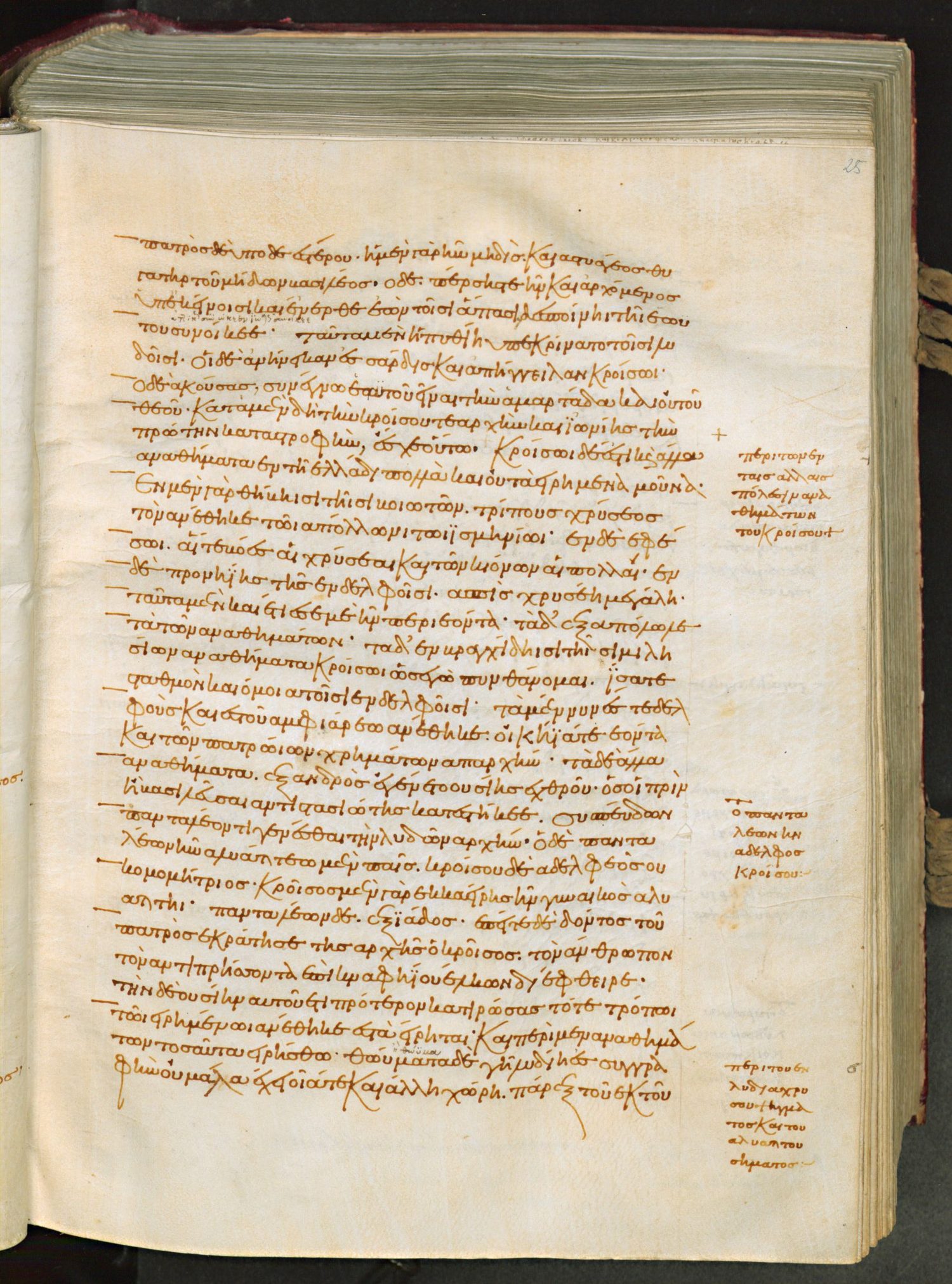
Laur. Plut. 70.3, fol. 25r: Greek here 1.91.5 to 1.93.1. Checked on the image (first and last words read and located in the Greek; each break checked against the neighbouring page): fol. 25r begins ‹πατρὸς δὲ ὑποδεεστέρου·ἣ μὲν› (1.91.5), ends ‹πάρεξ τοῦ ἐκ τοῦ› (1.93.1). English here: 1.92.1 to 1.93.1 (Godley's sentences for the sections whose Greek lies mostly on this page).
1.91.5πατρὸς δὲ ὑποδεεστέρου· 1.91.6ἣ μὲν γὰρ ἦν Μηδὶς καὶ Ἀστυάγεος θυγάτηρ τοῦ Μήδων βασιλέος, ὁ δὲ Πέρσης τε ἦν καὶ ἀρχόμενος ὑπʼ ἐκείνοισι καὶ ἔνερθε ἐὼν τοῖσι ἅπασι δεσποίνῃ τῇ ἑωυτοῦ συνοίκεε. ταῦτα μὲν ἡ Πυθίη ὑπεκρίνατο τοῖσι Λυδοῖσι, οἳ δὲ ἀνήνεικαν ἐς Σάρδις καὶ ἀπήγγειλαν Κροίσῳ. ὁ δὲ ἀκούσας συνέγνω ἑωυτοῦ εἶναι τὴν ἁμαρτάδα καὶ οὐ τοῦ θεοῦ. κατὰ μὲν δὴ τὴν Κροίσου τε ἀρχὴν καὶ Ἰωνίης τὴν πρώτην καταστροφὴν ἔσχε οὕτω. 1.92.1Κροίσῳ δὲ ἐστὶ ἄλλα ἀναθήματα ἐν τῇ Ἑλλάδι πολλὰ καὶ οὐ τὰ εἰρημένα μοῦνα. ἐν μὲν γὰρ Θήβῃσι τῇσι Βοιωτῶν τρίπους χρύσεος, τὸν ἀνέθηκέ τῷ Ἀπόλλωνι τῷ Ἰσμηνίῳ, ἐν δὲ Ἐφέσῳ αἵ τε βόες αἱ χρύσεαι καὶ τῶν κιόνων αἱ πολλαί, ἐν δὲ Προνηίης τῆς ἐν Δελφοῖσι ἀσπὶς χρυσέη μεγάλη. ταῦτα μὲν καὶ ἔτι ἐς ἐμὲ ἦν περιεόντα, τὰ δʼ ἐξαπόλωλε τῶν ἀναθημάτων· 1.92.2τὰ δʼ ἐν Βραγχίδῃσι τῇσι Μιλησίων ἀναθήματα Κροίσῳ, ὡς ἐγὼ πυνθάνομαι, ἴσα τε σταθμὸν καὶ ὅμοια τοῖσι ἐν Δελφοῖσι […] τὰ μέν νυν ἔς τε Δελφοὺς καὶ ἐς τοῦ Ἀμφιάρεω ἀνέθηκε οἰκήιά τε ἐόντα καὶ τῶν πατρωίων χρημάτων ἀπαρχήν· τὰ δὲ ἄλλα ἀναθήματα ἐξ ἀνδρὸς ἐγένετο οὐσίης ἐχθροῦ, ὅς οἱ πρὶν ἢ βασιλεῦσαι ἀντιστασιώτης κατεστήκεε, συσπεύδων Πανταλέοντι γενέσθαι τὴν Λυδῶν ἀρχήν. 1.92.3ὁ δὲ Πανταλέων ἦν Ἀλυάττεω μὲν παῖς, Κροίσου δὲ ἀδελφεὸς οὐκ ὁμομήτριος· Κροῖσος μὲν γὰρ ἐκ Καείρης ἦν γυναικὸς Ἀλυάττῃ, Πανταλέων δὲ ἐξ Ἰάδος. 1.92.4ἐπείτε δὲ δόντος τοῦ πατρὸς ἐκράτησε τῆς ἀρχῆς ὁ Κροῖσος, τὸν ἄνθρωπον τὸν ἀντιπρήσσοντα ἐπὶ κνάφου ἕλκων διέφθειρε, τὴν δὲ οὐσίην αὐτοῦ ἔτι πρότερον κατιρώσας τότε τρόπῳ τῷ εἰρημένῳ ἀνέθηκε ἐς τὰ εἴρηται. καὶ περὶ μὲν ἀναθημάτων τοσαῦτα εἰρήσθω. 1.93.1θώματα δὲ γῆ ἡ Λυδίη ἐς συγγραφὴν οὐ μάλα ἔχει, οἷά τε καὶ ἄλλη χώρη, πάρεξ τοῦ ἐκ τοῦ
1.92.1Now there are many offerings of Croesus in Hellas, and not only those whereof I have spoken. There is a golden tripod at Thebes in Boeotia, which he dedicated to Apollo of Ismenus; at Ephesus there are the oxen of gold and the greater part of the pillars; and in the temple of Proneïa at Delphi, a golden shield. All these yet remained till my lifetime; but some other of the offerings have perished. 1.92.2And the offerings of Croesus at Branchidae of the Milesians, as I have heard, are equal in weight and like to those at Delphi. Those which he dedicated at Delphi and the shrine of Amphiaraus were his own, the firstfruits of the wealth inherited from his father; the rest came from the estate of an enemy who had headed a faction against Croesus before he became king, and conspired to win the throne of Lydia for Pantaleon. 1.92.3This Pantaleon was a son of Alyattes, and half-brother of Croesus: Croesus was Alyattes’ son by a Carian and Pantaleon by an Ionian mother. 1.92.4So when Croesus gained the sovereignty by his father’s gift, he put the man who had conspired against him to death by drawing him across a carding-comb, and first confiscated his estate, then dedicated it as and where I have said. This is all that I shall say of Croesus’ offerings. 1.93.1There are not in Lydia many marvellous things for me to tell of, if it be compared with other countries, except the gold dust that comes down from Tmolus.
Where on the image
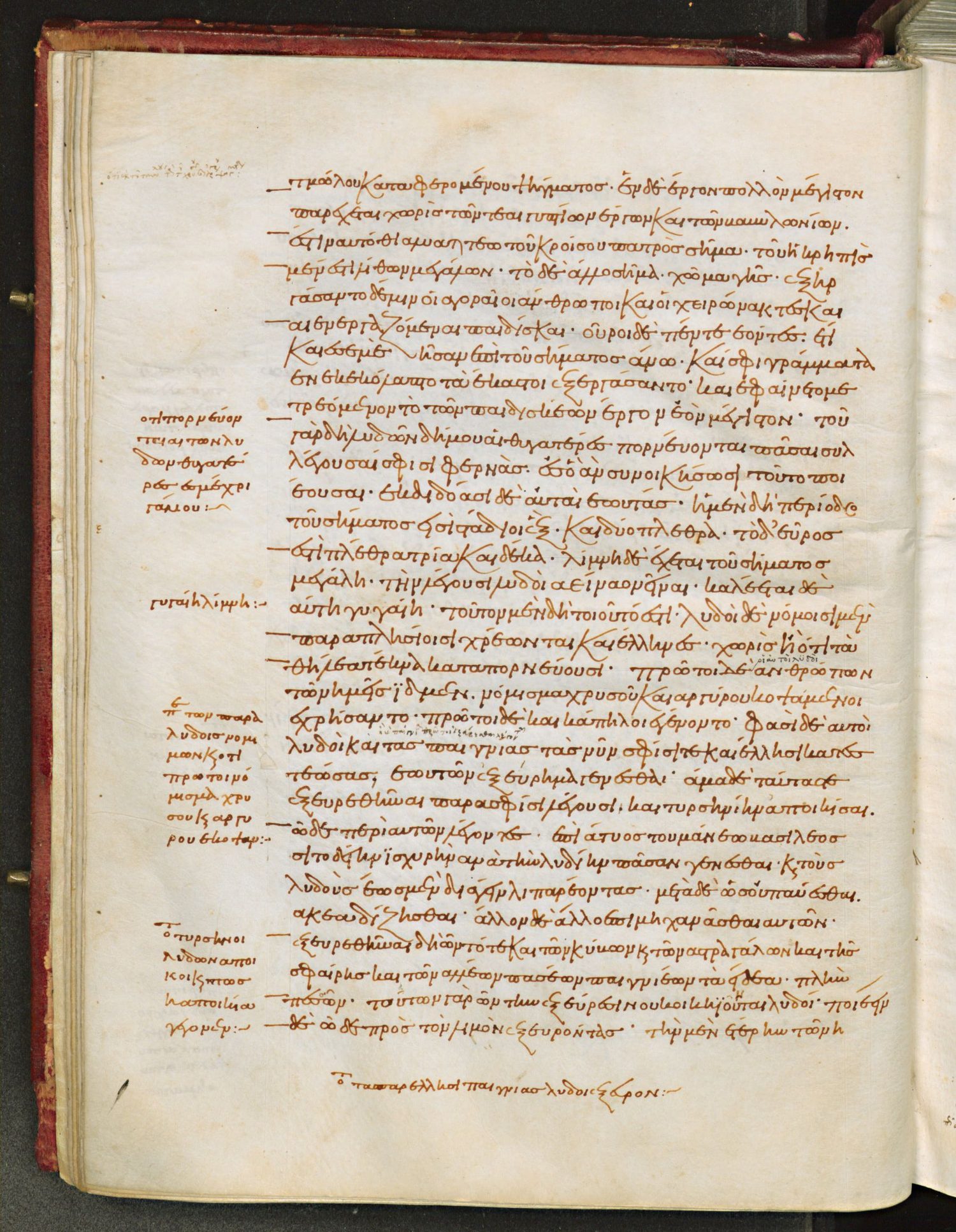
Laur. Plut. 70.3, fol. 25v: Greek here 1.93.1 to 1.94.4. Checked on the image (first and last words read and located in the Greek; each break checked against the neighbouring page): fol. 25v begins ‹Τμώλου καταφερομένου ψήγματος.ἓν δὲ› (1.93.1), ends ‹μὲν ἑτέρην τῶν ἡ-› (1.94.4). Below the text, a reader's note that the Lydians invented games. English here: 1.93.2 to 1.94.3 (Godley's sentences for the sections whose Greek lies mostly on this page).
1.93.1Τμώλου καταφερομένου ψήγματος. 1.93.2ἓν δὲ ἔργον πολλὸν μέγιστον παρέχεται χωρὶς τῶν τε Αἰγυπτίων ἔργων καὶ τῶν Βαβυλωνίων· ἔστι αὐτόθι Ἀλυάττεω τοῦ Κροίσου πατρὸς σῆμα, τοῦ ἡ κρηπὶς μὲν ἐστὶ λίθων μεγάλων, τὸ δὲ ἄλλο σῆμα χῶμα γῆς. ἐξεργάσαντο δέ μιν οἱ ἀγοραῖοι ἄνθρωποι καὶ οἱ χειρώνακτες καὶ αἱ ἐνεργαζόμεναι παιδίσκαι. 1.93.3οὖροι δὲ πέντε ἐόντες ἔτι καὶ ἐς ἐμὲ ἦσαν ἐπὶ τοῦ σήματος ἄνω, καί σφι γράμματα ἐνεκεκόλαπτο τὰ ἕκαστοι ἐξεργάσαντο, καὶ ἐφαίνετο μετρεόμενον τὸ τῶν παιδισκέων ἔργον ἐὸν μέγιστον. 1.93.4τοῦ γὰρ δὴ Λυδῶν δήμου αἱ θυγατέρες πορνεύονται πᾶσαι, συλλέγουσαι σφίσι φερνάς, ἐς ὃ ἂν συνοικήσωσι τοῦτο ποιέουσαι· ἐκδιδοῦσι δὲ αὐταὶ ἑωυτάς. 1.93.5ἡ μὲν δὴ περίοδος τοῦ σήματός εἰσὶ στάδιοι ἓξ καὶ δύο πλέθρα, τὸ δὲ εὖρος ἐστὶ πλέθρα τρία καὶ δέκα. λίμνη δὲ ἔχεται τοῦ σήματος μεγάλη, τὴν λέγουσι Λυδοὶ ἀείναον εἶναι· καλέεται δὲ αὕτη Γυγαίη. τοῦτο μὲν δὴ τοιοῦτο ἐστί. 1.94.1Λυδοὶ δὲ νόμοισι μὲν παραπλησίοισι χρέωνται καὶ Ἕλληνές, χωρὶς ἢ ὅτι τὰ θήλεα τέκνα καταπορνεύουσι, πρῶτοι δὲ ἀνθρώπων τῶν ἡμεῖς ἴδμεν νόμισμα χρυσοῦ καὶ ἀργύρου κοψάμενοι ἐχρήσαντο, πρῶτοι δὲ καὶ κάπηλοι ἐγένοντο. 1.94.2φασὶ δὲ αὐτοὶ Λυδοὶ καὶ τὰς παιγνίας τὰς νῦν σφίσι τε καὶ Ἕλλησι κατεστεώσας ἑωυτῶν ἐξεύρημα γενέσθαι· ἅμα δὲ ταύτας τε ἐξευρεθῆναι παρὰ σφίσι λέγουσι καὶ Τυρσηνίην ἀποικίσαι, ὧδε περὶ αὐτῶν λέγοντες. 1.94.3ἐπὶ Ἄτυος τοῦ Μάνεω βασιλέος σιτοδείην ἰσχυρὴν ἀνὰ τὴν Λυδίην πᾶσαν γενέσθαι, καὶ τοὺς Λυδοὺς τέως μὲν διάγειν λιπαρέοντας, μετὰ δὲ ὡς οὐ παύεσθαι, ἄκεα δίζησθαι, ἄλλον δὲ ἄλλο ἐπιμηχανᾶσθαι αὐτῶν. ἐξευρεθῆναι δὴ ὦν τότε καὶ τῶν κύβων καὶ τῶν ἀστραγάλων καὶ τῆς σφαίρης καὶ τῶν ἀλλέων πασέων παιγνιέων τὰ εἴδεα, πλὴν πεσσῶν τούτων γὰρ ὦν τὴν ἐξεύρεσιν οὐκ οἰκηιοῦνται Λυδοί. 1.94.4ποιέειν δὲ ὧδε πρὸς τὸν λιμὸν ἐξευρόντας, τὴν μὲν ἑτέρην τῶν ἡμερέων
1.93.2But there is one building to be seen there which is more notable than any, saving those of Egypt and Babylon. There is in Lydia the tomb of Alyattes the father of Croesus, the base whereof is made of great stones and the rest of it of mounded earth. It was built by the men of the market and the artificers and the prostitutes. 1.93.3There remained till my time five corner-stones set on the top of the tomb, and on these was graven the record of the work done by each kind: and measurement showed that the prostitutes’ share of the work was the greatest. 1.93.4All the daughters of the common people of Lydia ply the trade of prostitutes, to collect dowries, till they can get themselves husbands; and they offer themselves in marriage. 1.93.5Now this tomb has a circumference of six furlongs and a third, and its breadth is above two furlongs; and there is a great lake hard by the tomb, which, say the Lydians, is fed by ever-flowing springs; it is called the Gygaean lake. Such then is this tomb. 1.94.1The customs of the Lydians are like those of the Greeks, save that they make prostitutes of their female children. They were the first men (known to us) who coined and used gold and silver currency; and they were the first to sell by retail. 1.94.2And, according to what they themselves say, the pastimes now in use among them and the Greeks were invented by the Lydians: these, they say, were invented among them at the time when they colonised Tyrrhenia. 1.94.3This is their story: In the reign of Atys son of Manes there was great scarcity of food in all Lydia. For a while the Lydians bore this with what patience they could; presently, when there was no abatement of the famine, they sought for remedies, and divers plans were devised by divers men. Then it was that they invented the games of dice and knuckle-bones and ball, and all other forms of pastime except only draughts, which the Lydians do not claim to have discovered.
Where on the image
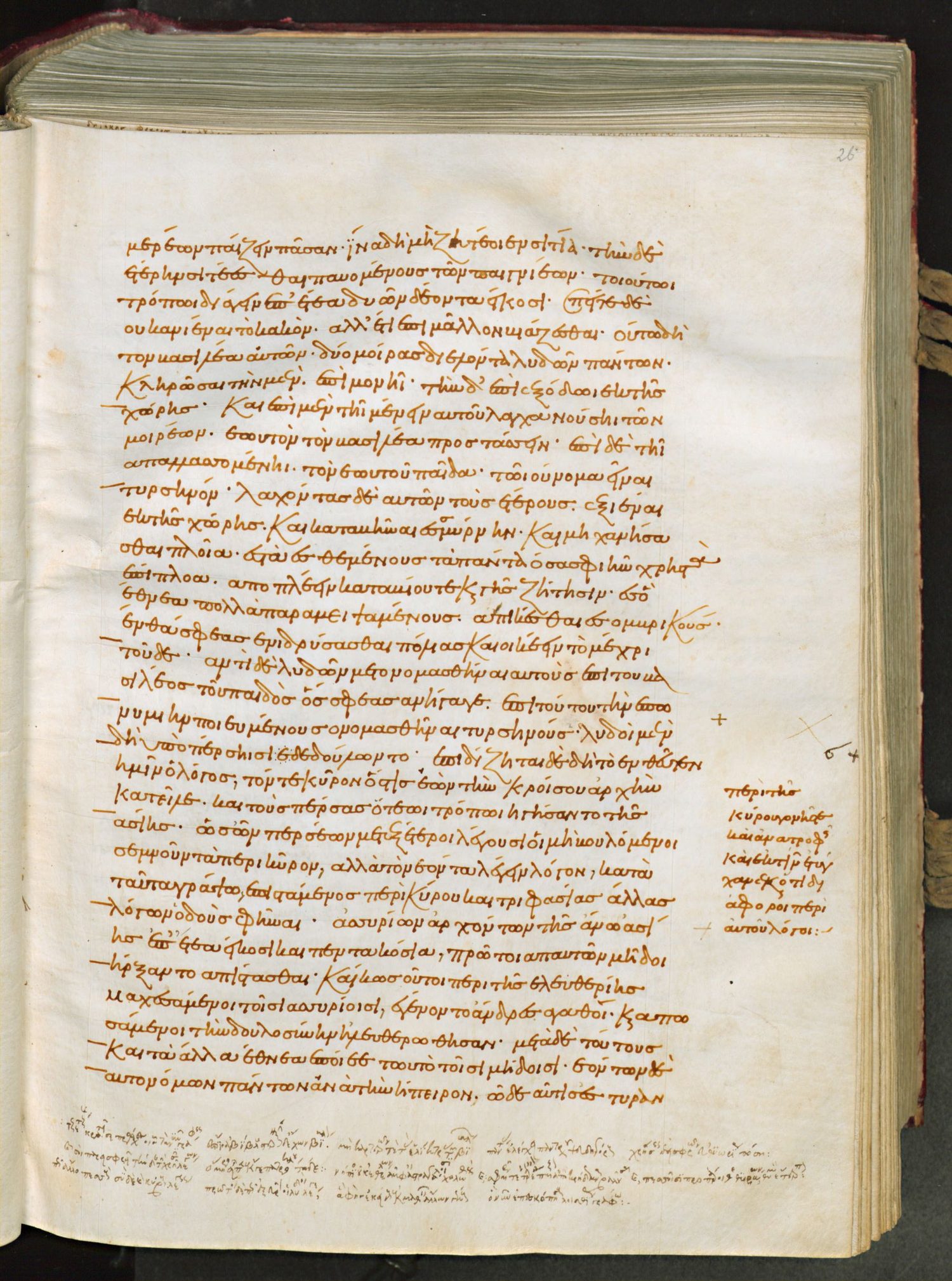
Laur. Plut. 70.3, fol. 26r: Greek here 1.94.4 to 1.94.7. Checked on the image (first and last words read and located in the Greek; each break checked against the neighbouring page): fol. 26r begins ‹-μερέων παίζειν πᾶσαν, ἵνα› (1.94.4), ends ‹ὧδε αὖτις ἐς τυραν-› (1.96.1). The word ‹ἡμερέων› is divided between fol. 25v and fol. 26r; it is given with fol. 25v. The lower margin is filled with readers' notes in small script. English here: 1.94.4 to 1.94.7 (Godley's sentences for the sections whose Greek lies mostly on this page).
1.94.4παίζειν πᾶσαν, ἵνα δὴ μὴ ζητέοιεν σιτία, τὴν δὲ ἑτέρην σιτέεσθαι παυομένους τῶν παιγνιέων. τοιούτῳ τρόπῳ διάγειν ἐπʼ ἔτεα δυῶν δέοντα εἴκοσι. 1.94.5ἐπείτε δὲ οὐκ ἀνιέναι τὸ κακὸν ἀλλʼ ἔτι ἐπὶ μᾶλλον βιάζεσθαι οὕτω δὴ τὸν βασιλέα αὐτῶν δύο μοίρας διελόντα Λυδῶν πάντων κληρῶσαι τὴν μὲν ἐπὶ μόνῃ τὴν δὲ ἐπὶ ἐξόδῳ ἐκ τῆς χώρης, καὶ ἐπὶ μὲν τῇ μένειν αὐτοῦ λαγχανούσῃ τῶν μοιρέων ἑωυτὸν τὸν βασιλέα προστάσσειν, ἐπὶ δὲ τῇ ἀπαλλασσομένῃ τὸν ἑωυτοῦ παῖδα, τῷ οὔνομα εἶναι Τυρσηνόν. 1.94.6λαχόντας δὲ αὐτῶν τοὺς ἑτέρους ἐξιέναι ἐκ τῆς χώρης καταβῆναι ἐς Σμύρνην καὶ μηχανήσασθαι πλοῖα, ἐς τὰ ἐσθεμένους τὰ πάντα ὅσα σφι ἦν χρηστὰ ἐπίπλοα, ἀποπλέειν κατὰ βίου τε καὶ γῆς ζήτησιν, ἐς ὃ ἔθνεα πολλὰ παραμειψαμένους ἀπικέσθαι ἐς Ὀμβρικούς, ἔνθα σφέας ἐνιδρύσασθαι πόλιας καὶ οἰκέειν τὸ μέχρι τοῦδε. 1.94.7ἀντὶ δὲ Λυδῶν μετονομασθῆναι αὐτοὺς ἐπὶ τοῦ βασιλέος τοῦ παιδός, ὅς σφεας ἀνήγαγε, ἐπὶ τούτου τὴν ἐπωνυμίην ποιευμένους ὀνομασθῆναι Τυρσηνούς. Λυδοὶ μὲν δὴ ὑπὸ Πέρσῃσι ἐδεδούλωντο.
1.94.4Then, using their discovery to lighten the famine, they would play for the whole of every other day, that they might not have to seek for food, and the next day they ceased from their play and ate. This was their manner of life for eighteen years. 1.94.5But the famine did not cease to plague them, and rather afflicted them yet more grievously. At last their king divided the people into two portions, and made them draw lots, so that the one part should remain and the other leave the country; he himself was to be the head of those who drew the lot to remain there, and his son, whose name was Tyrrhenus, of those who departed. 1.94.6Then one part of them, having drawn the lot, left the country and came down to Smyrna and built ships, whereon they set all their goods that could be carried on shipboard, and sailed away to seek a livelihood and a country; till at last, after sojourning with many nations in turn, they came to the Ombrici, where they founded cities and have dwelt ever since. 1.94.7They no longer called themselves Lydians, but Tyrrhenians, after the name of the king’s son who had led them thither. The Lydians, then, were enslaved by the Persians.
Notes
- Greek: the text printed in A. D. Godley's Loeb edition, via Perseus (tlg0016.tlg001.perseus-grc2). Square brackets mark words the editor considers later additions; [...] marks a gap the editor indicates. Perseus note markers are omitted.
- English: A. D. Godley, Herodotus vol. 1 (1920) (Loeb Classical Library), as transcribed on Wikisource. Godley's footnotes are omitted.
- Section numbers in the English were placed by comparing Godley's text with the Perseus version of his translation; where a section begins inside one of Godley's sentences, the English is kept with the page that holds the start of that sentence.
Cite
Sources
- Source: Florence, Laur. Plut. 70.3 (10th c.) via BML Teca Digitale + Greek of Godley's Loeb (Perseus) + English of A. D. Godley (Loeb, Wikisource) (holding institution)
- Critical edition: Greek of A. D. Godley's Loeb edition (1920-1925), via Perseus
← previous · → next · v cycle view · l back to library