Herodotus, Histories 2.19-34: The Nile, its flooding and its course
Introduction
Herodotus of Halicarnassus wrote the Histories in the third quarter of the 5th century BCE, an inquiry into the deeds of Greeks and barbarians and the causes of the wars between them, later divided into nine books. Book 2 is Herodotus' account of Egypt, written as background to Cambyses' invasion: the land and the Nile, the customs and religion of the Egyptians, and the history of their kings as the priests told it, down to Amasis.
The photographs are of Florence, Biblioteca Medicea Laurenziana, Plut. 70.3 (parchment, 10th century, 374 folios, 31 lines a page), Herodotus, Histories (codex A of the editors), the oldest surviving manuscript of the complete Histories, from the Teca Digitale of the Biblioteca Medicea Laurenziana. Each section below is the text of one page, or of the part of a page that falls within these chapters. The first and last words of every page were read on the photograph and located in the Greek, and every page break was checked against the next page; the notes quote these words. Readers' notes in the margins are not part of the text and are mentioned where they occur.
The Greek is the text printed in A. D. Godley's Loeb edition (1920-1925), from Perseus; it is the edited text, not a transcription of the manuscript, whose wording differs in places. The English is Godley's translation as printed, from Wikisource. Godley's English carries only chapter numbers; the section numbers shown in it were placed by comparison with the Perseus version of his translation. Each page's English is cut at the end of one of Godley's sentences, so it can begin or end a few lines away from the Greek of the page; each note gives the exact ranges.
This entry covers chapters 2.19-34, on fol. 60r to 64r.
How was this verified? (Provenance)
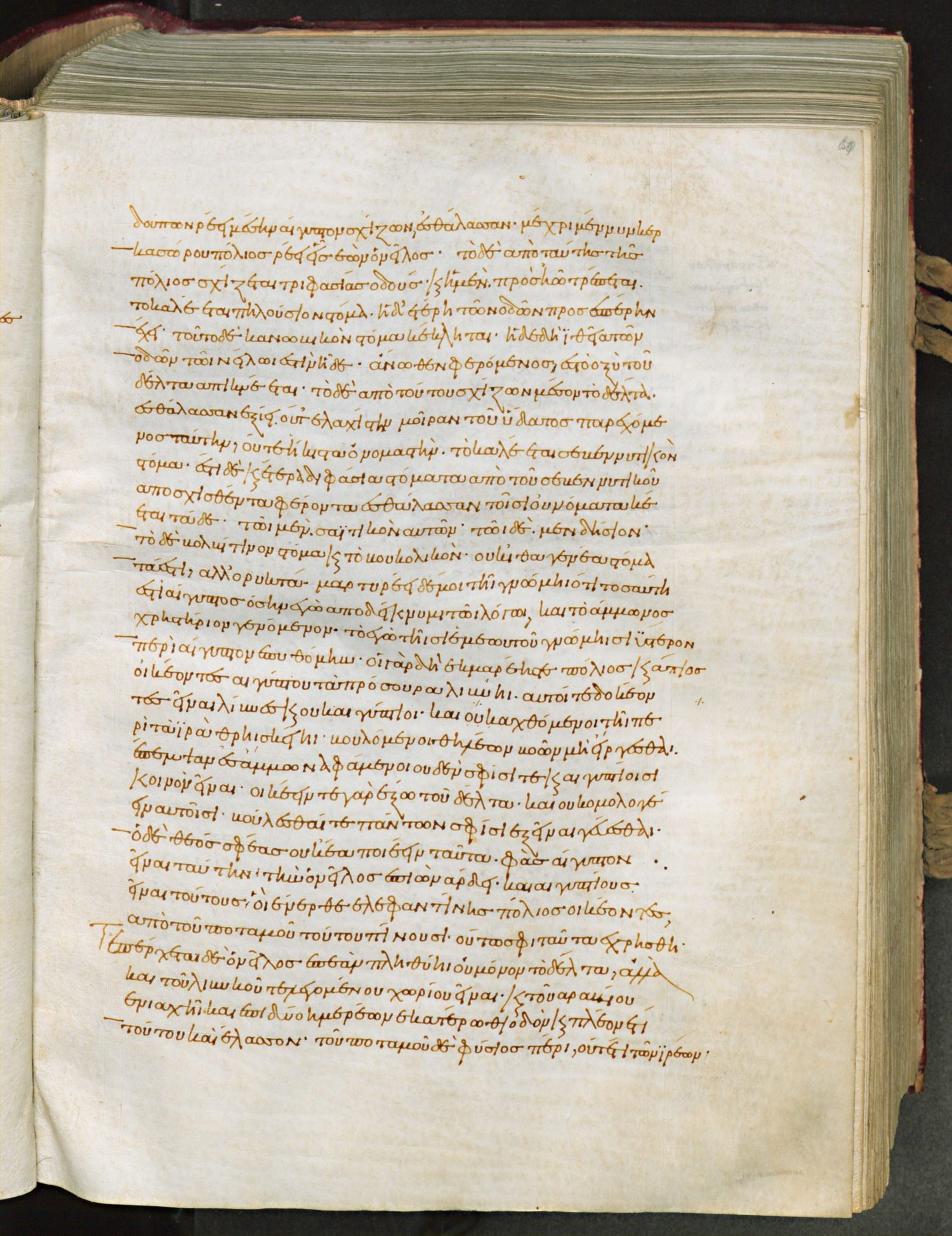
Where on the image
Laur. Plut. 70.3, fol. 60r: Greek here 2.19.1. Checked on the image (first and last words read and located in the Greek; each break checked against the neighbouring page): fol. 60r begins ‹-δούπων ῥέει μέσην Αἴγυπτον› (2.17.3), ends ‹οὔτε τι τῶν ἱρέων› (2.19.1). The word ‹Καταδούπων› is divided between fol. 59v and fol. 60r; it is given with fol. 59v. English here: 2.19.1 (Godley's sentences for the sections whose Greek lies mostly on this page).
2.19.1ἐπέρχεται δὲ ὁ Νεῖλος, ἐπεὰν πληθύῃ, οὐ μοῦνον τὸ Δέλτα ἀλλὰ καὶ τοῦ Λιβυκοῦ τε λεγομένου χωρίου εἶναι καὶ τοῦ Ἀραβίου ἐνιαχῇ καὶ ἐπὶ δύο ἡμερέων ἑκατέρωθι ὁδόν, καὶ πλέον ἔτι τούτου καὶ ἔλασσον. τοῦ ποταμοῦ δὲ φύσιος πέρι οὔτε τι τῶν ἱρέων
2.19.1When the Nile is in flood, it overflows not only the Delta but also the lands called Libyan and Arabian, in places as far as two days’ journey from either bank, and sometimes more than this, sometimes less. Concerning its nature, neither from the priests nor from any others could I learn anything.
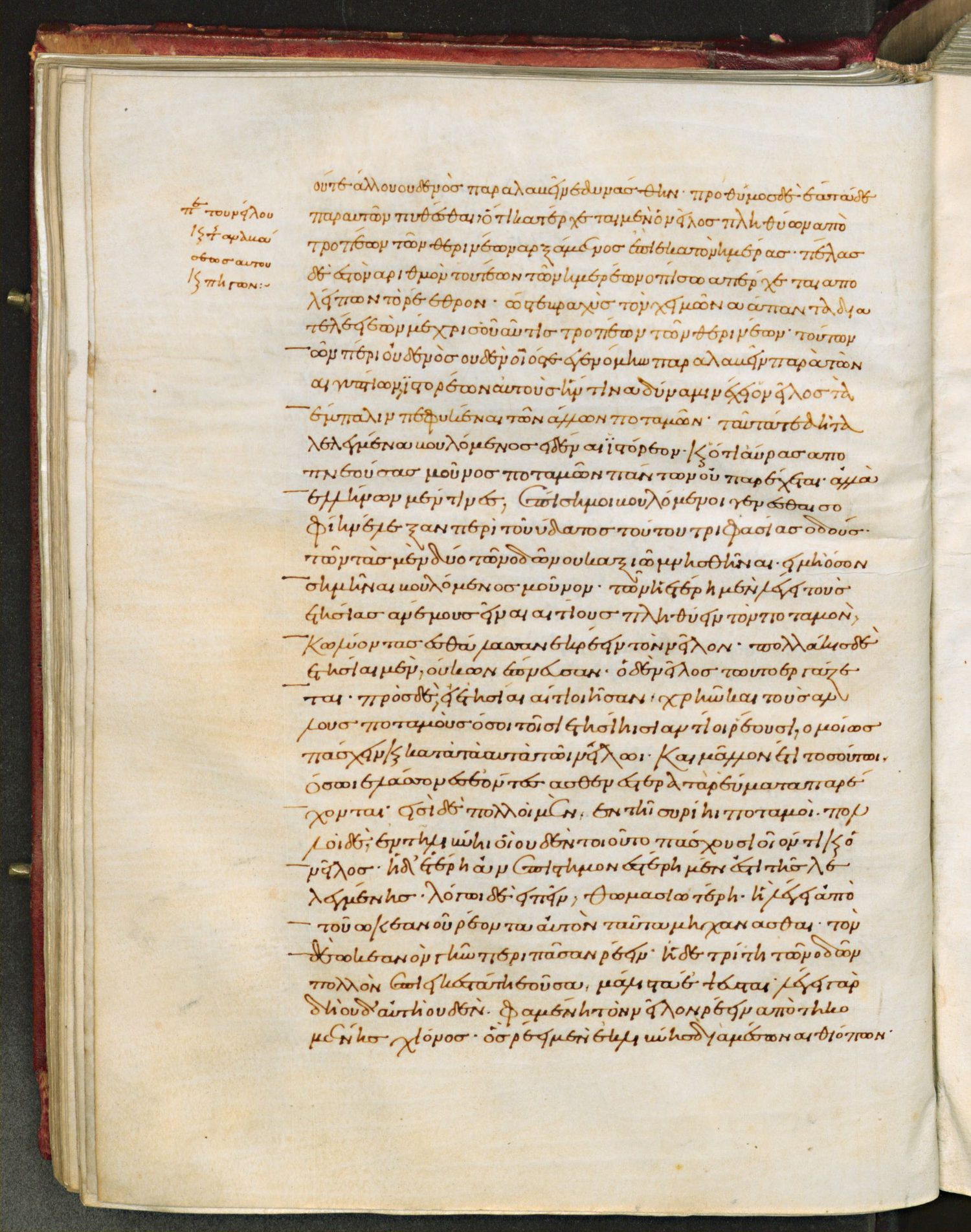
Where on the image
Laur. Plut. 70.3, fol. 60v: Greek here 2.19.1 to 2.22.1. Checked on the image (first and last words read and located in the Greek; each break checked against the neighbouring page): fol. 60v begins ‹οὔτε ἄλλου οὐδενὸς παραλαβεῖν› (2.19.1), ends ‹Λιβύης διὰ μέσων Αἰθιόπων› (2.22.1). English here: 2.19.2 to 2.22.2 (Godley's sentences for the sections whose Greek lies mostly on this page).
2.19.1οὔτε ἄλλου οὐδενὸς παραλαβεῖν ἐδυνάσθην. 2.19.2πρόθυμος δὲ ἔα τάδε παρʼ αὐτῶν πυθέσθαι, ὅ τι κατέρχεται μὲν ὁ Νεῖλος πληθύων ἀπὸ τροπέων τῶν θερινέων ἀρξάμενος ἐπὶ ἑκατὸν ἡμέρας, πελάσας δὲ ἐς τὸν ἀριθμὸν τουτέων τῶν ἡμερέων ὀπίσω ἀπέρχεται ἀπολείπων τὸ ῥέεθρον, ὥστε βραχὺς τὸν χειμῶνα ἅπαντα διατελέει ἐὼν μέχρι οὗ αὖτις τροπέων τῶν θερινέων. 2.19.3τούτων ὦν πέρι οὐδενὸς οὐδὲν οἷός τε ἐγενόμην παραλαβεῖν παρὰ τῶν Αἰγυπτίων, ἱστορέων αὐτοὺς ἥντινα δύναμιν ἔχει ὁ Νεῖλος τὰ ἔμπαλιν πεφυκέναι τῶν ἄλλων ποταμῶν· ταῦτά τε δὴ τὰ λελεγμένα βουλόμενος εἰδέναι ἱστόρεον καὶ ὅ τι αὔρας ἀποπνεούσας μοῦνος ποταμῶν πάντων οὐ παρέχεται. 2.20.1ἀλλὰ Ἑλλῄνων μὲν τινὲς ἐπίσημοι βουλόμενοι γενέσθαι σοφίην ἔλεξαν περὶ τοῦ ὕδατος τούτου τριφασίας ὁδούς· τῶν τὰς μὲν δύο τῶν ὁδῶν οὐδʼ ἀξιῶ μνησθῆναι εἰ μὴ ὅσον σημῆναι βουλόμενος μοῦνον· 2.20.2τῶν ἡ ἑτέρη μὲν λέγει τοὺς ἐτησίας ἀνέμους εἶναι αἰτίους πληθύειν τὸν ποταμόν, κωλύοντας ἐς θάλασσαν ἐκρέειν τὸν Νεῖλον. πολλάκις δὲ ἐτησίαι μὲν οὔκων ἔπνευσαν, ὁ δὲ Νεῖλος τὠυτὸ ἐργάζεται. 2.20.3πρὸς δέ, εἰ ἐτησίαι αἴτιοι ἦσαν, χρῆν καὶ τοὺς ἄλλους ποταμούς, ὅσοι τοῖσι ἐτησίῃσι ἀντίοι ῥέουσι, ὁμοίως πάσχειν καὶ κατὰ τὰ αὐτὰ τῷ Νείλῳ, καὶ μᾶλλον ἔτι τοσούτῳ ὅσῳ ἐλάσσονες ἐόντες ἀσθενέστερα τὰ ῥεύματα παρέχονται. εἰσὶ δὲ πολλοὶ μὲν ἐν τῇ Συρίῃ ποταμοὶ πολλοὶ δὲ ἐν τῇ Λιβύῃ, οἳ οὐδὲν τοιοῦτο πάσχουσι οἷόν τι καὶ ὁ Νεῖλος. 2.21.1ἡ δʼ ἑτέρη ἀνεπιστημονεστέρη μὲν ἐστὶ τῆς λελεγμένης, λόγῳ δὲ εἰπεῖν θωμασιωτέρη· ἣ λέγει ἀπὸ τοῦ Ὠκεανοῦ ῥέοντα αὐτὸν ταῦτα μηχανᾶσθαι, τὸν δὲ Ὠκεανὸν γῆν περὶ πᾶσαν ῥέειν. 2.22.1ἡ δὲ τρίτη τῶν ὁδῶν πολλὸν ἐπιεικεστάτη ἐοῦσα μάλιστα ἔψευσται· λέγει γὰρ δὴ οὐδʼ αὕτη οὐδέν, φαμένη τὸν Νεῖλον ῥέειν ἀπὸ τηκομένης χιόνος· ὃς ῥέει μὲν ἐκ Λιβύης διὰ μέσων Αἰθιόπων,
2.19.2Yet I was zealous to hear from them why it is that the Nile comes down with a rising flood for an hundred days from the summer solstice, and when this tale of days is complete sinks again with a diminishing stream, so that the river is low for the whole winter till the summer solstice again. 2.19.3Concerning this matter none of the Egyptians could tell me anything, when I asked them what power the Nile has to be contrary in nature to all other rivers. Of the matters aforesaid I wished to know, and asked; also why no airs blow from it as from every other stream. 2.20.1But some of the Greeks, wishing to be notable for cleverness, put forward three opinions about this river; of which there are two that I would not even mention, save to show only what they are. 2.20.2One of these will have it that the etesian winds are the cause of the rivers being in flood, because they hinder the Nile from flowing out into the sea. But there are many times when the etesian winds do not blow, yet the Nile does the same as before. 2.20.3And further, if the etesian winds were the cause, then, the other rivers which flow contrary to those winds should be affected in like manner even as is the Nile, and all the more, inasmuch as being smaller they have a weaker current. Yet there are many rivers in Syria and in Libya, which are nowise in the same case as the Nile. 2.21.1The second opinion is less grounded on knowledge than that afore-mentioned, though it is more marvellous to the ear: by it, the river effects what it does because it flows from the Ocean, which flows round all the world. 2.22.1The third opinion is the most plausible by far, yet is of all the most in error. It has no more truth in it than the others. According to this, the Nile flows from where snows melt; but it flows from Libya through the midst of Ethiopia, and issues out into Egypt; 2.22.2how then can it flow from snow, seeing that it comes from the hottest places to lands that are for the most part colder? nay, a man who can reason about such matters will find his chief proof, that there is no likelihood of the river’s flowing from snow, in this—that the winds blowing from Libya and Ethiopia are hot.
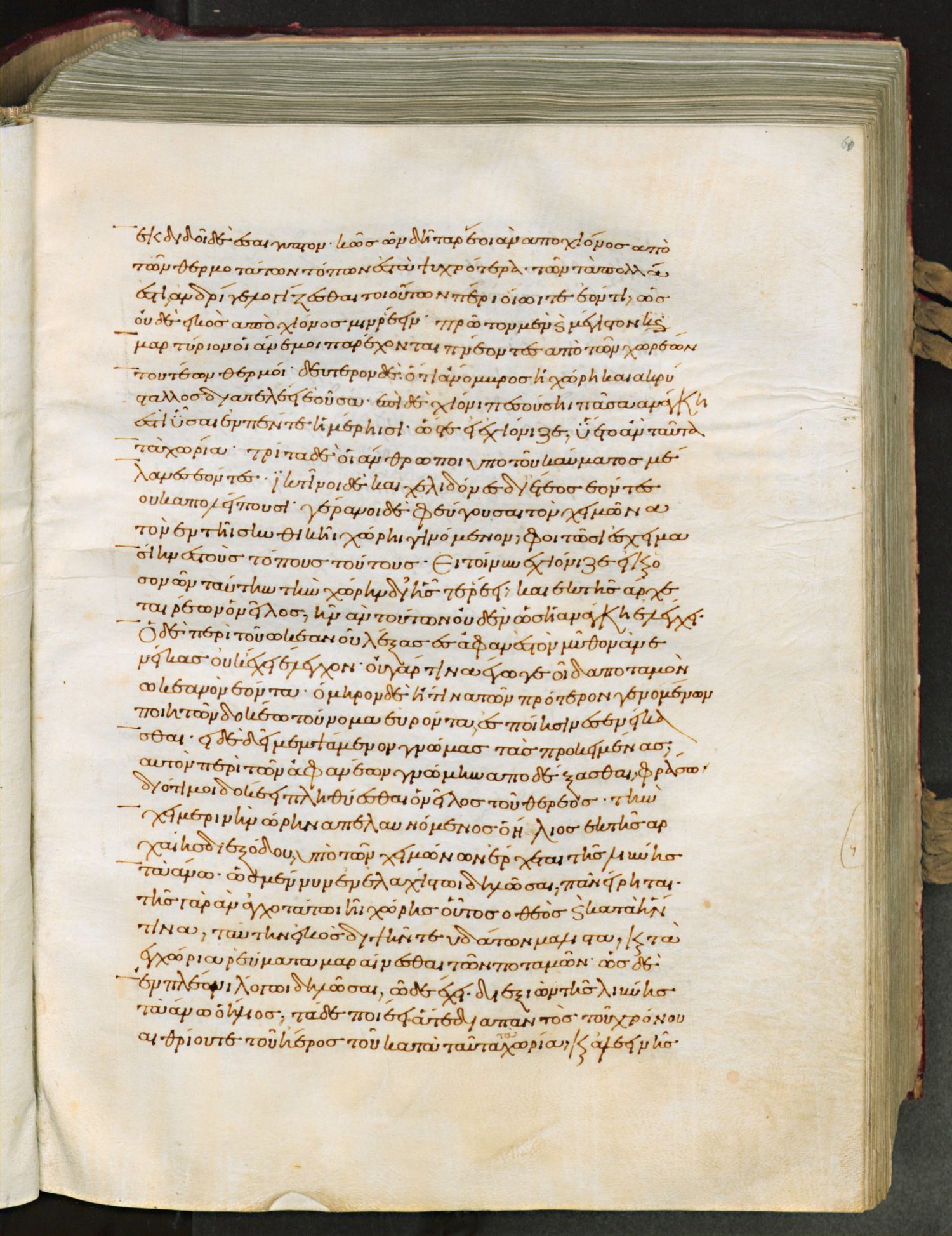
Where on the image
Laur. Plut. 70.3, fol. 61r: Greek here 2.22.1 to 2.25.1. Checked on the image (first and last words read and located in the Greek; each break checked against the neighbouring page): fol. 61r begins ‹ἐκδιδοῖ δὲ ἐς Αἴγυπτον.κῶς› (2.22.1), ends ‹τὰ χωρία καὶ ἀλεεινῆς› (2.25.1). English here: 2.22.3 to 2.25.2 (Godley's sentences for the sections whose Greek lies mostly on this page).
2.22.1ἐκδιδοῖ δὲ ἐς Αἴγυπτον. 2.22.2κῶς ὦν δῆτα ῥέοι ἂν ἀπὸ χιόνος, ἀπὸ τῶν θερμοτάτων ῥέων ἐς τὰ ψυχρότερα τὰ πολλά ἐστι; ἀνδρί γε λογίζεσθαι τοιούτων πέρι οἵῳ τε ἐόντι, ὡς οὐδὲ οἰκὸς ἀπὸ χιόνος μιν ῥέειν, πρῶτον μὲν καὶ μέγιστον μαρτύριον οἱ ἄνεμοι παρέχονται πνέοντες ἀπὸ τῶν χωρέων τουτέων θερμοί· 2.22.3δεύτερον δὲ ὅτι ἄνομβρος ἡ χώρη καὶ ἀκρύσταλλος διατελέει ἐοῦσα, ἐπὶ δὲ χιόνι πεσούσῃ πᾶσα ἀνάγκη ἐστὶ ὗσαι ἐν πέντε ἡμέρῃσι, ὥστε, εἰ ἐχιόνιζε, ὕετο ἂν ταῦτα τὰ χωρία· τρίτα δὲ οἱ ἄνθρωποι ὑπὸ τοῦ καύματος μέλανες ἐόντες. 2.22.4ἰκτῖνοι δὲ καὶ χελιδόνες διʼ ἔτεος ἐόντες οὐκ ἀπολείπουσι, γέρανοι δὲ φεύγουσαι τὸν χειμῶνα τὸν ἐν τῇ Σκυθικῇ χώρῃ γινόμενον φοιτῶσι ἐς χειμασίην ἐς τοὺς τόπους τούτους. εἰ τοίνυν ἐχιόνιζε καὶ ὅσον ὦν ταύτην τὴν χώρην διʼ ἧς τε ῥέει καὶ ἐκ τῆς ἄρχεται ῥέων ὁ Νεῖλος, ἦν ἂν τούτων οὐδέν, ὡς ἡ ἀνάγκη ἐλέγχει. 2.23.1ὁ δὲ περὶ τοῦ Ὠκεανοῦ λέξας ἐς ἀφανὲς τὸν μῦθον ἀνενείκας οὐκ ἔχει ἔλεγχον· οὐ γὰρ τινὰ ἔγωγε οἶδα ποταμὸν Ὠκεανὸν ἐόντα, Ὅμηρον δὲ ἢ τινὰ τῶν πρότερον γενομένων ποιητέων δοκέω τὸ οὔνομα εὑρόντα ἐς ποίησιν ἐσενείκασθαι. 2.24.1εἰ δὲ δεῖ μεμψάμενον γνώμας τὰς προκειμένας αὐτὸν περὶ τῶν ἀφανέων γνώμην ἀποδέξασθαι, φράσω διʼ ὅ τι μοι δοκέει πληθύνεσθαι ὁ Νεῖλος τοῦ θέρεος· τὴν χειμερινὴν ὥρην ἀπελαυνόμενος ὁ ἥλιος ἐκ τῆς ἀρχαίης διεξόδου ὑπὸ τῶν χειμώνων ἔρχεται τῆς Λιβύης τὰ ἄνω. 2.24.2ὡς μέν νυν ἐν ἐλαχίστῳ δηλῶσαι, πᾶν εἴρηται· τῆς γὰρ ἂν ἀγχοτάτω τε ᾖ χώρης οὗτος ὁ θεὸς καὶ κατὰ ἥντινα, ταύτην οἰκὸς διψῆν τε ὑδάτων μάλιστα καὶ τὰ ἐγχώρια ῥεύματα μαραίνεσθαι τῶν ποταμῶν. 2.25.1ὡς δὲ ἐν πλέονι λόγῳ δηλῶσαι, ὧδε ἔχει. διεξιὼν τῆς Λιβύης τὰ ἄνω ὁ ἥλιος τάδε ποιέει· ἅτε διὰ παντὸς τοῦ χρόνου αἰθρίου τε ἐόντος τοῦ ἠέρος τοῦ κατὰ ταῦτα τὰ χωρία καὶ ἀλεεινῆς
2.22.3And the second proof is, that the country is ever without rain and frost; but after snow has fallen there must needs be rain within five days; so that were there snow there would be rain in these lands. And the third proof is, that the men of the country are black by reason of the heat. 2.22.4Moreover, kites and swallows live there all the year round, and cranes, flying from the wintry weather of Scythia, come every year to these places to winter there. Now, were there but the least fall of snow in this country through which the Nile flows and whence it rises, none of these things would happen, as necessity proves. 2.23.1The opinion about the Ocean is grounded in obscurity and needs no disproof; for I know of no river of Ocean; and I suppose that Homer or some older poet invented this name and brought it into his poetry. 2.24.1If, having condemned the opinions proposed, I must now set forth what I myself think about these obscure matters, I will show what I suppose to be the cause of the Nile being in flood in the summer. During the winter the sun is driven by the storms from his customary course and passes over the inland parts of Libya. 2.24.2Now to make the shortest conclusion, that is all that need be said; for to whatever country this god is nearest, or over it, it is to be thought that that land is the thirstiest and that the rivers in it are diminished. 2.25.1But stated at greater length, the truth is as I shall show. In his passage over the inland parts of Libya—the air being ever clear in that region, the land warm and the winds cool—the sun does what he was wont to do in the summer in passing through the middle of the heaven: 2.25.2he draws the water to himself, and having so drawn it, expels it away to the inland regions, and the winds catch it and scatter and dissolve it; and, as is to be supposed, those that blow from that country, the south and the south-west, are the most rainy of all winds.
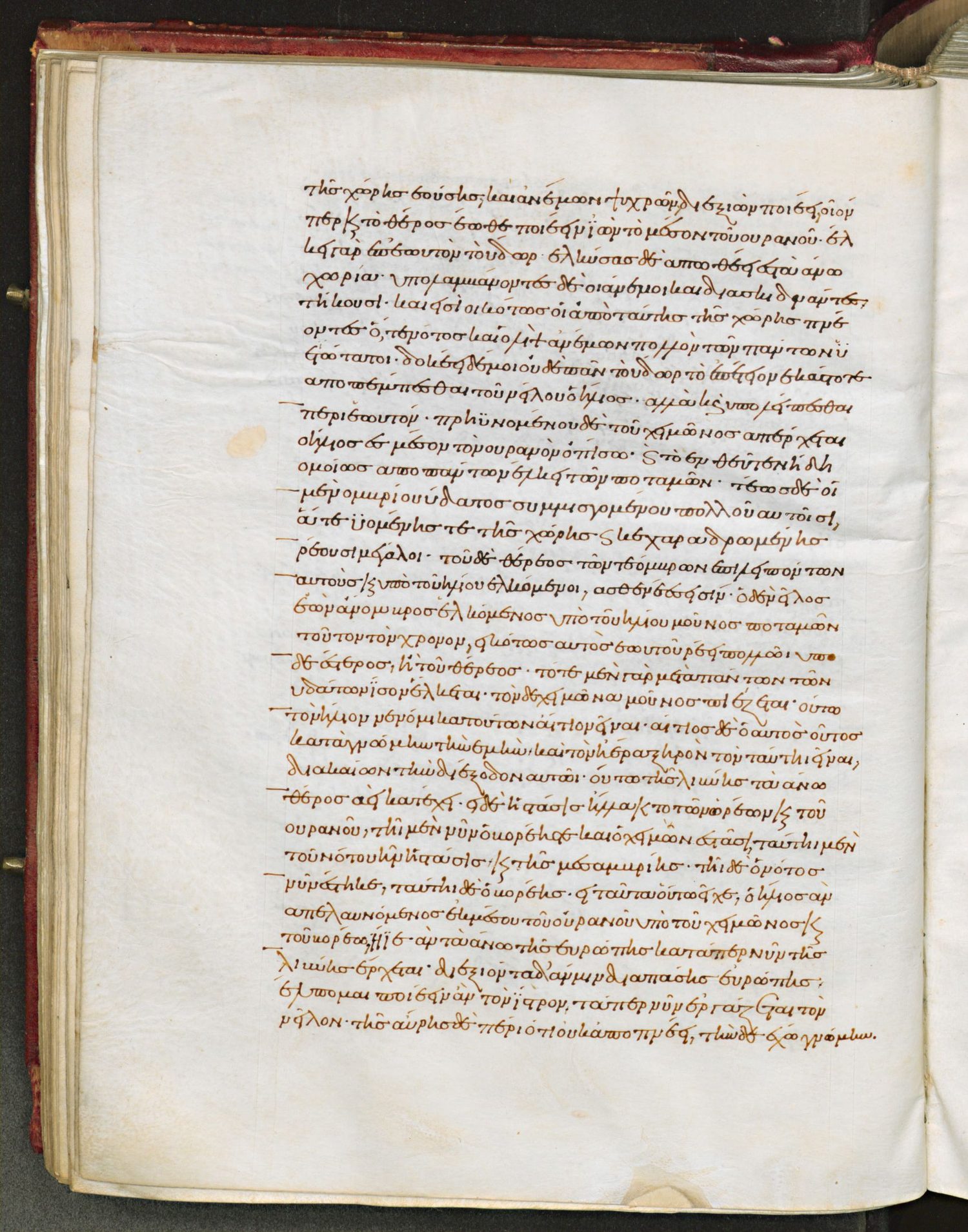
Where on the image
Laur. Plut. 70.3, fol. 61v: Greek here 2.25.1 to 2.27.1. Checked on the image (first and last words read and located in the Greek; each break checked against the neighbouring page): fol. 61v begins ‹τῆς χώρης ἐούσης καὶ› (2.25.1), ends ‹ἀποπνέει, τήνδε ἔχω γνώμην› (2.27.1). English here: 2.25.3 to 2.26.2 (Godley's sentences for the sections whose Greek lies mostly on this page).
2.25.1τῆς χώρης ἐούσης καὶ ἀνέμων ψυχρῶν, διεξιὼν ποιέει οἷόν περ καὶ τὸ θέρος ἔωθε ποιέειν ἰὼν τὸ μέσον τοῦ οὐρανοῦ· 2.25.2ἕλκει γὰρ ἐπʼ ἑωυτὸν τὸ ὕδωρ, ἑλκύσας δὲ ἀπωθέει ἐς τὰ ἄνω χωρία, ὑπολαμβάνοντες δὲ οἱ ἄνεμοι καὶ διασκιδνάντες τήκουσι· καὶ εἰσὶ οἰκότως οἱ ἀπὸ ταύτης τῆς χώρης πνέοντες, ὅ τε νότος καὶ ὁ λίψ, ἀνέμων πολλὸν τῶν πάντων ὑετιώτατοι 2.25.3δοκέει δέ μοι οὐδὲ πᾶν τὸ ὕδωρ τὸ ἐπέτειον ἑκάστοτε ἀποπέμπεσθαι τοῦ Νείλου ὁ ἥλιος, ἀλλὰ καὶ ὑπολείπεσθαι περὶ ἑωυτόν. πρηϋνομένου δὲ τοῦ χειμῶνος ἀπέρχεται ὁ ἥλιος ἐς μέσον τὸν οὐρανὸν ὀπίσω, καὶ τὸ ἐνθεῦτεν ἤδη ὁμοίως ἀπὸ πάντων ἕλκει τῶν ποταμῶν. 2.25.4τέως δὲ οἳ μὲν ὀμβρίου ὕδατος συμμισγομένου πολλοῦ αὐτοῖσι, ἅτε ὑομένης τε τῆς χώρης καὶ κεχαραδρωμένης, ῥέουσι μεγάλοι· τοῦ δὲ θέρεος τῶν τε ὄμβρων ἐπιλειπόντων αὐτοὺς καὶ ὑπὸ τοῦ ἡλίου ἑλκόμενοι ἀσθενέες εἰσί. 2.25.5ὁ δὲ Νεῖλος ἐὼν ἄνομβρος, ἑλκόμενος δὲ ὑπὸ τοῦ ἡλίου μοῦνος ποταμῶν τοῦτον τὸν χρόνον, οἰκότως αὐτὸς ἑωυτοῦ ῥέει πολλῷ ὑποδεέστερος ἢ τοῦ θέρεος· τότε μὲν γὰρ μετὰ πάντων τῶν ὑδάτων ἴσον ἕλκεται, τὸν δὲ χειμῶνα μοῦνος πιέζεται. 2.26.1οὕτω τὸν ἥλιον νενόμικα τούτων αἴτιον εἶναι. αἴτιος δὲ ὁ αὐτὸς οὗτος κατὰ γνώμην τὴν ἐμὴν καὶ τὸν ἠέρα ξηρὸν τὸν ταύτῃ εἶναι, διακαίων τὴν διέξοδον ἑωυτοῦ· οὕτω τῆς Λιβύης τὰ ἄνω θέρος αἰεὶ κατέχει. 2.26.2εἰ δὲ ἡ στάσις ἤλλακτο τῶν ὡρέων, καὶ τοῦ οὐρανοῦ τῇ μὲν νῦν ὁ βορέης τε καὶ ὁ χειμὼν ἑστᾶσι, ταύτῃ μὲν τοῦ νότου ἦν ἡ στάσις καὶ τῆς μεσαμβρίης, τῇ δὲ ὁ νότος νῦν ἕστηκε, ταύτῃ δὲ ὁ βορέης, εἰ ταῦτα οὕτω εἶχε, ὁ ἥλιος ἂν ἀπελαυνόμενος ἐκ μέσου τοῦ οὐρανοῦ ὑπὸ τοῦ χειμῶνος καὶ τοῦ βορέω ἤιε ἂν τὰ ἄνω τῆς Εὐρώπης κατά περ νῦν τῆς Λιβύης ἔρχεται, διεξιόντα δʼ ἄν μιν διὰ πάσης Εὐρώπης ἔλπομαι ποιέειν ἂν τὸν Ἴστρον τά περ νῦν ἐργάζεται τὸν Νεῖλον. 2.27.1τῆς αὔρης δὲ πέρι, ὅτι οὐκ ἀποπνέει, τήνδε ἔχω γνώμην,
2.25.3Yet I think that the sun never lets go all the water that he yearly draws up from the Nile, but keeps some back near to himself. Then as the winter becomes milder, the sun returns back to the middle of the heaven, and after that he draws from all rivers alike. 2.25.4Meantime the other rivers are swollen to high flood by the much water from the sky that falls into them, because the country is rained upon and cut into gullies; but in the summer they are low, lacking the rain and being drawn up too by the sun. 2.25.5But the Nile being fed by no rain, and being the only river in winter drawn up by the sun, at this time falls far short of the height that he had in summer; which is but natural; for in summer all other waters too and not his alone are attracted to the sun, but in the winter it is he alone who is afflicted. 2.26.1I am persuaded therefore that the sun is the cause of these matters. The dryness of the air in these parts is also caused by the sun, to my thinking, because he burns his passage through it; so it is that it is always summer in the inland part of Libya. 2.26.2But were the stations of the seasons changed, so that the south wind and the summer had their station where now the north wind and winter are set, and the north wind was where the south wind is now,—if this were so, the sun when driven from mid-heaven by the winter and the north wind would pass over the inland parts of Europe as he now passes over Libya, and I think that in his passage over all Europe he would work the same effect on the Ister as he now does on the Nile.
Where on the image
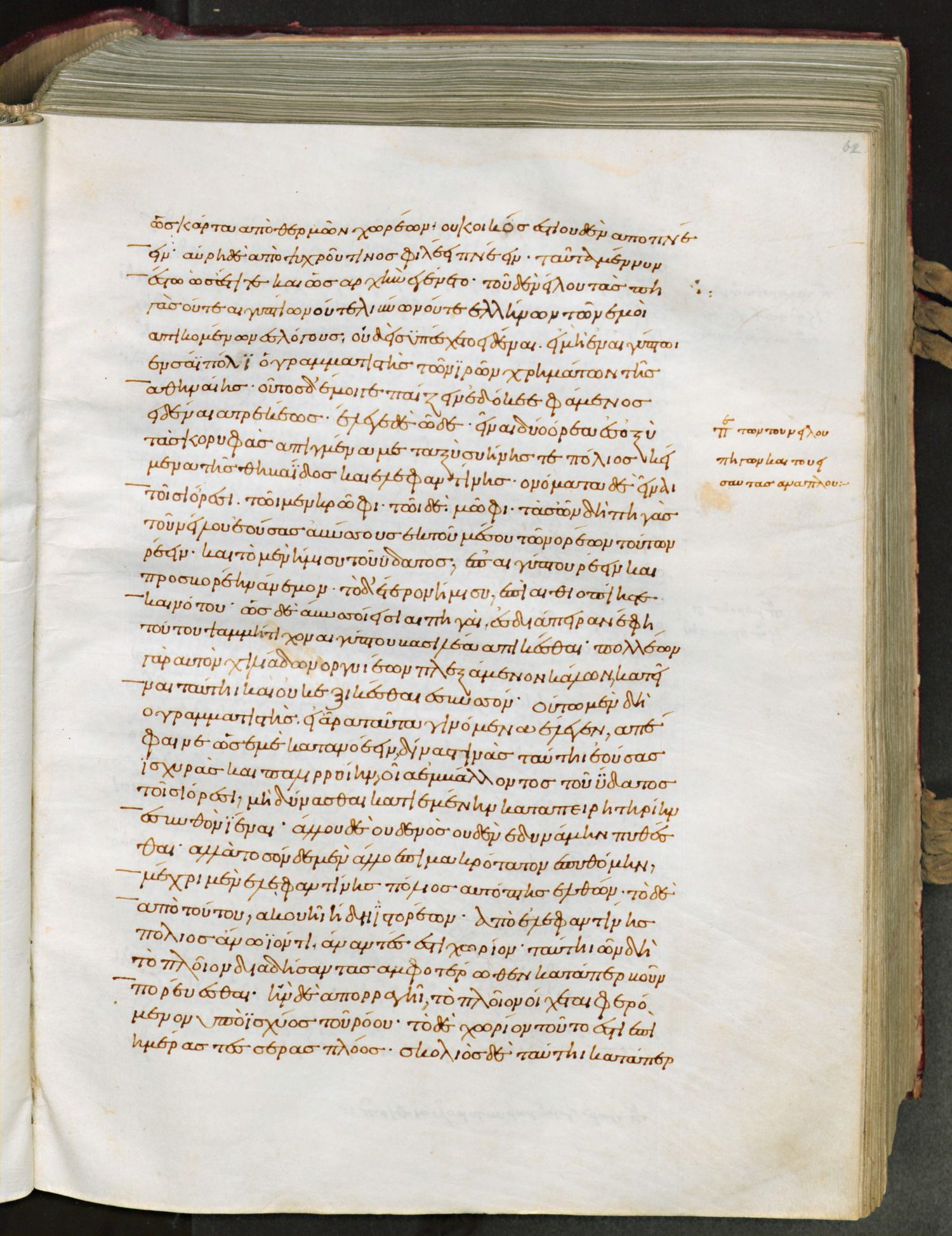
Laur. Plut. 70.3, fol. 62r: Greek here 2.27.1 to 2.29.3. Checked on the image (first and last words read and located in the Greek; each break checked against the neighbouring page): fol. 62r begins ‹ὡς κάρτα ἀπὸ θερμέων› (2.27.1), ends ‹δὲ ταύτῃ κατά περ› (2.29.3). English here: 2.27.1 to 2.29.2 (Godley's sentences for the sections whose Greek lies mostly on this page).
2.27.1ὡς κάρτα ἀπὸ θερμέων χωρέων οὐκ οἰκός ἐστι οὐδὲν ἀποπνέειν, αὔρη δὲ ἀπὸ ψυχροῦ τινος φιλέει πνέειν. 2.28.1ταῦτα μέν νυν ἔστω ὡς ἔστι τε καὶ ὡς ἀρχὴν ἐγένετο· τοῦ δὲ Νείλου τὰς πηγὰς οὔτε Αἰγυπτίων οὔτε Λιβύων οὔτε Ἑλλήνων τῶν ἐμοὶ ἀπικομένων ἐς λόγους οὐδεὶς ὑπέσχετο εἰδέναι, εἰ μὴ ἐν Αἰγύπτῳ ἐν Σάι πόλι ὁ γραμματιστὴς τῶν ἱρῶν χρημάτων τῆς Ἀθηναίης. 2.28.2οὗτος δʼ ἔμοιγε παίζειν ἐδόκεε φάμενος εἰδέναι ἀτρεκέως· ἔλεγε δὲ ὧδε, εἶναι δύο ὄρεα ἐς ὀξὺ τὰς κορυφὰς ἀπηγμένα, μεταξὺ Συήνης τε πόλιος κείμενα τῆς Θηβαΐδος καὶ Ἐλεφαντίνης, οὐνόματα δὲ εἶναι τοῖσι ὄρεσι τῷ μὲν Κρῶφι τῷ δὲ Μῶφι· 2.28.3τὰς ὦν δὴ πηγὰς τοῦ Νείλου ἐούσας ἀβύσσους ἐκ τοῦ μέσου τῶν ὀρέων τούτων ῥέειν, καὶ τὸ μὲν ἥμισυ τοῦ ὕδατος ἐπʼ Αἰγύπτου ῥέειν καὶ πρὸς βορέην ἄνεμον, τὸ δʼ ἕτερον ἥμισυ ἐπʼ Αἰθιοπίης τε καὶ νότου. 2.28.4ὡς δὲ ἄβυσσοι εἰσι αἱ πηγαί, ἐς διάπειραν ἔφη τούτου Ψαμμήτιχον Αἰγύπτου βασιλέα ἀπικέσθαι· πολλέων γὰρ αὐτὸν χιλιάδων ὀργυιέων πλεξάμενον κάλον κατεῖναι ταύτῃ καὶ οὐκ ἐξικέσθαι ἐς βυσσόν. 2.28.5οὕτω μὲν δὴ ὁ γραμματιστής, εἰ ἄρα ταῦτα γινόμενα ἔλεγε, ἀπέφαινε, ὡς ἐμὲ κατανοέειν, δίνας τινὰς ταύτῃ ἐούσας ἰσχυρὰς καὶ παλιρροίην, οἷα δὲ ἐμβάλλοντος τοῦ ὕδατος τοῖσι ὄρεσι, μὴ δύνασθαι κατιεμένην καταπειρητηρίην ἐς βυσσὸν ἰέναι. 2.29.1ἄλλου δὲ οὐδενὸς οὐδὲν ἐδυνάμην πυθέσθαι. ἀλλὰ τοσόνδε μὲν ἄλλο ἐπὶ μακρότατον ἐπυθόμην, μέχρι μὲν Ἐλεφαντίνης πόλιος αὐτόπτης ἐλθών, τὸ δὲ ἀπὸ τούτου ἀκοῇ ἤδη ἱστορέων. 2.29.2ἀπὸ Ἐλεφαντίνης πόλιος ἄνω ἰόντι ἄναντες ἐστὶ χωρίον· ταύτῃ ὦν δεῖ τὸ πλοῖον διαδήσαντας ἀμφοτέρωθεν κατά περ βοῦν πορεύεσθαι· ἢν δὲ ἀπορραγῇ τὸ πλοῖον οἴχεται φερόμενον ὑπὸ ἰσχύος τοῦ ῥόου. 2.29.3τὸ δὲ χωρίον τοῦτο ἐστὶ ἐπʼ ἡμέρας τέσσερας πλόος, σκολιὸς δὲ ταύτῃ κατά περ
2.27.1And for the reason why no air blows from the river, this is my opinion: it is not natural that any air blow from very hot places; airs ever come from that which is very cold. 2.28.1Be these matters, then, as they are and as they were made to be in the beginning. But as to the sources of the Nile, none that conversed with me, neither Egyptian, nor Libyan, nor Greek, professed to know them, except only the recorder of the sacred treasures of Athene in the Egyptian city of Sais. 2.28.2He, I thought, jested with me when he said that he had exact knowledge; but this was his story:—Between the city of Syene in the Thebaid and Elephantine there are two hills with sharp peaks, the one called Crophi and the other Mophi. 2.28.3The springs of the Nile, which are unfathomed, rise between these hills; and half the water flows towards Egypt northwards, the other half southwards towards Ethiopia. 2.28.4That this source cannot be fathomed, Psammetichus king of Egypt proved by experiment: for he had a rope woven of many a thousand fathoms’ length and let down into the spring, but he could not reach to the bottom. 2.28.5Thus, then, if the recorder spoke truth, he showed, as I think, that here are strong eddies and an upward flow of water, and the rushing of the stream against the hills makes the sounding-line when let down unable to reach the bottom. 2.29.1From no other man could I learn anything. But this much I learnt by the farthest inquiry that I could make, by my own travel and sight as far as the city of Elephantine, and beyond that by question and hearsay:—Beyond Elephantine, as one travels inland, the land rises. 2.29.2Here one must pass with the boat roped on both sides as men harness an ox; and if the rope break, the boat is carried away by the strength of the current.
Where on the image
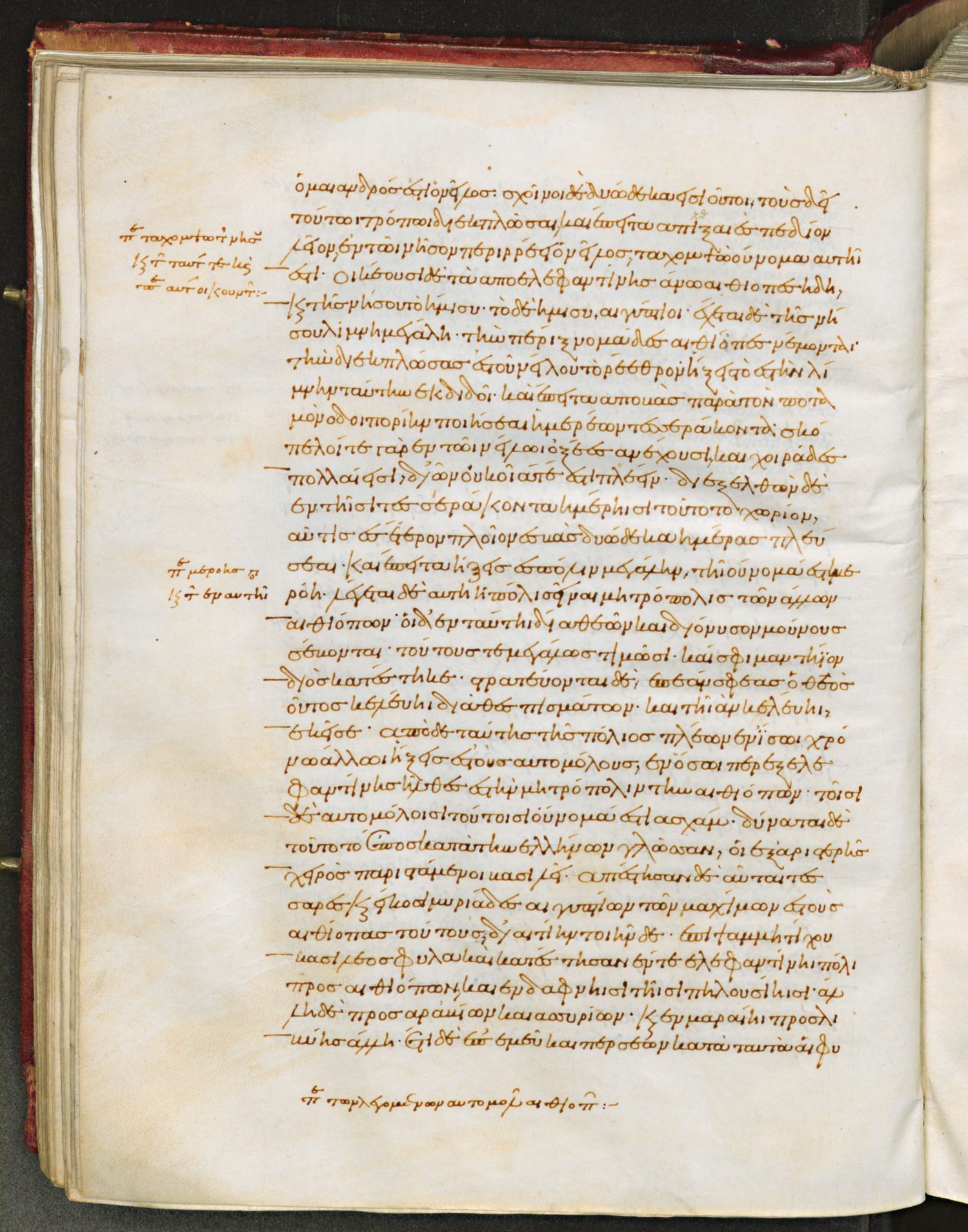
Laur. Plut. 70.3, fol. 62v: Greek here 2.29.3 to 2.30.3. Checked on the image (first and last words read and located in the Greek; each break checked against the neighbouring page): fol. 62v begins ‹ὁ Μαίανδρος ἐστὶ ὁ› (2.29.3), ends ‹κατὰ ταὐτὰ αἱ φυ-› (2.30.3). Below the text, a reader's note on the Egyptian deserters. English here: 2.29.3 to 2.30.2 (Godley's sentences for the sections whose Greek lies mostly on this page).
2.29.3ὁ Μαίανδρος ἐστὶ ὁ Νεῖλος· σχοῖνοι δὲ δυώδεκα εἰσὶ οὗτοι τοὺς δεῖ τούτῳ τῷ τρόπῳ διεκπλῶσαι. καὶ ἔπειτα ἀπίξεαι ἐς πεδίον λεῖον, ἐν τῷ νῆσον περιρρέει ὁ Νεῖλος· Ταχομψὼ οὔνομα αὐτῇ ἐστι. 2.29.4οἰκέουσι δὲ τὰ ἀπὸ Ἐλεφαντίνης ἄνω Αἰθίοπες ἤδη καὶ τῆς νήσου τὸ ἥμισυ, τὸ δὲ ἥμισυ Αἰγύπτιοι. ἔχεται δὲ τῆς νήσου λίμνην μεγάλη, τὴν πέριξ νομάδες Αἰθίοπες νέμονται· τὴν διεκπλώσας ἐς τοῦ Νείλου τὸ ῥέεθρον ἥξεις, τὸ ἐς τὴν λίμνην ταύτην ἐκδιδοῖ. 2.29.5καὶ ἔπειτα ἀποβὰς παρὰ τὸν ποταμὸν ὁδοιπορίην ποιήσεαι ἡμερέων τεσσεράκοντα· σκόπελοί τε γὰρ ἐν τῷ Νείλῳ ὀξέες ἀνέχουσι καὶ χοιράδες πολλαί εἰσι, διʼ ὧν οὐκ οἷά τε ἐστὶ πλέειν. 2.29.6διεξελθὼν δὲ ἐν τῇσι τεσσεράκοντα ἡμέρῃσι τοῦτο τὸ χωρίον, αὖτις ἐς ἕτερον πλοῖον ἐσβὰς δυώδεκα ἡμέρας πλεύσεαι, καὶ ἔπειτα ἥξεις ἐς πόλιν μεγάλην τῇ οὔνομα ἐστὶ Μερόη· λέγεται δὲ αὕτη ἡ πόλις εἶναι μητρόπολις τῶν ἄλλων Αἰθιόπων. 2.29.7οἱ δʼ ἐν ταύτῃ Δία θεῶν καὶ Διόνυσον μούνους σέβονται, τούτους τε μεγάλως τιμῶσι, καί σφι μαντήιον Διὸς κατέστηκε· στρατεύονται δὲ ἐπεάν σφεας ὁ θεὸς οὗτος κελεύῃ διὰ θεσπισμάτων, καὶ τῇ ἂν κελεύῃ, ἐκεῖσε. 2.30.1ἀπὸ δὲ ταύτης τῆς πόλιος πλέων ἐν ἴσῳ χρόνῳ ἄλλῳ ἥξεις ἐς τοὺς αὐτομόλους ἐν ὅσῳ περ ἐξ Ἐλεφαντίνης ἦλθες ἐς τὴν μητρόπολιν τὴν Αἰθιόπων. τοῖσι δὲ αὐτομόλοισι τούτοισι οὔνομα ἐστὶ Ἀσμάχ, δύναται δὲ τοῦτο τὸ ἔπος κατὰ τὴν Ἑλλήνων γλῶσσαν οἱ ἐξ ἀριστερῆς χειρὸς παριστάμενοι βασιλέι. 2.30.2ἀπέστησαν δὲ αὗται τέσσερες καὶ εἴκοσι μυριάδες Αἰγυπτίων τῶν μαχίμων ἐς τοὺς Αἰθίοπας τούτους διʼ αἰτίην τοιήνδε. ἐπὶ Ψαμμητίχου βασιλέος φυλακαὶ κατέστησαν ἔν τε Ἐλεφαντίνῃ πόλι πρὸς Αἰθιόπων καὶ ἐν Δάφνῃσι τῇσι Πηλουσίῃσι ἄλλη πρὸς Ἀραβίων τε καὶ Ἀσσυρίων, καὶ ἐν Μαρέῃ πρὸς Λιβύης ἄλλη. 2.30.3ἔτι δὲ ἐπʼ ἐμεῦ καὶ Περσέων κατὰ ταὐτὰ αἱ φυλακαὶ
2.29.3This part of the river is a four days’ journey by boat, and the Nile here is winding like the Maeander; a length of twelve schoeni must be passed in the aforesaid fashion. After that you will come to a level plain, where there is an island in the Nile, called Tachompso. 2.29.4Above Elephantine the country now begins to be inhabited by Ethiopians, and half the people of the island are Ethiopians and half Egyptians. Near to the island is a great lake, on the shores of which dwell nomad Ethiopians. Having crossed this, you will come to the stream of the Nile, which issues into this lake. 2.29.5Then you will disembark and journey along the river bank for forty days; for there are sharp projecting rocks in the Nile and many reefs, through which no boat can pass. 2.29.6Having traversed this part in forty days as I have said, you will take boat again and so travel for twelve days till you come to a great city called Meroe, which is said to be the capital of all Ethiopia. 2.29.7The people of the place worship no other gods but Zeus and Dionysus; these they greatly honour, and they have a place of divination sacred to Zeus; they send out armies whenever and whithersoever this god by oracle commands them. 2.30.1From this city you will make a journey by water of equal distance with that by which you came from Elephantine to the capital city of Ethiopia, and you will come to the land of the Deserters. These Deserters are called Asmach, which signifies, in our language, those who stand on the left hand of the king. 2.30.2These once, to the number of two hundred and forty thousand Egyptians of fighting age, revolted and joined themselves to the Ethiopians. The reason was this:—In the reign of Psammetichus there were garrisons posted at Elephantine on the side of Ethiopia, at Daphnae of Pelusium on the side of Arabia and Assyria, and at Marea on the side of Libya.
Where on the image
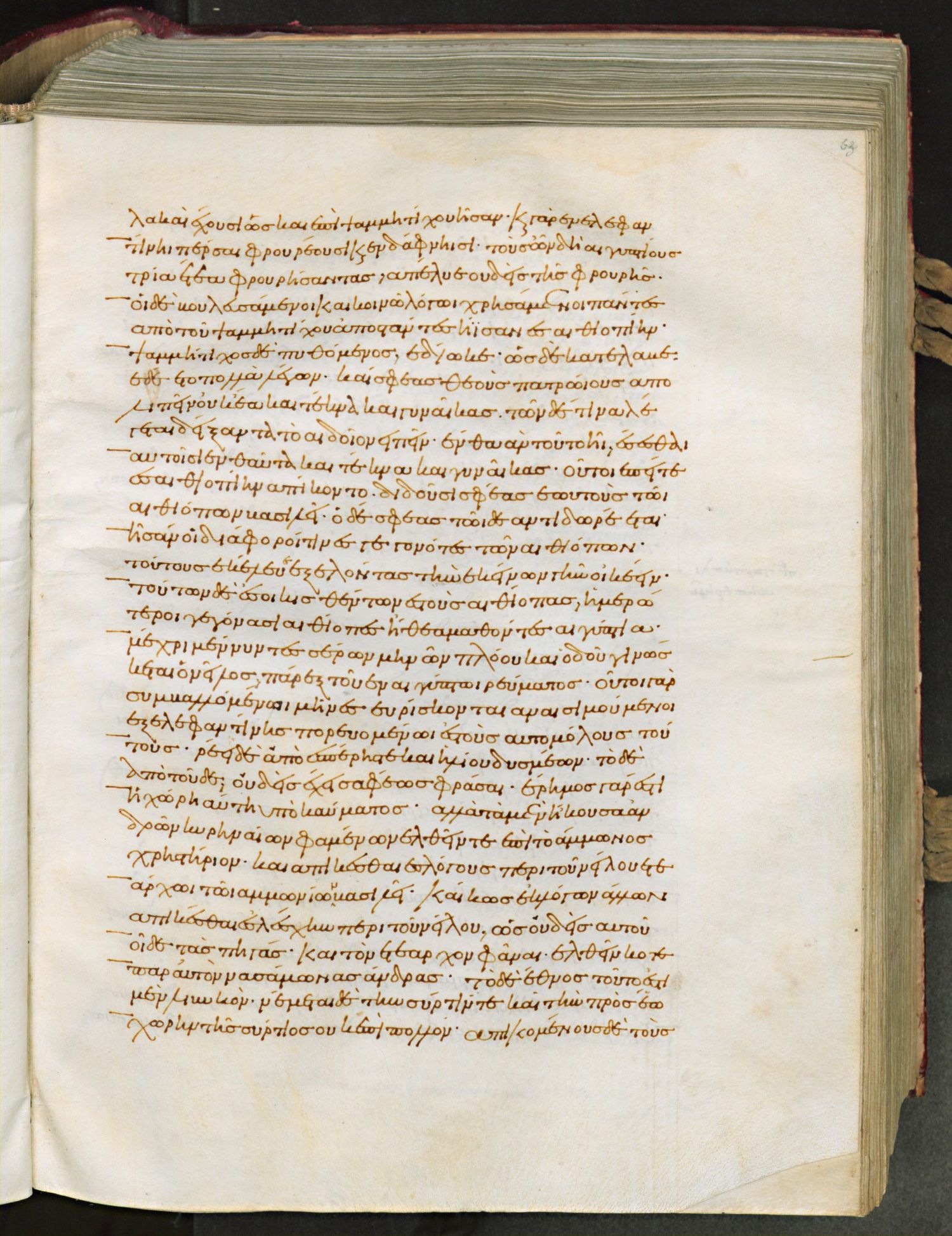
Laur. Plut. 70.3, fol. 63r: Greek here 2.30.3 to 2.32.3. Checked on the image (first and last words read and located in the Greek; each break checked against the neighbouring page): fol. 63r begins ‹-λακαὶ ἔχουσι ὡς καὶ› (2.30.3), ends ‹ἐπὶ πολλόν.ἀπικομένους δὲ τοὺς› (2.32.3). The word ‹φυλακαὶ› is divided between fol. 62v and fol. 63r; it is given with fol. 62v. English here: 2.30.3 to 2.32.2 (Godley's sentences for the sections whose Greek lies mostly on this page).
2.30.3ἔχουσι ὡς καὶ ἐπὶ Ψαμμητίχου ἦσαν· καὶ γὰρ ἐν Ἐλεφαντίνῃ Πέρσαι φρουρέουσι καὶ ἐν Δάφνῃσι. τοὺς ὦν δὴ Αἰγυπτίους τρία ἔτεα φρουρήσαντας ἀπέλυε οὐδεὶς τῆς φρουρῆς· οἳ δὲ βουλευσάμενοι καὶ κοινῷ λόγῳ χρησάμενοι πάντες ἀπὸ τοῦ Ψαμμητίχου ἀποστάντες ἤισαν ἐς Αἰθιοπίην. 2.30.4Ψαμμήτιχος δὲ πυθόμενος ἐδίωκε· ὡς δὲ κατέλαβε, ἐδέετο πολλὰ λέγων καί σφεας θεοὺς πατρωίους ἀπολιπεῖν οὐκ ἔα καὶ τέκνα καὶ γυναῖκας. τῶν δὲ τινὰ λέγεται δέξαντα τὸ αἰδοῖον εἰπεῖν, ἔνθα ἂν τοῦτο ᾖ, ἔσεσθαι αὐτοῖσι ἐνθαῦτα καὶ τέκνα καὶ γυναῖκας. 2.30.5οὗτοι ἐπείτε ἐς Αἰθιοπίην ἀπίκοντο, διδοῦσι σφέας αὐτοὺς τῷ Αἰθιόπων βασιλέι, ὁ δὲ σφέας τῷδε ἀντιδωρέεται· ἦσάν οἱ διάφοροι τινὲς γεγονότες τῶν Αἰθιόπων· τούτους ἐκέλευε ἐξελόντας τὴν ἐκείνων γῆν οἰκέειν. τούτων δὲ ἐσοικισθέντων ἐς τοὺς Αἰθίοπας ἡμερώτεροι γεγόνασι Αἰθίοπες, ἤθεα μαθόντες Αἰγύπτια. 2.31.1μέχρι μέν νυν τεσσέρων μηνῶν πλόου καὶ ὁδοῦ γινώσκεται ὁ Νεῖλος πάρεξ τοῦ ἐν Αἰγύπτῳ ῥεύματος· τοσοῦτοι γὰρ συμβαλλομένῳ μῆνες εὑρίσκονται ἀναισιμούμενοι ἐξ Ἐλεφαντίνης πορευομένῳ ἐς τοὺς αὐτομόλους τούτους. ῥέει δὲ ἀπὸ ἑσπέρης τε καὶ ἡλίου δυσμέων. τὸ δὲ ἀπὸ τοῦδε οὐδεὶς ἔχει σαφέως φράσαι· ἔρημος γὰρ ἐστὶ ἡ χώρη αὕτη ὑπὸ καύματος. 2.32.1ἀλλὰ τάδε μὲν ἤκουσα ἀνδρῶν Κυρηναίων φαμένων ἐλθεῖν τε ἐπὶ τὸ Ἄμμωνος χρηστήριον καὶ ἀπικέσθαι ἐς λόγους Ἐτεάρχῳ τῷ Ἀμμωνίων βασιλέι, καί κως ἐκ λόγων ἄλλων ἀπικέσθαι ἐς λέσχην περὶ τοῦ Νείλου, ὡς οὐδεὶς αὐτοῦ οἶδε τὰς πηγάς, καὶ τὸν Ἐτέαρχον φάναι ἐλθεῖν κοτε παρʼ αὐτὸν Νασαμῶνας ἄνδρας. 2.32.2τὸ δὲ ἔθνος τοῦτο ἐστὶ μὲν Λιβυκόν, νέμεται δὲ τὴν Σύρτιν τε καὶ τὴν πρὸς ἠῶ χώρην τῆς Σύρτιος οὐκ ἐπὶ πολλόν. 2.32.3ἀπικομένους δὲ τοὺς
2.30.3And still in my time the Persians hold these posts as they were held in the days of Psammetichus; there are Persian guards at Elephantine and at Daphnae. Now the Egyptians had been on guard for three years, and none came to relieve them; so taking counsel and making common cause, they revolted from Psammetichus and went to Ethiopia. 2.30.4Psammetichus heard of it and pursued after them; and when he overtook them he besought them with many words not to desert the gods of their fathers and their children and wives. Then one of them, so the story goes, said, pointing to his manly part, that wherever this should be they would have wives and children. 2.30.5So they came to Ethiopia, and gave themselves up to the king of the country; who, to make them a gift in return, bade them dispossess certain Ethiopians with whom he was at feud, and occupy their land. These Ethiopians then learnt Egyptian customs and have become milder-mannered by intermixture with the Egyptians. 2.31.1For as far as a distance of four months’ travel, then, by land and water, there is knowledge of the Nile, besides the part of it that is in Egypt So many months, as reckoning shows, lasts the journey from Elephantine to the country of the Deserters aforesaid. The river flows from the west and the sun’s setting. Beyond this none has clear knowledge to declare; for all that country is desert, by reason of heat. 2.32.1But this I heard from certain men of Cyrene, who told me that they had gone to the oracle of Ammon, and there conversed with Etearchus king of the Ammonians, and that from other matters of discourse they came to speak of the Nile, how no one knows the source of it. Then Etearchus told them that once he had been visited by certain Nasamonians. 2.32.2These are a Libyan people, inhabiting the country of the Syrtis and the country a little way to the east of the Syrtis.
Where on the image
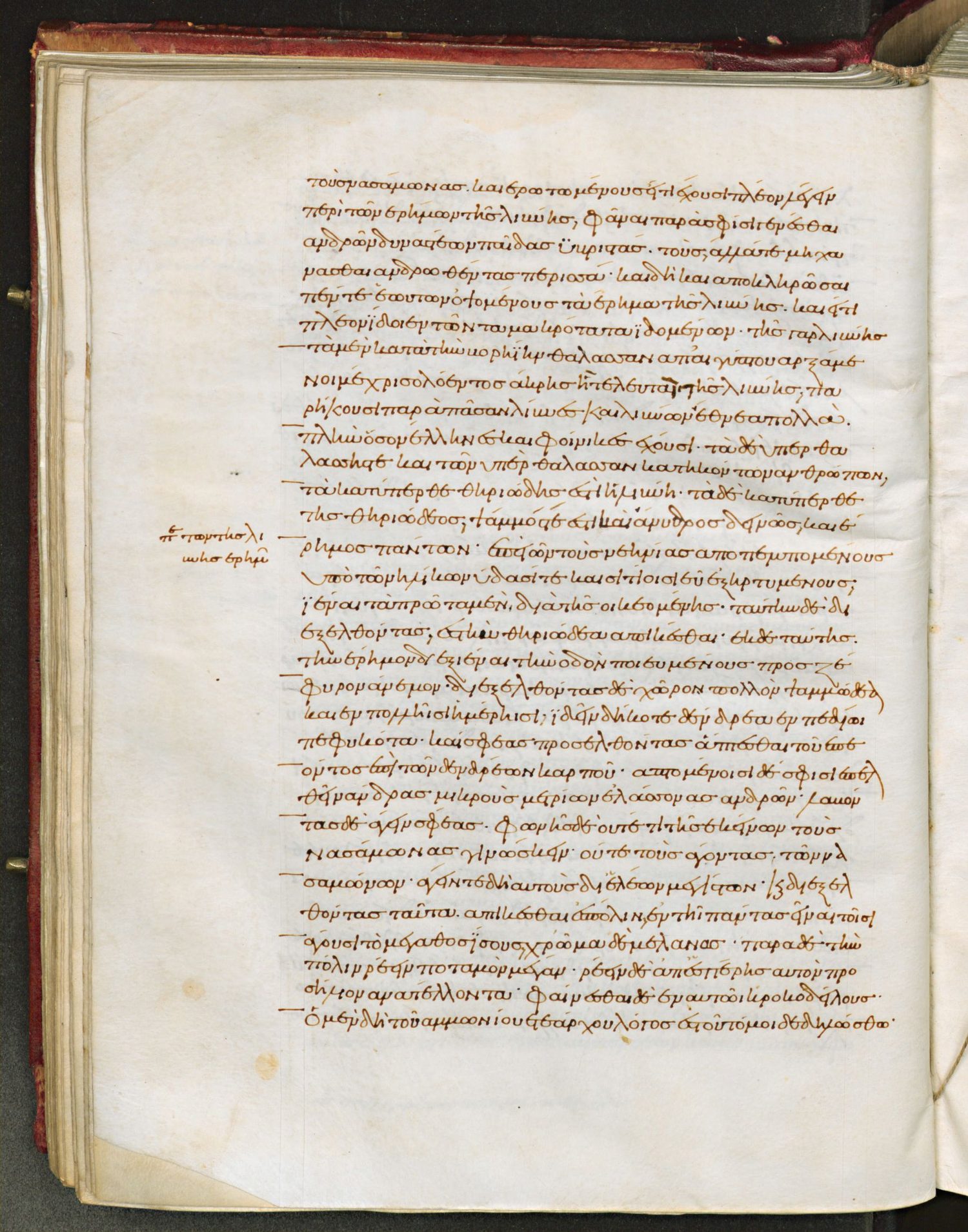
Laur. Plut. 70.3, fol. 63v: Greek here 2.32.3 to 2.33.1. Checked on the image (first and last words read and located in the Greek; each break checked against the neighbouring page): fol. 63v begins ‹Νασαμῶνας καὶ εἰρωτωμένους εἴ› (2.32.3), ends ‹ἐς τοῦτό μοι δεδηλώσθω› (2.33.1). English here: 2.32.3 to 2.32.7 (Godley's sentences for the sections whose Greek lies mostly on this page).
2.32.3Νασαμῶνας καὶ εἰρωτωμένους εἴ τι ἔχουσι πλέον λέγειν περὶ τῶν ἐρήμων τῆς Λιβύης, φάναι παρὰ σφίσι γενέσθαι ἀνδρῶν δυναστέων παῖδας ὑβριστάς, τοὺς ἄλλα τε μηχανᾶσθαι ἀνδρωθέντας περισσὰ καὶ δὴ καὶ ἀποκληρῶσαι πέντε ἑωυτῶν ὀψομένους τὰ ἔρημα τῆς Λιβύης, καὶ εἴ τι πλέον ἴδοιεν τῶν τὰ μακρότατα ἰδομένων. 2.32.4τῆς γὰρ Λιβύης τὰ μὲν κατὰ τὴν βορηίην θάλασσαν ἀπʼ Αἰγύπτου ἀρξάμενοι μέχρι Σολόεντος ἄκρης, ἣ τελευτᾷ τῆς Λιβύης, παρήκουσι παρὰ πᾶσαν Λίβυες καὶ Λιβύων ἔθνεα πολλά, πλὴν ὅσον Ἕλληνες καὶ Φοίνικες ἔχουσι· τὰ δὲ ὑπὲρ θαλάσσης τε καὶ τῶν ἐπὶ θάλασσαν κατηκόντων ἀνθρώπων, τὰ κατύπερθε θηριώδης ἐστὶ ἡ Λιβύη· τὰ δὲ κατύπερθε τῆς θηριώδεος ψάμμος τε ἐστὶ καὶ ἄνυδρος δεινῶς καὶ ἔρημος πάντων. 2.32.5εἶπαι ὦν τοὺς νεηνίας ἀποπεμπομένους ὑπὸ τῶν ἡλίκων, ὕδασί τε καὶ σιτίοισι εὖ ἐξηρτυμένους, ἰέναι τὰ πρῶτα μὲν διὰ τῆς οἰκεομένης, ταύτην δὲ διεξελθόντας ἐς τὴν θηριώδεα ἀπικέσθαι, ἐκ δὲ ταύτης τὴν ἔρημον διεξιέναι, τὴν ὁδὸν ποιευμένους πρὸς ζέφυρον ἄνεμον, 2.32.6διεξελθόντας δὲ χῶρον πολλὸν ψαμμώδεα καὶ ἐν πολλῇσι ἡμέρῃσι ἰδεῖν δή κοτε δένδρεα ἐν πεδίῳ πεφυκότα, καί σφεας προσελθόντας ἅπτεσθαι τοῦ ἐπεόντος ἐπὶ τῶν δενδρέων καρποῦ, ἁπτομένοισι δέ σφι ἐπελθεῖν ἄνδρας μικρούς, μετρίων ἐλάσσονας ἀνδρῶν, λαβόντας δὲ ἄγειν σφέας· φωνῆς δὲ οὔτε τι τῆς ἐκείνων τοὺς Νασαμῶνας γινώσκειν οὔτε τοὺς ἄγοντας τῶν Νασαμώνων· 2.32.7ἄγειν τε δὴ αὐτοὺς διʼ ἑλέων μεγίστων, καὶ διεξελθόντας ταῦτα ἀπικέσθαι ἐς πόλιν ἐν τῇ πάντας εἶναι τοῖσι ἄγουσι τὸ μέγαθος ἴσους, χρῶμα δὲ μέλανας. παρὰ δὲ τὴν πόλιν ῥέειν ποταμὸν μέγαν, ῥέειν δὲ ἀπὸ ἑσπέρης αὐτὸν πρὸς ἥλιον ἀνατέλλοντα, φαίνεσθαι δὲ ἐν αὐτῷ κροκοδείλους. 2.33.1ὁ μὲν δὴ τοῦ Ἀμμωνίου Ἐτεάρχου λόγος ἐς τοῦτό μοι δεδηλώσθω,
2.32.3When these Nasamonians on their coming were questioned if they brought any news concerning the Libyan desert, they told Etearchus that there had been among them certain sons of their chief men, proud and violent youths, who, when they came to man’s estate, besides planning other wild adventures, had chosen by lot five of their company to visit the deserts of Libya, and see what they might beyond the utmost range of travellers. 2.32.4It must be known that all the northern seacoast of Libya—from Egypt as far as the promontory of Soloeis, which is the end of Libya—is inhabited through its whole length by Libyans, many tribes of them, except the part held by Greeks and Phoenicians; the region of Libya above the sea and the men of the seacoast is infested by wild beasts; and farther inland than the wild-beast country all is sand, exceeding waterless and wholly desert. 2.32.5This then was the story told by the young men:—When they left their companions, being well supplied with water and provisions, they journeyed first through the inhabited country, and having passed this they came to the region of wild beasts. 2.32.6After this, they travelled over the desert, towards the west, and crossed a wide sandy region, till after many days they saw trees growing in a plain; when they came to these and were plucking the fruit of the trees, they were met by little men of stature smaller than common, who took them and led them away. The Nasamonians did not know these men’s language nor did the escort know the language of the Nasamonians. 2.32.7The men led them across great marshes, which having crossed they came to a city where all the people were of like stature with the escort, and black. A great river ran past this city, from the west towards the rising sun; crocodiles could be seen in it.
Where on the image
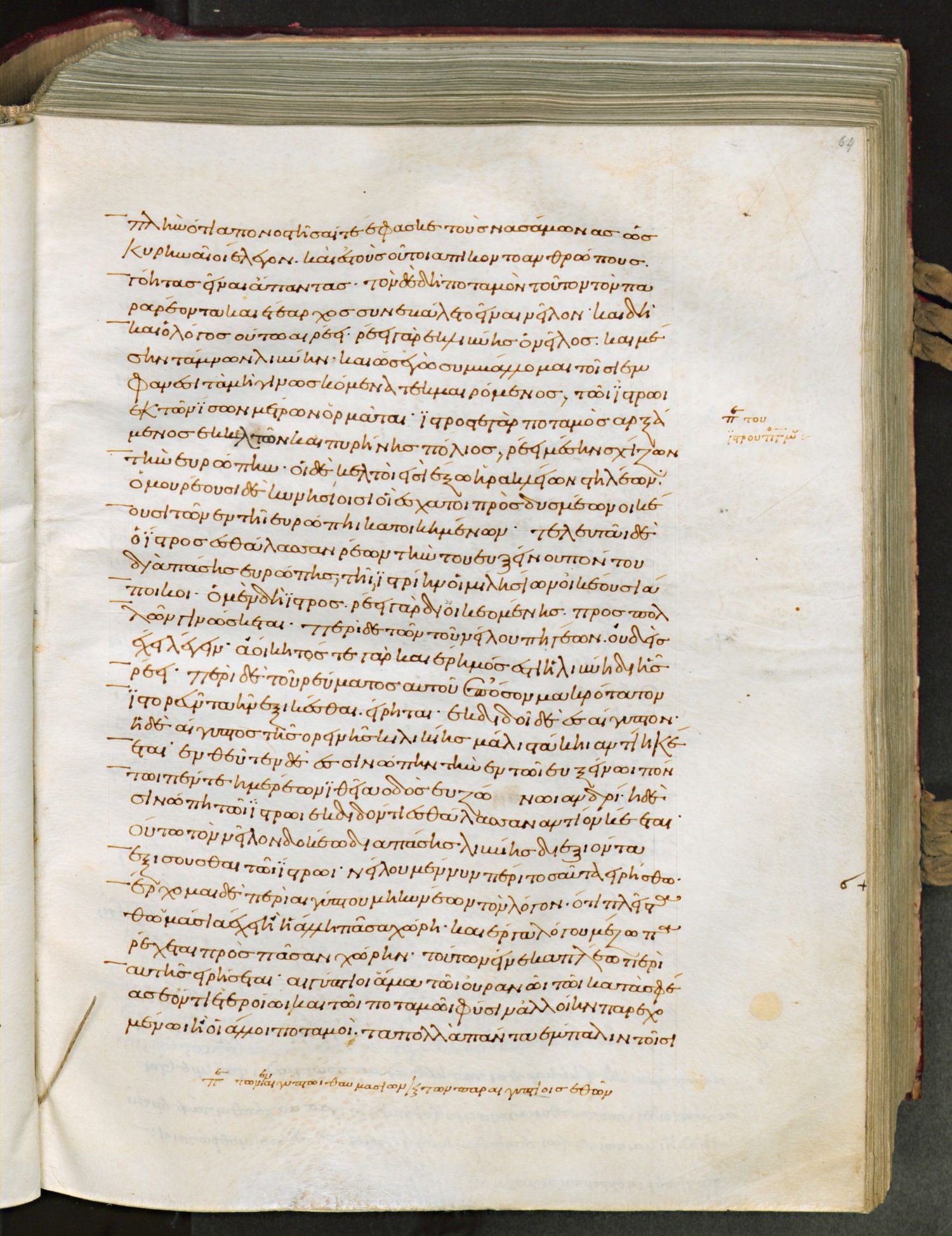
Laur. Plut. 70.3, fol. 64r: Greek here 2.33.1 to 2.34.2. Checked on the image (first and last words read and located in the Greek; each break checked against the neighbouring page): fol. 64r begins ‹πλὴν ὅτι ἀπονοστῆσαί τε› (2.33.1), ends ‹πολλὰ πάντα ἔμπαλιν τοῖσι› (2.35.2). Below the text, a reader's note on Egyptian customs. English here: 2.33.1 to 2.34.2 (Godley's sentences for the sections whose Greek lies mostly on this page).
2.33.1πλὴν ὅτι ἀπονοστῆσαί τε ἔφασκε τοὺς Νασαμῶνας, ὡς οἱ Κυρηναῖοι ἔλεγον, καὶ ἐς τοὺς οὗτοι ἀπίκοντο ἀνθρώπους, γόητας εἶναι ἅπαντας. 2.33.2τὸν δὲ δὴ ποταμὸν τοῦτον τὸν παραρρέοντα καὶ Ἐτέαρχος συνεβάλλετο εἶναι Νεῖλον, καὶ δὴ καὶ ὁ λόγος οὕτω αἱρέει. ῥέει γὰρ ἐκ Λιβύης ὁ Νεῖλος καὶ μέσην τάμνων Λιβύην, καὶ ὡς ἐγὼ συμβάλλομαι τοῖσι ἐμφανέσι τὰ μὴ γινωσκόμενα τεκμαιρόμενος, τῷ Ἴστρῳ ἐκ τῶν ἴσων μέτρων ὁρμᾶται. 2.33.3Ἴστρος τε γὰρ ποταμὸς ἀρξάμενος ἐκ Κελτῶν καὶ Πυρήνης πόλιος ῥέει μέσην σχίζων τὴν Εὐρώπην· οἱ δὲ Κελτοὶ εἰσὶ ἔξω Ἡρακλέων στηλέων, ὁμουρέουσι δὲ Κυνησίοισι, οἳ ἔσχατοι πρὸς δυσμέων οἰκέουσι τῶν ἐν τῇ Εὐρώπῃ κατοικημένων· 2.33.4τελευτᾷ δὲ ὁ Ἴστρος ἐς θάλασσαν ῥέων τὴν τοῦ Εὐξείνου πόντου διὰ πάσης Εὐρώπης, τῇ Ἰστρίην οἱ Μιλησίων οἰκέουσι ἄποικοι. 2.34.1ὁ μὲν δὴ Ἴστρος, ῥέει γὰρ διʼ οἰκεομένης, πρὸς πολλῶν γινώσκεται, περὶ δὲ τῶν τοῦ Νείλου πηγέων οὐδεὶς ἔχει λέγειν· ἀοίκητός τε γὰρ καὶ ἔρημος ἐστὶ ἡ Λιβύη διʼ ἧς ῥέει. περὶ δὲ τοῦ ῥεύματος αὐτοῦ, ἐπʼ ὅσον μακρότατον ἱστορεῦντα ἦν ἐξικέσθαι, εἴρηται· ἐκδιδοῖ δὲ ἐς Αἴγυπτον. ἡ δὲ Αἴγυπτος τῆς ὀρεινῆς Κιλικίης μάλιστά κῃ ἀντίη κέεται· 2.34.2ἐνθεῦτεν δὲ ἐς Σινώπην τὴν ἐν τῷ Εὐξείνῳ πόντῳ πέντε ἡμερέων ἰθέα ὁδὸς εὐζώνῳ ἀνδρί· ἡ δὲ Σινώπη τῷ Ἴστρῳ ἐκδιδόντι ἐς θάλασσαν ἀντίον κέεται. οὕτω τὸν Νεῖλον δοκέω διὰ πάσης τῆς Λιβύης διεξιόντα ἐξισοῦσθαι τῷ Ἴστρῳ.
2.33.1This is enough to say concerning the story told by Etearchus the Ammonian; except that he said that the Nasamonians returned—as the men of Cyrene told me—and that the people to whose country they came were all wizards; 2.33.2as to the river that ran past the city, Etearchus guessed it to be the Nile; and that is but reasonable. For the Nile flows from Libya, and right through the midst of that country; and as I guess, reasoning as to things unknown from visible signs, it takes its rise from the same measure of distance as the Ister. 2.33.3That river flows from the land of the Celtae and the city of Pyrene through the very midst of Europe; now the Celtae dwell beyond the pillars of Heracles, being neighbours of the Cynesii, who are the westernmost of all nations inhabiting Europe. 2.33.4The Ister, then, flows clean across Europe and ends its course in the Euxine sea, at Istria, which is inhabited by Milesian colonists. 2.34.1As it flows through inhabited country, its course is known to many; but none can speak of the source of the Nile; for Libya, through which it runs, is uninhabited and desert. Concerning its course I have told all that I could learn by inquiry; and it issues into Egypt. 2.34.2Now Egypt lies about opposite to the mountainous part of Cilicia; whence it is a straight five days’ journey for an unburdened man to Sinope on the Euxine; and Sinope lies over against the place where the Ister falls into the sea. Thus I suppose the course of the Nile in its passage through Libya to be like the course of the Ister.
Notes
- Greek: the text printed in A. D. Godley's Loeb edition, via Perseus (tlg0016.tlg001.perseus-grc2). Square brackets mark words the editor considers later additions; [...] marks a gap the editor indicates. Perseus note markers are omitted.
- English: A. D. Godley, Herodotus vol. 1 (1920) (Loeb Classical Library), as transcribed on Wikisource. Godley's footnotes are omitted.
- Section numbers in the English were placed by comparing Godley's text with the Perseus version of his translation; where a section begins inside one of Godley's sentences, the English is kept with the page that holds the start of that sentence.
Cite
Sources
- Source: Florence, Laur. Plut. 70.3 (10th c.) via BML Teca Digitale + Greek of Godley's Loeb (Perseus) + English of A. D. Godley (Loeb, Wikisource) (holding institution)
- Critical edition: Greek of A. D. Godley's Loeb edition (1920-1925), via Perseus
← previous · → next · v cycle view · l back to library