Herodotus, Histories 2.124-136: The pyramid builders
Introduction
Herodotus of Halicarnassus wrote the Histories in the third quarter of the 5th century BCE, an inquiry into the deeds of Greeks and barbarians and the causes of the wars between them, later divided into nine books. Book 2 is Herodotus' account of Egypt, written as background to Cambyses' invasion: the land and the Nile, the customs and religion of the Egyptians, and the history of their kings as the priests told it, down to Amasis.
The photographs are of Florence, Biblioteca Medicea Laurenziana, Plut. 70.3 (parchment, 10th century, 374 folios, 31 lines a page), Herodotus, Histories (codex A of the editors), the oldest surviving manuscript of the complete Histories, from the Teca Digitale of the Biblioteca Medicea Laurenziana. Each section below is the text of one page, or of the part of a page that falls within these chapters. The first and last words of every page were read on the photograph and located in the Greek, and every page break was checked against the next page; the notes quote these words. Readers' notes in the margins are not part of the text and are mentioned where they occur.
The Greek is the text printed in A. D. Godley's Loeb edition (1920-1925), from Perseus; it is the edited text, not a transcription of the manuscript, whose wording differs in places. The English is Godley's translation as printed, from Wikisource. Godley's English carries only chapter numbers; the section numbers shown in it were placed by comparison with the Perseus version of his translation. Each page's English is cut at the end of one of Godley's sentences, so it can begin or end a few lines away from the Greek of the page; each note gives the exact ranges.
This entry covers chapters 2.124-136, on fol. 86v to 90r.
How was this verified? (Provenance)
Where on the image
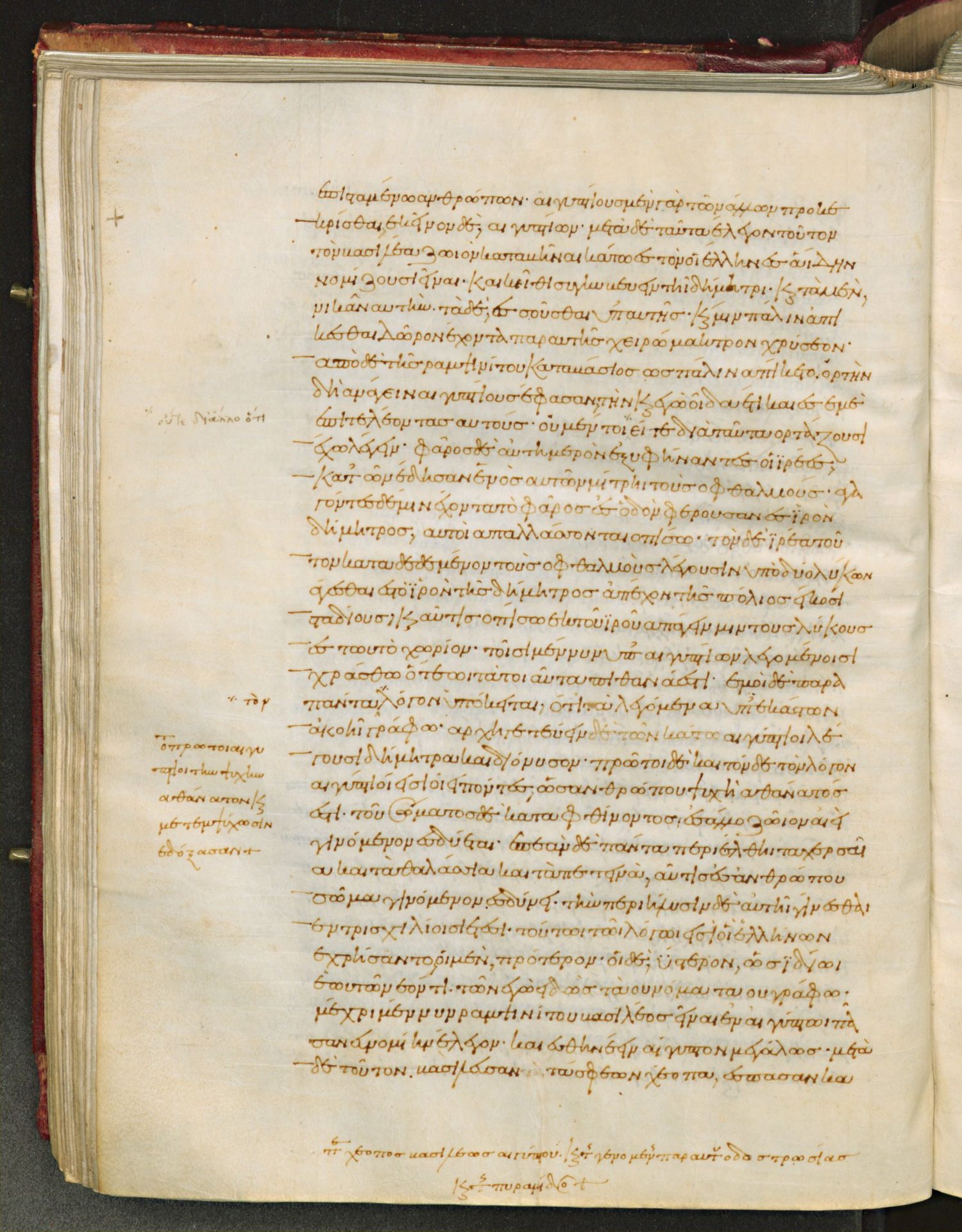
Laur. Plut. 70.3, fol. 86v: Greek here 2.124.1. Checked on the image (first and last words read and located in the Greek; each break checked against the neighbouring page): fol. 86v begins ‹ἐπισταμένῳ ἀνθρώπων. Αἰγυπτίους μὲν› (2.121f.2), ends ‹Χέοπα ἐς πᾶσαν κα-› (2.124.1) (page breaks read on the image for the Herodotus on Egypt collection). English here: 2.124.1 to 2.124.2 (Godley's sentences for the sections whose Greek lies mostly on this page).
2.124.1μέχρι μέν νυν Ῥαμψινίτου βασιλέος εἶναι ἐν Αἰγύπτῳ πᾶσαν εὐνομίην ἔλεγον καὶ εὐθηνέειν Αἴγυπτον μεγάλως, μετὰ δὲ τοῦτον βασιλεύσαντα σφέων Χέοπα ἐς πᾶσαν κακότητα
2.124.1Till the time of Rhampsinitus Egypt (so the priests told me) was in all ways well governed and greatly prospered, but Cheops, who was the next king, brought the people to utter misery. For first he shut up all the temples, so that none could sacrifice there; and next, he compelled all the Egyptians to work for him, appointing 2.124.2to some to drag stones from the quarries in the Arabian mountains to the Nile: and the stones being carried across the river in boats, others were charged to receive and drag them to the mountains called Libyan.
Where on the image
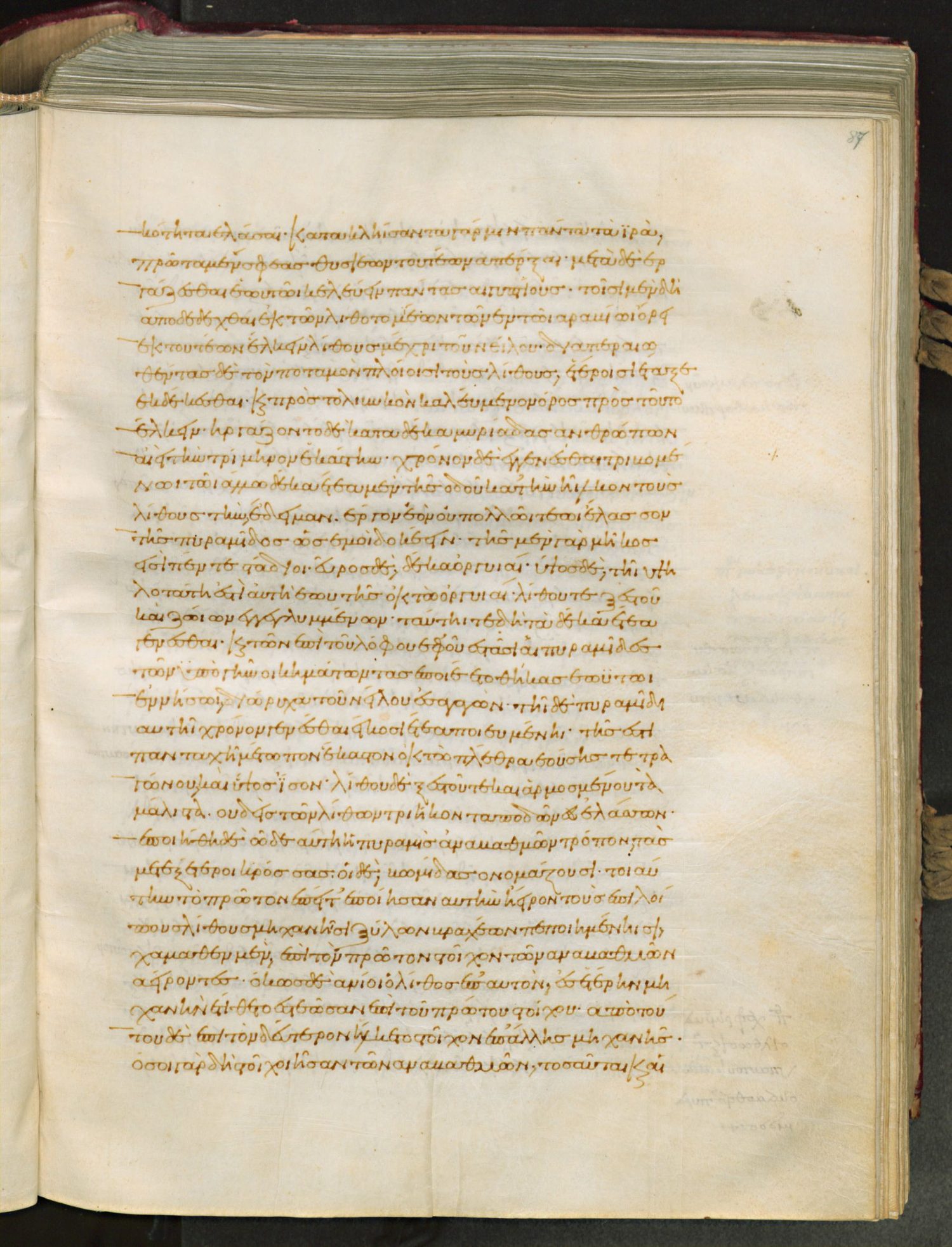
Laur. Plut. 70.3, fol. 87r: Greek here 2.124.1 to 2.125.4. Checked on the image (first and last words read and located in the Greek; each break checked against the neighbouring page): fol. 87r begins ‹-κότητα ἐλάσαι. κατακληίσαντα γάρ› (2.124.1), ends ‹τῶν ἀναβαθμῶν, τοσαῦται καὶ› (2.125.4) (page breaks read on the image for the Herodotus on Egypt collection). The word ‹κακότητα› is divided between fol. 86v and fol. 87r; it is given with fol. 86v. English here: 2.124.3 to 2.125.3 (Godley's sentences for the sections whose Greek lies mostly on this page).
2.124.1ἐλάσαι. κατακληίσαντα γάρ μιν πάντα τὰ ἱρὰ πρῶτα μὲν σφέας θυσιέων τουτέων ἀπέρξαι, μετὰ δὲ ἐργάζεσθαι ἑωυτῷ κελεύειν πάντας Αἰγυπτίους. 2.124.2τοῖσι μὲν δὴ ἀποδεδέχθαι ἐκ τῶν λιθοτομιέων τῶν ἐν τῷ Ἀραβίῳ ὄρεϊ, ἐκ τουτέων ἕλκειν λίθους μέχρι τοῦ Νείλου· διαπεραιωθέντας δὲ τὸν ποταμὸν πλοίοισι τοὺς λίθους ἑτέροισι ἐπέταξε ἐκδέκεσθαι καὶ πρὸς τὸ Λιβυκὸν καλεύμενον ὄρος, πρὸς τοῦτο ἕλκειν. 2.124.3ἐργάζοντο δὲ κατὰ δέκα μυριάδας ἀνθρώπων αἰεὶ τὴν τρίμηνον ἑκάστην. χρόνον δὲ ἐγγενέσθαι τριβομένῳ τῷ λεῷ δέκα ἔτεα μὲν τῆς ὁδοῦ κατʼ ἣν εἷλκον τοὺς λίθους, τὴν ἔδειμαν ἔργον ἐὸν οὐ πολλῷ τεῳ ἔλασσον τῆς πυραμίδος. ὡς ἐμοὶ δοκέειν· 2.124.4τῆς μὲν γὰρ μῆκος εἰσὶ πέντε στάδιοι, εὖρος δὲ δέκα ὀργυιαί, ὕψος δέ, τῇ ὑψηλοτάτη ἐστὶ αὐτὴ ἑωυτῆς, ὀκτὼ ὀργυιαί, λίθου δὲ ξεστοῦ καὶ ζῴων ἐγγεγλυμμένων· ταύτης τε δὴ τὰ δέκα ἔτεα γενέσθαι καὶ τῶν ἐπὶ τοῦ λόφου ἐπʼ οὗ ἑστᾶσι αἱ πυραμίδες, τῶν ὑπὸ γῆν οἰκημάτων, τὰς ἐποιέετο θήκας ἑωυτῷ ἐν νήσῳ, διώρυχα τοῦ Νείλου ἐσαγαγών. 2.124.5τῇ δὲ πυραμίδι αὐτῇ χρόνον γενέσθαι εἴκοσι ἔτεα ποιευμένῃ· τῆς ἐστὶ πανταχῇ μέτωπον ἕκαστον ὀκτὼ, πλέθρα ἐούσης τετραγώνου καὶ ὕψος ἴσον, λίθου δὲ ξεστοῦ τε καὶ ἁρμοσμένου τὰ μάλιστα· οὐδεὶς τῶν λίθων τριήκοντα ποδῶν ἐλάσσων. 2.125.1ἐποιήθη δὲ ὧδε αὕτη ἡ πυραμίς· ἀναβαθμῶν τρόπον, τὰς μετεξέτεροι κρόσσας οἳ δὲ βωμίδας ὀνομάζουσι, 2.125.2τοιαύτην τὸ πρῶτον ἐπείτε ἐποίησαν αὐτήν, ἤειρον τοὺς ἐπιλοίπους λίθους μηχανῇσι ξύλων βραχέων πεποιημένῃσι, χαμᾶθεν μὲν ἐπὶ τὸν πρῶτον στοῖχον τῶν ἀναβαθμῶν ἀείροντες· 2.125.3ὅκως δὲ ἀνίοι ὁ λίθος ἐπʼ αὐτόν, ἐς ἑτέρην μηχανὴν ἐτίθετο ἑστεῶσαν ἐπὶ τοῦ πρώτου στοίχου, ἀπὸ τούτου δὲ ἐπὶ τὸν δεύτερον εἵλκετο στοῖχον ἐπʼ ἄλλης μηχανῆς· 2.125.4ὅσοι γὰρ δὴ στοῖχοι ἦσαν τῶν ἀναβαθμῶν, τοσαῦται καὶ
2.124.3They worked in gangs of a hundred thousand men, each gang for three months. For ten years the people were afflicted in making the road whereon the stones were dragged, the making of which road was to my thinking a task but a little lighter than the building of the pyramid, 2.124.4for the road is five furlongs long and ten fathoms broad, and raised at its highest to a height of eight fathoms, and it is all of stone polished and carven with figures. The ten years aforesaid went to the making of this road and of the underground chambers on the hill whereon the pyramids stand; these the king meant to be burial-places for himself, and encompassed them with water, bringing in a channel from the Nile. 2.124.5The pyramid itself was twenty years in the making. Its base is square, each side eight hundred feet long, and its height is the same; the whole is of stone polished and most exactly fitted; there is no block of less than thirty feet in length. 2.125.1This pyramid was made like a stairway with tiers, or steps. 2.125.2When this, its first form, was completed, the workmen used levers made of short wooden logs to raise the rest of the stones; they heaved up the blocks from the ground on to the first tier of steps; 2.125.3when the stone had been so raised it was set on another lever that stood on the first tier, and a lever again drew it up from this tier to the next.
Where on the image
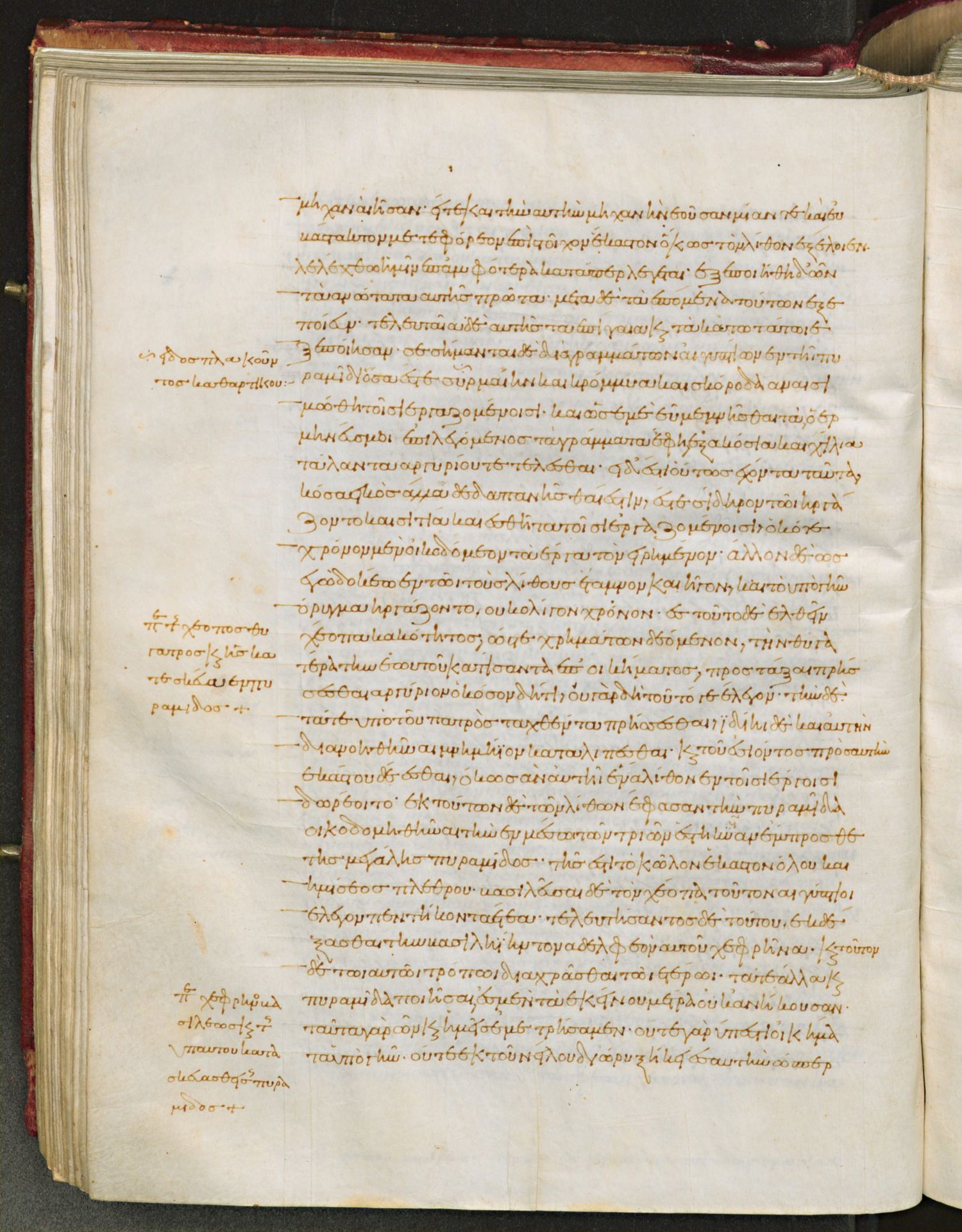
Laur. Plut. 70.3, fol. 87v: Greek here 2.125.4 to 2.127.2. Checked on the image (first and last words read and located in the Greek; each break checked against the neighbouring page): fol. 87v begins ‹μηχαναὶ ἦσαν, εἴτε καὶ› (2.125.4), ends ‹ἥκει ἐς αὐτὴν ὥσπερ› (2.127.2) (page breaks read on the image for the Herodotus on Egypt collection). English here: 2.125.4 to 2.127.2 (Godley's sentences for the sections whose Greek lies mostly on this page).
2.125.4μηχαναὶ ἦσαν, εἴτε καὶ τὴν αὐτὴν μηχανὴν ἐοῦσαν μίαν τε καὶ εὐβάστακτον μετεφόρεον ἐπὶ στοῖχον ἕκαστον, ὅκως τὸν λίθον ἐξέλοιεν· λελέχθω γὰρ ἡμῖν ἐπʼ ἀμφότερα, κατά περ λέγεται. 2.125.5ἐξεποιήθη δʼ ὦν τὰ ἀνώτατα αὐτῆς πρῶτα, μετὰ δὲ τὰ ἐχόμενα τούτων ἐξεποίευν, τελευταῖα δὲ αὐτῆς τὰ ἐπίγαια καὶ τὰ κατωτάτω ἐξεποίησαν. 2.125.6σεσήμανται δὲ διὰ γραμμάτων Αἰγυπτίων ἐν τῇ πυραμίδι ὅσα ἔς τε συρμαίην καὶ κρόμμυα καὶ σκόροδα ἀναισιμώθη τοῖσι ἐργαζομένοισι· καὶ ὡς ἐμὲ εὖ μεμνῆσθαι τὰ ὁ ἑρμηνεύς μοι ἐπιλεγόμενος τὰ γράμματα ἔφη, ἑξακόσια καὶ χίλια τάλαντα ἀργυρίου τετελέσθαι. 2.125.7εἰ δʼ ἔστι οὕτω ἔχοντα ταῦτα, κόσα οἰκὸς ἄλλα δεδαπανῆσθαι ἐστὶ ἔς τε σίδηρον τῷ ἐργάζοντο καὶ σιτία καὶ ἐσθῆτα τοῖσι ἐργαζομένοισι, ὁκότε χρόνον μὲν οἰκοδόμεον τὰ ἔργα τὸν εἰρημένον, ἄλλον δέ, ὡς ἐγὼ δοκέω, ἐν τῷ τοὺς λίθους ἔταμνον καὶ ἦγον καὶ τὸ ὑπὸ γῆν ὄρυγμα ἐργάζοντο, οὐκ ὀλίγον χρόνον. 2.126.1ἐς τοῦτο δὲ ἐλθεῖν Χέοπα κακότητος ὥστε χρημάτων δεόμενον τὴν θυγατέρα τὴν ἑωυτοῦ κατίσαντα ἐπʼ οἰκήματος προστάξαι πρήσσεσθαι ἀργύριον ὁκόσον δή τι· οὐ γὰρ δὴ τοῦτό γε ἔλεγον. τὴν δὲ τά τε ὑπὸ τοῦ πατρὸς ταχθέντα πρήσσεσθαι, ἰδίῃ δὲ καὶ αὐτὴν διανοηθῆναι μνημήιον καταλιπέσθαι, καὶ τοῦ ἐσιόντος πρὸς αὐτὴν ἑκάστου δέεσθαι ὅκως ἂν αὐτῇ ἕνα λίθον ἐν τοῖσι ἔργοισι δωρέοιτο. 2.126.2ἐκ τούτων δὲ τῶν λίθων ἔφασαν τὴν πυραμίδα οἰκοδομηθῆναι τὴν ἐν μέσῳ τῶν τριῶν ἑστηκυῖαν, ἔμπροσθε τῆς μεγάλης πυραμίδος, τῆς ἐστὶ τὸ κῶλον ἕκαστον ὅλου καὶ ἡμίσεος πλέθρου. 2.127.1βασιλεῦσαι δὲ τὸν Χέοπα τοῦτον Αἰγύπτιοι ἔλεγον πεντήκοντα ἔτεα, τελευτήσαντος δὲ τούτου ἐκδέξασθαι τὴν βασιληίην τὸν ἀδελφεὸν αὐτοῦ Χεφρῆνα· καὶ τοῦτον δὲ τῷ αὐτῷ τρόπῳ διαχρᾶσθαι τῷ ἑτέρῳ τά τε ἄλλα καὶ πυραμίδα ποιῆσαι, ἐς μὲν τὰ ἐκείνου μέτρα οὐκ ἀνήκουσαν· 2.127.2ταῦτα γὰρ ὦν καὶ ἡμεῖς ἐμετρήσαμεν· (οὔτε γὰρ ὕπεστι οἰκήματα ὑπὸ γῆν, οὔτε ἐκ τοῦ Νείλου διῶρυξ ἥκει ἐς αὐτὴν ὥσπερ
2.125.4It may be that there was a new lever on each tier of the steps, or perhaps there was but one lever, and that easily lifted, which they carried up to each tier in turn, when they had taken out the stone; I leave this uncertain, both ways being told me. 2.125.5But this is certain, that the upper part of the pyramid was the first finished off, then the next below it, and last of all the base and the lowest part. 2.125.6There are writings on the pyramid in Egyptian characters showing how much was spent on purges and onions and garlic for the workmen; and so far as I well remember, the interpreter when he read me the writing said that sixteen hundred talents of silver had been paid. 2.125.7Now if that is so, how much must needs have been expended on the iron with which they worked, and the workmen’s food and clothing? seeing that the time aforesaid was spent in building, and the hewing and carrying of the stone and the digging out of the underground parts was, as I suppose, a business of long duration. 2.126.1And so evil a man was Cheops that for lack of money he made his own daughter to sit in a chamber and exact payment (how much, I know not; for they did not tell me this). She, they say, doing her father’s bidding, was minded to leave some memorial of her own, and demanded of everyone who sought intercourse with her that he should give one stone to set in her work; 2.126.2and of these stones was built the pyramid that stands midmost of the three, over against the great pyramid; each side of it measures one hundred and fifty feet. 2.127.1Cheops reigned (so the Egyptians said) for fifty years; at his death he was succeeded by his brother Chephren, who bore himself in all respects like Cheops. Chephren also built a pyramid, of a less size than his. brother’s. I have myself measured it. 2.127.2It has no underground chambers, nor is it entered like the other by a canal from the Nile, but the river comes in through a built passage and encircles an island, in which, they say, Cheops himself lies.
Where on the image
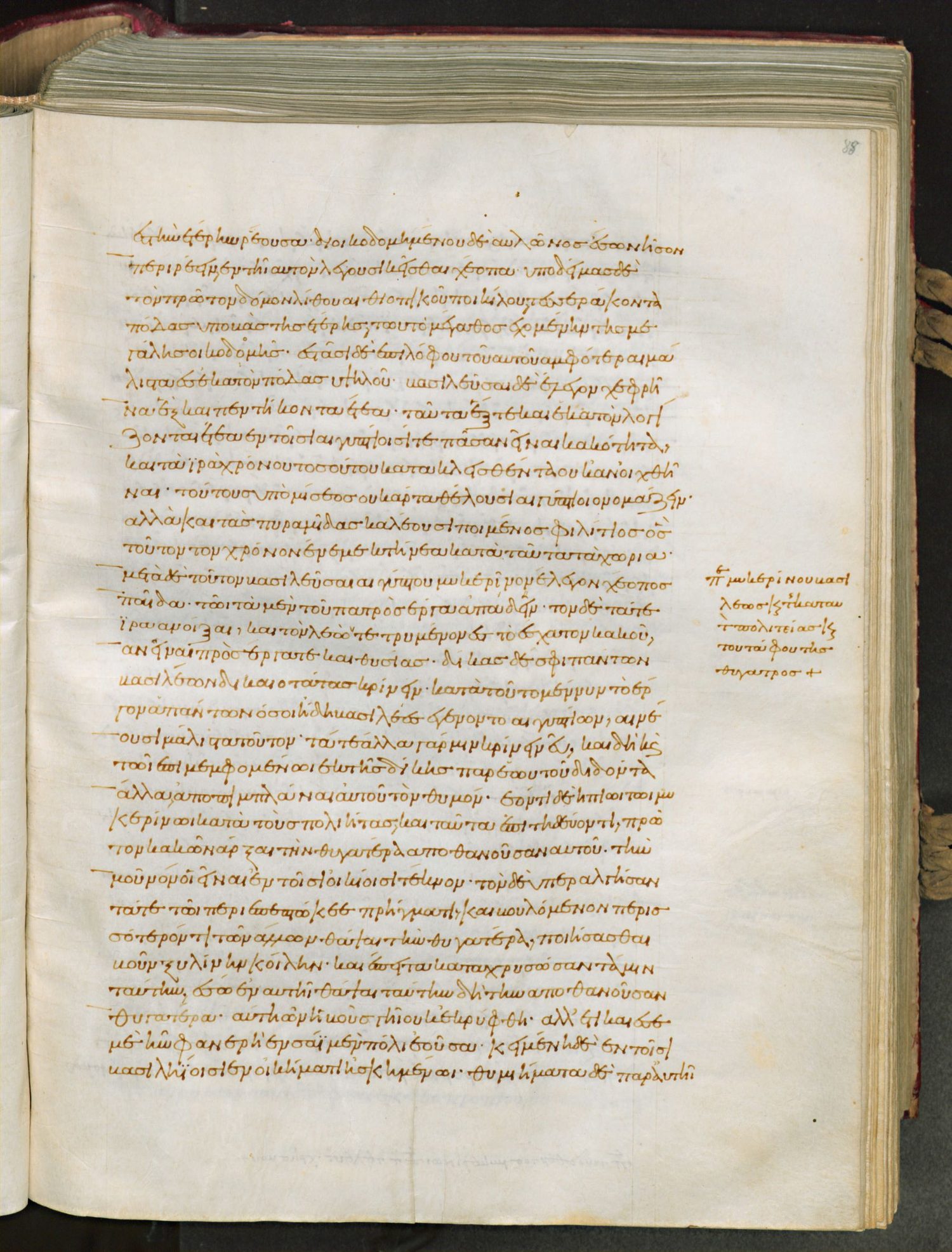
Laur. Plut. 70.3, fol. 88r: Greek here 2.127.2 to 2.130.1. Checked on the image (first and last words read and located in the Greek; each break checked against the neighbouring page): fol. 88r begins ‹ἐς τὴν ἑτέρην ῥέουσα·› (2.127.2), ends ‹θυμιήματα δὲ παρʼ αὐτῇ› (2.130.1) (page breaks read on the image for the Herodotus on Egypt collection). English here: 2.127.3 to 2.130.1 (Godley's sentences for the sections whose Greek lies mostly on this page).
2.127.2ἐς τὴν ἑτέρην ῥέουσα· διʼ οἰκοδομημένου δὲ αὐλῶνος ἔσω νῆσον περιρρέει, ἐν τῇ αὐτὸν λέγουσι κεῖσθαι Χέοπα)· 2.127.3ὑποδείμας δὲ τὸν πρῶτον δόμον λίθου Αἰθιοπικοῦ ποικίλου, τεσσεράκοντα πόδας ὑποβὰς τῆς ἑτέρης τὠυτὸ μέγαθος, ἐχομένην τῆς μεγάλης οἰκοδόμησε. ἑστᾶσι δὲ ἐπὶ λόφου τοῦ αὐτοῦ ἀμφότεραι, μάλιστα ἐς ἑκατὸν πόδας ὑψηλοῦ. βασιλεῦσαι δὲ ἔλεγον Χεφρῆνα ἓξ καὶ πεντήκοντα ἔτεα. 2.128.1ταῦτα ἕξ τε καὶ ἑκατὸν λογίζονται ἔτεα, ἐν τοῖσι Αἰγυπτίοισί τε πᾶσαν εἶναι κακότητα καὶ τὰ ἱρὰ χρόνου τοσούτου κατακληισθέντα οὐκ ἀνοιχθῆναι. τούτους ὑπὸ μίσεος οὐ κάρτα θέλουσι Αἰγύπτιοι ὀνομάζειν, ἀλλὰ καὶ τὰς πυραμίδας καλέουσι ποιμένος Φιλίτιος, ὃς τοῦτον τὸν χρόνον ἔνεμε κτήνεα κατὰ ταῦτα τὰ χωρία. 2.129.1μετὰ δὲ τοῦτον βασιλεῦσαι Αἰγύπτου Μυκερῖνον ἔλεγον Χέοπος παῖδα· τῷ τὰ μὲν τοῦ πατρὸς ἔργα ἀπαδεῖν, τὸν δὲ τά τε ἱρὰ ἀνοῖξαι καὶ τὸν λεὼν τετρυμένον ἐς τὸ ἔσχατον κακοῦ ἀνεῖναι πρὸς ἔργα τε καὶ θυσίας, δίκας δέ σφι πάντων βασιλέων δικαιότατα κρίνειν. 2.129.2κατὰ τοῦτο μέν νυν τὸ ἔργον ἁπάντων ὅσοι ἤδη βασιλέες ἐγένοντο Αἰγυπτίων αἰνέουσι μάλιστα τοῦτον. τά τε ἄλλα γάρ μιν κρίνειν εὖ, καὶ δὴ καὶ τῷ ἐπιμεμφομένῳ ἐκ τῆς δίκης παρʼ ἑωυτοῦ διδόντα ἄλλα ἀποπιμπλάναι αὐτοῦ τὸν θυμόν. 2.129.3ἐόντι δὲ ἠπίῳ τῷ Μυκερίνῳ κατὰ τοὺς πολιήτας καὶ ταῦτα ἐπιτηδεύοντι πρῶτον κακῶν ἄρξαι τὴν θυγατέρα ἀποθανοῦσαν αὐτοῦ, τὴν μοῦνόν οἱ εἶναι ἐν τοῖσι οἰκίοισι τέκνον. τὸν δὲ ὑπεραλγήσαντά τε τῷ περιεπεπτώκεε πρήγματι, καὶ βουλόμενον περισσότερόν τι τῶν ἄλλων θάψαι τὴν θυγατέρα, ποιήσασθαι βοῦν ξυλίνην κοίλην, καὶ ἔπειτα καταχρυσώσαντά μιν ταύτην ἔσω ἐν αὐτῇ θάψαι ταύτην δὴ τὴν ἀποθανοῦσαν θυγατέρα. 2.130.1αὕτη ὦν ἡ βοῦς γῇ οὐκ ἐκρύφθη, ἀλλʼ ἔτι καὶ ἐς ἐμὲ ἦν φανερή, ἐν Σάι μὲν πόλι ἐοῦσα, κειμένη δὲ ἐν τοῖσι βασιληίοισι ἐν οἰκήματι ἠσκημένῳ· θυμιήματα δὲ παρʼ αὐτῇ
2.127.3This pyramid was built of the same bigness as the other, save that it falls forty feet short of it in height; it stands near to the great pyramid; the lowest layer of it is of variegated Ethiopian stone. Both of them stand on the same ridge, which is about an hundred feet high. Chephren, they said, reigned for fifty-six years. 2.128.1Thus they reckon that for a hundred and six years Egypt was in great misery and the temples so long shut were never opened. So much do the people hate the memory of these two kings that they do not greatly wish to name them, and call the pyramids after the shepherd Philitis, who then pastured his flocks in this place. 2.129.1The next king of Egypt, they said, was Cheops’ son Mycerinus. He, being displeased with his father’s doings, opened the temples and suffered the people, now ground down to the depth of misery, to go to their business and their sacrifices; and he was the justest judge among all the kings. 2.129.2It is on this account that he is praised beyond all the rulers of Egypt; for not only were his judgments just, but if any were not contented with the sentence Mycerinus would give such an one a present out of his own estate to satisfy him for his loss. 2.129.3Such was his practice, and so he ruled his people with clemency, yet calamities befel him, of which the first was the death of his daughter, the only child of his household. Greatly grieving over this misfortune, he desired to give her a burial something more excellent than ordinary; he made therefore a hollow cow’s image of gilded wood and placed therein the body of his dead daughter. 2.130.1This cow was not buried in the earth but was to be seen even in my time, in the town of Sais, where it lay in an adorned chamber of the palace; incense of all kinds is offered daily before it, and a lamp burns by it all through every night.
Where on the image
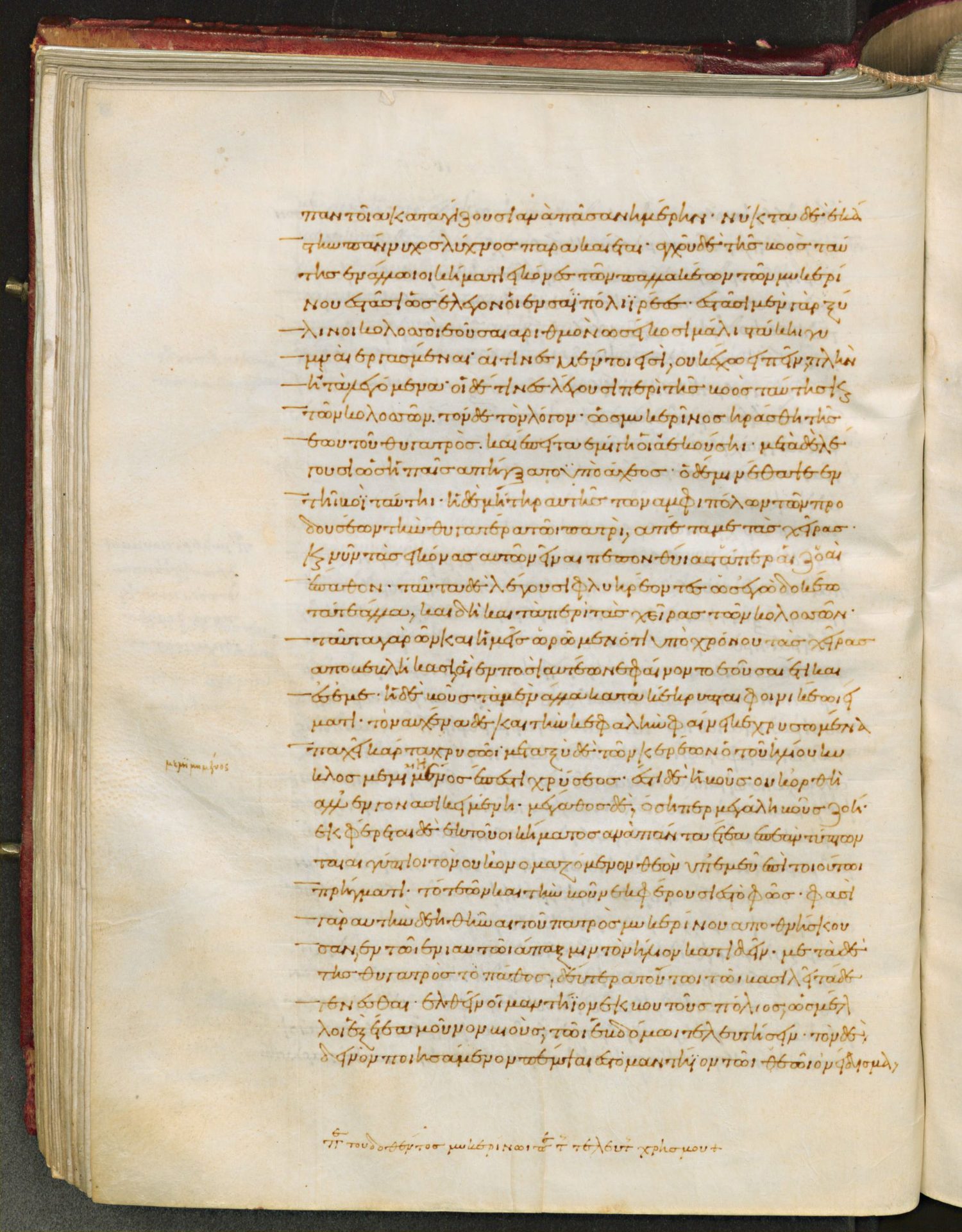
Laur. Plut. 70.3, fol. 88v: Greek here 2.130.1 to 2.133.2. Checked on the image (first and last words read and located in the Greek; each break checked against the neighbouring page): fol. 88v begins ‹παντοῖα καταγίζουσι ἀνὰ πᾶσαν› (2.130.1), ends ‹μαντήιον τῷ θεῷ ὀνείδισμα› (2.133.2) (page breaks read on the image for the Herodotus on Egypt collection). English here: 2.130.2 to 2.133.1 (Godley's sentences for the sections whose Greek lies mostly on this page).
2.130.1παντοῖα καταγίζουσι ἀνὰ πᾶσαν ἡμέρην, νύκτα δὲ ἑκάστην πάννυχος λύχνος παρακαίεται. 2.130.2ἀγχοῦ δὲ τῆς βοὸς ταύτης ἐν ἄλλῳ οἰκήματι εἰκόνες τῶν παλλακέων τῶν Μυκερίνου ἑστᾶσι, ὡς ἔλεγον οἱ ἐν Σάι πόλι ἱρέες· ἑστᾶσι μὲν γὰρ ξύλιναι κολοσσοί, ἐοῦσαι ἀριθμὸν ὡς εἴκοσι μάλιστά κῃ, γυμναὶ ἐργασμέναι· αἵτινες μέντοι εἰσί, οὐκ ἔχω εἰπεῖν πλὴν ἢ τὰ λεγόμενα. 2.131.1οἳ δὲ τινὲς λέγουσι περὶ τῆς βοὸς ταύτης καὶ τῶν κολοσσῶν τόνδε τὸν λόγον, ὡς Μυκερῖνος ἠράσθη τῆς ἑωυτοῦ θυγατρὸς καὶ ἔπειτα ἐμίγη οἱ ἀεκούσῃ· 2.131.2μετὰ δὲ λέγουσι ὡς ἡ παῖς ἀπήγξατο ὑπὸ ἄχεος, ὁ δέ μιν ἔθαψε ἐν τῇ βοῒ ταύτῃ, ἡ δὲ μήτηρ αὐτῆς τῶν ἀμφιπόλων τῶν προδουσέων τὴν θυγατέρα τῷ πατρὶ ἀπέταμε τὰς χεῖρας, καὶ νῦν τὰς εἰκόνας αὐτέων εἶναι πεπονθυίας τά περ αἱ ζωαὶ ἔπαθον. 2.131.3ταῦτα δὲ λέγουσι φλυηρέοντες, ὡς ἐγὼ δοκέω, τά τε ἄλλα καὶ δὴ καὶ τὰ περὶ τὰς χεῖρας τῶν κολοσσῶν· ταύτας γὰρ ὦν καὶ ἡμεῖς ὡρῶμεν ὅτι ὑπὸ χρόνου τὰς χεῖρας ἀποβεβλήκασι, αἳ ἐν ποσὶ αὐτέων ἐφαίνοντο ἐοῦσαι ἔτι καὶ ἐς ἐμέ. 2.132.1ἡ δὲ βοῦς τὰ μὲν ἄλλα κατακέκρυπται φοινικέῳ εἵματι, τὸν αὐχένα δὲ καὶ τὴν κεφαλὴν φαίνει κεχρυσωμένα παχέι κάρτα χρυσῷ· μεταξὺ δὲ τῶν κερέων ὁ τοῦ ἡλίου κύκλος μεμιμημένος ἔπεστι χρύσεος. 2.132.2ἔστι δὲ ἡ βοῦς οὐκ ὀρθὴ ἀλλʼ ἐν γούνασι κειμένη, μέγαθος δὲ ὅση περ μεγάλη βοῦς ζωή. ἐκφέρεται δὲ ἐκ τοῦ οἰκήματος ἀνὰ πάντα ἔτεα, ἐπεὰν τύπτωνται Αἰγύπτιοι τὸν οὐκ ὀνομαζόμενον θεὸν ὑπʼ ἐμεῦ ἐπὶ τοιούτῳ πρήγματι· 2.132.3τότε ὦν καὶ τὴν βοῦν ἐκφέρουσι ἐς τὸ φῶς· φασὶ γὰρ αὐτὴν δεηθῆναι τοῦ πατρὸς Μυκερίνου ἀποθνήσκουσαν ἐν τῷ ἐνιαυτῷ ἅπαξ μιν τὸν ἥλιον κατιδεῖν. 2.133.1μετὰ δὲ τῆς θυγατρὸς τὸ πάθος δεύτερα τούτῳ τῷ βασιλέι τάδε γενέσθαι· ἐλθεῖν οἱ μαντήιον ἐκ Βουτοῦς πόλιος ὡς μέλλοι ἓξ ἔτεα μοῦνον βιοὺς τῷ ἑβδόμῳ τελευτήσειν. 2.133.2τὸν δὲ δεινὸν ποιησάμενον πέμψαι ἐς τὸ μαντήιον τῷ θεῷ ὀνείδισμα,
2.130.2There is another chamber near to this image, where stand the statues of Mycerinus’ concubines, as the priests of Sais told me; and indeed there are about twenty colossal wooden figures there, made like naked women, but I have only the priests’ word to show who they are. 2.131.1Some have a story about the cow and the statues, how Mycerinus conceived a passion for his own daughter and did her foul wrong, 2.131.2and she strangled herself for grief: then he buried her, they say, in this image of a cow; the girl’s mother cut off the hands of the attendants who had betrayed the daughter to her father, so that now (it is said) their statues are in the plight to which the living women were brought. 2.131.3But this I believe to be a foolish tale, especially as respects the hands of the figures. As we ourselves saw, it is time which has made the hands to drop away; they were to be seen even in my day lying on the ground before the statues. 2.132.1As for the cow, it is covered with a purple robe, and shows only the head and neck, which are encrusted with a very thick layer of gold. Between its horns it bears the golden figure of the sun’s orb. 2.132.2It does not stand, but kneels; its stature is that of a live cow of great size. This image is carried out of the chamber once in every year, whenever the Egyptians make lamentation for the god whom I name not in speaking of these matters; it is 2.132.3then that the cow is brought out into the light, for Mycerinus’ daughter, they say, entreated him at her death that she might see the sun once a year. 2.133.1After the grievous death of his daughter, it next happened to Mycerinus that an oracle was sent to him from the city of Buto, declaring that he had but six years to live and must die in the seventh.
Where on the image
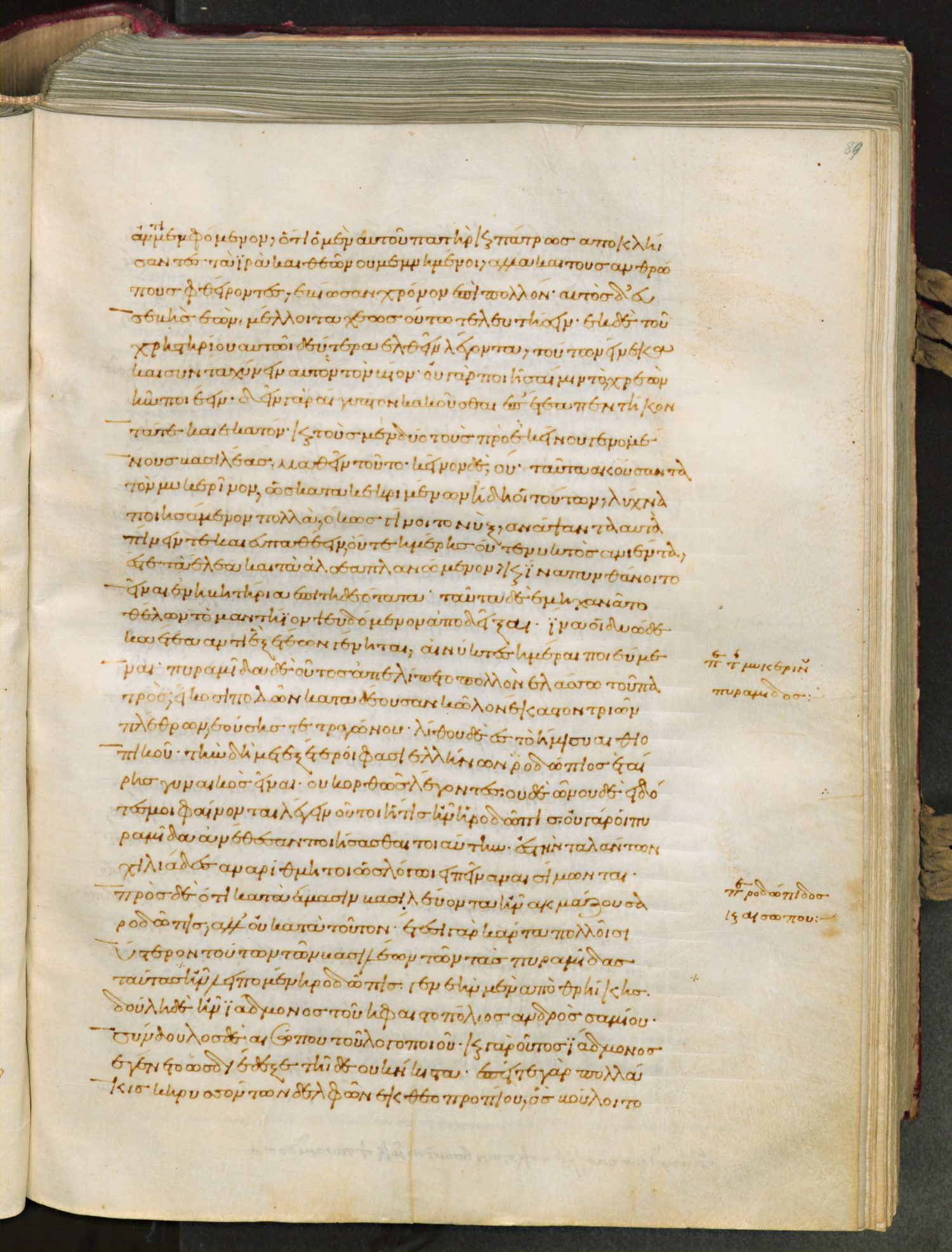
Laur. Plut. 70.3, fol. 89r: Greek here 2.133.2 to 2.134.4. Checked on the image (first and last words read and located in the Greek; each break checked against the neighbouring page): fol. 89r begins ‹ἀντιμεμφόμενον ὅτι ὁ μὲν› (2.133.2), ends ‹ἐκ θεοπροπίου ὃς βούλοιτο› (2.134.4) (page breaks read on the image for the Herodotus on Egypt collection). English here: 2.133.2 to 2.134.4 (Godley's sentences for the sections whose Greek lies mostly on this page).
2.133.2ἀντιμεμφόμενον ὅτι ὁ μὲν αὐτοῦ πατὴρ καὶ πάτρως, ἀποκληίσαντες τὰ ἱρὰ καὶ θεῶν οὐ μεμνημένοι ἀλλὰ καὶ τοὺς ἀνθρώπους φθείροντες, ἐβίωσαν χρόνον ἐπὶ πολλόν, αὐτὸς δʼ εὐσεβὴς ἐὼν μέλλοι ταχέως οὕτω τελευτήσειν. 2.133.3ἐκ δὲ τοῦ χρηστηρίου αὐτῷ δεύτερα ἐλθεῖν λέγοντα τούτων εἵνεκα καὶ συνταχύνειν αὐτὸν τὸν βίον· οὐ γὰρ ποιῆσαί μιν τὸ χρεὸν ἦν ποιέειν· δεῖν γὰρ Αἴγυπτον κακοῦσθαι ἐπʼ ἔτεα πεντήκοντά τε καὶ ἑκατόν, καὶ τοὺς μὲν δύο τοὺς πρὸ ἐκείνου γενομένους βασιλέας μαθεῖν τοῦτο, κεῖνον δὲ οὔ. 2.133.4ταῦτα ἀκούσαντα τὸν Μυκερῖνον, ὡς κατακεκριμένων ἤδη οἱ τούτων, λύχνα ποιησάμενον πολλά, ὅκως γίνοιτο νύξ, ἀνάψαντα αὐτὰ πίνειν τε καὶ εὐπαθέειν, οὔτε ἡμέρης οὔτε νυκτὸς ἀνιέντα, ἔς τε τὰ ἕλεα καὶ τὰ ἄλσεα πλανώμενον καὶ ἵνα πυνθάνοιτο εἶναι ἐνηβητήρια ἐπιτηδεότατα. 2.133.5ταῦτα δὲ ἐμηχανᾶτο θέλων τὸ μαντήιον ψευδόμενον ἀποδέξαι, ἵνα οἱ δυώδεκα ἔτεα ἀντὶ ἓξ ἐτέων γένηται, αἱ νύκτες ἡμέραι ποιεύμεναι. 2.134.1πυραμίδα δὲ οὗτος ἀπελίπετο πολλὸν ἐλάσσω τοῦ πατρός, εἴκοσι ποδῶν καταδέουσαν κῶλον ἕκαστον τριῶν πλέθρων, ἐούσης τετραγώνου, λίθου δὲ ἐς τὸ ἥμισυ Αἰθιοπικοῦ· τὴν δὴ μετεξέτεροι φασὶ Ἑλλήνων Ῥοδώπιος ἑταίρης γυναικὸς εἶναι, οὐκ ὀρθῶς λέγοντες. 2.134.2οὐδὲ ὦν οὐδὲ εἰδότες μοι φαίνονται λέγειν οὗτοι ἥτις ἦν ἡ Ῥοδῶπις· οὐ γὰρ ἄν οἱ πυραμίδα ἀνέθεσαν ποιήσασθαι τοιαύτην, ἐς τὴν ταλάντων χιλιάδες ἀναρίθμητοι ὡς λόγῳ εἰπεῖν ἀναισίμωνται· πρὸς δὲ ὅτι κατὰ Ἄμασιν βασιλεύοντα ἦν ἀκμάζουσα Ῥοδῶπις, ἀλλʼ οὐ κατὰ τοῦτον. 2.134.3ἔτεσι γὰρ κάρτα πολλοῖσι ὕστερον τούτων τῶν βασιλέων τῶν τὰς πυραμίδας ταύτας ἦν λιπομένων Ῥοδῶπις, γενεὴν μὲν ἀπὸ Θρηίκης, δούλη δὲ ἦν Ἰάδμονος τοῦ Ἡφαιστοπόλιος ἀνδρὸς Σαμίου, σύνδουλος δὲ Αἰσώπου τοῦ λογοποιοῦ. καὶ γὰρ οὗτος Ἰάδμονος ἐγένετο, ὡς διέδεξε τῇδε οὐκ ἥκιστα· 2.134.4ἐπείτε γὰρ πολλάκις κηρυσσόντων Δελφῶν ἐκ θεοπροπίου ὃς βούλοιτο
2.133.2The king deemed this unjust, and sent back to the oracle a message of reproach, blaming the god: why must he die so soon who was pious, whereas his father and his uncle had lived long, who shut up the temples, and regarded not the gods, and destroyed men? 2.133.3But a second utterance from the place of divination declared to him that his good deeds were the very cause of shortening his life; for he had done what was contrary to fate; Egypt should have been afflicted for an hundred and fifty years, whereof the two kings before him had been aware, but not Mycerinus. 2.133.4Hearing this, he knew that his doom was fixed. Therefore he caused many lamps to be made, and would light these at nightfall and drink and make merry; by day or night he never ceased from revelling, roaming to the marsh country and the groves and wherever he heard of the likeliest places of pleasure. 2.133.5Thus he planned, that by turning night into day he might make his six years into twelve and so prove the oracle false. 2.134.1This king too left a pyramid, but far smaller than his father’s; its sides form a square whereof each side is two hundred and eighty feet in length; as far as the half of its height it is of Ethiopian stone. Some Greeks say that it was built by Rhodopis, the courtesan, but they are in error; 2.134.2indeed it is clear to me that when they say this they do not know who Rhodopis was, else they would never have credited her with the building of a pyramid whereon what I may call an uncountable sum of talents must have been expended. And it is a further proof of their error that Rhodopis flourished in the reign of Amasis, not of Mycerinus, and 2.134.3thus very many years after these kings who built the pyramids. She was a Thracian by birth, slave to Iadmon, son of Hephaestopolis, a Samian, and fellow-slave of Aesopus the story-writer. For he also was owned by Iadmon; of which the chiefest proof is that 2.134.4when the Delphians, obeying an oracle, issued many proclamations inviting whosoever would to claim the penalty for the killing of Aesopus, none would undertake it but only another Iadmon, grandson of the first. Thus was Aesopus too shown to be the slave of Iadmon.
Where on the image
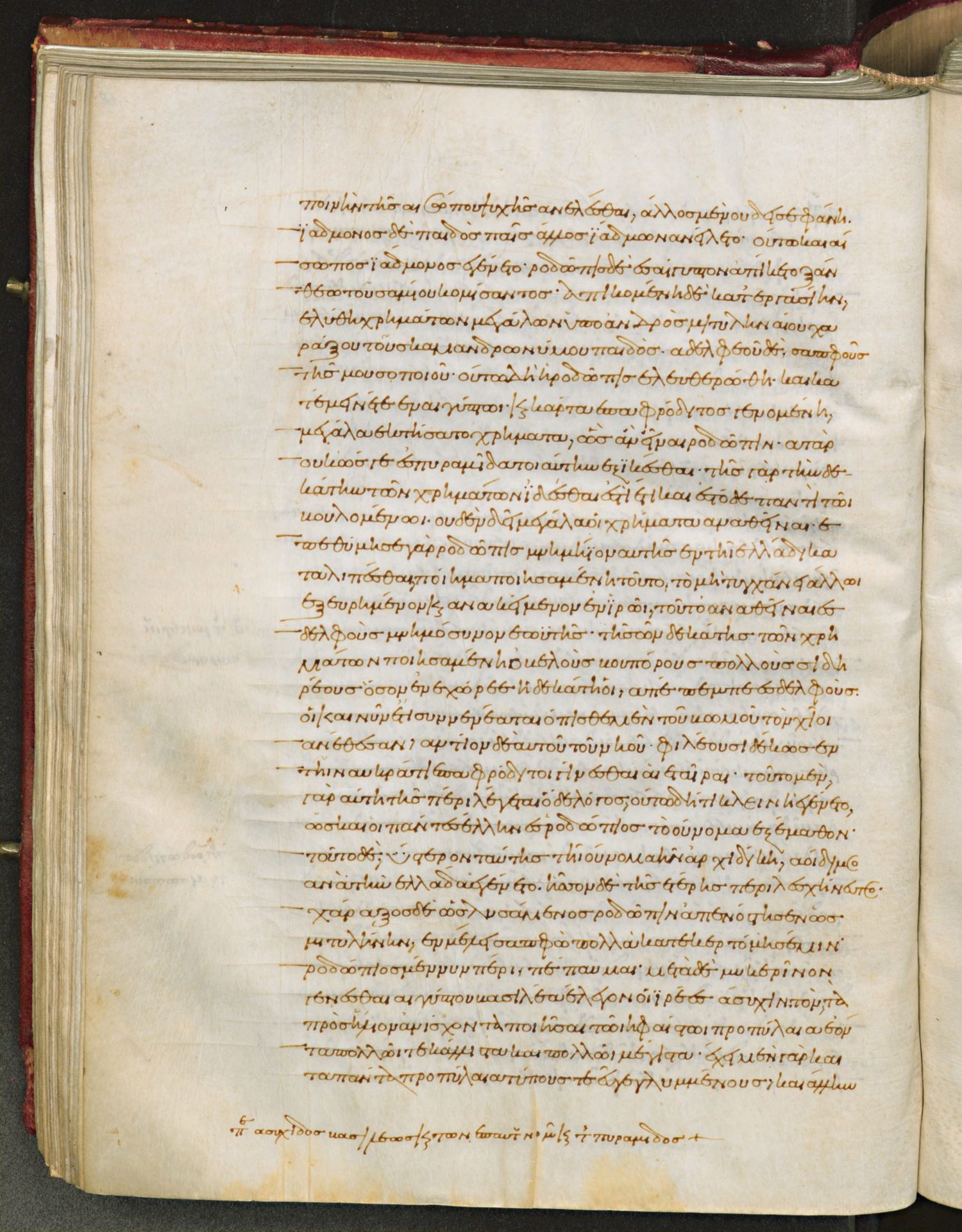
Laur. Plut. 70.3, fol. 89v: Greek here 2.134.4 to 2.136.1. Checked on the image (first and last words read and located in the Greek; each break checked against the neighbouring page): fol. 89v begins ‹ποινὴν τῆς Αἰσώπου ψυχῆς› (2.134.4), ends ‹τε ἐγγεγλυμμένους καὶ ἄλλην› (2.136.1) (page breaks read on the image for the Herodotus on Egypt collection). English here: 2.135.1 to 2.136.1 (Godley's sentences for the sections whose Greek lies mostly on this page).
2.134.4ποινὴν τῆς Αἰσώπου ψυχῆς ἀνελέσθαι, ἄλλος μὲν οὐδεὶς ἐφάνη, Ἰάδμονος δὲ παιδὸς παῖς ἄλλος Ἰάδμων ἀνείλετο. οὕτω καὶ Αἴσωπος Ἰάδμονος ἐγένετο. 2.135.1Ῥοδῶπις δὲ ἐς Αἴγυπτον ἀπίκετο Ξάνθεω τοῦ Σαμίου κομίσαντος, ἀπικομένη δὲ κατʼ ἐργασίην ἐλύθη χρημάτων μεγάλων ὑπὸ ἀνδρὸς Μυτιληναίου Χαράξου τοῦ Σκαμανδρωνύμου παιδός, ἀδελφεοῦ δὲ Σαπφοῦς τῆς μουσοποιοῦ. 2.135.2οὕτω δὴ ἡ Ῥοδῶπις ἐλευθερώθη, καὶ κατέμεινέ τε ἐν Αἰγύπτῳ καὶ κάρτα ἐπαφρόδιτος γενομένη μεγάλα ἐκτήσατο χρήματα ὡς ἂν εἶναι Ῥοδώπι, ἀτὰρ οὐκ ὥς γε ἐς πυραμίδα τοιαύτην ἐξικέσθαι. 2.135.3τῆς γὰρ τὴν δεκάτην τῶν χρημάτων ἰδέσθαι ἐστὶ ἔτι καὶ ἐς τόδε παντὶ τῷ βουλομένῳ, οὐδὲν δεῖ μεγάλα οἱ χρήματα ἀναθεῖναι. ἐπεθύμησε γὰρ Ῥοδῶπις μνημήιον ἑωυτῆς ἐν τῇ Ἑλλάδι καταλιπέσθαι, ποίημα ποιησαμένη τοῦτο τὸ μὴ τυγχάνοι ἄλλῳ ἐξευρημένον καὶ ἀνακείμενον ἐν ἱρῷ, τοῦτο ἀναθεῖναι ἐς Δελφοὺς μνημόσυνον ἑωυτῆς. 2.135.4τῆς ὦν δεκάτης τῶν χρημάτων ποιησαμένη ὀβελοὺς βουπόρους πολλοὺς σιδηρέους, ὅσον ἐνεχώρεε ἡ δεκάτη οἱ, ἀπέπεμπε ἐς Δελφούς· οἳ καὶ νῦν ἔτι συννενέαται ὄπισθε μὲν τοῦ βωμοῦ τὸν Χῖοι ἀνέθεσαν, ἀντίον δὲ αὐτοῦ τοῦ νηοῦ. 2.135.5φιλέουσι δέ κως ἐν τῇ Ναυκράτι ἐπαφρόδιτοι γίνεσθαι αἱ ἑταῖραι. τοῦτο μὲν γὰρ αὕτη, τῆς πέρι λέγεται ὅδε ὁ λόγος, οὕτω δή τι κλεινὴ ἐγένετο ὡς καὶ οἱ πάντες Ἕλληνες Ῥοδώπιος τὸ οὔνομα ἐξέμαθον· τοῦτο δὲ ὕστερον ταύτης, τῇ οὔνομα ἦν Ἀρχιδίκη, ἀοίδιμος ἀνὰ τὴν Ἑλλάδα ἐγένετο, ἧσσον δὲ τῆς ἑτέρης περιλεσχήνευτος. 2.135.6Χάραξος δὲ ὡς λυσάμενος Ῥοδῶπιν ἀπενόστησε ἐς Μυτιλήνην, ἐν μέλεϊ Σαπφὼ πολλὰ κατεκερτόμησέ μιν. 2.136.1Ῥοδώπιος μέν νυν πέρι πέπαυμαι. μετὰ δὲ Μυκερῖνον γενέσθαι Αἰγύπτου βασιλέα ἔλεγον οἱ ἱρέες Ἄσυχιν, τὸν τὰ πρὸς ἥλιον ἀνίσχοντα ποιῆσαι τῷ Ἡφαίστῳ προπύλαια, ἐόντα πολλῷ τε κάλλιστα καὶ πολλῷ μέγιστα· ἔχει μὲν γὰρ καὶ τὰ πάντα προπύλαια τύπους τε ἐγγεγλυμμένους καὶ ἄλλην
2.135.1Rhodopis was brought to Egypt by Xanthes of Samos, and on her coming was for a great sum of money freed for the practice of her calling by Charaxus of Mytilene, son of Scamandronymus and brother of Sappho the poetess. 2.135.2Thus Rhodopis was set free and abode in Egypt, where, her charms becoming well known, she grew wealthy enough for a lady of her profession, but not for the building of such a pyramid. 2.135.3Seeing that to this day anyone who wishes may know what was the tenth part of her possessions, she cannot be credited with great wealth. For Rhodopis desired to leave a memorial of herself in Greece, by having something made which no one else had contrived and dedicated in a temple and presenting this at Delphi to preserve her memory; 2.135.4so she spent the tenth part of her substance on the making of a great number of iron ox-spits, as many as the tithe would pay for, and sent them to Delphi; these lie in a heap to this day, behind the altar set up by the Chians and in front of the shrine itself. 2.135.5It seems that the courtesans of Naucratis ever have the art of pleasing, for the woman of whom this story is told became so famous that all Greeks knew the name of Rhodopis, and in later days one Archidice was the theme of song throughout Greece, albeit less spoken of than the other. 2.135.6Charaxus, after giving Rhodopis her freedom, returned to Mytilene and was bitterly attacked by Sappho in one of her poems. 2.136.1Enough has been said of Rhodopis. After Mycerinus, said the priests, Asuchis became king of Egypt. He built the eastern outer court of Hephaestus’ temple; this is by much the fairest and largest of all the courts, for while all have carven figures and innumerable graces of architecture, this court has far more than any.
Where on the image
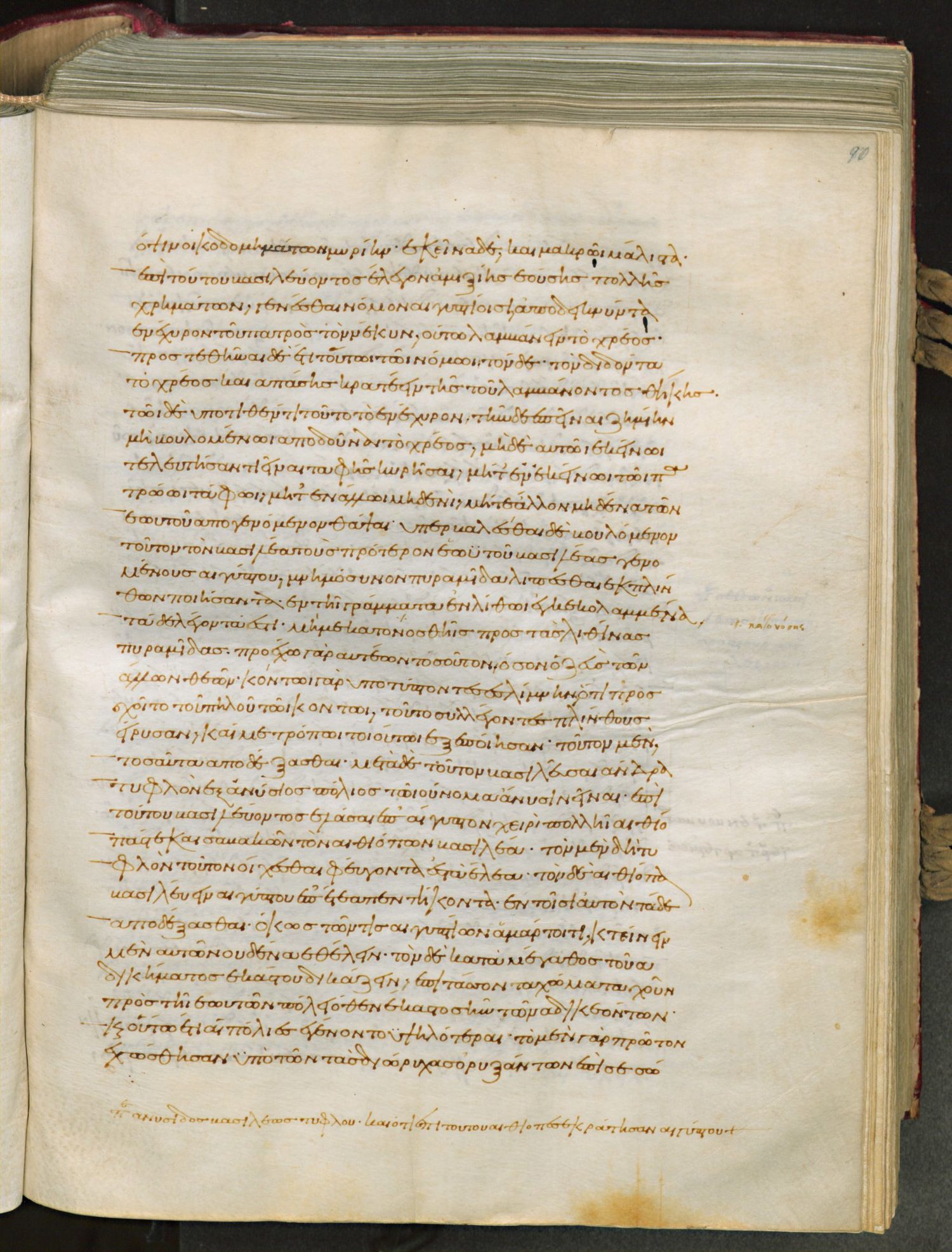
Laur. Plut. 70.3, fol. 90r: Greek here 2.136.1 to 2.136.4. Checked on the image (first and last words read and located in the Greek; each break checked against the neighbouring page): fol. 90r begins ‹ὄψιν οἰκοδομημάτων μυρίην, ἐκεῖνα› (2.136.1), ends ‹διώρυχας ὀρυξάντων ἐπὶ Σεσώ-› (2.137.4) (page breaks read on the image for the Herodotus on Egypt collection). English here: 2.136.2 to 2.136.4 (Godley's sentences for the sections whose Greek lies mostly on this page).
2.136.1ὄψιν οἰκοδομημάτων μυρίην, ἐκεῖνα δὲ καὶ μακρῷ μάλιστα. 2.136.2ἐπὶ τούτου βασιλεύοντος ἔλεγον, ἀμιξίης ἐούσης πολλῆς χρημάτων, γενέσθαι νόμον Αἰγυπτίοισι, ἀποδεικνύντα ἐνέχυρον τοῦ πατρὸς τὸν νέκυν οὕτω λαμβάνειν τὸ χρέος· προστεθῆναι δὲ ἔτι τούτῳ τῷ νόμῳ τόνδε, τὸν διδόντα τὸ χρέος καὶ ἁπάσης κρατέειν τῆς τοῦ λαμβάνοντος θήκης, τῷ δὲ ὑποτιθέντι τοῦτο τὸ ἐνέχυρον τήνδε ἐπεῖναι ζημίην μὴ βουλομένῳ ἀποδοῦναι τὸ χρέος, μήτε αὐτῷ ἐκείνῳ τελευτήσαντι εἶναι ταφῆς κυρῆσαι μήτʼ ἐν ἐκείνῳ τῷ πατρωίῳ τάφῳ μήτʼ ἐν ἄλλῳ μηδενί, μήτε ἄλλον μηδένα τῶν ἑωυτοῦ ἀπογενόμενον θάψαι. 2.136.3ὑπερβαλέσθαι δὲ βουλόμενον τοῦτον τὸν βασιλέα τοὺς πρότερον ἑωυτοῦ βασιλέας γενομένους Αἰγύπτου μνημόσυνον πυραμίδα λιπέσθαι ἐκ πλίνθων ποιήσαντα, ἐν τῇ γράμματα ἐν λίθῳ ἐγκεκολαμμένα τάδε λέγοντα ἐστί. 2.136.4μή με κατονοσθῇς πρὸς τὰς λιθίνας πυραμίδας· προέχω γὰρ αὐτέων τοσοῦτον ὅσον ὁ Ζεὺς τῶν ἄλλων θεῶν. κοντῷ γὰρ ὑποτύπτοντες ἐς λίμνην, ὅ τι πρόσσχοιτο τοῦ πηλοῦ τῷ κοντῷ, τοῦτο συλλέγοντες πλίνθους εἴρυσαν καί με τρόπῳ τοιούτῳ ἐξεποίησαν.
2.136.2In this king’s reign as they told me, money in Egypt passed not readily from hand to hand; wherefore a law was made that a man might borrow on the security of his father’s dead body; and the law provided also, that the lender should have a lien on the whole burial-vault of the borrower, and that the penalty for the giver of this security, should he fail to repay the debt, should be that he might neither himself be buried at death nor bury any deceased of his kin either in that tomb of his fathers nor in any other. 2.136.3Moreover, being desirous of excelling all who ruled Egypt before him, this king left a pyramid of brick to commemorate his name, on which is this writing, cut on a stone:—“Deem 2.136.4me not less than the pyramids of stone; for I am as much more excellent than they as Zeus is than the other gods; for they struck a pole down into a marsh and collected what mud clave to the pole; therewith they made bricks, and thus was I built.”
Notes
- Greek: the text printed in A. D. Godley's Loeb edition, via Perseus (tlg0016.tlg001.perseus-grc2). Square brackets mark words the editor considers later additions; [...] marks a gap the editor indicates. Perseus note markers are omitted.
- English: A. D. Godley, Herodotus vol. 1 (1920) (Loeb Classical Library), as transcribed on Wikisource. Godley's footnotes are omitted.
- Section numbers in the English were placed by comparing Godley's text with the Perseus version of his translation; where a section begins inside one of Godley's sentences, the English is kept with the page that holds the start of that sentence.
Cite
Sources
- Source: Florence, Laur. Plut. 70.3 (10th c.) via BML Teca Digitale + Greek of Godley's Loeb (Perseus) + English of A. D. Godley (Loeb, Wikisource) (holding institution)
- Critical edition: Greek of A. D. Godley's Loeb edition (1920-1925), via Perseus
← previous · → next · v cycle view · l back to library