Herodotus, Histories 2.137-150: Sabacos, Sethos, the priests' chronology and the labyrinth
Introduction
Herodotus of Halicarnassus wrote the Histories in the third quarter of the 5th century BCE, an inquiry into the deeds of Greeks and barbarians and the causes of the wars between them, later divided into nine books. Book 2 is Herodotus' account of Egypt, written as background to Cambyses' invasion: the land and the Nile, the customs and religion of the Egyptians, and the history of their kings as the priests told it, down to Amasis.
The photographs are of Florence, Biblioteca Medicea Laurenziana, Plut. 70.3 (parchment, 10th century, 374 folios, 31 lines a page), Herodotus, Histories (codex A of the editors), the oldest surviving manuscript of the complete Histories, from the Teca Digitale of the Biblioteca Medicea Laurenziana. Each section below is the text of one page, or of the part of a page that falls within these chapters. The first and last words of every page were read on the photograph and located in the Greek, and every page break was checked against the next page; the notes quote these words. Readers' notes in the margins are not part of the text and are mentioned where they occur.
The Greek is the text printed in A. D. Godley's Loeb edition (1920-1925), from Perseus; it is the edited text, not a transcription of the manuscript, whose wording differs in places. The English is Godley's translation as printed, from Wikisource. Godley's English carries only chapter numbers; the section numbers shown in it were placed by comparison with the Perseus version of his translation. Each page's English is cut at the end of one of Godley's sentences, so it can begin or end a few lines away from the Greek of the page; each note gives the exact ranges.
This entry covers chapters 2.137-150, on fol. 90r to 94r.
How was this verified? (Provenance)
Where on the image
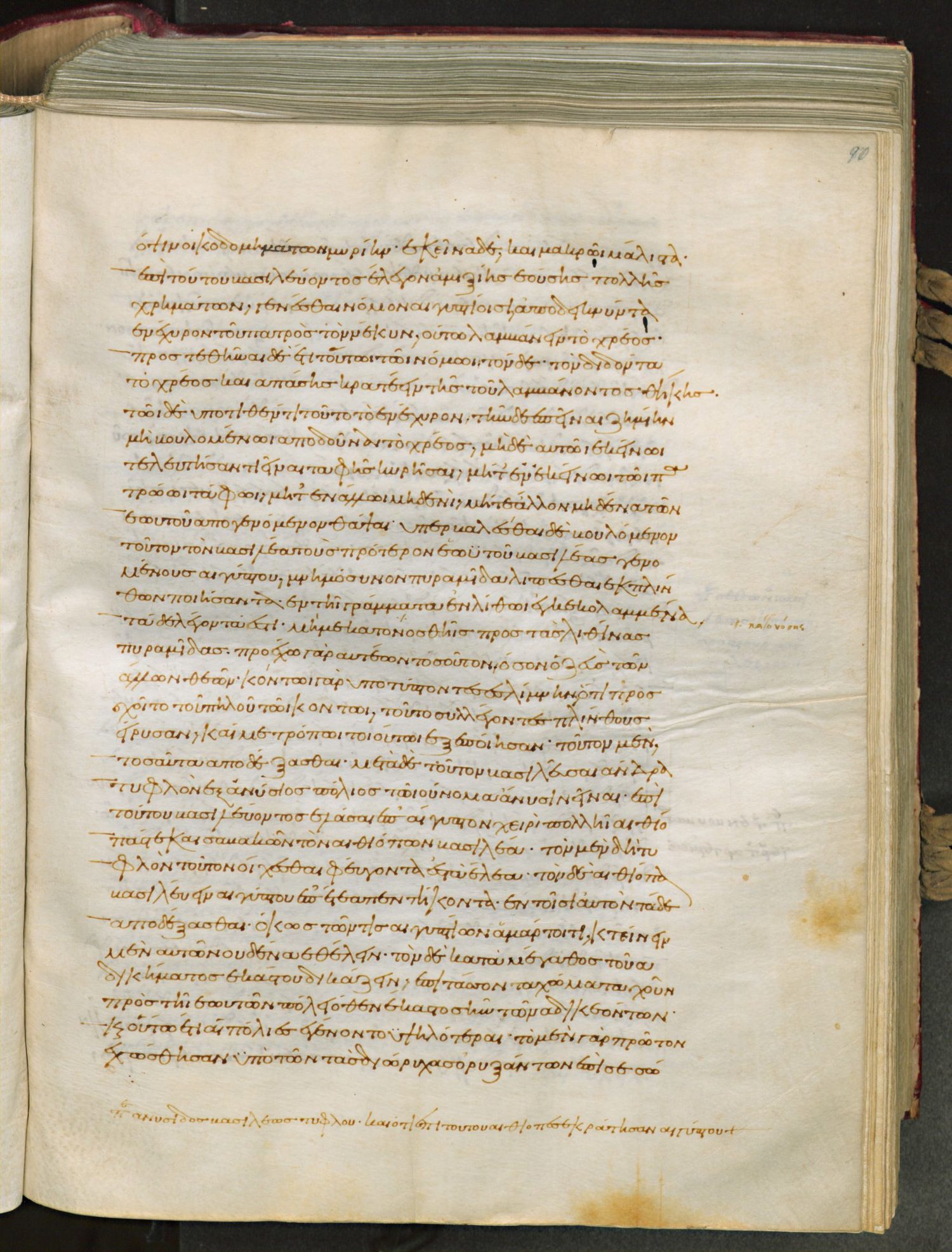
Laur. Plut. 70.3, fol. 90r: Greek here 2.137.1 to 2.137.4. Checked on the image (first and last words read and located in the Greek; each break checked against the neighbouring page): fol. 90r begins ‹ὄψιν οἰκοδομημάτων μυρίην, ἐκεῖνα› (2.136.1), ends ‹διώρυχας ὀρυξάντων ἐπὶ Σεσώ-› (2.137.4) (page breaks read on the image for the Herodotus on Egypt collection). English here: 2.137.1 to 2.137.4 (Godley's sentences for the sections whose Greek lies mostly on this page).
2.137.1τοῦτον μὲν τοσαῦτα ἀποδέξασθαι. μετὰ δὲ τοῦτον βασιλεῦσαι ἄνδρα τυφλὸν ἐξ Ἀνύσιος πόλιος, τῷ οὔνομα Ἄνυσιν εἶναι. ἐπὶ τούτου βασιλεύοντος ἐλάσαι ἐπʼ Αἴγυπτον χειρὶ πολλῇ Αἰθίοπάς τε καὶ Σαβακῶν τὸν Αἰθιόπων βασιλέα. 2.137.2τὸν μὲν δὴ τυφλὸν τοῦτον οἴχεσθαι φεύγοντα ἐς τὰ ἕλεα, τὸν δὲ Αἰθίοπα βασιλεύειν Αἰγύπτου ἐπʼ ἔτεα πεντήκοντα, ἐν τοῖσι αὐτὸν τάδε ἀποδέξασθαι· 2.137.3ὅκως τῶν τις Αἰγυπτίων ἁμάρτοι τι, κτείνειν μὲν αὐτῶν οὐδένα ἐθέλειν, τὸν δὲ κατὰ μέγαθος τοῦ ἀδικήματος ἑκάστῳ δικάζειν ἐπιτάσσοντα χώματα χοῦν πρὸς τῇ ἑωυτῶν πόλι, ὅθεν ἕκαστος ἦν τῶν ἀδικεόντων. καὶ οὕτω ἔτι αἱ πόλιες ἐγένοντο ὑψηλότεραι· 2.137.4τὸ μὲν γὰρ πρῶτον ἐχώσθησαν ὑπὸ τῶν τὰς διώρυχας ὀρυξάντων ἐπὶ Σεσώστριος
2.137.1These were the acts of Asuchis. After him reigned a blind man called Anysis, of the town of that name. In his reign Egypt was invaded by Sabacos king of Ethiopia and a great army of Ethiopians. 2.137.2The blind man fleeing away into the marshes, the Ethiopians ruled Egypt for fifty years. 2.137.3It is recorded in the history of his reign that he would never put to death any Egyptian wrongdoer, but sentenced all, according to the greatness of their offence, to raise embankments in the town of which each was a native. 2.137.4Thus the towns came to stand yet higher than before; for having been first built on embankments made by the diggers of the canals in the reign of Sesostris, they were yet further raised in the reign of the Ethiopian. Other Egyptian towns, to my thinking, were so dealt with, but the level of Bubastis was raised more than any.
Where on the image
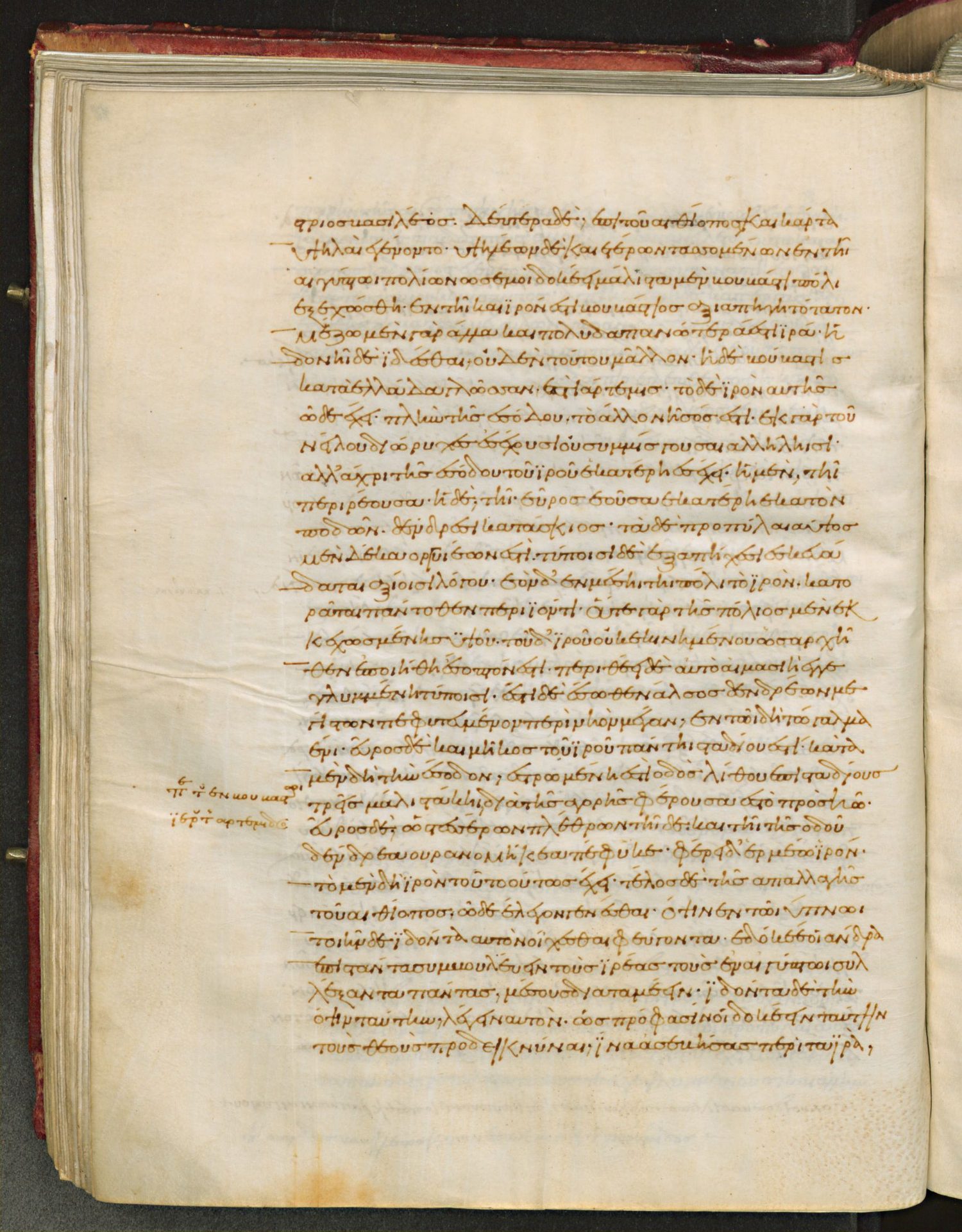
Laur. Plut. 70.3, fol. 90v: Greek here 2.137.4 to 2.139.2. Checked on the image (first and last words read and located in the Greek; each break checked against the neighbouring page): fol. 90v begins ‹-στριος βασιλέος, δεύτερα δὲ› (2.137.4), ends ‹ἀσεβήσας περὶ τὰ ἱρὰ› (2.139.2) (page breaks read on the image for the Herodotus on Egypt collection). The word ‹Σεσώστριος› is divided between fol. 90r and fol. 90v; it is given with fol. 90r. English here: 2.137.5 to 2.139.1 (Godley's sentences for the sections whose Greek lies mostly on this page).
2.137.4βασιλέος, δεύτερα δὲ ἐπὶ τοῦ Αἰθίοπος καὶ κάρτα ὑψηλαὶ ἐγένοντο. 2.137.5ὑψηλέων δὲ καὶ ἑτερέων γενομενέων ἐν τῇ Αἰγύπτῳ πολίων, ὡς ἐμοὶ δοκέει, μάλιστα ἡ ἐν Βουβάστιπόλις ἐξεχώσθη, ἐν τῇ καὶ ἱρόν ἐστι Βουβάστιος ἀξιαπηγητότατον· μέζω μὲν γὰρ ἄλλα καὶ πολυδαπανώτερα ἐστὶ ἱρά, ἡδονὴ δὲ ἰδέσθαι οὐδὲν τούτου μᾶλλον. ἡ δὲ Βούβαστις κατὰ Ἑλλάδα γλῶσσαν ἐστὶ Ἄρτεμις. 2.138.1τὸ δʼ ἱρὸν αὐτῆς ὧδε ἔχει. πλὴν τῆς ἐσόδου τὸ ἄλλο νῆσος ἐστί· ἐκ γὰρ τοῦ Νείλου διώρυχες ἐσέχουσι οὐ συμμίσγουσαι ἀλλήλῃσι, ἀλλʼ ἄχρι τῆς ἐσόδου τοῦ ἱροῦ ἑκατέρη ἐσέχει, ἣ μὲν τῇ περιρρέουσα ἣ δὲ τῇ, εὖρος ἐοῦσα ἑκατέρη ἑκατὸν ποδῶν, δένδρεσι κατάσκιος. 2.138.2τὰ δὲ προπύλαια ὕψος μὲν δέκα ὀργυιέων ἐστί, τύποισι δὲ ἑξαπήχεσι ἐσκευάδαται ἀξίοισι λόγου. ἐὸν δʼ ἐν μέσῃ τῇ πόλι τὸ ἱρὸν κατορᾶται πάντοθεν περιιόντι· ἅτε γὰρ τῆς πόλιος μὲν ἐκκεχωσμένης ὑψοῦ, τοῦ δʼ ἱροῦ οὐ κεκινημένου ὡς ἀρχῆθεν ἐποιήθη, ἔσοπτον ἐστί. 2.138.3περιθέει δὲ αὐτὸ αἱμασιὴ ἐγγεγλυμμένη τύποισι, ἔστι δὲ ἔσωθεν ἄλσος δενδρέων μεγίστων πεφυτευμένον περὶ νηὸν μέγαν, ἐν τῷ δὴ τὤγαλμα ἔνι· εὖρος δὲ καὶ μῆκος τοῦ ἱροῦ πάντῃ σταδίου ἐστί. 2.138.4κατὰ μὲν δὴ τὴν ἔσοδον ἐστρωμένη ἐστὶ ὁδὸς λίθου ἐπὶ σταδίους τρεῖς μάλιστά κῃ, διὰ τῆς ἀγορῆς φέρουσα ἐς τὸ πρὸς ἠῶ, εὖρος δὲ ὡς τεσσέρων πλέθρων· τῇ δὲ καὶ τῇ τῆς ὁδοῦ δένδρεα οὐρανομήκεα πέφυκε· φέρει δὲ ἐς Ἑρμέω ἱρόν. τὸ μὲν δὴ ἱρὸν τοῦτο οὕτω ἔχει. 2.139.1τέλος δὲ τῆς ἀπαλλαγῆς τοῦ Αἰθίοπος ὧδε ἔλεγον γενέσθαι· ὄψιν ἐν τῷ ὕπνῳ τοιήνδε ἰδόντα αὐτὸν οἴχεσθαι φεύγοντα· ἐδόκέε οἱ ἄνδρα ἐπιστάντα συμβουλεύειν τοὺς ἱρέας τοὺς ἐν Αἰγύπτῳ συλλέξαντα πάντας μέσους διαταμεῖν. 2.139.2ἰδόντα δὲ τὴν ὄψιν ταύτην λέγειν αὐτὸν ὡς πρόφασίν οἱ δοκέοι ταύτην τοὺς θεοὺς προδεικνύναι, ἵνα ἀσεβήσας περὶ τὰ ἱρὰ
2.137.5In this town there is a temple of Bubastis, and it is a building most worthy of note. Other temples are greater and more costly, but none pleasanter to the eye than this. Bubastis is, in the Greek language, Artemis. 2.138.1I will now show the form of her temple: save for the entrance, it stands on an island; two separate channels approach it from the Nile, and after coming up to the entry of the temple, they run round it on opposite sides; each of them is an hundred feet wide, and overshadowed by trees. 2.138.2The outer court has a height of ten fathoms, and is adorned with notable figures six cubits high. The temple is in the midst of the city, the whole circuit of which commands a view down into it; for the city’s level has been raised, but that of the temple has been left as it was from the first, so that it can be seen into from without. 2.138.3A stone wall, carven with figures, runs round it; within is a grove of very tall trees growing round a great shrine, wherein is the image of the goddess; the temple is a square, each side measuring a furlong. 2.138.4A road, paved with stone, of about three furlongs’ length leads to the entrance, running eastward through the market place, towards the temple of Hermes; this road is about four hundred feet wide, and bordered by trees reaching to heaven. Such is this temple. 2.139.1Now the departure of the Ethiopian (they said) was accomplished on this wise. He fled away from the country, having seen in a dream one who stood over him and counselled him to gather together all the priests in Egypt and cut them in sunder.
Where on the image
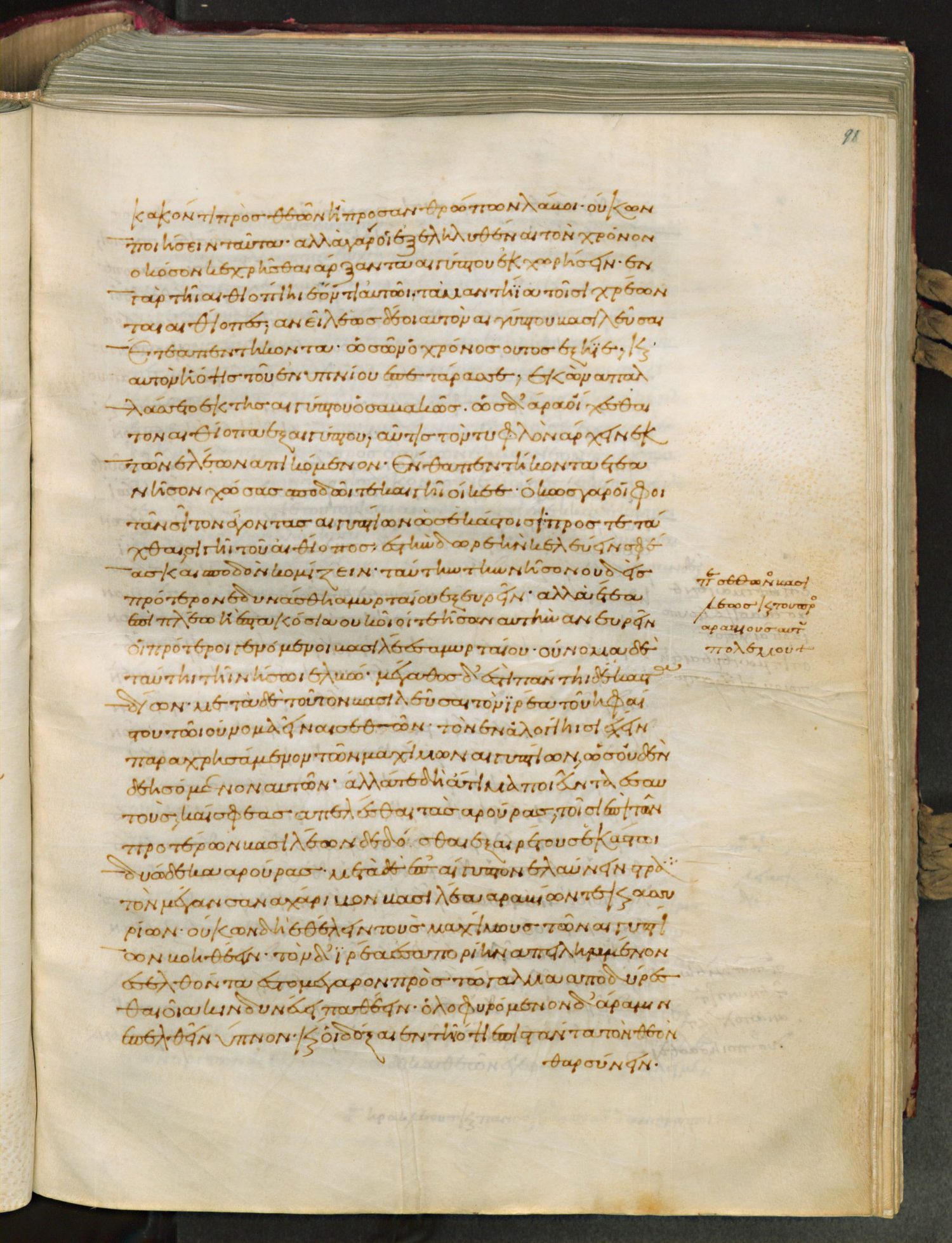
Laur. Plut. 70.3, fol. 91r: Greek here 2.139.2 to 2.141.3. Checked on the image (first and last words read and located in the Greek; each break checked against the neighbouring page): fol. 91r begins ‹κακόν τι πρὸς θεῶν› (2.139.2), ends ‹ἐπιστάντα τὸν θεὸν θαρσύνειν› (2.141.3) (page breaks read on the image for the Herodotus on Egypt collection). English here: 2.139.2 to 2.141.3 (Godley's sentences for the sections whose Greek lies mostly on this page).
2.139.2κακόν τι πρὸς θεῶν ἢ πρὸς ἀνθρώπων λάβοι· οὔκων ποιήσειν ταῦτα, ἀλλὰ γάρ οἱ ἐξεληλυθέναι τὸν χρόνον, ὁκόσον κεχρῆσθαι ἄρξαντα Αἰγύπτου ἐκχωρήσειν. 2.139.3ἐν γὰρ τῇ Αἰθιοπίῃ ἐόντι αὐτῷ τὰ μαντήια, τοῖσι χρέωνται Αἰθίοπες, ἀνεῖλε ὡς δέοι αὐτὸν Αἰγύπτου βασιλεῦσαι ἔτεα πεντήκοντα. ὡς ὦν ὁ χρόνος οὗτος ἐξήιε καὶ αὐτὸν ἡ ὄψις τοῦ ἐνυπνίου ἐπετάρασσε, ἑκὼν ἀπαλλάσσετο ἐκ τῆς Αἰγύπτου ὁ Σαβακῶς. 2.140.1ὡς δʼ ἄρα οἴχεσθαι τὸν Αἰθίοπα ἐξ Αἰγύπτου, αὖτις τὸν τυφλὸν ἄρχειν ἐκ τῶν ἑλέων ἀπικόμενον, ἔνθα πεντήκοντα ἔτεα νῆσον χώσας σποδῷ τε καὶ γῇ οἴκεε. ὅκως γάρ οἱ φοιτᾶν σῖτον ἄγοντας Αἰγυπτίων, ὡς ἑκάστοισι προστετάχθαι, σιγῇ τοῦ Αἰθίοπος, ἐς τὴν δωρεὴν κελεύειν σφέας καὶ σποδὸν κομίζειν. 2.140.2ταύτην τὴν νῆσον οὐδεὶς πρότερον ἐδυνάσθη Ἀμυρταίου ἐξευρεῖν, ἀλλὰ ἔτεα ἐπὶ πλέω ἢ ἑπτακόσια οὐκ οἷοί τε ἦσαν αὐτὴν ἀνευρεῖν οἱ πρότεροι γενόμενοι βασιλέες Ἀμυρταίου. οὔνομα δὲ ταύτῃ τῇ νήσῳ Ἐλβώ, μέγαθος δʼ ἐστὶ πάντῃ δέκα σταδίων. 2.141.1μετὰ δὲ τοῦτον βασιλεῦσαι τὸν ἱρέα τοῦ Ἡφαίστου, τῷ οὔνομα εἶναι Σεθῶν· τὸν ἐν ἀλογίῃσι ἔχειν παραχρησάμενον τῶν μαχίμων Αἰγυπτίων ὡς οὐδὲν δεησόμενον αὐτῶν, ἄλλα τε δὴ ἄτιμα ποιεῦντα ἐς αὐτούς, καί σφεας ἀπελέσθαι τὰς ἀρούρας· τοῖσι ἐπὶ τῶν προτέρων βασιλέων δεδόσθαι ἐξαιρέτους ἑκάστῳ δυώδεκα ἀρούρας. 2.141.2μετὰ δὲ ἐπʼ Αἴγυπτον ἐλαύνειν στρατὸν μέγαν Σαναχάριβον βασιλέα Ἀραβίων τε καὶ Ἀσσυρίων· οὔκων δὴ ἐθέλειν τοὺς μαχίμους τῶν Αἰγυπτίων βοηθέειν. 2.141.3τὸν δʼ ἱρέα ἐς ἀπορίην ἀπειλημένον ἐσελθόντα ἐς τὸ μέγαρον πρὸς τὤγαλμα ἀποδύρεσθαι οἷα κινδυνεύει παθεῖν. ὀλοφυρόμενον δʼ ἄρα μιν ἐπελθεῖν ὕπνον, καί οἱ δόξαι ἐν τῇ ὄψι ἐπιστάντα τὸν θεὸν θαρσύνειν
2.139.2Having seen this vision, he said that he supposed it to be a manifestation sent to him by the gods, that he might commit sacrilege and so be punished by gods or men; he would not (he said) act so, but otherwise, for the time foretold for his rule over Egypt, after which he was to depart, was now fulfilled: 2.139.3for when he was still in Ethiopia the oracles which are inquired of by the people of that country declared to him that he was fated to reign fifty years over Egypt. Seeing that this time was now completed and that he was troubled by what he saw in his dream, Sabacos departed from Egypt of his own accord. 2.140.1The Ethiopian having left Egypt, the blind man (it is said) was king once more, returning from the marshes, where he had dwelt fifty years on an island which he built of ashes and earth; for the Egyptians, who were severally charged to bring him food without the Ethiopian’s knowledge, were bidden by the king to bring ashes whenever they came, as their gift. 2.140.2This island was never discovered before the time of Amyrtaeus; all the kings before him sought it in vain for more than seven hundred years. The name of it is Elbo, and it is ten furlongs long and of an equal breadth. 2.141.1The next king was the priest of Hephaestus, whose name was Sethos. He despised and took no account of the warrior Egyptians, thinking he would never need them; besides otherwise dishonouring them, he took away the chosen lands which had been given to them, twelve fields to each man, in the reign of former kings. 2.141.2So presently came king Sanacharib against Egypt, with a great host of Arabians and Assyrians; and the warrior Egyptians would not march against him. 2.141.3The priest, in this quandary, went into the temple shrine and there bewailed to the god’s image the peril which threatened him. In his lamentation he fell asleep, and dreamt that he saw the god standing over him and bidding him take courage, for he should suffer no ill by encountering the host of Arabia: “Myself,” said the god, “will send you champions.”
Where on the image
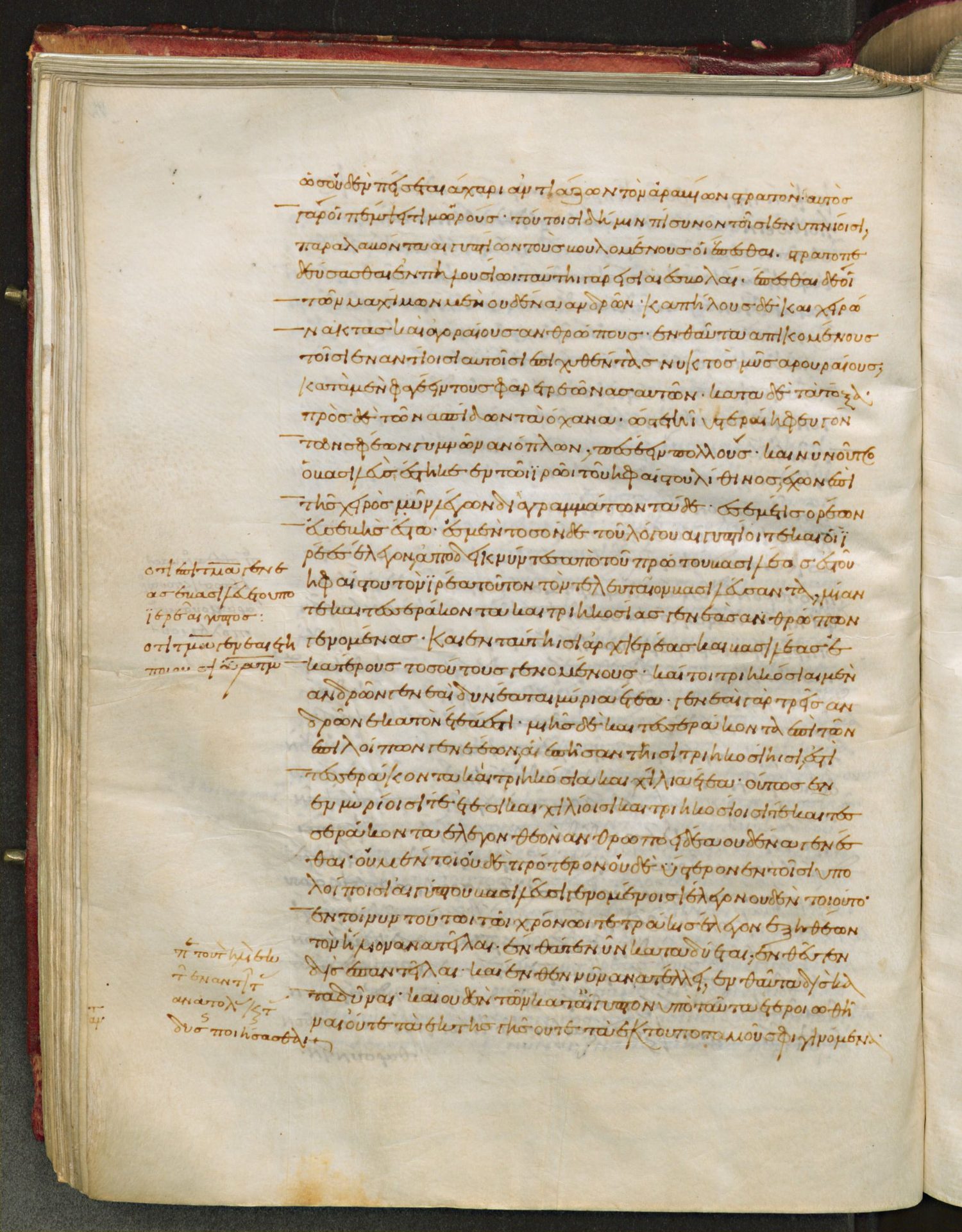
Laur. Plut. 70.3, fol. 91v: Greek here 2.141.3 to 2.142.4. Checked on the image (first and last words read and located in the Greek; each break checked against the neighbouring page): fol. 91v begins ‹ὡς οὐδὲν πείσεται ἄχαρι› (2.141.3), ends ‹τοῦ ποταμοῦ σφι γινόμενα› (2.142.4) (page breaks read on the image for the Herodotus on Egypt collection). English here: 2.141.4 to 2.142.4 (Godley's sentences for the sections whose Greek lies mostly on this page).
2.141.3ὡς οὐδὲν πείσεται ἄχαρι ἀντιάζων τὸν Ἀραβίων στρατόν· αὐτὸς γάρ οἱ πέμψειν τιμωρούς. 2.141.4τούτοισι δή μιν πίσυνον τοῖσι ἐνυπνίοισι, παραλαβόντα Αἰγυπτίων τοὺς βουλομένους οἱ ἕπεσθαι, στρατοπεδεύσασθαι ἐν Πηλουσίῳ· ταύτῃ γὰρ εἰσὶ αἱ ἐσβολαί· ἕπεσθαι δέ οἱ τῶν μαχίμων μὲν οὐδένα ἀνδρῶν, καπήλους δὲ καὶ χειρώνακτας καὶ ἀγοραίους ἀνθρώπους. 2.141.5ἐνθαῦτα ἀπικομένοισι τοῖσι ἐναντίοισι αὐτοῖσι ἐπιχυθέντας νυκτὸς μῦς ἀρουραίους κατὰ μὲν φαγεῖν τοὺς φαρετρεῶνας αὐτῶν κατὰ δὲ τὰ τόξα, πρὸς δὲ τῶν ἀσπίδων τὰ ὄχανα, ὥστε τῇ ὑστεραίῃ φευγόντων σφέων γυμνῶν πεσεῖν πολλούς. 2.141.6καὶ νῦν οὗτος ὁ βασιλεὺς ἕστηκε ἐν τῷ ἱρῷ τοῦ Ἡφαίστου λίθινος, ἔχων ἐπὶ τῆς χειρὸς μῦν, λέγων διὰ γραμμάτων τάδε· ἐς ἐμέ τις ὁρέων εὐσεβὴς ἔστω. 2.142.1ἐς μὲν τοσόνδε τοῦ λόγου Αἰγύπτιοί τε καὶ οἱ ἱρέες ἔλεγον, ἀποδεικνύντες ἀπὸ τοῦ πρώτου βασιλέος ἐς τοῦ Ἡφαίστου τὸν ἱρέα τοῦτον τὸν τελευταῖον βασιλεύσαντα μίαν τε καὶ τεσσεράκοντα καὶ τριηκοσίας γενεὰς ἀνθρώπων γενομένας, καὶ ἐν ταύτῃσι ἀρχιερέας καὶ βασιλέας ἑκατέρους τοσούτους γενομένους. 2.142.2καίτοι τριηκόσιαι μὲν ἀνδρῶν γενεαὶ δυνέαται μύρια ἔτεα· γενεαὶ γὰρ τρεῖς ἀνδρῶν ἑκατὸν ἔτεα ἐστί· μιῆς δὲ καὶ τεσσεράκοντα ἔτι τῶν ἐπιλοίπων γενεέων, αἳ ἐπῆσαν τῇσι τριηκοσίῃσι, ἐστὶ τεσσεράκοντα καὶ τριηκόσια καὶ χίλια ἔτεα. 2.142.3οὕτω ἐν μυρίοισί τε ἔτεσι καὶ χιλίοισι καὶ τριηκοσίοισί τε καὶ τεσσεράκοντα ἔλεγον θεὸν ἀνθρωποειδέα οὐδένα γενέσθαι· οὐ μέντοι οὐδὲ πρότερον οὐδὲ ὕστερον ἐν τοῖσι ὑπολοίποισι Αἰγύπτου βασιλεῦσι γενομένοισι ἔλεγον οὐδὲν τοιοῦτο. 2.142.4ἐν τοίνυν τούτῳ τῷ χρόνῳ τετράκις ἔλεγον ἐξ ἠθέων τὸν ἥλιον ἀνατεῖλαι· ἔνθα τε νῦν καταδύεται, ἐνθεῦτεν δὶς ἐπαντεῖλαι, καὶ ἔνθεν νῦν ἀνατέλλει, ἐνθαῦτα δὶς καταδῦναι. καὶ οὐδὲν τῶν κατʼ Αἴγυπτον ὑπὸ ταῦτα ἑτεροιωθῆναι, οὔτε τὰ ἐκ τῆς γῆς οὔτε τὰ ἐκ τοῦ ποταμοῦ σφι γινόμενα,
2.141.4So he trusted the vision, and encamped at Pelusium with such Egyptians as would follow him, for here is the road into Egypt; and none of the warriors would go with him, but only hucksters and artificers and traders. 2.141.5Their enemies too came thither, and one night a multitude of fieldmice swarmed over the Assyrian camp and devoured their quivers and their bows and the handles of their shields likewise, insomuch that they fled the next day unarmed and many fell. 2.141.6And at this day a stone statue of the Egyptian king stands in Hephaestus’ temple, with a mouse in his hand, and an inscription to this effect: “Look on me, and fear the gods.” 2.142.1Thus far went the record given me by the Egyptians and their priests; and they showed me that the time from the first king to that priest of Hephaestus, who was the last, covered three hundred and forty-one generations of men, and that in this time such also had been the number of their kings, and of their high priests. 2.142.2Now three hundred generations make up ten thousand years, three generations being equal to a century. And over and above the three hundred the remaining forty-one cover thirteen hundred and forty years. 2.142.3Thus the whole sum is eleven thousand three hundred and forty years; in all which time (they said) they had had no king who was a god in human form, nor had there been any such thing either before or after those years among the rest of the kings of Egypt. 2.142.4Four times in this period (so they told me) the sun rose contrary to his wont; twice he rose where he now sets, and twice he set where now he rises; yet Egypt at these times underwent no change, neither in the produce of the river and the land, nor in the matter of sickness and death.
Where on the image
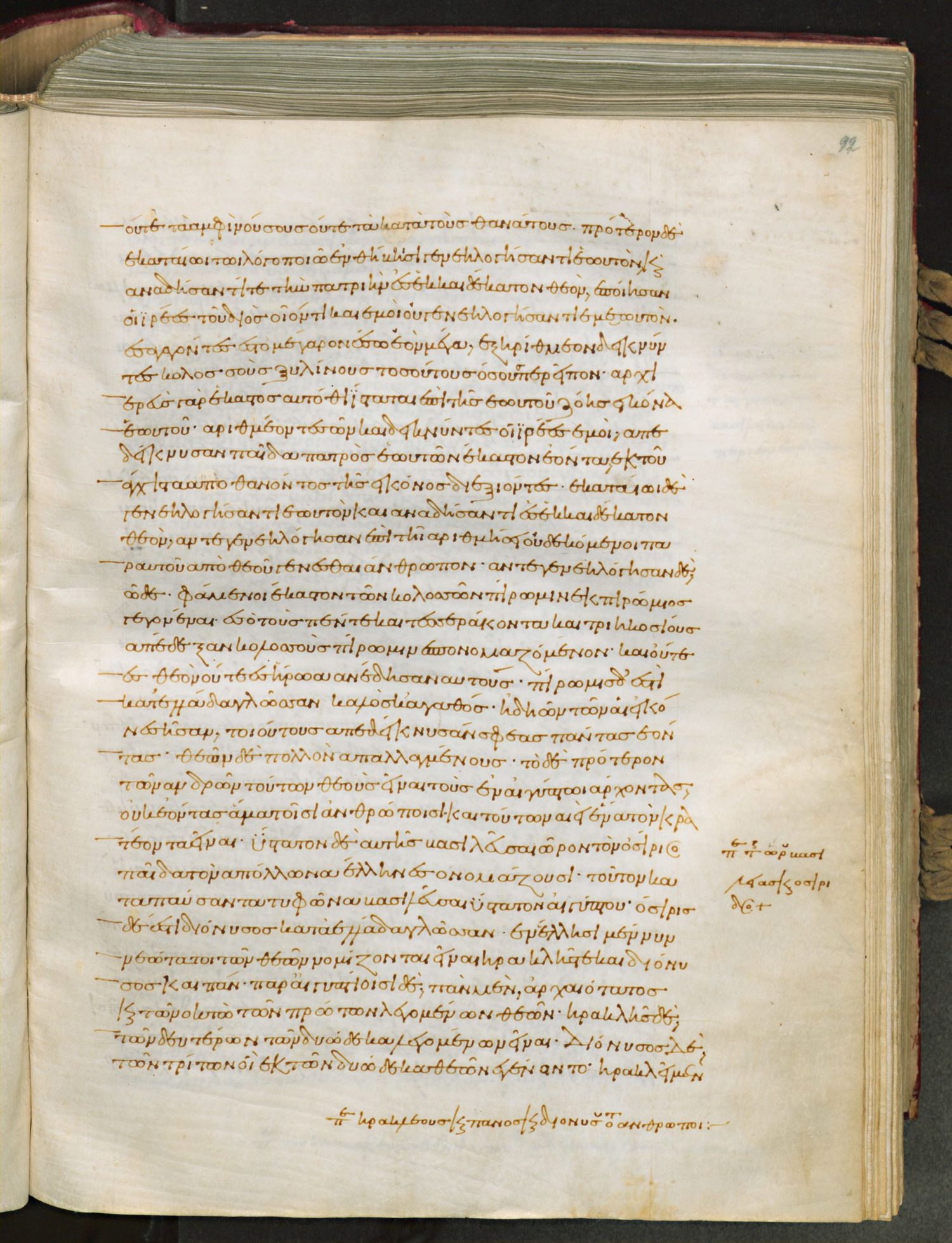
Laur. Plut. 70.3, fol. 92r: Greek here 2.142.4 to 2.145.2. Checked on the image (first and last words read and located in the Greek; each break checked against the neighbouring page): fol. 92r begins ‹οὔτε τὰ ἀμφὶ νούσους› (2.142.4), ends ‹δυώδεκα θεῶν ἐγένοντο.Ἡρακλέι μὲν› (2.145.2) (page breaks read on the image for the Herodotus on Egypt collection). English here: 2.143.1 to 2.145.1 (Godley's sentences for the sections whose Greek lies mostly on this page).
2.142.4οὔτε τὰ ἀμφὶ νούσους οὔτε τὰ κατὰ τοὺς θανάτους. 2.143.1πρότερον δὲ Ἑκαταίῳ τῷ λογοποιῷ ἐν Θήβῃσι γενεηλογήσαντί τε ἑωυτὸν καὶ ἀναδήσαντι τὴν πατριὴν ἐς ἑκκαιδέκατον θεὸν ἐποίησαν οἱ ἱρέες τοῦ Διὸς οἷόν τι καὶ ἐμοὶ οὐ γενεηλογήσαντι ἐμεωυτόν· 2.143.2ἐσαγαγόντες ἐς τὸ μέγαρον ἔσω ἐὸν μέγα ἐξηρίθμεον δεικνύντες κολοσσοὺς ξυλίνους τοσούτους ὅσους περ εἶπον· ἀρχιερεὺς γὰρ ἕκαστος αὐτόθι ἱστᾷ ἐπὶ τῆς ἑωυτοῦ ζόης εἰκόνα ἑωυτοῦ· 2.143.3ἀριθμέοντες ὦν καὶ δεικνύντες οἱ ἱρέες ἐμοὶ ἀπεδείκνυσαν παῖδα πατρὸς ἑωυτῶν ἕκαστον ἐόντα, ἐκ τοῦ ἄγχιστα ἀποθανόντος τῆς εἰκόνος διεξιόντες διὰ πασέων, ἕως οὗ ἀπέδεξαν ἁπάσας αὐτάς. 2.143.4Ἑκαταίῳ δὲ γενεηλογήσαντι ἑωυτὸν καὶ ἀναδήσαντι ἐς ἑκκαιδέκατον θεὸν ἀντεγενεηλόγησαν ἐπὶ τῇ ἀριθμήσι, οὐ δεκόμενοι παρʼ αὐτοῦ ἀπὸ θεοῦ γενέσθαι ἄνθρωπον· ἀντεγενεηλόγησαν δὲ ὧδε, φάμενοι ἕκαστον τῶν κολοσσῶν πίρωμιν ἐκ πιρώμιος γεγονέναι, ἐς ὃ τοὺς πέντε καὶ τεσσεράκοντα καὶ τριηκοσίους ἀπέδεξαν κολοσσούς [πίρωμιν ἐπονομαζόμενον], καὶ οὔτε ἐς θεὸν οὔτε ἐς ἥρωα ἀνέδησαν αὐτούς. πίρωμις δὲ ἐστὶ κατὰ Ἑλλάδα γλῶσσαν καλὸς κἀγαθός. 2.144.1ἤδη ὦν τῶν αἱ εἰκόνες ἦσαν, τοιούτους ἀπεδείκνυσαν σφέας πάντας ἐόντας, θεῶν δὲ πολλὸν ἀπαλλαγμένους. 2.144.2τὸ δὲ πρότερον τῶν ἀνδρῶν τούτων θεοὺς εἶναι τοὺς ἐν Αἰγύπτῳ ἄρχοντας, οὐκ ἐόντας ἅμα τοῖσι ἀνθρώποισι, καὶ τούτων αἰεὶ ἕνα τὸν κρατέοντα εἶναι· ὕστατον δὲ αὐτῆς βασιλεῦσαι Ὦρον τὸν Ὀσίριος παῖδα, τὸν Ἀπόλλωνα Ἕλληνες ὀνομάζουσι· τοῦτον καταπαύσαντα Τυφῶνα βασιλεῦσαι ὕστατον Αἰγύπτου. Ὄσιρις δὲ ἐστὶ Διόνυσος κατὰ Ἑλλάδα γλῶσσαν. 2.145.1ἐν Ἕλλησι μέν νυν νεώτατοι τῶν θεῶν νομίζονται εἶναι Ἡρακλέης τε καὶ Διόνυσος καὶ Πάν, παρʼ Αἰγυπτίοισι δὲ Πὰν μὲν ἀρχαιότατος καὶ τῶν ὀκτὼ τῶν πρώτων λεγομένων θεῶν, Ἡρακλέης δὲ τῶν δευτέρων τῶν δυώδεκα λεγομένων εἶναι, Διόνυσος δὲ τῶν τρίτων, οἳ ἐκ τῶν δυώδεκα θεῶν ἐγένοντο. 2.145.2Ἡρακλέι μὲν
2.143.1Hecataeus the historian was once at Thebes, where he made for himself a genealogy which connected him by lineage with a god in the sixteenth generation. But the priests did for him what they did for me (who had not traced my own lineage). 2.143.2They brought me into the great inner court of the temple and showed me there wooden figures which they counted up to the number they had already given, for every high priest sets there in his lifetime a statue of himself; counting and 2.143.3pointing to these, the priests showed me that each inherited from his father; they went through the whole tale of figures, back to the earliest from that of him who had lateliest died. 2.143.4Thus when Hecataeus had traced his descent and claimed that his sixteenth forefather was a god, the priests too traced a line of descent according to the method of their counting; for they would not be persuaded by him that a man could be descended from a god; they traced descent through the whole line of three hundred and forty-five figures, not connecting it with any ancestral god or hero, but declaring each figure to be a “Piromis” the son of a “Piromis,” that is, in the Greek language, one who is in all respects a good man. 2.144.1Thus they showed that all whose statues stood there had been good men, but wholly unlike gods. 2.144.2Before these men, they said, the rulers of Egypt were gods, but none had been contemporary with the human priests. Of these gods one or other had in succession been supreme; the last of them to rule the country was Osiris’ son Horus, called by the Greeks Apollo; he deposed Typhon, and was the last divine king of Egypt. Osiris is, in the Greek language, Dionysus. 2.145.1Among the Greeks, Heracles, Dionysus, and Pan are held to be the youngest of the gods. But in Egypt Pan is the most ancient of these and is one of the eight gods who are said to be the first of all, Heracles belongs to the second dynasty (that of the so-called twelve gods), and Dionysus to the third, which came after the twelve.
Where on the image
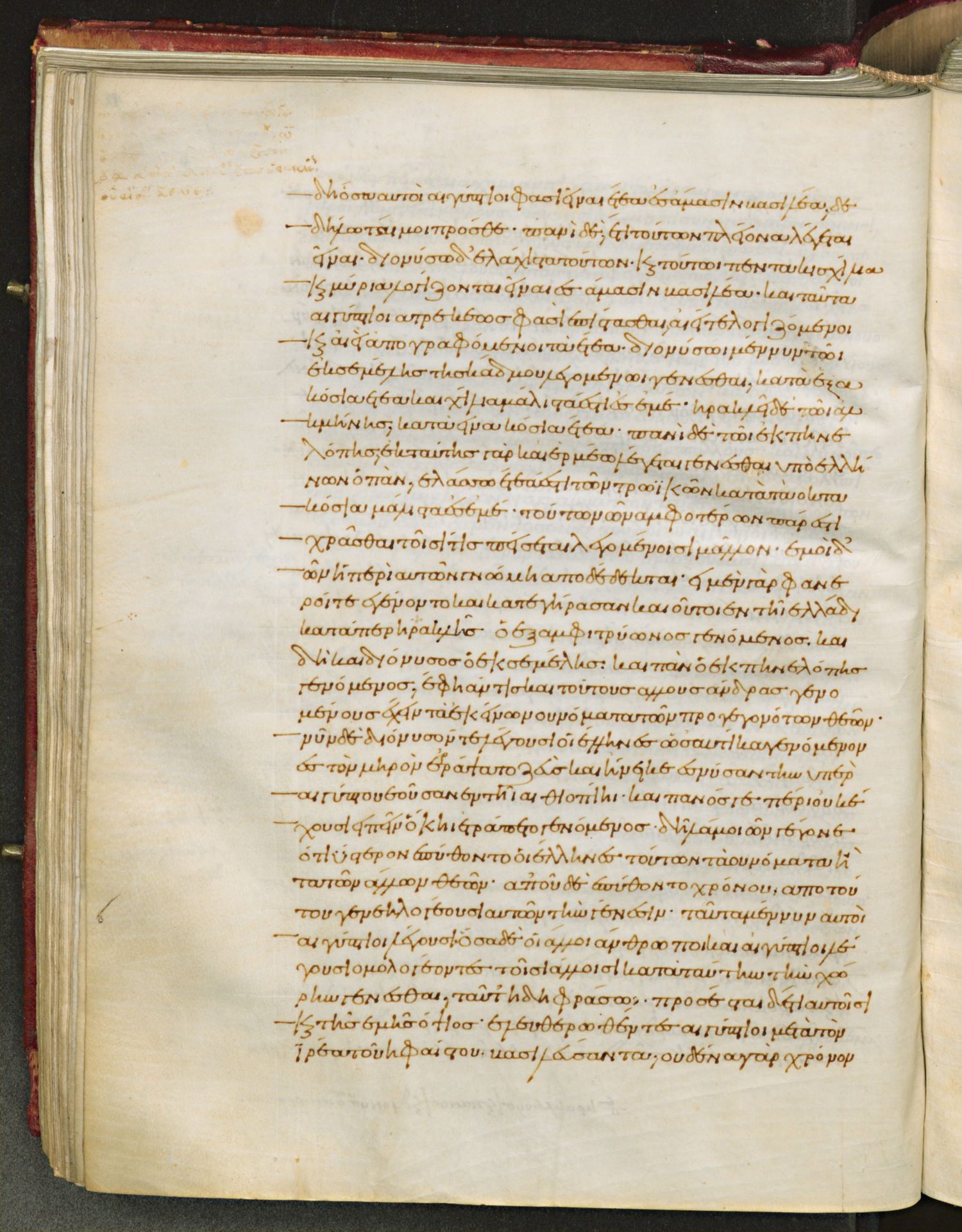
Laur. Plut. 70.3, fol. 92v: Greek here 2.145.2 to 2.147.2. Checked on the image (first and last words read and located in the Greek; each break checked against the neighbouring page): fol. 92v begins ‹δὴ ὅσα αὐτοὶ Αἰγύπτιοι› (2.145.2), ends ‹βασιλεύσαντα, οὐδένα γὰρ χρόνον› (2.147.2) (page breaks read on the image for the Herodotus on Egypt collection). English here: 2.145.2 to 2.147.1 (Godley's sentences for the sections whose Greek lies mostly on this page).
2.145.2δὴ ὅσα αὐτοὶ Αἰγύπτιοι φασὶ εἶναι ἔτεα ἐς Ἄμασιν βασιλέα, δεδήλωταί μοι πρόσθε· Πανὶ δὲ ἔτι τούτων πλέονα λέγεται εἶναι, Διονύσῳ δʼ ἐλάχιστα τούτων, καὶ τούτῳ πεντακισχίλια καὶ μύρια λογίζονται εἶναι ἐς Ἄμασιν βασιλέα. 2.145.3καὶ ταῦτα Αἰγύπτιοι ἀτρεκέως φασὶ ἐπίστασθαι, αἰεί τε λογιζόμενοι καὶ αἰεὶ ἀπογραφόμενοι τὰ ἔτεα. 2.145.4Διονύσῳ μέν νυν τῷ ἐκ Σεμέλης τῆς Κάδμου λεγομένῳ γενέσθαι κατὰ ἑξακόσια ἔτεα καὶ χίλια μάλιστα ἐστὶ ἐς ἐμέ, Ἡρακλέι δὲ τῷ Ἀλκμήνης κατὰ εἰνακόσια ἔτεα· Πανὶ δὲ τῷ ἐκ Πηνελόπης (ἐκ ταύτης γὰρ καὶ Ἑρμέω λέγεται γενέσθαι ὑπὸ Ἑλλήνων ὁ Πάν) ἐλάσσω ἔτεα ἐστὶ τῶν Τρωικῶν, κατὰ ὀκτακόσια μάλιστα ἐς ἐμέ. 2.146.1τούτων ὦν ἀμφοτέρων πάρεστι χρᾶσθαι τοῖσί τις πείσεται λεγομένοισι μᾶλλον· ἐμοὶ δʼ ὦν ἡ περὶ αὐτῶν γνώμη ἀποδέδεκται. εἰ μὲν γὰρ φανεροί τε ἐγένοντο καὶ κατεγήρασαν καὶ οὗτοι ἐν τῇ Ἑλλάδι, κατά περ Ἡρακλέης ὁ ἐξ Ἀμφιτρύωνος γενόμενος, καὶ δὴ καὶ Διόνυσος ὁ ἐκ Σεμέλης καὶ Πὰν ὁ ἐκ Πηνελόπης γενόμενος, ἔφη ἄν τις καὶ τούτους ἄλλους ἄνδρας γενομένους ἔχειν τὰ ἐκείνων οὐνόματα τῶν προγεγονότων θεῶν. 2.146.2νῦν δὲ Διόνυσόν τε λέγουσι οἱ Ἕλληνες ὡς αὐτίκα γενόμενον ἐς τὸν μηρὸν ἐνερράψατο Ζεὺς καὶ ἤνεικε ἐς Νύσαν τὴν ὑπὲρ Αἰγύπτου ἐοῦσαν ἐν τῇ Αἰθιοπίῃ, καὶ Πανός γε πέρι οὐκ ἔχουσι εἰπεῖν ὅκῃ ἐτράπετο γενόμενος. δῆλά μοι γέγονε ὅτι ὕστερον ἐπύθοντο οἱ Ἕλληνες τούτων τὰ οὐνόματα ἢ τὰ τῶν ἄλλων θεῶν· ἀπʼ οὗ δὲ ἐπύθοντο χρόνου, ἀπὸ τούτου γενεηλογέουσι αὐτῶν τὴν γένεσιν. 2.147.1ταῦτα μέν νυν αὐτοὶ Αἰγύπτιοι λέγουσι· ὅσα δὲ οἵ τε ἄλλοι ἄνθρωποι καὶ Αἰγύπτιοι λέγουσι ὁμολογέοντες τοῖσι ἄλλοισι κατὰ ταύτην τὴν χώρην γενέσθαι, ταῦτʼ ἤδη φράσω· προσέσται δέ τι αὐτοῖσι καὶ τῆς ἐμῆς ὄψιος. 2.147.2ἐλευθερωθέντες Αἰγύπτιοι μετὰ τὸν ἱρέα τοῦ Ἡφαίστου βασιλεύσαντα, οὐδένα γὰρ χρόνον
2.145.2How many years there were between Heracles and the reign of Amasis, I have already shown; Pan is said to be earlier still; the years between Dionysus and Amasis are the fewest, and they are reckoned by the Egyptians at fifteen thousand. 2.145.3Of all this the Egyptians claim to have certain knowledge, seeing that they had always reckoned the years and chronicled them in writing. 2.145.4Now the Dionysus who was called the son of Semele, daughter of Cadmus, was about sixteen hundred years before my time, and Heracles son of Alcmene about nine hundred years; and Pan the son of Penelope (for according to the Greeks Penelope and Hermes were the parents of Pan) was about eight hundred years before me, and thus of a later date than the Trojan war. 2.146.1With regard to these two, Pan and Dionysus, a man may follow whatsoever story he deems most credible; but I here declare my own opinion concerning them:—Had Dionysus son of Semele and Pan son of Penelope been made manifest in Hellas and lived there to old age, like Heracles the son of Amphitryon, it might have been said that they too (like Heracles) were but men, named after the older Pan and Dionysus, the gods of antiquity; 2.146.2but as it is, the Greek story has it that no sooner was Dionysus born than Zeus sewed him up in his thigh and carried him away to Nysa in Ethiopia beyond Egypt; and as for Pan, the Greeks know not what became of him after his birth. It is therefore plain to me that the Greeks learnt the names of these two gods later than the names of all the others, and trace the birth of both to the time when they gained the knowledge. 2.147.1Thus far I have recorded what the Egyptians themselves say. I will now relate what is recorded alike by Egyptians and foreigners to have happened in that land, and I will add thereto something of what I myself have seen.
Where on the image
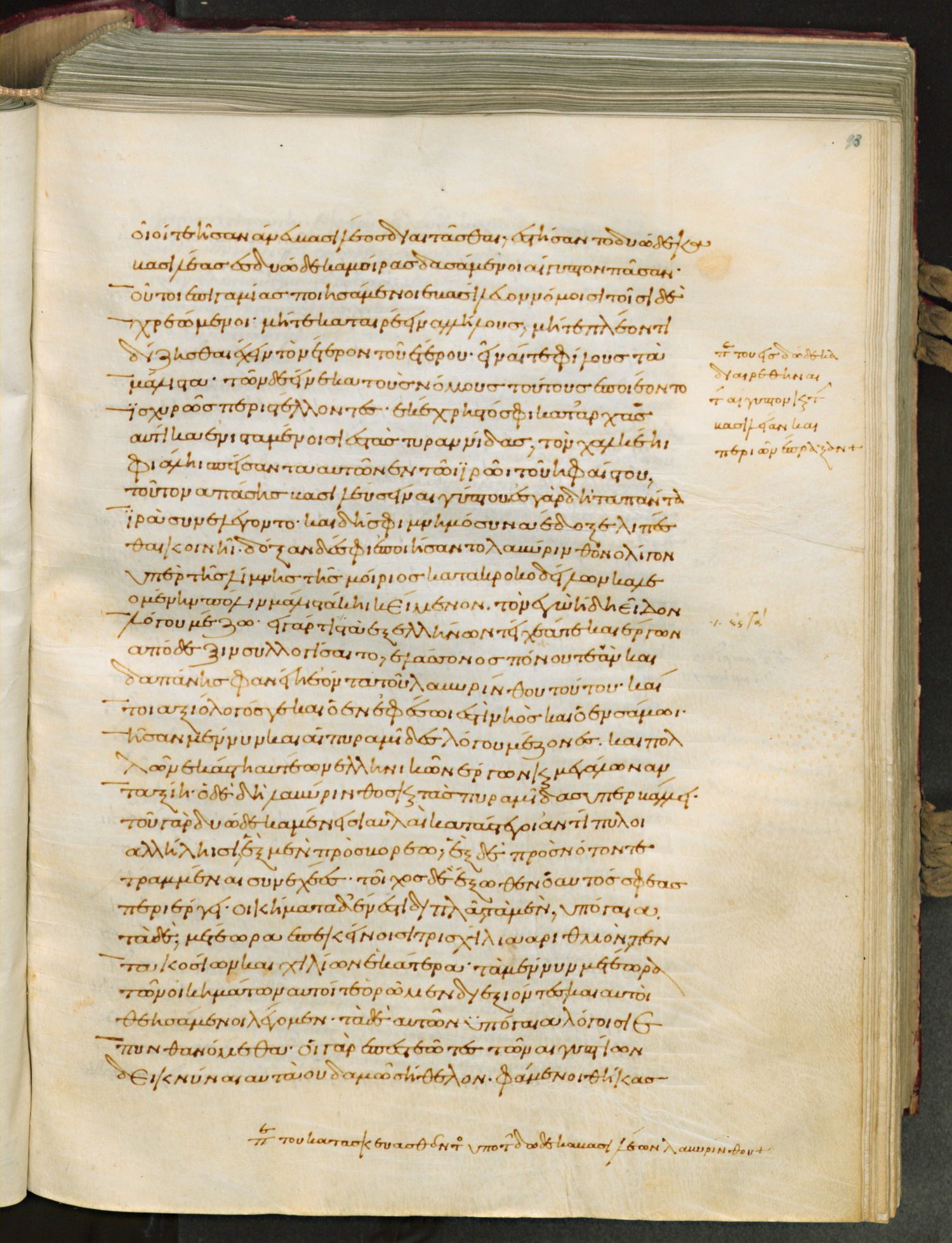
Laur. Plut. 70.3, fol. 93r: Greek here 2.147.2 to 2.148.5. Checked on the image (first and last words read and located in the Greek; each break checked against the neighbouring page): fol. 93r begins ‹οἷοί τε ἦσαν ἄνευ› (2.147.2), ends ‹οὐδαμῶς ἤθελον, φάμενοι θήκας› (2.148.5). Below the text, a reader's note on the labyrinth built by the twelve kings. English here: 2.147.2 to 2.148.5 (Godley's sentences for the sections whose Greek lies mostly on this page).
2.147.2οἷοί τε ἦσαν ἄνευ βασιλέος διαιτᾶσθαι, ἐστήσαντο δυώδεκα βασιλέας, δυώδεκα μοίρας δασάμενοι Αἴγυπτον πᾶσαν. 2.147.3οὗτοι ἐπιγαμίας ποιησάμενοι ἐβασίλευον νόμοισι τοῖσιδε χρεώμενοι, μήτε καταιρέειν ἀλλήλους μήτε πλέον τι δίζησθαι ἔχειν τὸν ἕτερον τοῦ ἑτέρου, εἶναί τε φίλους τὰ μάλιστα. 2.147.4τῶνδε δὲ εἵνεκα τοὺς νόμους τούτους ἐποιέοντο, ἰσχυρῶς περιστέλλοντες· ἐκέχρηστό σφι κατʼ ἀρχὰς αὐτίκα ἐνισταμένοισι ἐς τὰς τυραννίδας τὸν χαλκέῃ φιάλῃ σπείσαντα αὐτῶν ἐν τῷ ἱρῷ τοῦ Ἡφαίστου, τοῦτον ἁπάσης βασιλεύσειν Αἰγύπτου· ἐς γὰρ δὴ τὰ πάντα ἱρὰ συνελέγοντο. 2.148.1καὶ δή σφι μνημόσυνα ἔδοξε λιπέσθαι κοινῇ, δόξαν δέ σφι ἐποιήσαντο λαβύρινθον, ὀλίγον ὑπὲρ τῆς λίμνης τῆς Μοίριος κατὰ Κροκοδείλων καλεομένην πόλιν μάλιστά κῃ κείμενον· τὸν ἐγὼ ἤδη εἶδον λόγου μέζω. 2.148.2εἰ γάρ τις τὰ ἐξ Ἑλλήνων τείχεά τε καὶ ἔργων ἀπόδεξιν συλλογίσαιτο, ἐλάσσονος πόνου τε ἂν καὶ δαπάνης φανείη ἐόντα τοῦ λαβυρίνθου τούτου. καίτοι ἀξιόλογός γε καὶ ὁ ἐν Ἐφέσῳ ἐστὶ νηὸς καὶ ὁ ἐν Σάμῳ. 2.148.3ἦσαν μέν νυν καὶ αἱ πυραμίδες λόγου μέζονες, καὶ πολλῶν ἑκάστη αὐτέων Ἑλληνικῶν ἔργων καὶ μεγάλων ἀνταξίη, ὁ δὲ δὴ λαβύρινθος καὶ τὰς πυραμίδας ὑπερβάλλει· 2.148.4τοῦ [γὰρ] δυώδεκα μὲν εἰσὶ αὐλαὶ κατάστεγοι, ἀντίπυλοι ἀλλήλῃσι, ἓξ μὲν πρὸς βορέω ἓξ δὲ πρὸς νότον τετραμμέναι, συνεχέες· τοῖχος δὲ ἔξωθεν ὁ αὐτός σφεας περιέργει. οἰκήματα δʼ ἔνεστι διπλᾶ, τὰ μὲν ὑπόγαια τὰ δὲ μετέωρα ἐπʼ ἐκείνοισι, τρισχίλια ἀριθμόν, πεντακοσίων καὶ χιλίων ἑκάτερα. 2.148.5τὰ μέν νυν μετέωρα τῶν οἰκημάτων αὐτοί τε ὡρῶμεν διεξιόντες καὶ αὐτοὶ θεησάμενοι λέγομεν, τὰ δὲ αὐτῶν ὑπόγαια λόγοισι ἐπυνθανόμεθα· οἱ γὰρ ἐπεστεῶτες τῶν Αἰγυπτίων δεικνύναι αὐτὰ οὐδαμῶς ἤθελον, φάμενοι θήκας
2.147.2After the reign of the priest of Hephaestus the Egyptians were made free. But they could never live without a king, so they divided Egypt into twelve portions and set up twelve kings. 2.147.3These kings intermarried, and agreed to be close friends, undertaking not to depose one another nor to seek to possess one more than another. 2.147.4The reason of this agreement, which they zealously guarded, was this: at their very first establishment in their several lordships an oracle was given them that that one of them who poured a libation from a bronze vessel in the temple of Hephaestus (where, as in all the temples, it was their wont to assemble) should be king of all Egypt. 2.148.1Moreover they resolved to preserve the memory of their names by some joint enterprise; and having so resolved they made a labyrinth, a little way beyond the lake Moeris and near the place called the City of Crocodiles. 2.148.2I have myself seen it, and indeed no words can tell its wonders; were all that Greeks have builded and wrought added together the whole would be seen to be a matter of less labour and cost than was this labyrinth, albeit the temples at Ephesus and Samos are noteworthy buildings. 2.148.3Though the pyramids were greater than words can tell, and each one of them a match for many great monuments built by Greeks, this maze surpasses even the pyramids. 2.148.4It has twelve roofed courts, with doors over against each other: six face the north and six the south, in two continuous lines, all within one outer wall. There are also double sets of chambers, three thousand altogether, fifteen hundred above and the same number under ground. 2.148.5We ourselves viewed those that are above ground, and speak of what we have seen; of the underground chambers we were only told; the Egyptian wardens would by no means show them, these being, they said, the burial vaults of the kings who first built this labyrinth, and of the sacred crocodiles.
Where on the image
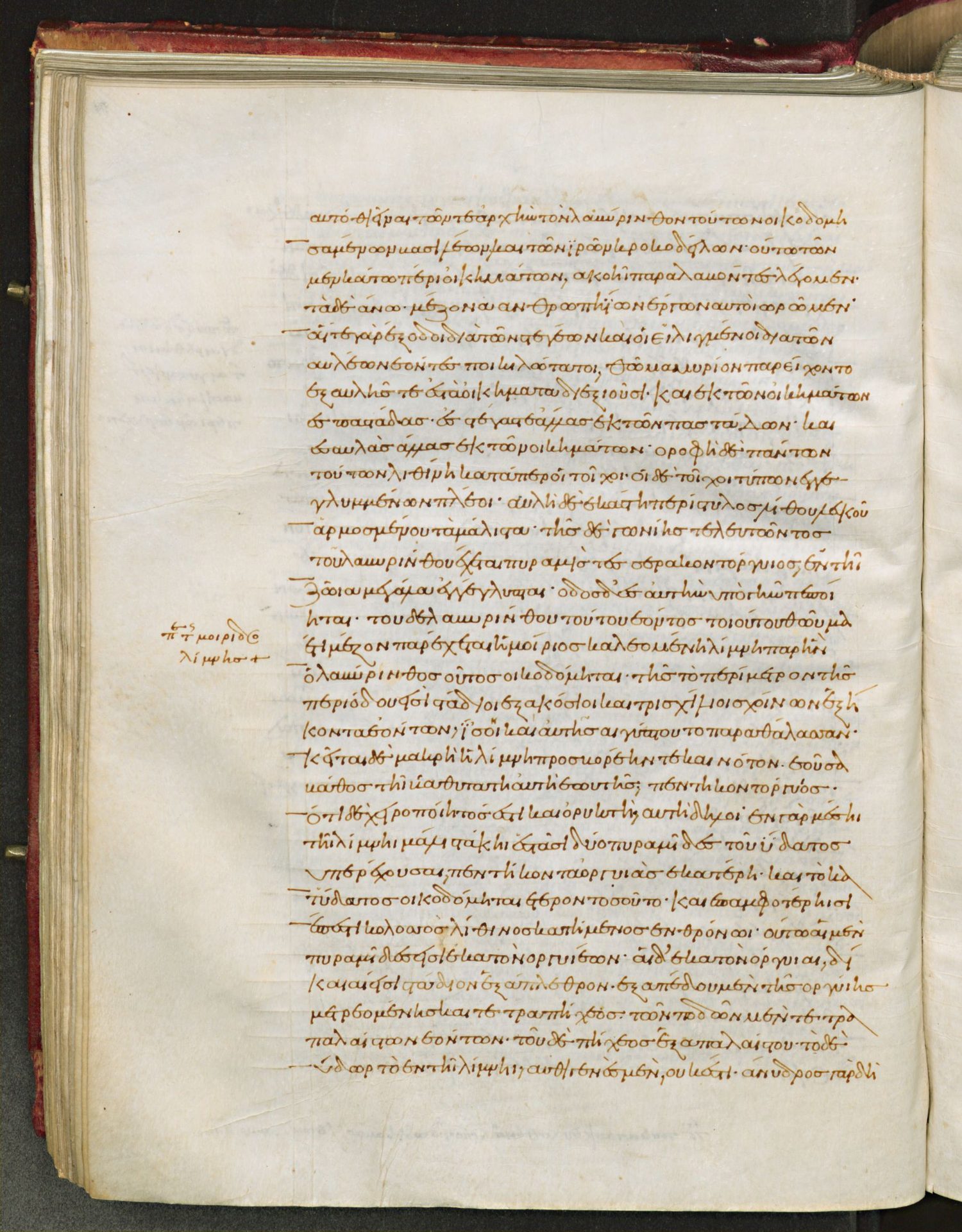
Laur. Plut. 70.3, fol. 93v: Greek here 2.148.5 to 2.149.4. Checked on the image (first and last words read and located in the Greek; each break checked against the neighbouring page): fol. 93v begins ‹αὐτόθι εἶναι τῶν τε› (2.148.5), ends ‹ἔστἱ ἄνυδρος γὰρ δὴ› (2.149.4). English here: 2.148.6 to 2.149.3 (Godley's sentences for the sections whose Greek lies mostly on this page).
2.148.5αὐτόθι εἶναι τῶν τε ἀρχὴν τὸν λαβύρινθον τοῦτον οἰκοδομησαμένων βασιλέων καὶ τῶν ἱρῶν κροκοδείλων. 2.148.6οὕτω τῶν μὲν κάτω πέρι οἰκημάτων ἀκοῇ παραλαβόντες λέγομεν, τὰ δὲ ἄνω μέζονα ἀνθρωπηίων ἔργων αὐτοὶ ὡρῶμεν· αἵ τε γὰρ διέξοδοι διὰ τῶν στεγέων καὶ οἱ ἑλιγμοὶ διὰ τῶν αὐλέων ἐόντες ποικιλώτατοι θῶμα μυρίον παρείχοντο ἐξ αὐλῆς τε ἐς τὰ οἰκήματα διεξιοῦσι καὶ ἐκ τῶν οἰκημάτων ἐς παστάδας, ἐς στέγας τε ἄλλας ἐκ τῶν παστάδων καὶ ἐς αὐλὰς ἄλλας ἐκ τῶν οἰκημάτων. 2.148.7ὀροφὴ δὲ πάντων τούτων λιθίνη κατά περ οἱ τοῖχοι, οἱ δὲ τοῖχοι τύπων ἐγγεγλυμμένων πλέοι, αὐλὴ δὲ ἑκάστη περίστυλος λίθου λευκοῦ ἁρμοσμένου τὰ μάλιστα. τῆς δὲ γωνίης τελευτῶντος τοῦ λαβυρίνθου ἔχεται πυραμὶς τεσσερακοντόργυιος, ἐν τῇ ζῷα μεγάλα ἐγγέγλυπται· ὁδὸς δʼ ἐς αὐτὴν ὑπὸ γῆν πεποίηται. 2.149.1τοῦ δὲ λαβυρίνθου τούτου ἐόντος τοιούτου θῶμα ἔτι μέζον παρέχεται ἡ Μοίριος καλεομένη λίμνη, παρʼ ἣν ὁ λαβύρινθος οὗτος οἰκοδόμηται· τῆς τὸ περίμετρον τῆς περιόδου εἰσὶ στάδιοι ἑξακόσιοι καὶ τρισχίλιοι, σχοίνων ἑξήκοντα ἐόντων, ἴσοι καὶ αὐτῆς Αἰγύπτου τὸ παρὰ θάλασσαν. κεῖται δὲ μακρὴ ἡ λίμνη πρὸς βορέην τε καὶ νότον, ἐοῦσα βάθος, τῇ βαθυτάτη αὐτὴ ἑωυτῆς, πεντηκοντόργυιος. 2.149.2ὅτι δὲ χειροποίητος ἐστὶ καὶ ὀρυκτή, αὐτὴ δηλοῖ· ἐν γὰρ μέσῃ τῇ λίμνῃ μάλιστά κῃ ἑστᾶσι δύο πυραμίδες, τοῦ ὕδατος ὑπερέχουσαι πεντήκοντα ὀργυιὰς ἑκατέρη, καὶ τὸ κατʼ ὕδατος οἰκοδόμηται ἕτερον τοσοῦτον, καὶ ἐπʼ ἀμφοτέρῃσι ἔπεστι κολοσσὸς λίθινος κατήμενος ἐν θρόνῳ. 2.149.3οὕτω αἱ μὲν πυραμίδες εἰσὶ ἑκατὸν ὀργυιέων, αἱ δʼ ἑκατὸν ὀργυιαὶ δίκαιαι εἰσὶ στάδιον ἑξάπλεθρον, ἑξαπέδου τε τῆς ὀργυιῆς μετρεομένης καὶ τετραπήχεος, τῶν ποδῶν μὲν τετραπαλαίστων ἐόντων, τοῦ δὲ πήχεος ἑξαπαλαίστου. 2.149.4τὸ δὲ ὕδωρ τὸ ἐν τῇ λίμνῃ αὐθιγενὲς μὲν οὐκ ἔστἱ ἄνυδρος γὰρ δὴ
2.148.6Thus we can only speak from hearsay of the lower chambers; the upper we saw for ourselves, and they are creations greater than human. The outlets of the chambers and the mazy passages hither and thither through the courts were an unending marvel to us as we passed from court to apartment and from apartment to colonnade, from colonnades again to more chambers and then into yet more courts. 2.148.7Over all this is a roof, made of stone like the walls, and the walls are covered with carven figures, and every court is set round with pillars of white stone most exactly fitted together. Hard by the corner where the labyrinth ends there stands a pyramid forty fathoms high, whereon great figures are carved. A passage has been made into this underground. 2.149.1Such is this labyrinth; and yet more marvellous is the lake Moeris, by which it stands. This lake has a circuit of three thousand six hundred furlongs, or sixty schoeni, which is as much as the whole seaboard of Egypt. Its length is from north to south; the deepest part has a depth of fifty fathoms. 2.149.2That it has been dug out and made by men’s hands the lake shows for itself; for almost in the middle of it stand two pyramids, so built that fifty fathoms of each are below and fifty above the water; atop of each is a colossal stone figure seated on a throne. 2.149.3Thus these pyramids are a hundred fathoms high; and a hundred fathoms equal a furlong of six hundred feet, the fathom measuring six feet or four cubits, the foot four spans and the cubit six spans.
Where on the image
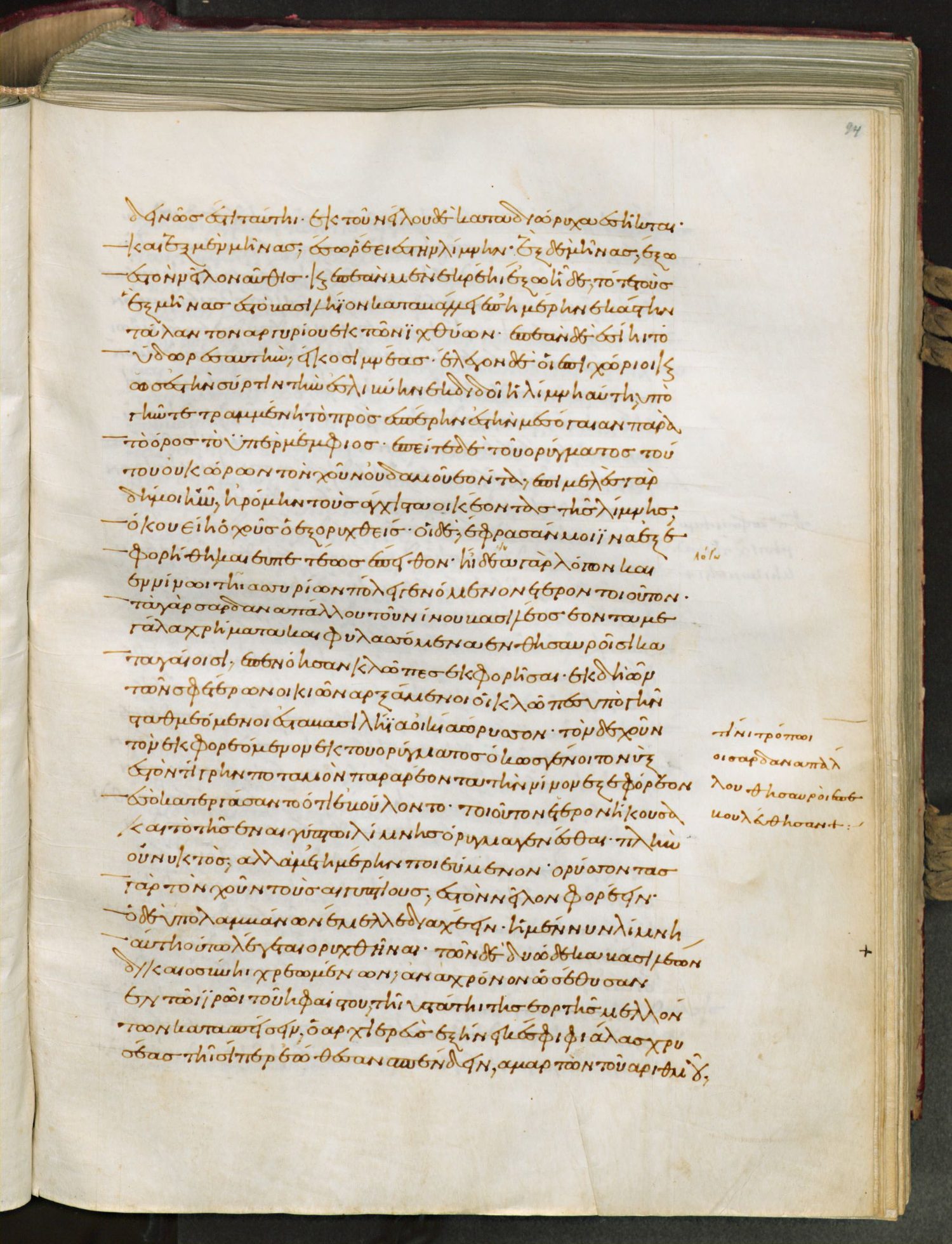
Laur. Plut. 70.3, fol. 94r: Greek here 2.149.4 to 2.150.4. Checked on the image (first and last words read and located in the Greek; each break checked against the neighbouring page): fol. 94r begins ‹δεινῶς ἐστι ἡ ταύτᾐ,› (2.149.4), ends ‹σπένδειν, ἁμαρτὼν τοῦ ἀριθμοῦ› (2.151.1). English here: 2.149.4 to 2.150.4 (Godley's sentences for the sections whose Greek lies mostly on this page).
2.149.4δεινῶς ἐστι ἡ ταύτᾐ, ἐκ τοῦ Νείλου δὲ κατὰ διώρυχα ἐσῆκται, καὶ ἓξ μὲν μῆνας ἔσω ῥέει ἐς τὴν λίμνην, ἓξ δὲ μῆνας ἔξω ἐς τὸν Νεῖλον αὖτις· 2.149.5καὶ ἐπεὰν μὲν ἐκρέῃ ἔξω, ἣ δὲ τότε τοὺς ἓξ μῆνας ἐς τὸ βασιλήιον καταβάλλει ἐπʼ ἡμέρην ἑκάστην τάλαντον ἀργυρίου ἐκ τῶν ἰχθύων, ἐπεὰν δὲ ἐσίῃ τὸ ὓδωρ ἐς αὐτήν, εἴκοσι μνέας. 2.150.1ἔλεγον δὲ οἱ ἐπιχώριοι καὶ ὡς ἐς τὴν Σύρτιν τὴν ἐς Λιβύην ἐκδιδοῖ ἡ λίμνη αὕτη ὑπὸ γῆν, τετραμμένη τὸ πρὸς ἑσπέρην ἐς τὴν μεσόγαιαν παρὰ τὸ ὄρος τὸ ὑπὲρ Μέμφιος. 2.150.2ἐπείτε δὲ τοῦ ὀρύγματος τούτου οὐκ ὥρων τὸν χοῦν οὐδαμοῦ ἐόντα, ἐπιμελὲς γὰρ δή μοι ἦν, εἰρόμην τοὺς ἄγχιστα οἰκέοντας τῆς λίμνης ὅκου εἴη ὁ χοῦς ὁ ἐξορυχθείς. οἳ δὲ ἔφρασάν μοι ἵνα ἐξεφορήθη, καὶ εὐπετέως ἔπειθον· ᾔδεα γὰρ λόγῳ καὶ ἐν Νίνῳ τῇ Ἀσσυρίων πόλι γενόμενον ἕτερον τοιοῦτον. 2.150.3τὰ γὰρ Σαρδαναπάλλου τοῦ Νίνου βασιλέος ἐόντα μεγάλα χρήματα καὶ φυλασσόμενα ἐν θησαυροῖσι καταγαίοισι ἐπενόησαν κλῶπες ἐκφορῆσαι. ἐκ δὴ ὦν τῶν σφετέρων οἰκίων ἀρξάμενοι οἱ κλῶπες ὑπὸ γῆν σταθμεόμενοι ἐς τὰ βασιλήια οἰκία ὤρυσσον, τὸν δὲ χοῦν τὸν ἐκφορεόμενον ἐκ τοῦ ὀρύγματος, ὅκως γένοιτο νύξ, ἐς τὸν Τίγρην ποταμὸν παραρρέοντα τὴν Νίνον ἐξεφόρεον, ἐς ὃ κατεργάσαντο ὅ τι ἐβούλοντο. 2.150.4τοιοῦτον ἕτερον ἤκουσα καὶ κατὰ τὸ τῆς ἐν Αἰγύπτῳ λίμνης ὄρυγμα γενέσθαι, πλὴν οὐ νυκτὸς ἀλλὰ μετʼ ἡμέρην ποιεύμενον· ὀρύσσοντας γὰρ τὸν χοῦν τοὺς Αἰγυπτίους ἐς τὸν Νεῖλον φορέειν· ὁ δὲ ὑπολαμβάνων ἔμελλε διαχέειν. ἡ μέν νυν λίμνη αὕτη οὕτω λέγεται ὀρυχθῆναι·
2.149.4The water of the lake is not natural (for the country here is exceeding waterless) but brought by a channel from the Nile; six months it flows into the lake, and six back into the river. 2.149.5For the six months that it flows from the lake, the daily take of fish brings a silver talent into the royal treasury, and twenty minae for each day of the flow into the lake. 2.150.1Further, the people of the country said that this lake issues by an underground stream into the Libyan Syrtis, and stretches inland towards the west along the mountains that are above Memphis. 2.150.2I could not anywhere see the earth taken from the digging of this lake, and this giving me matter for thought, I asked those who dwelt nearest to the lake where the stuff was that had been dug out. They told me whither it had been carried, and I readily believed them, for I had heard of a like thing happening in the Assyrian city of Ninus. 2.150.3Sardanapallus king of Ninus had great wealth, which he kept in an underground treasury. Certain thieves were minded to carry it off; they reckoned their course and dug an underground way from their own house to the palace, carrying the earth taken out of the dug passage at night to the Tigris, which runs past Ninus, till at length they accomplished their desire. 2.150.4This, I was told, had happened when the Egyptian lake was dug, save only that the work went on not by night but by day. The Egyptians bore the earth dug out by them to the Nile, to be caught and scattered (as was to be thought) by the river. Thus is this lake said to have been dug.
Notes
- Greek: the text printed in A. D. Godley's Loeb edition, via Perseus (tlg0016.tlg001.perseus-grc2). Square brackets mark words the editor considers later additions; [...] marks a gap the editor indicates. Perseus note markers are omitted.
- English: A. D. Godley, Herodotus vol. 1 (1920) (Loeb Classical Library), as transcribed on Wikisource. Godley's footnotes are omitted.
- Section numbers in the English were placed by comparing Godley's text with the Perseus version of his translation; where a section begins inside one of Godley's sentences, the English is kept with the page that holds the start of that sentence.
Cite
Sources
- Source: Florence, Laur. Plut. 70.3 (10th c.) via BML Teca Digitale + Greek of Godley's Loeb (Perseus) + English of A. D. Godley (Loeb, Wikisource) (holding institution)
- Critical edition: Greek of A. D. Godley's Loeb edition (1920-1925), via Perseus
← previous · → next · v cycle view · l back to library