Herodotus, Histories 2.151-169: Psammetichus, Necos, Psammis and Apries
Introduction
Herodotus of Halicarnassus wrote the Histories in the third quarter of the 5th century BCE, an inquiry into the deeds of Greeks and barbarians and the causes of the wars between them, later divided into nine books. Book 2 is Herodotus' account of Egypt, written as background to Cambyses' invasion: the land and the Nile, the customs and religion of the Egyptians, and the history of their kings as the priests told it, down to Amasis.
The photographs are of Florence, Biblioteca Medicea Laurenziana, Plut. 70.3 (parchment, 10th century, 374 folios, 31 lines a page), Herodotus, Histories (codex A of the editors), the oldest surviving manuscript of the complete Histories, from the Teca Digitale of the Biblioteca Medicea Laurenziana. Each section below is the text of one page, or of the part of a page that falls within these chapters. The first and last words of every page were read on the photograph and located in the Greek, and every page break was checked against the next page; the notes quote these words. Readers' notes in the margins are not part of the text and are mentioned where they occur.
The Greek is the text printed in A. D. Godley's Loeb edition (1920-1925), from Perseus; it is the edited text, not a transcription of the manuscript, whose wording differs in places. The English is Godley's translation as printed, from Wikisource. Godley's English carries only chapter numbers; the section numbers shown in it were placed by comparison with the Perseus version of his translation. Each page's English is cut at the end of one of Godley's sentences, so it can begin or end a few lines away from the Greek of the page; each note gives the exact ranges.
This entry covers chapters 2.151-169, on fol. 94r to 99r.
How was this verified? (Provenance)
Where on the image
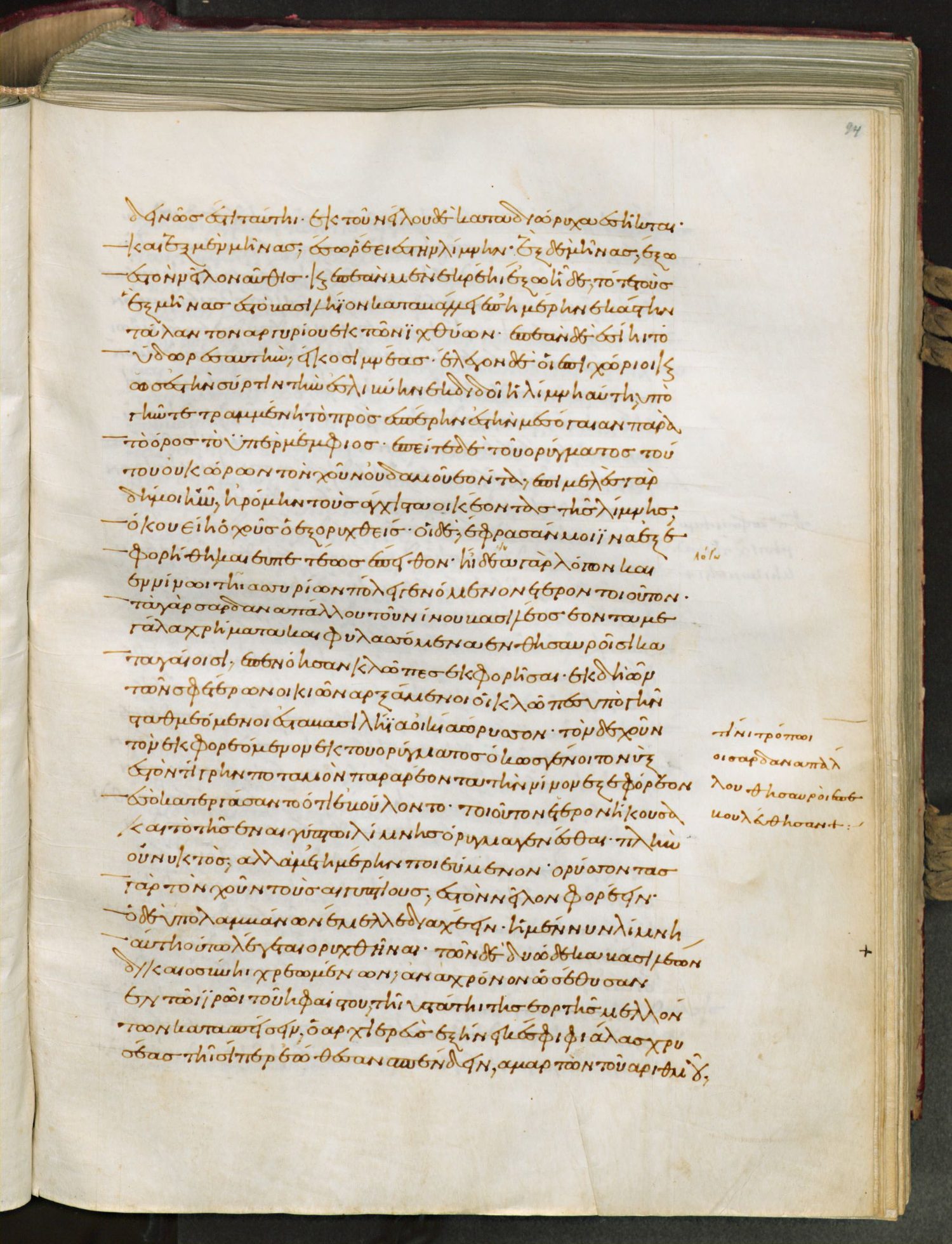
Laur. Plut. 70.3, fol. 94r: Greek here 2.151.1. Checked on the image (first and last words read and located in the Greek; each break checked against the neighbouring page): fol. 94r begins ‹δεινῶς ἐστι ἡ ταύτᾐ,› (2.149.4), ends ‹σπένδειν, ἁμαρτὼν τοῦ ἀριθμοῦ› (2.151.1). English here: 2.151.1 (Godley's sentences for the sections whose Greek lies mostly on this page).
2.151.1τῶν δὲ δυώδεκα βασιλέων δικαιοσύνῃ χρεωμένων, ἀνὰ χρόνον ὡς ἔθυσαν ἐν τῷ ἱρῷ τοῦ Ἡφαίστου, τῇ ὑστάτῃ τῆς ὁρτῆς, μελλόντων κατασπείσειν, ὁ ἀρχιερεὺς ἐξήνεικέ σφι φιάλας χρυσέας, τῇσί περ ἐώθεσαν σπένδειν, ἁμαρτὼν τοῦ ἀριθμοῦ,
2.151.1Now the twelve kings dealt justly; and as time went on they came to sacrifice in Hephaestus’ temple. On the last day of the feast, they being about to pour libations, the high priest brought out the golden vessels which they commonly used for this; but he counted wrongly and gave the twelve only eleven.
Where on the image
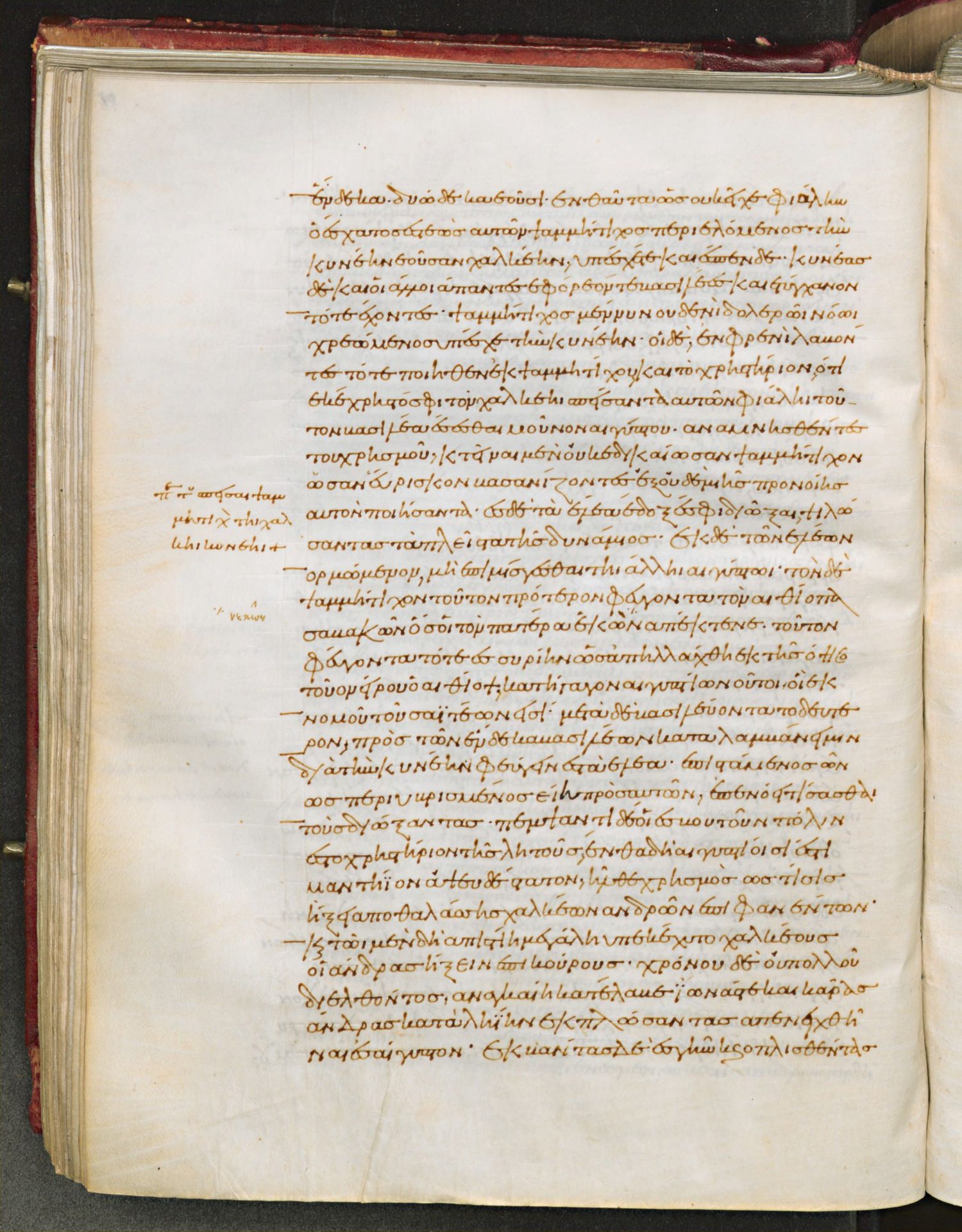
Laur. Plut. 70.3, fol. 94v: Greek here 2.151.1 to 2.152.4. Checked on the image (first and last words read and located in the Greek; each break checked against the neighbouring page): fol. 94v begins ‹ἕνδεκα δυώδεκα ἐοῦσι.ἐνθαῦτα ὡς› (2.151.1), ends ‹ἐς γῆν καὶ ὁπλισθέντας› (2.152.4). English here: 2.151.2 to 2.152.4 (Godley's sentences for the sections whose Greek lies mostly on this page).
2.151.1ἕνδεκα δυώδεκα ἐοῦσι. 2.151.2ἐνθαῦτα ὡς οὐκ εἶχε φιάλην ὁ ἔσχατος ἑστεὼς αὐτῶν Ψαμμήτιχος, περιελόμενος τὴν κυνέην ἐοῦσαν χαλκέην ὑπέσχε τε καὶ ἔσπενδε. κυνέας δὲ καὶ οἱ ἄλλοι ἅπαντες ἐφόρεόν τε βασιλέες καὶ ἐτύγχανον τότε ἔχοντες. 2.151.3Ψαμμήτιχος μέν νυν οὐδενὶ δολερῷ νόῳ χρεώμενος ὑπέσχε τὴν κυνέην· οἳ δὲ ἐν φρενὶ λαβόντες τό τε ποιηθὲν ἐκ Ψαμμητίχου καὶ τὸ χρηστήριον, ὅτι ἐκέχρηστό σφι τὸν χαλκέῃ σπείσαντα αὐτῶν φιάλῃ τοῦτον βασιλέα ἔσεσθαι μοῦνον Αἰγύπτου, ἀναμνησθέντες τοῦ χρησμοῦ κτεῖναι μὲν οὐκ ἐδικαίωσαν Ψαμμήτιχον, ὡς ἀνεύρισκον βασανίζοντες ἐξ οὐδεμιῆς προνοίης αὐτὸν ποιήσαντα, ἐς δὲ τὰ ἕλεα ἔδοξέ σφι διῶξαι ψιλώσαντας τὰ πλεῖστα τῆς δυνάμιος, ἐκ δὲ τῶν ἑλέων ὁρμώμενον μὴ ἐπιμίσγεσθαι τῇ ἄλλῃ Αἰγύπτῳ. 2.152.1τὸν δὲ Ψαμμήτιχον τοῦτον πρότερον φεύγοντα τὸν Αἰθίοπα Σαβακῶν, ὅς οἱ τὸν πατέρα Νεκῶν ἀπέκτεινε, τοῦτον φεύγοντα τότε ἐς Συρίην, ὡς ἀπαλλάχθη ἐκ τῆς ὄψιος τοῦ ὀνείρου ὁ Αἰθίοψ, κατήγαγον Αἰγυπτίων οὗτοι οἳ ἐκ νομοῦ τοῦ Σαΐτεω εἰσί. 2.152.2μετὰ δὲ βασιλεύοντα τὸ δεύτερον πρὸς τῶν ἕνδεκα βασιλέων καταλαμβάνει μιν διὰ τὴν κυνέην φεύγειν ἐς τὰ ἕλεα. 2.152.3ἐπιστάμενος ὦν ὡς περιυβρισμένος εἴη πρὸς αὐτῶν, ἐπενόεε τίσασθαι τοὺς διώξαντας. πέμψαντι δέ οἱ ἐς Βουτοῦν πόλιν ἐς τὸ χρηστήριον τῆς Λητοῦς, ἔνθα δὴ Αἰγυπτίοισι ἐστὶ μαντήιον ἀψευδέστατον, ἦλθε χρησμὸς ὡς τίσις ἥξει ἀπὸ θαλάσσης χαλκέων ἀνδρῶν ἐπιφανέντων. 2.152.4καὶ τῷ μὲν δὴ ἀπιστίη μεγάλη ὑπεκέχυτο χαλκέους οἱ ἄνδρας ἥξειν ἐπικούρους. χρόνου δὲ οὐ πολλοῦ διελθόντος ἀναγκαίη κατέλαβε Ἴωνάς τε καὶ Κᾶρας ἄνδρας κατὰ ληίην ἐκπλώσαντας ἀπενειχθῆναι ἐς Αἴγυπτον, ἐκβάντας δὲ ἐς γῆν καὶ ὁπλισθέντας
2.151.2So he who stood last of them, Psammetichus, got no vessel; wherefore taking off his bronze helmet he held it out and poured the libation with it. All the other kings too were wont to wear helmets, and were then helmeted; 2.151.3it was not in guile, then, that Psammetichus held out his headgear; but the rest marked Psammetichus’ deed, and remembered the oracle which promised the sovereignty of all Egypt to whosoever should pour libation from a vessel of bronze; wherefore, though they deemed Psammetichus not to deserve death (for they proved him and found that he had acted without intent), they resolved to strip him of the most of his power and chase him away into the marshes, and that he was not to concern himself with the rest of Egypt. 2.152.1This Psammetichus had formerly been in Syria, whither he had fled from Sabacos the Ethiopian, who killed his father Necos; then, when the Ethiopian departed by reason of what he saw in a dream, the Egyptians of the province of Sais brought him back from Syria; and now 2.152.2Psammetichus was for the second time king, when it happened to him to be driven away into the marshes by the eleven kings by reason of the matter of the helmet. 2.152.3Therefore he held himself to have been outrageously dealt with by them and had a mind to be avenged on those who had expelled him, and he sent to inquire of the oracle of Leto in the town of Buto, which is the most infallible in Egypt; the oracle answered that he should have vengeance when he saw men of bronze coming from the sea. 2.152.4Psammetichus secretly disbelieved that men of bronze would come to aid him. But after no long time, certain Ionians and Carians, voyaging for plunder, were forced to put in on the coast of Egypt, where they disembarked in their mail of bronze; and an Egyptian came into the marsh country and brought news to Psammetichus (for he had never before seen mailed men) that men of bronze were come from the sea and were foraging in the plain.
Where on the image
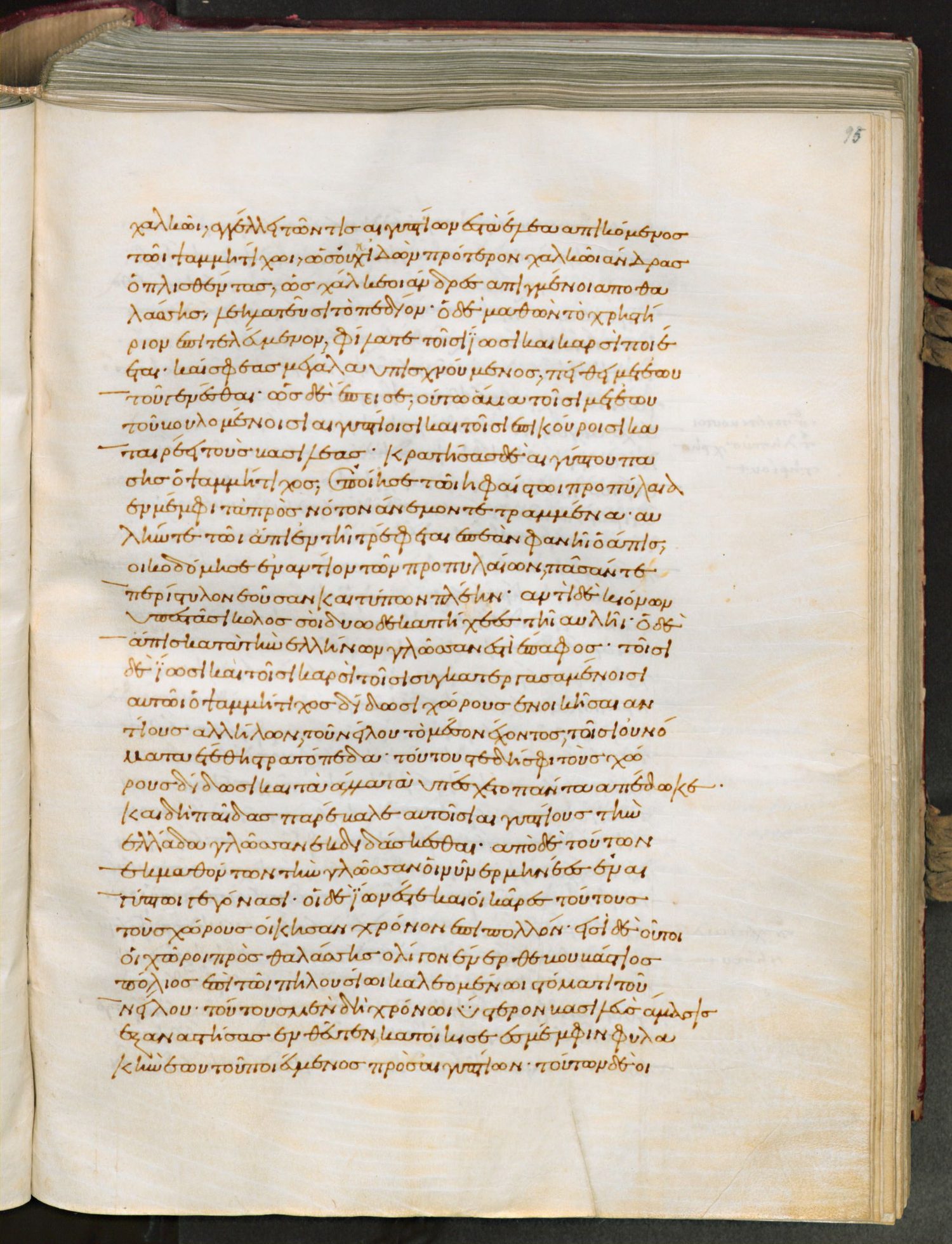
Laur. Plut. 70.3, fol. 95r: Greek here 2.152.4 to 2.154.4. Checked on the image (first and last words read and located in the Greek; each break checked against the neighbouring page): fol. 95r begins ‹χαλκῷ ἀγγέλλει τῶν τις› (2.152.4), ends ‹πρὸς Αἰγυπτίων.τούτων δὲ οἰ-› (2.154.4). English here: 2.152.5 to 2.154.3 (Godley's sentences for the sections whose Greek lies mostly on this page).
2.152.4χαλκῷ ἀγγέλλει τῶν τις Αἰγυπτίων ἐς τὰ ἕλεα ἀπικόμενος τῷ Ψαμμητίχῳ, ὡς οὐκ ἰδὼν πρότερον χαλκῷ ἄνδρας ὁπλισθέντας, ὡς χάλκεοι ἄνδρες ἀπιγμένοι ἀπὸ θαλάσσης λεηλατεῦσι τὸ πεδίον. 2.152.5ὁ δὲ μαθὼν τὸ χρηστήριον ἐπιτελεύμενον φίλα τε τοῖσι Ἴωσι καὶ Καρσὶ ποιέεται καί σφεας μεγάλα ὑπισχνεύμενος πείθει μετʼ ἑωυτοῦ γενέσθαι. ὡς δὲ ἔπεισε, οὕτω ἅμα τοῖσι τὰ ἑωυτοῦ βουλομένοισι Αἰγυπτίοισι καὶ τοῖσι ἐπικούροισι καταιρέει τοὺς βασιλέας. 2.153.1κρατήσας δὲ Αἰγύπτου πάσης ὁ Ψαμμήτιχος ἐποίησε τῷ Ἡφαίστῳ προπύλαια ἐν Μέμφι τὰ πρὸς νότον ἄνεμον τετραμμένα, αὐλήν τε τῷ Ἄπι, ἐν τῇ τρέφεται ἐπεὰν φανῇ ὁ Ἆπις, οἰκοδόμησε ἐναντίον τῶν προπυλαίων, πᾶσάν τε περίστυλον ἐοῦσαν καὶ τύπων πλέην· ἀντὶ δὲ κιόνων ὑπεστᾶσι κολοσσοὶ δυωδεκαπήχεες τῇ αὐλῇ. ὁ δὲ Ἆπις κατὰ τὴν Ἑλλήνων γλῶσσαν ἐστὶ Ἔπαφος. 2.154.1τοῖσι δὲ Ἴωσι καὶ τοῖσι Καρσὶ τοῖσι συγκατεργασαμένοισι αὐτῷ ὁ Ψαμμήτιχος δίδωσι χώρους ἐνοικῆσαι ἀντίους ἀλλήλων, τοῦ Νείλου τὸ μέσον ἔχοντος, τοῖσι οὐνόματα ἐτέθη Στρατόπεδα· τούτους τε δή σφι τοὺς χώρους δίδωσι καὶ τὰ ἄλλα τὰ ὑπέσχετο πάντα ἀπέδωκε. 2.154.2καὶ δὴ καὶ παῖδας παρέβαλε αὐτοῖσι Αἰγυπτίους τὴν Ἑλλάδα γλῶσσαν ἐκδιδάσκεσθαι. ἀπὸ δὲ τούτων ἐκμαθόντων τὴν γλῶσσαν οἱ νῦν ἑρμηνέες ἐν Αἰγύπτῳ γεγόνασι. 2.154.3οἱ δὲ Ἴωνές τε καὶ οἱ Κᾶρες τούτους τοὺς χώρους οἴκησαν χρόνον ἐπὶ πολλόν· εἰσὶ δὲ οὗτοι οἱ χῶροι πρὸς θαλάσσης ὀλίγον ἔνερθε Βουβάστιος πόλιος, ἐπὶ τῷ Πηλουσίῳ καλεομένῳ στόματι τοῦ Νείλου. τούτους μὲν δὴ χρόνῳ ὕστερον βασιλεὺς Ἄμασις ἐξαναστήσας ἐνθεῦτεν κατοίκισε ἐς Μέμφιν, φυλακὴν ἑωυτοῦ ποιεύμενος πρὸς Αἰγυπτίων. 2.154.4τούτων δὲ οἰκισθέντων
2.152.5Psammetichus saw in this the fulfilment of the oracle; he made friends with the Ionians and Carians, and promised them great rewards if they would join him, and having won them, with the aid of such Egyptians as consented and these allies he deposed the eleven kings. 2.153.1Having made himself master of all Egypt, he made the southern outercourt of Hephaestus’ temple at Memphis, and built over against this a court for Apis, where Apis is kept and fed whenever he appears; this court has an inner colonnade all round it and many carved figures; the roof is held up by great statues twelve cubits high for pillars. Apis is in the Greek language Epaphus. 2.154.1The Ionians and Carians who had helped him to conquer were given by Psammetichus places to dwell in called The Camps, opposite to each other on either side of the Nile; and besides this he paid them all that he had promised. 2.154.2Moreover he put Egyptian boys in their hands to be taught the Greek tongue; these, learning Greek, were the ancestors of the Egyptian interpreters. 2.154.3The Ionians and Carians dwelt a long time in these places, which are near the sea, on the arm of the Nile called the Pelusian, a little way below the town of Bubastis. Long afterwards, king Amasis removed them thence and settled them at Memphis, to be his guard against the Egyptians.
Where on the image
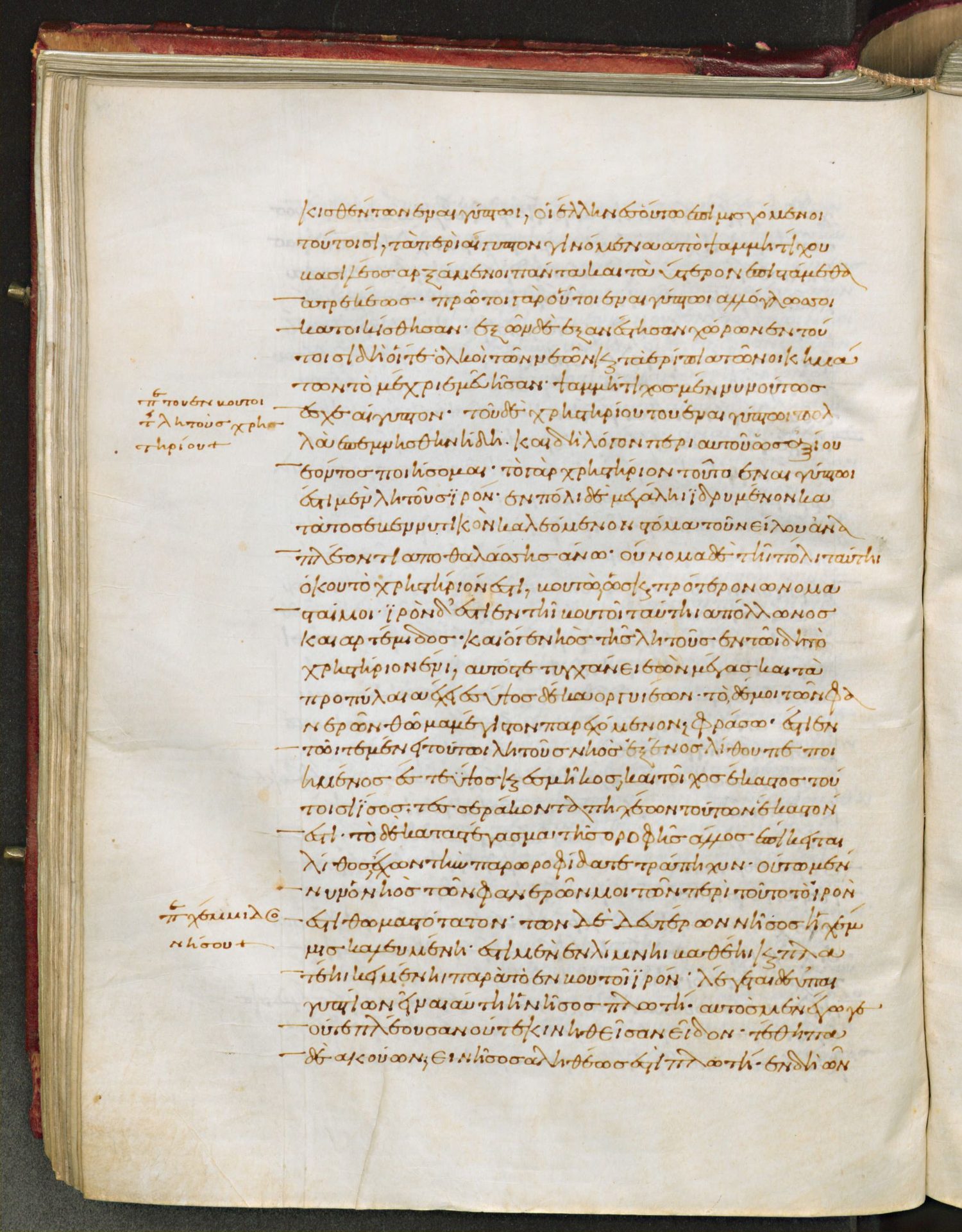
Laur. Plut. 70.3, fol. 95v: Greek here 2.154.4 to 2.156.3. Checked on the image (first and last words read and located in the Greek; each break checked against the neighbouring page): fol. 95v begins ‹-κισθέντων ἐν Αἰγύπτῳ, οἱ› (2.154.4), ends ‹ἐστὶ πλωτή.ἐν δὲ ὦν› (2.156.3). The word ‹οἰκισθέντων› is divided between fol. 95r and fol. 95v; it is given with fol. 95r. English here: 2.154.4 to 2.156.2 (Godley's sentences for the sections whose Greek lies mostly on this page).
2.154.4ἐν Αἰγύπτῳ, οἱ Ἕλληνες οὕτω ἐπιμισγόμενοι τούτοισι τὰ περὶ Αἴγυπτον γινόμενα ἀπὸ Ψαμμητίχου βασιλέος ἀρξάμενοι πάντα καὶ τὰ ὕστερον ἐπιστάμεθα ἀτρεκέως· πρῶτοι γὰρ οὗτοι ἐν Αἰγύπτῳ ἀλλόγλωσσοι κατοικίσθησαν. 2.154.5ἐξ ὧν δὲ ἐξανέστησαν χώρων, ἐν τούτοισι δὲ οἵ τε ὁλκοὶ τῶν νεῶν καὶ τὰ ἐρείπια τῶν οἰκημάτων τὸ μέχρι ἐμεῦ ἦσαν. 2.155.1Ψαμμήτιχος μέν νυν οὕτω ἔσχε Αἴγυπτον. τοῦ δὲ χρηστηρίου τοῦ ἐν Αἰγύπτῳ πολλὰ ἐπεμνήσθην ἤδη, καὶ δὴ λόγον περὶ αὐτοῦ ὡς ἀξίου ἐόντος ποιήσομαι. τὸ γὰρ χρηστήριον τοῦτο τὸ ἐν Αἰγύπτῳ ἐστὶ μὲν Λητοῦς ἱρόν, ἐν πόλι δὲ μεγάλῃ ἱδρυμένον κατὰ τὸ Σεβεννυτικὸν καλεόμενον στόμα τοῦ Νείλου, ἀναπλέοντι ἀπὸ θαλάσσης ἄνω. 2.155.2οὔνομα δὲ τῇ πόλι ταύτῃ ὅκου τὸ χρηστήριον ἐστὶ Βουτώ, ὡς καὶ πρότερον ὠνόμασταί μοι. ἱρὸν δὲ ἐστὶ ἐν τῇ Βουτοῖ ταύτῃ Ἀπόλλωνος καὶ Ἀρτέμιδος, καὶ ὅ γε νηὸς τῆς Λητοῦς, ἐν τῷ δὴ τὸ χρηστήριον ἔνι, αὐτός τε τυγχάνει ἐὼν μέγας καὶ τὰ προπύλαια ἔχει ἐς ὕψος δέκα ὀργυιέων. 2.155.3τὸ δέ μοι τῶν φανερῶν ἦν θῶμα μέγιστον παρεχόμενον, φράσω· ἔστι ἐν τῷ τεμένεϊ τούτῳ Λητοῦς νηὸς ἐξ ἑνὸς λίθου πεποιημένος ἔς τε ὕψος καὶ ἐς μῆκος καὶ τοῖχος ἕκαστος τούτοισι ἴσος τεσσεράκοντα πηχέων τούτων ἕκαστον ἐστί, τὸ δὲ καταστέγασμα τῆς ὀροφῆς ἄλλος ἐπίκειται λίθος, ἔχων τὴν παρωροφίδα τετράπηχυν. 2.156.1οὕτω μέν νυν ὁ νηὸς τῶν φανερῶν μοι τῶν περὶ τοῦτο τὸ ἱρὸν ἐστὶ θωμαστότατον, τῶν δὲ δευτέρων νῆσος ἡ Χέμμις καλευμένη· 2.156.2ἔστι μὲν ἐν λίμνῃ βαθέῃ καὶ πλατέῃ κειμένη παρὰ τὸ ἐν Βουτοῖ ἱρόν, λέγεται δὲ ὑπʼ Αἰγυπτίων εἶναι αὕτη ἡ νῆσος πλωτή. αὐτὸς μὲν ἔγωγε οὔτε πλέουσαν οὔτε κινηθεῖσαν εἶδον, τέθηπα δὲ ἀκούων εἰ νῆσος ἀληθέως ἐστὶ πλωτή. 2.156.3ἐν δὲ ὦν
2.154.4It comes of our intercourse with these settlers in Egypt (who were the first men of alien speech to settle in that country) that we Greeks have exact knowledge of the history of Egypt from the reign of Psammetichus onwards. 2.154.5There still remained till my time, in the places whence the Ionians and Carians were removed, the landing engines of their ships and the ruins of their houses. 2.155.1This is the story of Psammetichus’ conquest of Egypt. I have often made mention of the Egyptian oracle, and I will now treat fully of it, for this it deserves. This Egyptian oracle is in a temple sacred to Leto, and is situated in a great city by the Sebennytic arm of the Nile, on the way up from the sea. 2.155.2The name of the city where is this oracle is Buto; I have already named it. In Buto there is a temple of Apollo and Artemis. The shrine of Leto in which is the oracle is itself very great, and its outer court is ten fathoms high. 2.155.3But I will now tell of what was the most marvellous among things visible there: in this precinct is the shrine of Leto, whereof the height and length of the walls is all made of a single stone slab each wall has an equal length and height, namely, forty cubits. Another slab makes the surface of the roof, the cornice of which is four cubits broad. 2.156.1Thus then the shrine is the most marvellous of all things that I saw in this temple but of things of lesser note, the most wondrous is the island called Chemmis. 2.156.2This lies in a deep and wide lake near to the temple at Buto, and the Egyptians say that it floats. For myself I never saw it float, nor move at all, and I thought it a marvellous tale, that an island should truly float.
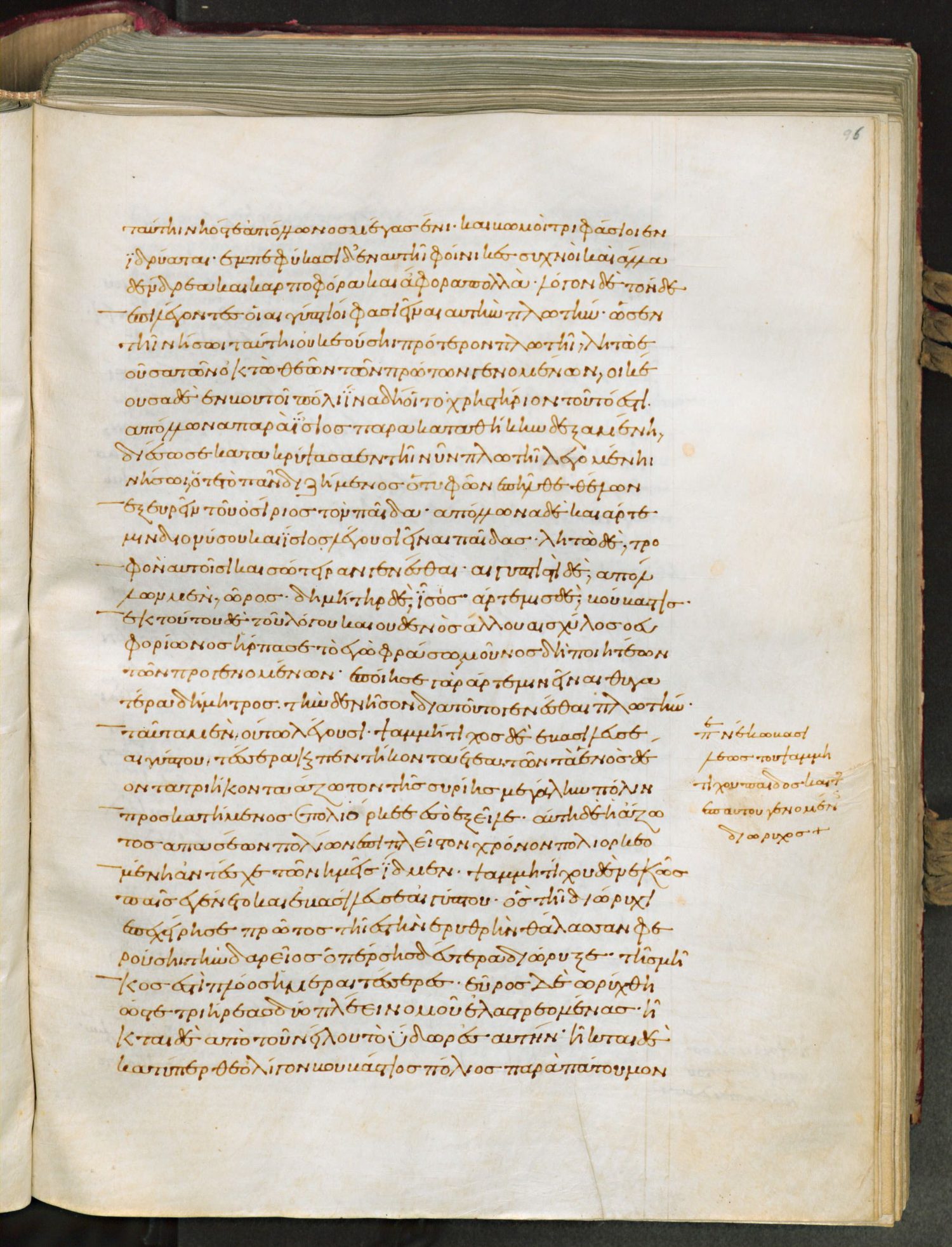
Where on the image
Laur. Plut. 70.3, fol. 96r: Greek here 2.156.3 to 2.158.2. Checked on the image (first and last words read and located in the Greek; each break checked against the neighbouring page): fol. 96r begins ‹ταύτῃ νηός τε Ἀπόλλωνος› (2.156.3), ends ‹Βουβάστιος πόλιος παρὰ Πάτουμον› (2.158.2). English here: 2.156.3 to 2.158.1 (Godley's sentences for the sections whose Greek lies mostly on this page).
2.156.3ταύτῃ νηός τε Ἀπόλλωνος μέγας ἔνι καὶ βωμοὶ τριφάσιοι ἐνιδρύαται, ἐμπεφύκασι δʼ ἐν αὐτῇ φοίνικες συχνοὶ καὶ ἄλλα δένδρεα καὶ καρποφόρα καὶ ἄφορα πολλά. 2.156.4λόγον δὲ τόνδε ἐπιλέγοντες οἱ Αἰγύπτιοι φασὶ εἶναι αὐτὴν πλωτήν, ὡς ἐν τῇ νήσῳ ταύτῃ οὐκ ἐούσῃ πρότερον πλωτῇ Λητώ, ἐοῦσα τῶν ὀκτὼ θεῶν τῶν πρώτων γενομένων, οἰκέουσα δὲ ἐν Βουτοῖ πόλι, ἵνα δή οἱ τὸ χρηστήριον τοῦτο ἐστί, Ἀπόλλωνα παρʼ Ἴσιος παρακαταθήκην δεξαμένη διέσωσε κατακρύψασα ἐν τῇ νῦν πλωτῇ λεγομένῃ νήσῳ, ὅτε τὸ πᾶν διζήμενος ὁ Τυφῶν ἐπῆλθε, θέλων ἐξευρεῖν τοῦ Ὀσίριος τὸν παῖδα. 2.156.5Ἀπόλλωνα δὲ καὶ Ἄρτεμιν Διονύσου καὶ Ἴσιος λέγουσι εἶναι παῖδας, Λητοῦν δὲ τροφὸν αὐτοῖσι καὶ σώτειραν γενέσθαι. Αἰγυπτιστὶ δὲ Ἀπόλλων μὲν Ὦρος, Δημήτηρ δὲ Ἶσις, Ἄρτεμις δὲ Βούβαστις. 2.156.6ἐκ τούτου δὲ τοῦ λόγου καὶ οὐδενὸς ἄλλου Αἰσχύλος ὁ Εὐφορίωνος ἥρπασε τὸ ἐγὼ φράσω, μοῦνος δὴ ποιητέων τῶν προγενομένων· ἐποίησε γὰρ Ἄρτεμιν εἶναι θυγατέρα Δήμητρος. τὴν δὲ νῆσον διὰ τοῦτο γενέσθαι πλωτήν. ταῦτα μὲν οὕτω λέγουσι. 2.157.1Ψαμμήτιχος δὲ ἐβασίλευσε Αἰγύπτου τέσσερα καὶ πεντήκοντα ἔτεα, τῶν τὰ ἑνὸς δέοντα τριήκοντα Ἄζωτον τῆς Συρίης μεγάλην πόλιν προσκατήμενος ἐπολιόρκεε, ἐς ὃ ἐξεῖλε. αὕτη δὲ ἡ Ἄζωτος ἁπασέων πολίων ἐπὶ πλεῖστον χρόνον πολιορκεομένη ἀντέσχε τῶν ἡμεῖς ἴδμεν. 2.158.1Ψαμμητίχου δὲ Νεκῶς παῖς ἐγένετο καὶ ἐβασίλευσε Αἰγύπτου, ὃς τῇ διώρυχι ἐπεχείρησε πρῶτος τῇ ἐς τὴν Ἐρυθρὴν θάλασσαν φερούσῃ, τὴν Δαρεῖος ὁ Πέρσης δεύτερα διώρυξε· τῆς μῆκος ἐστὶ πλόος ἡμέραι τέσσερες, εὖρος δὲ ὠρύχθη ὥστε τριήρεας δύο πλέειν ὁμοῦ ἐλαστρευμένας. 2.158.2ἦκται δὲ ἀπὸ τοῦ Νείλου τὸ ὕδωρ ἐς αὐτήν· ἦκται δὲ κατύπερθε ὀλίγον Βουβάστιος πόλιος παρὰ Πάτουμον
2.156.3However that be, there is a great shrine of Apollo thereon, and three altars stand there; many palm trees grow in the island, and other trees too, some yielding fruit and some not. 2.156.4The story told by the Egyptians to show why the island moves is this: when Typhon came seeking through the world for the son of Osiris, Leto, being one of the eight earliest gods, and dwelling in Buto where this oracle of hers is, received Apollo in charge from Isis and hid him for safety in this island which was before immovable but is now said to float. 2.156.5Apollo and Artemis were (they say) children of Dionysus and Isis, and Leto was made their nurse and preserver; in Egyptian, Apollo is Horus, Demeter Isis, Artemis Bubastis. 2.156.6It was from this and no other legend that Aeschylus son of Euphorion stole an imagination, which is in no other poet, that Artemis was the daughter of Demeter. For the aforesaid reason (say the Egyptians) the island was made to float Such is the tale. 2.157.1Psammetichus ruled Egypt for fifty-four years; for twenty-nine of these he sat before Azotus, a great city in Syria, and besieged it till he took it. Azotus held out against a siege longer than any city of which I have heard. 2.158.1Psammetichus had a son Necos, who became king of Egypt. It was he who began the making of the canal into the Red Sea, which was finished by Darius the Persian. This is four days’ voyage in length, and it was dug wide enough for two triremes to move in it rowed abreast.
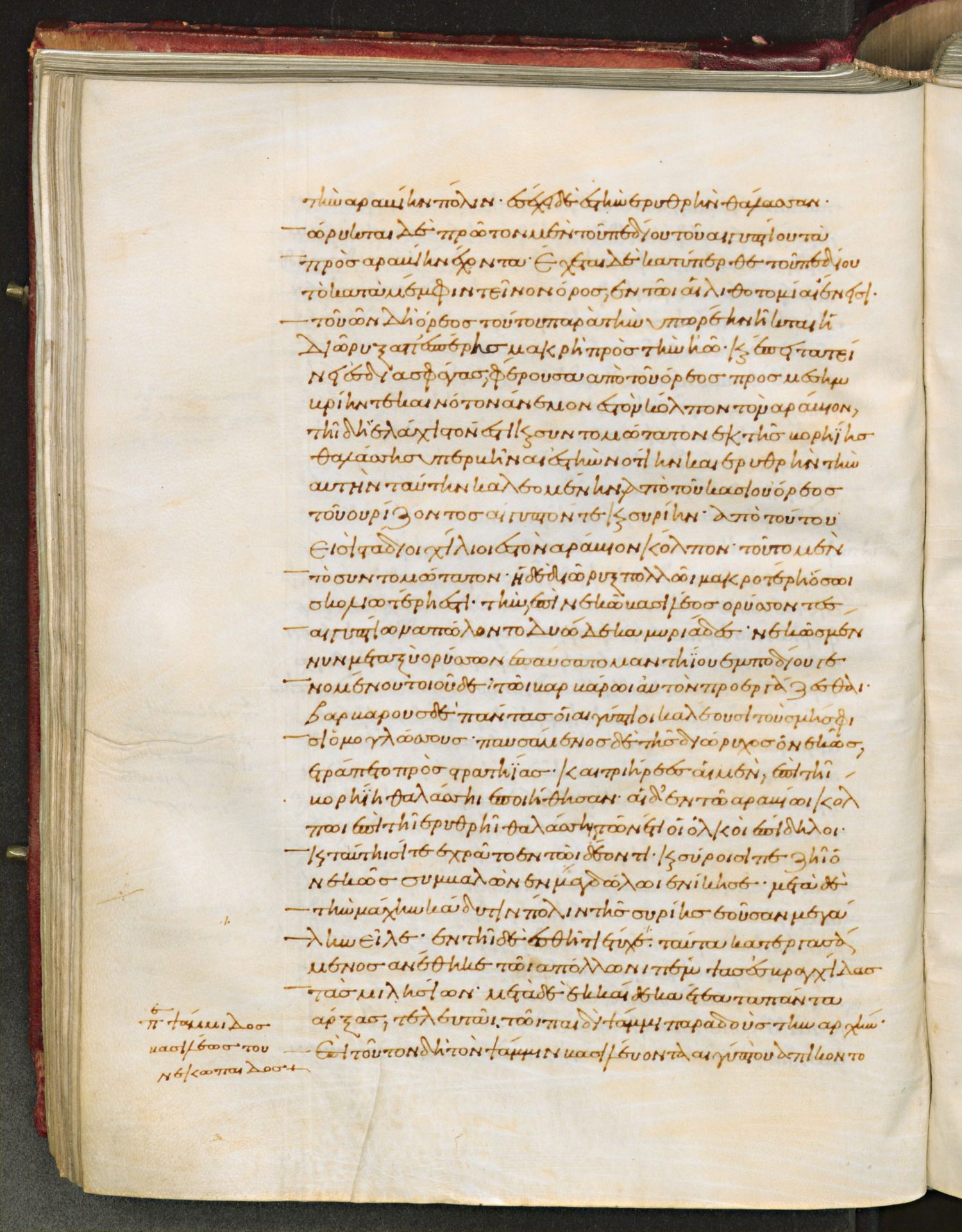
Where on the image
Laur. Plut. 70.3, fol. 96v: Greek here 2.158.2 to 2.160.1. Checked on the image (first and last words read and located in the Greek; each break checked against the neighbouring page): fol. 96v begins ‹τὴν Ἀραβίην πόλιν, ἐσέχει› (2.158.2), ends ‹Ψάμμιν βασιλεύοντα Αἰγύπτου ἀπίκοντο› (2.160.1). English here: 2.158.2 to 2.159.3 (Godley's sentences for the sections whose Greek lies mostly on this page).
2.158.2τὴν Ἀραβίην πόλιν, ἐσέχει δὲ ἐς τὴν Ἐρυθρὴν θάλασσαν. ὀρώρυκται δὲ πρῶτον μὲν τοῦ πεδίου τοῦ Αἰγυπτίου τὰ πρὸς Ἀραβίην ἔχοντα· ἔχεται δὲ κατύπερθε τοῦ πεδίου τὸ κατὰ Μέμφιν τεῖνον ὄρος, ἐν τῷ αἱ λιθοτομίαι ἔνεισι· 2.158.3τοῦ ὦν δὴ ὄρεος τούτου παρὰ τὴν ὑπώρεαν ἦκται ἡ διῶρυξ ἀπʼ ἑσπέρης μακρὴ πρὸς τὴν ἠῶ, καὶ ἔπειτα τείνει ἐς διασφάγας, φέρουσα ἀπὸ τοῦ ὄρεος πρὸς μεσαμβρίην τε καὶ νότον ἄνεμον ἐς τὸν κόλπον τὸν Ἀράβιον. 2.158.4τῇ δὲ ἐλάχιστον ἐστὶ καὶ συντομώτατον ἐκ τῆς βορηίης θαλάσσης ὑπερβῆναι ἐς τὴν νοτίην καὶ Ἐρυθρὴν τὴν αὐτὴν ταύτην καλεομένην, ἀπὸ τοῦ Κασίου ὄρεος τοῦ οὐρίζοντος Αἴγυπτόν τε καὶ Συρίην, ἀπὸ τούτου εἰσὶ στάδιοι ἀπαρτὶ χίλιοι ἐς τὸν Ἀράβιον κόλπον. 2.158.5τοῦτο μὲν τὸ συντομώτατον, ἡ δὲ διῶρυξ πολλῷ μακροτέρη, ὅσῳ σκολιωτέρη ἐστί· τὴν ἐπὶ Νεκῶ βασιλέος ὀρύσσοντες Αἰγυπτίων ἀπώλοντο δυώδεκα μυριάδες. Νεκῶς μέν νυν μεταξὺ ὀρύσσων ἐπαύσατο μαντηίου ἐμποδίου γενομένου τοιοῦδε, τῷ βαρβάρῳ αὐτὸν προεργάζεσθαι. βαρβάρους δὲ πάντας οἱ Αἰγύπτιοι καλέουσι τοὺς μὴ σφίσι ὁμογλώσσους. 2.159.1παυσάμενος δὲ τῆς διώρυχος ὁ Νεκῶς ἐτράπετο πρὸς στρατηίας, καὶ τριήρεες αἳ μὲν ἐπὶ τῇ βορηίῃ θαλάσσῃ ἐποιήθησαν, αἳ δʼ ἐν τῷ Ἀραβίῳ κόλπῳ ἐπὶ τῇ Ἐρυθρῇ θαλάσσῃ, τῶν ἔτι οἱ ὁλκοὶ ἐπίδηλοι. 2.159.2καὶ ταύτῃσί τε ἐχρᾶτο ἐν τῷ δέοντι καὶ Σύροισι πεζῇ ὁ Νεκῶς συμβαλὼν ἐν Μαγδώλῳ ἐνίκησε, μετὰ δὲ τὴν μάχην Κάδυτιν πόλιν τῆς Συρίης ἐοῦσαν μεγάλην εἷλε. 2.159.3ἐν τῇ δὲ ἐσθῆτι ἔτυχε ταῦτα κατεργασάμενος, ἀνέθηκε τῷ Ἀπόλλωνι πέμψας ἐς Βραγχίδας τὰς Μιλησίων. μετὰ δέ, ἑκκαίδεκα ἔτεα τὰ πάντα ἄρξας, τελευτᾷ, τῷ παιδὶ Ψάμμι παραδοὺς τὴν ἀρχήν. 2.160.1ἐπὶ τοῦτον δὴ τὸν Ψάμμιν βασιλεύοντα Αἰγύπτου ἀπίκοντο
2.158.2It is fed by the Nile, and is carried from a little above Bubastis by the Arabian town of Patumus; it issues into the Red Sea. The beginning of the digging was in the part of the Egyptian plain which is nearest to Arabia; the mountains that extend to Memphis (in which mountains are the stone quarries) come close to this plain; 2.158.3the canal is led along the lower slope of these mountains in a long reach from west to east; passing then into a ravine it bears southward out of the hill country towards the Arabian Gulf. 2.158.4Now the shortest and most direct passage from the northern to the southern or Red Sea is from the Casian promontory, which is the boundary between Egypt and Syria, to the Arabian Gulf, and this is a distance of one thousand furlongs, neither more nor less; 2.158.5this is the most direct way, but the canal is by much longer, inasmuch as it is more crooked. In Necos’ reign a hundred and twenty thousand Egyptians perished in the digging of it. During the course of excavations, Necos ceased from the work, being stayed by a prophetic utterance that he was toiling beforehand for the barbarian. The Egyptians call all men of other languages barbarians. 2.159.1Necos then ceased from making the canal and engaged rather in warlike preparation; some of his ships of war were built on the northern sea, and some in the Arabian Gulf, by the Red Sea coast: the landing-engines of these are still to be seen. 2.159.2He used these ships at need, and with his land army met and defeated the Syrians at Magdolus, taking the great Syrian city of Cadytis after the battle. 2.159.3He sent to Branchidae of Miletus and dedicated there to Apollo the garments in which he won these victories. Presently he died after a reign of sixteen years, and his son Psammis reigned in his stead.
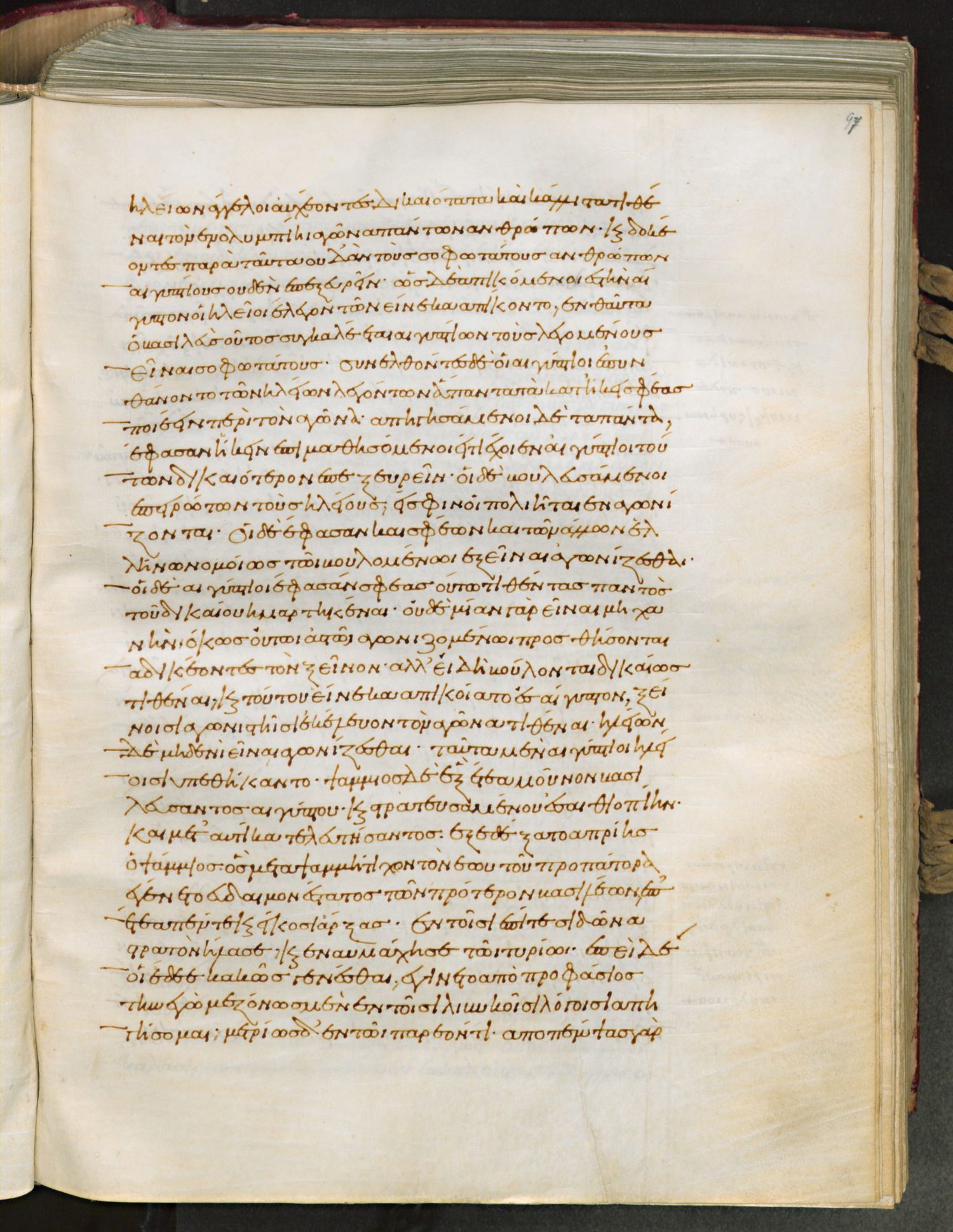
Where on the image
Laur. Plut. 70.3, fol. 97r: Greek here 2.160.1 to 2.161.4. Checked on the image (first and last words read and located in the Greek; each break checked against the neighbouring page): fol. 97r begins ‹Ἠλείων ἄγγελοι, αὐχέοντες δικαιότατα› (2.160.1), ends ‹ἐν τῷ παρεόντι.ἀποπέμψας γὰρ› (2.161.4). English here: 2.160.1 to 2.161.3 (Godley's sentences for the sections whose Greek lies mostly on this page).
2.160.1Ἠλείων ἄγγελοι, αὐχέοντες δικαιότατα καὶ κάλλιστα τιθέναι τὸν ἐν Ὀλυμπίῃ ἀγῶνα πάντων ἀνθρώπων, καὶ δοκέοντες παρὰ ταῦτα οὐδʼ ἂν τοὺς σοφωτάτους ἀνθρώπων Αἰγυπτίους οὐδὲν ἐπεξευρεῖν· 2.160.2ὡς δὲ ἀπικόμενοι ἐς τὴν Αἴγυπτον οἱ Ἠλεῖοι ἔλεγον τῶν εἵνεκα ἀπίκοντο, ἐνθαῦτα ὁ βασιλεὺς οὗτος συγκαλέεται Αἰγυπτίων τοὺς λεγομένους εἶναι σοφωτάτους. συνελθόντες δὲ οἱ Αἰγύπτιοι ἐπυνθάνοντο τῶν Ἠλείων λεγόντων ἅπαντα τὰ κατήκει σφέας ποιέειν περὶ τὸν ἀγῶνα· ἀπηγησάμενοι δὲ τὰ πάντα ἔφασαν ἥκειν ἐπιμαθησόμενοι εἴ τι ἔχοιεν Αἰγύπτιοι τούτων δικαιότερον ἐπεξευρεῖν. 2.160.3οἳ δὲ βουλευσάμενοι ἐπειρώτων τοὺς Ἠλείους εἴ σφι οἱ πολιῆται ἐναγωνίζονται. οἳ δὲ ἔφασαν καὶ σφέων καὶ τῶν ἄλλων Ἑλλήνων ὁμοίως τῷ βουλομένῳ ἐξεῖναι ἀγωνίζεσθαι. 2.160.4οἱ δὲ Αἰγύπτιοι ἔφασαν σφέας οὕτω τιθέντας παντὸς τοῦ δικαίου ἡμαρτηκέναι. οὐδεμίαν γὰρ εἶναι μηχανὴν ὅκως οὐ τῷ ἀστῷ ἀγωνιζομένῳ προσθήσονται, ἀδικέοντες τὸν ξεῖνον. ἀλλʼ εἰ δὴ βούλονται δικαίως τιθέναι καὶ τούτου εἵνεκα ἀπικοίατο ἐς Αἴγυπτον, ξείνοισι ἀγωνιστῇσι ἐκέλευον τὸν ἀγῶνα τιθέναι, Ἠλείων δὲ μηδενὶ εἶναι ἀγωνίζεσθαι. ταῦτα μὲν Αἰγύπτιοι Ἠλείοισι ὑπεθήκαντο. 2.161.1ψάμμιος δὲ ἓξ ἔτεα μοῦνον βασιλεύσαντος Αἰγύπτου καὶ στρατευσαμένου ἐς Αἰθιοπίην καὶ μεταυτίκα τελευτήσαντος ἐξεδέξατο Ἀπρίης ὁ Ψάμμιος· 2.161.2ὃς μετὰ Ψαμμήτιχον τὸν ἑωυτοῦ προπάτορα ἐγένετο εὐδαιμονέστατος τῶν πρότερον βασιλέων, ἐπʼ ἔτεα πέντε καὶ εἴκοσι ἄρξας, ἐν τοῖσι ἐπί τε Σιδῶνα στρατὸν ἤλασε καὶ ἐναυμάχησε τῷ Τυρίῳ. 2.161.3ἐπεὶ δέ οἱ ἔδεε κακῶς γενέσθαι, ἐγίνετο ἀπὸ προφάσιος τὴν ἐγὼ μεζόνως μὲν ἐν τοῖσι Λιβυκοῖσι λόγοισι ἀπηγήσομαι, μετρίως δʼ ἐν τῷ παρεόντι. 2.161.4ἀποπέμψας γὰρ
2.160.1While this Psammis was king of Egypt he was visited by ambassadors from Elis, the Eleans boasting that they had ordered the Olympic games with all the justice and fairness in the world, and claiming that even the Egyptians, albeit the wisest of all men, could not better it. 2.160.2When the Eleans came to Egypt and told the purpose of their coming, Psammis summoned an assembly of those who were said to be the wisest men in Egypt. These assembled, and inquired of the Eleans, who told them of the rules of the games which they must obey, and, having declared these, said they had come that if the Egyptians could invent any juster way they might learn this too. 2.160.3The Egyptians consulted together, and then asked the Eleans if their own townsmen took part in the contests. The Eleans answered that this was so: all Greeks from Elis or elsewhere might contend. 2.160.4Then the Egyptians said that this rule was wholly wide of justice: “For,” said they, “it cannot be but that you will favour your own townsmen in the contest and deal unfairly by a stranger. Nay, if you will indeed make just rules and have therefore come to Egypt, you should admit only-strangers to the contest, and not Eleans.” Such was the counsel of the Egyptians to the Eleans. 2.161.1Psammis reigned over Egypt for six years only; he invaded Ethiopia, and immediately thereafter died, and Apries his son reigned in his stead. 2.161.2He was more fortunate than any former king (save only his great-grandfather Psammetichus) during his rule of twenty-five years, in which he sent an army against Sidon and did battle by sea with the king of Tyre. 2.161.3But when it was fated that ill should befall him, the cause of it was one that I will now deal with briefly, and at greater length in the Libyan part of this history.
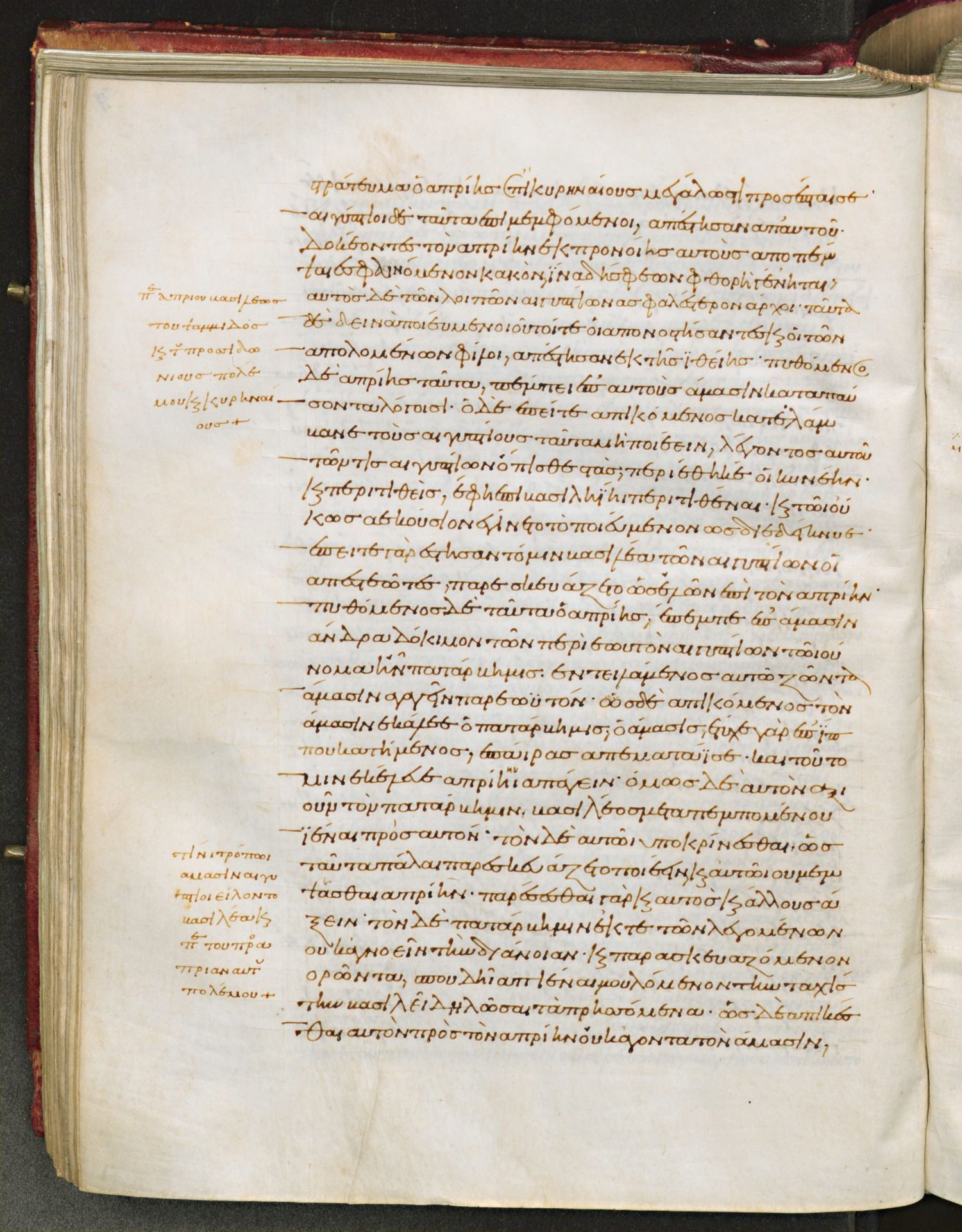
Where on the image
Laur. Plut. 70.3, fol. 97v: Greek here 2.161.4 to 2.162.5. Checked on the image (first and last words read and located in the Greek; each break checked against the neighbouring page): fol. 97v begins ‹στράτευμα ὁ Ἀπρίης ἐπὶ› (2.161.4), ends ‹οὐκ ἄγοντα τὸν Ἄμασιν› (2.162.5). English here: 2.161.4 to 2.162.5 (Godley's sentences for the sections whose Greek lies mostly on this page).
2.161.4στράτευμα ὁ Ἀπρίης ἐπὶ Κυρηναίους μεγαλωστὶ προσέπταισε, Αἰγύπτιοι δὲ ταῦτα ἐπιμεμφόμενοι ἀπέστησαν ἀπʼ αὐτοῦ, δοκέοντες τὸν Ἀπρίην ἐκ προνοίης αὐτοὺς ἀποπέμψαι ἐς φαινόμενον κακόν, ἵνα δὴ σφέων φθορὴ γένηται, αὐτὸς δὲ τῶν λοιπῶν Αἰγυπτίων ἀσφαλέστερον ἄρχοι. ταῦτα δὲ δεινὰ ποιεύμενοι οὗτοί τε οἱ ἀπονοστήσαντες καὶ οἱ τῶν ἀπολομένων φίλοι ἀπέστησαν ἐκ τῆς ἰθέης. 2.162.1πυθόμενος δὲ Ἀπρίης ταῦτα πέμπει ἐπʼ αὐτοὺς Ἄμασιν καταπαύσοντα λόγοισι. ὁ δὲ ἐπείτε ἀπικόμενος κατελάμβανε τοὺς Αἰγυπτίους ταῦτα μὴ ποιέειν, λέγοντος αὐτοῦ τῶν τις Αἰγυπτίων ὄπισθε στὰς περιέθηκέ οἱ κυνέην, καὶ περιτιθεὶς ἔφη ἐπὶ βασιληίῃ περιτιθέναι. 2.162.2καὶ τῷ οὔ κως ἀεκούσιον ἐγίνετο τὸ ποιεύμενον, ὡς διεδείκνυε. ἐπείτε γὰρ ἐστήσαντό μιν βασιλέα τῶν Αἰγυπτίων οἱ ἀπεστεῶτες, παρεσκευάζετο ὡς ἐλῶν ἐπὶ τὸν Ἀπρίην. 2.162.3πυθόμενος δὲ ταῦτα ὁ Ἀπρίης ἔπεμπε ἐπʼ Ἄμασιν ἄνδρα δόκιμον τῶν περὶ ἑωυτὸν Αἰγυπτίων, τῷ οὔνομα ἦν Πατάρβημις, ἐντειλάμενος αὐτῷ ζῶντα Ἄμασιν ἀγαγεῖν παρʼ ἑωυτόν. ὡς δὲ ἀπικόμενος τὸν Ἄμασιν ἐκάλεε ὁ Πατάρβημις, ὁ Ἄμασις, ἔτυχε γὰρ ἐπʼ ἵππου κατήμενος, ἐπαείρας ἀπεματάισε, καὶ τοῦτό μιν ἐκέλευε Ἀπρίῃ ἀπάγειν. 2.162.4ὅμως δὲ αὐτὸν ἀξιοῦν τὸν Πατάρβημιν βασιλέος μεταπεμπομένου ἰέναι πρὸς αὐτόν· τὸν δὲ αὐτῷ ὑποκρίνεσθαι ὡς ταῦτα πάλαι παρεσκευάζετο ποιέειν, καὶ αὐτῷ οὐ μέμψεσθαι Ἀπρίην· παρέσεσθαι γὰρ καὶ αὐτὸς καὶ ἄλλους ἄξειν. 2.162.5τὸν δὲ Πατάρβημιν ἔκ τε τῶν λεγομένων οὐκ ἀγνοέειν τὴν διάνοιαν, καὶ παρασκευαζόμενον ὁρῶντα σπουδῇ ἀπιέναι, βουλόμενον τὴν ταχίστην βασιλέι δηλῶσαι τὰ πρησσόμενα. ὡς δὲ ἀπικέσθαι αὐτὸν πρὸς τὸν Ἀπρίην οὐκ ἄγοντα τὸν Ἄμασιν,
2.161.4Apries sent a great host against Cyrene and suffered a great defeat. The Egyptians blamed him for this and rebelled against him; for they thought that Apries had knowingly sent his men to their doom, that by their so perishing he might be the safer in his rule over the rest of the Egyptians. Bitterly angered by this, those who returned home and the friends of the slain openly revolted. 2.162.1Hearing of this, Apries sent Amasis to them to persuade them from their purpose. When Amasis came up with the Egyptians he exhorted them to desist from what they did; but while he spoke an Egyptian came behind him and put a helmet on his head, saying it was the token of royalty. 2.162.2And Amasis showed that this was not displeasing to him, for being made king by the rebel Egyptians he prepared to march against Apries. 2.162.3When Apries heard of it, he sent against Amasis an esteemed Egyptian named Patarbemis, one of his own court, charging him to take the rebel alive and bring him into his presence. Patarbemis came, and summoned Amasis, who lifted his leg with an unseemly gesture (being then on horseback) and bade the messenger take that token back to Apries. 2.162.4But when Patarbemis was nevertheless instant that Amasis should obey the king’s summons and go to him—such is the story—Amasis answered that he had long been making ready to do this, and Apries should be well satisfied with him: “For I will come myself,” quoth he, “and bring others with me.” 2.162.5Hearing this, Patarbemis could not mistake Amasis’ purpose; he saw his preparations and made haste to depart, that he might with all speed make known to the king what was afoot. When Apries saw him return without Amasis he gave him no chance to speak, but in his rage and fury bade cut off Patarbemis’ ears and nose.
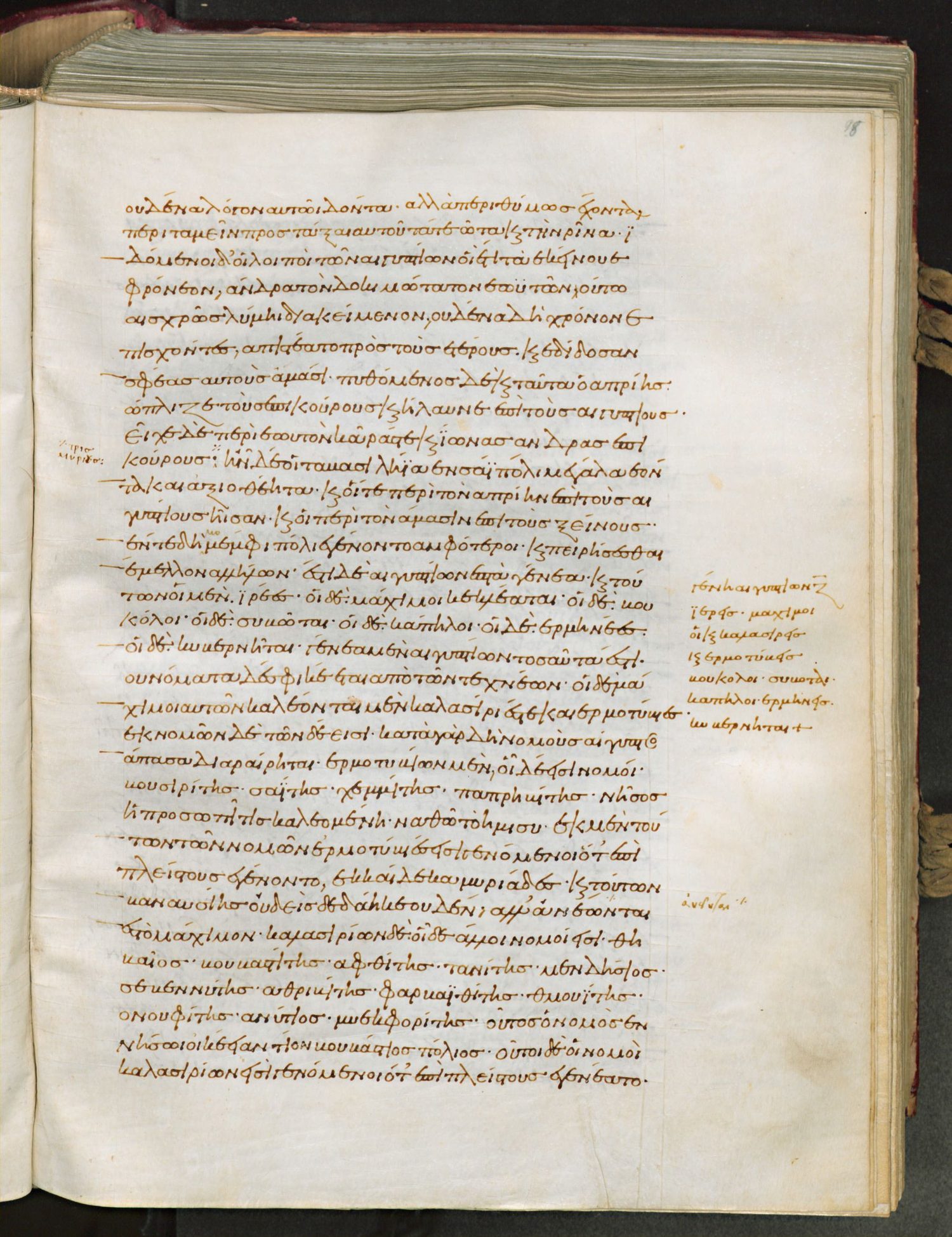
Where on the image
Laur. Plut. 70.3, fol. 98r: Greek here 2.162.5 to 2.166.2. Checked on the image (first and last words read and located in the Greek; each break checked against the neighbouring page): fol. 98r begins ‹οὐδένα λόγον αὐτῷ δόντα› (2.162.5), ends ‹ὅτε ἐπὶ πλείστους ἐγένοντο› (2.166.2). English here: 2.162.6 to 2.166.2 (Godley's sentences for the sections whose Greek lies mostly on this page).
2.162.5οὐδένα λόγον αὐτῷ δόντα ἀλλὰ περιθύμως ἔχοντα περιταμεῖν προστάξαι αὐτοῦ τά τε ὦτα καὶ τὴν ῥῖνα. 2.162.6ἰδόμενοι δʼ οἱ λοιποὶ τῶν Αἰγυπτίων, οἳ ἔτι τὰ ἐκείνου ἐφρόνεον, ἄνδρα τὸν δοκιμώτατον ἑωυτῶν οὕτω αἰσχρῶς λύμῃ διακείμενον, οὐδένα δὴ χρόνον ἐπισχόντες ἀπιστέατο πρὸς τοὺς ἑτέρους καὶ ἐδίδοσαν σφέας αὐτοὺς Ἀμάσι. 2.163.1πυθόμενος δὲ καὶ ταῦτα ὁ Ἀπρίης ὥπλιζε τοὺς ἐπικούρους καὶ ἤλαυνε ἐπὶ τοὺς Αἰγυπτίους· εἶχε δὲ περὶ ἑωυτὸν Κᾶράς τε καὶ Ἴωνας ἄνδρας ἐπικούρους τρισμυρίους· ἦν δέ οἱ τὰ βασιλήια ἐν Σάι πόλι, μεγάλα ἐόντα καὶ ἀξιοθέητα. 2.163.2καὶ οἵ τε περὶ τὸν Ἀπρίην ἐπὶ τοὺς Αἰγυπτίους ἤισαν καὶ οἱ περὶ τὸν Ἄμασιν ἐπὶ τοὺς ξείνους· ἔν τε δὴ Μωμέμφι πόλι ἐγένοντο ἀμφότεροι καὶ πειρήσεσθαι ἔμελλον ἀλλήλων. 2.164.1ἔστι δὲ Αἰγυπτίων ἑπτὰ γένεα, καὶ τούτων οἳ μὲν ἱρέες οἳ δὲ μάχιμοι κεκλέαται, οἳ δὲ βουκόλοι οἳ δὲ συβῶται, οἳ δὲ κάπηλοι, οἳ δὲ ἑρμηνέες, οἳ δὲ κυβερνήται. γένεα μὲν Αἰγυπτίων τοσαῦτα ἐστί, οὐνόματα δέ σφι κέεται ἀπὸ τῶν τεχνέων. 2.164.2οἱ δὲ μάχιμοι αὐτῶν καλέονται μὲν Καλασίριές τε καὶ Ἑρμοτύβιες, ἐκ νομῶν δὲ τῶνδε εἰσί· κατὰ γὰρ δὴ νομοὺς Αἴγυπτος ἅπασα διαραίρηται. 2.165.1Ἑρμοτυβίων μὲν οἵδε εἰσὶ νομοί, Βουσιρίτης, Σαΐτης, Χεμμίτης, Παπρημίτης, νῆσος ἡ Προσωπῖτις καλεομένη, Ναθῶ τὸ ἥμισυ. ἐκ μὲν τούτων τῶν νομῶν Ἑρμοτύβιες εἰσί, γενόμενοι, ὅτε ἐπὶ πλείστους ἐγένοντο, ἑκκαίδεκα μυριάδες. καὶ τούτων βαναυσίης οὐδεὶς δεδάηκε οὐδέν, ἀλλʼ ἀνέωνται ἐς τὸ μάχιμον. 2.166.1καλασιρίων δὲ οἵδε ἄλλοι νομοί εἰσι, Θηβαῖος, Βουβαστίτης, Ἀφθίτης, Τανίτης, Μενδήσιος, Σεβεννύτης, Ἀθριβίτης, Φαρβαϊθίτης, Θμουΐτης, Ὀνουφίτης, Ἀνύτιος, Μυεκφορίτης· οὗτος ὁ νομὸς ἐν νήσῳ οἰκέει ἀντίον Βουβάστιος πόλιος. 2.166.2οὗτοι δὲ οἱ νομοὶ Καλασιρίων εἰσί, γενόμενοι, ὅτε ἐπὶ πλείστους ἐγένοντο,
2.162.6The rest of the Egyptians, who still favoured his cause, seeing the foul despite thus done to the man who was most esteemed among them, changed sides without more ado and delivered themselves over to Amasis. 2.163.1This news too being brought to Apries, he armed his guard and marched against the Egyptians; he had a bodyguard of Carians and Ionians, thirty thousand of them, and his royal dwelling was in the city of Sais, a great and marvellous palace. 2.163.2Apries’ men marched against the Egyptians, and so did Amasis’ men against the strangers; so they came both to Momemphis, where it was their purpose to prove each other’s quality. 2.164.1The Egyptians are divided into seven classes, severally entitled priests, warriors, cowherds, swineherds, hucksters, interpreters, and pilots. So many classes there are, each named after its vocation. 2.164.2The warriors are divided into Kalasiries and Hermotubies, and they belong to the following provinces (for all divisions in Egypt are made according to provinces). 2.165.1The Hermotubies are of the provinces of Busiris, Sais, Chemmis, and Papremis, the island called Prosopitis, and half of Natho—all of these; their number, at its greatest, attained to a hundred and sixty thousand. None of these has learnt any common trade; they are free to follow arms alone. 2.166.1The Kalasiries for their part are of the provinces of Thebes, Bubastis, Aphthis, Tanis, Mendes, Sebennys, Athribis, Pharbaïthis, Thmuis, Onuphis, Anytis, Myecphoris (this last is in an island over against the city of 2.166.2Bubastis)—all these; their number, at its greatest, attained to two hundred and fifty thousand men. These too may practise no trade but only war, which is their hereditary calling.
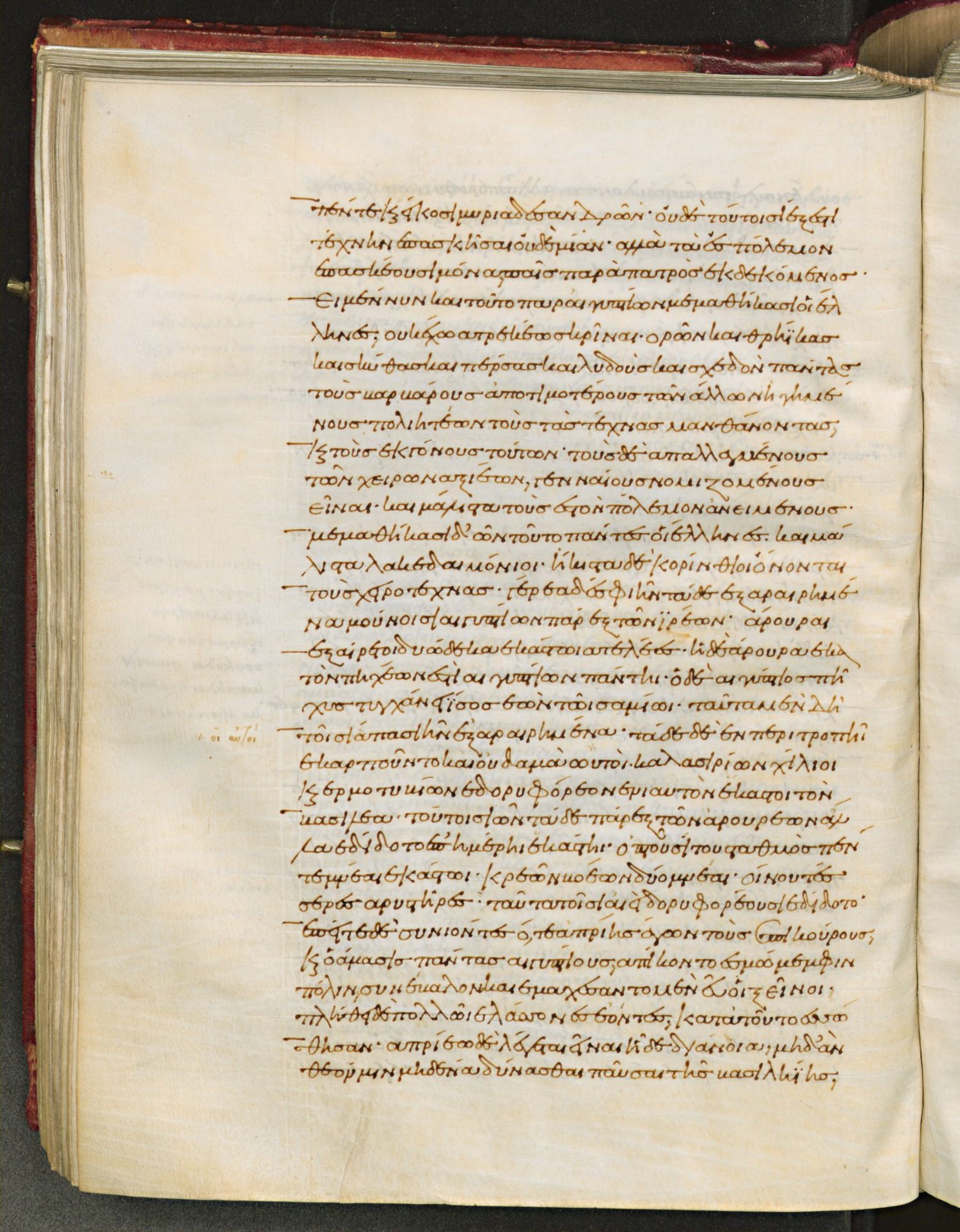
Where on the image
Laur. Plut. 70.3, fol. 98v: Greek here 2.166.2 to 2.169.2. Checked on the image (first and last words read and located in the Greek; each break checked against the neighbouring page): fol. 98v begins ‹πέντε καὶ εἴκοσι μυριάδες› (2.166.2), ends ‹δύνασθαι παῦσαι τῆς βασιληίης› (2.169.2). English here: 2.167.1 to 2.169.1 (Godley's sentences for the sections whose Greek lies mostly on this page).
2.166.2πέντε καὶ εἴκοσι μυριάδες ἀνδρῶν. οὐδὲ τούτοισι ἔξεστι τέχνην ἐπασκῆσαι οὐδεμίαν, ἀλλὰ τὰ ἐς πόλεμον ἐπασκέουσι μοῦνα, παῖς παρὰ πατρὸς ἐκδεκόμενος. 2.167.1εἰ μέν νυν καὶ τοῦτο παρʼ Αἰγυπτίων μεμαθήκασι οἱ Ἕλληνες, οὐκ ἔχω ἀτρεκέως κρῖναι, ὁρέων καὶ Θρήικας καὶ Σκύθας καὶ Πέρσας καὶ Λυδοὺς καὶ σχεδὸν πάντας τοὺς βαρβάρους ἀποτιμοτέρους τῶν ἄλλων ἡγημένους πολιητέων τοὺς τὰς τέχνας μανθάνοντας καὶ τοὺς ἐκγόνους τούτων, τοὺς δὲ ἀπαλλαγμένους τῶν χειρωναξιέων γενναίους νομιζομένους εἶναι, καὶ μάλιστα τοὺς ἐς τὸν πόλεμον ἀνειμένους· 2.167.2μεμαθήκασι δʼ ὦν τοῦτο πάντες οἱ Ἕλληνες καὶ μάλιστα Λακεδαιμόνιοι. ἥκιστα δὲ Κορίνθιοι ὄνονται τοὺς χειροτέχνας. 2.168.1γέρεα δέ σφι ἦν τάδε ἐξαραιρημένα μούνοισι Αἰγυπτίων πάρεξ τῶν ἱρέων, ἄρουραι ἐξαίρετοι δυώδεκα ἑκάστῳ ἀτελέες. ἡ δὲ ἄρουρα ἑκατὸν πηχέων ἐστὶ Αἰγυπτίων πάντῃ, ὁ δὲ Αἰγύπτιος πῆχυς τυγχάνει ἴσος ἐὼν τῷ Σαμίῳ. 2.168.2ταῦτα μὲν δὴ τοῖσι ἅπασι ἦν ἐξαραιρημένα, τάδε δὲ ἐν περιτροπῇ ἐκαρποῦντο καὶ οὐδαμὰ ὡυτοί. Καλασιρίων χίλιοι καὶ Ἑρμοτυβίων ἐδορυφόρεον ἐνιαυτὸν ἕκαστοι τὸν βασιλέα· τούτοισι ὦν τάδε πάρεξ τῶν ἀρουρέων ἄλλα ἐδίδοτο ἐπʼ ἡμέρῃ ἑκάστῃ, ὀπτοῦ σίτου σταθμὸς πέντε μνέαι ἑκάστῳ, κρεῶν βοέων δύο μνέαι, οἴνου τέσσερες ἀρυστῆρες. ταῦτα τοῖσι αἰεὶ δορυφορέουσι ἐδίδοτο. 2.169.1ἐπείτε δὲ συνιόντες ὅ τε Ἀπρίης ἄγων τοὺς ἐπικούρους καὶ ὁ Ἄμασις πάντας Αἰγυπτίους ἀπίκοντο ἐς Μώμεμφιν πόλιν, συνέβαλον· καὶ ἐμαχέσαντο μὲν εὖ οἱ ξεῖνοι, πλήθεϊ δὲ πολλῷ ἐλάσσονες ἐόντες κατὰ τοῦτο ἑσσώθησαν. 2.169.2Ἀπρίεω δὲ λέγεται εἶναι ἥδε διάνοια, μηδʼ ἂν θεόν μιν μηδένα δύνασθαι παῦσαι τῆς βασιληίης·
2.167.1Now whether this separation, like other customs, has come to Greece from Egypt, I cannot exactly judge. I know that in Thrace and Scythia and Persia and Lydia and nearly all foreign countries those who learn trades and their descendants are held in less esteem than the rest of the people, and those who have nothing to do with artisans’ work, especially men who are free to practise the art of war, are highly honoured. 2.167.2Thus much is certain, that this opinion, which is held by all Greeks and chiefly by the Lacedaemonians, is of foreign origin. It is in Corinth that artisans are held in least contempt. 2.168.1The warriors were the only Egyptians, except the priests, who had special privileges: for each of them there was set apart an untaxed plot of twelve acres. This acre is a square of a hundred Egyptian cubits each way, the Egyptian cubit being equal to the Samian. 2.168.2These lands were set apart for all; it was never the same men who cultivated them, but each in turn. A thousand Kalasiries and as many Hermotubies were the king’s annual bodyguard. These men, besides their lands, received each a daily provision of five minae’s weight of roast grain, two minae of beef, and four cups of wine. These were the gifts received by each bodyguard. 2.169.1When Apries with his guards and Amasis with the whole force of Egyptians came to the town of Momemphis, they joined battle; and though the foreigners fought well, they were by much the fewer, and therefore were worsted.
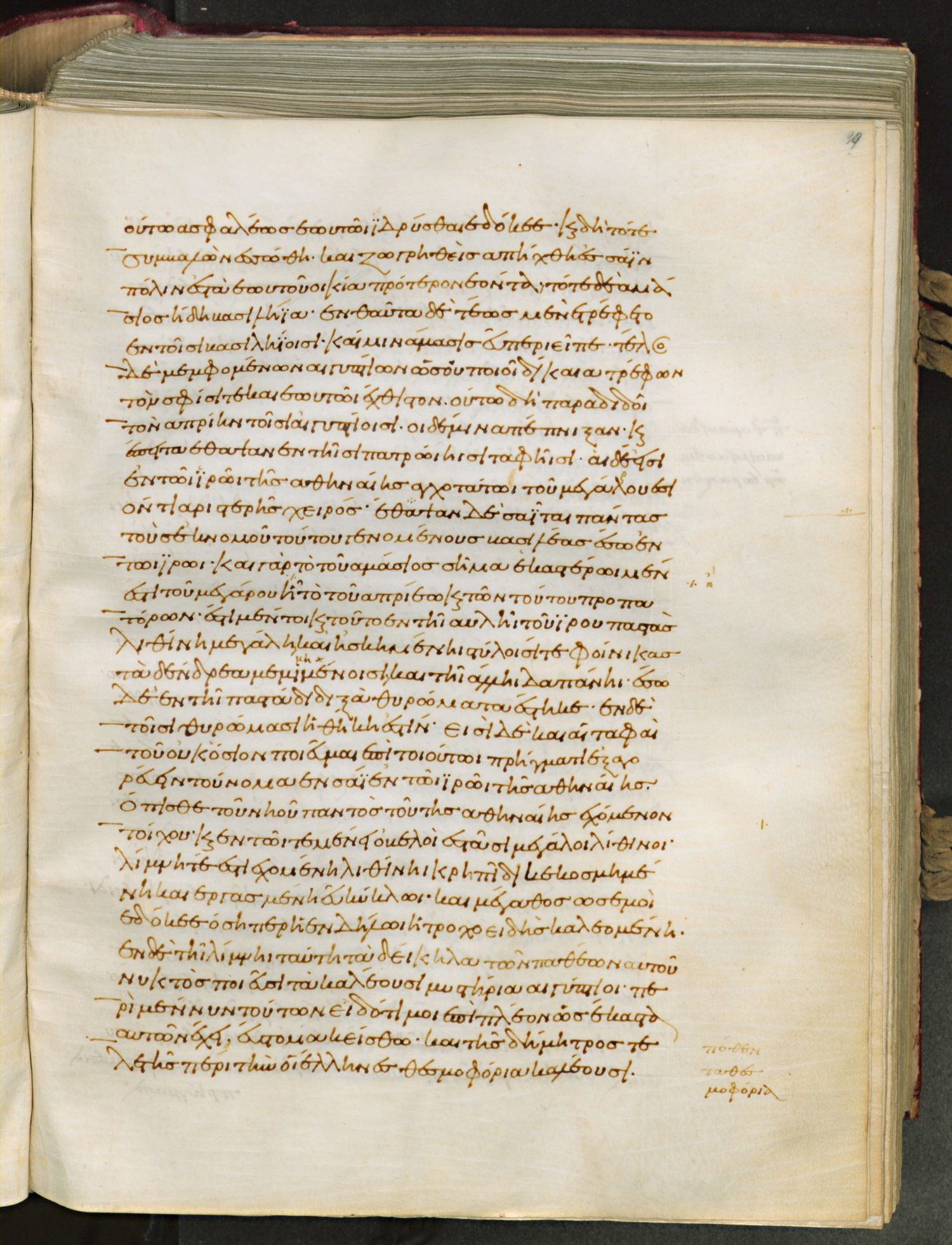
Where on the image
Laur. Plut. 70.3, fol. 99r: Greek here 2.169.2 to 2.169.5. Checked on the image (first and last words read and located in the Greek; each break checked against the neighbouring page): fol. 99r begins ‹οὕτω ἀσφαλέως ἑωυτῷ ἱδρῦσθαι› (2.169.2), ends ‹οἱ Ἕλληνες θεσμοφόρια καλέουσι› (2.171.2). English here: 2.169.2 to 2.169.5 (Godley's sentences for the sections whose Greek lies mostly on this page).
2.169.2οὕτω ἀσφαλέως ἑωυτῷ ἱδρῦσθαι ἐδόκεε. καὶ δὴ τότε συμβαλὼν ἑσσώθη καὶ ζωγρηθεὶς ἀπήχθη ἐς Σάιν πόλιν, ἐς τὰ ἑωυτοῦ οἰκία πρότερον ἐόντα, τότε δὲ Ἀμάσιος ἤδη βασιληία. 2.169.3ἐνθαῦτα δὲ τέως μὲν ἐτρέφετο ἐν τοῖσι βασιληίοισι, καί μιν Ἄμασις εὖ περιεῖπε· τέλος δὲ μεμφομένων Αἰγυπτίων ὡς οὐ ποιέοι δίκαια τρέφων τὸν σφίσι τε καὶ ἑωυτῷ ἔχθιστον, οὕτω δὴ παραδιδοῖ τὸν Ἀπρίην τοῖσι Αἰγυπτίοισι. οἳ δέ μιν ἀπέπνιξαν καὶ ἔπειτα ἔθαψαν ἐν τῇσι πατρωίῃσι ταφῇσι· 2.169.4αἳ δὲ εἰσὶ ἐν τῷ ἱρῷ τῆς Ἀθηναίης, ἀγχοτάτω τοῦ μεγάρου, ἐσιόντι ἀριστερῆς χειρός. ἔθαψαν δὲ Σαῗται πάντας τοὺς ἐκ νομοῦ τούτου γενομένους βασιλέας ἔσω ἐν τῷ ἱρῷ. 2.169.5καὶ γὰρ τὸ τοῦ Ἀμάσιος σῆμα ἑκαστέρω μὲν ἐστὶ τοῦ μεγάρου ἢ τὸ τοῦ Ἀπρίεω καὶ τῶν τούτου προπατόρων, ἔστι μέντοι καὶ τοῦτο ἐν τῇ αὐλῇ τοῦ ἱροῦ, παστὰς λιθίνη μεγάλη καὶ ἠσκημένη στύλοισί τε φοίνικας τὰ δένδρεα μεμιμημένοισι καὶ τῇ ἄλλῃ δαπάνῃ· ἔσω δὲ ἐν τῇ παστάδι διξὰ θυρώματα ἕστηκε, ἐν δὲ τοῖσι θυρώμασι ἡ θήκη ἐστί.
2.169.2Apries, they say, supposed that not even a god could depose him from his throne; so firmly he thought he was established; and now being worsted in battle and taken captive he was brought to Sais, to the royal dwelling which belonged once to him but now to Amasis. 2.169.3There he was sustained for a while in the palace, and well entreated by Amasis. But presently the Egyptians complained that there was no justice in allowing one who was their own and their king’s bitterest enemy to live; whereupon Amasis gave Apries up to them, and they strangled him and then buried him in the burial-place of his fathers. 2.169.4This is in the temple of Athene, very near to the sanctuary, on the left of the entrance. The people of Sais buried within the temple precinct all kings who were natives of their province. 2.169.5The tomb of Amasis is farther from the sanctuary than the tomb of Apries and his ancestors; yet it also is within the temple court; it is a great colonnade of stone, richly adorned, the pillars whereof are wrought in the form of palm trees. In this colonnade are two portals, and the place where the coffin lies is within their doors.
Notes
- Greek: the text printed in A. D. Godley's Loeb edition, via Perseus (tlg0016.tlg001.perseus-grc2). Square brackets mark words the editor considers later additions; [...] marks a gap the editor indicates. Perseus note markers are omitted.
- English: A. D. Godley, Herodotus vol. 1 (1920) (Loeb Classical Library), as transcribed on Wikisource. Godley's footnotes are omitted.
- Section numbers in the English were placed by comparing Godley's text with the Perseus version of his translation; where a section begins inside one of Godley's sentences, the English is kept with the page that holds the start of that sentence.
Cite
Sources
- Source: Florence, Laur. Plut. 70.3 (10th c.) via BML Teca Digitale + Greek of Godley's Loeb (Perseus) + English of A. D. Godley (Loeb, Wikisource) (holding institution)
- Critical edition: Greek of A. D. Godley's Loeb edition (1920-1925), via Perseus
← previous · → next · v cycle view · l back to library