Herodotus, Histories 2.170-182: Amasis
Introduction
Herodotus of Halicarnassus wrote the Histories in the third quarter of the 5th century BCE, an inquiry into the deeds of Greeks and barbarians and the causes of the wars between them, later divided into nine books. Book 2 is Herodotus' account of Egypt, written as background to Cambyses' invasion: the land and the Nile, the customs and religion of the Egyptians, and the history of their kings as the priests told it, down to Amasis.
The photographs are of Florence, Biblioteca Medicea Laurenziana, Plut. 70.3 (parchment, 10th century, 374 folios, 31 lines a page), Herodotus, Histories (codex A of the editors), the oldest surviving manuscript of the complete Histories, from the Teca Digitale of the Biblioteca Medicea Laurenziana. Each section below is the text of one page, or of the part of a page that falls within these chapters. The first and last words of every page were read on the photograph and located in the Greek, and every page break was checked against the next page; the notes quote these words. Readers' notes in the margins are not part of the text and are mentioned where they occur.
The Greek is the text printed in A. D. Godley's Loeb edition (1920-1925), from Perseus; it is the edited text, not a transcription of the manuscript, whose wording differs in places. The English is Godley's translation as printed, from Wikisource. Godley's English carries only chapter numbers; the section numbers shown in it were placed by comparison with the Perseus version of his translation. Each page's English is cut at the end of one of Godley's sentences, so it can begin or end a few lines away from the Greek of the page; each note gives the exact ranges.
This entry covers chapters 2.170-182, on fol. 99r to 102r.
How was this verified? (Provenance)
Where on the image
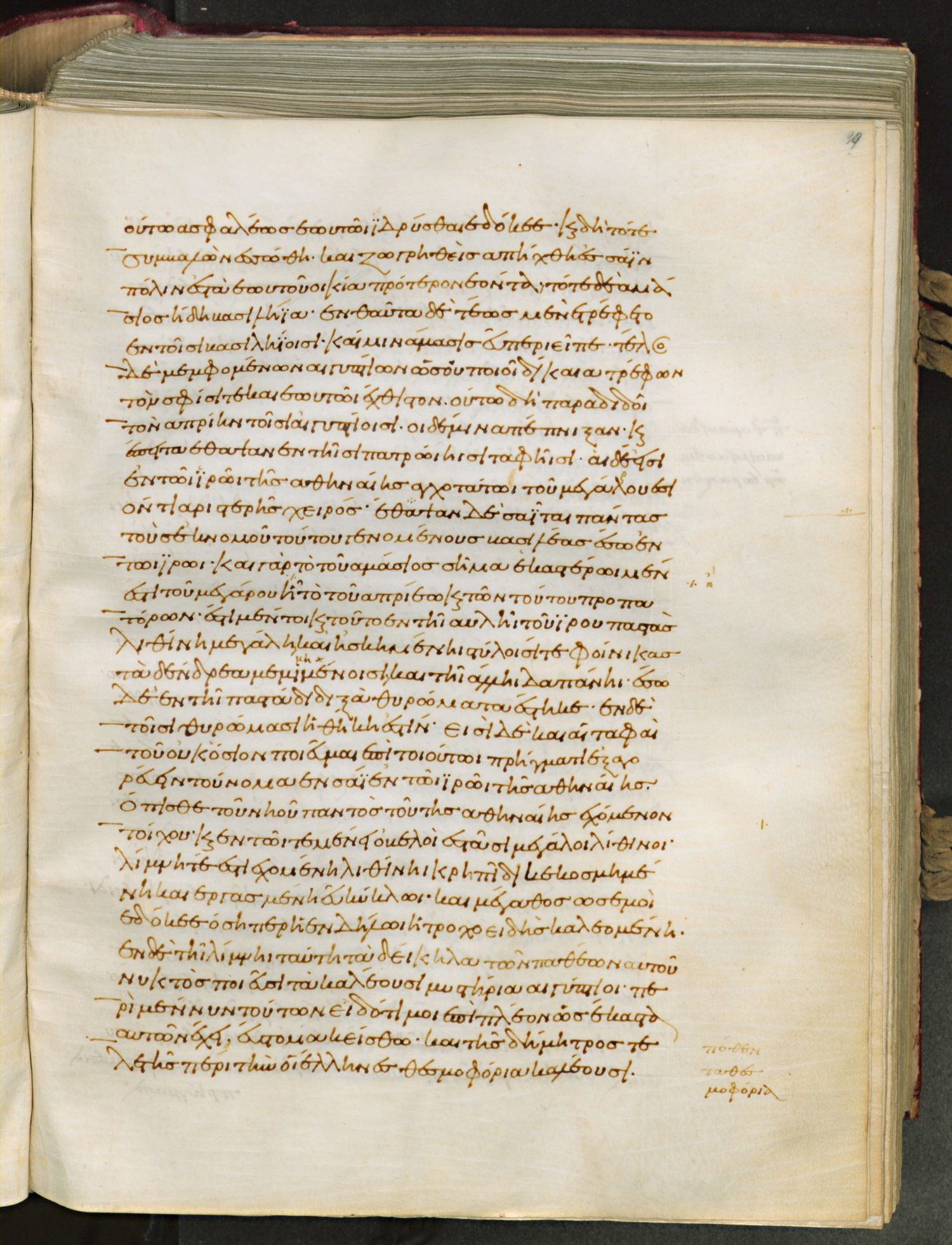
Laur. Plut. 70.3, fol. 99r: Greek here 2.170.1 to 2.171.2. Checked on the image (first and last words read and located in the Greek; each break checked against the neighbouring page): fol. 99r begins ‹οὕτω ἀσφαλέως ἑωυτῷ ἱδρῦσθαι› (2.169.2), ends ‹οἱ Ἕλληνες θεσμοφόρια καλέουσι› (2.171.2). English here: 2.170.1 to 2.171.2 (Godley's sentences for the sections whose Greek lies mostly on this page).
2.170.1εἰσὶ δὲ καὶ αἱ ταφαὶ τοῦ οὐκ ὅσιον ποιεῦμαι ἐπὶ τοιούτῳ πρήγματι ἐξαγορεύειν τὸ οὔνομα ἐν Σάι, ἐν τῷ ἱρῷ τῆς Ἀθηναίης, ὄπισθε τοῦ νηοῦ, παντὸς τοῦ τῆς Ἀθηναίης ἐχόμεναι τοίχου. 2.170.2καὶ ἐν τῷ τεμένεϊ ὀβελοὶ ἑστᾶσι μεγάλοι λίθινοι, λίμνη τε ἐστὶ ἐχομένη λιθίνῃ κρηπῖδι κεκοσμημένη καὶ ἐργασμένη εὖ κύκλῳ καὶ μέγαθος, ὡς ἐμοὶ ἐδόκεε, ὅση περ ἡ ἐν Δήλῳ ἡ τροχοειδὴς καλεομένη. 2.171.1ἐν δὲ τῇ λίμνῃ ταύτῃ τὰ δείκηλα τῶν παθέων αὐτοῦ νυκτὸς ποιεῦσι, τὰ καλέουσι μυστήρια Αἰγύπτιοι. περὶ μέν νυν τούτων εἰδότι μοι ἐπὶ πλέον ὡς ἕκαστα αὐτῶν ἔχει, εὔστομα κείσθω. 2.171.2καὶ τῆς Δήμητρος τελετῆς πέρι, τὴν οἱ Ἕλληνες θεσμοφόρια καλέουσι,
2.170.1There is also at Sais the burial-place of him whose name I deem it forbidden to utter in speaking of such a matter; it is in the temple of Athene, behind and close to the whole length of the wall of the shrine. 2.170.2Moreover great stone obelisks stand in the precinct; and there is a lake hard by, adorned with a stone margin and wrought to a complete circle; it is, as it seemed to me, of the bigness of the lake at Delos which they call the Round Pond. 2.171.1On this lake they enact by night the story of the god’s sufferings, a rite which the Egyptians call the Mysteries. I could speak more exactly of these matters, for I know the truth, but I will hold 2.171.2my peace; nor will I say aught concerning that rite of Demeter which the Greeks call Thesmophoria, saving such part of it as I am not forbidden to mention.
Where on the image
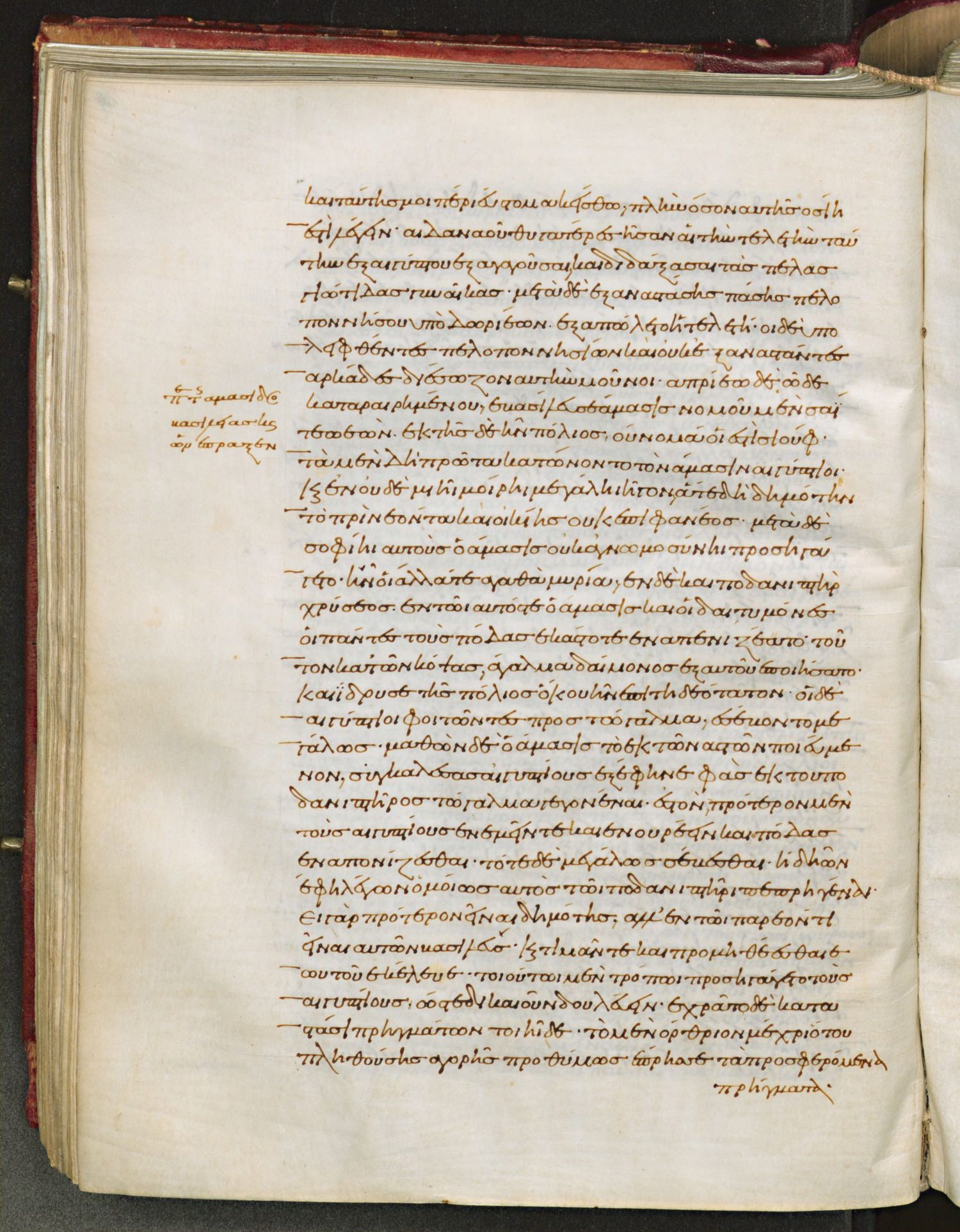
Laur. Plut. 70.3, fol. 99v: Greek here 2.171.2 to 2.173.1. Checked on the image (first and last words read and located in the Greek; each break checked against the neighbouring page): fol. 99v begins ‹καὶ ταύτης μοι πέρι› (2.171.2), ends ‹ἔπρησσε τὰ προσφερόμενα πρήγματα› (2.173.1). English here: 2.171.3 to 2.173.1 (Godley's sentences for the sections whose Greek lies mostly on this page).
2.171.2καὶ ταύτης μοι πέρι εὔστομα κείσθω, πλὴν ὅσον αὐτῆς ὁσίη ἐστὶ λέγειν· 2.171.3αἱ Δαναοῦ θυγατέρες ἦσαν αἱ τὴν τελετὴν ταύτην ἐξ Αἰγύπτου ἐξαγαγοῦσαι καὶ διδάξασαι τὰς Πελασγιώτιδας γυναῖκας· μετὰ δὲ ἐξαναστάσης πάσης Πελοποννήσου ὑπὸ Δωριέων ἐξαπώλετο ἡ τελετή, οἱ δὲ ὑπολειφθέντες Πελοποννησίων καὶ οὐκ ἐξαναστάντες Ἀρκάδες διέσωζον αὐτὴν μοῦνοι. 2.172.1Ἀπρίεω δὲ ὧδε καταραιρημένου ἐβασίλευσε Ἄμασις, νομοῦ μὲν Σαΐτεω ἐών, ἐκ τῆς δὲ ἦν πόλιος, οὔνομά οἱ ἐστὶ Σιούφ. 2.172.2τὰ μὲν δὴ πρῶτα κατώνοντο τὸν Ἄμασιν Αἰγύπτιοι καὶ ἐν οὐδεμιῇ μοίρῃ μεγάλῃ ἦγον ἅτε δὴ δημότην τὸ πρὶν ἐόντα καὶ οἰκίης οὐκ ἐπιφανέος· μετὰ δὲ σοφίῃ αὐτοὺς ὁ Ἄμασις, οὐκ ἀγνωμοσύνῃ προσηγάγετο. 2.172.3ἦν οἱ ἄλλα τε ἀγαθὰ μυρία, ἐν δὲ καὶ ποδανιπτὴρ χρύσεος, ἐν τῷ αὐτός τε ὁ Ἄμασις καὶ οἱ δαιτυμόνες οἱ πάντες τοὺς πόδας ἑκάστοτε ἐναπενίζοντο· τοῦτον κατʼ ὦν κόψας ἄγαλμα δαίμονος ἐξ αὐτοῦ ἐποιήσατο, καὶ ἵδρυσε τῆς πόλιος ὅκου ἦν ἐπιτηδεότατον· οἱ δὲ Αἰγύπτιοι φοιτέοντες πρὸς τὤγαλμα ἐσέβοντο μεγάλως. 2.172.4μαθὼν δὲ ὁ Ἄμασις τὸ ἐκ τῶν ἀστῶν ποιεύμενον, συγκαλέσας Αἰγυπτίους ἐξέφηνε φὰς ἐκ τοῦ ποδανιπτῆρος τὤγαλμα γεγονέναι, ἐς τὸν πρότερον μὲν τοὺς Αἰγυπτίους ἐνεμέειν τε καὶ ἐνουρέειν καὶ πόδας ἐναπονίζεσθαι, τότε δὲ μεγάλως σέβεσθαι. 2.172.5ἤδη ὦν ἔφη λέγων ὁμοίως αὐτὸς τῷ ποδανιπτῆρι πεπρηγέναι· εἰ γὰρ πρότερον εἶναι δημότης, ἀλλʼ ἐν τῷ παρεόντι εἶναι αὐτῶν βασιλεύς· καὶ τιμᾶν τε καὶ προμηθέεσθαι ἑωυτοῦ ἐκέλευε. 2.173.1τοιούτῳ μὲν τρόπῳ προσηγάγετο τοὺς Αἰγυπτίους ὥστε δικαιοῦν δουλεύειν, ἐχρᾶτο δὲ καταστάσι πρηγμάτων τοιῇδε· τὸ μὲν ὄρθριον μέχρι ὅτευ πληθούσης ἀγορῆς προθύμως ἔπρησσε τὰ προσφερόμενα πρήγματα,
2.171.3It was the daughters of Danaus who brought this rite out of Egypt and taught it to the Pelasgian women; afterwards, when the people of Peloponnesus were driven out by the Dorians, it was lost, except in so far as it was preserved by the Arcadians alone, the Peloponnesian nation that was not driven out but left in its home. 2.172.1Apries being thus deposed, Amasis became king; he was of a town called Siuph in the province of Saïs. 2.172.2Now at first he was contemned and held in but little regard by the Egyptians, as having been but a common man and of no high family; but presently he won them to him by being cunning and not arrogant. 2.172.3He had among his countless treasures a golden foot-bath, in which he and all those who feasted with him were ever wont to wash their feet. This he broke in pieces and made thereof a god’s image, which he set in the most fitting place in the city; and the Egyptians came ever and anon to this image and held it in great reverence. 2.172.4When Amasis knew what the townsmen did, he called the Egyptians together and told them that the image had been made out of the foot-bath; once (said he) his subjects had washed their feet in it and put it to yet viler uses; now they greatly revered it. 2.172.5“So now” (quoth he to them) “it has fared with me as with the foot-bath; once I was a common man, now I am your king; it is your duty to honour me and hold me in regard.” 2.173.1In this manner he won the Egyptians to consent to be his slaves; and this is how he ordered his affairs: in the morning, till the filling of the market place, he wrought zealously at such business as came before him; the rest of the day he spent in drinking and jesting with his boon companions in idle and sportive mood.
Where on the image
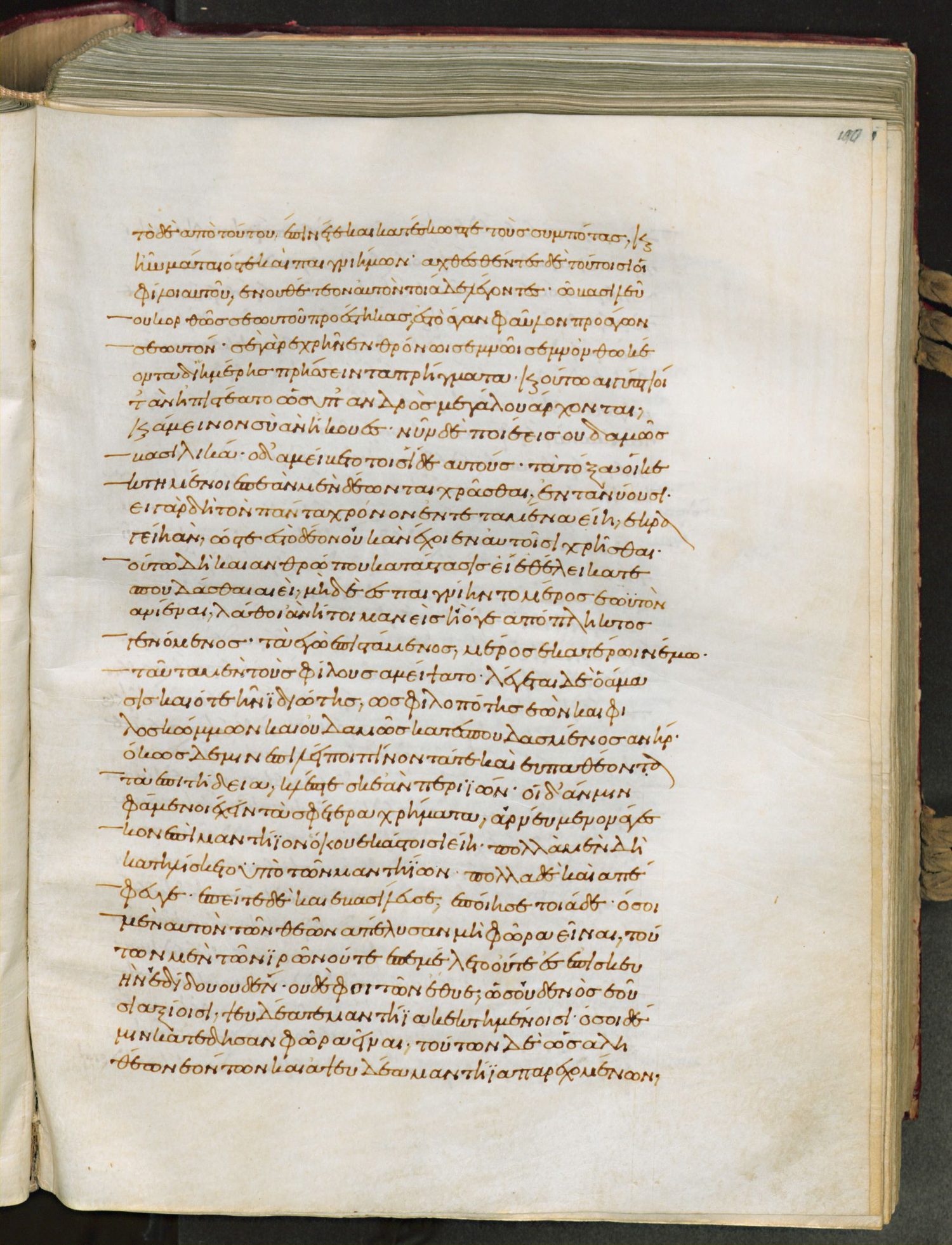
Laur. Plut. 70.3, fol. 100r: Greek here 2.173.1 to 2.174.2. Checked on the image (first and last words read and located in the Greek; each break checked against the neighbouring page): fol. 100r begins ‹τὸ δὲ ἀπὸ τούτου› (2.173.1), ends ‹καὶ ἀψευδέα μαντήια παρεχομένων› (2.174.2). English here: 2.173.2 to 2.174.2 (Godley's sentences for the sections whose Greek lies mostly on this page).
2.173.1τὸ δὲ ἀπὸ τούτου ἔπινέ τε καὶ κατέσκωπτε τοὺς συμπότας καὶ ἦν μάταιός τε καὶ παιγνιήμων. 2.173.2ἀχθεσθέντες δὲ τούτοισι οἱ φίλοι αὐτοῦ ἐνουθέτεον αὐτὸν τοιάδε λέγοντες. ὦ βασιλεῦ, οὐκ ὀρθῶς, σεωυτοῦ προέστηκας, ἐς τὸ ἄγαν φαῦλον προάγων σεωυτόν. σὲ γὰρ ἐχρῆν ἐν θρόνῳ σεμνῷ σεμνὸν θωκέοντα διʼ ἡμέρης πρήσσειν τὰ πρήγματα, καὶ οὕτω Αἰγύπτιοί τʼ ἂν ἠπιστέατο ὡς ὑπʼ ἀνδρὸς μεγάλου ἄρχονται, καὶ ἄμεινον σὺ ἂν ἤκουες· νῦν δὲ ποιέεις οὐδαμῶς βασιλικά. 2.173.3ὃ δʼ ἀμείβετο τοῖσιδε αὐτούς. τὰ τόξα οἱ ἐκτημένοι, ἐπεὰν μὲν δέωνται χρᾶσθαι, ἐντανύουσι· εἰ γὰρ δὴ τὸν πάντα χρόνον ἐντεταμένα εἴη, ἐκραγείη ἄν, ὥστε ἐς τὸ δέον οὐκ ἂν ἔχοιεν αὐτοῖσι χρᾶσθαι. 2.173.4οὕτω δὲ καὶ ἀνθρώπου κατάστασις· εἰ ἐθέλοι κατεσπουδάσθαι αἰεὶ μηδὲ ἐς παιγνίην τὸ μέρος ἑωυτὸν ἀνιέναι, λάθοι ἂν ἤτοι μανεὶς ἢ ὅ γε ἀπόπληκτος γενόμενος· τὰ ἐγὼ ἐπιστάμενος μέρος ἑκατέρῳ νέμω. ταῦτα μὲν τοὺς φίλους ἀμείψατο. 2.174.1λέγεται δὲ ὁ Ἄμασις, καὶ ὅτε ἦν ἰδιώτης, ὡς φιλοπότης ἦν καὶ φιλοσκώμμων καὶ οὐδαμῶς κατεσπουδασμένος ἀνήρ· ὅκως δέ μιν ἐπιλείποι πίνοντά τε καὶ εὐπαθέοντα τὰ ἐπιτήδεα, κλέπτεσκε ἂν περιιών· οἳ δʼ ἄν μιν φάμενοι ἔχειν τὰ σφέτερα χρήματα ἀρνεύμενον ἄγεσκον ἐπὶ μαντήιον, ὅκου ἑκάστοισι εἴη. πολλὰ μὲν δὴ καὶ ἡλίσκετο ὑπὸ τῶν μαντηίων, πολλὰ δὲ καὶ ἀπέφευγε. 2.174.2ἐπείτε δὲ καὶ ἐβασίλευσε, ἐποίησε τοιάδε· ὅσοι μὲν αὐτὸν τῶν θεῶν ἀπέλυσαν μὴ φῶρα εἶναι, τούτων μὲν τῶν ἱρῶν οὔτε ἐπεμέλετο οὔτε ἐς ἐπισκευὴν ἐδίδου οὐδέν, οὐδὲ φοιτέων ἔθυε ὡς οὐδενὸς ἐοῦσι ἀξίοισι ψευδέα τε μαντήια ἐκτημένοισι· ὅσοι δέ μιν κατέδησαν φῶρα εἶναι, τούτων δὲ ὡς ἀληθέων θεῶν ἐόντων καὶ ἀψευδέα μαντήια παρεχομένων
2.173.2But this displeased his friends, who thus admonished him: “O King, you are ill guided so to demean yourself. We would have you sit aloft on a throne of pride all day doing your business; thus would the Egyptians know that they have a great man for their ruler, and you would have the better name among them; but now your behaviour is nowise royal.” 2.173.3“Nay,” Amasis answered them, “men that have bows bend them at need only; were bows kept for ever bent they would break, and so would be of no avail when they were needed. 2.173.4Such too is the nature of men. Were they to be ever at serious work nor permit themselves a fair share of sport they would go mad or silly ere they knew it; I am well aware of that, and give each of the two its turn.” Such was his answer to his friends. 2.174.1It is said that before Amasis was a king he was a man nowise serious-minded but much given to drinking and jesting; and when his drinking and merrymaking brought him to penury, he would wander around and steal from one and another. Then those others, when he denied the charge that he had taken their possessions, would bring him to whatever place of divination was nearest them; and the oracles often declared him guilty and often acquitted him. 2.174.2When he became king, he took no care of the shrines of the gods who had acquitted him of theft, nor gave them aught for maintenance, nor made it his practice to sacrifice there, for he deemed them to be worthless and their oracles to be false; but he tended with all care the gods who had declared his guilt, holding them to be gods in very truth and their oracles infallible.
Where on the image
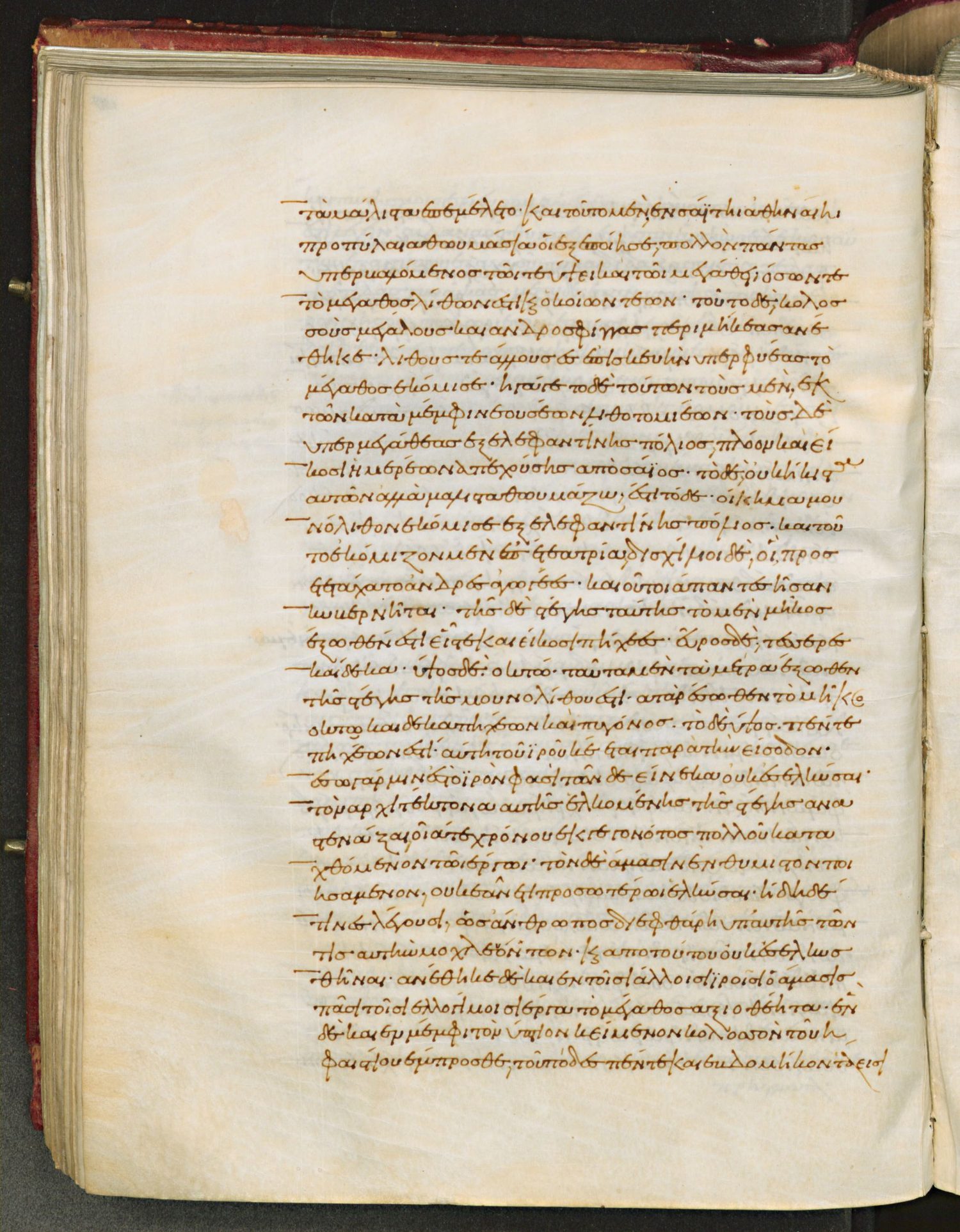
Laur. Plut. 70.3, fol. 100v: Greek here 2.174.2 to 2.176.1. Checked on the image (first and last words read and located in the Greek; each break checked against the neighbouring page): fol. 100v begins ‹τὰ μάλιστα ἐπεμέλετο.καὶ τοῦτο› (2.174.2), ends ‹πέντε καὶ ἑβδομήκοντα εἰσὶ› (2.176.1). The page reads τούτων μάλιστα where the edition has τὰ μάλιστα (2.174.2). English here: 2.175.1 to 2.176.1 (Godley's sentences for the sections whose Greek lies mostly on this page).
2.174.2τὰ μάλιστα ἐπεμέλετο. 2.175.1καὶ τοῦτο μὲν ἐν Σάι τῇ Ἀθηναίῃ προπύλαια θωμάσια οἷα ἐξεποίησε, πολλὸν πάντας ὑπερβαλόμενος τῷ τε ὕψεϊ καὶ τῷ μεγάθεϊ, ὅσων τε τὸ μέγαθος λίθων ἐστὶ καὶ ὁκοίων τεῶν· τοῦτο δὲ κολοσσοὺς μεγάλους καὶ ἀνδρόσφιγγας περιμήκεας ἀνέθηκε, λίθους τε ἄλλους ἐς ἐπισκευὴν ὑπερφυέας τὸ μέγαθος ἐκόμισε. 2.175.2ἠγάγετο δὲ τούτων τοὺς μὲν ἐκ τῶν κατὰ Μέμφιν ἐουσέων λιθοτομιέων, τοὺς δὲ ὑπερμεγάθεας ἐξ Ἐλεφαντίνης πόλιος πλόον καὶ εἴκοσι ἡμερέων ἀπεχούσης ἀπὸ Σάιος. 2.175.3τὸ δὲ οὐκ ἥκιστα αὐτῶν ἀλλὰ μάλιστα θωμάζω, ἔστι τόδε· οἴκημα μουνόλιθον ἐκόμισε ἐξ Ἐλεφαντίνης πόλιος, καὶ τοῦτο ἐκόμιζον μὲν ἐπʼ ἔτεα τρία, δισχίλιοι δέ οἱ προσετετάχατο ἄνδρες ἀγωγέες, καὶ οὗτοι ἅπαντες ἦσαν κυβερνῆται. τῆς δὲ στέγης ταύτης τὸ μὲν μῆκος ἔξωθεν ἐστὶ εἷς τε καὶ εἴκοσι πήχεες, εὖρος δὲ τεσσερεσκαίδεκα, ὕψος δὲ ὀκτώ. 2.175.4ταῦτα μὲν τὰ μέτρα ἔξωθεν τῆς στέγης τῆς μουνολίθου ἐστί, ἀτὰρ ἔσωθεν τὸ μῆκος ὀκτωκαίδεκα πηχέων καὶ πυγόνος […], τὸ δὲ ὕψος πέντε πηχέων ἐστί. αὕτη τοῦ ἱροῦ κέεται παρὰ τὴν ἔσοδον· 2.175.5ἔσω γάρ μιν ἐς τὸ ἱρόν φασι τῶνδε εἵνεκα οὐκ ἐσελκύσαι· τὸν ἀρχιτέκτονα αὐτῆς ἑλκομένης τῆς στέγης ἀναστενάξαι, οἷά τε χρόνου ἐγγεγονότος πολλοῦ καὶ ἀχθόμενον τῷ ἔργῳ, τὸν δὲ Ἄμασιν ἐνθύμιον ποιησάμενον οὐκ ἐᾶν ἔτι προσωτέρω ἑλκύσαι. ἤδη δὲ τινὲς λέγουσι ὡς ἄνθρωπος διεφθάρη ὑπʼ αὐτῆς τῶν τις αὐτὴν μοχλευόντων, καὶ ἀπὸ τούτου οὐκ ἐσελκυσθῆναι. 2.176.1ἀνέθηκε δὲ καὶ ἐν τοῖσι ἄλλοισι ἱροῖσι ὁ Ἄμασις πᾶσι τοῖσι ἐλλογίμοισι ἔργα τὸ μέγαθος ἀξιοθέητα, ἐν δὲ καὶ ἐν Μέμφι τὸν ὕπτιον κείμενον κολοσσὸν τοῦ Ἡφαιστείου ἔμπροσθε, τοῦ πόδες πέντε καὶ ἑβδομήκοντα εἰσὶ
2.175.1Amasis made a marvellous outer court for the temple of Athene at Saïs, surpassing, in height and grandeur, and in the size and splendour of the stones, all who had erected such buildings; moreover, he set up huge images and vast man-headed sphinxes, and brought enormous blocks of stone besides for the building. 2.175.2Some of these he brought from the stone quarries of Memphis; those of greatest size came from the city Elephantine, distant twenty days’ journey by river from Saïs. 2.175.3But let me now tell of what I hold the most marvellous of his works. He brought from Elephantine a shrine made of one single block of stone; three years it was in the bringing, and two thousand men were charged with the carriage of it, pilots all of them. This chamber measures in outer length twenty-one cubits, in breadth fourteen, in height eight. 2.175.4These are the outer measurements of the chamber which is made of one block; its inner length is of eighteen cubits and four-fifths of a cubit, and its height of five cubits. 2.175.5It lies by the entrance of the temple; the reason why it was not dragged within into the temple was (so they say), that while it was being drawn the chief builder groaned aloud for the much time spent and his weariness of the work, and Amasis taking this to heart would not suffer it to be drawn further. Some again say that a man, one of them that heaved up the shrine, was crushed by it, and therefore it was not dragged within. 2.176.1Moreover Amasis dedicated, besides monuments of marvellous size in all the other temples of note, the huge image that lies supine before Hephaestus’ temple at Memphis; this image is seventy-five feet in length; there stand on the same base, on either side of the great image, two huge statues hewn from the same block, each of them twenty feet high.
Where on the image
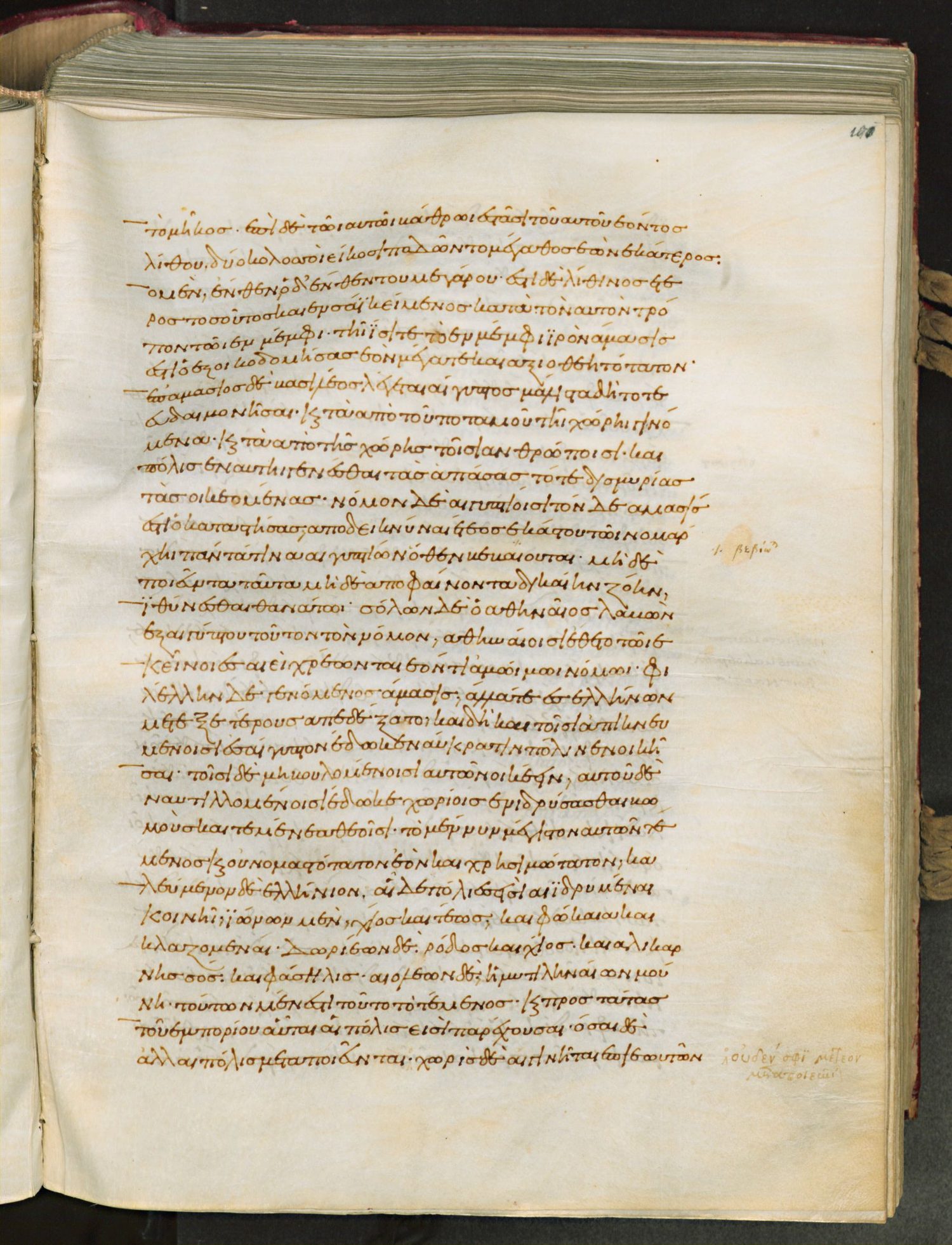
Laur. Plut. 70.3, fol. 101r: Greek here 2.176.1 to 2.178.3. Checked on the image (first and last words read and located in the Greek; each break checked against the neighbouring page): fol. 101r begins ‹τὸ μῆκος· ἐπὶ δὲ› (2.176.1), ends ‹δὲ Αἰγινῆται ἐπὶ ἑωυτῶν› (2.178.3). English here: 2.176.2 to 2.178.3 (Godley's sentences for the sections whose Greek lies mostly on this page).
2.176.1τὸ μῆκος· ἐπὶ δὲ τῷ αὐτῷ βάθρῳ ἑστᾶσι τοῦ αὐτοῦ ἐόντος λίθου δύο κολοσσοί, εἴκοσι ποδῶν τὸ μέγαθος ἐὼν ἑκάτερος, ὃ μὲν ἔνθεν ὃ δʼ ἔνθεν τοῦ μεγάλου. 2.176.2ἔστι δὲ λίθινος ἕτερος τοσοῦτος καὶ ἐν Σάι, κείμενος κατὰ τὸν αὐτὸν τρόπον τῷ ἐν Μέμφι. τῇ Ἴσι τε τὸ ἐν Μέμφι ἱρὸν Ἄμασις ἐστὶ ὁ ἐξοικοδομήσας, ἐὸν μέγα τε καὶ ἀξιοθεητότατον. 2.177.1ἐπʼ Ἀμάσιος δὲ βασιλέος λέγεται Αἴγυπτος μάλιστα δὴ τότε εὐδαιμονῆσαι καὶ τὰ ἀπὸ τοῦ ποταμοῦ τῇ χώρῃ γινόμενα καὶ τὰ ἀπὸ τῆς χώρης τοῖσι ἀνθρώποισι, καὶ πόλις ἐν αὐτῇ γενέσθαι τὰς ἁπάσας τότε δισμυρίας τὰς οἰκεομένας. 2.177.2νόμον τε Αἰγυπτίοισι τόνδε Ἄμασις ἐστὶ ὁ καταστήσας, ἀποδεικνύναι ἔτεος ἑκάστου τῷ νομάρχῃ πάντα τινὰ Αἰγυπτίων ὅθεν βιοῦται· μὴ δὲ ποιεῦντα ταῦτα μηδὲ ἀποφαίνοντα δικαίην ζόην ἰθύνεσθαι θανάτῳ. Σόλων δὲ ὁ Ἀθηναῖος λαβὼν ἐξ Αἰγύπτου τοῦτον τὸν νόμον Ἀθηναίοισι ἔθετο· τῷ ἐκεῖνοι ἐς αἰεὶ χρέωνται ἐόντι ἀμώμῳ νόμῳ. 2.178.1φιλέλλην δὲ γενόμενος ὁ Ἄμασις ἄλλα τε ἐς Ἑλλήνων μετεξετέρους ἀπεδέξατο, καὶ δὴ καὶ τοῖσι ἀπικνευμένοισι ἐς Αἴγυπτον ἔδωκε Ναύκρατιν πόλιν ἐνοικῆσαι· τοῖσι δὲ μὴ βουλομένοισι αὐτῶν οἰκέειν, αὐτοῦ δὲ ναυτιλλομένοισι ἔδωκε χώρους ἐνιδρύσασθαι βωμοὺς καὶ τεμένεα θεοῖσι. 2.178.2τὸ μέν νυν μέγιστον αὐτῶν τέμενος, καὶ ὀνομαστότατον ἐὸν καὶ χρησιμώτατον, καλεύμενον δὲ Ἑλλήνιον, αἵδε αἱ πόλιες εἰσὶ αἱ ἱδρυμέναι κοινῇ, Ἱώνων μὲν Χίος καὶ Τέως καὶ Φώκαια καὶ Κλαζομεναί, Δωριέων δὲ Ῥόδος καὶ Κνίδος καὶ Ἁλικαρνησσὸς καὶ Φάσηλις, Αἰολέων δὲ ἡ Μυτιληναίων μούνη. 2.178.3τουτέων μὲν ἐστὶ τοῦτο τὸ τέμενος, καὶ προστάτας τοῦ ἐμπορίου αὗται αἱ πόλιες εἰσὶ αἱ παρέχουσαι· ὅσαι δὲ ἄλλαι πόλιες μεταποιεῦνται, οὐδέν σφι μετεὸν μεταποιεῦνται. χωρὶς δὲ Αἰγινῆται ἐπὶ ἑωυτῶν
2.176.2There is at Saïs another stone figure of like bigness, lying as lies the figure at Memphis. It was Amasis, too, who built the great and most marvellous temple of Isis at Memphis. 2.177.1It is said that in the reign of Amasis Egypt attained to its greatest prosperity, in respect of what the river did for the land and the land for its people: and that the whole sum of inhabited cities in the country was twenty thousand. 2.177.2It was Amasis also who made the law that every Egyptian should yearly declare his means of livelihood to the ruler of his province, and, failing so to do or to prove that he had a just way of life, be punished with death. Solon the Athenian got this law from Egypt and established it among his people; may they ever keep it! for it is a perfect law. 2.178.1Amasis became a lover of the Greeks, and besides other services which he did to some of them he gave those who came to Egypt the city of Naucratis to dwell in, and to those who voyaged to the country without desire to settle there he gave lands where they might set altars and make holy places for their gods. 2.178.2Of these the greatest and most famous and most visited precinct is that which is called the Hellenion, founded jointly by the Ionian cities of Chios, Teos, Phocaea, and Clazomenae, the Dorian cities of Rhodes, Cnidus, Halicarnassus, and Phaselis, and one Aeolian city, Mytilene. 2.178.3It is to these that the precinct belongs, and these are they that appoint wardens of the port; if any others claim rights therein they lay claim to that wherein they have no part or lot. The Aeginetans made a precinct of their own, sacred to Zeus; and so did the Samians for Here and the Milesians for Apollo.
Where on the image
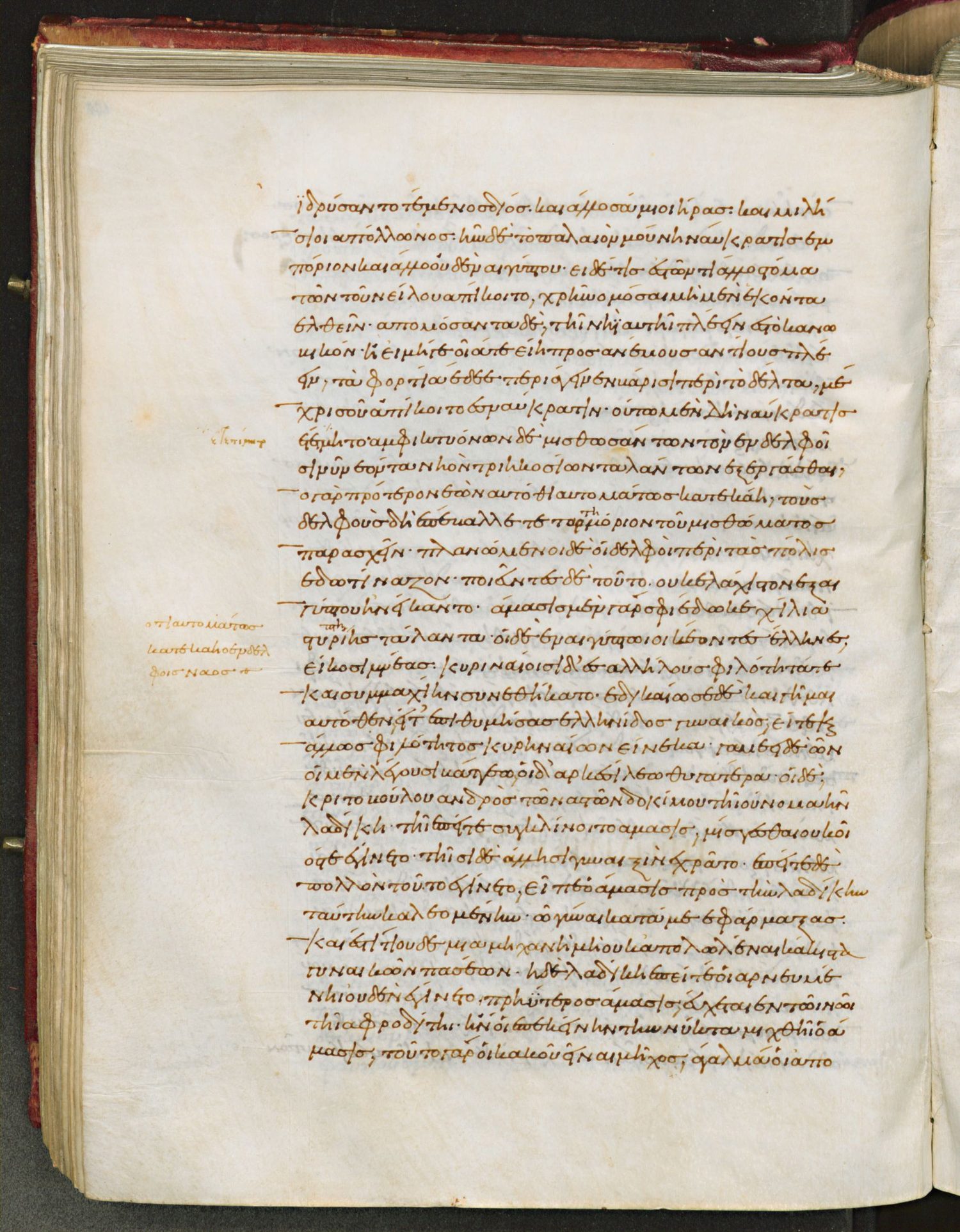
Laur. Plut. 70.3, fol. 101v: Greek here 2.178.3 to 2.181.4. Checked on the image (first and last words read and located in the Greek; each break checked against the neighbouring page): fol. 101v begins ‹ἱδρύσαντο τέμενος Διός, καὶ› (2.178.3), ends ‹μῆχος, ἄγαλμά οἱ ἀπο-› (2.181.4). English here: 2.179.1 to 2.181.4 (Godley's sentences for the sections whose Greek lies mostly on this page).
2.178.3ἱδρύσαντο τέμενος Διός, καὶ ἄλλο Σάμιοι Ἥρης καὶ Μιλήσιοι Ἀπόλλωνος. 2.179.1ἦν δὲ τὸ παλαιὸν μούνη Ναύκρατις ἐμπόριον καὶ ἄλλο οὐδὲν Αἰγύπτου· εἰ δέ τις ἐς τῶν τι ἄλλο στομάτων τοῦ Νείλου ἀπίκοιτο, χρῆν ὀμόσαι μὴ μὲν ἑκόντα ἐλθεῖν, ἀπομόσαντα δὲ τῇ νηὶ αὐτῇ πλέειν ἐς τὸ Κανωβικόν· ἢ εἰ μή γε οἷά τε εἴη πρὸς ἀνέμους ἀντίους πλέειν, τὰ φορτία ἔδεε περιάγειν ἐν βάρισι περὶ τὸ Δέλτα, μέχρι οὗ ἀπίκοιτο ἐς Ναύκρατιν. οὕτω μὲν δὴ Ναύκρατις ἐτετίμητο. 2.180.1Ἀμφικτυόνων δὲ μισθωσάντων τὸν ἐν Δελφοῖσι νῦν ἐόντα νηὸν τριηκοσίων ταλάντων ἐξεργάσασθαι (ὁ γὰρ πρότερον ἐὼν αὐτόθι αὐτόματος κατεκάη), τοὺς Δελφοὺς δὴ ἐπέβαλλε τεταρτημόριον τοῦ μισθώματος παρασχεῖν. 2.180.2πλανώμενοι δὲ οἱ Δελφοὶ περὶ τὰς πόλις ἐδωτίναζον, ποιεῦντες δὲ τοῦτο οὐκ ἐλάχιστον ἐξ Αἰγύπτου ἠνείκαντο· Ἄμασις μὲν γάρ σφι ἔδωκε χίλια στυπτηρίης τάλαντα, οἱ δὲ ἐν Αἰγύπτῳ οἰκέοντες Ἕλληνες εἴκοσι μνέας. 2.181.1Κυρηναίοισι δὲ Ἄμασις φιλότητά τε καὶ συμμαχίην συνεθήκατο, ἐδικαίωσε δὲ καὶ γῆμαι αὐτόθεν, εἴτʼ ἐπιθυμήσας Ἑλληνίδος γυναικὸς εἴτε καὶ ἄλλως φιλότητος Κυρηναίων εἵνεκα· 2.181.2γαμέει δὲ ὦν οἳ μὲν λέγουσι Βάττου οἳ δʼ Ἀρκεσίλεω θυγατέρα, οἳ δὲ Κριτοβούλου ἀνδρὸς τῶν ἀστῶν δοκίμου, τῇ οὔνομα ἦν Λαδίκη· τῇ ἐπείτε συγκλίνοιτο ὁ Ἄμασις, μίσγεσθαι οὐκ οἷός τε ἐγίνετο, τῇσι δὲ ἄλλῃσι γυναιξὶ ἐχρᾶτο. 2.181.3ἐπείτε δὲ πολλὸν τοῦτο ἐγίνετο, εἶπε ὁ Ἄμασις πρὸς τὴν Λαδίκην ταύτην καλεομένην, ὦ γύναι, κατά με ἐφάρμαξας, καὶ ἔστι τοι οὐδεμία μηχανὴ μὴ οὐκ ἀπολωλέναι κάκιστα γυναικῶν πασέων. 2.181.4ἡ δὲ Λαδίκη, ἐπείτε οἱ ἀρνευμένῃ οὐδὲν ἐγίνετο πρηΰτερος ὁ Ἄμασις, εὔχεται ἐν τῷ νόῳ τῇ Ἀφροδίτῃ, ἤν οἱ ὑπʼ ἐκείνην τὴν νύκτα μιχθῇ ὁ Ἄμασις, τοῦτο γάρ οἱ κακοῦ εἶναι μῆχος, ἄγαλμά οἱ ἀποπέμψειν
2.179.1Naucratis was in old time the only trading port in Egypt. Whosoever came to any other mouth of the Nile must swear that he had not come of his own will, and having so sworn must then take his ship and sail to the Canobic mouth; or, if he could not sail against contrary winds, he must carry his cargo in barges round the Delta till he came to Naucratis. In such honour was Naucratis held. 2.180.1When the Amphictyons had contracted for three hundred talents the work of finishing the temple that now stands at Delphi (that which was formerly there having been burnt by pure mischance), it fell to the Delphians to provide a fourth part of the cost. 2.180.2They went about from city to city collecting gifts, and in this business they got most from Egypt; for Amasis gave them a thousand talents’ weight of astringent earth, and the Greek dwellers in Egypt twenty minae. 2.181.1Amasis made friends and allies of the people of Cyrene. Moreover he thought fit to take himself a wife from thence; whether it was that he desired a Greek woman, or that he had other cause for winning the friendship of Cyrene, I 2.181.2know not; but he married one Ladice, said to be the daughter of Battus by some, of Arcesilaus by others, and by others again of Critobulus, an esteemed citizen of the place. But it so fell out that Ladice was the only woman with whom Amasis could not have intercourse; 2.181.3and this continuing, Amasis said to this Ladice, “Woman, you have cast a spell on me, and most assuredly you shall come to the most terrible end of all women.” 2.181.4So, the king’s anger not abating for all her denial, Ladice vowed in her heart to Aphrodite that she would send the goddess a statue to Cyrene if Amasis had intercourse with her that night; for that would remedy the evil; and thereafter all went well, and Amasis loved his wife much.
Where on the image
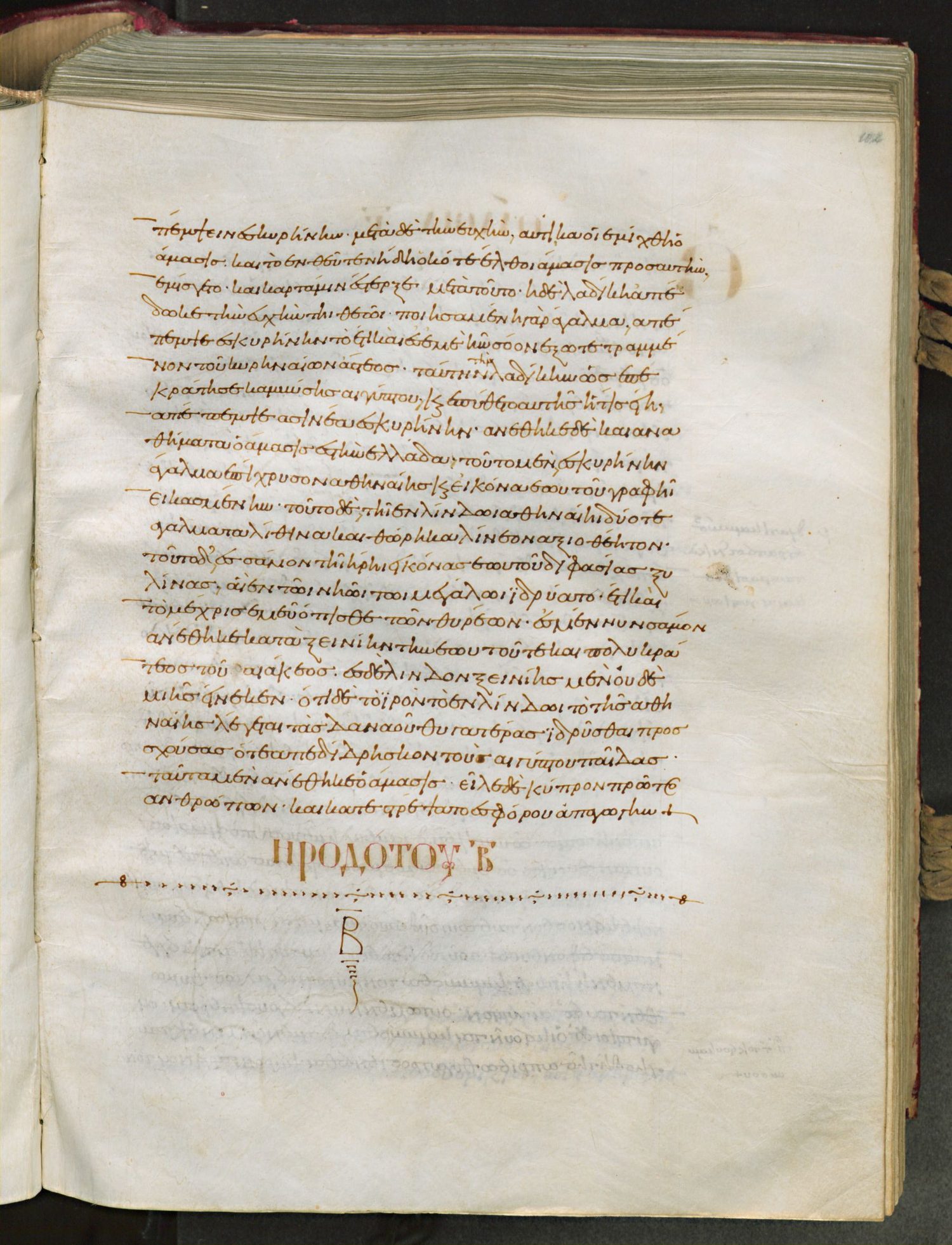
Laur. Plut. 70.3, fol. 102r: Greek here 2.181.4 to 2.182.2. Checked on the image (first and last words read and located in the Greek; each break checked against the neighbouring page): fol. 102r begins ‹-πέμψειν ἐς Κυρήνην. μετὰ› (2.181.4), ends ‹κατεστρέψατο ἐς φόρου ἀπαγωγήν› (2.182.2). The word ‹ἀποπέμψειν› is divided between fol. 101v and fol. 102r; it is given with fol. 101v. Book 2 ends in line 24; below it, the subscription Ἡροδότου β´ in red and a decorative line. English here: 2.181.5 to 2.182.2 (Godley's sentences for the sections whose Greek lies mostly on this page).
2.181.4ἐς Κυρήνην. μετὰ δὲ τὴν εὐχὴν αὐτίκα οἱ ἐμίχθη ὁ Ἄμασις. καὶ τὸ ἐνθεῦτεν ἤδη, ὁκότε ἔλθοι Ἄμασις πρὸς αὐτήν, ἐμίσγετο, καὶ κάρτα μιν ἔστερξε μετὰ τοῦτο. 2.181.5ἡ δὲ Λαδίκη ἀπέδωκε τὴν εὐχὴν τῇ θεῷ· ποιησαμένη γὰρ ἄγαλμα ἀπέπεμψε ἐς Κυρήνην, τὸ ἔτι καὶ ἐς ἐμὲ ἦν σόον, ἔξω τετραμμένον τοῦ Κυρηναίων ἄστεος. ταύτην τὴν Λαδίκην, ὡς ἐπεκράτησε Καμβύσης Αἰγύπτου καὶ ἐπύθετο αὐτῆς ἥτις εἴη, ἀπέπεμψε ἀσινέα ἐς Κυρήνην. 2.182.1ἀνέθηκε δὲ καὶ ἀναθήματα ὁ Ἄμασις ἐς τὴν Ἑλλάδα, τοῦτο μὲν ἐς Κυρήνην ἄγαλμα ἐπίχρυσον Ἀθηναίης καὶ εἰκόνα ἑωυτοῦ γραφῇ εἰκασμένην, τοῦτο δὲ τῇ ἐν Λίνδῳ Ἀθηναίῃ δύο τε ἀγάλματα λίθινα καὶ θώρηκα λίνεον ἀξιοθέητον, τοῦτο δʼ ἐς Σάμον τῇ Ἥρῃ εἰκόνας ἑωυτοῦ διφασίας ξυλίνας, αἳ ἐν τῷ νηῷ τῷ μεγάλῳ ἱδρύατο ἔτι καὶ τὸ μέχρι ἐμεῦ, ὄπισθε τῶν θυρέων. 2.182.2ἐς μέν νυν Σάμον ἀνέθηκε κατὰ ξεινίην τὴν ἑωυτοῦ τε καὶ Πολυκράτεος τοῦ Αἰάκεος, ἐς δὲ Λίνδον ξεινίης μὲν οὐδεμιῆς εἵνεκεν, ὅτι δὲ τὸ ἱρὸν τὸ ἐν Λίνδῳ τὸ τῆς Ἀθηναίης λέγεται τὰς Δαναοῦ θυγατέρας ἱδρύσασθαι προσσχούσας, ὅτε ἀπεδίδρησκον τοὺς Αἰγύπτου παῖδας. ταῦτα μὲν ἀνέθηκε ὁ Ἄμασις, εἷλε δὲ Κύπρον πρῶτος ἀνθρώπων καὶ κατεστρέψατο ἐς φόρου ἀπαγωγήν.
2.181.5Ladice paid her vow to the goddess; she had an image made and sent it to Cyrene, where it stood safe till my time, facing outwards from the city. Cambyses, when he had conquered Egypt and learnt who Ladice was, sent her away to Cyrene unharmed. 2.182.1Moreover Amasis dedicated offerings in Hellas. He gave to Cyrene a gilt image of Athene and a painted picture of himself, to Athene of Lindus two stone images and a marvellous linen breast-plate, and to Here in Samos two wooden statues of himself, which stood yet in my time behind the doors in the great shrine. 2.182.2The offerings in Samos were dedicated by reason of the friendship between Amasis and Polycrates son of Aeaces; what he gave to Lindus was for no friendship with any man, but because it is said that the temple of Athene in Lindus was founded by the daughters of Danaus, when they landed there in their flight from the sons of Egyptus. Such were Amasis’ offerings. Moreover he was the first conqueror of Cyprus, which he made tributary to himself.
Notes
- Greek: the text printed in A. D. Godley's Loeb edition, via Perseus (tlg0016.tlg001.perseus-grc2). Square brackets mark words the editor considers later additions; [...] marks a gap the editor indicates. Perseus note markers are omitted.
- English: A. D. Godley, Herodotus vol. 1 (1920) (Loeb Classical Library), as transcribed on Wikisource. Godley's footnotes are omitted.
- Section numbers in the English were placed by comparing Godley's text with the Perseus version of his translation; where a section begins inside one of Godley's sentences, the English is kept with the page that holds the start of that sentence.
Cite
Sources
- Source: Florence, Laur. Plut. 70.3 (10th c.) via BML Teca Digitale + Greek of Godley's Loeb (Perseus) + English of A. D. Godley (Loeb, Wikisource) (holding institution)
- Critical edition: Greek of A. D. Godley's Loeb edition (1920-1925), via Perseus
← previous · → next · v cycle view · l back to library