Herodotus, Histories 3.1-16: Cambyses conquers Egypt
Introduction
Herodotus of Halicarnassus wrote the Histories in the third quarter of the 5th century BCE, an inquiry into the deeds of Greeks and barbarians and the causes of the wars between them, later divided into nine books. Book 3 tells of Cambyses' conquest of Egypt and his madness, Polycrates of Samos, the rising of the Magi and the seven Persians who overthrew them, the accession of Darius and his provinces, and the revolt and recapture of Babylon.
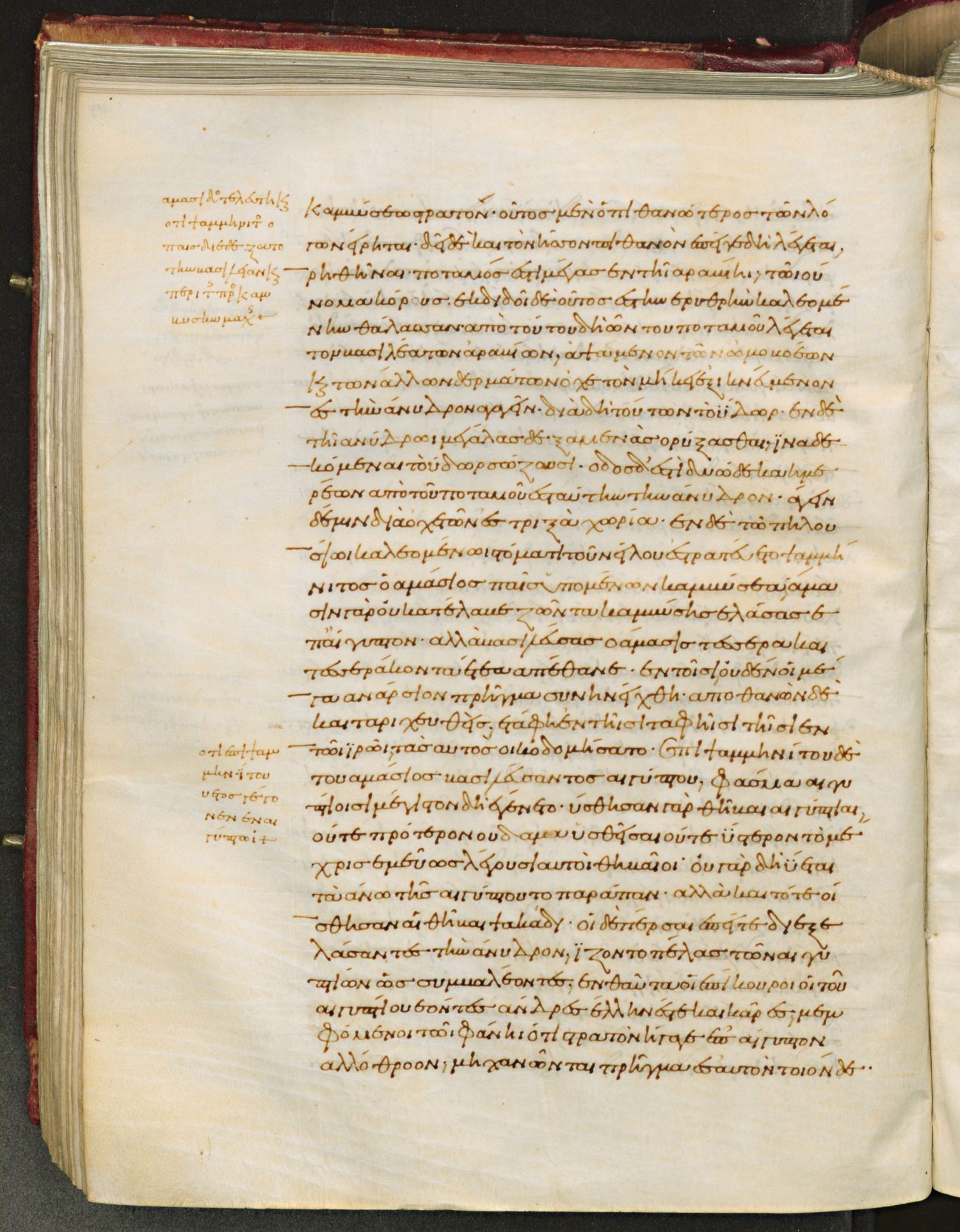
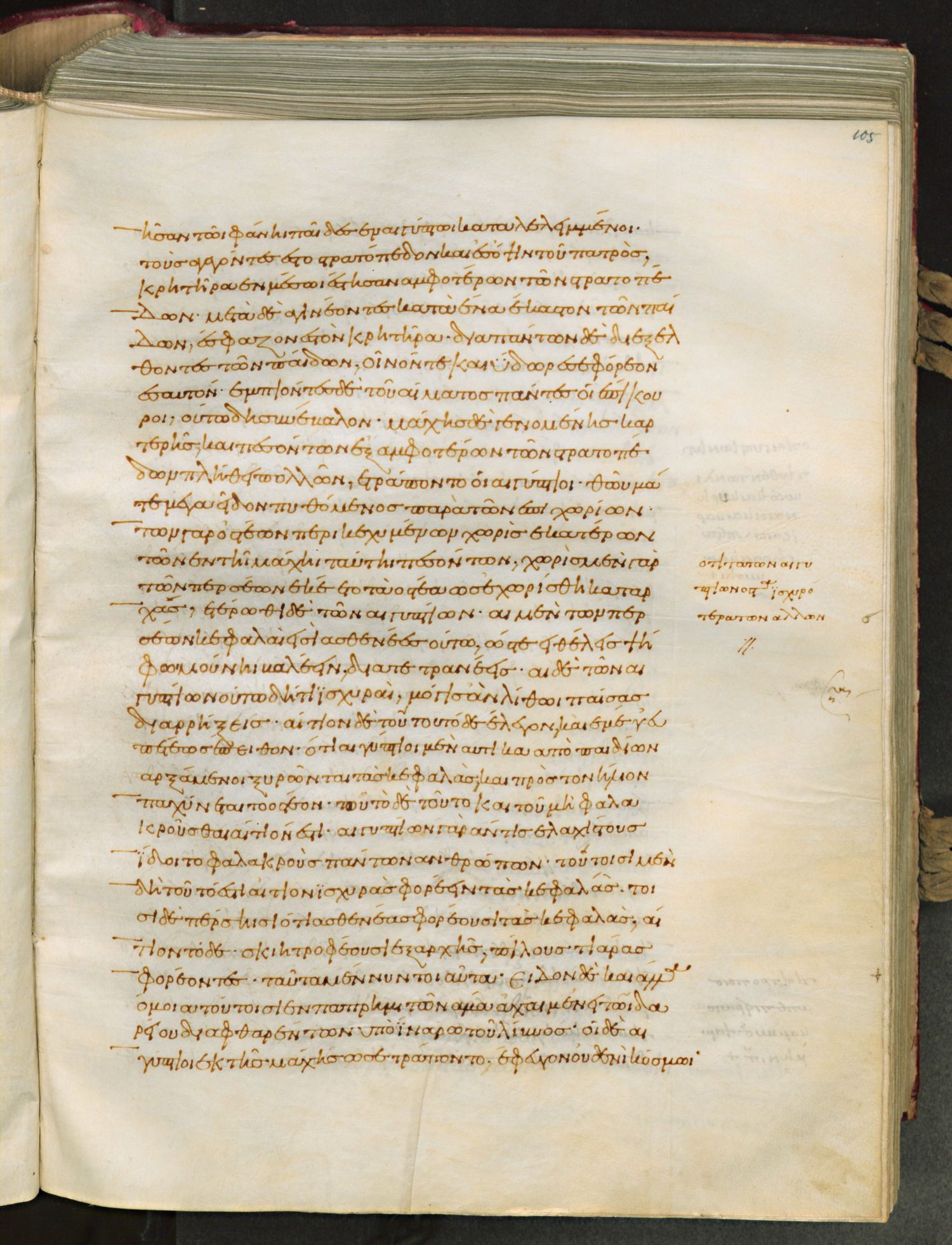
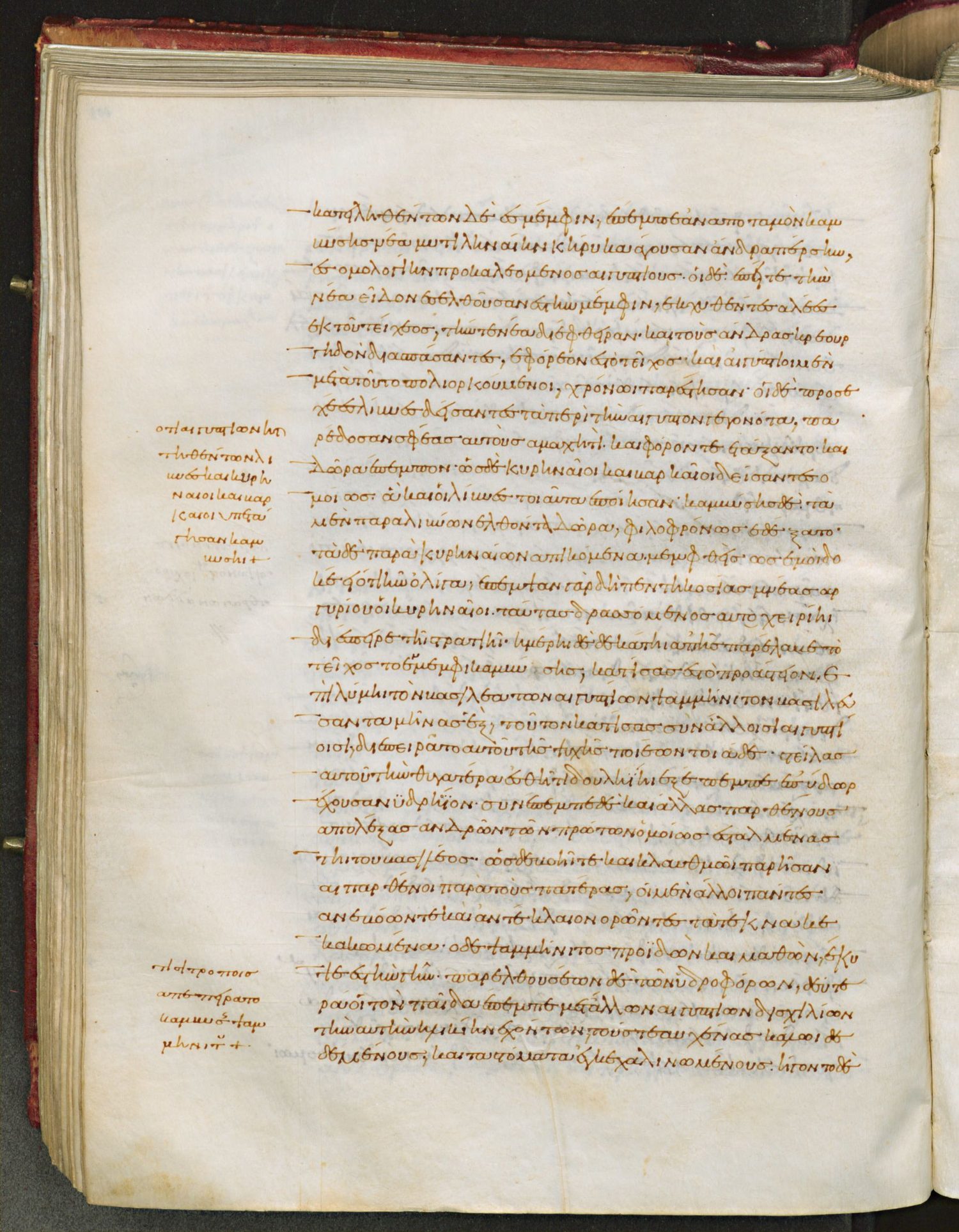
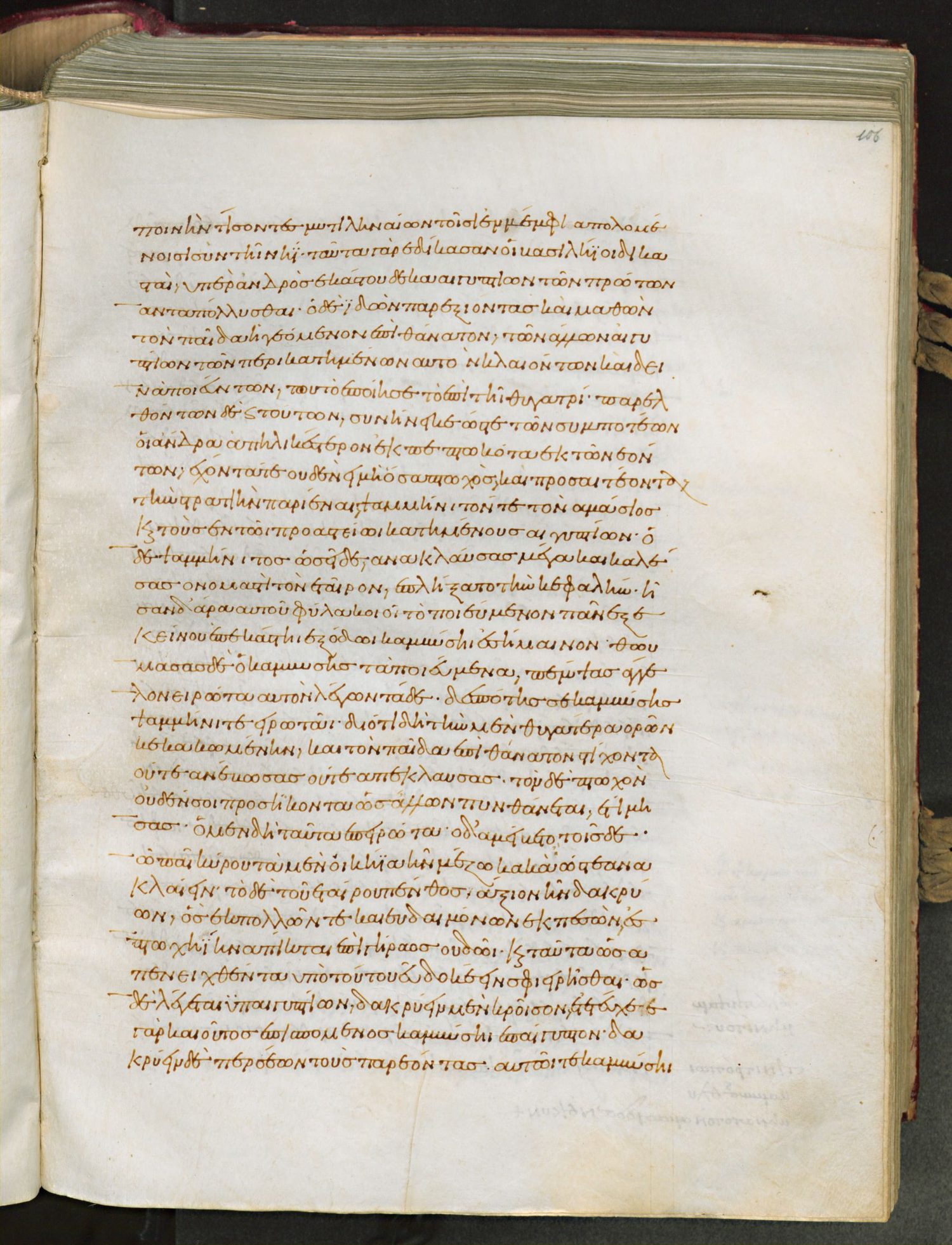
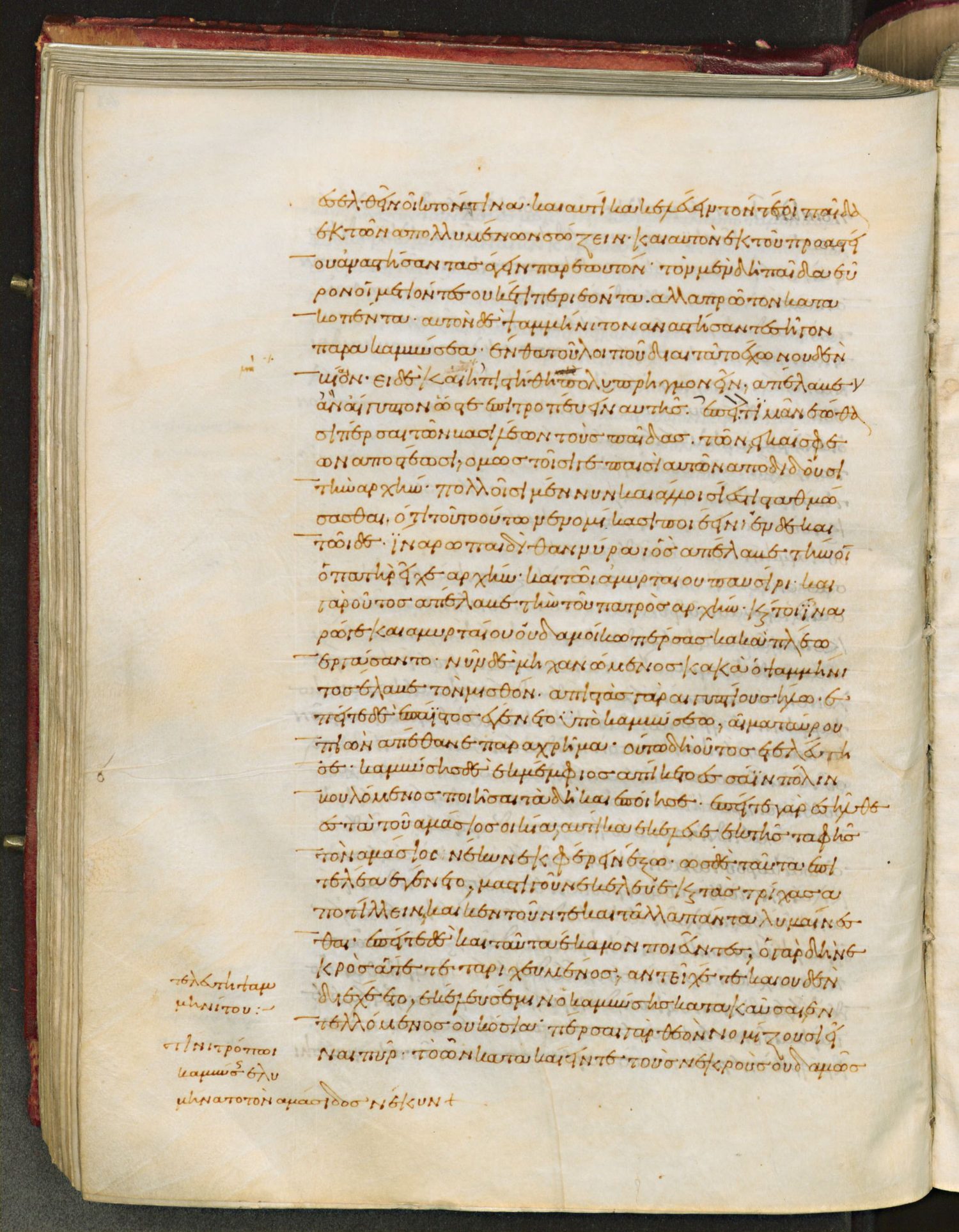
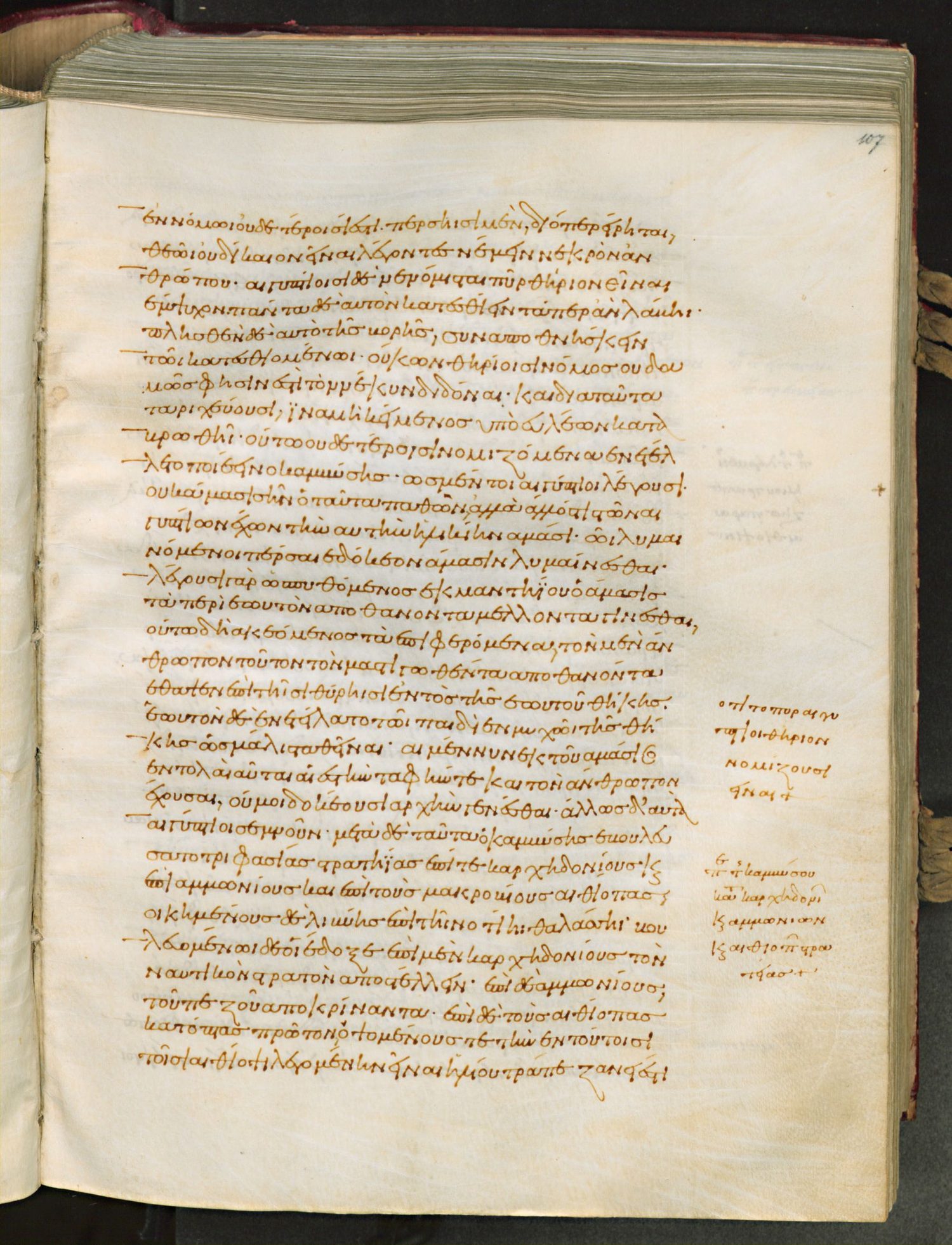
The photographs are of Florence, Biblioteca Medicea Laurenziana, Plut. 70.3 (parchment, 10th century, 374 folios, 31 lines a page), Herodotus, Histories (codex A of the editors), the oldest surviving manuscript of the complete Histories, from the Teca Digitale of the Biblioteca Medicea Laurenziana. Each section below is the text of one page, or of the part of a page that falls within these chapters. The first and last words of every page were read on the photograph and located in the Greek, and every page break was checked against the next page; the notes quote these words. Readers' notes in the margins are not part of the text and are mentioned where they occur.
The Greek is the text printed in A. D. Godley's Loeb edition (1920-1925), from Perseus; it is the edited text, not a transcription of the manuscript, whose wording differs in places. The English is Godley's translation as printed, from Wikisource. Godley's English carries only chapter numbers; the section numbers shown in it were placed by comparison with the Perseus version of his translation. Each page's English is cut at the end of one of Godley's sentences, so it can begin or end a few lines away from the Greek of the page; each note gives the exact ranges.
This entry covers chapters 3.1-16, on fol. 102v to 107r.
How was this verified? (Provenance)
Where on the image
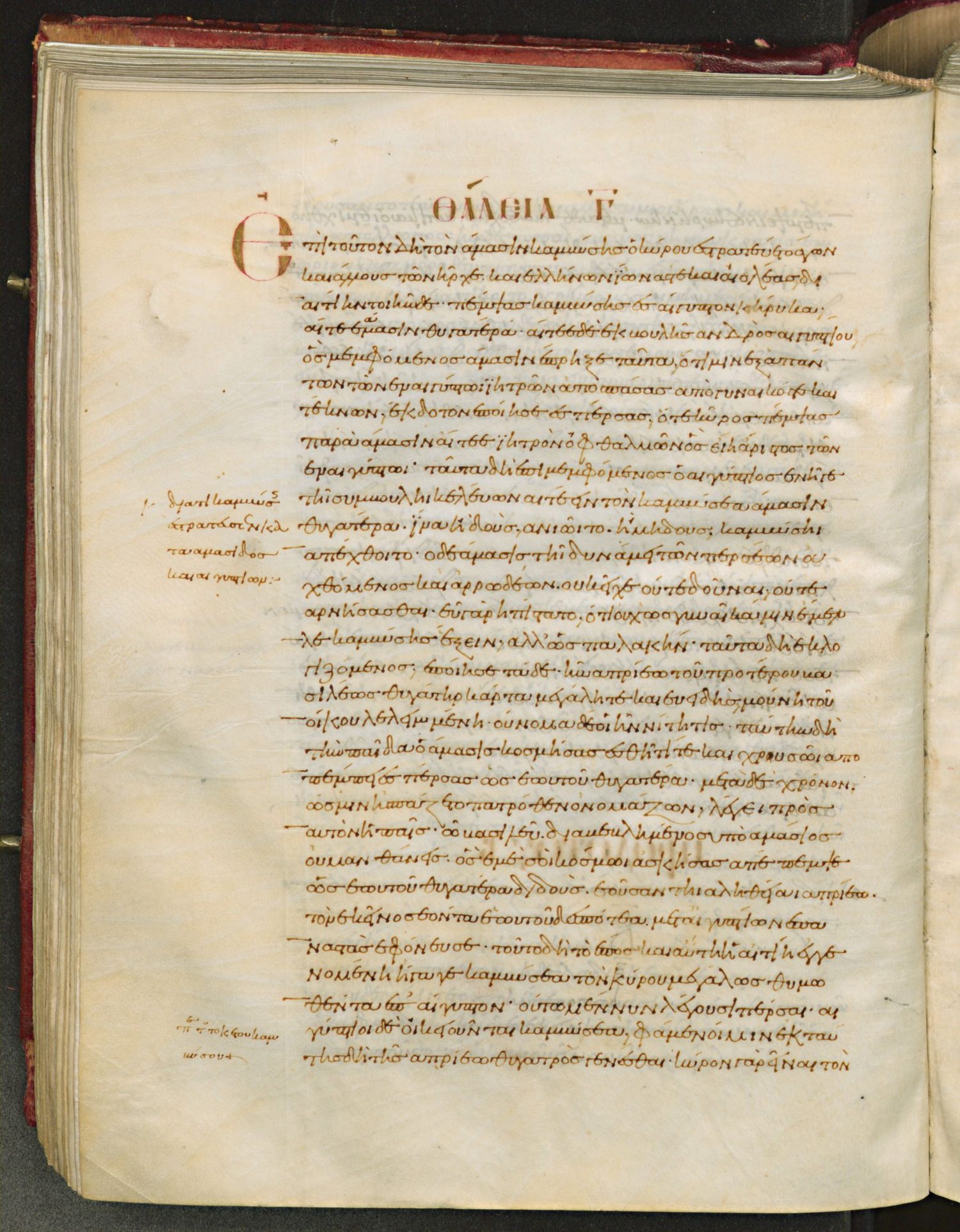
Laur. Plut. 70.3, fol. 102v: Greek here 3.1.1 to 3.2.1. Checked on the image (first and last words read and located in the Greek; each break checked against the neighbouring page): fol. 102v begins ‹ἐπὶ τοῦτον δὴ τὸν› (3.1.1), ends ‹Κῦρον γὰρ εἶναι τὸν› (3.2.1). Book 3 begins under the red title Θάλεια γ´ with a red initial Ε. English here: 3.1.1 to 3.2.1 (Godley's sentences for the sections whose Greek lies mostly on this page).
3.1.1ἐπὶ τοῦτον δὴ τὸν Ἄμασιν Καμβύσης ὁ Κύρου ἐστρατεύετο, ἄγων καί ἄλλους τῶν ἦρχε καὶ Ἑλλήνων Ἴωνάς τε καὶ Αἰολέας, διʼ αἰτίην τοιήνδε. πέμψας Καμβύσης ἐς Αἴγυπτον κήρυκα αἴτεε Ἄμασιν θυγατέρα, αἴτεε δὲ ἐκ βουλῆς ἀνδρὸς Αἰγυπτίου, ὃς μεμφόμενος Ἄμασιν ἔπρηξε ταῦτα ὅτι μιν ἐξ ἁπάντων τῶν ἐν Αἰγύπτῳ ἰητρῶν ἀποσπάσας ἀπὸ γυναικός τε καὶ τέκνων ἔκδοτον ἐποίησε ἐς Πέρσας, ὅτε Κῦρος πέμψας παρὰ Ἄμασιν αἴτεε ἰητρὸν ὀφθαλμῶν ὃς εἴη ἄριστος τῶν ἐν Αἰγύπτῳ. 3.1.2ταῦτα δὴ ἐπιμεμφόμενος ὁ Αἰγύπτιος ἐνῆγε τῇ συμβουλῇ κελεύων αἰτέειν τὸν Καμβύσεα Ἄμασιν θυγατέρα, ἵνα ἢ δοὺς ἀνιῷτο ἢ μὴ δοὺς Καμβύσῃ ἀπέχθοιτο. ὁ δὲ Ἄμασις τῇ δυνάμι τῶν Περσέων ἀχθόμενος καὶ ἀρρωδέων οὐκ εἶχε οὔτε δοῦναι οὔτε ἀρνήσασθαι· εὖ γὰρ ἠπίστατο ὅτι οὐκ ὡς γυναῖκά μιν ἔμελλε Καμβύσης ἕξειν ἀλλʼ ὡς παλλακήν. 3.1.3ταῦτα δὴ ἐκλογιζόμενος ἐποίησε τάδε. ἦν Ἀπρίεω τοῦ προτέρου βασιλέος θυγάτηρ κάρτα μεγάλη τε καὶ εὐειδὴς μούνη τοῦ οἴκου λελειμμένη, οὔνομα δέ οἱ ἦν Νίτητις· ταύτην δὴ τὴν παῖδα ὁ Ἄμασις κοσμήσας ἐσθῆτί τε καὶ χρυσῷ ἀποπέμπει ἐς Πέρσας ὡς ἑωυτοῦ θυγατέρα. 3.1.4μετὰ δὲ χρόνον ὥς μιν ἠσπάζετο πατρόθεν ὀνομάζων, λέγει πρὸς αὐτὸν ἡ παῖς ὦ βασιλεῦ, διαβεβλημένος ὑπὸ Ἀμάσιος οὐ μανθάνεις. ὃς ἐμὲ σοὶ κόσμῳ ἀσκήσας ἀπέπεμψε ὡς ἑωυτοῦ θυγατέρα διδούς, ἐοῦσαν τῇ ἀληθείῃ Ἀπρίεω, τὸν ἐκεῖνος ἐόντα ἑωυτοῦ δεσπότεα μετʼ Αἰγυπτίων ἐπαναστὰς ἐφόνευσε. 3.1.5τοῦτο δὴ τὸ ἔπος καὶ αὕτη ἡ αἰτίη ἐγγενομένη ἤγαγε Καμβύσεα τὸν Κύρου μεγάλως θυμωθέντα ἐπʼ Αἴγυπτον. 3.2.1οὕτω μέν νυν λέγουσι Πέρσαι. Αἰγύπτιοι δὲ οἰκηιοῦνται Καμβύσεα, φάμενοί μιν ἐκ ταύτης δὴ τῆς Ἀπρίεω θυγατρὸς γενέσθαι· Κῦρον γὰρ εἶναι τὸν
3.1.1It was against this Amasis that Cambyses led an army of his subjects, Ionian and Aeolian Greeks among them. This was his reason: Cambyses sent a herald to Egypt asking Amasis for his daughter; and this he did by the counsel of a certain Egyptian, who devised it by reason of a grudge that he bore against Amasis, because when Cyrus sent to Amasis asking for the best eye-doctor in Egypt the king had chosen this man 3.1.2out of all the Egyptian physicians and sent him perforce to Persia away from his wife and children. With this grudge in mind he moved Cambyses by his counsel to ask Amasis for his daughter, that Amasis might be grieved if he gave her, or Cambyses’ enemy if he refused her. So Amasis was sorely afraid of the power of Persia, and could neither give his daughter nor deny her; for he knew well that Cambyses would make her not his queen but his mistress. 3.1.3Reasoning thus he bethought him of a very tall and fair damsel called Nitetis, daughter of the former king Apries, and all that was left of that family; Amasis decked her out with raiment and golden ornaments and sent her to the Persians as if she were his own daughter. 3.1.4But after a while, the king greeting her as the daughter of Amasis, the damsel said, “King, you know not how Amasis has deceived you: he decked me out with ornaments and sent me to you to pass for his own daughter; but I am in truth the daughter of his master Apries, whom he and other Egyptians rebelled against and slew.” 3.1.5It was these words and this reason that prevailed with Cambyses to lead him in great anger against Egypt. 3.2.1This is the Persian story. But the Egyptians claim Cambyses for their own; they say that he was the son of this daughter of Apries, and that it was Cyrus, not Cambyses, who sent to Amasis for his daughter.
Where on the image
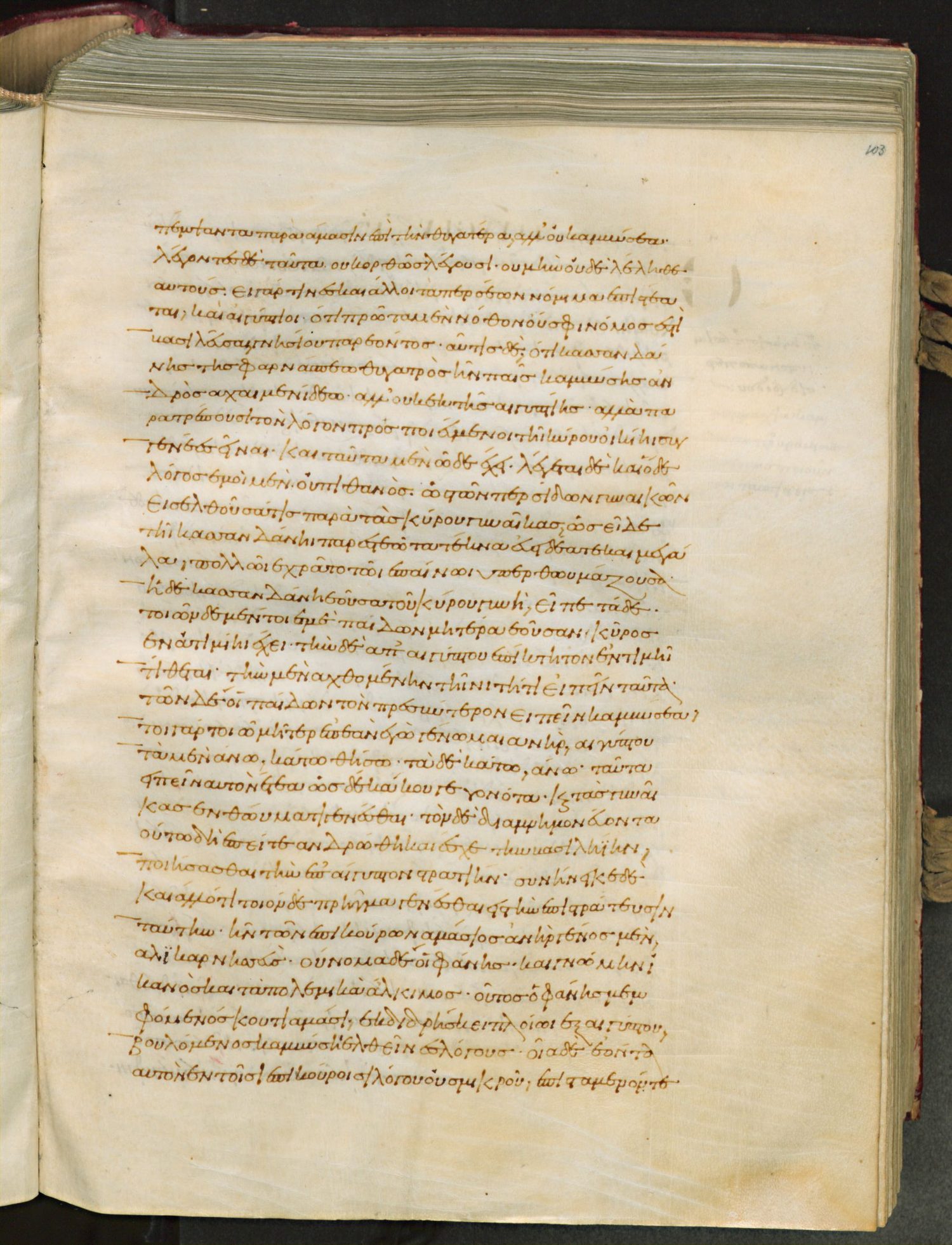
Laur. Plut. 70.3, fol. 103r: Greek here 3.2.1 to 3.4.2. Checked on the image (first and last words read and located in the Greek; each break checked against the neighbouring page): fol. 103r begins ‹πέμψαντα παρὰ Ἄμασιν ἐπὶ› (3.2.1), ends ‹οὐ σμικροῦ ἐπιστάμενόν τε› (3.4.2). English here: 3.2.2 to 3.4.1 (Godley's sentences for the sections whose Greek lies mostly on this page).
3.2.1πέμψαντα παρὰ Ἄμασιν ἐπὶ τὴν θυγατέρα, ἀλλʼ οὐ Καμβύσεα. λέγοντες δὲ ταῦτα οὐκ ὀρθῶς λέγουσι. 3.2.2οὐ μὲν οὐδὲ λέληθε αὐτούς (εἰ γὰρ τινὲς καὶ ἄλλοι, τὰ Περσέων νόμιμα ἐπιστέαται καὶ Αἰγύπτιοι) ὅτι πρῶτα μὲν νόθον οὔ σφι νόμος ἐστὶ βασιλεῦσαι γνησίου παρεόντος, αὖτις δὲ ὅτι Κασσανδάνης τῆς Φαρνάσπεω θυγατρὸς ἦν παῖς Καμβύσης, ἀνδρὸς Ἀχαιμενίδεω, ἀλλʼ οὐκ ἐκ τῆς Αἰγυπτίης. ἀλλὰ παρατρέπουσι τὸν λόγον προσποιεύμενοι τῇ Κύρου οἰκίῃ συγγενέες εἶναι. 3.3.1καὶ ταῦτα μὲν ὧδε ἔχει. λέγεται δὲ καὶ ὅδε λόγος, ἐμοὶ μὲν οὐ πιθανός, ὡς τῶν Περσίδων γυναικῶν ἐσελθοῦσά τις παρὰ τὰς Κύρου γυναῖκας, ὡς εἶδε τῇ Κασσανδάνῃ παρεστεῶτα τέκνα εὐειδέα τε καὶ μεγάλα, πολλῷ ἐχρᾶτο τῷ ἐπαίνῳ ὑπερθωμάζουσα, ἡ δὲ Κασσανδάνη ἐοῦσα τοῦ Κύρου γυνὴ εἶπε τάδε· 3.3.2τοιῶνδε μέντοι ἐμὲ παίδων μητέρα ἐοῦσαν Κῦρος ἐν ἀτιμίῃ ἔχει, τὴν δὲ ἀπʼ Αἰγύπτου ἐπίκτητον ἐν τιμῇ τίθεται. τὴν μὲν ἀχθομένην τῇ Νιτήτι εἰπεῖν ταῦτα, τῶν δέ οἱ παίδων τὸν πρεσβύτερον εἰπεῖν Καμβύσεα· 3.3.3τοιγάρ τοι ὦ μῆτερ, ἐπεὰν ἐγὼ γένωμαι ἀνήρ, Αἰγύπτου τὰ μὲν ἄνω κάτω θήσω, τὰ δὲ κάτω ἄνω. ταῦτα εἰπεῖν αὐτὸν ἔτεα ὡς δέκα κου γεγονότα, καὶ τὰς γυναῖκας ἐν θώματι γενέσθαι· τὸν δὲ διαμνημονεύοντα οὕτω δή, ἐπείτε ἀνδρώθη καὶ ἔσχε τὴν βασιληίην, ποιήσασθαι τὴν ἐπʼ Αἴγυπτον στρατηίην. 3.4.1συνήνεικε δὲ καὶ ἄλλο τι τοιόνδε πρῆγμα γενέσθαι ἐς τὴν ἐπιστράτευσιν ταύτην. ἦν τῶν ἐπικούρων Ἀμάσιος ἀνὴρ γένος μὲν Ἁλικαρνησσεύς, οὔνομα δέ οἱ Φάνης, καὶ γνώμην ἱκανὸς καὶ τὰ πολεμικὰ ἄλκιμος. 3.4.2οὗτος ὁ Φάνης μεμφόμενός κού τι Ἀμάσι ἐκδιδρήσκει πλοίῳ ἐξ Αἰγύπτου, βουλόμενος Καμβύσῃ ἐλθεῖν ἐς λόγους. οἷα δὲ ἐόντα αὐτὸν ἐν τοῖσι ἐπικούροισι λόγου οὐ σμικροῦ ἐπιστάμενόν τε
3.2.2But this tale is false. Nay, they are well aware (for the Egyptians have a truer knowledge than any man of the Persian laws) firstly, that no bastard may be king of Persia if there be a son born in lawful wedlock; and secondly, that Cambyses was born not of the Egyptian woman but of Cassandane, daughter of Pharnaspes, an Achaemenid. But they so twist the story because they would claim kinship with the house of Cyrus. 3.3.1So much for this matter. There is another tale too, which I do not believe:—that a certain Persian lady came to visit Cyrus’ wives, and greatly praised and admired the fair and tall children who stood by Cassandane. 3.3.2Then Cassandane, Cyrus’ wife, said, “Ay, yet though I be the mother of such children Cyrus dishonours me and honours this newcomer from Egypt.” So she spoke in her bitterness against Nitetis; and Cambyses, the eldest of her sons, said, “ 3.3.3Then, mother, when I am grown a man, I will turn all Egypt upside down.” When he said this he was about ten years old, and the women marvelled at him; but he kept it in mind, and it was thus that when he grew up and became king, he made the expedition against Egypt. 3.4.1It chanced also that another thing befell tending to this expedition. There was among Amasis’ foreign soldiers one Phanes, a Halicarnassian by birth, a man of sufficient judgment and valiant in war.
Where on the image
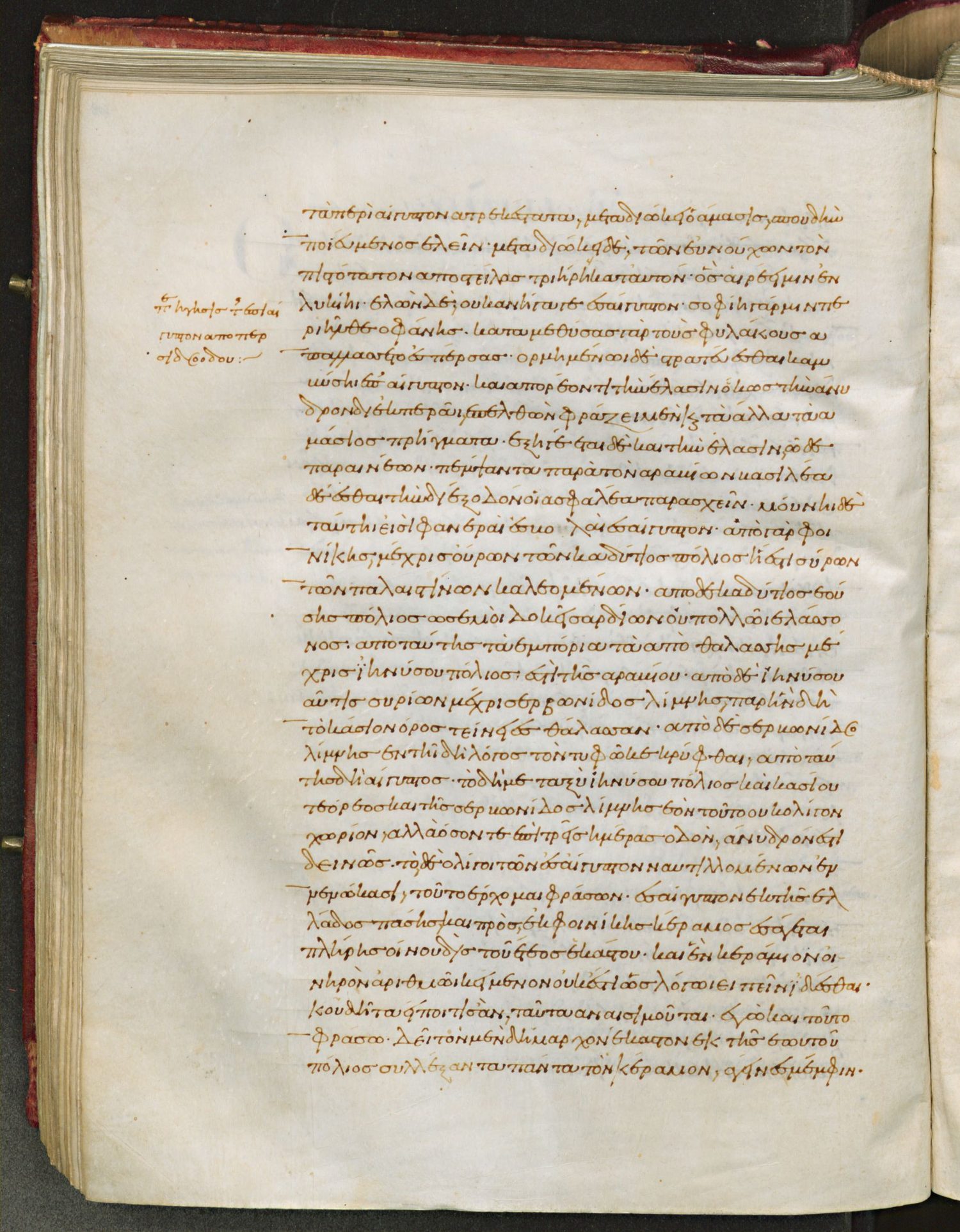
Laur. Plut. 70.3, fol. 103v: Greek here 3.4.2 to 3.6.2. Checked on the image (first and last words read and located in the Greek; each break checked against the neighbouring page): fol. 103v begins ‹τὰ περὶ Αἴγυπτον ἀτρεκέστατα,› (3.4.2), ends ‹κέραμον ἄγειν ἐς Μέμφιν› (3.6.2). English here: 3.4.2 to 3.6.1 (Godley's sentences for the sections whose Greek lies mostly on this page).
3.4.2τὰ περὶ Αἴγυπτον ἀτρεκέστατα, μεταδιώκει ὁ Ἄμασις σπουδὴν ποιεύμενος ἑλεῖν, μεταδιώκει δὲ τῶν εὐνούχων τὸν πιστότατον ἀποστείλας τριήρεϊ κατʼ αὐτόν, ὃς αἱρέει μιν ἐν Λυκίῃ, ἑλὼν δὲ οὐκ ἀνήγαγε ἐς Αἴγυπτον· σοφίῃ γάρ μιν περιῆλθε ὁ Φάνης· 3.4.3καταμεθύσας γὰρ τοὺς φυλάκους ἀπαλλάσσετο ἐς Πέρσας. ὁρμημένῳ δὲ στρατεύεσθαι Καμβύσῃ ἐπʼ Αἴγυπτον καὶ ἀπορέοντι τὴν ἔλασιν, ὅκως τὴν ἄνυδρον διεκπερᾷ, ἐπελθὼν φράζει μὲν καὶ τὰ ἄλλα τὰ Ἀμάσιος πρήγματα, ἐξηγέεται δὲ καὶ τὴν ἔλασιν, ὧδε παραινέων, πέμψαντα παρὰ τὸν Ἀραβίων βασιλέα δέεσθαι τὴν διέξοδόν οἱ ἀσφαλέα παρασχεῖν. 3.5.1μούνῃ δὲ ταύτῃ εἰσὶ φανεραὶ ἐσβολαὶ ἐς Αἴγυπτον. ἀπὸ γὰρ Φοινίκης μέχρι οὔρων τῶν Καδύτιος πόλιος ἐστὶ Σύρων τῶν Παλαιστίνων καλεομένων· 3.5.2ἀπὸ δὲ Καδύτιος ἐούσης πόλιος, ὡς ἐμοὶ δοκέει, Σαρδίων οὐ πολλῷ ἐλάσσονος, ἀπὸ ταύτης τὰ ἐμπόρια τὰ ἐπὶ θαλάσσης μέχρι Ἰηνύσου πόλιος ἐστὶ τοῦ Ἀραβίου, ἀπὸ δὲ Ἰηνύσου αὖτις Σύρων μέχρι Σερβωνίδος λίμνης, παρʼ ἣν δὴ τὸ Κάσιον ὄρος τείνει ἐς θάλασσαν· 3.5.3ἀπὸ δὲ Σερβωνίδος λίμνης, ἐν τῇ δὴ λόγος τὸν Τυφῶ κεκρύφθαι, ἀπὸ ταύτης ἤδη Αἴγυπτος. τὸ δὴ μεταξὺ Ἰηνύσου πόλιος καὶ Κασίου τε ὄρεος καὶ τῆς Σερβωνίδος λίμνης, ἐὸν τοῦτο οὐκ ὀλίγον χωρίον ἀλλὰ ὅσον τε ἐπὶ τρεῖς ἡμέρας ὁδόν, ἄνυδρον ἐστὶ δεινῶς. 3.6.1τὸ δὲ ὀλίγοι τῶν ἐς Αἴγυπτον ναυτιλλομένων ἐννενώκασι, τοῦτο ἔρχομαι φράσων. ἐς Αἴγυπτον ἐκ τῆς Ἑλλάδος πάσης καὶ πρὸς ἐκ Φοινίκης κέραμος ἐσάγεται πλήρης οἴνου δὶς τοῦ ἔτεος ἑκάστου, καὶ ἓν κεράμιον οἰνηρὸν ἀριθμῷ κεινὸν οὐκ ἔστι ὡς λόγῳ εἰπεῖν ἰδέσθαι. 3.6.2κοῦ δῆτα, εἴποι τις ἄν, ταῦτα ἀναισιμοῦται; ἐγὼ καὶ τοῦτο φράσω· δεῖ τὸν μὲν δήμαρχον ἕκαστον ἐκ τῆς ἑωυτοῦ πόλιος συλλέξαντα πάντα τὸν κέραμον ἄγειν ἐς Μέμφιν,
3.4.2This Phanes had some grudge against Amasis, and fled from Egypt on shipboard that he might have an audience of Cambyses. Seeing that he was a man much esteemed among the foreign soldiery and had an exact knowledge of all Egyptian matters, Amasis was zealous to take him, and sent a trireme with the trustiest of his eunuchs to pursue him. This eunuch caught him in Lycia but never brought him back to Egypt; for Phanes was too clever for him, and made his guards drunk and so escaped to Persia. 3.4.3There he found Cambyses prepared to set forth against Egypt, but in doubt as to his march, how he should cross the waterless desert; so Phanes showed him what was Amasis’ condition and how he should march; as to this, he counselled Cambyses to send and ask the king of the Arabians for a safe passage. 3.5.1Now the only manifest way of entry into Egypt is this. The road runs from Phoenice as far as the borders of the city of Cadytis, which belongs to the Syrians of Palestine, as it is called. 3.5.2From Cadytis (which, as I judge, is a city not much smaller than Sardis) to the city of Ienysus the seaports belong to the Arabians; then they are Syrian again from Ienysus as far as the Serbonian marsh, beside which the Casian promontory stretches seawards; 3.5.3from this Serbonian marsh, where Typho, it is said, was hidden, the country is Egypt. Now between Ienysus and the Casian mountain and the Serbonian marsh there lies a wide territory for as much as three days’ journey, wondrous waterless. 3.6.1I will now tell of a thing that but few of those who sail to Egypt have perceived. Earthen jars full of wine are brought into Egypt twice a year from all Greece and Phoenice besides: yet one might safely say there is not a single empty wine jar anywhere in the country.
Where on the image
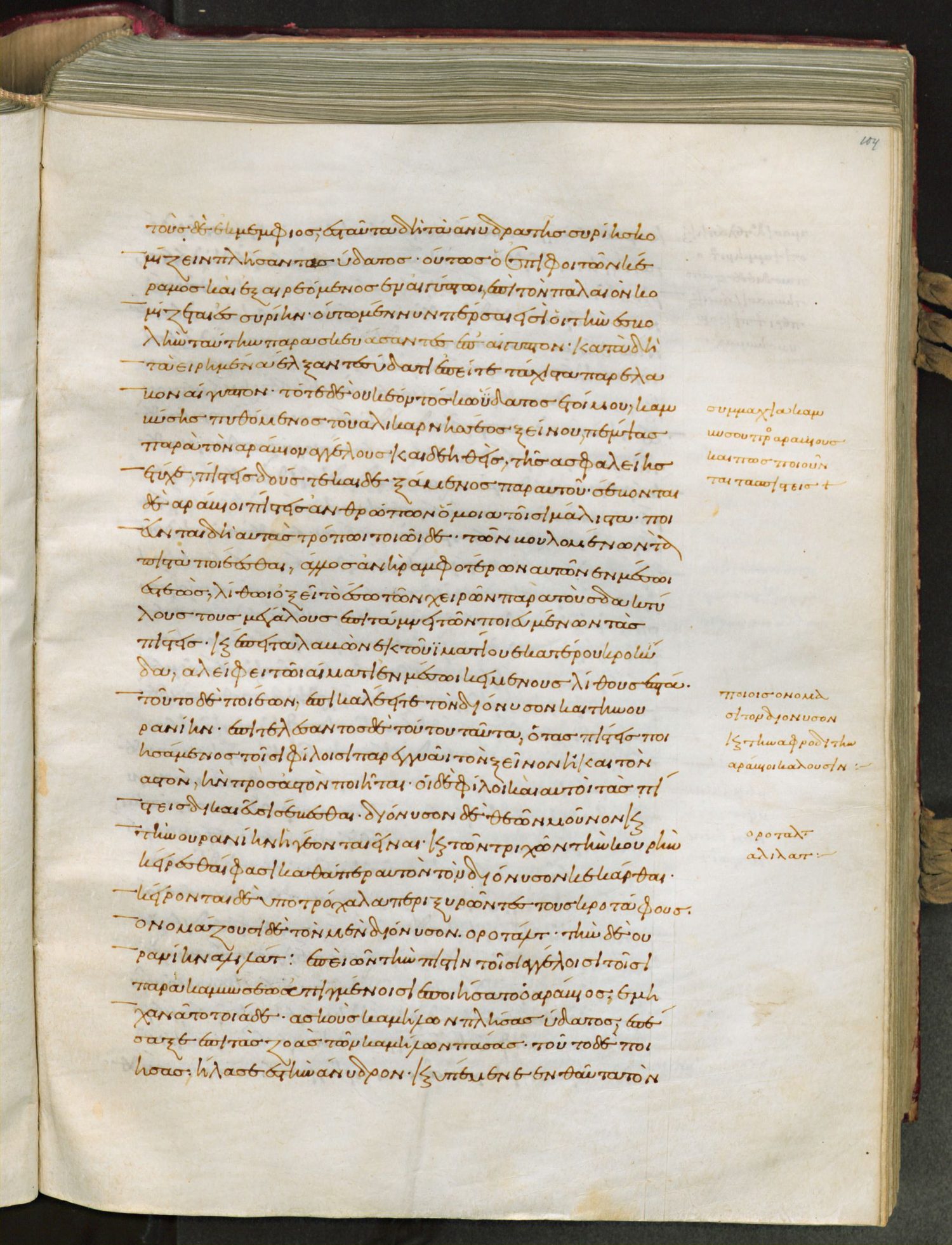
Laur. Plut. 70.3, fol. 104r: Greek here 3.6.2 to 3.9.1. Checked on the image (first and last words read and located in the Greek; each break checked against the neighbouring page): fol. 104r begins ‹τοὺς δὲ ἐκ Μέμφιος› (3.6.2), ends ‹καὶ ὑπέμενε ἐνθαῦτα τὸν› (3.9.1). English here: 3.6.2 to 3.9.1 (Godley's sentences for the sections whose Greek lies mostly on this page).
3.6.2τοὺς δὲ ἐκ Μέμφιος ἐς ταῦτα δὴ τὰ ἄνυδρα τῆς Συρίης κομίζειν πλήσαντας ὕδατος. οὕτω ὁ ἐπιφοιτέων κέραμος καὶ ἐξαιρεόμενος ἐν Αἰγύπτῳ ἐπὶ τὸν παλαιὸν κομίζεται ἐς Συρίην. 3.7.1οὕτω μέν νυν Πέρσαι εἰσὶ οἱ τὴν ἐσβολὴν ταύτην παρασκευάσαντες ἐς Αἴγυπτον, κατὰ δὴ τὰ εἰρημένα σάξαντες ὕδατι, ἐπείτε τάχιστα παρέλαβον Αἴγυπτον. 3.7.2τότε δὲ οὐκ ἐόντος κω ὕδατος ἑτοίμου, Καμβύσης πυθόμενος τοῦ Ἁλικαρνησσέος ξείνου, πέμψας παρὰ τὸν Ἀράβιον ἀγγέλους καὶ δεηθεὶς τῆς ἀσφαλείης ἔτυχε, πίστις δούς τε καὶ δεξάμενος παρʼ αὐτοῦ. 3.8.1σέβονται δὲ Ἀράβιοι πίστις ἀνθρώπων ὅμοια τοῖσι μάλιστα, ποιεῦνται δὲ αὐτὰς τρόπῳ τοιῷδε· τῶν βουλομένων τὰ πιστὰ ποιέεσθαι ἄλλος ἀνήρ, ἀμφοτέρων αὐτῶν ἐν μέσῳ ἑστεώς, λίθῳ ὀξέι τὸ ἔσω τῶν χειρῶν παρὰ τοὺς δακτύλους τοὺς μεγάλους ἐπιτάμνει τῶν ποιευμένων τὰς πίστις, καὶ ἔπειτα λαβὼν ἐκ τοῦ ἱματίου ἑκατέρου κροκύδα ἀλείφει τῷ αἵματι ἐν μέσῳ κειμένους λίθους ἑπτά· τοῦτο δὲ ποιέων ἐπικαλέει τε τὸν Διόνυσον καὶ τὴν Οὐρανίην. 3.8.2ἐπιτελέσαντος δὲ τούτου ταῦτα, ὁ τὰς πίστις ποιησάμενος τοῖσι φίλοισι παρεγγυᾷ τὸν ξεῖνον ἢ καὶ τὸν ἀστόν, ἢν πρὸς ἀστὸν ποιέηται· οἱ δὲ φίλοι καὶ αὐτοὶ τὰς πίστις δικαιεῦσι σέβεσθαι. 3.8.3Διόνυσον δὲ θεῶν μοῦνον καὶ τὴν Οὐρανίην ἡγέονται εἶναι, καὶ τῶν τριχῶν τὴν κουρὴν κείρεσθαι φασὶ κατά περ αὐτὸν τὸν Διόνυσον κεκάρθαι· κείρονται δὲ περιτρόχαλα, ὑποξυρῶντες τοὺς κροτάφους. ὀνομάζουσι δὲ τὸν μὲν Διόνυσον Ὀροτάλτ, τὴν δὲ Οὐρανίην Ἀλιλάτ. 3.9.1ἐπεὶ ὦν τὴν πίστιν τοῖσι ἀγγέλοισι τοῖσι παρὰ Καμβύσεω ἀπιγμένοισι ἐποιήσατο ὁ Ἀράβιος, ἐμηχανᾶτο τοιάδε· ἀσκοὺς καμήλων πλήσας, ὕδατος ἐπέσαξε ἐπὶ τὰς ζωὰς τῶν καμήλων πάσας, τοῦτο δὲ ποιήσας ἤλασε ἐς τὴν ἄνυδρον καὶ ὑπέμενε ἐνθαῦτα τὸν
3.6.2What then (one may ask) becomes of them? This too I will tell. Each governor of a district must gather in all the earthen pots from his own township and take them to Memphis, and the people of Memphis must fill them with water and carry them to those waterless lands of Syria; so the earthen pottery that is brought to Egypt and unloaded or emptied there is carried to Syria to join the stock that has already been taken there. 3.7.1Now as soon as the Persians took possession of Egypt, it was they who thus provided for the entry into that country, filling pots with water as I have said. 3.7.2But at this time there was as yet no ready supply of water; wherefore Cambyses, hearing what was said by the stranger from Halicarnassus, sent messengers to the Arabian and asked and obtained safe conduct, giving and receiving from him pledges. 3.8.1There are no men who respect pledges more than the Arabians. This is the manner of their giving them:—a man stands between the two parties that would give security, and cuts with a sharp stone the palms of the hands of the parties, by the thumb; then he takes a piece of wood from the cloak of each and smears with the blood seven stones that lie between them, calling the while on Dionysus and the Heavenly Aphrodite; and when he has fully 3.8.2done this, he that gives the security commends to his friends the stranger (or his countryman if the party be such), and his friends hold themselves bound to honour the pledge. 3.8.3They deem none other to be gods save Dionysus and the Heavenly Aphrodite; and they say that the cropping of their hair is like the cropping of the hair of Dionysus, cutting it round the head and shaving the temples. They call Dionysus, Orotalt; and Aphrodite, Alilat. 3.9.1Having then pledged himself to the messengers who had come from Cambyses, the Arabian planned and did as I shall show: he filled camel-skins with water and loaded all his live camels with these; which done, he drove them into the waterless land and there awaited Cambyses’ army.
Where on the image
Laur. Plut. 70.3, fol. 104v: Greek here 3.9.1 to 3.11.1. Checked on the image (first and last words read and located in the Greek; each break checked against the neighbouring page): fol. 104v begins ‹Καμβύσεω στρατόν.οὗτος μὲν ὁ› (3.9.1), ends ‹πρῆγμα ἐς αὐτὸν τοιόνδε› (3.11.1). English here: 3.9.2 to 3.11.1 (Godley's sentences for the sections whose Greek lies mostly on this page).
3.9.1Καμβύσεω στρατόν. 3.9.2οὗτος μὲν ὁ πιθανώτερος τῶν λόγων εἴρηται, δεῖ δὲ καὶ τὸν ἧσσον πιθανόν, ἐπεί γε δὴ λέγεται, ῥηθῆναι. ποταμός ἐστι μέγας ἐν τῇ Ἀραβίῃ τῷ οὔνομα Κόρυς, ἐκδιδοῖ δὲ οὗτος ἐς τὴν Ἐρυθρὴν καλεομένην θάλασσαν· 3.9.3ἀπὸ τούτου δὴ ὦν τοῦ ποταμοῦ λέγεται τὸν βασιλέα τῶν Ἀραβίων, ῥαψάμενον τῶν ὠμοβοέων καὶ τῶν ἄλλων δερμάτων ὀχετὸν μήκεϊ ἐξικνεύμενον ἐς τὴν ἄνυδρον, ἀγαγεῖν διὰ δὴ τούτων τὸ ὕδωρ, ἐν δὲ τῇ ἀνύδρῳ μεγάλας δεξαμενὰς ὀρύξασθαι, ἵνα δεκόμεναι τὸ ὕδωρ σώζωσι. 3.9.4ὁδὸς δʼ ἐστὶ δυώδεκα ἡμερέων ἀπὸ τοῦ ποταμοῦ ἐς ταύτην τὴν ἄνυδρον. ἄγειν δέ μιν διʼ ὀχετῶν τριῶν ἐς τριξὰ χωρία. 3.10.1ἐν δὲ τῷ Πηλουσίῳ καλεομένῳ στόματι τοῦ Νείλου ἐστρατοπεδεύετο Ψαμμήνιτος ὁ Ἀμάσιος παῖς ὑπομένων Καμβύσεα. 3.10.2Ἄμασιν γὰρ οὐ κατέλαβε ζῶντα Καμβύσης ἐλάσας ἐπʼ Αἴγυπτον, ἀλλὰ βασιλεύσας ὁ Ἄμασις τέσσερα καὶ τεσσεράκοντα ἔτεα ἀπέθανε, ἐν τοῖσι οὐδέν οἱ μέγα ἀνάρσιον πρῆγμα συνηνείχθη· ἀποθανὼν δὲ καὶ ταριχευθεὶς ἐτάφη ἐν τῇσι ταφῇσι ἐν τῷ ἱρῷ, τὰς αὐτὸς οἰκοδομήσατο. 3.10.3ἐπὶ Ψαμμηνίτου δὲ τοῦ Ἀμάσιος βασιλεύοντος Αἰγύπτου φάσμα Αἰγυπτίοισι μέγιστον δὴ ἐγένετο· ὕσθησαν γὰρ Θῆβαι αἱ Αἰγύπτιαι, οὔτε πρότερον οὐδαμὰ ὑσθεῖσαι οὔτε ὕστερον τὸ μέχρι ἐμεῦ, ὡς λέγουσι αὐτοὶ Θηβαῖοι· οὐ γὰρ δὴ ὕεται τὰ ἄνω τῆς Αἰγύπτου τὸ παράπαν· ἀλλὰ καὶ τότε ὕσθησαν αἱ Θῆβαι ψακάδι. 3.11.1οἱ δὲ Πέρσαι ἐπείτε διεξελάσαντες τὴν ἄνυδρον ἵζοντο πέλας τῶν Αἰγυπτίων ὡς συμβαλέοντες, ἐνθαῦτα οἱ ἐπίκουροι οἱ τοῦ Αἰγυπτίου, ἐόντες ἄνδρες Ἕλληνές τε καὶ Κᾶρες, μεμφόμενοι τῷ Φάνῃ ὅτι στρατὸν ἤγαγε ἐπʼ Αἴγυπτον ἀλλόθροον, μηχανῶνται πρῆγμα ἐς αὐτὸν τοιόνδε.
3.9.2This is the most credible of the stories told; but I must relate the less credible tale also, since they tell it. There is a great river in Arabia called Corys, issuing into the sea called Red. 3.9.3From this river (it is said) the king of the Arabians carried water by a duct of sewn ox-hides and other hides of a length sufficient to reach to the dry country; and he had great tanks dug in that country to receive and keep the water. 3.9.4It is a twelve days’ journey from the river to that desert. By three ducts (they say) he led the water to three several places. 3.10.1Psammenitus, son of Amasis, was encamped by the mouth of the Nile called Pelusian, awaiting Cambyses. 3.10.2For when Cambyses marched against Egypt he found Amasis no longer alive; he had died after reigning forty-four years, in which no great misfortune had befallen him; and being dead he was embalmed and laid in the burial-place built for himself in the temple. 3.10.3While his son Psammenitus was king of Egypt, the people saw a most wonderful sight, namely, rain at Thebes of Egypt, where, as the Thebans themselves say, there had never been rain before, nor since to my lifetime; for indeed there is no rain at all in the upper parts of Egypt; but at that time a drizzle of rain fell at Thebes. 3.11.1Now the Persians having crossed the waterless country and encamped near the Egyptians with intent to give battle, the foreign soldiery of the Egyptian, Greeks and Carians, devised a plan to punish Phanes, being wroth with him for leading a stranger army into Egypt.
Where on the image
Laur. Plut. 70.3, fol. 105r: Greek here 3.11.2 to 3.13.1. Checked on the image (first and last words read and located in the Greek; each break checked against the neighbouring page): fol. 105r begins ‹ἦσαν τῷ Φάνῃ παῖδες› (3.11.2), ends ‹ἐτράποντο, ἔφευγον οὐδενὶ κόσμῳ› (3.13.1). English here: 3.11.2 to 3.12.4 (Godley's sentences for the sections whose Greek lies mostly on this page).
3.11.2ἦσαν τῷ Φάνῃ παῖδες ἐν Αἰγύπτῳ καταλελειμμένοι· τοὺς ἀγαγόντες ἐς τὸ στρατόπεδον καὶ ἐς ὄψιν τοῦ πατρὸς κρητῆρα ἐν μέσῳ ἔστησαν ἀμφοτέρων τῶν στρατοπέδων, μετὰ δὲ ἀγινέοντες κατὰ ἕνα ἕκαστον τῶν παίδων ἔσφαζον ἐς τὸν κρητῆρα· 3.11.3διὰ πάντων δὲ διεξελθόντες τῶν παίδων οἶνόν τε καὶ ὕδωρ ἐσεφόρεον ἐς αὐτόν, ἐμπιόντες δὲ τοῦ αἵματος πάντες οἱ ἐπίκουροι οὕτω δὴ συνέβαλον. μάχης δὲ γενομένης καρτερῆς καὶ πεσόντων ἐξ ἀμφοτέρων τῶν στρατοπέδων πλήθεϊ πολλῶν ἐτράποντο οἱ Αἰγύπτιοι. 3.12.1θῶμα δὲ μέγα εἶδον πυθόμενος παρὰ τῶν ἐπιχωρίων· τῶν γὰρ ὀστέων περικεχυμένων χωρὶς ἑκατέρων τῶν ἐν τῇ μάχῃ ταύτῃ πεσόντων (χωρὶς μὲν γὰρ τῶν Περσέων ἔκειτο τὰ ὀστέα, ὡς ἐχωρίσθη κατʼ ἀρχάς, ἑτέρωθι δὲ τῶν Αἰγυπτίων), αἱ μὲν τῶν Περσέων κεφαλαί εἰσι ἀσθενέες οὕτω ὥστε, εἰ θέλεις ψήφῳ μούνῃ βαλεῖν, διατετρανέεις, αἱ δὲ τῶν Αἰγυπτίων οὕτω δή τι ἰσχυραί, μόγις ἂν λίθῳ παίσας διαρρήξειας. 3.12.2αἴτιον δὲ τούτου τόδε ἔλεγον, καὶ ἐμέ γʼ εὐπετέως ἔπειθον, ὅτι Αἰγύπτιοι μὲν αὐτίκα ἀπὸ παιδίων ἀρξάμενοι ξυρῶνται τὰς κεφαλὰς καὶ πρὸς τὸν ἥλιον παχύνεται τὸ ὀστέον. 3.12.3τὠυτὸ δὲ τοῦτο καὶ τοῦ μὴ φαλακροῦσθαι αἴτιον ἐστί· Αἰγυπτίων γὰρ ἄν τις ἐλαχίστους ἴδοιτο φαλακροὺς πάντων ἀνθρώπων. 3.12.4τούτοισι μὲν δὴ τοῦτο ἐστὶ αἴτιον ἰσχυρὰς φορέειν τὰς κεφαλάς, τοῖσι δὲ Πέρσῃσι ὅτι ἀσθενέας φορέουσι τὰς κεφαλὰς αἴτιον τόδε· σκιητροφέουσι ἐξ ἀρχῆς πίλους τιάρας φορέοντες. ταῦτα μέν νυν τοιαῦτα· εἶδον δὲ καὶ ἄλλα ὅμοια τούτοισι ἐν Παπρήμι τῶν ἅμα Ἀχαιμένεϊ τῷ Δαρείου διαφθαρέντων ὑπὸ Ἰνάρω τοῦ Λίβυος. 3.13.1οἱ δὲ Αἰγύπτιοι ἐκ τῆς μάχης ὡς ἐτράποντο, ἔφευγον οὐδενὶ κόσμῳ·
3.11.2Phanes had left sons in Egypt; these they brought to the camp, into their father’s sight, and set a great bowl between the two armies; then they brought the sons one by one and cut their throats over the bowl. 3.11.3When all the sons were killed, they poured into the bowl wine and water, and the foreign soldiery drank of this and thereafter gave battle. The fight waxed hard, and many of both armies fell; but at length the Egyptians were routed. 3.12.1I saw there a strange thing, of which the people of the country had told me. The bones of those slain on either side in this fight lying scattered separately (for the Persian bones lay in one place and the Egyptian in another, where the armies had first separately stood), the skulls of the Persians are so brittle that if you throw no more than a pebble it will pierce them, but the Egyptian skulls are so strong that a blow of a stone will hardly break them. 3.12.2And this, the people said (which for my own part I readily believed), is the reason of it: the Egyptians shave their heads from childhood, and the bone thickens by exposure to the sun. 3.12.3This also is the reason why they do not grow bald; for nowhere can one see so few bald heads as in Egypt. 3.12.4Their skulls then are strong for this reason; and the cause of the Persian skulls being weak is that they shelter their heads through their lives with the felt hats (called tiaras) which they wear. Such is the truth of this matter. I saw too the skulls of those Persians at Papremis who were slain with Darius’ son Achaemenes by Inaros the Libyan, and they were like the others.
Where on the image
Laur. Plut. 70.3, fol. 105v: Greek here 3.13.1 to 3.14.5. Checked on the image (first and last words read and located in the Greek; each break checked against the neighbouring page): fol. 105v begins ‹κατειληθέντων δὲ ἐς Μέμφιν,› (3.13.1), ends ‹τὰ στόματα ἐγκεχαλινωμένους·ἤγοντο δὲ› (3.14.5). English here: 3.13.1 to 3.14.5 (Godley's sentences for the sections whose Greek lies mostly on this page).
3.13.1κατειληθέντων δὲ ἐς Μέμφιν, ἔπεμπε ἀνὰ ποταμὸν Καμβύσης νέα Μυτιληναίην κήρυκα ἄγουσαν ἄνδρα Πέρσην, ἐς ὁμολογίην προκαλεόμενος Αἰγυπτίους. 3.13.2οἳ δὲ ἐπείτε τὴν νέα εἶδον ἐσελθοῦσαν ἐς τὴν Μέμφιν, ἐκχυθέντες ἁλέες ἐκ τοῦ τείχεος τήν τε νέα διέφθειραν καὶ τοὺς ἄνδρας κρεουργηδὸν διασπάσαντες ἐφόρεον ἐς τὸ τεῖχος. 3.13.3καὶ Αἰγύπτιοι μὲν μετὰ τοῦτο πολιορκεύμενοι χρόνῳ παρέστησαν, οἱ δὲ προσεχέες Λίβυες δείσαντες τὰ περὶ τὴν Αἴγυπτον γεγονότα παρέδοσαν σφέας αὐτοὺς ἀμαχητὶ καὶ φόρον τε ἐτάξαντο καὶ δῶρα ἔπεμπον. ὣς δὲ Κυρηναῖοι καὶ Βαρκαῖοι, δείσαντες ὁμοίως καὶ οἱ Λίβυες, τοιαῦτα ἐποίησαν. 3.13.4Καμβύσης δὲ τὰ μὲν παρὰ Λιβύων ἐλθόντα δῶρα φιλοφρόνως ἐδέξατο· τὰ δὲ παρὰ Κυρηναίων ἀπικόμενα μεμφθείς, ὡς ἐμοὶ δοκέει, ὅτι ἦν ὀλίγα· ἔπεμψαν γὰρ δὴ πεντακοσίας μνέας ἀργυρίου οἱ Κυρηναῖοι· ταύτας δρασσόμενος αὐτοχειρίῃ διέσπειρε τῇ στρατιῇ. 3.14.1ἡμέρῃ δὲ δεκάτῃ ἀπʼ ἧς παρέλαβε τὸ τεῖχος τὸ ἐν Μέμφι Καμβύσης, κατίσας ἐς τὸ προάστειον ἐπὶ λύμῃ τὸν βασιλέα τῶν Αἰγυπτίων Ψαμμήνιτον, βασιλεύσαντα μῆνας ἕξ, τοῦτον κατίσας σὺν ἄλλοισι Αἰγυπτίοισι διεπειρᾶτο αὐτοῦ τῆς ψυχῆς ποιέων τοιάδε· 3.14.2στείλας αὐτοῦ τὴν θυγατέρα ἐσθῆτι δουληίῃ ἐξέπεμπε ἐπʼ ὕδωρ ἔχουσαν ὑδρήιον, συνέπεμπε δὲ καὶ ἄλλας παρθένους ἀπολέξας ἀνδρῶν τῶν πρώτων, ὁμοίως ἐσταλμένας τῇ τοῦ βασιλέος. 3.14.3ὡς δὲ βοῇ τε καὶ κλαυθμῷ παρήισαν αἱ παρθένοι παρὰ τοὺς πατέρας, οἱ μὲν ἄλλοι πάντες ἀντεβόων τε καὶ ἀντέκλαιον ὁρῶντες τὰ τέκνα κεκακωμένα, ὁ δὲ Ψαμμήνιτος προϊδὼν καὶ μαθὼν ἔκυψε ἐς τὴν γῆν. 3.14.4παρελθουσέων δὲ τῶν ὑδροφόρων, δεύτερά οἱ τὸν παῖδα ἔπεμπε μετʼ ἄλλων Αἰγυπτίων δισχιλίων τὴν αὐτὴν ἡλικίην ἐχόντων, τούς τε αὐχένας κάλῳ δεδεμένους καὶ τὰ στόματα ἐγκεχαλινωμένους· 3.14.5ἤγοντο δὲ
3.13.1After their rout in the battle the Egyptians fled in disorder; and they being driven into Memphis, Cambyses sent a Persian herald up the river in a ship of Mytilene to invite them to an agreement. 3.13.2But when they saw the ship coming to Memphis, they sallied out all together from their walls, destroyed the ship, tore the crew asunder (like butchers) and carried them within the walls. 3.13.3So the Egyptians were besieged, and after a good while yielded; but the neighbouring Libyans, affrighted by what had happened in Egypt, surrendered unresisting, laying tribute on themselves and sending gifts; and so too, affrighted like the Libyans, did the people of Cyrene and Barca. 3.13.4Cambyses received in all kindness the gifts of the Libyans; but he seized what came from Cyrene and scattered it with his own hands among his army. This he did, as I think, to mark his displeasure at the littleness of the gift; for the Cyrenaeans had sent five hundred silver minae. 3.14.1On the tenth day after the surrender of the walled city of Memphis, Cambyses took Psammenitus king of Egypt, who had reigned for six months, and set him down in the outer part of the city with other Egyptians, to do him despite; having so done he made trial of Psammenitus’ spirit, as I shall show. 3.14.2He dressed the king’s daughter in slave’s attire and sent her with a vessel to fetch water, in company with other maidens dressed as she was, chosen from the families of the chief men. 3.14.3So when the damsels passed before their fathers crying and lamenting, all the rest answered with like cries and weeping, seeing their children’s evil case; but Psammenitus, having seen with his own eyes and learnt all, bowed himself to the ground. 3.14.4When the water-carriers had passed by, Cambyses next made Psammenitus’ son to pass him with two thousand Egyptians of like age besides, all with ropes bound round their necks and bits in their mouths; 3.14.5who were led forth to make atonement for those Mytilenaeans who had perished with their ship at Memphis; for such was the judgment of the royal judges, that every man’s death be paid for by the slaying of ten noble Egyptians.
Where on the image
Laur. Plut. 70.3, fol. 106r: Greek here 3.14.5 to 3.14.11. Checked on the image (first and last words read and located in the Greek; each break checked against the neighbouring page): fol. 106r begins ‹ποινὴν τίσοντες Μυτιληναίων τοῖσι› (3.14.5), ends ‹παρεόντας· αὐτῷ τε Καμβύσῃ› (3.14.11). English here: 3.14.6 to 3.14.11 (Godley's sentences for the sections whose Greek lies mostly on this page).
3.14.5ποινὴν τίσοντες Μυτιληναίων τοῖσι ἐν Μέμφι ἀπολομένοισι σὺν τῇ νηί. ταῦτα γὰρ ἐδίκασαν οἱ βασιλήιοι δικασταί, ὑπὲρ ἀνδρὸς ἑκάστου δέκα Αἰγυπτίων τῶν πρώτων ἀνταπόλλυσθαι. 3.14.6ὁ δὲ ἰδὼν παρεξιόντας καὶ μαθὼν τὸν παῖδα ἡγεόμενον ἐπὶ θάνατον, τῶν ἄλλων Αἰγυπτίων τῶν περικατημένων αὐτὸν κλαιόντων καὶ δεινὰ ποιεύντων, τὠυτὸ ἐποίησε τὸ καὶ ἐπὶ τῇ θυγατρί. 3.14.7παρελθόντων δὲ καὶ τούτων, συνήνεικε ὥστε τῶν συμποτέων οἱ ἄνδρα ἀπηλικέστερον, ἐκπεπτωκότα ἐκ τῶν ἐόντων ἔχοντά τε οὐδὲν εἰ μὴ ὅσα πτωχὸς καὶ προσαιτέοντα τὴν στρατιήν, παριέναι Ψαμμήνιτόν τε τὸν Ἀμάσιος καὶ τοὺς ἐν τῷ προαστείῳ κατημένους Αἰγυπτίων. ὁ δὲ Ψαμμήνιτος ὡς εἶδε, ἀνακλαύσας μέγα καὶ καλέσας ὀνομαστὶ τὸν ἑταῖρον ἐπλήξατο τὴν κεφαλήν. 3.14.8ἦσαν δʼ ἄρα αὐτοῦ φύλακοι, οἳ τὸ ποιεύμενον πᾶν ἐξ ἐκείνου ἐπʼ ἑκάστῃ ἐξόδῳ Καμβύσῃ ἐσήμαινον. θωμάσας δὲ ὁ Καμβύσης τὰ ποιεύμενα, πέμψας ἄγγελον εἰρώτα αὐτὸν λέγων τάδε. 3.14.9δεσπότης σε Καμβύσης, Ψαμμήνιτε, εἰρωτᾷ διʼ ὅ τι δὴ τὴν μὲν θυγατέρα ὁρέων κεκακωμένην καὶ τὸν παῖδα ἐπὶ θάνατον στείχοντα οὔτε ἀνέβωσας οὔτε ἀπέκλαυσας, τὸν δὲ πτωχὸν οὐδὲν σοὶ προσήκοντα, ὡς ἄλλων πυνθάνεται, ἐτίμησας. ὃ μὲν δὴ ταῦτα ἐπειρώτα, ὃ δʼ ἀμείβετο τοῖσιδε. 3.14.10ὦ παῖ Κύρου, τὰ μὲν οἰκήια ἦν μέζω κακὰ ἢ ὥστε ἀνακλαίειν, τὸ δὲ τοῦ ἑταίρου πένθος ἄξιον ἦν δακρύων, ὃς ἐκ πολλῶν τε καὶ εὐδαιμόνων ἐκπεσὼν ἐς πτωχηίην ἀπῖκται ἐπὶ γήραος οὐδῷ. καὶ ταῦτα ὡς ἀπενειχθέντα ὑπὸ τούτου εὖ δοκέειν σφι εἰρῆσθαι, 3.14.11ὡς [δὲ] λέγεται ὑπʼ Αἰγυπτίων, δακρύειν μὲν Κροῖσον (ἐτετεύχεε γὰρ καὶ οὗτος ἐπισπόμενος Καμβύσῃ ἐπʼ Αἴγυπτους), δακρύειν δὲ Περσέων τοὺς παρεόντας· αὐτῷ τε Καμβύσῃ
3.14.6When Psammenitus saw them pass by and perceived that his son was led out to die, and all the Egyptians who sat with him wept and showed their affliction, he did as he had done at the sight of his daughter. 3.14.7When these too had gone by, it chanced that there was one of his boon companions, a man past his prime, that had lost all his possessions, and had but what a poor man might have, and begged of the army; this man now passed before Psammenitus son of Amasis and the Egyptians who sat in the outer part of the city. When Psammenitus saw him, he broke into loud weeping, smiting his head and calling on his companion by name. 3.14.8Now there were men set to watch Psammenitus, who told Cambyses all that he did as each went forth. Marvelling at what the king did, Cambyses made this inquiry of him by a messenger: “ 3.14.9Psammenitus, Cambyses my master asks of you why, seeing your daughter mishandled and your son going to his death, you neither cried aloud nor wept, yet did this honour to the poor man, who (as Cambyses learns from others) is none of your kin?” So the messenger inquired. 3.14.10Psammenitus answered: “Son of Cyrus, my private grief was too great for weeping; but the misfortune of my companion called for tears—one that has lost wealth and good fortune and now on the threshold of old age is come to beggary.” When the messenger so reported, and Cambyses and his court, it is said, found the answer good, then, 3.14.11as the Egyptians tell, Croesus wept (for it chanced that he too had come with Cambyses to Egypt) and so did the Persians that were there; Cambyses himself felt somewhat of pity, and forthwith he bade that Psammenitus’ son be saved alive out of those that were to be slain, and that Psammenitus himself be taken from the outer part of the city and brought before him.
Where on the image
Laur. Plut. 70.3, fol. 106v: Greek here 3.14.11 to 3.16.3. Checked on the image (first and last words read and located in the Greek; each break checked against the neighbouring page): fol. 106v begins ‹ἐσελθεῖν οἶκτον τινά, καὶ› (3.14.11), ends ‹γε τοὺς νεκροὺς οὐδαμῶς› (3.16.3). English here: 3.15.1 to 3.16.3 (Godley's sentences for the sections whose Greek lies mostly on this page).
3.14.11ἐσελθεῖν οἶκτον τινά, καὶ αὐτίκα κελεύειν τόν τέ οἱ παῖδα ἐκ τῶν ἀπολλυμένων σώζειν καὶ αὐτὸν ἐκ τοῦ προαστείου ἀναστήσαντας ἄγειν παρʼ ἑωυτόν. 3.15.1τὸν μὲν δὴ παῖδα εὗρον αὐτοῦ οἱ μετιόντες οὐκέτι περιεόντα ἀλλὰ πρῶτον κατακοπέντα, αὐτὸν δὲ Ψαμμήνιτον ἀναστήσαντες ἦγον παρὰ Καμβύσεα· 3.15.2ἔνθα τοῦ λοιποῦ διαιτᾶτο ἔχων οὐδὲν βίαιον. εἰ δὲ καὶ ἠπιστήθη μὴ πολυπρηγμονέειν, ἀπέλαβε ἂν Αἴγυπτον ὥστε ἐπιτροπεύειν αὐτῆς, ἐπεὶ τιμᾶν ἐώθασι Πέρσαι τῶν βασιλέων τοὺς παῖδας· τῶν, εἰ καὶ σφέων ἀποστέωσι, ὅμως τοῖσί γε παισὶ αὐτῶν ἀποδιδοῦσι τὴν ἀρχήν. 3.15.3πολλοῖσι μέν νυν καὶ ἄλλοισι ἐστὶ σταθμώσασθαι ὅτι τοῦτο οὕτω νενομίκασι ποιέειν, ἐν δὲ καὶ τῷ τε Ἰνάρω παιδὶ Θαννύρᾳ, ὃς ἀπέλαβε τήν οἱ ὁ πατὴρ εἶχε ἀρχήν, καὶ τῷ Ἀμυρταίου Παυσίρι· καὶ γὰρ οὗτος ἀπέλαβε τὴν τοῦ πατρὸς ἀρχήν. καίτοι Ἰνάρω γε καὶ Ἀμυρταίου οὐδαμοί κω Πέρσας κακὰ πλέω ἐργάσαντο. 3.15.4νῦν δὲ μηχανώμενος κακὰ ὁ Ψαμμήνιτος ἔλαβε τὸν μισθόν· ἀπιστὰς γὰρ Αἰγυπτίους ἥλω· ἐπείτε δὲ ἐπάιστος ἐγένετο ὑπὸ Καμβύσεω, αἷμα ταύρου πιὼν ἀπέθανε παραχρῆμα. οὕτω δὴ οὗτος ἐτελεύτησε. 3.16.1Καμβύσης δὲ ἐκ Μέμφιος ἀπίκετο ἐς Σάιν πόλιν, βουλόμενος ποιῆσαι τὰ δὴ καὶ ἐποίησε. ἐπείτε γὰρ ἐσῆλθε ἐς τὰ τοῦ Ἀμάσιος οἰκία, αὐτίκα ἐκέλευε ἐκ τῆς ταφῆς τὸν Ἀμάσιος νέκυν ἐκφέρειν ἔξω· ὡς δὲ ταῦτα ἐπιτελέα ἐγένετο, μαστιγοῦν ἐκέλευε καὶ τὰς τρίχας ἀποτίλλειν καὶ κεντοῦν τε καὶ τἆλλα πάντα λυμαίνεσθαι. 3.16.2ἐπείτε δὲ καὶ ταῦτα ἔκαμον ποιεῦντες (ὁ γὰρ δὴ νεκρὸς ἅτε τεταριχευμένος ἀντεῖχέ τε καὶ οὐδὲν διεχέετο), ἐκέλευσέ μιν ὁ Καμβύσης κατακαῦσαι, ἐντελλόμενος οὐκ ὅσια· Πέρσαι γὰρ θεὸν νομίζουσι εἶναι πῦρ. 3.16.3τὸ ὦν κατακαίειν γε τοὺς νεκροὺς οὐδαμῶς
3.15.1As for the son, those that went for him found that he was no longer living, but had been the first to be hewn down; but they brought Psammenitus away and led him to Cambyses; and there he lived, and no violence was done him for the rest of his life. 3.15.2And had he but been wise enough to mind his own business, he would have so far won back Egypt as to be governor of it; for the Persians are wont to honour king’s sons; even though kings revolt from them, yet they give back to their sons the sovereign power. 3.15.3There are many instances showing that it is their custom so to do, and notably the giving back of his father’s sovereign power to Thannyras son of Inaros, and also to Pausiris son of Amyrtaeus; yet none ever did the Persians more harm than Inaros and Amyrtaeus. 3.15.4But as it was, Psammenitus plotted evil and got his reward; for he was caught raising a revolt among the Egyptians; and when this came to Cambyses’ ears, Psammenitus drank bulls’ blood and forthwith died. Such was his end. 3.16.1From Memphis Cambyses went to the city Sais, desiring to do that which indeed he did. Entering the house of Amasis, straightway he bade carry Amasis’ body out from its place of burial; and when this was accomplished, he gave command to scourge it and pull out the hair and pierce it with goads, and do it despite in all other ways. 3.16.2When they were weary of doing this (for the body, being embalmed, remained whole and did not fall to pieces), Cambyses commanded to burn it, a sacrilegious command; for the Persians hold fire to be a god; 3.16.3therefore neither nation deems it right to burn the dead, the Persians for the reason assigned, as they say it is wrong to give the dead body of a man to a god; while the Egyptians believe fire to be a living beast that devours all that it catches, and when sated with its meal dies together with that whereon it feeds.
Where on the image
Laur. Plut. 70.3, fol. 107r: Greek here 3.16.3 to 3.16.7. Checked on the image (first and last words read and located in the Greek; each break checked against the neighbouring page): fol. 107r begins ‹ἐν νόμῳ οὐδετέροισι ἐστί,› (3.16.3), ends ‹ἡλίου τράπεζαν εἰ ἔστι› (3.17.2). English here: 3.16.4 to 3.16.7 (Godley's sentences for the sections whose Greek lies mostly on this page).
3.16.3ἐν νόμῳ οὐδετέροισι ἐστί, Πέρσῃσι μὲν διʼ ὅ περ εἴρηται, θεῷ οὐ δίκαιον εἶναι λέγοντες νέμειν νεκρὸν ἀνθρώπου· Αἰγυπτίοισι δὲ νενόμισται πῦρ θηρίον εἶναι ἔμψυχον, πάντα δὲ αὐτὸ κατεσθίειν τά περ ἂν λάβῃ, πλησθὲν δὲ αὐτὸ τῆς βορῆς συναποθνήσκειν τῷ κατεσθιομένῳ. 3.16.4οὔκων θηρίοισι νόμος οὐδαμῶς σφι ἐστὶ τὸν νέκυν διδόναι, καὶ διὰ ταῦτα ταριχεύουσι, ἵνα μὴ κείμενος ὑπὸ εὐλέων καταβρωθῇ. οὕτω οὐδετέροισι νομιζόμενα ἐνετέλλετο ποιέειν ὁ Καμβύσης. 3.16.5ὡς μέντοι, Αἰγύπτιοι λέγουσι, οὐκ Ἄμασις ἦν ὁ ταῦτα παθών, ἀλλὰ ἄλλος τις τῶν Αἰγυπτίων ἔχων τὴν αὐτὴν ἡλικίην Ἀμάσι, τῷ λυμαινόμενοι Πέρσαι ἐδόκεον Ἀμάσι λυμαίνεσθαι. 3.16.6λέγουσι γὰρ ὡς πυθόμενος ἐκ μαντηίου ὁ Ἄμασις τὰ περὶ ἑωυτὸν ἀποθανόντα μέλλοντα γίνεσθαι, οὕτω δὴ ἀκεόμενος τὰ ἐπιφερόμενα τὸν μὲν ἄνθρωπον τοῦτον τὸν μαστιγωθέντα ἀποθανόντα ἔθαψε ἐπὶ τῇσι θύρῃσι ἐντὸς τῆς ἑωυτοῦ θήκης, ἑωυτὸν δὲ ἐνετείλατο τῷ παιδὶ ἐν μυχῷ τῆς θήκης ὡς μάλιστα θεῖναι. 3.16.7αἱ μέν νυν ἐκ τοῦ Ἀμάσιος ἐντολαὶ αὗται αἱ ἐς τὴν ταφήν τε καὶ τὸν ἄνθρωπον ἔχουσαι οὔ μοι δοκέουσι ἀρχὴν γενέσθαι, ἄλλως δʼ αὐτὰ Αἰγύπτιοι σεμνοῦν.
3.16.4Now it is by no means their custom to give the dead to beasts; and this is why they embalm the corpse, that it may not lie and be eaten of worms. Thus Cambyses commanded the doing of a thing contrary to the custom of both peoples. 3.16.5Howbeit, as the Egyptians say, it was not Amasis to whom this was done, but another Egyptian of a like stature, whom the Persians despitefully used thinking that they so treated Amasis. 3.16.6For their story is that Amasis learnt from an oracle what was to be done to him after his death, and so to avert this doom buried this man, him that was scourged, at his death by the door within his own vault, and commanded his son that he himself should be laid in the farthest corner of the vault. 3.16.7I think that these commands of Amasis, respecting the burial-place and the man, were never given at all, and that the Egyptians but please themselves with a lying tale.
Notes
- Greek: the text printed in A. D. Godley's Loeb edition, via Perseus (tlg0016.tlg001.perseus-grc2). Square brackets mark words the editor considers later additions; [...] marks a gap the editor indicates. Perseus note markers are omitted.
- English: A. D. Godley, Herodotus vol. 2 (1921) (Loeb Classical Library), as transcribed on Wikisource. Godley's footnotes are omitted.
- Section numbers in the English were placed by comparing Godley's text with the Perseus version of his translation; where a section begins inside one of Godley's sentences, the English is kept with the page that holds the start of that sentence.
Cite
Sources
- Source: Florence, Laur. Plut. 70.3 (10th c.) via BML Teca Digitale + Greek of Godley's Loeb (Perseus) + English of A. D. Godley (Loeb, Wikisource) (holding institution)
- Critical edition: Greek of A. D. Godley's Loeb edition (1920-1925), via Perseus
← previous · → next · v cycle view · l back to library