Herodotus, Histories 2.35-53: Egyptian customs and the Egyptian origin of Greek gods
Introduction
Herodotus of Halicarnassus wrote the Histories in the third quarter of the 5th century BCE, an inquiry into the deeds of Greeks and barbarians and the causes of the wars between them, later divided into nine books. Book 2 is Herodotus' account of Egypt, written as background to Cambyses' invasion: the land and the Nile, the customs and religion of the Egyptians, and the history of their kings as the priests told it, down to Amasis.
The photographs are of Florence, Biblioteca Medicea Laurenziana, Plut. 70.3 (parchment, 10th century, 374 folios, 31 lines a page), Herodotus, Histories (codex A of the editors), the oldest surviving manuscript of the complete Histories, from the Teca Digitale of the Biblioteca Medicea Laurenziana. Each section below is the text of one page, or of the part of a page that falls within these chapters. The first and last words of every page were read on the photograph and located in the Greek, and every page break was checked against the next page; the notes quote these words. Readers' notes in the margins are not part of the text and are mentioned where they occur.
The Greek is the text printed in A. D. Godley's Loeb edition (1920-1925), from Perseus; it is the edited text, not a transcription of the manuscript, whose wording differs in places. The English is Godley's translation as printed, from Wikisource. Godley's English carries only chapter numbers; the section numbers shown in it were placed by comparison with the Perseus version of his translation. Each page's English is cut at the end of one of Godley's sentences, so it can begin or end a few lines away from the Greek of the page; each note gives the exact ranges.
This entry covers chapters 2.35-53, on fol. 64r to 69v.
How was this verified? (Provenance)
Where on the image
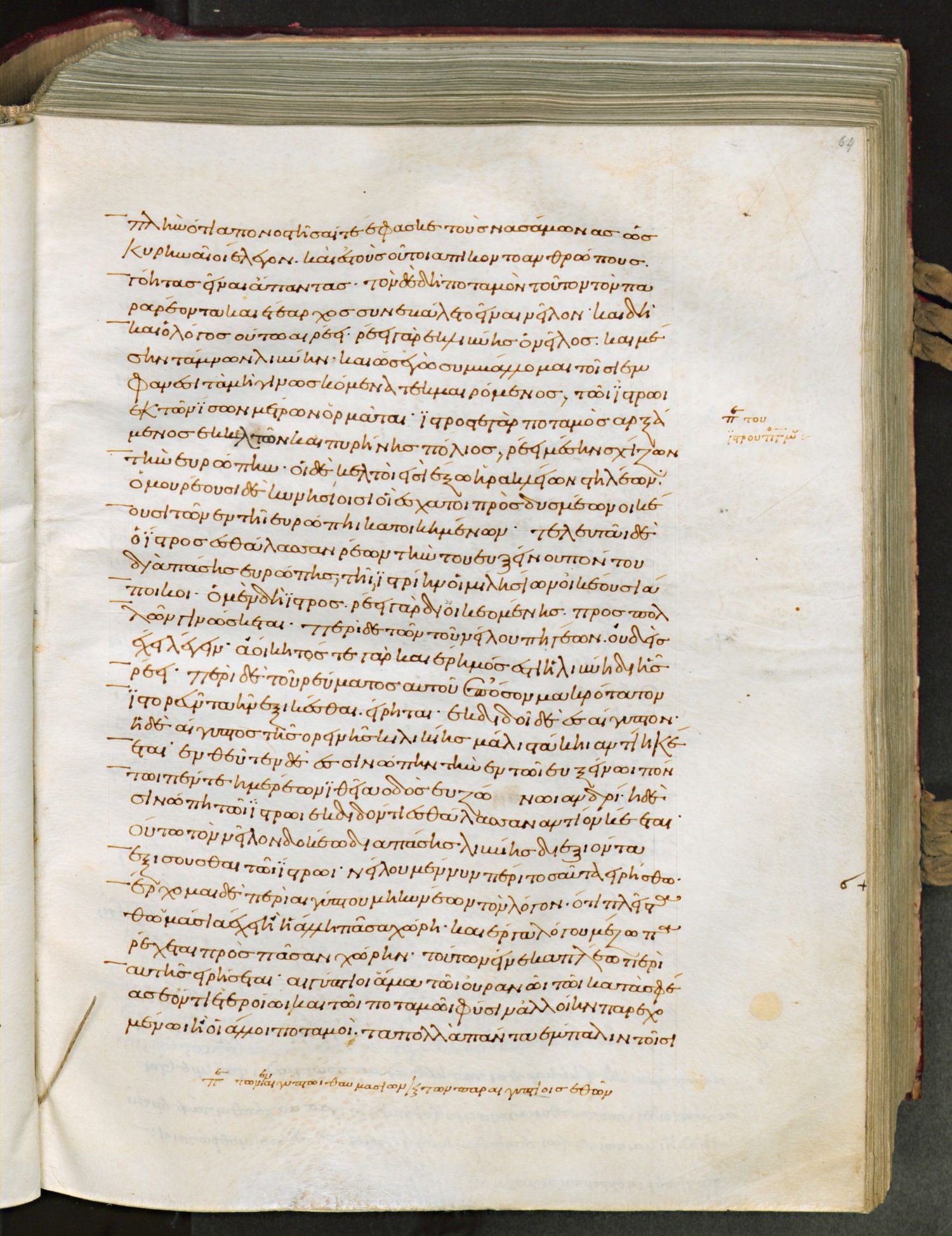
Laur. Plut. 70.3, fol. 64r: Greek here 2.35.1 to 2.35.2. Checked on the image (first and last words read and located in the Greek; each break checked against the neighbouring page): fol. 64r begins ‹πλὴν ὅτι ἀπονοστῆσαί τε› (2.33.1), ends ‹πολλὰ πάντα ἔμπαλιν τοῖσι› (2.35.2). Below the text, a reader's note on Egyptian customs. English here: 2.35.1 (Godley's sentences for the sections whose Greek lies mostly on this page).
2.35.1Νείλου μέν νυν πέρι τοσαῦτα εἰρήσθω· ἔρχομαι δὲ περὶ Αἰγύπτου μηκυνέων τὸν λόγον, ὅτι πλεῖστα θωμάσια ἔχει ἢ ἡ ἄλλη πᾶσα χώρη καὶ ἔργα λόγου μέζω παρέχεται πρὸς πᾶσαν χώρην· τούτων εἵνεκα πλέω περὶ αὐτῆς εἰρήσεται. 2.35.2Αἰγύπτιοι ἅμα τῷ οὐρανῷ τῷ κατὰ σφέας ἐόντι ἑτεροίῳ καὶ τῷ ποταμῷ φύσιν ἀλλοίην παρεχομένῳ ἢ οἱ ἄλλοι ποταμοί, τὰ πολλὰ πάντα ἔμπαλιν τοῖσι
2.35.1It is sufficient to say thus much concerning the Nile. But concerning Egypt I will now speak at length, because nowhere are there so many marvellous things, nor in the whole world beside are there to be seen so many works of unspeakable greatness; therefore I shall say the more concerning Egypt.
Where on the image
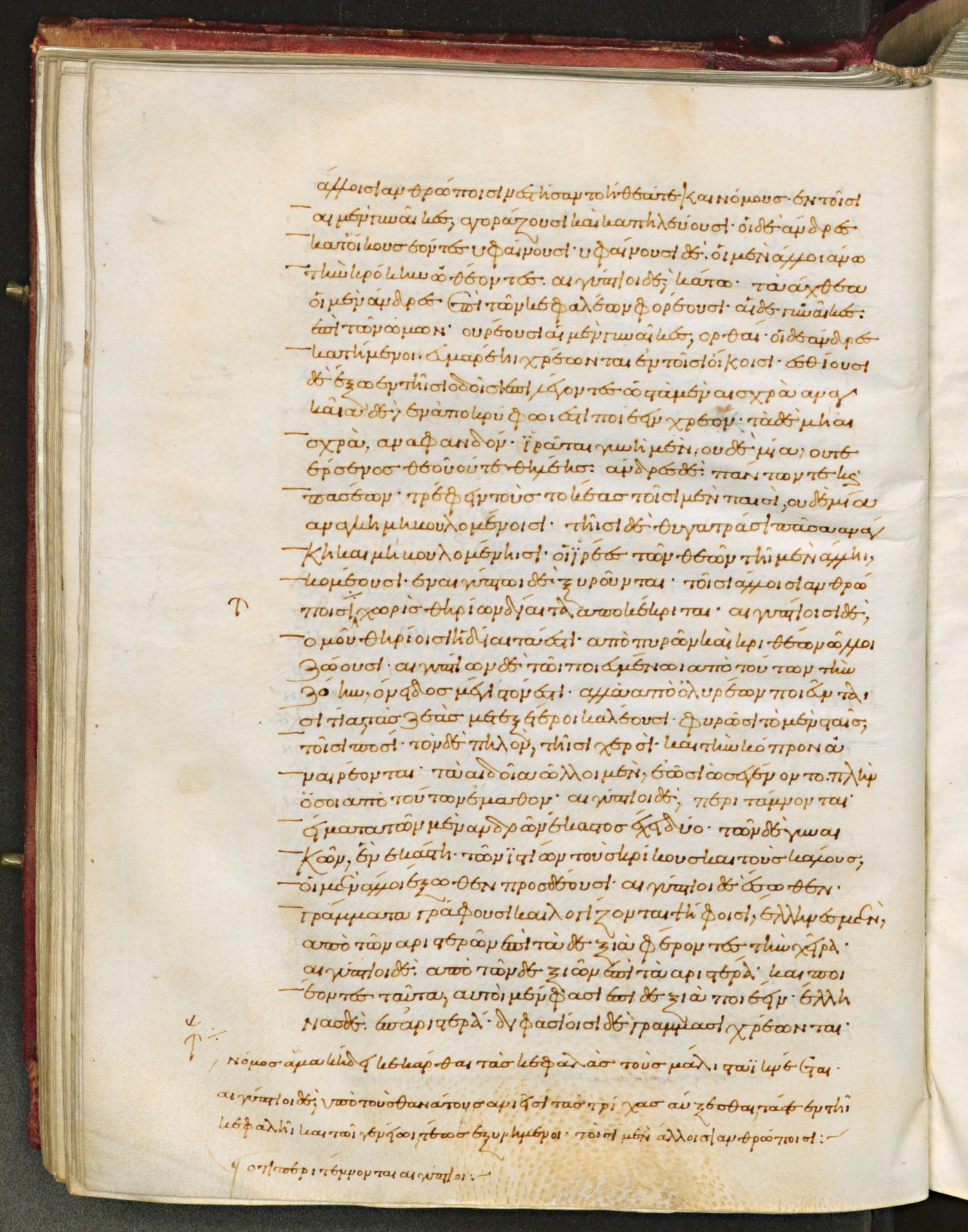
Laur. Plut. 70.3, fol. 64v: Greek here 2.35.2 to 2.36.4. Checked on the image (first and last words read and located in the Greek; each break checked against the neighbouring page): fol. 64v begins ‹ἄλλοισι ἀνθρώποισι ἐστήσαντο ἤθεά› (2.35.2), ends ‹διφασίοισι δὲ γράμμασι χρέωνται› (2.36.4). Three lines in the lower margin, in a smaller hand, give words of 2.36.1 (from νόμος ἅμα κήδεϊ κεκάρθαι τὰς κεφαλάς to τοῖσι μὲν ἄλλοισι ἀνθρώποισι). English here: 2.35.2 to 2.36.4 (Godley's sentences for the sections whose Greek lies mostly on this page).
2.35.2ἄλλοισι ἀνθρώποισι ἐστήσαντο ἤθεά τε καὶ νόμους· ἐν τοῖσι αἱ μὲν γυναῖκες ἀγοράζουσι καὶ καπηλεύουσι, οἱ δὲ ἄνδρες κατʼ οἴκους ἐόντες ὑφαίνουσι· ὑφαίνουσι δὲ οἱ μὲν ἄλλοι ἄνω τὴν κρόκην ὠθέοντες, Αἰγύπτιοι δὲ κάτω. 2.35.3τὰ ἄχθεα οἱ μὲν ἄνδρες ἐπὶ τῶν κεφαλέων φορέουσι, αἱ δὲ γυναῖκες ἐπὶ τῶν ὤμων. οὐρέουσι αἱ μὲν γυναῖκες ὀρθαί, οἱ δὲ ἄνδρες κατήμενοι. εὐμαρείῃ χρέωνται ἐν τοῖσι οἴκοισι, ἐσθίουσι δὲ ἔξω ἐν τῇσι ὁδοῖσι ἐπιλέγοντες ὡς τὰ μὲν αἰσχρὰ ἀναγκαῖα δὲ ἐν ἀποκρύφῳ ἐστὶ ποιέειν χρεόν, τὰ δὲ μὴ αἰσχρὰ ἀναφανδόν. 2.35.4ἱρᾶται γυνὴ μὲν οὐδεμία οὔτε ἔρσενος θεοῦ οὔτε θηλέης, ἄνδρες δὲ πάντων τε καὶ πασέων. τρέφειν τοὺς τοκέας τοῖσι μὲν παισὶ οὐδεμία ἀνάγκη μὴ βουλομένοισι, τῇσι δὲ θυγατράσι πᾶσα ἀνάγκη καὶ μὴ βουλομένῃσι. 2.36.1οἱ ἱρέες τῶν θεῶν τῇ μὲν ἄλλῃ κομέουσι, ἐν Αἰγύπτῳ δὲ ξυρῶνται. τοῖσι ἄλλοισι ἀνθρώποισι νόμος ἅμα κήδεϊ κεκάρθαι τὰς κεφαλὰς τοὺς μάλιστα ἱκνέεται, Αἰγύπτιοι δὲ ὑπὸ τοὺς θανάτους ἀνιεῖσι τὰς τρίχας αὔξεσθαι τάς τε ἐν τῇ κεφαλῇ καὶ τῷ γενείῳ, τέως ἐξυρημένοι. 2.36.2τοῖσι μὲν ἄλλοισι ἀνθρώποισι χωρὶς θηρίων ἡ δίαιτα ἀποκέκριται, Αἰγυπτίοισι δὲ ὁμοῦ θηρίοισι ἡ δίαιτα ἐστί. ἀπὸ πυρῶν καὶ κριθέων ὧλλοι ζώουσι, Αἰγυπτίων δὲ τῷ ποιευμένῳ ἀπὸ τούτων τὴν ζόην ὄνειδος μέγιστον ἐστί, ἀλλὰ ἀπὸ ὀλυρέων ποιεῦνται σιτία, τὰς ζειὰς μετεξέτεροι καλέουσι. 2.36.3φυρῶσι τὸ μὲν σταῖς τοῖσι ποσί, τὸν δὲ πηλὸν τῇσι χερσί, καὶ τὴν κόπρον ἀναιρέονται. τὰ αἰδοῖα ὧλλοι μὲν ἐῶσι ὡς ἐγένοντο, πλὴν ὅσοι ἀπὸ τούτων ἔμαθον, Αἰγύπτιοι δὲ περιτάμνονται. εἵματα τῶν μὲν ἀνδρῶν ἕκαστος ἔχει δύο, τῶν δὲ γυναικῶν ἓν ἑκάστη. 2.36.4τῶν ἱστίων τοὺς κρίκους καὶ τοὺς κάλους οἱ μὲν ἄλλοι ἔξωθεν προσδέουσι, Αἰγύπτιοι δὲ ἔσωθεν. γράμματα γράφουσι καὶ λογίζονται ψήφοισι Ἕλληνες μὲν ἀπὸ τῶν ἀριστερῶν ἐπὶ τὰ δεξιὰ φέροντες τὴν χεῖρα, Αἰγύπτιοι δὲ ἀπὸ τῶν δεξιῶν ἐπὶ τὰ ἀριστερά· καὶ ποιεῦντες ταῦτα αὐτοὶ μὲν φασὶ ἐπὶ δεξιὰ ποιέειν, Ἕλληνας δὲ ἐπʼ ἀριστερά. διφασίοισι δὲ γράμμασι χρέωνται,
2.35.2As the Egyptians have a climate peculiar to themselves, and their river is different in its nature from all other rivers, so have they made all their customs and laws of a kind contrary for the most part to those of all other men. Among them, the women buy and sell, the men abide at home and weave; and whereas in weaving all others push the woof upwards, the Egyptians push it downwards. 2.35.3Men carry burdens on their heads, women on their shoulders. Women make water standing, men sitting. They relieve nature indoors, and eat out of doors in the streets, giving the reason, that things unseemly but necessary should be done in secret, things not unseemly should be done openly. 2.35.4No woman is dedicated to the service of any god or goddess; men are dedicated to all deities male or female. Sons are not compelled against their will to support their parents, but daughters must do so though they be unwilling. 2.36.1Everywhere else, priests of the gods wear their hair long; in Egypt they are shaven. With all other men, in mourning for the dead those most nearly concerned have their heads shaven; Egyptians are shaven at other times, but after a death they let their hair and beard grow. 2.36.2The Egyptians are the only people who keep their animals with them in the house. Whereas all others live on wheat and barley, it is the greatest disgrace for an Egyptian so to live; they make food from a coarse grain which some call spelt. 2.36.3They knead dough with their feet, and gather mud and dung with their hands. The Egyptians and those who have learnt it from them are the only people who practise circumcision. Every man has two garments, every woman only one. 2.36.4The rings and sheets of sails are made fast elsewhere outside the boat, but inside it in Egypt. The Greeks write and calculate by moving the hand from left to right; the Egyptians do contrariwise; yet they say that their way of writing is towards the right, and the Greek way towards the left. They use two kinds of writing; one is called sacred, the other common.
Where on the image
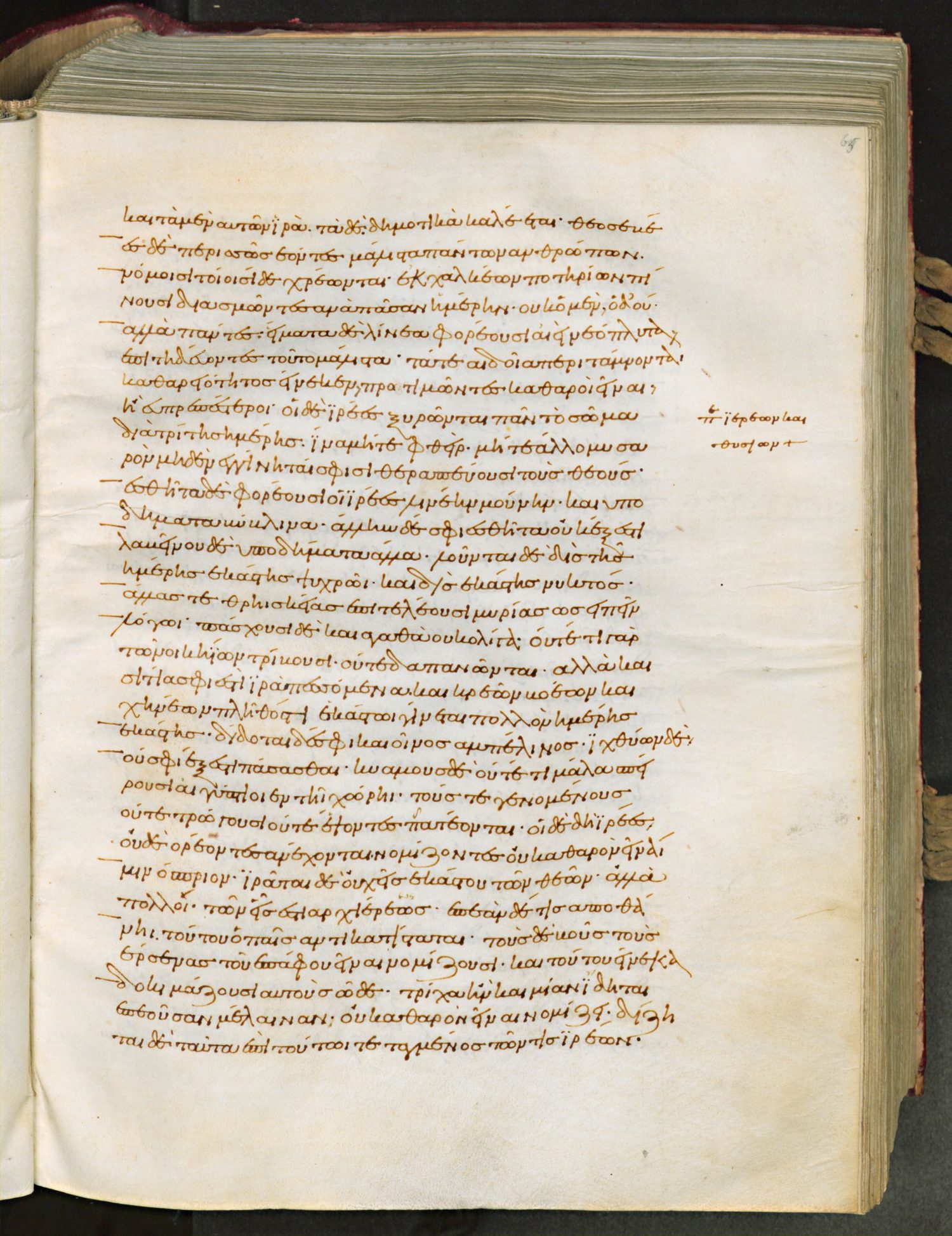
Laur. Plut. 70.3, fol. 65r: Greek here 2.36.4 to 2.38.2. Checked on the image (first and last words read and located in the Greek; each break checked against the neighbouring page): fol. 65r begins ‹καὶ τὰ μὲν αὐτῶν› (2.36.4), ends ‹τεταγμένος τῶν τις ἱρέων› (2.38.2). English here: 2.37.1 to 2.38.2 (Godley's sentences for the sections whose Greek lies mostly on this page).
2.36.4καὶ τὰ μὲν αὐτῶν ἱρὰ τὰ δὲ δημοτικὰ καλέεται. 2.37.1θεοσεβέες δὲ περισσῶς ἐόντες μάλιστα πάντων ἀνθρώπων νόμοισι τοιοῖσιδε χρέωνται. ἐκ χαλκέων ποτηρίων πίνουσι, διασμῶντες ἀνὰ πᾶσαν ἡμέρην, οὐκ ὃ μὲν ὃ δʼ οὔ, ἀλλὰ πάντες. 2.37.2εἵματα δὲ λίνεα φορέουσι αἰεὶ νεόπλυτα, ἐπιτηδεύοντες τοῦτο μάλιστα, τά τε αἰδοῖα περιτάμνονται καθαρειότητος εἵνεκεν, προτιμῶντες καθαροὶ εἶναι ἢ εὐπρεπέστεροι. οἱ δὲ ἱρέες ξυρῶνται πᾶν τὸ σῶμα διὰ τρίτης ἡμέρης, ἵνα μήτε φθεὶρ μήτε ἄλλο μυσαρὸν μηδὲν ἐγγίνηταί σφι θεραπεύουσι τοὺς θεούς. 2.37.3ἐσθῆτα δὲ φορέουσι οἱ ἱρέες λινέην μούνην καὶ ὑποδήματα βύβλινα· ἄλλην δέ σφι ἐσθῆτα οὐκ ἔξεστι λαβεῖν οὐδὲ ὑποδήματα ἄλλα. λοῦνται δὲ δὶς τῆς ἡμέρης ἑκάστης ψυχρῷ καὶ δὶς ἑκάστης νυκτός, ἄλλας τε θρησκηίας ἐπιτελέουσι μυρίας ὡς εἰπεῖν λόγῳ. 2.37.4πάσχουσι δὲ καὶ ἀγαθὰ οὐκ ὀλίγα· οὔτε τι γὰρ τῶν οἰκηίων τρίβουσι οὔτε δαπανῶνται, ἀλλὰ καὶ σιτία σφι ἐστὶ ἱρὰ πεσσόμενα, καὶ κρεῶν βοέων καὶ χηνέων πλῆθός τι ἑκάστῳ γίνεται πολλὸν ἡμέρης ἑκάστης, δίδοται δέ σφι καὶ οἶνος ἀμπέλινος· ἰχθύων δὲ οὔ σφι ἔξεστι πάσασθαι. 2.37.5κυάμους δὲ οὔτε τι μάλα σπείρουσι Αἰγύπτιοι ἐν τῇ χώρῃ, τούς τε γινομένους οὔτε τρώγουσι οὔτε ἕψοντες πατέονται, οἱ δὲ δὴ ἱρέες οὐδὲ ὁρέοντες ἀνέχονται, νομίζοντες οὐ καθαρὸν εἶναί μιν ὄσπριον. ἱρᾶται δὲ οὐκ εἷς ἑκάστου τῶν θεῶν ἀλλὰ πολλοί, τῶν εἷς ἐστι ἀρχιερεύς· ἐπεὰν δέ τις ἀποθάνῃ, τούτου ὁ παῖς ἀντικατίσταται. 2.38.1τοὺς δὲ βοῦς τοὺς ἔρσενας τοῦ Ἐπάφου εἶναι νομίζουσι, καὶ τούτου εἵνεκα δοκιμάζουσι αὐτοὺς ὧδε· τρίχα ἢν καὶ μίαν ἴδηται ἐπεοῦσαν μέλαιναν, οὐ καθαρὸν εἶναι νομίζει. 2.38.2δίζηται δὲ ταῦτα ἐπὶ τούτῳ τεταγμένος τῶν τις ἱρέων
2.37.1They are beyond measure religious, more than any other nation; and these are among their customs:—They drink from cups of bronze, which they cleanse out daily; this is done not by some but by all. 2.37.2They are especially careful ever to wear newly-washed linen raiment. They practise circumcision for cleanliness’ sake; for they set cleanness above seemliness. Their priests shave the whole body every other day, that no lice or aught else that is foul may infest them in their service of the gods. 2.37.3The priests wear a single linen garment and sandals of papyrus: they may take no other kind of clothing or footwear. Twice a day and twice every night they wash in cold water. Their religious observances are, one may say, innumerable. 2.37.4But also they receive many benefits; they neither consume nor spend aught of their own; sacred food is cooked for them, to each man is brought every day flesh of beeves and geese in great abundance, and wine of grapes too is given to them. They may not eat fish. 2.37.5The Egyptians sow no beans in their country; if any grow, they will not eat them either raw or cooked; the priests cannot endure even to see them, considering beans an unclean kind of pulse. Many (not one alone) are dedicated to the service of each god. One of these is the high priest; and when a high priest dies his son succeeds to his office. 2.38.1They hold that bulls belong to Epaphus, and therefore test them thus to see if there be as much as one black hair on them; if there be, the bull is deemed not pure; 2.38.2one of the priests, appointed to this task, examines the beast, making it to stand and to lie, and drawing out its tongue, to know whether it bear none of the stated signs which I shall declare hereafter. He looks also to the hairs of the tail, to see if they grow naturally.
Where on the image
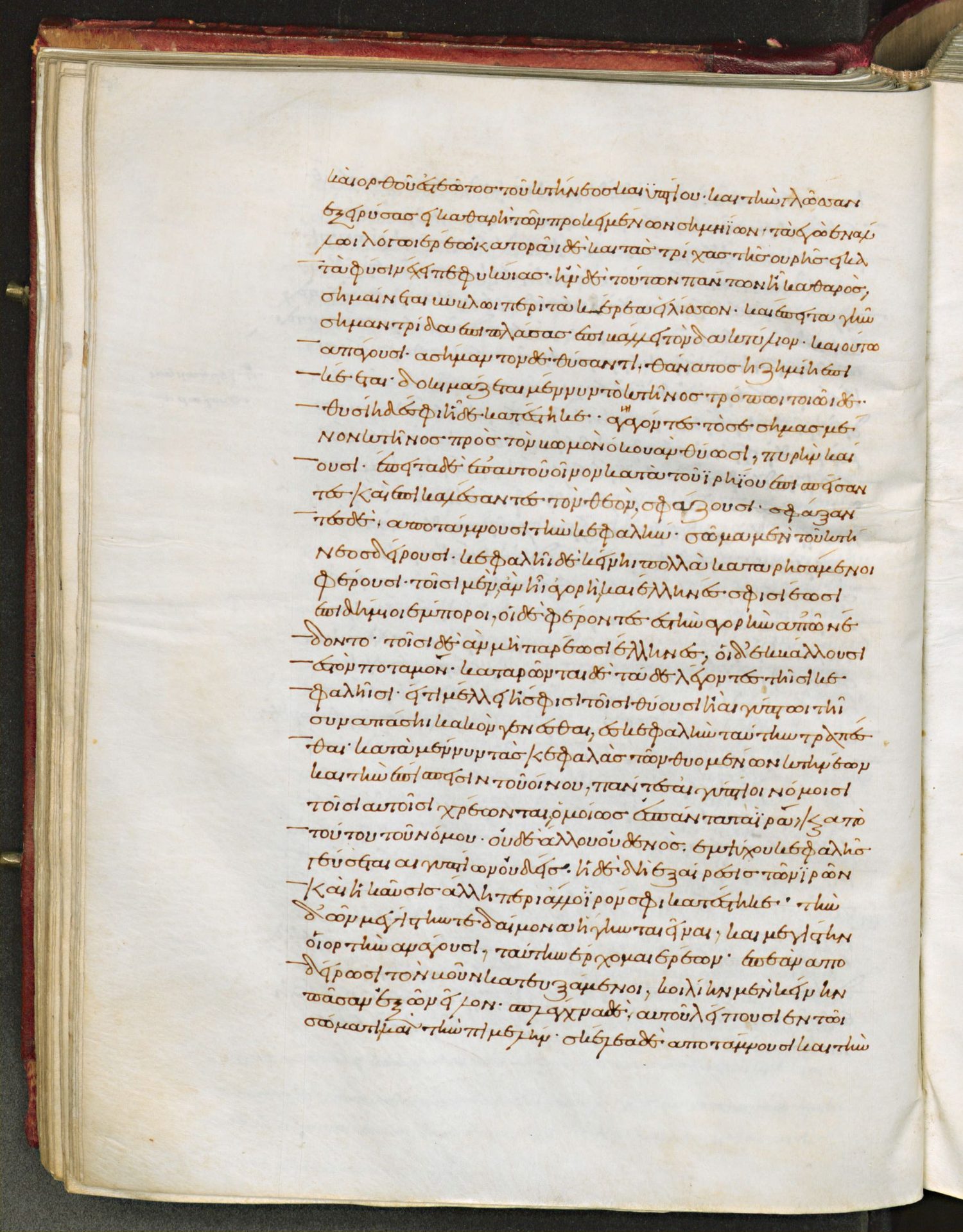
Laur. Plut. 70.3, fol. 65v: Greek here 2.38.2 to 2.40.2. Checked on the image (first and last words read and located in the Greek; each break checked against the neighbouring page): fol. 65v begins ‹καὶ ὀρθοῦ ἑστεῶτος τοῦ› (2.38.2), ends ‹δὲ ἀποτάμνουσι καὶ τὴν› (2.40.2). English here: 2.38.3 to 2.40.2 (Godley's sentences for the sections whose Greek lies mostly on this page).
2.38.2καὶ ὀρθοῦ ἑστεῶτος τοῦ κτήνεος καὶ ὑπτίου, καὶ τὴν γλῶσσαν ἐξειρύσας, εἰ καθαρὴ τῶν προκειμένων σημηίων, τὰ ἐγὼ ἐν ἄλλῳ λόγῳ ἐρέω· κατορᾷ δὲ καὶ τὰς τρίχας τῆς οὐρῆς εἰ κατὰ φύσιν ἔχει πεφυκυίας. 2.38.3ἢν δὲ τούτων πάντων ᾖ καθαρός, σημαίνεται βύβλῳ περὶ τὰ κέρεα εἱλίσσων καὶ ἔπειτα γῆν σημαντρίδα ἐπιπλάσας ἐπιβάλλει τὸν δακτύλιον, καὶ οὕτω ἀπάγουσι. ἀσήμαντον δὲ θύσαντι θάνατος ἡ ζημίη ἐπικέεται. δοκιμάζεται μέν νυν τὸ κτῆνος τρόπῳ τοιῷδε, θυσίη δέ σφι ἥδε κατέστηκε. 2.39.1ἀγαγόντες τὸ σεσημασμένον κτῆνος πρὸς τὸν βωμὸν ὅκου ἂν θύωσι, πῦρ ἀνακαίουσι, ἔπειτα δὲ ἐπʼ αὐτοῦ οἶνον κατὰ τοῦ ἱρηίου ἐπισπείσαντες καὶ ἐπικαλέσαντες τὸν θεὸν σφάζουσι, σφάξαντες δὲ ἀποτάμνουσι τὴν κεφαλήν. 2.39.2σῶμα μὲν δὴ τοῦ κτήνεος δείρουσι, κεφαλῇ δὲ κείνῃ πολλὰ καταρησάμενοι φέρουσι, τοῖσι μὲν ἂν ᾖ ἀγορὴ καὶ Ἕλληνές σφι ἔωσι ἐπιδήμιοι ἔμποροι, οἳ δὲ φέροντες ἐς τὴν ἀγορὴν ἀπʼ ὦν ἔδοντο, τοῖσι δὲ ἂν μὴ παρέωσι Ἕλληνες, οἳ δʼ ἐκβάλλουσι ἐς τὸν ποταμόν· 2.39.3καταρῶνται δὲ τάδε λέγοντες τῇσι κεφαλῇσι, εἴ τι μέλλοι ἢ σφίσι τοῖσι θύουσι ἢ Αἰγύπτῳ τῇ συναπάσῃ κακὸν γενέσθαι, ἐς κεφαλὴν ταύτην τραπέσθαι. 2.39.4κατὰ μέν νυν τὰς κεφαλὰς τῶν θυομένων κτηνέων καὶ τὴν ἐπίσπεισιν τοῦ οἴνου πάντες Αἰγύπτιοι νόμοισι τοῖσι αὐτοῖσι χρέωνται ὁμοίως ἐς πάντα τὰ ἱρά, καὶ ἀπὸ τούτου τοῦ νόμου οὐδὲ ἄλλου οὐδενὸς ἐμψύχου κεφαλῆς γεύσεται Αἰγυπτίων οὐδείς. 2.40.1ἡ δὲ δὴ ἐξαίρεσις τῶν ἱρῶν καὶ ἡ καῦσις ἄλλη περὶ ἄλλο ἱρόν σφι κατέστηκε· τὴν δʼ ὦν μεγίστην τε δαίμονα ἥγηνται εἶναι καὶ μεγίστην οἱ ὁρτὴν ἀνάγουσι, ταύτην ἔρχομαι ἐρέων […] 2.40.2ἐπεὰν ἀποδείρωσι τὸν βοῦν, κατευξάμενοι κοιλίην μὲν κείνην πᾶσαν ἐξ ὦν εἷλον, σπλάγχνά δὲ αὐτοῦ λείπουσι ἐν τῷ σώματι καὶ τὴν πιμελήν, σκέλεα δὲ ἀποτάμνουσι καὶ τὴν
2.38.3If it be pure in all these respects, the priest marks it by wrapping papyrus round the horns, then smears it with sealing-earth and stamps it with his ring; and after this they lead the bull away. But the penalty is death for sacrificing a bull that the priest has not marked. Such is the manner of proving the beast; I will now show how it is sacrificed. 2.39.1Having brought the marked beast to the altar where the Sacrifice is to be, they kindle a fire; then they pour wine on the altar over the victim and call upon the god; then they cut its throat, and having so done they sever the head from the body. 2.39.2They flay the carcase of the victim, then invoke many curses on its head and carry the same away. Where there is a market, and Greek traders in the place, the head is taken to the market and sold; where there are no Greeks, it is thrown into the river. 2.39.3The imprecation which they utter over the heads is, that whatever ill threatens themselves, who sacrifice, or the whole of Egypt, may fall upon that head. 2.39.4In respect of the heads of sacrificed beasts and the libation of wine, the practice of all Egyptians is the same in all sacrifices; and from this ordinance no Egyptian will taste of the head of anything that had life. 2.40.1But in regard to the disembowelling and burning of the victims, there is a different way for each sacrifice. I will now, however, speak of that goddess whom they deem the greatest, and in whose honour they keep highest festival. 2.40.2The ox being flayed, after prayer made as aforesaid they take out the whole stomach, leaving the entrails in the carcase and the fat, and cut off the legs, the end of the loin, the shoulders, and the neck.
Where on the image
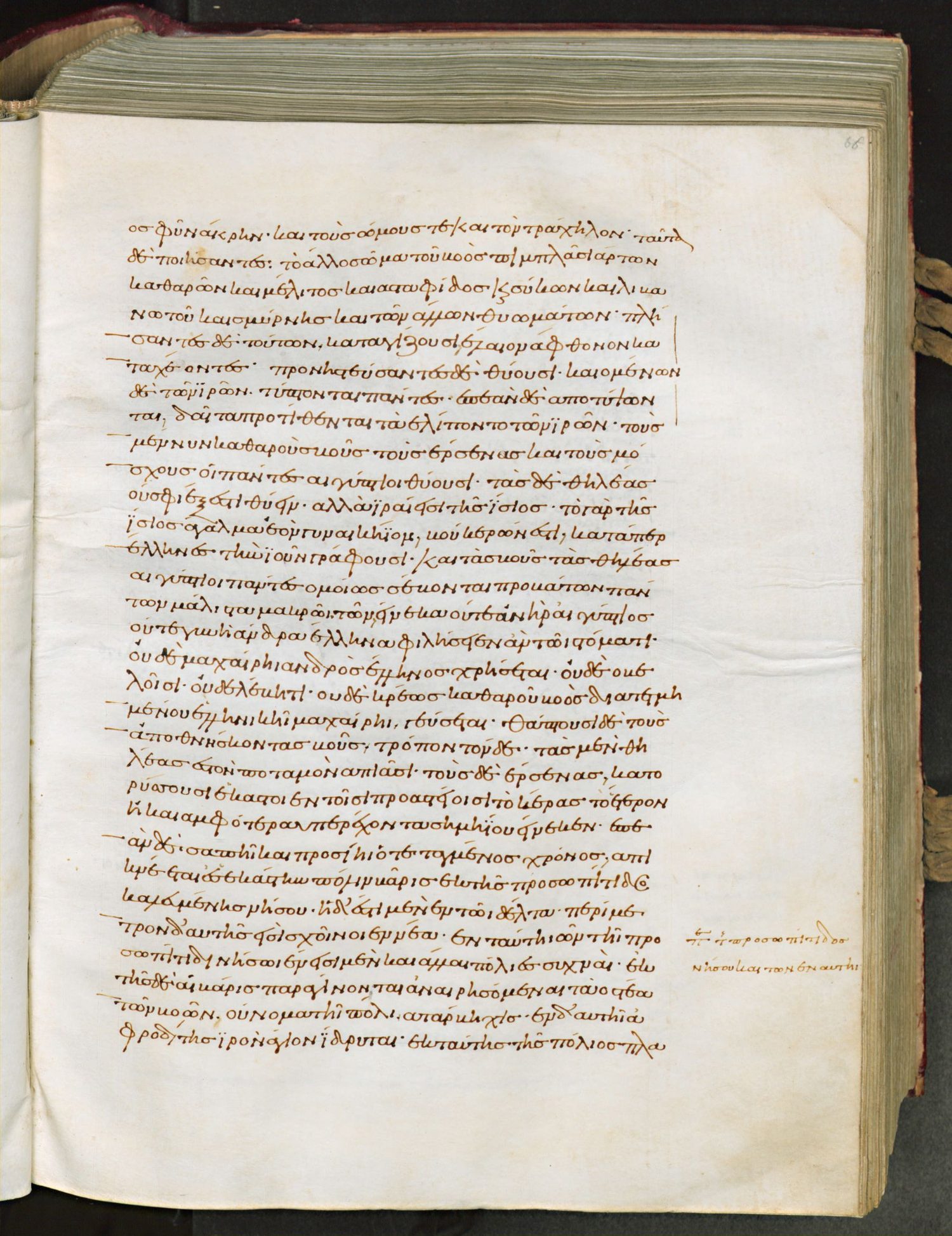
Laur. Plut. 70.3, fol. 66r: Greek here 2.40.2 to 2.41.6. Checked on the image (first and last words read and located in the Greek; each break checked against the neighbouring page): fol. 66r begins ‹ὀσφὺν ἄκρην καὶ τοὺς› (2.40.2), ends ‹ταύτης τῆς πόλιος πλα-› (2.41.6). English here: 2.40.3 to 2.41.5 (Godley's sentences for the sections whose Greek lies mostly on this page).
2.40.2ὀσφὺν ἄκρην καὶ τοὺς ὤμους τε καὶ τὸν τράχηλον. 2.40.3ταῦτα δὲ ποιήσαντες τὸ ἄλλο σῶμα τοῦ βοὸς πιμπλᾶσι ἄρτων καθαρῶν καὶ μέλιτος καὶ ἀσταφίδος καὶ σύκων καὶ λιβανωτοῦ καὶ σμύρνης καὶ τῶν ἄλλων θυωμάτων, πλήσαντες δὲ τούτων καταγίζουσι, ἔλαιον ἄφθονον καταχέοντες· 2.40.4προνηστεύσαντες δὲ θύουσι, καιομένων δὲ τῶν ἱρῶν τύπτονται πάντες, ἐπεὰν δὲ ἀποτύψωνται, δαῖτα προτίθενται τὰ ἐλίποντο τῶν ἱρῶν. 2.41.1τοὺς μέν νυν καθαροὺς βοῦς τοὺς ἔρσενας καὶ τοὺς μόσχους οἱ πάντες Αἰγύπτιοι θύουσι, τὰς δὲ θηλέας οὔ σφι ἔξεστι θύειν, ἀλλὰ ἱραί εἰσι τῆς Ἴσιος· 2.41.2τὸ γὰρ τῆς Ἴσιος ἄγαλμα ἐὸν γυναικήιον βούκερων ἐστὶ κατά περ Ἕλληνες τὴν Ἰοῦν γράφουσι, καὶ τὰς βοῦς τὰς θηλέας Αἰγύπτιοι πάντες ὁμοίως σέβονται προβάτων πάντων μάλιστα μακρῷ. 2.41.3τῶν εἵνεκα οὔτε ἀνὴρ Αἰγύπτιος οὔτε γυνὴ ἄνδρα Ἕλληνα φιλήσειε ἂν τῷ στόματι, οὐδὲ μαχαίρῃ ἀνδρὸς Ἕλληνος χρήσεται οὐδὲ ὀβελοῖσι οὐδὲ λέβητι, οὐδὲ κρέως καθαροῦ βοὸς διατετμημένου Ἑλληνικῇ μαχαίρῃ γεύσεται. 2.41.4θάπτουσι δὲ τοὺς ἀποθνήσκοντας βοῦς τρόπον τόνδε· τὰς μὲν θηλέας ἐς τὸν ποταμὸν ἀπιεῖσι, τοὺς δὲ ἔρσενας κατορύσσουσι ἕκαστοι ἐν τοῖσι προαστείοισι, τὸ κέρας τὸ ἕτερον ἢ καὶ ἀμφότερα ὑπερέχοντα σημηίου εἵνεκεν· ἐπεὰν δὲ σαπῇ καὶ προσίῃ ὁ τεταγμένος χρόνος, ἀπικνέεται ἐς ἑκάστην πόλιν βᾶρις ἐκ τῆς Προσωπίτιδος καλευμένης νήσου. 2.41.5ἣ δʼ ἔστι μὲν ἐν τῷ Δέλτα, περίμετρον δὲ αὐτῆς εἰσὶ σχοῖνοι ἐννέα. ἐν ταύτῃ ὦν τῇ Προσωπίτιδι νήσῳ ἔνεισι μὲν καὶ ἄλλαι πόλιες συχναί, ἐκ τῆς δὲ αἱ βάριες παραγίνονται ἀναιρησόμεναι τὰ ὀστέα τῶν βοῶν, οὔνομα τῇ πόλι Ἀτάρβηχις, ἐν δʼ αὐτῇ Ἀφροδίτης ἱρὸν ἅγιον ἵδρυται. 2.41.6ἐκ ταύτης τῆς πόλιος πλανῶνται
2.40.3Having done this, they fill what remains of the carcase of the ox with pure bread, honey, raisins, figs, frankincense, myrrh, and other kinds of incense, and then burn it, pouring much oil on it. 2.40.4They fast before the sacrifice, and while it is burning they all make lamentation; and when their lamentation is over, they set out a meal of what is left of the victim. 2.41.1All Egyptians sacrifice unblemished bulls and bull-calves; they may not sacrifice cows; these are sacred to Isis. 2.41.2For the images of Isis are in woman’s form, horned like an ox, as the Greeks picture Io, and cows are held by far the most sacred of all beasts of the herd by all Egyptians alike. 2.41.3For this reason no Egyptian man or woman will kiss a Greek man, or use a knife, or a spit, or a caldron belonging to a Greek, or taste the flesh of an unblemished ox that has been cut up with a Greek knife. 2.41.4Oxen that die are dealt with in the following way:—Cows are cast into the river, bulls are buried by each city in its suburbs, with one or both horns uncovered for a sign: then, when the carcase is decomposed, and the time appointed is at hand, a boat comes to each city from the island called Prosopitis, an island in the Delta, of nine schoeni in circuit. 2.41.5There are many other towns in Prosopitis; that one from which come the boats to gather the bones of the bulls is called Atarbechis; there stands in it a temple of Aphrodite of great sanctity.
Where on the image
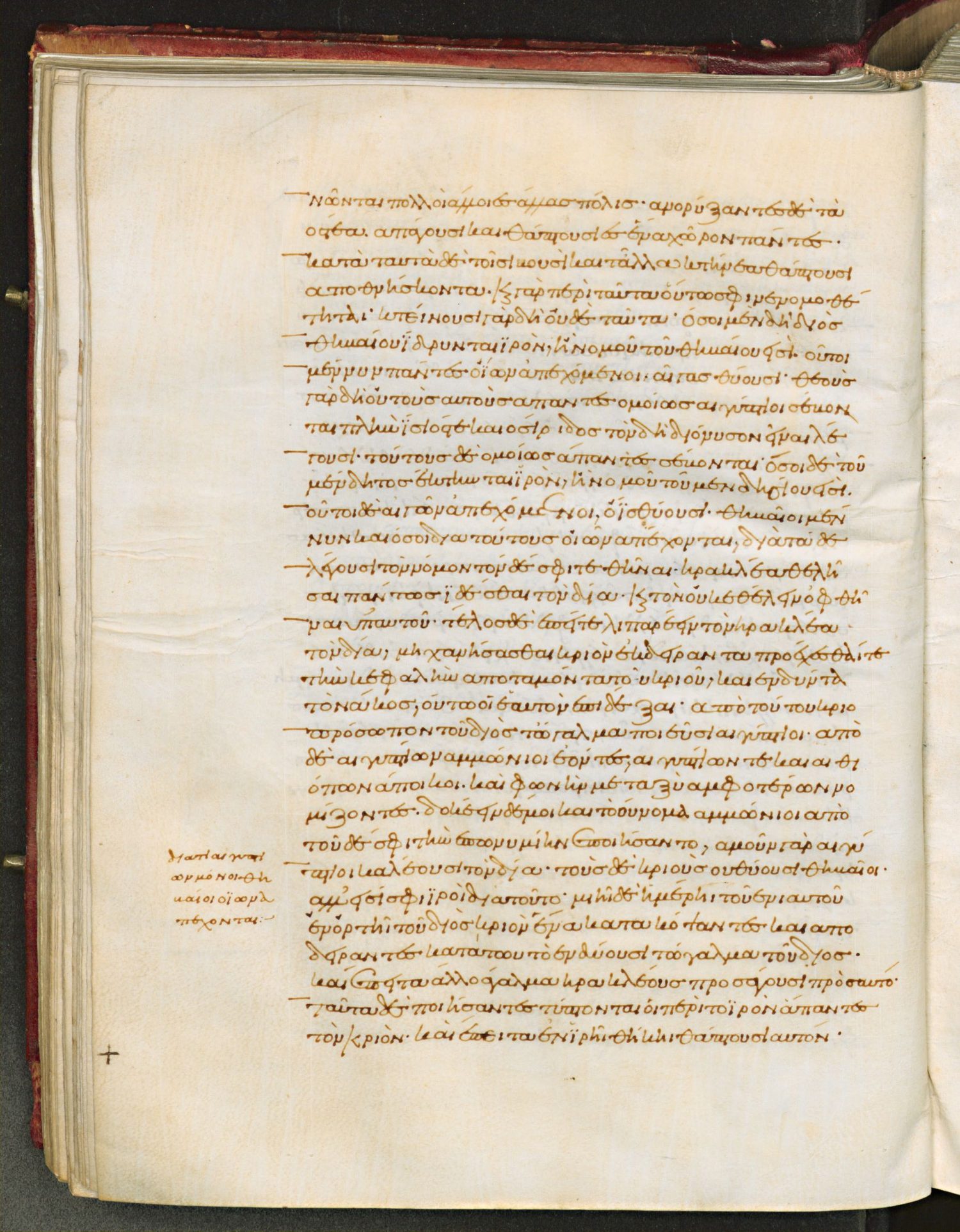
Laur. Plut. 70.3, fol. 66v: Greek here 2.41.6 to 2.42.6. Checked on the image (first and last words read and located in the Greek; each break checked against the neighbouring page): fol. 66v begins ‹-νῶνται πολλοὶ ἄλλοι ἐς› (2.41.6), ends ‹ἱρῇ θήκῃ θάπτουσι αὐτόν› (2.42.6). The word ‹πλανῶνται› is divided between fol. 66r and fol. 66v; it is given with fol. 66r. English here: 2.41.6 to 2.42.6 (Godley's sentences for the sections whose Greek lies mostly on this page).
2.41.6πολλοὶ ἄλλοι ἐς ἄλλας πόλις, ἀνορύξαντες δὲ τὰ ὀστέα ἀπάγουσι καὶ θάπτουσι ἐς ἕνα χῶρον πάντες. κατὰ ταὐτὰ δὲ τοῖσι βουσὶ καὶ τἆλλα κτήνεα θάπτουσι ἀποθνήσκοντα· καὶ γὰρ περὶ ταῦτα οὕτω σφι νενομοθέτηται· κτείνουσι γὰρ δὴ οὐδὲ ταῦτα. 2.42.1ὅσοι μὲν δὴ Διὸς Θηβαιέος ἵδρυνται ἱρὸν ἤ νομοῦ τοῦ Θηβαίου εἰσί, οὗτοι μέν νυν πάντες ὀίων ἀπεχόμενοι αἶγας θύουσι. 2.42.2θεοὺς γὰρ δὴ οὐ τοὺς αὐτοὺς ἅπαντες ὁμοίως Αἰγύπτιοι σέβονται, πλὴν Ἴσιός τε καὶ Ὀσίριος, τὸν δὴ Διόνυσον εἶναι λέγουσι· τούτους δὲ ὁμοίως ἅπαντες σέβονται. ὅσοι δὲ τοῦ Μένδητος ἔκτηνται ἱρὸν ἢ νομοῦ τοῦ Μενδησίου εἰσί, οὗτοι δὲ αἰγῶν ἀπεχόμενοι ὄις θύουσι. 2.42.3Θηβαῖοι μέν νυν καὶ ὅσοι διὰ τούτους ὀίων ἀπέχονται, διὰ τάδε λέγουσι τὸν νόμον τόνδε σφίσι τεθῆναι. Ἡρακλέα θελῆσαι πάντως ἰδέσθαι τὸν Δία, καὶ τὸν οὐκ ἐθέλειν ὀφθῆναι ὑπʼ αὐτοῦ· τέλος δέ, ἐπείτε λιπαρέειν τὸν Ἡρακλέα, τάδε τὸν Δία μηχανήσασθαι· 2.42.4κριὸν ἐκδείραντα προσχέσθαι τε τὴν κεφαλὴν ἀποταμόντα τοῦ κριοῦ καὶ ἐνδύντα τὸ νάκος οὕτω οἱ ἑωυτὸν ἐπιδέξαι. ἀπὸ τούτου κριοπρόσωπον τοῦ Διὸς τὤγαλμα ποιεῦσι Αἰγύπτιοι, ἀπὸ δὲ Αἰγυπτίων Ἀμμώνιοι, ἐόντες Αἰγυπτίων τε καὶ Αἰθιόπων ἄποικοι καὶ φωνὴν μεταξὺ ἀμφοτέρων νομίζοντες. 2.42.5δοκέειν δέ μοι, καὶ τὸ οὔνομα Ἀμμώνιοι ἀπὸ τοῦδε σφίσι τὴν ἐπωνυμίην ἐποιήσαντο· Ἀμοῦν γὰρ Αἰγύπτιοι καλέουσι τὸν Δία. τοὺς δὲ κριοὺς οὐ θύουσι Θηβαῖοι, ἀλλʼ εἰσί σφι ἱροὶ διὰ τοῦτο. 2.42.6μιῇ δὲ ἡμέρῃ τοῦ ἐνιαυτοῦ, ἐν ὁρτῇ τοῦ Διός, κριὸν ἕνα κατακόψαντες καὶ ἀποδείραντες κατὰ τὠυτὸ ἐνδύουσι τὤγαλμα τοῦ Διός, καὶ ἔπειτα ἄλλο ἄγαλμα Ἡρακλέος προσάγουσι πρὸς αὐτό. ταῦτα δὲ ποιήσαντες τύπτονται οἱ περὶ τὸ ἱρὸν ἅπαντες τὸν κριὸν καὶ ἔπειτα ἐν ἱρῇ θήκῃ θάπτουσι αὐτόν.
2.41.6From this town many go about, some to one town and some to another, and dig up the bones, which they then carry away and all bury in one place. As they bury the oxen, so they do with all other beasts at death. Such is their ordinance respecting these also; for they, too, may not be killed. 2.42.1All that have among them a temple of Zeus of Thebes, or are of the Theban province, sacrifice goats but will not touch sheep. 2.42.2For no gods are worshipped in common by the whole of Egypt save only Isis and Osiris, whom they say to be Dionysus; these are worshipped by all alike. Those who have a temple of Mendes or are of the Mendesian province sacrifice sheep, but will not touch goats. 2.42.3The Thebans, and those who by the Theban example will not touch sheep give the following reason for their ordinance: Heracles (they say) would by all means look upon Zeus, and Zeus would not be seen by him. At last, being earnestly entreated by Heracles, Zeus contrived a device, whereby 2.42.4he showed himself displaying the head and wearing the fleece of a ram which he had flayed and beheaded. It is from this that the Egyptian images of Zeus have a ram’s head; and in this the Egyptians are imitated by the Ammonians, who are colonists from Egypt and Ethiopia and speak a language compounded of the tongues of both countries. 2.42.5It was from this, I think, that the Ammonians got their name too; for Amun is the Egyptian name for Zeus. The Thebans, then, hold rams sacred for this reason, and do not sacrifice them. 2.42.6But on one day in the year, at the festival of Zeus, they cut in pieces and flay a single ram and put the fleece on the image of Zeus, as in the story; then they bring an image of Heracles near to it. Having done this, all that are about the temple mourn for the ram, and presently bury it in a sacred coffer.
Where on the image
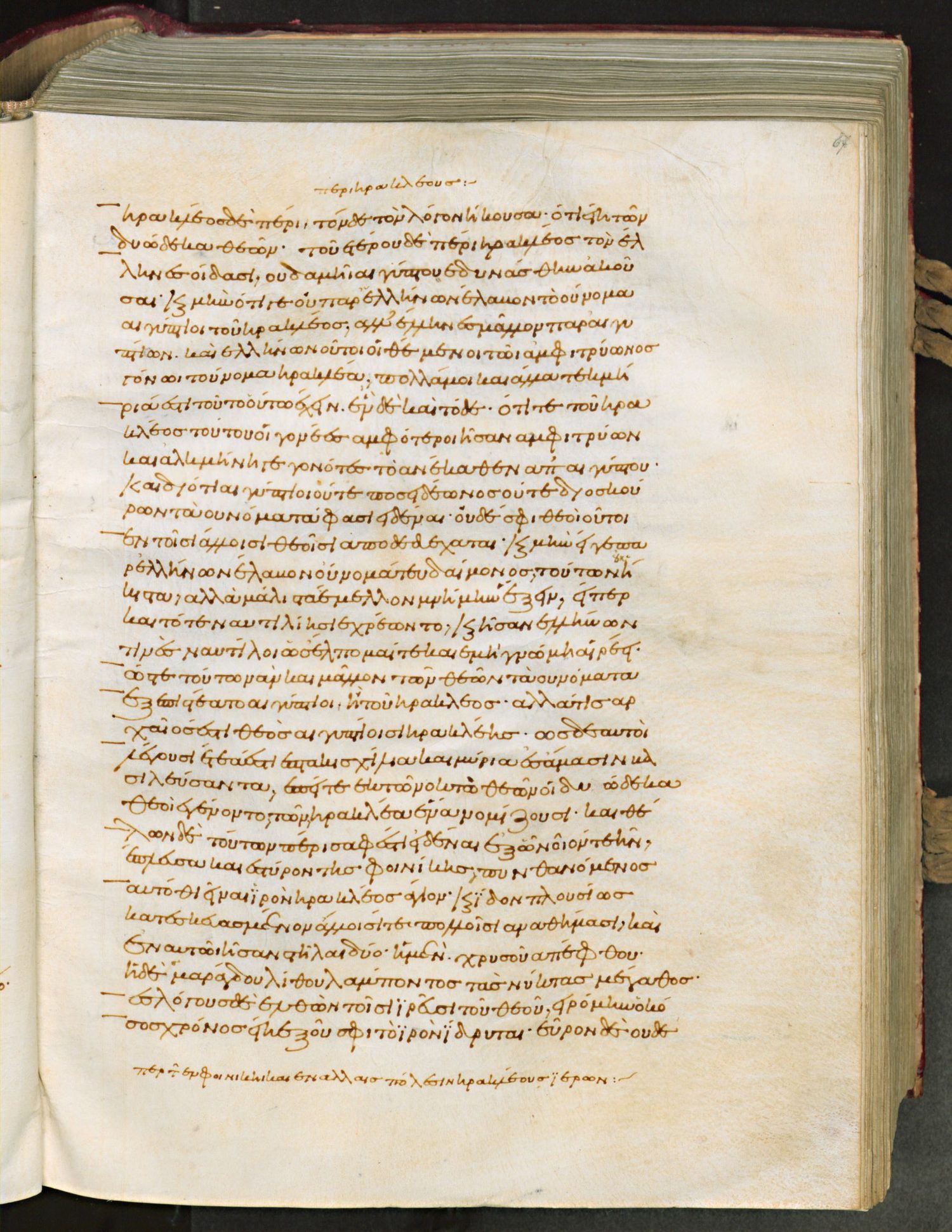
Laur. Plut. 70.3, fol. 67r: Greek here 2.43.1 to 2.44.3. Checked on the image (first and last words read and located in the Greek; each break checked against the neighbouring page): fol. 67r begins ‹Ἡρακλέος δὲ πέρι τόνδε› (2.43.1), ends ‹ἱρὸν ἵδρυται.εὗρον δὲ οὐδὲ› (2.44.3). Below the text, a reader's note on the temple of Heracles in Phoenicia and elsewhere. English here: 2.43.1 to 2.44.2 (Godley's sentences for the sections whose Greek lies mostly on this page).
2.43.1Ἡρακλέος δὲ πέρι τόνδε τὸν λόγον ἤκουσα, ὅτι εἴη τῶν δυώδεκα θεῶν· τοῦ ἑτέρου δὲ πέρι Ἡρακλέος, τὸν Ἕλληνες οἴδασι, οὐδαμῇ Αἰγύπτου ἐδυνάσθην ἀκοῦσαι. 2.43.2καὶ μὴν ὅτι γε οὐ παρʼ Ἑλλήνων ἔλαβον τὸ οὔνομα Αἰγύπτιοι τοῦ Ἡρακλέος, ἀλλὰ Ἕλληνες μᾶλλον παρʼ Αἰγυπτίων καὶ Ἑλλήνων οὗτοι οἱ θέμενοι τῷ Ἀμφιτρύωνος γόνῳ τοὔνομα Ἡρακλέα, πολλά μοι καὶ ἄλλα τεκμήρια ἐστὶ τοῦτο οὕτω ἔχειν, ἐν δὲ καὶ τόδε, ὅτι τε τοῦ Ἡρακλέος τούτου οἱ γονέες ἀμφότεροι ἦσαν Ἀμφιτρύων καὶ Ἀλκμήνη γεγονότες τὸ ἀνέκαθεν ἀπʼ Αἰγύπτου, καὶ διότι Αἰγύπτιοι οὔτε Ποσειδέωνος οὔτε Διοσκούρων τὰ οὐνόματα φασὶ εἰδέναι, οὐδέ σφι θεοὶ οὗτοι ἐν τοῖσι ἄλλοισι θεοῖσι ἀποδεδέχαται. 2.43.3καὶ μὴν εἴ γε παρʼ Ἑλλήνων ἔλαβον οὔνομά τευ δαίμονος, τούτων οὐκ ἥκιστα ἀλλὰ μάλιστα ἔμελλον μνήμην ἕξειν, εἴ περ καὶ τότε ναυτιλίῃσι ἐχρέωντο καὶ ἦσαν Ἑλλήνων τινὲς ναυτίλοι, ὡς ἔλπομαί τε καὶ ἐμὴ γνώμη αἱρέει· ὥστε τούτων ἂν καὶ μᾶλλον τῶν θεῶν τὰ οὐνόματα ἐξεπιστέατο Αἰγύπτιοι ἢ τοῦ Ἡρακλέος. 2.43.4ἀλλά τις ἀρχαῖος ἐστὶ θεὸς Αἰγυπτίοισι Ἡρακλέης· ὡς δὲ αὐτοὶ λέγουσι, ἔτεα ἐστὶ ἑπτακισχίλια καὶ μύρια ἐς Ἄμασιν βασιλεύσαντα, ἐπείτε ἐκ τῶν ὀκτὼ θεῶν οἱ δυώδεκα θεοὶ ἐγένοντο τῶν Ἡρακλέα ἕνα νομίζουσι. 2.44.1καὶ θέλων δὲ τούτων πέρι σαφές τι εἰδέναι ἐξ ὧν οἷόν τε ἦν, ἔπλευσα καὶ ἐς Τύρον τῆς Φοινίκης, πυνθανόμενος αὐτόθι εἶναι ἱρὸν Ἡρακλέος ἅγιον. 2.44.2καὶ εἶδον πλουσίως κατεσκευασμένον ἄλλοισί τε πολλοῖσι ἀναθήμασι, καὶ ἐν αὐτῷ ἦσαν στῆλαι δύο, ἣ μὲν χρυσοῦ ἀπέφθου, ἣ δὲ σμαράγδου λίθου λάμποντος τὰς νύκτας μέγαθος. ἐς λόγους δὲ ἐλθὼν τοῖσι ἱρεῦσι τοῦ θεοῦ εἰρόμην ὁκόσος χρόνος εἴη ἐξ οὗ σφι τὸ ἱρὸν ἵδρυται. 2.44.3εὗρον δὲ οὐδὲ
2.43.1Concerning Heracles, I heard it said that he was one of the twelve gods. But I could nowhere in Egypt hear anything concerning the other Heracles, whom the Greeks know. 2.43.2I have indeed many proofs that the name of Heracles did not come from Hellas to Egypt, but from Egypt to Hellas (and in Hellas to those Greeks who gave the name Heracles to the son of Amphitryon); and this is the chief among them—that Amphitryon and Alcmene, the parents of this Heracles, were both by descent Egyptian; and that the Egyptians deny knowledge of the names of Poseidon and the Dioscuri, nor are these gods reckoned among the gods of Egypt. 2.43.3Yet had they got the name of any deity from the Greeks, it was these more than any that they were like to remember, if indeed they were already making sea voyages and the Greeks too had seafaring men, as I suppose and judge; so that the names of these gods would have been even better known to the Egyptians than the name of Heracles. 2.43.4Nay, Heracles is a very ancient god in Egypt; as the Egyptians themselves say, the change of the eight gods to the twelve, of whom they deem Heracles one, was made seventeen thousand years before the reign of Amasis. 2.44.1Moreover, wishing to get clear knowledge of this matter whence it was possible so to do, I took ship to Tyre in Phoenice, where I heard that there was a very holy temple of Heracles. 2.44.2There I saw it, richly equipped with many other offerings, besides that in it there were two pillars, one of refined gold, one of emerald, a great pillar that shone in the night-time; and in converse with the priests I asked how long it was since their temple was built.
Where on the image
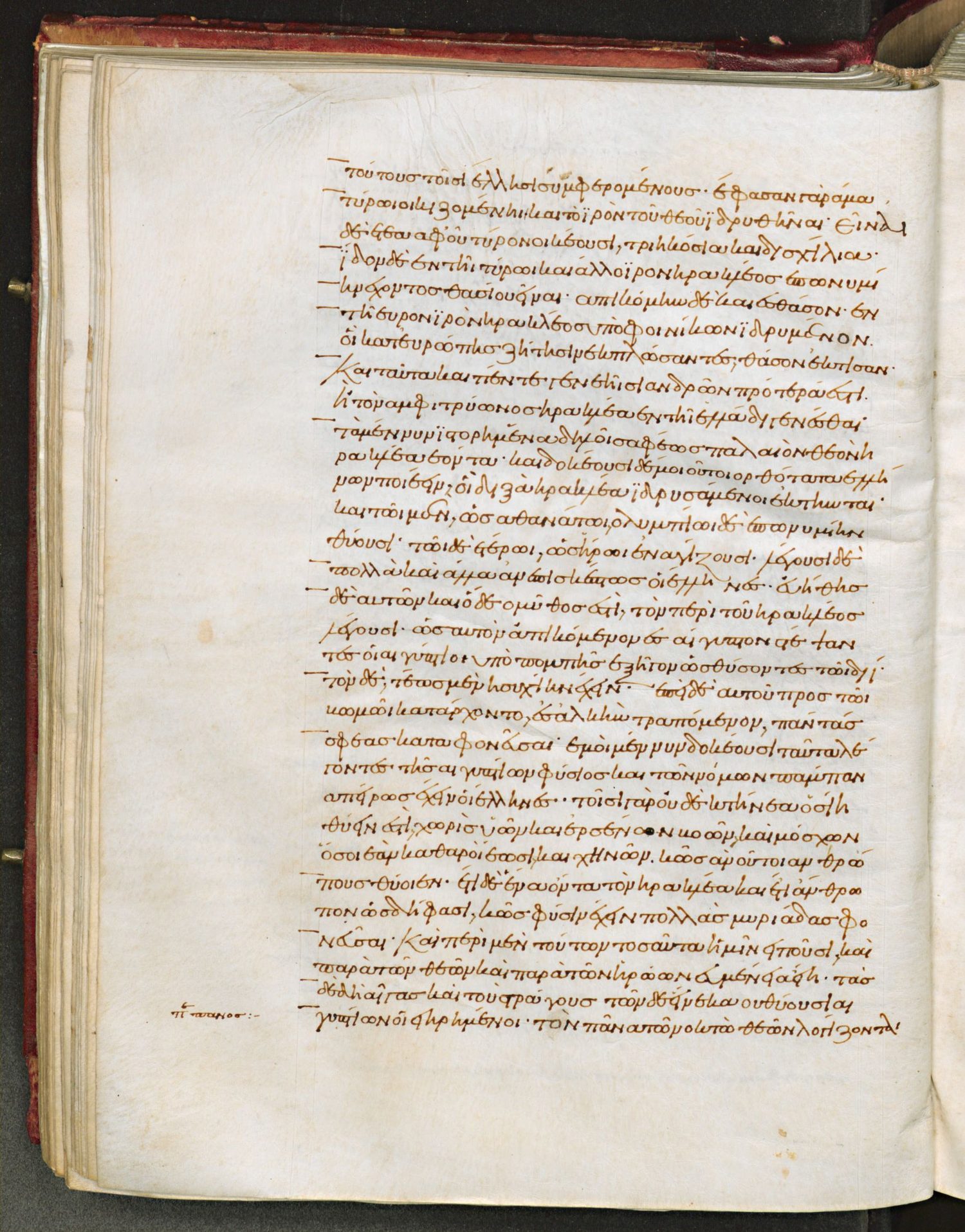
Laur. Plut. 70.3, fol. 67v: Greek here 2.44.3 to 2.46.1. Checked on the image (first and last words read and located in the Greek; each break checked against the neighbouring page): fol. 67v begins ‹τούτους τοῖσι Ἕλλησι συμφερομένους·› (2.44.3), ends ‹τῶν ὀκτὼ θεῶν λογίζονται› (2.46.1). English here: 2.44.3 to 2.46.1 (Godley's sentences for the sections whose Greek lies mostly on this page).
2.44.3τούτους τοῖσι Ἕλλησι συμφερομένους· ἔφασαν γὰρ ἅμα Τύρῳ οἰκιζομένῃ καὶ τὸ ἱρὸν τοῦ θεοῦ ἱδρυθῆναι, εἶναι δὲ ἔτεα ἀπʼ οὗ Τύρον οἰκέουσι τριηκόσια καὶ δισχίλια. εἶδον δὲ ἐν τῇ Τύρῳ καὶ ἄλλο ἱρὸν Ἡρακλέος ἐπωνυμίην ἔχοντος Θασίου εἶναι· 2.44.4ἀπικόμην δὲ καὶ ἐς Θάσον, ἐν τῇ εὗρον ἱρὸν Ἡρακλέος ὑπὸ Φοινίκων ἱδρυμένον, οἳ κατʼ Εὐρώπης ζήτησιν ἐκπλώσαντες Θάσον ἔκτισαν· καὶ ταῦτα καὶ πέντε γενεῇσι ἀνδρῶν πρότερα ἐστὶ ἢ τὸν Ἀμφιτρύωνος Ἡρακλέα ἐν τῇ Ἑλλάδι γενέσθαι. 2.44.5τὰ μέν νυν ἱστορημένα δηλοῖ σαφέως παλαιὸν θεὸν Ἡρακλέα ἐόντα, καὶ δοκέουσι δέ μοι οὗτοι ὀρθότατα Ἑλλήνων ποιέειν, οἳ διξὰ Ἡράκλεια ἱδρυσάμενοι ἔκτηνται, καὶ τῷ μὲν ὡς ἀθανάτῳ Ὀλυμπίῳ δὲ ἐπωνυμίην θύουσι, τῷ δὲ ἑτέρῳ ὡς ἥρωι ἐναγίζουσι. 2.45.1λέγουσι δὲ πολλὰ καὶ ἄλλα ἀνεπισκέπτως οἱ Ἕλληνες, εὐήθης δὲ αὐτῶν καὶ ὅδε ὁ μῦθος ἐστὶ τὸν περὶ τοῦ Ἡρακλέος λέγουσι, ὡς αὐτὸν ἀπικόμενον ἐς Αἴγυπτον στέψαντες οἱ Αἰγύπτιοι ὑπὸ πομπῆς ἐξῆγον ὡς θύσοντες τῷ Διί· τὸν δὲ τέως μὲν ἡσυχίην ἔχειν, ἐπεὶ δὲ αὐτοῦ πρὸς τῷ βωμῷ κατάρχοντο, ἐς ἀλκὴν τραπόμενον πάντας σφέας καταφονεῦσαι. 2.45.2ἐμοὶ μέν νυν δοκέουσι ταῦτα λέγοντες τῆς Αἰγυπτίων φύσιος καὶ τῶν νόμων πάμπαν ἀπείρως ἔχειν οἱ Ἕλληνες· τοῖσι γὰρ οὐδὲ κτήνεα ὁσίη θύειν ἐστὶ χωρὶς ὑῶν καὶ ἐρσένων βοῶν καὶ μόσχων, ὅσοι ἂν καθαροὶ ἔωσι, καὶ χηνῶν, κῶς ἂν οὗτοι ἀνθρώπους θύοιεν; 2.45.3ἔτι δὲ ἕνα ἐόντα τὸν Ἡρακλέα καὶ ἔτι ἄνθρωπον, ὡς δὴ φασί, κῶς φύσιν ἔχει πολλὰς μυριάδας φονεῦσαι; καὶ περὶ μὲν τούτων τοσαῦτα ἡμῖν εἰποῦσι καὶ παρὰ τῶν θεῶν καὶ παρὰ τῶν ἡρώων εὐμένεια εἴη. 2.46.1τὰς δὲ δὴ αἶγας καὶ τοὺς τράγους τῶνδε εἵνεκα οὐ θύουσι Αἰγυπτίων οἱ εἰρημένοι· τὸν Πᾶνα τῶν ὀκτὼ θεῶν λογίζονται
2.44.3I found that neither did their account tally with the belief of the Greeks; for they said that the temple of the god was founded when Tyre first became a city, and that was two thousand three hundred years since. At Tyre I saw yet another temple of that Heracles called the Thasian. 2.44.4Then I went to Thasos, too, where I found a temple of Heracles built by the Phoenicians, who made a settlement there when they voyaged in search of Europe; now they did so as much as five generations before the birth in Hellas of Heracles the son of Amphitryon. 2.44.5Therefore, what I have discovered by inquiry plainly shows that Heracles is an ancient god. And further: those Greeks, I think, are most in the right, who have established and practise two worships of Heracles, sacrificing to one Heracles as to an immortal, and calling him the Olympian, but to the other bringing offerings as to a dead hero. 2.45.1But among the many ill-considered tales told by the Greeks, this is a very foolish story which they relate about Heracles—how when he came to Egypt the Egyptians crowned him and led him out in a procession to sacrifice him to Zeus; and for a while (they say) he followed quietly, but when they began the first rites of sacrifice upon him at the altar, he resisted and slew them all. 2.45.2Now it seems to me that by this story the Greeks show themselves wholly ignorant of the character and customs of the Egyptians; for how should they sacrifice men, who are forbidden to sacrifice even the lower animals, save only swine and bulls and bull-calves, if they be unblemished, and geese? 2.45.3Moreover, Heracles being alone, and still but a man, as they say, how is it natural that he should slay a countless multitude? So much I say of this matter; may no god or hero be displeased with me therefor! 2.46.1This is the reason why the Egyptians of whom I have spoken sacrifice no goats, male or female: the Mendesians reckon Pan among the eight gods, who, they say, were before the twelve gods.
Where on the image
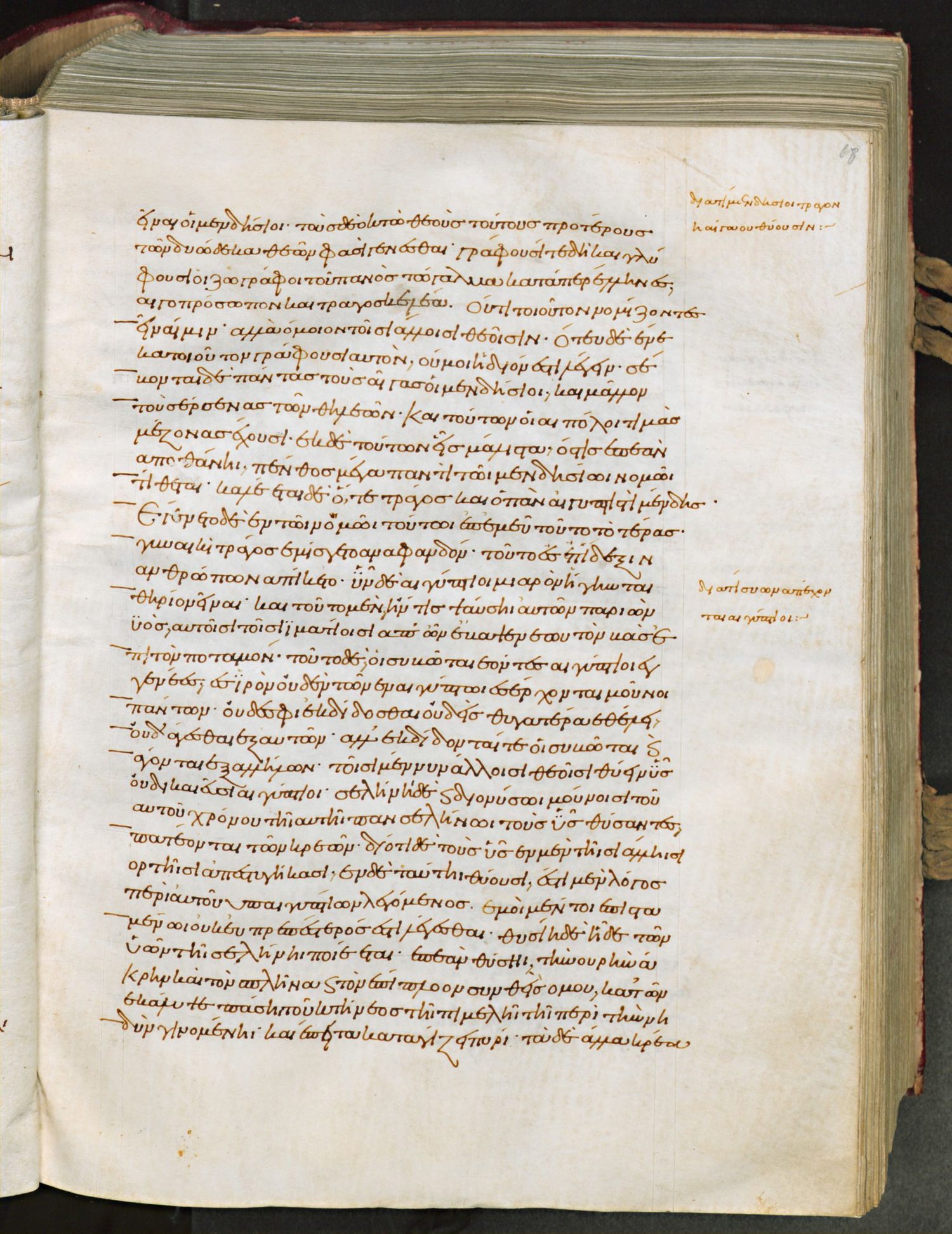
Laur. Plut. 70.3, fol. 68r: Greek here 2.46.1 to 2.47.3. Checked on the image (first and last words read and located in the Greek; each break checked against the neighbouring page): fol. 68r begins ‹εἶναι οἱ Μενδήσιοι, τοὺς› (2.46.1), ends ‹τὰ δὲ ἄλλα κρέα› (2.47.3). English here: 2.46.2 to 2.47.3 (Godley's sentences for the sections whose Greek lies mostly on this page).
2.46.1εἶναι οἱ Μενδήσιοι, τοὺς δὲ ὀκτὼ θεοὺς τούτους προτέρους τῶν δυώδεκα θεῶν φασι γενέσθαι. 2.46.2γράφουσί τε δὴ καὶ γλύφουσι οἱ ζωγράφοι καὶ οἱ ἀγαλματοποιοὶ τοῦ Πανὸς τὤγαλμα κατά περ Ἕλληνες αἰγοπρόσωπον καὶ τραγοσκελέα, οὔτι τοιοῦτον νομίζοντες εἶναί μιν ἀλλὰ ὁμοῖον τοῖσι ἄλλοισι θεοῖσι· ὅτευ δὲ εἵνεκα τοιοῦτον γράφουσι αὐτόν, οὔ μοι ἥδιον ἐστὶ λέγειν. 2.46.3σέβονται δὲ πάντας τοὺς αἶγας οἱ Μενδήσιοι, καὶ μᾶλλον τοὺς ἔρσενας τῶν θηλέων, καὶ τούτων οἱ αἰπόλοι τιμὰς μέζονας ἔχουσι· ἐκ δὲ τούτων ἕνα μάλιστα, ὅστις ἐπεὰν ἀποθάνῃ, πένθος μέγα παντὶ τῷ Μενδησίῳ νομῷ τίθεται. 2.46.4καλέεται δὲ ὅ τε τράγος καὶ ὁ Πὰν Αἰγυπτιστὶ Μένδης. ἐγένετο δὲ ἐν τῷ νομῷ τούτῳ ἐπʼ ἐμεῦ τοῦτο τὸ τέρας· γυναικὶ τράγος ἐμίσγετο ἀναφανδόν. τοῦτο ἐς ἐπίδεξιν ἀνθρώπων ἀπίκετο. 2.47.1ὗν δὲ Αἰγύπτιοι μιαρὸν ἥγηνται θηρίον εἶναι, καὶ τοῦτο μὲν ἤν τις ψαύσῃ αὐτῶν παριὼν αὐτοῖσι τοῖσι ἱματίοισι ἀπʼ ὦν ἔβαψε ἑωυτὸν βὰς ἐς τὸν ποταμόν· τοῦτο δὲ οἱ συβῶται ἐόντες Αἰγύπτιοι ἐγγενέες ἐς ἱρὸν οὐδὲν τῶν ἐν Αἰγύπτῳ ἐσέρχονται μοῦνοι πάντων, οὐδέ σφι ἐκδίδοσθαι οὐδεὶς θυγατέρα ἐθέλει οὐδʼ ἄγεσθαι ἐξ αὐτῶν, ἀλλʼ ἐκδίδονταί τε οἱ συβῶται καὶ ἄγονται ἐξ ἀλλήλων. 2.47.2τοῖσι μέν νυν ἄλλοισι θεοῖσι θύειν ὗς οὐ δικαιοῦσι Αἰγύπτιοι, Σελήνῃ δὲ καὶ Διονύσῳ μούνοισι τοῦ αὐτοῦ χρόνου, τῇ αὐτῇ πανσελήνῳ, τοὺς ὗς θύσαντες πατέονται τῶν κρεῶν. διότι δὲ τοὺς ὗς ἐν μὲν τῇσι ἄλλῃσι ὁρτῇσι ἀπεστυγήκασι ἐν δὲ ταύτῃ θύουσι, ἔστι μὲν λόγος περὶ αὐτοῦ ὑπʼ Αἰγυπτίων λεγόμενος, ἐμοὶ μέντοι ἐπισταμένῳ οὐκ εὐπρεπέστερος ἐστὶ λέγεσθαι. 2.47.3θυσίη δὲ ἥδε τῶν ὑῶν τῇ Σελήνῃ ποιέεται· ἐπεὰν θύσῃ, τὴν οὐρὴν ἄκρην καὶ τὸν σπλῆνα καὶ τὸν ἐπίπλοον συνθεὶς ὁμοῦ κατʼ ὦν ἐκάλυψε πάσῃ τοῦ κτήνεος τῇ πιμελῇ τῇ περὶ τὴν νηδὺν γινομένῃ, καὶ ἔπειτα καταγίζει πυρί· τὰ δὲ ἄλλα κρέα
2.46.2Now in their painting and sculpture the image of Pan is made as among the Greeks with the head and the legs of a goat; not that he is deemed to be in truth such, or unlike to other gods; but why they so present him I have no wish to say. 2.46.3The Mendesians hold all goats sacred, the male even more than the female, and goatherds are held in especial honour: one he-goat is most sacred of all; when he dies it is ordained that there should be great mourning in all the Mendesian province. 2.46.4In the Egyptian language Mendes is the name both for the he-goat and for Pan. In my lifetime a monstrous thing happened in this province, a woman having open intercourse with a he-goat. This came to be publicly known. 2.47.1Swine are held by the Egyptians to be unclean beasts. Firstly, if an Egyptian touch a hog in passing by, he goes to the river and dips himself in it, clothed as he is and secondly, swineherds, native born Egyptians though they be, are alone of all men forbidden to enter any Egyptian temple; nor will any give a swineherd his daughter in marriage, nor take a wife from their women; but swineherds intermarry among themselves. 2.47.2Nor do the Egyptians think right to sacrifice swine to any god save the Moon and Dionysus; to these they sacrifice their swine at the same time, in the same season of full moon; then they eat of the flesh. The Egyptians have an account of the reason why they sacrifice swine at this festival, yet abominate them at others; I know it, but it is not fitting that I should relate it. 2.47.3But this is how they sacrifice swine to the Moon: the sacrificer lays the end of the tail and the spleen and the caul together and covers them up with all the fat that he finds about the belly, then burns all with fire; as for the rest of the flesh, they eat it at the time of full moon when they sacrifice the victim; but they will not taste it on any other day. Poor men, having but slender means, mould swine of dough, which they then bake and sacrifice.
Where on the image
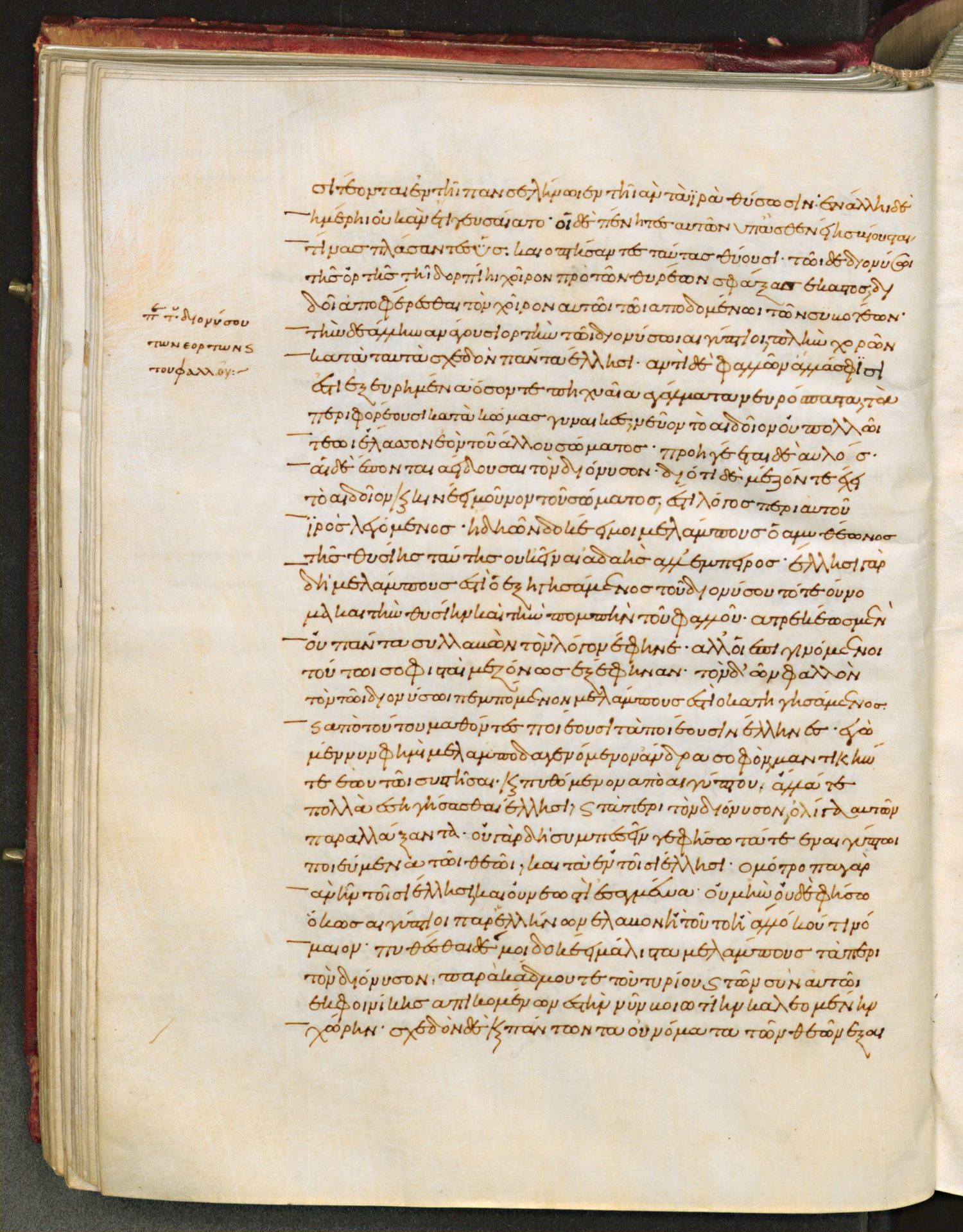
Laur. Plut. 70.3, fol. 68v: Greek here 2.47.3 to 2.50.1. Checked on the image (first and last words read and located in the Greek; each break checked against the neighbouring page): fol. 68v begins ‹σιτέονται ἐν τῇ πανσελήνῳ› (2.47.3), ends ‹τῶν θεῶν ἐξ Αἰ-› (2.50.1). English here: 2.48.1 to 2.49.3 (Godley's sentences for the sections whose Greek lies mostly on this page).
2.47.3σιτέονται ἐν τῇ πανσελήνῳ ἐν τῇ ἂν τὰ ἱρὰ θύσωσι, ἐν ἄλλῃ δὲ ἡμέρῃ οὐκ ἂν ἔτι γευσαίατο. οἱ δὲ πένητες αὐτῶν ὑπʼ ἀσθενείης βίου σταιτίνας πλάσαντες ὗς καὶ ὀπτήσαντες ταύτας θύουσι. 2.48.1τῷ δὲ Διονύσῳ τῆς ὁρτῆς τῇ δορπίῃ χοῖρον πρὸ τῶν θυρέων σφάξας ἕκαστος διδοῖ ἀποφέρεσθαι τὸν χοῖρον αὐτῷ τῷ ἀποδομένῳ τῶν συβωτέων. 2.48.2τὴν δὲ ἄλλην ἀνάγουσι ὁρτὴν τῷ Διονύσῳ οἱ Αἰγύπτιοι πλὴν χορῶν κατὰ ταὐτὰ σχεδὸν πάντα Ἕλλησι· ἀντὶ δὲ φαλλῶν ἄλλα σφι ἐστὶ ἐξευρημένα, ὅσον τε πηχυαῖα ἀγάλματα νευρόσπαστα, τὰ περιφορέουσι κατὰ κώμας γυναῖκες, νεῦον τὸ αἰδοῖον, οὐ πολλῷ τεῳ ἔλασσον ἐὸν τοῦ ἄλλου σώματος· προηγέεται δὲ αὐλός, αἳ δὲ ἕπονται ἀείδουσαι τὸν Διόνυσον. 2.48.3διότι δὲ μέζον τε ἔχει τὸ αἰδοῖον καὶ κινέει μοῦνον τοῦ σώματος, ἔστι λόγος περὶ αὐτοῦ ἱρὸς λεγόμενος. 2.49.1ἤδη ὦν δοκέει μοι Μελάμπους ὁ Ἀμυθέωνος τῆς θυσίης ταύτης οὐκ εἶναι ἀδαὴς ἀλλʼ ἔμπειρος. Ἕλλησι γὰρ δὴ Μελάμπους ἐστὶ ὁ ἐξηγησάμενος τοῦ Διονύσου τό τε οὔνομα καὶ τὴν θυσίην καὶ τὴν πομπὴν τοῦ φαλλοῦ· ἀτρεκέως μὲν οὐ πάντα συλλαβὼν τὸν λόγον ἔφηνε, ἀλλʼ οἱ ἐπιγενόμενοι τούτῳ σοφισταὶ μεζόνως ἐξέφηναν· τὸν δʼ ὦν φαλλὸν τὸν τῷ Διονύσῳ πεμπόμενον Μελάμπους ἐστὶ ὁ κατηγησάμενος, καὶ ἀπὸ τούτου μαθόντες ποιεῦσι τὰ ποιεῦσι Ἕλληνες. 2.49.2ἐγὼ μέν νυν φημὶ Μελάμποδα γενόμενον ἄνδρα σοφὸν μαντικήν τε ἑωυτῷ συστῆσαι καὶ πυθόμενον ἀπʼ Αἰγύπτου ἄλλα τε πολλὰ ἐσηγήσασθαι Ἕλλησι καὶ τὰ περὶ τὸν Διόνυσον, ὀλίγα αὐτῶν παραλλάξαντα. οὐ γὰρ δὴ συμπεσεῖν γε φήσω τά τε ἐν Αἰγύπτῳ ποιεύμενα τῷ θεῷ καὶ τὰ ἐν τοῖσι Ἕλλησι· ὁμότροπα γὰρ ἂν ἦν τοῖσι Ἕλλησι καὶ οὐ νεωστὶ ἐσηγμένα. 2.49.3οὐ μὲν οὐδὲ φήσω ὅκως Αἰγύπτιοι παρʼ Ἑλλήνων ἔλαβον ἢ τοῦτο ἢ ἄλλο κού τι νόμαιον. πυθέσθαι δέ μοι δοκέει μάλιστα Μελάμπους τὰ περὶ τὸν Διόνυσον παρὰ Κάδμου τε τοῦ Τυρίου καὶ τῶν σὺν αὐτῷ ἐκ Φοινίκης ἀπικομένων ἐς τὴν νῦν Βοιωτίην καλεομένην χώρην. 2.50.1σχεδὸν δὲ καὶ πάντων τὰ οὐνόματα τῶν θεῶν ἐξ Αἰγύπτου
2.48.1To Dionysus, on the evening of his festival, everyone offers a porker which he kills before his door and then gives to the swineherd himself who has sold it, for him to take away. 2.48.2The rest of the festival of Dionysus is ordered by the Egyptians much as it is by the Greeks, except for the dances; but in place of the phallus they have invented the use of puppets a cubit long moved by strings, which are carried about the villages by women, the male member moving and near as big as 2.48.3the rest of the body; a flute-player goes before, the women follow after, singing of Dionysus. There is a sacred legend which gives the reason for the appearance and motions of these puppets. 2.49.1Now, this being so, it seems to me that Melampus son of Amytheon was not ignorant but had attained knowledge of this sacrifice. For it was Melampus who taught the Greeks the name of Dionysus, and the way of sacrificing to him, and the phallic procession; I would not in strictness say that he showed them completely the whole matter, for the later teachers added somewhat to his showing; but it was from him that the Greeks learnt to bear the phallus along in honour of Dionysus, and they got their present practice from his teaching. 2.49.2I think, then, that Melampus showed himself a clever man, in that he had acquired the prophetic art, and in his teaching of the worship of Dionysus, besides much else, came from Egypt with but slight change; for I will not admit that it is a chance agreement between the Egyptian ritual of Dionysus and the Greek; for were that so, the Greek ritual would be of a Greek nature and not but lately introduced. 2.49.3Nor yet will I hold that the Egyptians took either this or any other custom from the Greeks. But I believe that Melampus learnt the worship of Dionysus chiefly from Cadmus of Tyre and those who came with Cadmus from Phoenice to the land now called Boeotia.
Where on the image
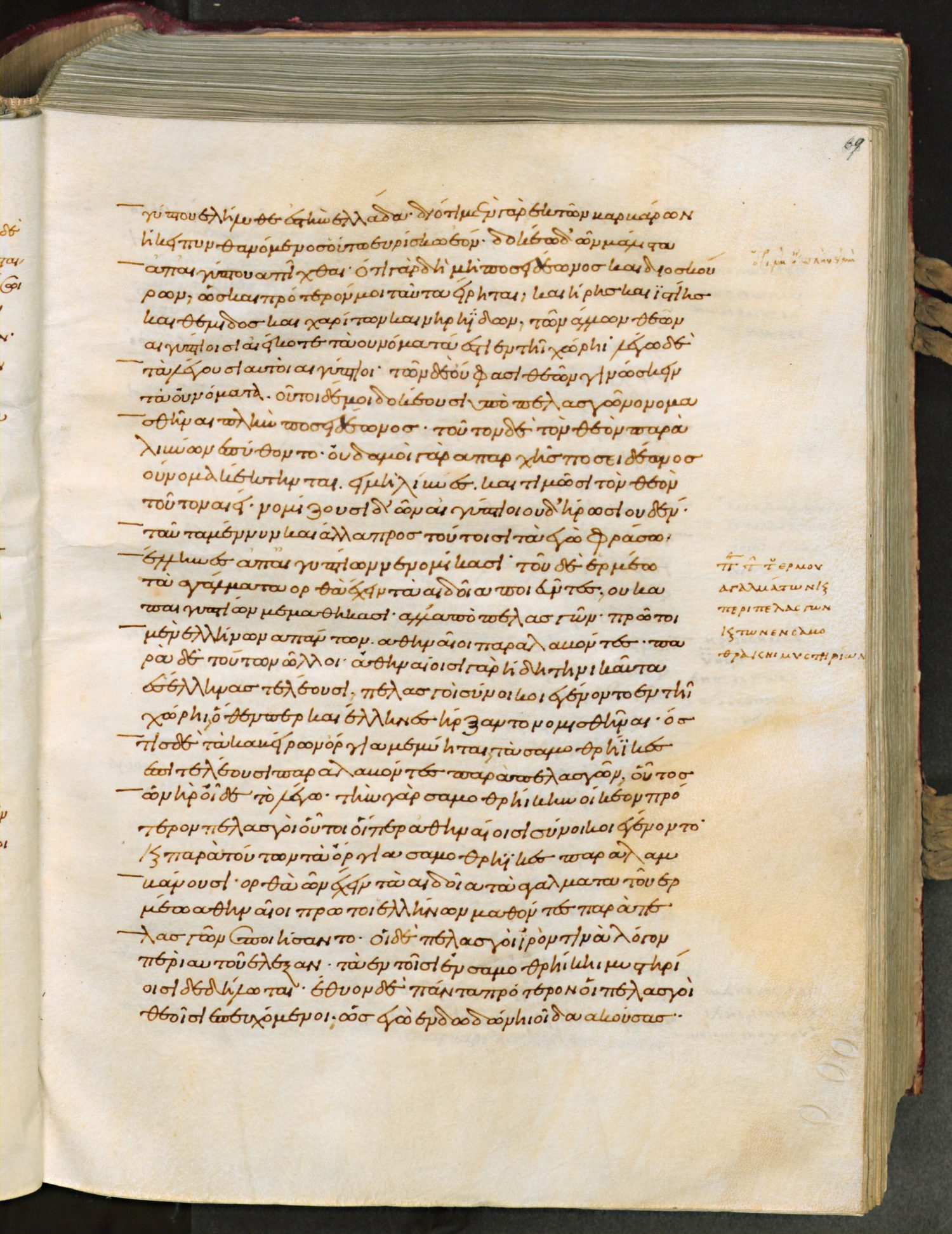
Laur. Plut. 70.3, fol. 69r: Greek here 2.50.1 to 2.52.1. Checked on the image (first and last words read and located in the Greek; each break checked against the neighbouring page): fol. 69r begins ‹-γύπτου ἐλήλυθε ἐς τὴν› (2.50.1), ends ‹ἐν Δωδώνῃ οἶδα ἀκούσας› (2.52.1). The word ‹Αἰγύπτου› is divided between fol. 68v and fol. 69r; it is given with fol. 68v. English here: 2.50.1 to 2.51.4 (Godley's sentences for the sections whose Greek lies mostly on this page).
2.50.1ἐλήλυθε ἐς τὴν Ἑλλάδα. διότι μὲν γὰρ ἐκ τῶν βαρβάρων ἥκει, πυνθανόμενος οὕτω εὑρίσκω ἐόν· δοκέω δʼ ὦν μάλιστα ἀπʼ Αἰγύπτου ἀπῖχθαι. 2.50.2ὅτι γὰρ δὴ μὴ Ποσειδέωνος καὶ Διοσκούρων, ὡς καὶ πρότερόν μοι ταῦτα εἴρηται, καὶ Ἥρης καὶ Ἱστίης καὶ Θέμιος καὶ Χαρίτων καὶ Νηρηίδων, τῶν ἄλλων θεῶν Αἰγυπτίοισι αἰεί κοτε τὰ οὐνόματα ἐστὶ ἐν τῇ χώρῃ. λέγω δὲ τὰ λέγουσι αὐτοὶ Αἰγύπτιοι. τῶν δὲ οὔ φασι θεῶν γινώσκειν τὰ οὐνόματα, οὗτοι δέ μοι δοκέουσι ὑπὸ Πελασγῶν ὀνομασθῆναι, πλὴν Ποσειδέωνος· τοῦτον δὲ τὸν θεὸν παρὰ Λιβύων ἐπύθοντο· 2.50.3οὐδαμοὶ γὰρ ἀπʼ ἀρχῆς Ποσειδέωνος οὔνομα ἔκτηνται εἰ μὴ Λίβυες καὶ τιμῶσι τὸν θεὸν τοῦτον αἰεί. νομίζουσι δʼ ὦν Αἰγύπτιοι οὐδʼ ἥρωσι οὐδέν. 2.51.1ταῦτα μέν νυν καὶ ἄλλα πρὸς τούτοισι, τὰ ἐγὼ φράσω, Ἕλληνες ἀπʼ Αἰγυπτίων νενομίκασι· τοῦ δὲ Ἑρμέω τὰ ἀγάλματα ὀρθὰ ἔχειν τὰ αἰδοῖα ποιεῦντες οὐκ ἀπʼ Αἰγυπτίων μεμαθήκασι, ἀλλʼ ἀπὸ Πελασγῶν πρῶτοι μὲν Ἑλλήνων ἁπάντων Ἀθηναῖοι παραλαβόντες, παρὰ δὲ τούτων ὧλλοι. 2.51.2Ἀθηναίοισι γὰρ ἤδη τηνικαῦτα ἐς Ἕλληνας τελέουσι Πελασγοὶ σύνοικοι ἐγένοντο ἐν τῇ χώρῃ, ὅθεν περ καὶ Ἕλληνες ἤρξαντο νομισθῆναι. ὅστις δὲ τὰ Καβείρων ὄργια μεμύηται, τὰ Σαμοθρήικες ἐπιτελέουσι παραλαβόντες παρὰ Πελασγῶν, οὗτος ὡνὴρ οἶδε τὸ λέγω· 2.51.3τὴν γὰρ Σαμοθρηίκην οἴκεον πρότερον Πελασγοὶ οὗτοι οἵ περ Ἀθηναίοισι σύνοικοι ἐγένοντο, καὶ παρὰ τούτων Σαμοθρήικες τὰ ὄργια παραλαμβάνουσι. 2.51.4ὀρθὰ ὦν ἔχειν τὰ αἰδοῖα τἀγάλματα τοῦ Ἑρμέω Ἀθηναῖοι πρῶτοι Ἑλλήνων μαθόντες παρὰ Πελασγῶν ἐποιήσαντο· οἱ δὲ Πελασγοὶ ἱρόν τινα λόγον περὶ αὐτοῦ ἔλεξαν, τὰ ἐν τοῖσι ἐν Σαμοθρηίκῃ μυστηρίοισι δεδήλωται. 2.52.1ἔθυον δὲ πάντα πρότερον οἱ Πελασγοὶ θεοῖσι ἐπευχόμενοι, ὡς ἐγὼ ἐν Δωδώνῃ οἶδα ἀκούσας,
2.50.1Indeed, wellnigh all the names of the gods came to Hellas from Egypt. For I am assured by inquiry that they have come from foreign parts, and I believe that they came chiefly from Egypt. 2.50.2Except the names of Poseidon and the Dioscuri, as I have already said, and Here, and Hestia, and Themis, and the Graces and the Nereids, the names of all the gods have ever existed in Egypt. I say but what the Egyptians themselves say. The gods whose names they say they do not know were, as I think, named by the Pelasgians, save only Poseidon, of whom they learnt the knowledge from the Libyans. 2.50.3Alone of all nations the Libyans have had among them the name of Poseidon from the first, and they have ever honoured this god. The Egyptians, however, are not accustomed to pay any honours to heroes. 2.51.1These customs then and others besides, which I shall show, were taken by the Greeks from the Egyptians. It was not so with the ithyphallic images of Hermes; the making of these came from the Pelasgians, from whom the Athenians were the first of all Greeks to take it, and then handed it on to others. 2.51.2For the Athenians were then already counted as Greeks when the Pelasgians came to dwell in the land with them, and thereby began to be considered as Greeks. Whoever has been initiated into the rites of the Cabeiri, which the Samothracians learnt from the Pelasgians and now practice, he understands what my meaning is. 2.51.3Samothrace was formerly inhabited by those Pelasgians who came to dwell among the Athenians, and it is from them that the Samothracians take their rites. 2.51.4The Athenians, then, were the first Greeks to make ithyphallic images of Hermes, and this they did because the Pelasgians taught them. The Pelasgians told a certain sacred tale about this, which is set forth in the Samothracian mysteries.
Where on the image
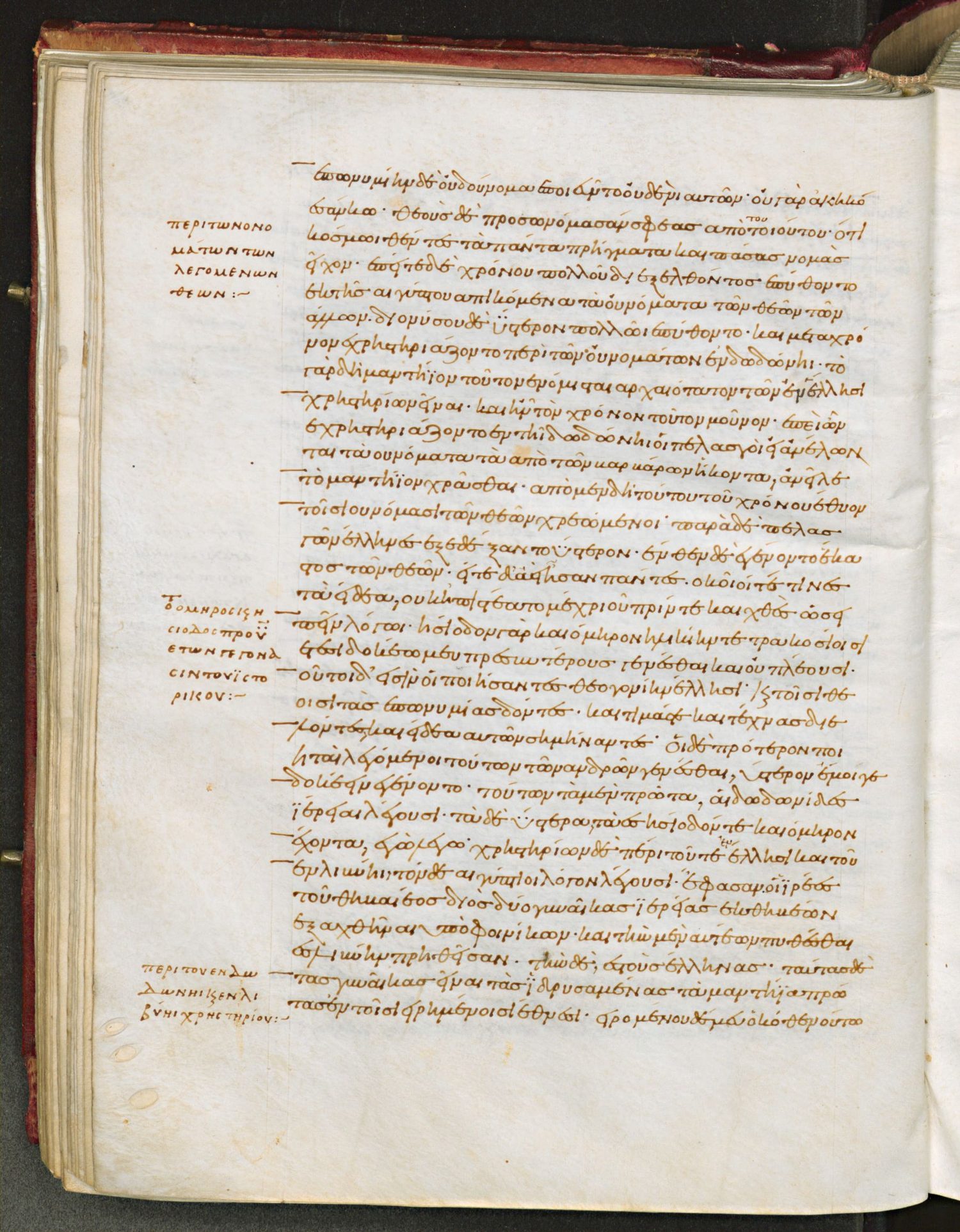
Laur. Plut. 70.3, fol. 69v: Greek here 2.52.1 to 2.53.3. Checked on the image (first and last words read and located in the Greek; each break checked against the neighbouring page): fol. 69v begins ‹ἐπωνυμίην δὲ οὐδʼ οὔνομα› (2.52.1), ends ‹δέ μευ ὁκόθεν οὕτω› (2.54.2). English here: 2.52.1 to 2.53.3 (Godley's sentences for the sections whose Greek lies mostly on this page).
2.52.1ἐπωνυμίην δὲ οὐδʼ οὔνομα ἐποιεῦντο οὐδενὶ αὐτῶν· οὐ γὰρ ἀκηκόεσάν κω. θεοὺς δὲ προσωνόμασαν σφέας ἀπὸ τοῦ τοιούτου, ὅτι κόσμῳ θέντες τὰ πάντα πρήγματα καὶ πάσας νομὰς εἶχον. 2.52.2ἔπειτα δὲ χρόνου πολλοῦ διεξελθόντος ἐπύθοντο ἐκ τῆς Αἰγύπτου ἀπικόμενα τὰ οὐνόματα τῶν θεῶν τῶν ἄλλων, Διονύσου δὲ ὕστερον πολλῷ ἐπύθοντο. καὶ μετὰ χρόνον ἐχρηστηριάζοντο περὶ τῶν οὐνομάτων ἐν Δωδώνῃ· τὸ γὰρ δὴ μαντήιον τοῦτο νενόμισται ἀρχαιότατον τῶν ἐν Ἕλλησι χρηστηρίων εἶναι, καὶ ἦν τὸν χρόνον τοῦτον μοῦνον. 2.52.3ἐπεὶ ὦν ἐχρηστηριάζοντο ἐν τῇ Δωδώνῃ οἱ Πελασγοὶ εἰ ἀνέλωνται τὰ οὐνόματα τὰ ἀπὸ τῶν βαρβάρων ἥκοντα, ἀνεῖλε τὸ μαντήιον χρᾶσθαι. ἀπὸ μὲν δὴ τούτου τοῦ χρόνου ἔθυον τοῖσι οὐνόμασι τῶν θεῶν χρεώμενοι· παρὰ δὲ Πελασγῶν Ἕλληνες ἐξεδέξαντο ὕστερον. 2.53.1ἔνθεν δὲ ἐγένοντο ἕκαστος τῶν θεῶν, εἴτε αἰεὶ ἦσαν πάντες, ὁκοῖοί τε τινὲς τὰ εἴδεα, οὐκ ἠπιστέατο μέχρι οὗ πρώην τε καὶ χθὲς ὡς εἰπεῖν λόγῳ. 2.53.2Ἡσίοδον γὰρ καὶ Ὅμηρον ἡλικίην τετρακοσίοισι ἔτεσι δοκέω μευ πρεσβυτέρους γενέσθαι καὶ οὐ πλέοσι· οὗτοι δὲ εἰσὶ οἱ ποιήσαντες θεογονίην Ἕλλησι καὶ τοῖσι θεοῖσι τὰς ἐπωνυμίας δόντες καὶ τιμάς τε καὶ τέχνας διελόντες καὶ εἴδεα αὐτῶν σημήναντες. 2.53.3οἱ δὲ πρότερον ποιηταὶ λεγόμενοι τούτων τῶν ἀνδρῶν γενέσθαι ὕστερον, ἔμοιγε δοκέειν, ἐγένοντο. τούτων τὰ μὲν πρῶτα αἱ Δωδωνίδες ἱρεῖαι λέγουσι, τὰ δὲ ὕστερα τὰ ἐς Ἡσίοδόν τε καὶ Ὅμηρον ἔχοντα ἐγὼ λέγω.
2.52.1Formerly, in all their sacrifices, the Pelasgians called upon gods (this I know, for I was told at Dodona) without giving name or appellation to any; for they had not as yet heard of such. They called them gods because all things and the due assignment thereof were by them set in order. 2.52.2Then, after a long while, they learnt the names first of the rest of the gods, which came to them from Egypt, and, much later, the name of Dionysus; and presently they inquired of the oracle at Dodona concerning the names; for this place of divination is held to be the most ancient in Hellas, and at that time it was the only one. 2.52.3When the Pelasgians, then, inquired at Dodona if they should adopt the names that had come from foreign parts, the oracle bade them use the names. From that time onwards they used the names of the gods in their sacrifices; and the Greeks received these later from the Pelasgians. 2.53.1But whence each of the gods came into being, or whether they had all for ever existed, and what outward forms they had, the Greeks knew not till (so to say) a very little while ago 2.53.2for I suppose that the time of Hesiod and Homer was not more than four hundred years before my own; and these are they who taught the Greeks of the descent of the gods, and gave to all their several names, and honours, and arts, and declared their outward forms. 2.53.3But those poets who are said to be older than Hesiod and Homer were, to my thinking, of later birth. The earlier part of all this is what the priestesses of Dodona tell; the later, that which concerns Hesiod and Homer, is what I myself say.
Notes
- Greek: the text printed in A. D. Godley's Loeb edition, via Perseus (tlg0016.tlg001.perseus-grc2). Square brackets mark words the editor considers later additions; [...] marks a gap the editor indicates. Perseus note markers are omitted.
- English: A. D. Godley, Herodotus vol. 1 (1920) (Loeb Classical Library), as transcribed on Wikisource. Godley's footnotes are omitted.
- Section numbers in the English were placed by comparing Godley's text with the Perseus version of his translation; where a section begins inside one of Godley's sentences, the English is kept with the page that holds the start of that sentence.
Cite
Sources
- Source: Florence, Laur. Plut. 70.3 (10th c.) via BML Teca Digitale + Greek of Godley's Loeb (Perseus) + English of A. D. Godley (Loeb, Wikisource) (holding institution)
- Critical edition: Greek of A. D. Godley's Loeb edition (1920-1925), via Perseus
← previous · → next · v cycle view · l back to library