Herodotus, Histories 2.54-64: Oracles and festivals
Introduction
Herodotus of Halicarnassus wrote the Histories in the third quarter of the 5th century BCE, an inquiry into the deeds of Greeks and barbarians and the causes of the wars between them, later divided into nine books. Book 2 is Herodotus' account of Egypt, written as background to Cambyses' invasion: the land and the Nile, the customs and religion of the Egyptians, and the history of their kings as the priests told it, down to Amasis.
The photographs are of Florence, Biblioteca Medicea Laurenziana, Plut. 70.3 (parchment, 10th century, 374 folios, 31 lines a page), Herodotus, Histories (codex A of the editors), the oldest surviving manuscript of the complete Histories, from the Teca Digitale of the Biblioteca Medicea Laurenziana. Each section below is the text of one page, or of the part of a page that falls within these chapters. The first and last words of every page were read on the photograph and located in the Greek, and every page break was checked against the next page; the notes quote these words. Readers' notes in the margins are not part of the text and are mentioned where they occur.
The Greek is the text printed in A. D. Godley's Loeb edition (1920-1925), from Perseus; it is the edited text, not a transcription of the manuscript, whose wording differs in places. The English is Godley's translation as printed, from Wikisource. Godley's English carries only chapter numbers; the section numbers shown in it were placed by comparison with the Perseus version of his translation. Each page's English is cut at the end of one of Godley's sentences, so it can begin or end a few lines away from the Greek of the page; each note gives the exact ranges.
This entry covers chapters 2.54-64, on fol. 69v to 71v.
How was this verified? (Provenance)
Where on the image
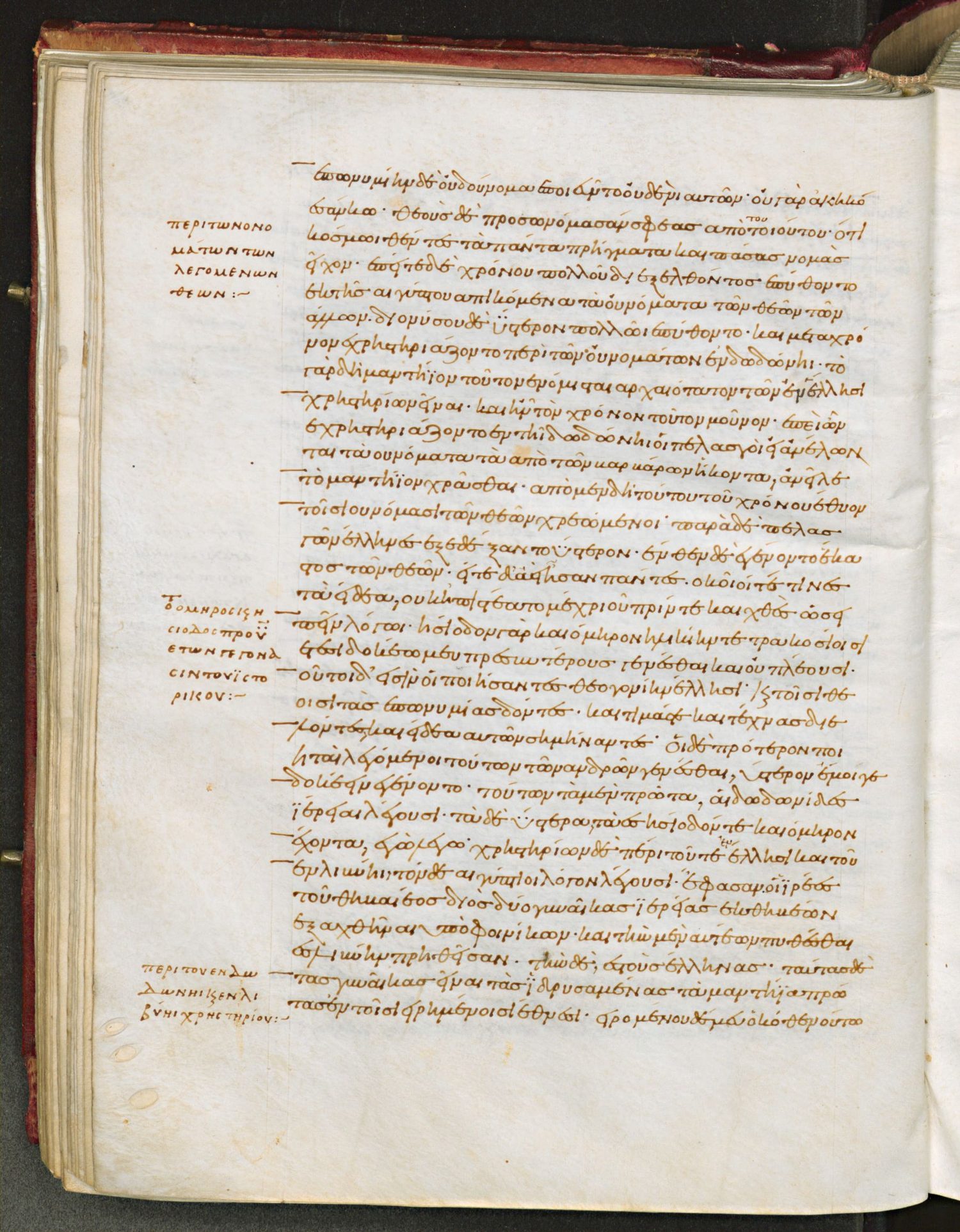
Laur. Plut. 70.3, fol. 69v: Greek here 2.54.1 to 2.54.2. Checked on the image (first and last words read and located in the Greek; each break checked against the neighbouring page): fol. 69v begins ‹ἐπωνυμίην δὲ οὐδʼ οὔνομα› (2.52.1), ends ‹δέ μευ ὁκόθεν οὕτω› (2.54.2). English here: 2.54.1 (Godley's sentences for the sections whose Greek lies mostly on this page).
2.54.1χρηστηρίων δὲ πέρι τοῦ τε ἐν Ἕλλησι καὶ τοῦ ἐν Λιβύῃ τόνδε Αἰγύπτιοι λόγον λέγουσι. ἔφασαν οἱ ἱρέες τοῦ Θηβαιέος Διὸς δύο γυναῖκας ἱρείας ἐκ Θηβέων ἐξαχθῆναι ὑπὸ Φοινίκων, καὶ τὴν μὲν αὐτέων πυθέσθαι ἐς Λιβύην πρηθεῖσαν τὴν δὲ ἐς τοὺς Ἕλληνας· ταύτας δὲ τὰς γυναῖκας εἶναι τὰς ἱδρυσαμένας τὰ μαντήια πρώτας ἐν τοῖσι εἰρημένοισι ἔθνεσι. 2.54.2εἰρομένου δέ μευ ὁκόθεν οὕτω
2.54.1But as concerning the oracles in Hellas, and that one which is in Libya, this is the account given by the Egyptians. The priests of Zeus of Thebes told me that two priestesses had been carried away from Thebes by Phoenicians; one of them (so, they said, they had learnt) was taken away and sold in Libya, and the other in Hellas; these women, they said, were the first founders of places of divination in the countries aforesaid.
Where on the image
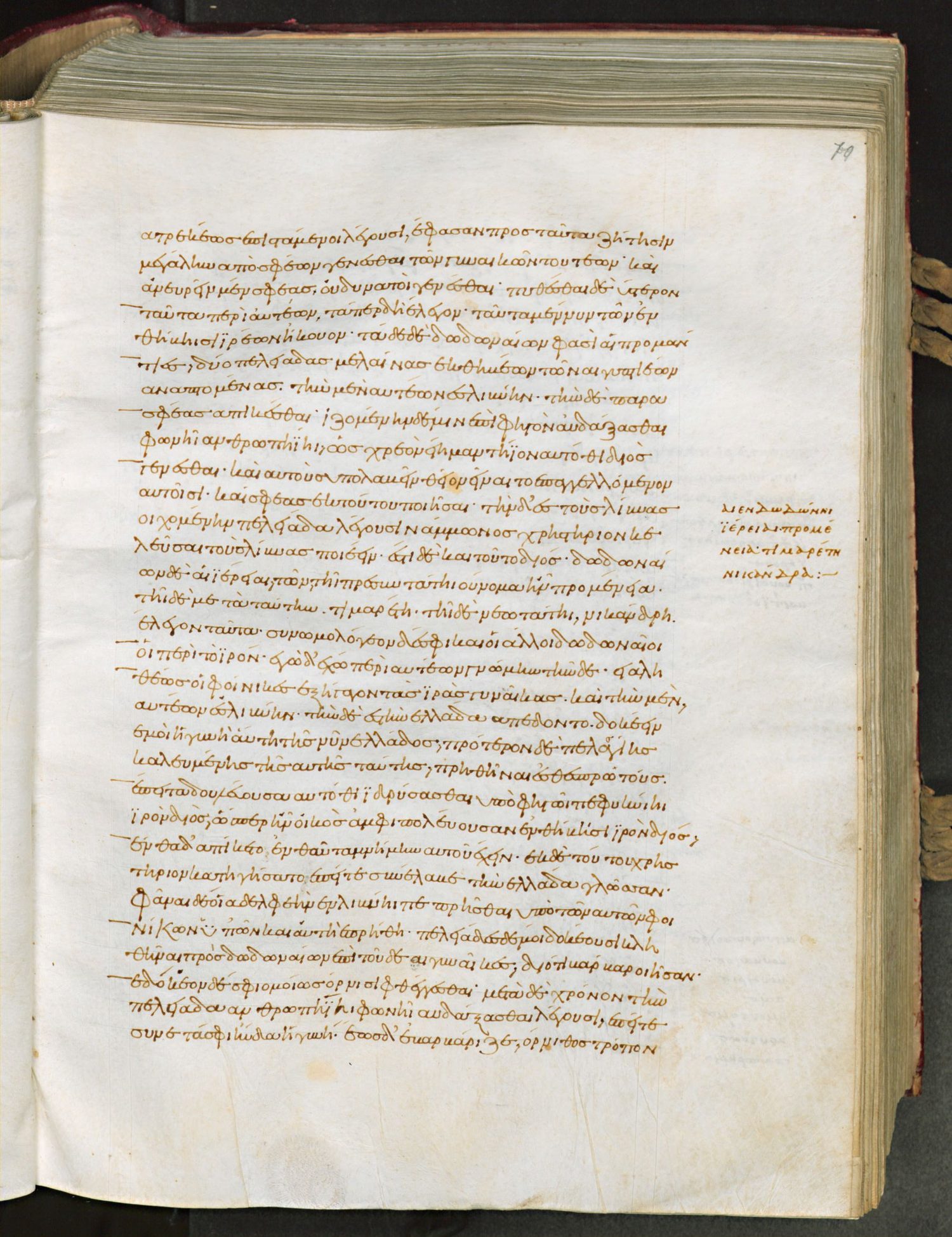
Laur. Plut. 70.3, fol. 70r: Greek here 2.54.2 to 2.57.2. Checked on the image (first and last words read and located in the Greek; each break checked against the neighbouring page): fol. 70r begins ‹ἀτρεκέως ἐπιστάμενοι λέγουσι, ἔφασαν› (2.54.2), ends ‹δὲ ἐβαρβάριζε, ὄρνιθος τρόπον› (2.57.2). English here: 2.54.2 to 2.57.3 (Godley's sentences for the sections whose Greek lies mostly on this page).
2.54.2ἀτρεκέως ἐπιστάμενοι λέγουσι, ἔφασαν πρὸς ταῦτα ζήτησιν μεγάλην ἀπὸ σφέων γενέσθαι τῶν γυναικῶν τουτέων, καὶ ἀνευρεῖν μὲν σφέας οὐ δυνατοὶ γενέσθαι, πυθέσθαι δὲ ὕστερον ταῦτα περὶ αὐτέων τά περ δὴ ἔλεγον. 2.55.1ταῦτα μέν νυν τῶν ἐν Θήβῃσι ἱρέων ἤκουον, τάδε δὲ Δωδωναίων φασὶ αἱ προμάντιες· δύο πελειάδας μελαίνας ἐκ Θηβέων τῶν Αἰγυπτιέων ἀναπταμένας τὴν μὲν αὐτέων ἐς Λιβύην τὴν δὲ παρὰ σφέας ἀπικέσθαι, 2.55.2ἱζομένην δέ μιν ἐπὶ φηγὸν αὐδάξασθαι φωνῇ ἀνθρωπηίῃ ὡς χρεὸν εἴη μαντήιον αὐτόθι Διὸς γενέσθαι, καὶ αὐτοὺς ὑπολαβεῖν θεῖον εἶναι τὸ ἐπαγγελλόμενον αὐτοῖσι, καί σφεας ἐκ τούτου ποιῆσαι. 2.55.3τὴν δὲ ἐς τοὺς Λίβυας οἰχομένην πελειάδα λέγουσι Ἄμμωνος χρηστήριον κελεῦσαι τοὺς Λίβυας ποιέειν· ἔστι δὲ καὶ τοῦτο Διός. Δωδωναίων δὲ αἱ ἱρεῖαι, τῶν τῇ πρεσβυτάτῃ οὔνομα ἦν Προμένεια, τῇ δὲ μετὰ ταύτην Τιμαρέτη, τῇ δὲ νεωτάτῃ Νικάνδρη, ἔλεγον ταῦτα· συνωμολόγεον δέ σφι καὶ οἱ ἄλλοι Δωδωναῖοι οἱ περὶ τὸ ἱρόν. 2.56.1ἐγὼ δʼ ἔχω περὶ αὐτῶν γνώμην τήνδε· εἰ ἀληθέως οἱ Φοίνικες ἐξήγαγον τὰς ἱρὰς γυναῖκας καὶ τὴν μὲν αὐτέων ἐς Λιβύην τὴν δὲ ἐς τὴν Ἐλλάδα ἀπέδοντο, δοκέει ἐμοί ἡ γυνὴ αὕτη τῆς νῦν Ἑλλάδος, πρότερον δὲ Πελασγίης καλευμένης τῆς αὐτῆς ταύτης, πρηθῆναι ἐς Θεσπρωτούς, 2.56.2ἔπειτα δουλεύουσα αὐτόθι ἱδρύσασθαι ὑπὸ φηγῷ πεφυκυίῃ ἱρὸν Διός, ὥσπερ ἦν οἰκὸς ἀμφιπολεύουσαν ἐν Θήβῃσι ἱρὸν Διός, ἔνθα ἀπίκετο, ἐνθαῦτα μνήμην αὐτοῦ ἔχειν· 2.56.3ἐκ δὲ τούτου χρηστήριον κατηγήσατο, ἐπείτε συνέλαβε τὴν Ἑλλάδα γλῶσσαν· φάναι δέ οἱ ἀδελφεὴν ἐν Λιβύῃ πεπρῆσθαι ὑπὸ τῶν αὐτῶν Φοινίκων ὑπʼ ὧν καὶ αὐτὴ ἐπρήθη. 2.57.1πελειάδες δέ μοι δοκέουσι κληθῆναι πρὸς Δωδωναίων ἐπὶ τοῦδε αἱ γυναῖκες, διότι βάρβαροι ἦσαν, ἐδόκεον δέ σφι ὁμοίως ὄρνισι φθέγγεσθαι· 2.57.2μετὰ δὲ χρόνον τὴν πελειάδα ἀνθρωπηίῃ φωνῇ αὐδάξασθαι λέγουσι, ἐπείτε συνετά σφι ηὔδα ἡ γυνή· ἕως δὲ ἐβαρβάριζε, ὄρνιθος τρόπον
2.54.2When I asked them how it was that they could speak with so certain knowledge, they said in reply that their people had sought diligently for these women, and had never been able to find them, but had learnt later the tale which was now told to me. 2.55.1That, then, I heard from the Theban priests; and what follows, is told by the prophetesses of Dodona: to wit, that two black doves had come flying from Thebes in Egypt, one to Libya and one to Dodona 2.55.2this last settled on an oak tree, and uttered there human speech, declaring that there must be there a place of divination from Zeus; the people of Dodona understood that the message was divine, and therefore they established the oracular shrine. 2.55.3The dove which came to Libya bade the Libyans (so they say) to make an oracle of Amnion; this also is sacred to Zeus. Such was the tale told by the Dodonaean priestesses, of whom the eldest was Promeneia and the next in age Timarete, and the youngest Nicandra; and the rest of the servants of the temple at Dodona likewise held it true. 2.56.1But this is my own belief about it. If the Phoenicians did in truth carry away the sacred women and sell one in Libya and one in Hellas, then to my thinking the part of what is now Hellas, but was formerly called Pelasgia, where this last was sold, was Thesprotia; 2.56.2and presently, being there in slavery, she established a shrine of Zeus under an oak that was growing there; for it was reasonable that as she had been a handmaid of the temple of Zeus at Thebes she should remember that temple in the land to which she had come. 2.56.3After this she taught divination, as soon as she understood the Greek language and she said that her sister had been sold in Libya by the same Phoenicians who sold her. 2.57.1I suppose that these women were called “doves” by the people of Dodona because they spoke a strange language, and the people thought it like the cries of birds; 2.57.2presently the woman spoke what they could understand, and that is why they say that the dove uttered human speech; as long as she spoke in her foreign language, they thought her voice was like the voice of a bird. For how could a dove utter the speech of men? The tale that the dove was black signifies that the woman was 2.57.3Egyptian.
Where on the image
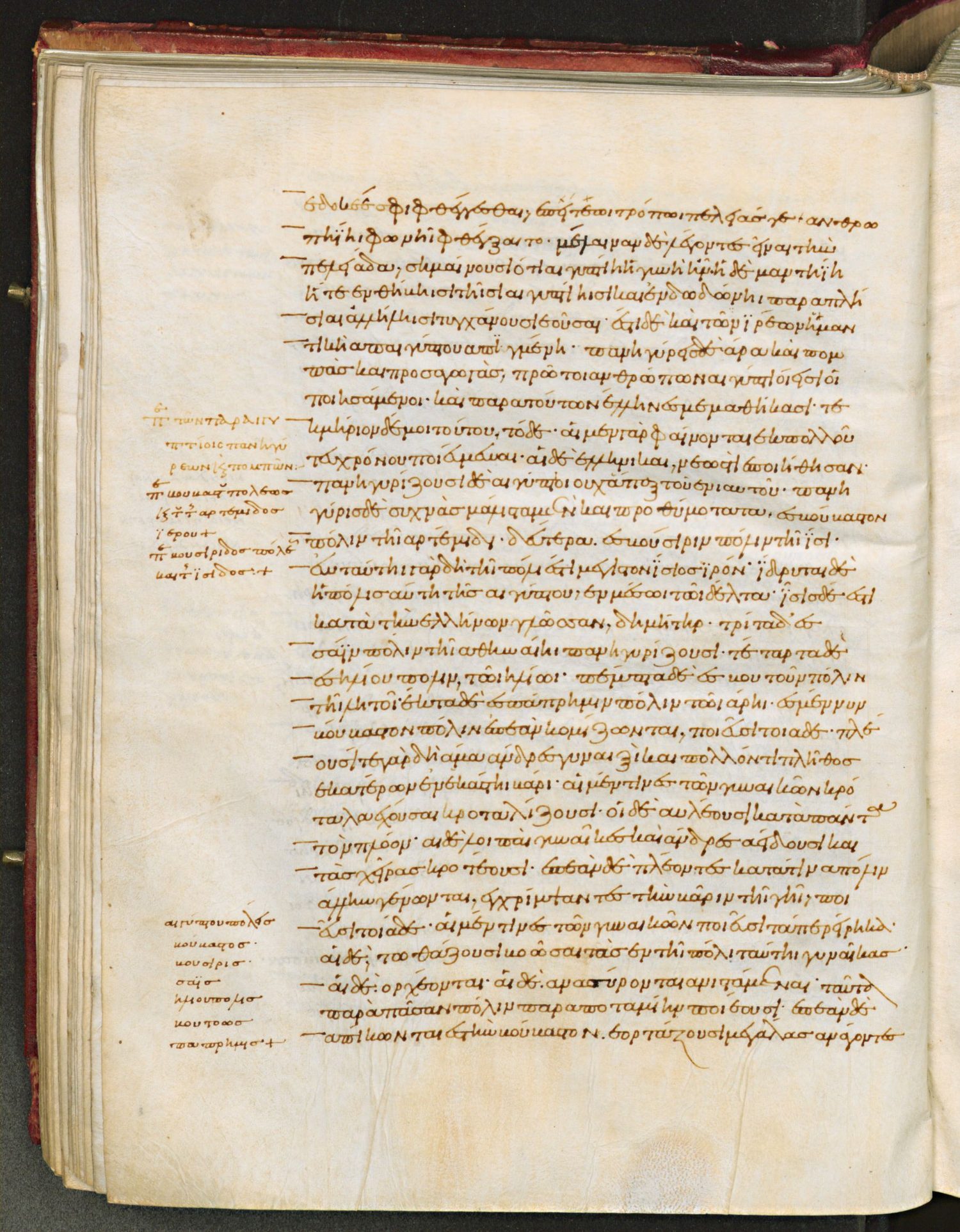
Laur. Plut. 70.3, fol. 70v: Greek here 2.57.2 to 2.60.3. Checked on the image (first and last words read and located in the Greek; each break checked against the neighbouring page): fol. 70v begins ‹ἐδόκεέ σφι φθέγγεσθαι, ἐπεὶ› (2.57.2), ends ‹Βούβαστιν, ὁρτάζουσι μεγάλας ἀνάγοντες› (2.60.3). English here: 2.58.1 to 2.60.2 (Godley's sentences for the sections whose Greek lies mostly on this page).
2.57.2ἐδόκεέ σφι φθέγγεσθαι, ἐπεὶ τέῳ ἂν τρόπῳ πελειάς γε ἀνθρωπηίῃ φωνῇ φθέγξαιτο; μέλαιναν δὲ λέγοντες εἶναι τὴν πελειάδα σημαίνουσι ὅτι Αἰγυπτίη ἡ γυνὴ ἦν. 2.57.3ἡ δὲ μαντηίη ἥ τε ἐν Θήβῃσι τῇσι Αἰγυπτίῃσι καὶ ἐν Δωδώνῃ παραπλήσιαι ἀλλήλῃσι τυγχάνουσι ἐοῦσαι. ἔστι δὲ καὶ τῶν ἱρῶν ἡ μαντικὴ ἀπʼ Αἰγύπτου ἀπιγμένη. 2.58.1πανηγύρις δὲ ἄρα καὶ πομπὰς καὶ προσαγωγὰς πρῶτοι ἀνθρώπων Αἰγύπτιοι εἰσὶ οἱ ποιησάμενοι, καὶ παρὰ τούτων Ἕλληνες μεμαθήκασι. τεκμήριον δέ μοι τούτου τόδε· αἱ μὲν γὰρ φαίνονται ἐκ πολλοῦ τευ χρόνου ποιεύμεναι, αἱ δὲ Ἑλληνικαὶ νεωστὶ ἐποιήθησαν. 2.59.1πανηγυρίζουσι δὲ Αἰγύπτιοι οὐκ ἅπαξ τοῦ ἐνιαυτοῦ, πανηγύρις δὲ συχνάς, μάλιστα μὲν καὶ προθυμότατα ἐς Βούβαστιν πόλιν τῇ Ἀρτέμιδι, δεύτερα δὲ ἐς Βούσιριν πόλιν τῇ Ἴσι· 2.59.2ἐν ταύτῃ γὰρ δὴ τῇ πόλι ἐστὶ μέγιστον Ἴσιος ἱρόν, ἵδρυται δὲ ἡ πόλις αὕτη τῆς Αἰγύπτου ἐν μέσῳ τῷ Δέλτα· Ἶσις δὲ ἐστὶ κατὰ τὴν Ἑλλήνων γλῶσσαν Δημήτηρ. 2.59.3τρίτα δὲ ἐς Σάιν πόλιν τῇ Ἀθηναίῃ πανηγυρίζουσι, τέταρτα δὲ ἐς Ἡλίου πόλιν τῷ Ἡλίω, πέμπτα δὲ ἐς Βουτοῦν πόλιν τῇ Λητοῖ, ἕκτα δὲ ἐς Πάπρημιν πόλιν τῷ Ἄρεϊ. 2.60.1ἐς μέν νυν Βούβαστιν πόλιν ἐπεὰν κομίζωνται, ποιεῦσι τοιάδε. πλέουσί τε γὰρ δὴ ἅμα ἄνδρες γυναιξὶ καὶ πολλόν τι πλῆθος ἑκατέρων ἐν ἑκάστῃ βάρι· αἳ μὲν τινὲς τῶν γυναικῶν κρόταλα ἔχουσαι κροταλίζουσι, οἳ δὲ αὐλέουσι κατὰ πάντα τὸν πλόον, αἱ δὲ λοιπαὶ γυναῖκες καὶ ἄνδρες ἀείδουσι καὶ τὰς χεῖρας κροτέουσι. 2.60.2ἐπεὰν δὲ πλέοντες κατά τινα πόλιν ἄλλην γένωνται, ἐγχρίμψαντες τὴν βᾶριν τῇ γῇ ποιεῦσι τοιάδε· αἳ μὲν τινὲς τῶν γυναικῶν ποιεῦσι τά περ εἴρηκα, αἳ δὲ τωθάζουσι βοῶσαι τὰς ἐν τῇ πόλι ταύτῃ γυναῖκας, αἳ δὲ ὀρχέονται, αἳ δὲ ἀνασύρονται ἀνιστάμεναι. ταῦτα παρὰ πᾶσαν πόλιν παραποταμίην ποιεῦσι· 2.60.3ἐπεὰν δὲ ἀπίκωνται ἐς τὴν Βούβαστιν, ὁρτάζουσι μεγάλας ἀνάγοντες
2.58.1The fashions of divination at Thebes of Egypt and Dodona are like to one another; moreover the practice of divining from the sacrificed victim has also come from Egypt. It would seem too that the Egyptians were the first people to establish solemn assemblies, and processions, and services; the Greeks learnt all this from them. I hold this proved, because the Egyptian ceremonies are manifestly very ancient, and the Greek are of late origin. 2.59.1The Egyptians hold solemn assemblies not once in the year, but often. The chiefest of these and the most zealously celebrated is at the town of Bubastis in honour of Artemis, and the next is that in honour of Isis at Busiris. 2.59.2This town is in the middle of the Egyptian Delta, and there is in it a very great temple of Isis, who is in the Greek language, Demeter. 2.59.3The third greatest festival is at Sais in honour of Athene; the fourth is the festival of the sun at Heliopolis, the fifth of Leto at Buto, and the sixth of Ares at Papremis. 2.60.1When the people are on their way to Bubastis they go by river, men and women together, a great number of each in every boat. Some of the women make a noise with rattles, others play flutes all the way, while the rest of the women, and the men, sing and clap their hands. 2.60.2As they journey by river to Bubastis, whenever they come near any other town they bring their boat near the bank; then some of the women do as I have said, while some shout mockery of the women of the town; others dance, and others stand up and expose their persons. This they do whenever they come beside any riverside town.
Where on the image
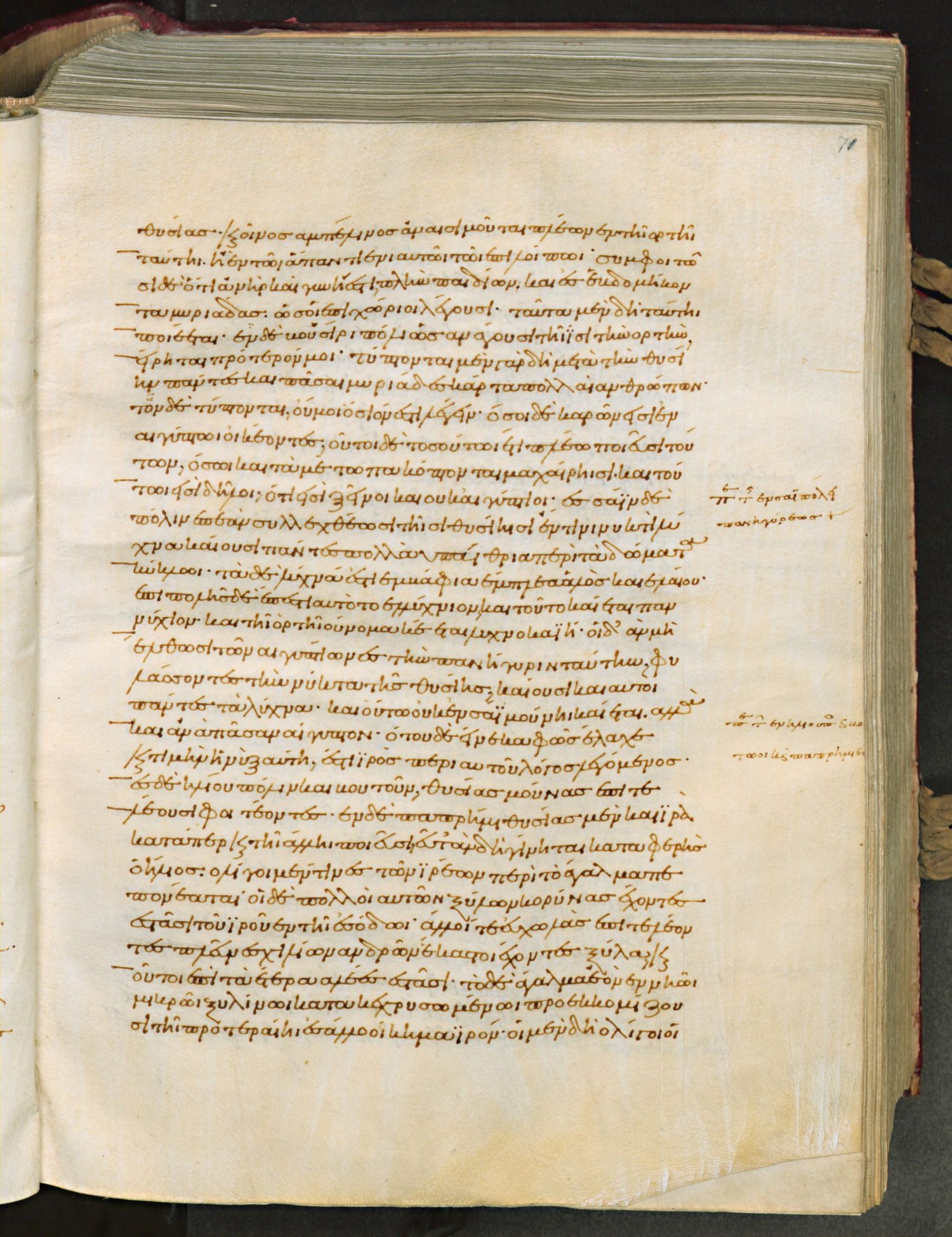
Laur. Plut. 70.3, fol. 71r: Greek here 2.60.3 to 2.63.2. Checked on the image (first and last words read and located in the Greek; each break checked against the neighbouring page): fol. 71r begins ‹θυσίας, καὶ οἶνος ἀμπέλινος› (2.60.3), ends ‹μὲν δὴ ὀλίγοι οἱ› (2.63.2). English here: 2.60.3 to 2.63.1 (Godley's sentences for the sections whose Greek lies mostly on this page).
2.60.3θυσίας, καὶ οἶνος ἀμπέλινος ἀναισιμοῦται πλέων ἐν τῇ ὁρτῇ ταύτῃ ἢ ἐν τῷ ἅπαντι ἐνιαυτῷ τῷ ἐπιλοίπῳ. συμφοιτῶσι δέ, ὅ τι ἀνὴρ καὶ γυνή ἐστι πλὴν παιδίων, καὶ ἐς ἑβδομήκοντα μυριάδας, ὡς οἱ ἐπιχώριοι λέγουσι. 2.61.1ταῦτα μὲν δὴ ταύτῃ ποιέεται, ἐν δὲ Βουσίρι πόλι ὡς ἀνάγουσι τῇ Ἴσι τὴν ὁρτήν, εἴρηται προτερόν μοι· τύπτονται μὲν γὰρ δὴ μετὰ τὴν θυσίην πάντες καὶ πᾶσαι, μυριάδες κάρτα πολλαὶ ἀνθρώπων· τὸν δὲ τύπτονται, οὔ μοι ὅσιον ἐστὶ λέγειν. 2.61.2ὅσοι δὲ Καρῶν εἰσι ἐν Αἰγύπτῳ οἰκέοντες, οὗτοι δὲ τοσούτῳ ἔτι πλέω ποιεῦσι τούτων ὅσῳ καὶ τὰ μέτωπα κόπτονται μαχαίρῃσι, καὶ τούτῳ εἰσὶ δῆλοι ὅτι εἰσὶ ξεῖνοι καὶ οὐκ Αἰγύπτιοι. 2.62.1ἐς Σάιν δὲ πόλιν ἐπεὰν συλλεχθέωσι, τῆς θυσίης ἐν τῇ νυκτὶ λύχνα καίουσι πάντες πολλὰ ὑπαίθρια περὶ τὰ δώματα κύκλῳ· τὰ δὲ λύχνα ἐστὶ ἐμβάφια ἔμπλεα ἁλὸς καὶ ἐλαίου, ἐπιπολῆς δὲ ἔπεστι αὐτὸ τὸ ἐλλύχνιον, καὶ τοῦτο καίεται παννύχιον, καὶ τῇ ὁρτῇ οὔνομα κέεται λυχνοκαΐη. 2.62.2οἳ δʼ ἂν μὴ ἔλθωσι τῶν Αἰγυπτίων ἐς τὴν πανήγυριν ταύτην, φυλάσσοντες τὴν νύκτα τῆς θυσίης καίουσι καὶ αὐτοὶ πάντες τὰ λύχνα, καὶ οὕτω οὐκ ἐν Σάι μούνῃ καίεται ἀλλὰ καὶ ἀνὰ πᾶσαν Αἴγυπτον. ὅτευ δὲ εἵνεκα φῶς ἔλαχε καὶ τιμὴν ἡ νὺξ αὕτη, ἔστι ἱρὸς περὶ αὐτοῦ λόγος λεγόμενος. 2.63.1ἐς δὲ Ἡλίου τε πόλιν καὶ Βουτοῦν θυσίας μούνας ἐπιτελέουσι φοιτέοντες. ἐν δὲ Παπρήμι θυσίας μὲν καὶ ἱρὰ κατά περ καὶ τῇ ἄλλῃ ποιεῦσι· εὖτʼ ἂν δὲ γίνηται καταφερὴς ὁ ἥλιος, ὀλίγοι μὲν τινὲς τῶν ἱρέων περὶ τὤγαλμα πεπονέαται, οἱ δὲ πολλοὶ αὐτῶν ξύλων κορύνας ἔχοντες ἑστᾶσι τοῦ ἱροῦ ἐν τῇ ἐσόδῳ, ἄλλοι τε εὐχωλὰς ἐπιτελέοντες πλεῦνες χιλίων ἀνδρῶν, ἕκαστοι ἔχοντες ξύλα καὶ οὗτοι, ἐπὶ τὰ ἕτερα ἁλέες ἑστᾶσι. 2.63.2τὸ δὲ ἄγαλμα ἐὸν ἐν νηῷ μικρῷ ξυλίνῳ κατακεχρυσωμένῳ προεκκομίζουσι τῇ προτεραίῃ ἐς ἄλλο οἴκημα ἱρόν. οἱ μὲν δὴ ὀλίγοι οἱ
2.60.3But when they have reached Bubastis, they make a festival with great sacrifices, and more wine is drunk at this feast than in the whole year beside. Men and women (but not children) are wont to assemble there to the number of seven hundred thousand, as the people of the place say. 2.61.1Such is their practice there; I have already told how they keep the feast of Isis at Busiris. There, after the sacrifice, all the men and women lament, in countless numbers; but it were profane for me to say who it is for whom they lament. 2.61.2Carian dwellers in Egypt do even more than this, for they cut their foreheads with knives; showing thereby, that they are not Egyptians but strangers. 2.62.1When they assemble at Sais, on the night of the sacrifice, they all keep lamps burning in the open air round about their houses. These lamps are saucers full of salt and oil, the wick floating thereon, and burning all night. This is called the Feast of Lamps. 2.62.2Egyptians who do not come to this assemblage are careful on the night of sacrifice to keep their own lamps burning, and so they are alight not only at Sais but throughout all Egypt. A sacred tale is told showing why this night is thus lit up and honoured. 2.63.1When the people go to Heliopolis and Buto they offer sacrifice only. At Papremis sacrifice is offered and rites performed as elsewhere; but when the sun is sinking, while a few of the priests are left to busy themselves with the image, the greater number of them beset the entrance of the temple, with clubs of wood in their hands; they are confronted by more than a thousand men, all performing vows and all carrying wooden clubs like the rest.
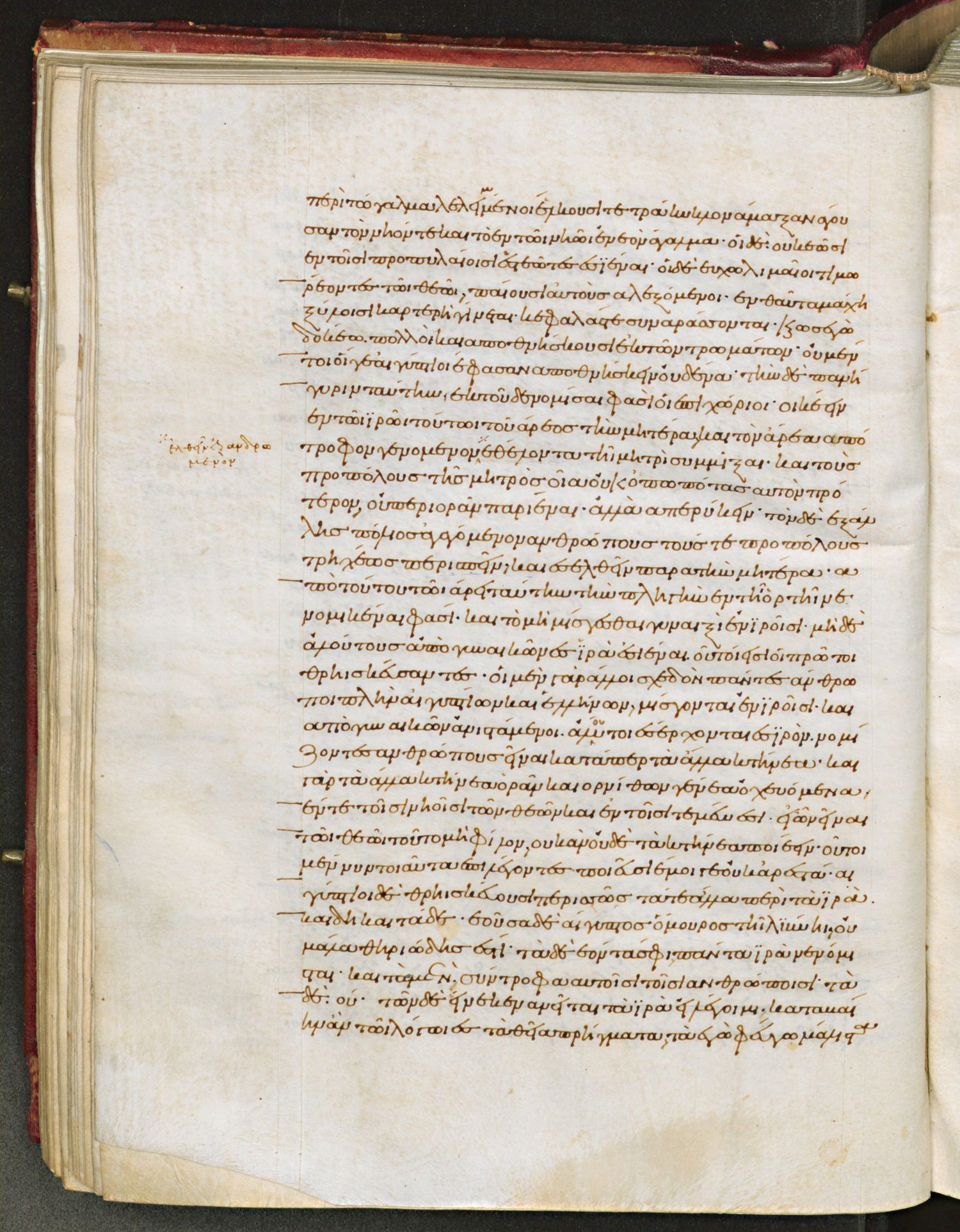
Where on the image
Laur. Plut. 70.3, fol. 71v: Greek here 2.63.2 to 2.64.2. Checked on the image (first and last words read and located in the Greek; each break checked against the neighbouring page): fol. 71v begins ‹περὶ τὤγαλμα λελειμμένοι ἕλκουσι› (2.63.2), ends ‹τὰ ἐγὼ φεύγω μάλιστα› (2.65.2). English here: 2.63.2 to 2.64.2 (Godley's sentences for the sections whose Greek lies mostly on this page).
2.63.2περὶ τὤγαλμα λελειμμένοι ἕλκουσι τετράκυκλον ἅμαξαν ἄγουσαν τὸν νηόν τε καὶ τὸ ἐν τῷ νηῷ ἐνεὸν ἄγαλμα, οἳ δὲ οὐκ ἐῶσι ἐν τοῖσι προπυλαίοισι ἑστεῶτες ἐσιέναι, οἱ δὲ εὐχωλιμαῖοι τιμωρέοντες τῷ θεῷ παίουσι αὐτοὺς ἀλεξομένους. 2.63.3ἐνθαῦτα μάχη ξύλοισι καρτερὴ γίνεται κεφαλάς τε συναράσσονται, καὶ ὡς ἐγὼ δοκέω πολλοὶ καὶ ἀποθνήσκουσι ἐκ τῶν τρωμάτων· οὐ μέντοι οἵ γε Αἰγύπτιοι ἔφασαν ἀποθνήσκειν οὐδένα. 2.63.4τὴν δὲ πανήγυριν ταύτην ἐκ τοῦδε νομίσαι φασὶ οἱ ἐπιχώριοι· οἰκέειν ἐν τῷ ἱρῷ τούτῳ τοῦ Ἄρεος τὴν μητέρα, καὶ τὸν Ἄρεα ἀπότροφον γενόμενον ἐλθεῖν ἐξανδρωμένον ἐθέλοντα τῇ μητρὶ συμμῖξαι, καὶ τοὺς προπόλους τῆς μητρός, οἷα οὐκ ὀπωπότας αὐτὸν πρότερον, οὐ περιορᾶν παριέναι ἀλλὰ ἀπερύκειν, τὸν δὲ ἐξ ἄλλης πόλιος ἀγαγόμενον ἀνθρώπους τούς τε προπόλους τρηχέως περισπεῖν καὶ ἐσελθεῖν παρὰ τὴν μητέρα. ἀπὸ τούτου τῷ Ἄρεϊ ταύτην τὴν πληγὴν ἐν τῇ ὁρτῇ νενομικέναι φασί. 2.64.1καὶ τὸ μὴ μίσγεσθαι γυναιξὶ ἐν ἱροῖσι μηδὲ ἀλούτους ἀπὸ γυναικῶν ἐς ἱρὰ ἐσιέναι οὗτοι εἰσὶ οἱ πρῶτοι θρησκεύσαντες. οἱ μὲν γὰρ ἄλλοι σχεδὸν πάντες ἄνθρωποι, πλὴν Αἰγυπτίων καὶ Ἑλλήνων, μίσγονται ἐν ἱροῖσι καὶ ἀπὸ γυναικῶν ἀνιστάμενοι ἄλουτοι ἐσέρχονται ἐς ἱρόν, νομίζοντες ἀνθρώπους εἶναι κατά περ τὰ ἄλλα κτήνεα· 2.64.2καὶ γὰρ τὰ ἄλλα κτήνεα ὁρᾶν καὶ ὀρνίθων γένεα ὀχευόμενα ἔν τε τοῖσι νηοῖσι τῶν θεῶν καὶ ἐν τοῖσι τεμένεσι· εἰ ὦν εἶναι τῷ θεῷ τοῦτο μὴ φίλον, οὐκ ἂν οὐδὲ τὰ κτήνεα ποιέειν. οὗτοι μέν νυν τοιαῦτα ἐπιλέγοντες ποιεῦσι ἔμοιγε οὐκ ἀρεστά·
2.63.2The image of the god, in a little wooden gilt casket, is carried on the day before this from the temple to another sacred chamber. The few who are left with the image draw a four-wheeled cart carrying it in its casket; the other priests stand in the temple porch and prevent its entrance; the votaries take the part of the god, and smite the priests, who resist. 2.63.3There is hard fighting with clubs, and heads are broken, and as I think (though the Egyptians told me no life was lost), many die of their wounds. 2.63.4The assemblage, say the people of the country, took its rise thus:—The mother of Ares dwelt in this temple; Ares had been reared away from her, and when he grew to manhood came to hold converse with his mother; but as her attendants, never having seen him before, kept him off and would not suffer him to pass, Ares brought men from another town, roughly handled the attendants, and gained access to his mother. From this, they say, arose this custom of a battle of blows at the festival in honour of Ares. 2.64.1Further, it was the Egyptians who first made it a matter of religious observance not to have intercourse with women in temples, nor enter a temple after such intercourse without washing. Nearly all other men are less careful in this matter than are the Egyptians and Greeks, and hold a man to be like any other animal; 2.64.2for beasts and birds (they say) are seen to mate both in the temples and the sacred precincts; now were this displeasing to the god neither would the beasts do so. This is the reason given by others for practices which I for my part mislike; but the Egyptians in this and in all other matters are exceeding strict against desecration of their temples.
Notes
- Greek: the text printed in A. D. Godley's Loeb edition, via Perseus (tlg0016.tlg001.perseus-grc2). Square brackets mark words the editor considers later additions; [...] marks a gap the editor indicates. Perseus note markers are omitted.
- English: A. D. Godley, Herodotus vol. 1 (1920) (Loeb Classical Library), as transcribed on Wikisource. Godley's footnotes are omitted.
- Section numbers in the English were placed by comparing Godley's text with the Perseus version of his translation; where a section begins inside one of Godley's sentences, the English is kept with the page that holds the start of that sentence.
Cite
Sources
- Source: Florence, Laur. Plut. 70.3 (10th c.) via BML Teca Digitale + Greek of Godley's Loeb (Perseus) + English of A. D. Godley (Loeb, Wikisource) (holding institution)
- Critical edition: Greek of A. D. Godley's Loeb edition (1920-1925), via Perseus
← previous · → next · v cycle view · l back to library