Herodotus, Histories 2.65-76: Sacred animals
Introduction
Herodotus of Halicarnassus wrote the Histories in the third quarter of the 5th century BCE, an inquiry into the deeds of Greeks and barbarians and the causes of the wars between them, later divided into nine books. Book 2 is Herodotus' account of Egypt, written as background to Cambyses' invasion: the land and the Nile, the customs and religion of the Egyptians, and the history of their kings as the priests told it, down to Amasis.
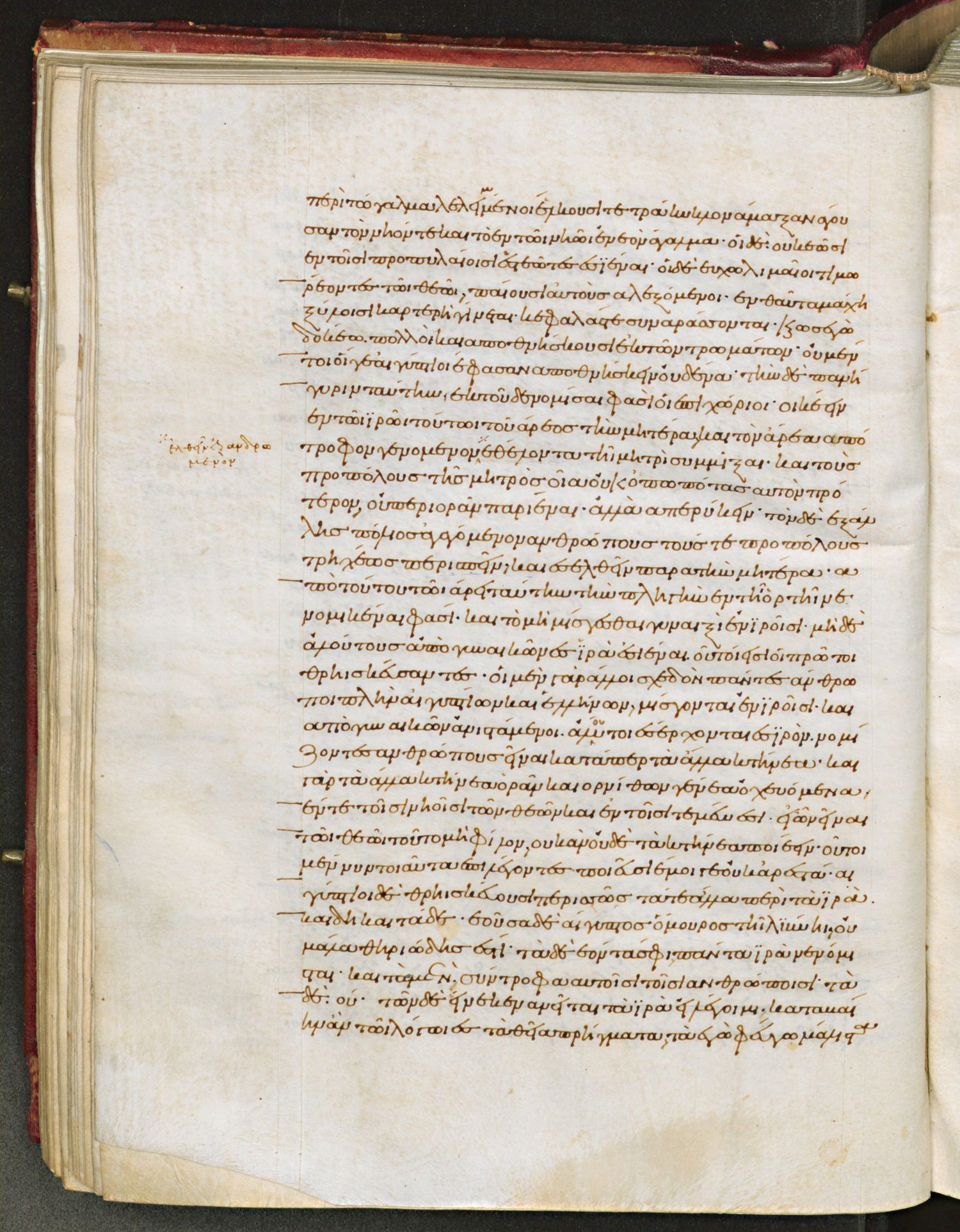
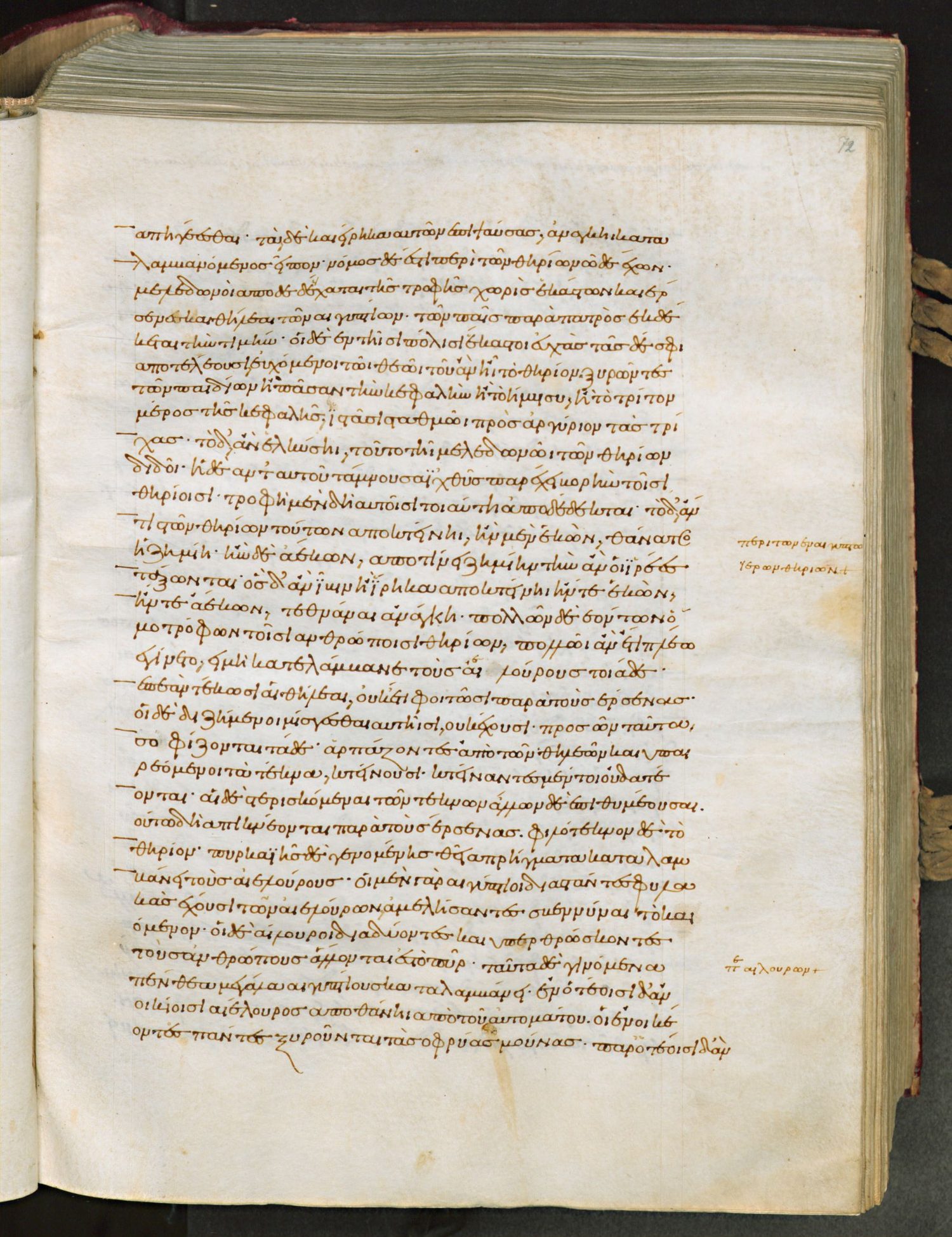
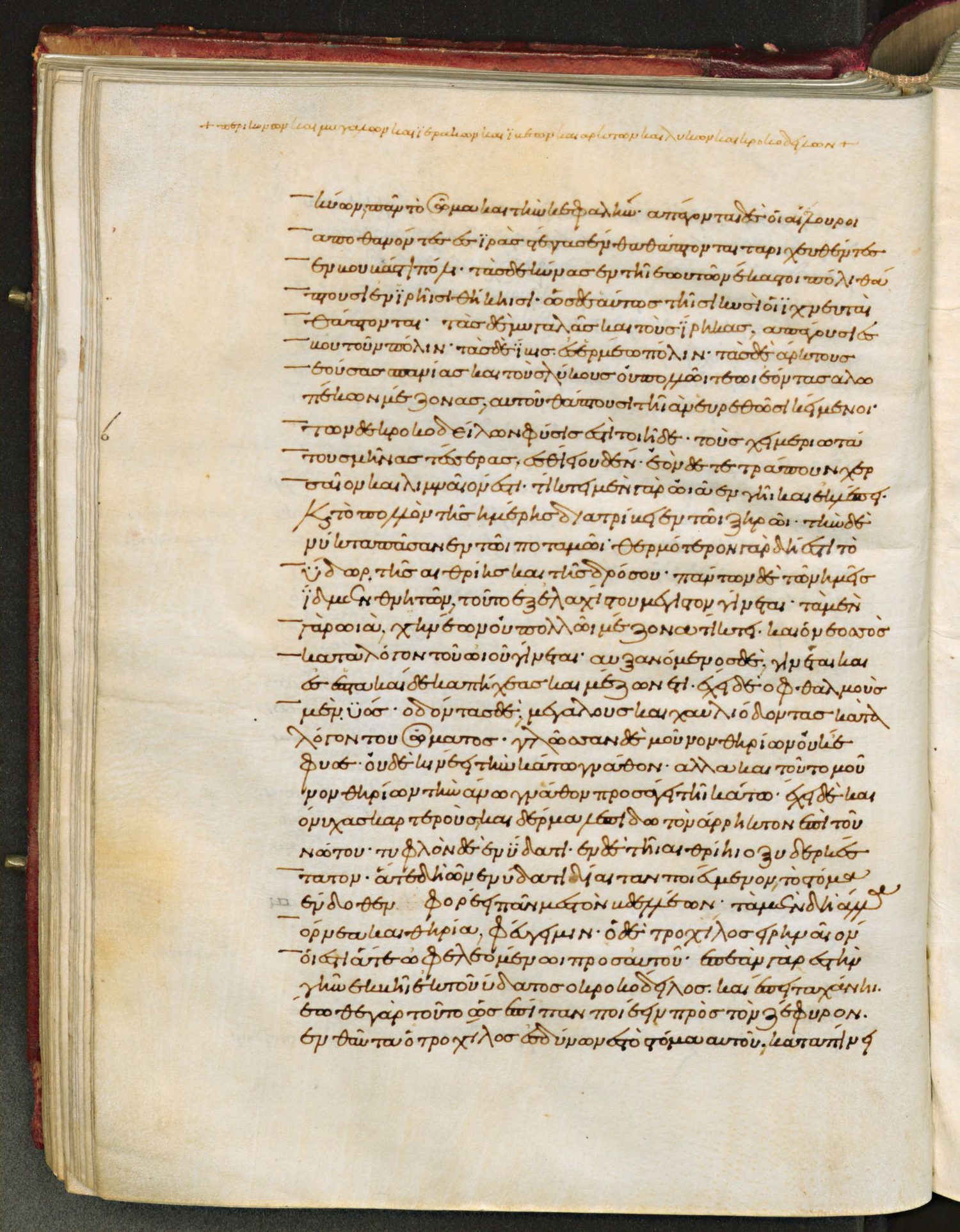
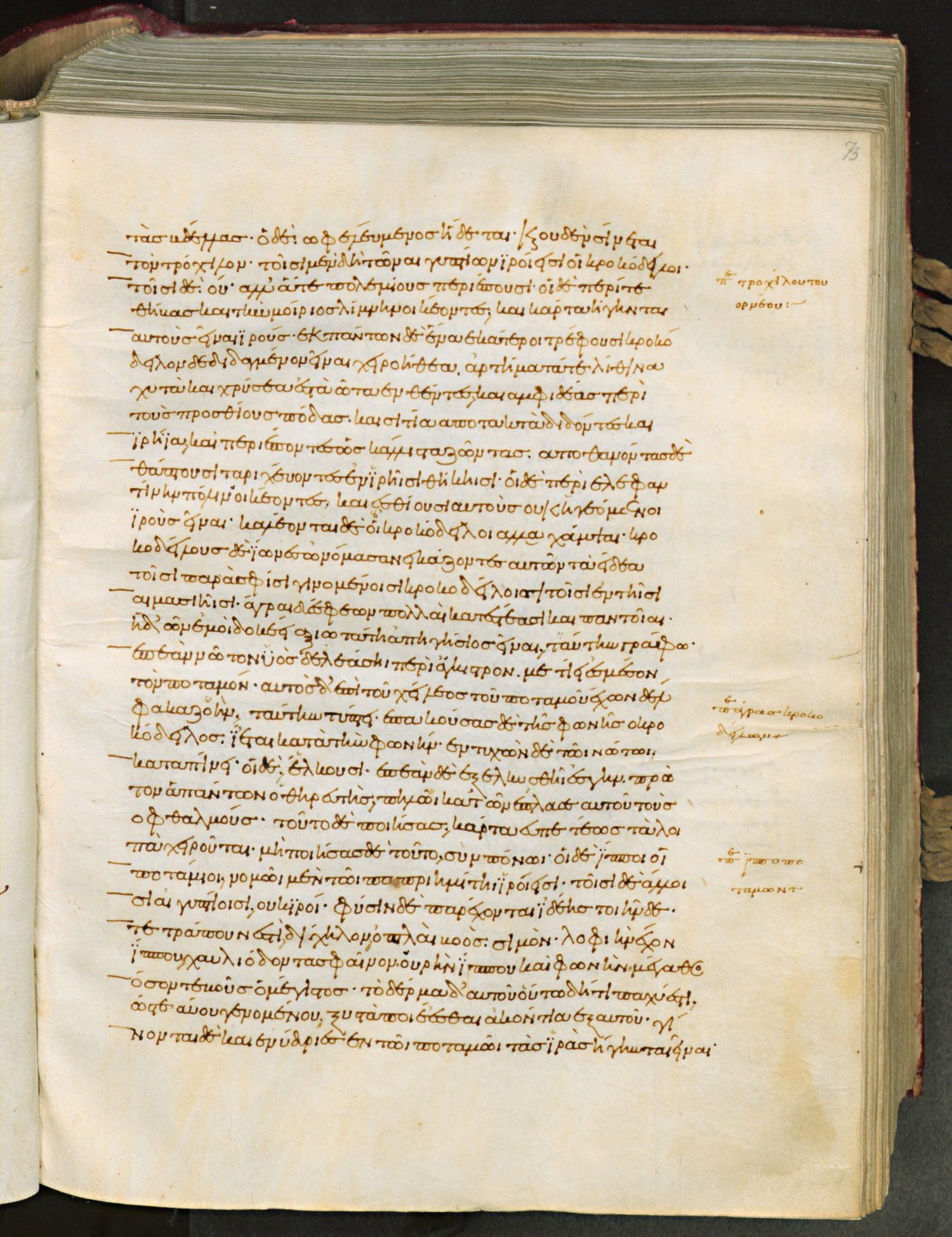
The photographs are of Florence, Biblioteca Medicea Laurenziana, Plut. 70.3 (parchment, 10th century, 374 folios, 31 lines a page), Herodotus, Histories (codex A of the editors), the oldest surviving manuscript of the complete Histories, from the Teca Digitale of the Biblioteca Medicea Laurenziana. Each section below is the text of one page, or of the part of a page that falls within these chapters. The first and last words of every page were read on the photograph and located in the Greek, and every page break was checked against the next page; the notes quote these words. Readers' notes in the margins are not part of the text and are mentioned where they occur.
The Greek is the text printed in A. D. Godley's Loeb edition (1920-1925), from Perseus; it is the edited text, not a transcription of the manuscript, whose wording differs in places. The English is Godley's translation as printed, from Wikisource. Godley's English carries only chapter numbers; the section numbers shown in it were placed by comparison with the Perseus version of his translation. Each page's English is cut at the end of one of Godley's sentences, so it can begin or end a few lines away from the Greek of the page; each note gives the exact ranges.
This entry covers chapters 2.65-76, on fol. 71v to 74r.
How was this verified? (Provenance)
Where on the image
Laur. Plut. 70.3, fol. 71v: Greek here 2.65.1 to 2.65.2. Checked on the image (first and last words read and located in the Greek; each break checked against the neighbouring page): fol. 71v begins ‹περὶ τὤγαλμα λελειμμένοι ἕλκουσι› (2.63.2), ends ‹τὰ ἐγὼ φεύγω μάλιστα› (2.65.2). English here: 2.65.1 (Godley's sentences for the sections whose Greek lies mostly on this page).
2.65.1Αἰγύπτιοι δὲ θρησκεύουσι περισσῶς τά τε ἄλλα περὶ τὰ ἱρὰ καὶ δὴ καὶ τάδε. 2.65.2ἐοῦσα ἡ Αἴγυπτος ὅμουρος τῇ Λιβύῃ οὐ μάλα θηριώδης ἐστί· τὰ δὲ ἐόντα σφι ἅπαντα ἱρὰ νενόμισται, καὶ τὰ μὲν σύντροφα αὐτοῖσι τοῖσι ἀνθρώποισι, τὰ δὲ οὔ. τῶν δὲ εἵνεκεν ἀνεῖται τὰ θηρία ἱρὰ εἰ λέγοιμι, καταβαίην ἂν τῷ λόγῳ ἐς τὰ θεῖα πρήγματα, τὰ ἐγὼ φεύγω μάλιστα
2.65.1Though Egypt has Libya on its borders, it is not a country of many animals. All of them are held sacred some of these are part of mens’ households and some not; but were I to declare the reason why they are dedicated, I should be brought to speak of matters of divinity, of which I am especially unwilling to treat; I have never touched upon such save where necessity has compelled me.
Where on the image
Laur. Plut. 70.3, fol. 72r: Greek here 2.65.2 to 2.66.4. Checked on the image (first and last words read and located in the Greek; each break checked against the neighbouring page): fol. 72r begins ‹ἀπηγέεσθαι· τὰ δὲ καὶ› (2.65.2), ends ‹παρʼ ὁτέοισι δʼ ἂν› (2.66.4). English here: 2.65.3 to 2.66.4 (Godley's sentences for the sections whose Greek lies mostly on this page).
2.65.2ἀπηγέεσθαι· τὰ δὲ καὶ εἴρηκα αὐτῶν ἐπιψαύσας, ἀναγκαίῃ καταλαμβανόμενος εἶπον. 2.65.3νόμος δὲ ἐστὶ περὶ τῶν θηρίων ὧδε ἔχων· μελεδωνοὶ ἀποδεδέχαται τῆς τροφῆς χωρὶς ἑκάστων καὶ ἔρσενες καὶ θήλεαι τῶν Αἰγυπτίων, τῶν παῖς παρὰ πατρὸς ἐκδέκεται τὴν τιμήν. 2.65.4οἳ δὲ ἐν τῇσι πόλισι ἕκαστοι εὐχὰς τάσδε σφι ἀποτελέουσι· εὐχόμενοι τῷ θεῷ τοῦ ἂν ᾖ τὸ θηρίον, ξυρῶντες τῶν παιδίων ἢ πᾶσαν τὴν κεφαλὴν ἢ τὸ ἥμισυ ἢ τὸ τρίτον μέρος τῆς κεφαλῆς, ἱστᾶσι σταθμῷ πρὸς ἀργύριον τὰς τρίχας· τὸ δʼ ἂν ἑλκύσῃ, τοῦτο τῇ μελεδωνῷ τῶν θηρίων διδοῖ, ἣ δὲ ἀντʼ αὐτοῦ τάμνουσα ἰχθῦς παρέχει βορὴν τοῖσι θηρίοισι. 2.65.5τροφὴ μὲν δὴ αὐτοῖσι τοιαύτη ἀποδέδεκται· τὸ δʼ ἄν τις τῶν θηρίων τούτων ἀποκτείνῃ, ἢν μὲν ἑκών, θάνατος ἡ ζημίη, ἢν δὲ ἀέκων, ἀποτίνει ζημίην τὴν ἂν οἱ ἱρέες τάξωνται. ὃς δʼ ἂν ἶβιν ἢ ἴρηκα ἀποκτείνῃ, ἤν τε ἑκὼν ἤν τε ἀέκων, τεθνάναι ἀνάγκη. 2.66.1πολλῶν δὲ ἐόντων ὁμοτρόφων τοῖσι ἀνθρώποισι θηρίων πολλῷ ἂν ἔτι πλέω ἐγίνετο, εἰ μὴ κατελάμβανε τοὺς αἰελούρους τοιάδε· ἐπεὰν τέκωσι αἱ θήλεαι, οὐκέτι φοιτέουσι παρὰ τοὺς ἔρσενας· οἳ δὲ διζήμενοι μίσγεσθαι αὐτῇσι οὐκ ἔχουσι. 2.66.2πρὸς ὦν ταῦτα σοφίζονται τάδε· ἁρπάζοντες ἀπὸ τῶν θηλέων καὶ ὑπαιρεόμενοι τὰ τέκνα κτείνουσι, κτείναντες μέντοι οὐ πατέονται· αἳ δὲ στερισκόμεναι τῶν τέκνων, ἄλλων δὲ ἐπιθυμέουσαι, οὕτω δὴ ἀπικνέονται παρὰ τοὺς ἔρσενας· φιλότεκνον γὰρ τὸ θηρίον. 2.66.3πυρκαϊῆς δὲ γενομένης θεῖα πρήγματα καταλαμβάνει τοὺς αἰελούρους· οἱ μὲν γὰρ Αἰγύπτιοι διαστάντες φυλακὰς ἔχουσι τῶν αἰελούρων, ἀμελήσαντες σβεννύναι τὸ καιόμενον, οἱ δὲ αἰέλουροι διαδύνοντες καὶ ὑπερθρώσκοντες τοὺς ἀνθρώπους ἐσάλλονται ἐς τὸ πῦρ. 2.66.4ταῦτα δὲ γινόμενα πένθεα μεγάλα τοὺς Αἰγυπτίους καταλαμβάνει. ἐν ὁτέοισι δʼ ἂν οἰκίοισι αἰέλουρος ἀποθάνῃ ἀπὸ τοῦ αὐτομάτου, οἱ ἐνοικέοντες πάντες ξυρῶνται τὰς ὀφρύας μούνας, παρʼ ὁτέοισι δʼ ἂν
2.65.3But I. will now show how it is customary to deal with the animals. Men and women are appointed guardians to provide nourishment for each kind severally; a son inherits this office from his father. 2.65.4Townsmen in each place, when they pay their vows, make prayer to the god to whom the animal is dedicated, shaving the whole or the half or the third part of their children’s heads, and weighing the hair in a balance against a sum of silver; then whatever be the weight in silver of the hair is given to the female guardian of the creatures, who buys fish with it, cuts them up and feeds them therewith. 2.65.5Thus is food provided for them. Whoever kills one of these creatures with intention is punished with death; if he kill by mischance he pays whatever penalty the priests appoint. Whoever kills an ibis or a hawk, with intention or without, must die for it. 2.66.1There are many household animals; and there would be many more, were it not for what happens to the cats. When the females have kittened they will not consort with the males; and these seek them but cannot get their will of them; 2.66.2so their device is to steal and carry off and kill the kittens (but they do not eat what they have killed). The mothers, deprived of their young and desiring to have more will then consort with the males; for they are creatures that love offspring. 2.66.3And when a fire breaks out very strange things happen to the cats. The Egyptians stand round in a broken line, thinking more of the cats than of quenching the burning; but the cats slip through or leap over the men and spring into the fire. 2.66.4When this happens, there is great mourning in Egypt. Dwellers in a house where a cat has died a natural death shave their eyebrows and no more; where a dog has so died, the head and the whole body are shaven.
Where on the image
Laur. Plut. 70.3, fol. 72v: Greek here 2.66.4 to 2.68.5. Checked on the image (first and last words read and located in the Greek; each break checked against the neighbouring page): fol. 72v begins ‹κύων, πᾶν τὸ σῶμα› (2.66.4), ends ‹τὸ στόμα αὐτοῦ καταπίνει› (2.68.5). A reader's note in small script stands in the upper margin. English here: 2.67.1 to 2.68.5 (Godley's sentences for the sections whose Greek lies mostly on this page).
2.66.4κύων, πᾶν τὸ σῶμα καὶ τὴν κεφαλήν. 2.67.1ἀπάγονται δὲ οἱ αἰέλουροι ἀποφανόντες ἐς ἱρὰς στέγας, ἔνθα θάπτονται ταριχευθέντες, ἐν Βουβάστιπόλι· τὰς δὲ κύνας ἐν τῇ ἑωυτῶν ἕκαστοι πόλι θάπτουσι ἐν ἱρῇσι θήκῃσι. ὣς δὲ αὕτως τῇσι κυσὶ οἱ ἰχνευταὶ θάπτονται. τὰς δὲ μυγαλᾶς καὶ τοὺς ἴρηκας ἀπάγουσι ἐς Βουτοῦν πόλιν, τὰς δὲ ἴβις ἐς Ἑρμέω πόλιν. 2.67.2τὰς δὲ ἄρκτους ἐούσας σπανίας καὶ τοὺς λύκους οὐ πολλῷ τεῳ ἐόντας ἀλωπέκων μέζονας αὐτοῦ θάπτουσι τῇ ἂν εὑρεθέωσι κείμενοι. 2.68.1τῶν δὲ κροκοδείλων φύσις ἐστὶ τοιήδε. τοὺς χειμεριωτάτους μῆνας τέσσερας ἐσθίει οὐδέν, ἐὸν δὲ τετράπουν χερσαῖον καὶ λιμναῖον ἐστί. τίκτει μὲν γὰρ ᾠὰ ἐν γῇ καὶ ἐκλέπει, καὶ τὸ πολλὸν τῆς ἡμέρης διατρίβει ἐν τῷ ξηρῷ, τὴν δὲ νύκτα πᾶσαν ἐν τῷ ποταμῷ· θερμότερον γὰρ δή ἐστι τὸ ὕδωρ τῆς τε αἰθρίης καὶ τῆς δρόσου. 2.68.2πάντων δὲ τῶν ἡμεῖς ἴδμεν θνητῶν τοῦτο ἐξ ἐλαχίστου μέγιστον γίνεται· τὰ μὲν γὰρ ᾠὰ χηνέων οὐ πολλῷ μέζονα τίκτει, καὶ ὁ νεοσσὸς κατὰ λόγον τοῦ ᾠοῦ γίνεται, αὐξανόμενος δὲ γίνεται καὶ ἐς ἑπτακαίδεκα πήχεας καὶ μέζων ἔτι. 2.68.3ἔχει δὲ ὀφθαλμοὺς μὲν ὑός, ὀδόντας δὲ μεγάλους καὶ χαυλιόδοντας κατὰ λόγον τοῦ σώματος. γλῶσσαν δὲ μοῦνον θηρίων οὐκ ἔφυσε, οὐδὲ κινέει τὴν κάτω γνάθον, ἀλλὰ καὶ τοῦτο μοῦνον θηρίων τὴν ἄνω γνάθον προσάγει τῇ κάτω. 2.68.4ἔχει δὲ καὶ ὄνυχας καρτεροὺς καὶ δέρμα λεπιδωτὸν ἄρρηκτον ἐπὶ τοῦ νώτου. τυφλὸν δὲ ἐν ὕδατι, ἐν δὲ τῇ αἰθρίῃ ὀξυδερκέστατον. ἅτε δὴ ὦν ἐν ὕδατι δίαιταν ποιεύμενον, τὸ στόμα ἔνδοθεν φορέει πᾶν μεστὸν βδελλέων. τὰ μὲν δὴ ἄλλα ὄρνεα καὶ θηρία φεύγει μιν, ὁ δὲ τροχίλος εἰρηναῖόν οἱ ἐστὶ ἅτε ὠφελεομένῳ πρὸς αὐτοῦ· 2.68.5ἐπεὰν γὰρ ἐς τὴν γῆν ἐκβῇ ἐκ τοῦ ὕδατος ὁ κροκόδειλος καὶ ἔπειτα χάνῃ (ἔωθε γὰρ τοῦτο ὡς ἐπίπαν ποιέειν πρὸς τὸν ζέφυρον), ἐνθαῦτα ὁ τροχίλος ἐσδύνων ἐς τὸ στόμα αὐτοῦ καταπίνει
2.67.1Dead cats are taken away into sacred buildings, where they are embalmed and buried, in the town of Bubastis; bitches are buried in sacred coffins by the townsmen, in their several towns; and the like is done with ichneumons. Shrewmice and hawks are taken away to Buto, ibises to the city of Hermes. 2.67.2There are but few bears, and the wolves are little bigger than foxes; both these are buried wherever they are found lying. 2.68.1I will now show what kind of creature is the crocodile. For the four winter months it eats nothing. It has four feet, and lives both on land and in the water, for it lays eggs and hatches them out on land, and it passes the greater part of the day on dry ground, and the night in the river, the water being warmer than the air and dew. 2.68.2No mortal creature known to us grows from so small a beginning to such greatness; for its eggs are not much bigger than goose eggs, and the young crocodile is of a bigness answering thereto, but it grows to a length of seventeen cubits and more. 2.68.3It has eyes like pigs’ eyes, and great teeth and tusks answering to the bigness of its body. It is the only animal that has no tongue. Nor does it move the lower jaw. It is the only creature that brings the upper jaw down upon the lower. 2.68.4It has also strong claws, and a scaly impenetrable hide on its back. It is blind in the water, but very keen of sight in the air. Since it lives in the water, its mouth is all full within of leeches. All birds and beasts flee from it, except only the sandpiper, with which it is at peace, because this bird does the crocodile a service; 2.68.5for whenever the crocodile comes ashore out of the water and then opens its mouth (and this it does for the most part to catch the west wind), the sandpiper goes into its mouth and eats the leeches; the crocodile is pleased by this service and does the sandpiper no harm.
Where on the image
Laur. Plut. 70.3, fol. 73r: Greek here 2.68.5 to 2.72.1. Checked on the image (first and last words read and located in the Greek; each break checked against the neighbouring page): fol. 73r begins ‹τὰς βδέλλας· ὁ δὲ› (2.68.5), ends ‹τὰς ἱρὰς ἥγηνται εἶναι› (2.72.1). English here: 2.69.1 to 2.71.1 (Godley's sentences for the sections whose Greek lies mostly on this page).
2.68.5τὰς βδέλλας· ὁ δὲ ὠφελεύμενος ἥδεται καὶ οὐδὲν σίνεται τὸν τροχίλον. 2.69.1τοῖσι μὲν δὴ τῶν Αἰγυπτίων ἱροί εἰσι οἱ κροκόδειλοι, τοῖσι δὲ οὔ, ἀλλʼ ἅτε πολεμίους περιέπουσι· οἱ δὲ περί τε Θήβας καὶ τὴν Μοίριος λίμνην οἰκέοντες καὶ κάρτα ἥγηνται αὐτοὺς εἶναι ἱρούς· 2.69.2ἐκ πάντων δὲ ἕνα ἑκάτεροι τρέφουσι κροκόδειλον δεδιδαγμένον εἶναι χειροήθεα, ἀρτήματά τε λίθινα χυτὰ καὶ χρύσεα ἐς τὰ ὦτα ἐνθέντες καὶ ἀμφιδέας περὶ τοὺς ἐμπροσθίους πόδας, καὶ σιτία ἀποτακτὰ διδόντες καὶ ἱρήια, καὶ περιέποντες ὡς κάλλιστα ζῶντας· ἀποθανόντας δὲ θάπτουσι ταριχεύσαντες ἐν ἱρῇσι θήκῃσι. 2.69.3οἱ δὲ περὶ Ἐλεφαντίνην πόλιν οἰκέοντες καὶ ἐσθίουσι αὐτοὺς οὐκ ἡγεόμενοι ἱροὺς εἶναι. καλέονται δὲ οὐ κροκόδειλοι ἀλλὰ χάμψαι· κροκοδείλους δὲ Ἴωνες ὠνόμασαν, εἰκάζοντες αὐτῶν τὰ εἴδεα τοῖσι παρὰ σφίσι γινομένοισι κροκοδείλοισι τοῖσι ἐν τῇσι αἱμασιῇσι. 2.70.1ἄγραι δὲ σφέων πολλαὶ κατεστᾶσι καὶ παντοῖαι· ἣ δʼ ὦν ἔμοιγε δοκέει ἀξιωτάτη ἀπηγήσιος εἶναι, ταύτην γράφω. ἐπεὰν νῶτον ὑὸς δελεάσῃ περὶ ἄγκιστρον, μετιεῖ ἐς μέσον τὸν ποταμόν, αὐτὸς δὲ ἐπὶ τοῦ χείλεος τοῦ ποταμοῦ ἔχων δέλφακα ζωὴν ταύτην τύπτει. 2.70.2ἐπακούσας δὲ τῆς φωνῆς ὁ κροκόδειλος ἵεται κατὰ τὴν φωνήν, ἐντυχὼν δὲ τῷ νώτῳ καταπίνει· οἳ δὲ ἕλκουσι. ἐπεὰν δὲ ἐξελκυσθῇ ἐς γῆν, πρῶτον ἁπάντων ὁ θηρευτὴς πηλῷ κατʼ ὦν ἔπλασε αὐτοῦ τοὺς ὀφθαλμούς· τοῦτο δὲ ποιήσας κάρτα εὐπετέως τὰ λοιπὰ χειροῦται, μὴ ποιήσας δὲ τοῦτο σὺν πόνῳ. 2.71.1οἱ δὲ ἵπποι οἱ ποτάμιοι νομῷ μὲν τῷ Παπρημίτῃ ἱροί εἰσι, τοῖσι δὲ ἄλλοισι Αἰγυπτίοισι οὐκ ἱροί. φύσιν δὲ παρέχονται ἰδέης τοιήνδε· τετράπουν ἐστί, δίχηλον, ὁπλαὶ βοός, σιμόν, λοφιὴν ἔχον ἵππου, χαυλιόδοντας φαῖνον, οὐρὴν ἵππου καὶ φωνήν, μέγαθος ὅσον τε βοῦς ὁ μέγιστος· τὸ δέρμα δʼ αὐτοῦ οὕτω δή τι παχύ ἐστι ὥστε αὔου γενομένου ξυστὰ ποιέεσθαι ἀκόντια ἐξ αὐτοῦ. 2.72.1γίνονται δὲ καὶ ἐνύδριες ἐν τῷ ποταμῷ, τὰς ἱρὰς ἥγηνται εἶναι.
2.69.1Some of the Egyptians hold crocodiles sacred, others do not so, but treat them as enemies. The dwellers about Thebes and the lake Moeris deem them to be very sacred. 2.69.2There, in every place one crocodile is kept, trained to be tame; they put ornaments of glass and gold on its ears and bracelets on its forefeet, provide for it special food and offerings, and give the creatures the best of treatment while they live; after death the crocodiles are embalmed and buried in sacred coffins. 2.69.3But about Elephantine they are not held sacred, and are even eaten. The Egyptians do not call them crocodiles, but champsae. The Ionians called them crocodiles, from their likeness to the lizards which they have in their walls. 2.70.1There are many and various ways of crocodile hunting; I will write only of that one way which I think most worthy of mention:—The hunter baits a hook with a chine of pork, and lets it float into the midst of the river; he himself stays on the bank with a young live pig, which he beats. 2.70.2Hearing the cries of the pig, the crocodile goes after the sound, and meets the chine, which it swallows; then the hunters pull the line. When the crocodile is drawn ashore, first of all the hunter smears its eyes over with mud; when this is done the quarry is very easily mastered, which, without that, is no light matter. 2.71.1River horses are sacred in the province of Papremis, but not elsewhere in Egypt. For their outward form, they are four-footed, with cloven hoofs like oxen; their noses are blunt; they are maned like horses, with tusks showing, and have a horse’s tail and a horse’s neigh; their bigness is that of the biggest oxen. Their hide is so thick that when it is dried spearshafts are made of it.
Where on the image
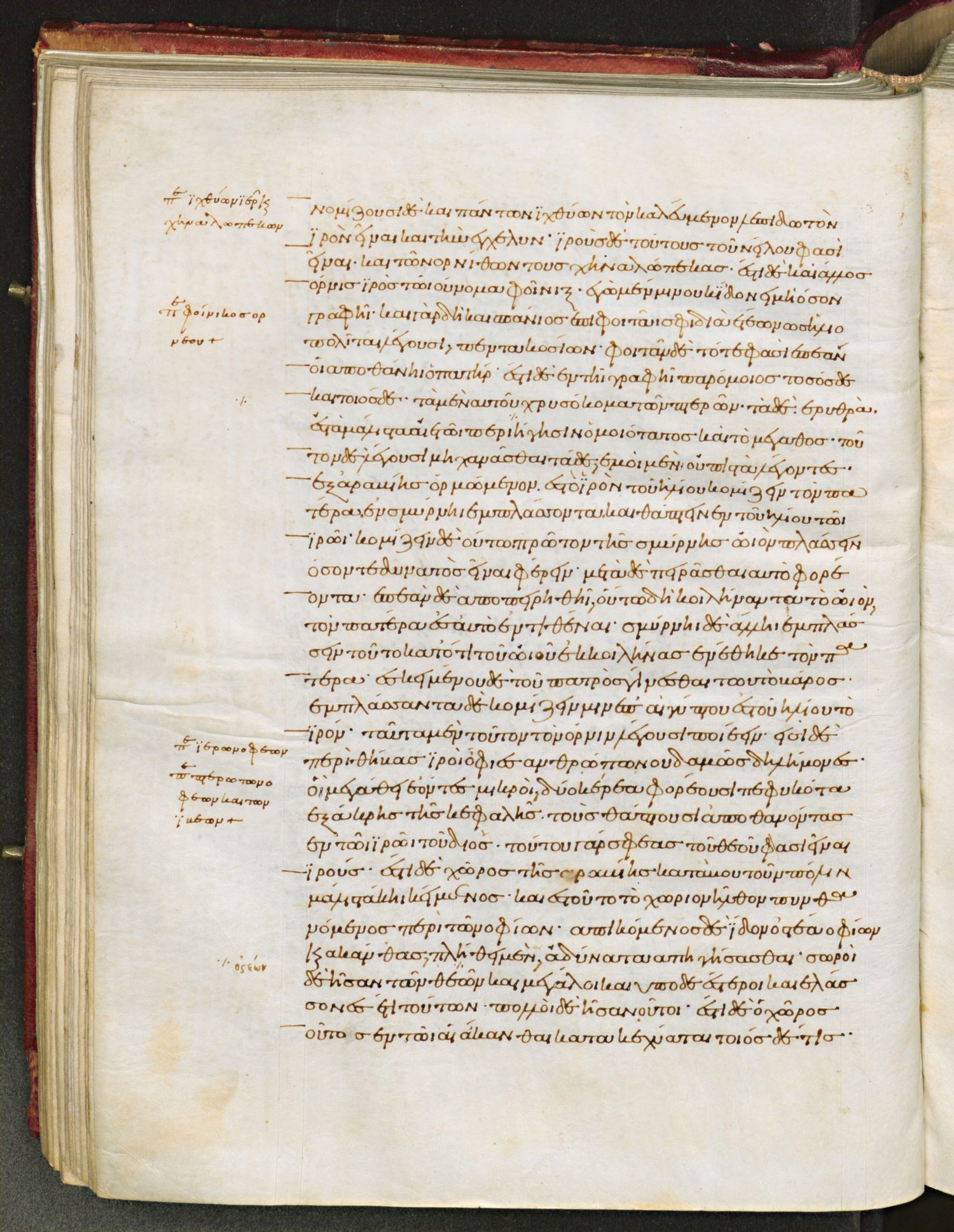
Laur. Plut. 70.3, fol. 73v: Greek here 2.72.1 to 2.75.2. Checked on the image (first and last words read and located in the Greek; each break checked against the neighbouring page): fol. 73v begins ‹νομίζουσι δὲ καὶ τῶν› (2.72.1), ends ‹ἄκανθαι κατακεχύαται, τοιόσδε τις› (2.75.2). English here: 2.72.1 to 2.75.1 (Godley's sentences for the sections whose Greek lies mostly on this page).
2.72.1νομίζουσι δὲ καὶ τῶν ἰχθύων τὸν καλεύμενον λεπιδωτὸν ἱρὸν εἶναι καὶ τὴν ἔγχελυν, ἱροὺς δὲ τούτους τοῦ Νείλου φασὶ εἶναι, καὶ τῶν ὀρνίθων τοὺς χηναλώπεκας. 2.73.1ἔστι δὲ καὶ ἄλλος ὄρνις ἱρός, τῷ οὔνομα φοῖνιξ. ἐγὼ μέν μιν οὐκ εἶδον εἰ μὴ ὅσον γραφῇ· καὶ γὰρ δὴ καὶ σπάνιος ἐπιφοιτᾷ σφι, διʼ ἐτέων, ὡς Ἡλιοπολῖται λέγουσι, πεντακοσίων· 2.73.2φοιτᾶν δὲ τότε φασὶ ἐπεάν οἱ ἀποθάνῃ ὁ πατήρ. ἔστι δέ, εἰ τῇ γραφῇ παρόμοιος, τοσόσδε καὶ τοιόσδε· τὰ μὲν αὐτοῦ χρυσόκομα τῶν πτερῶν τὰ δὲ ἐρυθρὰ ἐς τὰ μάλιστα· αἰετῷ περιήγησιν ὁμοιότατος καὶ τὸ μέγαθος. 2.73.3τοῦτον δὲ λέγουσι μηχανᾶσθαι τάδε, ἐμοὶ μὲν οὐ πιστὰ λέγοντες· ἐξ Ἀραβίης ὁρμώμενον ἐς τὸ ἱρὸν τοῦ Ἡλίου κομίζειν τὸν πατέρα ἐν σμύρνῃ ἐμπλάσσοντα καὶ θάπτειν ἐν τοῦ Ἡλίου τῷ ἱρῷ, 2.73.4κομίζειν δὲ οὕτω· πρῶτον τῆς σμύρνης ᾠὸν πλάσσειν ὅσον τε δυνατός ἐστι φέρειν, μετὰ δὲ πειρᾶσθαι αὐτὸ φορέοντα, ἐπεὰν δὲ ἀποπειρηθῇ, οὕτω δὴ κοιλήναντα τὸ ᾠὸν τὸν πατέρα ἐς αὐτὸ ἐντιθέναι, σμύρνῃ δὲ ἄλλῃ ἐμπλάσσειν τοῦτο κατʼ ὅ τι τοῦ ᾠοῦ ἐκκοιλήνας ἐνέθηκε τὸν πατέρα· ἐσκειμένου δὲ τοῦ πατρὸς γίνεσθαι τὠυτὸ βάρος· ἐμπλάσαντα δὲ κομίζειν μιν ἐπʼ Αἰγύπτου ἐς τοῦ Ἡλίου τὸ ἱρόν. ταῦτα μὲν τοῦτον τὸν ὄρνιν λέγουσι ποιέειν. 2.74.1εἰσὶ δὲ περὶ Θήβας ἱροὶ ὄφιες, ἀνθρώπων οὐδαμῶς δηλήμονες, οἳ μεγάθεϊ ἐόντες μικροὶ δύο κέρεα φορέουσι πεφυκότα ἐξ ἄκρης τῆς κεφαλῆς· τοὺς θάπτουσι ἀποθανόντας ἐν τῷ ἱρῷ τοῦ Διός· τούτου γὰρ σφέας τοῦ θεοῦ φασι εἶναι ἱρούς. 2.75.1ἔστι δὲ χῶρος τῆς Ἀραβίης κατὰ Βουτοῦν πόλιν μάλιστά κῃ κείμενος, καὶ ἐς τοῦτο τὸ χωρίον ἦλθον πυνθανόμενος περὶ τῶν πτερωτῶν ὀφίων· ἀπικόμενος δὲ εἶδον ὀστέα ὀφίων καὶ ἀκάνθας πλήθεϊ μὲν ἀδύνατα ἀπηγήσασθαι, σωροὶ δὲ ἦσαν ἀκανθέων καὶ μεγάλοι καὶ ὑποδεέστεροι καὶ ἐλάσσονες ἔτι τούτων, πολλοὶ δὲ ἦσαν οὗτοι. 2.75.2ἔστι δὲ ὁ χῶρος οὗτος, ἐν τῷ αἱ ἄκανθαι κατακεχύαται, τοιόσδε τις,
2.72.1Otters also are found in the river, which the Egyptians deem sacred; and they hold sacred that fish too which is called the scale-fish, and the eel. These, and the fox-goose among birds, are said to be sacred to the god of the Nile. 2.73.1Another bird also is sacred; it is called the phoenix. I myself have never seen it, but only pictures of it; for the bird comes but seldom into Egypt, once in five hundred years, as the people of Heliopolis say. 2.73.2It is said that the phoenix comes when his father dies. If the picture truly shows his size and appearance, his plumage is partly golden but mostly red. He is most like an eagle in shape and bigness. The Egyptians tell a tale of this bird’s devices which I do not believe. 2.73.3He comes, they say, from Arabia bringing his father to the Sun’s temple enclosed in myrrh, and there buries him. 2.73.4His manner of bringing is this: first he moulds an egg of myrrh as heavy as he can carry, and when he has proved its weight by lifting it he then hollows out the egg and puts his father in it, covering over with more myrrh the hollow in which the body lies; so the egg being with his father in it of the same weight as before, the phoenix, after enclosing him, carries him to the temple of the Sun in Egypt. Such is the tale of what is done by this bird. 2.74.1Near Thebes there are sacred snakes, harmless to men, small in size and bearing two horns on the top of their heads. These, when they die, are buried in the temple of Zeus, to whom they are said to be sacred. 2.75.1Not far from the town of Buto, there is a place in Arabia to which I went to learn about the winged serpents. When I came thither, I saw innumerable bones and backbones of serpents; many heaps of backbones there were, great and small and smaller still.
Where on the image
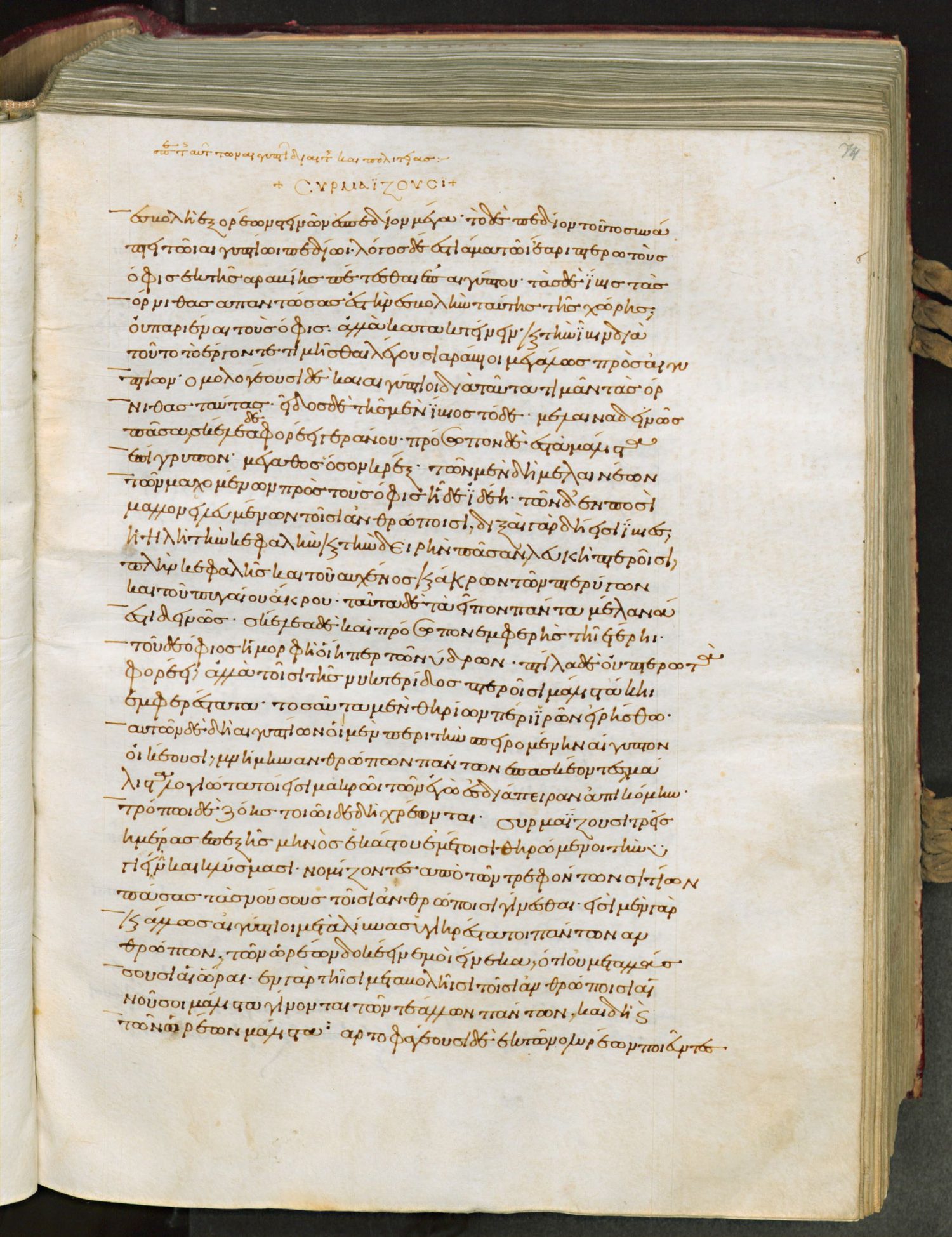
Laur. Plut. 70.3, fol. 74r: Greek here 2.75.2 to 2.76.3. Checked on the image (first and last words read and located in the Greek; each break checked against the neighbouring page): fol. 74r begins ‹ἐσβολὴ ἐξ ὀρέων στεινῶν› (2.75.2), ends ‹ἐκ τῶν ὀλυρέων ποιεῦντες› (2.77.4). Above the text, a reader's note and the word συρμαΐζουσι written between crosses. English here: 2.75.2 to 2.76.3 (Godley's sentences for the sections whose Greek lies mostly on this page).
2.75.2ἐσβολὴ ἐξ ὀρέων στεινῶν ἐς πεδίον μέγα, τὸ δὲ πεδίον τοῦτο συνάπτει τῷ Αἰγυπτίῳ πεδίῳ. 2.75.3λόγος δὲ ἐστὶ ἅμα τῷ ἔαρι πτερωτοὺς ὄφις ἐκ τῆς Ἀραβίης πέτεσθαι ἐπʼ Αἰγύπτου, τὰς δὲ ἴβις τὰς ὄρνιθας ἀπαντώσας ἐς τὴν ἐσβολὴν ταύτης τῆς χώρης οὐ παριέναι τοὺς ὄφις ἀλλὰ κατακτείνειν. 2.75.4καὶ τὴν ἶβιν διὰ τοῦτο τὸ ἔργον τετιμῆσθαι λέγουσι Ἀράβιοι μεγάλως πρὸς Αἰγυπτίων· ὁμολογέουσι δὲ καὶ Αἰγύπτιοι διὰ ταῦτα τιμᾶν τὰς ὄρνιθας ταύτας. 2.76.1εἶδος δὲ τῆς μὲν ἴβιος τόδε· μέλαινα δεινῶς πᾶσα, σκέλεα δὲ φορέει γεράνου, πρόσωπον δὲ ἐς τὰ μάλιστα ἐπίγρυπον, μέγαθος ὅσον κρέξ. τῶν μὲν δὴ μελαινέων τῶν μαχομενέων πρὸς τοὺς ὄφις ἥδε ἰδέη, τῶν δʼ ἐν ποσὶ μᾶλλον εἱλευμενέων τοῖσι ἀνθρώποισι (διξαὶ γὰρ δή εἰσι ἴβιες) 2.76.2ψιλὴ τὴν κεφαλὴν καὶ τὴν δειρὴν πᾶσαν, λευκὴ πτεροῖσι πλὴν κεφαλῆς καὶ αὐχένος καὶ ἀκρέων τῶν πτερύγων καὶ τοῦ πυγαίου ἄκρου (ταῦτα δὲ τὰ εἶπον πάντα μέλανα ἐστὶ δεινῶς), σκέλεα δὲ καὶ πρόσωπον ἐμφερὴς τῇ ἑτέρῃ. τοῦ δὲ ὄφιος ἡ μορφὴ οἵη περ τῶν ὕδρων, 2.76.3πτίλα δὲ οὐ πτερωτὰ φορέει ἀλλὰ τοῖσι τῆς νυκτερίδος πτεροῖσι μάλιστά κῃ ἐμφερέστατα. Τοσαῦτα μὲν θηρίων πέρι ἱρῶν εἰρήσθω.
2.75.2This place, where lay the backbones scattered, is where a narrow mountain pass opens into a great plain, which is joined to the plain of Egypt. 2.75.3Winged serpents are said to fly at the beginning of spring, from Arabia, making for Egypt; but the ibis birds encounter the invaders in this pass and kill them. 2.75.4The Arabians say that the ibis is greatly honoured by the Egyptians for this service, and the Egyptians give the same reason for honouring these birds. 2.76.1Now this is the appearance of the ibis. It is all deep black, with legs like a crane’s, and a beak strongly hooked; its size is that of a landrail. Such is the outward form of the ibis which fights with the serpents. Those that most consort with men (for the ibis is of two kinds) 2.76.2have all the head and neck bare of feathers; their plumage is white, save the head and neck and the tips of wings and tail (these being deep black); the legs and beak of the bird are like those of the other ibis. The serpents are like water-snakes. 2.76.3Their wings are not feathered but most like the wings of a bat. I have now said enough concerning creatures that are sacred.
Notes
- Greek: the text printed in A. D. Godley's Loeb edition, via Perseus (tlg0016.tlg001.perseus-grc2). Square brackets mark words the editor considers later additions; [...] marks a gap the editor indicates. Perseus note markers are omitted.
- English: A. D. Godley, Herodotus vol. 1 (1920) (Loeb Classical Library), as transcribed on Wikisource. Godley's footnotes are omitted.
- Section numbers in the English were placed by comparing Godley's text with the Perseus version of his translation; where a section begins inside one of Godley's sentences, the English is kept with the page that holds the start of that sentence.
Cite
Sources
- Source: Florence, Laur. Plut. 70.3 (10th c.) via BML Teca Digitale + Greek of Godley's Loeb (Perseus) + English of A. D. Godley (Loeb, Wikisource) (holding institution)
- Critical edition: Greek of A. D. Godley's Loeb edition (1920-1925), via Perseus
← previous · → next · v cycle view · l back to library