Herodotus, Histories 2.77-90: Egyptian diet, medicine and embalming
Introduction
Herodotus of Halicarnassus wrote the Histories in the third quarter of the 5th century BCE, an inquiry into the deeds of Greeks and barbarians and the causes of the wars between them, later divided into nine books. Book 2 is Herodotus' account of Egypt, written as background to Cambyses' invasion: the land and the Nile, the customs and religion of the Egyptians, and the history of their kings as the priests told it, down to Amasis.
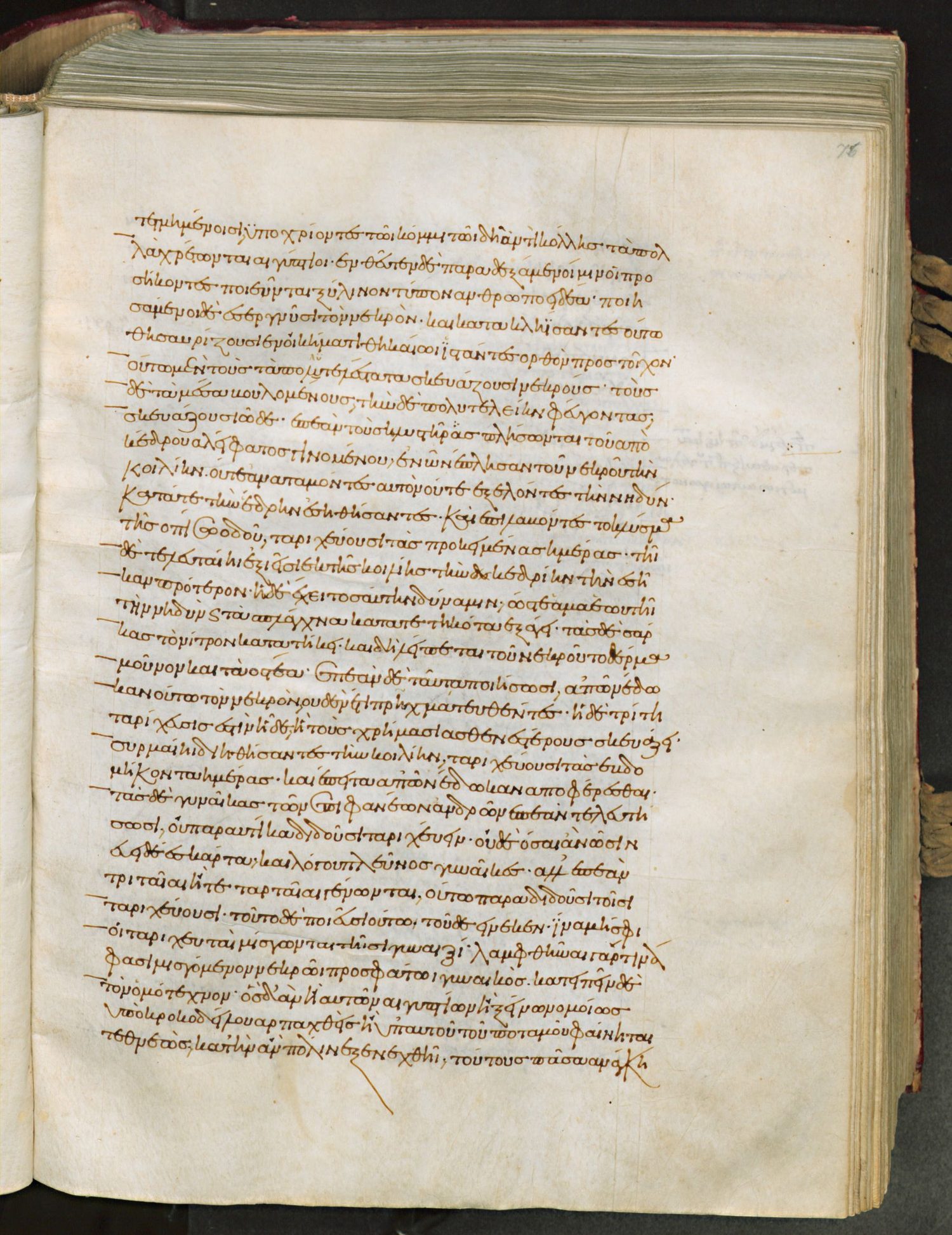
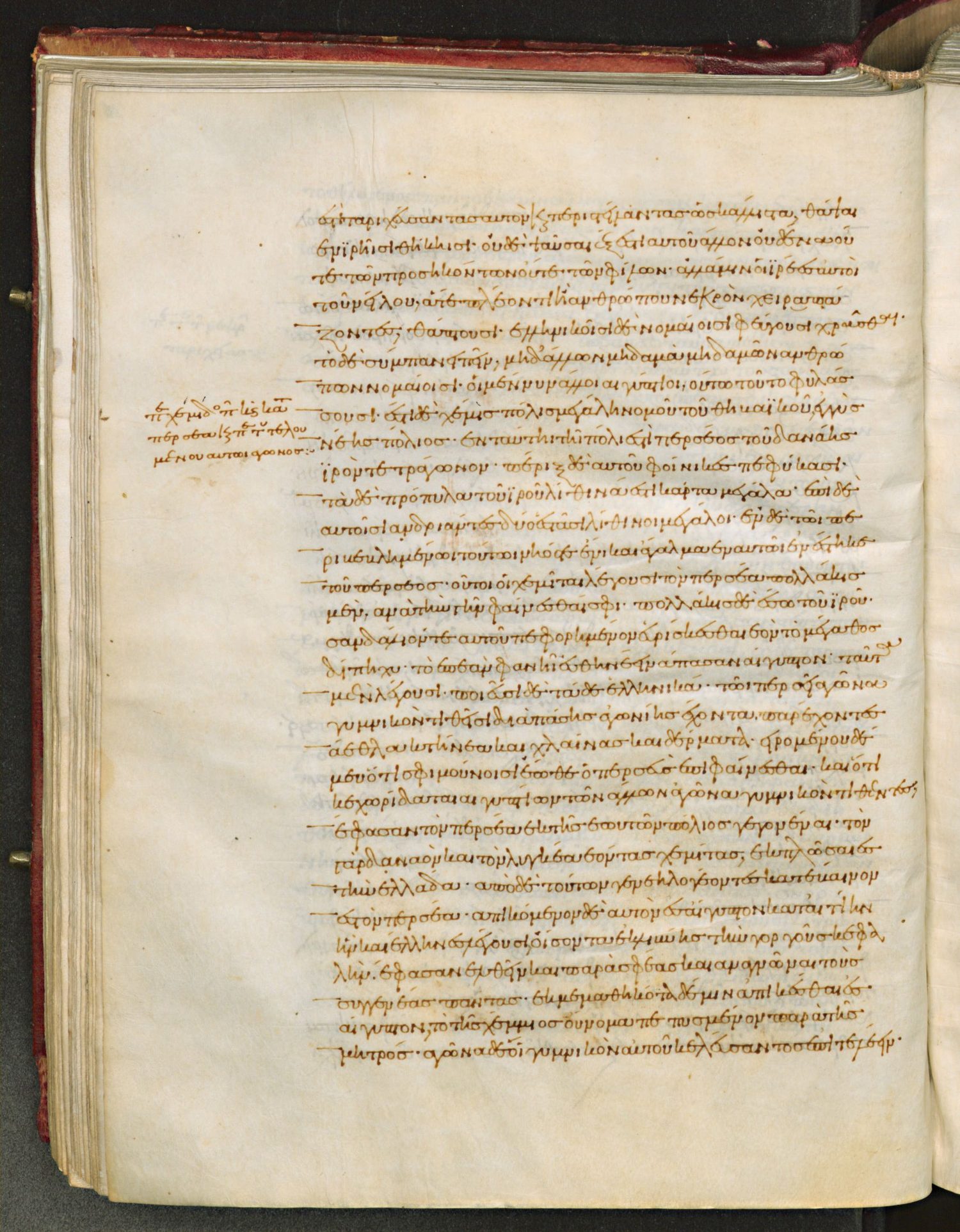
The photographs are of Florence, Biblioteca Medicea Laurenziana, Plut. 70.3 (parchment, 10th century, 374 folios, 31 lines a page), Herodotus, Histories (codex A of the editors), the oldest surviving manuscript of the complete Histories, from the Teca Digitale of the Biblioteca Medicea Laurenziana. Each section below is the text of one page, or of the part of a page that falls within these chapters. The first and last words of every page were read on the photograph and located in the Greek, and every page break was checked against the next page; the notes quote these words. Readers' notes in the margins are not part of the text and are mentioned where they occur.
The Greek is the text printed in A. D. Godley's Loeb edition (1920-1925), from Perseus; it is the edited text, not a transcription of the manuscript, whose wording differs in places. The English is Godley's translation as printed, from Wikisource. Godley's English carries only chapter numbers; the section numbers shown in it were placed by comparison with the Perseus version of his translation. Each page's English is cut at the end of one of Godley's sentences, so it can begin or end a few lines away from the Greek of the page; each note gives the exact ranges.
This entry covers chapters 2.77-90, on fol. 74r to 76v.
How was this verified? (Provenance)
Where on the image
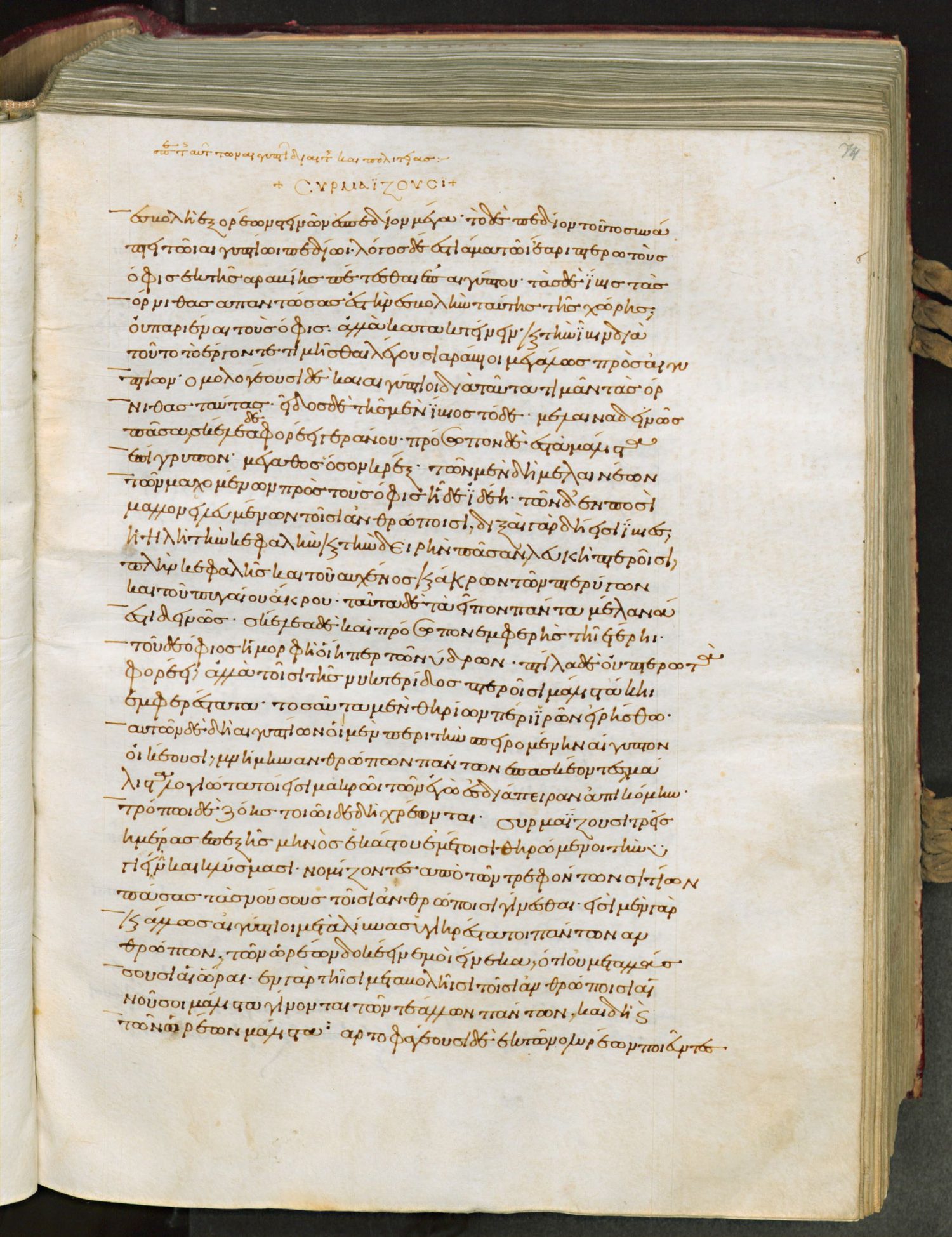
Laur. Plut. 70.3, fol. 74r: Greek here 2.77.1 to 2.77.4. Checked on the image (first and last words read and located in the Greek; each break checked against the neighbouring page): fol. 74r begins ‹ἐσβολὴ ἐξ ὀρέων στεινῶν› (2.75.2), ends ‹ἐκ τῶν ὀλυρέων ποιεῦντες› (2.77.4). Above the text, a reader's note and the word συρμαΐζουσι written between crosses. English here: 2.77.1 to 2.77.3 (Godley's sentences for the sections whose Greek lies mostly on this page).
2.77.1αὐτῶν δὲ δὴ Αἰγυπτίων οἳ μὲν περὶ τὴν σπειρομένην Αἴγυπτον οἰκέουσι, μνήμην ἀνθρώπων πάντων ἐπασκέοντες μάλιστα λογιώτατοι εἰσὶ μακρῷ τῶν ἐγὼ ἐς διάπειραν ἀπικόμην, 2.77.2τρόπῳ δὲ ζόης τοιῷδε διαχρέωνται· συρμαΐζουσι τρεῖς ἡμέρας ἐπεξῆς μηνὸς ἑκάστου, ἐμέτοισι θηρώμενοι τὴν ὑγιείην καὶ κλύσμασι, νομίζοντες ἀπὸ τῶν τρεφόντων σιτίων πάσας τὰς νούσους τοῖσι ἀνθρώποισι γίνεσθαι. 2.77.3εἰσὶ μὲν γὰρ καὶ ἄλλως Αἰγύπτιοι μετὰ Λίβυας ὑγιηρέστατοι πάντων ἀνθρώπων τῶν ὡρέων δοκέειν ἐμοὶ εἵνεκα, ὅτι οὐ μεταλλάσσουσι αἱ ὧραι· ἐν γὰρ τῇσι μεταβολῇσι τοῖσι ἀνθρώποισι αἱ νοῦσοι μάλιστα γίνονται τῶν τε ἄλλων πάντων καὶ δὴ καὶ τῶν ὡρέων μάλιστα. 2.77.4ἀρτοφαγέουσι δὲ ἐκ τῶν ὀλυρέων ποιεῦντες
2.77.1Among the Egyptians themselves, those who dwell in the cultivated country are the most careful of all men to preserve the memory of the past, and none whom I have questioned have so many chronicles. 2.77.2I will now speak of the manner of life which they use. For three following days in every month they purge themselves, pursuing after health by means of emetics and drenches; for they think it is from the food which they eat that all sicknesses come to men. 2.77.3Even without this, the Egyptians are the healthiest of all men, next to the Libyans; the reason of which to my thinking is that the climate in all seasons is the same; for change is the great cause of men’s falling sick, more especially changes of seasons.
Where on the image
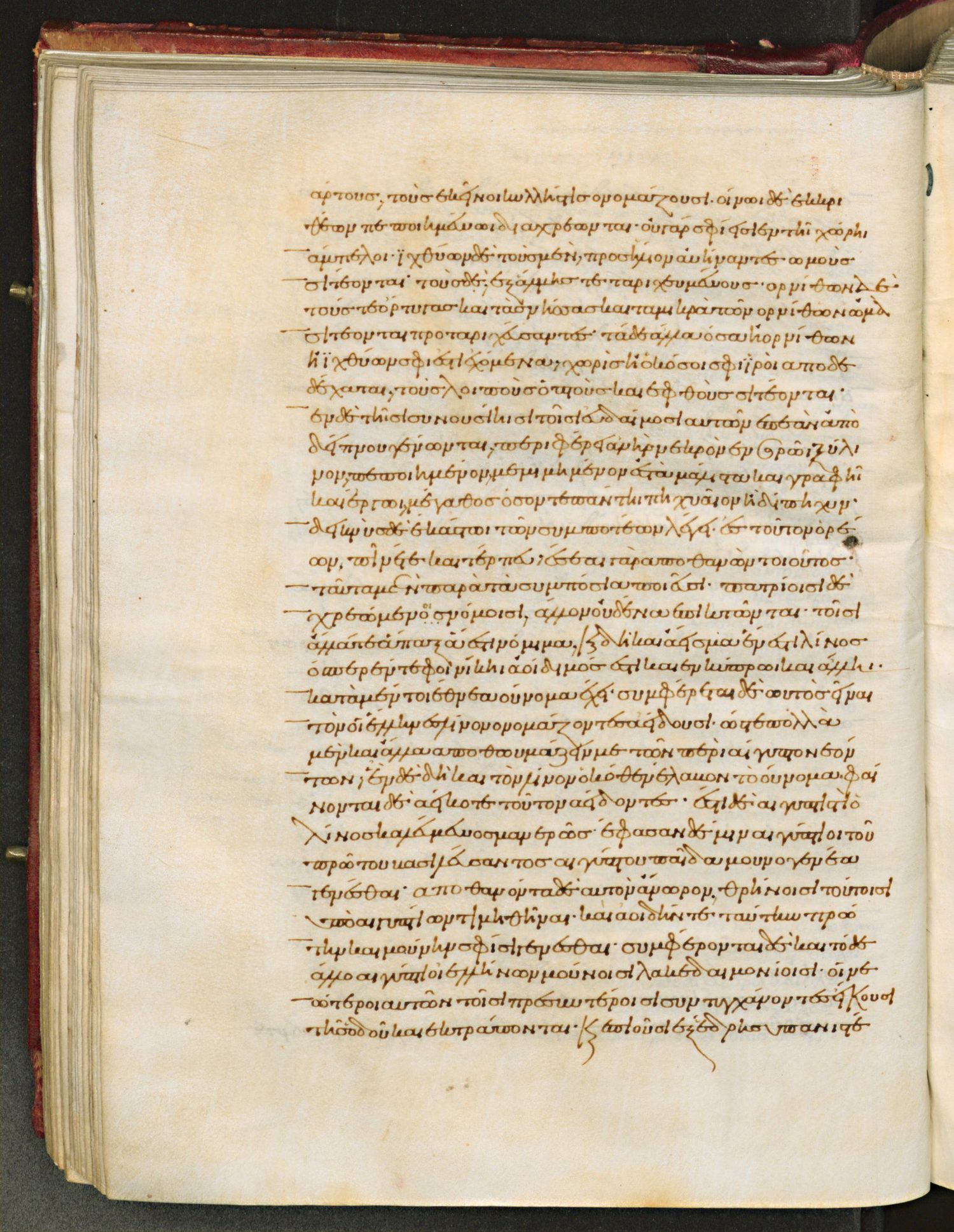
Laur. Plut. 70.3, fol. 74v: Greek here 2.77.4 to 2.80.1. Checked on the image (first and last words read and located in the Greek; each break checked against the neighbouring page): fol. 74v begins ‹ἄρτους, τοὺς ἐκεῖνοι κυλλήστις› (2.77.4), ends ‹ἐπιοῦσι ἐξ ἕδρης ὑπανιστέ-› (2.80.1). English here: 2.77.4 to 2.80.1 (Godley's sentences for the sections whose Greek lies mostly on this page).
2.77.4ἄρτους, τοὺς ἐκεῖνοι κυλλήστις ὀνομάζουσι. οἴνῳ δὲ ἐκ κριθέων πεποιημένῳ διαχρέωνται· οὐ γάρ σφι εἰσὶ ἐν τῇ χώρῃ ἄμπελοι. ἰχθύων δὲ τοὺς μὲν πρὸς ἥλιον αὐήναντες ὠμοὺς σιτέονται, τοὺς δὲ ἐξ ἅλμης τεταριχευμένους. 2.77.5ὀρνίθων δὲ τούς τε ὄρτυγας καὶ τὰς νήσσας καὶ τὰ μικρὰ τῶν ὀρνίθων ὠμὰ σιτέονται προταριχεύσαντες. τὰ δὲ ἄλλα ὅσα ἢ ὀρνίθων ἢ ἰχθύων σφι ἐστὶ ἐχόμενα, χωρὶς ἢ ὁκόσοι σφι ἱροὶ ἀποδεδέχαται, τοὺς λοιποὺς ὀπτοὺς καὶ ἑφθοὺς σιτέονται. 2.78.1ἐν δὲ τῇσι συνουσίῃσι τοῖσι εὐδαίμοσι αὐτῶν, ἐπεὰν ἀπὸ δείπνου γένωνται, περιφέρει ἀνὴρ νεκρὸν ἐν σορῷ ξύλινον πεποιημένον, μεμιμημένον ἐς τὰ μάλιστα καὶ γραφῇ καὶ ἔργῳ, μέγαθος ὅσον τε πηχυαῖον ἢ δίπηχυν, δεικνὺς δὲ ἑκάστῳ τῶν συμποτέων λέγει ἐς τοῦτον ὁρέων πῖνέ τε καὶ τέρπευ· ἔσεαι γὰρ ἀποθανὼν τοιοῦτος. ταῦτα μὲν παρὰ τὰ συμπόσια ποιεῦσι. 2.79.1πατρίοισι δὲ χρεώμενοι νόμοισι ἄλλον οὐδένα ἐπικτῶνται· τοῖσι ἄλλα τε ἐπάξια ἐστὶ νόμιμα, καὶ δὴ καὶ ἄεισμα ἕν ἐστι, Λίνος, ὅσπερ ἔν τε Φοινίκῃ ἀοίδιμος ἐστὶ καὶ ἐν Κύπρῳ καὶ ἄλλῃ, κατὰ μέντοι ἔθνεα οὔνομα ἔχει, 2.79.2συμφέρεται δὲ ὡυτὸς εἶναι τὸν οἱ Ἕλληνες Λίνον ὀνομάζοντες ἀείδουσι, ὥστε πολλὰ μὲν καὶ ἄλλα ἀποθωμάζειν με τῶν περὶ Αἴγυπτον ἐόντων, ἐν δὲ δὴ καὶ τὸν Λίνον ὁκόθεν ἔλαβον τὸ οὔνομα· φαίνονται δὲ αἰεί κοτε τοῦτον ἀείδοντες. ἔστι δὲ Αἰγυπτιστὶ ὁ Λίνος καλεύμενος Μανερῶς. 2.79.3ἔφασαν δέ μιν Αἰγύπτιοι τοῦ πρώτου βασιλεύσαντος Αἰγύπτου παῖδα μουνογενέα γενέσθαι, ἀποθανόντα δὲ αὐτὸν ἄνωρον θρήνοισι τούτοισι ὑπὸ Αἰγυπτίων τιμηθῆναι, καὶ ἀοιδήν τε ταύτην πρώτην καὶ μούνην σφίσι γενέσθαι. 2.80.1συμφέρονται δὲ καὶ τόδε ἄλλο Αἰγύπτιοι Ἑλλήνων μούνοισι Λακεδαιμονίοισι· οἱ νεώτεροι αὐτῶν τοῖσι πρεσβυτέροισι συντυγχάνοντες εἴκουσι τῆς ὁδοῦ καὶ ἐκτρέπονται καὶ ἐπιοῦσι ἐξ ἕδρης ὑπανιστέαται.
2.77.4They eat bread, making loaves which they call “cyllestis” of coarse grain. For wine, they use a drink made of barley; for they have no vines in their country. They eat fish uncooked, either dried in the sun or preserved with brine. 2.77.5Quails and ducks and small birds are salted and eaten raw; all other kinds of birds, as well as fish (except those that the Egyptians hold sacred) are eaten roast and boiled. 2.78.1At rich men’s banquets, after dinner a man carries round a wooden image of a corpse in a coffin, painted and carved in exact imitation, a cubit or two cubits long. This he shows to each of the company, saying “Drink and make merry, but look on this; for such shalt thou be when thou art dead.” Such is the custom at their drinking-bouts. 2.79.1They keep the ordinances of their fathers, and add none others to them. Among other notable customs of theirs is this, that they have one song, the Linus-song, which is sung in Phoenice and Cyprus and elsewhere; each nation has a name of its own for this, 2.79.2but it is the same song that the Greeks sing, and call Linus; wherefore it is to me one of the many strange things in Egypt, whence the Egyptians got the name. Plainly they have ever sung this song; the name for Linus in Egyptian is Maneros. 2.79.3The Egyptians told me that Maneros was the only son of their first king, who died untimely, and this dirge was sung by the Egyptians in his honour; and this, they said, was their earliest and their only chant. 2.80.1There is a custom too which no Greeks save the Lacedaemonians have in common with the Egyptians:—younger men, when they meet their elders, turn aside and give place to them in the way, and rise from their seats when an older man approaches.
Where on the image
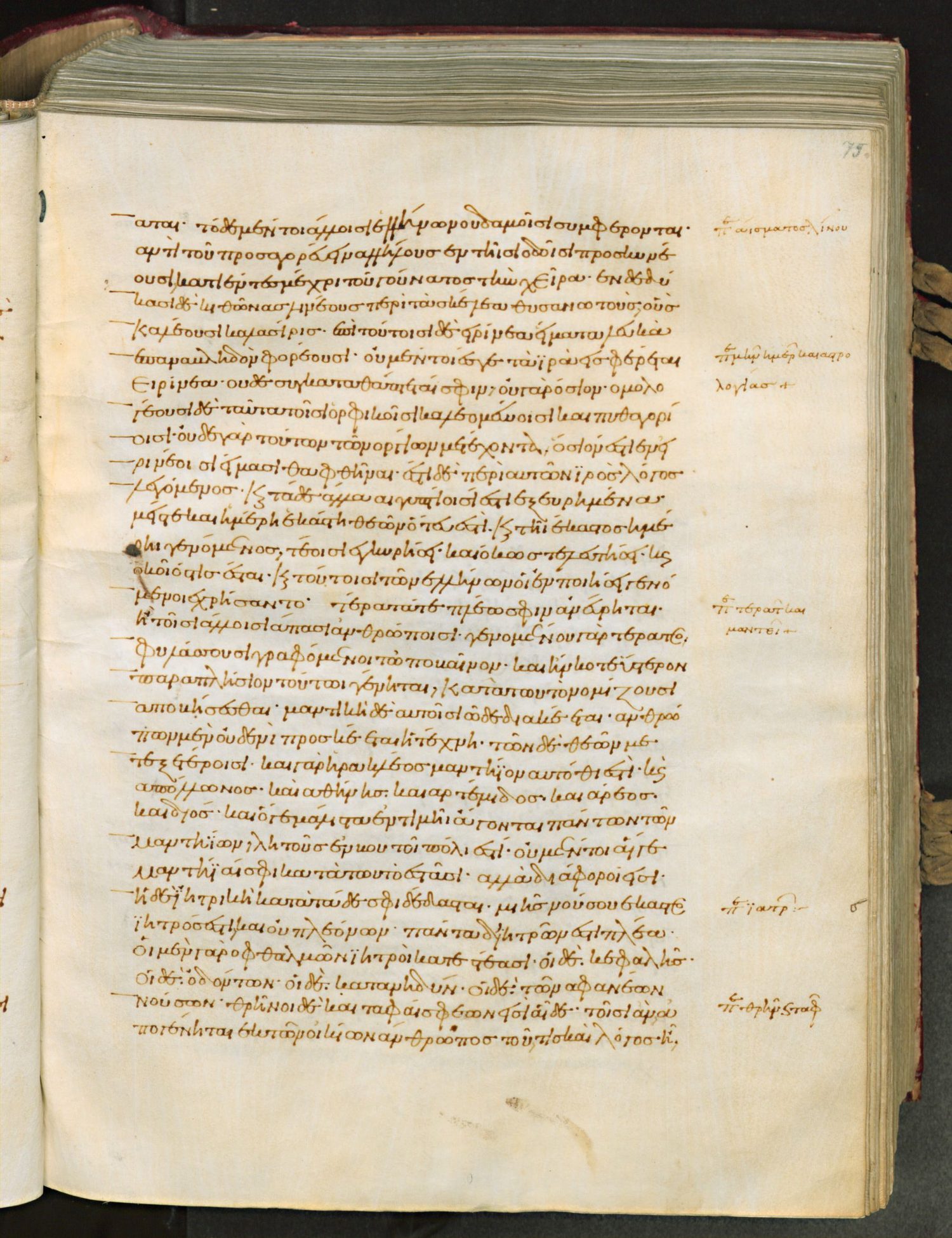
Laur. Plut. 70.3, fol. 75r: Greek here 2.80.2 to 2.85.1. Checked on the image (first and last words read and located in the Greek; each break checked against the neighbouring page): fol. 75r begins ‹-αται.τόδε μέντοι ἄλλοισι Ἑλλήνων› (2.80.1), ends ‹τις καὶ λόγος ᾖ› (2.85.1). The word ‹ὑπανιστέαται.› is divided between fol. 74v and fol. 75r; it is given with fol. 74v. English here: 2.80.2 to 2.84.1 (Godley's sentences for the sections whose Greek lies mostly on this page).
2.80.2τόδε μέντοι ἄλλοισι Ἑλλήνων οὐδαμοῖσι συμφέρονται· ἀντὶ τοῦ προσαγορεύειν ἀλλήλους ἐν τῇσι ὁδοῖσι προσκυνέουσι κατιέντες μέχρι τοῦ γούνατος τὴν χεῖρα. 2.81.1ἐνδεδύκασι δὲ κιθῶνας λινέους περὶ τὰ σκέλεα θυσανωτούς, τοὺς καλέουσι καλασίρις· ἐπὶ τούτοισι δὲ εἰρίνεα εἵματα λευκὰ ἐπαναβληδὸν φορέουσι. οὐ μέντοι ἔς γε τὰ ἱρὰ ἐσφέρεται εἰρίνεα οὐδὲ συγκαταθάπτεταί σφι· οὐ γὰρ ὅσιον. 2.81.2ὁμολογέουσι δὲ ταῦτα τοῖσι Ὀρφικοῖσι καλεομένοισι καὶ Βακχικοῖσι, ἐοῦσι δὲ Αἰγυπτίοισι καὶ Πυθαγορείοισι· οὐδὲ γὰρ τούτων τῶν ὀργίων μετέχοντα ὅσιον ἐστὶ ἐν εἰρινέοισι εἵμασι θαφθῆναι. ἔστι δὲ περὶ αὐτῶν ἱρὸς λόγος λεγόμενος. 2.82.1καὶ τάδε ἄλλα Αἰγυπτίοισι ἐστὶ ἐξευρημένα, μείς τε καὶ ἡμέρη ἑκάστη θεῶν ὅτευ ἐστί, καὶ τῇ ἕκαστος ἡμέρῃ γενόμενος ὁτέοισι ἐγκυρήσει καὶ ὅκως τελευτήσει καὶ ὁκοῖός τις ἔσται. καὶ τούτοισι τῶν Ἑλλήνων οἱ ἐν ποιήσι γενόμενοι ἐχρήσαντο. 2.82.2τέρατά τε πλέω σφι ἀνεύρηται ἢ τοῖσι ἄλλοισι ἅπασι ἀνθρώποισι· γενομένου γὰρ τέρατος φυλάσσουσι γραφόμενοι τὠποβαῖνον, καὶ ἤν κοτε ὕστερον παραπλήσιον τούτῳ γένηται, κατὰ τὠυτὸ νομίζουσι ἀποβήσεσθαι. 2.83.1μαντικὴ δὲ αὐτοῖσι ὧδε διακέεται· ἀνθρώπων μὲν οὐδενὶ προσκέεται ἡ τέχνη, τῶν δὲ θεῶν μετεξετέροισι· καὶ γὰρ Ἡρακλέος μαντήιον αὐτόθι ἐστὶ καὶ Ἀπόλλωνος καὶ Ἀθηναίης καὶ Ἀρτέμιδος καὶ Ἄρεος καὶ Διός, καὶ τό γε μάλιστα ἐν τιμῇ ἄγονται πάντων τῶν μαντηίων, Λητοῦς ἐν Βουτοῖ πόλι ἐστί. οὐ μέντοι αἵ γε μαντηίαι σφι κατὰ τὠυτὸ ἑστᾶσι, ἀλλὰ διάφοροι εἰσί. 2.84.1ἡ δὲ ἰητρικὴ κατὰ τάδε σφι δέδασται· μιῆς νούσου ἕκαστος ἰητρός ἐστι καὶ οὐ πλεόνων. πάντα δʼ ἰητρῶν ἐστι πλέα· οἳ μὲν γὰρ ὀφθαλμῶν ἰητροὶ κατεστᾶσι, οἳ δὲ κεφαλῆς, οἳ δὲ ὀδόντων, οἳ δὲ τῶν κατὰ νηδύν, οἳ δὲ τῶν ἀφανέων νούσων. 2.85.1θρῆνοι δὲ καὶ ταφαί σφεων εἰσὶ αἵδε· τοῖσι ἂν ἀπογένηται ἐκ τῶν οἰκίων ἄνθρωπος τοῦ τις καὶ λόγος ᾖ,
2.80.2But they have another custom which is nowhere known in Greece: passers-by do not address each other, but salute by lowering the hand to the knee. 2.81.1They wear linen tunics with fringes hanging about the legs, called “calasiris,” and loose white woollen mantles over these. But nothing of wool is brought into temples, or buried with them; that is forbidden. 2.81.2In this they follow the same rule as the ritual called Orphic and Bacchic, but which is in truth Egyptian and Pythagorean; for neither may those initiated into these rites be buried in woollen wrappings. There is a sacred legend about this. 2.82.1I pass to other inventions of the Egyptians. They assign each month and each day to some god; they can tell what fortune and what end and what disposition a man shall have according to the day of his birth. This has given material to Greeks who deal in poetry. 2.82.2They have made themselves more omens than all other nations together; when an ominous thing happens they take note of the outcome and write it down; and if something of a like kind happen again they think it will have a like result. 2.83.1As to the art of divination among them, it belongs to some of the gods, but to no one among men; there are in their country oracles of Heracles, Apollo, Athene, Artemis, Ares, and Zeus, and (which is the most honoured of all) of Leto in the town of Buto. Nevertheless they have diverse ways of divination, not one only. 2.84.1The practice of medicine is so divided among them, that each physician is a healer of one disease and no more. All the country is full of physicians, some of the eye, some of the teeth, some of what pertains to the belly, and some of the hidden diseases.
Where on the image
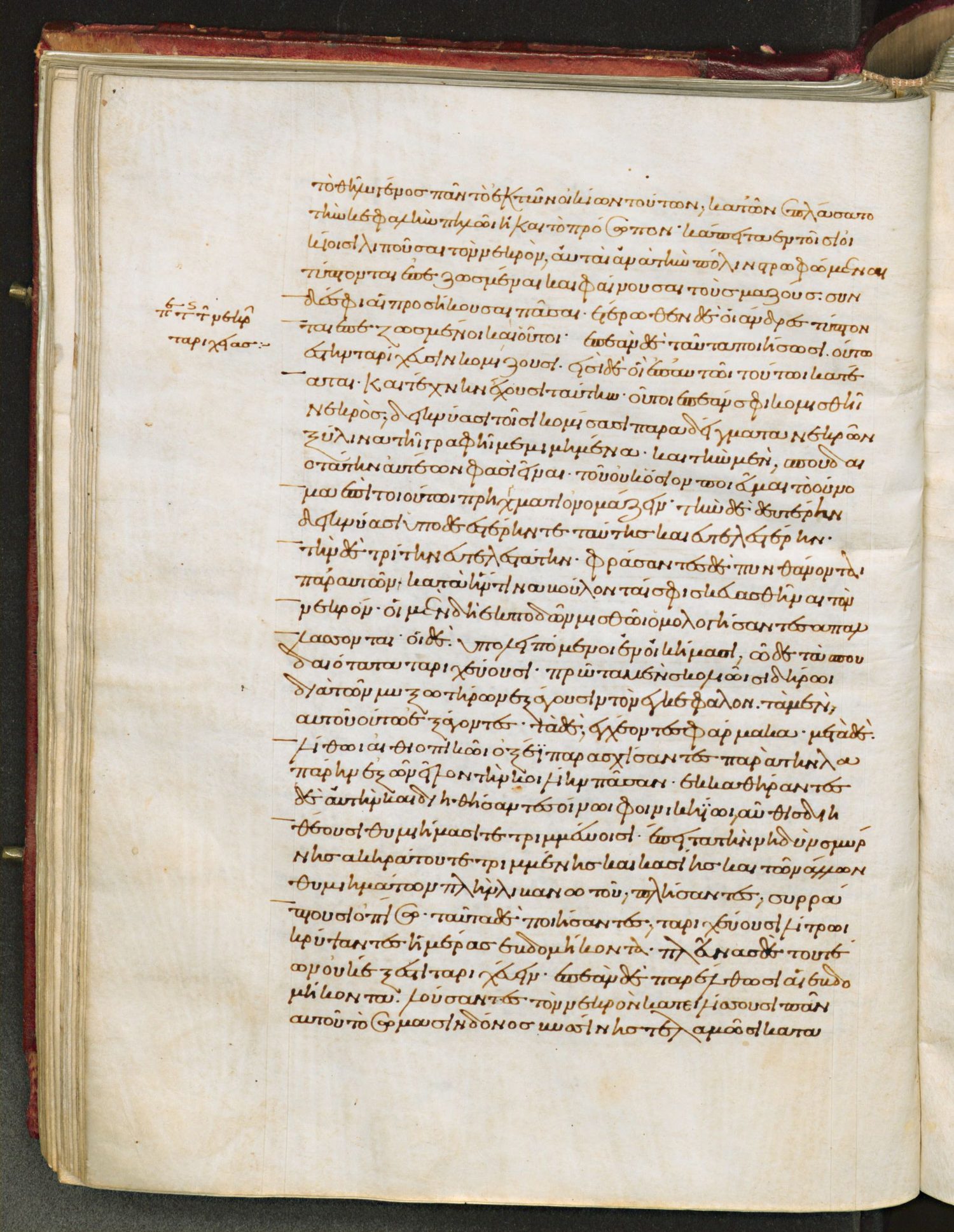
Laur. Plut. 70.3, fol. 75v: Greek here 2.85.1 to 2.86.6. Checked on the image (first and last words read and located in the Greek; each break checked against the neighbouring page): fol. 75v begins ‹τὸ θῆλυ γένος πᾶν› (2.85.1), ends ‹σινδόνος βυσσίνης τελαμῶσι κατα-› (2.86.6). English here: 2.85.1 to 2.86.6 (Godley's sentences for the sections whose Greek lies mostly on this page).
2.85.1τὸ θῆλυ γένος πᾶν τὸ ἐκ τῶν οἰκίων τούτων κατʼ ὦν ἐπλάσατο τὴν κεφαλὴν πηλῷ ἢ καὶ τὸ πρόσωπον, κἄπειτα ἐν τοῖσι οἰκίοισι λιποῦσαι τὸν νεκρὸν αὐταὶ ἀνὰ τὴν πόλιν στρωφώμεναι τύπτονται ἐπεζωσμέναι καὶ φαίνουσαι τοὺς μαζούς, σὺν δέ σφι αἱ προσήκουσαι πᾶσαι, 2.85.2ἑτέρωθεν δὲ οἱ ἄνδρες, τύπτονται ἐπεζωμένοι καὶ οὗτοι. ἐπεὰν δὲ ταῦτα ποιήσωσι, οὕτω ἐς τὴν ταρίχευσιν κομίζουσι. 2.86.1εἰσὶ δὲ οἳ ἐπʼ αὐτῷ τούτῳ κατέαται καὶ τέχνην ἔχουσι ταύτην. 2.86.2οὗτοι, ἐπεάν σφι κομισθῇ νεκρός, δεικνύουσι τοῖσι κομίσασι παραδείγματα νεκρῶν ξύλινα, τῇ γραφῇ μεμιμημένα […], καὶ τὴν μὲν σπουδαιοτάτην αὐτέων φασὶ εἶναι τοῦ οὐκ ὅσιον ποιεῦμαι τὸ οὔνομα ἐπὶ τοιούτῳ πρήγματι ὀνομάζειν, τὴν δὲ δευτέρην δεικνύουσι ὑποδεεστέρην τε ταύτης καὶ εὐτελεστέρην, τὴν δὲ τρίτην εὐτελεστάτην· φράσαντες δὲ πυνθάνονται παρʼ αὐτῶν κατὰ ἥντινα βούλονταί σφι σκευασθῆναι τὸν νεκρόν. 2.86.3οἳ μὲν δὴ ἐκποδὼν μισθῷ ὁμολογήσαντες ἀπαλλάσσονται, οἳ δὲ ὑπολειπόμενοι ἐν οἰκήμασι ὧδε τὰ σπουδαιότατα ταριχεύουσι. πρῶτα μὲν σκολιῷ σιδήρῳ διὰ τῶν μυξωτήρων ἐξάγουσι τὸν ἐγκέφαλον, τὰ μὲν αὐτοῦ οὕτω ἐξάγοντες, τὰ δὲ ἐγχέοντες φάρμακα· 2.86.4μετὰ δὲ λίθῳ Αἰθιοπικῷ ὀξέι παρασχίσαντες παρὰ τὴν λαπάρην ἐξ ὦν εἷλον τὴν κοιλίην πᾶσαν, ἐκκαθήραντες δὲ αὐτὴν καὶ διηθήσαντες οἴνῳ φοινικηίῳ αὖτις διηθέουσι θυμιήμασι τετριμμένοισι· 2.86.5ἔπειτα τὴν νηδὺν σμύρνης ἀκηράτου τετριμμένης καὶ κασίης καὶ τῶν ἄλλων θυμιημάτων, πλὴν λιβανωτοῦ, πλήσαντες συρράπτουσι ὀπίσω. ταῦτα δὲ ποιήσαντες ταριχεύουσι λίτρῳ κρύψαντες ἡμέρας ἑβδομήκοντα· πλεῦνας δὲ τουτέων οὐκ ἔξεστι ταριχεύειν. 2.86.6ἐπεὰν δὲ παρέλθωσι αἱ ἑβδομήκοντα, λούσαντες τὸν νεκρὸν κατειλίσσουσι πᾶν αὐτοῦ τὸ σῶμα σινδόνος βυσσίνης τελαμῶσι κατατετμημένοισι,
2.85.1They mourn and bury the dead as I will show. Whenever a man of note is lost to his house by death, all the womenkind of the house daub their faces or heads with mud; then, with all the women of their kin, they leave the corpse in the house, and roam about the city lamenting, with their garments girt round them and their breasts showing; 2.85.2and the men too lament in their place, with garments girt likewise. When this is done, they take the dead body to be embalmed. 2.86.1There are men whose whole business this is and who have this special craft. 2.86.2These, when a dead body is brought to them, show the bringers wooden models of corpses, painted in exact imitation; the most perfect manner of embalming belongs, they say, to One whose name it were profane for me to speak in treating of such matters; the second way, which they show, is less perfect than the first, and cheaper, and the third is the least costly of all. Having shown these, they ask the bringers of the body in which fashion they desire to have it prepared. 2.86.3The bearers, having agreed in a price, go their ways, and the workmen, left behind in their place, embalm the body. If they do this in the most perfect way, they first draw out part of the brain through the nostrils with an iron hook, and inject certain drugs into the rest. 2.86.4Then, making a cut near the flank with a sharp knife of Ethiopian stone, they take out all the intestines, and clean the belly, rinsing it with palm 2.86.5wine and bruised spices; and presently, filling the belly with pure ground myrrh and casia and any other spices, save only frankincense, they sew up the anus. Having done this, they conceal the body for seventy days, embalmed in saltpetre; no longer time is allowed for the embalming; 2.86.6and when the seventy days are past they wash the body and wrap the whole of it in bandages of fine linen cloth, anointed with gum, which the Egyptians mostly use instead of glue; which done, they give back the dead man to his friends.
Where on the image
Laur. Plut. 70.3, fol. 76r, 76v: Greek here 2.86.6 to 2.90.2. Checked on the image (first and last words read and located in the Greek; each break checked against the neighbouring page): fol. 76r begins ‹-τετμημένοισι, ὑποχρίοντες τῷ κόμμι,› (2.86.6), ends ‹ἐξενειχθῇ, τούτους πᾶσα ἀνάγκη› (2.90.1). The word ‹κατατετμημένοισι,› is divided between fol. 75v and fol. 76r; it is given with fol. 75v. fol. 76v begins ‹ἐστὶ ταριχεύσαντας αὐτὸν καὶ› (2.90.1), ends ‹γυμνικὸν αὐτοῦ κελεύσαντος ἐπιτελέειν› (2.91.6). This section joins the text of fol. 76r and 76v that belongs to these chapters, because the part on one of the pages is too short to carry any of Godley's sentences on its own. English here: 2.86.7 to 2.90.2 (Godley's sentences for the sections whose Greek lies mostly on this page).
2.86.6ὑποχρίοντες τῷ κόμμι, τῷ δὴ ἀντὶ κόλλης τὰ πολλὰ χρέωνται Αἰγύπτιοι. 2.86.7ἐνθεῦτεν δὲ παραδεξάμενοί μιν οἱ προσήκοντες ποιεῦνται ξύλινον τύπον ἀνθρωποειδέα, ποιησάμενοι δὲ ἐσεργνῦσι τὸν νεκρόν, καὶ κατακληίσαντες οὕτω θησαυρίζουσι ἐν οἰκήματι θηκαίῳ, ἱστάντες ὀρθὸν πρὸς τοῖχον. 2.87.1οὕτω μὲν τοὺς τὰ πολυτελέστατα σκευάζουσι νεκρούς, τοὺς δὲ τὰ μέσα βουλομένους τὴν δὲ πολυτελείην φεύγοντας σκευάζουσι ὧδε· 2.87.2ἐπεὰν τοὺς κλυστῆρας πλήσωνται τοῦ ἀπὸ κέδρου ἀλείφατος γινομένου, ἐν ὦν ἔπλησαν τοῦ νεκροῦ τὴν κοιλίην, οὔτε ἀναταμόντες αὐτὸν οὔτε ἐξελόντες τὴν νηδύν, κατὰ δὲ τὴν ἕδρην ἐσηθήσαντες καὶ ἐπιλαβόντες τὸ κλύσμα τῆς ὀπίσω ὁδοῦ ταριχεύουσι τὰς προκειμένας ἡμέρας, τῇ δὲ τελευταίῃ ἐξιεῖσι ἐκ τῆς κοιλίης τὴν κεδρίην τὴν ἐσῆκαν πρότερον. 2.87.3ἣ δὲ ἔχει τοσαύτην δύναμιν ὥστε ἅμα ἑωυτῇ τὴν νηδὺν καὶ τὰ σπλάγχνα κατατετηκότα ἐξάγει· τὰς δὲ σάρκας τὸ λίτρον κατατήκει, καὶ δὴ λείπεται τοῦ νεκροῦ τὸ δέρμα μοῦνον καὶ τὰ ὀστέα. ἐπεὰν δὲ ταῦτα ποιήσωσι, ἀπʼ ὦν ἔδωκαν οὕτω τὸν νεκρόν, οὐδὲν ἔτι πρηγματευθέντες. 2.88.1ἡ δὲ τρίτη ταρίχευσις ἐστὶ ἥδε, ἣ τοὺς χρήμασι ἀσθενεστέρους σκευάζει· συρμαίῃ διηθήσαντες τὴν κοιλίην ταριχεύουσι τὰς ἑβδομήκοντα ἡμέρας καὶ ἔπειτα ἀπʼ ὦν ἔδωκαν ἀποφέρεσθαι. 2.89.1τὰς δὲ γυναῖκας τῶν ἐπιφανέων ἀνδρῶν, ἐπεὰν τελευτήσωσι, οὐ παραυτίκα διδοῦσι ταριχεύειν, οὐδὲ ὅσαι ἂν ἔωσι εὐειδέες κάρτα καὶ λόγου πλεῦνος γυναῖκες· ἀλλʼ ἐπεὰν τριταῖαι ἢ τεταρταῖαι γένωνται, οὕτω παραδιδοῦσι τοῖσι ταριχεύουσι. 2.89.2τοῦτο δὲ ποιεῦσι οὕτω τοῦδε εἵνεκεν, ἵνα μή σφι οἱ ταριχευταὶ μίσγωνται τῇσι γυναιξί· λαμφθῆναι γὰρ τινὰ φασὶ μισγόμενον νεκρῷ προσφάτῳ γυναικός, κατειπεῖν δὲ τὸν ὁμότεχνον. 2.90.1ὃς δʼ ἂν ἢ αὐτῶν Αἰγυπτίων ἢ ξείνων ὁμοίως ὑπὸ κροκοδείλου ἁρπασθεὶς ἢ ὑπʼ αὐτοῦ τοῦ ποταμοῦ φαίνηται τεθνεώς, κατʼ ἣν ἂν πόλιν ἐξενειχθῇ, τούτους πᾶσα ἀνάγκη ἐστὶ ταριχεύσαντας αὐτὸν καὶ περιστείλαντας ὡς κάλλιστα θάψαι ἐν ἱρῇσι θήκῃσι· 2.90.2οὐδὲ ψαῦσαι ἔξεστι αὐτοῦ ἄλλον οὐδένα οὔτε τῶν προσηκόντων οὔτε τῶν φίλων, ἀλλά μιν οἱ ἱρέες αὐτοὶ τοῦ Νείλου ἅτε πλέον τι ἢ ἀνθρώπου νεκρὸν χειραπτάζοντες θάπτουσι.
2.86.7These make a hollow wooden figure like a man, in which they enclose the corpse, shut it up, and preserve it safe in a coffin-chamber, placed erect against a wall. 2.87.1This is how they prepare the dead who have wished for the most costly fashion; those whose wish was for the middle and less costly way are prepared in another fashion. 2.87.2The embalmers charge their syringes with cedar oil and therewith fill the belly of the dead man, making no cut, nor removing the intestines, but injecting the drench through the anus and checking it from returning; then they embalm the body for the appointed days; on the last day they let the oil which they poured in pass out again. 2.87.3It has so great power that it brings away the inner parts and intestines all dissolved; the flesh is eaten away by the saltpetre, and in the end nothing is left of the body but skin and bone. Then the embalmers give back the dead body with no more ado. 2.88.1When they use the third manner of embalming, which is the preparation of the poorer dead, they cleanse the belly with a purge, embalm the body for the seventy days and then give it back to be taken away. 2.89.1Wives of notable men, and women of great beauty and reputation, are not at once given over to the embalmers, but only after they have been dead for three or four days; 2.89.2this is done, that the embalmers may not have carnal intercourse with them. For it is said that one was found having intercourse with a woman newly dead, and was denounced by his fellow-workman. 2.90.1When anyone, be he Egyptian or stranger, is known to have been carried off by a crocodile or drowned by the river itself, such an one must by all means be embalmed and tended as fairly as may be and buried in a sacred coffin by the townsmen of the place where he is cast up; nor may 2.90.2any of his kinsfolk or his friends touch him, but his body is deemed something more than human, and is handled and buried by the priests of the Nile themselves.
Notes
- Greek: the text printed in A. D. Godley's Loeb edition, via Perseus (tlg0016.tlg001.perseus-grc2). Square brackets mark words the editor considers later additions; [...] marks a gap the editor indicates. Perseus note markers are omitted.
- English: A. D. Godley, Herodotus vol. 1 (1920) (Loeb Classical Library), as transcribed on Wikisource. Godley's footnotes are omitted.
- Section numbers in the English were placed by comparing Godley's text with the Perseus version of his translation; where a section begins inside one of Godley's sentences, the English is kept with the page that holds the start of that sentence.
Cite
Sources
- Source: Florence, Laur. Plut. 70.3 (10th c.) via BML Teca Digitale + Greek of Godley's Loeb (Perseus) + English of A. D. Godley (Loeb, Wikisource) (holding institution)
- Critical edition: Greek of A. D. Godley's Loeb edition (1920-1925), via Perseus
← previous · → next · v cycle view · l back to library