Herodotus, Histories 2.91-98: Chemmis, the marsh-dwellers and the Nile boats
Introduction
Herodotus of Halicarnassus wrote the Histories in the third quarter of the 5th century BCE, an inquiry into the deeds of Greeks and barbarians and the causes of the wars between them, later divided into nine books. Book 2 is Herodotus' account of Egypt, written as background to Cambyses' invasion: the land and the Nile, the customs and religion of the Egyptians, and the history of their kings as the priests told it, down to Amasis.
The photographs are of Florence, Biblioteca Medicea Laurenziana, Plut. 70.3 (parchment, 10th century, 374 folios, 31 lines a page), Herodotus, Histories (codex A of the editors), the oldest surviving manuscript of the complete Histories, from the Teca Digitale of the Biblioteca Medicea Laurenziana. Each section below is the text of one page, or of the part of a page that falls within these chapters. The first and last words of every page were read on the photograph and located in the Greek, and every page break was checked against the next page; the notes quote these words. Readers' notes in the margins are not part of the text and are mentioned where they occur.
The Greek is the text printed in A. D. Godley's Loeb edition (1920-1925), from Perseus; it is the edited text, not a transcription of the manuscript, whose wording differs in places. The English is Godley's translation as printed, from Wikisource. Godley's English carries only chapter numbers; the section numbers shown in it were placed by comparison with the Perseus version of his translation. Each page's English is cut at the end of one of Godley's sentences, so it can begin or end a few lines away from the Greek of the page; each note gives the exact ranges.
This entry covers chapters 2.91-98, on fol. 76v to 78v.
How was this verified? (Provenance)
Where on the image
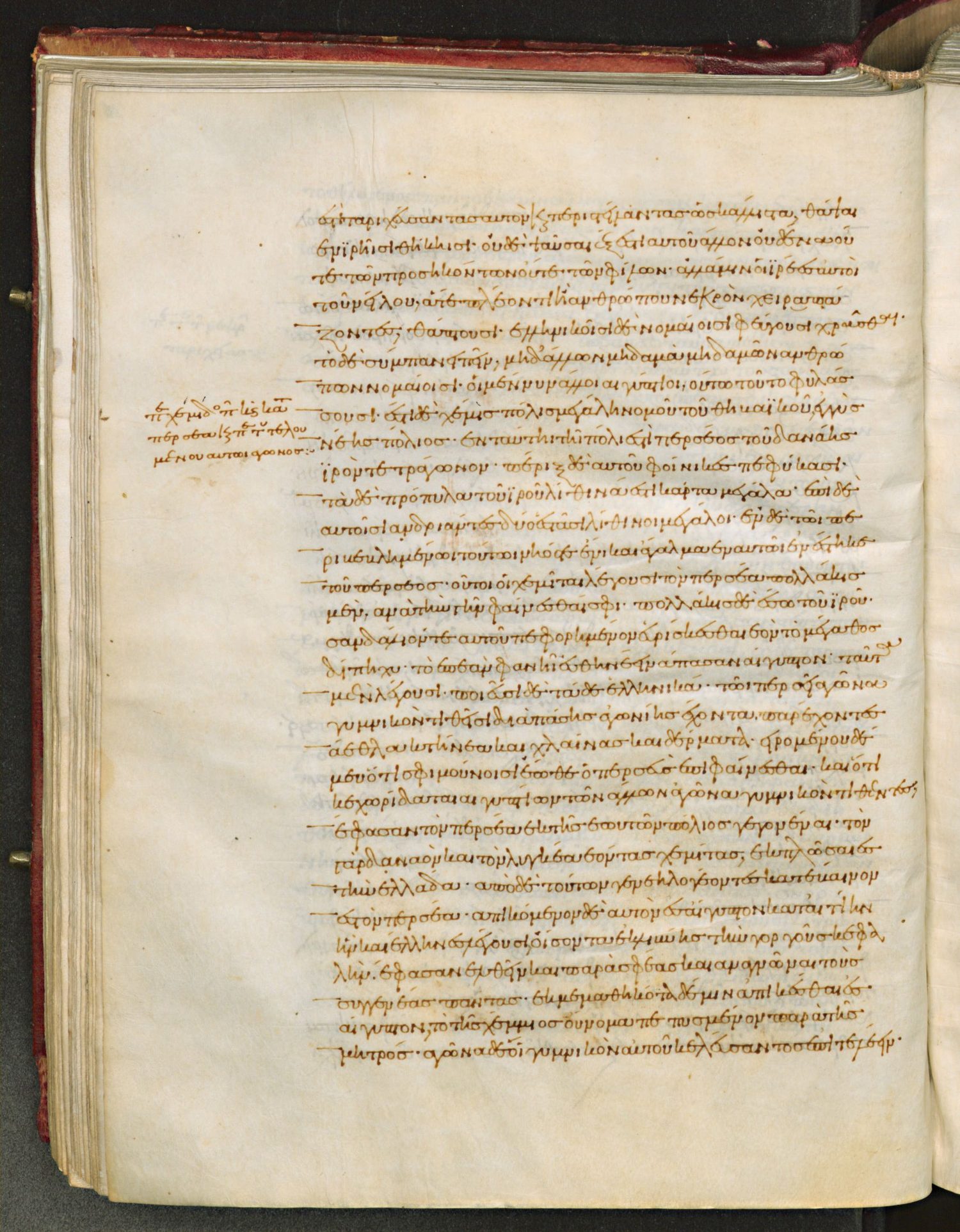
Laur. Plut. 70.3, fol. 76v: Greek here 2.91.1 to 2.91.6. Checked on the image (first and last words read and located in the Greek; each break checked against the neighbouring page): fol. 76v begins ‹ἐστὶ ταριχεύσαντας αὐτὸν καὶ› (2.90.1), ends ‹γυμνικὸν αὐτοῦ κελεύσαντος ἐπιτελέειν› (2.91.6). English here: 2.91.1 to 2.91.6 (Godley's sentences for the sections whose Greek lies mostly on this page).
2.91.1ἑλληνικοῖσι δὲ νομαίοισι φεύγουσι χρᾶσθαι, τὸ δὲ σύμπαν εἰπεῖν, μηδʼ ἄλλων μηδαμὰ μηδαμῶν ἀνθρώπων νομαίοισι. οἱ μέν νυν ἄλλοι Αἰγύπτιοι οὕτω τοῦτο φυλάσσουσι, ἔστι δὲ Χέμμις πόλις μεγάλη νομοῦ τοῦ Θηβαϊκοῦ ἐγγὺς Νέης πόλιος· 2.91.2ἐν ταύτῃ τῇ πόλι ἐστὶ Περσέος τοῦ Δανάης ἱρὸν τετράγωνον, πέριξ δὲ αὐτοῦ φοίνικες πεφύκασι. τὰ δὲ πρόπυλα τοῦ ἱροῦ λίθινα ἐστὶ κάρτα μεγάλα· ἐπὶ δὲ αὐτοῖσι ἀνδριάντες δύο ἑστᾶσι λίθινοι μεγάλοι. ἐν δὲ τῷ περιβεβλημένῳ τούτῳ νηός τε ἔνι καὶ ἄγαλμα ἐν αὐτῷ ἐνέστηκε τοῦ Περσέος. 2.91.3οὗτοι οἱ Χεμμῖται λέγουσι τὸν Περσέα πολλάκις μὲν ἀνὰ τὴν γῆν φαίνεσθαί σφι πολλάκις δὲ ἔσω τοῦ ἱροῦ, σανδάλιόν τε αὐτοῦ πεφορημένον εὑρίσκεσθαι ἐὸν τὸ μέγαθος δίπηχυ, τὸ ἐπεὰν φανῇ, εὐθηνέειν ἅπασαν Αἴγυπτον. 2.91.4ταῦτα μὲν λέγουσι, ποιεῦσι δὲ τάδε Ἑλληνικὰ τῷ Περσέι· ἀγῶνα γυμνικὸν τιθεῖσι διὰ πάσης ἀγωνίης ἔχοντα, παρέχοντες ἄεθλα κτήνεα καὶ χλαίνας καὶ δέρματα. 2.91.5εἰρομένου δέ μευ ὅ τι σφι μούνοισι ἔωθε ὁ Περσεὺς ἐπιφαίνεσθαι καὶ ὅ τι κεχωρίδαται Αἰγυπτίων τῶν ἄλλων ἀγῶνα γυμνικὸν τιθέντες, ἔφασαν τὸν Περσέα ἐκ τῆς ἑωυτῶν πόλιος γεγονέναι· τὸν γὰρ Δαναὸν καὶ τὸν Λυγκέα ἐόντας Χεμμίτας ἐκπλῶσαι ἐς τὴν Ἑλλάδα, ἀπὸ δὲ τούτων γενεηλογέοντες κατέβαινον ἐς τὸν Περσέα. 2.91.6ἀπικόμενον δὲ αὐτὸν ἐς Αἴγυπτον κατʼ αἰτίην τὴν καὶ Ἕλληνες λέγουσι, οἴσοντα ἐκ Λιβύης τὴν Γοργοῦς κεφαλήν, ἔφασαν ἐλθεῖν καὶ παρὰ σφέας καὶ ἀναγνῶναι τοὺς συγγενέας πάντας· ἐκμεμαθηκότα δέ μιν ἀπικέσθαι ἐς Αἴγυπτον τὸ τῆς Χέμμιος οὔνομα, πεπυσμένον παρὰ τῆς μητρός. ἀγῶνα δέ οἱ γυμνικὸν αὐτοῦ κελεύσαντος ἐπιτελέειν.
2.91.1The Egyptians shun the use of Greek customs, and (to speak generally) the customs of any other men whatever. Yet, though the rest are careful of this, there is a great city called Chemmis, in the Theban province, near the New City; 2.91.2in this city is a square temple of Perseus son of Danae, in a grove of palm trees. The colonnade before this temple is of stone, very great; and there stand at the entrance two great stone statues. In this outer court there is a shrine with an image of Perseus standing in it. 2.91.3The people of this Chemmis say that Perseus is often seen up and down this land, and often within the temple, and that the sandal he wears is found, and it is two cubits long; when that is seen, all Egypt prospers. 2.91.4This is what they say; and their doings in honour of Perseus are Greek, in that they celebrate games comprising every form of contest, and offer animals and cloaks and skins as prizes. 2.91.5When I asked why Perseus appeared to. them alone, and why, unlike all other Egyptians, they celebrate games, they told me that Perseus was by lineage of their city; for Danaus and Lynceus, who voyaged to Greece, were of Chemmis; and they traced descent from these down to Perseus. 2.91.6They told too how when he came to Egypt for the reason alleged also by the Greeks—namely, to bring the Gorgon’s head from Libya—he came to Chemmis too and recognised all his kin; and how before he came to Egypt he had heard the name of Chemmis from his mother. It was at his bidding, said they, that they celebrated the games.
Where on the image
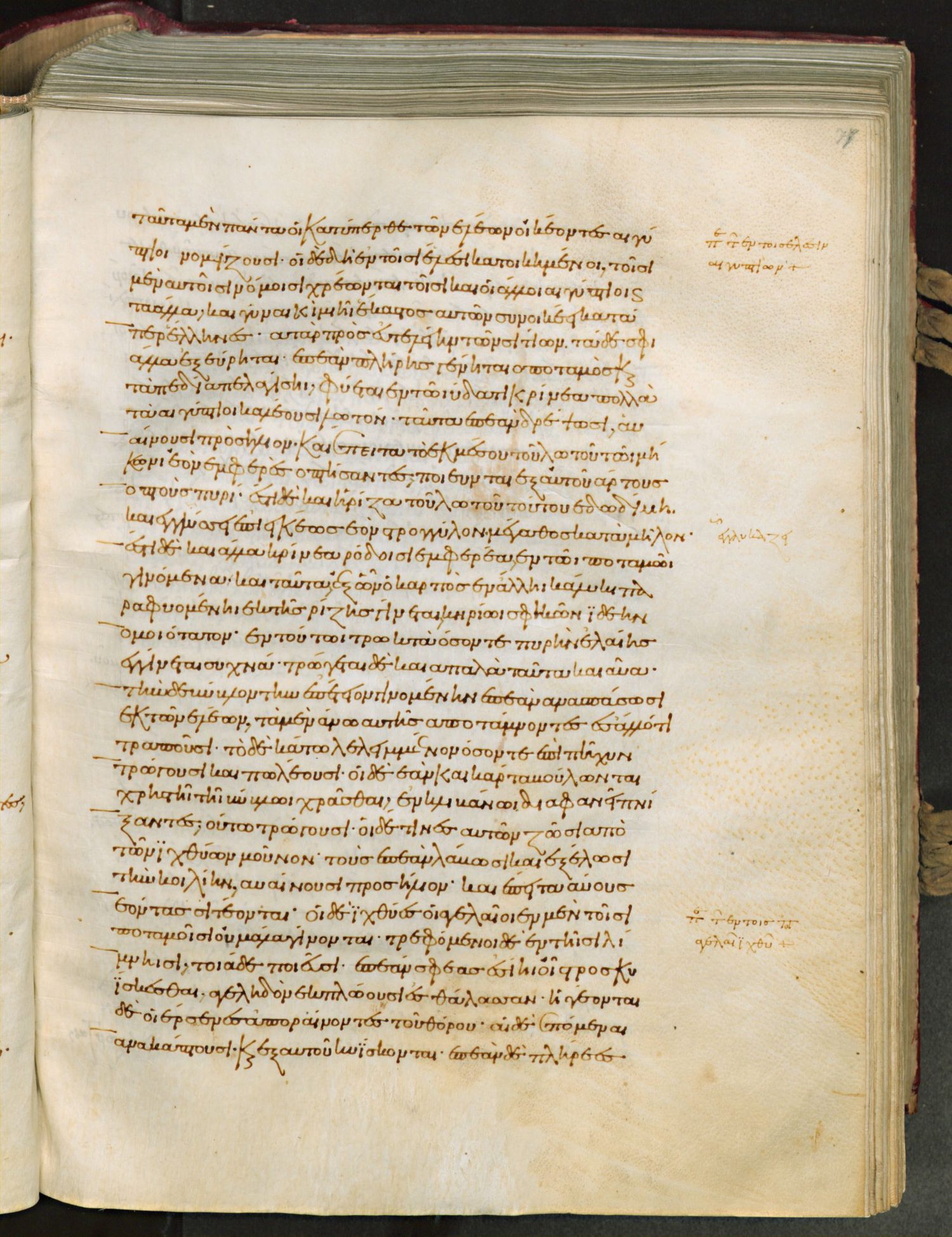
Laur. Plut. 70.3, fol. 77r: Greek here 2.92.1 to 2.93.2. Checked on the image (first and last words read and located in the Greek; each break checked against the neighbouring page): fol. 77r begins ‹ταῦτα μὲν πάντα οἱ› (2.92.1), ends ‹αὐτοῦ κυΐσκονται.ἐπεὰν δὲ πλήρεες› (2.93.2). English here: 2.92.1 to 2.93.1 (Godley's sentences for the sections whose Greek lies mostly on this page).
2.92.1ταῦτα μὲν πάντα οἱ κατύπερθε τῶν ἑλέων οἰκέοντες Αἰγύπτιοι νομίζουσι· οἱ δὲ δὴ ἐν τοῖσι ἕλεσι κατοικημένοι τοῖσι μὲν αὐτοῖσι νόμοισι χρέωνται τοῖσι καὶ οἱ ἄλλοι Αἰγύπτιοι, καὶ τὰ ἄλλα καὶ γυναικὶ μιῇ ἕκαστος αὐτῶν συνοικέει κατά περ Ἕλληνες, ἀτὰρ πρὸς εὐτελείην τῶν σιτίων τάδε σφι ἄλλα ἐξεύρηται. 2.92.2ἐπεὰν πλήρης γένηται ὁ ποταμὸς καὶ τὰ πεδία πελαγίσῃ, φύεται ἐν τῷ ὕδατι κρίνεα πολλά, τὰ Αἰγύπτιοι καλέουσι λωτόν· ταῦτʼ ἐπεὰν δρέψωσι αὐαίνουσι πρὸς ἥλιον καὶ ἔπειτα τὸ ἐκ μέσου τοῦ λωτοῦ, τῇ μήκωνι ἐὸν ἐμφερές, πτίσαντες ποιεῦνται ἐξ αὐτοῦ ἄρτους ὀπτοὺς πυρί. 2.92.3ἔστι δὲ καὶ ἡ ῥίζα τοῦ λωτοῦ τούτου ἐδωδίμη καὶ ἐγγλύσσει ἐπιεικέως, ἐὸν στρογγύλον, μέγαθος κατὰ μῆλον. 2.92.4ἔστι δὲ καὶ ἄλλα κρίνεα ῥόδοισι ἐμφερέα, ἐν τῷ ποταμῷ γινόμενα καὶ ταῦτα, ἐξ ὧν ὁ καρπὸς ἐν ἄλλῃ κάλυκι παραφυομένῃ ἐκ τῆς ῥίζης γίνεται, κηρίῳ σφηκῶν ἰδέην ὁμοιότατον· ἐν τούτῳ τρωκτὰ ὅσον τε πυρὴν ἐλαίης ἐγγίνεται συχνά, τρώγεται δὲ καὶ ἁπαλὰ ταῦτα καὶ αὖα. 2.92.5τὴν δὲ βύβλον τὴν ἐπέτειον γινομένην ἐπεὰν ἀνασπάσωσι ἐκ τῶν ἑλέων, τὰ μὲν ἄνω αὐτῆς ἀποτάμνοντες ἐς ἄλλο τι τρέπουσι, τὸ δὲ κάτω λελειμμένον ὅσον τε ἐπὶ πῆχυν τρώγουσι καὶ πωλέουσι· οἳ δὲ ἂν καὶ κάρτα βούλωνται χρηστῇ τῇ βύβλῳ χρᾶσθαι, ἐν κλιβάνῳ διαφανέι πνίξαντες οὕτω τρώγουσι. οἳ δὲ τινὲς αὐτῶν ζῶσι ἀπὸ τῶν ἰχθύων μοῦνον, τοὺς ἐπεὰν λάβωσι καὶ ἐξέλωσι τὴν κοιλίην, αὐαίνουσι πρὸς ἥλιον καὶ ἔπειτα αὔους ἐόντας σιτέονται. 2.93.1οἱ δὲ ἰχθύες οἱ ἀγελαῖοι ἐν μὲν τοῖσι ποταμοῖσι οὐ μάλα γίνονται, τρεφόμενοι δὲ ἐν τῇσι λίμνῃσι τοιάδε ποιεῦσι. ἐπεάν σφεας ἐσίῃ οἶστρος κυΐσκεσθαι, ἀγεληδὸν ἐκπλέουσι ἐς θάλασσαν· ἡγέονται δὲ οἱ ἔρσενες ἀπορραίνοντες τοῦ θοροῦ, αἳ δὲ ἑπόμεναι ἀνακάπτουσι καὶ ἐξ αὐτοῦ κυΐσκονται. 2.93.2ἐπεὰν δὲ πλήρεες
2.92.1All these are the customs of Egyptians who dwell above the marsh country. Those who inhabit the marshes have the same customs as the rest, both in other respects, and in that each man has one wife, as in Greece. They have, besides, devised means to make their food less costly. 2.92.2When the river is in flood and overflows the plains, many lilies, which the Egyptians call lotus, grow in the water. They pluck these and dry them in the sun, then they crush the poppy-like centre of the plant and bake loaves of it. 2.92.3The root also of this lotus is eatable, and of a sweetish taste; it is round, and of the bigness of an apple. 2.92.4Other lilies also grow in the river, which are like roses; the fruit of these is found in a calyx springing from the root by a separate stalk, and is most like to a comb made by wasps; this produces many eatable seeds as big as an olive-stone, which are eaten both fresh and dried. 2.92.5They use also the byblus which grows annually: it is plucked from the marshes, the top of it cut off and turned to other ends, and the lower part, about a cubit’s length, eaten or sold. Those who wish to use the byblus at its very best bake it before eating in a redhot oven. Some live on fish alone. They catch the fish, take out the intestines, then dry them in the sun and eat them dried. 2.93.1Fish that go in shoals do not often come to birth in the river; they are reared in the lakes, and this is the way with them: when the desire of spawning comes on them, they swim out to sea in shoals, the males leading, and throwing out their seed, while the females come after and swallow it and so conceive.
Where on the image
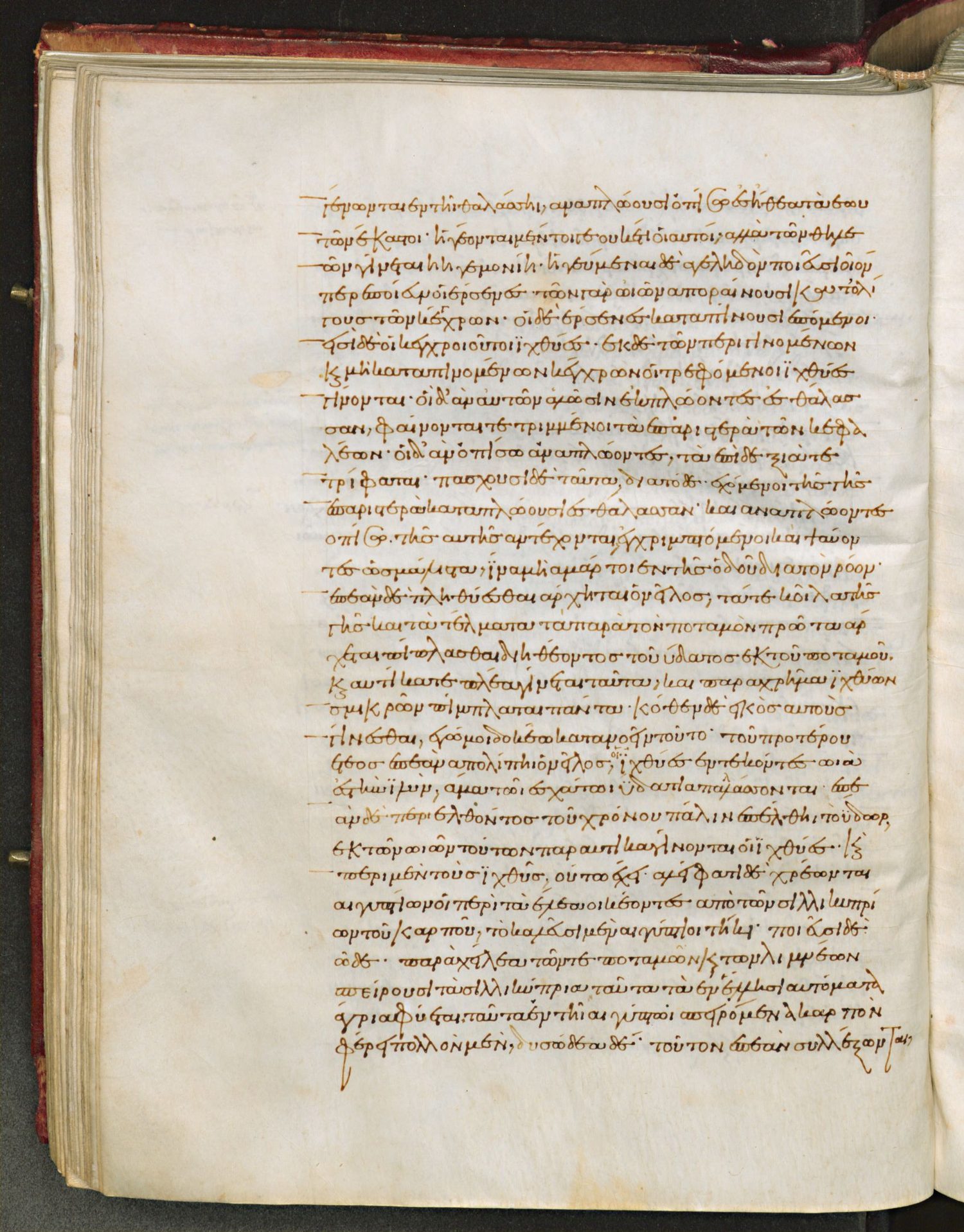
Laur. Plut. 70.3, fol. 77v: Greek here 2.93.2 to 2.94.2. Checked on the image (first and last words read and located in the Greek; each break checked against the neighbouring page): fol. 77v begins ‹γένωνται ἐν τῇ θαλάσσῃ,› (2.93.2), ends ‹δέ· τοῦτον ἐπεὰν συλλέξωνται› (2.94.2). English here: 2.93.2 to 2.94.2 (Godley's sentences for the sections whose Greek lies mostly on this page).
2.93.2γένωνται ἐν τῇ θαλάσσῃ, ἀναπλώουσι ὀπίσω ἐς ἤθεα τὰ ἑωυτῶν ἕκαστοι, ἡγέονται μέντοι γε οὐκέτι οἱ αὐτοί, ἀλλὰ τῶν θηλέων γίνεται ἡ ἡγεμονία· ἡγεύμεναι δὲ ἀγεληδὸν ποιεῦσι οἷόν περ ἐποίευν οἱ ἔρσενες· τῶν γὰρ ᾠῶν ἀπορραίνουσι κατʼ ὀλίγους τῶν κέγχρων, οἱ δὲ ἔρσενες καταπίνουσι ἑπόμενοι. εἰσὶ δὲ οἱ κέγχροι οὗτοι ἰχθύες. 2.93.3ἐκ δὲ τῶν περιγινομένων καὶ μὴ καταπινομένων κέγχρων οἱ τρεφόμενοι ἰχθύες γίνονται. οἵ δʼ ἂν αὐτῶν ἁλῶσι ἐκπλώοντες ἐς θάλασσαν, φαίνονται τετριμμένοι τὰ ἐπʼ ἀριστερὰ τῶν κεφαλέων, οἳ δʼ ἂν ὀπίσω ἀναπλώοντες, τὰ ἐπὶ δεξιὰ τετρίφαται. 2.93.4πάσχουσι δὲ ταῦτα διὰ τόδε· ἐχόμενοι τῆς γῆς ἐπʼ ἀριστερὰ καταπλώουσι ἐς θάλασσαν, καὶ ἀναπλώοντες ὀπίσω τῆς αὐτῆς ἀντέχονται, ἐγχριμπτόμενοι καὶ ψαύοντες ὡς μάλιστα, ἵνα δὴ μὴ ἁμάρτοιεν τῆς ὁδοῦ διὰ τὸν ῥόον. 2.93.5ἐπεὰν δὲ πληθύνεσθαι ἄρχηται ὁ Νεῖλος, τά τε κοῖλα τῆς γῆς καὶ τὰ τέλματα τὰ παρὰ τὸν ποταμὸν πρῶτα ἄρχεται πίμπλασθαι διηθέοντος τοῦ ὕδατος ἐκ τοῦ ποταμοῦ· καὶ αὐτίκα τε πλέα γίνεται ταῦτα καὶ παραχρῆμα ἰχθύων σμικρῶν πίμπλαται πάντα. 2.93.6κόθεν δὲ οἰκὸς αὐτοὺς γίνεσθαι, ἐγώ μοι δοκέω κατανοέειν τοῦτο· τοῦ προτέρου ἔτεος ἐπεὰν ἀπολίπῃ ὁ Νεῖλος, οἱ ἰχθύες ἐντεκόντες ᾠὰ ἐς τὴν ἰλὺν ἅμα τῷ ἐσχάτῳ ὕδατι ἀπαλλάσσονται· ἐπεὰν δὲ περιελθόντος τοῦ χρόνου πάλιν ἐπέλθῃ τὸ ὕδωρ, ἐκ τῶν ᾠῶν τούτων παραυτίκα γίνονται οἱ ἰχθύες οὗτοι. 2.94.1καὶ περὶ μὲν τοὺς ἰχθύας οὕτω ἔχει. ἀλείφατι δὲ χρέωνται Αἰγυπτίων οἱ περὶ τὰ ἕλεα οἰκέοντες ἀπὸ τῶν σιλλικυπρίων τοῦ καρποῦ, τὸ καλεῦσι μὲν Αἰγύπτιοι κίκι, ποιεῦσι δὲ ὧδε. παρὰ τὰ χείλεα τῶν τε ποταμῶν καὶ τῶν λιμνέων σπείρουσι τὰ σιλλικύπρια 2.94.2ταῦτα, τὰ ἐν Ἕλλησι αὐτόματα ἄγρια φύεται· ταῦτα ἐν τῇ Αἰγύπτῳ σπειρόμενα καρπὸν φέρει πολλὸν μὲν δυσώδεα δέ· τοῦτον ἐπεὰν συλλέξωνται,
2.93.2When the females have become pregnant in the sea, then all the fish swim back to their homes; but now it is the females and not the males who lead the way, going before in a shoal, and (like the males) throwing off ever and anon a few of their eggs (which are like millet-seeds), which the males devour as they follow. These millet-seeds, or eggs, are fish. 2.93.3It is from the surviving eggs, which are not devoured, that the fish which grow come to the birth. Those fish that are caught while swimming seawards show bruises on the left side of their heads; those that are caught returning, on the right side. 2.93.4This happens to them because as they swim seawards they keep close to the left bank, and hold to the same bank also in their return, grazing it and touching it as much as they may, I suppose lest the current should make them miss their course. 2.93.5When the Nile begins to rise, hollow and marshy places near the river are the first to begin to fill, the water trickling through from the river, and as soon as they are flooded they are suddenly full of little fishes. 2.93.6Whence it is like that these come into being I believe that I can guess. When the Nile falls, the fish have spawned into the mud before they leave it with the last of the water; and as the time comes round, and in the next year the flood comes again, this spawn at once gives birth to these fishes. 2.94.1So much then for the fishes. The Egyptians who live about the marshes use an oil drawn from the castor-berry, which they call kiki. They sow this plant on the banks of the rivers and lakes; it grows wild in 2.94.2Hellas; in Egypt it produces abundant but ill-smelling fruit, which is gathered, and either bruised and pressed, or boiled after roasting, and the liquid that comes from it collected. This is thick and as useful as oil for lamps, and gives off a strong smell.
Where on the image
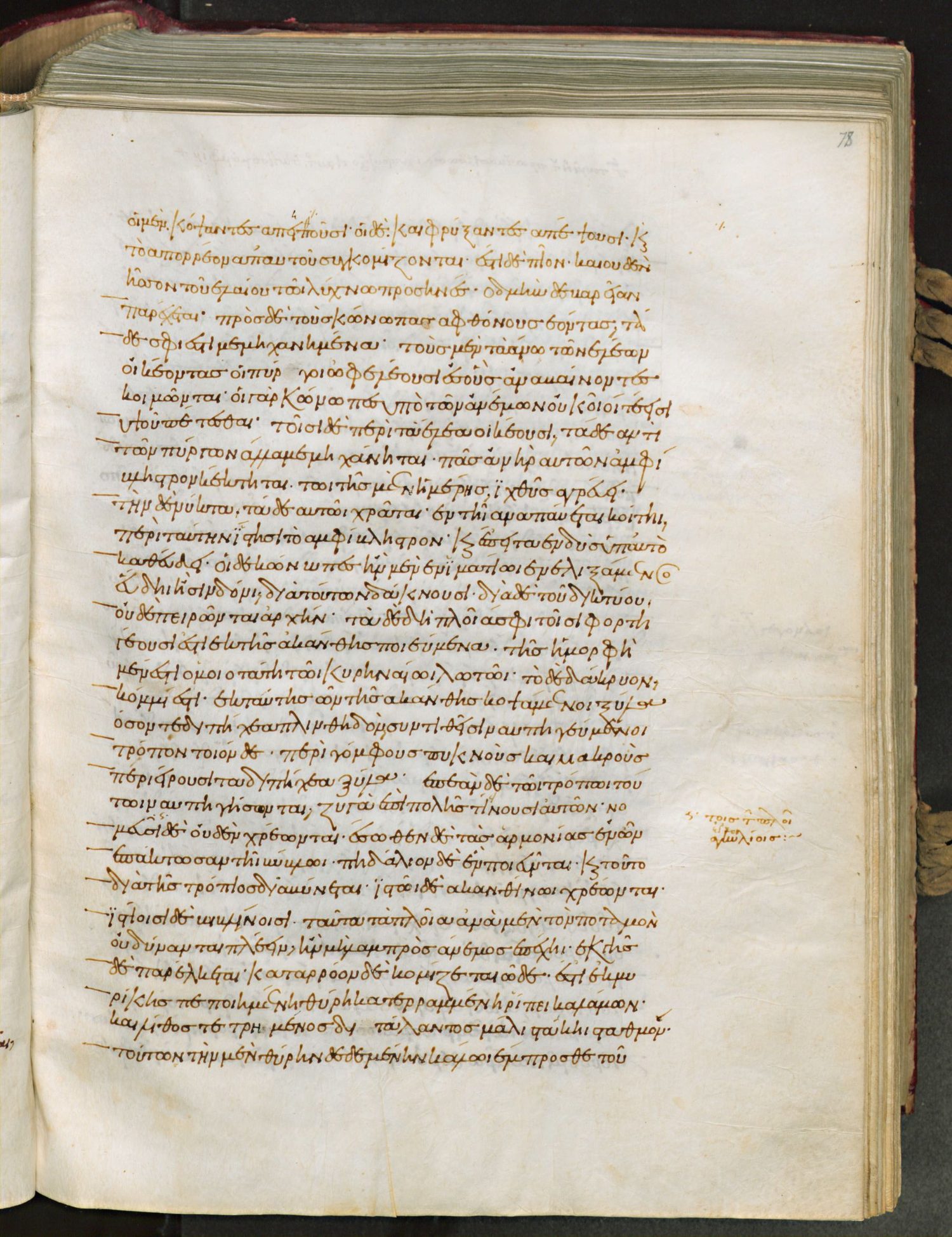
Laur. Plut. 70.3, fol. 78r: Greek here 2.94.2 to 2.96.4. Checked on the image (first and last words read and located in the Greek; each break checked against the neighbouring page): fol. 78r begins ‹οἳ μὲν κόψαντες ἀπιποῦσι,› (2.94.2), ends ‹δεδεμένην κάλῳ ἔμπροσθε τοῦ› (2.96.4). English here: 2.95.1 to 2.96.4 (Godley's sentences for the sections whose Greek lies mostly on this page).
2.94.2οἳ μὲν κόψαντες ἀπιποῦσι, οἳ δὲ καὶ φρύξαντες ἀπέψουσι, καὶ τὸ ἀπορρέον ἀπʼ αὐτοῦ συγκομίζονται. ἔστι δὲ πῖον καὶ οὐδὲν ἧσσον τοῦ ἐλαίου τῷ λύχνῳ προσηνές, ὀδμὴν δὲ βαρέαν παρέχεται. 2.95.1πρὸς δὲ τοὺς κώνωπας ἀφθόνους ἐόντας τάδε σφι ἐστὶ μεμηχανημένα. τοὺς μὲν τὰ ἄνω τῶν ἑλέων οἰκέοντας οἱ πύργοι ὠφελέουσι, ἐς τοὺς ἀναβαίνοντες κοιμῶνται· οἱ γὰρ κώνωπες ὑπὸ τῶν ἀνέμων οὐκ οἷοί τε εἰσὶ ὑψοῦ πέτεσθαι. 2.95.2τοῖσι δὲ περὶ τὰ ἕλεα οἰκέουσι τάδε ἀντὶ τῶν πύργων ἄλλα μεμηχάνηται· πᾶς ἀνὴρ αὐτῶν ἀμφίβληστρον ἔκτηται, τῷ τῆς μὲν ἡμέρης ἰχθῦς ἀγρεύει, τὴν δὲ νύκτα τάδε αὐτῷ χρᾶται· ἐν τῇ ἀναπαύεται κοίτῃ, περὶ ταύτην ἵστησι τὸ ἀμφίβληστρον καὶ ἔπειτα ἐνδὺς ὑπʼ αὐτὸ κατεύδει. 2.95.3οἱ δὲ κώνωπες, ἢν μὲν ἐν ἱματίῳ ἐνειλιξάμενος εὕδῃ ἢ σινδόνι, διὰ τούτων δάκνουσι, διὰ δὲ τοῦ δικτύου οὐδὲ πειρῶνται ἀρχήν. 2.96.1τὰ δὲ δὴ πλοῖά σφι, τοῖσι φορτηγέουσι, ἐστὶ ἐκ τῆς ἀκάνθης ποιεύμενα, τῆς ἡ μορφὴ μὲν ἐστὶ ὁμοιοτάτη τῷ Κυρηναίῳ λωτῷ, τὸ δὲ δάκρυον κόμμι ἐστί. ἐκ ταύτης ὦν τῆς ἀκάνθης κοψάμενοι ξύλα ὅσον τε διπήχεα πλινθηδὸν συντιθεῖσι ναυπηγεύμενοι τρόπον τοιόνδε· 2.96.2περὶ γόμφους πυκνοὺς καὶ μακροὺς περιείρουσι τὰ διπήχεα ξύλα· ἐπεὰν δὲ τῷ τρόπῳ τούτῳ ναυπηγήσωνται, ζυγὰ ἐπιπολῆς τείνουσι αὐτῶν· νομεῦσι δὲ οὐδὲν χρέωνται· ἔσωθεν δὲ τὰς ἁρμονίας ἐν ὦν ἐπάκτωσαν τῇ βύβλῳ. 2.96.3πηδάλιον δὲ ἓν ποιεῦνται, καὶ τοῦτο διὰ τῆς τρόπιος διαβύνεται. ἱστῷ δὲ ἀκανθίνῳ χρέωνται, ἱστίοισι δὲ βυβλίνοισι. ταῦτα τὰ πλοῖα ἀνὰ μὲν τὸν ποταμὸν οὐ δύναται πλέειν, ἢν μὴ λαμπρὸς ἄνεμος ἐπέχῃ, ἐκ γῆς δὲ παρέλκεται, κατὰ ῥόον δὲ κομίζεται ὧδε· 2.96.4ἔστι ἐκ μυρίκης πεποιημένη θύρη, κατερραμμένη ῥιπὶ καλάμων, καὶ λίθος τετρημένος διτάλαντος μάλιστά κῃ σταθμόν· τούτων τὴν μὲν θύρην δεδεμένην κάλῳ ἔμπροσθε τοῦ
2.95.1Gnats are abundant; this is how the Egyptians protect themselves against them: those who dwell higher up than the marshy country are well served by the towers whither they ascend to sleep, for the winds prevent the gnats from flying aloft; 2.95.2those living about the marshes have a different device, instead of the towers. Every man of them has a net, with which he catches fish by day, and for the night he sets it round the bed where he rests, then creeps under it and so sleeps. 2.95.3If he sleep wrapped in a garment or cloth, the gnats bite through it; but through the net they do not even try at all to bite. 2.96.1The boats in which they carry cargo are made of the acacia, which is in form most like to the lotus of Cyrene, and its sap is gum. Of this tree they cut logs of two cubits length and lay them like courses of bricks, and build the boat 2.96.2by making these two-cubit logs fast to long and close-set stakes; and having so built they set crossbeams athwart and on the logs. They use no ribs. They caulk the seams within with byblus. 2.96.3There is one rudder, passing through a hole in the boat’s keel. The mast is of acacia-wood and the sails of byblus. These boats cannot move upstream unless a brisk breeze continue; they are towed from the bank; but downstream they are thus managed: 2.96.4they have a raft made of tamarisk wood, fastened together with matting of reeds, and a pierced stone of about two talents’ weight; the raft is let go to float down ahead of the boat, made fast to it by a rope, and the stone is made fast also by a rope to the after part of the boat.
Where on the image
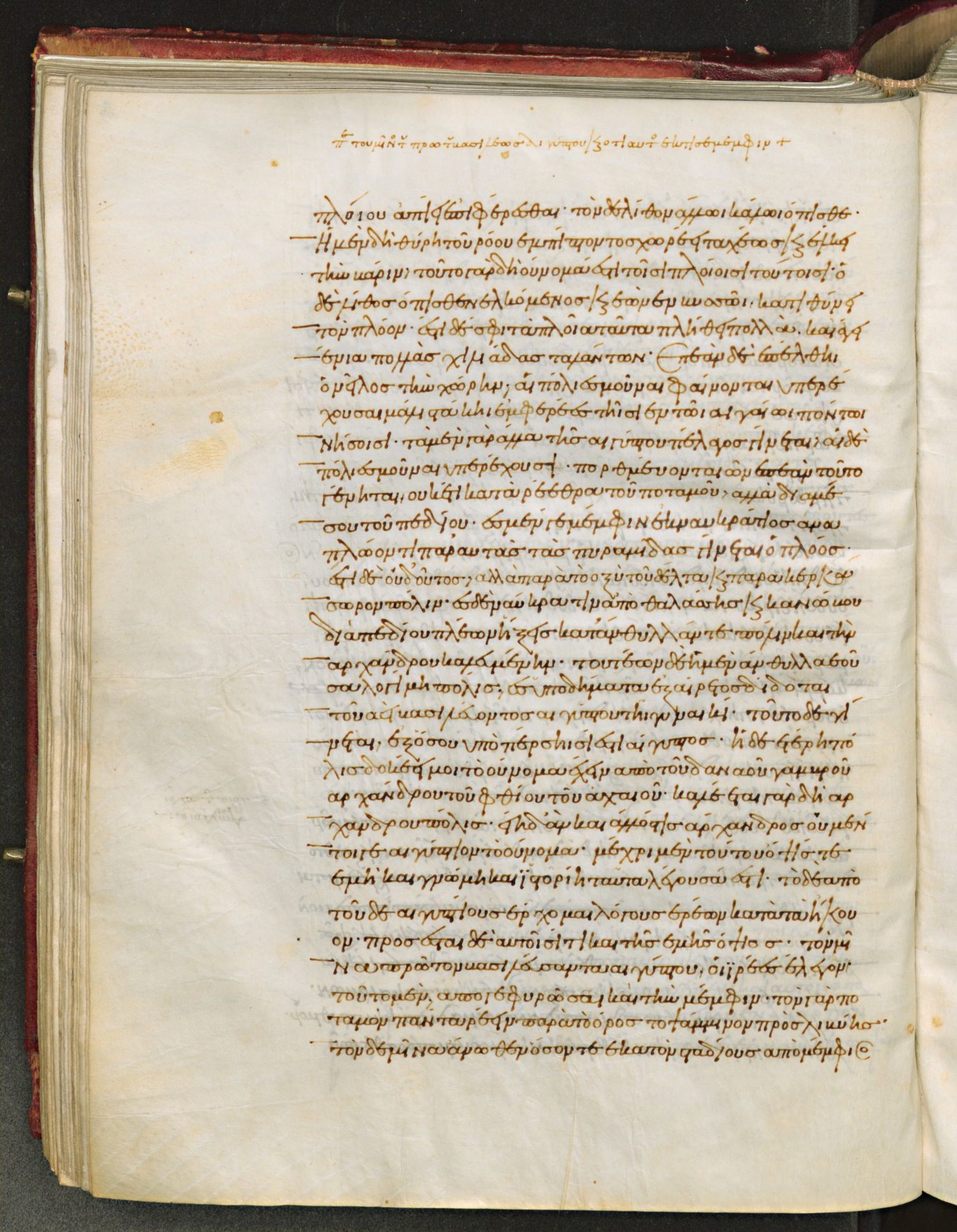
Laur. Plut. 70.3, fol. 78v: Greek here 2.96.4 to 2.98.2. Checked on the image (first and last words read and located in the Greek; each break checked against the neighbouring page): fol. 78v begins ‹πλοίου ἀπιεῖ ἐπιφέρεσθαι, τὸν› (2.96.4), ends ‹ἑκατὸν σταδίους ἀπὸ Μέμφιος› (2.99.2) (page breaks read on the image for the Herodotus on Egypt collection). A reader's heading on the first king of Egypt stands in the upper margin. English here: 2.96.5 to 2.98.2 (Godley's sentences for the sections whose Greek lies mostly on this page).
2.96.4πλοίου ἀπιεῖ ἐπιφέρεσθαι, τὸν δὲ λίθον ἄλλῳ κάλῳ ὄπισθε. 2.96.5ἡ μὲν δὴ θύρη τοῦ ῥόου ἐμπίπτοντος χωρέει ταχέως καὶ ἕλκει τὴν βᾶριν (τοῦτο γὰρ δὴ οὔνομα ἐστὶ τοῖσι πλοίοισι τούτοισι), ὁ δὲ λίθος ὄπισθε ἐπελκόμενος καὶ ἐὼν ἐν βυσσῷ κατιθύνει τὸν πλόον. ἔστι δέ σφι τὰ πλοῖα ταῦτα πλήθεϊ πολλά, καὶ ἄγει ἔνια πολλὰς χιλιάδας ταλάντων. 2.97.1ἐπεὰν δὲ ἐπέλθῃ ὁ Νεῖλος τὴν χώρην, αἱ πόλιες μοῦναι φαίνονται ὑπερέχουσαι, μάλιστά κῃ ἐμφερέες τῇσι ἐν τῷ Αἰγαίῳ πόντῳ νήσοισι· τὰ μὲν γὰρ ἄλλα τῆς Αἰγύπτου πέλαγος γίνεται, αἱ δὲ πόλιες μοῦναι ὑπερέχουσι. πορθμεύονται ὦν, ἐπεὰν τοῦτο γένηται, οὐκέτι κατὰ τὰ ῥέεθρα τοῦ ποταμοῦ ἀλλὰ διὰ μέσου τοῦ πεδίου. 2.97.2ἐς μέν γε Μέμφιν ἐκ Ναυκράτιος ἀναπλώοντι παρʼ αὐτὰς τὰς πυραμίδας γίνεται ὁ πλόος· ἔστι δὲ οὐδʼ οὗτος, ἀλλὰ παρὰ τὸ ὀξὺ τοῦ Δέλτα καὶ παρὰ Κερκάσωρον πόλιν· ἐς δὲ Ναύκρατιν ἀπὸ θαλάσσης καὶ Κανώβου διὰ πεδίου πλέων ἥξεις κατʼ Ἄνθυλλάν τε πόλιν καὶ τὴν Ἀρχάνδρου καλευμένην. 2.98.1τουτέων δὲ ἡ μὲν Ἄνθυλλα ἐοῦσα λογίμη πόλις ἐς ὑποδήματα ἐξαίρετος δίδοται τοῦ αἰεὶ βασιλεύοντος Αἰγύπτου τῇ γυναικί (τοῦτο δὲ γίνεται ἐξ ὅσου ὑπὸ Πέρσῃσι ἐστὶ Αἴγυπτος), 2.98.2ἡ δὲ ἑτέρη πόλις δοκέει μοι τὸ οὔνομα ἔχειν ἀπὸ τοῦ Δαναοῦ γαμβροῦ Ἀρχάνδρου τοῦ Φθίου τοῦ Ἀχαιοῦ· καλέεται γὰρ δὴ Ἀρχάνδρου πόλις. εἴη δʼ ἂν καὶ ἄλλος τις Ἄρχανδρος, οὐ μέντοι γε Αἰγύπτιον τὸ οὔνομα.
2.96.5So, driven by the current, the raft floats swiftly and tows the “baris” (which is the name of these boats,) and the stone dragging behind on the river bottom keeps the boat’s course straight. There are many of these boats; some are of many thousand talents’ burden. 2.97.1When the Nile overflows the land, the towns alone are seen high and dry above the water, very like to the islands in the Aegean sea. These alone stand out, the rest of Egypt being a sheet of water. So when this happens folk are ferried not, as is their wont, in the course of the stream, but clean over the plain. 2.97.2From Naucratis indeed to Memphis the boat going upwards passes close by the pyramids themselves; the usual course is not this, but by the Delta’s point and the town Cercasorus: but your voyage from the sea and Canobus to Naucratis will take you over the plain near the town of Anthylla and that which is called Archandrus’ town. 2.98.1Anthylla is a town of some name, and is specially assigned to the consort of the reigning king of Egypt, for the provision of her shoes. This has been done since Egypt has been under Persian dominion. 2.98.2The other town, I think, is named after Archandrus son of Phthius the Achaean, and son-in-law of Danaus; for it is called Archandrus’ town. It may be that there was another Archandrus; but the name is not Egyptian.
Notes
- Greek: the text printed in A. D. Godley's Loeb edition, via Perseus (tlg0016.tlg001.perseus-grc2). Square brackets mark words the editor considers later additions; [...] marks a gap the editor indicates. Perseus note markers are omitted.
- English: A. D. Godley, Herodotus vol. 1 (1920) (Loeb Classical Library), as transcribed on Wikisource. Godley's footnotes are omitted.
- Section numbers in the English were placed by comparing Godley's text with the Perseus version of his translation; where a section begins inside one of Godley's sentences, the English is kept with the page that holds the start of that sentence.
Cite
Sources
- Source: Florence, Laur. Plut. 70.3 (10th c.) via BML Teca Digitale + Greek of Godley's Loeb (Perseus) + English of A. D. Godley (Loeb, Wikisource) (holding institution)
- Critical edition: Greek of A. D. Godley's Loeb edition (1920-1925), via Perseus
← previous · → next · v cycle view · l back to library