Herodotus, Histories 2.99-110: Min, Nitocris, Moeris and Sesostris
Introduction
Herodotus of Halicarnassus wrote the Histories in the third quarter of the 5th century BCE, an inquiry into the deeds of Greeks and barbarians and the causes of the wars between them, later divided into nine books. Book 2 is Herodotus' account of Egypt, written as background to Cambyses' invasion: the land and the Nile, the customs and religion of the Egyptians, and the history of their kings as the priests told it, down to Amasis.
The photographs are of Florence, Biblioteca Medicea Laurenziana, Plut. 70.3 (parchment, 10th century, 374 folios, 31 lines a page), Herodotus, Histories (codex A of the editors), the oldest surviving manuscript of the complete Histories, from the Teca Digitale of the Biblioteca Medicea Laurenziana. Each section below is the text of one page, or of the part of a page that falls within these chapters. The first and last words of every page were read on the photograph and located in the Greek, and every page break was checked against the next page; the notes quote these words. Readers' notes in the margins are not part of the text and are mentioned where they occur.
The Greek is the text printed in A. D. Godley's Loeb edition (1920-1925), from Perseus; it is the edited text, not a transcription of the manuscript, whose wording differs in places. The English is Godley's translation as printed, from Wikisource. Godley's English carries only chapter numbers; the section numbers shown in it were placed by comparison with the Perseus version of his translation. Each page's English is cut at the end of one of Godley's sentences, so it can begin or end a few lines away from the Greek of the page; each note gives the exact ranges.
This entry covers chapters 2.99-110, on fol. 78v to 81v.
How was this verified? (Provenance)
Where on the image
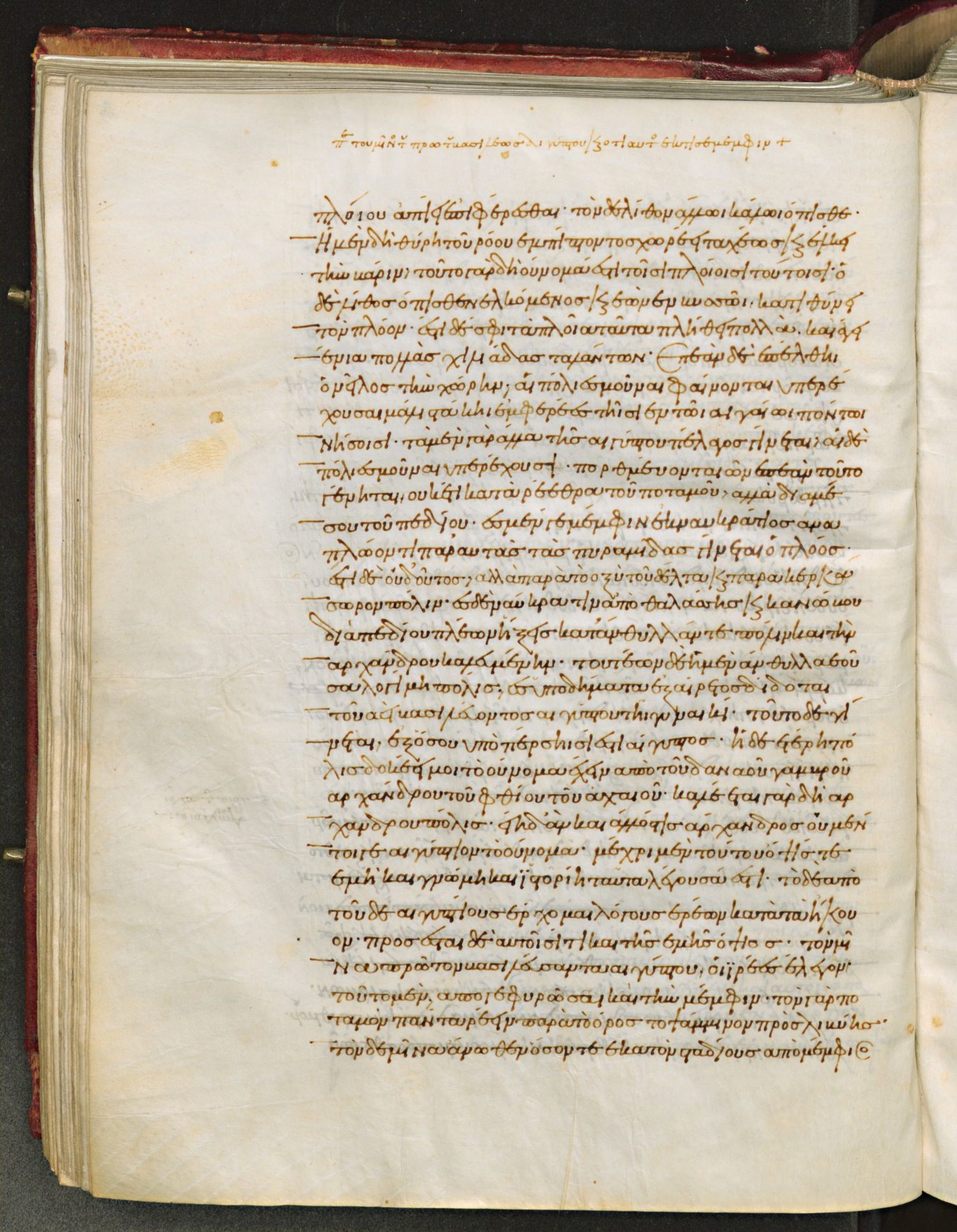
Laur. Plut. 70.3, fol. 78v: Greek here 2.99.1 to 2.99.2. Checked on the image (first and last words read and located in the Greek; each break checked against the neighbouring page): fol. 78v begins ‹πλοίου ἀπιεῖ ἐπιφέρεσθαι, τὸν› (2.96.4), ends ‹ἑκατὸν σταδίους ἀπὸ Μέμφιος› (2.99.2) (page breaks read on the image for the Herodotus on Egypt collection). A reader's heading on the first king of Egypt stands in the upper margin. English here: 2.99.1 to 2.99.2 (Godley's sentences for the sections whose Greek lies mostly on this page).
2.99.1μέχρι μὲν τούτου ὄψις τε ἐμὴ καὶ γνώμη καὶ ἱστορίη ταῦτα λέγουσα ἐστί, τὸ δὲ ἀπὸ τοῦδε Αἰγυπτίους ἔρχομαι λόγους ἐρέων κατὰ τὰ ἤκουον· προσέσται δὲ αὐτοῖσί τι καὶ τῆς ἐμῆς ὄψιος. 2.99.2Μῖνα τὸν πρῶτον βασιλεύσαντα Αἰγύπτου οἱ ἱρέες ἔλεγον τοῦτο μὲν ἀπογεφυρῶσαι τὴν Μέμφιν. τὸν γὰρ ποταμὸν πάντα ῥέειν παρὰ τὸ ὄρος τὸ ψάμμινον πρὸς Λιβύης, τὸν δὲ Μῖνα ἄνωθεν, ὅσον τε ἑκατὸν σταδίους ἀπὸ Μέμφιος,
2.99.1Thus far all I have said is the outcome of my own sight and judgment and inquiry. Henceforth I will record Egyptian chronicles, according to that which I have heard, adding thereto somewhat of what I myself have seen. 2.99.2The priests told me that Min was the first king of Egypt, and that first he separated Memphis from the Nile by a dam. All the river had flowed close under the sandy mountains on the Libyan side, but Min made the southern bend of it which begins about an hundred furlongs above Memphis, by damming the stream; thereby he dried up the ancient course, and carried the river by a channel so that it flowed midway between the hills.
Where on the image
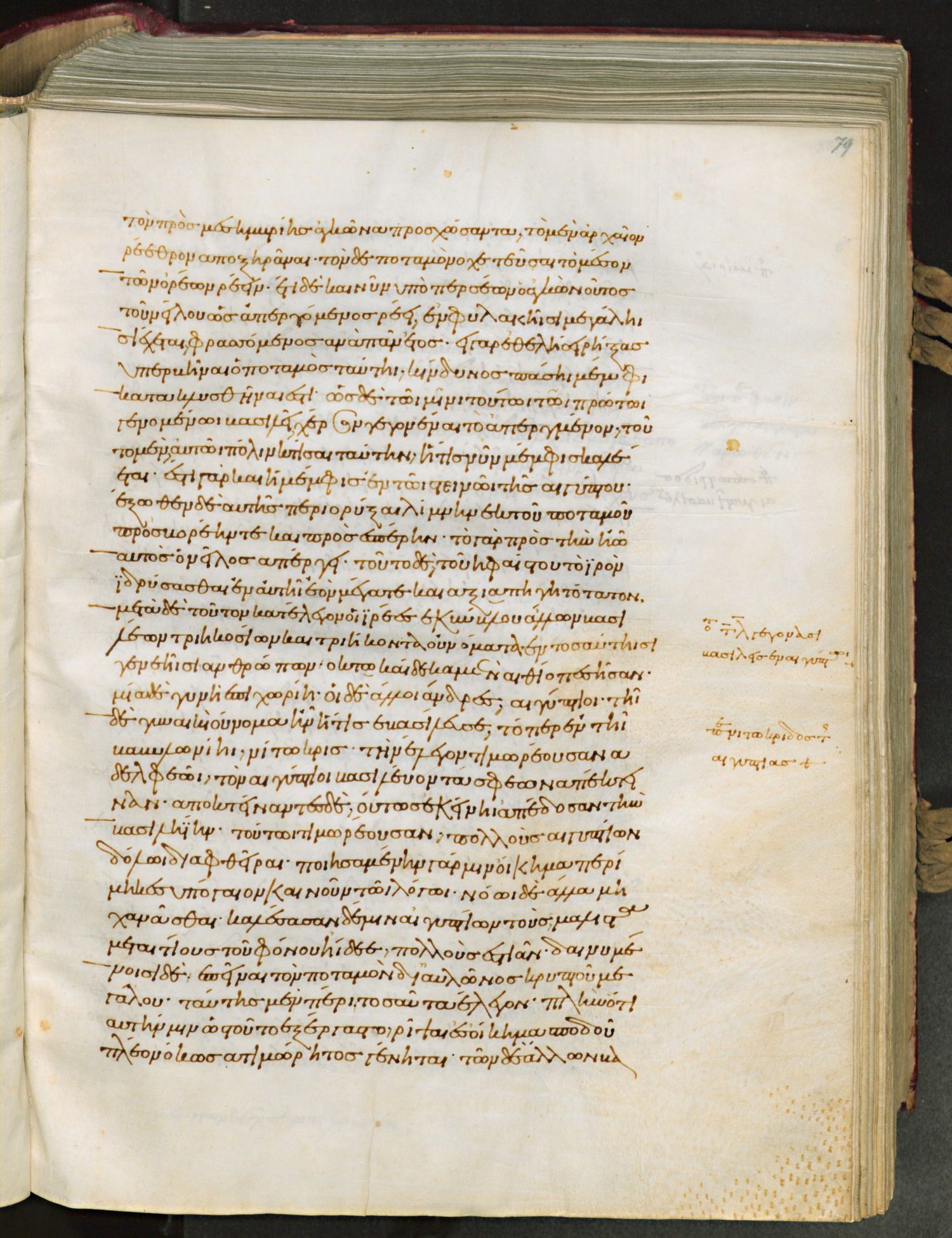
Laur. Plut. 70.3, fol. 79r: Greek here 2.99.2 to 2.101.1. Checked on the image (first and last words read and located in the Greek; each break checked against the neighbouring page): fol. 79r begins ‹τὸν πρὸς μεσαμβρίης ἀγκῶνα› (2.99.2), ends ‹ἀτιμώρητος γένηται.τῶν δὲ ἄλλων› (2.101.1) (page breaks read on the image for the Herodotus on Egypt collection). English here: 2.99.3 to 2.100.4 (Godley's sentences for the sections whose Greek lies mostly on this page).
2.99.2τὸν πρὸς μεσαμβρίης ἀγκῶνα προσχώσαντα τὸ μὲν ἀρχαῖον ῥέεθρον ἀποξηρῆναι, τὸν δὲ ποταμὸν ὀχετεῦσαι τὸ μέσον τῶν ὀρέων ῥέειν. 2.99.3ἔτι δὲ καὶ νῦν ὑπὸ Περσέων ὁ ἀγκὼν οὗτος τοῦ Νείλου ὡς ἀπεργμένος ῥέῃ ἐν φυλακῇσι μεγάλῃσι ἔχεται, φρασσόμενος ἀνὰ πᾶν ἔτος· εἰ γὰρ ἐθελήσει ῥήξας ὑπερβῆναι ὁ ποταμὸς ταύτῃ, κίνδυνος πάσῃ Μέμφι κατακλυσθῆναι ἐστί. 2.99.4ὡς δὲ τῷ Μῖνι τούτῳ τῷ πρώτῳ γενομένῳ βασιλέι χέρσον γεγονέναι τὸ ἀπεργμένον, τοῦτο μὲν ἐν αὐτῷ πόλιν κτίσαι ταύτην ἥτις νῦν Μέμφις καλέεται· ἔστι γὰρ καὶ ἡ Μέμφις ἐν τῷ στεινῷ τῆς Αἰγύπτου· ἔξωθεν δὲ αὐτῆς περιορύξαι λίμνην ἐκ τοῦ ποταμοῦ πρὸς βορέην τε καὶ πρὸς ἑσπέρην (τὸ γὰρ πρὸς τὴν ἠῶ αὐτὸς ὁ Νεῖλος ἀπέργει), τοῦτο δὲ τοῦ Ἡφαίστου τὸ ἱρὸν ἱδρύσασθαι ἐν αὐτῇ, ἐὸν μέγα τε καὶ ἀξιαπηγητότατον. 2.100.1μετὰ δὲ τοῦτον κατέλεγον οἱ ἱρέες ἐκ βύβλου ἄλλων βασιλέων τριηκοσίων καὶ τριήκοντα οὐνόματα. ἐν τοσαύτῃσι δὲ γενεῇσι ἀνθρώπων ὀκτωκαίδεκα μὲν Αἰθίοπες ἦσαν, μία δὲ γυνὴ ἐπιχωρίη, οἱ δὲ ἄλλοι ἄνδρες Αἰγύπτιοι. 2.100.2τῇ δὲ γυναικὶ οὔνομα ἦν, ἥτις ἐβασίλευσε, τό περ τῇ Βαβυλωνίῃ, Νίτωκρις· τὴν ἔλεγον τιμωρέουσαν ἀδελφεῷ, τὸν Αἰγύπτιοι βασιλεύοντα σφέων ἀπέκτειναν, ἀποκτείναντες δὲ οὕτω ἐκείνῃ ἀπέδοσαν τὴν βασιληίην, τούτῳ τιμωρέουσαν πολλοὺς Αἰγυπτίων διαφθεῖραι δόλῳ. 2.100.3ποιησαμένην γάρ μιν οἴκημα περίμηκες ὑπόγαιον καινοῦν τῷ λόγῳ, νόῳ δὲ ἄλλα μηχανᾶσθαι· καλέσασαν δέ μιν Αἰγυπτίων τοὺς μάλιστα μεταιτίους τοῦ φόνου ᾔδεε πολλοὺς ἱστιᾶν, δαινυμένοισι δὲ ἐπεῖναι τὸν ποταμὸν διʼ αὐλῶνος κρυπτοῦ μεγάλου. 2.100.4ταύτης μὲν πέρι τοσαῦτα ἔλεγον, πλὴν ὅτι αὐτήν μιν, ὡς τοῦτο ἐξέργαστο, ῥίψαι ἐς οἴκημα σποδοῦ πλέον, ὅκως ἀτιμώρητος γένηται. 2.101.1τῶν δὲ ἄλλων
2.99.3And to this day the Persians keep careful guard over this bend of the river, strengthening its dam every year, that it may keep the current in; for were the Nile to burst his dykes and overflow here, all Memphis were in danger of drowning. 2.99.4Then, when this first king Min had made what he thus cut off to be dry land, he first founded in it that city which is now called Memphis—for even Memphis lies in the narrow part of Egypt—and outside of it he dug a lake to its north and west, from the river (the Nile itself being the eastern boundary of the place); and secondly, he built in it the great and most noteworthy temple of Hephaestus. 2.100.1After him came three hundred and thirty kings, whose names the priests recited from a papyrus roll. In all these many generations there were eighteen Ethiopian kings, and one queen, native to the country; the rest were all Egyptian men. 2.100.2The name of the queen was the same as that of the Babylonian princess, Nitocris. She, to avenge her brother (he was king of Egypt and was slain by his subjects, who then gave Nitocris the sovereignty) put many of the Egyptians to death by guile. 2.100.3She built a spacious underground chamber; then, with the pretence of handselling it, but with far other intent in her mind, she gave a great feast, inviting to it those Egyptians whom she knew to have been most concerned in her brother’s murder; and while they feasted she let the river in upon them by a great and secret channel. 2.100.4This was all that the priests told of her, save that also when she had done this she cast herself into a chamber full of hot ashes, thereby to escape vengeance.
Where on the image
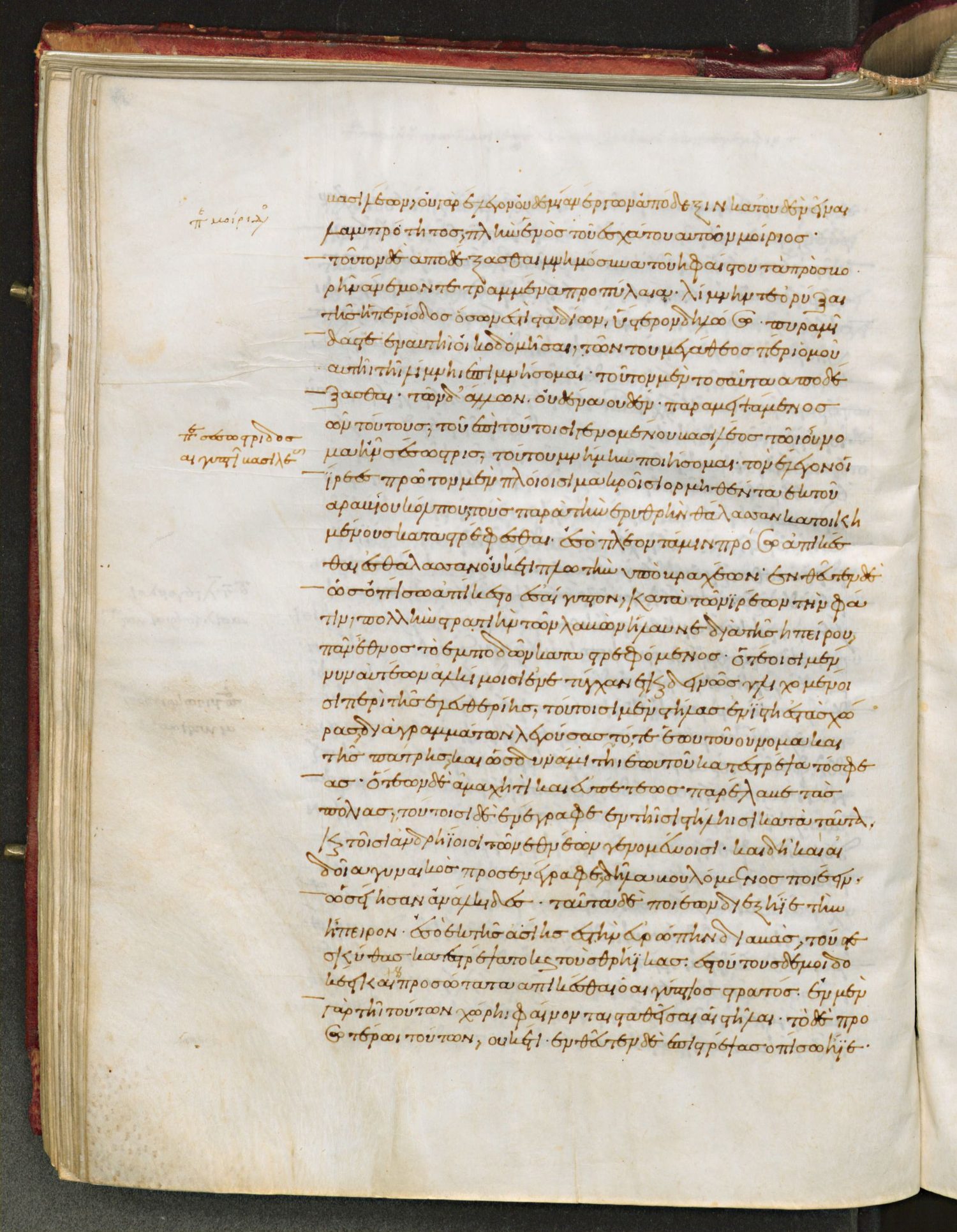
Laur. Plut. 70.3, fol. 79v: Greek here 2.101.1 to 2.103.2. Checked on the image (first and last words read and located in the Greek; each break checked against the neighbouring page): fol. 79v begins ‹βασιλέων οὐ γὰρ ἔλεγον› (2.101.1), ends ‹δὲ ἐπιστρέψας ὀπίσω ἤιε› (2.103.2) (page breaks read on the image for the Herodotus on Egypt collection). English here: 2.101.1 to 2.103.1 (Godley's sentences for the sections whose Greek lies mostly on this page).
2.101.1βασιλέων οὐ γὰρ ἔλεγον οὐδεμίαν ἔργων ἀπόδεξιν καὶ οὐδὲν εἶναι λαμπρότητος, πλὴν ἑνὸς τοῦ ἐσχάτου αὐτῶν Μοίριος· 2.101.2τοῦτον δὲ ἀποδέξασθαι μνημόσυνα τοῦ Ἡφαίστου τὰ πρὸς βορέην ἄνεμον τετραμμένα προπύλαια, λίμνην τε ὀρύξαι, τῆς ἡ περίοδος ὅσων ἐστὶ σταδίων ὕστερον δηλώσω, πυραμίδας τε ἐν αὐτῇ οἰκοδομῆσαι, τῶν τοῦ μεγάθεος πέρι ὁμοῦ αὐτῇ τῇ λίμνῃ ἐπιμνήσομαι· τοῦτον μὲν τοσαῦτα ἀποδέξασθαι, τῶν δὲ ἄλλων οὐδένα οὐδέν. 2.102.1παραμειψάμενος ὦν τούτους τοῦ ἐπὶ τούτοισι γενομένου βασιλέος, τῷ οὔνομα ἦν Σέσωστρις, τούτου μνήμην ποιήσομαι· 2.102.2τὸν ἔλεγον οἱ ἱρέες πρῶτον μὲν πλοίοισι μακροῖσι ὁρμηθέντα ἐκ τοῦ Ἀραβίου κόλπου τοὺς παρὰ τὴν Ἐρυθρὴν θάλασσαν κατοικημένους καταστρέφεσθαι, ἐς ὃ πλέοντά μιν πρόσω ἀπικέσθαι ἐς θάλασσαν οὐκέτι πλωτὴν ὑπὸ βραχέων. 2.102.3ἐνθεῦτεν δὲ ὡς ὀπίσω ἀπίκετο ἐς Αἴγυπτον, κατὰ τῶν ἱρέων τὴν φάτιν, πολλὴν στρατιὴν τῶν λαβὼν ἤλαυνε διὰ τῆς ἠπείρου, πᾶν ἔθνος τὸ ἐμποδὼν καταστρεφόμενος. 2.102.4ὁτέοισι μέν νυν αὐτῶν ἀλκίμοισι ἐνετύγχανε καὶ δεινῶς γλιχομένοισι περὶ τῆς ἐλευθερίης, τούτοισι μὲν στήλας ἐνίστη ἐς τὰς χώρας διὰ γραμμάτων λεγούσας τό τε ἑωυτοῦ οὔνομα καὶ τῆς πάτρης, καὶ ὡς δυνάμι τῇ ἑωυτοῦ κατεστρέψατο σφέας· 2.102.5ὅτεων δὲ ἀμαχητὶ καὶ εὐπετέως παρέλαβε τὰς πόλιας, τούτοισι δὲ ἐνέγραφε ἐν τῇσι στήλῃσι κατὰ ταὐτὰ καὶ τοῖσι ἀνδρηίοισι τῶν ἐθνέων γενομένοισι, καὶ δὴ καὶ αἰδοῖα γυναικὸς προσενέγραφε, δῆλα βουλόμενος ποιέειν ὡς εἴησαν ἀνάλκιδες. 2.103.1ταῦτα δὲ ποιέων διεξήιε τὴν ἤπειρον, ἐς ὃ ἐκ τῆς Ἀσίης ἐς τὴν Εὐρώπην διαβὰς τούς τε Σκύθας κατεστρέψατο καὶ τοὺς Θρήικας. ἐς τούτους δέ μοι δοκέει καὶ προσώτατα ἀπικέσθαι ὁ Αἰγύπτιος στρατός· ἐν μὲν γὰρ τῇ τούτων χώρῃ φαίνονται σταθεῖσαι αἱ στῆλαι, τὸ δὲ προσωτέρω τούτων οὐκέτι. 2.103.2ἐνθεῦτεν δὲ ἐπιστρέψας ὀπίσω ἤιε,
2.101.1But of the other kings they related no achievement or deed of great note, save of Moeris, who was the last of them. 2.101.2This Moeris was remembered as having built the northern forecourt of the temple of Hephaestus, and dug a lake, of as many furlongs in circuit as I shall later show; and built there pyramids also, the size of which I will mention when I speak of the lake. All this was Moeris’ work, they said; of none of the rest had they anything to record. 2.102.1Passing over these, therefore, I will now speak of the king who came after them, Sesostris. 2.102.2This king, said the priests, set out with a fleet of long ships from the Arabian Gulf and subdued all the dwellers by the Red Sea, till as he sailed on he came to a sea which was too shallow for his vessels. 2.102.3After returning thence back to Egypt, he gathered a great army (according to the story of the priests) and marched over the mainland, subduing every nation to which he came. 2.102.4When those that he met were valiant men and strove hard for freedom, he set up pillars in their land whereon the inscription showed his own name and his country’s, and how he had overcome them with his own power; 2.102.5but when the cities had made no resistance and been easily taken, then he put an inscription on the pillars even as he had done where the nations were brave; but he drew also on them the privy parts of a woman, wishing to show clearly that the people were cowardly. 2.103.1Thus doing he marched over the country till he had passed over from Asia to Europe and subdued the Scythians and Thracians. Thus far and no farther, I think, the Egyptian army went; for the pillars can be seen standing in their country, but in none beyond it.
Where on the image
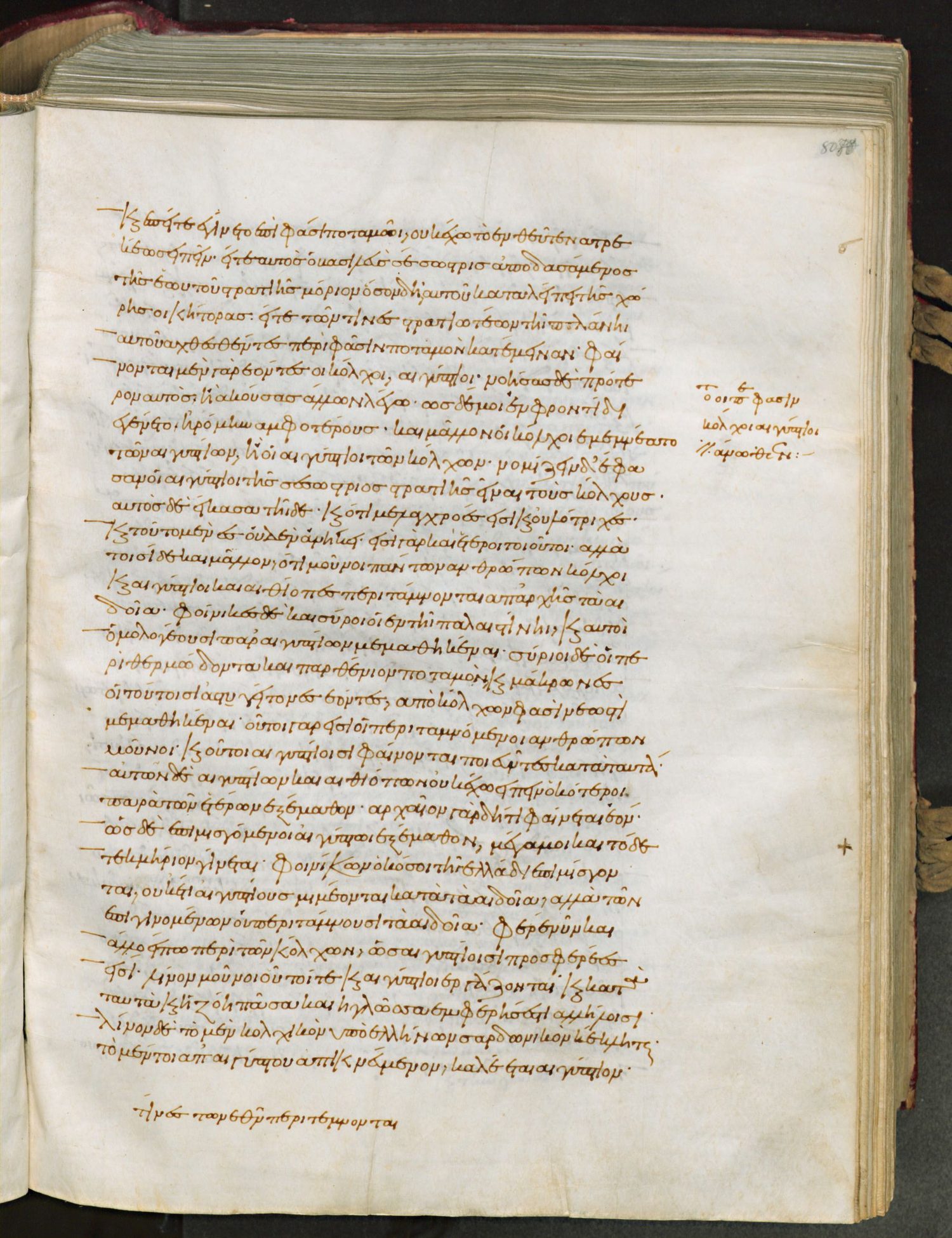
Laur. Plut. 70.3, fol. 80r: Greek here 2.103.2 to 2.105.1. Checked on the image (first and last words read and located in the Greek; each break checked against the neighbouring page): fol. 80r begins ‹καὶ ἐπείτε ἐγίνετο ἐπὶ› (2.103.2), ends ‹Αἰγύπτου ἀπικνεύμενον καλέεται Αἰγύπτιον› (2.105.1) (page breaks read on the image for the Herodotus on Egypt collection). English here: 2.103.2 to 2.105.1 (Godley's sentences for the sections whose Greek lies mostly on this page).
2.103.2καὶ ἐπείτε ἐγίνετο ἐπὶ Φάσι ποταμῷ, οὐκ ἔχω τὸ ἐνθεῦτεν ἀτρεκέως εἰπεῖν εἴτε αὐτὸς ὁ βασιλεὺς Σέσωστρις ἀποδασάμενος τῆς ἑωυτοῦ στρατιῆς μόριον ὅσον δὴ αὐτοῦ κατέλιπε τῆς χώρης οἰκήτορας, εἴτε τῶν τινες στρατιωτέων τῇ πλάνῃ αὐτοῦ ἀχθεσθέντες περὶ Φᾶσιν ποταμὸν κατέμειναν. 2.104.1φαίνονται μὲν γὰρ ἐόντες οἱ Κόλχοι Αἰγύπτιοι, νοήσας δὲ πρότερον αὐτὸς ἢ ἀκούσας ἄλλων λέγω. ὡς δέ μοι ἐν φροντίδι ἐγένετο, εἰρόμην ἀμφοτέρους, καὶ μᾶλλον οἱ Κόλχοι ἐμεμνέατο τῶν Αἰγυπτίων ἢ οἱ Αἰγύπτιοι τῶν Κόλχων· 2.104.2νομίζειν δʼ ἔφασαν οἱ Αἰγύπτιοι τῆς Σεσώστριος στρατιῆς εἶναι τοὺς Κόλχους. αὐτὸς δὲ εἴκασα τῇδε, καὶ ὅτι μελάγχροες εἰσὶ καὶ οὐλότριχες. καὶ τοῦτο μὲν ἐς οὐδὲν ἀνήκει· εἰσὶ γὰρ καὶ ἕτεροι τοιοῦτοι· ἀλλὰ τοῖσιδε καὶ μᾶλλον, ὅτι μοῦνοι πάντων ἀνθρώπων Κόλχοι καὶ Αἰγύπτιοι καὶ Αἰθίοπες περιτάμνονται ἀπʼ ἀρχῆς τὰ αἰδοῖα. 2.104.3Φοίνικες δὲ καὶ Σύροι οἱ ἐν τῇ Παλαιστίνῃ καὶ αὐτοὶ ὁμολογέουσι παρʼ Αἰγυπτίων μεμαθηκέναι, Σύριοι δὲ οἱ περὶ Θερμώδοντα καὶ Παρθένιον ποταμὸν καὶ Μάκρωνες οἱ τούτοισι ἀστυγείτονες ἐόντες ἀπὸ Κόλχων φασὶ νεωστὶ μεμαθηκέναι. οὗτοι γὰρ εἰσὶ οἱ περιταμνόμενοι ἀνθρώπων μοῦνοι, καὶ οὗτοι Αἰγυπτίοισι φαίνονται ποιεῦντες κατὰ ταὐτά. 2.104.4αὐτῶν δὲ Αἰγυπτίων καὶ Αἰθιόπων οὐκ ἔχω εἰπεῖν ὁκότεροι παρὰ τῶν ἑτέρων ἐξέμαθον· ἀρχαῖον γὰρ δή τι φαίνεται ἐόν. ὡς δὲ ἐπιμισγόμενοι Αἰγύπτῳ ἐξέμαθον, μέγα μοι καὶ τόδε τεκμήριον γίνεται· Φοινίκων ὁκόσοι τῇ Ἑλλάδι ἐπιμίσγονται, οὐκέτι Αἰγυπτίους μιμέονται κατὰ τὰ αἰδοῖα. ἀλλὰ τῶν ἐπιγινομένων οὐ περιτάμνουσι τὰ αἰδοῖα. 2.105.1φέρε νῦν καὶ ἄλλο εἴπω περὶ τῶν Κόλχων, ὡς Αἰγυπτίοισι προσφερέες εἰσί· λίνον μοῦνοι οὗτοί τε καὶ Αἰγύπτιοι ἐργάζονται καὶ κατὰ ταὐτά, καὶ ἡ ζόη πᾶσα καὶ ἡ γλῶσσα ἐμφερής ἐστι ἀλλήλοισι. λίνον δὲ τὸ μὲν Κολχικὸν ὑπὸ Ἑλλήνων Σαρδωνικὸν κέκληται, τὸ μέντοι ἀπʼ Αἰγύπτου ἀπικνεύμενον καλέεται Αἰγύπτιον.
2.103.2Thence he turned about and went back homewards; and when he came to the Phasis river, it may be (for I cannot speak with exact knowledge) that King Sesostris divided off some part of his army and left it there to dwell in the country, or it may be that some of his soldiers grew weary of his wanderings, and stayed by the Phasis. 2.104.1For it is plain to see that the Colchians are Egyptians; and this that I say I myself noted before I heard it from others. When I began to think on this matter, I inquired of both peoples; and the Colchians remembered the Egyptians better than the Egyptians remembered the Colchians; 2.104.2the Egyptians said that they held the Colchians to be part of Sesostris’ army. I myself guessed it to be so, partly because they are dark-skinned and woolly-haired; though that indeed goes for nothing, seeing that other peoples, too, are such; but my better proof was that the Colchians and Egyptians and Ethiopians are the only nations that have from the first practised circumcision. 2.104.3The Phoenicians and the Syrians of Palestine acknowledge of themselves that they learnt the custom from the Egyptians, and the Syrians of the valleys of the Thermodon and the Parthenius, as well as their neighbours the Macrones, say that they learnt it lately from the Colchians. These are the only nations that circumcise, and it is seen that they do even as the Egyptians. 2.104.4But as to the Egyptians and Ethiopians themselves, I cannot say which nation learnt it from the other; for it is manifestly a very ancient custom. That the others learnt it from intercourse with Egypt I hold to be clearly proved by this—that Phoenicians who hold intercourse with Hellas cease to imitate the Egyptians in this matter and do not circumcise their children. 2.105.1Nay, and let me speak of another matter in which the Colchians are like to the Egyptians: they and the Egyptians alone work linen, and have the same way, a way peculiar to themselves, of working it; and they are alike in all their manner of life, and in their speech. Linen has two names: the Colchian kind is called by the Greeks Sardonian; that which comes from Egypt is called Egyptian.
Where on the image
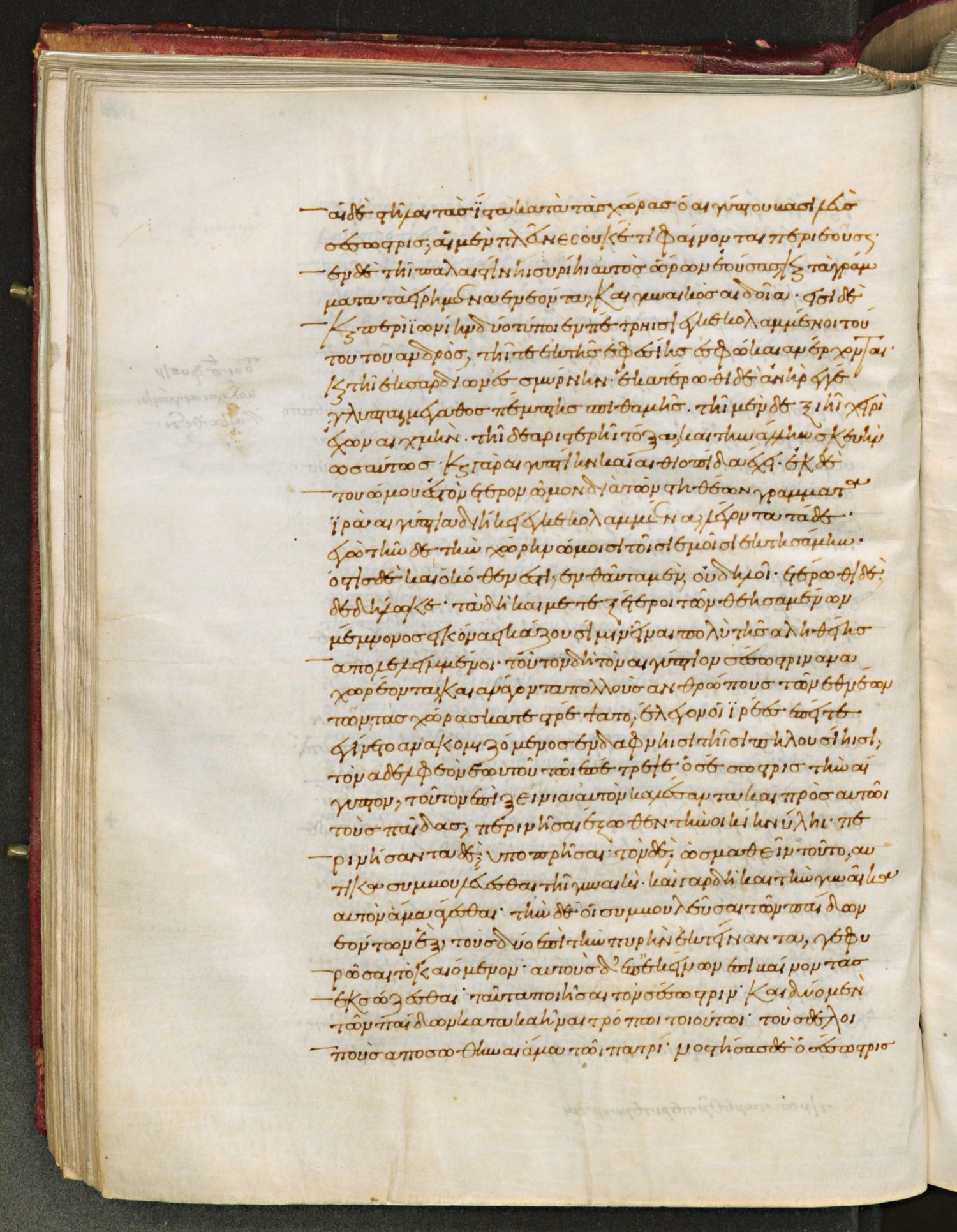
Laur. Plut. 70.3, fol. 80v: Greek here 2.106.1 to 2.108.1. Checked on the image (first and last words read and located in the Greek; each break checked against the neighbouring page): fol. 80v begins ‹αἱ δὲ στῆλαι τὰς› (2.106.1), ends ‹πατρί.νοστήσας δὲ ὁ Σέσωστρις› (2.108.1) (page breaks read on the image for the Herodotus on Egypt collection). English here: 2.106.1 to 2.107.2 (Godley's sentences for the sections whose Greek lies mostly on this page).
2.106.1αἱ δὲ στῆλαι τὰς ἵστα κατὰ τὰς χώρας ὁ Αἰγύπτου βασιλεὺς Σέσωστρις, αἱ μὲν πλεῦνες οὐκέτι φαίνονται περιεοῦσαι, ἐν δὲ τῇ Παλαιστίνῃ Συρίῃ αὐτὸς ὥρων ἐούσας καὶ τὰ γράμματα τὰ εἰρημένα ἐνεόντα καὶ γυναικὸς αἰδοῖα. 2.106.2εἰσὶ δὲ καὶ περὶ Ἰωνίην δύο τύποι ἐν πέτρῃσι ἐγκεκολαμμένοι τούτου τοῦ ἀνδρός, τῇ τε ἐκ τῆς Ἐφεσίης ἐς Φώκαιαν ἔρχονται καὶ τῇ ἐκ Σαρδίων ἐς Σμύρνην. 2.106.3ἑκατέρωθι δὲ ἀνὴρ ἐγγέγλυπται μέγαθος πέμπτης σπιθαμῆς, τῇ μὲν δεξιῇ χειρὶ ἔχων αἰχμὴν τῇ δὲ ἀριστερῇ τόξα, καὶ τὴν ἄλλην σκευὴν ὡσαύτως· καὶ γὰρ Αἰγυπτίην καὶ Αἰθιοπίδα ἔχει· 2.106.4ἐκ δὲ τοῦ ὤμου ἐς τὸν ἕτερον ὦμον διὰ τῶν στηθέων γράμματα ἱρὰ Αἰγύπτια διήκει ἐγκεκολαμμένα, λέγοντα τάδε· ἐγὼ τήνδε τὴν χώρην ὤμοισι τοῖσι ἐμοῖσι ἐκτησάμην. ὅστις δὲ καὶ ὁκόθεν ἐστί, ἐνθαῦτα μὲν οὐ δηλοῖ, ἑτέρωθι δὲ δεδήλωκε· 2.106.5τὰ δὴ καὶ μετεξέτεροι τῶν θεησαμένων Μέμνονος εἰκόνα εἰκάζουσί μιν εἶναι, πολλὸν τῆς ἀληθείης ἀπολελειμμένοι. 2.107.1τοῦτον δὴ τὸν Αἰγύπτιον Σέσωστριν ἀναχωρέοντα καὶ ἀνάγοντα πολλοὺς ἀνθρώπους τῶν ἐθνέων τῶν τὰς χώρας κατεστρέψατο, ἔλεγον οἱ ἱρέες, ἐπείτε ἐγίνετο ἀνακομιζόμενος ἐν Δάφνῃσι τῇσι Πηλουσίῃσι, τὸν ἀδελφεὸν ἑωυτοῦ, τῷ ἐπέτρεψε ὁ Σέσωστρις τὴν Αἴγυπτον, τοῦτον ἐπὶ ξείνια αὐτὸν καλέσαντα καὶ πρὸς αὐτῷ τοὺς παῖδας περινῆσαι ἔξωθεν τὴν οἰκίην ὕλῃ, περινήσαντα δὲ ὑποπρῆσαι. 2.107.2τὸν δὲ ὡς μαθεῖν τοῦτο, αὐτίκα συμβουλεύεσθαι τῇ γυναικί· καὶ γὰρ δὴ καὶ τὴν γυναῖκα αὐτὸν ἅμα ἄγεσθαι· τὴν δέ οἱ συμβουλεῦσαι τῶν παίδων ἐόντων ἓξ τοὺς δύο ἐπὶ τὴν πυρὴν ἐκτείναντα γεφυρῶσαι τὸ καιόμενον, αὐτοὺς δὲ ἐπʼ ἐκείνων ἐπιβαίνοντας ἐκσώζεσθαι. ταῦτα ποιῆσαι τὸν Σέσωστριν, καὶ δύο μὲν τῶν παίδων κατακαῆναι τρόπῳ τοιούτῳ, τοὺς δὲ λοιποὺς ἀποσωθῆναι ἅμα τῷ πατρί. 2.108.1νοστήσας δὲ ὁ Σέσωστρις
2.106.1As to the pillars which Sesostris, king of Egypt, set up in the countries, most of them are no longer to be seen. But I myself saw them in the Palestine part of Syria, with the writing aforesaid and the women’s privy parts upon them. 2.106.2Also there are in Ionia two figures of this man carven in rock, one on the road from Ephesus to Phocaea, and the other on that from Sardis to Smyrna. 2.106.3In both places there is a man of a height of four cubits and a half cut in relief, with a spear in his right hand and a bow in his left, and the rest of his equipment answering thereto; for it is both Egyptian and Ethiopian; 2.106.4and right across the breast from one shoulder to the other there is carven a writing in the Egyptian sacred character, saying: “I myself won this land with the might of my shoulders.” There is nothing here to show who he is and whence he comes, but it is shown elsewhere. 2.106.5Some of those who have seen these figures guess them to be Memnon, but they are far indeed from the truth. 2.107.1Now when this Egyptian Sesostris (so said the priests), being on his way homewards and bringing many men of the nations whose countries he had subdued, had come in his return to Daphnae of Pelusium, his brother, to whom he had given Egypt in charge, invited him and his sons to a banquet and then piled wood round the house and set it on fire. 2.107.2When Sesostris was aware of this, he took counsel at once with his wife, whom (it was said) he was bringing with him; and she counselled him to lay two of his six sons on the fire and to make a bridge over the burning whereby they might pass over the bodies of the two and escape. This Sesostris did; two of his sons were thus burnt, but the rest were saved alive with their father.
Where on the image
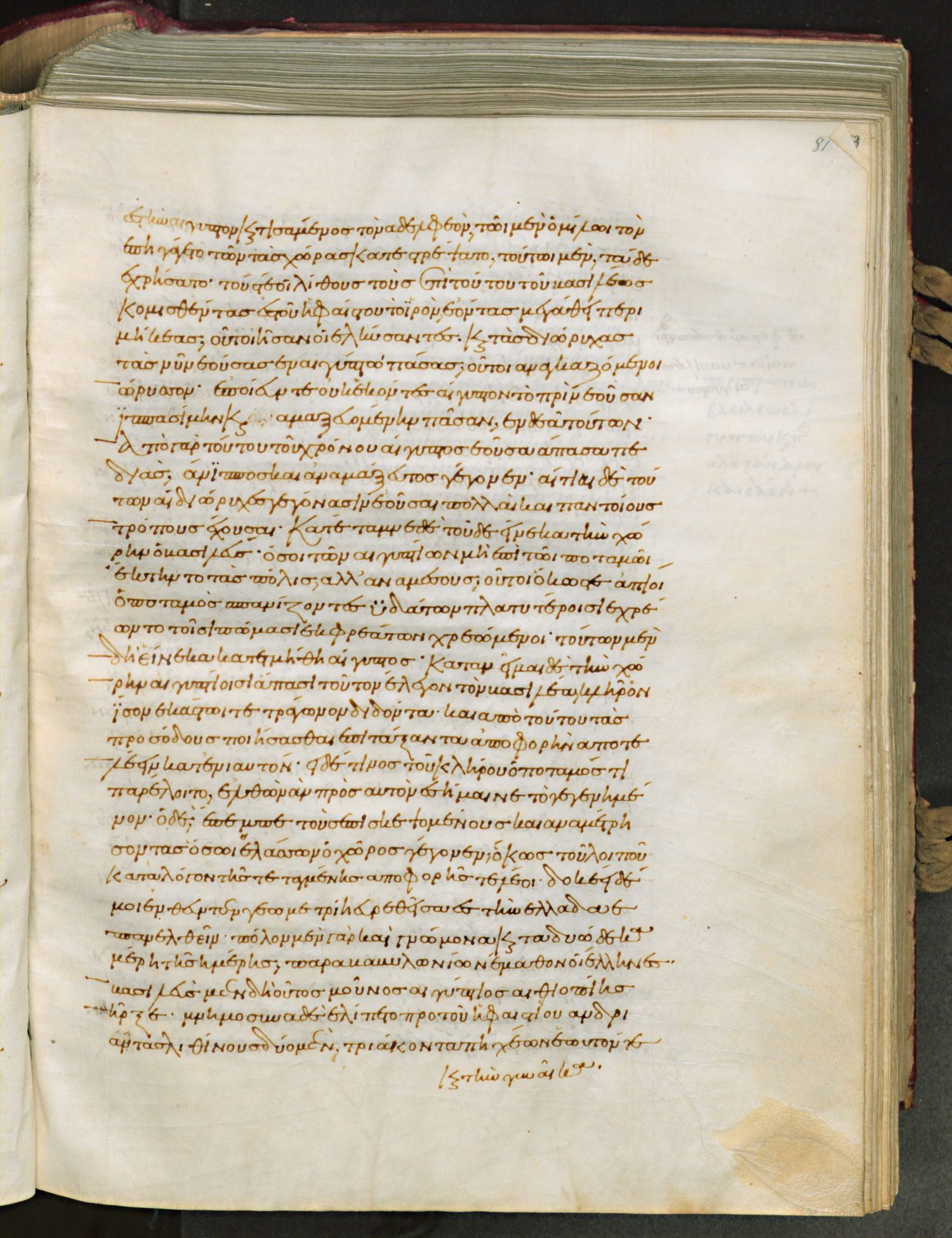
Laur. Plut. 70.3, fol. 81r: Greek here 2.108.1 to 2.110.1. Checked on the image (first and last words read and located in the Greek; each break checked against the neighbouring page): fol. 81r begins ‹ἐς τὴν Αἴγυπτον καὶ› (2.108.1), ends ‹τε καὶ τὴν γυναῖκα› (2.110.1) (page breaks read on the image for the Herodotus on Egypt collection). English here: 2.108.1 to 2.110.1 (Godley's sentences for the sections whose Greek lies mostly on this page).
2.108.1ἐς τὴν Αἴγυπτον καὶ τισάμενος τὸν ἀδελφεόν, τῷ μὲν ὁμίλῳ τὸν ἐπηγάγετο τῶν τὰς χώρας κατεστρέψατο, τούτῳ μὲν τάδε ἐχρήσατο· 2.108.2τούς τέ οἱ λίθους τοὺς ἐπὶ τούτου τοῦ βασιλέος κομισθέντας ἐς τοῦ Ἡφαίστου τὸ ἱρόν, ἐόντας μεγάθεϊ περιμήκεας, οὗτοι ἦσαν οἱ ἑλκύσαντες, καὶ τὰς διώρυχας τὰς νῦν ἐούσας ἐν Αἰγύπτῳ πάσας οὗτοι ἀναγκαζόμενοι ὤρυσσον, ἐποίευν τε οὐκ ἑκόντες Αἴγυπτον, τὸ πρὶν ἐοῦσαν ἱππασίμην καὶ ἁμαξευομένην πᾶσαν, ἐνδεᾶ τούτων. 2.108.3ἀπὸ γὰρ τούτου τοῦ χρόνου Αἴγυπτος ἐοῦσα πεδιὰς πᾶσα ἄνιππος καὶ ἀναμάξευτος γέγονε· αἴτιαι δὲ τούτων αἱ διώρυχες γεγόνασι ἐοῦσαι πολλαὶ καὶ παντοίους τρόπους ἔχουσαί. 2.108.4κατέταμνε δὲ τοῦδε εἵνεκα τὴν χώρην ὁ βασιλεύς· ὅσοι τῶν Αἰγυπτίων μὴ ἐπὶ τῷ ποταμῷ ἔκτηντο τὰς πόλις ἀλλʼ ἀναμέσους, οὗτοι, ὅκως τε ἀπίοι ὁ ποταμός, σπανίζοντες ὑδάτων πλατυτέροισι ἐχρέωντο τοῖσι πόμασι, ἐκ φρεάτων χρεώμενοι. 2.109.1τούτων μὲν δὴ εἵνεκα κατετμήθη ἡ Αἴγυπτος. κατανεῖμαι δὲ τὴν χώρην Αἰγυπτίοισι ἅπασι τοῦτον ἔλεγον τὸν βασιλέα, κλῆρον ἴσον ἑκάστῳ τετράγωνον διδόντα, καὶ ἀπὸ τούτου τὰς προσόδους ποιήσασθαι, ἐπιτάξαντα ἀποφορὴν ἐπιτελέειν κατʼ ἐνιαυτόν. 2.109.2εἰ δὲ τινὸς τοῦ κλήρου ὁ ποταμός τι παρέλοιτο, ἐλθὼν ἂν πρὸς αὐτὸν ἐσήμαινε τὸ γεγενημένον· ὁ δὲ ἔπεμπε τοὺς ἐπισκεψομένους καὶ ἀναμετρήσοντας ὅσῳ ἐλάσσων ὁ χῶρος γέγονε, ὅκως τοῦ λοιποῦ κατὰ λόγον τῆς τεταγμένης ἀποφορῆς τελέοι. 2.109.3δοκέει δέ μοι ἐνθεῦτεν γεωμετρίη εὑρεθεῖσα ἐς τὴν Ἑλλάδα ἐπανελθεῖν· πόλον μὲν γὰρ καὶ γνώμονα καὶ τὰ δυώδεκα μέρεα τῆς ἡμέρης παρὰ Βαβυλωνίων ἔμαθον οἱ Ἕλληνες. 2.110.1βασιλεὺς μὲν δὴ οὗτος μοῦνος Αἰγύπτιος Αἰθιοπίης ἦρξε, μνημόσυνα δὲ ἐλίπετο πρὸ τοῦ Ἡφαιστείου ἀνδριάντας λιθίνους, δύο μὲν τριήκοντα πηχέων, ἑωυτόν τε καὶ τὴν γυναῖκα,
2.108.1Having returned to Egypt, and taken vengeance on his brother, Sesostris found work, as I shall show, for the multitude which he brought with him from the countries which he had subdued. 2.108.2It was these who dragged the great and long blocks of stone which were brought in this king’s reign to the temple of Hephaestus; and it was they who were compelled to dig all the canals which are now in Egypt, and thus, albeit with no such intent, made what was before a land of horses and carts to be now without either. 2.108.3For from this time Egypt, albeit a level land, could use no horses or carts, by reason of the canals being so many and going every way. The reason why the king thus intersected the country was this: 2.108.4those Egyptians whose towns were not on the Nile but inland from it lacked water whenever the flood left their land, and drank only brackish water from wells. 2.109.1For this cause Egypt was intersected. This king moreover (so they said) divided the country among all the Egyptians by giving each an equal square parcel of land, and made this his source of revenue, appointing the payment of a yearly tax. 2.109.2And any man who was robbed by the river of a part of his land would come to Sesostris and declare what had befallen him; then the king would send men to look into it and measure the space by which the land was diminished, so that thereafter it should pay in proportion to the tax originally imposed. 2.109.3From this, to my thinking, the Greeks learnt the art of measuring land; the sunclock and the sundial, and the twelve divisions of the day, came to Hellas not from Egypt but from Babylonia. 2.110.1Sesostris was the only Egyptian king who also ruled Ethiopia. To commemorate his name, he set before the temple of Hephaestus two stone statues of himself and his wife, each thirty cubits high, and statues of his four sons, each of twenty cubits.
Where on the image
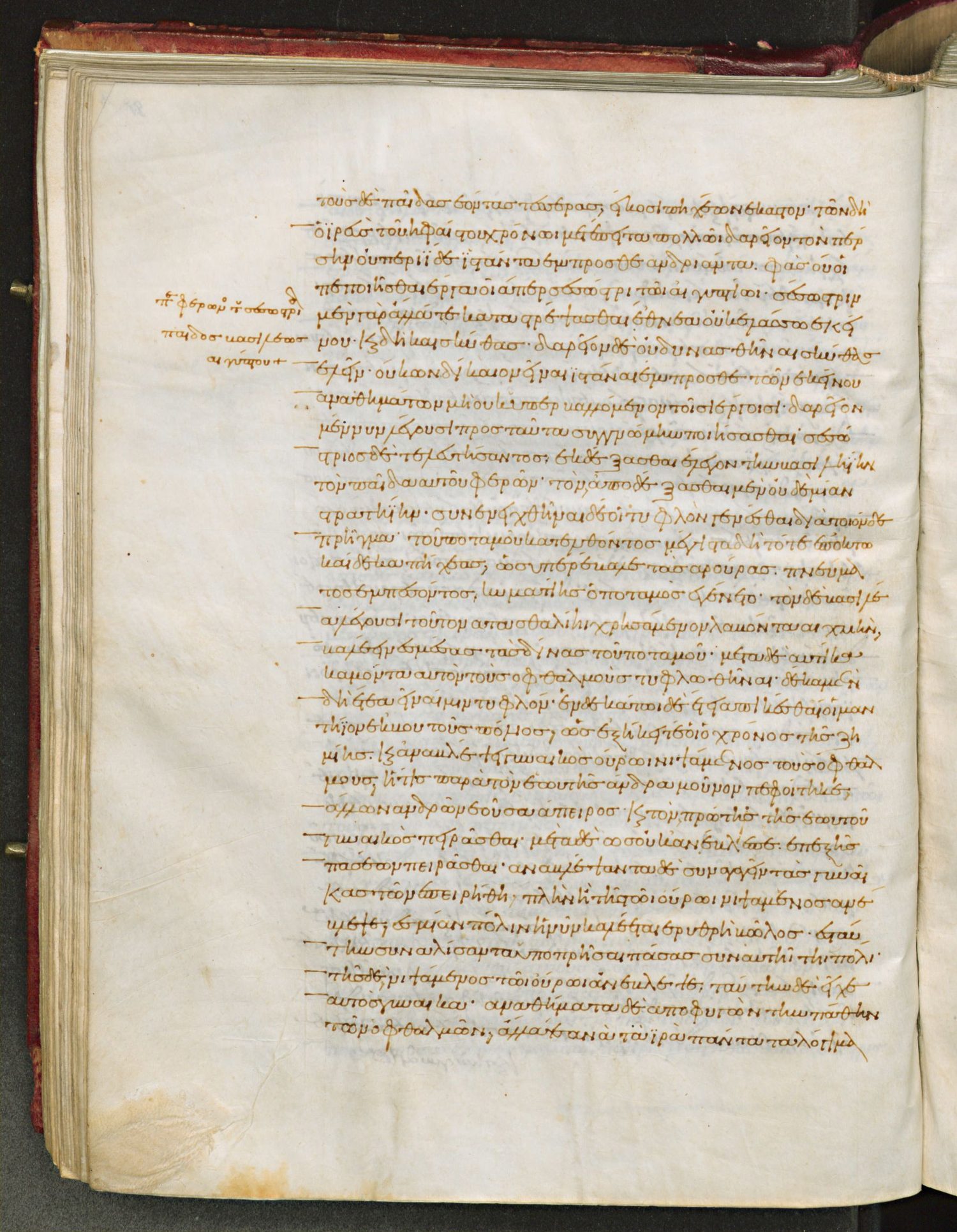
Laur. Plut. 70.3, fol. 81v: Greek here 2.110.1 to 2.110.3. Checked on the image (first and last words read and located in the Greek; each break checked against the neighbouring page): fol. 81v begins ‹τοὺς δὲ παῖδας ἐόντας› (2.110.1), ends ‹ἱρὰ πάντα τὰ λόγιμα› (2.111.4) (page breaks read on the image for the Herodotus on Egypt collection). English here: 2.110.2 to 2.110.3 (Godley's sentences for the sections whose Greek lies mostly on this page).
2.110.1τοὺς δὲ παῖδας ἐόντας τέσσερας εἴκοσι πηχέων ἕκαστον· 2.110.2τῶν δὴ ὁ ἱρεὺς τοῦ Ἡφαίστου χρόνῳ μετέπειτα πολλῷ Δαρεῖον τὸν Πέρσην οὐ περιεῖδε ἱστάντα ἔμπροσθε ἀνδριάντα, φὰς οὔ οἱ πεποιῆσθαι ἔργα οἷά περ Σεσώστρι τῷ Αἰγυπτίῳ· Σέσωστριν μὲν γὰρ ἄλλα τε καταστρέψασθαι ἔθνεα οὐκ ἐλάσσω ἐκείνου καὶ δὴ καὶ Σκύθας, Δαρεῖον δὲ οὐ δυνασθῆναι Σκύθας ἑλεῖν· 2.110.3οὔκων δίκαιον εἶναι ἱστάναι ἔμπροσθε τῶν ἐκείνου ἀναθημάτων μὴ οὐκ ὑπερβαλλόμενον τοῖσι ἔργοισι. Δαρεῖον μέν νυν λέγουσι πρὸς ταῦτα συγγνώμην ποιήσασθαι.
2.110.2Long afterwards Darius the Persian would have set up his statue before these; but the priest of Hephaestus forbade him, saying that he had achieved nothing equal to the deeds of Sesostris the Egyptian; for Sesostris (he said) had subdued the Scythians, besides as many other nations as Darius had conquered, and Darius had not been able to overcome the Scythians; 2.110.3therefore it was not just that Darius should set his statue before the statues of Sesostris, whose achievements he had not equalled. Darius, it is said, let the priest have his way.
Notes
- Greek: the text printed in A. D. Godley's Loeb edition, via Perseus (tlg0016.tlg001.perseus-grc2). Square brackets mark words the editor considers later additions; [...] marks a gap the editor indicates. Perseus note markers are omitted.
- English: A. D. Godley, Herodotus vol. 1 (1920) (Loeb Classical Library), as transcribed on Wikisource. Godley's footnotes are omitted.
- Section numbers in the English were placed by comparing Godley's text with the Perseus version of his translation; where a section begins inside one of Godley's sentences, the English is kept with the page that holds the start of that sentence.
Cite
Sources
- Source: Florence, Laur. Plut. 70.3 (10th c.) via BML Teca Digitale + Greek of Godley's Loeb (Perseus) + English of A. D. Godley (Loeb, Wikisource) (holding institution)
- Critical edition: Greek of A. D. Godley's Loeb edition (1920-1925), via Perseus
← previous · → next · v cycle view · l back to library