Herodotus, Histories 3.17-29: The long-lived Ethiopians, Ammon and the Apis
Introduction
Herodotus of Halicarnassus wrote the Histories in the third quarter of the 5th century BCE, an inquiry into the deeds of Greeks and barbarians and the causes of the wars between them, later divided into nine books. Book 3 tells of Cambyses' conquest of Egypt and his madness, Polycrates of Samos, the rising of the Magi and the seven Persians who overthrew them, the accession of Darius and his provinces, and the revolt and recapture of Babylon.
The photographs are of Florence, Biblioteca Medicea Laurenziana, Plut. 70.3 (parchment, 10th century, 374 folios, 31 lines a page), Herodotus, Histories (codex A of the editors), the oldest surviving manuscript of the complete Histories, from the Teca Digitale of the Biblioteca Medicea Laurenziana. Each section below is the text of one page, or of the part of a page that falls within these chapters. The first and last words of every page were read on the photograph and located in the Greek, and every page break was checked against the next page; the notes quote these words. Readers' notes in the margins are not part of the text and are mentioned where they occur.
The Greek is the text printed in A. D. Godley's Loeb edition (1920-1925), from Perseus; it is the edited text, not a transcription of the manuscript, whose wording differs in places. The English is Godley's translation as printed, from Wikisource. Godley's English carries only chapter numbers; the section numbers shown in it were placed by comparison with the Perseus version of his translation. Each page's English is cut at the end of one of Godley's sentences, so it can begin or end a few lines away from the Greek of the page; each note gives the exact ranges.
This entry covers chapters 3.17-29, on fol. 107r to 110v.
How was this verified? (Provenance)
Where on the image
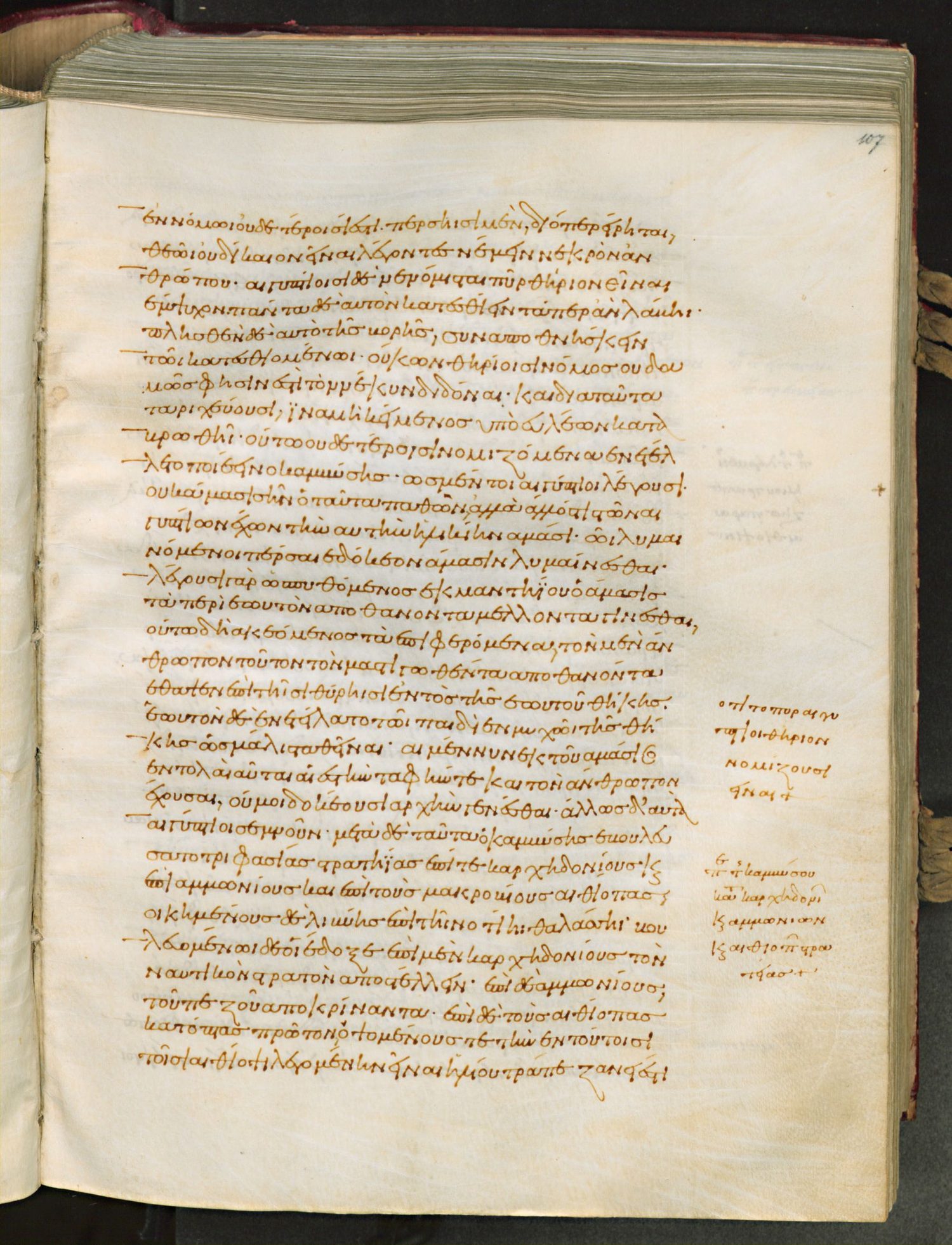
Laur. Plut. 70.3, fol. 107r: Greek here 3.17.1 to 3.17.2. Checked on the image (first and last words read and located in the Greek; each break checked against the neighbouring page): fol. 107r begins ‹ἐν νόμῳ οὐδετέροισι ἐστί,› (3.16.3), ends ‹ἡλίου τράπεζαν εἰ ἔστι› (3.17.2). English here: 3.17.1 to 3.17.2 (Godley's sentences for the sections whose Greek lies mostly on this page).
3.17.1μετὰ δὲ ταῦτα ὁ Καμβύσης ἐβουλεύσατο τριφασίας στρατηίας, ἐπί τε Καρχηδονίους καὶ ἐπὶ Ἀμμωνίους καὶ ἐπὶ τοὺς μακροβίους Αἰθίοπας, οἰκημένους δὲ Λιβύης ἐπὶ τῇ νοτίῃ θαλάσσῃ· 3.17.2βουλευομένῳ δέ οἱ ἔδοξε ἐπὶ μὲν Καρχηδονίους τὸν ναυτικὸν στρατὸν ἀποστέλλειν, ἐπὶ δὲ Ἀμμωνίους τοῦ πεζοῦ ἀποκρίναντα, ἐπὶ δὲ τοὺς Αἰθίοπας κατόπτας πρῶτον, ὀψομένους τε τὴν ἐν τούτοισι τοῖσι Αἰθίοψι λεγομένην εἶναι ἡλίου τράπεζαν εἰ ἔστι
3.17.1After this Cambyses planned three expeditions, against the Carchedonians, and against the Ammonians, and against the “long-lived” Ethiopians, who dwelt on the Libyan coast of the southern sea. 3.17.2Taking counsel, he resolved to send his fleet against the Carchedonians and a part of his land army against the Ammonians; to Ethiopia he would send first spies, to see what truth there were in the story of a Table of the Sun in that country, and to spy out all else besides, under the pretext of bearing gifts for the Ethiopian king.
Where on the image
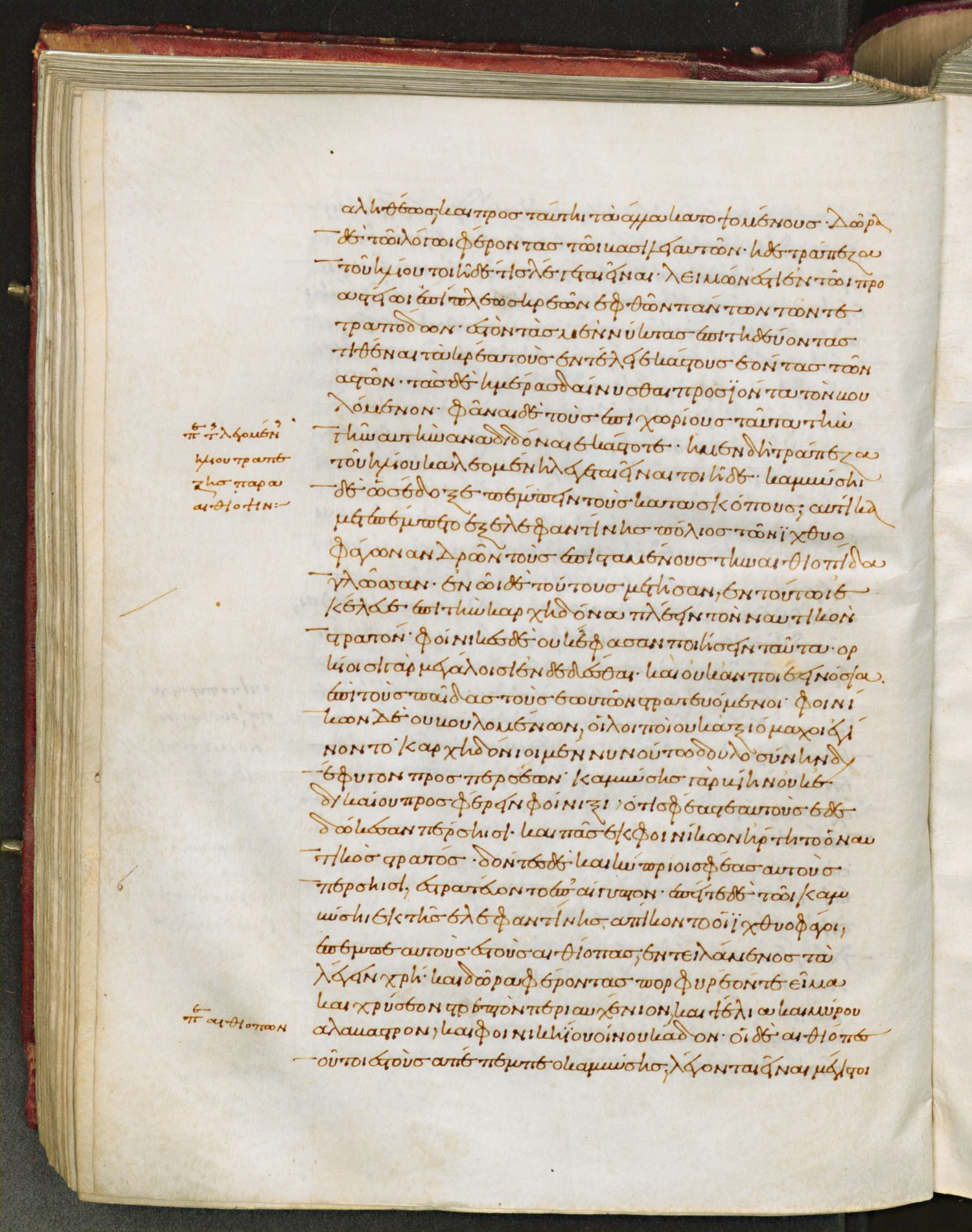
Laur. Plut. 70.3, fol. 107v: Greek here 3.17.2 to 3.20.1. Checked on the image (first and last words read and located in the Greek; each break checked against the neighbouring page): fol. 107v begins ‹ἀληθέως, καὶ πρὸς ταύτῃ› (3.17.2), ends ‹Καμβύσης, λέγονται εἶναι μέγιστοι› (3.20.1). English here: 3.18.1 to 3.20.1 (Godley's sentences for the sections whose Greek lies mostly on this page).
3.17.2ἀληθέως, καὶ πρὸς ταύτῃ τὰ ἄλλα κατοψομένους, δῶρα δὲ τῷ λόγῳ φέροντας τῷ βασιλέι αὐτῶν. 3.18.1ἡ δὲ τράπεζα τοῦ ἡλίου τοιήδε τις λέγεται εἶναι, λειμὼν ἐστὶ ἐν τῷ προαστείῳ ἐπίπλεος κρεῶν ἑφθῶν πάντων τῶν τετραπόδων, ἐς τὸν τὰς μὲν νύκτας ἐπιτηδεύοντας τιθέναι τὰ κρέα τοὺς ἐν τέλεϊ ἑκάστοτε ἐόντας τῶν ἀστῶν, τὰς δὲ ἡμέρας δαίνυσθαι προσιόντα τὸν βουλόμενον. φάναι δὲ τοὺς ἐπιχωρίους ταῦτα τὴν γῆν αὐτὴν ἀναδιδόναι ἑκάστοτε. 3.19.1ἡ μὲν δὴ τράπεζα τοῦ ἡλίου καλεομένη λέγεται εἶναι τοιήδε. Καμβύσῃ δὲ ὡς ἔδοξε πέμπειν τοὺς κατασκόπους, αὐτίκα μετεπέμπετο ἐξ Ἐλεφαντίνης πόλιος τῶν Ἰχθυοφάγων ἀνδρῶν τοὺς ἐπισταμένους τὴν Αἰθιοπίδα γλῶσσαν. 3.19.2ἐν ᾧ δὲ τούτους μετήισαν, ἐν τούτῳ ἐκέλευε ἐπὶ τὴν Καρχηδόνα πλέειν τὸν ναυτικὸν στρατόν. Φοίνικες δὲ οὐκ ἔφασαν ποιήσειν ταῦτα· ὁρκίοισι γὰρ μεγάλοισι ἐνδεδέσθαι, καὶ οὐκ ἂν ποιέειν ὅσια ἐπὶ τοὺς παῖδας τοὺς ἑωυτῶν στρατευόμενοι. Φοινίκων δὲ οὐ βουλομένων οἱ λοιποὶ οὐκ ἀξιόμαχοι ἐγίνοντο. 3.19.3Καρχηδόνιοι μέν νυν οὕτω δουλοσύνην διέφυγον πρὸς Περσέων· Καμβύσης γὰρ βίην οὐκ ἐδικαίου προσφέρειν Φοίνιξι, ὅτι σφέας τε αὐτοὺς ἐδεδώκεσαν Πέρσῃσι καὶ πᾶς ἐκ Φοινίκων ἤρτητο ὁ ναυτικὸς στρατός. δόντες δὲ καὶ Κύπριοι σφέας αὐτοὺς Πέρσῃσι ἐστρατεύοντο ἐπʼ Αἴγυπτον. 3.20.1ἐπείτε δὲ τῷ Καμβύσῃ ἐκ τῆς Ἐλεφαντίνης ἀπίκοντο οἱ Ἰχθυοφάγοι, ἔπεμπε αὐτοὺς ἐς τοὺς Αἰθίοπας ἐντειλάμενος τὰ λέγειν χρῆν καὶ δῶρα φέροντας πορφύρεόν τε εἷμα καὶ χρύσεον στρεπτὸν περιαυχένιον καὶ ψέλια καὶ μύρου ἀλάβαστρον καὶ φοινικηίου οἴνου κάδον. οἱ δὲ Αἰθίοπες οὗτοι, ἐς τοὺς ἀπέπεμπε ὁ Καμβύσης, λέγονται εἶναι μέγιστοι
3.18.1Now this is said to be the fashion of the Table of the Sun. There is a meadow outside the city, filled with the boiled flesh of all four-footed things; here during the night the men of authority among the townsmen are careful to set out the meat, and all day he that wishes comes and feasts thereon. These meats, say the people of the country, are ever produced by the earth of itself. 3.19.1Such is the story of the Sun’s Table. When Cambyses was resolved to send the spies, he sent straightway to fetch from the city Elephantine those of the Fish-eaters who understood the Ethiopian language. 3.19.2While they were seeking these men, he bade his fleet sail against Carchedon. But the Phoenicians would not consent; for they were bound, they said, by a strict treaty, and could not righteously attack their own sons; and the Phoenicians being unwilling, the rest were of no account as fighters. 3.19.3Thus the Carchedonians escaped being enslaved by the Persians; for Cambyses would not use force with the Phoenicians, seeing that they had willingly surrendered to the Persians, and the whole fleet drew its strength from them. The Cyprians too had come of their own accord to aid the Persians against Egypt. 3.20.1When the Fish-eaters came from Elephantine at Cambyses’ message, he sent them to Ethiopia, charged with what they should say, and bearing gifts, to wit, a purple cloak and a twisted gold necklace and armlets and an alabaster box of incense and an earthenware jar of palm wine. These Ethiopians, to whom Cambyses sent them, are said to be the tallest and fairest of all men.
Where on the image
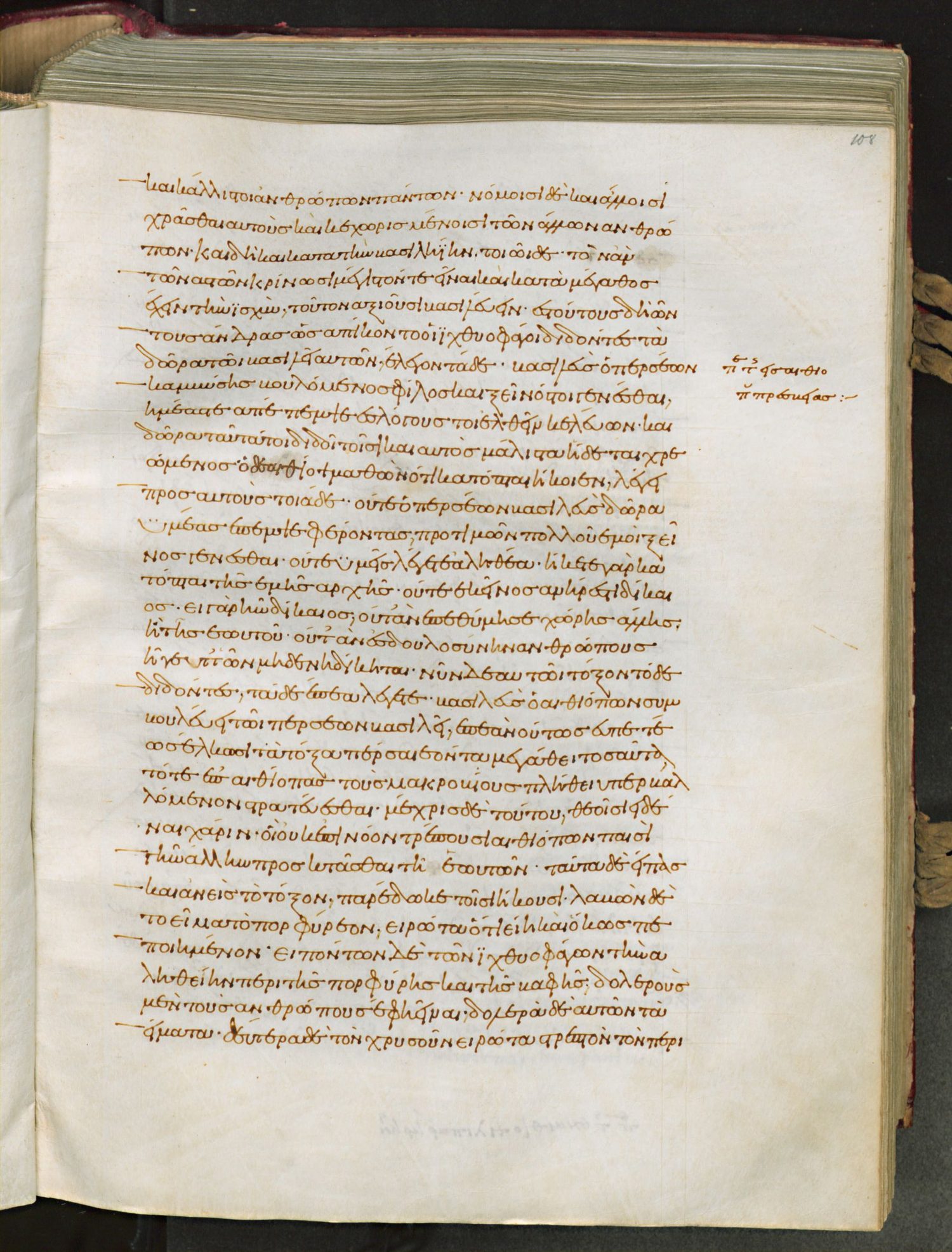
Laur. Plut. 70.3, fol. 108r: Greek here 3.20.1 to 3.22.2. Checked on the image (first and last words read and located in the Greek; each break checked against the neighbouring page): fol. 108r begins ‹καὶ κάλλιστοι ἀνθρώπων πάντων.νόμοισι› (3.20.1), ends ‹τὸν στρεπτὸν τὸν περι-› (3.22.2). English here: 3.20.2 to 3.22.1 (Godley's sentences for the sections whose Greek lies mostly on this page).
3.20.1καὶ κάλλιστοι ἀνθρώπων πάντων. 3.20.2νόμοισι δὲ καὶ ἄλλοισι χρᾶσθαι αὐτοὺς κεχωρισμένοισι τῶν ἄλλων ἀνθρώπων καὶ δὴ καὶ κατὰ τὴν βασιληίην τοιῷδε· τὸν ἂν τῶν ἀστῶν κρίνωσι μέγιστόν τε εἶναι καὶ κατὰ τὸ μέγαθος ἔχειν τὴν ἰσχύν, τοῦτον ἀξιοῦσι βασιλεύειν. 3.21.1ἐς τούτους δὴ ὦν τοὺς ἄνδρας ὡς ἀπίκοντο οἱ Ἰχθυοφάγοι, διδόντες τὰ δῶρα τῷ, βασιλέι αὐτῶν ἔλεγον τάδε. βασιλεὺς ὁ Περσέων Καμβύσης, βουλόμενος φίλος καὶ ξεῖνός τοι γενέσθαι, ἡμέας τε ἀπέπεμψε ἐς λόγους τοι ἐλθεῖν κελεύων, καὶ δῶρα ταῦτά τοι διδοῖ τοῖσι καὶ αὐτὸς μάλιστα ἥδεται χρεώμενος. 3.21.2ὁ δὲ Αἰθίοψ μαθὼν ὅτι κατόπται ἥκοιεν, λέγει πρὸς αὐτοὺς τοιάδε. οὔτε ὁ Περσέων βασιλεὺς δῶρα ὑμέας ἔπεμψε φέροντας προτιμῶν πολλοῦ ἐμοὶ ξεῖνος γενέσθαι, οὔτε ὑμεῖς λέγετε ἀληθέα (ἥκετε γὰρ κατόπται τῆς ἐμῆς ἀρχῆς), οὔτε ἐκεῖνος ἀνήρ δίκαιος. εἰ γὰρ ἦν δίκαιος, οὔτʼ ἂν ἐπεθύμησε χώρης ἄλλης ἢ τῆς ἑωυτοῦ, οὔτʼ ἂν ἐς δουλοσύνην ἀνθρώπους ἦγε ὑπʼ ὧν μηδὲν ἠδίκηται. νῦν δὲ αὐτῷ τόξον τόδε διδόντες τάδε ἔπεα λέγετε. 3.21.3βασιλεὺς ὁ Αἰθιόπων συμβουλεύει τῷ Περσέων βασιλέι, ἐπεὰν οὕτω εὐπετέως ἕλκωσι τὰ τόξα Πέρσαι ἐόντα μεγάθεϊ τοσαῦτα, τότε ἐπʼ Αἰθίοπας τοὺς μακροβίους πλήθεϊ ὑπερβαλλόμενον στρατεύεσθαι· μέχρι δὲ τούτου θεοῖσι εἰδέναι χάριν, οἳ οὐκ ἐπὶ νόον τρέπουσι Αἰθιόπων παισὶ γῆν ἄλλην προσκτᾶσθαι τῇ ἑωυτῶν. 3.22.1ταῦτα δὲ εἴπας καὶ ἀνεὶς τὸ τόξον παρέδωκε τοῖσι ἥκουσι. λαβὼν δὲ τὸ εἷμα τὸ πορφύρεον εἰρώτα ὅ τι εἴη καὶ ὅκως πεποιημένον· εἰπόντων δὲ τῶν Ἰχθυοφάγων τὴν ἀληθείην περὶ τῆς πορφύρης καὶ τῆς βαφῆς, δολεροὺς μὲν τοὺς ἀνθρώπους ἔφη εἶναι, δολερὰ δὲ αὐτῶν τὰ εἵματα. 3.22.2δεύτερα δὲ τὸν χρυσὸν εἰρώτα τὸν στρεπτὸν τὸν περιαυχένιον
3.20.2Their way of choosing kings is different from that of all others, as (it is said) are all their laws; they deem worthy to be their king that townsman whom they judge to be tallest and to have strength proportioned to his stature. 3.21.1These were the men to whom the Fish-eaters came, offering gifts and delivering this message to their king: “Cambyses king of Persia, desiring to be your friend and guest, sends us with command to address ourselves to you; and he offers you such gifts as he himself chiefly delights to use.” 3.21.2But the Ethiopian, perceiving that they had come as spies, spoke thus to them: “It is not because he sets great store by my friendship that the Persian King sends you with gifts, nor do you speak the truth (for you have come to spy out my dominions), nor is your king a righteous man; for were he such, he would not have coveted any country other than his own, nor would he now try to enslave men who have done him no wrong. 3.21.3Now, give him this bow, and this message: ‘The King of the Ethiopians counsels the King of the Persians, when the Persians can draw a bow of this greatness as easily as I do, then to bring overwhelming odds to attack the long-lived Ethiopians; but till then, to thank the gods who put it not in the minds of the sons of the Ethiopians to win more territory than they have.’” 3.22.1So speaking he unstrung the bow and gave it to the men who had come. Then, taking the purple cloak, he asked what it was and how it was made; and when the Fish-eaters told him the truth about the purple and the way of dyeing, he said that both the men and their garments were full of guile.
Where on the image
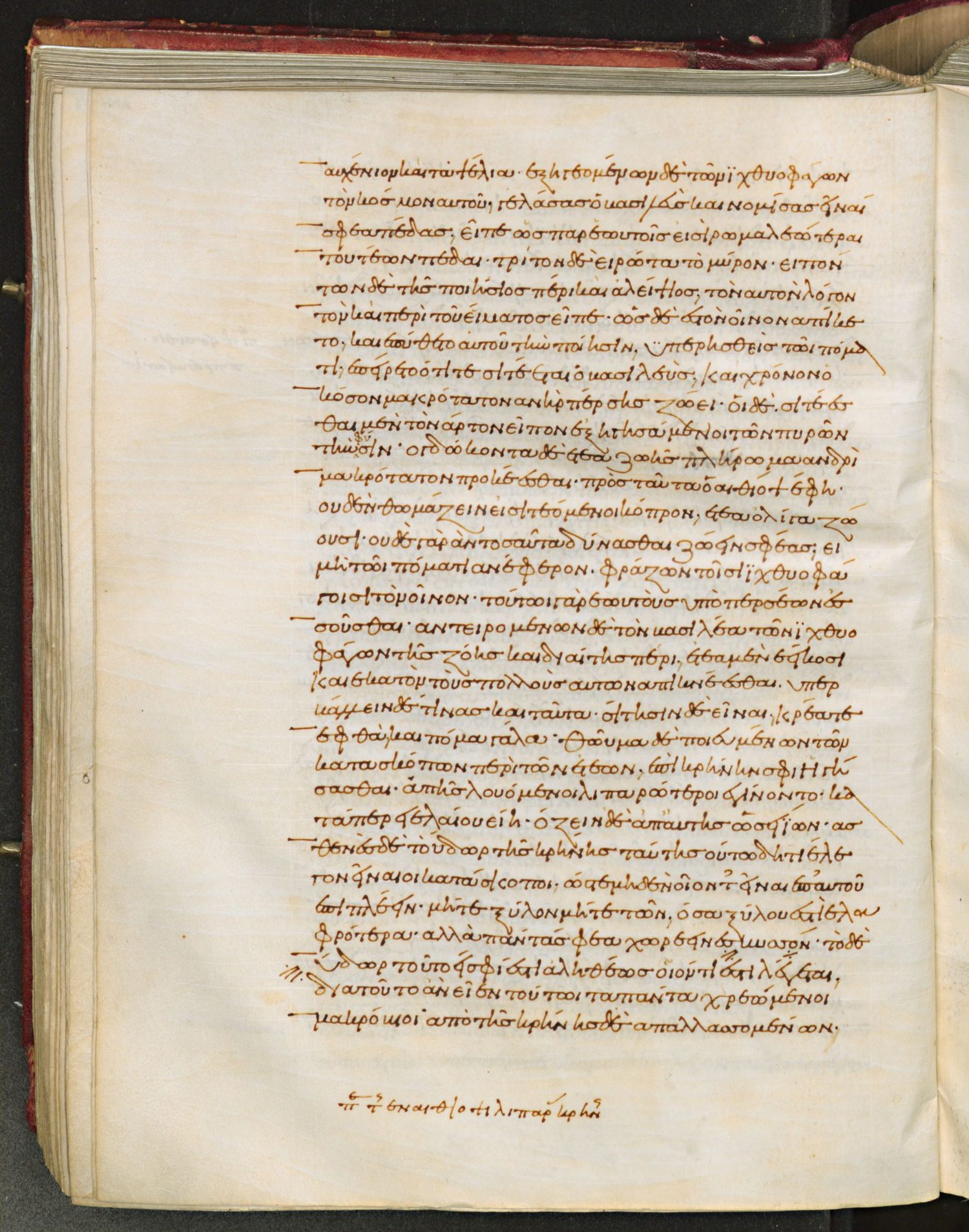
Laur. Plut. 70.3, fol. 108v: Greek here 3.22.2 to 3.23.4. Checked on the image (first and last words read and located in the Greek; each break checked against the neighbouring page): fol. 108v begins ‹-αυχένιον καὶ τὰ ψέλια·› (3.22.2), ends ‹τῆς κρήνης δὲ ἀπαλλασσομένων› (3.23.4). The word ‹περιαυχένιον› is divided between fol. 108r and fol. 108v; it is given with fol. 108r. Below the text, a reader's note on the spring in Ethiopia. English here: 3.22.2 to 3.23.3 (Godley's sentences for the sections whose Greek lies mostly on this page).
3.22.2καὶ τὰ ψέλια· ἐξηγεομένων δὲ τῶν Ἰχθυοφάγων τὸν κόσμον αὐτοῦ, γελάσας ὁ βασιλεὺς καὶ νομίσας εἶναι σφέα πέδας εἶπε ὡς παρʼ ἑωυτοῖσι εἰσὶ ῥωμαλεώτεραι τουτέων πέδαι. 3.22.3τρίτον δὲ εἰρώτα τὸ μύρον· εἰπόντων δὲ τῆς ποιήσιος πέρι καὶ ἀλείψιος, τὸν αὐτὸν λόγον τὸν καὶ περὶ τοῦ εἵματος εἶπε. ὡς δὲ ἐς τὸν οἶνον ἀπίκετο καὶ ἐπύθετο αὐτοῦ τὴν ποίησιν, ὑπερησθεὶς τῷ πόματι ἐπείρετο ὅ τι τε σιτέεται ὁ βασιλεὺς καὶ χρόνον ὁκόσον μακρότατον ἀνὴρ Πέρσης ζώει. 3.22.4οἳ δὲ σιτέεσθαι μὲν τὸν ἄρτον εἶπον, ἐξηγησάμενοι τῶν πυρῶν τὴν φύσιν, ὀγδώκοντα δὲ ἔτεα ζόης πλήρωμα ἀνδρὶ μακρότατον προκεῖσθαι. πρὸς ταῦτα ὁ Αἰθίοψ ἔφη οὐδὲν θωμάζειν εἰ σιτεόμενοι κόπρον ἔτεα ὀλίγα ζώουσι· οὐδὲ γὰρ ἂν τοσαῦτα δύνασθαι ζώειν σφέας, εἰ μὴ τῷ πόματι ἀνέφερον, φράζων τοῖσι Ἰχθυοφάγοισι τὸν οἶνον· τούτῳ γὰρ ἑωυτοὺς ὑπὸ Περσέων ἑσσοῦσθαι. 3.23.1ἀντειρομένων δὲ τὸν βασιλέα τῶν Ἰχθυοφάγων τῆς ζόης καὶ διαίτης πέρι, ἔτεα μὲν ἐς εἴκοσι καὶ ἑκατὸν τοὺς πολλοὺς αὐτῶν ἀπικνέεσθαι, ὑπερβάλλειν δὲ τινὰς καὶ ταῦτα, σίτησιν δὲ εἶναι κρέα τε ἑφθὰ καὶ πόμα γάλα. 3.23.2θῶμα δὲ ποιευμένων τῶν κατασκόπων περὶ τῶν ἐτέων, ἐπὶ κρήνην σφι ἡγήσασθαι, ἀπʼ ἧς λουόμενοι λιπαρώτεροι ἐγίνοντο, κατά περ εἰ ἐλαίου εἴη· ὄζειν δὲ ἀπʼ αὐτῆς ὡς εἰ ἴων. 3.23.3ἀσθενὲς δὲ τὸ ὕδωρ τῆς κρήνης ταύτης οὕτω δή τι ἔλεγον εἶναι οἱ κατάσκοποι ὥστε μηδὲν οἷόν τʼ εἶναι ἐπʼ αὐτοῦ ἐπιπλέειν, μήτε ξύλον μήτε τῶν ὅσα ξύλου ἐστὶ ἐλαφρότερα, ἀλλὰ πάντα σφέα χωρέειν ἐς βυσσόν. τὸ δὲ ὕδωρ τοῦτο εἴ σφι ἐστὶ ἀληθέως οἷόν τι λέγεται, διὰ τοῦτο ἂν εἶεν, τούτῳ τὰ πάντα χρεώμενοι, μακρόβιοι. 3.23.4ἀπὸ τῆς κρήνης δὲ ἀπαλλασσομένων,
3.22.2Next he inquired about the twisted gold necklace and the bracelets; and when the Fish-eaters told him how they were made, the king smiled, and, thinking them to be fetters, said: “We have stronger chains than these.” 3.22.3Thirdly he inquired about the incense; and when they told him of the making and the applying of it, he made the same reply as about the cloak. But when he came to the wine and asked about the making of it, he was vastly pleased with the draught, and asked further what food their king ate, and what was the greatest age to which a Persian lived. 3.22.4They told him their king ate bread, showing him how wheat grew; and said that the full age to which a man might hope to live was eighty years. Then said the Ethiopian, it was no wonder that their lives were so short, if they ate dung; they would never attain even to that age were it not for the strengthening power of the draught,—whereby he signified to the Fish-eaters the wine,—for in this, he said, the Persians excelled the Ethiopians. 3.23.1The Fish-eaters then in turn asking of the Ethiopian length of life and diet, he said that most of them attained to an hundred and twenty years, and some even to more; their food was boiled meat and their drink milk. 3.23.2The spies showed wonder at the tale of years; whereon he led them, it is said, to a spring, by washing wherein they grew sleeker, as though it were of oil; and it smelt as it were of violets. 3.23.3So light, the spies said, was this water, that nothing would float on it, neither wood nor anything lighter than wood, but all sank to the bottom. If this water be truly such as they say, it is likely that their constant use of it makes the people long-lived.
Where on the image
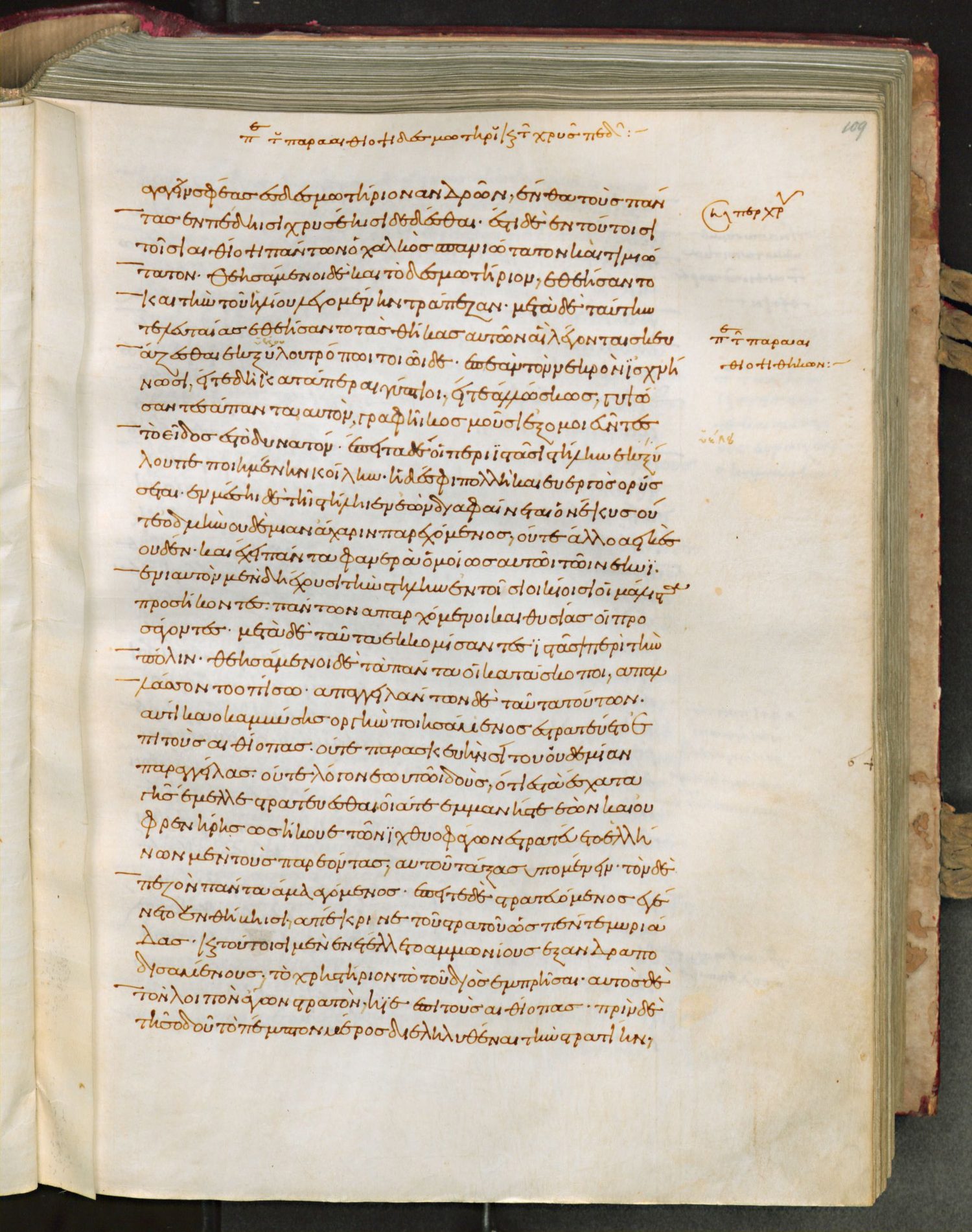
Laur. Plut. 70.3, fol. 109r: Greek here 3.23.4 to 3.25.4. Checked on the image (first and last words read and located in the Greek; each break checked against the neighbouring page): fol. 109r begins ‹ἀγαγεῖν σφεας ἐς δεσμωτήριον› (3.23.4), ends ‹μέρος διεληλυθέναι τὴν στρατιήν› (3.25.4). A reader's note on the Ethiopian prison with golden fetters stands in the upper margin. English here: 3.23.4 to 3.25.3 (Godley's sentences for the sections whose Greek lies mostly on this page).
3.23.4ἀγαγεῖν σφεας ἐς δεσμωτήριον ἀνδρῶν, ἔνθα τοὺς πάντας ἐν πέδῃσι χρυσέῃσι δεδέσθαι. ἔστι δὲ ἐν τούτοισι τοῖσι Αἰθίοψι πάντων ὁ χαλκὸς σπανιώτατον καὶ τιμιώτατον. θεησάμενοι δὲ καὶ τὸ δεσμωτήριον, ἐθεήσαντο καὶ τὴν τοῦ ἡλίου λεγομένην τράπεζαν. 3.24.1μετὰ δὲ ταύτην τελευταίας ἐθεήσαντο τὰς θήκας αὐτῶν, αἳ λέγονται σκευάζεσθαι ἐξ ὑέλου τρόπῳ τοιῷδε· 3.24.2ἐπεὰν τὸν νεκρὸν ἰσχνήνωσι, εἴτε δὴ κατά περ Αἰγύπτιοι εἴτε ἄλλως κως, γυψώσαντες ἅπαντα αὐτὸν γραφῇ κοσμέουσι, ἐξομοιεῦντες τὸ εἶδος ἐς τὸ δυνατόν, ἔπειτα δέ οἱ περιιστᾶσι στήλην ἐξ ὑέλου πεποιημένην κοίλην· ἣ δέ σφι πολλὴ καὶ εὐεργὸς ὀρύσσεται. 3.24.3ἐν μέσῃ δὲ τῇ στήλῃ ἐνεὼν διαφαίνεται ὁ νέκυς, οὔτε ὀδμὴν οὐδεμίαν ἄχαριν παρεχόμενος οὔτε ἄλλο ἀεικὲς οὐδέν, καὶ ἔχει πάντα φανερὰ ὁμοίως αὐτῷ τῷ νέκυϊ. 3.24.4ἐνιαυτὸν μὲν δὴ ἔχουσι τὴν στήλην ἐν τοῖσι οἰκίοισι οἱ μάλιστα προσήκοντες, πάντων ἀπαρχόμενοι καὶ θυσίας οἱ προσάγοντες· μετὰ δὲ ταῦτα ἐκκομίσαντες ἱστᾶσι περὶ τὴν πόλιν. 3.25.1θεησάμενοι δὲ τὰ πάντα οἱ κατάσκοποι ἀπαλλάσσοντο ὀπίσω. ἀπαγγειλάντων δὲ ταῦτα τούτων, αὐτίκα ὁ Καμβύσης ὀργὴν ποιησάμενος ἐστρατεύετο ἐπὶ τοὺς Αἰθίοπας, οὔτε παρασκευὴν σίτου οὐδεμίαν παραγγείλας, οὔτε λόγον ἑωυτῷ δοὺς ὅτι ἐς τὰ ἔσχατα γῆς ἔμελλε στρατεύεσθαι· 3.25.2οἷα δὲ ἐμμανής τε ἐὼν καὶ οὐ φρενήρης, ὡς ἤκουε τῶν Ἰχθυοφάγων, ἐστρατεύετο, Ἑλλήνων μὲν τοὺς παρεόντας αὐτοῦ τάξας ὑπομένειν, τὸν δὲ πεζὸν πάντα ἅμα ἀγόμενος. 3.25.3ἐπείτε δὲ στρατευόμενος ἐγένετο ἐν Θήβῃσι, ἀπέκρινε τοῦ στρατοῦ ὡς πέντε μυριάδας, καὶ τούτοισι μὲν ἐνετέλλετο Ἀμμωνίους ἐξανδραποδισαμένους τὸ χρηστήριον τὸ τοῦ Διὸς ἐμπρῆσαι, αὐτὸς δὲ τὸν λοιπὸν ἄγων στρατὸν ἤιε ἐπὶ τοὺς Αἰθίοπας. 3.25.4πρὶν δὲ τῆς ὁδοῦ τὸ πέμπτον μέρος διεληλυθέναι τὴν στρατιήν,
3.23.4When they left the spring, the king led them to a prison where all the men were bound with fetters of gold. Among these Ethiopians there is nothing so scarce and so precious as bronze. Then, having seen the prison, they saw what is called the Table of the Sun. 3.24.1Last after this they viewed the Ethiopian coffins; these are said to be made of alabaster, as I shall describe: 3.24.2they make the dead body to shrink, either as the Egyptians do or in some other way, then cover it with gypsum and paint it all as far as they may in the likeness of the living man; 3.24.3then they set it within a hollow pillar of alabaster, which they dig in abundance from the ground, and it is easily wrought; the body can be seen in the pillar through the alabaster, no evil stench nor aught unseemly proceeding from it, and showing clearly all its parts, as if it were the dead man himself. 3.24.4The nearest of kin keep the pillar in their house for a year, giving it of the firstfruits and offering it sacrifices; after which they bring the pillars out and set them round about the city. 3.25.1Having viewed all, the spies departed back again. When they reported all this, Cambyses was angry, and marched forthwith against the Ethiopians, neither giving command for any provision of food nor considering that he was about to lead his army to the ends of the earth; and 3.25.2being not in his right mind but mad, he marched at once on hearing from the Fish-eaters, setting the Greeks who were with him to await him where they were, and taking with him all his land army. 3.25.3When he came in his march to Thebes, he parted about fifty thousand men from his army, and charged them to enslave the Ammonians and burn the oracle of Zeus; and he himself went on towards Ethiopia with the rest of his host.
Where on the image
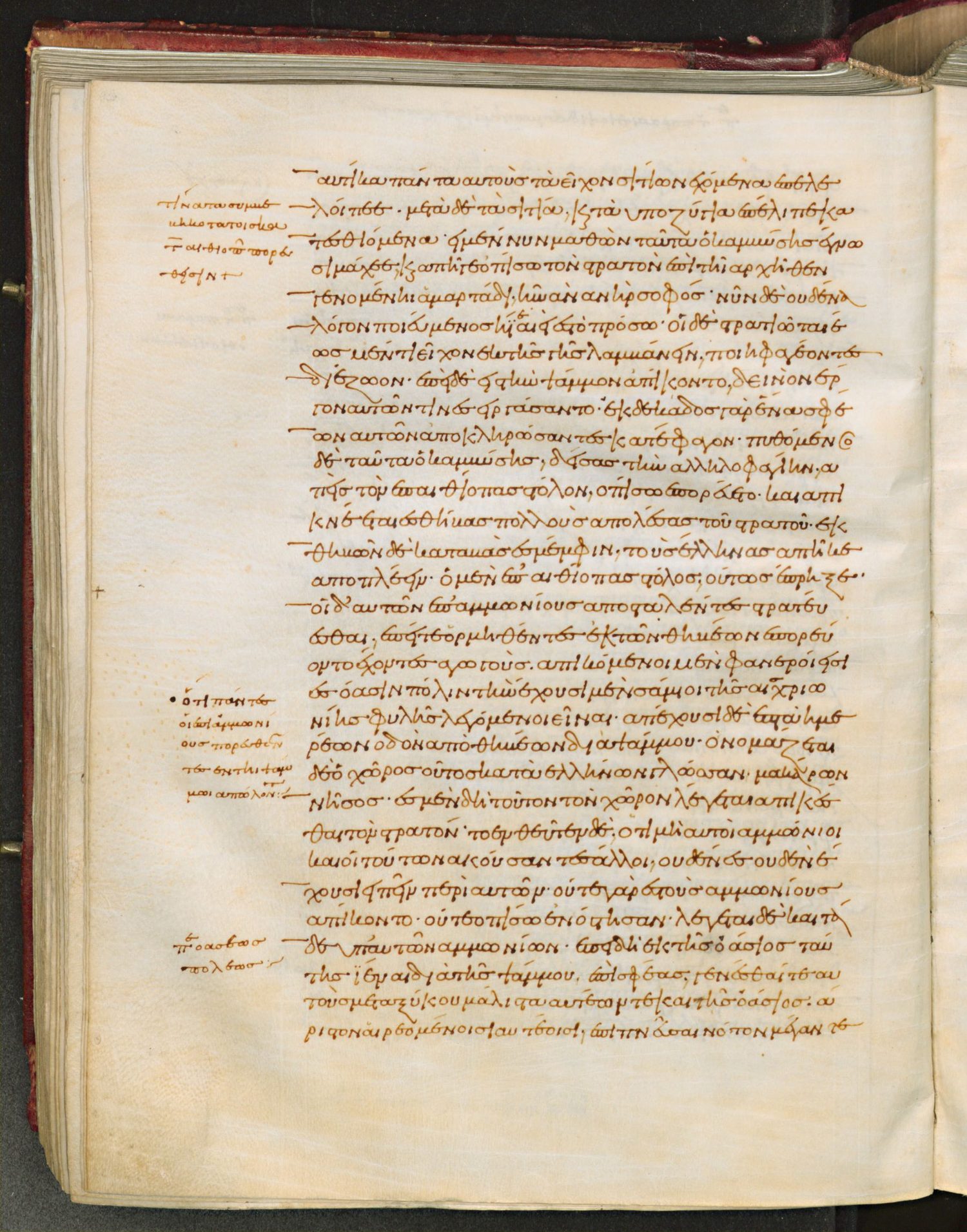
Laur. Plut. 70.3, fol. 109v: Greek here 3.25.4 to 3.26.3. Checked on the image (first and last words read and located in the Greek; each break checked against the neighbouring page): fol. 109v begins ‹αὐτίκα πάντα αὐτοὺς τὰ› (3.25.4), ends ‹ἐπιπνεῦσαι νότον μέγαν τε› (3.26.3). English here: 3.25.4 to 3.26.3 (Godley's sentences for the sections whose Greek lies mostly on this page).
3.25.4αὐτίκα πάντα αὐτοὺς τὰ εἶχον σιτίων ἐχόμενα ἐπελελοίπεε, μετὰ δὲ τὰ σιτία καὶ τὰ ὑποζύγια ἐπέλιπε κατεσθιόμενα. 3.25.5εἰ μέν νυν μαθὼν ταῦτα ὁ Καμβύσης ἐγνωσιμάχεε καὶ ἀπῆγε ὀπίσω τὸν στρατόν, ἐπὶ τῇ ἀρχῆθεν γενομένῃ ἁμαρτάδι ἦν ἂν ἀνὴρ σοφός· νῦν δὲ οὐδένα λόγον ποιεύμενος ἤιε αἰεὶ ἐς τὸ πρόσω. 3.25.6οἱ δὲ στρατιῶται ἕως μέν τι εἶχον ἐκ τῆς γῆς λαμβάνειν, ποιηφαγέοντες διέζωον, ἐπεὶ δὲ ἐς τὴν ψάμμον ἀπίκοντο, δεινὸν ἔργον αὐτῶν τινες ἐργάσαντο· ἐκ δεκάδος γὰρ ἕνα σφέων αὐτῶν ἀποκληρώσαντες κατέφαγον. 3.25.7πυθόμενος δὲ ταῦτα ὁ Καμβύσης, δείσας τὴν ἀλληλοφαγίην, ἀπεὶς τὸν ἐπʼ Αἰθίοπας στόλον ὀπίσω ἐπορεύετο καὶ ἀπικνέεται ἐς Θήβας πολλοὺς ἀπολέσας τοῦ στρατοῦ· ἐκ Θηβέων δὲ καταβὰς ἐς Μέμφιν τοὺς Ἕλληνας ἀπῆκε ἀποπλέειν. 3.26.1ὁ μὲν ἐπʼ Αἰθίοπας στόλος οὕτω ἔπρηξε· οἱ δʼ αὐτῶν ἐπʼ Ἀμμωνίους ἀποσταλέντες στρατεύεσθαι, ἐπείτε ὁρμηθέντες ἐκ τῶν Θηβέων ἐπορεύοντο ἔχοντες ἀγωγούς, ἀπικόμενοι μὲν φανεροί εἰσι ἐς Ὄασιν πόλιν, τὴν ἔχουσι μὲν Σάμιοι τῆς Αἰσχριωνίης φυλῆς λεγόμενοι εἶναι, ἀπέχουσι δὲ ἑπτὰ ἡμερέων ὁδὸν ἀπὸ Θηβέων διὰ ψάμμου· ὀνομάζεται δὲ ὁ χῶρος οὗτος κατὰ Ἑλλήνων γλῶσσαν Μακάρων νῆσος. 3.26.2ἐς μὲν δὴ τοῦτον τὸν χῶρον λέγεται ἀπικέσθαι τὸν στρατόν, τὸ ἐνθεῦτεν δέ, ὅτι μὴ αὐτοὶ Ἀμμώνιοι καὶ οἱ τούτων ἀκούσαντες, ἄλλοι οὐδένες οὐδὲν ἔχουσι εἰπεῖν περὶ αὐτῶν· οὔτε γὰρ ἐς τοὺς Ἀμμωνίους ἀπίκοντο οὔτε ὀπίσω ἐνόστησαν. 3.26.3λέγεται δὲ κατὰ τάδε ὑπʼ αὐτῶν Ἀμμωνίων· ἐπειδὴ ἐκ τῆς Ὀάσιος ταύτης ἰέναι διὰ τῆς ψάμμου ἐπὶ σφέας, γενέσθαι τε αὐτοὺς μεταξύ κου μάλιστα αὐτῶν τε καὶ τῆς Ὀάσιος, ἄριστον αἱρεομένοισι αὐτοῖσι ἐπιπνεῦσαι νότον μέγαν τε
3.25.4But before his army had accomplished the fifth part of their journey they had come to an end of all there was in the way of provision, and after the food was gone they ate the beasts of burden till there was none of these left also. 3.25.5Now had Cambyses, when he perceived this, changed his mind and led his army back again, he had been a wise man at last after his first fault; but as it was, he went ever forward, nothing recking. 3.25.6While his soldiers could get anything from the earth, they kept themselves alive by eating grass; but when they came to the sandy desert, certain of them did a terrible deed, taking by lot one man out of ten and eating him. 3.25.7Hearing this, Cambyses feared their becoming cannibals, and so gave up his expedition against the Ethiopians and marched back to Thebes, with the loss of many of his army; from Thebes he came down to Memphis, and sent the Greeks to sail away. 3.26.1So fared the expedition against Ethiopia. As for those of the host who were sent to march against the Ammonians, they set forth and journeyed from Thebes with guides; and it is known that they came to the city Oasis, where dwell Samians said to be of the Aeschrionian tribe, seven days’ march from Thebes across sandy desert; this place is called, in the Greek language, the Island of the Blest. 3.26.2Thus far, it is said, the army came; after that, save the Ammonians themselves and those who heard from them, no man can say aught of them; for they neither reached the Ammonians nor returned back. 3.26.3But this is what the Ammonians themselves say: When the Persians were crossing the sand from the Oasis to attack them, and were about midway between their country and the Oasis, while they were breakfasting a great and violent south wind arose, which buried them in the masses of sand which it bore; and so they disappeared from sight. Such is the Ammonian tale about this army.
Where on the image
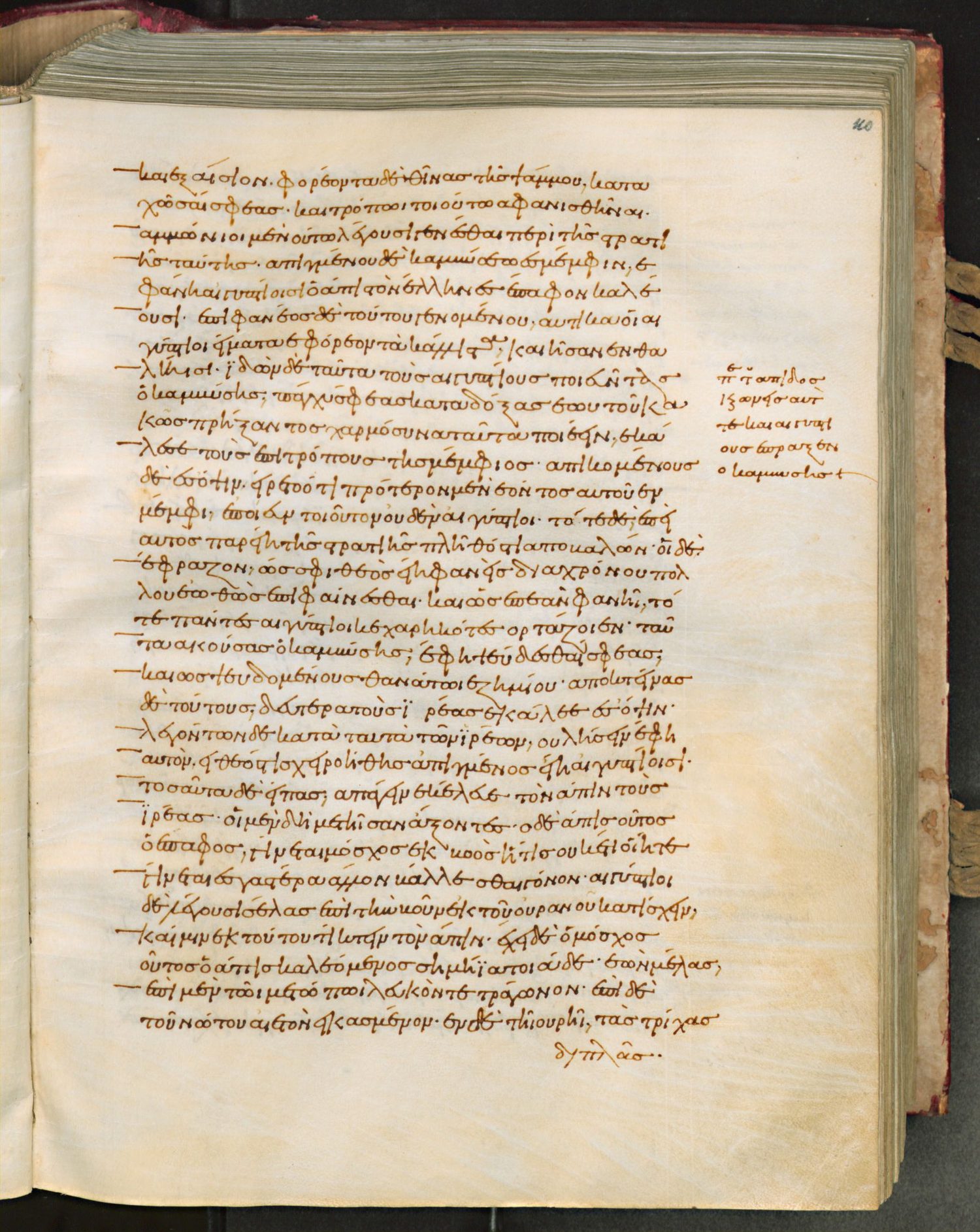
Laur. Plut. 70.3, fol. 110r: Greek here 3.26.3 to 3.28.3. Checked on the image (first and last words read and located in the Greek; each break checked against the neighbouring page): fol. 110r begins ‹καὶ ἐξαίσιον, φορέοντα δὲ› (3.26.3), ends ‹τῇ οὐρῇ τὰς τρίχας› (3.28.3). Fol. 110r ends τὰς τρίχας and fol. 110v begins ἐπὶ δὲ τῇ γλώσσῃ κάνθαρον: the edition has τὰς τρίχας διπλᾶς, ὑπὸ δὲ τῇ γλώσσῃ (3.28.3). English here: 3.27.1 to 3.28.3 (Godley's sentences for the sections whose Greek lies mostly on this page).
3.26.3καὶ ἐξαίσιον, φορέοντα δὲ θῖνας τῆς ψάμμου καταχῶσαι σφέας, καὶ τρόπῳ τοιούτῳ ἀφανισθῆναι. Ἀμμώνιοι μὲν οὕτω λέγουσι γενέσθαι περὶ τῆς στρατιῆς ταύτης. 3.27.1ἀπιγμένου δὲ Καμβύσεω ἐς Μέμφιν ἐφάνη Αἰγυπτίοισι ὁ Ἆπις, τὸν Ἕλληνες Ἔπαφον καλέουσι· ἐπιφανέος δὲ τούτου γενομένου αὐτίκα οἱ Αἰγύπτιοι εἵματα ἐφόρεον τὰ κάλλιστα καὶ ἦσαν ἐν θαλίῃσι. 3.27.2ἰδὼν δὲ ταῦτα τοὺς Αἰγυπτίους ποιεῦντας ὁ Καμβύσης, πάγχυ σφέας καταδόξας ἑωυτοῦ κακῶς πρήξαντος χαρμόσυνα ταῦτα ποιέειν, ἐκάλεε τοὺς ἐπιτρόπους τῆς Μέμφιος, ἀπικομένους δὲ ἐς ὄψιν εἴρετο ὅ τι πρότερον μὲν ἐόντος αὐτοῦ ἐν Μέμφι ἐποίευν τοιοῦτον οὐδὲν Αἰγύπτιοι, τότε δὲ ἐπεὶ αὐτὸς παρείη τῆς στρατιῆς πλῆθός τι ἀποβαλών. 3.27.3οἳ δὲ ἔφραζον ὥς σφι θεὸς εἴη φανεὶς διὰ χρόνου πολλοῦ ἐωθὼς ἐπιφαίνεσθαι, καὶ ὡς ἐπεὰν φανῇ τότε πάντες Αἰγύπτιοι κεχαρηκότες ὁρτάζοιεν. ταῦτα ἀκούσας ὁ Καμβύσης ἔφη ψεύδεσθαι σφέας καὶ ὡς ψευδομένους θανάτῳ ἐζημίου. 3.28.1ἀποκτείνας δὲ τούτους δεύτερα τοὺς ἱρέας ἐκάλεε ἐς ὄψιν· λεγόντων δὲ κατὰ ταὐτὰ τῶν ἱρέων, οὐ λήσειν ἔφη αὐτὸν εἰ θεός τις χειροήθης ἀπιγμένος εἴη Αἰγυπτίοισι. τοσαῦτα δὲ εἴπας ἀπάγειν ἐκέλευε τὸν Ἆπιν τοὺς ἱρέας. οἳ μὲν δὴ μετήισαν ἄξοντες. 3.28.2ὁ δὲ Ἆπις οὗτος ὁ Ἔπαφος γίνεται μόσχος ἐκ βοός, ἥτις οὐκέτι οἵη τε γίνεται ἐς γαστέρα ἄλλον βάλλεσθαι γόνον. Αἰγύπτιοι δὲ λέγουσι σέλας ἐπὶ τὴν βοῦν ἐκ τοῦ οὐρανοῦ κατίσχειν, καί μιν ἐκ τούτου τίκτειν τὸν Ἆπιν. 3.28.3ἔχει δὲ ὁ μόσχος οὗτος ὁ Ἆπις καλεόμενος σημήια τοιάδε ἐὼν μέλας, ἐπὶ μὲν τῷ μετώπῳ λευκόν τι τρίγωνον, ἐπὶ δὲ τοῦ νώτου αἰετὸν εἰκασμένον, ἐν δὲ τῇ οὐρῇ τὰς τρίχας διπλᾶς,
3.27.1After Cambyses was come to Memphis there appeared in Egypt that Apis whom the Greeks call Epaphus; at which revelation straightway the Egyptians donned their fairest garments and kept high festival. 3.27.2Seeing the Egyptians so doing, Cambyses was fully persuaded that these signs of joy were for his misfortunes, and summoned the rulers of Memphis; when they came before him he asked them why the Egyptians acted so at the moment of his coming with so many of his army lost, though they had done nothing like it when he was before at Memphis. 3.27.3The rulers told him that a god, who had been wont to reveal himself at long intervals of time, had now appeared to them; and that all Egypt rejoiced and made holiday whenever he so appeared. At this Cambyses said that they lied, and he punished them with death for their lie. 3.28.1Having put them to death, he next summoned the priests before him. When they gave him the same account, he said that “if a tame god had come to the Egyptians he would know it”; and with no more words he bade the priests bring Apis. So they went to seek and bring him. 3.28.2This Apis, or Epaphus, is a calf born of a cow that can never conceive again. By what the Egyptians say, the cow is made pregnant by a light from heaven, and thereafter gives birth to Apis. 3.28.3The marks of this calf called Apis are these: he is black, and has on his forehead a three-cornered white spot, and the likeness of an eagle on his back; the hairs of the tail are double, and there is a knot under the tongue.
Where on the image
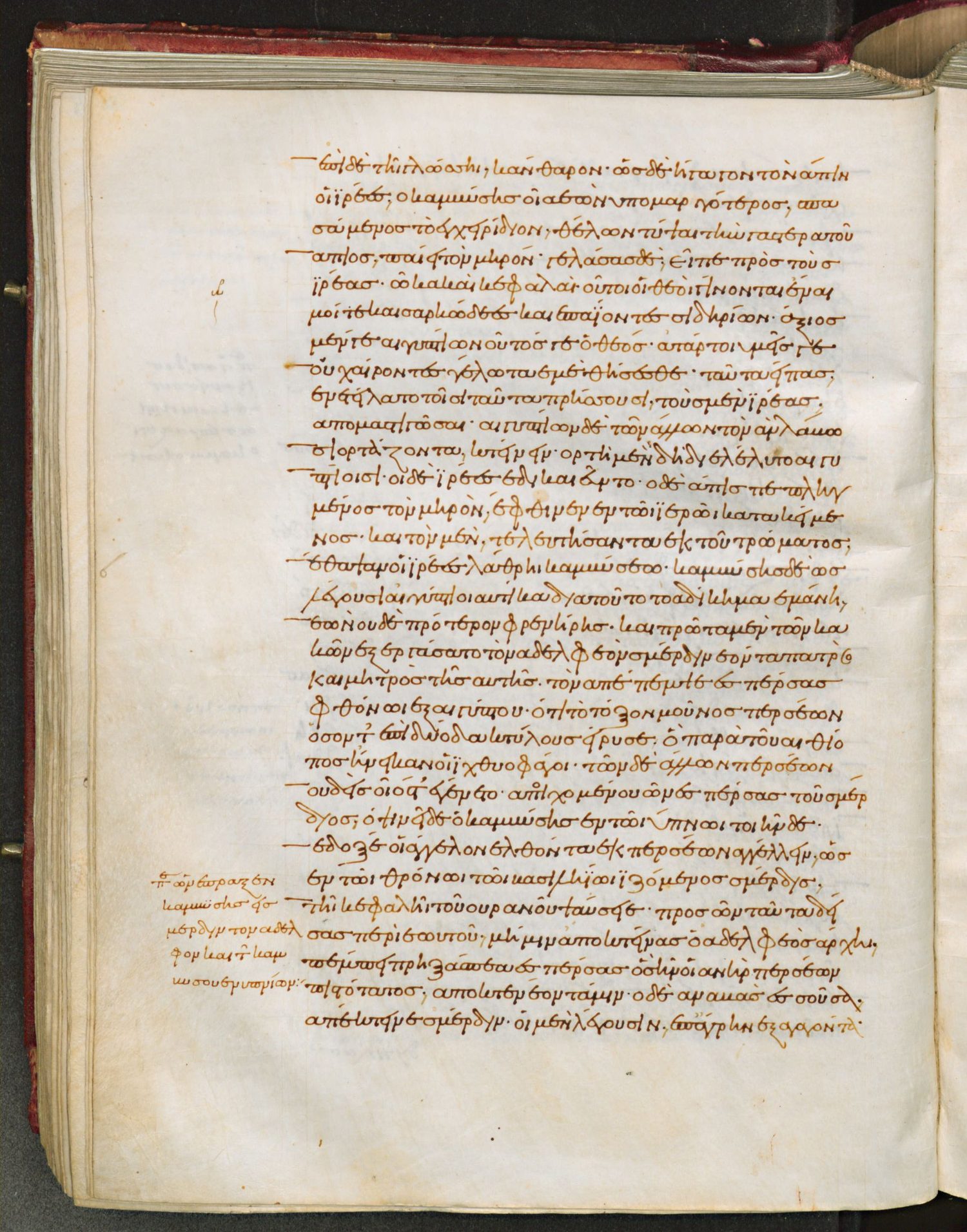
Laur. Plut. 70.3, fol. 110v: Greek here 3.28.3 to 3.29.3. Checked on the image (first and last words read and located in the Greek; each break checked against the neighbouring page): fol. 110v begins ‹ὑπὸ δὲ τῇ γλώσσῃ› (3.28.3), ends ‹λέγουσι ἐπʼ ἄγρην ἐξαγαγόντα› (3.30.3). Fol. 110r ends τὰς τρίχας and fol. 110v begins ἐπὶ δὲ τῇ γλώσσῃ κάνθαρον: the edition has τὰς τρίχας διπλᾶς, ὑπὸ δὲ τῇ γλώσσῃ (3.28.3). English here: 3.29.1 to 3.29.3 (Godley's sentences for the sections whose Greek lies mostly on this page).
3.28.3ὑπὸ δὲ τῇ γλώσσῃ κάνθαρον. 3.29.1ὡς δὲ ἤγαγον τὸν Ἆπιν οἱ ἱρέες, ὁ Καμβύσης, οἷα ἐὼν ὑπομαργότερος, σπασάμενος τὸ ἐγχειρίδιον, θέλων τύψαι τὴν γαστέρα τοῦ Ἄπιος παίει τὸν μηρόν· γελάσας δὲ εἶπε πρὸς τοὺς ἱρέας 3.29.2ὦ κακαὶ κεφαλαί, τοιοῦτοι θεοὶ γίνονται, ἔναιμοί τε καὶ σαρκώδεες καὶ ἐπαΐοντες σιδηρίων; ἄξιος μέν γε Αἰγυπτίων οὗτός γε ὁ θεός, ἀτάρ τοι ὑμεῖς γε οὐ χαίροντες γέλωτα ἐμὲ θήσεσθε. ταῦτα εἴπας ἐνετείλατο τοῖσι ταῦτα πρήσσουσι τοὺς μὲν ἱρέας ἀπομαστιγῶσαι, Αἰγυπτίων δὲ τῶν ἄλλων τὸν ἂν λάβωσι ὁρτάζοντα κτείνειν. 3.29.3ὁρτὴ μὲν δὴ διελέλυτο Αἰγυπτίοισι, οἱ δὲ ἱρέες ἐδικαιεῦντο, ὁ δὲ Ἆπις πεπληγμένος τὸν μηρὸν ἔφθινε ἐν τῷ ἱρῷ κατακείμενος. καὶ τὸν μὲν τελευτήσαντα ἐκ τοῦ τρώματος ἔθαψαν οἱ ἱρέες λάθρῃ Καμβύσεω.
3.29.1When the priests led Apis in, Cambyses—for he was well-nigh mad—drew his dagger and made to stab the calf in the belly, but smote the thigh; then laughing he said to the priests: “Wretched 3.29.2wights, are these your gods, creatures of flesh and blood that can feel weapons of iron? that is a god worthy of the Egyptians. But for you, you shall suffer for making me your laughing-stock.” So saying he bade those, whose business it was, to scourge the priests well, and to kill any other Egyptian whom they found holiday-making. 3.29.3So the Egyptian festival was ended, and the priests were punished, and Apis lay in the temple and died of the blow on the thigh. When he was dead of the wound, the priests buried him without Cambyses’ knowledge.
Notes
- Greek: the text printed in A. D. Godley's Loeb edition, via Perseus (tlg0016.tlg001.perseus-grc2). Square brackets mark words the editor considers later additions; [...] marks a gap the editor indicates. Perseus note markers are omitted.
- English: A. D. Godley, Herodotus vol. 2 (1921) (Loeb Classical Library), as transcribed on Wikisource. Godley's footnotes are omitted.
- Section numbers in the English were placed by comparing Godley's text with the Perseus version of his translation; where a section begins inside one of Godley's sentences, the English is kept with the page that holds the start of that sentence.
Cite
Sources
- Source: Florence, Laur. Plut. 70.3 (10th c.) via BML Teca Digitale + Greek of Godley's Loeb (Perseus) + English of A. D. Godley (Loeb, Wikisource) (holding institution)
- Critical edition: Greek of A. D. Godley's Loeb edition (1920-1925), via Perseus
← previous · → next · v cycle view · l back to library