Herodotus, Histories 3.106-117: The ends of the earth
Introduction
Herodotus of Halicarnassus wrote the Histories in the third quarter of the 5th century BCE, an inquiry into the deeds of Greeks and barbarians and the causes of the wars between them, later divided into nine books. Book 3 tells of Cambyses' conquest of Egypt and his madness, Polycrates of Samos, the rising of the Magi and the seven Persians who overthrew them, the accession of Darius and his provinces, and the revolt and recapture of Babylon.
The photographs are of Florence, Biblioteca Medicea Laurenziana, Plut. 70.3 (parchment, 10th century, 374 folios, 31 lines a page), Herodotus, Histories (codex A of the editors), the oldest surviving manuscript of the complete Histories, from the Teca Digitale of the Biblioteca Medicea Laurenziana. Each section below is the text of one page, or of the part of a page that falls within these chapters. The first and last words of every page were read on the photograph and located in the Greek, and every page break was checked against the next page; the notes quote these words. Readers' notes in the margins are not part of the text and are mentioned where they occur.
The Greek is the text printed in A. D. Godley's Loeb edition (1920-1925), from Perseus; it is the edited text, not a transcription of the manuscript, whose wording differs in places. The English is Godley's translation as printed, from Wikisource. Godley's English carries only chapter numbers; the section numbers shown in it were placed by comparison with the Perseus version of his translation. Each page's English is cut at the end of one of Godley's sentences, so it can begin or end a few lines away from the Greek of the page; each note gives the exact ranges.
This entry covers chapters 3.106-117, on fol. 132r to 134v.
How was this verified? (Provenance)
Where on the image
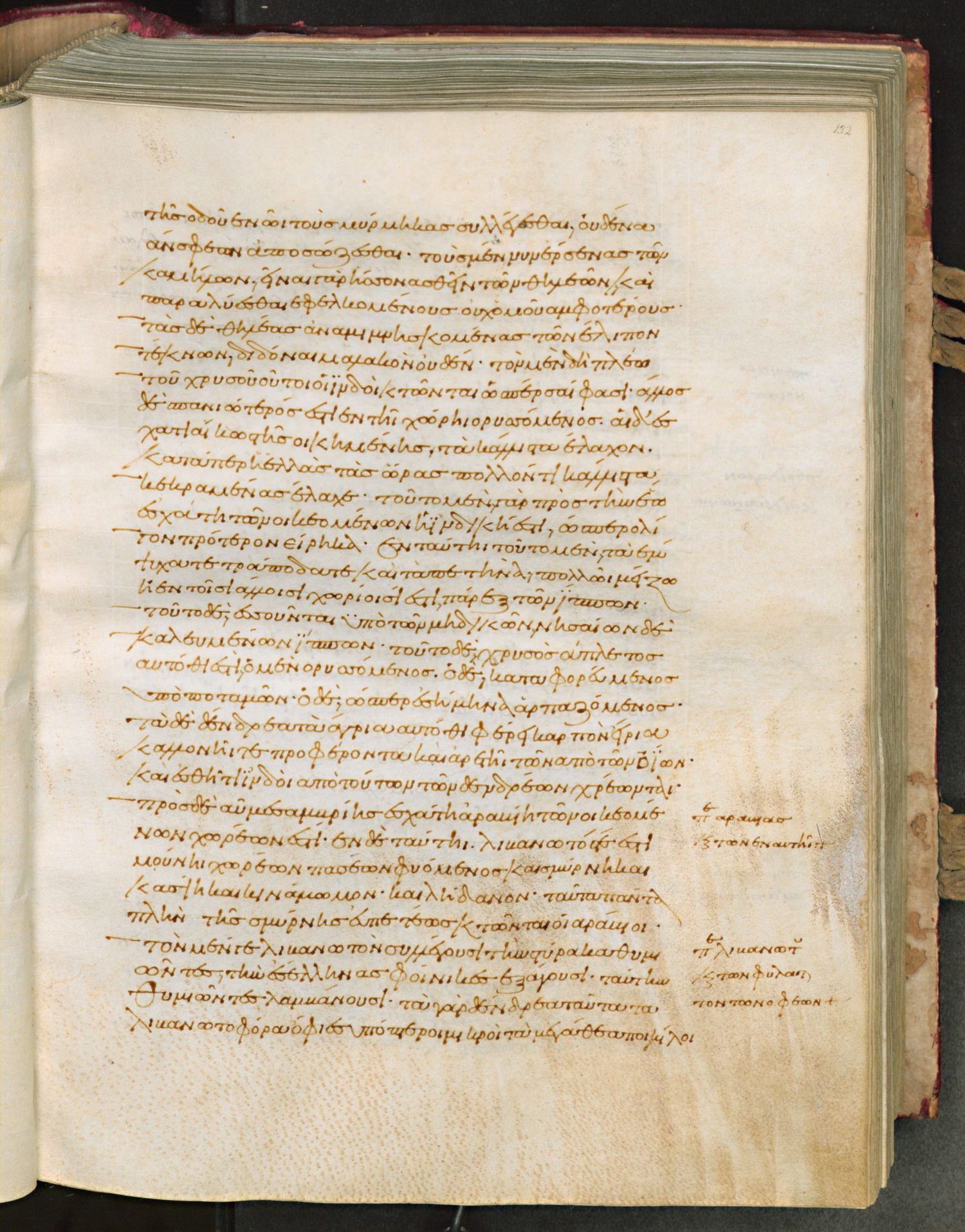
Laur. Plut. 70.3, fol. 132r: Greek here 3.106.1 to 3.107.2. Checked on the image (first and last words read and located in the Greek; each break checked against the neighbouring page): fol. 132r begins ‹τῆς ὁδοῦ ἐν ᾧ› (3.105.1), ends ‹μικροὶ τὰ μεγάθεα, ποικίλοι› (3.107.2). English here: 3.106.1 to 3.107.2 (Godley's sentences for the sections whose Greek lies mostly on this page).
3.106.1αἱ δʼ ἐσχατιαί κως τῆς οἰκεομένης τὰ κάλλιστα ἔλαχον, κατά περ ἡ Ἑλλὰς τὰς ὥρας πολλόν τι κάλλιστα κεκρημένας ἔλαχε. 3.106.2τοῦτο μὲν γὰρ πρὸς τὴν ἠῶ ἐσχάτη τῶν οἰκεομενέων ἡ Ἰνδική ἐστι, ὥσπερ ὀλίγῳ πρότερον εἴρηκα· ἐν ταύτῃ τοῦτο μὲν τὰ ἔμψυχα, τετράποδά τε καὶ τὰ πετεινά, πολλῷ μέζω ἢ ἐν τοῖσι ἄλλοισι χωρίοισι ἐστί, πάρεξ τῶν ἵππων (οὗτοι δὲ ἑσσοῦνται ὑπὸ τῶν Μηδικῶν, Νησαίων δὲ καλευμένων ἵππων), τοῦτο δὲ χρυσὸς ἄπλετος αὐτόθι ἐστί, ὃ μὲν ὀρυσσόμενος, ὁ δὲ καταφορεύμενος ὑπὸ ποταμῶν, ὁ δὲ ὥσπερ ἐσήμηνα ἁρπαζόμενος. 3.106.3τὰ δὲ δένδρεα τὰ ἄγρια αὐτόθι φέρει καρπὸν εἴρια καλλονῇ τε προφέροντα καὶ ἀρετῇ τῶν ἀπὸ τῶν ὀίων· καὶ ἐσθῆτι Ἰνδοὶ ἀπὸ τούτων τῶν δενδρέων χρέωνται. 3.107.1πρὸς δʼ αὖ μεσαμβρίης ἐσχάτη Ἀραβίη τῶν οἰκεομενέων χωρέων ἐστί, ἐν δὲ ταύτῃ λιβανωτός τε ἐστὶ μούνῃ χωρέων πασέων φυόμενος καὶ σμύρνη καὶ κασίη καὶ κινάμωμον καὶ λήδανον. ταῦτα πάντα πλὴν τῆς σμύρνης δυσπετέως κτῶνται οἱ Ἀράβιοι. 3.107.2τὸν μέν γε λιβανωτὸν συλλέγουσι τὴν στύρακα θυμιῶντες, τὴν ἐς Ἕλληνας Φοίνικες ἐξάγουσι· ταύτην θυμιῶντες λαμβάνουσι· τὰ γὰρ δένδρεα ταῦτα τὰ λιβανωτοφόρα ὄφιες ὑπόπτεροι, μικροὶ τὰ μεγάθεα, ποικίλοι
3.106.1It would seem that the fairest blessings have been granted to the most distant nations of the world, whereas in Hellas the seasons have by much the kindliest temperature. 3.106.2As I have lately said, India lies at the world’s most distant eastern limit; and in India all living creatures four-footed and flying are by much bigger than those of other lands, except the horses, which are smaller than the Median horses called Nesaean; moreover the gold there, whether dug from the earth or brought down by rivers or got as I have shown, is very abundant. 3.106.3There too there grows on wild trees wool more beautiful and excellent than the wool of sheep; these trees supply the Indians with clothing. 3.107.1Again, Arabia is the most distant to the south of all inhabited countries: and this is the only country which yields frankincense and myrrh and casia and cinnamon and gum-mastich. All these but myrrh are difficult for the Arabians to get. 3.107.2They gather frankincense by burning that storax which Phoenicians carry to Hellas; this they burn and so get the frankincense; for the spice-bearing trees are guarded by small winged snakes of varied colour, many round each tree; these are the snakes that attack Egypt. Nothing save the smoke of storax will drive them away from the trees.
Where on the image
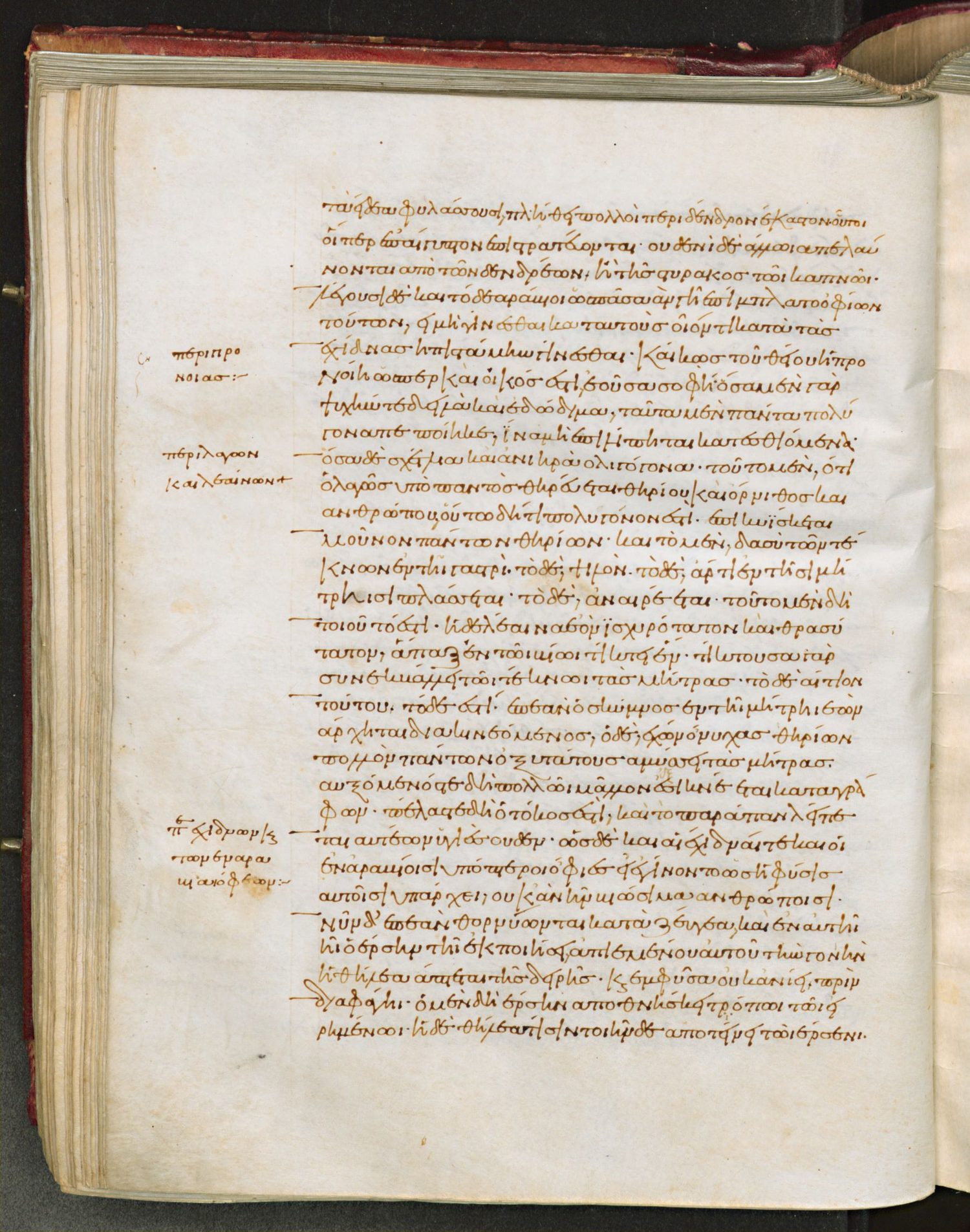
Laur. Plut. 70.3, fol. 132v: Greek here 3.107.2 to 3.109.2. Checked on the image (first and last words read and located in the Greek; each break checked against the neighbouring page): fol. 132v begins ‹τὰ εἴδεα, φυλάσσουσι πλήθεϊ› (3.107.2), ends ‹τοιήνδε ἀποτίνει τῷ ἔρσενι› (3.109.2). English here: 3.108.1 to 3.109.1 (Godley's sentences for the sections whose Greek lies mostly on this page).
3.107.2τὰ εἴδεα, φυλάσσουσι πλήθεϊ πολλοὶ περὶ δένδρον ἕκαστον, οὗτοι οἵ περ ἐπʼ Αἴγυπτον ἐπιστρατεύονται, οὐδενὶ δὲ ἄλλῳ ἀπελαύνονται ἀπὸ τῶν δενδρέων ἢ τῆς στύρακος τῷ καπνῷ. 3.108.1λέγουσι δὲ καὶ τόδε Ἀράβιοι, ὡς πᾶσα ἂν γῆ ἐπίμπλατο τῶν ὀφίων τούτων, εἰ μὴ γίνεσθαι κατʼ αὐτοὺς οἷόν τι κατὰ τὰς ἐχίδνας ἠπιστάμην γίνεσθαι. 3.108.2καί κως τοῦ θείου ἡ προνοίη, ὥσπερ καὶ οἰκός ἐστι, ἐοῦσα σοφή, ὅσα μὲν ψυχήν τε δειλὰ καὶ ἐδώδιμα, ταῦτα μὲν πάντα πολύγονα πεποίηκε, ἵνα μὴ ἐπιλίπῃ κατεσθιόμενα, ὅσα δὲ σχέτλια καὶ ἀνιηρά, ὀλιγόγονα. 3.108.3τοῦτο μέν, ὅτι ὁ λαγὸς ὑπὸ παντὸς θηρεύεται θηρίου καὶ ὄρνιθος καὶ ἀνθρώπου, οὕτω δή τι πολύγονον ἐστί· ἐπικυΐσκεται μοῦνον πάντων θηρίων, καὶ τὸ μὲν δασὺ τῶν τέκνων ἐν τῇ γαστρὶ τὸ δὲ ψιλόν, τὸ δὲ ἄρτι ἐν τῇσι μήτρῃσι πλάσσεται, τὸ δὲ ἀναιρέεται. 3.108.4τοῦτο μὲν δὴ τοιοῦτο ἐστί· ἡ δὲ δὴ λέαινα ἐὸν ἰσχυρότατον καὶ θρασύτατον ἅπαξ ἐν τῷ βίῳ τίκτει ἕν· τίκτουσα γὰρ συνεκβάλλει τῷ τέκνῳ τὰς μήτρας. τὸ δὲ αἴτιον τούτου τόδε ἐστί· ἐπεὰν ὁ σκύμνος ἐν τῇ μητρὶ ἐὼν ἄρχηται διακινεόμενος, ὁ δὲ ἔχων ὄνυχας θηρίων πολλὸν πάντων ὀξυτάτους ἀμύσσει τὰς μήτρας, αὐξόμενός τε δὴ πολλῷ μᾶλλον ἐσικνέεται καταγράφων· πέλας τε δὴ ὁ τόκος ἐστί, καὶ τὸ παράπαν λείπεται αὐτέων ὑγιὲς οὐδέν. 3.109.1ὣς δὲ καὶ οἱ ἔχιδναί τε καὶ οἱ ἐν Ἀραβίοισι ὑπόπτεροι ὄφιες εἰ ἐγίνοντο ὡς ἡ φύσις αὐτοῖσι ὑπάρχει, οὐκ ἂν ἦν βιώσιμα ἀνθρώποισι· νῦν δʼ ἐπεὰν θορνύωνται κατὰ ζεύγεα καὶ ἐν αὐτῇ ᾖ ὁ ἔρσην τῇ ἐκποιήσι, ἀπιεμένου αὐτοῦ τὴν γονὴν ἡ θήλεα ἅπτεται τῆς δειρῆς, καὶ ἐμφῦσα οὐκ ἀνιεῖ πρὶν ἂν διαφάγῃ. 3.109.2ὁ μὲν δὴ ἔρσην ἀποθνήσκει τρόπῳ τῷ εἰρημένῳ, ἡ δὲ θήλεα τίσιν τοιήνδε ἀποτίνει τῷ ἔρσενι·
3.108.1The Arabians also say that the whole country would be full of these snakes were it not with them as I have heard that it is with vipers. 3.108.2It would seem that the wisdom of divine Providence (as is but reasonable) has made all creatures prolific that are timid and fit to eat, that they be not minished from off the earth by being eaten up, whereas but few young are born to creatures cruel and baneful. 3.108.3The hare is so prolific, for that it is the prey of every beast and bird and man; alone of all creatures it conceives in pregnancy; some of the unborn young are hairy, some still naked, some are still forming in the womb while others are just conceived. 3.108.4But whereas this is so with the hare, the lioness, a very strong and bold beast, bears offspring but once in her life, and then but one cub; for the uterus comes out with the cub in the act of birth. This is the reason of it:—when the cub first begins to stir in the mother, its claws, much sharper than those of any other creature, tear the uterus, and as it grows, much more does it scratch and tear, so that when the hour of birth is near seldom is any of the uterus left whole. 3.109.1It is so too with vipers and the winged serpents of Arabia: were they born in the natural manner of serpents no life were possible for men; but as it is, when they pair, and the male is in the very act of generation, the female seizes him by the neck, nor lets go her grip till she has bitten the neck through.
Where on the image
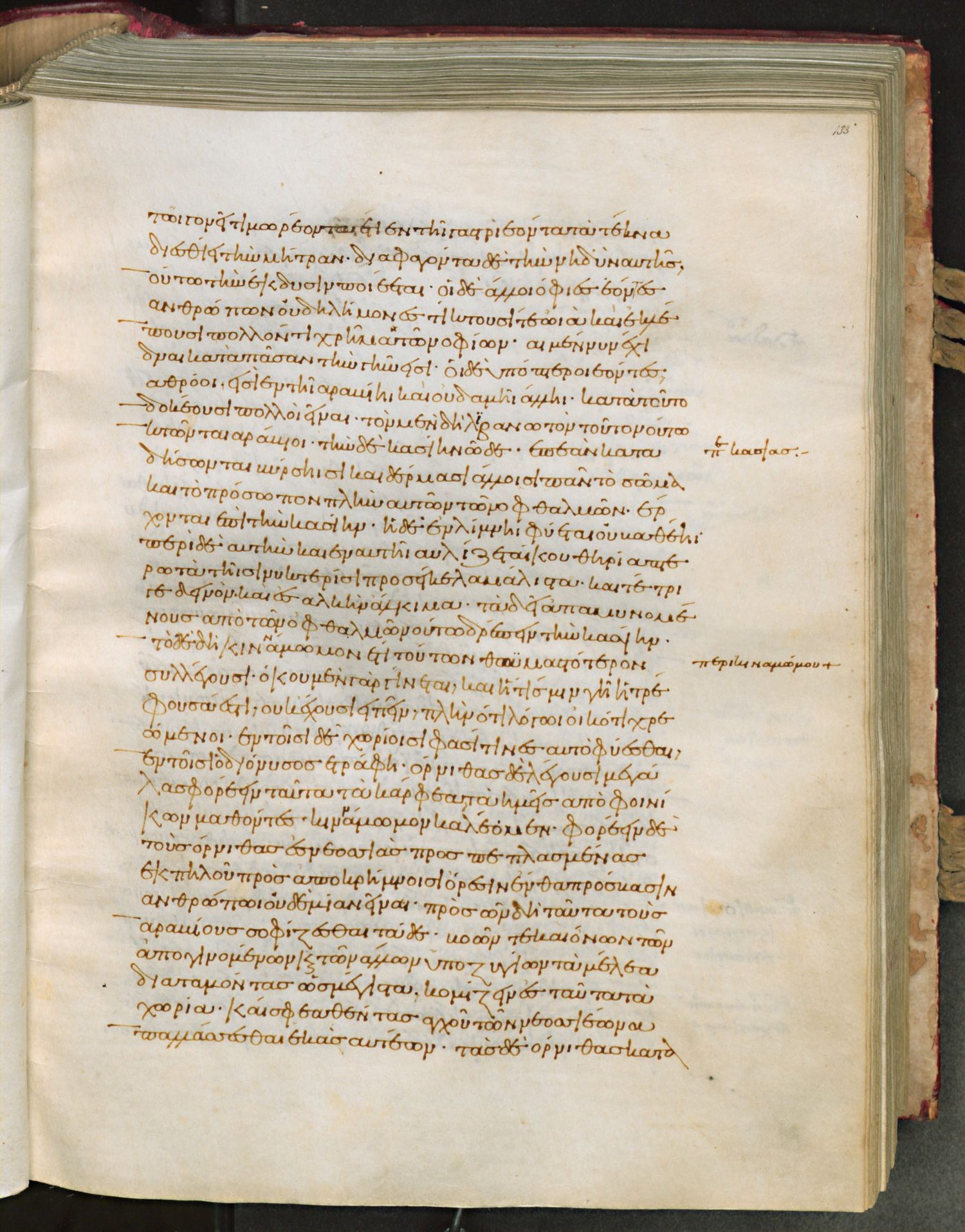
Laur. Plut. 70.3, fol. 133r: Greek here 3.109.2 to 3.111.3. Checked on the image (first and last words read and located in the Greek; each break checked against the neighbouring page): fol. 133r begins ‹τῷ γονέι τιμωρέοντα ἔτι› (3.109.2), ends ‹τὰς δὲ ὄρνιθας κατα-› (3.111.3). English here: 3.109.2 to 3.111.3 (Godley's sentences for the sections whose Greek lies mostly on this page).
3.109.2τῷ γονέι τιμωρέοντα ἔτι ἐν τῇ γαστρὶ ἐόντα τὰ τέκνα διεσθίει τὴν μητέρα, διαφαγόντα δὲ τὴν νηδὺν αὐτῆς οὕτω τὴν ἔκδυσιν ποιέεται. 3.109.3οἱ δὲ ἄλλοι ὄφιες ἐόντες ἀνθρώπων οὐ δηλήμονες τίκτουσί τε ᾠὰ καὶ ἐκλέπουσι πολλόν τι χρῆμα τῶν τέκνων. αἱ μέν νυν ἔχιδναι κατὰ πᾶσαν τὴν γῆν εἰσί, οἱ δὲ ὑπόπτεροι ὄφιες ἀθρόοι εἰσὶ ἐν τῇ Ἀραβίῃ καὶ οὐδαμῇ ἄλλῃ· κατὰ τοῦτο δοκέουσι πολλοὶ εἶναι. 3.110.1τὸν μὲν δὴ λιβανωτὸν τοῦτον οὕτω κτῶνται Ἀράβιοι, τὴν δὲ κασίην ὧδε. ἐπεὰν καταδήσωνται βύρσῃσι καὶ δέρμασι ἄλλοισι πᾶν τὸ σῶμα καὶ τὸ πρόσωπον πλὴν αὐτῶν τῶν ὀφθαλμῶν, ἔρχονται ἐπὶ τὴν κασίην· ἣ δὲ ἐν λίμνῃ φύεται οὐ βαθέῃ, περὶ δὲ αὐτὴν καὶ ἐν αὐτῇ αὐλίζεταί κου θηρία πτερωτά, τῇσι νυκτερίσι προσείκελα μάλιστα, καὶ τέτριγε δεινόν, καὶ ἐς ἀλκὴν ἄλκιμα· τὰ δεῖ ἀπαμυνομένους ἀπὸ τῶν ὀφθαλμῶν οὕτω δρέπειν τὴν κασίην. 3.111.1τὸ δὲ δὴ κινάμωμον ἔτι τούτων θωμαστότερον συλλέγουσι. ὅκου μὲν γὰρ γίνεται καὶ ἥτις μιν γῆ ἡ τρέφουσα ἐστί, οὐκ ἔχουσι εἰπεῖν, πλὴν ὅτι λόγῳ οἰκότι χρεώμενοι ἐν τοῖσιδε χωρίοισι φασὶ τινὲς αὐτὸ φύεσθαι ἐν τοῖσι ὁ Διόνυσος ἐτράφη· 3.111.2ὄρνιθας δὲ λέγουσι μεγάλας φορέειν ταῦτα τὰ κάρφεα τὰ ἡμεῖς ἀπὸ Φοινίκων μαθόντες κινάμωμον καλέομεν, φορέειν δὲ τὰς ὄρνιθας ἐς νεοσσιὰς προσπεπλασμένας ἐκ πηλοῦ πρὸς ἀποκρήμνοισι ὄρεσι, ἔνθα πρόσβασιν ἀνθρώπῳ οὐδεμίαν εἶναι. 3.111.3πρὸς ὦν δὴ ταῦτα τοὺς Ἀραβίους σοφίζεσθαι τάδε· βοῶν τε καὶ ὄνων τῶν ἀπογινομένων καὶ τῶν ἄλλων ὑποζυγίων τὰ μέλεα διαταμόντας ὡς μέγιστα κομίζειν ἐς ταῦτα τὰ χωρία, καί σφεα θέντας ἀγχοῦ τῶν νεοσσιέων ἀπαλλάσσεσθαι ἑκὰς αὐτέων· τὰς δὲ ὄρνιθας καταπετομένας
3.109.2Thus the male dies; but the female is punished for his death; the young avenge their father, and gnaw at their mother while they are yet within her; nor are they dropped from her till they have eaten their way through her womb. 3.109.3Other snakes, that do no harm to men, lay eggs and hatch out a vast number of young. The Arabian winged serpents do indeed seem to be many; but it is because (whereas there are vipers in every land) these are all in Arabia and are nowhere else found. 3.110.1The Arabians get their frankincense as I have shown; for the winning of casia, when they seek it they bind oxhides and other skins over all their bodies and faces, leaving only the eyes. Casia grows in a shallow lake; round this and in it live certain winged creatures, very like bats, that squeak shrilly and make a stout resistance; these must be kept from the men’s eyes if the casia is to be plucked. 3.111.1As for cinnamon, they gather it in a fashion even stranger. Where it grows and what kind of land nurtures it they cannot say, save that it is reported, reasonably enough, to grow in the places where Dionysus was reared. 3.111.2There are great birds, it is said, that take these dry sticks which the Phoenicians have taught us to call cinnamon, and carry them off to nests built of mud and attached to precipitous crags, to which no man can approach. 3.111.3The Arabian device for defeating the birds is to cut into very large pieces dead oxen and asses and other beasts of burden, then to set these near the eyries, withdrawing themselves far off. The birds then fly down (it is said) and carry the pieces of the beasts up to their nests; which not being able to bear the weight break and fall down the mountain side; and then the Arabians come up and gather what they seek. Thus is cinnamon said to be gathered, and so to come from Arabia to other lands.
Where on the image
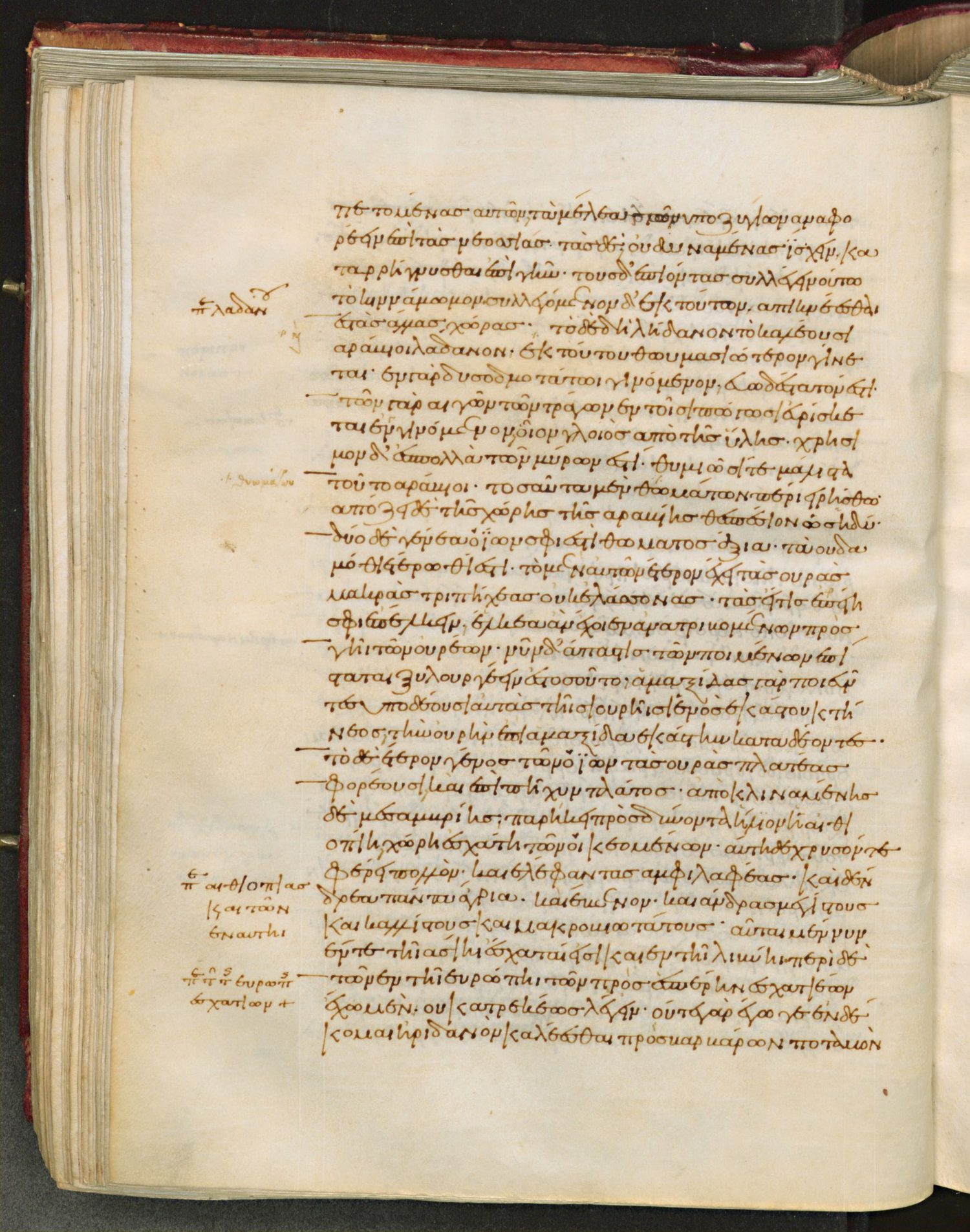
Laur. Plut. 70.3, fol. 133v: Greek here 3.111.3 to 3.115.1. Checked on the image (first and last words read and located in the Greek; each break checked against the neighbouring page): fol. 133v begins ‹-πετομένας τὰ μέλεα τῶν› (3.111.3), ends ‹καλέεσθαι πρὸς βαρβάρων ποταμὸν› (3.115.1). The word ‹καταπετομένας› is divided between fol. 133r and fol. 133v; it is given with fol. 133r. English here: 3.112.1 to 3.115.1 (Godley's sentences for the sections whose Greek lies mostly on this page).
3.111.3τὰ μέλεα τῶν ὑποζυγίων ἀναφορέειν ἐπὶ τὰς νεοσσιάς, τὰς δὲ οὐ δυναμένας ἴσχειν καταρρήγνυσθαι ἐπὶ γῆν, τοὺς δὲ ἐπιόντας συλλέγειν. οὕτω μὲν τὸ κινάμωμον συλλεγόμενον ἐκ τούτων ἀπικνέεσθαι ἐς τὰς ἄλλας χώρας. 3.112.1τὸ δὲ δὴ λήδανον, τὸ καλέουσι Ἀράβιοι λάδανον, ἔτι τούτου θωμασιώτερον γίνεται· ἐν γὰρ δυσοδμοτάτῳ γινόμενον εὐωδέστατον ἐστί· τῶν γὰρ αἰγῶν τῶν τράγων ἐν τοῖσι πώγωσι εὑρίσκεται ἐγγινόμενον οἷον γλοιὸς ἀπὸ τῆς ὕλης. χρήσιμον δʼ ἐς πολλὰ τῶν μύρων ἐστί, θυμιῶσί τε μάλιστα τοῦτο Ἀράβιοι. 3.113.1τοσαῦτα μὲν θυωμάτων πέρι εἰρήσθω, ἀπόζει δὲ τῆς χώρης τῆς Ἀραβίης θεσπέσιον ὡς ἡδύ. δύο δὲ γένεα ὀίων σφι ἐστὶ θώματος ἄξια, τὰ οὐδαμόθι ἑτέρωθι ἐστί. τὸ μὲν αὐτῶν ἕτερον ἔχει τὰς οὐρὰς μακράς, τριῶν πηχέων οὐκ ἐλάσσονας, τὰς εἴ τις ἐπείη σφι ἐπέλκειν, ἕλκεα ἂν ἔχοιεν ἀνατριβομενέων πρὸς τῇ γῇ τῶν οὐρέων· 3.113.2νῦν δʼ ἅπας τις τῶν ποιμένων ἐπίσταται ξυλουργέειν ἐς τοσοῦτο· ἁμαξίδας γὰρ ποιεῦντες ὑποδέουσι αὐτὰς τῇσι οὐρῇσι, ἑνὸς ἑκάστου κτήνεος τὴν οὐρὴν ἐπὶ ἁμαξίδα ἑκάστην καταδέοντες. τὸ δὲ ἕτερον γένος τῶν ὀίων τὰς οὐρὰς πλατέας φορέουσι καὶ ἐπὶ πῆχυν πλάτος. 3.114.1ἀποκλινομένης δὲ μεσαμβρίης παρήκει πρὸς δύνοντα ἥλιον ἡ Αἰθιοπίη χώρη ἐσχάτη τῶν οἰκεομενέων· αὕτη δὲ χρυσόν τε φέρει πολλὸν καὶ ἐλέφαντας ἀμφιλαφέας καὶ δένδρεα πάντα ἄγρια καὶ ἔβενον καὶ ἄνδρας μεγίστους καὶ καλλίστους καὶ μακροβιωτάτους. 3.115.1αὗται μέν νυν ἔν τε τῇ Ἀσίῃ ἐσχατιαί εἰσι καὶ ἐν τῇ Λιβύῃ. περὶ δὲ τῶν ἐν τῇ Εὐρώπῃ τῶν πρὸς ἑσπέρην ἐσχατιέων ἔχω μὲν οὐκ ἀτρεκέως λέγειν· οὔτε γὰρ ἔγωγε ἐνδέκομαι Ἠριδανὸν καλέεσθαι πρὸς βαρβάρων ποταμὸν
3.112.1But gum-mastich, which Greeks call ledanon and Arabians ladanon, is yet more strangely produced. Its scent is most sweet, yet nothing smells more evilly than that which produces it; for it is found in the beards of he-goats, forming in them like tree-gum. This is used in the making of many perfumes; there is nothing that the Arabians so often burn as incense. 3.113.1I have said enough of the spices of Arabia; airs wondrous sweet blow from that land. They have moreover two marvellous kinds of sheep, nowhere else found. One of these has tails no less than three cubits long. Were the sheep to trail these after them, they would suffer hurt by the rubbing of the tails on the ground; 3.113.2but as it is every shepherd there knows enough of carpentry to make little carts which they fix under the tails, binding the tail of each several sheep on its own cart. The other kind of sheep has a tail a full cubit broad. 3.114.1Where south inclines westwards, the part of the world stretching farthest towards the sunset is Ethiopia; here is great plenty of gold, and abundance of elephants, and all woodland trees, and ebony; and the people are the tallest and fairest and longest-lived of all men. 3.115.1These then are the most distant parts of the world in Asia and Libya. But concerning the farthest western parts of Europe I cannot speak with exactness; for I do not believe that there is a river called by foreigners Eridanus issuing into the northern sea, whence our amber is said to come, nor have I any knowledge of Tin-islands, whence our tin is brought.
Where on the image
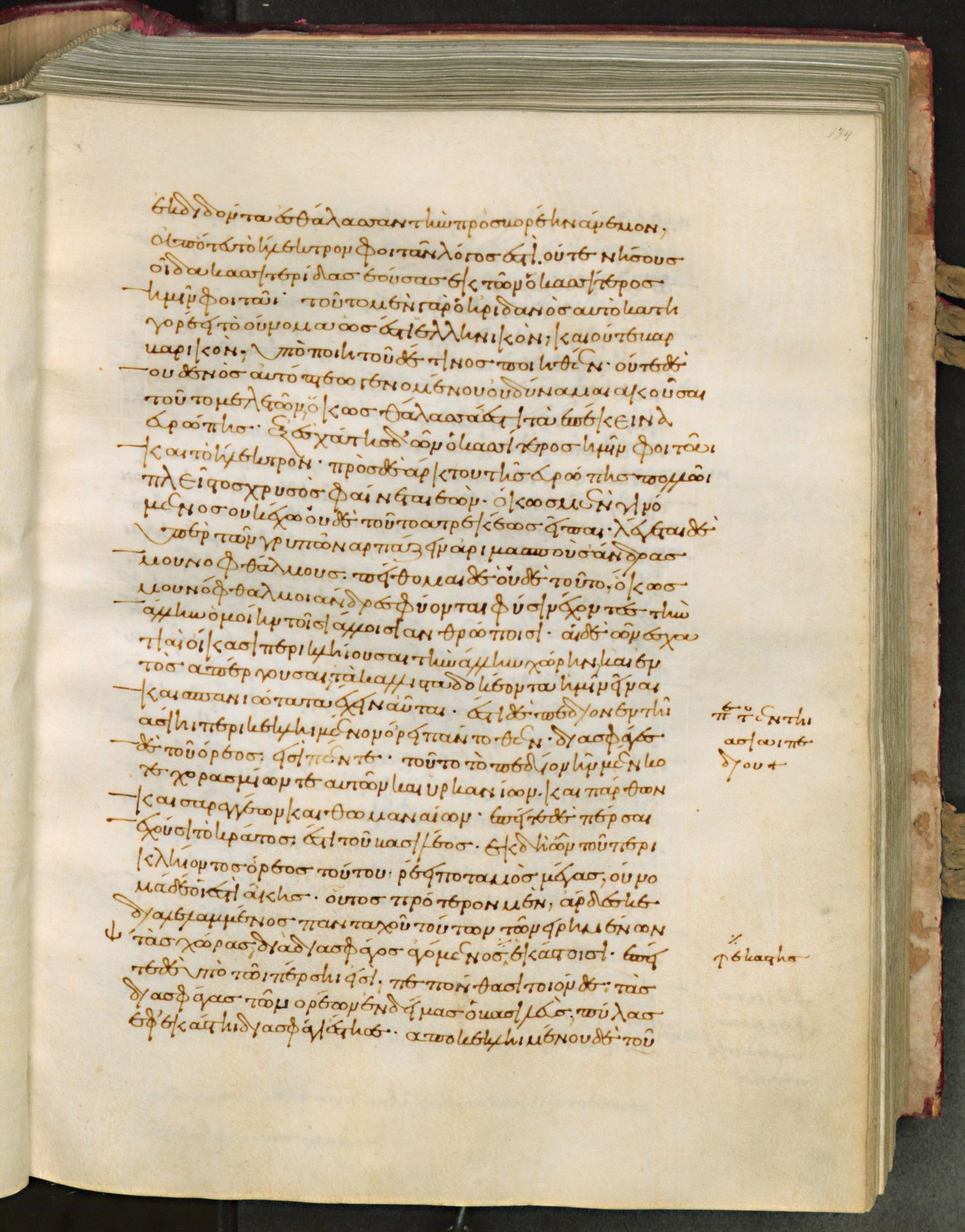
Laur. Plut. 70.3, fol. 134r: Greek here 3.115.1 to 3.117.3. Checked on the image (first and last words read and located in the Greek; each break checked against the neighbouring page): fol. 134r begins ‹ἐκδιδόντα ἐς θάλασσαν τὴν› (3.115.1), ends ‹ἔστησε· ἀποκεκληιμένου δὲ τοῦ› (3.117.3). The article τοῦ (3.117.3) stands both at the end of fol. 134r and at the start of fol. 134v. English here: 3.115.2 to 3.117.3 (Godley's sentences for the sections whose Greek lies mostly on this page).
3.115.1ἐκδιδόντα ἐς θάλασσαν τὴν πρὸς βορέην ἄνεμον, ἀπʼ ὅτευ τὸ ἤλεκτρον φοιτᾶν λόγος ἐστί, οὔτε νήσους οἶδα Κασσιτερίδας ἐούσας, ἐκ τῶν ὁ κασσίτερος ἡμῖν φοιτᾷ. 3.115.2τοῦτο μὲν γὰρ ὁ Ἠριδανὸς αὐτὸ κατηγορέει τὸ οὔνομα ὡς ἔστι Ἑλληνικὸν καὶ οὐ βάρβαρον, ὑπὸ ποιητέω δὲ τινὸς ποιηθέν· τοῦτο δὲ οὐδενὸς αὐτόπτεω γενομένου δύναμαι ἀκοῦσαι, τοῦτο μελετῶν, ὅκως θάλασσα ἐστὶ τὰ ἐπέκεινα Εὐρώπης. ἐξ ἐσχάτης δʼ ὦν ὁ κασσίτερος ἡμῖν φοιτᾷ καὶ τὸ ἤλεκτρον. 3.116.1πρὸς δὲ ἄρκτου τῆς Εὐρώπης πολλῷ τι πλεῖστος χρυσὸς φαίνεται ἐών· ὅκως μὲν γινόμενος, οὐκ ἔχω οὐδὲ τοῦτο ἀτρεκέως εἶπαι, λέγεται δὲ ὑπὲκ τῶν γρυπῶν ἁρπάζειν Ἀριμασποὺς ἄνδρας μουνοφθάλμους. 3.116.2πείθομαι δὲ οὐδὲ τοῦτο ὅκως μουνόφθαλμοι ἄνδρες φύονται, φύσιν ἔχοντες τὴν ἄλλην ὁμοίην τοῖσι ἄλλοισι ἀνθρώποισι· 3.116.3αἱ δὲ ὦν ἐσχατιαὶ οἴκασι, περικληίουσαι τὴν ἄλλην χώρην καὶ ἐντὸς ἀπέργουσαι, τὰ κάλλιστα δοκέοντα ἡμῖν εἶναι καὶ σπανιώτατα ἔχειν αὗται. 3.117.1ἔστι δὲ πεδίον ἐν τῇ Ἀσίῃ περικεκληιμένον ὄρεϊ πάντοθεν, διασφάγες δὲ τοῦ ὄρεος εἰσὶ πέντε. τοῦτο τὸ πεδίον ἦν μὲν κοτὲ Χορασμίων, ἐν οὔροισι ἐὸν Χορασμίων τε αὐτῶν καὶ Ὑρκανίων καὶ Πάρθων καὶ Σαραγγέων καὶ Θαμαναίων, ἐπείτε δὲ Πέρσαι ἔχουσι τὸ κράτος, ἐστὶ τοῦ βασιλέος. 3.117.2ἐκ δὴ ὦν τοῦ περικληίοντος ὄρεος τούτου ῥέει ποταμὸς μέγας, οὔνομα δέ οἱ ἐστὶ Ἄκης. οὗτος πρότερον μὲν ἄρδεσκε διαλελαμμένος πενταχοῦ τούτων τῶν εἰρημένων τὰς χώρας, διὰ διασφάγος ἀγόμενος ἑκάστης ἑκάστοισι· ἐπείτε δὲ ὑπὸ τῷ Πέρσῃ εἰσί, πεπόνθασι τοιόνδε· 3.117.3τὰς διασφάγας τῶν ὀρέων ἐνδείμας ὁ βασιλεὺς πύλας ἐπʼ ἑκάστῃ διασφάγι ἔστησε· ἀποκεκληιμένου δὲ
3.115.2The very name of the Eridanus bewrays itself as not a foreign but a Greek name, invented by some poet; nor for all my diligence have I been able to learn from one who has seen it that there is a sea beyond Europe. This only we know, that our tin and amber come from the most distant parts. 3.116.1This is also plain, that to the north of Europe there is by far more gold than elsewhere. In this matter again I cannot with certainty say how the gold is got; some will have it that one-eyed men called Arimaspians steal it from griffins. 3.116.2But this too I hold incredible, that there can be men in all else like other men, yet having but one eye. 3.116.3Suffice it that it is but reasonable that the most distant parts of the world, as they enclose and wholly surround all other lands, should have those things which we deem best and rarest. 3.117.1There is in Asia a plain surrounded by mountains, through which mountains there are five clefts. This plain belonged formerly to the Chorasmians; it adjoins the land of the Chorasmians themselves, the Hyrcanians, Parthians, Sarangians, and Thamanaei; but since the Persians have held sway it has been the king’s own land. 3.117.2Now from the encircling mountains flows a great river called Aces. Its stream divides into five channels, and watered formerly the lands of the peoples aforesaid by passing to them severally through the five clefts; but since the beginning of the Persian rule 3.117.3the king has blocked the mountain clefts, and closed each passage with a gate; the water thus barred from outlet, the plain within the mountains becomes a lake, seeing that the river pours into it and finds no way out.
Where on the image
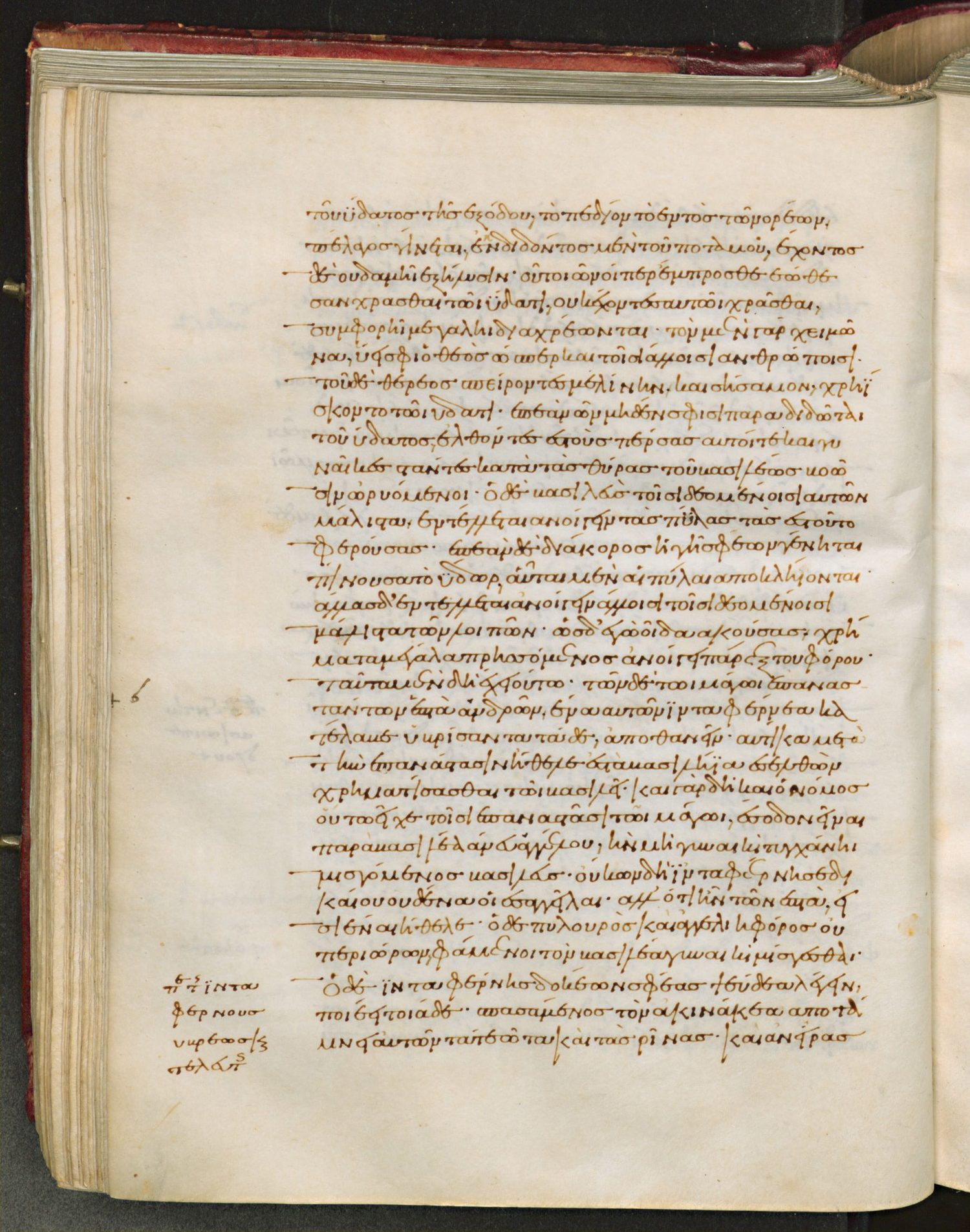
Laur. Plut. 70.3, fol. 134v: Greek here 3.117.3 to 3.117.6. Checked on the image (first and last words read and located in the Greek; each break checked against the neighbouring page): fol. 134v begins ‹τοῦ ὕδατος τῆς ἐξόδου› (3.117.3), ends ‹τὰς ῥῖνας, καὶ ἀνείρας› (3.118.2). The article τοῦ (3.117.3) stands both at the end of fol. 134r and at the start of fol. 134v. English here: 3.117.4 to 3.117.6 (Godley's sentences for the sections whose Greek lies mostly on this page).
3.117.3τοῦ ὕδατος τῆς ἐξόδου τὸ πεδίον τὸ ἐντὸς τῶν ὀρέων πέλαγος γίνεται, ἐνδιδόντος μὲν τοῦ ποταμοῦ, ἔχοντος δὲ οὐδαμῇ ἐξήλυσιν. 3.117.4οὗτοι ὦν οἵ περ ἔμπροσθε ἐώθεσαν χρᾶσθαι τῷ ὕδατι, οὐκ ἔχοντες αὐτῷ χρᾶσθαι συμφορῇ μεγάλῃ διαχρέωνται. τὸν μὲν γὰρ χειμῶνα ὕει σφι ὁ θεὸς ὥσπερ καὶ τοῖσι ἄλλοισι ἀνθρώποισι, τοῦ δὲ θέρεος σπείροντες μελίνην καὶ σήσαμον χρηίσκονται τῷ ὕδατι. 3.117.5ἐπεὰν ὦν μηδέν σφι παραδιδῶται τοῦ ὕδατος, ἐλθόντες ἐς τοὺς Πέρσας αὐτοί τε καὶ γυναῖκες, στάντες κατὰ τὰς θύρας τοῦ βασιλέος βοῶσι ὠρυόμενοι, ὁ δὲ βασιλεὺς τοῖσι δεομένοισι αὐτῶν μάλιστα ἐντέλλεται ἀνοίγειν τὰς πύλας τὰς ἐς τοῦτο φερούσας. 3.117.6ἐπεὰν δὲ διάκορος ἡ γῆ σφεων γένηται πίνουσα τὸ ὕδωρ, αὗται μὲν αἱ πύλαι ἀποκληίονται, ἄλλας δʼ ἐντέλλεται ἀνοίγειν ἄλλοισι τοῖσι δεομένοισι μάλιστα τῶν λοιπῶν. ὡς δʼ ἐγὼ οἶδα ἀκούσας, χρήματα μεγάλα πρησσόμενος ἀνοίγει πάρεξ τοῦ φόρου.
3.117.4Those therefore who formerly used the water can use it no longer, and are in very evil case; for whereas in winter they have the rain from heaven like other men, in summer they are in need of the water for their sown millet and sesame. 3.117.5So whenever no water is given to them, they come into Persia with their women, and cry and howl before the door of the king’s palace, till the king commands that the river-gate which leads thither should be opened for those whose need is greatest; 3.117.6then, when this land has drunk its fill of water, that gate is shut, and the king bids open another for those of the rest who most require it. I have heard and know that he exacts great sums, over and above the tribute, for the opening of the gates.
Notes
- Greek: the text printed in A. D. Godley's Loeb edition, via Perseus (tlg0016.tlg001.perseus-grc2). Square brackets mark words the editor considers later additions; [...] marks a gap the editor indicates. Perseus note markers are omitted.
- English: A. D. Godley, Herodotus vol. 2 (1921) (Loeb Classical Library), as transcribed on Wikisource. Godley's footnotes are omitted.
- Section numbers in the English were placed by comparing Godley's text with the Perseus version of his translation; where a section begins inside one of Godley's sentences, the English is kept with the page that holds the start of that sentence.
Cite
Sources
- Source: Florence, Laur. Plut. 70.3 (10th c.) via BML Teca Digitale + Greek of Godley's Loeb (Perseus) + English of A. D. Godley (Loeb, Wikisource) (holding institution)
- Critical edition: Greek of A. D. Godley's Loeb edition (1920-1925), via Perseus
← previous · → next · v cycle view · l back to library