Herodotus, Histories 3.118-138: Intaphrenes, Oroetes and Democedes
Introduction
Herodotus of Halicarnassus wrote the Histories in the third quarter of the 5th century BCE, an inquiry into the deeds of Greeks and barbarians and the causes of the wars between them, later divided into nine books. Book 3 tells of Cambyses' conquest of Egypt and his madness, Polycrates of Samos, the rising of the Magi and the seven Persians who overthrew them, the accession of Darius and his provinces, and the revolt and recapture of Babylon.
The photographs are of Florence, Biblioteca Medicea Laurenziana, Plut. 70.3 (parchment, 10th century, 374 folios, 31 lines a page), Herodotus, Histories (codex A of the editors), the oldest surviving manuscript of the complete Histories, from the Teca Digitale of the Biblioteca Medicea Laurenziana. Each section below is the text of one page, or of the part of a page that falls within these chapters. The first and last words of every page were read on the photograph and located in the Greek, and every page break was checked against the next page; the notes quote these words. Readers' notes in the margins are not part of the text and are mentioned where they occur.
The Greek is the text printed in A. D. Godley's Loeb edition (1920-1925), from Perseus; it is the edited text, not a transcription of the manuscript, whose wording differs in places. The English is Godley's translation as printed, from Wikisource. Godley's English carries only chapter numbers; the section numbers shown in it were placed by comparison with the Perseus version of his translation. Each page's English is cut at the end of one of Godley's sentences, so it can begin or end a few lines away from the Greek of the page; each note gives the exact ranges.
This entry covers chapters 3.118-138, on fol. 134v to 141r.
How was this verified? (Provenance)
Where on the image
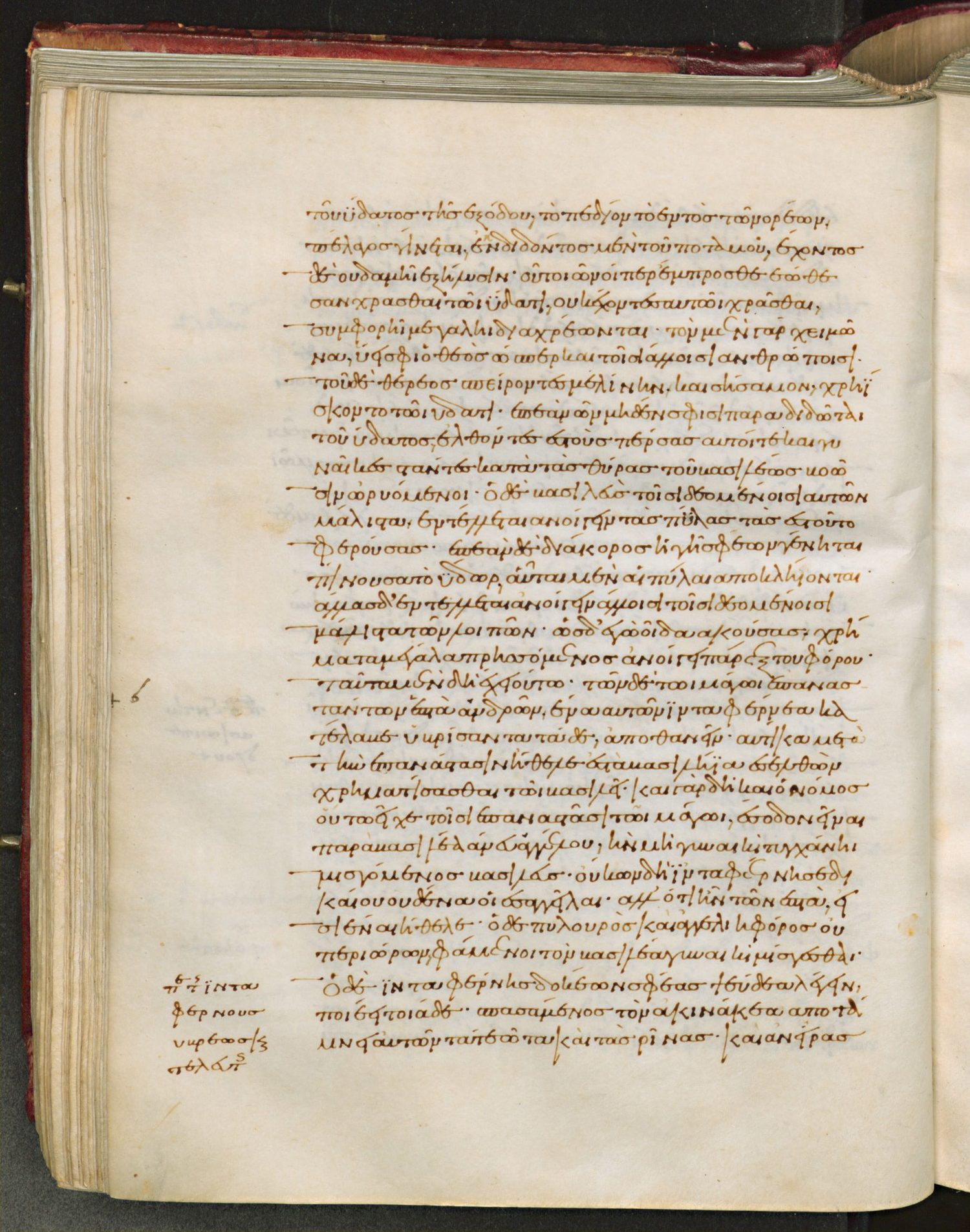
Laur. Plut. 70.3, fol. 134v: Greek here 3.118.1 to 3.118.2. Checked on the image (first and last words read and located in the Greek; each break checked against the neighbouring page): fol. 134v begins ‹τοῦ ὕδατος τῆς ἐξόδου› (3.117.3), ends ‹τὰς ῥῖνας, καὶ ἀνείρας› (3.118.2). The article τοῦ (3.117.3) stands both at the end of fol. 134r and at the start of fol. 134v. English here: 3.118.1 to 3.118.2 (Godley's sentences for the sections whose Greek lies mostly on this page).
3.118.1ταῦτα μὲν δὴ ἔχει οὕτω. τῶν δὲ τῷ Μάγῳ ἐπαναστάντων ἑπτὰ ἀνδρῶν, ἕνα αὐτῶν Ἰνταφρένεα κατέλαβε ὑβρίσαντα τάδε ἀποθανεῖν αὐτίκα μετὰ τὴν ἐπανάστασιν. ἤθελε ἐς τὰ βασιλήια ἐσελθὼν χρηματίσασθαι τῷ βασιλέι· καὶ γὰρ δὴ καὶ ὁ νόμος οὕτω εἶχε, τοῖσι ἐπαναστᾶσι τῷ Μάγῳ ἔσοδον εἶναι παρὰ βασιλέα ἄνευ ἀγγέλου, ἢν μὴ γυναικὶ τυγχάνῃ μισγόμενος βασιλεύς. 3.118.2οὔκων δὴ Ἰνταφρένης ἐδικαίου οὐδένα οἱ ἐσαγγεῖλαι, ἀλλʼ ὅτι ἦν τῶν ἑπτά, ἐσιέναι ἤθελε. ὁ δὲ πυλουρὸς καὶ ὁ ἀγγελιηφόρος οὐ περιώρων, φάμενοι τὸν βασιλέα γυναικὶ μίσγεσθαι. ὁ δὲ Ἰνταφρένης δοκέων σφέας ψεύδεα λέγειν ποιέει τοιάδε· σπασάμενος τὸν ἀκινάκεα ἀποτάμνει αὐτῶν τά τε ὦτα καὶ τὰς ῥῖνας, καὶ ἀνείρας
3.118.1So much for these matters. But Intaphrenes, one of the seven rebels against the Magian, was brought to his death by a deed of violence immediately after the rebellion. He desired to enter the palace and speak with the king; for this was the law, that the rebels should come into the king’s presence without announcement given, if the king were not with one of his wives. 3.118.2Intaphrenes then claimed his right to enter unannounced, as one of the seven; but the gate-warden and the messenger forbade him, the king being, they said, with one of his wives. Intaphrenes thought they spoke falsely; drawing his scimitar he cut off their noses and ears, then strung these on his horse’s bridle and bound it round the men’s necks, and so let them go.
Where on the image
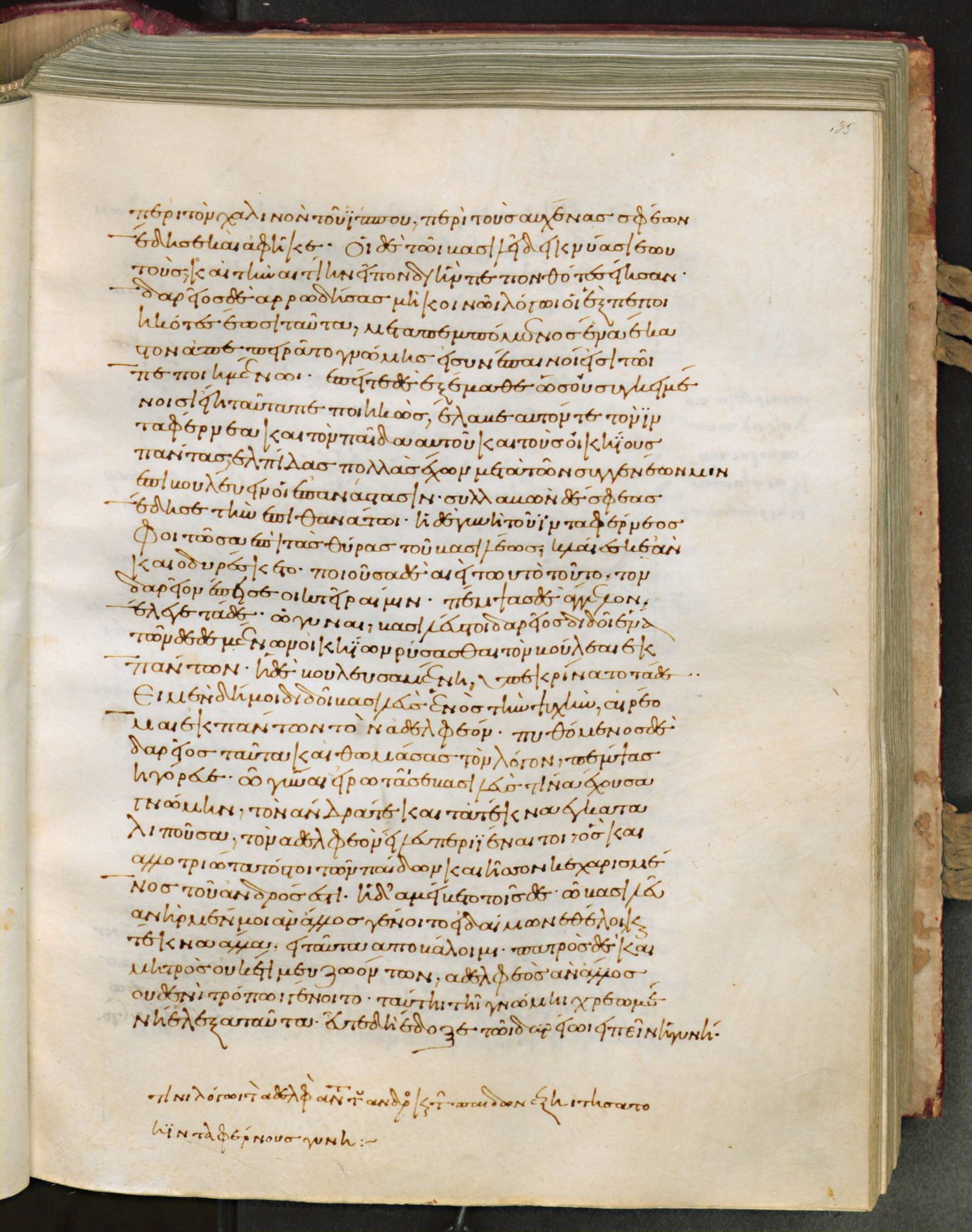
Laur. Plut. 70.3, fol. 135r: Greek here 3.118.2 to 3.119.7. Checked on the image (first and last words read and located in the Greek; each break checked against the neighbouring page): fol. 135r begins ‹περὶ τὸν χαλινὸν τοῦ› (3.118.2), ends ‹Δαρείῳ εἰπεῖν ἡ γυνή› (3.119.7). Below the text, a reader's note on the wife of Intaphrenes, who asked for her brother. English here: 3.119.1 to 3.119.6 (Godley's sentences for the sections whose Greek lies mostly on this page).
3.118.2περὶ τὸν χαλινὸν τοῦ ἵππου περὶ τοὺς αὐχένας σφέων ἔδησε, καὶ ἀπῆκε. 3.119.1οἳ δὲ τῷ βασιλέι δεικνύουσι ἑωυτοὺς καὶ τὴν αἰτίην εἶπον διʼ ἣν πεπονθότες εἴησαν. Δαρεῖος δὲ ἀρρωδήσας μὴ κοινῷ λόγῳ οἱ ἓξ πεποιηκότες ἔωσι ταῦτα, μεταπεμπόμενος ἕνα ἕκαστον ἀπεπειρᾶτο γνώμης, εἰ συνέπαινοι εἰσὶ τῷ πεποιημένῳ. 3.119.2ἐπείτε δὲ ἐξέμαθε ὡς οὐ σὺν κείνοισι εἴη ταῦτα πεποιηκώς, ἔλαβε αὐτόν τε τὸν Ἰνταφρένεα καὶ τοὺς παῖδας αὐτοῦ καὶ τοὺς οἰκηίους πάντας, ἐλπίδας πολλὰς ἔχων μετὰ τῶν συγγενέων μιν ἐπιβουλεύειν οἱ ἐπανάστασιν, συλλαβὼν δὲ σφέας ἔδησε τὴν ἐπὶ θανάτῳ. 3.119.3ἡ δὲ γυνὴ τοῦ Ἰνταφρένεος φοιτῶσα ἐπὶ τὰς θύρας τοῦ βασιλέος κλαίεσκε ἂν καὶ ὀδυρέσκετο· ποιεῦσα δὲ αἰεὶ τὠυτὸ τοῦτο τὸν Δαρεῖον ἔπεισε οἰκτεῖραί μιν. πέμψας δὲ ἄγγελον ἔλεγε τάδε· ὦ γύναι, βασιλεύς τοι Δαρεῖος διδοῖ ἕνα τῶν δεδεμένων οἰκηίων ῥύσασθαι τὸν βούλεαι ἐκ πάντων. 3.119.4ἣ δὲ βουλευσαμένη ὑπεκρίνετο τάδε· εἰ μὲν δή μοι διδοῖ βασιλεὺς ἑνὸς τὴν ψυχήν, αἱρέομαι ἐκ πάντων τὸν ἀδελφεόν. 3.119.5πυθόμενος δὲ Δαρεῖος ταῦτα καὶ θωμάσας τὸν λόγον, πέμψας ἠγόρευε ὦ γύναι, εἰρωτᾷ σε βασιλεύς, τίνα ἔχουσα γνώμην, τὸν ἄνδρα τε καὶ τὰ τέκνα ἐγκαταλιποῦσα, τὸν ἀδελφεὸν εἵλευ περιεῖναί τοι, ὃς καὶ ἀλλοτριώτερός τοι τῶν παίδων καὶ ἧσσον κεχαρισμένος τοῦ ἀνδρός ἐστι. 3.119.6ἣ δʼ ἀμείβετο τοῖσιδε. ὦ βασιλεῦ, ἀνὴρ μέν μοι ἂν ἄλλος γένοιτο, εἰ δαίμων ἐθέλοι, καὶ τέκνα ἄλλα, εἰ ταῦτα ἀποβάλοιμι· πατρὸς δὲ καὶ μητρὸς οὐκέτι μευ ζωόντων ἀδελφεὸς ἂν ἄλλος οὐδενὶ τρόπῳ γένοιτο. ταύτῃ τῇ γνώμῃ χρεωμένη ἔλεξα ταῦτα. 3.119.7εὖ τε δὴ ἔδοξε τῷ Δαρείῳ εἰπεῖν ἡ γυνή,
3.119.1They showed themselves to the king and told him the reason why they had been so treated. Darius, fearing that this might be a conspiracy of the six, sent for each severally and questioned him, to know if they approved the deed; 3.119.2and being assured that they had no part in it, he seized Intaphrenes with his sons and all his household—for he much suspected that the man was plotting a rebellion with his kinsfolk—and imprisoned them with intent to put them to death. 3.119.3Then Intaphrenes’ wife came ever and anon to the palace gates, weeping and lamenting; and at last her continual so doing moved Darius to compassion; and he sent 3.119.4a messenger to tell her that Darius would grant her the life of one of her imprisoned kinsfolk, whomsoever she chose. She, after counsel taken, answered that if this were the king’s boon she chose the life of her brother. 3.119.5Darius was astonished when he heard her answer, and sent one who said to her: “Woman, the king would know for what reason you pass over your husband and your children and choose rather to save the life of your brother, who is less close to you than your children and less dear than your husband.” 3.119.6“O King,” she answered, “another husband I may get, if heaven so will, and other children, if I lose these; but my father and mother are dead, and so I can by no means get another brother; that is why I have thus spoken.”
Where on the image
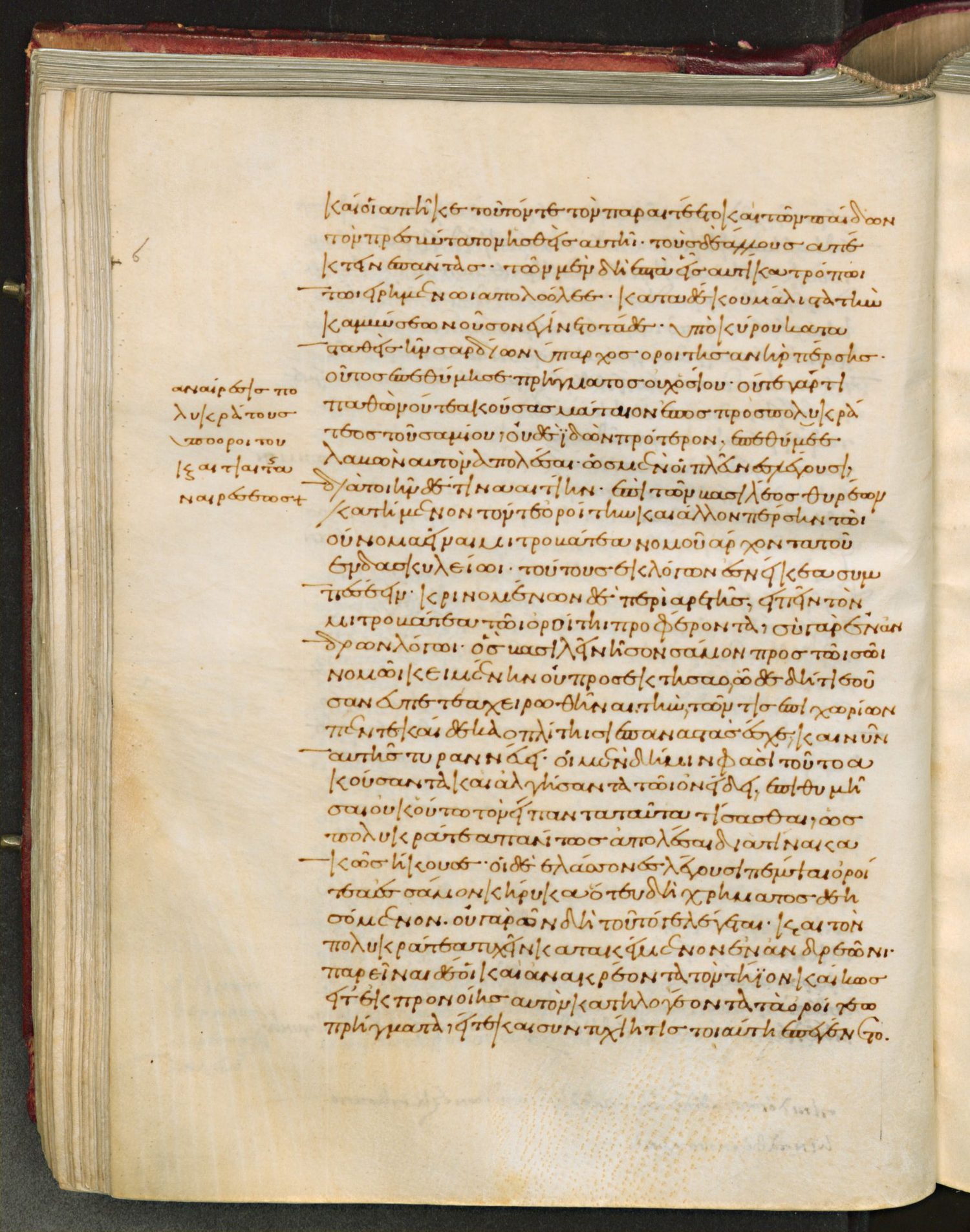
Laur. Plut. 70.3, fol. 135v: Greek here 3.119.7 to 3.121.2. Checked on the image (first and last words read and located in the Greek; each break checked against the neighbouring page): fol. 135v begins ‹καί οἱ ἀπῆκε τοῦτόν› (3.119.7), ends ‹συντυχίη τις τοιαύτη ἐπεγένετο› (3.121.2). English here: 3.119.7 to 3.121.2 (Godley's sentences for the sections whose Greek lies mostly on this page).
3.119.7καί οἱ ἀπῆκε τοῦτόν τε τὸν παραιτέετο καὶ τῶν παίδων τὸν πρεσβύτατον, ἡσθεὶς αὐτῇ, τοὺς δὲ ἄλλους ἀπέκτεινε πάντας. τῶν μὲν δὴ ἑπτὰ εἷς αὐτίκα τρόπῳ τῷ εἰρημένῳ ἀπολώλεε. 3.120.1κατὰ δέ κου μάλιστα τὴν Καμβύσεω νοῦσον ἐγίνετο τάδε. ὑπὸ Κύρου κατασταθεὶς ἦν Σαρδίων ὕπαρχος Ὀροίτης ἀνὴρ Πέρσης· οὗτος ἐπεθύμησε πρήγματος οὐκ ὁσίου· οὔτε γάρ τι παθὼν οὔτε ἀκούσας μάταιον ἔπος πρὸς Πολυκράτεος τοῦ Σαμίου, οὐδὲ ἰδὼν πρότερον, ἐπεθύμεε λαβὼν αὐτὸν ἀπολέσαι, ὡς μὲν οἱ πλεῦνες λέγουσι, διὰ τοιήνδε τινὰ αἰτίην. 3.120.2ἐπὶ τῶν βασιλέος θυρέων κατήμενον τόν τε Ὀροίτεα καὶ ἄλλον Πέρσην τῷ οὔνομα εἶναι Μιτροβάτεα, νομοῦ ἄρχοντα τοῦ ἐν Δασκυλείῳ, τούτους ἐκ λόγων ἐς νείκεα συμπεσεῖν, κρινομένων δὲ περὶ ἀρετῆς εἰπεῖν τὸν Μιτροβάτεα τῷ Ὀροίτῃ προφέροντα 3.120.3σὺ γὰρ ἐν ἀνδρῶν λόγῳ, ὃς βασιλέι νῆσον Σάμον πρὸς τῷ σῷ νομῷ προσκειμένην οὐ προσεκτήσαο, ὧδε δή τι ἐοῦσαν εὐπετέα χειρωθῆναι, τὴν τῶν τις ἐπιχωρίων πεντεκαίδεκα ὁπλίτῃσι ἐπαναστὰς ἔσχε καὶ νῦν αὐτῆς τυραννεύει; 3.120.4οἳ μὲν δή μιν φασὶ τοῦτο ἀκούσαντα καὶ ἀλγήσαντα τῷ ὀνείδεϊ ἐπιθυμῆσαι οὐκ οὕτω τὸν εἴπαντα ταῦτα τίσασθαι ὡς Πολυκράτεα πάντως ἀπολέσαι, διʼ ὅντινα κακῶς ἤκουσε. 3.121.1οἱ δὲ ἐλάσσονες λέγουσι πέμψαι Ὀροίτεα ἐς Σάμον κήρυκα ὅτευ δὴ χρήματος δεησόμενον (οὐ γὰρ ὦν δὴ τοῦτό γε λέγεται), καὶ τὸν Πολυκράτεα τυχεῖν κατακείμενον ἐν ἀνδρεῶνι, παρεῖναι δέ οἱ καὶ Ἀνακρέοντα τὸν Τήιον· 3.121.2καί κως εἴτʼ ἐκ προνοίης αὐτὸν κατηλογέοντα τὰ Ὀροίτεω πρήγματα, εἴτε καὶ συντυχίη τις τοιαύτη ἐπεγένετο·
3.119.7Darius was pleased, and thought the reason good; he delivered to the woman him for whose life she had asked, and the eldest of her sons besides; all the rest he put to death. Thus immediately perished one of the seven. 3.120.1What I will now relate happened about the time of Cambyses’ sickness. The viceroy of Sardis appointed by Cyrus was Oroetes, a Persian. This man purposed to do a great wrong; for though he had received no hurt by deed or word from Polycrates of Samos, nor had even seen him, he formed the desire of seizing and killing him. 3.120.2The reason alleged by most was this:—As Oroetes and another Persian, Mitrobates by name, governor of the province at Dascyleium, sat by the king’s door, they fell from talk to wrangling and comparing of their several achievements: and Mitrobates taunted Oroetes, saying, “ 3.120.3You are not to be accounted a man; the island of Samos lies close to your province, yet you have not added it to the king’s dominion—an island so easy to conquer that some native of it rose against his rulers with fifteen men at arms, and is now lord of it.” 3.120.4Some say that Oroetes, angered by this taunt, was less desirous of punishing the utterer of it than of by all means destroying the reason of the reproach, namely Polycrates. 3.121.1Others (but fewer) say that when Oroetes sent a herald to Samos with some request (it is not said what this was), the herald found Polycrates lying in the men’s apartments, in the company of Anacreon of Teos; 3.121.2and, whether by design to show contempt for Oroetes, or by mere chance, when Oroetes’ herald entered and addressed him, Polycrates, then lying with his face to the wall, never turned nor answered him.
Where on the image
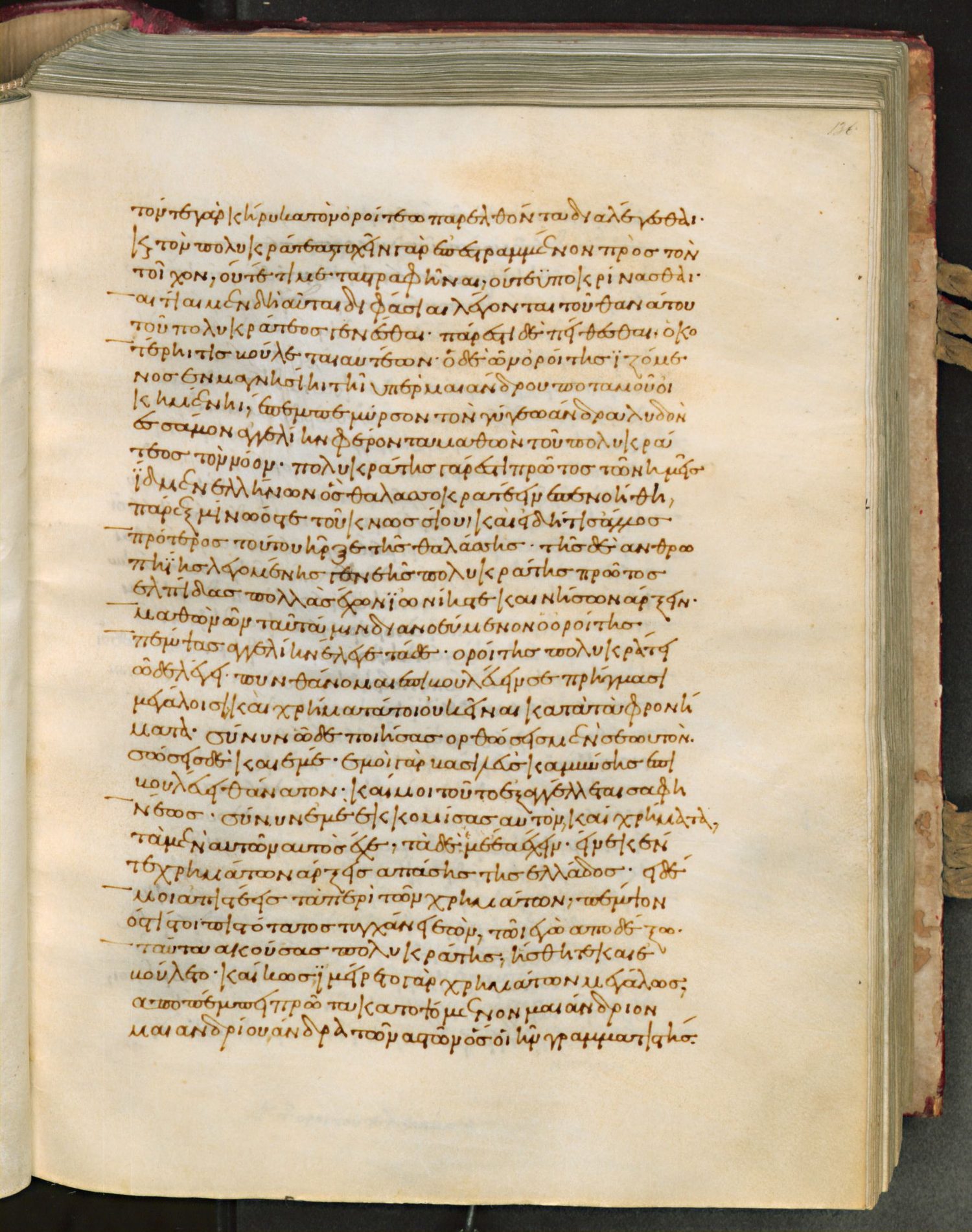
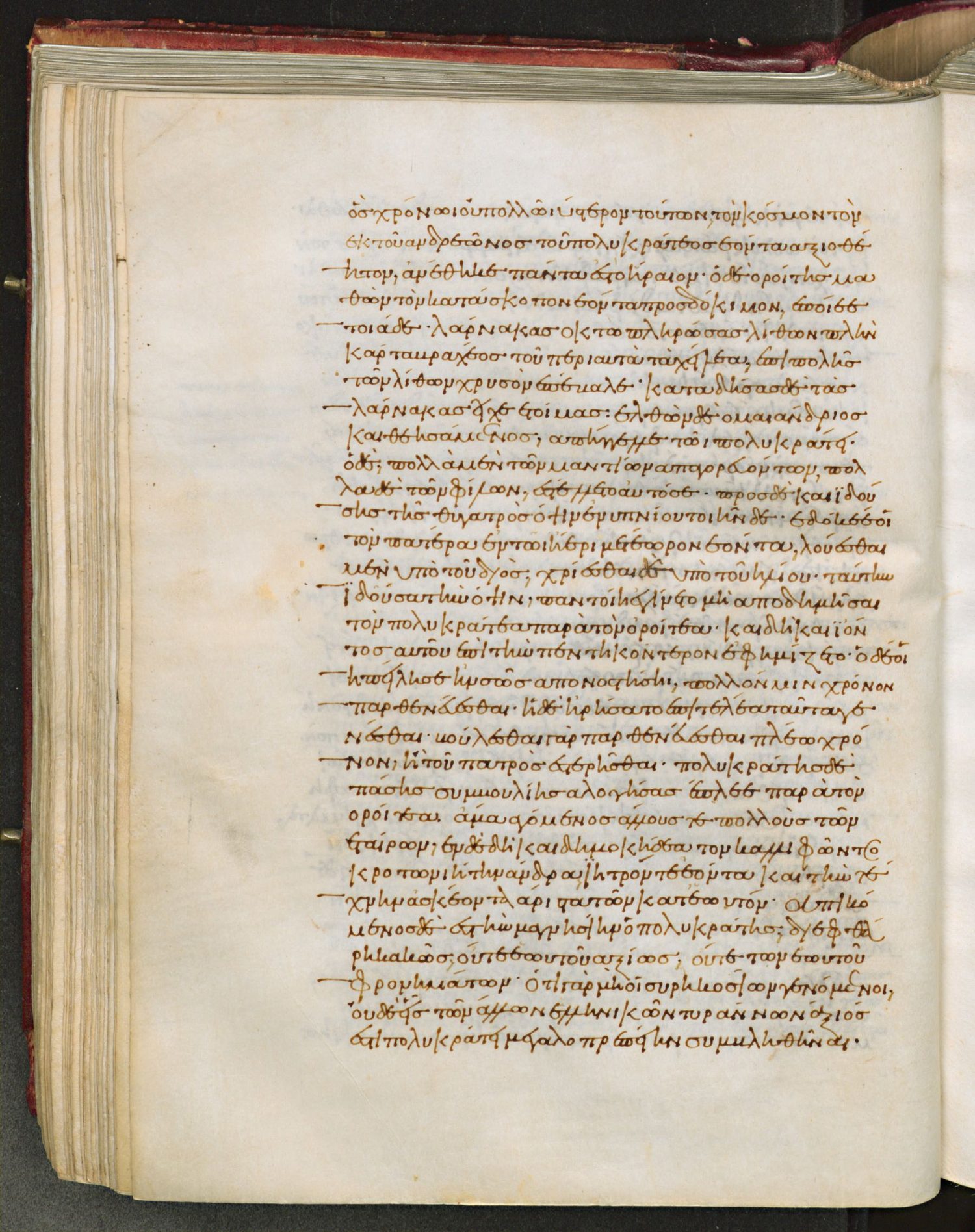
Laur. Plut. 70.3, fol. 136r: Greek here 3.121.2 to 3.123.1. Checked on the image (first and last words read and located in the Greek; each break checked against the neighbouring page): fol. 136r begins ‹τόν τε γὰρ κήρυκα› (3.121.2), ends ‹ὅς οἱ ἦν γραμματιστής› (3.123.1). English here: 3.122.1 to 3.123.1 (Godley's sentences for the sections whose Greek lies mostly on this page).
3.121.2τόν τε γὰρ κήρυκα τὸν Ὀροίτεω παρελθόντα διαλέγεσθαι, καὶ τὸν Πολυκράτεα (τυχεῖν γὰρ ἀπεστραμμένον πρὸς τὸν τοῖχον) οὔτε τι μεταστραφῆναι οὔτε ὑποκρίνασθαι. 3.122.1αἰτίαι μὲν δὴ αὗται διφάσιαι λέγονται τοῦ θανάτου τοῦ Πολυκράτεος γενέσθαι, πάρεστι δὲ πείθεσθαι ὁκοτέρῃ τις βούλεται αὐτέων. ὁ δὲ ὦν Ὀροίτης ἱζόμενος ἐν Μαγνησίῃ τῇ ὑπὲρ Μαιάνδρου ποταμοῦ οἰκημένῃ ἔπεμπε Μύρσον τὸν Γύγεω ἄνδρα Λυδὸν ἐς Σάμον ἀγγελίην φέροντα, μαθὼν τοῦ Πολυκράτεος τὸν νόον. 3.122.2Πολυκράτης γὰρ ἐστὶ πρῶτος τῶν ἡμεῖς ἴδμεν Ἑλλήνων ὃς θαλασσοκρατέειν ἐπενοήθη, πάρεξ Μίνωός τε τοῦ Κνωσσίου καὶ εἰ δή τις ἄλλος πρότερος τούτου ἦρξε τῆς θαλάσσης· τῆς δὲ ἀνθρωπηίης λεγομένης γενεῆς Πολυκράτης πρῶτος, ἐλπίδας πολλὰς ἔχων Ἰωνίης τε καὶ νήσων ἄρξειν. 3.122.3μαθὼν ὦν ταῦτά μιν διανοεύμενον ὁ Ὀροίτης πέμψας ἀγγελίην ἔλεγε τάδε. Ὀροίτης Πολυκράτεϊ ὧδε λέγει. πυνθάνομαι ἐπιβουλεύειν σε πρήγμασι μεγάλοισι, καὶ χρήματά τοι οὐκ εἶναι κατὰ τὰ φρονήματα. σύ νυν ὧδε ποιήσας ὀρθώσεις μὲν σεωυτόν, σώσεις δὲ καὶ ἐμέ· ἐμοὶ γὰρ βασιλεὺς Καμβύσης ἐπιβουλεύει θάνατον, καί μοι τοῦτο ἐξαγγέλλεται σαφηνέως. 3.122.4σύ νυν ἐμὲ ἐκκομίσας αὐτὸν καὶ χρήματα, τὰ μὲν αὐτῶν αὐτὸς ἔχε, τὰ δὲ ἐμὲ ἔα ἔχειν· εἵνεκέν τε χρημάτων ἄρξεις ἁπάσης τῆς Ἑλλάδος. εἰ δέ μοι ἀπιστέεις τὰ περὶ τῶν χρημάτων, πέμψον ὅστις τοι πιστότατος τυγχάνει ἐών, τῷ ἐγὼ ἀποδέξω. 3.123.1ταῦτα ἀκούσας Πολυκράτης ἥσθη τε καὶ ἐβούλετο· καί κως ἱμείρετο γὰρ χρημάτων μεγάλως, ἀποπέμπει πρῶτα κατοψόμενον Μαιάνδριον Μαιανδρίου ἄνδρα τῶν ἀστῶν, ὅς οἱ ἦν γραμματιστής·
3.122.1These are the two reasons alleged for Polycrates’ death; believe which you will. But the upshot was that Oroetes, being then at Magnesia which stands above the river Maeander, sent Myrsus, son of Gyges, a Lydian, with a message to Samos, having learnt Polycrates’ purpose; 3.122.2for Polycrates was the first Greek, of whom I have knowledge, to aim at the mastery of the sea, leaving out of account Minos of Cnossus and any others who before him held maritime dominion; of such as may be called men Polycrates was the first so to do, and he had great hope of making himself master of Ionia and the Islands. 3.122.3Learning then that such was his intent, Oroetes sent him this message: “These from Oroetes to Polycrates:—I learn that you plan great enterprises, and that you have not money sufficient for your purpose. Do then as I counsel and you will make yourself to prosper and me to be safe. King Cambyses designs my death; of this I have clear intelligence. 3.122.4Now if you will bring me away with my money, you may take part of it for yourself and leave the rest with me; thus shall you have wealth enough to rule all Hellas. If you mistrust what I tell you of the money, send your trustiest minister and I will prove it to him.” 3.123.1Hearing this, Polycrates liked the plan and consented; and, as it chanced that he had a great desire for money, he first sent one of his townsmen, Maeandrius, son of Maeandrius, to look into the matter; this man was his scribe; it was he who not long afterwards dedicated in the Heraeum all the splendid adornment of the men’s apartment in Polycrates’ house.
Where on the image
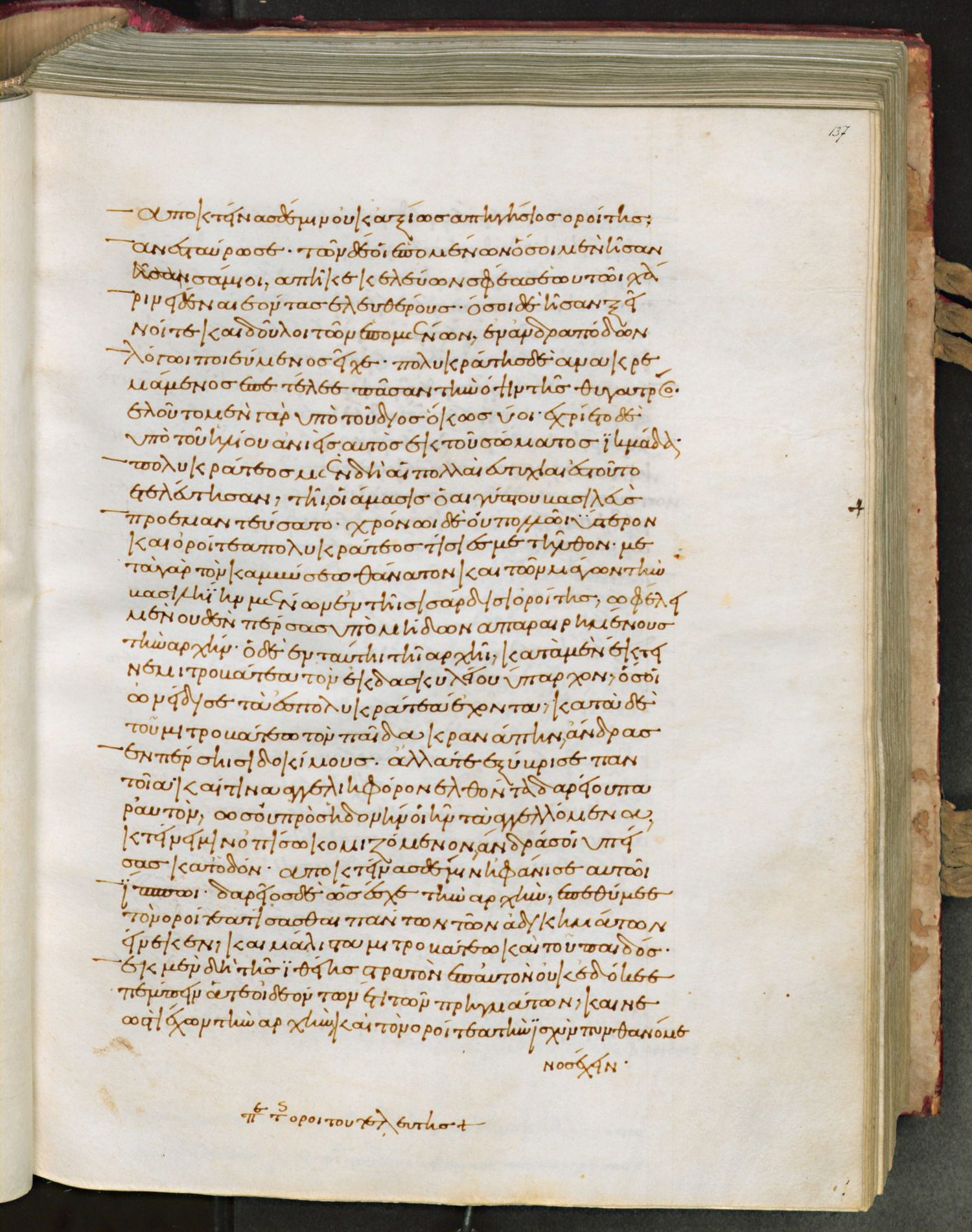
Laur. Plut. 70.3, fol. 136v: Greek here 3.123.1 to 3.125.2. Checked on the image (first and last words read and located in the Greek; each break checked against the neighbouring page): fol. 136v begins ‹ὃς χρόνῳ οὐ πολλῷ› (3.123.1), ends ‹ἐστὶ Πολυκράτεϊ μεγαλοπρεπείην συμβληθῆναι› (3.125.2). English here: 3.123.2 to 3.125.2 (Godley's sentences for the sections whose Greek lies mostly on this page).
3.123.1ὃς χρόνῳ οὐ πολλῷ ὕστερον τούτων τὸν κόσμον τὸν ἐκ τοῦ ἀνδρεῶνος τοῦ Πολυκράτεος ἐόντα ἀξιοθέητον ἀνέθηκε πάντα ἐς τὸ Ἥραιον. 3.123.2ὁ δὲ Ὀροίτης μαθὼν τὸν κατάσκοπον ἐόντα προσδόκιμον ἐποίεε τοιάδε· λάρνακας ὀκτὼ πληρώσας λίθων πλὴν κάρτα βραχέος τοῦ περὶ αὐτὰ τὰ χείλεα, ἐπιπολῆς τῶν λίθων χρυσὸν ἐπέβαλε, καταδήσας δὲ τὰς λάρνακας εἶχε ἑτοίμας. ἐλθὼν δὲ ὁ Μαιάνδριος καὶ θεησάμενος ἀπήγγελλε τῷ Πολυκράτεϊ. 3.124.1ὁ δὲ πολλὰ μὲν τῶν μαντίων ἀπαγορευόντων πολλὰ δὲ τῶν φίλων ἐστέλλετο αὐτόσε, πρὸς δὲ καὶ ἰδούσης τῆς θυγατρὸς ὄψιν ἐνυπνίου τοιήνδε· ἐδόκεε οἷ τὸν πατέρα ἐν τῷ ἠέρι μετέωρον ἐόντα λοῦσθαι μὲν ὑπὸ τοῦ Διός, χρίεσθαι δὲ ὑπὸ τοῦ ἡλίου. 3.124.2ταύτην ἰδοῦσα τὴν ὄψιν παντοίη ἐγίνετο μὴ ἀποδημῆσαι τὸν Πολυκράτεα παρὰ τὸν Ὀροίτεα, καὶ δὴ καὶ ἰόντος αὐτοῦ ἐπὶ τὴν πεντηκόντερον ἐπεφημίζετο. ὁ δέ οἱ ἠπείλησε, ἢν σῶς ἀπονοστήσῃ, πολλόν μιν χρόνον παρθενεύεσθαι. ἣ δὲ ἠρήσατο ἐπιτελέα ταῦτα γενέσθαι· βούλεσθαι γὰρ παρθενεύεσθαι πλέω χρόνον ἢ τοῦ πατρὸς ἐστερῆσθαι. 3.125.1Πολυκράτης δὲ πάσης συμβουλίης ἀλογήσας ἔπλεε παρὰ τὸν Ὀροίτεα, ἅμα ἀγόμενος ἄλλους τε πολλοὺς τῶν ἑταίρων, ἐν δὲ δὴ καὶ Δημοκήδεα τὸν Καλλιφῶντος Κροτωνιήτην ἄνδρα, ἰητρόν τε ἐόντα καὶ τὴν τέχνην ἀσκέοντα ἄριστα τῶν κατʼ ἑωυτόν. 3.125.2ἀπικόμενος δὲ ἐς τὴν Μαγνησίην ὁ Πολυκράτης διεφθάρη κακῶς, οὔτε ἑωυτοῦ ἀξίως οὔτε τῶν ἑωυτοῦ φρονημάτων· ὅτι γὰρ μὴ οἱ Συρηκοσίων γενόμενοι τύραννοι οὐδὲ εἷς τῶν ἄλλων Ἑλληνικῶν τυράννων ἄξιος ἐστὶ Πολυκράτεϊ μεγαλοπρεπείην συμβληθῆναι.
3.123.2When Oroetes heard that an inspection was to be looked for, he filled eight chests with stones, saving only a very shallow layer at the top; then he laid gold on the surface of the stones, made the chests fast and kept them ready. Maeandrius came and saw, and brought word back to his master. 3.124.1Polycrates then prepared to visit Oroetes, despite the strong dissuasion of his diviners and friends, and a vision seen by his daughter in a dream; she dreamt that she saw her father aloft in the air, washed by Zeus and anointed by the sun; 3.124.2after this vision she used all means to persuade him not to go on this journey to Oroetes; even as he went to his fifty-oared ship she prophesied evil for him. When Polycrates threatened her that if he came back safe, she should long remain a virgin, she answered with a prayer that his threat might be fulfilled: for she would rather, she said, be long left a virgin than lose her father. 3.125.1But Polycrates would listen to no counsel. He sailed to meet Oroetes, with a great retinue of followers, among whom was Democedes, son of Calliphon, a man of Crotona and the most skilful physician of his time. 3.125.2But no sooner had Polycrates come to Magnesia than he was foully murdered, making an end which ill beseemed himself and his pride; for, saving only the despots of Syracuse, there is no despot of Greek race to be compared with Polycrates for magnificence.
Where on the image
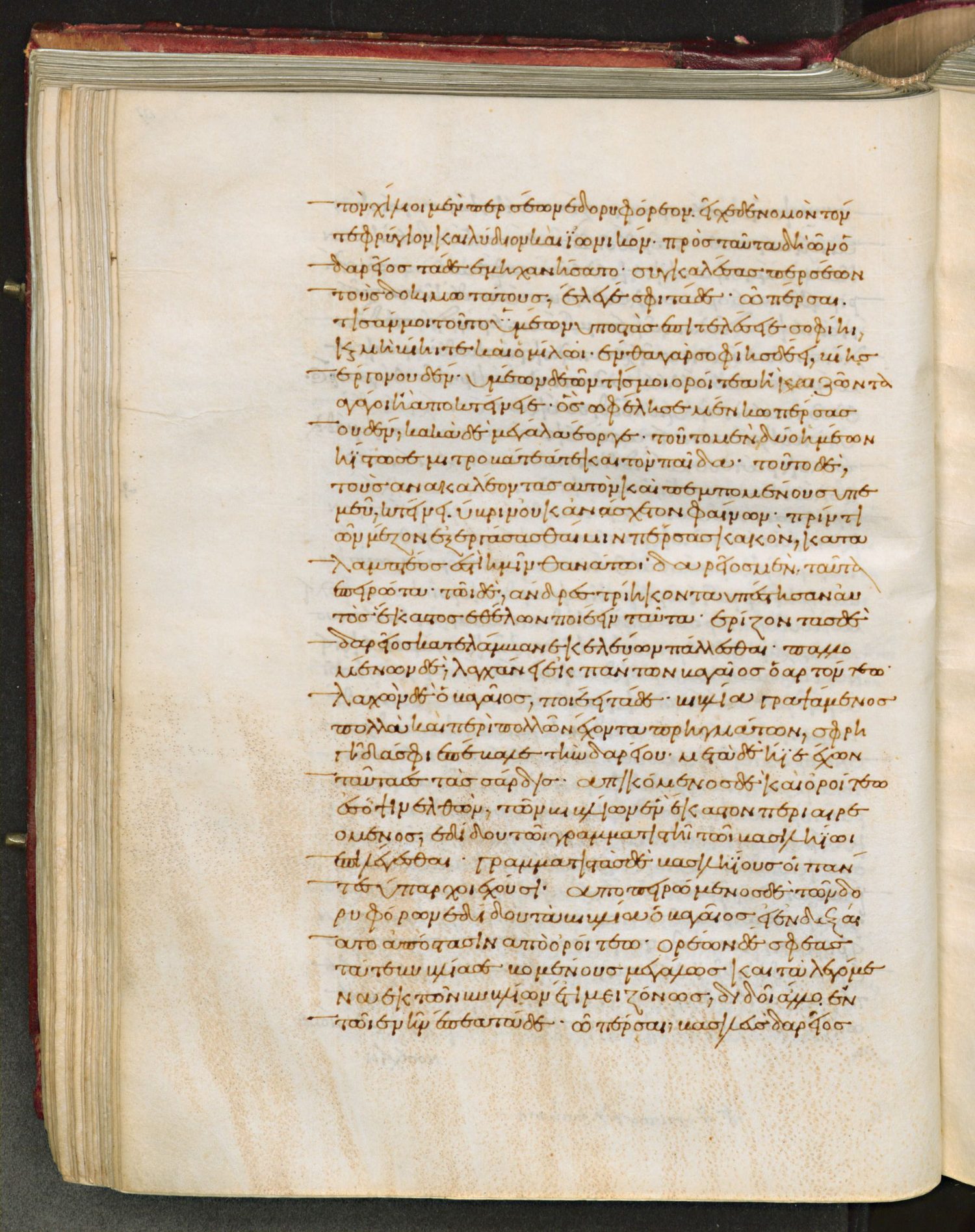
Laur. Plut. 70.3, fol. 137r: Greek here 3.125.3 to 3.127.1. Checked on the image (first and last words read and located in the Greek; each break checked against the neighbouring page): fol. 137r begins ‹ἀποκτείνας δέ μιν οὐκ› (3.125.3), ends ‹τὴν ἰσχὺν πυνθανόμενος ἔχειν› (3.127.1). Below the text, a reader's note on the death of Oroetes. English here: 3.125.3 to 3.127.1 (Godley's sentences for the sections whose Greek lies mostly on this page).
3.125.3ἀποκτείνας δέ μιν οὐκ ἀξίως ἀπηγήσιος Ὀροίτης ἀνεσταύρωσε· τῶν δέ οἱ ἑπομένων ὅσοι μὲν ἦσαν Σάμιοι, ἀπῆκε, κελεύων σφέας ἑωυτῷ χάριν εἰδέναι ἐόντας ἐλευθέρους, ὅσοι δὲ ἦσαν ξεῖνοί τε καὶ δοῦλοι τῶν ἑπομένων, ἐν ἀνδραπόδων λόγῳ ποιεύμενος εἶχε. 3.125.4Πολυκράτης δὲ ἀνακρεμάμενος ἐπετέλεε πᾶσαν τὴν ὄψιν τῆς θυγατρός· ἐλοῦτο μὲν γὰρ ὑπὸ τοῦ Διὸς ὅκως ὕοι, ἐχρίετο δὲ ὑπὸ τοῦ ἡλίου, ἀνιεὶς αὐτὸς ἐκ τοῦ σώματος ἰκμάδα. 3.126.1Πολυκράτεος μὲν δὴ αἱ πολλαὶ εὐτυχίαι ἐς τοῦτο ἐτελεύτησαν τῇ οἱ Ἄμασις ὁ Αἰγύπτου βασιλεὺς προεμαντεύσατο. χρόνῳ δὲ οὐ πολλῷ ὕστερον καὶ Ὀροίτεα Πολυκράτεος τίσιες μετῆλθον. μετὰ γὰρ τὸν Καμβύσεω θάνατον καὶ τῶν Μάγων τὴν βασιληίην μένων ἐν τῇσι Σάρδισι Ὀροίτης ὠφέλεε μὲν οὐδὲν Πέρσας ὑπὸ Μήδων ἀπαραιρημένους τὴν ἀρχήν· 3.126.2ὁ δὲ ἐν ταύτῃ τῇ ταραχῇ κατὰ μὲν ἔκτεινε Μιτροβάτεα τὸν ἐκ Δασκυλείου ὕπαρχον, ὅς οἱ ὠνείδισε τὰ ἐς Πολυκράτεα ἔχοντα, κατὰ δὲ τοῦ Μιτροβάτεω τὸν παῖδα Κρανάσπην, ἄνδρας ἐν Πέρσῃσι δοκίμους, ἄλλα τε ἐξύβρισε παντοῖα καί τινα ἀγγελιηφόρον ἐλθόντα Δαρείου παρʼ αὐτόν, ὡς οὐ πρὸς ἡδονήν οἱ ἦν τὰ ἀγγελλόμενα, κτείνει μιν ὀπίσω κομιζόμενον, ἄνδρας οἱ ὑπείσας κατʼ ὁδόν, ἀποκτείνας δέ μιν ἠφάνισε αὐτῷ ἵππῳ. 3.127.1Δαρεῖος δὲ ὡς ἔσχε τὴν ἀρχήν, ἐπεθύμεε τὸν Ὀροίτεα τίσασθαι πάντων τῶν ἀδικημάτων εἵνεκεν καὶ μάλιστα Μιτροβάτεω καὶ τοῦ παιδός. ἐκ μὲν δὴ τῆς ἰθέης στρατὸν ἐπʼ αὐτὸν οὐκ ἐδόκεε πέμπειν ἅτε οἰδεόντων ἔτι τῶν πρηγμάτων, καὶ νεωστὶ ἔχων τὴν ἀρχὴν καὶ τὸν Ὀροίτεα μεγάλην τὴν ἰσχὺν πυνθανόμενος ἔχειν·
3.125.3Having killed him (in some way not fit to be told) Oroetes then crucified him; as for the Samians in his retinue he let them go, bidding them thank Oroetes for their freedom; those who were not Samians, or were servants of Polycrates’ followers, he kept for slaves. 3.125.4So Polycrates was hanged aloft, and thereby his daughter’s dream came true; for he was washed by Zeus when it rained, and the moisture from his body was his anointment by the sun. 3.126.1This was the end of Polycrates’ many successes, as Amasis king of Egypt had forewarned him. But not long after, Oroetes was overtaken by the powers that avenged Polycrates. After Cambyses had died and the Magians won the kingship, Oroetes stayed in Sardis, where he in no way helped the Persians to regain the power taken from them by the Medes, 3.126.2but contrariwise; for in this confusion he slew two notable Persians, Mitrobates, the governor from Dascyleium, who had taunted him concerning Polycrates, and Mitrobates’ son, Cranaspes; and besides many other violent deeds, when a messenger from Darius came with a message which displeased him, he set an ambush by the way and killed that messenger on his journey homewards, and made away with the man’s body and horse. 3.127.1So when Darius became king he was minded to punish Oroetes for all his wrongdoing, and chiefly for the killing of Mitrobates and his son. But he thought it best not to send an army openly against the satrap, seeing that all was still in ferment and he himself was still new to the royal power; moreover he heard that Oroetes was very strong, having a guard of a thousand Persian spearmen and being governor of the Phrygian and Lydian and Ionian province.
Where on the image
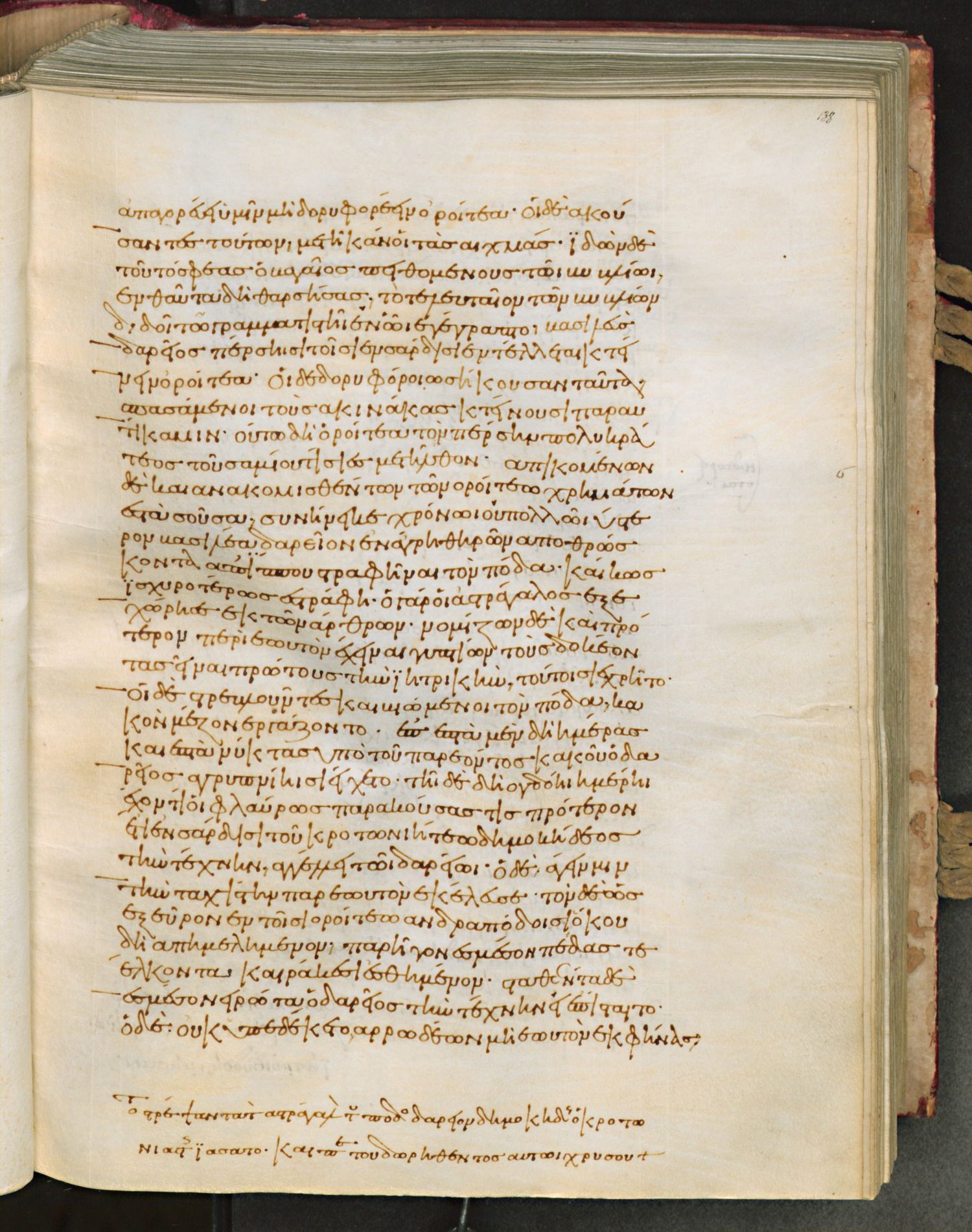
Laur. Plut. 70.3, fol. 137v: Greek here 3.127.1 to 3.128.4. Checked on the image (first and last words read and located in the Greek; each break checked against the neighbouring page): fol. 137v begins ‹τὸν χίλιοι μὲν Περσέων› (3.127.1), ends ‹ὦ Πέρσαι, βασιλεὺς Δαρεῖος› (3.128.4). English here: 3.127.2 to 3.128.4 (Godley's sentences for the sections whose Greek lies mostly on this page).
3.127.1τὸν χίλιοι μὲν Περσέων ἐδορυφόρεον, εἶχε δὲ νομὸν τόν τε Φρύγιον καὶ Λύδιον καὶ Ἰωνικόν. 3.127.2πρὸς ταῦτα δὴ ὦν ὁ Δαρεῖος τάδε ἐμηχανήσατο. συγκαλέσας Περσέων τοὺς δοκιμωτάτους ἔλεγέ σφι τάδε. ὦ Πέρσαι, τίς ἄν μοι τοῦτο ὑμέων ὑποστὰς ἐπιτελέσειε σοφίῃ καὶ μὴ βίῃ τε καὶ ὁμίλῳ; ἔνθα γὰρ σοφίης δέει, βίης ἔργον οὐδέν· 3.127.3ὑμέων δὲ ὦν τίς μοι Ὀροίτεα ἢ ζώοντα ἀγάγοι ἢ ἀποκτείνειε; ὃς ὠφέλησε μέν κω Πέρσας οὐδέν, κακὰ δὲ μεγάλα ἔοργε· τοῦτο μὲν δύο ἡμέων ἠίστωσε, Μιτροβάτεά τε καὶ τὸν παῖδα αὐτοῦ, τοῦτο δὲ τοὺς ἀνακαλέοντας αὐτὸν καὶ πεμπομένους ὑπʼ ἐμεῦ κτείνει, ὕβριν οὐκ ἀνασχετὸν φαίνων. πρίν τι ὦν μέζον ἐξεργάσασθαί μιν Πέρσας κακόν, καταλαμπτέος ἐστὶ ἡμῖν θανάτῳ. 3.128.1Δαρεῖος μὲν ταῦτα ἐπειρώτα, τῷ δὲ ἄνδρες τριήκοντα ὑπέστησαν, αὐτὸς ἕκαστος ἐθέλων ποιέειν ταῦτα. ἐρίζοντας δὲ Δαρεῖος κατελάμβανε κελεύων πάλλεσθαι· παλλομένων δὲ λαγχάνει ἐκ πάντων Βαγαῖος ὁ Ἀρτόντεω· 3.128.2λαχὼν δὲ ὁ Βαγαῖος ποιέει τάδε· βυβλία γραψάμενος πολλὰ καὶ περὶ πολλῶν ἔχοντα πρηγμάτων σφρηγῖδά σφι ἐπέβαλε τὴν Δαρείου, μετὰ δὲ ἤιε ἔχων ταῦτα ἐς τὰς Σάρδις. 3.128.3ἀπικόμενος δὲ καὶ Ὀροίτεω ἐς ὄψιν ἐλθών, τῶν βυβλίων ἓν ἕκαστον περιαιρεόμενος ἐδίδου τῷ γραμματιστῇ τῷ βασιληίῳ ἐπιλέγεσθαι· γραμματιστὰς δὲ βασιληίους οἱ πάντες ὕπαρχοι ἔχουσι· ἀποπειρώμενος δὲ τῶν δορυφόρων ἐδίδου τὰ βυβλία ὁ Βαγαῖος, εἰ ἐνδεξαίατο ἀπόστασιν ἀπὸ Ὀροίτεω. 3.128.4ὁρέων δὲ σφέας τά τε βυβλία σεβομένους μεγάλως καὶ τὰ λεγόμενα ἐκ τῶν βυβλίων ἔτι μεζόνως, διδοῖ ἄλλο ἐν τῷ ἐνῆν ἔπεα τάδε· ὦ Πέρσαι, βασιλεὺς Δαρεῖος
3.127.2Resorting therefore to a device to help him, he summoned an assembly of the most notable Persians, whom he thus addressed: “Who is there among you, men of Persia, that will undertake and achieve a thing for me not with force and numbers, but by cunning? Force has no place where cunning is needful. 3.127.3But to the matter in hand—which of you will bring me Oroetes alive, or kill him? for he has done the Persians no good, but much harm; two of us he has slain, Mitrobates and his son; nay, and he slays my messengers who are sent to recall him; so unbearable is the insolence of his acts. Therefore we must see that death stays him from doing the Persians some yet worse evil.” 3.128.1At this question thirty men promised that they were ready each for himself to do the king’s will. Darius bade them not contend but draw lots; they all did so, and the lot fell on Bagaeus, son of Artontes. 3.128.2He, thus chosen, got written many letters concerning many matters; then sealing them with Darius’ seal he went with them to Sardis. 3.128.3Coming there into Oroetes’ presence he took out each letter severally and gave it to one of the royal scribes who attend all governors, for him to read; giving the letters with intent to try the spearmen and learn if they would consent to revolt against Oroetes, 3.128.4Seeing that they paid great regard to the rolls and yet more to what was written therein, he gave another, wherein were these words: “Persians! King Darius forbids you to be Oroetes’ guard,” which when the guard heard they lowered their spears before him.
Where on the image
Laur. Plut. 70.3, fol. 138r: Greek here 3.128.4 to 3.130.1. Checked on the image (first and last words read and located in the Greek; each break checked against the neighbouring page): fol. 138r begins ‹ἀπαγορεύει ὑμῖν μὴ δορυφορέειν› (3.128.4), ends ‹ἀρρωδέων μὴ ἑωυτὸν ἐκφήνας› (3.130.1). Below the text, a reader's note on Darius and Democedes of Croton. English here: 3.128.5 to 3.130.1 (Godley's sentences for the sections whose Greek lies mostly on this page).
3.128.4ἀπαγορεύει ὑμῖν μὴ δορυφορέειν Ὀροίτεα. οἳ δὲ ἀκούσαντες τούτων μετῆκάν οἱ τὰς αἰχμάς. 3.128.5ἰδὼν δὲ τοῦτο σφέας ὁ Βαγαῖος πειθομένους τῷ βυβλίῳ, ἐνθαῦτα δὴ θαρσήσας τὸ τελευταῖον τῶν βυβλίων διδοῖ τῷ γραμματιστῇ, ἐν τῷ ἐγέγραπτο βασιλεὺς Δαρεῖος Πέρσῃσι τοῖσι ἐν Σάρδισι ἐντέλλεται κτείνειν Ὀροίτεα. οἱ δὲ δορυφόροι ὡς ἤκουσαν ταῦτα, σπασάμενοι τοὺς ἀκινάκας κτείνουσι παραυτίκα μιν, οὕτω δὴ Ὀροίτεα τὸν Πέρσην Πολυκράτεος τοῦ Σαμίου τίσιες μετῆλθον. 3.129.1ἀπικομένων δὲ καὶ ἀνακομισθέντων τῶν Ὀροίτεω χρημάτων ἐς τὰ Σοῦσα, συνήνεικε χρόνῳ οὐ πολλῷ ὕστερον βασιλέα Δαρεῖον ἐν ἄγρῃ θηρῶν ἀποθρώσκοντα ἀπʼ ἵππου στραφῆναι τὸν πόδα. 3.129.2καί κως ἰσχυροτέρως ἐστράφη· ὁ γάρ οἱ ἀστράγαλος ἐξεχώρησε ἐκ τῶν ἄρθρων. νομίζων δὲ καὶ πρότερον περὶ ἑωυτὸν ἔχειν Αἰγυπτίων τοὺς δοκέοντας εἶναι πρώτους τὴν ἰητρικήν, τούτοισι ἐχρᾶτο. οἳ δὲ στρεβλοῦντες καὶ βιώμενοι τὸν πόδα κακὸν μέζον ἐργάζοντο. 3.129.3ἐπʼ ἑπτὰ μὲν δὴ ἡμέρας καὶ ἑπτὰ νύκτας ὑπὸ τοῦ παρεόντος κακοῦ ὁ Δαρεῖος ἀγρυπνίῃσι εἴχετο· τῇ δὲ δὴ ὀγδόῃ ἡμέρῃ ἔχοντί οἱ φλαύρως, παρακούσας τις πρότερον ἔτι ἐν Σάρδισι τοῦ Κροτωνιήτεω Δημοκήδεος τὴν τέχνην ἀγγέλλει τῷ Δαρείῳ· ὁ δὲ ἄγειν μιν τὴν ταχίστην παρʼ ἑωυτὸν ἐκέλευσε· τὸν δὲ ὡς ἐξεῦρον ἐν τοῖσι Ὀροίτεω ἀνδραπόδοισι ὅκου δὴ ἀπημελημένον, παρῆγον ἐς μέσον πέδας τε ἕλκοντα καὶ ῥάκεσι ἐσθημένον. 3.130.1σταθέντα δὲ ἐς μέσον εἰρώτα ὁ Δαρεῖος τὴν τέχνην εἰ ἐπίσταιτο· ὁ δὲ οὐκ ὑπεδέκετο, ἀρρωδέων μὴ ἑωυτὸν ἐκφήνας
3.128.5When Bagaeus saw that they obeyed the letter thus far, he took heart and gave the last roll to the scribe, wherein were these words: “King Darius charges the Persians in Sardis to kill Oroetes.” Hearing this the spearmen drew their scimitars and killed Oroetes forthwith. Thus was Oroetes the Persian overtaken by the powers that avenged Polycrates of Samos. 3.129.1Oroetes’ slaves and other possessions were brought to Susa. Not long after this, it happened that Darius, while hunting, twisted his foot in dismounting from his horse, 3.129.2so violently that the ball of the ankle joint was dislocated from its socket. Darius called in the first physicians of Egypt, whom he had till now kept near his person; who, by their forcible wrenching of the foot, did but make the hurt worse; 3.129.3and for seven days and nights the king could get no sleep for the pain. On the eighth day he was in very evil case; then someone, who had heard in Sardis of the skill of Democedes of Croton, told the king of him. Darius bade Democedes be brought to him without delay. Finding the physician somewhere all unregarded and forgotten among Oroetes’ slaves, they brought him forth, dragging his chains and clad in rags. 3.130.1When he came before the king, Darius asked him if he had knowledge of his art. Democedes denied it, for he feared that by revealing the truth about himself he would wholly be cut off from Hellas.
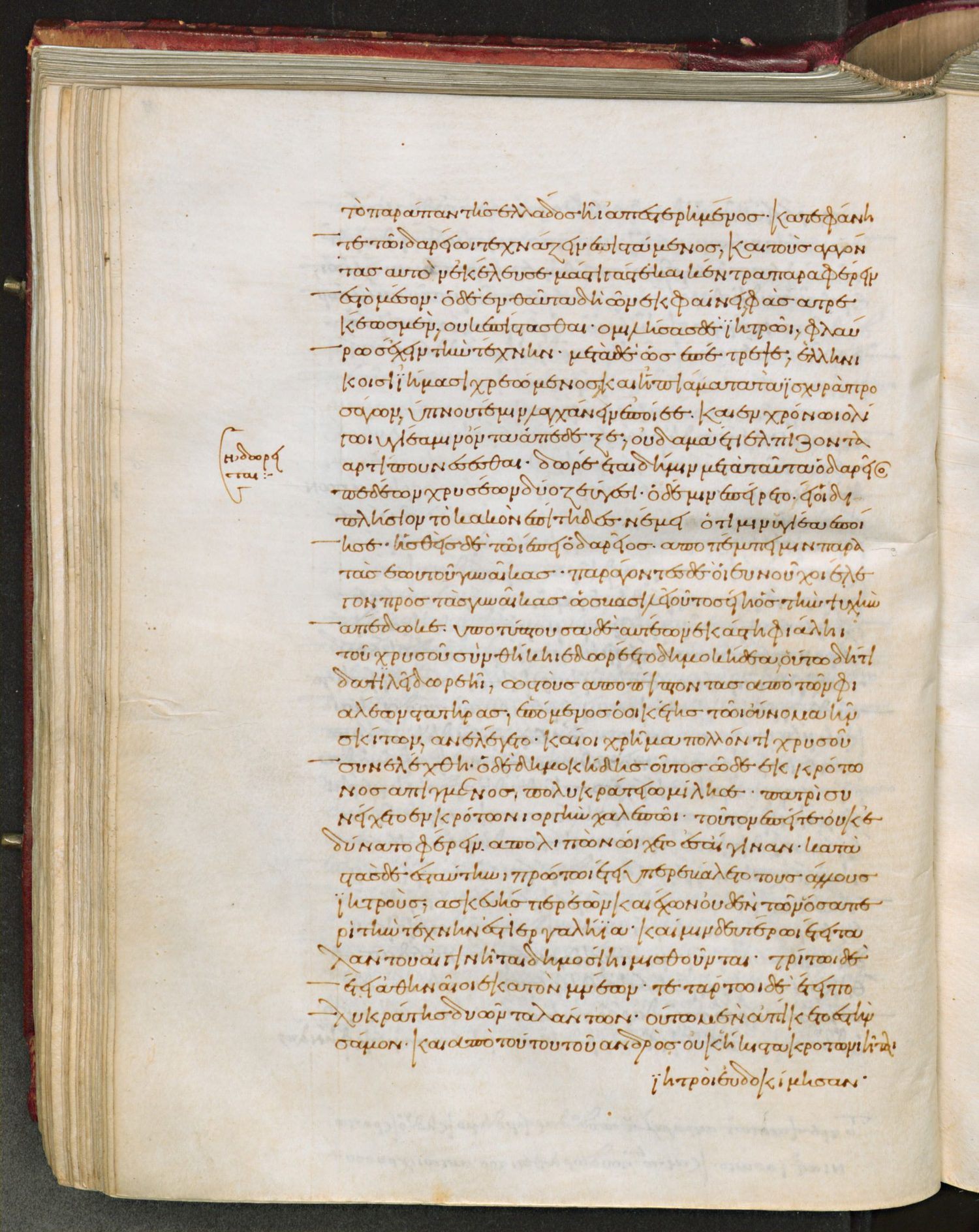
Where on the image
Laur. Plut. 70.3, fol. 138v: Greek here 3.130.1 to 3.131.2. Checked on the image (first and last words read and located in the Greek; each break checked against the neighbouring page): fol. 138v begins ‹τὸ παράπαν τῆς Ἑλλάδος› (3.130.1), ends ‹ἥκιστα Κροτωνιῆται ἰητροὶ εὐδοκίμησαν› (3.131.2). The last line holds only ἰητροὶ εὐδοκίμησαν. English here: 3.130.2 to 3.131.3 (Godley's sentences for the sections whose Greek lies mostly on this page).
3.130.1τὸ παράπαν τῆς Ἑλλάδος ᾖ ἀπεστερημένος· 3.130.2κατεφάνη τε τῷ Δαρείῳ τεχνάζειν ἐπιστάμενος, καὶ τοὺς ἀγαγόντας αὐτὸν ἐκέλευσε μάστιγάς τε καὶ κέντρα παραφέρειν ἐς τὸ μέσον. ὁ δὲ ἐνθαῦτα δὴ ὦν ἐκφαίνει, φὰς ἀτρεκέως μὲν οὐκ ἐπίστασθαι, ὁμιλήσας δὲ ἰητρῷ φλαύρως ἔχειν τὴν τέχνην. 3.130.3μετὰ δέ, ὥς οἱ ἐπέτρεψε, Ἑλληνικοῖσι ἰήμασι χρεώμενος καὶ ἤπια μετὰ τὰ ἰσχυρὰ προσάγων ὕπνου τέ μιν λαγχάνειν ἐποίεε καὶ ἐν χρόνῳ ὀλίγῳ ὑγιέα μιν ἀπέδεξε, οὐδαμὰ ἔτι ἐλπίζοντα ἀρτίπουν ἔσεσθαι. 3.130.4δωρέεται δή μιν μετὰ ταῦτα ὁ Δαρεῖος πεδέων χρυσέων δύο ζεύγεσι· ὁ δέ μιν ἐπείρετο εἴ οἱ διπλήσιον τὸ κακὸν ἐπίτηδες νέμει, ὅτι μιν ὑγιέα ἐποίησε. ἡσθεὶς δὲ τῷ ἔπεϊ ὁ Δαρεῖος ἀποπέμπει μιν παρὰ τὰς ἑωυτοῦ γυναῖκας· παράγοντες δὲ οἱ εὐνοῦχοι ἔλεγον πρὸς τὰς γυναῖκας ὡς βασιλέι οὗτος εἴη ὃς τὴν ψυχὴν ἀπέδωκε. 3.130.5ὑποτύπτουσα δὲ αὐτέων ἑκάστη φιάλῃ τοῦ χρυσοῦ ἐς θήκην ἐδωρέετο Δημοκήδεα οὕτω δή τι δαψιλέι δωρεῇ ὡς τοὺς ἀποπίπτοντας ἀπὸ τῶν φιαλέων στατῆρας ἑπόμενος ὁ οἰκέτης, τῷ οὔνομα ἦν Σκίτων, ἀνελέγετο καί οἱ χρῆμα πολλόν τι χρυσοῦ συνελέχθη. 3.131.1ὁ δὲ Δημοκήδης οὗτος ὧδε ἐκ Κρότωνος ἀπιγμένος Πολυκράτεϊ ὡμίλησε· πατρὶ συνείχετο ἐν τῇ Κρότωνι ὀργὴν χαλεπῷ· τοῦτον ἐπείτε οὐκ ἐδύνατο φέρειν, ἀπολιπὼν οἴχετο ἐς Αἴγιναν. καταστὰς δὲ ἐς ταύτην πρώτῳ ἔτεϊ ὑπερεβάλετο τοὺς ἄλλους ἰητρούς, ἀσκευής περ ἐὼν καὶ ἔχων οὐδὲν τῶν ὅσα περὶ τὴν τέχνην ἐστὶ ἐργαλήια. 3.131.2καί μιν δευτέρῳ ἔτεϊ ταλάντου Αἰγινῆται δημοσίῃ μισθοῦνται, τρίτῳ δὲ ἔτεϊ Ἀθηναῖοι ἑκατὸν μνέων, τετάρτῳ δὲ ἔτεϊ Πολυκράτης δυῶν ταλάντων. οὕτω μὲν ἀπίκετο ἐς τὴν Σάμον, καὶ ἀπὸ τούτου τοῦ ἀνδρὸς οὐκ ἥκιστα Κροτωνιῆται ἰητροὶ εὐδοκίμησαν.
3.130.2Darius saw clearly that he was using craft to hide his knowledge, and bade those who led him to bring out scourges and goads for him. Then Democedes confessed, in so far as to say that his knowledge was not exact: but he had consorted (he said) with a physician and thereby gained some poor acquaintance with the art. 3.130.3Darius then entrusting the matter to him, Democedes applied Greek remedies and used gentleness instead of the Egyptians’ violence; whereby he made the king able to sleep and in a little while recovered him of his hurt, though Darius had had no hope of regaining the use of his foot. 3.130.4After this, Darius rewarded him with a gift of two pairs of golden fetters. “Is it then your purpose,” Democedes asked, “to double my pains for my making you whole?” Darius, pleased by his wit, sent him to the king’s wives. The eunuchs brought him to the women, saying, “This is he who saved the king’s life”; whereupon 3.130.5each of them took a vessel and, scooping with it from a chest full of gold, so richly rewarded the physician that the servant, whose name was Sciton, collected a very great sum of gold by following and gleaning the staters that fell from the vessels. 3.131.1Now this is how Democedes had come from Croton to live with Polycrates: he was troubled with a harsh-tempered father at Croton, whom being unable to bear, he left him and went to Aegina. Settled there, before a year was out, he excelled all the other physicians, although he had no equipment nor any of the implements of his calling. 3.131.2In his second year the Aeginetans paid him a talent to be their public physician; in the next the Athenians hired him for an hundred minae, and Polycrates in the next again for two talents. Thus he came to Samos; and the fame of the Crotoniat physicians was chiefly owing to him; 3.131.3for at this time the best physicians in Greek countries were those of Croton, and next to them those of Cyrene. About the same time the Argives had the name of being the best musicians.
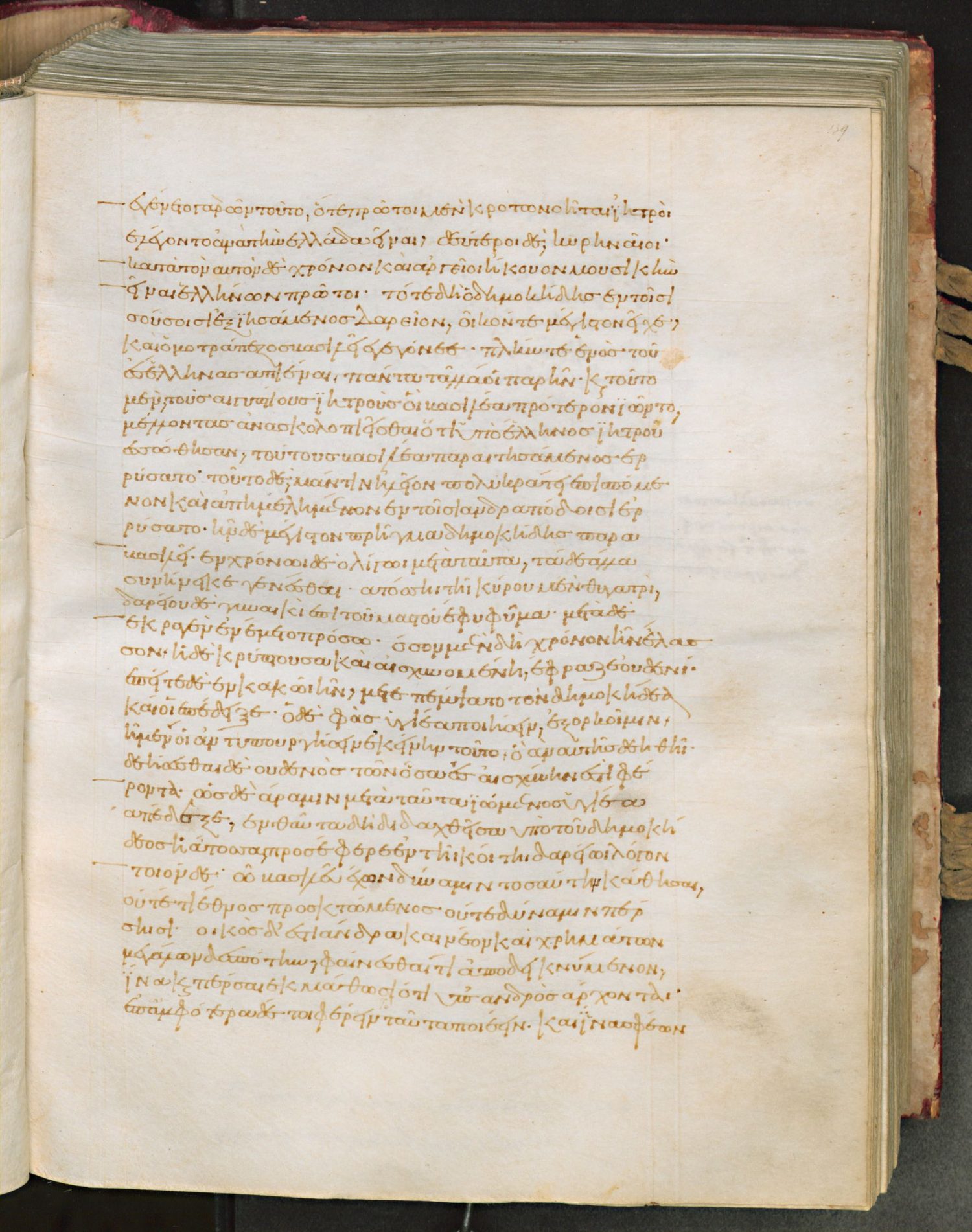
Where on the image
Laur. Plut. 70.3, fol. 139r: Greek here 3.131.3 to 3.134.2. Checked on the image (first and last words read and located in the Greek; each break checked against the neighbouring page): fol. 139r begins ‹ἐγένετο γὰρ ὦν τοῦτο› (3.131.3), ends ‹ποιέειν, καὶ ἵνα σφέων› (3.134.2). English here: 3.132.1 to 3.134.2 (Godley's sentences for the sections whose Greek lies mostly on this page).
3.131.3ἐγένετο γὰρ ὦν τοῦτο ὅτε πρῶτοι μὲν Κροτωνιῆται ἰητροὶ ἐλέγοντο ἀνὰ τὴν Ἑλλάδα εἶναι, δεύτεροι δὲ Κυρηναῖοι. κατὰ τὸν αὐτὸν δὲ τοῦτον χρόνον καὶ Ἀργεῖοι ἤκουον μουσικὴν εἶναι Ἑλλήνων πρῶτοι. 3.132.1τότε δὴ ὁ Δημοκήδης ἐν τοῖσι Σούσοισι ἐξιησάμενος Δαρεῖον οἶκόν τε μέγιστον εἶχε καὶ ὁμοτράπεζος βασιλέι ἐγεγόνεε, πλήν τε ἑνὸς τοῦ ἐς Ἕλληνας ἀπιέναι πάντα τἆλλά οἱ παρῆν. 3.132.2καὶ τοῦτο μὲν τοὺς Αἰγυπτίους ἰητρούς, οἳ βασιλέα πρότερον ἰῶντο, μέλλοντας ἀνασκολοπιεῖσθαι ὅτι ὑπὸ Ἕλληνος ἰητροῦ ἑσσώθησαν, τούτους βασιλέα παραιτησάμενος ἐρρύσατο· τοῦτο δὲ μάντιν Ἠλεῖον Πολυκράτεϊ ἐπισπόμενον καὶ ἀπημελημένον ἐν τοῖσι ἀνδραπόδοισι ἐρρύσατο. ἦν δὲ μέγιστον πρῆγμα Δημοκήδης παρὰ βασιλέι. 3.133.1ἐν χρόνῳ δὲ ὀλίγῳ μετὰ ταῦτα τάδε ἄλλα συνήνεικε γενέσθαι. Ἀτόσσῃ τῇ Κύρου μὲν θυγατρὶ Δαρείου δὲ γυναικὶ ἐπὶ τοῦ μαστοῦ ἔφυ φῦμα, μετὰ δὲ ἐκραγὲν ἐνέμετο πρόσω. ὅσον μὲν δὴ χρόνον ἦν ἔλασσον, ἣ δὲ κρύπτουσα καὶ αἰσχυνομένη ἔφραζε οὐδενί· ἐπείτε δὲ ἐν κακῷ ἦν, μετεπέμψατο τὸν Δημοκήδεα καί οἱ ἐπέδεξε. 3.133.2ὁ δὲ φὰς ὑγιέα ποιήσειν ἐξορκοῖ μιν ἦ μέν οἱ ἀντυπουργήσειν ἐκείνην τοῦτο τὸ ἂν αὐτῆς δεηθῇ· δεήσεσθαι δὲ οὐδενὸς τῶν ὅσα ἐς αἰσχύνην ἐστὶ φέροντα. 3.134.1ὡς δὲ ἄρα μιν μετὰ ταῦτα ἰώμενος ὑγιέα ἀπέδεξε, ἐνθαῦτα δὴ διδαχθεῖσα ὑπὸ τοῦ Δημοκήδεος ἡ Ἄτοσσα προσέφερε ἐν τῇ κοίτῃ Δαρείῳ λόγον τοιόνδε. ὦ βασιλεῦ, ἔχων δύναμιν τοσαύτην κάτησαι, οὔτε τι ἔθνος προσκτώμενος οὔτε δύναμιν Πέρσῃσι. 3.134.2οἰκὸς δὲ ἐστὶ ἄνδρα καὶ νέον καὶ χρημάτων μεγάλων δεσπότην φαίνεσθαί τι ἀποδεικνύμενον, ἵνα καὶ Πέρσαι ἐκμάθωσι ὅτι ὑπʼ ἀνδρὸς ἄρχονται. ἐπʼ ἀμφότερα δέ τοι συμφέρει ταῦτα ποιέειν, καὶ ἵνα σφέων
3.132.1So now for having healed Darius at Susa Democedes had a very great house and ate at the king’s table; all was his, except only permission to return to his Greek home. 3.132.2When the Egyptian chirurgeons who had till now attended on the king were about to be impaled for being less skilful than a Greek, Democedes begged their lives of the king and saved them; and he saved besides an Elean diviner, who had been of Polycrates’ retinue and was left neglected among the slaves. Mightily in favour with the king was Democedes. 3.133.1Not long after this, Atossa, Cyrus’ daughter and Darius’ wife, found a swelling growing on her breast, which broke and spread further. As long as it was but a small matter, she said nothing of it but hid it for shame; but presently growing worse, she sent for Democedes and showed it to him. 3.133.2He promised to cure her, but made her to swear that she would requite him by granting whatsoever he requested of her; saying, that he would ask nothing shameful. 3.134.1His remedies having made her whole, Atossa at Democedes’ prompting thus addressed Darius in their chamber: “Sire, you are a mighty ruler; why sit you idle, winning neither new dominions nor new power for your Persians? 3.134.2If you would have them know that they have a man for their king, it is right and fitting for one of your youth and your wealth to let them see you achieving some great enterprise. Thereby will you gain a double advantage: the Persians will know that their king is truly a man; and in the stress of war they will have no leisure for conspiring against you.
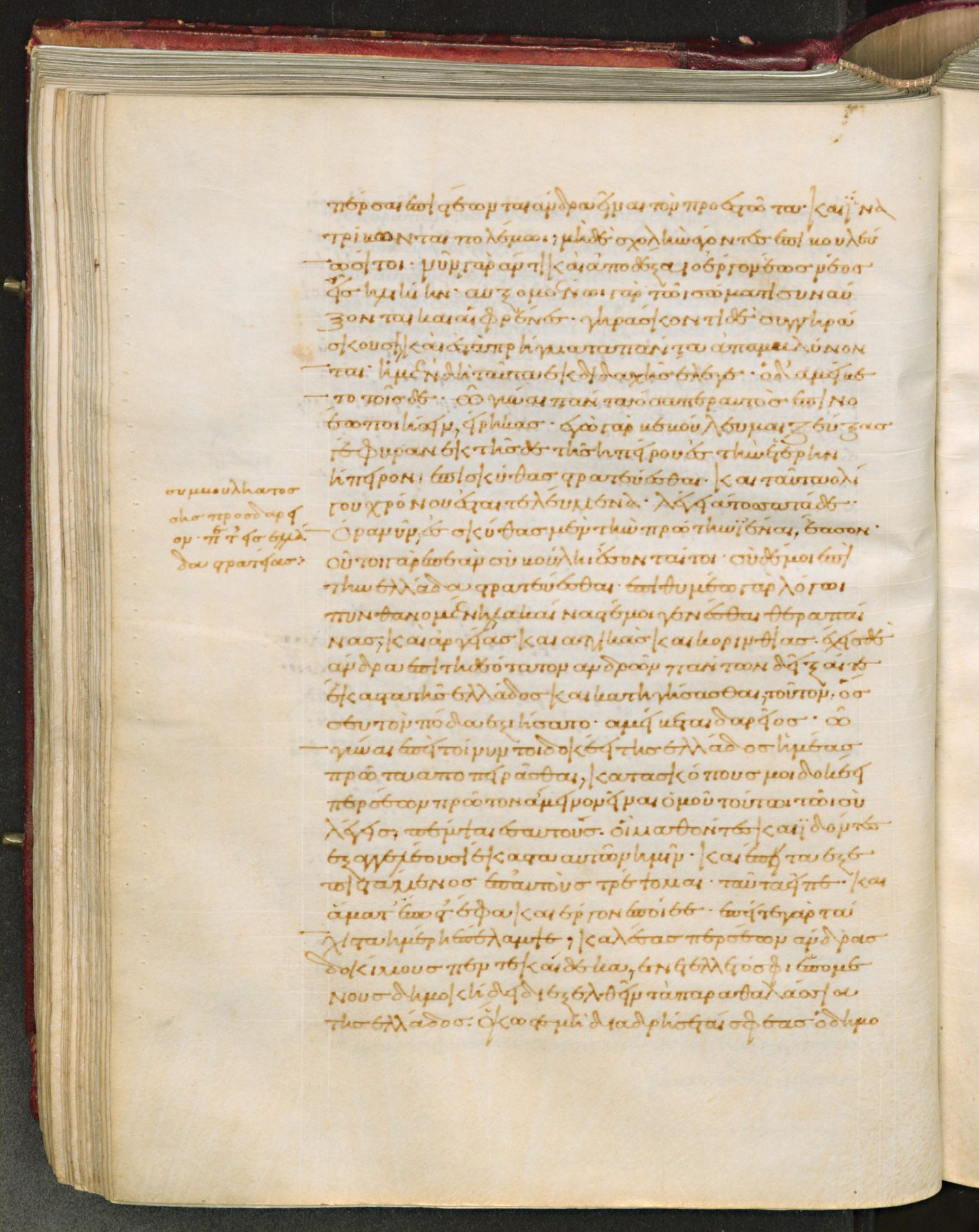
Where on the image
Laur. Plut. 70.3, fol. 139v: Greek here 3.134.2 to 3.135.1. Checked on the image (first and last words read and located in the Greek; each break checked against the neighbouring page): fol. 139v begins ‹Πέρσαι ἐπίστωνται ἄνδρα εἶναι› (3.134.2), ends ‹διαδρήσεται σφέας ὁ Δημο-› (3.135.1). English here: 3.134.3 to 3.135.1 (Godley's sentences for the sections whose Greek lies mostly on this page).
3.134.2Πέρσαι ἐπίστωνται ἄνδρα εἶναι τὸν προεστεῶτα, καὶ ἵνα τρίβωνται πολέμῳ μηδὲ σχολὴν ἄγοντες ἐπιβουλεύωσί τοι. 3.134.3νῦν γὰρ ἄν τι καὶ ἀποδέξαιο ἔργον, ἕως νέος εἶς ἡλικίην· αὐξομένῳ γὰρ τῷ σώματι συναύξονται καὶ αἱ φρένες, γηράσκοντι δὲ συγγηράσκουσι καὶ ἐς τὰ πρήγματα πάντα ἀπαμβλύνονται. 3.134.4ἣ μὲν δὴ ταῦτα ἐκ διδαχῆς ἔλεγε, ὃ δʼ ἀμείβετο τοῖσιδε. ὦ γύναι, πάντα ὅσα περ αὐτὸς ἐπινοέω ποιήσειν εἴρηκας· ἐγὼ γὰρ βεβούλευμαι ζεύξας γέφυραν ἐκ τῆσδε τῆς ἠπείρου ἐς τὴν ἑτέρην ἤπειρον ἐπὶ Σκύθας στρατεύεσθαι· καὶ ταῦτα ὀλίγου χρόνου ἔσται τελεύμενα. λέγει Ἄτοσσα τάδε. 3.134.5ὅρα νυν, ἐπὶ Σκύθας μὲν τὴν πρώτην ἰέναι ἔασον· οὗτοι γάρ, ἐπεὰν σὺ βούλῃ, ἔσονταί τοι· σὺ δέ μοι ἐπὶ τὴν Ἑλλάδα στρατεύεσθαι. ἐπιθυμέω γὰρ λόγῳ πυνθανομένη Λακαίνας τέ μοι γενέσθαι θεραπαίνας καὶ Ἀργείας καὶ Ἀττικὰς καὶ Κορινθίας. ἔχεις δὲ ἄνδρα ἐπιτηδεότατον ἀνδρῶν πάντων δέξαι τε ἕκαστα τῆς Ἑλλάδος καὶ κατηγήσασθαι, τοῦτον ὅς σευ τὸν πόδα ἐξιήσατο. 3.134.6ἀμείβεται Δαρεῖος ὦ γύναι, ἐπεὶ τοίνυν τοι δοκέει τῆς Ἑλλάδος ἡμέας πρῶτα ἀποπειρᾶσθαι, κατασκόπους μοι δοκέει Περσέων πρῶτον ἄμεινον εἶναι ὁμοῦ τούτῳ τῷ σὺ λέγεις πέμψαι ἐς αὐτούς, οἳ μαθόντες καὶ ἰδόντες ἐξαγγελέουσι ἕκαστα αὐτῶν ἡμῖν· καὶ ἔπειτα ἐξεπιστάμενος ἐπʼ αὐτοὺς τρέψομαι. 3.135.1ταῦτα εἶπε καὶ ἅμα ἔπος τε καὶ ἔργον ἐποίεε. ἐπείτε γὰρ τάχιστα ἡμέρη ἐπέλαμψε, καλέσας Περσέων ἄνδρας δοκίμους πεντεκαίδεκα ἐνετέλλετό σφι ἑπομένους Δημοκήδεϊ διεξελθεῖν τὰ παραθαλάσσια τῆς Ἑλλάδος, ὅκως τε μὴ διαδρήσεται σφέας ὁ Δημοκήδης,
3.134.3Now is your time for achieving great deeds, while you are still young: for as a man’s mind grows with his body’s growth, so as the body ages the mind too grows older and duller for all uses.” 3.134.4Thus she spoke, being so prompted. “Lady,” said Darius, “what you say I am already minded to do. I am resolved to make a bridge from this to the other continent and so lead an army against the Scythians; and in a little while we will set about accomplishing this.” 3.134.5“See now,” Atossa answered, “forbear for the nonce to attack the Scythians; you will find them whenever you so desire; nay, rather, I pray you, march against Hellas. I have heard of Laconian and Argive and Attic and Corinthian women, and would fain have them for handmaidens. There is a man by you who is fitter than any other to instruct and guide you in all matters concerning Hellas: I mean the physician who healed your foot.” 3.134.6“Lady,” answered Darius, “since it is your desire that we should first try conclusions with Hellas, methinks it is best that we send Persians with the man of whom you speak to spy out the land and bring us news of all that they have seen in it; thus shall I have full knowledge to help my adventure against Hellas.” 3.135.1So said Darius, and it was no sooner said than done. For the next day at dawn he called to him fifteen notable Persians, and bade them go with Democedes and pass along the seaboard of Hellas; charging them, too, by all means to bring the physician back and not suffer him to escape.
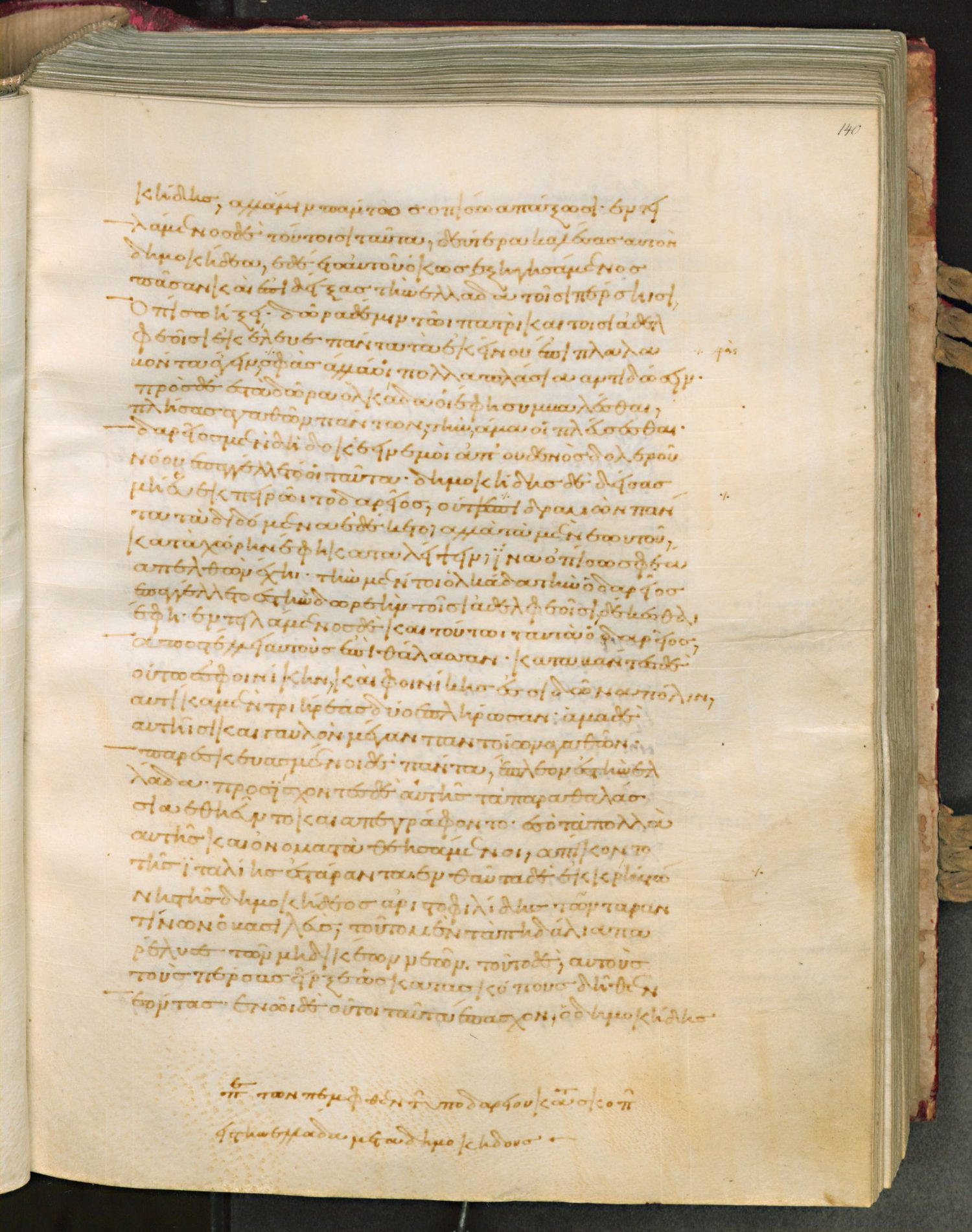
Where on the image
Laur. Plut. 70.3, fol. 140r: Greek here 3.135.1 to 3.136.2. Checked on the image (first and last words read and located in the Greek; each break checked against the neighbouring page): fol. 140r begins ‹-κήδης, ἀλλά μιν πάντως› (3.135.1), ends ‹ταῦτα ἔπασχον, ὁ Δημοκήδης› (3.136.2). The word ‹Δημοκήδης,› is divided between fol. 139v and fol. 140r; it is given with fol. 139v. Below the text, a reader's note on the Persian spies sent to Greece with Democedes. English here: 3.135.2 to 3.136.2 (Godley's sentences for the sections whose Greek lies mostly on this page).
3.135.1ἀλλά μιν πάντως ὀπίσω ἀπάξουσι. 3.135.2ἐντειλάμενος δὲ τούτοισι ταῦτα, δεύτερα καλέσας αὐτὸν Δημοκήδεα ἐδέετο αὐτοῦ ὅκως ἐξηγησάμενος πᾶσαν καὶ ἐπιδέξας τὴν Ἑλλάδα τοῖσι Πέρσῃσι ὀπίσω ἥξει· δῶρα δέ μιν τῷ πατρὶ καὶ τοῖσι ἀδελφεοῖσι ἐκέλευε πάντα τὰ ἐκείνου ἔπιπλα λαβόντα ἄγειν, φὰς ἄλλα οἱ πολλαπλήσια ἀντιδώσειν· πρὸς δὲ ἐς τὰ δῶρα ὁλκάδα οἱ ἔφη συμβαλέεσθαι πλήσας ἀγαθῶν παντοίων, τὴν ἅμα οἱ πλεύσεσθαι. 3.135.3Δαρεῖος μὲν δή, δοκέειν ἐμοί, ἀπʼ οὐδενὸς δολεροῦ νόου ἐπαγγέλλετό οἱ ταῦτα. Δημοκήδης δὲ δείσας μή εὑ ἐκπειρῷτο Δαρεῖος, οὔτι ἐπιδραμὼν πάντα τὰ διδόμενα ἐδέκετο, ἀλλὰ τὰ μὲν ἑωυτοῦ κατὰ χώρην ἔφη καταλείψειν, ἵνα ὀπίσω σφέα ἀπελθὼν ἔχοι, τὴν μέντοι ὁλκάδα, τήν οἱ Δαρεῖος ἐπαγγέλλετο ἐς τὴν δωρεὴν τοῖσι ἀδελφεοῖσι, δέκεσθαι ἔφη. ἐντειλάμενος δὲ καὶ τούτῳ ταὐτὰ ὁ Δαρεῖος ἀποστέλλει αὐτοὺς ἐπὶ θάλασσαν. 3.136.1καταβάντες δὲ οὗτοι ἐς Φοινίκην καὶ Φοινίκης ἐς Σιδῶνα πόλιν αὐτίκα μὲν τριήρεας δύο ἐπλήρωσαν, ἅμα δὲ αὐτῇσι καὶ γαῦλον μέγαν παντοίων ἀγαθῶν· παρεσκευασμένοι δὲ πάντα ἔπλεον ἐς τὴν Ἑλλάδα, προσίσχοντες δὲ αὐτῆς τὰ παραθαλάσσια ἐθηεῦντο καὶ ἀπεγράφοντο, ἐς ὃ τὰ πολλὰ αὐτῆς καὶ ὀνομαστὰ θεησάμενοι ἀπίκοντο τῆς Ἰταλίης ἐς Τάραντα. 3.136.2ἐνθαῦτα δὲ ἐκ ῥηστώνης τῆς Δημοκήδεος Ἀριστοφιλίδης τῶν Ταραντίνων ὁ βασιλεὺς τοῦτο μὲν τὰ πηδάλια παρέλυσε τῶν Μηδικέων νεῶν, τοῦτο δὲ αὐτοὺς τοὺς Πέρσας εἶρξε ὡς κατασκόπους δῆθεν ἐόντας. ἐν ᾧ δὲ οὗτοι ταῦτα ἔπασχον, ὁ Δημοκήδης
3.135.2Having thus charged them he next sent for Democedes himself, and required of him that when he had shown and made clear all Hellas to the Persians, he should come back; “And take,” said he, “all your movable goods to give your father and your brethren; I will give you many times as much in return; and I will send to sail with you a ship of burden with a cargo of all things desirable.” 3.135.3Darius, I think, made this promise in all honesty. But Democedes feared lest the king should be but trying him; therefore he made no haste to accept all that was offered, but answered that he would leave his own possessions where they were, that he might have them at his return; as for the ship which Darius promised him to carry the gifts for his brethren, that he accepted. Having laid this same charge on Democedes also, Darius sent all the company to the coast. 3.136.1They came down to the city of Sidon in Phoenice, and there chartered two triremes, as well as a great galleon laden with all things desirable; and when all was ready they set sail for Hellas, where they surveyed and made a record of the coasts to which they came; until having viewed the greater and most famous parts they reached Taras in Italy. 3.136.2There Aristophilides, king of the Tarentines, willing to do Democedes a kindness, took off the steering gear from the Median ships, and put the Persians under a guard, calling them spies. While they were in this plight Democedes made his way to Croton; nor did Aristophilides set the Persians free and restore to them what he had taken from their ships, till the physician was by now in his own country.
Where on the image
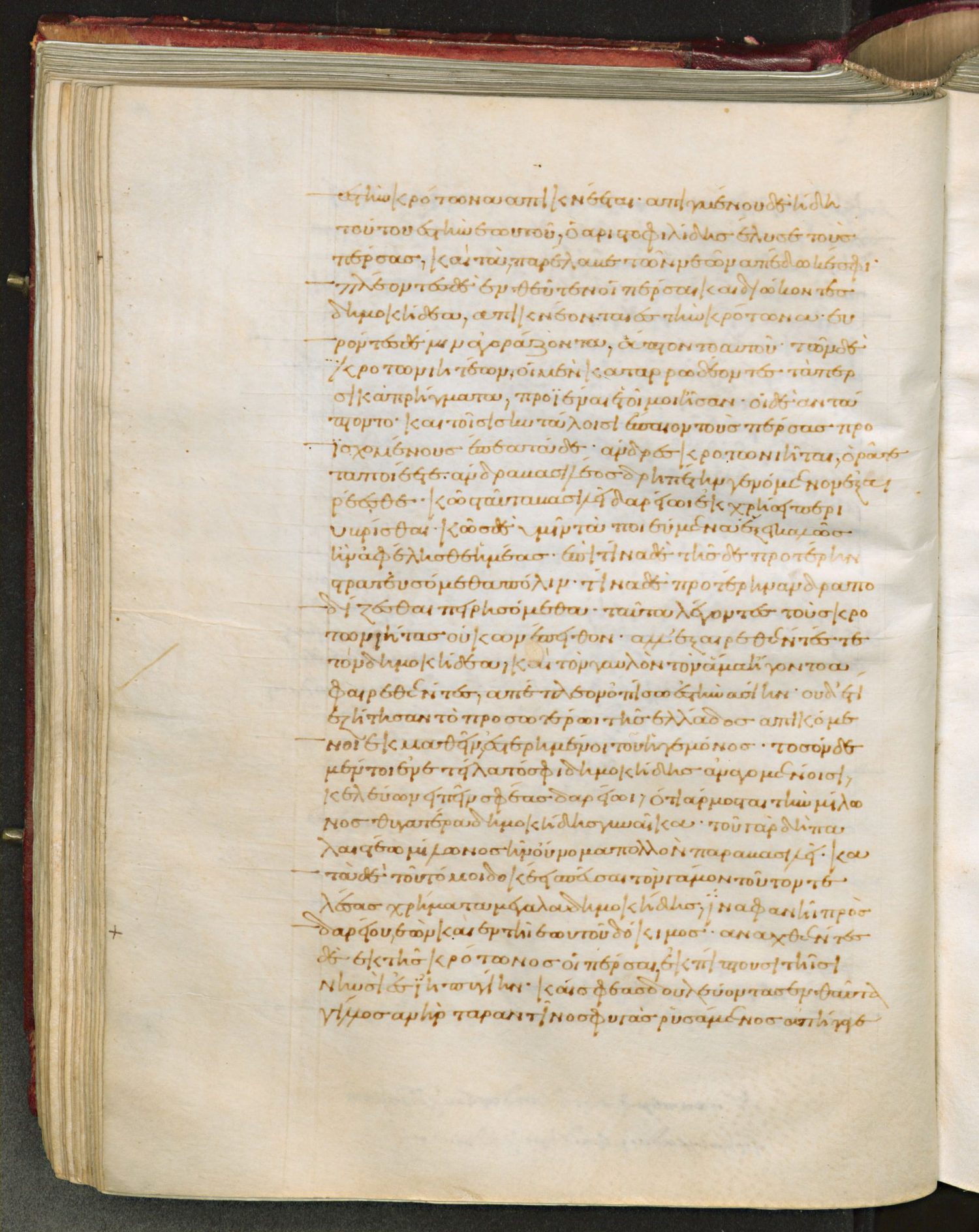
Laur. Plut. 70.3, fol. 140v: Greek here 3.136.2 to 3.138.1. Checked on the image (first and last words read and located in the Greek; each break checked against the neighbouring page): fol. 140v begins ‹ἐς τὴν Κρότωνα ἀπικνέεται·› (3.136.2), ends ‹Ταραντῖνος φυγὰς ῥυσάμενος ἀπήγαγε› (3.138.1). English here: 3.137.1 to 3.138.1 (Godley's sentences for the sections whose Greek lies mostly on this page).
3.136.2ἐς τὴν Κρότωνα ἀπικνέεται· ἀπιγμένου δὲ ἤδη τούτου ἐς τὴν ἑωυτοῦ ὁ Ἀριστοφιλίδης ἔλυσε τοὺς Πέρσας, καὶ τὰ παρέλαβε τῶν νεῶν ἀπέδωκέ σφι. 3.137.1πλέοντες δὲ ἐνθεῦτεν οἱ Πέρσαι καὶ διώκοντες Δημοκήδεα ἀπικνέονται ἐς τὴν Κρότωνα, εὑρόντες δέ μιν ἀγοράζοντα ἅπτοντο αὐτοῦ. 3.137.2τῶν δὲ Κροτωνιητέων οἳ μὲν καταρρωδέοντες τὰ Περσικὰ πρήγματα προϊέναι ἕτοιμοι ἦσαν, οἳ δὲ ἀντάπτοντο καὶ τοῖσι σκυτάλοισι ἔπαιον τοὺς Πέρσας προϊσχομένους ἔπεα τάδε. ἄνδρες Κροτωνιῆται, ὁρᾶτε τὰ ποιέετε· ἄνδρα βασιλέος δρηπέτην γενόμενον ἐξαιρέεσθε. 3.137.3κῶς ταῦτα βασιλέι Δαρείῳ ἐκχρήσει περιυβρίσθαι; κῶς δὲ ὑμῖν τὰ ποιεύμενα ἕξει καλῶς, ἢν ἀπέλησθε ἡμέας; ἐπὶ τίνα δὲ τῆσδε προτέρην στρατευσόμεθα πόλιν; τίνα δὲ προτέρην ἀνδραποδίζεσθαι περιησόμεθα; 3.137.4ταῦτα λέγοντες τοὺς Κροτωνιήτας οὔκων ἔπειθον, ἀλλʼ ἐξαιρεθέντες τε τὸν Δημοκήδεα καὶ τὸν γαῦλον τὸν ἅμα ἤγοντο ἀπαιρεθέντες ἀπέπλεον ὀπίσω ἐς τὴν Ἀσίην, οὐδʼ ἔτι ἐζήτησαν τὸ προσωτέρω τῆς Ἑλλάδος ἀπικόμενοι ἐκμαθεῖν, ἐστερημένοι τοῦ ἡγεμόνος. 3.137.5τοσόνδε μέντοι ἐνετείλατό σφι Δημοκήδης ἀναγομένοισι, κελεύων εἰπεῖν σφεας Δαρείῳ ὅτι ἅρμοσται τὴν Μίλωνος θυγατέρα Δημοκήδης γυναῖκα. τοῦ γὰρ δὴ παλαιστέω Μίλωνος ἦν οὔνομα πολλὸν παρὰ βασιλέι· κατὰ δὲ τοῦτό μοι δοκέει σπεῦσαι τὸν γάμον τοῦτον τελέσας χρήματα μεγάλα Δημοκήδης, ἵνα φανῇ πρὸς Δαρείου ἐὼν καὶ ἐν τῇ ἑωυτοῦ δόκιμος. 3.138.1ἀναχθέντες δὲ ἐκ τῆς Κρότωνος οἱ Πέρσαι ἐκπίπτουσι τῇσι νηυσὶ ἐς Ἰηπυγίην, καί σφεας δουλεύοντας ἐνθαῦτα Γίλλος ἀνὴρ Ταραντῖνος φυγὰς ῥυσάμενος ἀπήγαγε
3.137.1The Persians sailed from Taras and pursued Democedes to Croton, where they found him in the market and were for seizing him. 3.137.2Some Crotoniats, who feared the Persian power, would have given him up; but others held him against the king’s men and beat them with their staves. “Nay,” said the Persians, “look well, men of Croton, what you do; you are taking from us an escaped slave of the great 3.137.3king; think you that King Darius will rest content under this insolence? Think you that the deed will profit you if you take him from us? Your city will then be the first that we will attack and essay to enslave.” 3.137.4But the men of Croton paid no heed to them; so the Persians lost Democedes and the galleon that had been their consort, and sailed back for Asia, making no endeavour to visit and learn of the further parts of Hellas now that their guide was taken from them. 3.137.5But Democedes gave them a message as they were setting sail; they should tell Darius, he said, that Democedes was betrothed to the daughter of Milon. For Darius held the name of Milon the wrestler in great honour; and, to my thinking, the reason of Democedes’ seeking this match and paying a great sum for it was to show Darius that he was a man of estimation in his own country as well as Persia. 3.138.1The Persians then put out from Croton; but their ships were wrecked on the Iapygian coast, and they themselves made slaves in the country, until one Gillus, a banished man of Taras, released and restored them to Darius.
Where on the image
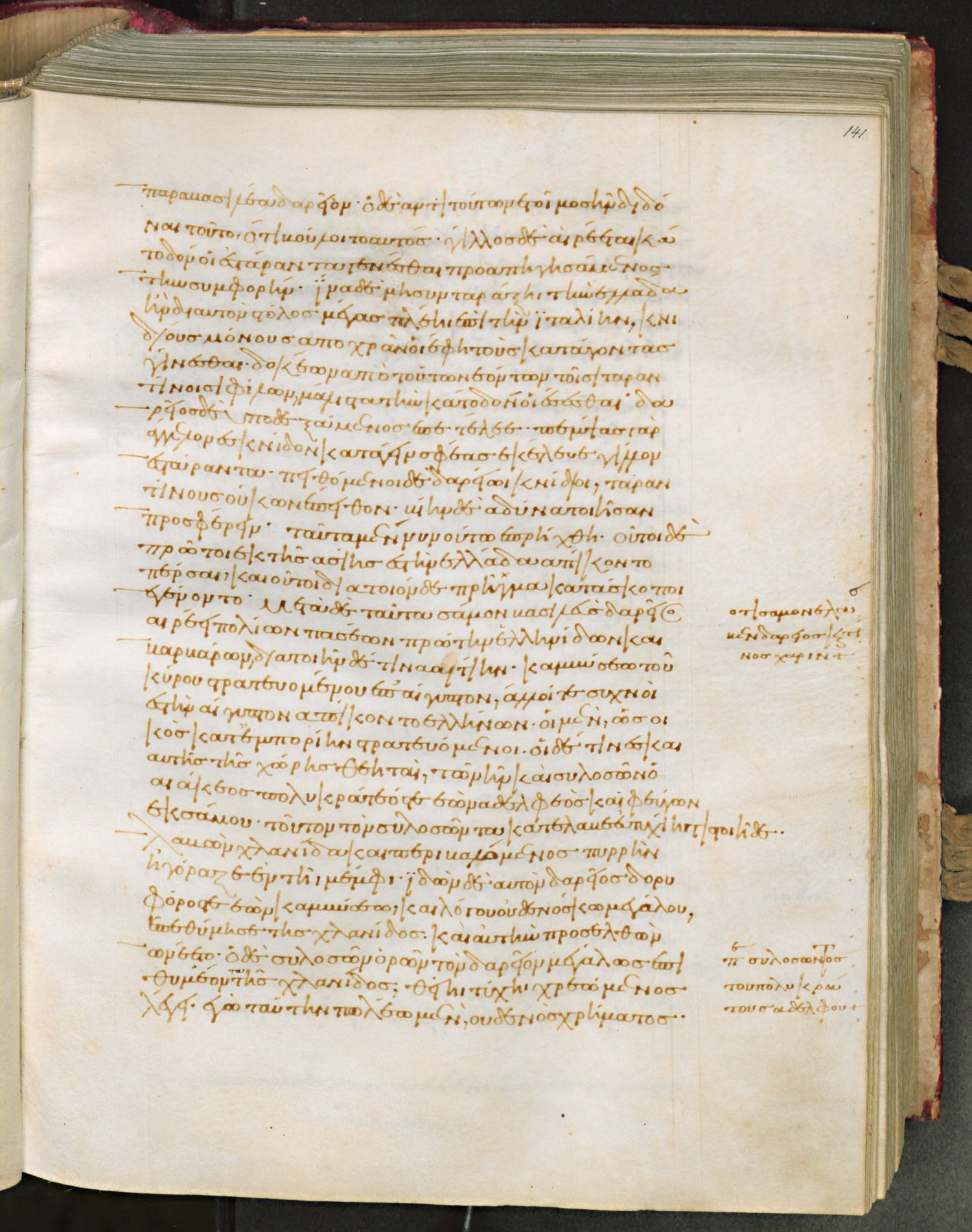
Laur. Plut. 70.3, fol. 141r: Greek here 3.138.1 to 3.138.4. Checked on the image (first and last words read and located in the Greek; each break checked against the neighbouring page): fol. 141r begins ‹παρὰ βασιλέα Δαρεῖον. ὁ› (3.138.1), ends ‹πωλέω μὲν οὐδενὸς χρήματος› (3.139.3). English here: 3.138.2 to 3.138.4 (Godley's sentences for the sections whose Greek lies mostly on this page).
3.138.1παρὰ βασιλέα Δαρεῖον. ὁ δὲ ἀντὶ τούτων ἕτοιμος ἦν διδόναι τοῦτο ὅ τι βούλοιτο αὐτός. 3.138.2Γίλλος δὲ αἱρέεται κάτοδόν οἱ ἐς Τάραντα γενέσθαι, προαπηγησάμενος τὴν συμφορήν· ἵνα δὲ μὴ συνταράξῃ τὴν Ἑλλάδα, ἢν διʼ αὐτὸν στόλος μέγας πλέῃ ἐπὶ τὴν Ἰταλίην, Κνιδίους μούνους ἀποχρᾶν οἱ ἔφη τοὺς κατάγοντας γίνεσθαι, δοκέων ἀπὸ τούτων ἐόντων τοῖσι Ταραντίνοισι φίλων μάλιστα τὴν κάτοδόν οἱ ἔσεσθαι. 3.138.3Δαρεῖος δὲ ὑποδεξάμενος ἐπετέλεε· πέμψας γὰρ ἄγγελον ἐς Κνίδον κατάγειν σφέας ἐκέλευε Γίλλον ἐς Τάραντα. πειθόμενοι δὲ Δαρείῳ Κνίδιοι Ταραντίνους οὔκων ἔπειθον, βίην δὲ ἀδύνατοι ἦσαν προσφέρειν. 3.138.4ταῦτα μέν νυν οὕτω ἐπρήχθη· οὗτοι δὲ πρῶτοι ἐκ τῆς Ἀσίης ἐς τὴν Ἑλλάδα ἀπίκοντο Πέρσαι, καὶ οὗτοι διὰ τοιόνδε πρῆγμα κατάσκοποι ἐγένοντο.
3.138.2In return for this the king offered Gillus any reward that he might desire; Gillus told the story of his misfortune, and asked above all to be restored to Taras; but, not willing that a great armament should for his cause sail to Italy and thereby he should help to trouble Hellas, it was enough, he said, that the Cnidians alone should be his escort; for he supposed that thus the Tarentines would be the readier to receive him back, the Cnidians being their friends. 3.138.3Darius kept his word, and sent a messenger to the men of Cnidos, bidding them bring Gillus back to Taras. They obeyed Darius; but they could not persuade the Tarentines to their will, and were not able to compel them. 3.138.4This is the whole story. These Persians were the first who came from Asia into Hellas; and they came to view the country for the reason aforesaid.
Notes
- Greek: the text printed in A. D. Godley's Loeb edition, via Perseus (tlg0016.tlg001.perseus-grc2). Square brackets mark words the editor considers later additions; [...] marks a gap the editor indicates. Perseus note markers are omitted.
- English: A. D. Godley, Herodotus vol. 2 (1921) (Loeb Classical Library), as transcribed on Wikisource. Godley's footnotes are omitted.
- Section numbers in the English were placed by comparing Godley's text with the Perseus version of his translation; where a section begins inside one of Godley's sentences, the English is kept with the page that holds the start of that sentence.
Cite
Sources
- Source: Florence, Laur. Plut. 70.3 (10th c.) via BML Teca Digitale + Greek of Godley's Loeb (Perseus) + English of A. D. Godley (Loeb, Wikisource) (holding institution)
- Critical edition: Greek of A. D. Godley's Loeb edition (1920-1925), via Perseus
← previous · → next · v cycle view · l back to library