Herodotus, Histories 3.89-105: The tribute of the provinces; the Indians and their gold
Introduction
Herodotus of Halicarnassus wrote the Histories in the third quarter of the 5th century BCE, an inquiry into the deeds of Greeks and barbarians and the causes of the wars between them, later divided into nine books. Book 3 tells of Cambyses' conquest of Egypt and his madness, Polycrates of Samos, the rising of the Magi and the seven Persians who overthrew them, the accession of Darius and his provinces, and the revolt and recapture of Babylon.
The photographs are of Florence, Biblioteca Medicea Laurenziana, Plut. 70.3 (parchment, 10th century, 374 folios, 31 lines a page), Herodotus, Histories (codex A of the editors), the oldest surviving manuscript of the complete Histories, from the Teca Digitale of the Biblioteca Medicea Laurenziana. Each section below is the text of one page, or of the part of a page that falls within these chapters. The first and last words of every page were read on the photograph and located in the Greek, and every page break was checked against the next page; the notes quote these words. Readers' notes in the margins are not part of the text and are mentioned where they occur.
The Greek is the text printed in A. D. Godley's Loeb edition (1920-1925), from Perseus; it is the edited text, not a transcription of the manuscript, whose wording differs in places. The English is Godley's translation as printed, from Wikisource. Godley's English carries only chapter numbers; the section numbers shown in it were placed by comparison with the Perseus version of his translation. Each page's English is cut at the end of one of Godley's sentences, so it can begin or end a few lines away from the Greek of the page; each note gives the exact ranges.
This entry covers chapters 3.89-105, on fol. 128v to 132r.
How was this verified? (Provenance)
Where on the image
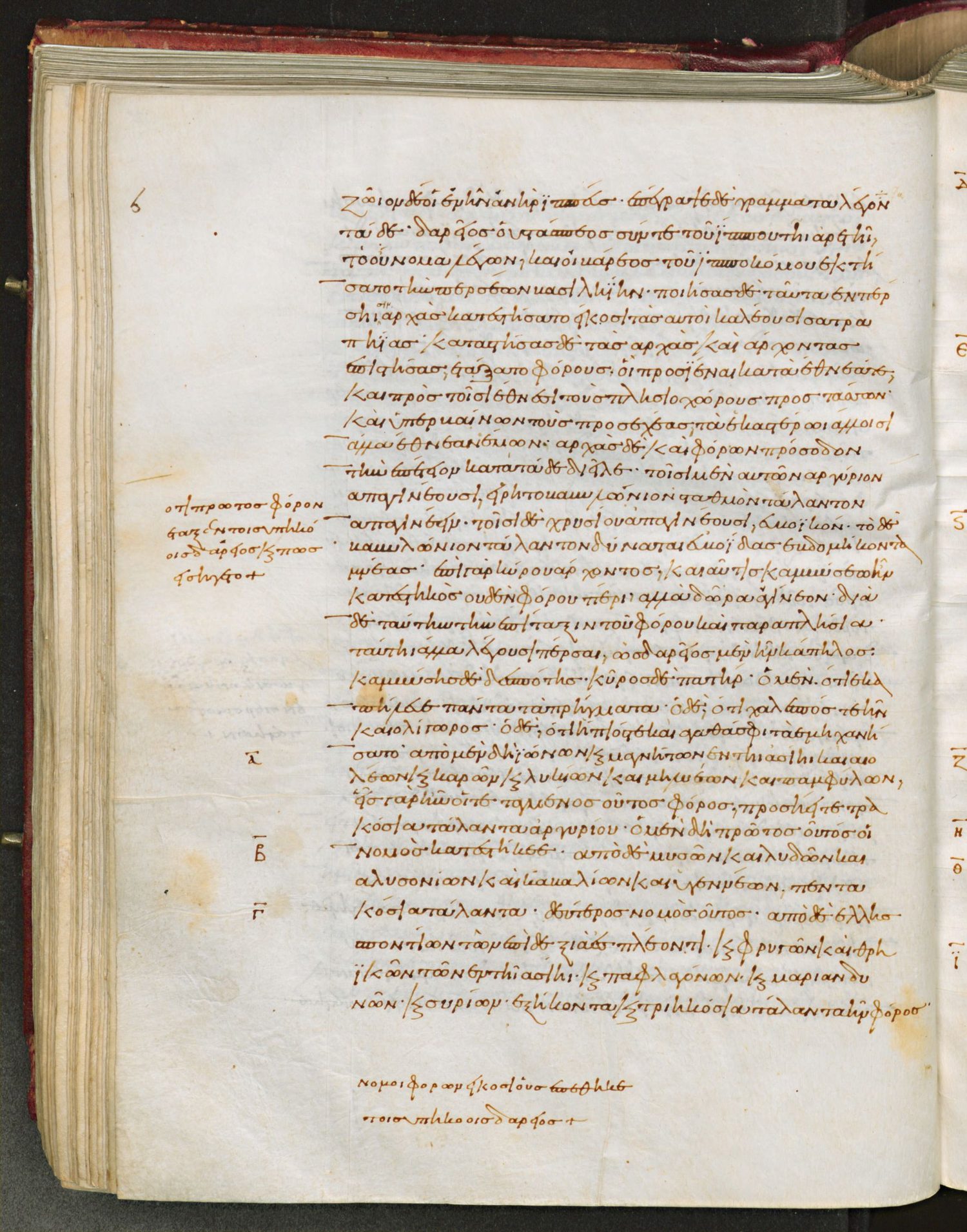
Laur. Plut. 70.3, fol. 128v: Greek here 3.89.1 to 3.90.2. Checked on the image (first and last words read and located in the Greek; each break checked against the neighbouring page): fol. 128v begins ‹ζῷον δέ οἱ ἐνῆν› (3.88.3), ends ‹τριηκόσια τάλαντα ἦν φόρος› (3.90.2). Two lines below the text hold a reader's note on the tribute districts set by Darius. English here: 3.89.1 to 3.90.2 (Godley's sentences for the sections whose Greek lies mostly on this page).
3.89.1ποιήσας δὲ ταῦτα ἐν Πέρσῃσι ἀρχὰς κατεστήσατο εἴκοσι, τὰς αὐτοὶ καλέουσι σατραπηίας· καταστήσας δὲ τὰς ἀρχὰς καὶ ἄρχοντας ἐπιστήσας ἐτάξατο φόρους οἱ προσιέναι κατὰ ἔθνεά τε καὶ πρὸς τοῖσι ἔθνεσι τοὺς πλησιοχώρους προστάσσων, καὶ ὑπερβαίνων τοὺς προσεχέας τὰ ἑκαστέρω ἄλλοισι ἄλλα ἔθνεα νέμων. 3.89.2ἀρχὰς δὲ καὶ φόρων πρόσοδον τὴν ἐπέτειον κατὰ τάδε διεῖλε. τοῖσι μὲν αὐτῶν ἀργύριον ἀπαγινέουσι εἴρητο Βαβυλώνιον σταθμὸν τάλαντον ἀπαγινέειν, τοῖσι δὲ χρυσίον ἀπαγινέουσι Εὐβοϊκόν. τὸ δὲ Βαβυλώνιον τάλαντον δύναται Εὐβοΐδας ὀκτὼ καὶ ἑβδομήκοντα μνέας. 3.89.3ἐπὶ γὰρ Κύρου ἄρχοντος καὶ αὖτις Καμβύσεω ἦν κατεστηκὸς οὐδὲν φόρου πέρι, ἀλλὰ δῶρα ἀγίνεον. διὰ δὲ ταύτην τὴν ἐπίταξιν τοῦ φόρου καὶ παραπλήσια ταύτῃ ἄλλα λέγουσι Πέρσαι ὡς Δαρεῖος μὲν ἦν κάπηλος, Καμβύσης δὲ δεσπότης, Κῦρος δὲ πατήρ, ὃ μὲν ὅτι ἐκαπήλευε πάντα τὰ πρήγματα, ὁ δὲ ὅτι χαλεπός τε ἦν καὶ ὀλίγωρος, ὁ δὲ ὅτι ἤπιός τε καὶ ἀγαθά σφι πάντα ἐμηχανήσατο. 3.90.1ἀπὸ μὲν δὴ Ἰώνων καὶ Μαγνήτων τῶν ἐν τῇ Ἀσίῃ καὶ Αἰολέων καὶ Καρῶν καὶ Λυκίων καὶ Μιλυέων καὶ Παμφύλων (εἷς γὰρ ἦν οἱ τεταγμένος οὗτος φόρος) προσήιε τετρακόσια τάλαντα ἀργυρίου. ὁ μὲν δὴ πρῶτος οὗτός οἱ νομὸς κατεστήκεε, ἀπὸ δὲ Μυσῶν καὶ Λυδῶν καὶ Λασονίων καὶ Καβαλέων καὶ Ὑτεννέων πεντακόσια τάλαντα· δεύτερος νομὸς οὗτος. 3.90.2ἀπὸ δὲ Ἑλλησποντίων τῶν ἐπὶ δεξιὰ ἐσπλέοντι καὶ Φρυγῶν καὶ Θρηίκων τῶν ἐν τῇ Ἀσίῃ καὶ Παφλαγόνων καὶ Μαριανδυνῶν καὶ Συρίων ἑξήκοντα καὶ τριηκόσια τάλαντα ἦν φόρος·
3.89.1Having so done in Persia, he divided his dominions into twenty governments, called by the Persians satrapies; and doing so and appointing governors, he ordained that each several nation should pay him tribute; to this end he united each nation with its closest neighbours, and, beyond these nearest lands, assigned those that were farther off some to one and some to another nation. 3.89.2I will now show how he divided his governments and the tributes which were paid him yearly. Those that paid in silver were appointed to render the weight of a Babylonian talent; those that paid in gold, an Euboïc talent; the Babylonian talent being equal to seventy-eight Euboïc minae. 3.89.3In the reigns of Cyrus and Cambyses after him there was no fixed tribute, but payment was made in gifts. It is by reason of this fixing of tribute, and other like ordinances, that the Persians called Darius the huckster, Cambyses the master, and Cyrus the father; for Darius made petty profit out of everything, Cambyses was harsh and arrogant, Cyrus was merciful and ever wrought for their well-being. 3.90.1The Ionians, Magnesians of Asia, Aeolians, Carians, Lycians, Milyans, and Pamphylians, on whom Darius laid one joint tribute, paid a revenue of four hundred talents of silver. This was established as his first province. The Mysians, Lydians, Lasonians, Cabalians, and Hytennians paid five hundred talents; this was the second province. 3.90.2The third comprised the Hellespontians on the right of the entrance of the straits, the Phrygians, Thracians of Asia, Paphlagonians, Mariandynians, and Syrians; these paid three hundred and sixty talents of tribute.
Where on the image
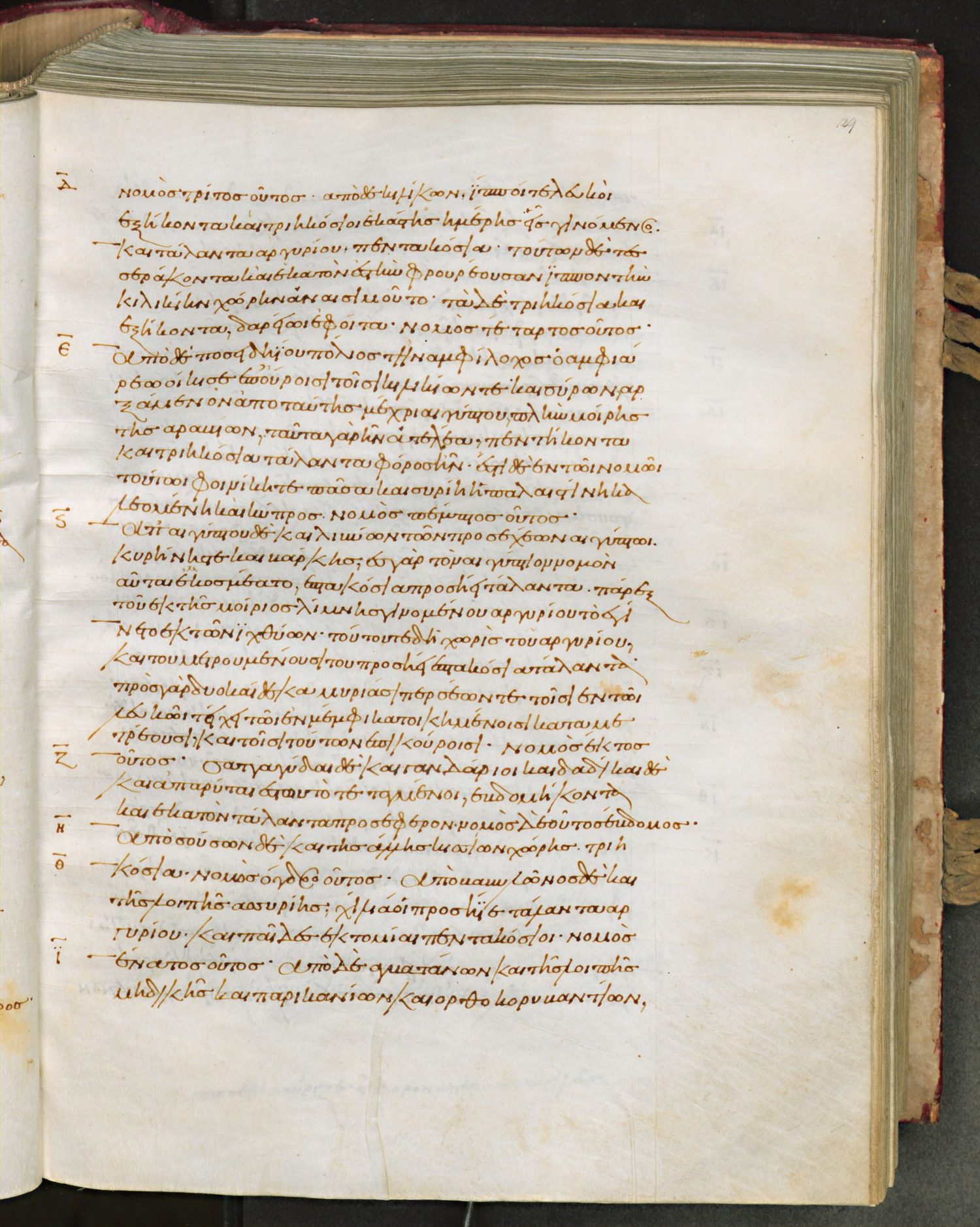
Laur. Plut. 70.3, fol. 129r: Greek here 3.90.2 to 3.92.1. Checked on the image (first and last words read and located in the Greek; each break checked against the neighbouring page): fol. 129r begins ‹νομὸς τρίτος οὗτος.ἀπὸ δὲ› (3.90.2), ends ‹καὶ Παρικανίων καὶ Ὀρθοκορυβαντίων› (3.92.1). English here: 3.90.3 to 3.92.1 (Godley's sentences for the sections whose Greek lies mostly on this page).
3.90.2νομὸς τρίτος οὗτος. 3.90.3ἀπὸ δὲ Κιλίκων ἵπποι τε λευκοὶ ἑξήκοντα καὶ τριηκόσιοι, ἑκάστης ἡμέρης εἷς γινόμενος, καὶ τάλαντα ἀργυρίου πεντακόσια· τούτων δὲ τεσσεράκοντα καὶ ἑκατὸν ἐς τὴν φρουρέουσαν ἵππον τὴν Κιλικίην χώρην ἀναισιμοῦτο, τὰ δὲ τριηκόσια καὶ ἑξήκοντα Δαρείῳ ἐφοίτα· νομὸς τέταρτος οὗτος. 3.91.1ἀπὸ δὲ Ποσιδηίου πόλιος, τὴν Ἀμφίλοχος ὁ Ἀμφιάρεω οἴκισε ἐπʼ οὔροισι τοῖσι Κιλίκων τε καὶ Σύρων, ἀρξάμενος ἀπὸ ταύτης μέχρι Αἰγύπτου, πλὴν μοίρης τῆς Ἀραβίων (ταῦτα γὰρ ἦν ἀτελέα), πεντήκοντα καὶ τριηκόσια τάλαντα φόρος ἦν. ἔστι δὲ ἐν τῷ νομῷ τούτῳ Φοινίκη τε πᾶσα καὶ Συρίη ἡ Παλαιστίνη καλεομένη καὶ Κύπρος· νομὸς πέμπτος οὗτος. 3.91.2ἀπʼ Αἰγύπτου δὲ καὶ Λιβύων τῶν προσεχέων Αἰγύπτῳ καὶ Κυρήνης τε καὶ Βάρκης (ἐς γὰρ τὸν Αἰγύπτιον νομὸν αὗται ἐκεκοσμέατο) ἑπτακόσια προσήιε τάλαντα, πάρεξ τοῦ ἐκ τῆς Μοίριος λίμνης γινομένου ἀργυρίου, τὸ ἐγίνετο ἐκ τῶν ἰχθύων· 3.91.3τούτου τε δὴ χωρὶς τοῦ ἀργυρίου καὶ τοῦ [ἐπιμετρουμένου] σίτου προσήιε ἑπτακόσια τάλαντα· σίτου γὰρ δύο καὶ δέκα μυριάδας Περσέων τε τοῖσι ἐν τῷ Λευκῷ τείχεϊ τῷ ἐν Μέμφι κατοικημένοισι καταμετρέουσι καὶ τοῖσι τούτων ἐπικούροισι. νομὸς ἕκτος οὗτος. 3.91.4Σατταγύδαι δὲ καὶ Γανδάριοι καὶ Δαδίκαι τε καὶ Ἀπαρύται ἐς τὠυτὸ τεταγμένοι ἑβδομήκοντα καὶ ἑκατὸν τάλαντα προσέφερον· νομὸς δὲ οὗτος ἕβδομος. ἀπὸ Σούσων δὲ καὶ τῆς ἄλλης Κισσίων χώρης τριηκόσια· νομὸς ὄγδοος οὗτος. 3.92.1ἀπὸ Βαβυλῶνος δὲ καὶ τῆς λοιπῆς Ἀσσυρίης χίλιά οἱ προσήιε τάλαντα ἀργυρίου καὶ παῖδες ἐκτομίαι πεντακόσιοι· νομὸς εἴνατος οὗτος. ἀπὸ δὲ Ἀγβατάνων καὶ τῆς λοιπῆς Μηδικῆς καὶ Παρικανίων καὶ Ὀρθοκορυβαντίων
3.90.3The fourth province was Cilicia. This rendered three hundred and sixty white horses, one for each day in the year, and five hundred talents of silver. An hundred and forty of these were expended on the horsemen who were the guard of Cilicia; the three hundred and sixty that remained were paid to Darius. 3.91.1The fifth province was the country (except the part belonging to the Arabians, which paid no tribute) between Posideion, a city founded on the Cilician and Syrian border by Amphilochus son of Amphiaraus, and Egypt; this paid three hundred and fifty talents; in this province was all Phoenice, and the part of Syria called Palestine, and Cyprus. 3.91.2The sixth province was Egypt and the neighbouring parts of Libya, and Cyrene and Barca, all which were included in the province of Egypt. Hence came seven hundred talents, besides the revenue of silver from the fish of the lake Moeris; 3.91.3besides that silver and the measure of grain that was given also, seven hundred talents were paid; for an hundred and twenty thousand bushels of grain were also assigned to the Persians quartered at the White Citadel of Memphis and their allies. 3.91.4The Sattagydae, Gandarii, Dadicae, and Aparytae paid together an hundred and seventy talents; this was the seventh province; the eighth was Susa and the rest of the Cissian country, paying three hundred talents. 3.92.1Babylon and the rest of Assyria rendered to Darius a thousand talents of silver and five hundred boys to be eunuchs; this was the ninth province; Agbatana and the rest of Media, with the Paricanians and Orthocorybantians, paid four hundred and fifty talents, and was the tenth province.
Where on the image
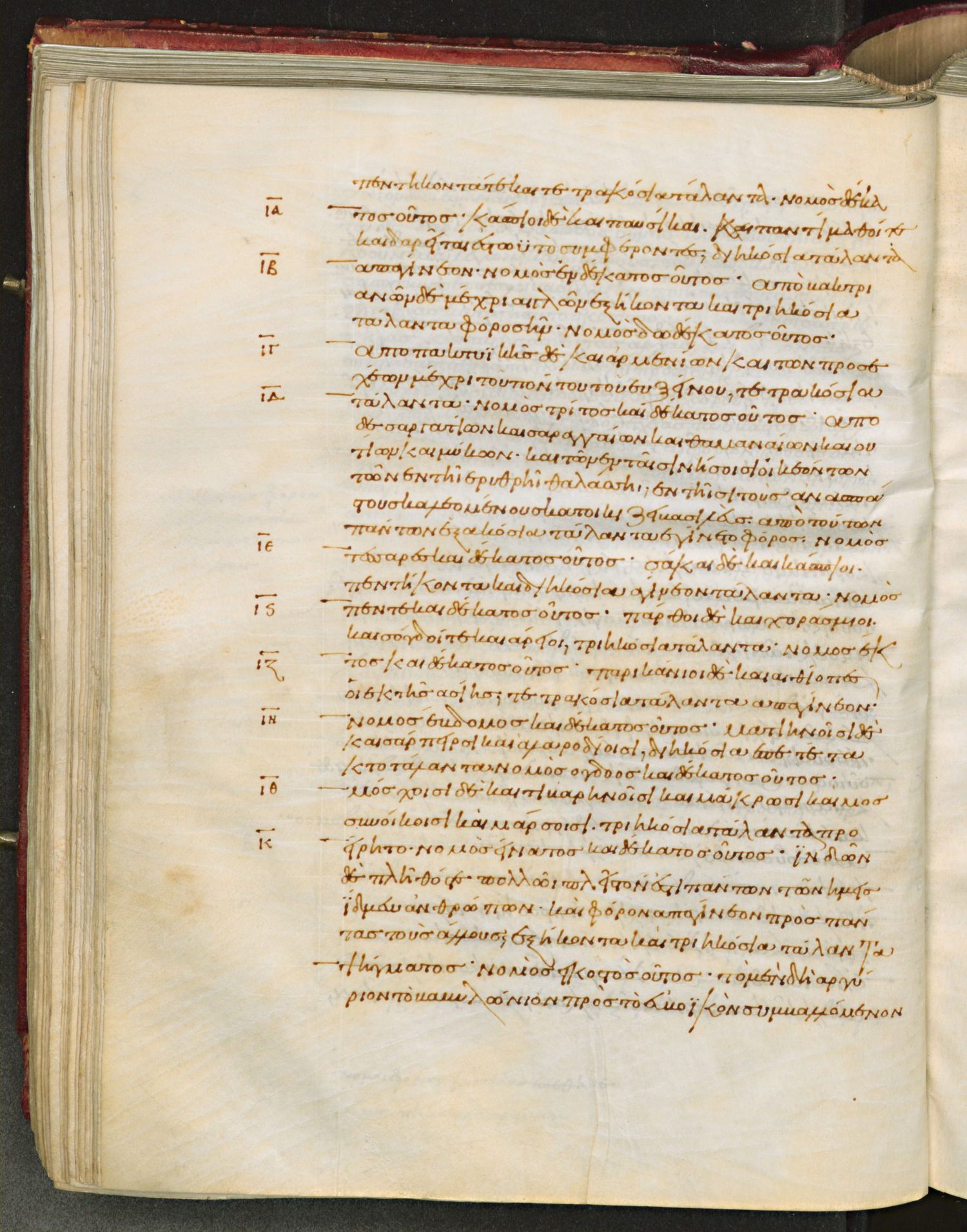
Laur. Plut. 70.3, fol. 129v: Greek here 3.92.1 to 3.95.1. Checked on the image (first and last words read and located in the Greek; each break checked against the neighbouring page): fol. 129v begins ‹πεντήκοντά τε καὶ τετρακόσια› (3.92.1), ends ‹πρὸς τὸ Εὐβοϊκὸν συμβαλλόμενον› (3.95.1). English here: 3.92.2 to 3.94.2 (Godley's sentences for the sections whose Greek lies mostly on this page).
3.92.1πεντήκοντά τε καὶ τετρακόσια τάλαντα· νομὸς δέκατος οὗτος. 3.92.2Κάσπιοι δὲ καὶ Παυσίκαι καὶ Παντίμαθοί τε καὶ Δαρεῖται ἐς τὠυτὸ συμφέροντες διηκόσια τάλαντα ἀπαγίνεον· νομὸς ἑνδέκατος οὗτος. 3.93.1ἀπὸ Βακτριανῶν δὲ μέχρι Αἰγλῶν ἑξήκοντα καὶ τριηκόσια τάλαντα φόρος ἦν· νομὸς δυωδέκατος οὗτος. ἀπὸ Πακτυϊκῆς δὲ καὶ Ἀρμενίων καὶ τῶν προσεχέων μέχρι τοῦ πόντου τοῦ Εὐξείνου τετρακόσια τάλαντα· νομὸς τρίτος καὶ δέκατος οὗτος. 3.93.2ἀπὸ δὲ Σαγαρτίων καὶ Σαραγγέων καὶ Θαμαναίων καὶ Οὐτίων καὶ Μύκων καὶ τῶν ἐν τῇσι νήσοισι οἰκεόντων τῶν ἐν τῇ Ἐρυθρῇ θαλάσσῃ, ἐν τῇσι τοὺς ἀνασπάστους καλεομένους κατοικίζει βασιλεύς, ἀπὸ τούτων πάντων ἑξακόσια τάλαντα ἐγίνετο φόρος· νομὸς τέταρτος καὶ δέκατος οὗτος. 3.93.3Σάκαι δὲ καὶ Κάσπιοι πεντήκοντα καὶ διηκόσια ἀπαγίνεον τάλαντα· νομὸς πέμπτος καὶ δέκατος οὗτος. Πάρθοι δὲ καὶ Χοράσμιοι καὶ Σόγδοι τε καὶ Ἄρειοι τριηκόσια τάλαντα· νομὸς ἕκτος καὶ δέκατος οὗτος. 3.94.1Παρικάνιοι δὲ καὶ Αἰθίοπες οἱ ἐκ τῆς Ἀσίης τετρακόσια τάλαντα ἀπαγίνεον· νομὸς ἕβδομος καὶ δέκατος οὗτος. Ματιηνοῖσι δὲ καὶ Σάσπειρσι καὶ Ἀλαροδίοισι διηκόσια ἐπετέτακτο τάλαντα· νομὸς ὄγδοος καὶ δέκατος οὗτος. 3.94.2Μόσχοισι δὲ καὶ Τιβαρηνοῖσι καὶ Μάκρωσι καὶ Μοσσυνοίκοισι καὶ Μαρσὶ τριηκόσια τάλαντα προείρητο· νομὸς εἴνατος καὶ δέκατος οὗτος. Ἰνδῶν δὲ πλῆθός τε πολλῷ πλεῖστον ἐστὶ πάντων τῶν ἡμεῖς ἴδμεν ἀνθρώπων, καὶ φόρον ἀπαγίνεον πρὸς πάντας τοὺς ἄλλους ἑξήκοντα καὶ τριηκόσια τάλαντα ψήγματος· νομὸς εἰκοστὸς οὗτος. 3.95.1τὸ μὲν δὴ ἀργύριον τὸ Βαβυλώνιον πρὸς τὸ Εὐβοϊκὸν συμβαλλόμενον
3.92.2The eleventh comprised the Caspii, Pausicae, Pantimathi, and Daritae, paying jointly two hundred; 3.93.1The twelfth, the Bactrians as far as the land of the Aegli; these paid three hundred and sixty. The thirteenth, the Pactyic country and Armenia and the lands adjoining thereto as far as the Euxine sea; these paid four hundred. 3.93.2The fourteenth province was made up of the Sagartii, Sarangeis, Thamanaei, Utii, Myci, and the dwellers on those islands of the southern sea wherein the king plants the people said to be “removed”; these together paid a tribute of six hundred talents. 3.93.3The Sacae and Caspii were the fifteenth, paying two hundred and fifty. The Parthians, Chorasmians, Sogdi, and Arii were the sixteenth, paying three hundred. 3.94.1The Paricanii and Ethiopians of Asia, being the seventeenth, paid four hundred; the Matieni, Saspiri, and Alarodii were the eighteenth, and two hundred talents were the appointed tribute. 3.94.2The Moschi, Tibareni, Macrones, Mossynoeci, and Mares, the nineteenth province, were ordered to pay three hundred. The Indians made up the twentieth province. These are more in number than any nation known to me, and they paid a greater tribute than any other province, namely three hundred and sixty talents of gold dust.
Where on the image
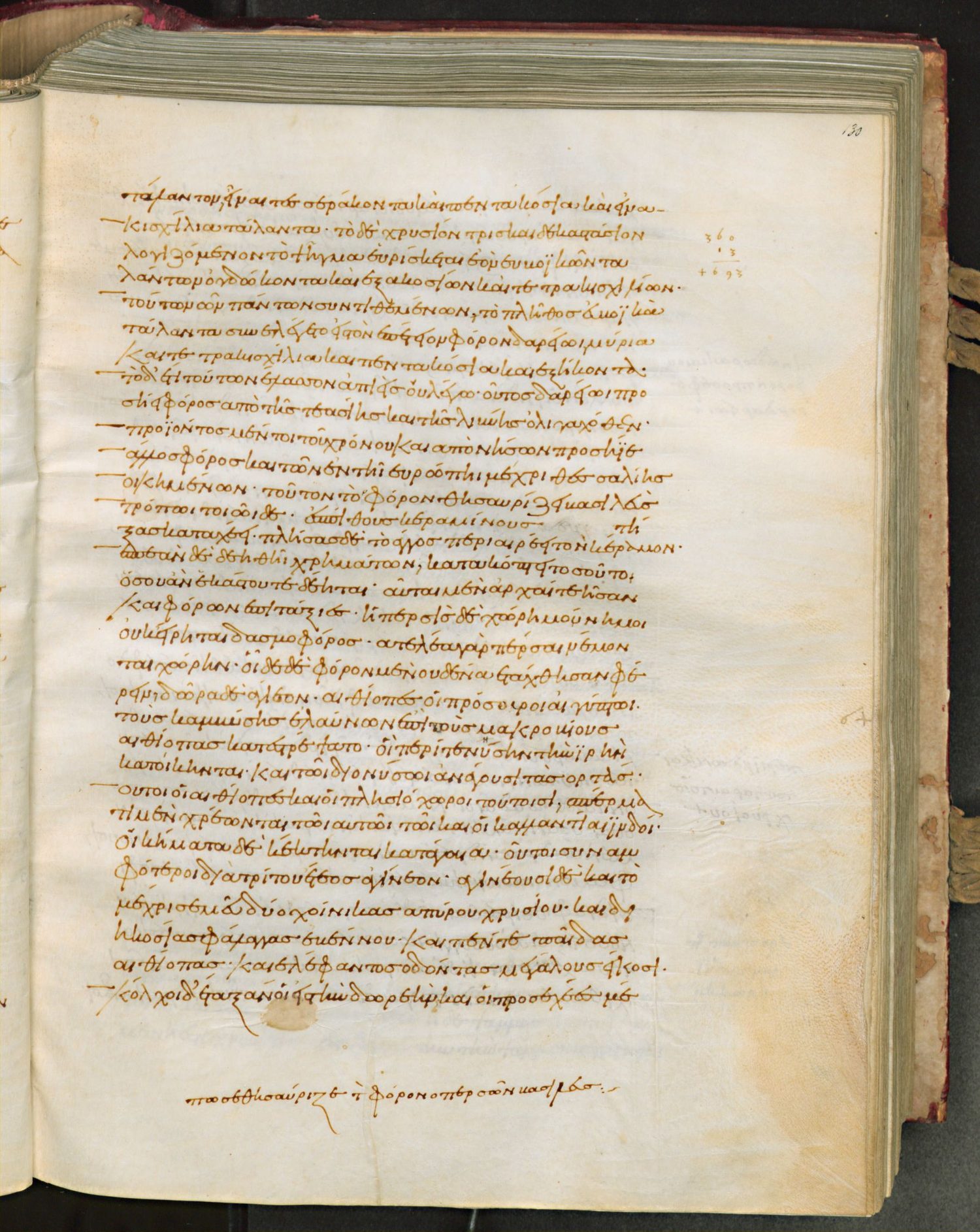
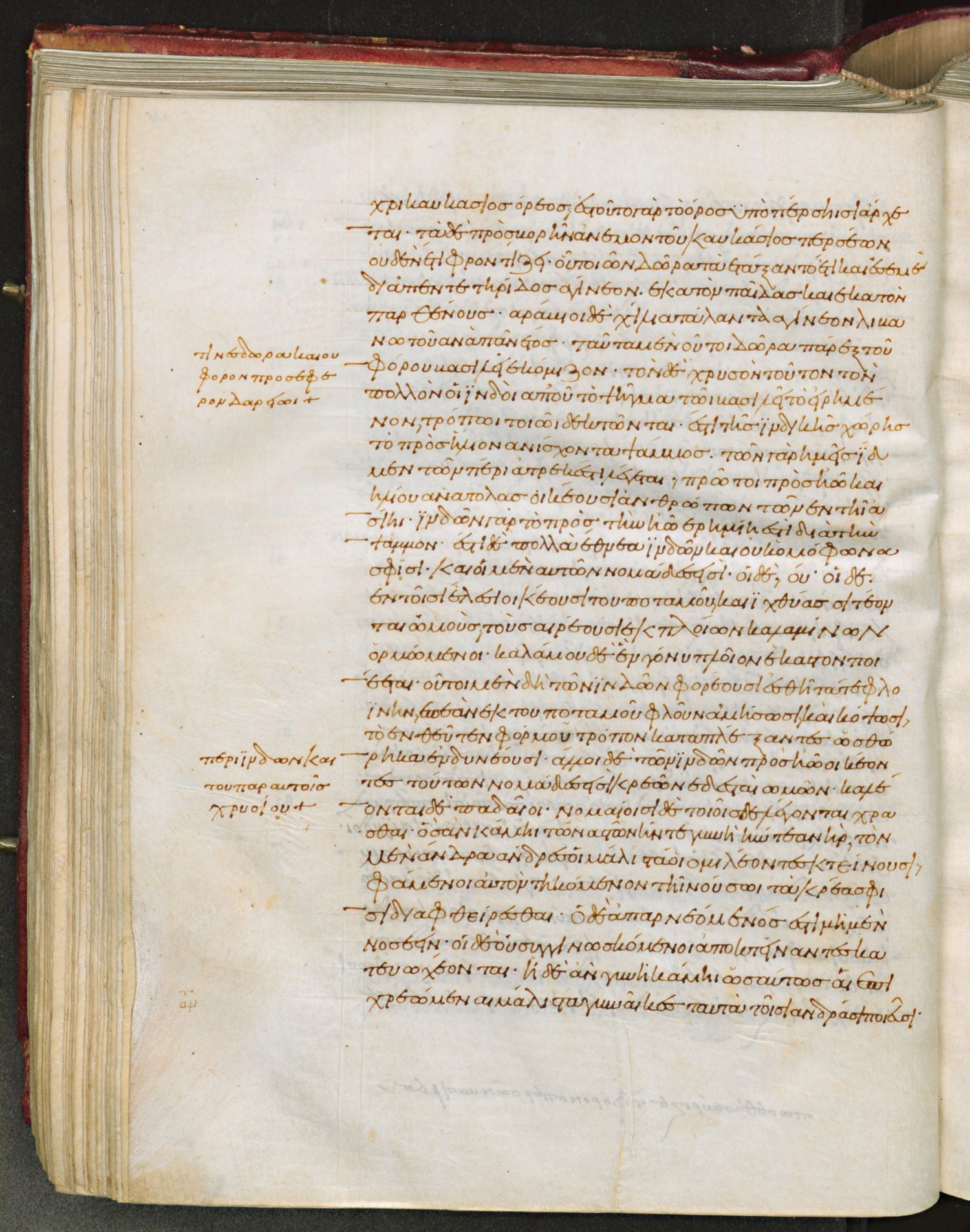
Laur. Plut. 70.3, fol. 130r: Greek here 3.95.1 to 3.97.4. Checked on the image (first and last words read and located in the Greek; each break checked against the neighbouring page): fol. 130r begins ‹τάλαντον γίνεται ὀγδώκοντα καὶ› (3.95.1), ends ‹καὶ οἱ προσεχέες μέ-› (3.97.4). Below the text, a reader's note on the tribute paid to the Persian king. English here: 3.95.1 to 3.97.3 (Godley's sentences for the sections whose Greek lies mostly on this page).
3.95.1τάλαντον γίνεται ὀγδώκοντα καὶ ὀκτακόσια καὶ εἰνακισχίλια τάλαντα·τὸ δὲ χρυσίον τρισκαιδεκαστάσιον λογιζόμενον, τὸ ψῆγμα εὑρίσκεται ἐὸν Εὐβοϊκῶν ταλάντων ὀγδώκοντα καὶ ἑξακοσίων καὶ τετρακισχιλίων. 3.95.2τούτων ὦν πάντων συντιθεμένων τὸ πλῆθος Εὐβοϊκὰ τάλαντα συνελέγετο ἐς τὸν ἐπέτειον φόρον Δαρείῳ μύρια καὶ τετρακισχίλια καὶ πεντακόσια καὶ ἑξήκοντα· τὸ δʼ ἔτι τούτων ἔλασσον ἀπιεὶς οὐ λέγω. 3.96.1οὗτος Δαρείῳ προσήιε φόρος ἀπὸ τῆς τε Ἀσίης καὶ τῆς Λιβύης ὀλιγαχόθεν. προϊόντος μέντοι τοῦ χρόνου καὶ ἀπὸ νήσων προσήιε ἄλλος φόρος καὶ τῶν ἐν τῇ Εὐρώπῃ μέχρι Θεσσαλίης οἰκημένων. 3.96.2τοῦτον τὸν φόρον θησαυρίζει βασιλεὺς τρόπῳ τοιῷδε· ἐς πίθους κεραμίνους τήξας καταχέει, πλήσας δὲ τὸ ἄγγος περιαιρέει τὸν κέραμον· ἐπεὰν δὲ δεηθῇ χρημάτων, κατακόπτει τοσοῦτο ὅσου ἂν ἑκάστοτε δέηται. 3.97.1αὗται μὲν ἀρχαί τε ἦσαν καὶ φόρων ἐπιτάξιες. ἡ Περσὶς δὲ χώρη μούνη μοι οὐκ εἴρηται δασμοφόρος· ἀτελέα γὰρ Πέρσαι νέμονται χώρην. 3.97.2οἵδε δὲ φόρον μὲν οὐδένα ἐτάχθησαν φέρειν, δῶρα δὲ ἀγίνεον· Αἰθίοπες οἱ πρόσουροι Αἰγύπτῳ, τοὺς Καμβύσης ἐλαύνων ἐπὶ τοὺς μακροβίους Αἰθίοπας κατεστρέψατο, οἵ τε περί τε Νύσην τὴν ἱρὴν κατοίκηνται καὶ τῷ Διονύσῳ ἀνάγουσι τὰς ὁρτάς· [οὗτοι οἱ Αἰθίοπες καὶ οἱ πλησιόχωροι τούτοισι σπέρματι μὲν χρέωνται τῷ αὐτῷ τῷ καὶ οἱ Καλλαντίαι Ἰνδοί, οἰκήματα δὲ ἔκτηνται κατάγαια.] 3.97.3οὗτοι συναμφότεροι διὰ τρίτου ἔτεος ἀγίνεον, ἀγινέουσι δὲ καὶ τὸ μέχρι ἐμεῦ, δύο χοίνικας ἀπύρου χρυσίου καὶ διηκοσίας φάλαγγας ἐβένου καὶ πέντε παῖδας Αἰθίοπας καὶ ἐλέφαντος ὀδόντας μεγάλους εἴκοσι. 3.97.4Κόλχοι δὲ τὰ ἐτάξαντο ἐς τὴν δωρεὴν καὶ οἱ προσεχέες μέχρι
3.95.1Now if these Babylonian silver talents be reckoned in Euboïc money, the sum is seen to be nine thousand eight hundred and eighty Euboïc talents: 3.95.2and the gold coin being counted as thirteen times the value of the silver, the gold-dust is found to be of the worth of four thousand six hundred and eighty Euboïc talents. Therefore it is seen by adding all together that Darius collected a yearly tribute of fourteen thousand five hundred and sixty talents; I take no account of figures less than ten. 3.96.1This was Darius’ revenue from Asia and a few parts of Libya. But as time went on he drew tribute also from the islands and the dwellers in Europe, as far as Thessaly. 3.96.2The tribute is stored by the king in this fashion: he melts it down and pours it into earthen vessels; when the vessel is full he breaks the earthenware away, and when he needs money coins as much as will serve his purpose. 3.97.1These were the several governments and appointments of tribute. The Persian country is the only one which I have not recorded as tributary; for the Persians dwell free from all taxes. 3.97.2As for those on whom no tribute was laid, but who rendered gifts instead, they were, firstly, the Ethiopians nearest to Egypt, whom Cambyses subdued in his march towards the long-lived Ethiopians; and also those who dwell about the holy Nysa, where Dionysus is the god of their festivals. [The seed of these Ethiopians and their neighbours is like the seed of the Indian Callantiae; they live underground.] 3.97.3These together brought every other year and still bring a gift of two choenixes of unrefined gold, two hundred blocks of ebony, five Ethiopian boys, and twenty great elephants’ tusks.
Where on the image
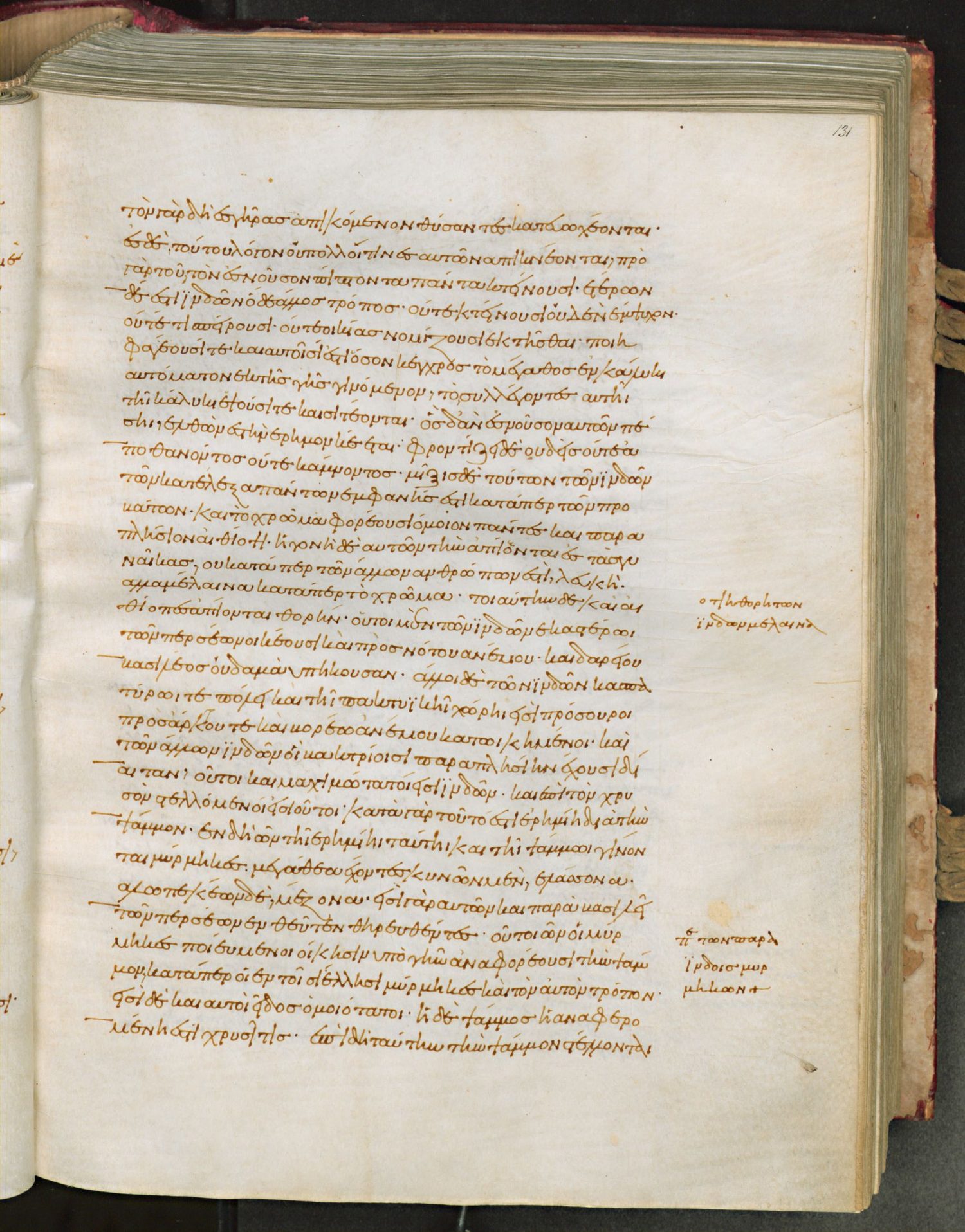
Laur. Plut. 70.3, fol. 130v: Greek here 3.97.4 to 3.99.2. Checked on the image (first and last words read and located in the Greek; each break checked against the neighbouring page): fol. 130v begins ‹-χρι Καυκάσιος ὄρεος (ἐς› (3.97.4), ends ‹ταὐτὰ τοῖσι ἀνδράσι ποιεῦσι› (3.99.2). The word ‹μέχρι› is divided between fol. 130r and fol. 130v; it is given with fol. 130r. English here: 3.97.4 to 3.99.1 (Godley's sentences for the sections whose Greek lies mostly on this page).
3.97.4Καυκάσιος ὄρεος (ἐς τοῦτο γὰρ τὸ ὄρος ὑπὸ Πέρσῃσι ἄρχεται, τὰ δὲ πρὸς βορέην ἄνεμον τοῦ Καυκάσιος Περσέων οὐδὲν ἔτι φροντίζει), οὗτοι ὦν δῶρα τὰ ἐτάξαντο ἔτι καὶ ἐς ἐμὲ διὰ πεντετηρίδος ἀγίνεον, ἑκατὸν παῖδας καὶ ἑκατὸν παρθένους. 3.97.5Ἀράβιοι δὲ χίλια τάλαντα ἀγίνεον λιβανωτοῦ ἀνὰ πᾶν ἔτος. ταῦτα μὲν οὗτοι δῶρα πάρεξ τοῦ φόρου βασιλέι ἐκόμιζον. 3.98.1τὸν δὲ χρυσὸν τοῦτον τὸν πολλὸν οἱ Ἰνδοί, ἀπʼ οὗ τὸ ψῆγμα τῷ βασιλέι τὸ εἰρημένον κομίζουσι, τρόπῳ τοιῷδε κτῶνται. 3.98.2ἔστι τῆς Ἰνδικῆς χώρης τὸ πρὸς ἥλιον ἀνίσχοντα ψάμμος· τῶν γὰρ ἡμεῖς ἴδμεν, τῶν καὶ πέρι ἀτρεκές τι λέγεται, πρῶτοι πρὸς ἠῶ καὶ ἡλίου ἀνατολὰς οἰκέουσι ἀνθρώπων τῶν ἐν τῇ Ἀσίῃ Ἰνδοί· Ἰνδῶν γὰρ τὸ πρὸς τὴν ἠῶ ἐρημίη ἐστὶ διὰ τὴν ψάμμον. 3.98.3ἔστι δὲ πολλὰ ἔθνεα Ἰνδῶν καὶ οὐκ ὁμόφωνα σφίσι, καὶ οἳ μὲν αὐτῶν νομάδες εἰσὶ οἳ δὲ οὔ, οἳ δὲ ἐν τοῖσι ἕλεσι οἰκέουσι τοῦ ποταμοῦ καὶ ἰχθύας σιτέονται ὠμούς, τοὺς αἱρέουσι ἐκ πλοίων καλαμίνων ὁρμώμενοι· καλάμου δὲ ἓν γόνυ πλοῖον ἕκαστον ποιέεται. 3.98.4οὗτοι μὲν δὴ τῶν Ἰνδῶν φορέουσι ἐσθῆτα φλοΐνην· ἐπεὰν ἐκ τοῦ ποταμοῦ φλοῦν ἀμήσωσι καὶ κόψωσι, τὸ ἐνθεῦτεν φορμοῦ τρόπον καταπλέξαντες ὡς θώρηκα ἐνδύνουσι. 3.99.1ἄλλοι δὲ τῶν Ἰνδῶν πρὸς ἠῶ οἰκέοντες τούτων νομάδες εἰσὶ κρεῶν ἐδεσταὶ ὠμῶν, καλέονται δὲ Παδαῖοι, νομαίοισι δὲ τοιοῖσιδε λέγονται χρᾶσθαι· ὃς ἂν κάμῃ τῶν ἀστῶν, ἤν τε γυνὴ ἤν τε ἀνήρ, τὸν μὲν ἄνδρα ἄνδρες οἱ μάλιστά οἱ ὁμιλέοντες κτείνουσι, φάμενοι αὐτὸν τηκόμενον τῇ νούσῳ τὰ κρέα σφίσι διαφθείρεσθαι· ὁ δὲ ἄπαρνος ἐστὶ μὴ μὲν νοσέειν, οἱ δὲ οὐ συγγινωσκόμενοι ἀποκτείναντες κατευωχέονται. 3.99.2ἣ δὲ ἂν γυνὴ κάμῃ, ὡσαύτως αἱ ἐπιχρεώμεναι μάλιστα γυναῖκες ταὐτὰ τοῖσι ἀνδράσι ποιεῦσι.
3.97.4Gifts were also required of the Colchians and their neighbours as far as the Caucasian mountains (which is as far as the Persian rule reaches, the country north of the Caucasus paying no regard to the Persians); these were rendered every four years and are still so rendered, namely, an hundred boys and as many maidens. 3.97.5The Arabians rendered a thousand talents’ weight of frankincense yearly. Such were the gifts of these peoples to the king, besides the tribute. 3.98.1All this abundance of gold, whence the Indians send the aforesaid gold-dust to the king, they win in such manner as I will show. 3.98.2All to the east of the Indian country is sand; among all men of whom hearsay gives us any clear knowledge the Indians dwell farthest to the east and the sunrise of all the nations of Asia; for on the eastern side of India all is desert by reason of the sand. 3.98.3There are many Indian nations, none speaking the same language; some of them are nomads, some not; some dwell in the river marshes and live on raw fish, which they catch from reed boats. Each boat is made of one single length between the joints of a reed. 3.98.4These Indians wear clothes of rushes; they mow and cut these from the river, then plait them crosswise like a mat, and put it on like a breastplate. 3.99.1Other Indians, to the east of these, are nomads and eat raw flesh; they are called Padaei. It is said to be their custom that when any of their countryfolk male or female are sick, a man’s closest friends kill him, saying that they lose his flesh by the wasting of the disease; though he denies that he is sick, yet they will not believe him, but kill and eat him.
Where on the image
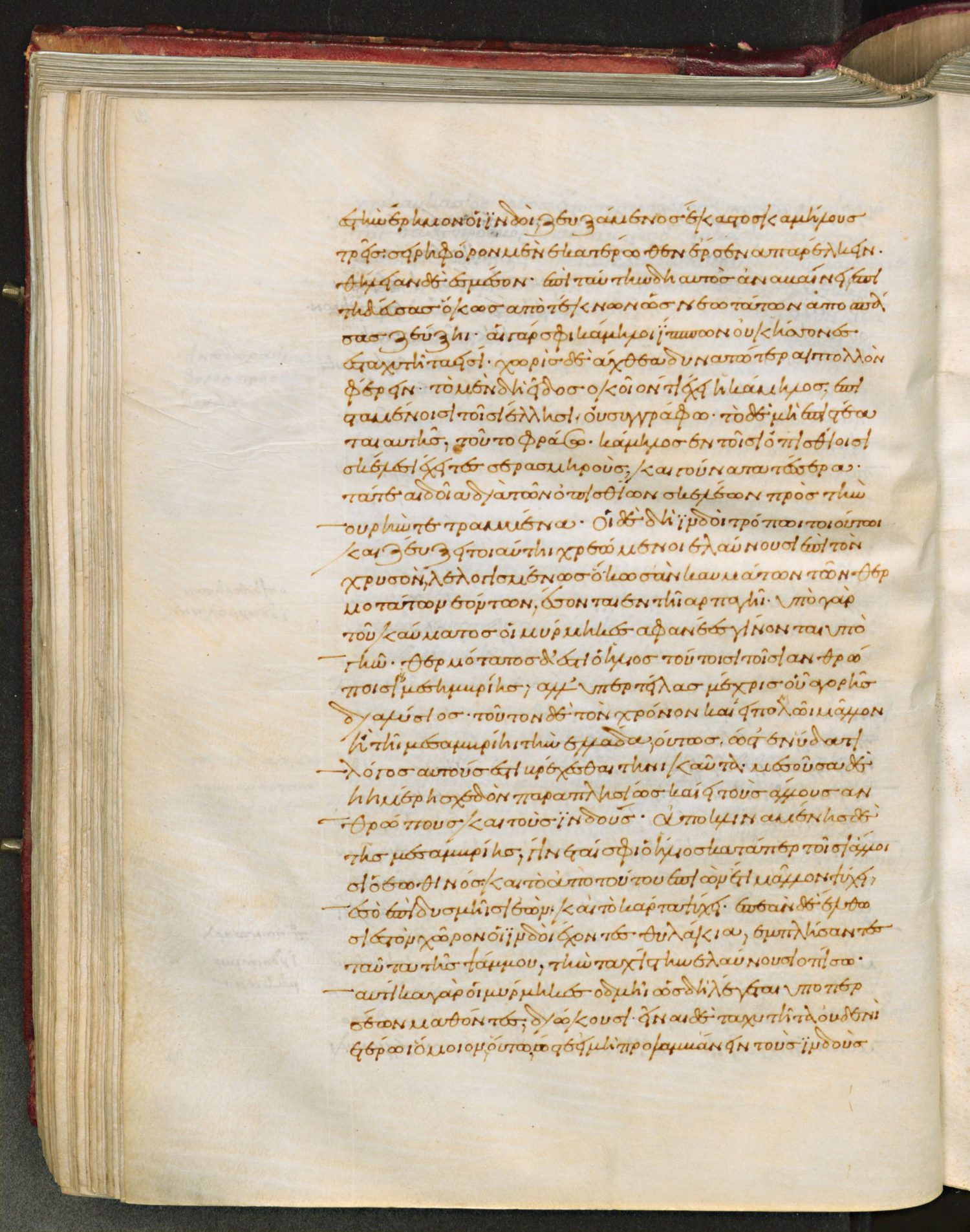
Laur. Plut. 70.3, fol. 131r: Greek here 3.99.2 to 3.102.3. Checked on the image (first and last words read and located in the Greek; each break checked against the neighbouring page): fol. 131r begins ‹τὸν γὰρ δὴ ἐς› (3.99.2), ends ‹ταύτην τὴν ψάμμον στέλλονται› (3.102.3). English here: 3.99.2 to 3.102.2 (Godley's sentences for the sections whose Greek lies mostly on this page).
3.99.2τὸν γὰρ δὴ ἐς γῆρας ἀπικόμενον θύσαντες κατευωχέονται· ἐς δὲ τούτου λόγον οὐ πολλοί τινες αὐτῶν ἀπικνέονται· πρὸ γὰρ τοῦ τὸν ἐς νοῦσον πίπτοντα πάντα κτείνουσι. 3.100.1ἑτέρων δὲ ἐστὶ Ἰνδῶν ὅδε ἄλλος τρόπος· οὔτε κτείνουσι οὐδὲν ἔμψυχον οὔτε τι σπείρουσι οὔτε οἰκίας νομίζουσι ἐκτῆσθαι ποιηφαγέουσί τε· καὶ αὐτοῖσι ἐστὶ ὅσον κέγχρος τὸ μέγαθος ἐν κάλυκι, αὐτόματον ἐκ τῆς γῆς γινόμενον, τὸ συλλέγοντες αὐτῇ τῇ κάλυκι ἕψουσί τε καὶ σιτέονται. ὃς δʼ ἂν ἐς νοῦσον αὐτῶν πέσῃ, ἐλθὼν ἐς τὴν ἔρημον κεῖται· φροντίζει δὲ οὐδεὶς οὔτε ἀποθανόντος οὔτε κάμνοντος. 3.101.1μίξις δὲ τούτων τῶν Ἰνδῶν τῶν κατέλεξα πάντων ἐμφανής ἐστι κατά περ τῶν προβάτων, καὶ τὸ χρῶμα φορέουσι ὅμοιον πάντες καὶ παραπλήσιον Αἰθίοψι. 3.101.2ἡ γονὴ δὲ αὐτῶν, τὴν ἀπίενται ἐς τὰς γυναῖκας, οὐ κατά περ τῶν ἄλλων ἀνθρώπων ἐστὶ λευκή, ἀλλὰ μέλαινα κατά περ τὸ χρῶμα. τοιαύτην δὲ καὶ Αἰθίοπες ἀπίενται θορήν. οὗτοι μὲν τῶν Ἰνδῶν ἑκαστέρω τῶν Περσέων οἰκέουσι καὶ πρὸς νότου ἀνέμου, καὶ Δαρείου βασιλέος οὐδαμὰ ὑπήκουσαν. 3.102.1ἄλλοι δὲ τῶν Ἰνδῶν Κασπατύρῳ τε πόλι καὶ τῇ Πακτυϊκῇ χώρῃ εἰσὶ πρόσουροι, πρὸς ἄρκτου τε καὶ βορέω ἀνέμου κατοικημένοι τῶν ἄλλων Ἰνδῶν, οἳ Βακτρίοισι παραπλησίην ἔχουσι δίαιταν. οὗτοι καὶ μαχιμώτατοι εἰσὶ Ἰνδῶν καὶ οἱ ἐπὶ τὸν χρυσὸν στελλόμενοι εἰσὶ οὗτοι· κατὰ γὰρ τοῦτο ἐστὶ ἐρημίη διὰ τὴν ψάμμον. 3.102.2ἐν δὴ ὦν τῇ ἐρημίῃ ταύτῃ καὶ τῇ ψάμμῳ γίνονται μύρμηκες μεγάθεα ἔχοντες κυνῶν μὲν ἐλάσσονα ἀλωπέκων δὲ μέζονα· εἰσὶ γὰρ αὐτῶν καὶ παρὰ βασιλέι τῷ Περσέων ἐνθεῦτεν θηρευθέντες. οὗτοι ὦν οἱ μύρμηκες ποιεύμενοι οἴκησιν ὑπὸ γῆν ἀναφορέουσι τὴν ψάμμον κατά περ οἱ ἐν τοῖσι Ἕλλησι μύρμηκες κατὰ τὸν αὐτὸν τρόπον, εἰσὶ δὲ καὶ αὐτοὶ τὸ εἶδος ὁμοιότατοι· ἡ δὲ ψάμμος ἡ ἀναφερομένη ἐστὶ χρυσῖτις. 3.102.3ἐπὶ δὴ ταύτην τὴν ψάμμον στέλλονται
3.99.2When a woman is sick she is put to death like the men by the women who most consort with her. As for one that has come to old age, they sacrifice him and feast on his flesh; but there are not many who come thereto, for all who fall sick are killed ere that. 3.100.1There are other Indians, again, who kill no living creature, nor sow, nor are wont to have houses; they eat grass, and they have a grain growing naturally from the earth in its husk, about the size of a millet-seed, which they gather with the husk and boil and eat. When any one of them falls sick he goes into the desert and lies there, none regarding whether he be sick or die. 3.101.1These Indians of whom I speak have intercourse openly like cattle; they are all black-skinned, like the Ethiopians. 3.101.2Their genital seed too is not white like other men’s, but black like their skin, and resembles in this respect that of the Ethiopians. These Indians dwell far away from the Persians southwards, and were no subjects of King Darius. 3.102.1Other Indians dwell near the town of Caspatyrus and the Pactyic country, northward of the rest of India; these live like the Bactrians; they are of all Indians the most warlike, and it is they who are charged with the getting of the gold; for in these parts all is desert by reason of the sand. 3.102.2There are found in this sandy desert ants not so big as dogs but bigger than foxes; the Persian king has some of these, which have been caught there. These ants make their dwellings underground, digging out the sand in the same manner as do the ants in Greece, to which they are very like in shape, and the sand which they carry forth from the holes is full of gold.
Where on the image
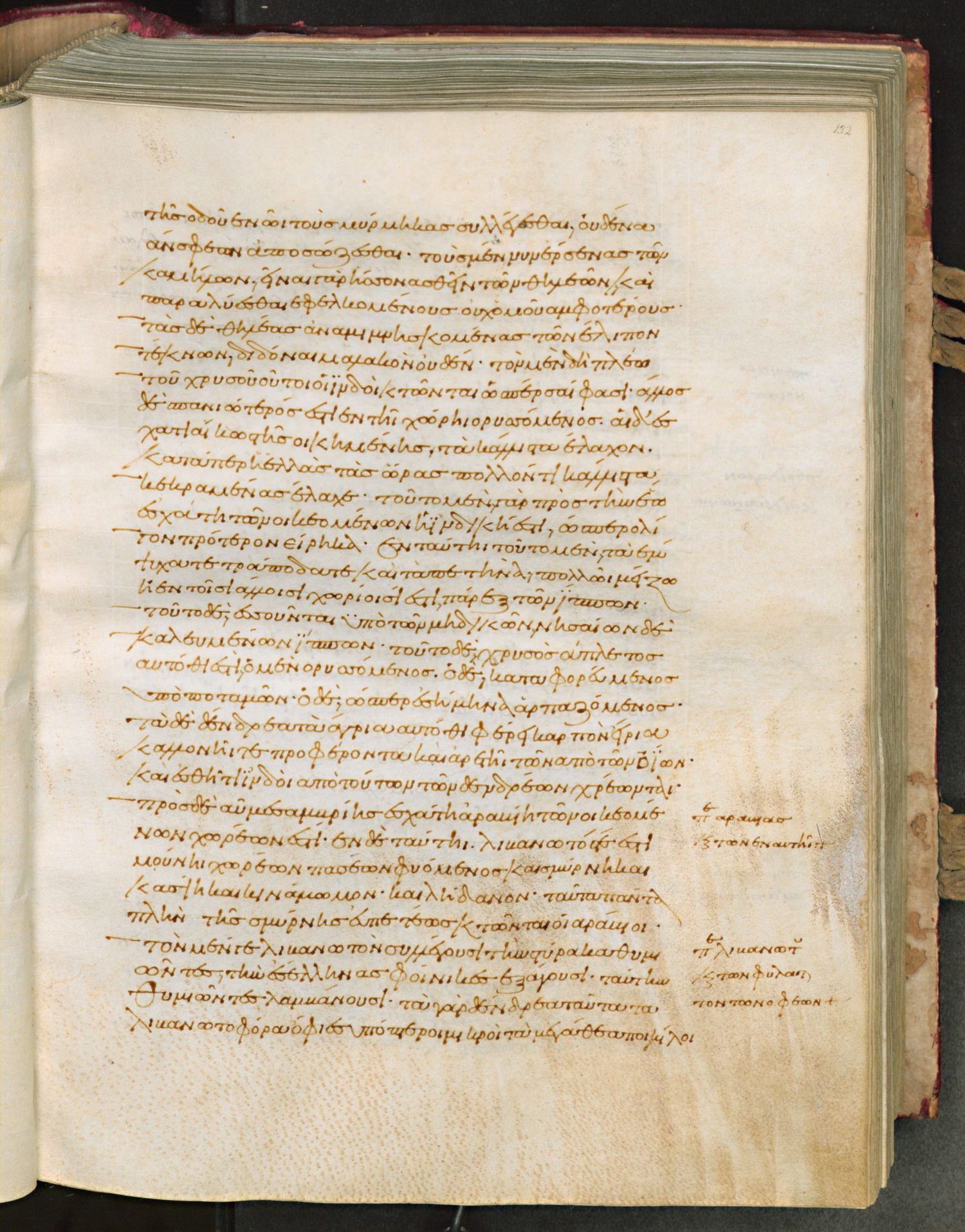
Laur. Plut. 70.3, fol. 131v: Greek here 3.102.3 to 3.105.1. Checked on the image (first and last words read and located in the Greek; each break checked against the neighbouring page): fol. 131v begins ‹ἐς τὴν ἔρημον οἱ› (3.102.3), ends ‹μὴ προλαμβάνειν τοὺς Ἰνδοὺς› (3.105.1). English here: 3.102.3 to 3.105.1 (Godley's sentences for the sections whose Greek lies mostly on this page).
3.102.3ἐς τὴν ἔρημον οἱ Ἰνδοί, ζευξάμενος ἕκαστος καμήλους τρεῖς, σειρηφόρον μὲν ἑκατέρωθεν ἔρσενα παρέλκειν, θήλεαν δὲ ἐς μέσον· ἐπὶ ταύτην δὴ αὐτὸς ἀναβαίνει, ἐπιτηδεύσας ὅκως ἀπὸ τέκνων ὡς νεωτάτων ἀποσπάσας ζεύξει. αἱ γάρ σφι κάμηλοι ἵππων οὐκ ἥσσονες ἐς ταχυτῆτα εἰσί, χωρὶς δὲ ἄχθεα δυνατώτεραι πολλὸν φέρειν. 3.103.1τὸ μὲν δὴ εἶδος ὁκοῖόν τι ἔχει ἡ κάμηλος, ἐπισταμένοισι τοῖσι Ἕλλησι οὐ συγγράφω· τὸ δὲ μὴ ἐπιστέαται αὐτῆς, τοῦτο φράσω· κάμηλος ἐν τοῖσι ὀπισθίοισι σκέλεσι ἔχει τέσσερας μηροὺς καὶ γούνατα τέσσερα, τά τε αἰδοῖα διὰ τῶν ὀπισθίων σκελέων πρὸς τὴν οὐρὴν τετραμμένα. 3.104.1οἱ δὲ δὴ Ἰνδοὶ τρόπῳ τοιούτῳ καὶ ζεύξι τοιαύτῃ χρεώμενοι ἐλαύνουσι ἐπὶ τὸν χρυσὸν λελογισμένως ὅκως καυμάτων τῶν θερμοτάτων ἐόντων ἔσονται ἐν τῇ ἁρπαγῇ· ὑπὸ γὰρ τοῦ καύματος οἱ μύρμηκες ἀφανέες γίνονται ὑπὸ γῆν. 3.104.2θερμότατος δὲ ἐστὶ ὁ ἥλιος τούτοισι τοῖσι ἀνθρώποισι τὸ ἑωθινόν, οὐ κατά περ τοῖσι ἄλλοισι μεσαμβρίης, ἀλλʼ ὑπερτείλας μέχρι οὗ ἀγορῆς διαλύσιος. τοῦτον δὲ τὸν χρόνον καίει πολλῷ μᾶλλον ἢ τῇ μεσαμβρίῃ τὴν Ἑλλάδα, οὕτω ὥστʼ ἐν ὕδατι λόγος αὐτούς ἐστι βρέχεσθαι τηνικαῦτα. 3.104.3μεσοῦσα δὲ ἡ ἡμέρη σχεδὸν παραπλησίως καίει τούς τε ἄλλους ἀνθρώπους καὶ τοὺς Ἰνδούς. ἀποκλινομένης δὲ τῆς μεσαμβρίης γίνεταί σφι ὁ ἥλιος κατά περ τοῖσι ἄλλοισι ὁ ἑωθινός, καὶ τὸ ἀπὸ τούτου ἀπιὼν ἐπὶ μᾶλλον ψύχει, ἐς ὃ ἐπὶ δυσμῇσι ἐὼν καὶ τὸ κάρτα ψύχει. 3.105.1ἐπεὰν δὲ ἔλθωσι ἐς τὸν χῶρον οἱ Ἰνδοὶ ἔχοντες θυλάκια, ἐμπλήσαντες ταῦτα τῆς ψάμμου τὴν ταχίστην ἐλαύνουσι ὀπίσω· αὐτίκα γὰρ οἱ μύρμηκες ὀδμῇ, ὡς δὴ λέγεται ὑπὸ Περσέων, μαθόντες διώκουσι. εἶναι δὲ ταχυτῆτα οὐδενὶ ἑτέρῳ ὅμοιον, οὕτω ὥστε, εἰ μὴ προλαμβάνειν τοὺς Ἰνδοὺς
3.102.3It is for this sand that the Indians set forth into the desert. They harness three camels apiece, a male led camel on either side to help in draught, and a female in the middle: the man himself rides on the female, careful that when harnessed she has been taken away from as young an offspring as may be. Their camels are as swift as horses, and much better able to bear burdens besides. 3.103.1I do not describe the camel’s appearance to Greeks, for they know it; but I will show them a thing which they do not know concerning it: the hindlegs of the camel have four thighbones and four knee-joints; its privy parts are turned towards the tail between the hindlegs. 3.104.1Thus and with teams so harnessed the Indians ride after the gold, using all diligence that they shall be about the business of taking it when the heat is greatest; for the ants are then out of sight underground. 3.104.2Now in these parts the sun is hottest in the morning, not at midday as elsewhere, but from sunrise to the hour of market-closing. Through these hours it is hotter by much than in Hellas at noon, so that men are said to sprinkle themselves with water at this time. 3.104.3At midday the sun’s heat is well nigh the same in India and elsewhere. As it grows to afternoon, the sun of India has the power of the morning sun in other lands; with its sinking the day becomes ever cooler, till at sunset it is exceeding cold. 3.105.1So when the Indians come to the place with their sacks, they fill these with the sand and ride away back with all speed; for, as the Persians say, the ants forthwith scent them out and give chase, being, it would seem, so much swifter than all other creatures that if the Indians made not haste on their way while the ants are mustering, not one of them would escape.
Where on the image
Laur. Plut. 70.3, fol. 132r: Greek here 3.105.1 to 3.105.2. Checked on the image (first and last words read and located in the Greek; each break checked against the neighbouring page): fol. 132r begins ‹τῆς ὁδοῦ ἐν ᾧ› (3.105.1), ends ‹μικροὶ τὰ μεγάθεα, ποικίλοι› (3.107.2). English here: 3.105.2 (Godley's sentences for the sections whose Greek lies mostly on this page).
3.105.1τῆς ὁδοῦ ἐν ᾧ τοὺς μύρμηκας συλλέγεσθαι, οὐδένα ἂν σφέων ἀποσώζεσθαι. 3.105.2τοὺς μέν νυν ἔρσενας τῶν καμήλων, εἶναι γὰρ ἥσσονας θέειν τῶν θηλέων, παραλύεσθαι ἐπελκομένους, οὐκ ὁμοῦ ἀμφοτέρους· τὰς δὲ θηλέας ἀναμιμνησκομένας τῶν ἔλιπον τέκνων ἐνδιδόναι μαλακὸν οὐδέν. τὸν μὲν δὴ πλέω τοῦ χρυσοῦ οὕτω οἱ Ἰνδοὶ κτῶνται, ὡς Πέρσαι φασί· ἄλλος δὲ σπανιώτερος ἐστι ἐν τῇ χώρῃ ὀρυσσόμενος.
3.105.2So they loose the male trace-camels as they begin to lag, one at a time (these being slower than the females); the mares never tire, for they remember the young that they have left. Such is the tale. Most of the gold (say the Persians) is got in this way by the Indians; there is some besides that they dig from mines in their country, but it is less abundant.
Notes
- Greek: the text printed in A. D. Godley's Loeb edition, via Perseus (tlg0016.tlg001.perseus-grc2). Square brackets mark words the editor considers later additions; [...] marks a gap the editor indicates. Perseus note markers are omitted.
- English: A. D. Godley, Herodotus vol. 2 (1921) (Loeb Classical Library), as transcribed on Wikisource. Godley's footnotes are omitted.
- Section numbers in the English were placed by comparing Godley's text with the Perseus version of his translation; where a section begins inside one of Godley's sentences, the English is kept with the page that holds the start of that sentence.
Cite
Sources
- Source: Florence, Laur. Plut. 70.3 (10th c.) via BML Teca Digitale + Greek of Godley's Loeb (Perseus) + English of A. D. Godley (Loeb, Wikisource) (holding institution)
- Critical edition: Greek of A. D. Godley's Loeb edition (1920-1925), via Perseus
← previous · → next · v cycle view · l back to library