Herodotus, Histories 3.139-149: Syloson and the taking of Samos
Introduction
Herodotus of Halicarnassus wrote the Histories in the third quarter of the 5th century BCE, an inquiry into the deeds of Greeks and barbarians and the causes of the wars between them, later divided into nine books. Book 3 tells of Cambyses' conquest of Egypt and his madness, Polycrates of Samos, the rising of the Magi and the seven Persians who overthrew them, the accession of Darius and his provinces, and the revolt and recapture of Babylon.
The photographs are of Florence, Biblioteca Medicea Laurenziana, Plut. 70.3 (parchment, 10th century, 374 folios, 31 lines a page), Herodotus, Histories (codex A of the editors), the oldest surviving manuscript of the complete Histories, from the Teca Digitale of the Biblioteca Medicea Laurenziana. Each section below is the text of one page, or of the part of a page that falls within these chapters. The first and last words of every page were read on the photograph and located in the Greek, and every page break was checked against the next page; the notes quote these words. Readers' notes in the margins are not part of the text and are mentioned where they occur.
The Greek is the text printed in A. D. Godley's Loeb edition (1920-1925), from Perseus; it is the edited text, not a transcription of the manuscript, whose wording differs in places. The English is Godley's translation as printed, from Wikisource. Godley's English carries only chapter numbers; the section numbers shown in it were placed by comparison with the Perseus version of his translation. Each page's English is cut at the end of one of Godley's sentences, so it can begin or end a few lines away from the Greek of the page; each note gives the exact ranges.
This entry covers chapters 3.139-149, on fol. 141r to 144r.
How was this verified? (Provenance)
Where on the image
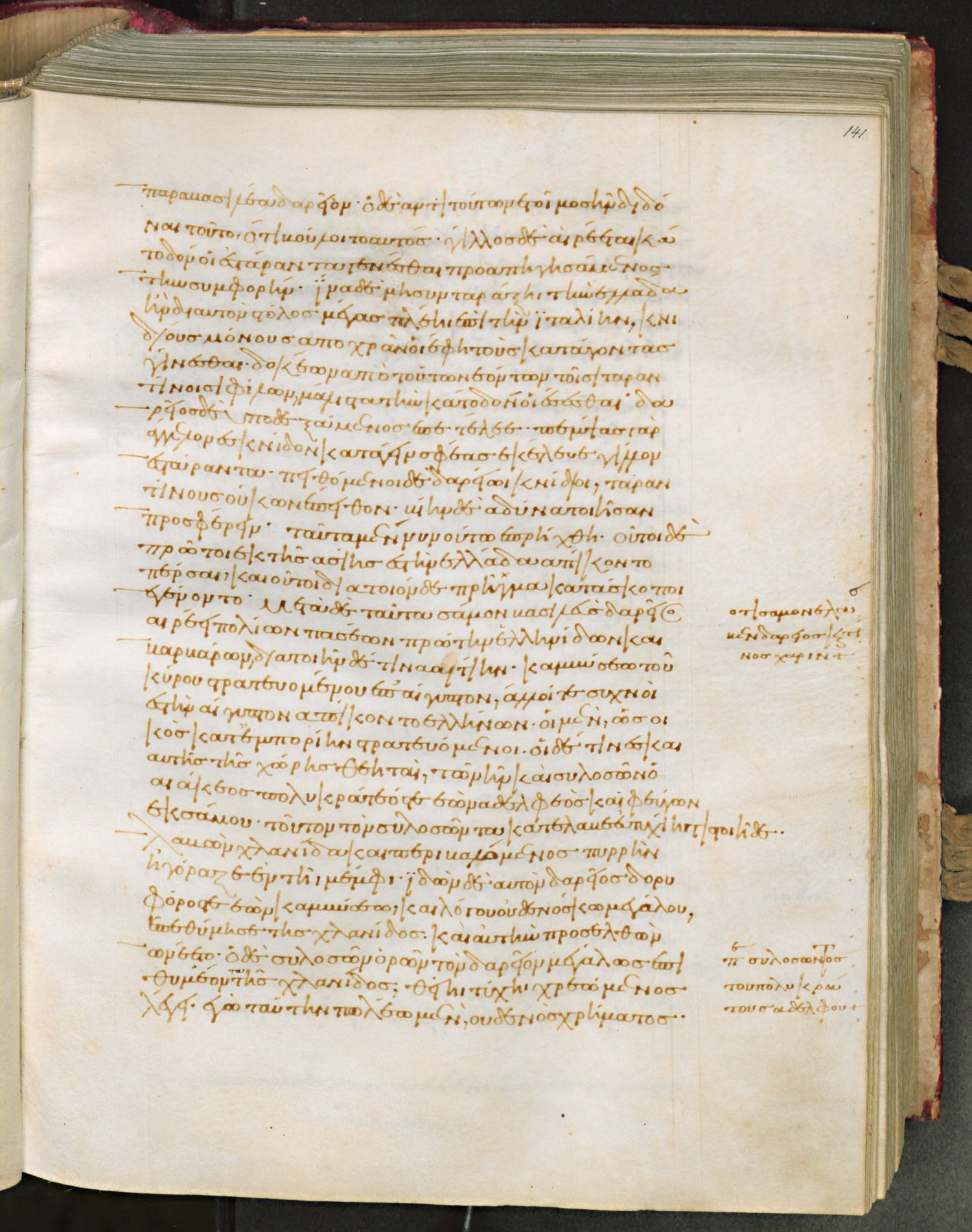
Laur. Plut. 70.3, fol. 141r: Greek here 3.139.1 to 3.139.3. Checked on the image (first and last words read and located in the Greek; each break checked against the neighbouring page): fol. 141r begins ‹παρὰ βασιλέα Δαρεῖον. ὁ› (3.138.1), ends ‹πωλέω μὲν οὐδενὸς χρήματος› (3.139.3). English here: 3.139.1 to 3.139.3 (Godley's sentences for the sections whose Greek lies mostly on this page).
3.139.1μετὰ δὲ ταῦτα Σάμον βασιλεὺς Δαρεῖος αἱρέει, πολίων πασέων πρώτην Ἑλληνίδων καὶ βαρβάρων, διὰ τοιήνδε τινὰ αἰτίην. Καμβύσεω τοῦ Κύρου στρατευομένου ἐπʼ Αἴγυπτον ἄλλοι τε συχνοὶ ἐς τὴν Αἴγυπτον ἀπίκοντο Ἑλλήνων, οἳ μέν, ὡς οἰκός, κατʼ ἐμπορίην στρατευόμενοι, οἳ δὲ τινὲς καὶ αὐτῆς τῆς χώρης θεηταί· τῶν ἦν καὶ Συλοσῶν ὁ Αἰάκεος, Πολυκράτεός τε ἐὼν ἀδελφεὸς καὶ φεύγων ἐκ Σάμου. 3.139.2τοῦτον τὸν Συλοσῶντα κατέλαβε εὐτυχίη τις τοιήδε. λαβὼν χλανίδα καὶ περιβαλόμενος πυρρὴν ἠγόραζε ἐν τῇ Μέμφι· ἰδὼν δὲ αὐτὸν Δαρεῖος, δορυφόρος τε ἐὼν Καμβύσεω καὶ λόγου οὐδενός κω μεγάλου, ἐπεθύμησε τῆς χλανίδος καὶ αὐτὴν προσελθὼν ὠνέετο. 3.139.3ὁ δὲ Συλοσῶν ὁρέων τὸν Δαρεῖον μεγάλως ἐπιθυμέοντα τῆς χλανίδος, θείῃ τύχῃ χρεώμενος λέγει ἐγὼ ταύτην πωλέω μὲν οὐδενὸς χρήματος,
3.139.1After this, Darius conquered Samos, the greatest of all city states, Greek or other, the reason of his conquest being this:—When Cambyses, son of Cyrus, invaded Egypt, many Greeks came with the army to that country, some to trade, as was natural, and some to see the country itself; among whom was Syloson, son of Aeaces, Polycrates’ brother, and now banished from Samos. 3.139.2This Syloson had a stroke of good luck. He was in the market at Memphis wearing a red cloak, when Darius, at that time one of Cambyses’ guard and as yet a man of no great account, saw him, and coveting the cloak came and offered to buy it. 3.139.3When Syloson saw Darius’ eagerness, by good luck he was moved to say, “I will not sell you my cloak; but if it must be so, and no help for it, you can have it for nothing.” To this Darius agreed and took the garment.
Where on the image
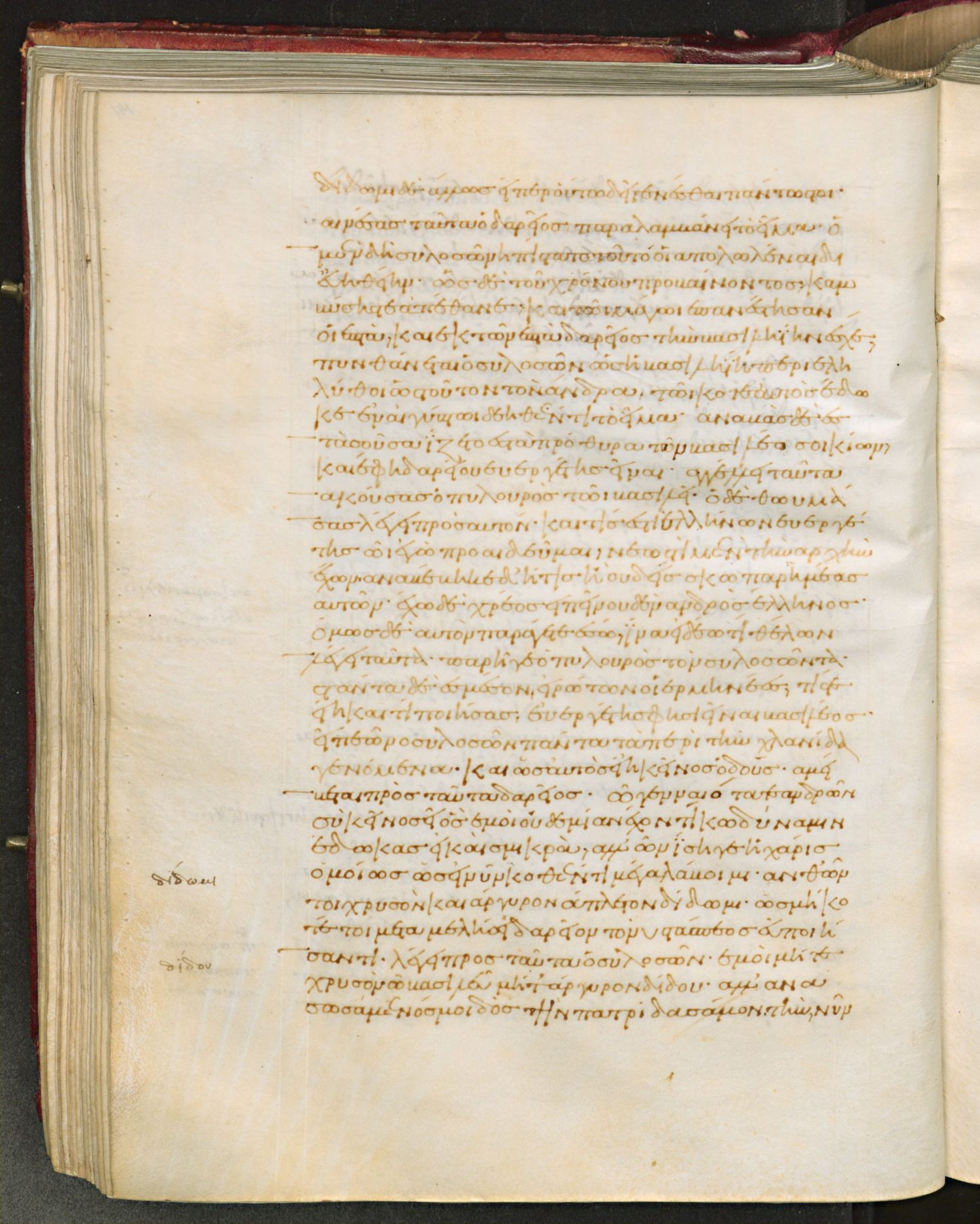
Laur. Plut. 70.3, fol. 141v: Greek here 3.139.3 to 3.140.5. Checked on the image (first and last words read and located in the Greek; each break checked against the neighbouring page): fol. 141v begins ‹δίδωμι δὲ ἄλλως, εἴ› (3.139.3), ends ‹πατρίδα Σάμον, τὴν νῦν› (3.140.5). The first lines are faded. English here: 3.140.1 to 3.140.4 (Godley's sentences for the sections whose Greek lies mostly on this page).
3.139.3δίδωμι δὲ ἄλλως, εἴ περ οὕτω δεῖ γενέσθαι πάντως τοι. αἰνέσας ταῦτα ὁ Δαρεῖος παραλαμβάνει τὸ εἷμα. 3.140.1ὁ μὲν δὴ Συλοσῶν ἠπίστατο τοῦτό οἱ ἀπολωλέναι διʼ εὐηθείην. ὡς δὲ τοῦ χρόνου προβαίνοντος Καμβύσης τε ἀπέθανε καὶ τῷ Μάγῳ ἐπανέστησαν οἱ ἑπτὰ καὶ ἐκ τῶν ἑπτὰ Δαρεῖος τὴν βασιληίην ἔσχε, πυνθάνεται ὁ Συλοσῶν ὡς ἡ βασιληίη περιεληλύθοι ἐς τοῦτον τὸν ἄνδρα τῷ κοτὲ αὐτὸς ἔδωκε ἐν Αἰγύπτῳ δεηθέντι τὸ εἷμα. ἀναβὰς δὲ ἐς τὰ Σοῦσα ἵζετο ἐς τὰ πρόθυρα τῶν βασιλέος οἰκίων καὶ ἔφη Δαρείου εὐεργέτης εἶναι. 3.140.2ἀγγέλλει ταῦτα ἀκούσας ὁ πυλουρὸς τῷ βασιλέι· ὁ δὲ θωμάσας λέγει πρὸς αὐτόν καὶ τίς ἐστὶ Ἑλλήνων εὐεργέτης τῷ ἐγὼ προαιδεῦμαι, νεωστὶ μὲν τὴν ἀρχὴν ἔχων; ἀναβέβηκε δʼ ἤ τις ἢ οὐδείς κω παρʼ ἡμέας αὐτῶν, ἔχω δὲ χρέος εἰπεῖν οὐδὲν ἀνδρὸς Ἕλληνος. ὅμως δὲ αὐτὸν παράγετε ἔσω, ἵνα εἰδέω τί θέλων λέγει ταῦτα. 3.140.3παρῆγε ὁ πυλουρὸς τὸν Συλοσῶντα, στάντα δὲ ἐς μέσον εἰρώτων οἱ ἑρμηνέες τίς τε εἴη καὶ τί ποιήσας εὐεργέτης φησὶ εἶναι βασιλέος. εἶπε ὦν ὁ Συλοσῶν πάντα τὰ περὶ τὴν χλανίδα γενόμενα, καὶ ὡς αὐτὸς εἴη κεῖνος ὁ δούς. 3.140.4ἀμείβεται πρὸς ταῦτα Δαρεῖος ὦ γενναιότατε ἀνδρῶν, σὺ κεῖνος εἶς ὃς ἐμοὶ οὐδεμίαν ἔχοντί κω δύναμιν ἔδωκας εἰ καὶ σμικρά, ἀλλʼ ὦν ἴση γε ἡ χάρις ὁμοίως ὡς εἰ νῦν κοθέν τι μέγα λάβοιμι· ἀντʼ ὧν τοι χρυσὸν καὶ ἄργυρον ἄπλετον δίδωμι, ὡς μή κοτέ τοι μεταμελήσῃ Δαρεῖον τὸν Ὑστάσπεος εὖ ποιήσαντι. λέγει πρὸς ταῦτα ὁ Συλοσῶν 3.140.5ἐμοὶ μήτε χρυσὸν ὦ βασιλεῦ μήτε ἄργυρον δίδου, ἀλλʼ ἀνασωσάμενός μοι δὸς τὴν πατρίδα Σάμον, τὴν νῦν
3.140.1Syloson supposed that he had lost his cloak out of foolish good nature. But in time Cambyses died, the seven rebelled against the Magian, and of the seven Darius came to the throne; Syloson then learned that the successor to the royal power was the man to whom he had given at request the garment in Egypt; so he went up to Susa and sat at the king’s porch, saying that he was one of Darius’ benefactors. 3.140.2When the gate-ward brought word of this to the king, “But to what Greek benefactor,” Darius asked, “can I owe thanks? In the little time since I have been king hardly one of that nation has come to us, and I have, I may say, no need of any Greek. Nevertheless let him be brought in, that I may know his meaning.” 3.140.3The gate-ward brought Syloson in and set him before them; and the interpreters asked him who he was, and what he had done to call himself the king’s benefactor. Then Syloson told the story of the cloak, and said that it was he who had given it. 3.140.4“Most generous man,” said Darius, “you are he who made me a present when I had as yet no power; if it was but a little thing, yet it was as thankworthy as if someone now gave me a great gift. Take in requital abundance of gold and silver, that you may never repent of the service you did Darius son of Hystaspes.”
Where on the image
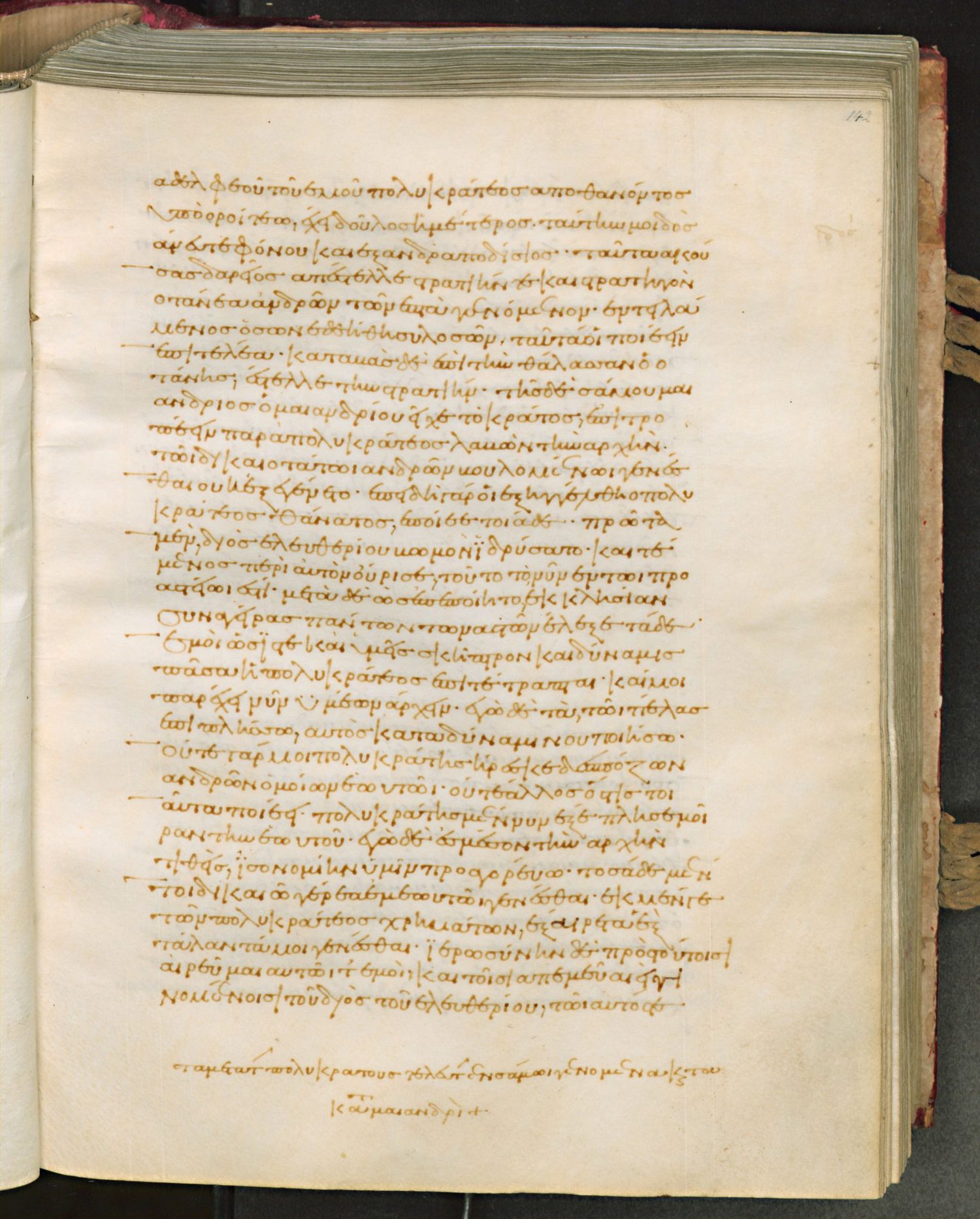
Laur. Plut. 70.3, fol. 142r: Greek here 3.140.5 to 3.142.4. Checked on the image (first and last words read and located in the Greek; each break checked against the neighbouring page): fol. 142r begins ‹ἀδελφεοῦ τοῦ ἐμοῦ Πολυκράτεος› (3.140.5), ends ‹ἐλευθερίου· τῷ αὐτός τε› (3.142.4). Below the text, a reader's note on events in Samos after the death of Polycrates. English here: 3.140.5 to 3.142.4 (Godley's sentences for the sections whose Greek lies mostly on this page).
3.140.5ἀδελφεοῦ τοῦ ἐμοῦ Πολυκράτεος ἀποθανόντος ὑπὸ Ὀροίτεω ἔχει δοῦλος ἡμέτερος· ταύτην μοι δὸς ἄνευ τε φόνου καὶ ἐξανδραποδίσιος. 3.141.1ταῦτα ἀκούσας Δαρεῖος ἀπέστελλε στρατιήν τε καὶ στρατηγὸν Ὀτάνεα ἀνδρῶν τῶν ἑπτὰ γενόμενον, ἐντειλάμενος, ὅσων ἐδεήθη ὁ Συλοσῶν, ταῦτά οἱ ποιέειν ἐπιτελέα. καταβὰς δὲ ἐπὶ τὴν θάλασσαν ὁ Ὀτάνης ἔστελλε τὴν στρατιήν. 3.142.1τῆς δὲ Σάμου Μαιάνδριος ὁ Μαιανδρίου εἶχε τὸ κράτος, ἐπιτροπαίην παρὰ Πολυκράτεος λαβὼν τὴν ἀρχήν· τῷ δικαιοτάτῳ ἀνδρῶν βουλομένῳ γενέσθαι οὐκ ἐξεγένετο. 3.142.2ἐπειδὴ γάρ οἱ ἐξαγγέλθη ὁ Πολυκράτεος θάνατος, ἐποίεε τοιάδε· πρῶτα μὲν Διὸς ἐλευθερίου βωμὸν ἱδρύσατο καὶ τέμενος περὶ αὐτὸν οὔρισε τοῦτο τὸ νῦν ἐν τῷ προαστείῳ ἐστί· μετὰ δέ, ὥς οἱ ἐπεποίητο, ἐκκλησίην συναγείρας πάντων τῶν ἀστῶν ἔλεξε τάδε. 3.142.3ἐμοί, ὡς ἴστε καὶ ὑμεῖς, σκῆπτρον καὶ δύναμις πᾶσα ἡ Πολυκράτεος ἐπιτέτραπται, καί μοι παρέχει νῦν ὑμέων ἄρχειν. ἐγὼ δὲ τὰ τῷ πέλας ἐπιπλήσσω, αὐτὸς κατὰ δύναμιν οὐ ποιήσω· οὔτε γάρ μοι Πολυκράτης ἤρεσκε δεσπόζων ἀνδρῶν ὁμοίων ἑωυτῷ οὔτε ἄλλος ὅστις τοιαῦτα ποιέει. Πολυκράτης μέν νυν ἐξέπλησε μοῖραν τὴν ἑωυτοῦ, ἐγὼ δὲ ἐς μέσον τὴν ἀρχὴν τιθεὶς ἰσονομίην ὑμῖν προαγορεύω. 3.142.4τοσάδε μέντοι δικαιῶ γέρεα ἐμεωυτῷ γενέσθαι, ἐκ μέν γε τῶν Πολυκράτεος χρημάτων ἐξαίρετα ἓξ τάλαντά μοι γενέσθαι, ἱρωσύνην δὲ πρὸς τούτοισι αἱρεῦμαι αὐτῷ τέ μοι καὶ τοῖσι ἀπʼ ἐμεῦ αἰεὶ γινομένοισι τοῦ Διὸς τοῦ ἐλευθερίου· τῷ αὐτός τε
3.140.5“Nay,” Syloson answered, “I ask neither gold, O king, nor silver; only win me back my fatherland of Samos, where my brother Polycrates has been done to death by Oroetes, and our slave now rules; give me back Samos, but so that there be no bloodshed nor enslaving.” 3.141.1Hearing this Darius sent an army, and Otanes, one of the seven, to command it, charging him to perform all Syloson’s will. So Otanes came down to the coast and made his army ready. 3.142.1Now Samos was ruled by Maeandrius, son of Maeandrius, whom Polycrates had made his vicegerent. This Maeandrius desired to act with all justice, but could not. 3.142.2For when he had news of Polycrates’ death, first he set up an altar to Zeus the Liberator and marked out round it that sacred enclosure which is still to be seen in the suburb of the city; when this was done, he called an assembly of all the townsfolk, and thus addressed them: “It is known 3.142.3to you that I have sole charge of Polycrates’ sceptre and dominion; and it is in my power to be your ruler. But, so far as in me lies, I will not myself do that which I account blameworthy in my neighbour. I ever misliked that Polycrates or any other man should lord it over men like to himself. Polycrates has fulfilled his destiny; for myself, I call you to share all power, and I proclaim equality; 3.142.4only claiming as my own such privilege that six talents of Polycrates’ wealth be set apart for my use, and that I and my descendants have besides the priesthood of Zeus the Liberator, whose temple I have founded, and I now give you freedom.”
Where on the image
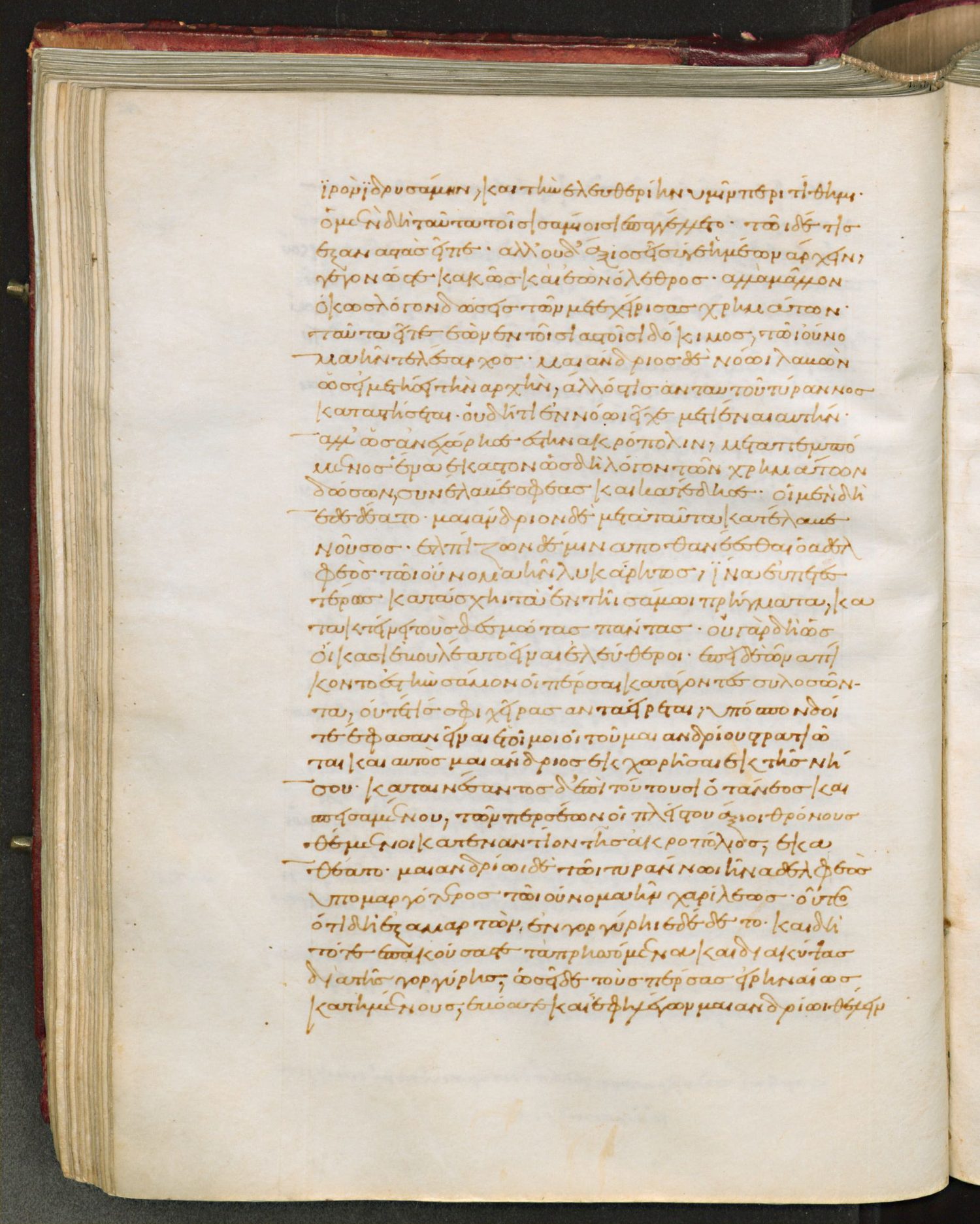
Laur. Plut. 70.3, fol. 142v: Greek here 3.142.4 to 3.145.1. Checked on the image (first and last words read and located in the Greek; each break checked against the neighbouring page): fol. 142v begins ‹ἱρὸν ἱδρυσάμην καὶ τὴν› (3.142.4), ends ‹ἔφη λέγων Μαιανδρίῳ θέλειν› (3.145.1). English here: 3.142.5 to 3.145.2 (Godley's sentences for the sections whose Greek lies mostly on this page).
3.142.4ἱρὸν ἱδρυσάμην καὶ τὴν ἐλευθερίην ὑμῖν περιτίθημι. 3.142.5ὃ μὲν δὴ ταῦτα τοῖσι Σαμίοισι ἐπαγγέλλετο· τῶν δέ τις ἐξαναστὰς εἶπε ἀλλʼ οὐδʼ ἄξιος εἶς σύ γε ἡμέων ἄρχειν, γεγονώς τε κακῶς καὶ ἐὼν ὄλεθρος· ἀλλὰ μᾶλλον ὅκως λόγον δώσεις τῶν μετεχείρισας χρημάτων. 3.143.1ταῦτα εἶπε ἐὼν ἐν τοῖσι ἀστοῖσι δόκιμος, τῷ οὔνομα ἦν Τελέσαρχος. Μαιάνδριος δὲ νόῳ λαβὼν ὡς εἰ μετήσει τὴν ἀρχήν, ἄλλος τις ἀντʼ αὐτοῦ τύραννος καταστήσεται, οὐδὲν ἔτι ἐν νόῳ εἶχε μετιέναι αὐτήν, ἀλλʼ ὡς ἀνεχώρησε ἐς τὴν ἀκρόπολιν, μεταπεμπόμενος ἕνα ἕκαστον ὡς δὴ λόγον τῶν χρημάτων δώσων, συνέλαβε σφέας καὶ κατέδησε. 3.143.2οἳ μὲν δὴ ἐδεδέατο, Μαιάνδριον δὲ μετὰ ταῦτα κατέλαβε νοῦσος. ἐλπίζων δέ μιν ἀποθανέεσθαι ὁ ἀδελφεός, τῷ οὔνομα ἦν Λυκάρητος, ἵνα εὐπετεστέρως κατάσχῃ τὰ ἐν τῇ Σάμῳ πρήγματα, κατακτείνει τοὺς δεσμώτας πάντας· οὐ γὰρ δή, ὡς οἴκασι, ἐβούλοντο εἶναι ἐλεύθεροι. 3.144.1ἐπειδὴ ὦν ἀπίκοντο ἐς τὴν Σάμον οἱ Πέρσαι κατάγοντες Συλοσῶντα, οὔτε τίς σφι χεῖρας ἀνταείρεται, ὑπόσπονδοί τε ἔφασαν εἶναι ἕτοιμοι οἱ τοῦ Μαιανδρίου στασιῶται καὶ αὐτὸς Μαιάνδριος ἐκχωρῆσαι ἐκ τῆς νήσου. καταινέσαντος δʼ ἐπὶ τούτοισι Ὀτάνεω καὶ σπεισαμένου, τῶν Περσέων οἱ πλείστου ἄξιοι θρόνους θέμενοι κατεναντίον τῆς ἀκροπόλιος κατέατο. 3.145.1Μαιανδρίῳ δὲ τῷ τυράννῳ ἦν ἀδελφεὸς ὑπομαργότερος, τῷ οὔνομα ἦν Χαρίλεως· οὗτος ὅ τι δὴ ἐξαμαρτὼν ἐν γοργύρῃ ἐδέδετο, καὶ δὴ τότε ἐπακούσας τε τὰ πρησσόμενα καὶ διακύψας διὰ τῆς γοργύρης, ὡς εἶδε τοὺς Πέρσας εἰρηναίως κατημένους, ἐβόα τε καὶ ἔφη λέγων Μαιανδρίῳ θέλειν
3.142.5Such was Maeandrius’ promise to the Samians. But one of them arose and answered: “Nay, but who are you? You are not worthy to reign over us, being a low-born knave and rascal. See to it rather that you give an account of the moneys that you have handled.” 3.143.1These were the words of Telesarchus, a man of note among the townsfolk. But Maeandrius, perceiving that if he let the sovereignty slip someone else would make himself despot instead, resolved not to give it up. Withdrawing into the citadel, he sent for each man severally, as though to render an account of the money; then he seized and bound them. 3.143.2So they being in prison, Maeandrius presently fell sick. His brother Lycaretus thought him like to die, and, that so he might the more easily make himself master of Samos, put all the prisoners to death. They had, it would seem, no desire for freedom. 3.144.1So when the Persians brought Syloson back to Samos, none resisted them, but Maeandrius and those of his faction offered to depart from the island under a flag of truce; Otanes agreed to this, and the treaty being made, the Persians of highest rank sat them down on seats that they had set over against the citadel. 3.145.1Now Maeandrius the despot had a crazy brother named Charilaus, who lay bound in the dungeon for some offence; this man heard what was afoot, and by peering through the dungeon window saw the Persians sitting there peaceably; 3.145.2whereupon he cried with a loud voice that he desired to have speech with Maeandrius. His brother, hearing him, bade Charilaus be loosed and brought before him. No sooner had he been brought than he essayed with much reviling and abuse to persuade Maeandrius to attack the Persians. “Villain,” he cried, “you have bound and imprisoned me, your own brother, who had done nothing to deserve it; and when you see the Persians casting you out of house and home, have you no courage to avenge yourself, though you could so easily master them?
Where on the image
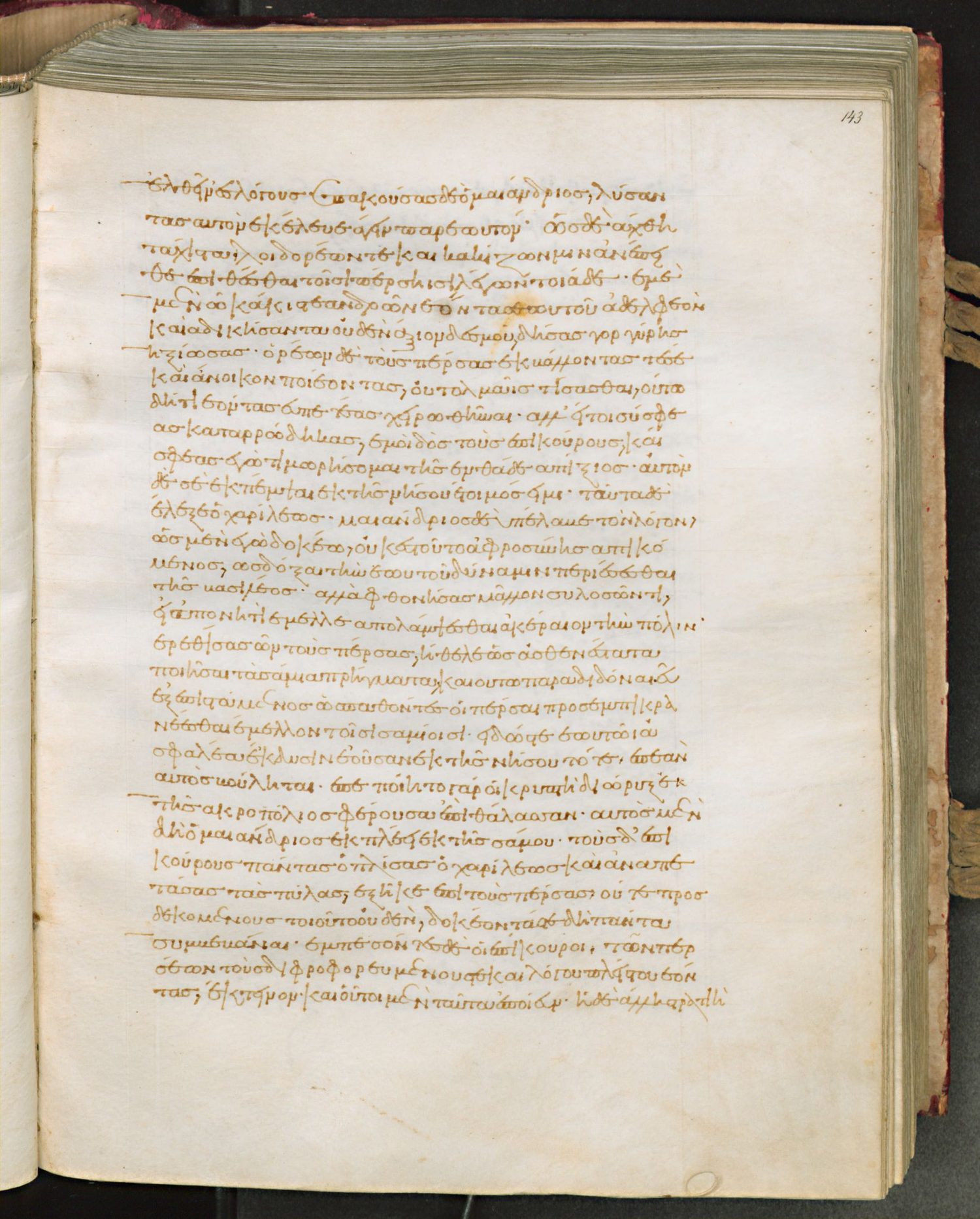
Laur. Plut. 70.3, fol. 143r: Greek here 3.145.1 to 3.146.4. Checked on the image (first and last words read and located in the Greek; each break checked against the neighbouring page): fol. 143r begins ‹ἐλθεῖν ἐς λόγους.ἐπακούσας δὲ› (3.145.1), ends ‹ἡ δὲ ἄλλη στρατιὴ› (3.146.4). English here: 3.145.3 to 3.146.3 (Godley's sentences for the sections whose Greek lies mostly on this page).
3.145.1ἐλθεῖν ἐς λόγους. 3.145.2ἐπακούσας δὲ ὁ Μαιάνδριος λύσαντας αὐτὸν ἐκέλευε ἄγειν παρʼ ἑωυτόν· ὡς δὲ ἄχθη τάχιστα, λοιδορέων τε καὶ κακίζων μιν ἀνέπειθε ἐπιθέσθαι τοῖσι Πέρσῃσι, λέγων τοιάδε. ἐμὲ μέν, ὦ κάκιστε ἀνδρῶν, ἐόντα σεωυτοῦ ἀδελφεὸν καὶ ἀδικήσαντα οὐδὲν ἄξιον δεσμοῦ δήσας γοργύρης ἠξίωσας· ὁρέων δὲ τοὺς Πέρσας ἐκβάλλοντάς τέ σε καὶ ἄνοικον ποιέοντας οὐ τολμᾷς τίσασθαι, οὕτω δή τι ἐόντας εὐπετέας χειρωθῆναι. 3.145.3ἀλλʼ εἴ τοι σὺ σφέας καταρρώδηκας, ἐμοὶ δὸς τοὺς ἐπικούρους, καί σφεας ἐγὼ τιμωρήσομαι τῆς ἐνθάδε ἀπίξιος· αὐτὸν δέ σε ἐκπέμψαι ἐκ τῆς νήσου ἕτοιμος εἰμί. 3.146.1ταῦτα δὲ ἔλεξε ὁ Χαρίλεως· Μαιάνδριος δὲ ὑπέλαβε τὸν λόγον, ὡς μὲν ἐγὼ δοκέω, οὐκ ἐς τοῦτο ἀφροσύνης ἀπικόμενος ὡς δόξαι τὴν ἑωυτοῦ δύναμιν περιέσεσθαι τῆς βασιλέος, ἀλλὰ φθονήσας μᾶλλον Συλοσῶντι εἰ ἀπονητὶ ἔμελλε ἀπολάμψεσθαι ἀκέραιον τὴν πόλιν. 3.146.2ἐρεθίσας ὦν τοὺς Πέρσας ἤθελε ὡς ἀσθενέστατα ποιῆσαι τὰ Σάμια πρήγματα καὶ οὕτω παραδιδόναι, εὖ ἐξεπιστάμενος ὡς παθόντες οἱ Πέρσαι κακῶς προσεμπικρανέεσθαι ἔμελλον τοῖσι Σαμίοισι, εἰδώς τε ἑωυτῷ ἀσφαλέα ἔκδυσιν ἐοῦσαν ἐκ τῆς νήσου τότε ἐπεὰν αὐτὸς βούληται· ἐπεποίητο γάρ οἱ κρυπτὴ διῶρυξ ἐκ τῆς ἀκροπόλιος φέρουσα ἐπὶ θάλασσαν. 3.146.3αὐτὸς μὲν δὴ ὁ Μαιάνδριος ἐκπλέει ἐκ τῆς Σάμου· τοὺς δʼ ἐπικούρους πάντας ὁπλίσας ὁ Χαρίλεως, καὶ ἀναπετάσας τὰς πύλας, ἐξῆκε ἐπὶ τοὺς Πέρσας οὔτε προσδεκομένους τοιοῦτο οὐδὲν δοκέοντάς τε δὴ πάντα συμβεβάναι. ἐμπεσόντες δὲ οἱ ἐπίκουροι τῶν Περσέων τοὺς διφροφορευμένους τε καὶ λόγου πλείστου ἐόντας ἔκτεινον. 3.146.4καὶ οὗτοι μὲν ταῦτα ἐποίευν, ἡ δὲ ἄλλη στρατιὴ
3.145.3If you are yourself afraid of them, give me your foreign guards, and I will punish them for their coming hither; as for you, I will give you safe conduct out of the island.” 3.146.1So said Charilaus. Maeandrius took his advice. This he did, to my thinking, not that he was so foolish as to suppose that he would be strong enough to vanquish the king, but because he grudged that Syloson should recover Samos safe and whole with no trouble. 3.146.2He desired therefore to anger the Persians and thereby to weaken Samos as much as he might before surrendering it, for he was well aware that if the Persians were harmed they would be bitterly wroth with the Samians. Moreover he knew that he could get himself safe out of the island whenever he would, having made a secret passage leading from the citadel to the sea. 3.146.3Maeandrius then set sail himself from Samos; but Charilaus armed all the guards, opened the citadel gates, and threw the guard upon the Persians. These supposed that a full agreement had now been made, and were taken at unawares; the guard fell upon them and slew the Persians of highest rank, those who were carried in litters.
Where on the image
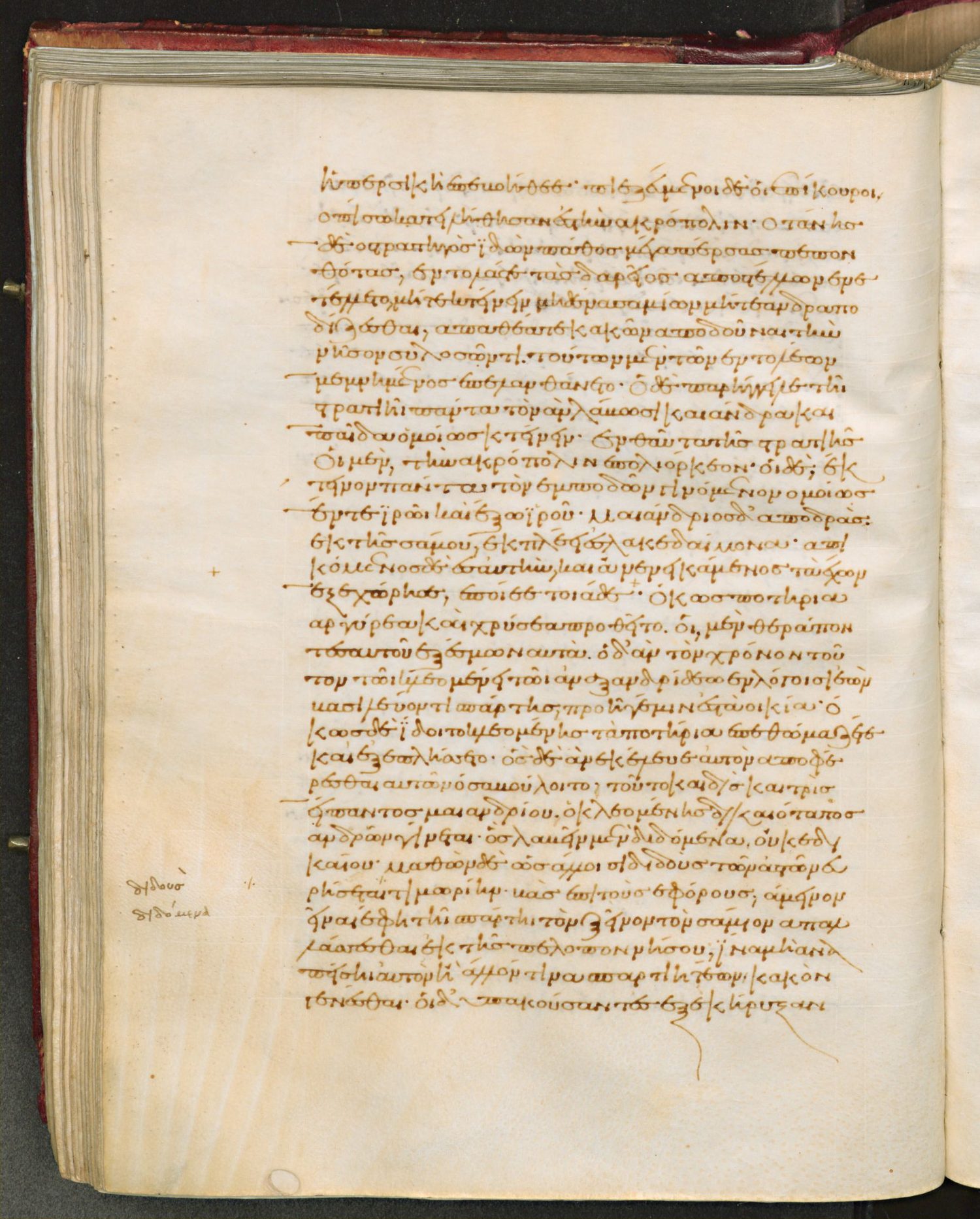
Laur. Plut. 70.3, fol. 143v: Greek here 3.146.4 to 3.148.2. Checked on the image (first and last words read and located in the Greek; each break checked against the neighbouring page): fol. 143v begins ‹ἡ Περσικὴ ἐπεβοήθεε· πιεζεύμενοι› (3.146.4), ends ‹οἳ δʼ ὑπακούσαντες ἐξεκήρυξαν› (3.148.2). English here: 3.146.4 to 3.148.2 (Godley's sentences for the sections whose Greek lies mostly on this page).
3.146.4ἡ Περσικὴ ἐπεβοήθεε· πιεζεύμενοι δὲ οἱ ἐπίκουροι ὀπίσω κατειλήθησαν ἐς τὴν ἀκρόπολιν. 3.147.1Ὀτάνης δὲ ὁ στρατηγὸς ἰδὼν πάθος μέγα Πέρσας πεπονθότας, ἐντολὰς μὲν τὰς Δαρεῖός οἱ ἀποστέλλων ἐνετέλλετο, μήτε κτείνειν μηδένα Σαμίων μήτε ἀνδραποδίζεσθαι ἀπαθέα τε κακῶν ἀποδοῦναι τὴν νῆσον Συλοσῶντι, τουτέων μὲν τῶν ἐντολέων μεμνημένος ἐπελανθάνετο, ὁ δὲ παρήγγειλε τῇ στρατιῇ πάντα τὸν ἂν λάβωσι καὶ ἄνδρα καὶ παῖδα ὁμοίως κτείνειν. 3.147.2ἐνθαῦτα τῆς στρατιῆς οἳ μὲν τὴν ἀκρόπολιν ἐπολιόρκεον, οἳ δὲ ἔκτεινον πάντα τὸν ἐμποδὼν γινόμενον ὁμοίως ἔν τε ἱρῷ καὶ ἔξω ἱροῦ. 3.148.1Μαιάνδριος δὲ ἀποδρὰς ἐκ τῆς Σάμου ἐκπλέει ἐς Λακεδαίμονα· ἀπικόμενος δὲ ἐς αὐτὴν καὶ ἀνενεικάμενος τὰ ἔχων ἐξεχώρησε, ἐποίεε τοιάδε· ὅκως ποτήρια ἀργύρεά τε καὶ χρύσεα προθεῖτο, οἱ μὲν θεράποντες αὐτοῦ ἐξέσμων αὐτά, ὃ δʼ ἂν τὸν χρόνον τοῦτον τῷ Κλεομένεϊ τῷ Ἀναξανδρίδεω ἐν λόγοισι ἐών, βασιλεύοντι Σπάρτης, προῆγέ μιν ἐς τὰ οἰκία· ὅκως δὲ ἴδοιτο Κλεομένης τὰ ποτήρια, ἀπεθώμαζέ τε καὶ ἐξεπλήσσετο· ὁ δὲ ἂν ἐκέλευε αὐτὸν ἀποφέρεσθαι αὐτῶν ὅσα βούλοιτο. 3.148.2τοῦτο καὶ δὶς καὶ τρὶς εἴπαντος Μαιανδρίου ὁ Κλεομένης δικαιότατος ἀνδρῶν γίνεται, ὃς λαβεῖν μὲν διδόμενα οὐκ ἐδικαίου, μαθὼν δὲ ὡς ἄλλοισι διδοὺς τῶν ἀστῶν εὑρήσεται τιμωρίην, βὰς ἐπὶ τοὺς ἐφόρους ἄμεινον εἶναι ἔφη τῇ Σπάρτῃ τὸν ξεῖνον τὸν Σάμιον ἀπαλλάσσεσθαι ἐκ τῆς Πελοποννήσου, ἵνα μὴ ἀναπείσῃ ἢ αὐτὸν ἢ ἄλλον τινὰ Σπαρτιητέων κακὸν γενέσθαι. οἳ δʼ ὑπακούσαντες ἐξεκήρυξαν
3.146.4At this the rest of the Persian force came up and pressed the guards hard, driving them into the citadel. 3.147.1The Persian captain Otanes, seeing the great harm done to the Persians, of set purpose put away from his memory the command given him at his departure by Darius to kill or enslave no Samian but deliver the island unharmed to Syloson; and he commanded his army to kill all they took, men and boys alike. 3.147.2Then, while some of the Persians laid siege to the citadel, the rest slew all they met, whether in temples or without. 3.148.1Maeandrius, escaping from Samos, sailed to Lacedaemon; and when he had come thither and brought up the possessions with which he had left his country, it was his custom to make a display of silver and gold drinking cups; while his servants were cleaning these, he would converse with the king of Sparta, Cleomenes son of Anaxandrides, and would bring him to his house. Cleomenes, whenever he saw the cups, marvelling greatly at them, Maeandrius would bid him take away as many of them as he wished. 3.148.2Maeandrius made this offer two or three times; Cleomenes herein showed his great honesty, that he would not accept it; but, perceiving that there were others in Lacedaemon from whom Maeandrius would get help by offering them the cups, he went to the ephors and told them it were best for Sparta that this Samian stranger should quit the country, lest he should persuade Cleomenes himself or some other Spartan to do evil. The ephors listened to his counsel and banished Maeandrius by proclamation.
Where on the image
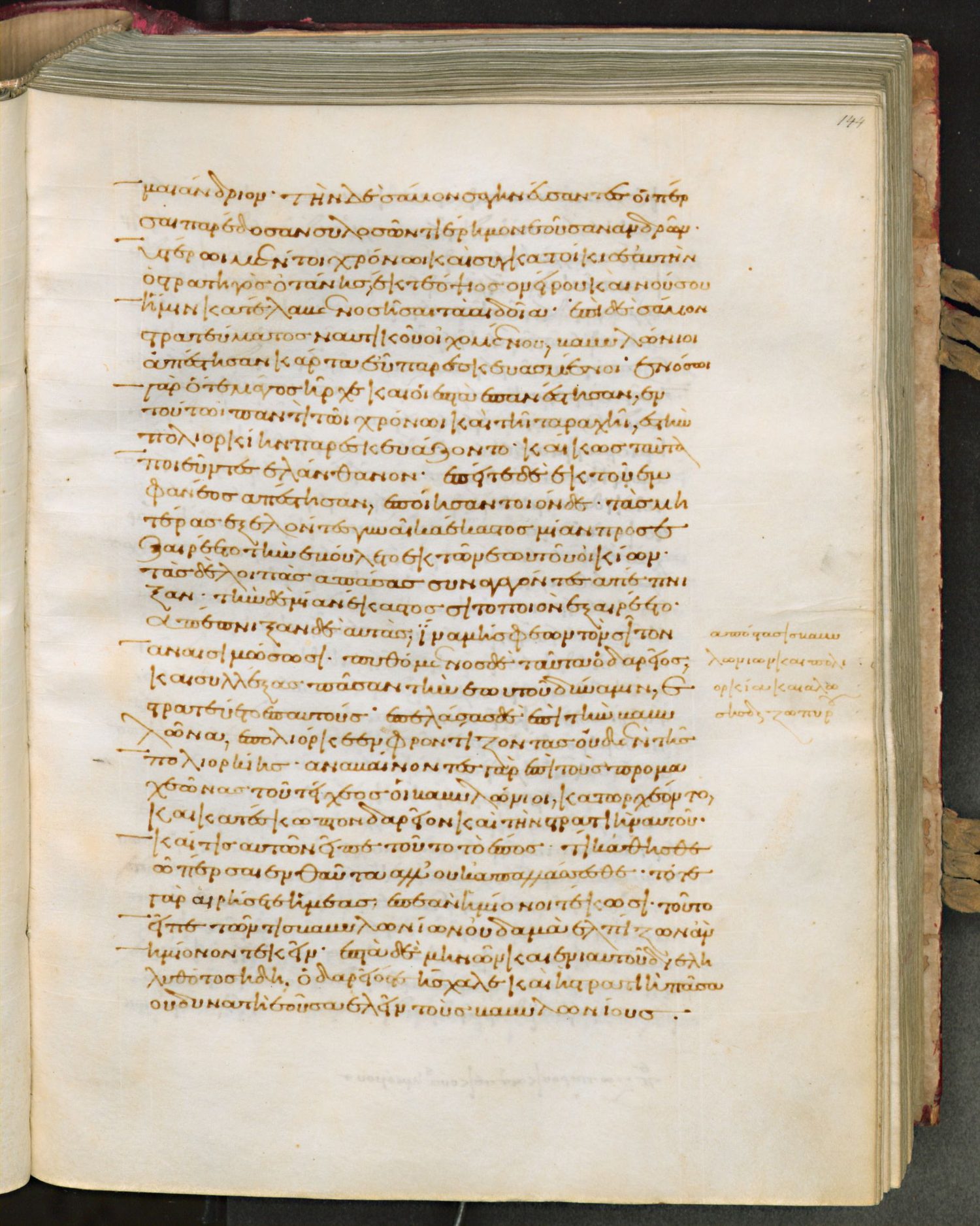
Laur. Plut. 70.3, fol. 144r: Greek here 3.148.2 to 3.149.1. Checked on the image (first and last words read and located in the Greek; each break checked against the neighbouring page): fol. 144r begins ‹Μαιάνδριον.τὴν δὲ Σάμον [σαγηνεύσαντες]› (3.148.2), ends ‹ἐοῦσα ἑλεῖν τοὺς Βαβυλωνίους› (3.152.1). English here: 3.149.1 (Godley's sentences for the sections whose Greek lies mostly on this page).
3.148.2Μαιάνδριον. 3.149.1τὴν δὲ Σάμον [σαγηνεύσαντες] οἱ Πέρσαι παρέδοσαν Συλοσῶντι ἔρημον ἐοῦσαν ἀνδρῶν. ὑστέρῳ μέντοι χρόνῳ καὶ συγκατοίκισε αὐτὴν ὁ στρατηγὸς Ὀτάνης ἔκ τε ὄψιος ὀνείρου καὶ νούσου ἥ μιν κατέλαβε νοσῆσαι τὰ αἰδοῖα.
3.149.1As for Samos, the Persians swept it clear and delivered it over uninhabited to Syloson. But afterwards Otanes, the Persian general, gave his aid to settle the land, being moved thereto by a dream, and a sickness which attacked his secret parts.
Notes
- Greek: the text printed in A. D. Godley's Loeb edition, via Perseus (tlg0016.tlg001.perseus-grc2). Square brackets mark words the editor considers later additions; [...] marks a gap the editor indicates. Perseus note markers are omitted.
- English: A. D. Godley, Herodotus vol. 2 (1921) (Loeb Classical Library), as transcribed on Wikisource. Godley's footnotes are omitted.
- Section numbers in the English were placed by comparing Godley's text with the Perseus version of his translation; where a section begins inside one of Godley's sentences, the English is kept with the page that holds the start of that sentence.
Cite
Sources
- Source: Florence, Laur. Plut. 70.3 (10th c.) via BML Teca Digitale + Greek of Godley's Loeb (Perseus) + English of A. D. Godley (Loeb, Wikisource) (holding institution)
- Critical edition: Greek of A. D. Godley's Loeb edition (1920-1925), via Perseus
← previous · → next · v cycle view · l back to library