Herodotus, Histories 3.30-38: The madness of Cambyses
Introduction
Herodotus of Halicarnassus wrote the Histories in the third quarter of the 5th century BCE, an inquiry into the deeds of Greeks and barbarians and the causes of the wars between them, later divided into nine books. Book 3 tells of Cambyses' conquest of Egypt and his madness, Polycrates of Samos, the rising of the Magi and the seven Persians who overthrew them, the accession of Darius and his provinces, and the revolt and recapture of Babylon.
The photographs are of Florence, Biblioteca Medicea Laurenziana, Plut. 70.3 (parchment, 10th century, 374 folios, 31 lines a page), Herodotus, Histories (codex A of the editors), the oldest surviving manuscript of the complete Histories, from the Teca Digitale of the Biblioteca Medicea Laurenziana. Each section below is the text of one page, or of the part of a page that falls within these chapters. The first and last words of every page were read on the photograph and located in the Greek, and every page break was checked against the next page; the notes quote these words. Readers' notes in the margins are not part of the text and are mentioned where they occur.
The Greek is the text printed in A. D. Godley's Loeb edition (1920-1925), from Perseus; it is the edited text, not a transcription of the manuscript, whose wording differs in places. The English is Godley's translation as printed, from Wikisource. Godley's English carries only chapter numbers; the section numbers shown in it were placed by comparison with the Perseus version of his translation. Each page's English is cut at the end of one of Godley's sentences, so it can begin or end a few lines away from the Greek of the page; each note gives the exact ranges.
This entry covers chapters 3.30-38, on fol. 110v to 113v.
How was this verified? (Provenance)
Where on the image
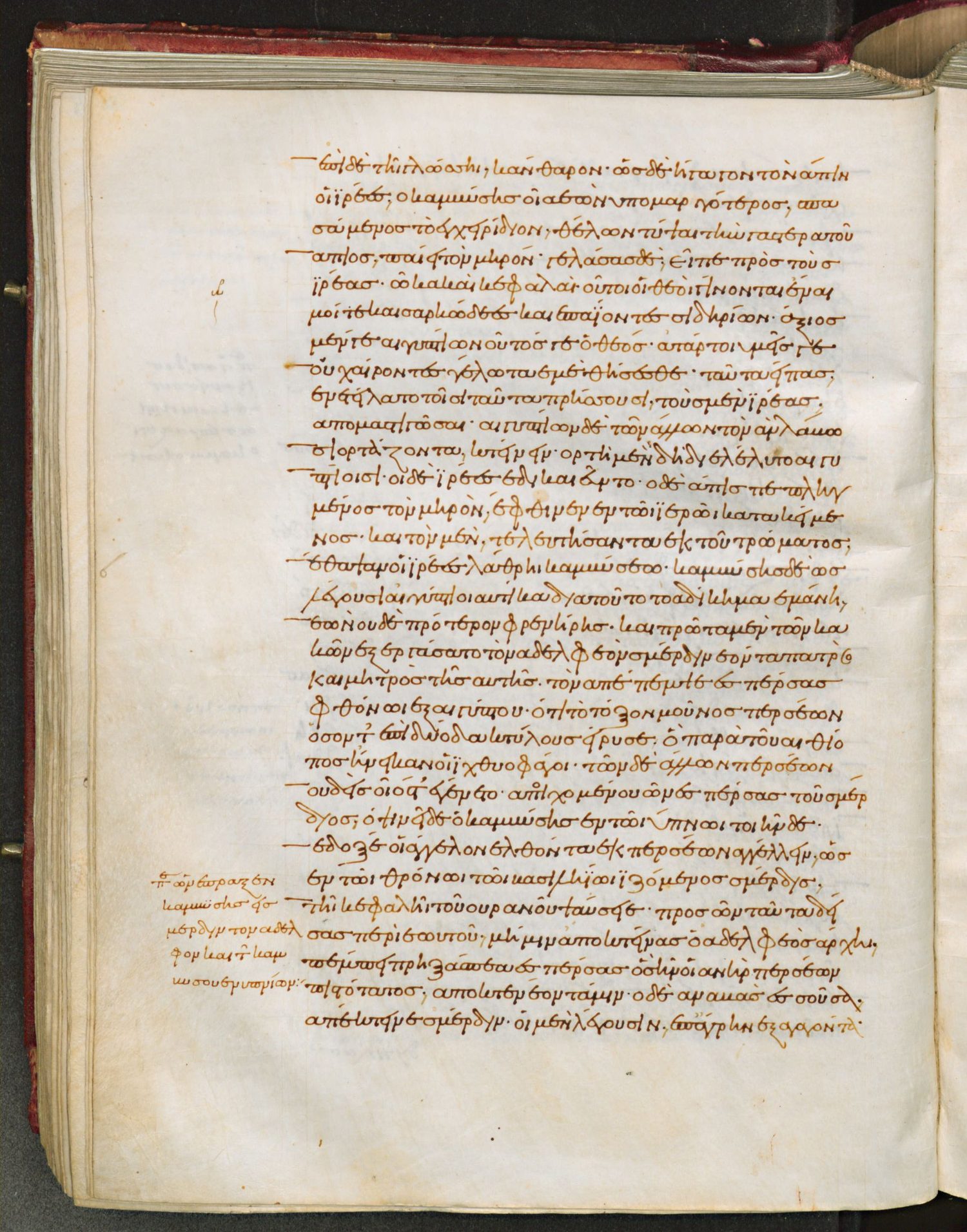
Laur. Plut. 70.3, fol. 110v: Greek here 3.30.1 to 3.30.3. Checked on the image (first and last words read and located in the Greek; each break checked against the neighbouring page): fol. 110v begins ‹ὑπὸ δὲ τῇ γλώσσῃ› (3.28.3), ends ‹λέγουσι ἐπʼ ἄγρην ἐξαγαγόντα› (3.30.3). Fol. 110r ends τὰς τρίχας and fol. 110v begins ἐπὶ δὲ τῇ γλώσσῃ κάνθαρον: the edition has τὰς τρίχας διπλᾶς, ὑπὸ δὲ τῇ γλώσσῃ (3.28.3). English here: 3.30.1 to 3.30.3 (Godley's sentences for the sections whose Greek lies mostly on this page).
3.30.1Καμβύσης δέ, ὡς λέγουσι Αἰγύπτιοι, αὐτίκα διὰ τοῦτο τὸ ἀδίκημα ἐμάνη, ἐὼν οὐδὲ πρότερον φρενήρης. καὶ πρῶτα μὲν τῶν κακῶν ἐξεργάσατο τὸν ἀδελφεὸν Σμέρδιν ἐόντα πατρὸς καὶ μητρὸς τῆς αὐτῆς, τὸν ἀπέπεμψε ἐς Πέρσας φθόνῳ ἐξ Αἰγύπτου, ὅτι τὸ τόξον μοῦνος Περσέων ὅσον τε ἐπὶ δύο δακτύλους εἴρυσε, τὸ παρὰ τοῦ Αἰθίοπος ἤνεικαν οἱ Ἰχθυοφάγοι, τῶν δὲ ἄλλων Περσέων οὐδεὶς οἷός τε ἐγένετο. 3.30.2ἀποιχομένου ὦν ἐς Πέρσας τοῦ Σμέρδιος ὄψιν εἶδε ὁ Καμβύσης ἐν τῷ ὕπνῳ τοιήνδε· ἔδοξέ οἱ ἄγγελον ἐλθόντα ἐκ Περσέων ἀγγέλλειν ὡς ἐν τῷ θρόνῳ τῷ βασιληίῳ ἱζόμενος Σμέρδις τῇ κεφαλῇ τοῦ οὐρανοῦ ψαύσειε. 3.30.3πρὸς ὦν ταῦτα δείσας περὶ ἑωυτοῦ μή μιν ἀποκτείνας ὁ ἀδελφεὸς ἄρχῃ, πέμπει Πρηξάσπεα ἐς Πέρσας, ὃς ἦν οἱ ἀνὴρ Περσέων πιστότατος, ἀποκτενέοντά μιν. ὁ δὲ ἀναβὰς ἐς Σοῦσα ἀπέκτεινε Σμέρδιν, οἳ μὲν λέγουσι ἐπʼ ἄγρην ἐξαγαγόντα,
3.30.1By reason of this wrongful deed, as the Egyptians say, Cambyses’ former want of sense turned straightway to madness. His first evil act was to make away with his full brother Smerdis, whom he had sent away from Egypt to Persia out of jealousy, because Smerdis alone could draw the bow brought from the Ethiopian by the Fish-eaters as far as two fingerbreadths; but no other Persian could draw it. 3.30.2Smerdis having gone to Persia, Cambyses saw in a dream a vision, whereby it seemed to him that a messenger came from Persia and told him that Smerdis had sat on the royal throne with his head reaching to heaven. 3.30.3Fearing therefore for himself, lest his brother might slay him and so be king, he sent to Persia Prexaspes, the trustiest of his Persians, to kill Smerdis. Prexaspes went up to Susa and so did; some say that he took Smerdis out a-hunting, others that he brought him to the Red Sea and there drowned him.
Where on the image
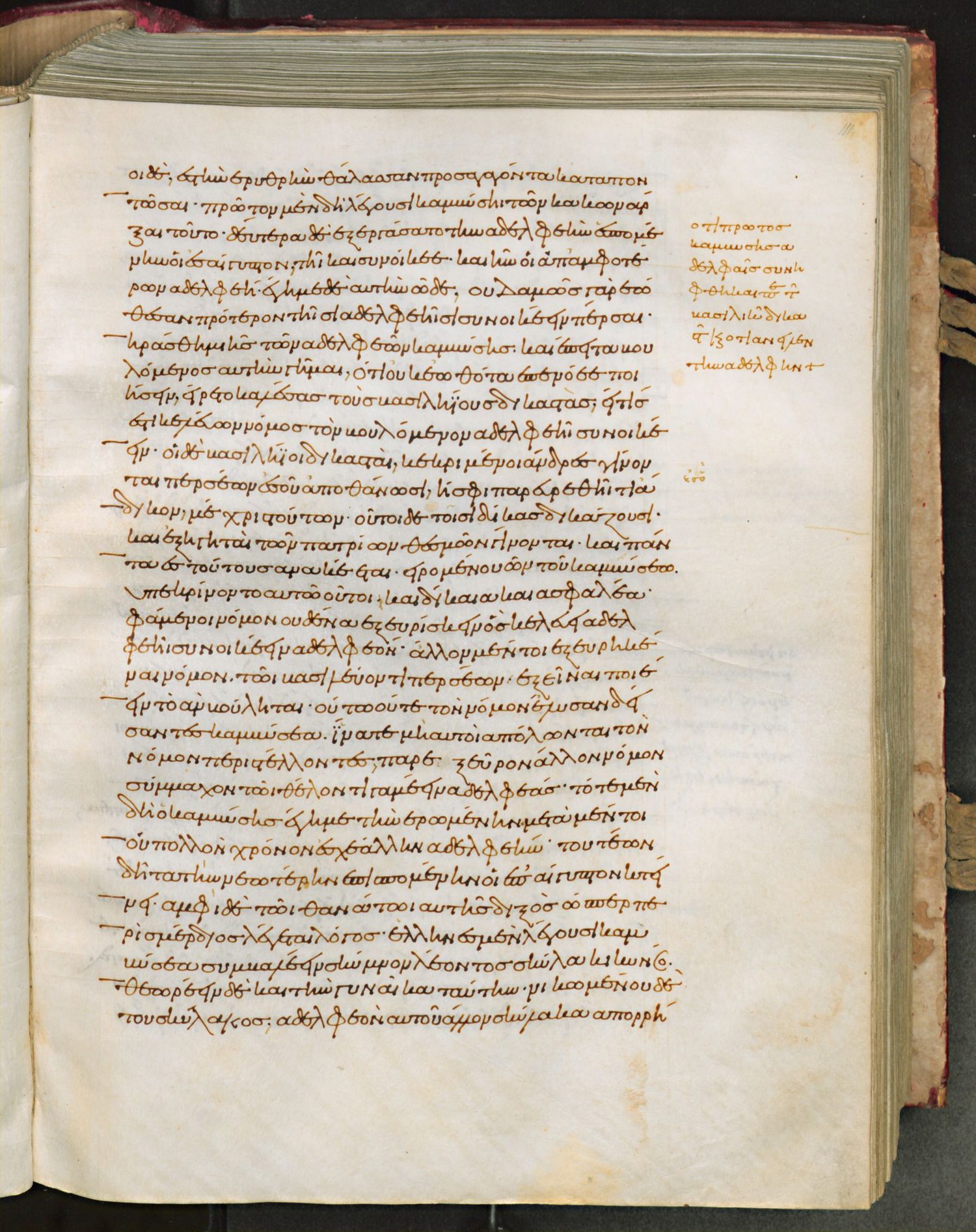
Laur. Plut. 70.3, fol. 111r: Greek here 3.30.3 to 3.32.1. Checked on the image (first and last words read and located in the Greek; each break checked against the neighbouring page): fol. 111r begins ‹οἳ δὲ ἐς τὴν› (3.30.3), ends ‹αὐτοῦ ἄλλον σκύλακα ἀπορρή-› (3.32.1). English here: 3.31.1 to 3.32.1 (Godley's sentences for the sections whose Greek lies mostly on this page).
3.30.3οἳ δὲ ἐς τὴν Ἐρυθρὴν θάλασσαν προαγαγόντα καταποντῶσαι. 3.31.1πρῶτον μὲν δὴ λέγουσι Καμβύσῃ τῶν κακῶν ἄρξαι τοῦτο· δεύτερα δὲ ἐξεργάσατο τὴν ἀδελφεὴν ἑσπομένην οἱ ἐς Αἴγυπτον, τῇ καὶ συνοίκεε καὶ ἦν οἱ ἀπʼ ἀμφοτέρων ἀδελφεή. 3.31.2ἔγημε δὲ αὐτὴν ὧδε· οὐδαμῶς γὰρ ἐώθεσαν πρότερον τῇσι ἀδελφεῇσι συνοικέειν Πέρσαι. ἠράσθη μιῆς τῶν ἀδελφεῶν Καμβύσης, καὶ ἔπειτα βουλόμενος αὐτὴν γῆμαι, ὅτι οὐκ ἐωθότα ἐπενόεε ποιήσειν, εἴρετο καλέσας τοὺς βασιληίους δικαστὰς εἴ τις ἐστὶ κελεύων νόμος τὸν βουλόμενον ἀδελφεῇ συνοικέειν. 3.31.3οἱ δὲ βασιλήιοι δικασταὶ κεκριμένοι ἄνδρες γίνονται Περσέων, ἐς οὗ ἀποθάνωσι ἤ σφι παρευρεθῇ τι ἄδικον, μέχρι τούτου· οὗτοι δὲ τοῖσι πέρσῃσι δίκας δικάζουσι καὶ ἐξηγηταὶ τῶν πατρίων θεσμῶν γίνονται, καὶ πάντα ἐς τούτους ἀνακέεται. 3.31.4εἰρομένου ὦν τοῦ Καμβύσεω, ὑπεκρίνοντο αὐτῷ οὗτοι καὶ δίκαια καὶ ἀσφαλέα, φάμενοι νόμον οὐδένα ἐξευρίσκειν ὃς κελεύει ἀδελφεῇ συνοικέειν ἀδελφεόν, ἄλλον μέντοι ἐξευρηκέναι νόμον, τῷ βασιλεύοντι Περσέων ἐξεῖναι ποιέειν τὸ ἂν βούληται. 3.31.5οὕτω οὔτε τὸν νόμον ἔλυσαν δείσαντες Καμβύσεα, ἵνα τε μὴ αὐτοὶ ἀπόλωνται τὸν νόμον περιστέλλοντες, παρεξεῦρον ἄλλον νόμον σύμμαχον τῷ θέλοντι γαμέειν ἀδελφεάς. 3.31.6τότε μὲν δὴ ὁ Καμβύσης ἔγημε τὴν ἐρωμένην, μετὰ μέντοι οὐ πολλὸν χρόνον ἔσχε ἄλλην ἀδελφεήν. τουτέων δῆτα τὴν νεωτέρην ἐπισπομένην οἱ ἐπʼ Αἴγυπτον κτείνει. 3.32.1ἀμφὶ δὲ τῷ θανάτῳ αὐτῆς διξὸς ὥσπερ περὶ Σμέρδιος λέγεται λόγος. Ἕλληνες μὲν λέγουσι Καμβύσεα συμβαλεῖν σκύμνον λέοντος σκύλακι κυνός, θεωρέειν δὲ καὶ τὴν γυναῖκα ταύτην, νικωμένου δὲ τοῦ σκύλακος ἀδελφεὸν αὐτοῦ ἄλλον σκύλακα ἀπορρήξαντα
3.31.1This, they say, was the first of Cambyses’ evil acts; next, he made away with his full sister, who had come with him to Egypt, and whom he had taken to wife. 3.31.2He married her on this wise (for before this, it had by no means been customary for Persians to marry their sisters): Cambyses was enamoured of one of his sisters and presently desired to take her to wife; but his intention being contrary to usage, he summoned the royal judges and inquired whether there were any law suffering one, that so desired, to marry his sister. 3.31.3These royal judges are men chosen out from the Persians to be so till they die or are detected in some injustice; it is they who decide suits in Persia and interpret the laws of the land; all matters are referred to them. 3.31.4These then replied to Cambyses with an answer which was both just and safe, namely, that they could find no law giving a brother power to marry his sister; but that they had also found a law whereby the King of Persia might do whatsoever he wished. 3.31.5Thus they broke not the law for fear of Cambyses, and, to save themselves from death for maintaining it, they found another law to justify one that desired wedlock with sisters. 3.31.6So for the nonce Cambyses married her of whom he was enamoured; yet presently he took another sister to wife. It was the younger of these who had come with him to Egypt, and whom he now killed. 3.32.1There are two tales of her death, as of the death of Smerdis. The Greeks say that Cambyses had set a puppy to fight a lion’s cub, with this woman too looking on; and the puppy being worsted, another puppy, its brother, broke its leash and came to help, whereby the two dogs together got the better of the cub.
Where on the image
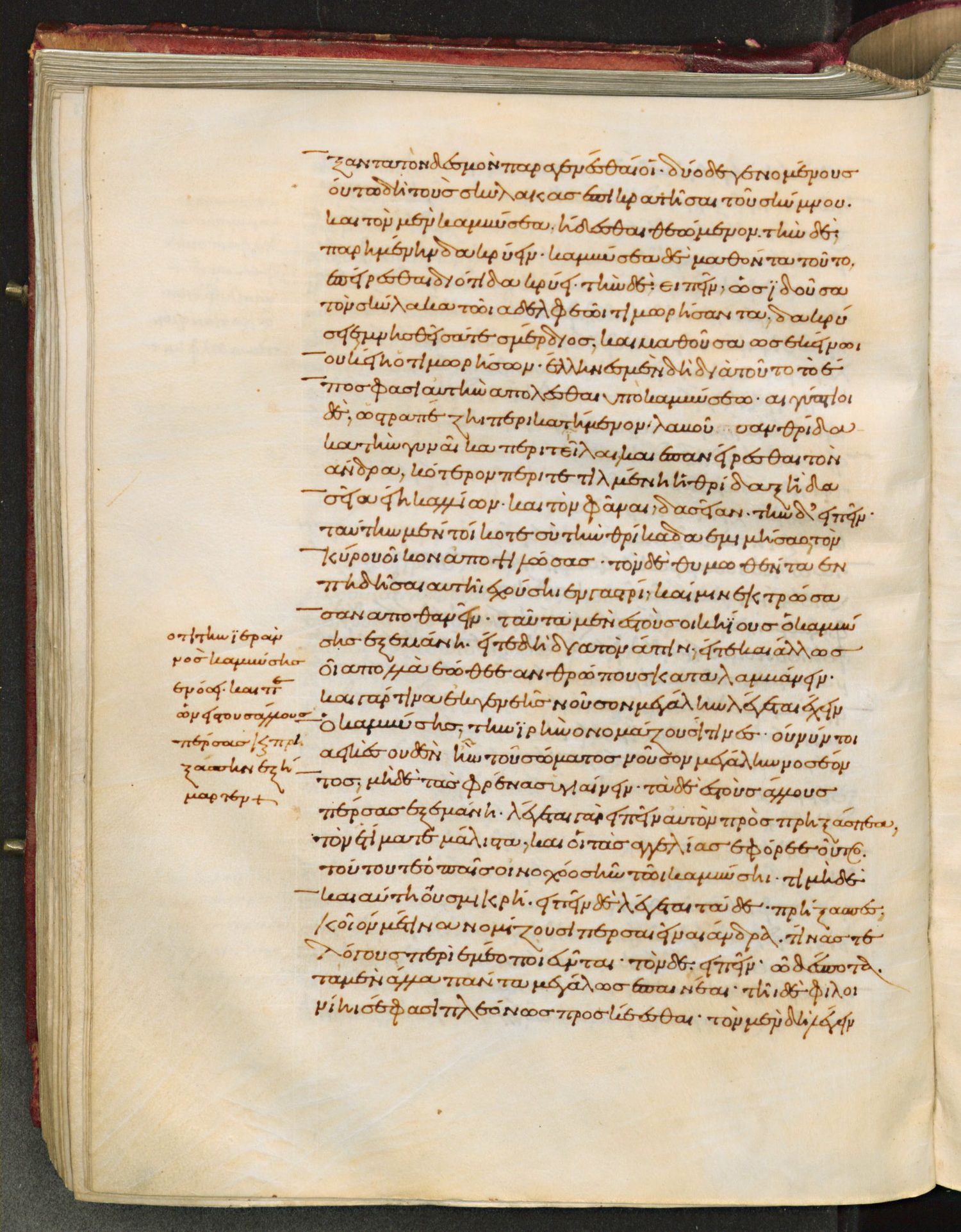
Laur. Plut. 70.3, fol. 111v: Greek here 3.32.1 to 3.34.3. Checked on the image (first and last words read and located in the Greek; each break checked against the neighbouring page): fol. 111v begins ‹-ξαντα τὸν δεσμὸν παραγενέσθαι› (3.32.1), ends ‹προσκεῖσθαι.τὸν μὲν δὴ λέγειν› (3.34.3). The word ‹ἀπορρήξαντα› is divided between fol. 111r and fol. 111v; it is given with fol. 111r. English here: 3.32.2 to 3.34.2 (Godley's sentences for the sections whose Greek lies mostly on this page).
3.32.1τὸν δεσμὸν παραγενέσθαι οἱ, δύο δὲ γενομένους οὕτω δὴ τοὺς σκύλακας ἐπικρατῆσαι τοῦ σκύμνου. 3.32.2καὶ τὸν μὲν Καμβύσεα ἥδεσθαι θεώμενον, τὴν δὲ παρημένην δακρύειν. Καμβύσεα δὲ μαθόντα τοῦτο ἐπειρέσθαι διʼ ὅ τι δακρύει, τὴν δὲ εἰπεῖν ὡς ἰδοῦσα τὸν σκύλακα τῷ ἀδελφεῷ τιμωρήσαντα δακρύσειε, μνησθεῖσά τε Σμέρδιος καὶ μαθοῦσα ὡς ἐκείνῳ οὐκ εἴη ὁ τιμωρήσων. 3.32.3Ἕλληνες μὲν δὴ διὰ τοῦτο τὸ ἔπος φασὶ αὐτὴν ἀπολέσθαι ὑπὸ Καμβύσεω, Αἰγύπτιοι δὲ ὡς τραπέζῃ παρακατημένων λαβοῦσαν θρίδακα τὴν γυναῖκα περιτῖλαι καὶ ἐπανειρέσθαι τὸν ἄνδρα κότερον περιτετιλμένη ἡ θρίδαξ ἢ δασέα εἴη καλλίων, καὶ τὸν φάναι δασέαν, τὴν δʼ εἰπεῖν 3.32.4ταύτην μέντοι κοτὲ σὺ τὴν θρίδακα ἐμιμήσαο τὸν Κύρου οἶκον ἀποψιλώσας. τὸν δὲ θυμωθέντα ἐμπηδῆσαι αὐτῇ ἐχούσῃ ἐν γαστρί, καί μιν ἐκτρώσασαν ἀποθανεῖν. 3.33.1ταῦτα μὲν ἐς τοὺς οἰκηίους ὁ Καμβύσης ἐξεμάνη, εἴτε δὴ διὰ τὸν Ἆπιν εἴτε καὶ ἄλλως, οἷα πολλὰ ἔωθε ἀνθρώπους κακὰ καταλαμβάνειν· καὶ γὰρ τινὰ ἐκ γενεῆς νοῦσον μεγάλην λέγεται ἔχειν ὁ Καμβύσης, τὴν ἱρὴν ὀνομάζουσι τινές. οὔ νύν τοι ἀεικὲς οὐδὲν ἦν τοῦ σώματος νοῦσον μεγάλην νοσέοντος μηδὲ τὰς φρένας ὑγιαίνειν. 3.34.1τάδε δʼ ἐς τοὺς ἄλλους Πέρσας ἐξεμάνη. λέγεται γὰρ εἰπεῖν αὐτὸν πρὸς Πρηξάσπεα, τὸν ἐτίμα τε μάλιστα καί οἱ τὰς ἀγγελίας ἐφόρεε οὗτος, τούτου τε ὁ παῖς οἰνοχόος ἦν τῷ Καμβύσῃ, τιμὴ δὲ καὶ αὕτη οὐ σμικρή· εἰπεῖν δὲ λέγεται τάδε. 3.34.2Πρήξασπες, κοῖόν με τινὰ νομίζουσι Πέρσαι εἶναι ἄνδρα τίνας τε λόγους περὶ ἐμέο ποιεῦνται; τὸν δὲ εἰπεῖν ὦ δέσποτα, τὰ μὲν ἄλλα πάντα μεγάλως ἐπαινέαι, τῇ δὲ φιλοινίῃ σε φασὶ πλεόνως προσκεῖσθαι. 3.34.3τὸν μὲν δὴ λέγειν
3.32.2Cambyses, they say, was pleased with the sight, but the woman wept as she sat by. Cambyses perceived it and asking why she wept, she said she had wept when she saw the puppy help its brother, for thinking of Smerdis and how there was none to avenge him. 3.32.3For saying this, according to the Greek story, Cambyses put her to death. But the Egyptian tale is that as the two sat at table the woman took a lettuce and plucked off the leaves, then asked her husband whether he liked the look of it, with or without leaves; “With the leaves,” said he; whereupon she answered: “ 3.32.4Yet you have stripped Cyrus’ house as bare as this lettuce.” Angered at this, they say, he leaped upon her, she being great with child; and she miscarried and died of the hurt he gave her. 3.33.1Such were Cambyses’ mad acts to his own household, whether they were done because of Apis or grew from some of the many troubles that are wont to beset men; for indeed he is said to have been afflicted from his birth with that grievous disease which some call “sacred.” It is no unlikely thing then that when his body was grievously afflicted his mind too should be diseased. 3.34.1I will now tell of his mad dealings with the rest of Persia. He said, as they report, to Prexaspes—whom he held in especial honour, who brought him all his messages, whose son held the very honourable office of Cambyses’ cup-bearer—thus, I say, he spoke to Prexaspes: “ 3.34.2What manner of man, Prexaspes, do the Persians think me to be, and how speak they of me?” “Sire,” said Prexaspes, “for all else they greatly praise you; but they say that you love wine too well.”
Where on the image
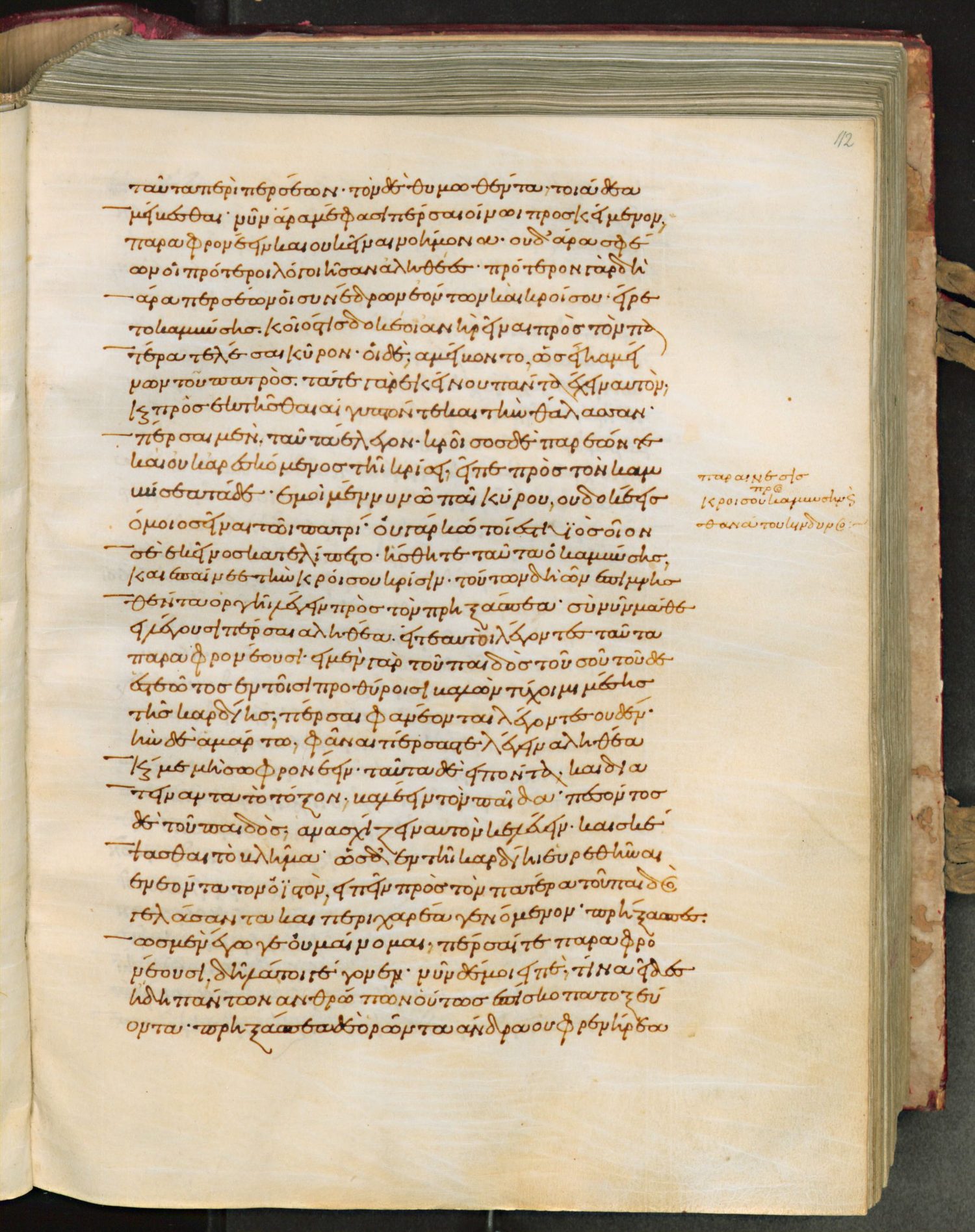
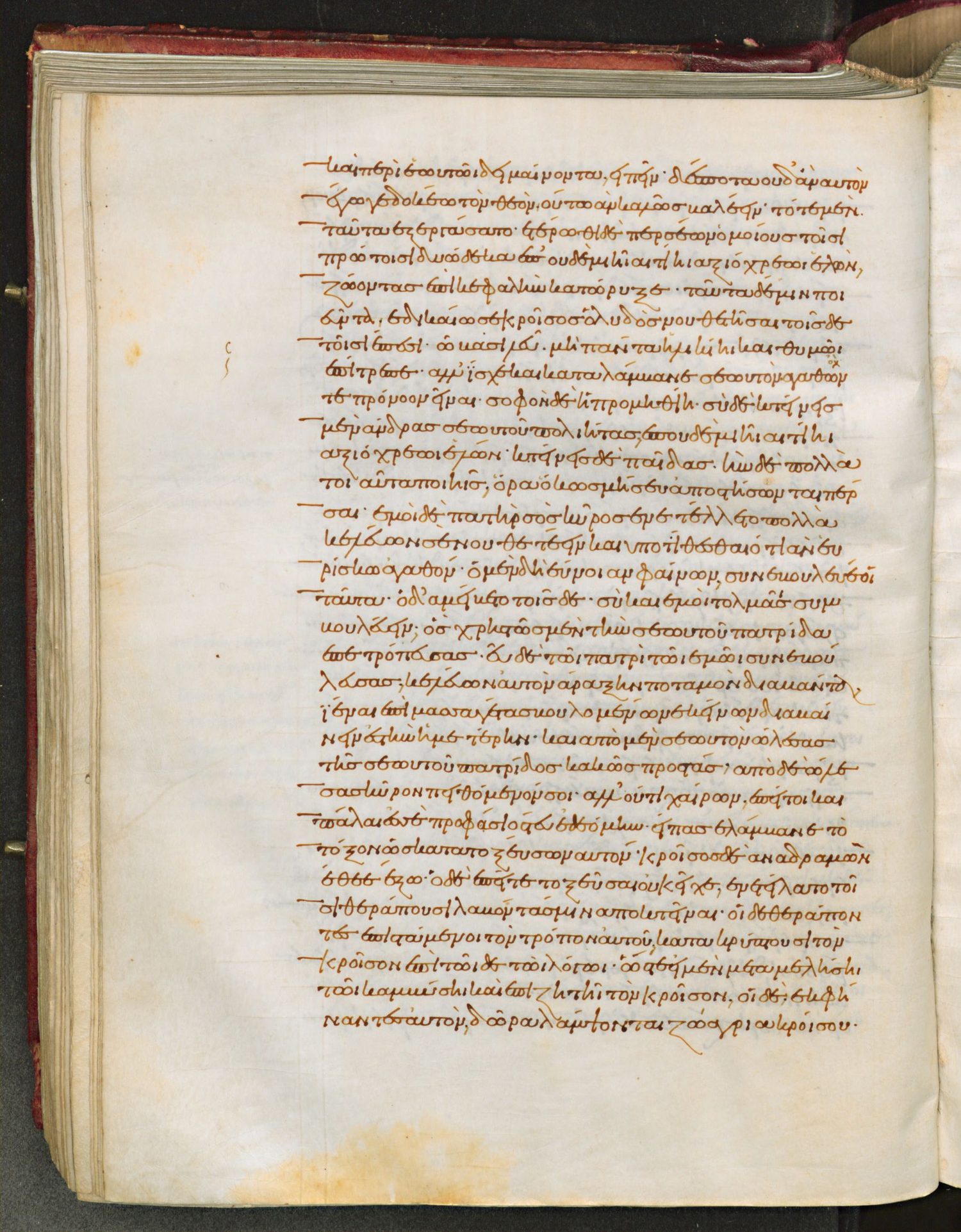
Laur. Plut. 70.3, fol. 112r: Greek here 3.34.3 to 3.35.4. Checked on the image (first and last words read and located in the Greek; each break checked against the neighbouring page): fol. 112r begins ‹ταῦτα περὶ Περσέων, τὸν› (3.34.3), ends ‹ὁρῶντα ἄνδρα οὐ φρενήρεα› (3.35.4). English here: 3.34.3 to 3.35.4 (Godley's sentences for the sections whose Greek lies mostly on this page).
3.34.3ταῦτα περὶ Περσέων, τὸν δὲ θυμωθέντα τοιάδε ἀμείβεσθαι. νῦν ἄρα με φασὶ Πέρσαι οἴνῳ προσκείμενον παραφρονέειν καὶ οὐκ εἶναι νοήμονα· οὐδʼ ἄρα σφέων οἱ πρότεροι λόγοι ἦσαν ἀληθέες. 3.34.4πρότερον γὰρ δὴ ἄρα, Περσέων οἱ συνέδρων ἐόντων καὶ Κροίσου, εἴρετο Καμβύσης κοῖός τις δοκέοι ἀνὴρ εἶναι πρὸς τὸν πατέρα τελέσαι Κῦρον, οἳ δὲ ἀμείβοντο ὡς εἴη ἀμείνων τοῦ πατρός· τά τε γὰρ ἐκείνου πάντα ἔχειν αὐτὸν καὶ προσεκτῆσθαι Αἴγυπτόν τε καὶ τὴν θάλασσαν. 3.34.5Πέρσαι μὲν ταῦτα ἔλεγον, Κροῖσος δὲ παρεών τε καὶ οὐκ ἀρεσκόμενος τῇ κρίσι εἶπε πρὸς τὸν Καμβύσεα τάδε. ἐμοὶ μέν νυν, ὦ παῖ Κύρου, οὐ δοκέεις ὅμοιος εἶναι τῷ πατρί· οὐ γάρ κώ τοι ἐστὶ υἱὸς οἷον σε ἐκεῖνος κατελίπετο. ἥσθη τε ταῦτα ἀκούσας ὁ Καμβύσης καὶ ἐπαίνεε τὴν Κροίσου κρίσιν. 3.35.1τούτων δὴ ὦν ἐπιμνησθέντα ὀργῇ λέγειν πρὸς τὸν Πρηξάσπεα σύ νυν μάθε εἰ λέγουσι Πέρσαι ἀληθέα εἴτε αὐτοὶ λέγοντες ταῦτα παραφρονέουσι· 3.35.2εἰ μὲν γὰρ τοῦ παιδὸς τοῦ σοῦ τοῦδε ἑστεῶτος ἐν τοῖσι προθύροισι βαλὼν τύχοιμι μέσης τῆς καρδίης, Πέρσαι φανέονται λέγοντες οὐδέν· ἢν δὲ ἁμάρτω, φάναι Πέρσας τε λέγειν ἀληθέα καί με μὴ σωφρονέειν. 3.35.3ταῦτα δὲ εἰπόντα καὶ διατείναντα τὸ τόξον βαλεῖν τὸν παῖδα, πεσόντος δὲ τοῦ παιδὸς ἀνασχίζειν αὐτὸν κελεύειν καὶ σκέψασθαι τὸ βλῆμα· ὡς δὲ ἐν τῇ καρδίῃ εὑρεθῆναι ἐνεόντα τὸν ὀιστόν, εἰπεῖν πρὸς τὸν πατέρα τοῦ παιδὸς γελάσαντα καὶ περιχαρέα γενόμενον 3.35.4Πρήξασπες, ὡς μὲν ἐγὼ τε οὐ μαίνομαι Πέρσαι τε παραφρονέουσι, δῆλά τοι γέγονε. νῦν δέ μοι εἰπέ, τίνα εἶδες ἤδη πάντων ἀνθρώπων οὕτω ἐπίσκοπα τοξεύοντα; Πρηξάσπεα δὲ ὁρῶντα ἄνδρα οὐ φρενήρεα
3.34.3So he reported of the Persians; the king angrily replied: “If the Persians now say that ’tis my fondness for wine that drives me to frenzy and madness, then it would seem that their former saying also was a lie.” 3.34.4For it is said that ere this, certain Persians and Croesus sitting with him, Cambyses asked what manner of man they thought him to be in comparison with Cyrus his father; and they answered, “that Cambyses was the better man; for he had all of Cyrus’ possessions and had won besides Egypt and the sea.” 3.34.5So said the Persians; but Croesus, who was present, and was ill-satisfied with their judgment, thus spoke to Cambyses: “To my thinking, son of Cyrus, you are not like your father; for you have as yet no son such as he left after him in you.” This pleased Cambyses, and he praised Croesus’ judgment. 3.35.1Remembering this, then, he said to Prexaspes in his anger: “Judge you then if the Persians speak truth, or rather are themselves out of their minds when they so speak of me. 3.35.2Yonder stands your son in the porch; now if I shoot and pierce his heart, that will prove the Persians to be wrong; if I miss, then say that they are right and I out of my senses.” 3.35.3So saying, he strung his bow and hit the boy, and bade open the fallen body and examine the wound: and the arrow being found in the heart, Cambyses laughed in great glee and said to the boy’s father: “ 3.35.4It is plain, Prexaspes, that I am in my right mind and the Persians mad; now tell me: what man in the world saw you ever that shot so true to the mark?” Prexaspes, it is said, replied (for he saw that Cambyses was mad, and he feared for his own life), “Master, I think that not even the god himself could shoot so true.”
Where on the image
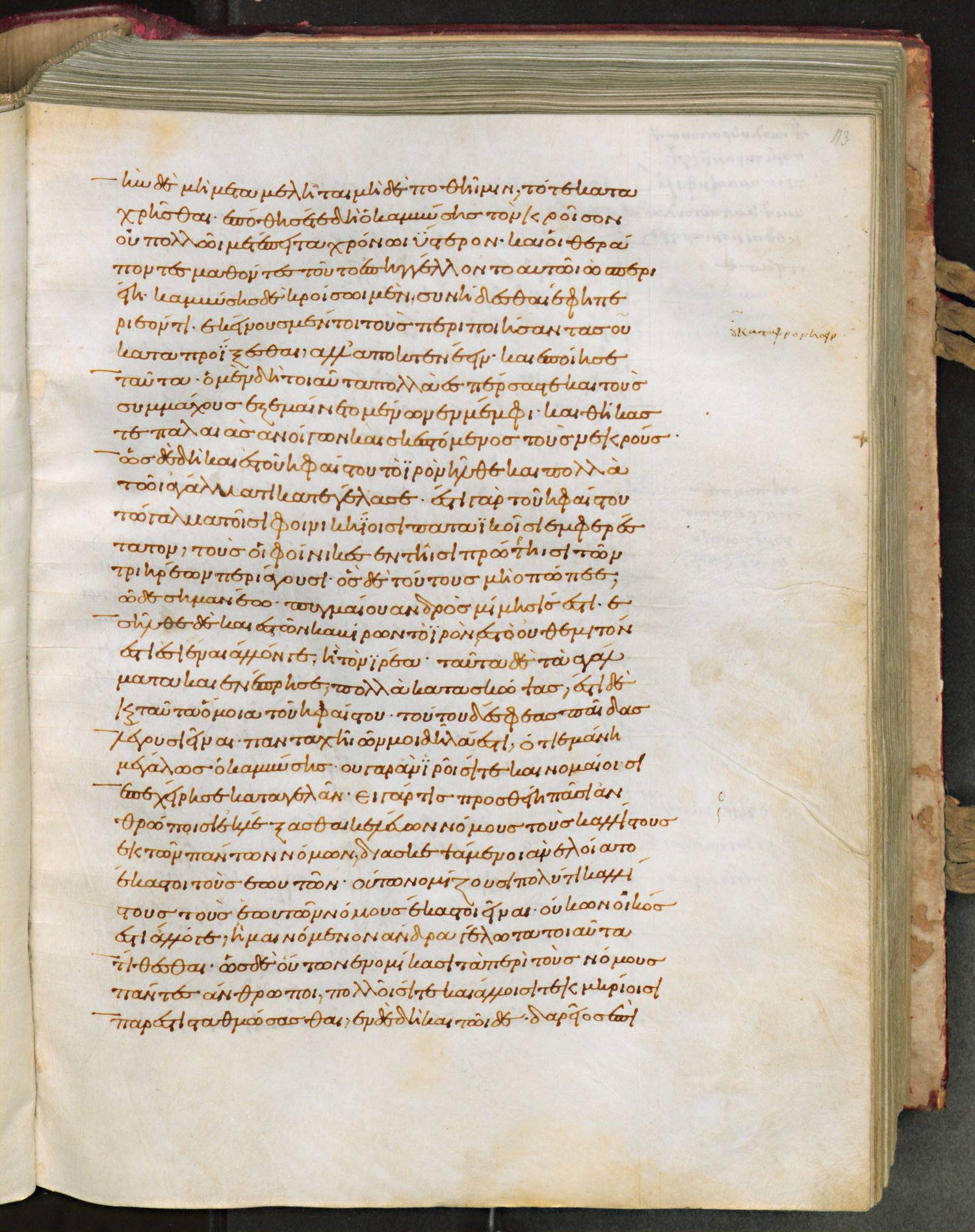
Laur. Plut. 70.3, fol. 112v: Greek here 3.35.4 to 3.36.5. Checked on the image (first and last words read and located in the Greek; each break checked against the neighbouring page): fol. 112v begins ‹καὶ περὶ ἑωυτῷ δειμαίνοντα› (3.35.4), ends ‹δῶρα λάμψονται ζωάγρια Κροίσου› (3.36.5). English here: 3.35.5 to 3.36.5 (Godley's sentences for the sections whose Greek lies mostly on this page).
3.35.4καὶ περὶ ἑωυτῷ δειμαίνοντα εἰπεῖν δέσποτα, οὐδʼ ἂν αὐτὸν ἔγωγε δοκέω τὸν θεὸν οὕτω ἂν καλῶς βαλεῖν. 3.35.5τότε μὲν ταῦτα ἐξεργάσατο, ἑτέρωθι δὲ Περσέων ὁμοίους τοῖσι πρώτοισι δυώδεκα ἐπʼ οὐδεμιῇ αἰτίῃ ἀξιοχρέῳ ἑλὼν ζώοντας ἐπὶ κεφαλὴν κατώρυξε. 3.36.1ταῦτα δέ μιν ποιεῦντα ἐδικαίωσε Κροῖσος ὁ Λυδὸς νουθετῆσαι τοῖσιδε τοῖσι ἔπεσι. ὦ βασιλεῦ, μὴ πάντα ἡλικίῃ καὶ θυμῷ ἐπίτραπε, ἀλλʼ ἴσχε καὶ καταλάμβανε σεωυτόν· ἀγαθόν τι πρόνοον εἶναι, σοφὸν δὲ ἡ προμηθίη. σὺ δὲ κτείνεις μὲν ἄνδρας σεωυτοῦ πολιήτας ἐπʼ οὐδεμιῇ αἰτίῃ ἀξιοχρέῳ ἑλών, κτείνεις δὲ παῖδας. 3.36.2ἢν δὲ πολλὰ τοιαῦτα ποιέῃς, ὅρα ὅκως μή σευ ἀποστήσονται Πέρσαι. ἐμοὶ δὲ πατὴρ σὸς Κῦρος ἐνετέλλετο πολλὰ κελεύων σε νουθετέειν καὶ ὑποτίθεσθαι ὅ τι ἂν εὑρίσκω ἀγαθόν. ὃ μὲν δὴ εὐνοίην φαίνων συνεβούλευέ οἱ ταῦτα· ὃ δʼ ἀμείβετο τοῖσιδε. 3.36.3σὺ καὶ ἐμοὶ τολμᾷς συμβουλεύειν, ὃς χρηστῶς μὲν τὴν σεωυτοῦ πατρίδα ἐπετρόπευσας, εὖ δὲ τῷ πατρὶ τῷ ἐμῷ συνεβούλευσας, κελεύων αὐτὸν Ἀράξεα ποταμὸν διαβάντα ἰέναι ἐπὶ Μασσαγέτας, βουλομένων ἐκείνων διαβαίνειν ἐς τὴν ἡμετέρην, καὶ ἀπὸ μὲν σεωυτὸν ὤλεσας τῆς σεωυτοῦ πατρίδος κακῶς προστάς, ἀπὸ δὲ ὤλεσας Κῦρον πειθόμενον σοί, ἀλλʼ οὔτι χαίρων, ἐπεί τοι καὶ πάλαι ἐς σὲ προφάσιός τευ ἐδεόμην ἐπιλαβέσθαι. 3.36.4ταῦτα δὲ εἴπας ἐλάμβανε τὸ τόξον ὡς κατατοξεύσων αὐτόν, Κροῖσος δὲ ἀναδραμὼν ἔθεε ἔξω. ὁ δὲ ἐπείτε τοξεῦσαι οὐκ εἶχε, ἐνετείλατο τοῖσι θεράπουσι λαβόντας μιν ἀποκτεῖναι. 3.36.5οἱ δὲ θεράποντες ἐπιστάμενοι τὸν τρόπον αὐτοῦ κατακρύπτουσι τὸν Κροῖσον ἐπὶ τῷδε τῷ λόγῳ ὥστε, εἰ μὲν μεταμελήσῃ τῷ Καμβύσῃ καὶ ἐπιζητέῃ τὸν Κροῖσον, οἳ δὲ ἐκφήναντες αὐτὸν δῶρα λάμψονται ζωάγρια Κροίσου,
3.35.5Thus did Cambyses then; at another time he took twelve Persians, equal to the noblest in the land, proved them guilty of some petty offence, and buried them alive up to the neck. 3.36.1For these acts Croesus the Lydian thought fit to take him to task, and thus addressed him: “Sire, do not ever let youth and passion have their way; put some curb and check on yourself; prudence is a good thing, forethought is wisdom. But what of you? you put to death men of your own country proved guilty of but a petty offence; ay, and you kill boys. 3.36.2If you do often so, look to it lest the Persians revolt from you. As for me, your father Cyrus earnestly bade me counsel you and give you such advice as I think to be good.” Croesus gave him this counsel out of goodwill; but Cambyses answered: “ 3.36.3It is very well that you should dare to counsel me too; you, who governed your own country right usefully, and gave fine advice to my father—bidding him, when the Massagetae were willing to cross over into our lands, to pass the Araxes and attack them; thus you wrought your own ruin by misgoverning your country, and Cyrus’s by overpersuading him. Nay, but you shall rue it; long have I waited for an occasion to deal with you.” 3.36.4With that Cambyses took his bow to shoot him dead; but Croesus leapt up and ran out; and Cambyses, being unable to shoot him, charged his attendants to take and kill him. 3.36.5They, knowing Cambyses’ mood, hid Croesus; being minded, if Cambyses should repent and seek for Croesus, to reveal him and receive gifts for saving his life; but if he should not repent nor wish Croesus back, then to kill the Lydian.
Where on the image
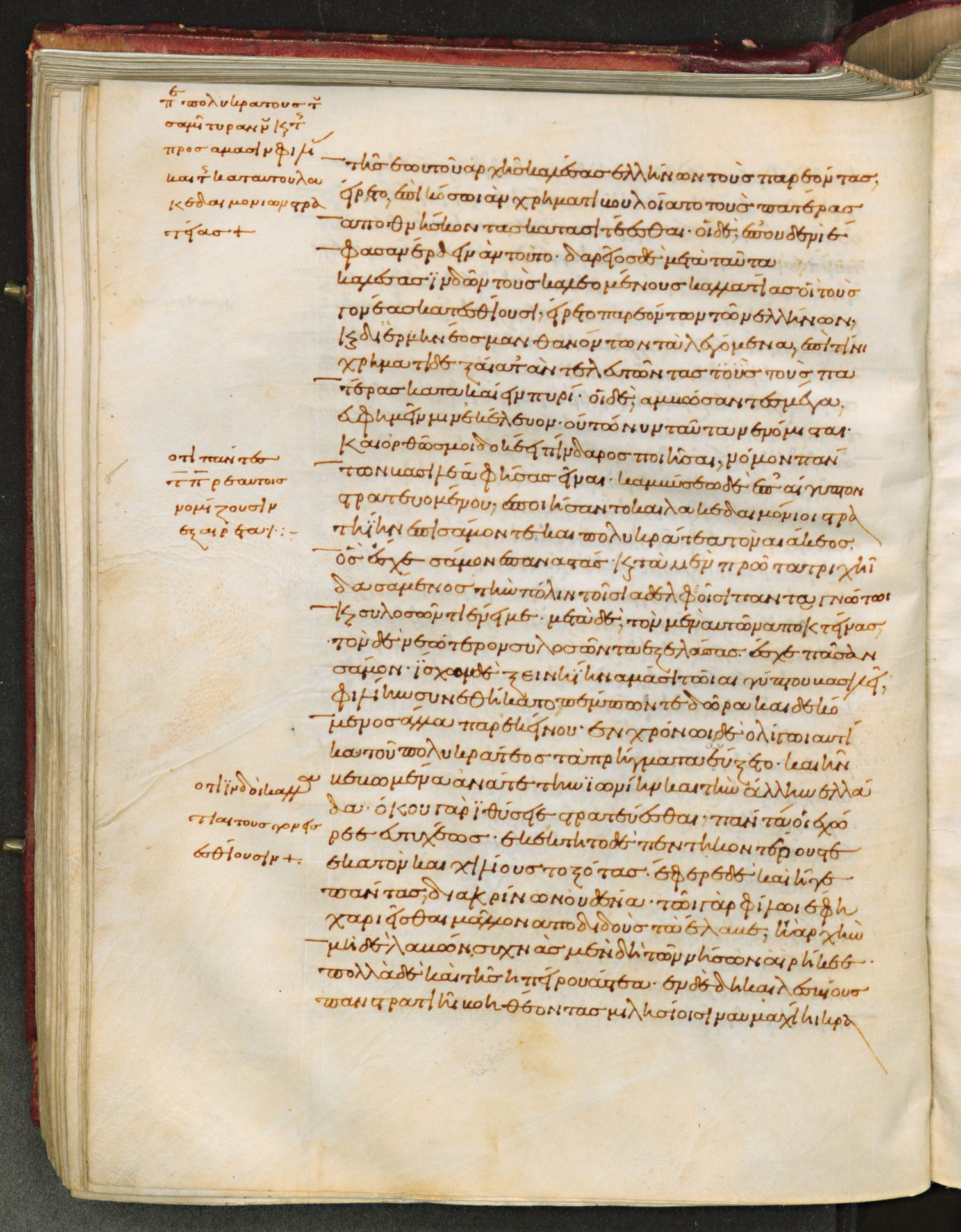
Laur. Plut. 70.3, fol. 113r: Greek here 3.36.5 to 3.38.3. Checked on the image (first and last words read and located in the Greek; each break checked against the neighbouring page): fol. 113r begins ‹ἢν δὲ μὴ μεταμέληται› (3.36.5), ends ‹δὴ καὶ τῷδε.Δαρεῖος ἐπὶ› (3.38.3). English here: 3.36.6 to 3.38.3 (Godley's sentences for the sections whose Greek lies mostly on this page).
3.36.5ἢν δὲ μὴ μεταμέληται μηδὲ ποθέῃ μιν, τότε καταχρᾶσθαι. 3.36.6ἐπόθησέ τε δὴ ὁ Καμβύσης τὸν Κροῖσον οὐ πολλῷ μετέπειτα χρόνῳ ὕστερον, καὶ οἱ θεράποντες μαθόντες τοῦτο ἐπηγγέλλοντο αὐτῷ ὡς περιείη. Καμβύσης δὲ Κροίσῳ μὲν συνήδεσθαι ἔφη περιεόντι, ἐκείνους μέντοι τοὺς περιποιήσαντας οὐ καταπροΐξεσθαι ἀλλʼ ἀποκτενέειν· καὶ ἐποίησε ταῦτα. 3.37.1ὃ μὲν δὴ τοιαῦτα πολλὰ ἐς Πέρσας τε καὶ τοὺς συμμάχους ἐξεμαίνετο, μένων ἐν Μέμφι καὶ θήκας τε παλαιὰς ἀνοίγων καὶ σκεπτόμενος τοὺς νεκρούς. 3.37.2ὣς δὲ δὴ καὶ ἐς τοῦ Ἡφαίστου τὸ ἱρὸν ἦλθε καὶ πολλὰ τῷ ἀγάλματι κατεγέλασε. ἔστι γὰρ τοῦ Ἡφαίστου τὤγαλμα τοῖσι Φοινικηίοισι Παταΐκοισι ἐμφερέστατον, τοὺς οἱ Φοίνικες ἐν τῇσι πρῴρῃσι τῶν τριηρέων περιάγουσι. ὃς δὲ τούτους μὴ ὄπωπε, ὧδε σημανέω· πυγμαίου ἀνδρὸς μίμησις ἐστί. 3.37.3ἐσῆλθε δὲ καὶ ἐς τῶν Καβείρων τὸ ἱρόν, ἐς τὸ οὐ θεμιτόν ἐστι ἐσιέναι ἄλλον γε ἢ τὸν ἱρέα· ταῦτα δὲ τὰ ἀγάλματα καὶ ἐνέπρησε πολλὰ κατασκώψας. ἔστι δὲ καὶ ταῦτα ὅμοια τοῖσι τοῦ Ἡφαίστου· τούτου δὲ σφέας παῖδας λέγουσι εἶναι. 3.38.1πανταχῇ ὦν μοι δῆλα ἐστὶ ὅτι ἐμάνη μεγάλως ὁ Καμβύσης· οὐ γὰρ ἂν ἱροῖσί τε καὶ νομαίοισι ἐπεχείρησε καταγελᾶν. εἰ γάρ τις προθείη πᾶσι ἀνθρώποισι ἐκλέξασθαι κελεύων νόμους τοὺς καλλίστους ἐκ τῶν πάντων νόμων, διασκεψάμενοι ἂν ἑλοίατο ἕκαστοι τοὺς ἑωυτῶν· οὕτω νομίζουσι πολλόν τι καλλίστους τοὺς ἑωυτῶν νόμους ἕκαστοι εἶναι. 3.38.2οὔκων οἰκός ἐστι ἄλλον γε ἢ μαινόμενον ἄνδρα γέλωτα τὰ τοιαῦτα τίθεσθαι· ὡς δὲ οὕτω νενομίκασι τὰ περὶ τοὺς νόμους πάντες ἄνθρωποι, πολλοῖσί τε καὶ ἄλλοισι τεκμηρίοισι πάρεστι σταθμώσασθαι, ἐν δὲ δὴ καὶ τῷδε. 3.38.3Δαρεῖος ἐπὶ
3.36.6Not long after this Cambyses did wish Croesus back, perceiving which the attendants told him that Croesus was alive still. Cambyses said that he too was glad of it; but that they, who had saved Croesus alive, should not go scot free, but be killed; and this was done. 3.37.1Many such mad deeds did Cambyses to the Persians and his allies; he abode at Memphis, and there opened ancient coffins and examined the dead bodies. 3.37.2Thus too he entered the temple of Hephaestus and made much mockery of the image there. This image of Hephaestus is most like to the Phoenician Pataïci, which the Phoenicians carry on the prows of their triremes. I will describe it for him who has not seen these figures: it is in the likeness of a dwarf. 3.37.3Also he entered the temple of the Cabeiri, into which none may enter save the priest; the images here he even burnt, with bitter mockery. These also are like the images of Hephaestus, and are said to be his sons. 3.38.1I hold it then in every way proved that Cambyses was very mad; else he would never have set himself to deride religion and custom. For if it were proposed to all nations to choose which seemed best of all customs, each, after examination made, would place its own first; so well is each persuaded that its own are by far the best. 3.38.2It is not therefore to be supposed that any, save a madman, would turn such things to ridicule. I will give this one proof among many from which it may be inferred that all men hold this belief about their customs:— 3.38.3When Darius was king, he summoned the Greeks who were with him and asked them what price would persuade them to eat their fathers’ dead bodies. They answered that there was no price for which they would do it.
Where on the image
Laur. Plut. 70.3, fol. 113v: Greek here 3.38.3 to 3.38.4. Checked on the image (first and last words read and located in the Greek; each break checked against the neighbouring page): fol. 113v begins ‹τῆς ἑωυτοῦ ἀρχῆς καλέσας› (3.38.3), ends ‹βοηθέοντας Μιλησίοισι ναυμαχίῃ κρα-› (3.39.4). English here: 3.38.4 (Godley's sentences for the sections whose Greek lies mostly on this page).
3.38.3τῆς ἑωυτοῦ ἀρχῆς καλέσας Ἑλλήνων τοὺς παρεόντας εἴρετο ἐπὶ κόσῳ ἂν χρήματι βουλοίατο τοὺς πατέρας ἀποθνήσκοντας κατασιτέεσθαι· οἳ δὲ ἐπʼ οὐδενὶ ἔφασαν ἔρδειν ἂν τοῦτο. 3.38.4Δαρεῖος δὲ μετὰ ταῦτα καλέσας Ἰνδῶν τοὺς καλεομένους Καλλατίας, οἳ τοὺς γονέας κατεσθίουσι, εἴρετο, παρεόντων τῶν Ἑλλήνων καὶ διʼ ἑρμηνέος μανθανόντων τὰ λεγόμενα, ἐπὶ τίνι χρήματι δεξαίατʼ ἂν τελευτῶντας τοὺς πατέρας κατακαίειν πυρί· οἳ δὲ ἀμβώσαντες μέγα εὐφημέειν μιν ἐκέλευον. οὕτω μέν νυν ταῦτα νενόμισται, καὶ ὀρθῶς μοι δοκέει Πίνδαρος ποιῆσαι νόμον πάντων βασιλέα φήσας εἶναι.
3.38.4Then he summoned those Indians who are called Callatiae, who eat their parents, and asked them (the Greeks being present and understanding by interpretation what was said) what would make them willing to burn their fathers at death. The Indians cried aloud, that he should not speak of so horrid an act. So firmly rooted are these beliefs; and it is, I think, rightly said in Pindar’s poem that use and wont is lord of all.
Notes
- Greek: the text printed in A. D. Godley's Loeb edition, via Perseus (tlg0016.tlg001.perseus-grc2). Square brackets mark words the editor considers later additions; [...] marks a gap the editor indicates. Perseus note markers are omitted.
- English: A. D. Godley, Herodotus vol. 2 (1921) (Loeb Classical Library), as transcribed on Wikisource. Godley's footnotes are omitted.
- Section numbers in the English were placed by comparing Godley's text with the Perseus version of his translation; where a section begins inside one of Godley's sentences, the English is kept with the page that holds the start of that sentence.
Cite
Sources
- Source: Florence, Laur. Plut. 70.3 (10th c.) via BML Teca Digitale + Greek of Godley's Loeb (Perseus) + English of A. D. Godley (Loeb, Wikisource) (holding institution)
- Critical edition: Greek of A. D. Godley's Loeb edition (1920-1925), via Perseus
← previous · → next · v cycle view · l back to library